MODULE 8: Business plan BSC Kragujevac Trainer: Aleksandar Ostoji ć Date:
Schedule for today … 1  hour  –  introduction to each other ,  introduction to module, working groups formation and introduction to business planning 1  hour  –  1 st  day presentation  ( business plan structure ,  choosing ideas   and initiation of the business plan preparation ) 20 min –  coffee break 40 min –  joint activities on worksheets  50 min –  daily presentations of prepared worksheets 10 min –  final remarks 1  hour  – individual  counseling
About the Trainer ... M Sc in Management ; Master d egree in Creation and Development of SMEs in Transition Countries  (Univer sity of  Bolo gna );  Grad. Eng. Of Entrepreneurial Management Employed as Assistant at the Faculty of Entrepreneurial Management  –  course Entrepreneurship ; Project Manager  consulting company La rive Serbia –  part of  Larive International,  the Netherlands 7  years of experience gathered in running family business, work in several privately owned foreign and domestic firms, as well as by working at two faculties
Da y 1  –  Introduction to business plan How to choose business idea?   Defini tion of a business plan The point of business plan preparation Who uses business plan? Met h odolog y for business plan preparation Business plan resume How to present yourself in the business plan?
How to choose business idea ? Some forethoughts for choosing business idea : Every life problem is a specific business chance   A one that observes is not always capable to spot a problem  (White ’s list of problems ) Every problem in life causes the creation of ideas for its resolving   Of course, not all ideas are equally good (e.g.   comb for bald headed people !!!)
So… NOT EVERY IDEA IS A CHANCE, BUT EVERY CHANCE WAS SOMEBODY’S IDEA !!! Conclusion :  Everything starts with an idea, and in order to get to the idea one must think – do not ever stop thinking !!! The next step after the choice of business idea is business plan preparation ...
Defini tion of a Business   P lan Business plan is a document in which a business idea is being processed with market and financial tools, in order to prove or disapprove the justification of the business idea implementation .
Business plan has the following basic characteristics : It does not have strictly defined unique form  –  it is mostly prepared according to the instructions given by the institution which accepts business plans There are no specific qualifications for someone to become professional consultant in business planning Business plan is used when starting business, expansion of a company, getting financial resources,etc The basic assumption for the business plan preparation, which is in the same time its major defect, is the following :  EVERYTHING THAT IS PRODUCED IS SOLD,  EVERYTHING THAT IS SOLD IS ACTUALLY PAID !
The Point of Business Plan Preparation  To show the path from point  A  to point  B To assess all relevant aspects of doing business To justify the implementation of the business idea To lower investment risk To make mistakes on paper – not in reality To precisely define the actual possibility of business functioning
Who uses business  plan ? The first and the most important user of the business plan is the entrepreneur itself Besides entrepreneur, business plan is used also by: Bank s C redit institu tions Business partners Managers employed at entrepreneur’s company
M et h odolog y for business  plan preparation Taking into account the complexity of various methodologies, a unique methodology has been developed for the purpose of this training, adjusted to beginners. For effective use of the most of existing methodologies, a specific know-how from finance, management accounting, etc… are necessary . Met h odolog y given in this training is a quality base for future upgrade with appropriate consulting help .
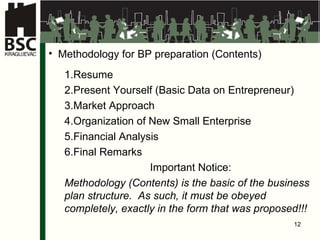
Met h odolog y   for BP preparation  ( Contents ) Re sume Present Yourself  ( Basic Data on Entrepreneur ) Market Approach Organiz ation of New Small Enterprise Finan cial Analysis Final Remarks Important Notice : M et h odolog y  ( Contents )  is the basic of the business plan structure.   As such, it must be obeyed completely, exactly in the form that was proposed !!!
The First Title in Your  BP - 1 Re su me The point of resume is to show the most important data about business plan on one page . Re su me  is always at the beginning of the business plan, just after the  front page  and   contents . Re su me  contains some data that the one who prepares BP cannot know at the beginning of the preparation, but despite this, resume is prepared at the very beginning, and finalized at the end of BP preparation .
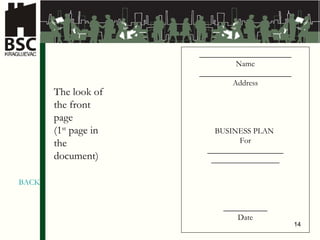
_______________________ Name _______________________ Address BUSINESS PLAN  For ___________________ _________________ ___________ Date The look of the front page (1 st  page in the document ) BACK
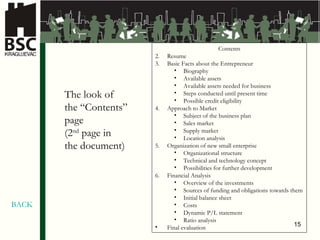
Contents Resume Basic Facts about the Entrepreneur Biography Available assets Available assets needed for business Steps conducted until present time   Possible credit eligibility  Approach to Market Subject of the business plan Sales market Supply market   Location analysis Organization of new small enterprise Organiz ational structure Te chnical and technology concept Possibilities for further development Finan cial Analysis Overview of the investments Sources of funding and obligations towards them Initial balance sheet Costs D y nam ic   P/L statement Ratio analysis Final evaluation The look of  the “Contents”  page (2 nd  page in  the document ) BACK
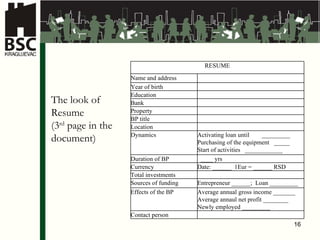
The look of Resume ( 3 rd  page in the  do c ument) RE SU ME Name and  ad d res s Year of birth Education Bank Property BP title Location Dynamics Activating loan until  _________ Purchasing of the equipment  _____ Start of activities  ____________ Duration of BP ____ yrs Currency Date: ______  1Eur = ______ RSD Total investments Sources of funding Entrepreneur ______;  Loan _________ Effects of the BP Average annual gross income _______ Average annaul net profit ________ Newly employed _________ Contact person
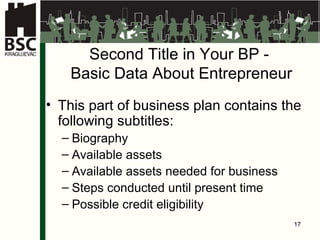
Second Title in Your BP  -  Basic Data About Entrepreneur This part of business plan contains the following subtitles : Bi ography Available assets Available assets needed for business Steps conducted until present time   Possible credit eligibility
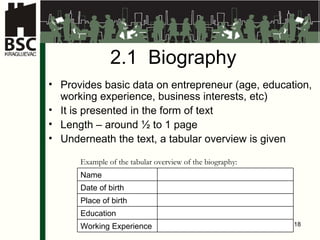
2.1  Biogra phy   Provides basic data on entrepreneur  ( age ,  education ,  working experience ,  business interests ,  etc ) It is presented in the form of text   Length – around ½ to 1 page Underneath the text, a tabular overview is given Exampl e  of the tabular overview of the biography : Name Date of birth Place of birth Education Working Experience
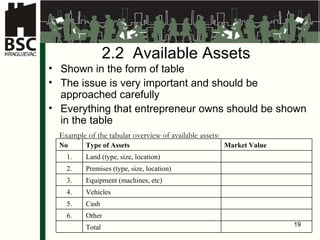
2.2  Available Assets Shown in the form of table The issue is very important and should be approached carefully Everything that entrepreneur owns should be shown in the table Example of the tabular overview of available assets : No Type of Assets Market Value 1. Land  ( type ,  size , lo cation ) 2. Premises  ( type ,  size , lo cation ) 3. Equipment  ( machines, etc ) 4. Vehicles 5. Cash 6. Ot her Total
2.3  Available Assets  Needed for Business It is shown in the table that looks exactly the same as the one in the previous chapter Contains the same or smaller amount of data than the previous table  ( here, only those assets that will be used in the activity of the future company, or in other words, those assets that will become assets of the company, are listed )
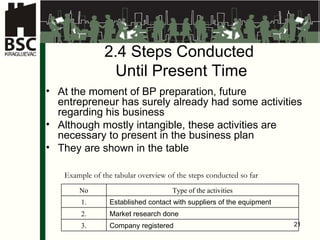
2.4  Steps Conducted  Until Present Time At the  moment  of BP preparation, future entrepreneur has surely already had some activities regarding his business Although mostly intangible, these activities are necessary to present in the business plan They are shown in the table Example of the tabular overview of the steps conducted so far No Type of the activities 1. Established contact with suppliers of the equipment 2. Market research done 3. Company registered
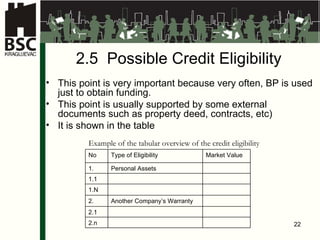
2.5  Possible Credit Eligibility This point is very important because very often, BP is used just to obtain funding .  This point is usually supported by some external documents such as property deed ,  contracts ,  etc ) It is shown in the table Example of the tabular overview of the credit eligibility No Type of Eligibility Market Value 1. Personal Assets 1.1 1.N 2. Another Company’s Warranty 2.1 2.n
20 MIN  COFFEE BREAK  –  PLEASE BE PUNCTUAL !!!
Now you can start working on your worksheets, and I am here to support  and advise you during the work!!!  (40 min) ............................................................ Presentation of daily work – 50 min THANK YOU FOR THE ATTENTION AND SEE YOU TOMORROW
MODULE 8: Business plan BSC Kragujevac Trainer: Aleksandar Ostojic Date:
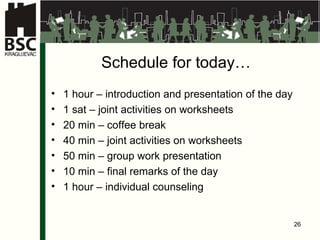
Schedule for today … 1  hour  –  introduction and presentation of the day 1 sat –  joint activities on worksheets 20 min –  coffee break 40 min –  joint activities on worksheets 50 min – gr o up  work presentation 10 min –  final remarks of the day 1  hour  – indiv idual counseling
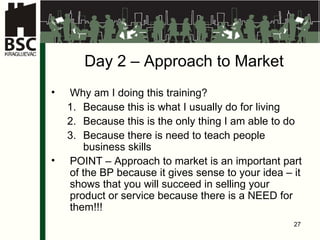
Da y 2  –  Approach to Market Why am I doing this training ? Because this is what I usually do for living Because this is the only thing I am able to do Because there is need to teach people business skills POINT  –  Approach to market is an important part of the BP because it gives sense to your idea – it shows that you will succeed in selling your product or service because there is a NEED for them !!!
T hird Title in Your  BP -  3  Market Approach  ( Analysis )  In this part of the business plan, there are  4  subtitles : Subject of the business plan Sales market Supply market Location analysis
3.1  Subject of the Business Plan In this chapter, an author needs to describe in words what is the basic business idea, i.e. which products and services will be produced and in what quantities .  Competition products and services should be described, as well as the reasons why planned products and services will be better than the existing ones .
Example of the  tab u lar  overview of the products that are subject to BP : Tabular overview of the products should be provided However, entrepreneurs mostly do not have all resources needed to start, which means that acquiring some assets  ( equipment ,  vehicles ,  offices… )  is also the purpose of BP preparation, isn’t it ? No Product (service) Annual Quantity Annual Turnover 1. 2. 3. TOTAL
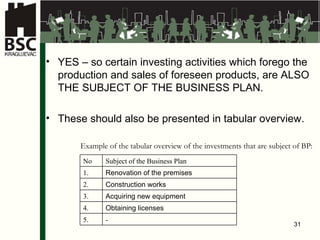
YES  –  so certain investing activities which forego the production and sales of foreseen products, are ALSO THE SUBJECT OF THE BUSINESS PLAN .  These should also be presented in tabular overview . Example of the tabular overview of the  invest ments that are subject of BP : No Subject of the Business Plan  1. Renovation of the premises 2. Construction works 3. Acquiring new equipment 4. Obtaining licenses 5. -
3.2  Sales Market Sales market must be  thoroughly  examined in every BP, due to the simple fact that this is the place where turnover is created . If entrepreneur has conducted some activities prior to the BP preparation, these activities have certainly referred to sales market . Results of the market surveys conducted in the preparatory phase should be shown at the beginning of this chapter ,  with detailed explanation of the used methods .
Thoroughly examined market  (te x t  and / or  tab l e)  means : Showing the target group of consumers Defining geographical area observed Assuming current average sales of the given products at the observed markets Assuming the demand in the future  ( together with the factors that influence the demand ) Showing the current suppliers of the given products  ( services ) –  competition Stating the methods and channels of sales and distribution Explain the future pricing policy
Within this chapter, it is necessary to explain planned promotional mix, which means: Advertisements: packaging, brochures, billboards, radio Sales facilitation: lotteries, gifts, fairs, exhibitions, demonstrations PR: seminars, sponsorships Selling forms: presentations, meetings Direct marketing: catalogues, post, e-business
3.3  Supply Market The supply market is also the basic issue in the BP because that is where the majority of costs are created  This subtitle needs to explain the market in terms of the following characteristics : Overview of the needed raw materials Overview of the prices of these materials Showing the list of suppliers Where applicable, these characteristics should be shown in the tabular overview
3.4  L o cation Analysis Location is, by definition, an area  i n which the activity is situated  –  whether we observe the premises, or just the activity itself. For all businesses ,  location is extremely important issue that makes difference between success and failure of the business .  Why ? Traffic ,  Cheap rents ,  Local taxes and laws , Climate , Other advantages coming out from the wisely chosen location .
This chapter should pay attention to both macro and micro location  (te x t  and / or  tabl e ) , according to some  ( or all) of the following criteria : Climate Lo c al  taxes and laws Connections to major roads Connections to natural resources (rivers, woods ..) Vicinity of urban areas Vicinity of shopping malls Vicinity of the suppliers Other criteria important for business
Now you can start working on your worksheets, and I am here to support and advise you !!!   ( 1 hr   of work – 20 min break – 40 min of work ) ............................................................ Daily work presentation  – 50 min Thank you for the attention and see you tomorrow!!!
MODULE 8: Business plan BSC Kragujevac Trainer: Aleksandar Ostojic Date:
Schedule for today ... 1  hour  –  introduction and presentation of the day 1 sat –  joint activities on worksheets 20 min –  coffee break 40 min –  joint activities on worksheets 50 min – gr o up  work presentation 10 min –  final remarks of the day 1  hour  – indiv idual counseling
D ay 3  –  Organi za tion of New Small Enterprise This chapter of the business plan can be characterized as its “technical” part . The task of every BP is to show the intended way of working in the new enterprise .  Why ? Because it is necessary for the whole BP to make sense, even to the person who does not have required expertise for assessing it at all .
Fourth Title in Your BP  – Organi s a tion of New Small Enterprise At the beginning of this chapter, information about future (or existing) registration of the company should be given . Also, it needs to be explained how it is intended to plan, organize, manage and control the process of work (text or flow chart) . Explain the policy towards quality management, existing or future certificates, etc ...
After explaining the system, the following titles should be elaborated :   Organi s a t iona l   structure Technical and technological concept Possibilities for further development
Besides these subtitles, it often happens that this chapter gives reasons why the chosen technology and organization should be implemented, and these reasons come from the market and from individual situation, so basically, a tool for this is SWOT analysis  S trenghts and  W eaknesses  of the organization O pportunities and  T hreats  from the market
4.1  Organiza t iona l   S tru c tur e At the beginning of his work, small enterprises usually do not have the structure because they only have  2-3  employees . However, visually shown structure is the first instrument of audit and control  ( Why is control important ?) Visually shown structure also tells a lot about responsibilities, relationship with supervisors, etc . Organiza t iona l  stru c tur e is also a solid base to be upgraded with the written form of work place designs, when the moment comes.
Organiza t iona l  stru c tur e is best shown in the form of diagram, with remarks relating to : Specifi c   tasks of the employees Communication flows between parts of the organizational structure Do c ument s to be used at the beginning of the activities, etc .
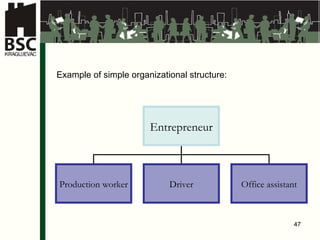
Example of simple  organiza t ion al  stru c ture: Entrepreneur Production worker Driver Office assistant
4.2   Te c hni cal and T e c hnolo gical   Concept Within this chapter, it is necessary to describe the process of work itself i.e. process of production of products or services It can be done in text or graph After general description of the work process, the following subtitles should be elaborated : Required land Required facilities Required equipment Required infrastructure Required human resources
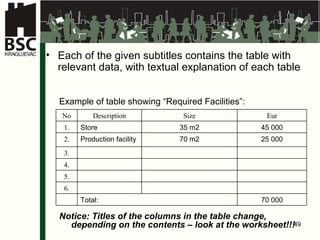
Each of the given subtitles contains the table with relevant data, with textual explanation of each table Example of table showing “Required Facilities” : Notice :  Titles of the columns in the table change, depending on the contents  –  look at the worksheet !!! No Description Size Eur 1. Store 35 m2 45 000 2. Production facility 70 m2 25 000 3. 4. 5. 6. Total: 70 000
4.3  Possibilities for Further Development Explain how company will develop in the future in terms of : Activity Organiza tion Market HR
Now you can start working on your worksheets, and I am here to support and advise you !!!   ( 1 hr   of work – 20 min break – 40 min of work ) ............................................................ Daily work presentation  – 50 min Thank you for the attention and see you tomorrow!!!
MODULE 8: Business plan BSC Kragujevac Trainer: Aleksandar Ostojic Date:
Schedule of the Day ... 1  hour  –  introduction and presentation of the day 1 sat –  joint activities on worksheets 20 min –  coffee break 40 min –  joint activities on worksheets 50 min – gr o up  work presentation 10 min –  final remarks of the day 1  hour  – indiv idual counseling
Da y 4  – Finan c ia l   A nal ysis This chapter is the core of the business plan preparation Due to the circumstances on the loans market it can be viewed as the most important part of the BP  ( all stakeholders are interested to know how much money is needed and when it would pay off) When preparing this chapter, it is necessary to consult a financial advisor (or an accountant) in order to predict and avoid mistakes  ( WHICH WILL CERTAINLY HAPPEN ).
Although this chapter is normally the hardest one to prepare and it assumes the knowledge of serious financial tools, it is possible to shorten it a little to show only the basic financial performances of the business T he following will be defined and explained in this chapter : Needed investments Sources of funding and obligations towards them Initial balance sheet Identification of costs Forming total revenue Dynamic P/L Statement Ration analysis
Fifth Title in Your BP  –  Finan c ia l  anal ysis No text under this title Everything that should have been said, had already been said in the previous chapters If there is anyhow a need to explain something, it can be done in the form of notices under the tables which show financial data
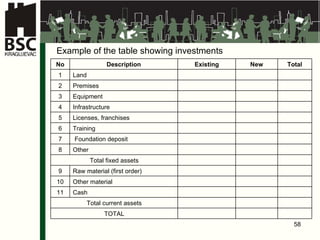
5.1  Needed Investments Shown in the table, with partially pre-defined fields, whereby columns separate existing and new investments, respectively Those fields that have not been pre-defined, refer to the initial current assets and they can vary from case to case It is very important to consider all existing assets as an investment, such as e.g. car that I already have, but now I will need it for my new business
Example of the table showing investments No Description Existing New Total 1 Land 2 Premises 3 Equipment 4 Infrastru c tur e   5 L icen s e s , fran chises 6 Training 7 Foundation deposit 8 Ot her   Total fixed assets 9 Raw material (first order) 10 Other material 11 Cash Total current assets TOTAL
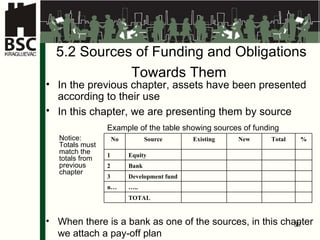
5.2  Sources of Funding and Obligations Towards Them   In the previous chapter, assets have been presented according to their use In this chapter, we are presenting them by source   Example of the table showing sources of funding No tice :  Totals must match the totals from previous chapter When there is a bank as one of the sources, in this chapter we attach a pay-off plan No Source Existing New Total % 1 Equity 2 Bank  3 Development fund n… … .. TOTAL
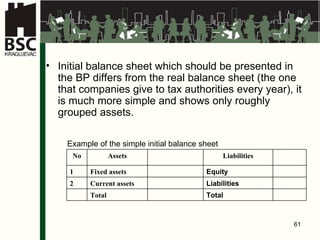
5.3  Initial Balance Sheet B alance Sheet is a document which gives the information about the assets of the company, by two criterias respectively : By uses ,  and   By sources. A part in which the assets are shown by their use is called ASSETS SIDE,  while the other part of the balance sheet which shows  a ssets by sources is called LIABILITIES SIDE . A ssets side always equals Liabilities side .
Initial balance sheet which should be presented in the BP differs from the real balance sheet (the one that companies give to tax authorities every year), it is much more simple and shows only roughly grouped assets . Example of the simple initial balance sheet No Assets Liabilities 1 Fixed assets Equity 2 Current assets Liabilities Total Total
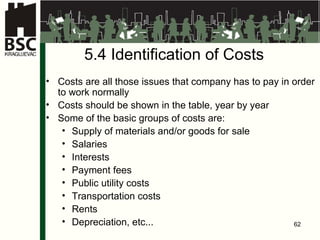
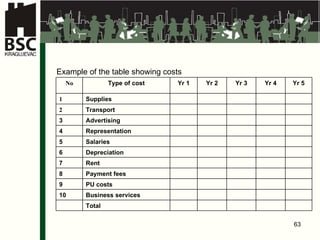
5.4  Identification of Costs   Costs are all those issues that company has to pay in order to work normally Costs should be shown in the table, year by year Some of the basic groups of costs are : Supply of materials and/or goods for sale Salaries Interests Payment fees Public utility costs T ransporta tion costs Rents Depreciation ,  etc ...
Example of the table showing costs No Type of cost Yr 1 Yr 2 Yr 3 Yr 4 Yr 5 1 Supplies 2 Transport 3 Advertising 4 Repre s enta tion 5 Salaries 6 Depreciation 7 Rent 8 Payment fees 9 PU costs 10 Business services Total
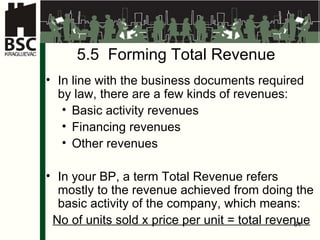
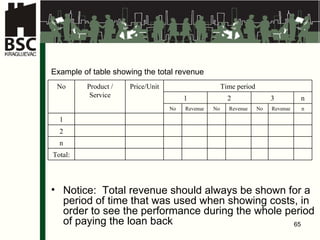
5.5  Formi ng Total Revenue In line with the business documents required by law, there are a few kinds of revenues : Basic activity revenues F inan c in g revenues O ther revenues In your BP, a term Total Revenue refers mostly to the revenue achieved from doing the basic activity of the company, which means:  No of units sold x price per unit = total revenue
N otice :  Total revenue should always be shown for a period of time that was used when showing costs ,  in order to see the performance during the whole period of paying the loan back Example of table showing the total revenue No Product / Service Price / Unit Time period 1 2 3 n No Revenue No Revenue No Revenue n 1 2 n Total:
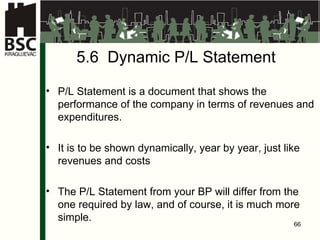
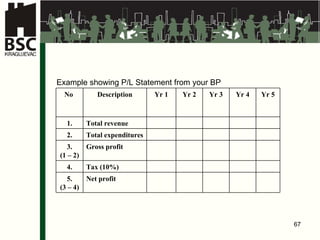
5.6  Dynamic P/L Statement P/L Statement is a document that shows the performance of the company in terms of revenues and expenditures . It is to be shown dynamically, year by year, just like revenues and costs The P/L Statement from your BP will differ from the one required by law, and of course, it is much more simple .
Example showing P/L Statement from your BP No  Description Yr  1 Yr  2 Yr  3 Yr  4 Yr  5 1. Total revenue 2. Total expenditures 3. (1 – 2) Gross profit 4. Tax  (10%) 5. (3 – 4) Net  profit
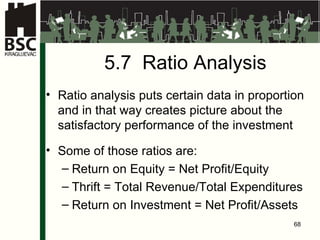
5.7  Ratio Analysis Ratio analysis puts certain data in proportion and in that way creates picture about the satisfactory performance of the investment Some of those ratios are : Return on Equity  =  Net Profit / Equity Thrift  =  Total Revenue / Total Expenditures Return on Investment  =  Net Profit / Assets
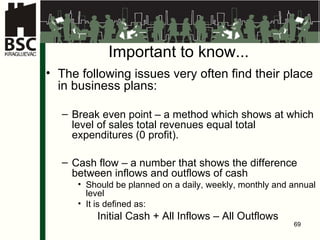
Important to know ... The following issues very often find their place in business plans: Break even point  –  a method which shows at which level of sales total revenues equal total expenditures (0 profit) . Cash flow –  a number that shows the difference between inflows and outflows of cash   Should be planned on a daily, weekly, monthly and annual level   It is defined as : Initial Cash  +  All Inflows  –  All Outflows
Now you can start working on your worksheets, and I am here to support and advise you !!!   ( 1 hr   of work – 20 min break – 40 min of work ) ............................................................ Daily work presentation  – 50 min Thank you for the attention and see you tomorrow!!!
MODULE 8: Business plan BSC Kragujevac Trainer: Aleksandar Ostojic Date:
Schedule for today ... 1 5  min – Intoduction 1  hour   and  1 5 min –  3  pres enta tions   x  25 min (15  min each  + 10  min discussion for each presentation ) 20 min –  coffee break 1  jour   and  20 min – 2 pre s enta tions   x  25 min + g uest 50 min – feedback  and  evalua tion  list s 10 min –  final remarks for the training 1  hour  – indivi dual counseling
Da y   5  –  Presentations and Evaluation Why do people eat more eggs from hens then those from geese ? BECAUSE HENS ANNOUNCE TO EVERYBODY THAT THEY HAVE LAID THE EGG !!! PO INT: PRE S ENTA TION IS AS IMPORTANT AS THE BUSINESS PLAN ITSELF.
Now choose the representative of your working group to hold the presentation  During presentations, write down unclarities, questions for discussion and remarks START PRESENTING!!!
The Most Common Mistakes in  BP  Preparation ... The entrepreneur is not well informed Ignoring signals from the market Falling in love with your idea Too optimistic predictions about sales Too strict  implementa tion of the BP Not having consultants during the BP preparation
Taking into account that every one of us knows more today than he used to know yesterday, I sincerely hope that I have taught you to understand what you don’t know and what you need to ask during your entrepreneurial life !!! Thank you for your cooperation and attention !!!

Aleksandar Ostojic - Business plan

  • 1.
    MODULE 8: Businessplan BSC Kragujevac Trainer: Aleksandar Ostoji ć Date:
  • 2.
    Schedule for today… 1 hour – introduction to each other , introduction to module, working groups formation and introduction to business planning 1 hour – 1 st day presentation ( business plan structure , choosing ideas and initiation of the business plan preparation ) 20 min – coffee break 40 min – joint activities on worksheets 50 min – daily presentations of prepared worksheets 10 min – final remarks 1 hour – individual counseling
  • 3.
    About the Trainer... M Sc in Management ; Master d egree in Creation and Development of SMEs in Transition Countries (Univer sity of Bolo gna ); Grad. Eng. Of Entrepreneurial Management Employed as Assistant at the Faculty of Entrepreneurial Management – course Entrepreneurship ; Project Manager consulting company La rive Serbia – part of Larive International, the Netherlands 7 years of experience gathered in running family business, work in several privately owned foreign and domestic firms, as well as by working at two faculties
  • 4.
    Da y 1 – Introduction to business plan How to choose business idea? Defini tion of a business plan The point of business plan preparation Who uses business plan? Met h odolog y for business plan preparation Business plan resume How to present yourself in the business plan?
  • 5.
    How to choosebusiness idea ? Some forethoughts for choosing business idea : Every life problem is a specific business chance A one that observes is not always capable to spot a problem (White ’s list of problems ) Every problem in life causes the creation of ideas for its resolving Of course, not all ideas are equally good (e.g. comb for bald headed people !!!)
  • 6.
    So… NOT EVERYIDEA IS A CHANCE, BUT EVERY CHANCE WAS SOMEBODY’S IDEA !!! Conclusion : Everything starts with an idea, and in order to get to the idea one must think – do not ever stop thinking !!! The next step after the choice of business idea is business plan preparation ...
  • 7.
    Defini tion ofa Business P lan Business plan is a document in which a business idea is being processed with market and financial tools, in order to prove or disapprove the justification of the business idea implementation .
  • 8.
    Business plan hasthe following basic characteristics : It does not have strictly defined unique form – it is mostly prepared according to the instructions given by the institution which accepts business plans There are no specific qualifications for someone to become professional consultant in business planning Business plan is used when starting business, expansion of a company, getting financial resources,etc The basic assumption for the business plan preparation, which is in the same time its major defect, is the following : EVERYTHING THAT IS PRODUCED IS SOLD, EVERYTHING THAT IS SOLD IS ACTUALLY PAID !
  • 9.
    The Point ofBusiness Plan Preparation To show the path from point A to point B To assess all relevant aspects of doing business To justify the implementation of the business idea To lower investment risk To make mistakes on paper – not in reality To precisely define the actual possibility of business functioning
  • 10.
    Who uses business plan ? The first and the most important user of the business plan is the entrepreneur itself Besides entrepreneur, business plan is used also by: Bank s C redit institu tions Business partners Managers employed at entrepreneur’s company
  • 11.
    M et hodolog y for business plan preparation Taking into account the complexity of various methodologies, a unique methodology has been developed for the purpose of this training, adjusted to beginners. For effective use of the most of existing methodologies, a specific know-how from finance, management accounting, etc… are necessary . Met h odolog y given in this training is a quality base for future upgrade with appropriate consulting help .
  • 12.
    Met h odology for BP preparation ( Contents ) Re sume Present Yourself ( Basic Data on Entrepreneur ) Market Approach Organiz ation of New Small Enterprise Finan cial Analysis Final Remarks Important Notice : M et h odolog y ( Contents ) is the basic of the business plan structure. As such, it must be obeyed completely, exactly in the form that was proposed !!!
  • 13.
    The First Titlein Your BP - 1 Re su me The point of resume is to show the most important data about business plan on one page . Re su me is always at the beginning of the business plan, just after the front page and contents . Re su me contains some data that the one who prepares BP cannot know at the beginning of the preparation, but despite this, resume is prepared at the very beginning, and finalized at the end of BP preparation .
  • 14.
    _______________________ Name _______________________Address BUSINESS PLAN For ___________________ _________________ ___________ Date The look of the front page (1 st page in the document ) BACK
  • 15.
    Contents Resume BasicFacts about the Entrepreneur Biography Available assets Available assets needed for business Steps conducted until present time Possible credit eligibility Approach to Market Subject of the business plan Sales market Supply market Location analysis Organization of new small enterprise Organiz ational structure Te chnical and technology concept Possibilities for further development Finan cial Analysis Overview of the investments Sources of funding and obligations towards them Initial balance sheet Costs D y nam ic P/L statement Ratio analysis Final evaluation The look of the “Contents” page (2 nd page in the document ) BACK
  • 16.
    The look ofResume ( 3 rd page in the do c ument) RE SU ME Name and ad d res s Year of birth Education Bank Property BP title Location Dynamics Activating loan until _________ Purchasing of the equipment _____ Start of activities ____________ Duration of BP ____ yrs Currency Date: ______ 1Eur = ______ RSD Total investments Sources of funding Entrepreneur ______; Loan _________ Effects of the BP Average annual gross income _______ Average annaul net profit ________ Newly employed _________ Contact person
  • 17.
    Second Title inYour BP - Basic Data About Entrepreneur This part of business plan contains the following subtitles : Bi ography Available assets Available assets needed for business Steps conducted until present time Possible credit eligibility
  • 18.
    2.1 Biography Provides basic data on entrepreneur ( age , education , working experience , business interests , etc ) It is presented in the form of text Length – around ½ to 1 page Underneath the text, a tabular overview is given Exampl e of the tabular overview of the biography : Name Date of birth Place of birth Education Working Experience
  • 19.
    2.2 AvailableAssets Shown in the form of table The issue is very important and should be approached carefully Everything that entrepreneur owns should be shown in the table Example of the tabular overview of available assets : No Type of Assets Market Value 1. Land ( type , size , lo cation ) 2. Premises ( type , size , lo cation ) 3. Equipment ( machines, etc ) 4. Vehicles 5. Cash 6. Ot her Total
  • 20.
    2.3 AvailableAssets Needed for Business It is shown in the table that looks exactly the same as the one in the previous chapter Contains the same or smaller amount of data than the previous table ( here, only those assets that will be used in the activity of the future company, or in other words, those assets that will become assets of the company, are listed )
  • 21.
    2.4 StepsConducted Until Present Time At the moment of BP preparation, future entrepreneur has surely already had some activities regarding his business Although mostly intangible, these activities are necessary to present in the business plan They are shown in the table Example of the tabular overview of the steps conducted so far No Type of the activities 1. Established contact with suppliers of the equipment 2. Market research done 3. Company registered
  • 22.
    2.5 PossibleCredit Eligibility This point is very important because very often, BP is used just to obtain funding . This point is usually supported by some external documents such as property deed , contracts , etc ) It is shown in the table Example of the tabular overview of the credit eligibility No Type of Eligibility Market Value 1. Personal Assets 1.1 1.N 2. Another Company’s Warranty 2.1 2.n
  • 23.
    20 MIN COFFEE BREAK – PLEASE BE PUNCTUAL !!!
  • 24.
    Now you canstart working on your worksheets, and I am here to support and advise you during the work!!! (40 min) ............................................................ Presentation of daily work – 50 min THANK YOU FOR THE ATTENTION AND SEE YOU TOMORROW
  • 25.
    MODULE 8: Businessplan BSC Kragujevac Trainer: Aleksandar Ostojic Date:
  • 26.
    Schedule for today… 1 hour – introduction and presentation of the day 1 sat – joint activities on worksheets 20 min – coffee break 40 min – joint activities on worksheets 50 min – gr o up work presentation 10 min – final remarks of the day 1 hour – indiv idual counseling
  • 27.
    Da y 2 – Approach to Market Why am I doing this training ? Because this is what I usually do for living Because this is the only thing I am able to do Because there is need to teach people business skills POINT – Approach to market is an important part of the BP because it gives sense to your idea – it shows that you will succeed in selling your product or service because there is a NEED for them !!!
  • 28.
    T hird Titlein Your BP - 3 Market Approach ( Analysis ) In this part of the business plan, there are 4 subtitles : Subject of the business plan Sales market Supply market Location analysis
  • 29.
    3.1 Subjectof the Business Plan In this chapter, an author needs to describe in words what is the basic business idea, i.e. which products and services will be produced and in what quantities . Competition products and services should be described, as well as the reasons why planned products and services will be better than the existing ones .
  • 30.
    Example of the tab u lar overview of the products that are subject to BP : Tabular overview of the products should be provided However, entrepreneurs mostly do not have all resources needed to start, which means that acquiring some assets ( equipment , vehicles , offices… ) is also the purpose of BP preparation, isn’t it ? No Product (service) Annual Quantity Annual Turnover 1. 2. 3. TOTAL
  • 31.
    YES – so certain investing activities which forego the production and sales of foreseen products, are ALSO THE SUBJECT OF THE BUSINESS PLAN . These should also be presented in tabular overview . Example of the tabular overview of the invest ments that are subject of BP : No Subject of the Business Plan 1. Renovation of the premises 2. Construction works 3. Acquiring new equipment 4. Obtaining licenses 5. -
  • 32.
    3.2 SalesMarket Sales market must be thoroughly examined in every BP, due to the simple fact that this is the place where turnover is created . If entrepreneur has conducted some activities prior to the BP preparation, these activities have certainly referred to sales market . Results of the market surveys conducted in the preparatory phase should be shown at the beginning of this chapter , with detailed explanation of the used methods .
  • 33.
    Thoroughly examined market (te x t and / or tab l e) means : Showing the target group of consumers Defining geographical area observed Assuming current average sales of the given products at the observed markets Assuming the demand in the future ( together with the factors that influence the demand ) Showing the current suppliers of the given products ( services ) – competition Stating the methods and channels of sales and distribution Explain the future pricing policy
  • 34.
    Within this chapter,it is necessary to explain planned promotional mix, which means: Advertisements: packaging, brochures, billboards, radio Sales facilitation: lotteries, gifts, fairs, exhibitions, demonstrations PR: seminars, sponsorships Selling forms: presentations, meetings Direct marketing: catalogues, post, e-business
  • 35.
    3.3 SupplyMarket The supply market is also the basic issue in the BP because that is where the majority of costs are created This subtitle needs to explain the market in terms of the following characteristics : Overview of the needed raw materials Overview of the prices of these materials Showing the list of suppliers Where applicable, these characteristics should be shown in the tabular overview
  • 36.
    3.4 Lo cation Analysis Location is, by definition, an area i n which the activity is situated – whether we observe the premises, or just the activity itself. For all businesses , location is extremely important issue that makes difference between success and failure of the business . Why ? Traffic , Cheap rents , Local taxes and laws , Climate , Other advantages coming out from the wisely chosen location .
  • 37.
    This chapter shouldpay attention to both macro and micro location (te x t and / or tabl e ) , according to some ( or all) of the following criteria : Climate Lo c al taxes and laws Connections to major roads Connections to natural resources (rivers, woods ..) Vicinity of urban areas Vicinity of shopping malls Vicinity of the suppliers Other criteria important for business
  • 38.
    Now you canstart working on your worksheets, and I am here to support and advise you !!! ( 1 hr of work – 20 min break – 40 min of work ) ............................................................ Daily work presentation – 50 min Thank you for the attention and see you tomorrow!!!
  • 39.
    MODULE 8: Businessplan BSC Kragujevac Trainer: Aleksandar Ostojic Date:
  • 40.
    Schedule for today... 1 hour – introduction and presentation of the day 1 sat – joint activities on worksheets 20 min – coffee break 40 min – joint activities on worksheets 50 min – gr o up work presentation 10 min – final remarks of the day 1 hour – indiv idual counseling
  • 41.
    D ay 3 – Organi za tion of New Small Enterprise This chapter of the business plan can be characterized as its “technical” part . The task of every BP is to show the intended way of working in the new enterprise . Why ? Because it is necessary for the whole BP to make sense, even to the person who does not have required expertise for assessing it at all .
  • 42.
    Fourth Title inYour BP – Organi s a tion of New Small Enterprise At the beginning of this chapter, information about future (or existing) registration of the company should be given . Also, it needs to be explained how it is intended to plan, organize, manage and control the process of work (text or flow chart) . Explain the policy towards quality management, existing or future certificates, etc ...
  • 43.
    After explaining thesystem, the following titles should be elaborated : Organi s a t iona l structure Technical and technological concept Possibilities for further development
  • 44.
    Besides these subtitles,it often happens that this chapter gives reasons why the chosen technology and organization should be implemented, and these reasons come from the market and from individual situation, so basically, a tool for this is SWOT analysis S trenghts and W eaknesses of the organization O pportunities and T hreats from the market
  • 45.
    4.1 Organizat iona l S tru c tur e At the beginning of his work, small enterprises usually do not have the structure because they only have 2-3 employees . However, visually shown structure is the first instrument of audit and control ( Why is control important ?) Visually shown structure also tells a lot about responsibilities, relationship with supervisors, etc . Organiza t iona l stru c tur e is also a solid base to be upgraded with the written form of work place designs, when the moment comes.
  • 46.
    Organiza t ional stru c tur e is best shown in the form of diagram, with remarks relating to : Specifi c tasks of the employees Communication flows between parts of the organizational structure Do c ument s to be used at the beginning of the activities, etc .
  • 47.
    Example of simple organiza t ion al stru c ture: Entrepreneur Production worker Driver Office assistant
  • 48.
    4.2 Te c hni cal and T e c hnolo gical Concept Within this chapter, it is necessary to describe the process of work itself i.e. process of production of products or services It can be done in text or graph After general description of the work process, the following subtitles should be elaborated : Required land Required facilities Required equipment Required infrastructure Required human resources
  • 49.
    Each of thegiven subtitles contains the table with relevant data, with textual explanation of each table Example of table showing “Required Facilities” : Notice : Titles of the columns in the table change, depending on the contents – look at the worksheet !!! No Description Size Eur 1. Store 35 m2 45 000 2. Production facility 70 m2 25 000 3. 4. 5. 6. Total: 70 000
  • 50.
    4.3 Possibilitiesfor Further Development Explain how company will develop in the future in terms of : Activity Organiza tion Market HR
  • 51.
    Now you canstart working on your worksheets, and I am here to support and advise you !!! ( 1 hr of work – 20 min break – 40 min of work ) ............................................................ Daily work presentation – 50 min Thank you for the attention and see you tomorrow!!!
  • 52.
    MODULE 8: Businessplan BSC Kragujevac Trainer: Aleksandar Ostojic Date:
  • 53.
    Schedule of theDay ... 1 hour – introduction and presentation of the day 1 sat – joint activities on worksheets 20 min – coffee break 40 min – joint activities on worksheets 50 min – gr o up work presentation 10 min – final remarks of the day 1 hour – indiv idual counseling
  • 54.
    Da y 4 – Finan c ia l A nal ysis This chapter is the core of the business plan preparation Due to the circumstances on the loans market it can be viewed as the most important part of the BP ( all stakeholders are interested to know how much money is needed and when it would pay off) When preparing this chapter, it is necessary to consult a financial advisor (or an accountant) in order to predict and avoid mistakes ( WHICH WILL CERTAINLY HAPPEN ).
  • 55.
    Although this chapteris normally the hardest one to prepare and it assumes the knowledge of serious financial tools, it is possible to shorten it a little to show only the basic financial performances of the business T he following will be defined and explained in this chapter : Needed investments Sources of funding and obligations towards them Initial balance sheet Identification of costs Forming total revenue Dynamic P/L Statement Ration analysis
  • 56.
    Fifth Title inYour BP – Finan c ia l anal ysis No text under this title Everything that should have been said, had already been said in the previous chapters If there is anyhow a need to explain something, it can be done in the form of notices under the tables which show financial data
  • 57.
    5.1 NeededInvestments Shown in the table, with partially pre-defined fields, whereby columns separate existing and new investments, respectively Those fields that have not been pre-defined, refer to the initial current assets and they can vary from case to case It is very important to consider all existing assets as an investment, such as e.g. car that I already have, but now I will need it for my new business
  • 58.
    Example of thetable showing investments No Description Existing New Total 1 Land 2 Premises 3 Equipment 4 Infrastru c tur e 5 L icen s e s , fran chises 6 Training 7 Foundation deposit 8 Ot her Total fixed assets 9 Raw material (first order) 10 Other material 11 Cash Total current assets TOTAL
  • 59.
    5.2 Sourcesof Funding and Obligations Towards Them In the previous chapter, assets have been presented according to their use In this chapter, we are presenting them by source Example of the table showing sources of funding No tice : Totals must match the totals from previous chapter When there is a bank as one of the sources, in this chapter we attach a pay-off plan No Source Existing New Total % 1 Equity 2 Bank 3 Development fund n… … .. TOTAL
  • 60.
    5.3 InitialBalance Sheet B alance Sheet is a document which gives the information about the assets of the company, by two criterias respectively : By uses , and By sources. A part in which the assets are shown by their use is called ASSETS SIDE, while the other part of the balance sheet which shows a ssets by sources is called LIABILITIES SIDE . A ssets side always equals Liabilities side .
  • 61.
    Initial balance sheetwhich should be presented in the BP differs from the real balance sheet (the one that companies give to tax authorities every year), it is much more simple and shows only roughly grouped assets . Example of the simple initial balance sheet No Assets Liabilities 1 Fixed assets Equity 2 Current assets Liabilities Total Total
  • 62.
    5.4 Identificationof Costs Costs are all those issues that company has to pay in order to work normally Costs should be shown in the table, year by year Some of the basic groups of costs are : Supply of materials and/or goods for sale Salaries Interests Payment fees Public utility costs T ransporta tion costs Rents Depreciation , etc ...
  • 63.
    Example of thetable showing costs No Type of cost Yr 1 Yr 2 Yr 3 Yr 4 Yr 5 1 Supplies 2 Transport 3 Advertising 4 Repre s enta tion 5 Salaries 6 Depreciation 7 Rent 8 Payment fees 9 PU costs 10 Business services Total
  • 64.
    5.5 Forming Total Revenue In line with the business documents required by law, there are a few kinds of revenues : Basic activity revenues F inan c in g revenues O ther revenues In your BP, a term Total Revenue refers mostly to the revenue achieved from doing the basic activity of the company, which means: No of units sold x price per unit = total revenue
  • 65.
    N otice : Total revenue should always be shown for a period of time that was used when showing costs , in order to see the performance during the whole period of paying the loan back Example of table showing the total revenue No Product / Service Price / Unit Time period 1 2 3 n No Revenue No Revenue No Revenue n 1 2 n Total:
  • 66.
    5.6 DynamicP/L Statement P/L Statement is a document that shows the performance of the company in terms of revenues and expenditures . It is to be shown dynamically, year by year, just like revenues and costs The P/L Statement from your BP will differ from the one required by law, and of course, it is much more simple .
  • 67.
    Example showing P/LStatement from your BP No Description Yr 1 Yr 2 Yr 3 Yr 4 Yr 5 1. Total revenue 2. Total expenditures 3. (1 – 2) Gross profit 4. Tax (10%) 5. (3 – 4) Net profit
  • 68.
    5.7 RatioAnalysis Ratio analysis puts certain data in proportion and in that way creates picture about the satisfactory performance of the investment Some of those ratios are : Return on Equity = Net Profit / Equity Thrift = Total Revenue / Total Expenditures Return on Investment = Net Profit / Assets
  • 69.
    Important to know... The following issues very often find their place in business plans: Break even point – a method which shows at which level of sales total revenues equal total expenditures (0 profit) . Cash flow – a number that shows the difference between inflows and outflows of cash Should be planned on a daily, weekly, monthly and annual level It is defined as : Initial Cash + All Inflows – All Outflows
  • 70.
    Now you canstart working on your worksheets, and I am here to support and advise you !!! ( 1 hr of work – 20 min break – 40 min of work ) ............................................................ Daily work presentation – 50 min Thank you for the attention and see you tomorrow!!!
  • 71.
    MODULE 8: Businessplan BSC Kragujevac Trainer: Aleksandar Ostojic Date:
  • 72.
    Schedule for today... 1 5 min – Intoduction 1 hour and 1 5 min – 3 pres enta tions x 25 min (15 min each + 10 min discussion for each presentation ) 20 min – coffee break 1 jour and 20 min – 2 pre s enta tions x 25 min + g uest 50 min – feedback and evalua tion list s 10 min – final remarks for the training 1 hour – indivi dual counseling
  • 73.
    Da y 5 – Presentations and Evaluation Why do people eat more eggs from hens then those from geese ? BECAUSE HENS ANNOUNCE TO EVERYBODY THAT THEY HAVE LAID THE EGG !!! PO INT: PRE S ENTA TION IS AS IMPORTANT AS THE BUSINESS PLAN ITSELF.
  • 74.
    Now choose therepresentative of your working group to hold the presentation During presentations, write down unclarities, questions for discussion and remarks START PRESENTING!!!
  • 75.
    The Most CommonMistakes in BP Preparation ... The entrepreneur is not well informed Ignoring signals from the market Falling in love with your idea Too optimistic predictions about sales Too strict implementa tion of the BP Not having consultants during the BP preparation
  • 76.
    Taking into accountthat every one of us knows more today than he used to know yesterday, I sincerely hope that I have taught you to understand what you don’t know and what you need to ask during your entrepreneurial life !!! Thank you for your cooperation and attention !!!