UNITED NATIONS
     DEPARTMENT OF ECONOMIC AND SOCIAL AFFAIRS


Commission on Sustainable Development
Fifteenth Session
30 April-11 May 2007
New York


    Small-Scale Production and Use of Liquid Biofuels
                  in Sub-Saharan Africa:
       Perspectives for Sustainable Development


                               Prepared by
                     Energy and Transport Branch
                 Division for Sustainable Development
        United Nations Department of Economic and Social Affairs


                     BACKGROUND PAPER NO. 2
                             DESA/DSD/2007/2
ii                                                 Small-Scale Production and Use of Liquid Biofuels


Note
The views and opinions expressed do not necessarily represent those of the United Nations
Department of Economic and Social Affairs; the designations employed or terminology used
concerning the legal status of any country, territory, city or area or of its authorities, or concerning
the delimitation of frontiers do not imply the expression of any opinion whatsoever on the part of
the United Nations Department of Economic and Social Affairs.

This paper has been issued without formal editing.
Small-Scale Production and Use of Liquid Biofuels                                          iii


Contents


I.       Introduction ____________________________________________________________ 1

II.      Access to Energy for Sustainable Development_________________________________ 3

III.     Overview of Liquid Biofuels ________________________________________________ 3

IV.      Sustainability Issues Related to Biofuels Production and Use _____________________ 6

V.       Case Studies and Local and National Experiences
         With Liquid Biofuels in Sub-Saharan Africa __________________________________ 9

      A. Cultivation and Use of Jatropha Curcas L.___________________________________ 9
      B. Experimental Projects with Other Non-Edible Energy Crops___________________ 20
      C. Potential of Energy Use of Other Edible Cash Crops__________________________ 22
      D. Biofuels for Improved Cookstoves _________________________________________ 27
      E. Cross-Cutting Biofuels Activities __________________________________________ 28

VI.      Barriers to Biofuels Development in Sub-Saharan Africa _______________________ 30

VII.     Lessons Learned and Policy Options for Scaling-Up What Works ________________ 33

VII.     Conclusions and Recommendations ________________________________________ 35

Annexes I and II _____________________________________________________________ 37

Annex III ___________________________________________________________________ 38

Bibliography ________________________________________________________________ 41
iv                                    Small-Scale Production and Use of Liquid Biofuels


Abbreviations and Acronyms

AFREPREN             African Energy Policy Research Network
ASTM                 American Society for Testing and Materials
CARENSA              Cane Resources Network for Southern Africa
CFC                  Dutch Common Fund for Commodities
CFL                  Compact Fluorescent Light
CDM                  Clean Development Mechanism
CNESOLER             Centre National d'Energie Solaire & des Energies
                     Renouvelables –National Centre for Solar & Renewable
                     Energy, Mali
CSD                  United Nations Commission on Sustainable Development
Bio-DME              Biomethylether
BTL                  Biomass-to-Liquids
EGM                  Expert Group Meeting
ETBE                 Ethyl Tertiary Butyl Ether
EU                   European Union
FAEE                 Fatty Acid Ethyl Ester
FAME                 Fatty Acid Methyl Ester
FELISA               Farming for Energy, for better Livelihoods in Southern
                     Africa
FT                   Fischer-Tropsch diesel
GHG                  Greenhouse Gases
GTZ                  Gesellschaft fuer Technische Zusammenarbeit GmbH –
                     German Technical Cooperation
GVEP                 Global Village Energy Partnership
IEA                  International Energy Agency
KITE                 Kumasi Institute of Technology and Environment, Ghana
KNUST                Kwame Nkrumah University of Science and Technology,
                     Ghana
LED                  Light Emitting Diode
LDC                  Least Developed Countries
MFC Nyetaa           Malifolkecenter
MFP                  Multi-functional platform
PPO                  Pure Plant Oil
RME                  Rape Seed Methyl Ester
RSPO                 Roundtable on Sustainable Palm Oil
SEI                  Stockholm Environment Institute
Small-Scale Production and Use of Liquid Biofuels                                            v


SMEs                              Small and Medium Enterprises
SVO                               Straight Vegetable Oil
TaTEDO                            Tanzania Traditional Energy Development and
                                  Environment Organisation
UEMOA                             Union Economique et Monétaire Ouest Africaine - West
                                  African Economic and Monetary Union
UNDESA                            United Nations Department of Economic and Social Affairs
UNDP                              United Nations Development Programme
UNEP                              United Nations Environment Programme
UNIDO                             United Nations Industrial Development Organization
Small-Scale Production and Use of Liquid Biofuels                                                  1


I.       Introduction

Purpose
The purpose of this paper is to assess the status and analyze the perspectives of small-scale biofuel
production and use in sub-Saharan Africa. Study objectives are threefold:
     •   Discuss technical, socio-economic, and environmental benefits of small scale biofuels in
         terms of improving energy access by the poor, lessening reliance of countries on oil
         imports, creating additional sources and means for income generation, promoting rural
         development, and mitigating environmental pollution at both local and global levels.
     •   Identify major technical, informational, and financial barriers to the scale-up of small-
         scale biofuel production and use.
     •   Propose a series of policy options and measures for scaling up small scale biofuels
         production and use in sub-Saharan Africa.

Background
Energy is central for sustainable development and poverty reduction. During CSD-14,
Governments reiterated the need to expand access to reliable, affordable and environmentally
sound energy services for estimated 1.6 billion people around the world. Whereas some progress
has been achieved in providing access to modern energy services in the Asian region, development
in Africa is still lagging far behind in many ways. The situation is particularly precarious in sub-
Saharan Africa where a mere 70 gigawatt installed capacity of electric power is available for a
population of roughly 725 million. More than 500 million people in sub-Saharan Africa do not
have electricity in their homes and rely on the unsustainable forms of solid biomass (fire wood,
agricultural residues, animal wastes, etc.) to meet basic energy needs for cooking, heating, and
lighting. Most schools and clinics do not have electric light and businesses often suffer power
interruptions.
In recent years several developing countries have gained positive experiences with the
decentralized and small-scale production and use of fuel crops. As has been shown by a number of
projects and organizations, the production and use of liquid biofuels from local feedstock can
make a positive contribution to improving access to sustainable and affordable energy.
Cultivation and harvesting of fuel crops can enhance agricultural productivity and local economic
development directly as well as indirectly through crop by-products. In addition, some liquid
biofuels emit much less pollutants than conventional fuels and could significantly reduce negative
impacts on public health. Biofuels production and use can also bring about positive gender effects
since it is often women and children at the village and household levels who carry the load of
agricultural production and fuel collection.

Approach
To prepare this background paper, the Division for Sustainable Development at the United
Nations Department of Economic and Social Affairs mobilized a team of experts with knowledge
and experience on issues related to renewable energy for poverty reduction in general, and small-
scale biofuels in particular. The experts brought expertise in policy issues related to energy for
sustainable development and practical experience in the production and use of liquid biofuels.
Experts represented sub-Saharan Africa as well as other countries with related experience
worldwide. A senior resource person assisted finalizing this background paper. A list of the
experts assembled for the study, as well as other UN contributors, is provided in Exhibit 1.
2                                                           Small-Scale Production and Use of Liquid Biofuels


Focus
This background paper focuses on the impact of biofuels for small-scale development and use by
households, farmers, communities, etc. Its emphasis is on the sustainable development of biofuels
to increase modern energy access to these stakeholders and thereby improve their lives and
livelihoods. It focuses on the initial experiences and the further development potentials and needs
in sub-Saharan Africa. It is not focused on the broader issues of biofuels for large scale industrial
and agro-industry development.1

Exhibit 1: List of Experts and Key Contributors to Small-Scale Production and Use of Liquid
                                     Background Paper

    (a) Expert Group Members
    Mali                                 Mr. Ibrahim Togola
                                         Director, Mali Folkcenter
    Zambia                               Mrs. Bernadette M. H. Lubozhya
                                         Former Chairperson
                                         the Board of Trustees for Kasisi Agricultural Training Center
    South Africa                         Ms. Jane Ann Sugrue
                                         Southern Africa co-ordinator of CURES- Citizens Unite for
                                         Renewable Energy and Sustainability
    Tanzania                             Mr. Estomith N. Sawe
                                         Executive Director, Tanzania Traditional Energy Development and
                                         Environment Organization
    India                                Mr. Jayarao Gururaja
                                         Senior Renewable Energy Policy Advisor
    Indonesia                            Mr. Robert Manurung
                                         Head , Biotechnology Research Center
                                         Bandung Institute of Technology, Indonesia
    Germany                              Mr. Reinhard Henning
                                         Director of the Jatropha Project
    United States                        Ms. Judy Siegel
                                         President, Energy and Security Group
                                         Background Paper Resource Person
    (b) UNDESA Background                Mr. Kui-Nang Mak, Chief
        Paper Management Team            Energy and Transport Branch,
                                         Division for Sustainable Development
    Energy and Transport Branch
    Members                              Mr. Ralph Wahnschafft
                                         Mr. Shaoyi Li
                                         Mr. Steffen Behrle
                                         Ms. Lucia Bartocci (former consultant)
    (c) Other UN Contributors
                                         Mr. Andrew Yager
    UNDP                                 Mr. Stephen Gitonga
                                         Mr. Arun Kashyap
    UNCTAD                               Ms. Susan Brandwayn
    IFAD                                 Ms. Xenia von Lilien


1
       This document complements a paper soon to be released by UN Energy entitled Sustainable Bioenergy: A
       Framework for Decision Makers which addresses these broader issues.
Small-Scale Production and Use of Liquid Biofuels                                                                 3


II.          Access to Energy for Sustainable Development
Eradicating poverty and hunger and providing energy is crucial for sustainable development and
for the achievement of the Millennium Development Goals. Without access to modern energy
services the poor in the developing countries are deprived of many potential income generating
opportunities. There are an estimated 1.6 billion people lacking access to modern energy services.
This situation entrenches poverty and causes increased unsustainable use of traditional solid
biomass (wood, charcoal, agricultural residues and animal waste), in particular for cooking and
heating.
The International Energy Agency (IEA) forecasts that the use of traditional energy sources will
decrease in many countries,2 but it is likely to increase in South Asia and sub-Saharan Africa,
together with population growth. The unsustainable use of fuel wood can accelerate deforestation
and lead to soil erosion, desertification, and increased risk of flooding and biodiversity loss. It also
has negative repercussions on human health, as cooking on traditional stoves is a major source of
indoor air pollutants. Reliance on traditional biomass can also further entrench gender disparities,
as the time spent, especially by women, on collecting traditional fuels could be spent on other
productive activities and education.
Modern forms of energy such as electricity and petroleum-based fuels account for only a fraction
of energy use of poor rural communities. The expansion of the electricity grid is costly and often
not affordable for poor communities, particularly those in sub-Saharan Africa. Electricity from
renewable energy sources such as small hydro, solar and wind energy systems also has high
capital costs. Therefore, in some of the least developed countries (LDCs) of Africa, traditional
biomass currently accounts for 70 to 90 percent of primary energy supply.3
The potential for improving efficiency in the production and use of solid biomass, e.g. cultivation
of fuelwood and introduction of more efficient cookstoves, is well documented in the literature.4
The potentials for biogas have also been explored and biogas is used effectively in many
developing countries. Thus, this paper complements other work and explores the conditions under
which the small-scale production and use of liquid biofuels can contribute to sustainable
development and poverty reduction, especially in sub-Saharan Africa, where subsistence
agriculture is still the main source of livelihood for a majority of the population.


III.         Overview of Liquid Biofuels
Bioenergy includes solid, liquid, or gaseous fuels, as well as electric power or chemical products
derived from organic matter, whether directly from plants or indirectly from plant-derived
industrial, commercial or urban wastes, or agricultural or forestry residues (see Exhibit 2).
Liquid biofuels, the subject of this paper, include pure plant oil, biodiesel, and bioethanol.
Biodiesel is based on esterification of plant oils. Ethanol is primarily derived from sugar, maize
and other starchy crops. Global production of biofuels consists primarily of ethanol. Biodiesel
comes second.


2
       According to IEA Renewable Information 2004, biomass provides approximately 10.7 per cent of the world total
       primary energy supply and 8 per cent of the global renewable energy supply.
3
       Stephen Karekezi, Kusum Lata and Suani Teixeira, Traditional Biomass Energy, Improving its Use and Moving to
       Modern Energy Use, Thematic Background Paper, International Conference for Renewable Energies, Bonn 2004.
4
       See Kgathi, D.L., D. O. Hall, A. Hategeka and M.B.M. Sekhwela 1997, Biomass Energy Policy in Africa: Selected
       Case Studies, AFREPREN and Stockholm Environment Institute, Zed Books London.
4                                                         Small-Scale Production and Use of Liquid Biofuels


                                       Exhibit 2: Bioenergy Overview


    SOLID BIOMASS: wood, vegetal waste (including wood waste and crops), conventional crops (oil and
    starch crops), charcoal, animal wastes, and other wastes (including the biodegradable fraction of
    municipal solid wastes) used for energy production

    LIQUID BIOFUEL: biodiesel and bioethanol (also includes bio-methanol, bio-oil, bio-dimethylether)
    A) Straight Vegetable Oil (SVO)/Pure Plant Oil (PPO): SVP/PPO can be used in most modern
       diesel vehicle engines only after some technical modifications. Principally, the viscosity of the
       SVO/PPO must be reduced by preheating it. Some diesel engines can even run on SVO/PPO
       without modifications. SVP/PPO includes coconut oil (in some Pacific small islands); rape
       seed/canola and sunflower oil (in some countries in Europe and in North America); jatropha oil (in
       Tanzania), etc.

    B) Biodiesel: Biodiesel can be used in pure form or may be blended with petroleum diesel at any
       concentration for use in most modern diesel engines. Biodiesel can be produced from a variety of
       feedstock, such as oil feedstock (rapeseed, soybean oils, jatropha, palm oil, hemp, algae, canola, flax
       and mustard), animal fats, and/or waste vegetable oil.

    C) Bioethanol: The largest single use of ethanol is as a fuel for transportation or as fuel additive. It can
       be produced from a variety of feedstocks such as sugar cane, corn, and sugar beet. It can also be
       produced from cassava, sweet sorghum, sunflower, potatoes, hemp or cotton seeds, or be derived
       from cellulose waste.

    BIOGAS: methane and carbon dioxide produced by anaerobic digestion or fermentation of biomass,
    such as landfill gas and digester gas.

There are various pathways to convert feedstock and raw materials into biofuels. First generation
biofuel technologies are well established, such as the transesterification of plant oils or the
fermentation of plant sugars. Second generation biofuel technologies include, among others, acid
hydrolysis of woodchips or straw for bioethanol. An overview of biofuels production is provided
in Exhibit 3.

The Production of Biodiesel
Oilseeds are crushed to extract oil. The residue cake can be used as a fertilizer or for animal feed.
In order to produce biodiesel, raw plant oils are filtered and mixed with ethanol or methanol to
initiate an esterification reaction. The esterification process separates fatty acid methyl esters,
which are the basis for biodiesel; the glycerin can be used in soap manufacture. Small-scale
cultivation of fuel crops for biodiesel is typically more economical if the various by-products are
used economically or commercially.
Direct use of plant oils for cooking or lighting is possible, but requires modified cookstoves or
lamps. In spite of experiments with alternative cook stoves for many years, liquid biofuels are not
yet widely used for cooking purposes. Biodiesel is primarily used in diesel engines which can
provide energy for various purposes.

The Production of Bioethanol
Bioethanol is primarily produced by fermentation of sugar cane or sugar beet. The sugar cane or
sugar beet is harvested and crushed, and soluble sugars are extracted by washing with water.
Alternatively, bioethanol can be produced from wood or straw using acid hydrolysis and enzyme
fermentation. This process is more complex and expensive.
Bioethanol from wheat requires an initial milling and malting (hydrolysis) process. Malting takes
place under controlled conditions of temperature and humidity. Enzymes present in the wheat
break down starches into sugars.
Small-Scale Production and Use of Liquid Biofuels                                                                        5


Production of bioethanol from corn is a similar fermentation process, but the initial processing of
the corn is different. First, the corn is milled either by a wet milling or by a dry milling process.
Enzymes are then used to break down the starches into sugars which are fermented and distilled.
Residues from corn milling can be used or sold as animal feed.
                                                                                        5
                                Exhibit 3: Production and Use of Liquid Biofuels

                                     First generation (conventional) biofuels

    Biofuel        Specific names        Biomass feedstock         Production               Uses
    type                                                           process
                   Straight Vegetable    Oil crops                 Cold pressing/           Diesel engines,
                   Oil (SVO)/            (e.g. Rape seed,          extraction               generators, pumping
    Vegetable/     Pure Plant Oil                                                           (all after modifications);
                                         Corn,
    Plant Oil      (PPO)                                                                    Use for cooking and
                                         Sunflower,
                                                                                            lighting, as possible
                                         Soybean,
                                                                                            Transportation
                                         Jatropha,
                   Biodiesel from
                                         Jojoba,
                   energy crops
                                         Coconut,
                   Rape seed methyl                                                         Diesel engines for
                                         Cotton,                   Cold pressing/
                   ester (RME), fatty                                                       power generation,
                                         Palm,                     extraction & trans-
                   acid methyl/ethyl                                                        mechanical
                                                                   esterification
    Biodiesel      ester                 etc.)                                              applications, pumping;
                   (FAME/FAEE)
                                         Algae                                              Transportation (diesel
                                                                                            engines)
                   Biodiesel from        Waste/cooking/ frying     Trans-esterification
                   waste                 oil/animal fat
                   FAME/FAEE
    Bioethanol     Conventional          Sugar cane                Hydrolysis &
                   bioethanol            Sweet sorghum             fermentation
                                         Sugar beet                                         Internal combustion
                                         Cassava                                            engine for motorized
                                         Grains                                             transport

    Bio-ETBE       Ethyl Tertiary        Bioethanol                Chemical synthesis
                   Butyl Ether

                                            Second generation biofuels

    Biodiesel      Hydro-treated         Vegetable oils and        Hydro-treatment
                   biodiesel             animal fat
    Bioethanol     Cellulosic            Lignocellulosic           Advanced
                   bioethanol            material                  hydrolysis &
                                                                   fermentation
    Synthetic      Biomass-to-liquids    Lignocellulosic           Gasification &
    biofuels       (BTL):                material                  synthesis                Internal combustion
                                                                                            engine for motorized
                   Fischer-Tropsch                                                          transport
                   (FT) diesel
                   Biomethanol
                   Biodimethyl-ether
                   (Bio-DME)
    Bio-                                 Lignocellulosic           Gasification &
    hydrogen                             material                  synthesis or biol.


5
      Adapted from: European Commission 2006, Biofuels in the European Union, A Vision for 2030 and Beyond, Final
      Report of the Biofuels Research Advisory Council.
6                                                  Small-Scale Production and Use of Liquid Biofuels


IV.       Sustainability Issues Related to Biofuels Production and Use
Biofuels are produced in many countries, albeit in varying quantities and at different costs. Liquid
biofuels have the potential to provide communities in sub-Saharan Africa with multiple essential
energy services such as electricity for lighting, small appliances or battery charging; for income
generating and educational activities; and for pumping water, cooking, and transportation. If
developed improperly, however, the effects could be increased food prices and a wider schism
between the rich and poor both in these countries and globally.
A number of issues need to be considered in the sustainable development of biofuels at the small-
scale level, as discussed below.

Economic and social development
      (a) Benefits: As biofuels industries grow, significant economic opportunities can emerge for
          small-scale farmers and entrepreneurs as the production, transport, and processing of
          crops often takes place in rural areas. Rural communities can also derive income from
          the processing of biofuels by-products, such as soap production, fertilizers, cattle cakes,
          etc.
          Small-scale farmers and entrepreneurs have a role to play in leading the creation of
          biofuels markets, particularly in rural areas, and providing access to modern energy for
          local populations that were previously unserved. SMEs can also participate across the
          supply chain, including feedstock development and production, processing,
          transportation, and marketing.
      (b) Concerns: As biofuels develop in sub-Saharan Africa, the tendency is often to seek for
          large-scale production which can rely on intensive cash crop cultivation and mechanized
          harvesting and production chains. This could lead to a sector dominated by only a few
          agro-energy industries, without creating significant gains for small farmers. This raises
          the concern of potentially aggravating socio-economic inequity.
      (c) Impacts on the poor: Biofuels such as vegetable oils and biodiesel can contribute to
          small-scale power production in rural areas and be competitive if displacing more
          expensive fossil fuels. Ensuring that the economic and social benefits of biofuels reach
          small-scale producers however will require on-going efforts to reduce costs and enhance
          efficiencies of these smaller-scale systems. It may also require government support such
          as incentives for small scale producers, seed distribution programs, minimum price
          warranties, organization of farmers and cooperatives, information exchange and
          awareness raising, technical assistance and training, etc.

Gender and health
      (a) Benefits: Currently, energy for cooking is a priority in sub-Saharan Africa, as 95 percent
          of all staples must be cooked. Traditional cookstoves, powered by fuelwood and dung,
          yield negative health and social impacts. Transition to improved cookstoves using bio-
          based feedstocks could free women and children from the collection and transport of
          wood and dung which can account for up to one-third of their productive time, and
          reduce the effects of indoor air pollution which is responsible for more deaths of women
          and children than malaria and tuberculosis combined. These cookstoves can also be used
          by local shop keepers and vendors to generate income.
      (b) Concerns: Current cookstoves using improved biofuels such as ethanol gel or pure plant
          oil can be expensive as compared to traditional stoves.
      (c) Impacts on the poor: Switching to modern biofuels may offer economic, social, and
          health benefits if cookstoves can be modified to use biofuels and these are made available
Small-Scale Production and Use of Liquid Biofuels                                                                      7


          at an affordable price to consumers. These stoves reduce the need for fuelwood collection
          freeing up time of women for other household and productive activities and children to
          go to school. They also reduce safety and security risks of traveling long distances for
          fuelwood collection and improve the living conditions in the home due to cleaner air.

Climate change mitigation
     (a) Benefits: Small-scale biofuel production and use implies no net increase in atmospheric
         carbon6 and could contribute to a reduction of greenhouse gas emissions (GHG) if it is
         produced and used on a larger scale displacing fossil fuels. The prospect of bilateral or
         multilateral aid transfers for climate change mitigation through CDM and other
         mechanisms is generating significant interest in biofuels in developing countries.
     (b) Concerns: Unless provisions are made for the small-scale producers and consumers, there
         will be little impact of climate change funding for these groups.
     (c) Impacts on the poor: Currently, CDM methodologies are in development to enable small-
         scale enterprises and consumers to benefit from carbon credits for distributed energy
         technologies, such as compact fluorescent light bulbs (CFLs) and light emitting diodes
         (LEDs). Similar methodologies and approaches, as they evolve, could be explored for
         modification/application to small-scale biofuels. Also, opportunities for “programmatic”
         versus “project-based” CDM could be assessed as this approach would allow for
         bundling of multiple actions executed over time and can address household and SME
         transactions.

Food security and energy
     (a) Benefits: Agricultural crops for biofuels can offer new income streams for farmers.
         Non-edible crops can be grown and harvested for biofuels applications and several
         biofuels feedstocks can be planted and grown on arable and marginal lands that are not
         under cultivation.
     (b) Concerns: One of the main sustainable development concerns is that biofuels, especially
         when produced on a large scale, may divert agricultural production away from food crops
         and drive prices up. Energy crops, if grown on a large scale, may compete with food
         crops in a number of ways including land use, investment requirements, infrastructure
         support, water, fertilizers, etc. In South Africa for example, the average price for maize in
         2005 increased by 28 percent and for sugar by 12.6 percent with some experts attributing
         this rise to growing demand for ethanol in global markets.7 Concerns also arise over
         growing crops for export, when the needs for energy access at home are significant.
     (c) Impacts on the poor: The poor in rural areas spend a higher portion of their income on
         food than those in urban and peri-urban areas, thus they will be the most severely affected
         by price rises of staples such as sugar, wheat, and maize. Where food security is an issue,
         cultivation of biofuel crops may focus on land that would not otherwise be used for food
         crop cultivation, as well as marginal lands. Use of non-food feedstocks such as jatropha
         and moringa may also be encouraged and governments should put in place mechanisms
         to protect the poor if food and fuel prices rise.


6
    The CO2 produced during the combustion of biofuels is compensated by the CO2 absorbed by the plants during their
    growth.
7
    J.A. Sugrue and R. Douthwaite, “Biofuel production and the threat to South Africa’s food security”. Regional Hunger
    and Vulnerability Programme ( RHVP) Briefing document April 2007, page 3.
8                                                          Small-Scale Production and Use of Liquid Biofuels


Biodiversity, water, soil and forestry
     (a) Benefits: In many instances, biofuel crops can help to improve and regenerate land,
         increase rotation cycles, contribute to soil recovery, and bring back nutrients.
     (b) Concerns: Demand for biofuels could increase the pressure for deforestation by requiring
         more land for biofuel crops. This can contribute to soil erosion, increase drought risks,
         and affect local biodiversity. In Africa, as in other regions, agricultural ecosystems can be
         complex and fragile. About 65 percent of total cropland and 30 percent of the pastureland
         in Africa are affected by degradation, with consequent declining agricultural yields. Soils
         are typically low in fertility and organic matter content, and soil fertility has been
         declining with removal of vegetation and overexploitation of land. Further, the use of
         scarce freshwater resources is a concern.
     (c) Impacts on the poor: Cultivation of bioenergy crops can only be sustainable if water
         requirements are managed well and if the available water supply for other agricultural
         purposes and human consumption is not negatively affected. Use of crops requiring
         minimal irrigation should be encouraged. Expansion could take place in degraded or
         marginal lands and maximize use of emerging strategies for environment preservation
         and sustainable development. Improvements in legislation and environmental
         enforcement by countries such as Brazil have helped to address key environmental
         factors associated with biofuels development including pollution of water resources,
         forest degradation, and biodiversity impacts and can serve as a model for Africa.

Biofuel trade
     (a) Benefits: Biofuel development at the national level and for trade is relatively new in the
         global marketplace. Brazil is the exception as it has been fostering a biofuels industry for
         over 30 years and today accounts for the bulk of the relatively limited biofuels traded
         worldwide, which is estimated at 10 percent of total biofuels produced. Biofuels trade has
         the potential to increase foreign income earnings and reduce foreign trade balances.
     (b) Concerns: To date, the two key biofuels feedstocks—sugarcane and corn—have been
         developed and traded as agricultural commodities for food application. Rising oil prices,
         climate change concerns, and proactive biofuels policies in a growing number of
         industrialized countries are stimulating a rising global interest in biofuels and the use of
         these commodities not only for food but also as a fuel feedstock. In particular, the US has
         proposed a mandatory target for replacement of about one-fifth of oil-based transport
         fuels estimating that about 35 billion gallons of biofuels to be sold by 2017; the EU has
         set a target to replace 10 percent of its transport fuels from biofuels by 2010, recognizing
         that it does not have the agricultural resources to meet this target and significant imports
         will be necessary.
          Further, technical standards and the need for harmonization across countries will be
          important issues that need to be addressed on biofuels trade.8
     (c) Impacts on the poor: Given that the demand for biofuels internationally is expected to
         continue to come from the industrialized countries, and the policies they put in place will
         drive the market, the issues around biofuels trade are global not local. If not properly
         handled, these policies could further enhance divisions and inequities between the rich
         and poor nations, leaving small-scale producers particularly in jeopardy.


8
    The American Society for Testing and Materials (ASTM) has established the biodiesel standard ASTM D 6751 with a
    2007 specification for fuel blend stock (B100) for middle distillate fuels (D 6751-07). The European standard is EN
    14214, which specifies requirements and test methods for marketed and delivered fatty acid methyl esters (FAME) to
    be used as automotive fuel for diesel engines.
Small-Scale Production and Use of Liquid Biofuels                                                                       9


V.         Case Studies and Local and National Experiences With Liquid
           Biofuels in Sub-Saharan Africa

A.         Cultivation and Use of Jatropha Curcas L.
There are approximately 175 species of jatropha. Jatropha curcas L., also known as physic nut, is a
tall bush or small tree (up to 4- 5 m height) of the euphorbia family. The plant originates from the
Caribbean and was first planted by Portuguese seafarers in the Cape Verde Islands and in Guinea
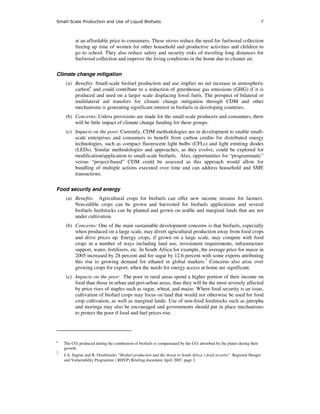
Bissau. Today, jatropha is grown in many African countries (see Exhibit 4).
Jatropha seeds and fruits are not edible. The plant is often used as a fence around homesteads,
gardens and fields, because it is not browsed by animals9. Jatropha seeds can be used for
producing oil, soap, candles and medicines. Jatropha curcas L. is the most suitable variety for
bioenergy production.

                             Exhibit 4: Jatropha Curcas Tree, Fence, and Raw Fruits


Source: http://www.biodieseltechnologiesindia.com and http://www.jatropha.de/

Jatropha grows well on marginal lands. It requires no more than 400-500 mm of rainfall per year
and can withstand long drought periods. It can also grow in areas with less precipitation provided
that humidity is sufficient. The economic life of the plant is approximately 35-40 years. Fruiting
starts between the first and second year, but a full harvest can only be obtained from the third year
onwards. The oil content in jatropha seeds is high and ranges from 25 to 37 percent. Depending on
yields, up to or 8.8 tons of jatropha seeds or 2,200 litres of jatropha oil can be obtained per hectare
per year. Current experiences in Mali show yields of around 3.5 to 5 tons of jatropha seed per
hectare. Exhibit 5 provides examples of average jatropha yields.

                               Exhibit 5: Average annual yields of jatropha plants

                Year of planting                           Average yield per plant (in Kg)
                 nd   rd
                2 -3 year                                  0.5 – 1.0
                 th
                4 year                                     1.5 - 2.5
                 th    th
                5 -10 year                                 2.5 – 5.0


Jatropha has been known and utilized by rural populations in various African countries for
decades. Jatropha hedges can reduce damage from wind, water and soil erosion. Jatropha seeds
are harvested either from fences or from plantations, usually by women. Jatropha oil can either be


9
     A non-toxic variety can be found in Mexico but is of no particular economic significance. See: H. P. S. Makkar,
     K. Becker and B. Schmook: “Edible provenances of Jatropha curcas from Quintana Roo state of Mexico and effect of
     roasting on antinutrient and toxic factors in seeds” in Plant Food for Human Nutrition, Springer Netherlands, Volume
     52, Number 1, March 1998, pp. 31-36.
10                                                     Small-Scale Production and Use of Liquid Biofuels


used as pure plant oil in retrofitted small combustion engines, larger diesel generators, or vehicle
diesel engines or it can be further processed through transesterification into biodiesel, which can
be blended with diesel or used straight in most engines and generators. The seedcake has a high
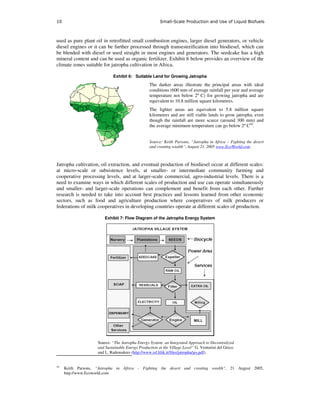
mineral content and can be used as organic fertilizer. Exhibit 6 below provides an overview of the
climate zones suitable for jatropha cultivation in Africa.

                            Exhibit 6: Suitable Land for Growing Jatropha

                                                 The darker areas illustrate the principal areas with ideal
                                                 conditions (600 mm of average rainfall per year and average
                                                 temperature not below 2º C) for growing jatropha and are
                                                 equivalent to 10.8 million square kilometres.
                                                 The lighter areas are equivalent to 5.8 million square
                                                 kilometres and are still viable lands to grow jatropha, even
                                                 though the rainfall are more scarce (around 300 mm) and
                                                 the average minimum temperature can go below 2º C10.


                                                 Source: Keith Parsons, “Jatropha in Africa – Fighting the desert
                                                 and creating wealth”, August 21, 2005 www.EcoWorld.com


Jatropha cultivation, oil extraction, and eventual production of biodiesel occur at different scales:
at micro-scale or subsistence levels, at smaller- or intermediate community farming and
cooperative processing levels, and at larger-scale commercial, agro-industrial levels. There is a
need to examine ways in which different scales of production and use can operate simultaneously
and smaller- and larger-scale operations can complement and benefit from each other. Further
research is needed to take into account best practices and lessons learned from other economic
sectors, such as food and agriculture production where cooperatives of milk producers or
federations of milk cooperatives in developing countries operate at different scales of production.

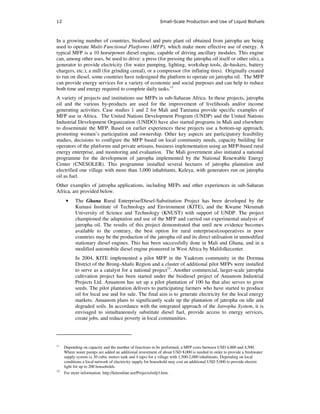
                        Exhibit 7: Flow Diagram of the Jatropha Energy System


                    Source: “The Jatropha Energy System: an Integrated Approach to Decentralized
                    and Sustainable Energy Production at the Village Level” G. Venturini del Greco
                    and L. Rademakers (http://www.isf.lilik.it/files/jatropha/jes.pdf).


10
     Keith Parsons, “Jatropha in Africa - Fighting the desert and creating wealth”, 21 August 2005,
     http://www.Ecoworld.com
Small-Scale Production and Use of Liquid Biofuels                                                               11


The production of biodiesel from plant oil involves the handling of hazardous chemicals which
requires sound technical know-how and a supply infrastructure of the chemicals. Small-scale
production of biodiesel is therefore difficult in areas with little qualified workforce and limited
availability of supplies. Scaling-up biodiesel production to community farming or agro-industrial
levels involves organizational challenges and higher investment costs.
Plans in India to establish large-scale jatropha seedling nurseries, plantations, oil extraction
centres, seed storages and biodiesel production plants (refineries) show the advantages and costs
of up-scaling biofuels (see Annex III).
Exhibit 8 below shows small scale expellers that are used in a variety of micro-scale jatropha oil
projects.

             Exhibit 8: Examples of Presses for Small-Scale Processing of Jatropha Seeds

                 Bielenberg/Ram Press                 A ram press is a small hand-press. Moving the bar up
                                                      and down operates a piston which applies pressure on
                                                      the seeds, extracting the oil, which then drips into a
                                                      container. About 5 kg of seed is needed for 1 litre of oil.
                                                      The capacity is about 1.5 litres per hour. The ram press
                                                      has the advantages of being of simple and economic
                                                      construction, easy to maintain and operate and being
                                                      operated by a single person. The two most common,
                                                      mid-sized models range in price between USD 100-280.


             Sayari/ Sundhara Oil Expeller            The Sayari (former Sundhara) oil expeller can be
                                                      powered by a diesel engine or an electric motor. It can
                                                      extract 1 litre of oil from 3kg of seeds and the extraction
                                                      rate is circa 20 litres per hour. It presses almost any hard
                                                      seeds with more than 25% oil content. The price is about
                                                      USD 3,200 for the one operated by the electric motor
                                                      and about USD 3,400 for the one with the diesel engine.


     Mafuta Mali (Swaili term for Oil Wealth) press
                                                      The oil wealth press is a manual press for local, small-
                                                      scale production and represents a more efficient version
                                                      of the Bielenberg Ram Press. The extraction efficiency
                                                      is considered better than any other manual press with
                                                      about 12 kg seeds per hour. It is easy to use and durable,
                                                      and its price is around USD 250.


                      Täby Press                      The Täby Press is a screw press manufactured in
                                                      Sweden. Various models are available for cold-pressing
                                                      rapeseed, linseed, flaxseed, sunflower seed, sesame
                                                      seed, peanut, groundnuts, mustard seed, poppy seed,
                                                      cotton seed, jojoba, etc. Various models are available
                                                      with different capacities (from 6 kg seeds per hour
                                                      producing circa 2 litres of oil to 90 kg seeds per hour
                                                      producing circa 25 litres of oil. Prices vary from about
                                                      USD 1,200 to USD 14,000.
12                                                          Small-Scale Production and Use of Liquid Biofuels


In a growing number of countries, biodiesel and pure plant oil obtained from jatropha are being
used to operate Multi-Functional Platforms (MFP), which make more effective use of energy. A
typical MFP is a 10 horsepower diesel engine, capable of driving ancillary modules. This engine
can, among other uses, be used to drive: a press (for pressing the jatropha oil itself or other oils), a
generator to provide electricity (for water pumping, lighting, workshop tools, de-huskers, battery
chargers, etc.), a mill (for grinding cereal), or a compressor (for inflating tires). Originally created
to run on diesel, some countries have redesigned the platform to operate on jatropha oil. The MFP
can provide energy services for a variety of economic and social purposes and can help to reduce
both time and energy required to complete daily tasks.11
A variety of projects and institutions use MFPs in sub-Saharan Africa. In these projects, jatropha
oil and the various by-products are used for the improvement of livelihoods and/or income
generating activities. Case studies 1 and 2 for Mali and Tanzania provide specific examples of
MFP use in Africa. The United Nations Development Program (UNDP) and the United Nations
Industrial Development Organization (UNIDO) have also started programs in Mali and elsewhere
to disseminate the MFP. Based on earlier experiences these projects use a bottom-up approach,
promoting women’s participation and ownership. Other key aspects are participatory feasibility
studies, decisions to configure the MFP based on local community needs, capacity building for
operators of the platforms and private artisans, business implementation using an MFP-based rural
energy enterprise, and monitoring and evaluation. The Mali government also initiated a national
programme for the development of jatropha implemented by the National Renewable Energy
Center (CNESOLER). This programme installed several hectares of jatropha plantation and
electrified one village with more than 3,000 inhabitants, Keleya, with generators run on jatropha
oil as fuel.
Other examples of jatropha applications, including MFPs and other experiences in sub-Saharan
Africa, are provided below.
      •    The Ghana Rural Enterprise/Diesel-Substitution Project has been developed by the
           Kumasi Institute of Technology and Environment (KITE), and the Kwame Nkrumah
           University of Science and Technology (KNUST) with support of UNDP. The project
           championed the adaptation and use of the MFP and carried out experimental analysis of
           jatropha oil. The results of this project demonstrated that until new evidence becomes
           available to the contrary, the best option for rural enterprises/cooperatives in poor
           countries may be the production of the jatropha oil and its direct utilisation in unmodified
           stationary diesel engines. This has been successfully done in Mali and Ghana, and in a
           modified automobile diesel engine pioneered in West Africa by Malifolkecenter.
           In 2004, KITE implemented a pilot MFP in the Yaakrom community in the Dormaa
           District of the Brong-Ahafo Region and a cluster of additional pilot MFPs were installed
           to serve as a catalyst for a national project12. Another commercial, larger-scale jatropha
           cultivation project has been started under the biodiesel project of Anuanom Industrial
           Projects Ltd. Anuanom has set up a pilot plantation of 100 ha that also serves to grow
           seeds. The pilot plantation delivers to participating farmers who have started to produce
           oil for local use and for sale. The final aim is to generate electricity for the local energy
           markets. Anuanom plans to significantly scale up the plantation of jatropha on idle and
           degraded soils. In accordance with the integrated approach of the Jatropha System, it is
           envisaged to simultaneously substitute diesel fuel, provide access to energy services,
           create jobs, and reduce poverty in local communities.


11
     Depending on capacity and the number of functions to be performed, a MFP costs between USD 4,000 and 4,500.
     Where water pumps are added an additional investment of about USD 8,000 is needed in order to provide a freshwater
     supply system (a 30 cubic meters tank and 4 taps) for a village with 1,500-2,000 inhabitants. Depending on local
     conditions a local network of electricity supply for household may cost an additional USD 5,000 to provide electric
     light for up to 200 households.
12
     For more information: http://kiteonline.net/Projects/mfp3.htm.
Small-Scale Production and Use of Liquid Biofuels                                                13


    •   Also in Ghana, two demonstration, capacity building, awareness raising, networking, and
        policy dialogue liquid biofuel projects are underway. These are “Production and
        Utilization of Jatropha Oil in the West Mamprusi District of the Northern Region,” and
        “Cultivation of the Physic Nut to Produce Biodiesel and Mitigate the Threat to Climate
        Change.” These projects have engaged women’s groups in rural areas to process jatropha
        oil into soap for rural bio-enterprises and biodiesel for the operation of lamps and mills.
        The second project worked in a different region with 2,000 farmers to produce jatropha
        biodiesel on a larger scale. The two projects successfully attracted the interest of policy
        makers and a committee has been created to develop a draft national biofuel policy.
    •   In Mozambique, a project by the name “Fuel Fences and Biodiesel” has planted jatropha
        trees for biodiesel production in Gorongosa, Nhamatanda, and Chimoio Districts. The
        project has demonstrated and built capacity for use of liquid biofuel to combat
        deforestation and provide a sustainable source of fuel for rural communities. Jatropha
        was planted on degraded land along roads and around community farms in rural
        Mozambique. Building capacity of the communities to produce biodiesel, the project lays
        the groundwork for activities that could eventually be upscaled and enlist private sector
        participation.
    •   Tanzania. Tanzania’s transport sector is primarily road-based, and its demand for fuel is
        growing rapidly. Importing virtually all of its fuel requirements, petroleum expenditures
        are a major burden on the Tanzanian economy and on many people’s livelihoods.
        Biofuels offer significant potential to contribute to Tanzania’s energy mix, especially in
        the transport sector. One of the most exciting potential energy crops in Tanzania, and in
        much of the semi-arid tropics, is jatropha curcas. Plant oils have been used for a variety
        of transport applications. While the costs of biofuel production are coming down as the
        price of petroleum is rising, fossil fuels continue to be less expensive, though the tipping
        point in Tanzania may be approaching rapidly. Until that time comes, plant oil biofuels
        can also be used to produce soap, or serve as cooking and lighting fuel in remote areas
        where imported petroleum products are sporadically unavailable – thus providing
        livelihood benefits while building capacity for future transition to fuel the transport
        sector.
        The purpose of this project was to introduce and expand production of jatropha as a cash
        crop, as raw material for plant-oil industries, and to demonstrate its potential in
        reforestation, erosion control, and reclamation of degraded land. Working with local
        women’s groups, the grantee (KAKUTE Ltd), trained over 1,500 people in jatropha
        management techniques, and planted more than 400 hectares of jatropha on marginal
        lands donated by the communities involved. The project successfully demonstrated the
        livelihood benefits of the crop, helping launch jatropha farming as a cash crop, while
        assisting others to begin soap-making businesses. Along with partner organizations, the
        grantee has gone on to advocate for an improved policy environment for biodiesel, with
        promising results to date. Implementation on the village scale project was coordinated by
        17 different village-based women’s groups, who produced the seedlings and cuttings for
        planting. In the first four years of the pilot project, 52,000 kg of seeds were sold to oil
        processors for approximately US$7,800, producing 5125 litres of oil worth about
        US$10,250 on the local market, and 3.5 tones of soap worth US$20,533. The amount of
        oil and soap produced is far below the capacity of the land to produce jatropha seeds, but
        goes a long way to demonstrate the potential profitability of the crop.
    •   In Zambia, a group of women with the support from German Technical Cooperation
        (GTZ) has been involved in a soap making enterprise using jatropha oil for the past seven
        years. Between 2000 and 2001, the National Oilseeds Development Programme under the
        Ministry of Agriculture and Cooperatives of Zambia, carried out demonstrations on the
        various uses of jatropha oil through national agricultural and commercial shows.
        In 2006, the Biofuels Association of Zambia was formed and is carrying out an
        awareness campaign on the potential of jatropha curcas’ contribution towards providing
14                                                Small-Scale Production and Use of Liquid Biofuels


         practical substitutes for fossil fuels and its important implications for meeting the demand
         for rural energy services in Zambia. The Government of Zambia has allocated
         US$150,000 for research on jatropha curcas and other biofuels in its 2007 budget. The
         Government is also in the process of reviewing its energy policy through a consultative
         process with the private sector. Biofuels have taken prominence in the revised draft
         energy policy which is expected to be finalized in 2007. Concurrent with revising of the
         energy policy, biofuels legislation and biofuel standards have been drafted. The standards
         are intended to ensure provision of a specified minimum of biofuels blends for all
         consumers within a specified period.
     •   In Zambia and Mozambique, the Gaia Movement Trust Living Earth Green World
         Action (GAIA), based in Switzerland, is introducing decentralised renewable energy
         systems based on jatropha oil production that are adapted to local conditions. This is
         being done with support of the Global Village Energy Partnership (GVEP).
         Currently, GAIA is training and assisting 500 small farm holders in Zambia to start
         production of jatropha as a cash crop on degraded land, establish/adapt local units to
         press oil from the seeds, train mechanics to make necessary adaptations to engines, and
         ultimately use the biofuel supply in dual fuel systems for stationary engines such as
         grinding mills, pumps, and generators in off-grid communities. GAIA is also replicating
         this project by targeting 25 Farmers Clubs (roughly 1,250 households) in Northern
         Mozambique to grow jatropha plants and will train local technicians in the cultivation
         and use of jatropha oil.
         Over the last two years, GAIA has trained community members to build more than 3,000
         low-cost firewood-saving stoves, established community nurseries and planted about
         200,000 trees, introduced and trained farmers to cultivate jatropha in 108 communities,
         established production of manual rope pumps at six locations, installed 312 pumps, and
         erected the first wind rope pump in Africa.


The following pages provide more detailed case studies of MFPs and jatropha development
activities in Mali and Tanzania.
Small-Scale Production and Use of Liquid Biofuels                                                 15


                                       Case study 1: Mali
MFC Nyetaa – decentralised biofuel for a new African development paradigm

                                                 Introduction
                                                 In the context of climate change and increasingly
                                                 expensive and insecure fossil fuel supplies, MFC
                                                 Nyetaa has been working for seven years on
                                                 developing pilot projects to demonstrate that pure
                                                 jatropha oil can fuel Mali’s future development in
                                                 a sustainable way, while benefiting local people.
                                                 These projects, which use jatropha oil as a diesel
                                                 substitute    for    multi-functional    platforms,
                                                 transportation, and rural electrification, serve as
                                                 models for future electrification projects in Mali,
                                                 West Africa, and globally. The combination of
                                                 macro- and micro-economic benefits and the use
                                                 of a CO2 neutral fuel source set the projects apart.
                                                 Inclusion of local people in project design and
                                                 implementation ensures these activities have
                                                 community roots and local buy-in, and participate
                                                 in revenue generation. Access to modern energy
                                                 services improves living standards and conditions
                                                 for small and medium enterprises.
Woman Collecting Jatropha Seeds

MFC Nyetaa, in collaboration with its partners, has embarked on the implementation of a large
scale jatropha-fuelled rural electrification project in the village of Garalo in southern Mali. Based
on a long standing request of the population
to have access to modern energy, the
commune of Garalo is setting up 1,000 ha
of jatropha plantations to provide the oil for
a 300 kW power plant. This plant will
provide clean electricity to more than
10,000 people for over 15 years, thereby
transforming the local economy. It does so
by providing power for productive use in
small industries and businesses, generating
employment, and supplying power for
social uses in schools, the maternity clinic,
community buildings, and domestic use. As
such this kind of project represents the new
paradigm for sustainable development in
Africa. MFC is organizing the project
activities and providing technical support.
                                                       100kW genset to be installed in Garalo
Fuelling rural energy supply
MFC Nyetaa works closely with ACCESS (an innovative energy service company), the local
municipal authorities, and the local population. Technical support for the project is provided by
the FACT Foundation (Fuels from Agriculture in Communal Technology), founded by a group of
biofuel specialists seeking to support income generation, social development, and improved
quality of life among rural communities in developing countries. Funding of Euro 300,000 was
contributed by the SHGW Foundation (Netherlands) and AMADER (the Malian Agency for the
Development of Household Energy and Rural Electrification) contributes Euro 293,000.
16                                                 Small-Scale Production and Use of Liquid Biofuels


Typical rural electrification projects provide electricity for lighting, refrigeration, TV, and radio.
Although this improves the lives of local people, it is a net drain on domestic finances as money is
used to pay for the service. In the Garalo Bagani Yelen model, however, families grow and collect
jatropha seeds for sale, thus increasing their ability to pay for services. Small businesses and
homes use the electricity for productive uses—increasing income and ability to pay for energy.

Sustainable biofuel production
The production of jatropha does not require irrigation, so there is no increased pressure on the
scarce and diminishing water resources. It is grown on a mixture of unused and abandoned land,
and people’s fields. It does not compete with food supply, and provides an income alternative to
cotton, which has poor returns due to heavily subsidized global markets and high pesticide needs.

This positive reciprocity between the electricity supply and jatropha production has an important
effect on the local economy. In a diesel project, money paid for fuel leaves the village and
eventually the country, with negative macro-economic effects. Local production of pure jatropha
oil means that the money for fuel enters the local village economy and has no net CO2 emissions.

The project is already well underway. Work on construction of the powerhouse has begun, and a
nursery has been created to produce 1,000,000 jatropha seedlings. To date, 650,000 seedlings have
been planted and another 400,000 will be completed before the rainy season in May 2007. Over
180 ha of jatropha are already one year old. Three 100 kW generators have been ordered and will
be installed in May 2007. These generators have been converted to run on pure jatropha oil.

MFC Nyetaa has developed the project from the idea phase through execution. A conference
“Jatropha as a Tool to Combat Energy Poverty” was held with the Ministry of Energy in January
2006, with participation from a variety of international and national development organizations.
This built a solid reputation for jatropha at the political level but also across Mali as the event was
well covered by the media. This broad support base has been critical in bringing the project to
fruition.

                        Jatropha seedlings at the Garalo project nursery, Mali


Source: MFC Nyetaa
Small-Scale Production and Use of Liquid Biofuels                                                17


              Case study 2: MFP and Jatropha Oil Production in Tanzania
In 2006, the Tanzania Traditional Energy Development and Environment Organisation (TaTEDO)
began piloting multi-functional platforms for productive uses in Tanzania. The objectives of the
project were to: install three MFPs and associated machineries for oil seed extraction, grain de-
hulling/milling, and battery charging; bring knowledge and capacity to the development and
implementation of MFP projects in Tanzania; develop capacity among beneficiaries on the use of
MFPs, management, and small business development; and demonstrate to policy makers,
investors, and donors that innovative solutions can provide improved energy services.
The first MFP was installed in Dar es Salaam at one of TaTEDO’s organisation centres for
training and information sharing purposes. Others have been installed in Engaruka village located
in Monduli district, and in Ngarinairobi Village in the Arumeru district. The platform engines run
on jatropha oil as well as on diesel during times of jatropha shortages. When operating on diesel,
the running costs are nearly twice that of the jatropha oil. In the long run the platform will run
entirely on the oil extracted from the locally grown jatropha seeds. TaTEDO is also training and
promoting the growing of jatropha plants in the region to ensure availability of jatropha seeds.
The MFPs are run commercially by a local entrepreneur selected by the villagers. This individual
is responsible for running the MFP, collecting connection/service fees, and ensuring platform
maintenance. The entrepreneur has been trained on operation and management of the MFP and
provided enterprise development skills to run the MFP sustainably. Experience shows that the
platform is more efficient when run and managed by a local entrepreneur rather than an outside
organisation. Recently, one entrepreneur has established a battery charging and lightning service.
Benefits from the program are: MFP systems have been appreciated by the villagers, particularly
women; use of locals skills and resources has been enhanced; the MFP has been integrated into the
local economy and adapted to beneficiary/customer needs; and the system is offering crucial social
and economic community services, including extended business and working hours. The MFP has
provided electric lighting, maize dehusking, and jatropha seed pressing.
Results/outcomes to date include: initiated MFP operations at 3 sites; constructed a village mini-
grid; 50 households connected to the grid (US$3 per month, flat rate); 12 shops connected to the
grid (US$5 per month); operators trained and entrepreneurs supported; 20 households accessing
electricity through battery charging; possibility of more modules connected on demand.
Challenges for replication are: organized availability of quality seeds which is not presently
available, lack of awareness on jatropha plants/benefits, no clear source of jatropha information in
the country, oil expellers not readily available, lack of ingredients for local biodiesel processing
(i.e., methanol), biofuels policy not yet in place. TaTEDO is working to address these barriers.
Planned activities include: scaling up the program to over 200 villages, improve jatropha
production/marketing, enhance income through carbon sales, promote supportive policies/
regulations, integrate biofuels into the country’s overall sustainable rural development efforts,
increase public awareness and outreach, enhance investment support, and project M&E.

                        Multifunctional platform in Engaruka village, Tanzania
18                                                         Small-Scale Production and Use of Liquid Biofuels


Exhibit 9 provides a detailed break-down of the economy of small-scale production of jatropha oil
in Tanzania, including costs and profits, exceeding the rates of farm laborers. This chart
demonstrates that jatropha production can be a profitable venture for rural workers. Using an oil
expeller versus a hand press further increases profits. Exhibit 10 includes information on the
production costs of jatropha oil in Haubi village, Tanzania.

  Exhibit 9: The Economy of Small-scale Production of Jatropha Oil as fuel in Tanzania (based on 2003
                                                data)

 Model assumption on labour costs:
 It is assumed that a rural worker earns about US$10 per month, working 6 days a week and 6 hours a day.
 The wage paid to farm labour may be equivalent to US$ 0.06 per hour. The legal minimum wage is US$
 1/day. With day of 6 working hours, this is equivalent to US$ 0.16/hour.
 Model assumption on collection / harvest of seeds: 3 kg of seeds can be harvested per hour, 5 kg are
 needed for 1 litre of oil; i. e. the labour to collect/harvest 1 kg of seeds is: 1.7 hours.
 Model assumption on extraction of the oil: Per working hour 1 litre of oil can be extracted by one
 person with a hand press. Additionally ½ hour is needed for purifying the raw oil (sedimentation,
 filtration); i.e. 1.5 working hours for the extraction of 1 litre of oil.


            A) Extraction with hand press                         B) Extraction with Sayari oil expeller
                   (Bielenberg ram press)

                                          Cost factors of oil production
                                           Harvesting/collecting seeds
                                                  1.7 hours/litre
                                                  Oil Extraction
                       1.5 hours/litre                                           (0.25) hours/litre
                                          Depreciation/Maintenance/Fuel
                       US$ 0.10/litre                                             US$ 0.12/litre


                                             Summary of costs
                                            Low cost calculation
                                         (US$ 10 /month, 144 hrs.)
            3.2 hrs at US$ 0.06 /hr = USD 0.18                    1.7 hrs at US$ 0.06/hr = USD 0.10
                                                 Extraction
                         US$ 0.08                                              US$ 0.12
                                                 Total Cost
                         US$ 0.26                                              US$ 0.22
                                                   Profit
                       US$ 0.22/litre                                        US$ 0.30/litre
                                            High cost calculation
                                             (USD 1/day, 6 hrs.)
            3.2 hrs at US$ 0.16/hr = USD 0.51                     1.7 hrs at US$ 0.16/hr = USD 0.27
                                                 Extraction
                         US$ 0.08                                              US$ 0.12
                                                 Total Cost
                         US$ 0.59                                              US$ 0.39
                                                   Profit
                        no feasibility                                       US$ 0.13/litre

                              Profit per working hour of oil production
 US$ 0.44 for 3.2 working hours, or USD 0.14/hour     US$ 0.40 for 1.7 working hours, or US$
                                                      0.24/hour


Source: Henning, Reinhard K., “The Jatropha System - Integrated Rural Development by Utilisation of Jatropha curcas L.
(JCL) as Raw Material and as Renewable Energy”
Small-Scale Production and Use of Liquid Biofuels                                                                19


              Exhibit 10: Estimated production cost of jatropha oil in Haubi village, Tanzania


Source: Del Greco and Rademakers 2006, The Jatropha Energy System: An integrated approach to decentralized and
sustainable energy production at the village level, p. 4.


Exhibit 11 provides the economics of jatropha cultivation and oil extraction in Madagascar, which
demonstrates similar experiences to the Tanzania case shown above. Depending on the
comparative (real) local market prices of diesel or other substitute fuels, under the right conditions
the sale of the extracted jatropha oil, whether generated by hand press or expeller, can exceed the
local minimum wage earning. As Exhibit 12 shows, the estimated production cost of jatropha oil
can be lower than the cost of diesel for many communities in sub-Saharan Africa. Low labour and
investment costs relative to diesel can make jatropha a lower risk system, enabling communities to
save money on fuel. As diesel is a major cost for villages, jatropha provides an attractive
alternative to generate income through oil sales and yield savings in diesel operating costs.

     Exhibit 11: Economy of oil production from collected Jatropha curcas L. seeds in Madagascar
                                         (approximate values)

                   Labor productivity of 1 working hour in the north of Madagascar
 Harvest of seeds, oil extraction with hand press, and vending of oil at the price           0.22 USD/h
 of diesel fuel (Harvest 2 hrs, extraction 1 hr, misc.½ hr)
 Harvest of seeds, oil extraction with expeller, and vending of oil at the price of          0.31 USD/h
 diesel fuel (Harvest 2 hrs, extraction 15 min, misc. 15 min)
 Minimum wage in local currency (approx equivalent to USD 1 per day/6                        0.17 USD/h
 working hours)

Source: Data calculated based on field research in Madagascar by Reinhard Henning.
20                                                           Small-Scale Production and Use of Liquid Biofuels


                      Exhibit 12: Cost of Jatropha Oil as Compared to Conventional Diesel.


Source: Del Greco and Rademakers 2006, The Jatropha Energy System: An integrated approach to decentralized and
sustainable energy production at the village level, p. 4.


B.           Experimental Projects with Other Non-Edible Energy Crops

“Invader bush”
In Namibia, the so-called “invader bush” appears to offer some opportunity for farmers to generate
electricity for local markets. The bush exists on more than 26,000 ha of land and appears to affect
cattle farms and the beef industry. Opportunities exist to use the bush for biomass energy. The
Namibia Agricultural Union’s Bush Utilization and Debushing Committee has drawn up a project
proposal for small-scale power generation based on combustion of invader bush. However, since
the current import prices for electricity from South Africa are more economical,13 the project has
been shelved at this time.

Jojoba (simmondsia chinensis)
This plant originates from Mexico and has the advantage of growing on marginal lands, especially
in hot climates, salty soils, and even deserts. It also has a considerable potential in terms of yield.
However, in order to use it as a biofuel crop, it would require being cultivated in very large
numbers. At present, its use does not seem to be an option in sub-Saharan Africa.

Neem tree (azadiracta indica)
The neem tree is a medium-sized tree from South Asia belonging to the family Meliacea. For over
5000 years, the neem tree has been used in India, primarily for traditional medicine. In Eastern and
Southern Africa, neem was planted by Indian settlers at the end of the nineteenth century and it
became naturalized along the coastal strip from Mogadishu to Maputo. Today, there are estimated
to be several hundred million neem trees all over sub-Saharan Africa. Neem, popularly referred to


13
     For more information: http://www.sardc.net/Editorial/sadctoday/documents/v9n2.pdf
Small-Scale Production and Use of Liquid Biofuels                                                                    21


us the 'health-maker tree', is in growing demand because of its many uses in afforestation, animal
and human health, and as a fuelwood. Neem is often planted to provide shade and has remarkable
properties in controlling insect pests. Leaves and seeds may be used or ground into oil, seed meal,
and water-oil emulsions. Neem oil could be a feedstock for producing biodiesel. However at
present, there do not appear to be projects using neem oil for the production of biodiesel or using
neem oil in cook stoves or in lamps.

Water hyacinth (eichhornia crassipes)
Water hyacinth is an aquatic plant which can live and reproduce, floating freely on the surface of
fresh waters. Its rate of proliferation under certain circumstances is extremely rapid and it can
spread to cause infestations over large areas of water causing practical problems for marine
transportation, fishing, and at intakes for hydro power and irrigation schemes. The plant originated
in the Amazon Basin. Water hyacinth grows in tropical and sub-tropical climates. Uncontrolled
growth of the plant has caused various problems on some lakes, in particular on Lake Victoria.
Although water hyacinth is seen in many countries as a weed, it is possible to find useful
applications as the plant has a high energy and protein content. Fibre from water hyacinth can be
used for a variety of applications and products, including paper, fibre board, yarn and robe, basket
work, and as an energy feedstock.
In Kenya, the idea to produce charcoal briquettes from water hyacinths has been proposed as a
way to deal with the rapidly expanding carpets of the plant on Lake Victoria. Due to the high
water content drying water hyacinth poses a considerable challenge for biofuel production (Eden
1994).
Converting water hyacinth to biogas has been an area of major interest for many years. Designs of
biogas digesters have been tested and research on biofuel from water hyacinth has been
undertaken mainly in Asia (Bangladesh, India, Indonesia, and the Philippines). In Africa, the
Kigali Institute of Science, Technology and Management (KIST) in Rwanda has developed and
installed biogas plants to treat human waste and generate biogas for cooking. In 2005 the project
has won the Ashden Award for Sustainable Energy (UK).14 Research on a biogas digester for
water hyacinth is also undertaken in Tanzania at the University of Dar es salaam (Kivaisi and
Mtila 1998).

Nipa fruticans
A Nigerian NGO located in the country’s Rivers State is undertaking a feasibility study on tapping
Nipa fruticans, an abundant mangrove palm in the Niger Delta, for ethanol production. This
ongoing project looks at ways to tap the potential biofuel crop in order to develop a local ethanol
industry around it. Such an industry would bring much needed jobs to this region.15

Algae
Research projects are currently under way in South Africa to explore possible contributions of
aquaculture and algae cultivation to biofuel production. The most important types of algae are
brown algae (Phaeophyta), red algae (Rhodophyta) and green algae (Chlorophyta or Charophyta).


14
     The Ashden Awards for Sustainable Energy 2005, Biogas plants providing sanitation and cooking fuel in Rwanda,
     URL: http://www.ashdenawards.org/winners/kist05.
15
     Source: http://www.biopact.com/site/projects.html.
22                                                       Small-Scale Production and Use of Liquid Biofuels


The most promising algae to be used for oil extraction are those belonging to the green algae
family. Green algae tend to produce starch rather than lipids. They have high growth rates and are
rather tolerant to temperature fluctuations16.
The production of algae to harvest oil for biodiesel has not yet been undertaken on a commercial
basis, but several experiments and feasibility studies suggest a potential for sustainable
development. Aquaculture does not require farmland or fresh water and algae cultivation can yield
up to 5000 litres of biofuels per ha. First experiments have been conducted on a large, commercial
scale. The South African firm De Beers plans to produce 16 to 24 billion litres of biodiesel from
algae within five years with an initial investment exceeding US$480 million. Algae cultivation is
highly capital intensive and thus not suitable for small-scale production.


C.         Potential of Energy Use of Other Edible Cash Crops
Various edible crops can also be used as a source for biofuel production. The most important are
analyzed here for their potential to be used in small-scale energy crop farming. Cultivation of
energy crop or use of edible crops for biofuels will only be a sustainable development option if the
local population is not affected by hunger or malnutrition.

Sugar cane (saccharum officinarum)
Sugar cane, shown in Exhibits 13 and 14, is a tall perennial grass native to warm temperate
tropical regions of Asia and Africa. Sugar cane belongs to the Poaceae family and is characterized
by stout, jointed, fibrous stalks that are rich in sugar and can grow 2 to 6 metres tall. Sugar cane is
grown in many countries around the world. The plant requires a tropical or sub-tropical climate
and at least 600 mm of rainfall per year. Sugar cane matures in 12-14 months. Sugar cane is a very
productive tropical plant in terms of yield per hectare.
Africa accounts for less than 3 percent of global sugar production, with Mauritius and South
Africa accounting for the bulk of this. Most other sub-Saharan African countries are sugar
exporters, thus bioethanol production opportunities from sugar cane are limited. Production of
bioethanol from sugar cane is typically considered commercially viable if conducted large-scale.
Sustainable cultivation of sugar cane for biofuel production therefore requires that small-scale
farmers and village communities adequately share the benefits.

Exhibit 13: Sugar Cane plantation                              Exhibit 14: Stacks of Sugar Cane


Source: http://www.photosearch.com


16
     The main types of algae for biofuels production include Scenedesmus dimorphus, Prymnesium parvum; Botryococcus
     braunii: and Dunaliella tertiolect.: For a complete list see www.oilgae.com/algae/oil/yield.
Small-Scale Production and Use of Liquid Biofuels                                                       23


                                   Exhibit 15: Energy Production of Sugar Cane

                                 Crop production         Fuel production         Energetic equivalent
                                     MT/ha                     /ha                     kwh/ha
         Saccharum                      35                   2,450                     16,000
         officinarum

     Source: www.energy.de

The potential of sugar cane as a source of renewable energy received worldwide attention
following the success of the Brazilian ethanol programme. The energy balance of sugar cane-
based ethanol in Brazil is around 8 to 1 and the programme has been commercially successful (see
Exhibit 15).
Bioethanol production from sugar cane raises various environmental concerns, primarily related to
fertilizer and fuel use. Pesticides and other pollutants can cause negative impacts. Smoke from
burning fields also needs to be taken into account, as well as the use of water for irrigation.
Expanding ethanol production has also affected biodiversity by clearing natural forests. All of
these sustainable development concerns need to be addressed where bioethanol is to be produced
on a large scale.
Besides the production of sugar, processing of sugar cane produces a variety of by-products. Non-
energy by-products are made from the fibre contained in bagasse and the organic components of
molasses and filter cake. Molasses and filter cake can be used as animal feeds or fertilizers, while
bagasse can be used to make particleboard and newsprint. Energy by-products include alcohol
fuels (ethanol), surplus electricity generated using bagasse and cane trash, and methane gas from
the wastewater of ethanol production. Exhibit 16 provides an overview of the many end-uses of
sugar cane.

                             Exhibit 16: Products that can be produced from sugar cane


Source: http://carensa.net

Project experiences with sugar cane in Africa are provided below.
     •     Malawi. The Department of Science and Technology in Malawi is conducting research
           on the use of sugar-based ethanol as an alternative fuel for petrol driven motor vehicles.
           The projects were initiated following a directive from the Cabinet to explore non-fossil
           sources of fuel for vehicles. The program is funded by the Malawi Government and
           implemented in collaboration with the Lilongwe Technical College and the Ethanol
           Company of Malawi Limited—thus a public-private partnership. The Ethanol Company
           is providing all the ethanol that is being used for the experiments free of charge and is
24                                                    Small-Scale Production and Use of Liquid Biofuels


           importing a new flex vehicle from Brazil for further experiments. A flex vehicle uses
           petrol and ethanol in any mixture in a single tank. Malawi currently produces about 18
           million litres of ethanol, with a potential to almost double this amount. The current use of
           ethanol is about 50 percent for blending with petrol; the rest used for industrial purposes,
           portable alcohol, and export. At present production levels Malawi has excess ethanol
           which can be used locally to fuel vehicles as the export price is lower than the local price.
           The benefits of ethanol fuel versus petroleum cited by the Malawi Government are:
           saving of valuable foreign exchange for other valuable activities; reduced CO2 emissions;
           hedging of risks over rising petroleum import prices; and increased demand for local
           sugarcane which means employment opportunities for local farmers across the ethanol
           processing and marketing chain. Results of tests to date have shown that it is possible to
           use 100 percent ethanol to drive motor vehicles in the country; continued testing is
           planned to monitor engine performance, assess costs and benefits, and determine long-
           term affects (if any) of a transition to ethanol.
      •    South Africa. South Africa is in process of developing large sugar cane plantations
           primarily for export. However, the ethanol produced can also be used to make ethanol gel
           which is an excellent fuel source for cooking and successful ethanol stove programmes
           have been implemented. In this way the bioethanol can be used locally to provide
           household energy. Small-scale farmers are, through programmes of the government and
           of the larger sugar organizations like SASA (Sugar Association of South Africa), starting
           to increase yields and this is proving promising. Varieties of sugar cane with higher
           biomass yields are also being pursued.
      •    Southern Africa Region. In South Africa and Mauritius bagasse has long been used to
           provide steam and electricity in sugar factories, making them energy self-sufficient.
           Recent advancements in technologies have enabled some sugar factories to produce
           surplus of electricity for sale to the grid.
           There are several initiatives related to sugar cane cultivation for bioethanol in sub-
           Saharan Africa. The most prominent is the Energy Services-Cane Resources Network for
           Southern Africa (CARENSA), supported by the Stockholm Environment Institute (SEI)
           and the European Union (EU). CARENSA created South-South and North-South
           network links to increase cultivation of sugarcane for production of bioenergy in
           Southern Africa as a contribution to sustainable development. CARENSA is a four-year
           project with 12 partners17.


17
     For more information: http://www.carensa.net/.
Small-Scale Production and Use of Liquid Biofuels                                                                                                                                                        25


Case Study 3: Zambia Sugar Cane/Sweet Sorghum for Ethanol Production
Ethanol production from sugar cane
Recently, cultivation and processing of sugar cane has been expanded considerably in Zambia.
Zambia Sugar Plc., the largest sugarcane plantation and processing company of Zambia, plans to
raise sugar output by 70 percent to 440,000 tons in 2011 to meet rising local demand, and supply
ethanol exports to the European Union. The company plans to invest US$150 million in expansion
and is poised to produce ethanol to meet Zambia’s need for 20% ethanol-petrol blend once a
policy is in place.
The Ministry of Energy and Water Development, in conjunction with the Ministry of Commerce,
Trade and Industry are classifying biofuels development as a priority area. Once this is done,
private investors such as Zambia Sugar Plc, who are planning to invest into the biofuel sub-sector,
will benefit from the incentives spelled out in Zambia Development Agency Act No. 11 of 2006.
Evaluation of sweet sorghum as an alternative bioenergy feedstock
The potential for sweet sorghum production has been evaluated by the University of Zambia. The
project assesses the performance of sweet sorghum varieties in three agro-ecological regions of
Zambia and on major soil types with respect to biomass production, sugar content and optimum
time for stem harvest. It also evaluates sweet sorghum as a supplement to bio-ethanol feedstock.
The agronomic evaluation tested 9 (8 exotic and one indigenous) sweet sorghum varieties. Results
showed that yields of some sweet sorghum varieties were competitive with sugar cane as three
yields could be produced within 18 months in contrast to only one sugar cane harvest in the same
period (Figures 1 and 2). This allows filling the off-crop season and year-round ethanol
production.

Figure 1: Fresh stem yield of sweet sorghum in Zambia                                                     Figure 2: Sugar content of sweet sorghum

                             50000                                                                                                  25
                                                                                                           Sugar content (Brix %)
  Fresh Stem Yield (kg/ha)


                             45000
                             40000
                                                                                                                                    20
                             35000
                                                                                                                                    15
                             30000
                             25000
                                                                                                                                    10
                             20000
                             15000                                                                                                   5
                             10000
                             5000                                                                                                    0
                                0
                                                                                                                                                                                     W ray
                                                                                                                                         Sima


                                                                                                                                                                                             Cowley

                                                                                                                                                                                                      Keller
                                                                                                                                                TS1

                                                                                                                                                      Madhura

                                                                                                                                                                Praj 1

                                                                                                                                                                         GE2

                                                                                                                                                                               GE3
                                     Sima


                                                  Madhura


                                                            Praj 1


                                                                                        Cowley


                                                                                                 Keller
                                            TS1


                                                                     GE2


                                                                           GE3


                                                                                 Wray


                                                                                                                                                      Sweet sorghum variety
                                                  Sweet sorghum variety

  Source: Kalaluka. Munyinda, Evaluation of Sweet Sorghum as an Alternative Bioenegy Feedstock, Crop Science Department,
  University Of Zambia

Munyinda et al’s finding agrees with the results obtained at National Agricultural Research
Institute in India. One hectare of sweet sorghum in one year (two seasons) yielded: 2-4 tons of
pearly white grain; 5-7 tons of dry leaves; 15-20 tons bagasse; and 5-9 tons syrup (750 brix) or
3,000 to 4,000 litres of ethanol (95 percent). Thus, preliminary results show production of sweet
sorghum could be integrated with sugar cane; the same infrastructure can be used for both.

African oil palm (elaeis guineensis)
Palm oil is a versatile raw material for both food and non-food use. See Exhibits 17 and 18 below.
Oil palms enable the production of palm oil (extracted from palm fruit) and palm kernel oil
(extracted from the fruit seeds). African oil palms are indigenous to the tropical rain forest region
in the coastal belt of West Africa from Liberia to Angola. Oil palms grow on a wide range of
tropical soils, require adequate water supply and are best cultivated on lowlands, with a 2-4 month
dry period. In commercial cultivation 75 to 150 palm trees are planted per hectare, yielding about
26                                                         Small-Scale Production and Use of Liquid Biofuels


2.5 MT of palm fruits per hectare per year. Oil palms are propagated by seed. A commercial
plantation of 410 ha would sustain about 50,000 trees. Each tree produces on average 5 bunches of
fruit, equivalent to 5 kg oil per year. The total annual yield of such a plantation can be 250,000 kg
oil per annum.18

Exhibit 17: African Oil Palm                                         Exhibit 18: African Oil Palm Fruits


Source: http://www.forestryimages.org/


Demand for African palm oil has been rising during recent years and is expected to increase
further19. Most palm oil is used to produce biodiesel. In several sub-Saharan African countries
successful projects are underway that have demonstrated the use of oil palms for sustainable
small-scale production of palm oil for biodiesel.
Country examples of African palm oil are provided below.
      •    In Tanzania, FELISA Co. Ltd. (FELISA stands for “Farming for Energy, for better
           Livelihoods in Southern Africa”) produces palm oil in an integrated system. Palm oil is
           extracted from palm fruits; the vegetable oil is processed (through cracking20) into
           biodiesel and the palm fruit residues (through pressing) become oil palm cake which is
           fermented for use as fertilizer. During the fermentation of the cake, biogas is produced,
           which is used for cooking, heating or for electricity production. The compost is
           reintroduced to the plantation as fertilizer allowing recovery of the nutritional elements21.
           In December 2006, UNIDO launched two new biomass pilot projects in the Kigoma and
           Dodoma regions of Tanzania to generate electricity from liquid biofuels, including palm
           oil seeds. The Kigoma biomass pilot project has the capacity of producing 30 kilowatts of
           electricity and will serve a project village. It is expected that the project will stimulate a
           market for palm fruits due to increased demand for palm oil.
      •    The Dutch Common Fund for Commodities22 (CFC) has implemented small-scale palm
           oil projects in Cameroon, Benin, Cote d’Ivoire, Ghana, and Nigeria. Recently, the
           Roundtable on Sustainable Palm Oil (RSPO) was established to promote the sustainable
           production and use of palm oil.23


18
     See: http://www.hort.purdue.edu/newcrop/duke_energy/Elaeis_guineensis.html
19
     From the 1990s to the present time, the area under palm oil cultivation had increased by about 43%, most of which
     were in Malaysia and Indonesia – the world’s largest producers of palm oil.
20
     Cracking, also known as pyrolisis is a process consisting in the chemical decomposition of organic materials by
     heating in the absence of oxygen or any other reagent.
21
     For more information: http://www.partners4africa.org/docs/PartnersForAfricaNewsletter-May2005.pdf
22
     See: http://www.common-fund.org/
23
     See: http://www.rspo.org/.
Small-Scale Production and Use of Liquid Biofuels                                                       27


Cassava (manihot esculenta)
Cassava is a staple food for approximately one billion people living in developing countries.
Cassava can be used for biofuel production and use, but its use as a biofuel crop can have negative
impacts on sustainable development. Therefore, it is not discussed in the paper in further detail.

Sweet sorghum (sorghum bicolor L. Moench)
Sweet sorghum is a versatile and valuable food and energy crop yielding 20 to 50 tons per hectare.
Sweet sorghum can be used to produce food (grains and sugar), industrial commodities (organic
fertilizer), and animal feed products. It can also produce renewable energy. Sweet sorghum can be
grown in all tropical, sub-tropical, temperate regions as well as on poor quality soils and in semi-
arid regions. Very resistant to droughts (it is also called “camel crop”), to flooding and to salinity
alkaline conditions, sweet sorghum is an annual plant with two cuts can be possible in some areas.
According to some experts, sweet sorghum could play a greater role as an energy crop in sub-
Saharan Africa. Challenges are seasonality and instability characteristics of its fermentable sugars
that require high investments if sweet sorghum is to be used for bioethanol production. Processing
facilities must be large enough to process the harvest within weeks. Unless other feedstocks are
available, ethanol production facilities will be underutilized or idle for many months each year.
Integrated production of several crops (sweet sorghum/sugar-cane; sweet sorghum/corn; sweet
sorghum/ sweet potatoes, etc.) and simultaneous processing of the full crop components (starch,
sugar, ligno-cellulosic) can considerably improve the economics of ethanol production.


D.            Biofuels for Improved Cookstoves
Sustainable energy for cooking is of crucial importance for rural development in sub-Saharan
Africa. This section provides examples of improved cookstoves using biofuels. Also, Case Study
4 describes the positive South African experience with ethanol gel in cookstoves.
        •     Jatropha oil in cookstoves. In recent years a technology has been developed in
              Germany24 that allows for the use of diverse crude or refined plant oils such as jatropha
              oil in a pressure stove with a special burner that does not require blending with other
              fuels25. The stove technology has been acquired by the Bosch and Siemens Home
              Appliances Group and the stove has been tested in the Philippines and, since 2006, in
              Arusha, Tanzania, using oil from a local jatropha plantation. Production of the stove
              began at both locations at the end of 2006, using mainly local material, but still relying on
              the import of one crucial high-technology component from Germany. The costs per stove
              amount to around US$50 (or Euro 30) per unit, including costs for imported components.
              The cultivation of jatropha and the production of biodiesel can make a significant
              contribution to sustainable development in sub-Saharan Africa. However, the positive
              impact can be significantly increased if further research and development (R&D) leads to
              the dissemination of low cost biofuel cook stoves that are more affordable for poor small-
              scale farmers and other rural households in developing countries.
        •     Ethanol in cookstoves. In 2000, the World Bank Development Marketplace awarded the
              Millennium Gelfuel Initiative a small grant to develop a renewable, low cost, and clean
              household cooking fuel together with a small company in Zimbabwe. Gelfuel is based on
              bioethanol alcohol produced primarily through the fermentation and distillation of sugar
              cane. The use of gelified and solid ethanol alcohol has been in practice for several
              decades as a cook fuel for soldiers or for recreational and catering applications. The


24
     University of Hohenheim, Germany.
25
     For start-up, a small amount of alcohol is required.
28                                                Small-Scale Production and Use of Liquid Biofuels


         Initiative has introduced the ethanol-based gelfuel in Zimbabwe and designed and
         retrofitted cook stoves.
         Currently, the Initiative is supplying approximately 12 municipalities with a double
         stove, gel fuel, oil lamps, and lamp oil. Each municipality supplies an average of 1,200-
         1,300 families with one stove, one oil lamp, resupply of 5 liters of gel fuel, and 500 ml of
         lamp oil on a monthly basis for the duration of one year. Municipalities are supplied
         through distributors which do the promotion and training of community members. Hands-
         on-training of the local customers has proven critical to ensure that the gel fuel is used
         economically.
     •   In Tanzania, KAKUTE Ltd has provided 10 stoves and 100 hurricane lamps to operate
         on jatropha oil. While the stoves are currently too expensive for immediate
         mainstreaming, the development of a cheaper stove could tap this potentially large
         market.


E.       Cross-Cutting Biofuels Activities
The West African Economic and Monetary Union (UEMOA) which comprises the eight member
states of Benin, Burkina Faso, Cote d'Ivoire, Guinea-Bissau, Mali, Niger, Senegal, and Togo,
has formulated a common energy policy in 2001. One pillar of this policy is the Regional
Biomass Energy Programme (PRBE). The goal of the PRBE is to contribute to the sustainable
development of biomass energy and to promote alternative energies for poverty reduction and the
preservation of the environment.
The policy aims at diversification of energy sources and the development of national bioenergy
strategies that include bioethanol, biodiesel and programmes of sustainable biomass energy. The
PRBE co-sponsors actions on biofuels by the member states. In Burkina Faso, a pilot project on
the production of ethanol and electricity from sorghum is being implemented under the
programme.
For the years 2006 to 2015, the UEMOA together with its member states and the regional chamber
of commerce and industry have funded a programme on the promotion and implementation of
national biofuel strategies, including national promotion strategies for jatropha oil and other
energy crops.
Small-Scale Production and Use of Liquid Biofuels                                                           29


Case Study 4: So Long Paraffin, Hello Ethanol Gel
While interest in alternative energy and green politics is often seen as the
preserve of the upper classes, working-class people in Johannesburg’s inner
city are already using renewable energy in their homes. On a pavement in
Joubert Park in Johannesburg, shoppers cluster around Tumelo Ramolefi’s
stall exclaiming and asking questions about his products. Ramolefi is not
selling the usual inner-city hawker stock of facecloths and socks. Instead, it
is his display of innovative renewable-energy gadgets that attracts the
attention of passers-by.

His bestselling items are ethanol gel stoves and lamps, which offer a
healthier, safer, and more efficient alternative to paraffin or coal fires.
Ethanol gel is a renewable form of energy made by mixing ethanol with a
thickening agent and water. The ethanol is extracted through the             Ethanol gel lamps are
fermentation and distillation of sugars from sources such as molasses, sugar much safer than paraffin
cane, and sweet sorghum or starch crops, like maize. Ramolefi sells          lamps. (Photograph:
ethanol gel products and appliances for GreenHeat South Africa, with         Oupa Nkosi)
branches in Durban, Johannesburg, and Cape Town. The stoves and ethanol gel - produced from sugar
cane - are manufactured in Durban. A two-plate stove sells for R160 (US$ 23); a lamp for R50
(US$7).

“This stove is number one,” said Maria Ndlela, who works in a recycling centre in Joubert Park and
has owned her stove for two months. She says it is easy to use and, while paraffin is cheaper than the
gel, the gel is more cost-efficient in the long run. Five litres of gel cost R60 (US$ 8.50) and paraffin
costs R21,99 (US$ 3.13) for the same amount. “Gel lasts. If you don’t use it too much, five litres of
gel takes you a month to use, but five litres of paraffin lasts only three days.” Ndlela says an added
attraction of ethanol is that the paraffin price fluctuates. “The price of paraffin is going up and down
with the petrol price,” she said, “So now I’m forgetting about paraffin.”

“What I like about the stove is that it will conquer our unreliable electricity,” said Florah Thulare. She
says pre-paid electricity cards are often unreliable and problems with them can take a day or two to be
resolved, leaving her without electricity to cook with at night. Safety is also a big selling point.
Paraffin stoves, which explode or are easily knocked over, cause fires, and poor ventilation can lead to
asphyxiation. “Coal can kill you during the night,” says Ramolefi.

Gel fuel burns with a carbon-free flame, so it does not cause respiratory problems like asthma, which
can be caused by emissions from paraffin, coal and wood fuel. The gel also does not produce any
smoke or smell. Gel fuel will not ignite if spilled like gas or paraffin and it is non-toxic and thus not
poisonous if swallowed by children. The stoves are designed so they will not fall over if bumped and
the stove’s legs allow it to slide when pushed instead of toppling over.

Ramolefi says that, even if an ethanol lamp is overturned, the gel will extinguish the wick -- and if a
stove is knocked over and a fire starts, it will not spread rapidly because the gel moves slowly. The
stoves are designed for cooking, but half of his customers buy them as heaters. While talking to
Ramolefi, Monty Marees stopped to buy a stove for her “auntie” who had just moved to the area.
Marees said the elderly woman took hours each evening to collect wood and warm her mbaula, a
brazier-type heater. She was buying the stove to warm her aunt before bed.

Ramolefi has sold about 70 stoves in the past 8 months and hopes the market will grow and prices will
drop, making the stoves more affordable for the poor. While sales were slow initially, word-of-mouth
and seeing neighbors cooking on ethanol stoves has increased customers. “You can’t buy something
you haven’t seen working anywhere. We need to demystify them for people.”
30                                                Small-Scale Production and Use of Liquid Biofuels


VI.      Barriers to Biofuels Development in Sub-Saharan Africa
As noted from the case studies and examples provided in the prior chapter, a number of barriers
hinder widespread deployment of small-scale biofuels in Sub-Saharan Africa. These are discussed
below.
Feedstock awareness. The choice of feedstock from which to produce small-scale biofuels is an
important issue, however there is limited African experience to date. If the availability of oil seeds
varies from year to year, small-scale production can be affected, especially when seed collection
remains in the informal sector. Establishing local storage could provide a buffer against supply
vagaries.
Biofuel production using edible crops is not suitable for most conditions in Sub-Saharan Africa
due to concerns about food security and competitive use of agricultural land. Use of straight
vegetable oil/pure plant oil can greatly simplify the use of biofuel as a transportation fuel since it
renders the transesterification process and involved technology and costs unnecessary. Successful
engine trials with raw pongamia oil in India and jatropha oil in Mali over a period of two to three
years have been reported. However, long term impacts on engine performance and maintenance
problems remain to be studied.
Land ownership. Land ownership patterns vary from country to country. Land owned by
government, forest land, land under custody of village council as common property, and privately
owned are the main categories. With considerable incomes being generated by biofuel cultivation,
the issue of competitive use of agricultural land will become increasingly relevant as land used for
agriculture and cash crop might get diverted for biofuel cultivation.
Policy support. Within sub-Saharan Africa, there are a lack of policies to support small-scale
biofuels development at the local level, including fiscal and financial incentives and provision for
SME fuel blenders. In cases where biofuels policies do exist, they tend to focus on subsidies for
large industrial biofuels producers, with smaller scale farmers mentioned as providing crop inputs
for these larger operations. The potentials for biofuels development to meet local energy needs has
not as yet been widely recognized.
Policies are needed to ensure that local households, businesses, and communities capture the
benefits of energy services afforded from biofuels development, as well as associated income and
job opportunities. Policies should be long term, stable, and clear, and ensure biofuels development
by local people, for local people. To ensure effective policy promotion, government decision
makers will need to engage small farmers and producers in the policy formulation discussions.
Policy support will need to consider a range of issues including production, logistics, linkages,
outreach, technical assistance, end user acceptance and pricing.
Affordable financing. A key barrier to small-scale biofuels development is access to affordable
financing. This is required by small farmers who need working capital for the purchase of seeds
and equipment as well debt and equity financing to build biofuels businesses. Consumers may
also require credit to purchase biofuels for their household or business needs at terms and
conditions matched to their ability to pay.
Institutional capacity and awareness. Currently in Sub-Saharan Africa, there is a lack of
awareness of the opportunities of small-scale biofuels, as well as the capacity to develop these
programs and projects. This includes a lack of capacity in the public sector (regional, national, and
local) for the development of effective policies to promote small-scale biofuels development; with
the private sector, including small farmers, to design, develop, implement, and operate these
projects; among consumers who lack information on the costs and benefits of these technologies;
and with local NGOs, credit providers, market intermediaries financiers, and others, all of which
have a significant role to play in the development and advancement of small-scale biofuels. Each
of these groups will require capacity building and support to develop small-scale biofuels potential
Small-Scale Production and Use of Liquid Biofuels                                                      31


in sub-Saharan Africa. Moreover, more effective coordination and cooperation between these
various stakeholders will be important.
Local technology production. In sub-Saharan Africa, there is a lack of locally available, locally
produced biofuels technology, products, and equipment. Local developers may be not be aware of
the available product offerings in the marketplace and how to obtain these, and foreign technology
can be difficult to procure and expensive to purchase. Development of local technologies,
products, and services matched to the needs of the marketplace will be important of the scale-up of
small-scale biofuels throughout sub-Saharan Africa.
Market development. To develop small-scale biofuels in the region, it will be necessary to
understand the market needs and establish effective supply chains for product delivery, servicing,
and financing. A key requirement is the need for effective business models for biofuels
development.
A host of operational issues will need to be considered across the value chain including: soil
characterization, plant/feedstock selection, seedling supply arrangements, post-planting
care/management, inter/multi cropping (very important to improve economics by extending the
planting season and diversifying crop base), outreach to local communities, blending
arrangements, safety and environmental safeguards, and risk management, etc.


Exhibit 20:     Criteria for sustainable small-scale production and use of liquid
biofuels


                                             Social Dimensions
                                         •   Increased standard of living
                                         •   Social inclusion
                                         •   Training
                                         •   Gender aspects
                                         •   Access to water and sanitation
                                         •   Improving health
                                         •   Combating rural migration
                                         •   Better education

          Economic Dimensions
          •    Economic feasibility
          •    Enhanced equity                                                 Environmental
          •    Food security                                                    Dimensions
          •    Local use                                                  •   Land management
          •    Job/Income generation                                      •   Water requirements
          •    Affordable financing                                       •   Fertilizer use
          •    Management skills                                          •   Soil protection
          •    Technology availability                                    •   Reduction of deforestation
          •    Skills                                                     •   Reduced GHG emissions
          •    Seasonality of                                             •   Biodiversity concerns
               feedstock


Criteria for sustainable small-scale production and use of liquid biofuels are shown in Exhibit 20.
These must address a variety of economic, social, and environmental factors. Application of these
criteria will be site and situation-specific, and the priorities may vary by region, country or
province.
32                                                Small-Scale Production and Use of Liquid Biofuels


In order to effectively contribute to sustainable development at the small-scale level, biofuel
projects should consider the following:


     (a) use energy crops that are suitable under local conditions, including climate, temperature,
         water availability, etc.
     (b) use energy crops that can grow on marginal and arid lands, requiring limited inputs
         (water, fertilizer, equipment, human skills).
     (c) select (if available and compatible with local conditions) energy crops that are not edible
         and thus do not compete with food crops.
     (d) focus on (energy) crops that have a variety of by-products and enable a number of
         income creating activities such as soap and medicines making, also promote multi/inter
         cropping where possible.
     (e) select energy crops that can be easily propagated and require only limited initial
         investment for purchasing seeds.
     (f) take into consideration availability and affordability of the required technology for
         processing the crops.
     (g) support small-scale projects that focus on basic energy and development needs for rural
         communities, as well as income generation and productive uses, with a focus on small
         producers/farmers.
     (h) benefit marginalized members of the community, including women and girls.
Small-Scale Production and Use of Liquid Biofuels                                                  33


VII.       Lessons Learned and Policy Options for Scaling-Up What
           Works
As noted in prior chapters, particularly from the case studies, small-scale production and use of
liquid biofuel can contribute to sustainable development. In several sub-Saharan countries small-
scale projects have shown positive results, providing access to energy services, increased income
for local communities, higher agricultural productivity, improvement of women’s working and
living conditions, more efficient management of natural resources and general quality of life
improvements.
Biofuel projects that are driven by local ownership, in which small farmers produce fuel for their
own use or for community applications, appear likely to produce and sustain benefits for a rural
community. The transfer of technology, the building of capacity and improvements in farming
techniques will not only help rural communities to gain access to energy, but also increase food
production, improve capacities to embark on income generating activities, add value to products,
empower women and protect soil from erosion.

Assessment of Local Needs, Development Potential and Constraints
Prior to introducing fuel crops it is important to analyze traditional fuel consumption patterns,
costs of (traditional) energy sources, and the share of household income spent on fuel to meet
energy needs. Land ownership also must to be part of the assessment. The question of whether
rural households or specific target groups own land or can obtain the rights to use land for energy
crop cultivation is of critical importance to the success and sustainability of biofuel projects, in
Sub-Saharan Africa, as well as elsewhere.
Before introducing any new crops, including energy crops, it is important to conduct field research
to identify those crops that are genuinely suitable for the area and local conditions. Perennial crops
may be easier to grow than annual crops (e.g., jatropha, moringa tree, croton, pongamia, palm oil,
etc.). They require less care after the initial years and less labour (with the exception of
harvesting). Crop selection should also consider the seasonality of the plant, local climate, quality
of soil, water availability, local ecosystem, skills of the local population and land availability.
A decision to produce biofuel opens up a choice between biodiesel and bioethanol. Biodiesel
production lends itself better to small scale processing as most perennial biodiesel crops can be
grown on marginal land, and they require less care compared to crops grown for producing
bioethanol. Crops for biodiesel production can be processed for several other uses resulting in by-
products such as fertilizer, medicine, or soap.

Social Development
In rural areas, biomass collection to meet energy needs is largely undertaken by women and girls
who spend many hours each day collecting fuelwood, and incurring risks of accidents, assaults
and animal bites. Fuel collection is time-consuming and reduces the valuable available time for
educational and income-generating activities. Moreover, women have less access than men to
credit, land ownership and training that are necessary for improving energy access to support
livelihoods and for income generating activities such as micro-enterprises. Analyzing the social
aspects of a project can be of crucial importance to the success or failure of any rural development
initiative in Africa, including biofuel development.

Agricultural Extension Services and Capacity Building
Local needs and potentials are essential when selecting the appropriate technology for biofuel
development. Capacity building involves various aspects, ranging from training of farmers to
selection of feedstock, or to the transfer of technical skills for artisans and blacksmith in order to
maintain equipment, transfer managerial and financial skills, and train rural women. Specific skill
34                                                 Small-Scale Production and Use of Liquid Biofuels


needs include information on high yielding plants, marketing expertise, building the local base for
cooperatives, access to inputs (e.g., seeds, fertilizer, etc), and support across the value chain.
Agricultural extension services and/or rural community support services play an important role in
supporting farmers to obtain seeds, tools, financing and marketing support. These services should
be expanded wherever new crops or production techniques are proposed to be introduced.

Policies
A range of policies are available to support sustainable small scale biofuels production. These
include both market push policies aimed at increasing biofuels supply, market pull policies which
seek to increase biofuels demand, and mega policies including feed-in tariffs (set a long term price
for biofuels) and renewable portfolio standards (require a set aside purchase for biofuels in the
market).
Fiscal policies and their implementation determine the economic feasibility of fuel crop cultivation
to a considerable degree. The feasibility of investment in fuel crop cultivation and biofuel
production increases with prices of the alternative fossil fuels in the various local markets.
Whereas relative price subsidies for diesel fuels or kerosene may narrow the scope for domestic
biofuel production and marketing in developing countries, taxation of these fossil fuels could raise
price levels and provide incentives for fuel crop cultivation. However, any fiscal policy
intervention needs to be carefully designed and calibrated.
A number of factors should be considered in establishing biofuels policies. These include
sustainability criteria for local development/use, policies and regulations to protect small farmers
from investors and large scale agro industries, fair trade practices, and linkage of biofuels to other
sectors. Promotion of national centers of excellence will also be important.

Financing
Biofuel projects, even small-scale projects, require investment and financing. Communities in
Sub-Saharan Africa face many constraints and barriers regarding access to adequate finance, such
as capital availability, resources, infrastructure and technology.
It has been generally acknowledged that the public sector in many developing countries will not be
able to finance all the investment needed to satisfy growing energy demand requirements. Thus, it
is important to work with private investors (local and international), multilateral institutions and
development assistance agencies in order to mobilize necessary technical support and the financial
means necessary for project implementation.

Setting Indicators
Following the completion of any assessment, it is important to set up baseline economic,
environmental, technical and social indicators to measure project performance.

Bottom-up Approach
Grassroots initiatives and the active involvement of targeted communities are essential for project
success. Rural development projects involving production and use of liquid biofuels will likely be
more sustainable if communities have been involved in the planning process, if all required inputs
are secured and made available, and if all new income generating opportunities are effectively
used.
Small-Scale Production and Use of Liquid Biofuels                                                 35


VII.     Conclusions and Recommendations
Biofuels can play an important role in improving the lives and livelihoods of people in sub-
Saharan Africa. Biofuel technologies can provide modern energy services that contribute to
greater employment and income opportunities, technological advancement, cleaner environment,
energy security, equal rights and gender equality, and overall, enhanced economic and social well
being.
At present, biofuels represent a fast and growing industry. The challenge is to balance large scale
industry development with small-scale local production and use. These sectors need to co-exist
and build upon the strengths that each has to offer.
The development of a biofuels industry in sub-Saharan Africa would need to be done in a
sustainable manner, addressing issues such as agricultural land competition, scarce water
resources, soil erosion, biodiversity concerns, food versus fuel issues, equity concerns of large
versus small-scale biofuels development, and biofuels trade issues. A range of promising energy
crops for sustainable development and use of small-scale biofuels development have been
identified, of which jatropha appears highly promising. Where possible, it is recommended that
perennial crops be a priority over annual crops, and multi/inter cropping be considered to enhance
economics. The issue of biofuels for cooking was also raised as a potential opportunity; however
the need for more affordable stoves is has been expressed frequently.
The expert group has identified a number of possible priorities for the international community in
accelerating the scale-up of biofuels technologies in sub-Saharan Africa. Suggested activities
include:
    •    Inventory of Existing Resources, Technologies, and Capacity for Small-Scale Biofuels
         Development in Sub-Saharan Africa. An important step on biofuels development in the
         region will be to assess the existing biofuels feedstock sources; technology availability;
         and capacity and skill set base at the local and community level. This will help to map
         out strengthen the case for specific interventions at a country and regional level, as
         discussed below.

    •    Technology R&D. Advance biofuels technology research, development, and
         demonstration to in order to drive down costs for the technologies; enhance product and
         system performance, reliability, and efficiency; and expand the base of cost competitive
         end use applications. These activities should have a particular focus on local technology
         development and production. National/regional research centers that include small-scale
         biofuels technologies should also be encouraged. Up-to-date technology information and
         data exchanges should also be encouraged.

    •    Improve Policy and Regulatory Frameworks. Securing political commitment and putting
         in place effective policy and regulatory frameworks are crucial elements that can improve
         the investment climate for bioenergy. Governments have a role to play at all levels—
         federal, state, and local—in effective policy design and emphasis could be given to
         development of local biofuels industries serving local applications and enhancing modern
         energy access at the community level. It is important that biofuels policies are clear and
         long term in nature to facilitate investment in biofuels technologies, projects, and
         programs, particularly by local financiers. Policies could address barriers to the
         development of small-scale activities and engage local stakeholders in policy
         formulation. Moreover, small-scale biofuels policies should be part of a larger biofuels
         strategy for the country and addressed early on in the process, and not added in as an after
         thought. Legal and regulatory frameworks, rules and regulations, and standards for
         biofuels may also need to be further developed and implemented with due consideration
         of small-scale farmers, developers, and investors

    •    Financing Facilitation. Finance and investment are essential ingredients in the growth
         and development of biofuels for small-scale production and use. It is particularly
36                                               Small-Scale Production and Use of Liquid Biofuels


         important to enlist local finance institutions and microfinance institutions that will
         understand local markets, conditions, and clients. Further, engaging international
         institutions, such as multilateral and bilateral donors, in the provision of upstream grant
         support, debt and equity, long term financing, and risk mitigation (credit enhancements
         and guarantees), will also be important to spur investment in small-scale biofuels
         activities. Linking with partnerships such as GVEP, the Renewable Energy and Energy
         Efficiency Partnership (REEEP), the European Union Energy Initiative (EUEI), and
         others will help to facilitate financing and policy support. The role for carbon financing
         of small-scale biofuels projects could also be further explored.

     •   Capacity Strengthening. Capacity building will be required in all aspects of small-scale
         biofuels project and program design, development, implementation, and operation.
         Capacity development is a prerequisite for governments, private firms and entrepreneurs,
         financiers, developers, academia and for industrialized and developing countries alike.
         Areas where capacity strengthening is most needed include:

             o    Technology R&D,        deployment,    marketing,    financing,   operation,   and
                  maintenance.

             o    Policy formulation, implementation, and regulation, including sensitizing
                  decision makers on the benefits of small-scale biofuels programs; awareness
                  raising needs to occur across a range of ministries including agriculture,
                  commerce energy, finance, forestry, industry, rural development, transportation,
                  etc.

             o    Business planning and development support for farmers, cooperatives, industry
                  groups, vehicle manufacturers etc, as well as development/replication of
                  effective business models and market linkages across the supply chain.

             o    Consumer outreach and awareness.

         Capacity requirements differ across countries given their varying stages of technology
         advancement.

     •   Market Development. Development of biofuels for small-scale applications should occur
         in three stages. Stage 1 may focus on households and providing access to modern energy
         services through local biofuels production. Stage 2 may concentrate on extension of
         energy services at the community level, for example to schools, clinics, street lighting
         etc, supplied by local farmers and producers. Stage 3 could make the linkages of small-
         scale producers with large scale producers, with small-scale farmers providing sale of
         crops and processed products to agri-industries operating large scale biofuels operations
         for domestic use and export.

     •   International Cooperation. Though each country has the lead responsibility for
         developing its own domestic renewable energy market, a role exists for enhanced
         international collaboration. This includes support by international development agencies
         of the UN, the World Bank and African Development Bank, and others. International
         cooperation activities could include an emphasis on capacity building and technical
         assistance, joint R&D, technology transfer, reduction of trade barriers, and investment
         and partnership. Opportunities for North-South and South-South cooperation will also be
         important. The need for development of local centers of excellence is important in
         fostering local African know-how on biofuels and South-South information exchange.
Small-Scale Production and Use of Liquid Biofuels                                                                  37


  Annexes I and II
                                     Average Yields of Some Biofuel Crops
                  Crop                                   Kg oil/ha                          Litres oil/ha

  Sugar cane                                               6500                                  7225

  Palm oil                                                 5000                                  5950

  Coconut                                                  2260                                  2689

  Jatropha                                                 1590                                  1892

  Jojoba                                                   1528                                  1818

  Rapeseed                                                 1000                                  1190

  Sunflower                                                  800                                  952

  Soybean                                                    375                                  446

  Corn                                                       145                                  172

  Adapted from: http://journeytoforever.org/biodiesel_yield.html#ascend.


                 Physical properties of selected plant oils, kerosene and diesel oil

Fuel                  Ignition Point          Kinematic            Iodine Value      Saponifi-              Gross
                                              Viscosity                             cation Value           Calorific
                              °C                                                                            Value
                                                  -6
                                               10 m²/s
                                                                                                            MJ /kg

Physic Nut Oil               340                  75.7                 103.0             198.0               39.65

Coconut Oil                270-300                51.9                 10.4              268.0               37.54

Palm Oil                     314                  88.6                 54.2              199.1               39.54

Rapeseed Oil                 317                  97.7                 98.6              174.7               40.56

Sunflower-seed               316                  65.8                 132.0             190.0               39.81
Oil

Kerosene                    50-55                  2.2                     -                -                43.50

Diesel Oil                    55                   2-8                     -                -                45.00


  Source: Muehlbauer, W., A. Esper, E. Stumpf and R. Baumann 1998, An Update on the Plant Oil-based Cooking Stove, in
  Foidl, N. and A. Kashyap (Eds.), Exploring the Potential of Jatropha curcas in Rural Development and Environmental
  Protection, The Rockefeller Foundation.
38                                                   Small-Scale Production and Use of Liquid Biofuels


Annex III

                                 Case study 5: India
            (from Satish Lele, Biodiesel Plant Designs, www.svlele.com)

Production of Seeds and oil
From the experience in India and elsewhere, a plant density of 2,500 per hectare (spacing of 2 x 2
meters) has been found to be optimal, although in rainfed areas on poor soils a lower plant density
of 1,666 has been felt to be more desirable. In such plantations Jatropha gives about 2 kg of seed
per tree. In relatively poor desert soils, such as in Kutch (Gujrat) the yields have been reported to
be 1 kg per plant. The seed production in plantations varies between 2.5 tons/hectare and 5
tons/hectare, depending upon whether the soils are poor or average. (Some people claim that you
can get 12 tons per hectare. This is not possible as 2 meters tall jatropha plant can not bear more
than 1 kg of seeds per season initially. This level of production may be possible from a 10 year old
jatropha plant).
If planted in hedges, the reported productivity of Jatropha is from 0.8 kg to 1 kg of seed per metre
of live fence. Assuming a square plot, a fence around it will have a length of 400 sq. meters and a
production of 0.4 tons of seed. A hedge along one hectare will be equal to 0.1 hectare of block
plantation. The seed production is around 3.5 tons / hectare / annum.
Oil content varies from 28 percent to 30 percent and 94 percent extraction; one hectare of
plantation will give 1.6 tons of oil if the soil is average, 0.75 ton if the soil is lateritic, and 1 ton if
the soil is of the type found in Kutch (Gujarat). One hectare of plantation on average soil will on
an average give 1.6 tons of oil. Plantation per hectare on poorer soils will give 0.9 tons of oil.

There can be 4 business lines:
- Plantation of Jatropha curcas
- Collection of Oil bearing seeds
- Processing of seeds to produce oil and seed cake. Processing of cake to get Bio Gas and Bio
  Fertilizer
- Manufacture of biodiesel
Nursery Raising and Plantation
You can set up nurseries which will supply plants to the beneficiary to ensure success of
plantations and quick return. It will also result in seed production at the end of the first year itself.
Nurseries will supply seedlings to the farmers in their village. A seedling will start yielding seeds
after a year of its plantation. It is planted at a spacing of 2m x 2m and 2500 plants will be grown in
1 hectare of Jatropha plantation. Although using a seedling of 4 to 6 months grown in a nursery
should not result in the usual rates of mortality of plantations, it will be reasonable to assume that
20% of the plants will need to be replaced. A nursery can produce 2 million plants a year.
Cost of Plantation
The cost of plantation in India has been estimated to be US$ 580 per hectare, inclusive of
plantation and maintenance for one year, training, overheads etc. It includes elements such as site
preparation, digging of pits, fertilizer & manure, cost of sapling and planting, irrigation,
deweeding, plant protection, maintenance for one year i.e., the stage up to which it will start seed
production etc. The cost of training, awareness generation, monitoring & evaluation is also
included.
Small-Scale Production and Use of Liquid Biofuels                                                             39


                     Employment Generation and Costs in Jatropha Plantation
                            (Current currency rate 1US$ = Rs. 43.30)
                                                                                   Cost     Employment in
                                                                                  (US$)      person days
S.No                                     Item
                                                                                  Year            Year
                                                                                 Ist IInd   Ist          IInd
 1     Site preparation i.e. cleaning and leveling of field - 10 Man Days        14         10
 2     Alignment and staking, 5 Man Days                                         7
       Digging of pits (2500 Nos) of 30 Cm3 size @ 30 pits per Man Day, 50
 3                                                                               70         50
       Man Days
       Cost of Manure (including transport) 2 kg per pit during 1st year
 4                                                                               46         20
       (2,000 kg), 1 kg per pit during second year onwards @ Rs. 400/tonne
       Cost of fertilizer @ Rs. 6 per kg (50 gm. Per plant during 1st year and
 5                                                                               20   11     2            1
       25 gm from 2nd year onward and 2 Man Days for each application.
       Mixing of Manure, insecticides fertilizers and refilling of pits @100
 6                                                                               35         25
       pits per Man Day 25 Man Days
       Cost of plants (including carriage) 2500 Nos. during first year and 500
 7                                                                             231    46    100          20
       Nos. of plants during second year for replanting @ Rs. 4 per plant.
       Planting and replanting cost 100 plants per Man Day.- 25 Man Days
 8                                                                               35   7     25            5
       and 5 Man Days, respectively
       Irrigation - 3 irrigation during 1st and one irrigation during 2nd year
 9                                                                               35   11     5            2
       @ Rs. 500/- per irrigation.
 10    Weeding and soil working 10 Man Days. x 2 times for 2 years               28   28    20           20
 11    Plant protection measure                                                  7           1
Sub total                                                                        528 103    263          48
Contingency (approx. 10% of the above)                                           52   12
Grand Total                                                                      580 115    263          48


Establishment of Seed Procurement cum Oil Extraction Centres
For the plantation based on a nursery a seed procurement centre with facility to store the procured
seed and an oil extraction plant will be necessary. Assuming 2,000 hectares of land to be covered
by a nursery, 7,500 tons of seed will arrive at the procurement centre and suitable facilities to store
the seed and extract oil will need to be created. Modern oil expellers with a capacity to express
about 94 percent of oil contained in the seed are available. The traditional oil expellers have very
low expression capacity. Hence modern oil expellers are proposed. Looking to the conditions
prevalent in areas where Jatropha will be grown, the size of expeller unit should be 1 ton/day
(capital cost US$ 1,620), 1 ton/hour (capital cost US$ 6,930) and 2 tons/hour (capital cost US$
11,550). Depending on the capacity of the plant the cost of expelling oil will be between US$
0.004 per litre to US$ 0.02 per litre of oil. The raw oil extracted from seed can be used for a
number of applications and will be offered first to the local community.
The surplus oil passed on by the oil expelling centres will need to be processed if it is to be
blended with diesel. The oil remaining after the requirement of the community has been met will
be sold to the agency which sets up the transesterification plant (for making raw oil suitable for
blending with diesel).
If the seeds from 2,000 to 3,000 plantations are to be procured and brought to one place, the cost
of extraction would be reduced to 25 percent. Depending upon the circumstances in a particular
area the level at which the oil expellers will be installed and their capacities would need to be
determined. It is expected an area of at least 2,000 hectares of plantation should be available
producing 7,500 tons of seed. Hence in most locations an oil expeller plant with 1 ton/hour
40                                                   Small-Scale Production and Use of Liquid Biofuels


capacity should meet the purpose. On average there may be one expeller for the area covered by
one nursery.
The seed collection centre and oil expelling facility is treated as one unit. Its cost is estimated as
US$ 1.8 million per unit.
                       Unit cost of seed procurement and expelling centre
                          Sl. No. Item                             US$
                          1       Seed godown                       716,000
                          2       Weighing bridge                   161,700
                          3       Weighing bridge                   115,500
                          4       Civil construction                115,500
                          5       Cost of land                       46,200
                          6       Cleaner & grader                   23,100
                          7       Drier                              23,100
                          8       DG Set                             23,100
                          9       Storage tank                       46,200
                          10      Cost of sub-centres (5 nos)       415,900
                          11      Miscelleneous expenditure 10 % 161,700
                                  Total                            1,848,000
Small-Scale Production and Use of Liquid Biofuels                                          41


Bibliography

Amoha, Onua, Jatropha Project in Ghana: How to Restore Vegetation and Ecosystem Along
       Major Man Made Lakes and Ways to Raise Finance. Speech by Mr. Onua Amoha, CEO
       of Anuanom Industrial Bio Products Ltd. at UNCTAD Workshop on Jatropha, Accra,
       Ghana, November 2006.

The Ashden Awards for Sustainable Energy 2005, Biogas plants providing sanitation and cooking
       fuel in Rwanda, URL: http://www.ashdenawards.org/winners/kist05.

Bachmann, Janet, Small-scale oilseed processing – Value added and processing guide. In:
       “ATTRA” (Appropriate Technology Transfer for Rural Areas), February 2001.

Buchholz, Thomas, T. Volk, T. Tennigkeit and I.P. Da Silva, Designing Decentralized Small-
       Scale Bioenergy Systems Based on Short Rotation Coppice for Rural Poverty Alleviation.
       14th European Biomass Conference & Exhibition, Paris, France, October 2005.

Cornland, Deborah W., F. X. Johnson, F. Yamba , E.N. Chidumayo, M. M.Morales, O.
        Kalumiana and S.B. Mtonga-Chidumayo, Sugarcane Resources for Sustainable
        Development: A Case Study Luena, Zambia. Stockholm Environment Institute, April
        2001.

Crane-Droesch, “Environmentally Sustainable Transport and Climate Change: Experiences and
        lessons from community initiatives”. Global Environment Facility/Small Grants Program.
        November 2006.

De Keyser, Stefan and H. Hongo, Farming for Energy for better Livelihoods in Southern Africa
       (FELISA). Paper presented at the PfA-TaTEDO Policy Dialogue Conference: The Role
       of Renewable Energy for Poverty Alleviation and Sustainable Development in Africa,
       Dar-es es-Salaam, Tanzania, June 2005.

De La Torre Ugarte, Daniel G., Developing Bioenergy: Economic and Social Issues. In: Bioenergy
        and Agriculture: Promises and Challenges (Edited by: Peter Hazell and K. P. Pachauri).
        International Food Policy Research Institute (IFPRI), December 2006.

Dione’, Josue’, Assuring Food and Nutrition Security in Africa by 2020: Prioritizing Action,
        Strengthening Actors, and Facilitating Partnerships. Kampala, Uganda, April 2004.

Eden, Robert, Water Hyacinth Utilisation, Thesis, Warwick University, UK, 1994.

Ejigu Mersie, The Biofuel Option – The Way Ahead: Some Thoughts. Biofuel Options Seminar,
       International Energy Agency, Paris, June 2005.

European Commission 2003, Biofuels Directive (2003/30/EC).

European Commission 2005, Biomass Action Plan (COM(2005) 628).

European Commission 2006, Strategy for Biofuels (COM(2006) 34).

European Union 2006, Seventh RTD Framework Programme (FP7)
42                                              Small-Scale Production and Use of Liquid Biofuels


Faaji, André, A Future Biomass Based Economy. Octave Lievenspiel Symposium on Sustainable
         Energy; Technical University of Eindhoven, The Netherlands, May 2005.

FAO (UN Food and Agriculture Organization), Bioenergy and the Millennium Development
      Goals. (http://www.fao.org/docrep/008/j5135e/j5135e01.htm)

FAO (UN Food and Agriculture Organization), The Energy and Agriculture Nexus. Environment
      and Natural Resources Working Paper, Rome, Italy, 2000.

Global Forest Coalition, Biofuels: A Disaster in the Making. In: “Energy Bulletin”, October 2006.

Grassi, Giuliano, Sweet Sorghum: One of the Best World Food-Feed-Energy Crops. Latin
        America Thematic Network on Bioenergy (LAMNET).

Gueye, Moustapha K., Environmental and Social Impacts of Bioenergy. International Conference:
        Sustainable Bioenergy: Challenges and Opportunities, Bonn, Germany, October 2006.

Gururaja, Jayarao, Biofuels and Sustainable Development: Issues, Challenges and Options. United
        Nations Department for Economic and Social Affairs, 2005.

Heller, Joachim, Physic nut – Jatropha curcas L.Promoting the conservation an duse of
         underutilized and neglected crops. International Plant Genetic Resource Institute
         (IPGRI), Rome, Italy, and Leibnitz Institut für Pflanzengenetik und
         Kulturpflanzenforschung (IPK), Gatersleben, Germany, 1996.

Henning, Reinhard K., Combating Desertification: The Jatropha Project of Mali, West Africa. In:
        Aridlansd Newsletter, No. 40, Fall/Winter 1996.

Henning, Reinhard K., The Jatropha System: Integrated Rural Development by Utilisation of
        Jatropha curcas L. (JCL) as Raw Material and as Renewable Energy. Hamburg,
        Germany, April 2004.

Henning, Reinhard K., Jatropha Curcas L. in Africa - Assessment of the impact of the
        dissemination of “the Jatropha System” on the ecology of the rural area and the social
        and economic situation of the rural population (target group) in selected countries in
        Africa. Case Study by Reinhard Henning, 2004.

Hongo, Haminu and S. De Keyser, Farming for Energy for Better Livelihoods in Southern Africa,
        FELISA: the Potential of Biofuels in Southern Africa. Partners for Africa, Issue n. 2, May
        2005.

Johnson Francis X., Import Substitution and Export Potential for Biofuels Trade: The Case of
        ethanol from sugarcane and sweet sorghum. International Conference: Sustainable
        Bioenergy: Challenges and Opportunities, Bonn, Germany, October 2006.

Kashyap, Arun, Sustainability Criteria: Land Use and Livelihoods. International Conference:
       Sustainable Bioenergy: Challenges and Opportunities, Bonn, Germany, October 2006.


Kivasi, A.K. and M. Mtila 1998, Production of biogas from water hyacinth (Eichhornia crassipes)
         (Mart) (Solms) in a two-stage bioreactor, World Journal of Microbiology and
         Biotechnology, Vol. 14, Number 1, pp. 125-131.

Kojima, Masami and T. Johnson, Potential for Biofuel for Transport in Developing Countries,
        ESMAP (World Bank/UNDP Energy Sector Management Assistance Program), October
        2005.
Small-Scale Production and Use of Liquid Biofuels                                               43


Makkar, H. P. S. , K. Becker and B. Schmook, Edible provenances of Jatropha curcas from
       Quintana Roo state of Mexico and effect of roasting on antinutrient and toxic factors in
       seeds. In: “Plant Food for Human Nutrition”, Springer Netherlands, Volume 52, Number
       1, March 1998.

Mathews, John, A Biofuels Manifesto: Why biofuels industry creation should be “Priority Number
       One” for the World Bank and for developing countries. Macquarie Graduate School of
       Management Macquarie University, Sydney, Australia, September 2006.

Osterkorn, Marianne, Ethanol in Africa – Nigeria Will Use Brazilian Blueprint for Its New
        Biofuels Industry. EcoWorld, July 2006.
        (http://www.ecoworld.com/home/articles2.cfm?tid=389)

Parsons, Keith, Jatropha in Africa: Fighting the desert and Creating Wealth. EcoWorld, August
         2005. (http://www.ecoworld.com/home/articles2.cfm?tid=367)

Pimentel , David and T. W. Patzek, Ethanol Production Using Corn, Switchgrass, and Wood;
        Biodiesel Production Using Soybean and Sunflower, Natural Resources Research, Vol.
        14, No. 1, March 2005 .

Pillai, R. Ramabhadran 2006, “KIDS develops biogas from hyacinth”, in The Hindu, India,
          24/11/2006. URL: http://www.hindu.com/2006/11/24/stories/2006112421440400.htm.

Sugrue, Annie, Biofuels as a Future Source of Energy for Women in Rural Settlements in Africa.
        Women in Environment Conference – Empowering Women for Environmental Action -
        Water, Energy and Agriculture Projects, August 2006.

Sugrue, JA, Douthwaite, R. “Biofuel Production and the Threat to South Africa’s
         Food Security”. Regional Hunger and Vulnerability Programme ( RHVP) Briefing
         document April 2007.

United Kingdom Parliamentary Office of Science and Technology, Access to Energy in
       Developing Countries. In: “Postnote”, Issue no. 191, December 2002.

United Kingdom Department of Transport, International resource costs of biodiesel and
       bioethanol. London, United Kingdom, September 2003.

United Nations Economic Commission for Africa (UNECA), Sustainable Energy: A Framework
        for New and Renewable Energy in Southern Africa. Economic Commission for Africa,
        Southern Africa Office, Lusaka, Zambia, March 2006.

United Nations Energy, Sustainable Bioenergy: A Framework for Decision Makers. UN Energy,
        April 2007 (Draft).

Van Eijck, Janske, Transition towards Jatropha Biofuels in Tanzania? An analysis with Strategic
        Niche Management, Eindhoven University of Technology, Department of Technology
        Management, Technology and Policy, March, 2006.

Venturini Del Greco, Giovanni and L. Rademakers, The Jatropha Energy System: An Integrated
        Approach to Decentralized Sustainable Production at the Village Level, Agroils S.r.l.,
        Italy.
44                                             Small-Scale Production and Use of Liquid Biofuels


Wiloso, Edi Iswanto, Triadi Basuki, and Syahrul Aiman 1996, Utilization of Agricultural Wastes
        for Biogas Production in Indonesia, in Ishizuka, Kozo, Shigeru Hisajima, and Darryl
        Macer (Eds.), Traditional Technology for Environmental Conservation and Sustainable
        Development      in    the    Asian-Pacific  Region,     pp.    134-138.         URL:
        http://www.eubios.info/TTEC/TTECEW.htm.

Yamba, Francis and K. Munyinda, Sweet Sorghum as a Supplementary Feedstock to Ethanol
       Production. Policy Dialogue Conference: The Role of Renewable Energy Policy in
       Africa for Poverty Alleviation and Sustainable Development, Dar es Salaam, Tanzania,
       June 2005

______ Jatropha Handbook – First Draft. Fact Foundation, March 2006.

_____ Invader Bush for Energy Generation. In “Southern African Development Community
        (SADC) Today”, Volume 9 n. 5, June 2006.

_____ Sugar, Cassava to Serve as Energy Resource Base in Nigeria. From: Biopact, Towards a
        Green      Energy     Pact    Between      Europe      and    Africa, June  2006.
        (http://biopact.com/2006/06/sugar-cassava-to-serve-as-energy.html)
Small-Scale Production and Use of Liquid Biofuels                                          45


Internet Sources


Biofuels and Biofuels Crops
    • Biopact http://www.biopact.com
    • Journey to Forever http://www.journeytoforever.org/
    • FAO – Land Suitability Maps http://www.fao.org/ag/agl/agll/cropsuit.asp
    • Purdue University, Centre for New Crops http://www.hort.purdue.edu/newcrop/
    • Biodiesel Encyclopedia http://www.castoroil.in/
    • Biofuel Wikipedia http://en.wikipedia.org/wiki/Biofuel


Multifunctional Platform
   • PTFM Network - Multifunctional Platforms: http://www.ptfm.net/
   • Mali Folkecenter: http://www.malifolkecenter.org
   • TaTEDO: http://www.tatedo.org/
   • KITE: http://www.kiteonline.net/


Jatropha
    • The Jatropha System: http://www.jatropha.de/
    • Centre of Excellence for Jatropha Biodiesel Promotion. http://www.jatrophabiodiesel.org/
    • Centre for Jatropha Promotion: http://www.jatrophaworld.org/


Algae
    •   Oil from algae: http://www.oilgae.com


Sugar Cane:
   • CARENSA (Cane Resources Network for southern Africa) http://carensa.net


Palm oil:
   • RSPO (Roundtable on Sustainable Palm Oil) http://www.rspo.org/

Small-Scale Production and Use of Biofuels for Sustainable Development in Sub-Saharan Africa

  • 1.
    UNITED NATIONS DEPARTMENT OF ECONOMIC AND SOCIAL AFFAIRS Commission on Sustainable Development Fifteenth Session 30 April-11 May 2007 New York Small-Scale Production and Use of Liquid Biofuels in Sub-Saharan Africa: Perspectives for Sustainable Development Prepared by Energy and Transport Branch Division for Sustainable Development United Nations Department of Economic and Social Affairs BACKGROUND PAPER NO. 2 DESA/DSD/2007/2
  • 2.
    ii Small-Scale Production and Use of Liquid Biofuels Note The views and opinions expressed do not necessarily represent those of the United Nations Department of Economic and Social Affairs; the designations employed or terminology used concerning the legal status of any country, territory, city or area or of its authorities, or concerning the delimitation of frontiers do not imply the expression of any opinion whatsoever on the part of the United Nations Department of Economic and Social Affairs. This paper has been issued without formal editing.
  • 3.
    Small-Scale Production andUse of Liquid Biofuels iii Contents I. Introduction ____________________________________________________________ 1 II. Access to Energy for Sustainable Development_________________________________ 3 III. Overview of Liquid Biofuels ________________________________________________ 3 IV. Sustainability Issues Related to Biofuels Production and Use _____________________ 6 V. Case Studies and Local and National Experiences With Liquid Biofuels in Sub-Saharan Africa __________________________________ 9 A. Cultivation and Use of Jatropha Curcas L.___________________________________ 9 B. Experimental Projects with Other Non-Edible Energy Crops___________________ 20 C. Potential of Energy Use of Other Edible Cash Crops__________________________ 22 D. Biofuels for Improved Cookstoves _________________________________________ 27 E. Cross-Cutting Biofuels Activities __________________________________________ 28 VI. Barriers to Biofuels Development in Sub-Saharan Africa _______________________ 30 VII. Lessons Learned and Policy Options for Scaling-Up What Works ________________ 33 VII. Conclusions and Recommendations ________________________________________ 35 Annexes I and II _____________________________________________________________ 37 Annex III ___________________________________________________________________ 38 Bibliography ________________________________________________________________ 41
  • 4.
    iv Small-Scale Production and Use of Liquid Biofuels Abbreviations and Acronyms AFREPREN African Energy Policy Research Network ASTM American Society for Testing and Materials CARENSA Cane Resources Network for Southern Africa CFC Dutch Common Fund for Commodities CFL Compact Fluorescent Light CDM Clean Development Mechanism CNESOLER Centre National d'Energie Solaire & des Energies Renouvelables –National Centre for Solar & Renewable Energy, Mali CSD United Nations Commission on Sustainable Development Bio-DME Biomethylether BTL Biomass-to-Liquids EGM Expert Group Meeting ETBE Ethyl Tertiary Butyl Ether EU European Union FAEE Fatty Acid Ethyl Ester FAME Fatty Acid Methyl Ester FELISA Farming for Energy, for better Livelihoods in Southern Africa FT Fischer-Tropsch diesel GHG Greenhouse Gases GTZ Gesellschaft fuer Technische Zusammenarbeit GmbH – German Technical Cooperation GVEP Global Village Energy Partnership IEA International Energy Agency KITE Kumasi Institute of Technology and Environment, Ghana KNUST Kwame Nkrumah University of Science and Technology, Ghana LED Light Emitting Diode LDC Least Developed Countries MFC Nyetaa Malifolkecenter MFP Multi-functional platform PPO Pure Plant Oil RME Rape Seed Methyl Ester RSPO Roundtable on Sustainable Palm Oil SEI Stockholm Environment Institute
  • 5.
    Small-Scale Production andUse of Liquid Biofuels v SMEs Small and Medium Enterprises SVO Straight Vegetable Oil TaTEDO Tanzania Traditional Energy Development and Environment Organisation UEMOA Union Economique et Monétaire Ouest Africaine - West African Economic and Monetary Union UNDESA United Nations Department of Economic and Social Affairs UNDP United Nations Development Programme UNEP United Nations Environment Programme UNIDO United Nations Industrial Development Organization
  • 7.
    Small-Scale Production andUse of Liquid Biofuels 1 I. Introduction Purpose The purpose of this paper is to assess the status and analyze the perspectives of small-scale biofuel production and use in sub-Saharan Africa. Study objectives are threefold: • Discuss technical, socio-economic, and environmental benefits of small scale biofuels in terms of improving energy access by the poor, lessening reliance of countries on oil imports, creating additional sources and means for income generation, promoting rural development, and mitigating environmental pollution at both local and global levels. • Identify major technical, informational, and financial barriers to the scale-up of small- scale biofuel production and use. • Propose a series of policy options and measures for scaling up small scale biofuels production and use in sub-Saharan Africa. Background Energy is central for sustainable development and poverty reduction. During CSD-14, Governments reiterated the need to expand access to reliable, affordable and environmentally sound energy services for estimated 1.6 billion people around the world. Whereas some progress has been achieved in providing access to modern energy services in the Asian region, development in Africa is still lagging far behind in many ways. The situation is particularly precarious in sub- Saharan Africa where a mere 70 gigawatt installed capacity of electric power is available for a population of roughly 725 million. More than 500 million people in sub-Saharan Africa do not have electricity in their homes and rely on the unsustainable forms of solid biomass (fire wood, agricultural residues, animal wastes, etc.) to meet basic energy needs for cooking, heating, and lighting. Most schools and clinics do not have electric light and businesses often suffer power interruptions. In recent years several developing countries have gained positive experiences with the decentralized and small-scale production and use of fuel crops. As has been shown by a number of projects and organizations, the production and use of liquid biofuels from local feedstock can make a positive contribution to improving access to sustainable and affordable energy. Cultivation and harvesting of fuel crops can enhance agricultural productivity and local economic development directly as well as indirectly through crop by-products. In addition, some liquid biofuels emit much less pollutants than conventional fuels and could significantly reduce negative impacts on public health. Biofuels production and use can also bring about positive gender effects since it is often women and children at the village and household levels who carry the load of agricultural production and fuel collection. Approach To prepare this background paper, the Division for Sustainable Development at the United Nations Department of Economic and Social Affairs mobilized a team of experts with knowledge and experience on issues related to renewable energy for poverty reduction in general, and small- scale biofuels in particular. The experts brought expertise in policy issues related to energy for sustainable development and practical experience in the production and use of liquid biofuels. Experts represented sub-Saharan Africa as well as other countries with related experience worldwide. A senior resource person assisted finalizing this background paper. A list of the experts assembled for the study, as well as other UN contributors, is provided in Exhibit 1.
  • 8.
    2 Small-Scale Production and Use of Liquid Biofuels Focus This background paper focuses on the impact of biofuels for small-scale development and use by households, farmers, communities, etc. Its emphasis is on the sustainable development of biofuels to increase modern energy access to these stakeholders and thereby improve their lives and livelihoods. It focuses on the initial experiences and the further development potentials and needs in sub-Saharan Africa. It is not focused on the broader issues of biofuels for large scale industrial and agro-industry development.1 Exhibit 1: List of Experts and Key Contributors to Small-Scale Production and Use of Liquid Background Paper (a) Expert Group Members Mali Mr. Ibrahim Togola Director, Mali Folkcenter Zambia Mrs. Bernadette M. H. Lubozhya Former Chairperson the Board of Trustees for Kasisi Agricultural Training Center South Africa Ms. Jane Ann Sugrue Southern Africa co-ordinator of CURES- Citizens Unite for Renewable Energy and Sustainability Tanzania Mr. Estomith N. Sawe Executive Director, Tanzania Traditional Energy Development and Environment Organization India Mr. Jayarao Gururaja Senior Renewable Energy Policy Advisor Indonesia Mr. Robert Manurung Head , Biotechnology Research Center Bandung Institute of Technology, Indonesia Germany Mr. Reinhard Henning Director of the Jatropha Project United States Ms. Judy Siegel President, Energy and Security Group Background Paper Resource Person (b) UNDESA Background Mr. Kui-Nang Mak, Chief Paper Management Team Energy and Transport Branch, Division for Sustainable Development Energy and Transport Branch Members Mr. Ralph Wahnschafft Mr. Shaoyi Li Mr. Steffen Behrle Ms. Lucia Bartocci (former consultant) (c) Other UN Contributors Mr. Andrew Yager UNDP Mr. Stephen Gitonga Mr. Arun Kashyap UNCTAD Ms. Susan Brandwayn IFAD Ms. Xenia von Lilien 1 This document complements a paper soon to be released by UN Energy entitled Sustainable Bioenergy: A Framework for Decision Makers which addresses these broader issues.
  • 9.
    Small-Scale Production andUse of Liquid Biofuels 3 II. Access to Energy for Sustainable Development Eradicating poverty and hunger and providing energy is crucial for sustainable development and for the achievement of the Millennium Development Goals. Without access to modern energy services the poor in the developing countries are deprived of many potential income generating opportunities. There are an estimated 1.6 billion people lacking access to modern energy services. This situation entrenches poverty and causes increased unsustainable use of traditional solid biomass (wood, charcoal, agricultural residues and animal waste), in particular for cooking and heating. The International Energy Agency (IEA) forecasts that the use of traditional energy sources will decrease in many countries,2 but it is likely to increase in South Asia and sub-Saharan Africa, together with population growth. The unsustainable use of fuel wood can accelerate deforestation and lead to soil erosion, desertification, and increased risk of flooding and biodiversity loss. It also has negative repercussions on human health, as cooking on traditional stoves is a major source of indoor air pollutants. Reliance on traditional biomass can also further entrench gender disparities, as the time spent, especially by women, on collecting traditional fuels could be spent on other productive activities and education. Modern forms of energy such as electricity and petroleum-based fuels account for only a fraction of energy use of poor rural communities. The expansion of the electricity grid is costly and often not affordable for poor communities, particularly those in sub-Saharan Africa. Electricity from renewable energy sources such as small hydro, solar and wind energy systems also has high capital costs. Therefore, in some of the least developed countries (LDCs) of Africa, traditional biomass currently accounts for 70 to 90 percent of primary energy supply.3 The potential for improving efficiency in the production and use of solid biomass, e.g. cultivation of fuelwood and introduction of more efficient cookstoves, is well documented in the literature.4 The potentials for biogas have also been explored and biogas is used effectively in many developing countries. Thus, this paper complements other work and explores the conditions under which the small-scale production and use of liquid biofuels can contribute to sustainable development and poverty reduction, especially in sub-Saharan Africa, where subsistence agriculture is still the main source of livelihood for a majority of the population. III. Overview of Liquid Biofuels Bioenergy includes solid, liquid, or gaseous fuels, as well as electric power or chemical products derived from organic matter, whether directly from plants or indirectly from plant-derived industrial, commercial or urban wastes, or agricultural or forestry residues (see Exhibit 2). Liquid biofuels, the subject of this paper, include pure plant oil, biodiesel, and bioethanol. Biodiesel is based on esterification of plant oils. Ethanol is primarily derived from sugar, maize and other starchy crops. Global production of biofuels consists primarily of ethanol. Biodiesel comes second. 2 According to IEA Renewable Information 2004, biomass provides approximately 10.7 per cent of the world total primary energy supply and 8 per cent of the global renewable energy supply. 3 Stephen Karekezi, Kusum Lata and Suani Teixeira, Traditional Biomass Energy, Improving its Use and Moving to Modern Energy Use, Thematic Background Paper, International Conference for Renewable Energies, Bonn 2004. 4 See Kgathi, D.L., D. O. Hall, A. Hategeka and M.B.M. Sekhwela 1997, Biomass Energy Policy in Africa: Selected Case Studies, AFREPREN and Stockholm Environment Institute, Zed Books London.
  • 10.
    4 Small-Scale Production and Use of Liquid Biofuels Exhibit 2: Bioenergy Overview SOLID BIOMASS: wood, vegetal waste (including wood waste and crops), conventional crops (oil and starch crops), charcoal, animal wastes, and other wastes (including the biodegradable fraction of municipal solid wastes) used for energy production LIQUID BIOFUEL: biodiesel and bioethanol (also includes bio-methanol, bio-oil, bio-dimethylether) A) Straight Vegetable Oil (SVO)/Pure Plant Oil (PPO): SVP/PPO can be used in most modern diesel vehicle engines only after some technical modifications. Principally, the viscosity of the SVO/PPO must be reduced by preheating it. Some diesel engines can even run on SVO/PPO without modifications. SVP/PPO includes coconut oil (in some Pacific small islands); rape seed/canola and sunflower oil (in some countries in Europe and in North America); jatropha oil (in Tanzania), etc. B) Biodiesel: Biodiesel can be used in pure form or may be blended with petroleum diesel at any concentration for use in most modern diesel engines. Biodiesel can be produced from a variety of feedstock, such as oil feedstock (rapeseed, soybean oils, jatropha, palm oil, hemp, algae, canola, flax and mustard), animal fats, and/or waste vegetable oil. C) Bioethanol: The largest single use of ethanol is as a fuel for transportation or as fuel additive. It can be produced from a variety of feedstocks such as sugar cane, corn, and sugar beet. It can also be produced from cassava, sweet sorghum, sunflower, potatoes, hemp or cotton seeds, or be derived from cellulose waste. BIOGAS: methane and carbon dioxide produced by anaerobic digestion or fermentation of biomass, such as landfill gas and digester gas. There are various pathways to convert feedstock and raw materials into biofuels. First generation biofuel technologies are well established, such as the transesterification of plant oils or the fermentation of plant sugars. Second generation biofuel technologies include, among others, acid hydrolysis of woodchips or straw for bioethanol. An overview of biofuels production is provided in Exhibit 3. The Production of Biodiesel Oilseeds are crushed to extract oil. The residue cake can be used as a fertilizer or for animal feed. In order to produce biodiesel, raw plant oils are filtered and mixed with ethanol or methanol to initiate an esterification reaction. The esterification process separates fatty acid methyl esters, which are the basis for biodiesel; the glycerin can be used in soap manufacture. Small-scale cultivation of fuel crops for biodiesel is typically more economical if the various by-products are used economically or commercially. Direct use of plant oils for cooking or lighting is possible, but requires modified cookstoves or lamps. In spite of experiments with alternative cook stoves for many years, liquid biofuels are not yet widely used for cooking purposes. Biodiesel is primarily used in diesel engines which can provide energy for various purposes. The Production of Bioethanol Bioethanol is primarily produced by fermentation of sugar cane or sugar beet. The sugar cane or sugar beet is harvested and crushed, and soluble sugars are extracted by washing with water. Alternatively, bioethanol can be produced from wood or straw using acid hydrolysis and enzyme fermentation. This process is more complex and expensive. Bioethanol from wheat requires an initial milling and malting (hydrolysis) process. Malting takes place under controlled conditions of temperature and humidity. Enzymes present in the wheat break down starches into sugars.
  • 11.
    Small-Scale Production andUse of Liquid Biofuels 5 Production of bioethanol from corn is a similar fermentation process, but the initial processing of the corn is different. First, the corn is milled either by a wet milling or by a dry milling process. Enzymes are then used to break down the starches into sugars which are fermented and distilled. Residues from corn milling can be used or sold as animal feed. 5 Exhibit 3: Production and Use of Liquid Biofuels First generation (conventional) biofuels Biofuel Specific names Biomass feedstock Production Uses type process Straight Vegetable Oil crops Cold pressing/ Diesel engines, Oil (SVO)/ (e.g. Rape seed, extraction generators, pumping Vegetable/ Pure Plant Oil (all after modifications); Corn, Plant Oil (PPO) Use for cooking and Sunflower, lighting, as possible Soybean, Transportation Jatropha, Biodiesel from Jojoba, energy crops Coconut, Rape seed methyl Diesel engines for Cotton, Cold pressing/ ester (RME), fatty power generation, Palm, extraction & trans- acid methyl/ethyl mechanical esterification Biodiesel ester etc.) applications, pumping; (FAME/FAEE) Algae Transportation (diesel engines) Biodiesel from Waste/cooking/ frying Trans-esterification waste oil/animal fat FAME/FAEE Bioethanol Conventional Sugar cane Hydrolysis & bioethanol Sweet sorghum fermentation Sugar beet Internal combustion Cassava engine for motorized Grains transport Bio-ETBE Ethyl Tertiary Bioethanol Chemical synthesis Butyl Ether Second generation biofuels Biodiesel Hydro-treated Vegetable oils and Hydro-treatment biodiesel animal fat Bioethanol Cellulosic Lignocellulosic Advanced bioethanol material hydrolysis & fermentation Synthetic Biomass-to-liquids Lignocellulosic Gasification & biofuels (BTL): material synthesis Internal combustion engine for motorized Fischer-Tropsch transport (FT) diesel Biomethanol Biodimethyl-ether (Bio-DME) Bio- Lignocellulosic Gasification & hydrogen material synthesis or biol. 5 Adapted from: European Commission 2006, Biofuels in the European Union, A Vision for 2030 and Beyond, Final Report of the Biofuels Research Advisory Council.
  • 12.
    6 Small-Scale Production and Use of Liquid Biofuels IV. Sustainability Issues Related to Biofuels Production and Use Biofuels are produced in many countries, albeit in varying quantities and at different costs. Liquid biofuels have the potential to provide communities in sub-Saharan Africa with multiple essential energy services such as electricity for lighting, small appliances or battery charging; for income generating and educational activities; and for pumping water, cooking, and transportation. If developed improperly, however, the effects could be increased food prices and a wider schism between the rich and poor both in these countries and globally. A number of issues need to be considered in the sustainable development of biofuels at the small- scale level, as discussed below. Economic and social development (a) Benefits: As biofuels industries grow, significant economic opportunities can emerge for small-scale farmers and entrepreneurs as the production, transport, and processing of crops often takes place in rural areas. Rural communities can also derive income from the processing of biofuels by-products, such as soap production, fertilizers, cattle cakes, etc. Small-scale farmers and entrepreneurs have a role to play in leading the creation of biofuels markets, particularly in rural areas, and providing access to modern energy for local populations that were previously unserved. SMEs can also participate across the supply chain, including feedstock development and production, processing, transportation, and marketing. (b) Concerns: As biofuels develop in sub-Saharan Africa, the tendency is often to seek for large-scale production which can rely on intensive cash crop cultivation and mechanized harvesting and production chains. This could lead to a sector dominated by only a few agro-energy industries, without creating significant gains for small farmers. This raises the concern of potentially aggravating socio-economic inequity. (c) Impacts on the poor: Biofuels such as vegetable oils and biodiesel can contribute to small-scale power production in rural areas and be competitive if displacing more expensive fossil fuels. Ensuring that the economic and social benefits of biofuels reach small-scale producers however will require on-going efforts to reduce costs and enhance efficiencies of these smaller-scale systems. It may also require government support such as incentives for small scale producers, seed distribution programs, minimum price warranties, organization of farmers and cooperatives, information exchange and awareness raising, technical assistance and training, etc. Gender and health (a) Benefits: Currently, energy for cooking is a priority in sub-Saharan Africa, as 95 percent of all staples must be cooked. Traditional cookstoves, powered by fuelwood and dung, yield negative health and social impacts. Transition to improved cookstoves using bio- based feedstocks could free women and children from the collection and transport of wood and dung which can account for up to one-third of their productive time, and reduce the effects of indoor air pollution which is responsible for more deaths of women and children than malaria and tuberculosis combined. These cookstoves can also be used by local shop keepers and vendors to generate income. (b) Concerns: Current cookstoves using improved biofuels such as ethanol gel or pure plant oil can be expensive as compared to traditional stoves. (c) Impacts on the poor: Switching to modern biofuels may offer economic, social, and health benefits if cookstoves can be modified to use biofuels and these are made available
  • 13.
    Small-Scale Production andUse of Liquid Biofuels 7 at an affordable price to consumers. These stoves reduce the need for fuelwood collection freeing up time of women for other household and productive activities and children to go to school. They also reduce safety and security risks of traveling long distances for fuelwood collection and improve the living conditions in the home due to cleaner air. Climate change mitigation (a) Benefits: Small-scale biofuel production and use implies no net increase in atmospheric carbon6 and could contribute to a reduction of greenhouse gas emissions (GHG) if it is produced and used on a larger scale displacing fossil fuels. The prospect of bilateral or multilateral aid transfers for climate change mitigation through CDM and other mechanisms is generating significant interest in biofuels in developing countries. (b) Concerns: Unless provisions are made for the small-scale producers and consumers, there will be little impact of climate change funding for these groups. (c) Impacts on the poor: Currently, CDM methodologies are in development to enable small- scale enterprises and consumers to benefit from carbon credits for distributed energy technologies, such as compact fluorescent light bulbs (CFLs) and light emitting diodes (LEDs). Similar methodologies and approaches, as they evolve, could be explored for modification/application to small-scale biofuels. Also, opportunities for “programmatic” versus “project-based” CDM could be assessed as this approach would allow for bundling of multiple actions executed over time and can address household and SME transactions. Food security and energy (a) Benefits: Agricultural crops for biofuels can offer new income streams for farmers. Non-edible crops can be grown and harvested for biofuels applications and several biofuels feedstocks can be planted and grown on arable and marginal lands that are not under cultivation. (b) Concerns: One of the main sustainable development concerns is that biofuels, especially when produced on a large scale, may divert agricultural production away from food crops and drive prices up. Energy crops, if grown on a large scale, may compete with food crops in a number of ways including land use, investment requirements, infrastructure support, water, fertilizers, etc. In South Africa for example, the average price for maize in 2005 increased by 28 percent and for sugar by 12.6 percent with some experts attributing this rise to growing demand for ethanol in global markets.7 Concerns also arise over growing crops for export, when the needs for energy access at home are significant. (c) Impacts on the poor: The poor in rural areas spend a higher portion of their income on food than those in urban and peri-urban areas, thus they will be the most severely affected by price rises of staples such as sugar, wheat, and maize. Where food security is an issue, cultivation of biofuel crops may focus on land that would not otherwise be used for food crop cultivation, as well as marginal lands. Use of non-food feedstocks such as jatropha and moringa may also be encouraged and governments should put in place mechanisms to protect the poor if food and fuel prices rise. 6 The CO2 produced during the combustion of biofuels is compensated by the CO2 absorbed by the plants during their growth. 7 J.A. Sugrue and R. Douthwaite, “Biofuel production and the threat to South Africa’s food security”. Regional Hunger and Vulnerability Programme ( RHVP) Briefing document April 2007, page 3.
  • 14.
    8 Small-Scale Production and Use of Liquid Biofuels Biodiversity, water, soil and forestry (a) Benefits: In many instances, biofuel crops can help to improve and regenerate land, increase rotation cycles, contribute to soil recovery, and bring back nutrients. (b) Concerns: Demand for biofuels could increase the pressure for deforestation by requiring more land for biofuel crops. This can contribute to soil erosion, increase drought risks, and affect local biodiversity. In Africa, as in other regions, agricultural ecosystems can be complex and fragile. About 65 percent of total cropland and 30 percent of the pastureland in Africa are affected by degradation, with consequent declining agricultural yields. Soils are typically low in fertility and organic matter content, and soil fertility has been declining with removal of vegetation and overexploitation of land. Further, the use of scarce freshwater resources is a concern. (c) Impacts on the poor: Cultivation of bioenergy crops can only be sustainable if water requirements are managed well and if the available water supply for other agricultural purposes and human consumption is not negatively affected. Use of crops requiring minimal irrigation should be encouraged. Expansion could take place in degraded or marginal lands and maximize use of emerging strategies for environment preservation and sustainable development. Improvements in legislation and environmental enforcement by countries such as Brazil have helped to address key environmental factors associated with biofuels development including pollution of water resources, forest degradation, and biodiversity impacts and can serve as a model for Africa. Biofuel trade (a) Benefits: Biofuel development at the national level and for trade is relatively new in the global marketplace. Brazil is the exception as it has been fostering a biofuels industry for over 30 years and today accounts for the bulk of the relatively limited biofuels traded worldwide, which is estimated at 10 percent of total biofuels produced. Biofuels trade has the potential to increase foreign income earnings and reduce foreign trade balances. (b) Concerns: To date, the two key biofuels feedstocks—sugarcane and corn—have been developed and traded as agricultural commodities for food application. Rising oil prices, climate change concerns, and proactive biofuels policies in a growing number of industrialized countries are stimulating a rising global interest in biofuels and the use of these commodities not only for food but also as a fuel feedstock. In particular, the US has proposed a mandatory target for replacement of about one-fifth of oil-based transport fuels estimating that about 35 billion gallons of biofuels to be sold by 2017; the EU has set a target to replace 10 percent of its transport fuels from biofuels by 2010, recognizing that it does not have the agricultural resources to meet this target and significant imports will be necessary. Further, technical standards and the need for harmonization across countries will be important issues that need to be addressed on biofuels trade.8 (c) Impacts on the poor: Given that the demand for biofuels internationally is expected to continue to come from the industrialized countries, and the policies they put in place will drive the market, the issues around biofuels trade are global not local. If not properly handled, these policies could further enhance divisions and inequities between the rich and poor nations, leaving small-scale producers particularly in jeopardy. 8 The American Society for Testing and Materials (ASTM) has established the biodiesel standard ASTM D 6751 with a 2007 specification for fuel blend stock (B100) for middle distillate fuels (D 6751-07). The European standard is EN 14214, which specifies requirements and test methods for marketed and delivered fatty acid methyl esters (FAME) to be used as automotive fuel for diesel engines.
  • 15.
    Small-Scale Production andUse of Liquid Biofuels 9 V. Case Studies and Local and National Experiences With Liquid Biofuels in Sub-Saharan Africa A. Cultivation and Use of Jatropha Curcas L. There are approximately 175 species of jatropha. Jatropha curcas L., also known as physic nut, is a tall bush or small tree (up to 4- 5 m height) of the euphorbia family. The plant originates from the Caribbean and was first planted by Portuguese seafarers in the Cape Verde Islands and in Guinea Bissau. Today, jatropha is grown in many African countries (see Exhibit 4). Jatropha seeds and fruits are not edible. The plant is often used as a fence around homesteads, gardens and fields, because it is not browsed by animals9. Jatropha seeds can be used for producing oil, soap, candles and medicines. Jatropha curcas L. is the most suitable variety for bioenergy production. Exhibit 4: Jatropha Curcas Tree, Fence, and Raw Fruits Source: http://www.biodieseltechnologiesindia.com and http://www.jatropha.de/ Jatropha grows well on marginal lands. It requires no more than 400-500 mm of rainfall per year and can withstand long drought periods. It can also grow in areas with less precipitation provided that humidity is sufficient. The economic life of the plant is approximately 35-40 years. Fruiting starts between the first and second year, but a full harvest can only be obtained from the third year onwards. The oil content in jatropha seeds is high and ranges from 25 to 37 percent. Depending on yields, up to or 8.8 tons of jatropha seeds or 2,200 litres of jatropha oil can be obtained per hectare per year. Current experiences in Mali show yields of around 3.5 to 5 tons of jatropha seed per hectare. Exhibit 5 provides examples of average jatropha yields. Exhibit 5: Average annual yields of jatropha plants Year of planting Average yield per plant (in Kg) nd rd 2 -3 year 0.5 – 1.0 th 4 year 1.5 - 2.5 th th 5 -10 year 2.5 – 5.0 Jatropha has been known and utilized by rural populations in various African countries for decades. Jatropha hedges can reduce damage from wind, water and soil erosion. Jatropha seeds are harvested either from fences or from plantations, usually by women. Jatropha oil can either be 9 A non-toxic variety can be found in Mexico but is of no particular economic significance. See: H. P. S. Makkar, K. Becker and B. Schmook: “Edible provenances of Jatropha curcas from Quintana Roo state of Mexico and effect of roasting on antinutrient and toxic factors in seeds” in Plant Food for Human Nutrition, Springer Netherlands, Volume 52, Number 1, March 1998, pp. 31-36.
  • 16.
    10 Small-Scale Production and Use of Liquid Biofuels used as pure plant oil in retrofitted small combustion engines, larger diesel generators, or vehicle diesel engines or it can be further processed through transesterification into biodiesel, which can be blended with diesel or used straight in most engines and generators. The seedcake has a high mineral content and can be used as organic fertilizer. Exhibit 6 below provides an overview of the climate zones suitable for jatropha cultivation in Africa. Exhibit 6: Suitable Land for Growing Jatropha The darker areas illustrate the principal areas with ideal conditions (600 mm of average rainfall per year and average temperature not below 2º C) for growing jatropha and are equivalent to 10.8 million square kilometres. The lighter areas are equivalent to 5.8 million square kilometres and are still viable lands to grow jatropha, even though the rainfall are more scarce (around 300 mm) and the average minimum temperature can go below 2º C10. Source: Keith Parsons, “Jatropha in Africa – Fighting the desert and creating wealth”, August 21, 2005 www.EcoWorld.com Jatropha cultivation, oil extraction, and eventual production of biodiesel occur at different scales: at micro-scale or subsistence levels, at smaller- or intermediate community farming and cooperative processing levels, and at larger-scale commercial, agro-industrial levels. There is a need to examine ways in which different scales of production and use can operate simultaneously and smaller- and larger-scale operations can complement and benefit from each other. Further research is needed to take into account best practices and lessons learned from other economic sectors, such as food and agriculture production where cooperatives of milk producers or federations of milk cooperatives in developing countries operate at different scales of production. Exhibit 7: Flow Diagram of the Jatropha Energy System Source: “The Jatropha Energy System: an Integrated Approach to Decentralized and Sustainable Energy Production at the Village Level” G. Venturini del Greco and L. Rademakers (http://www.isf.lilik.it/files/jatropha/jes.pdf). 10 Keith Parsons, “Jatropha in Africa - Fighting the desert and creating wealth”, 21 August 2005, http://www.Ecoworld.com
  • 17.
    Small-Scale Production andUse of Liquid Biofuels 11 The production of biodiesel from plant oil involves the handling of hazardous chemicals which requires sound technical know-how and a supply infrastructure of the chemicals. Small-scale production of biodiesel is therefore difficult in areas with little qualified workforce and limited availability of supplies. Scaling-up biodiesel production to community farming or agro-industrial levels involves organizational challenges and higher investment costs. Plans in India to establish large-scale jatropha seedling nurseries, plantations, oil extraction centres, seed storages and biodiesel production plants (refineries) show the advantages and costs of up-scaling biofuels (see Annex III). Exhibit 8 below shows small scale expellers that are used in a variety of micro-scale jatropha oil projects. Exhibit 8: Examples of Presses for Small-Scale Processing of Jatropha Seeds Bielenberg/Ram Press A ram press is a small hand-press. Moving the bar up and down operates a piston which applies pressure on the seeds, extracting the oil, which then drips into a container. About 5 kg of seed is needed for 1 litre of oil. The capacity is about 1.5 litres per hour. The ram press has the advantages of being of simple and economic construction, easy to maintain and operate and being operated by a single person. The two most common, mid-sized models range in price between USD 100-280. Sayari/ Sundhara Oil Expeller The Sayari (former Sundhara) oil expeller can be powered by a diesel engine or an electric motor. It can extract 1 litre of oil from 3kg of seeds and the extraction rate is circa 20 litres per hour. It presses almost any hard seeds with more than 25% oil content. The price is about USD 3,200 for the one operated by the electric motor and about USD 3,400 for the one with the diesel engine. Mafuta Mali (Swaili term for Oil Wealth) press The oil wealth press is a manual press for local, small- scale production and represents a more efficient version of the Bielenberg Ram Press. The extraction efficiency is considered better than any other manual press with about 12 kg seeds per hour. It is easy to use and durable, and its price is around USD 250. Täby Press The Täby Press is a screw press manufactured in Sweden. Various models are available for cold-pressing rapeseed, linseed, flaxseed, sunflower seed, sesame seed, peanut, groundnuts, mustard seed, poppy seed, cotton seed, jojoba, etc. Various models are available with different capacities (from 6 kg seeds per hour producing circa 2 litres of oil to 90 kg seeds per hour producing circa 25 litres of oil. Prices vary from about USD 1,200 to USD 14,000.
  • 18.
    12 Small-Scale Production and Use of Liquid Biofuels In a growing number of countries, biodiesel and pure plant oil obtained from jatropha are being used to operate Multi-Functional Platforms (MFP), which make more effective use of energy. A typical MFP is a 10 horsepower diesel engine, capable of driving ancillary modules. This engine can, among other uses, be used to drive: a press (for pressing the jatropha oil itself or other oils), a generator to provide electricity (for water pumping, lighting, workshop tools, de-huskers, battery chargers, etc.), a mill (for grinding cereal), or a compressor (for inflating tires). Originally created to run on diesel, some countries have redesigned the platform to operate on jatropha oil. The MFP can provide energy services for a variety of economic and social purposes and can help to reduce both time and energy required to complete daily tasks.11 A variety of projects and institutions use MFPs in sub-Saharan Africa. In these projects, jatropha oil and the various by-products are used for the improvement of livelihoods and/or income generating activities. Case studies 1 and 2 for Mali and Tanzania provide specific examples of MFP use in Africa. The United Nations Development Program (UNDP) and the United Nations Industrial Development Organization (UNIDO) have also started programs in Mali and elsewhere to disseminate the MFP. Based on earlier experiences these projects use a bottom-up approach, promoting women’s participation and ownership. Other key aspects are participatory feasibility studies, decisions to configure the MFP based on local community needs, capacity building for operators of the platforms and private artisans, business implementation using an MFP-based rural energy enterprise, and monitoring and evaluation. The Mali government also initiated a national programme for the development of jatropha implemented by the National Renewable Energy Center (CNESOLER). This programme installed several hectares of jatropha plantation and electrified one village with more than 3,000 inhabitants, Keleya, with generators run on jatropha oil as fuel. Other examples of jatropha applications, including MFPs and other experiences in sub-Saharan Africa, are provided below. • The Ghana Rural Enterprise/Diesel-Substitution Project has been developed by the Kumasi Institute of Technology and Environment (KITE), and the Kwame Nkrumah University of Science and Technology (KNUST) with support of UNDP. The project championed the adaptation and use of the MFP and carried out experimental analysis of jatropha oil. The results of this project demonstrated that until new evidence becomes available to the contrary, the best option for rural enterprises/cooperatives in poor countries may be the production of the jatropha oil and its direct utilisation in unmodified stationary diesel engines. This has been successfully done in Mali and Ghana, and in a modified automobile diesel engine pioneered in West Africa by Malifolkecenter. In 2004, KITE implemented a pilot MFP in the Yaakrom community in the Dormaa District of the Brong-Ahafo Region and a cluster of additional pilot MFPs were installed to serve as a catalyst for a national project12. Another commercial, larger-scale jatropha cultivation project has been started under the biodiesel project of Anuanom Industrial Projects Ltd. Anuanom has set up a pilot plantation of 100 ha that also serves to grow seeds. The pilot plantation delivers to participating farmers who have started to produce oil for local use and for sale. The final aim is to generate electricity for the local energy markets. Anuanom plans to significantly scale up the plantation of jatropha on idle and degraded soils. In accordance with the integrated approach of the Jatropha System, it is envisaged to simultaneously substitute diesel fuel, provide access to energy services, create jobs, and reduce poverty in local communities. 11 Depending on capacity and the number of functions to be performed, a MFP costs between USD 4,000 and 4,500. Where water pumps are added an additional investment of about USD 8,000 is needed in order to provide a freshwater supply system (a 30 cubic meters tank and 4 taps) for a village with 1,500-2,000 inhabitants. Depending on local conditions a local network of electricity supply for household may cost an additional USD 5,000 to provide electric light for up to 200 households. 12 For more information: http://kiteonline.net/Projects/mfp3.htm.
  • 19.
    Small-Scale Production andUse of Liquid Biofuels 13 • Also in Ghana, two demonstration, capacity building, awareness raising, networking, and policy dialogue liquid biofuel projects are underway. These are “Production and Utilization of Jatropha Oil in the West Mamprusi District of the Northern Region,” and “Cultivation of the Physic Nut to Produce Biodiesel and Mitigate the Threat to Climate Change.” These projects have engaged women’s groups in rural areas to process jatropha oil into soap for rural bio-enterprises and biodiesel for the operation of lamps and mills. The second project worked in a different region with 2,000 farmers to produce jatropha biodiesel on a larger scale. The two projects successfully attracted the interest of policy makers and a committee has been created to develop a draft national biofuel policy. • In Mozambique, a project by the name “Fuel Fences and Biodiesel” has planted jatropha trees for biodiesel production in Gorongosa, Nhamatanda, and Chimoio Districts. The project has demonstrated and built capacity for use of liquid biofuel to combat deforestation and provide a sustainable source of fuel for rural communities. Jatropha was planted on degraded land along roads and around community farms in rural Mozambique. Building capacity of the communities to produce biodiesel, the project lays the groundwork for activities that could eventually be upscaled and enlist private sector participation. • Tanzania. Tanzania’s transport sector is primarily road-based, and its demand for fuel is growing rapidly. Importing virtually all of its fuel requirements, petroleum expenditures are a major burden on the Tanzanian economy and on many people’s livelihoods. Biofuels offer significant potential to contribute to Tanzania’s energy mix, especially in the transport sector. One of the most exciting potential energy crops in Tanzania, and in much of the semi-arid tropics, is jatropha curcas. Plant oils have been used for a variety of transport applications. While the costs of biofuel production are coming down as the price of petroleum is rising, fossil fuels continue to be less expensive, though the tipping point in Tanzania may be approaching rapidly. Until that time comes, plant oil biofuels can also be used to produce soap, or serve as cooking and lighting fuel in remote areas where imported petroleum products are sporadically unavailable – thus providing livelihood benefits while building capacity for future transition to fuel the transport sector. The purpose of this project was to introduce and expand production of jatropha as a cash crop, as raw material for plant-oil industries, and to demonstrate its potential in reforestation, erosion control, and reclamation of degraded land. Working with local women’s groups, the grantee (KAKUTE Ltd), trained over 1,500 people in jatropha management techniques, and planted more than 400 hectares of jatropha on marginal lands donated by the communities involved. The project successfully demonstrated the livelihood benefits of the crop, helping launch jatropha farming as a cash crop, while assisting others to begin soap-making businesses. Along with partner organizations, the grantee has gone on to advocate for an improved policy environment for biodiesel, with promising results to date. Implementation on the village scale project was coordinated by 17 different village-based women’s groups, who produced the seedlings and cuttings for planting. In the first four years of the pilot project, 52,000 kg of seeds were sold to oil processors for approximately US$7,800, producing 5125 litres of oil worth about US$10,250 on the local market, and 3.5 tones of soap worth US$20,533. The amount of oil and soap produced is far below the capacity of the land to produce jatropha seeds, but goes a long way to demonstrate the potential profitability of the crop. • In Zambia, a group of women with the support from German Technical Cooperation (GTZ) has been involved in a soap making enterprise using jatropha oil for the past seven years. Between 2000 and 2001, the National Oilseeds Development Programme under the Ministry of Agriculture and Cooperatives of Zambia, carried out demonstrations on the various uses of jatropha oil through national agricultural and commercial shows. In 2006, the Biofuels Association of Zambia was formed and is carrying out an awareness campaign on the potential of jatropha curcas’ contribution towards providing
  • 20.
    14 Small-Scale Production and Use of Liquid Biofuels practical substitutes for fossil fuels and its important implications for meeting the demand for rural energy services in Zambia. The Government of Zambia has allocated US$150,000 for research on jatropha curcas and other biofuels in its 2007 budget. The Government is also in the process of reviewing its energy policy through a consultative process with the private sector. Biofuels have taken prominence in the revised draft energy policy which is expected to be finalized in 2007. Concurrent with revising of the energy policy, biofuels legislation and biofuel standards have been drafted. The standards are intended to ensure provision of a specified minimum of biofuels blends for all consumers within a specified period. • In Zambia and Mozambique, the Gaia Movement Trust Living Earth Green World Action (GAIA), based in Switzerland, is introducing decentralised renewable energy systems based on jatropha oil production that are adapted to local conditions. This is being done with support of the Global Village Energy Partnership (GVEP). Currently, GAIA is training and assisting 500 small farm holders in Zambia to start production of jatropha as a cash crop on degraded land, establish/adapt local units to press oil from the seeds, train mechanics to make necessary adaptations to engines, and ultimately use the biofuel supply in dual fuel systems for stationary engines such as grinding mills, pumps, and generators in off-grid communities. GAIA is also replicating this project by targeting 25 Farmers Clubs (roughly 1,250 households) in Northern Mozambique to grow jatropha plants and will train local technicians in the cultivation and use of jatropha oil. Over the last two years, GAIA has trained community members to build more than 3,000 low-cost firewood-saving stoves, established community nurseries and planted about 200,000 trees, introduced and trained farmers to cultivate jatropha in 108 communities, established production of manual rope pumps at six locations, installed 312 pumps, and erected the first wind rope pump in Africa. The following pages provide more detailed case studies of MFPs and jatropha development activities in Mali and Tanzania.
  • 21.
    Small-Scale Production andUse of Liquid Biofuels 15 Case study 1: Mali MFC Nyetaa – decentralised biofuel for a new African development paradigm Introduction In the context of climate change and increasingly expensive and insecure fossil fuel supplies, MFC Nyetaa has been working for seven years on developing pilot projects to demonstrate that pure jatropha oil can fuel Mali’s future development in a sustainable way, while benefiting local people. These projects, which use jatropha oil as a diesel substitute for multi-functional platforms, transportation, and rural electrification, serve as models for future electrification projects in Mali, West Africa, and globally. The combination of macro- and micro-economic benefits and the use of a CO2 neutral fuel source set the projects apart. Inclusion of local people in project design and implementation ensures these activities have community roots and local buy-in, and participate in revenue generation. Access to modern energy services improves living standards and conditions for small and medium enterprises. Woman Collecting Jatropha Seeds MFC Nyetaa, in collaboration with its partners, has embarked on the implementation of a large scale jatropha-fuelled rural electrification project in the village of Garalo in southern Mali. Based on a long standing request of the population to have access to modern energy, the commune of Garalo is setting up 1,000 ha of jatropha plantations to provide the oil for a 300 kW power plant. This plant will provide clean electricity to more than 10,000 people for over 15 years, thereby transforming the local economy. It does so by providing power for productive use in small industries and businesses, generating employment, and supplying power for social uses in schools, the maternity clinic, community buildings, and domestic use. As such this kind of project represents the new paradigm for sustainable development in Africa. MFC is organizing the project activities and providing technical support. 100kW genset to be installed in Garalo Fuelling rural energy supply MFC Nyetaa works closely with ACCESS (an innovative energy service company), the local municipal authorities, and the local population. Technical support for the project is provided by the FACT Foundation (Fuels from Agriculture in Communal Technology), founded by a group of biofuel specialists seeking to support income generation, social development, and improved quality of life among rural communities in developing countries. Funding of Euro 300,000 was contributed by the SHGW Foundation (Netherlands) and AMADER (the Malian Agency for the Development of Household Energy and Rural Electrification) contributes Euro 293,000.
  • 22.
    16 Small-Scale Production and Use of Liquid Biofuels Typical rural electrification projects provide electricity for lighting, refrigeration, TV, and radio. Although this improves the lives of local people, it is a net drain on domestic finances as money is used to pay for the service. In the Garalo Bagani Yelen model, however, families grow and collect jatropha seeds for sale, thus increasing their ability to pay for services. Small businesses and homes use the electricity for productive uses—increasing income and ability to pay for energy. Sustainable biofuel production The production of jatropha does not require irrigation, so there is no increased pressure on the scarce and diminishing water resources. It is grown on a mixture of unused and abandoned land, and people’s fields. It does not compete with food supply, and provides an income alternative to cotton, which has poor returns due to heavily subsidized global markets and high pesticide needs. This positive reciprocity between the electricity supply and jatropha production has an important effect on the local economy. In a diesel project, money paid for fuel leaves the village and eventually the country, with negative macro-economic effects. Local production of pure jatropha oil means that the money for fuel enters the local village economy and has no net CO2 emissions. The project is already well underway. Work on construction of the powerhouse has begun, and a nursery has been created to produce 1,000,000 jatropha seedlings. To date, 650,000 seedlings have been planted and another 400,000 will be completed before the rainy season in May 2007. Over 180 ha of jatropha are already one year old. Three 100 kW generators have been ordered and will be installed in May 2007. These generators have been converted to run on pure jatropha oil. MFC Nyetaa has developed the project from the idea phase through execution. A conference “Jatropha as a Tool to Combat Energy Poverty” was held with the Ministry of Energy in January 2006, with participation from a variety of international and national development organizations. This built a solid reputation for jatropha at the political level but also across Mali as the event was well covered by the media. This broad support base has been critical in bringing the project to fruition. Jatropha seedlings at the Garalo project nursery, Mali Source: MFC Nyetaa
  • 23.
    Small-Scale Production andUse of Liquid Biofuels 17 Case study 2: MFP and Jatropha Oil Production in Tanzania In 2006, the Tanzania Traditional Energy Development and Environment Organisation (TaTEDO) began piloting multi-functional platforms for productive uses in Tanzania. The objectives of the project were to: install three MFPs and associated machineries for oil seed extraction, grain de- hulling/milling, and battery charging; bring knowledge and capacity to the development and implementation of MFP projects in Tanzania; develop capacity among beneficiaries on the use of MFPs, management, and small business development; and demonstrate to policy makers, investors, and donors that innovative solutions can provide improved energy services. The first MFP was installed in Dar es Salaam at one of TaTEDO’s organisation centres for training and information sharing purposes. Others have been installed in Engaruka village located in Monduli district, and in Ngarinairobi Village in the Arumeru district. The platform engines run on jatropha oil as well as on diesel during times of jatropha shortages. When operating on diesel, the running costs are nearly twice that of the jatropha oil. In the long run the platform will run entirely on the oil extracted from the locally grown jatropha seeds. TaTEDO is also training and promoting the growing of jatropha plants in the region to ensure availability of jatropha seeds. The MFPs are run commercially by a local entrepreneur selected by the villagers. This individual is responsible for running the MFP, collecting connection/service fees, and ensuring platform maintenance. The entrepreneur has been trained on operation and management of the MFP and provided enterprise development skills to run the MFP sustainably. Experience shows that the platform is more efficient when run and managed by a local entrepreneur rather than an outside organisation. Recently, one entrepreneur has established a battery charging and lightning service. Benefits from the program are: MFP systems have been appreciated by the villagers, particularly women; use of locals skills and resources has been enhanced; the MFP has been integrated into the local economy and adapted to beneficiary/customer needs; and the system is offering crucial social and economic community services, including extended business and working hours. The MFP has provided electric lighting, maize dehusking, and jatropha seed pressing. Results/outcomes to date include: initiated MFP operations at 3 sites; constructed a village mini- grid; 50 households connected to the grid (US$3 per month, flat rate); 12 shops connected to the grid (US$5 per month); operators trained and entrepreneurs supported; 20 households accessing electricity through battery charging; possibility of more modules connected on demand. Challenges for replication are: organized availability of quality seeds which is not presently available, lack of awareness on jatropha plants/benefits, no clear source of jatropha information in the country, oil expellers not readily available, lack of ingredients for local biodiesel processing (i.e., methanol), biofuels policy not yet in place. TaTEDO is working to address these barriers. Planned activities include: scaling up the program to over 200 villages, improve jatropha production/marketing, enhance income through carbon sales, promote supportive policies/ regulations, integrate biofuels into the country’s overall sustainable rural development efforts, increase public awareness and outreach, enhance investment support, and project M&E. Multifunctional platform in Engaruka village, Tanzania
  • 24.
    18 Small-Scale Production and Use of Liquid Biofuels Exhibit 9 provides a detailed break-down of the economy of small-scale production of jatropha oil in Tanzania, including costs and profits, exceeding the rates of farm laborers. This chart demonstrates that jatropha production can be a profitable venture for rural workers. Using an oil expeller versus a hand press further increases profits. Exhibit 10 includes information on the production costs of jatropha oil in Haubi village, Tanzania. Exhibit 9: The Economy of Small-scale Production of Jatropha Oil as fuel in Tanzania (based on 2003 data) Model assumption on labour costs: It is assumed that a rural worker earns about US$10 per month, working 6 days a week and 6 hours a day. The wage paid to farm labour may be equivalent to US$ 0.06 per hour. The legal minimum wage is US$ 1/day. With day of 6 working hours, this is equivalent to US$ 0.16/hour. Model assumption on collection / harvest of seeds: 3 kg of seeds can be harvested per hour, 5 kg are needed for 1 litre of oil; i. e. the labour to collect/harvest 1 kg of seeds is: 1.7 hours. Model assumption on extraction of the oil: Per working hour 1 litre of oil can be extracted by one person with a hand press. Additionally ½ hour is needed for purifying the raw oil (sedimentation, filtration); i.e. 1.5 working hours for the extraction of 1 litre of oil. A) Extraction with hand press B) Extraction with Sayari oil expeller (Bielenberg ram press) Cost factors of oil production Harvesting/collecting seeds 1.7 hours/litre Oil Extraction 1.5 hours/litre (0.25) hours/litre Depreciation/Maintenance/Fuel US$ 0.10/litre US$ 0.12/litre Summary of costs Low cost calculation (US$ 10 /month, 144 hrs.) 3.2 hrs at US$ 0.06 /hr = USD 0.18 1.7 hrs at US$ 0.06/hr = USD 0.10 Extraction US$ 0.08 US$ 0.12 Total Cost US$ 0.26 US$ 0.22 Profit US$ 0.22/litre US$ 0.30/litre High cost calculation (USD 1/day, 6 hrs.) 3.2 hrs at US$ 0.16/hr = USD 0.51 1.7 hrs at US$ 0.16/hr = USD 0.27 Extraction US$ 0.08 US$ 0.12 Total Cost US$ 0.59 US$ 0.39 Profit no feasibility US$ 0.13/litre Profit per working hour of oil production US$ 0.44 for 3.2 working hours, or USD 0.14/hour US$ 0.40 for 1.7 working hours, or US$ 0.24/hour Source: Henning, Reinhard K., “The Jatropha System - Integrated Rural Development by Utilisation of Jatropha curcas L. (JCL) as Raw Material and as Renewable Energy”
  • 25.
    Small-Scale Production andUse of Liquid Biofuels 19 Exhibit 10: Estimated production cost of jatropha oil in Haubi village, Tanzania Source: Del Greco and Rademakers 2006, The Jatropha Energy System: An integrated approach to decentralized and sustainable energy production at the village level, p. 4. Exhibit 11 provides the economics of jatropha cultivation and oil extraction in Madagascar, which demonstrates similar experiences to the Tanzania case shown above. Depending on the comparative (real) local market prices of diesel or other substitute fuels, under the right conditions the sale of the extracted jatropha oil, whether generated by hand press or expeller, can exceed the local minimum wage earning. As Exhibit 12 shows, the estimated production cost of jatropha oil can be lower than the cost of diesel for many communities in sub-Saharan Africa. Low labour and investment costs relative to diesel can make jatropha a lower risk system, enabling communities to save money on fuel. As diesel is a major cost for villages, jatropha provides an attractive alternative to generate income through oil sales and yield savings in diesel operating costs. Exhibit 11: Economy of oil production from collected Jatropha curcas L. seeds in Madagascar (approximate values) Labor productivity of 1 working hour in the north of Madagascar Harvest of seeds, oil extraction with hand press, and vending of oil at the price 0.22 USD/h of diesel fuel (Harvest 2 hrs, extraction 1 hr, misc.½ hr) Harvest of seeds, oil extraction with expeller, and vending of oil at the price of 0.31 USD/h diesel fuel (Harvest 2 hrs, extraction 15 min, misc. 15 min) Minimum wage in local currency (approx equivalent to USD 1 per day/6 0.17 USD/h working hours) Source: Data calculated based on field research in Madagascar by Reinhard Henning.
  • 26.
    20 Small-Scale Production and Use of Liquid Biofuels Exhibit 12: Cost of Jatropha Oil as Compared to Conventional Diesel. Source: Del Greco and Rademakers 2006, The Jatropha Energy System: An integrated approach to decentralized and sustainable energy production at the village level, p. 4. B. Experimental Projects with Other Non-Edible Energy Crops “Invader bush” In Namibia, the so-called “invader bush” appears to offer some opportunity for farmers to generate electricity for local markets. The bush exists on more than 26,000 ha of land and appears to affect cattle farms and the beef industry. Opportunities exist to use the bush for biomass energy. The Namibia Agricultural Union’s Bush Utilization and Debushing Committee has drawn up a project proposal for small-scale power generation based on combustion of invader bush. However, since the current import prices for electricity from South Africa are more economical,13 the project has been shelved at this time. Jojoba (simmondsia chinensis) This plant originates from Mexico and has the advantage of growing on marginal lands, especially in hot climates, salty soils, and even deserts. It also has a considerable potential in terms of yield. However, in order to use it as a biofuel crop, it would require being cultivated in very large numbers. At present, its use does not seem to be an option in sub-Saharan Africa. Neem tree (azadiracta indica) The neem tree is a medium-sized tree from South Asia belonging to the family Meliacea. For over 5000 years, the neem tree has been used in India, primarily for traditional medicine. In Eastern and Southern Africa, neem was planted by Indian settlers at the end of the nineteenth century and it became naturalized along the coastal strip from Mogadishu to Maputo. Today, there are estimated to be several hundred million neem trees all over sub-Saharan Africa. Neem, popularly referred to 13 For more information: http://www.sardc.net/Editorial/sadctoday/documents/v9n2.pdf
  • 27.
    Small-Scale Production andUse of Liquid Biofuels 21 us the 'health-maker tree', is in growing demand because of its many uses in afforestation, animal and human health, and as a fuelwood. Neem is often planted to provide shade and has remarkable properties in controlling insect pests. Leaves and seeds may be used or ground into oil, seed meal, and water-oil emulsions. Neem oil could be a feedstock for producing biodiesel. However at present, there do not appear to be projects using neem oil for the production of biodiesel or using neem oil in cook stoves or in lamps. Water hyacinth (eichhornia crassipes) Water hyacinth is an aquatic plant which can live and reproduce, floating freely on the surface of fresh waters. Its rate of proliferation under certain circumstances is extremely rapid and it can spread to cause infestations over large areas of water causing practical problems for marine transportation, fishing, and at intakes for hydro power and irrigation schemes. The plant originated in the Amazon Basin. Water hyacinth grows in tropical and sub-tropical climates. Uncontrolled growth of the plant has caused various problems on some lakes, in particular on Lake Victoria. Although water hyacinth is seen in many countries as a weed, it is possible to find useful applications as the plant has a high energy and protein content. Fibre from water hyacinth can be used for a variety of applications and products, including paper, fibre board, yarn and robe, basket work, and as an energy feedstock. In Kenya, the idea to produce charcoal briquettes from water hyacinths has been proposed as a way to deal with the rapidly expanding carpets of the plant on Lake Victoria. Due to the high water content drying water hyacinth poses a considerable challenge for biofuel production (Eden 1994). Converting water hyacinth to biogas has been an area of major interest for many years. Designs of biogas digesters have been tested and research on biofuel from water hyacinth has been undertaken mainly in Asia (Bangladesh, India, Indonesia, and the Philippines). In Africa, the Kigali Institute of Science, Technology and Management (KIST) in Rwanda has developed and installed biogas plants to treat human waste and generate biogas for cooking. In 2005 the project has won the Ashden Award for Sustainable Energy (UK).14 Research on a biogas digester for water hyacinth is also undertaken in Tanzania at the University of Dar es salaam (Kivaisi and Mtila 1998). Nipa fruticans A Nigerian NGO located in the country’s Rivers State is undertaking a feasibility study on tapping Nipa fruticans, an abundant mangrove palm in the Niger Delta, for ethanol production. This ongoing project looks at ways to tap the potential biofuel crop in order to develop a local ethanol industry around it. Such an industry would bring much needed jobs to this region.15 Algae Research projects are currently under way in South Africa to explore possible contributions of aquaculture and algae cultivation to biofuel production. The most important types of algae are brown algae (Phaeophyta), red algae (Rhodophyta) and green algae (Chlorophyta or Charophyta). 14 The Ashden Awards for Sustainable Energy 2005, Biogas plants providing sanitation and cooking fuel in Rwanda, URL: http://www.ashdenawards.org/winners/kist05. 15 Source: http://www.biopact.com/site/projects.html.
  • 28.
    22 Small-Scale Production and Use of Liquid Biofuels The most promising algae to be used for oil extraction are those belonging to the green algae family. Green algae tend to produce starch rather than lipids. They have high growth rates and are rather tolerant to temperature fluctuations16. The production of algae to harvest oil for biodiesel has not yet been undertaken on a commercial basis, but several experiments and feasibility studies suggest a potential for sustainable development. Aquaculture does not require farmland or fresh water and algae cultivation can yield up to 5000 litres of biofuels per ha. First experiments have been conducted on a large, commercial scale. The South African firm De Beers plans to produce 16 to 24 billion litres of biodiesel from algae within five years with an initial investment exceeding US$480 million. Algae cultivation is highly capital intensive and thus not suitable for small-scale production. C. Potential of Energy Use of Other Edible Cash Crops Various edible crops can also be used as a source for biofuel production. The most important are analyzed here for their potential to be used in small-scale energy crop farming. Cultivation of energy crop or use of edible crops for biofuels will only be a sustainable development option if the local population is not affected by hunger or malnutrition. Sugar cane (saccharum officinarum) Sugar cane, shown in Exhibits 13 and 14, is a tall perennial grass native to warm temperate tropical regions of Asia and Africa. Sugar cane belongs to the Poaceae family and is characterized by stout, jointed, fibrous stalks that are rich in sugar and can grow 2 to 6 metres tall. Sugar cane is grown in many countries around the world. The plant requires a tropical or sub-tropical climate and at least 600 mm of rainfall per year. Sugar cane matures in 12-14 months. Sugar cane is a very productive tropical plant in terms of yield per hectare. Africa accounts for less than 3 percent of global sugar production, with Mauritius and South Africa accounting for the bulk of this. Most other sub-Saharan African countries are sugar exporters, thus bioethanol production opportunities from sugar cane are limited. Production of bioethanol from sugar cane is typically considered commercially viable if conducted large-scale. Sustainable cultivation of sugar cane for biofuel production therefore requires that small-scale farmers and village communities adequately share the benefits. Exhibit 13: Sugar Cane plantation Exhibit 14: Stacks of Sugar Cane Source: http://www.photosearch.com 16 The main types of algae for biofuels production include Scenedesmus dimorphus, Prymnesium parvum; Botryococcus braunii: and Dunaliella tertiolect.: For a complete list see www.oilgae.com/algae/oil/yield.
  • 29.
    Small-Scale Production andUse of Liquid Biofuels 23 Exhibit 15: Energy Production of Sugar Cane Crop production Fuel production Energetic equivalent MT/ha /ha kwh/ha Saccharum 35 2,450 16,000 officinarum Source: www.energy.de The potential of sugar cane as a source of renewable energy received worldwide attention following the success of the Brazilian ethanol programme. The energy balance of sugar cane- based ethanol in Brazil is around 8 to 1 and the programme has been commercially successful (see Exhibit 15). Bioethanol production from sugar cane raises various environmental concerns, primarily related to fertilizer and fuel use. Pesticides and other pollutants can cause negative impacts. Smoke from burning fields also needs to be taken into account, as well as the use of water for irrigation. Expanding ethanol production has also affected biodiversity by clearing natural forests. All of these sustainable development concerns need to be addressed where bioethanol is to be produced on a large scale. Besides the production of sugar, processing of sugar cane produces a variety of by-products. Non- energy by-products are made from the fibre contained in bagasse and the organic components of molasses and filter cake. Molasses and filter cake can be used as animal feeds or fertilizers, while bagasse can be used to make particleboard and newsprint. Energy by-products include alcohol fuels (ethanol), surplus electricity generated using bagasse and cane trash, and methane gas from the wastewater of ethanol production. Exhibit 16 provides an overview of the many end-uses of sugar cane. Exhibit 16: Products that can be produced from sugar cane Source: http://carensa.net Project experiences with sugar cane in Africa are provided below. • Malawi. The Department of Science and Technology in Malawi is conducting research on the use of sugar-based ethanol as an alternative fuel for petrol driven motor vehicles. The projects were initiated following a directive from the Cabinet to explore non-fossil sources of fuel for vehicles. The program is funded by the Malawi Government and implemented in collaboration with the Lilongwe Technical College and the Ethanol Company of Malawi Limited—thus a public-private partnership. The Ethanol Company is providing all the ethanol that is being used for the experiments free of charge and is
  • 30.
    24 Small-Scale Production and Use of Liquid Biofuels importing a new flex vehicle from Brazil for further experiments. A flex vehicle uses petrol and ethanol in any mixture in a single tank. Malawi currently produces about 18 million litres of ethanol, with a potential to almost double this amount. The current use of ethanol is about 50 percent for blending with petrol; the rest used for industrial purposes, portable alcohol, and export. At present production levels Malawi has excess ethanol which can be used locally to fuel vehicles as the export price is lower than the local price. The benefits of ethanol fuel versus petroleum cited by the Malawi Government are: saving of valuable foreign exchange for other valuable activities; reduced CO2 emissions; hedging of risks over rising petroleum import prices; and increased demand for local sugarcane which means employment opportunities for local farmers across the ethanol processing and marketing chain. Results of tests to date have shown that it is possible to use 100 percent ethanol to drive motor vehicles in the country; continued testing is planned to monitor engine performance, assess costs and benefits, and determine long- term affects (if any) of a transition to ethanol. • South Africa. South Africa is in process of developing large sugar cane plantations primarily for export. However, the ethanol produced can also be used to make ethanol gel which is an excellent fuel source for cooking and successful ethanol stove programmes have been implemented. In this way the bioethanol can be used locally to provide household energy. Small-scale farmers are, through programmes of the government and of the larger sugar organizations like SASA (Sugar Association of South Africa), starting to increase yields and this is proving promising. Varieties of sugar cane with higher biomass yields are also being pursued. • Southern Africa Region. In South Africa and Mauritius bagasse has long been used to provide steam and electricity in sugar factories, making them energy self-sufficient. Recent advancements in technologies have enabled some sugar factories to produce surplus of electricity for sale to the grid. There are several initiatives related to sugar cane cultivation for bioethanol in sub- Saharan Africa. The most prominent is the Energy Services-Cane Resources Network for Southern Africa (CARENSA), supported by the Stockholm Environment Institute (SEI) and the European Union (EU). CARENSA created South-South and North-South network links to increase cultivation of sugarcane for production of bioenergy in Southern Africa as a contribution to sustainable development. CARENSA is a four-year project with 12 partners17. 17 For more information: http://www.carensa.net/.
  • 31.
    Small-Scale Production andUse of Liquid Biofuels 25 Case Study 3: Zambia Sugar Cane/Sweet Sorghum for Ethanol Production Ethanol production from sugar cane Recently, cultivation and processing of sugar cane has been expanded considerably in Zambia. Zambia Sugar Plc., the largest sugarcane plantation and processing company of Zambia, plans to raise sugar output by 70 percent to 440,000 tons in 2011 to meet rising local demand, and supply ethanol exports to the European Union. The company plans to invest US$150 million in expansion and is poised to produce ethanol to meet Zambia’s need for 20% ethanol-petrol blend once a policy is in place. The Ministry of Energy and Water Development, in conjunction with the Ministry of Commerce, Trade and Industry are classifying biofuels development as a priority area. Once this is done, private investors such as Zambia Sugar Plc, who are planning to invest into the biofuel sub-sector, will benefit from the incentives spelled out in Zambia Development Agency Act No. 11 of 2006. Evaluation of sweet sorghum as an alternative bioenergy feedstock The potential for sweet sorghum production has been evaluated by the University of Zambia. The project assesses the performance of sweet sorghum varieties in three agro-ecological regions of Zambia and on major soil types with respect to biomass production, sugar content and optimum time for stem harvest. It also evaluates sweet sorghum as a supplement to bio-ethanol feedstock. The agronomic evaluation tested 9 (8 exotic and one indigenous) sweet sorghum varieties. Results showed that yields of some sweet sorghum varieties were competitive with sugar cane as three yields could be produced within 18 months in contrast to only one sugar cane harvest in the same period (Figures 1 and 2). This allows filling the off-crop season and year-round ethanol production. Figure 1: Fresh stem yield of sweet sorghum in Zambia Figure 2: Sugar content of sweet sorghum 50000 25 Sugar content (Brix %) Fresh Stem Yield (kg/ha) 45000 40000 20 35000 15 30000 25000 10 20000 15000 5 10000 5000 0 0 W ray Sima Cowley Keller TS1 Madhura Praj 1 GE2 GE3 Sima Madhura Praj 1 Cowley Keller TS1 GE2 GE3 Wray Sweet sorghum variety Sweet sorghum variety Source: Kalaluka. Munyinda, Evaluation of Sweet Sorghum as an Alternative Bioenegy Feedstock, Crop Science Department, University Of Zambia Munyinda et al’s finding agrees with the results obtained at National Agricultural Research Institute in India. One hectare of sweet sorghum in one year (two seasons) yielded: 2-4 tons of pearly white grain; 5-7 tons of dry leaves; 15-20 tons bagasse; and 5-9 tons syrup (750 brix) or 3,000 to 4,000 litres of ethanol (95 percent). Thus, preliminary results show production of sweet sorghum could be integrated with sugar cane; the same infrastructure can be used for both. African oil palm (elaeis guineensis) Palm oil is a versatile raw material for both food and non-food use. See Exhibits 17 and 18 below. Oil palms enable the production of palm oil (extracted from palm fruit) and palm kernel oil (extracted from the fruit seeds). African oil palms are indigenous to the tropical rain forest region in the coastal belt of West Africa from Liberia to Angola. Oil palms grow on a wide range of tropical soils, require adequate water supply and are best cultivated on lowlands, with a 2-4 month dry period. In commercial cultivation 75 to 150 palm trees are planted per hectare, yielding about
  • 32.
    26 Small-Scale Production and Use of Liquid Biofuels 2.5 MT of palm fruits per hectare per year. Oil palms are propagated by seed. A commercial plantation of 410 ha would sustain about 50,000 trees. Each tree produces on average 5 bunches of fruit, equivalent to 5 kg oil per year. The total annual yield of such a plantation can be 250,000 kg oil per annum.18 Exhibit 17: African Oil Palm Exhibit 18: African Oil Palm Fruits Source: http://www.forestryimages.org/ Demand for African palm oil has been rising during recent years and is expected to increase further19. Most palm oil is used to produce biodiesel. In several sub-Saharan African countries successful projects are underway that have demonstrated the use of oil palms for sustainable small-scale production of palm oil for biodiesel. Country examples of African palm oil are provided below. • In Tanzania, FELISA Co. Ltd. (FELISA stands for “Farming for Energy, for better Livelihoods in Southern Africa”) produces palm oil in an integrated system. Palm oil is extracted from palm fruits; the vegetable oil is processed (through cracking20) into biodiesel and the palm fruit residues (through pressing) become oil palm cake which is fermented for use as fertilizer. During the fermentation of the cake, biogas is produced, which is used for cooking, heating or for electricity production. The compost is reintroduced to the plantation as fertilizer allowing recovery of the nutritional elements21. In December 2006, UNIDO launched two new biomass pilot projects in the Kigoma and Dodoma regions of Tanzania to generate electricity from liquid biofuels, including palm oil seeds. The Kigoma biomass pilot project has the capacity of producing 30 kilowatts of electricity and will serve a project village. It is expected that the project will stimulate a market for palm fruits due to increased demand for palm oil. • The Dutch Common Fund for Commodities22 (CFC) has implemented small-scale palm oil projects in Cameroon, Benin, Cote d’Ivoire, Ghana, and Nigeria. Recently, the Roundtable on Sustainable Palm Oil (RSPO) was established to promote the sustainable production and use of palm oil.23 18 See: http://www.hort.purdue.edu/newcrop/duke_energy/Elaeis_guineensis.html 19 From the 1990s to the present time, the area under palm oil cultivation had increased by about 43%, most of which were in Malaysia and Indonesia – the world’s largest producers of palm oil. 20 Cracking, also known as pyrolisis is a process consisting in the chemical decomposition of organic materials by heating in the absence of oxygen or any other reagent. 21 For more information: http://www.partners4africa.org/docs/PartnersForAfricaNewsletter-May2005.pdf 22 See: http://www.common-fund.org/ 23 See: http://www.rspo.org/.
  • 33.
    Small-Scale Production andUse of Liquid Biofuels 27 Cassava (manihot esculenta) Cassava is a staple food for approximately one billion people living in developing countries. Cassava can be used for biofuel production and use, but its use as a biofuel crop can have negative impacts on sustainable development. Therefore, it is not discussed in the paper in further detail. Sweet sorghum (sorghum bicolor L. Moench) Sweet sorghum is a versatile and valuable food and energy crop yielding 20 to 50 tons per hectare. Sweet sorghum can be used to produce food (grains and sugar), industrial commodities (organic fertilizer), and animal feed products. It can also produce renewable energy. Sweet sorghum can be grown in all tropical, sub-tropical, temperate regions as well as on poor quality soils and in semi- arid regions. Very resistant to droughts (it is also called “camel crop”), to flooding and to salinity alkaline conditions, sweet sorghum is an annual plant with two cuts can be possible in some areas. According to some experts, sweet sorghum could play a greater role as an energy crop in sub- Saharan Africa. Challenges are seasonality and instability characteristics of its fermentable sugars that require high investments if sweet sorghum is to be used for bioethanol production. Processing facilities must be large enough to process the harvest within weeks. Unless other feedstocks are available, ethanol production facilities will be underutilized or idle for many months each year. Integrated production of several crops (sweet sorghum/sugar-cane; sweet sorghum/corn; sweet sorghum/ sweet potatoes, etc.) and simultaneous processing of the full crop components (starch, sugar, ligno-cellulosic) can considerably improve the economics of ethanol production. D. Biofuels for Improved Cookstoves Sustainable energy for cooking is of crucial importance for rural development in sub-Saharan Africa. This section provides examples of improved cookstoves using biofuels. Also, Case Study 4 describes the positive South African experience with ethanol gel in cookstoves. • Jatropha oil in cookstoves. In recent years a technology has been developed in Germany24 that allows for the use of diverse crude or refined plant oils such as jatropha oil in a pressure stove with a special burner that does not require blending with other fuels25. The stove technology has been acquired by the Bosch and Siemens Home Appliances Group and the stove has been tested in the Philippines and, since 2006, in Arusha, Tanzania, using oil from a local jatropha plantation. Production of the stove began at both locations at the end of 2006, using mainly local material, but still relying on the import of one crucial high-technology component from Germany. The costs per stove amount to around US$50 (or Euro 30) per unit, including costs for imported components. The cultivation of jatropha and the production of biodiesel can make a significant contribution to sustainable development in sub-Saharan Africa. However, the positive impact can be significantly increased if further research and development (R&D) leads to the dissemination of low cost biofuel cook stoves that are more affordable for poor small- scale farmers and other rural households in developing countries. • Ethanol in cookstoves. In 2000, the World Bank Development Marketplace awarded the Millennium Gelfuel Initiative a small grant to develop a renewable, low cost, and clean household cooking fuel together with a small company in Zimbabwe. Gelfuel is based on bioethanol alcohol produced primarily through the fermentation and distillation of sugar cane. The use of gelified and solid ethanol alcohol has been in practice for several decades as a cook fuel for soldiers or for recreational and catering applications. The 24 University of Hohenheim, Germany. 25 For start-up, a small amount of alcohol is required.
  • 34.
    28 Small-Scale Production and Use of Liquid Biofuels Initiative has introduced the ethanol-based gelfuel in Zimbabwe and designed and retrofitted cook stoves. Currently, the Initiative is supplying approximately 12 municipalities with a double stove, gel fuel, oil lamps, and lamp oil. Each municipality supplies an average of 1,200- 1,300 families with one stove, one oil lamp, resupply of 5 liters of gel fuel, and 500 ml of lamp oil on a monthly basis for the duration of one year. Municipalities are supplied through distributors which do the promotion and training of community members. Hands- on-training of the local customers has proven critical to ensure that the gel fuel is used economically. • In Tanzania, KAKUTE Ltd has provided 10 stoves and 100 hurricane lamps to operate on jatropha oil. While the stoves are currently too expensive for immediate mainstreaming, the development of a cheaper stove could tap this potentially large market. E. Cross-Cutting Biofuels Activities The West African Economic and Monetary Union (UEMOA) which comprises the eight member states of Benin, Burkina Faso, Cote d'Ivoire, Guinea-Bissau, Mali, Niger, Senegal, and Togo, has formulated a common energy policy in 2001. One pillar of this policy is the Regional Biomass Energy Programme (PRBE). The goal of the PRBE is to contribute to the sustainable development of biomass energy and to promote alternative energies for poverty reduction and the preservation of the environment. The policy aims at diversification of energy sources and the development of national bioenergy strategies that include bioethanol, biodiesel and programmes of sustainable biomass energy. The PRBE co-sponsors actions on biofuels by the member states. In Burkina Faso, a pilot project on the production of ethanol and electricity from sorghum is being implemented under the programme. For the years 2006 to 2015, the UEMOA together with its member states and the regional chamber of commerce and industry have funded a programme on the promotion and implementation of national biofuel strategies, including national promotion strategies for jatropha oil and other energy crops.
  • 35.
    Small-Scale Production andUse of Liquid Biofuels 29 Case Study 4: So Long Paraffin, Hello Ethanol Gel While interest in alternative energy and green politics is often seen as the preserve of the upper classes, working-class people in Johannesburg’s inner city are already using renewable energy in their homes. On a pavement in Joubert Park in Johannesburg, shoppers cluster around Tumelo Ramolefi’s stall exclaiming and asking questions about his products. Ramolefi is not selling the usual inner-city hawker stock of facecloths and socks. Instead, it is his display of innovative renewable-energy gadgets that attracts the attention of passers-by. His bestselling items are ethanol gel stoves and lamps, which offer a healthier, safer, and more efficient alternative to paraffin or coal fires. Ethanol gel is a renewable form of energy made by mixing ethanol with a thickening agent and water. The ethanol is extracted through the Ethanol gel lamps are fermentation and distillation of sugars from sources such as molasses, sugar much safer than paraffin cane, and sweet sorghum or starch crops, like maize. Ramolefi sells lamps. (Photograph: ethanol gel products and appliances for GreenHeat South Africa, with Oupa Nkosi) branches in Durban, Johannesburg, and Cape Town. The stoves and ethanol gel - produced from sugar cane - are manufactured in Durban. A two-plate stove sells for R160 (US$ 23); a lamp for R50 (US$7). “This stove is number one,” said Maria Ndlela, who works in a recycling centre in Joubert Park and has owned her stove for two months. She says it is easy to use and, while paraffin is cheaper than the gel, the gel is more cost-efficient in the long run. Five litres of gel cost R60 (US$ 8.50) and paraffin costs R21,99 (US$ 3.13) for the same amount. “Gel lasts. If you don’t use it too much, five litres of gel takes you a month to use, but five litres of paraffin lasts only three days.” Ndlela says an added attraction of ethanol is that the paraffin price fluctuates. “The price of paraffin is going up and down with the petrol price,” she said, “So now I’m forgetting about paraffin.” “What I like about the stove is that it will conquer our unreliable electricity,” said Florah Thulare. She says pre-paid electricity cards are often unreliable and problems with them can take a day or two to be resolved, leaving her without electricity to cook with at night. Safety is also a big selling point. Paraffin stoves, which explode or are easily knocked over, cause fires, and poor ventilation can lead to asphyxiation. “Coal can kill you during the night,” says Ramolefi. Gel fuel burns with a carbon-free flame, so it does not cause respiratory problems like asthma, which can be caused by emissions from paraffin, coal and wood fuel. The gel also does not produce any smoke or smell. Gel fuel will not ignite if spilled like gas or paraffin and it is non-toxic and thus not poisonous if swallowed by children. The stoves are designed so they will not fall over if bumped and the stove’s legs allow it to slide when pushed instead of toppling over. Ramolefi says that, even if an ethanol lamp is overturned, the gel will extinguish the wick -- and if a stove is knocked over and a fire starts, it will not spread rapidly because the gel moves slowly. The stoves are designed for cooking, but half of his customers buy them as heaters. While talking to Ramolefi, Monty Marees stopped to buy a stove for her “auntie” who had just moved to the area. Marees said the elderly woman took hours each evening to collect wood and warm her mbaula, a brazier-type heater. She was buying the stove to warm her aunt before bed. Ramolefi has sold about 70 stoves in the past 8 months and hopes the market will grow and prices will drop, making the stoves more affordable for the poor. While sales were slow initially, word-of-mouth and seeing neighbors cooking on ethanol stoves has increased customers. “You can’t buy something you haven’t seen working anywhere. We need to demystify them for people.”
  • 36.
    30 Small-Scale Production and Use of Liquid Biofuels VI. Barriers to Biofuels Development in Sub-Saharan Africa As noted from the case studies and examples provided in the prior chapter, a number of barriers hinder widespread deployment of small-scale biofuels in Sub-Saharan Africa. These are discussed below. Feedstock awareness. The choice of feedstock from which to produce small-scale biofuels is an important issue, however there is limited African experience to date. If the availability of oil seeds varies from year to year, small-scale production can be affected, especially when seed collection remains in the informal sector. Establishing local storage could provide a buffer against supply vagaries. Biofuel production using edible crops is not suitable for most conditions in Sub-Saharan Africa due to concerns about food security and competitive use of agricultural land. Use of straight vegetable oil/pure plant oil can greatly simplify the use of biofuel as a transportation fuel since it renders the transesterification process and involved technology and costs unnecessary. Successful engine trials with raw pongamia oil in India and jatropha oil in Mali over a period of two to three years have been reported. However, long term impacts on engine performance and maintenance problems remain to be studied. Land ownership. Land ownership patterns vary from country to country. Land owned by government, forest land, land under custody of village council as common property, and privately owned are the main categories. With considerable incomes being generated by biofuel cultivation, the issue of competitive use of agricultural land will become increasingly relevant as land used for agriculture and cash crop might get diverted for biofuel cultivation. Policy support. Within sub-Saharan Africa, there are a lack of policies to support small-scale biofuels development at the local level, including fiscal and financial incentives and provision for SME fuel blenders. In cases where biofuels policies do exist, they tend to focus on subsidies for large industrial biofuels producers, with smaller scale farmers mentioned as providing crop inputs for these larger operations. The potentials for biofuels development to meet local energy needs has not as yet been widely recognized. Policies are needed to ensure that local households, businesses, and communities capture the benefits of energy services afforded from biofuels development, as well as associated income and job opportunities. Policies should be long term, stable, and clear, and ensure biofuels development by local people, for local people. To ensure effective policy promotion, government decision makers will need to engage small farmers and producers in the policy formulation discussions. Policy support will need to consider a range of issues including production, logistics, linkages, outreach, technical assistance, end user acceptance and pricing. Affordable financing. A key barrier to small-scale biofuels development is access to affordable financing. This is required by small farmers who need working capital for the purchase of seeds and equipment as well debt and equity financing to build biofuels businesses. Consumers may also require credit to purchase biofuels for their household or business needs at terms and conditions matched to their ability to pay. Institutional capacity and awareness. Currently in Sub-Saharan Africa, there is a lack of awareness of the opportunities of small-scale biofuels, as well as the capacity to develop these programs and projects. This includes a lack of capacity in the public sector (regional, national, and local) for the development of effective policies to promote small-scale biofuels development; with the private sector, including small farmers, to design, develop, implement, and operate these projects; among consumers who lack information on the costs and benefits of these technologies; and with local NGOs, credit providers, market intermediaries financiers, and others, all of which have a significant role to play in the development and advancement of small-scale biofuels. Each of these groups will require capacity building and support to develop small-scale biofuels potential
  • 37.
    Small-Scale Production andUse of Liquid Biofuels 31 in sub-Saharan Africa. Moreover, more effective coordination and cooperation between these various stakeholders will be important. Local technology production. In sub-Saharan Africa, there is a lack of locally available, locally produced biofuels technology, products, and equipment. Local developers may be not be aware of the available product offerings in the marketplace and how to obtain these, and foreign technology can be difficult to procure and expensive to purchase. Development of local technologies, products, and services matched to the needs of the marketplace will be important of the scale-up of small-scale biofuels throughout sub-Saharan Africa. Market development. To develop small-scale biofuels in the region, it will be necessary to understand the market needs and establish effective supply chains for product delivery, servicing, and financing. A key requirement is the need for effective business models for biofuels development. A host of operational issues will need to be considered across the value chain including: soil characterization, plant/feedstock selection, seedling supply arrangements, post-planting care/management, inter/multi cropping (very important to improve economics by extending the planting season and diversifying crop base), outreach to local communities, blending arrangements, safety and environmental safeguards, and risk management, etc. Exhibit 20: Criteria for sustainable small-scale production and use of liquid biofuels Social Dimensions • Increased standard of living • Social inclusion • Training • Gender aspects • Access to water and sanitation • Improving health • Combating rural migration • Better education Economic Dimensions • Economic feasibility • Enhanced equity Environmental • Food security Dimensions • Local use • Land management • Job/Income generation • Water requirements • Affordable financing • Fertilizer use • Management skills • Soil protection • Technology availability • Reduction of deforestation • Skills • Reduced GHG emissions • Seasonality of • Biodiversity concerns feedstock Criteria for sustainable small-scale production and use of liquid biofuels are shown in Exhibit 20. These must address a variety of economic, social, and environmental factors. Application of these criteria will be site and situation-specific, and the priorities may vary by region, country or province.
  • 38.
    32 Small-Scale Production and Use of Liquid Biofuels In order to effectively contribute to sustainable development at the small-scale level, biofuel projects should consider the following: (a) use energy crops that are suitable under local conditions, including climate, temperature, water availability, etc. (b) use energy crops that can grow on marginal and arid lands, requiring limited inputs (water, fertilizer, equipment, human skills). (c) select (if available and compatible with local conditions) energy crops that are not edible and thus do not compete with food crops. (d) focus on (energy) crops that have a variety of by-products and enable a number of income creating activities such as soap and medicines making, also promote multi/inter cropping where possible. (e) select energy crops that can be easily propagated and require only limited initial investment for purchasing seeds. (f) take into consideration availability and affordability of the required technology for processing the crops. (g) support small-scale projects that focus on basic energy and development needs for rural communities, as well as income generation and productive uses, with a focus on small producers/farmers. (h) benefit marginalized members of the community, including women and girls.
  • 39.
    Small-Scale Production andUse of Liquid Biofuels 33 VII. Lessons Learned and Policy Options for Scaling-Up What Works As noted in prior chapters, particularly from the case studies, small-scale production and use of liquid biofuel can contribute to sustainable development. In several sub-Saharan countries small- scale projects have shown positive results, providing access to energy services, increased income for local communities, higher agricultural productivity, improvement of women’s working and living conditions, more efficient management of natural resources and general quality of life improvements. Biofuel projects that are driven by local ownership, in which small farmers produce fuel for their own use or for community applications, appear likely to produce and sustain benefits for a rural community. The transfer of technology, the building of capacity and improvements in farming techniques will not only help rural communities to gain access to energy, but also increase food production, improve capacities to embark on income generating activities, add value to products, empower women and protect soil from erosion. Assessment of Local Needs, Development Potential and Constraints Prior to introducing fuel crops it is important to analyze traditional fuel consumption patterns, costs of (traditional) energy sources, and the share of household income spent on fuel to meet energy needs. Land ownership also must to be part of the assessment. The question of whether rural households or specific target groups own land or can obtain the rights to use land for energy crop cultivation is of critical importance to the success and sustainability of biofuel projects, in Sub-Saharan Africa, as well as elsewhere. Before introducing any new crops, including energy crops, it is important to conduct field research to identify those crops that are genuinely suitable for the area and local conditions. Perennial crops may be easier to grow than annual crops (e.g., jatropha, moringa tree, croton, pongamia, palm oil, etc.). They require less care after the initial years and less labour (with the exception of harvesting). Crop selection should also consider the seasonality of the plant, local climate, quality of soil, water availability, local ecosystem, skills of the local population and land availability. A decision to produce biofuel opens up a choice between biodiesel and bioethanol. Biodiesel production lends itself better to small scale processing as most perennial biodiesel crops can be grown on marginal land, and they require less care compared to crops grown for producing bioethanol. Crops for biodiesel production can be processed for several other uses resulting in by- products such as fertilizer, medicine, or soap. Social Development In rural areas, biomass collection to meet energy needs is largely undertaken by women and girls who spend many hours each day collecting fuelwood, and incurring risks of accidents, assaults and animal bites. Fuel collection is time-consuming and reduces the valuable available time for educational and income-generating activities. Moreover, women have less access than men to credit, land ownership and training that are necessary for improving energy access to support livelihoods and for income generating activities such as micro-enterprises. Analyzing the social aspects of a project can be of crucial importance to the success or failure of any rural development initiative in Africa, including biofuel development. Agricultural Extension Services and Capacity Building Local needs and potentials are essential when selecting the appropriate technology for biofuel development. Capacity building involves various aspects, ranging from training of farmers to selection of feedstock, or to the transfer of technical skills for artisans and blacksmith in order to maintain equipment, transfer managerial and financial skills, and train rural women. Specific skill
  • 40.
    34 Small-Scale Production and Use of Liquid Biofuels needs include information on high yielding plants, marketing expertise, building the local base for cooperatives, access to inputs (e.g., seeds, fertilizer, etc), and support across the value chain. Agricultural extension services and/or rural community support services play an important role in supporting farmers to obtain seeds, tools, financing and marketing support. These services should be expanded wherever new crops or production techniques are proposed to be introduced. Policies A range of policies are available to support sustainable small scale biofuels production. These include both market push policies aimed at increasing biofuels supply, market pull policies which seek to increase biofuels demand, and mega policies including feed-in tariffs (set a long term price for biofuels) and renewable portfolio standards (require a set aside purchase for biofuels in the market). Fiscal policies and their implementation determine the economic feasibility of fuel crop cultivation to a considerable degree. The feasibility of investment in fuel crop cultivation and biofuel production increases with prices of the alternative fossil fuels in the various local markets. Whereas relative price subsidies for diesel fuels or kerosene may narrow the scope for domestic biofuel production and marketing in developing countries, taxation of these fossil fuels could raise price levels and provide incentives for fuel crop cultivation. However, any fiscal policy intervention needs to be carefully designed and calibrated. A number of factors should be considered in establishing biofuels policies. These include sustainability criteria for local development/use, policies and regulations to protect small farmers from investors and large scale agro industries, fair trade practices, and linkage of biofuels to other sectors. Promotion of national centers of excellence will also be important. Financing Biofuel projects, even small-scale projects, require investment and financing. Communities in Sub-Saharan Africa face many constraints and barriers regarding access to adequate finance, such as capital availability, resources, infrastructure and technology. It has been generally acknowledged that the public sector in many developing countries will not be able to finance all the investment needed to satisfy growing energy demand requirements. Thus, it is important to work with private investors (local and international), multilateral institutions and development assistance agencies in order to mobilize necessary technical support and the financial means necessary for project implementation. Setting Indicators Following the completion of any assessment, it is important to set up baseline economic, environmental, technical and social indicators to measure project performance. Bottom-up Approach Grassroots initiatives and the active involvement of targeted communities are essential for project success. Rural development projects involving production and use of liquid biofuels will likely be more sustainable if communities have been involved in the planning process, if all required inputs are secured and made available, and if all new income generating opportunities are effectively used.
  • 41.
    Small-Scale Production andUse of Liquid Biofuels 35 VII. Conclusions and Recommendations Biofuels can play an important role in improving the lives and livelihoods of people in sub- Saharan Africa. Biofuel technologies can provide modern energy services that contribute to greater employment and income opportunities, technological advancement, cleaner environment, energy security, equal rights and gender equality, and overall, enhanced economic and social well being. At present, biofuels represent a fast and growing industry. The challenge is to balance large scale industry development with small-scale local production and use. These sectors need to co-exist and build upon the strengths that each has to offer. The development of a biofuels industry in sub-Saharan Africa would need to be done in a sustainable manner, addressing issues such as agricultural land competition, scarce water resources, soil erosion, biodiversity concerns, food versus fuel issues, equity concerns of large versus small-scale biofuels development, and biofuels trade issues. A range of promising energy crops for sustainable development and use of small-scale biofuels development have been identified, of which jatropha appears highly promising. Where possible, it is recommended that perennial crops be a priority over annual crops, and multi/inter cropping be considered to enhance economics. The issue of biofuels for cooking was also raised as a potential opportunity; however the need for more affordable stoves is has been expressed frequently. The expert group has identified a number of possible priorities for the international community in accelerating the scale-up of biofuels technologies in sub-Saharan Africa. Suggested activities include: • Inventory of Existing Resources, Technologies, and Capacity for Small-Scale Biofuels Development in Sub-Saharan Africa. An important step on biofuels development in the region will be to assess the existing biofuels feedstock sources; technology availability; and capacity and skill set base at the local and community level. This will help to map out strengthen the case for specific interventions at a country and regional level, as discussed below. • Technology R&D. Advance biofuels technology research, development, and demonstration to in order to drive down costs for the technologies; enhance product and system performance, reliability, and efficiency; and expand the base of cost competitive end use applications. These activities should have a particular focus on local technology development and production. National/regional research centers that include small-scale biofuels technologies should also be encouraged. Up-to-date technology information and data exchanges should also be encouraged. • Improve Policy and Regulatory Frameworks. Securing political commitment and putting in place effective policy and regulatory frameworks are crucial elements that can improve the investment climate for bioenergy. Governments have a role to play at all levels— federal, state, and local—in effective policy design and emphasis could be given to development of local biofuels industries serving local applications and enhancing modern energy access at the community level. It is important that biofuels policies are clear and long term in nature to facilitate investment in biofuels technologies, projects, and programs, particularly by local financiers. Policies could address barriers to the development of small-scale activities and engage local stakeholders in policy formulation. Moreover, small-scale biofuels policies should be part of a larger biofuels strategy for the country and addressed early on in the process, and not added in as an after thought. Legal and regulatory frameworks, rules and regulations, and standards for biofuels may also need to be further developed and implemented with due consideration of small-scale farmers, developers, and investors • Financing Facilitation. Finance and investment are essential ingredients in the growth and development of biofuels for small-scale production and use. It is particularly
  • 42.
    36 Small-Scale Production and Use of Liquid Biofuels important to enlist local finance institutions and microfinance institutions that will understand local markets, conditions, and clients. Further, engaging international institutions, such as multilateral and bilateral donors, in the provision of upstream grant support, debt and equity, long term financing, and risk mitigation (credit enhancements and guarantees), will also be important to spur investment in small-scale biofuels activities. Linking with partnerships such as GVEP, the Renewable Energy and Energy Efficiency Partnership (REEEP), the European Union Energy Initiative (EUEI), and others will help to facilitate financing and policy support. The role for carbon financing of small-scale biofuels projects could also be further explored. • Capacity Strengthening. Capacity building will be required in all aspects of small-scale biofuels project and program design, development, implementation, and operation. Capacity development is a prerequisite for governments, private firms and entrepreneurs, financiers, developers, academia and for industrialized and developing countries alike. Areas where capacity strengthening is most needed include: o Technology R&D, deployment, marketing, financing, operation, and maintenance. o Policy formulation, implementation, and regulation, including sensitizing decision makers on the benefits of small-scale biofuels programs; awareness raising needs to occur across a range of ministries including agriculture, commerce energy, finance, forestry, industry, rural development, transportation, etc. o Business planning and development support for farmers, cooperatives, industry groups, vehicle manufacturers etc, as well as development/replication of effective business models and market linkages across the supply chain. o Consumer outreach and awareness. Capacity requirements differ across countries given their varying stages of technology advancement. • Market Development. Development of biofuels for small-scale applications should occur in three stages. Stage 1 may focus on households and providing access to modern energy services through local biofuels production. Stage 2 may concentrate on extension of energy services at the community level, for example to schools, clinics, street lighting etc, supplied by local farmers and producers. Stage 3 could make the linkages of small- scale producers with large scale producers, with small-scale farmers providing sale of crops and processed products to agri-industries operating large scale biofuels operations for domestic use and export. • International Cooperation. Though each country has the lead responsibility for developing its own domestic renewable energy market, a role exists for enhanced international collaboration. This includes support by international development agencies of the UN, the World Bank and African Development Bank, and others. International cooperation activities could include an emphasis on capacity building and technical assistance, joint R&D, technology transfer, reduction of trade barriers, and investment and partnership. Opportunities for North-South and South-South cooperation will also be important. The need for development of local centers of excellence is important in fostering local African know-how on biofuels and South-South information exchange.
  • 43.
    Small-Scale Production andUse of Liquid Biofuels 37 Annexes I and II Average Yields of Some Biofuel Crops Crop Kg oil/ha Litres oil/ha Sugar cane 6500 7225 Palm oil 5000 5950 Coconut 2260 2689 Jatropha 1590 1892 Jojoba 1528 1818 Rapeseed 1000 1190 Sunflower 800 952 Soybean 375 446 Corn 145 172 Adapted from: http://journeytoforever.org/biodiesel_yield.html#ascend. Physical properties of selected plant oils, kerosene and diesel oil Fuel Ignition Point Kinematic Iodine Value Saponifi- Gross Viscosity cation Value Calorific °C Value -6 10 m²/s MJ /kg Physic Nut Oil 340 75.7 103.0 198.0 39.65 Coconut Oil 270-300 51.9 10.4 268.0 37.54 Palm Oil 314 88.6 54.2 199.1 39.54 Rapeseed Oil 317 97.7 98.6 174.7 40.56 Sunflower-seed 316 65.8 132.0 190.0 39.81 Oil Kerosene 50-55 2.2 - - 43.50 Diesel Oil 55 2-8 - - 45.00 Source: Muehlbauer, W., A. Esper, E. Stumpf and R. Baumann 1998, An Update on the Plant Oil-based Cooking Stove, in Foidl, N. and A. Kashyap (Eds.), Exploring the Potential of Jatropha curcas in Rural Development and Environmental Protection, The Rockefeller Foundation.
  • 44.
    38 Small-Scale Production and Use of Liquid Biofuels Annex III Case study 5: India (from Satish Lele, Biodiesel Plant Designs, www.svlele.com) Production of Seeds and oil From the experience in India and elsewhere, a plant density of 2,500 per hectare (spacing of 2 x 2 meters) has been found to be optimal, although in rainfed areas on poor soils a lower plant density of 1,666 has been felt to be more desirable. In such plantations Jatropha gives about 2 kg of seed per tree. In relatively poor desert soils, such as in Kutch (Gujrat) the yields have been reported to be 1 kg per plant. The seed production in plantations varies between 2.5 tons/hectare and 5 tons/hectare, depending upon whether the soils are poor or average. (Some people claim that you can get 12 tons per hectare. This is not possible as 2 meters tall jatropha plant can not bear more than 1 kg of seeds per season initially. This level of production may be possible from a 10 year old jatropha plant). If planted in hedges, the reported productivity of Jatropha is from 0.8 kg to 1 kg of seed per metre of live fence. Assuming a square plot, a fence around it will have a length of 400 sq. meters and a production of 0.4 tons of seed. A hedge along one hectare will be equal to 0.1 hectare of block plantation. The seed production is around 3.5 tons / hectare / annum. Oil content varies from 28 percent to 30 percent and 94 percent extraction; one hectare of plantation will give 1.6 tons of oil if the soil is average, 0.75 ton if the soil is lateritic, and 1 ton if the soil is of the type found in Kutch (Gujarat). One hectare of plantation on average soil will on an average give 1.6 tons of oil. Plantation per hectare on poorer soils will give 0.9 tons of oil. There can be 4 business lines: - Plantation of Jatropha curcas - Collection of Oil bearing seeds - Processing of seeds to produce oil and seed cake. Processing of cake to get Bio Gas and Bio Fertilizer - Manufacture of biodiesel Nursery Raising and Plantation You can set up nurseries which will supply plants to the beneficiary to ensure success of plantations and quick return. It will also result in seed production at the end of the first year itself. Nurseries will supply seedlings to the farmers in their village. A seedling will start yielding seeds after a year of its plantation. It is planted at a spacing of 2m x 2m and 2500 plants will be grown in 1 hectare of Jatropha plantation. Although using a seedling of 4 to 6 months grown in a nursery should not result in the usual rates of mortality of plantations, it will be reasonable to assume that 20% of the plants will need to be replaced. A nursery can produce 2 million plants a year. Cost of Plantation The cost of plantation in India has been estimated to be US$ 580 per hectare, inclusive of plantation and maintenance for one year, training, overheads etc. It includes elements such as site preparation, digging of pits, fertilizer & manure, cost of sapling and planting, irrigation, deweeding, plant protection, maintenance for one year i.e., the stage up to which it will start seed production etc. The cost of training, awareness generation, monitoring & evaluation is also included.
  • 45.
    Small-Scale Production andUse of Liquid Biofuels 39 Employment Generation and Costs in Jatropha Plantation (Current currency rate 1US$ = Rs. 43.30) Cost Employment in (US$) person days S.No Item Year Year Ist IInd Ist IInd 1 Site preparation i.e. cleaning and leveling of field - 10 Man Days 14 10 2 Alignment and staking, 5 Man Days 7 Digging of pits (2500 Nos) of 30 Cm3 size @ 30 pits per Man Day, 50 3 70 50 Man Days Cost of Manure (including transport) 2 kg per pit during 1st year 4 46 20 (2,000 kg), 1 kg per pit during second year onwards @ Rs. 400/tonne Cost of fertilizer @ Rs. 6 per kg (50 gm. Per plant during 1st year and 5 20 11 2 1 25 gm from 2nd year onward and 2 Man Days for each application. Mixing of Manure, insecticides fertilizers and refilling of pits @100 6 35 25 pits per Man Day 25 Man Days Cost of plants (including carriage) 2500 Nos. during first year and 500 7 231 46 100 20 Nos. of plants during second year for replanting @ Rs. 4 per plant. Planting and replanting cost 100 plants per Man Day.- 25 Man Days 8 35 7 25 5 and 5 Man Days, respectively Irrigation - 3 irrigation during 1st and one irrigation during 2nd year 9 35 11 5 2 @ Rs. 500/- per irrigation. 10 Weeding and soil working 10 Man Days. x 2 times for 2 years 28 28 20 20 11 Plant protection measure 7 1 Sub total 528 103 263 48 Contingency (approx. 10% of the above) 52 12 Grand Total 580 115 263 48 Establishment of Seed Procurement cum Oil Extraction Centres For the plantation based on a nursery a seed procurement centre with facility to store the procured seed and an oil extraction plant will be necessary. Assuming 2,000 hectares of land to be covered by a nursery, 7,500 tons of seed will arrive at the procurement centre and suitable facilities to store the seed and extract oil will need to be created. Modern oil expellers with a capacity to express about 94 percent of oil contained in the seed are available. The traditional oil expellers have very low expression capacity. Hence modern oil expellers are proposed. Looking to the conditions prevalent in areas where Jatropha will be grown, the size of expeller unit should be 1 ton/day (capital cost US$ 1,620), 1 ton/hour (capital cost US$ 6,930) and 2 tons/hour (capital cost US$ 11,550). Depending on the capacity of the plant the cost of expelling oil will be between US$ 0.004 per litre to US$ 0.02 per litre of oil. The raw oil extracted from seed can be used for a number of applications and will be offered first to the local community. The surplus oil passed on by the oil expelling centres will need to be processed if it is to be blended with diesel. The oil remaining after the requirement of the community has been met will be sold to the agency which sets up the transesterification plant (for making raw oil suitable for blending with diesel). If the seeds from 2,000 to 3,000 plantations are to be procured and brought to one place, the cost of extraction would be reduced to 25 percent. Depending upon the circumstances in a particular area the level at which the oil expellers will be installed and their capacities would need to be determined. It is expected an area of at least 2,000 hectares of plantation should be available producing 7,500 tons of seed. Hence in most locations an oil expeller plant with 1 ton/hour
  • 46.
    40 Small-Scale Production and Use of Liquid Biofuels capacity should meet the purpose. On average there may be one expeller for the area covered by one nursery. The seed collection centre and oil expelling facility is treated as one unit. Its cost is estimated as US$ 1.8 million per unit. Unit cost of seed procurement and expelling centre Sl. No. Item US$ 1 Seed godown 716,000 2 Weighing bridge 161,700 3 Weighing bridge 115,500 4 Civil construction 115,500 5 Cost of land 46,200 6 Cleaner & grader 23,100 7 Drier 23,100 8 DG Set 23,100 9 Storage tank 46,200 10 Cost of sub-centres (5 nos) 415,900 11 Miscelleneous expenditure 10 % 161,700 Total 1,848,000
  • 47.
    Small-Scale Production andUse of Liquid Biofuels 41 Bibliography Amoha, Onua, Jatropha Project in Ghana: How to Restore Vegetation and Ecosystem Along Major Man Made Lakes and Ways to Raise Finance. Speech by Mr. Onua Amoha, CEO of Anuanom Industrial Bio Products Ltd. at UNCTAD Workshop on Jatropha, Accra, Ghana, November 2006. The Ashden Awards for Sustainable Energy 2005, Biogas plants providing sanitation and cooking fuel in Rwanda, URL: http://www.ashdenawards.org/winners/kist05. Bachmann, Janet, Small-scale oilseed processing – Value added and processing guide. In: “ATTRA” (Appropriate Technology Transfer for Rural Areas), February 2001. Buchholz, Thomas, T. Volk, T. Tennigkeit and I.P. Da Silva, Designing Decentralized Small- Scale Bioenergy Systems Based on Short Rotation Coppice for Rural Poverty Alleviation. 14th European Biomass Conference & Exhibition, Paris, France, October 2005. Cornland, Deborah W., F. X. Johnson, F. Yamba , E.N. Chidumayo, M. M.Morales, O. Kalumiana and S.B. Mtonga-Chidumayo, Sugarcane Resources for Sustainable Development: A Case Study Luena, Zambia. Stockholm Environment Institute, April 2001. Crane-Droesch, “Environmentally Sustainable Transport and Climate Change: Experiences and lessons from community initiatives”. Global Environment Facility/Small Grants Program. November 2006. De Keyser, Stefan and H. Hongo, Farming for Energy for better Livelihoods in Southern Africa (FELISA). Paper presented at the PfA-TaTEDO Policy Dialogue Conference: The Role of Renewable Energy for Poverty Alleviation and Sustainable Development in Africa, Dar-es es-Salaam, Tanzania, June 2005. De La Torre Ugarte, Daniel G., Developing Bioenergy: Economic and Social Issues. In: Bioenergy and Agriculture: Promises and Challenges (Edited by: Peter Hazell and K. P. Pachauri). International Food Policy Research Institute (IFPRI), December 2006. Dione’, Josue’, Assuring Food and Nutrition Security in Africa by 2020: Prioritizing Action, Strengthening Actors, and Facilitating Partnerships. Kampala, Uganda, April 2004. Eden, Robert, Water Hyacinth Utilisation, Thesis, Warwick University, UK, 1994. Ejigu Mersie, The Biofuel Option – The Way Ahead: Some Thoughts. Biofuel Options Seminar, International Energy Agency, Paris, June 2005. European Commission 2003, Biofuels Directive (2003/30/EC). European Commission 2005, Biomass Action Plan (COM(2005) 628). European Commission 2006, Strategy for Biofuels (COM(2006) 34). European Union 2006, Seventh RTD Framework Programme (FP7)
  • 48.
    42 Small-Scale Production and Use of Liquid Biofuels Faaji, André, A Future Biomass Based Economy. Octave Lievenspiel Symposium on Sustainable Energy; Technical University of Eindhoven, The Netherlands, May 2005. FAO (UN Food and Agriculture Organization), Bioenergy and the Millennium Development Goals. (http://www.fao.org/docrep/008/j5135e/j5135e01.htm) FAO (UN Food and Agriculture Organization), The Energy and Agriculture Nexus. Environment and Natural Resources Working Paper, Rome, Italy, 2000. Global Forest Coalition, Biofuels: A Disaster in the Making. In: “Energy Bulletin”, October 2006. Grassi, Giuliano, Sweet Sorghum: One of the Best World Food-Feed-Energy Crops. Latin America Thematic Network on Bioenergy (LAMNET). Gueye, Moustapha K., Environmental and Social Impacts of Bioenergy. International Conference: Sustainable Bioenergy: Challenges and Opportunities, Bonn, Germany, October 2006. Gururaja, Jayarao, Biofuels and Sustainable Development: Issues, Challenges and Options. United Nations Department for Economic and Social Affairs, 2005. Heller, Joachim, Physic nut – Jatropha curcas L.Promoting the conservation an duse of underutilized and neglected crops. International Plant Genetic Resource Institute (IPGRI), Rome, Italy, and Leibnitz Institut für Pflanzengenetik und Kulturpflanzenforschung (IPK), Gatersleben, Germany, 1996. Henning, Reinhard K., Combating Desertification: The Jatropha Project of Mali, West Africa. In: Aridlansd Newsletter, No. 40, Fall/Winter 1996. Henning, Reinhard K., The Jatropha System: Integrated Rural Development by Utilisation of Jatropha curcas L. (JCL) as Raw Material and as Renewable Energy. Hamburg, Germany, April 2004. Henning, Reinhard K., Jatropha Curcas L. in Africa - Assessment of the impact of the dissemination of “the Jatropha System” on the ecology of the rural area and the social and economic situation of the rural population (target group) in selected countries in Africa. Case Study by Reinhard Henning, 2004. Hongo, Haminu and S. De Keyser, Farming for Energy for Better Livelihoods in Southern Africa, FELISA: the Potential of Biofuels in Southern Africa. Partners for Africa, Issue n. 2, May 2005. Johnson Francis X., Import Substitution and Export Potential for Biofuels Trade: The Case of ethanol from sugarcane and sweet sorghum. International Conference: Sustainable Bioenergy: Challenges and Opportunities, Bonn, Germany, October 2006. Kashyap, Arun, Sustainability Criteria: Land Use and Livelihoods. International Conference: Sustainable Bioenergy: Challenges and Opportunities, Bonn, Germany, October 2006. Kivasi, A.K. and M. Mtila 1998, Production of biogas from water hyacinth (Eichhornia crassipes) (Mart) (Solms) in a two-stage bioreactor, World Journal of Microbiology and Biotechnology, Vol. 14, Number 1, pp. 125-131. Kojima, Masami and T. Johnson, Potential for Biofuel for Transport in Developing Countries, ESMAP (World Bank/UNDP Energy Sector Management Assistance Program), October 2005.
  • 49.
    Small-Scale Production andUse of Liquid Biofuels 43 Makkar, H. P. S. , K. Becker and B. Schmook, Edible provenances of Jatropha curcas from Quintana Roo state of Mexico and effect of roasting on antinutrient and toxic factors in seeds. In: “Plant Food for Human Nutrition”, Springer Netherlands, Volume 52, Number 1, March 1998. Mathews, John, A Biofuels Manifesto: Why biofuels industry creation should be “Priority Number One” for the World Bank and for developing countries. Macquarie Graduate School of Management Macquarie University, Sydney, Australia, September 2006. Osterkorn, Marianne, Ethanol in Africa – Nigeria Will Use Brazilian Blueprint for Its New Biofuels Industry. EcoWorld, July 2006. (http://www.ecoworld.com/home/articles2.cfm?tid=389) Parsons, Keith, Jatropha in Africa: Fighting the desert and Creating Wealth. EcoWorld, August 2005. (http://www.ecoworld.com/home/articles2.cfm?tid=367) Pimentel , David and T. W. Patzek, Ethanol Production Using Corn, Switchgrass, and Wood; Biodiesel Production Using Soybean and Sunflower, Natural Resources Research, Vol. 14, No. 1, March 2005 . Pillai, R. Ramabhadran 2006, “KIDS develops biogas from hyacinth”, in The Hindu, India, 24/11/2006. URL: http://www.hindu.com/2006/11/24/stories/2006112421440400.htm. Sugrue, Annie, Biofuels as a Future Source of Energy for Women in Rural Settlements in Africa. Women in Environment Conference – Empowering Women for Environmental Action - Water, Energy and Agriculture Projects, August 2006. Sugrue, JA, Douthwaite, R. “Biofuel Production and the Threat to South Africa’s Food Security”. Regional Hunger and Vulnerability Programme ( RHVP) Briefing document April 2007. United Kingdom Parliamentary Office of Science and Technology, Access to Energy in Developing Countries. In: “Postnote”, Issue no. 191, December 2002. United Kingdom Department of Transport, International resource costs of biodiesel and bioethanol. London, United Kingdom, September 2003. United Nations Economic Commission for Africa (UNECA), Sustainable Energy: A Framework for New and Renewable Energy in Southern Africa. Economic Commission for Africa, Southern Africa Office, Lusaka, Zambia, March 2006. United Nations Energy, Sustainable Bioenergy: A Framework for Decision Makers. UN Energy, April 2007 (Draft). Van Eijck, Janske, Transition towards Jatropha Biofuels in Tanzania? An analysis with Strategic Niche Management, Eindhoven University of Technology, Department of Technology Management, Technology and Policy, March, 2006. Venturini Del Greco, Giovanni and L. Rademakers, The Jatropha Energy System: An Integrated Approach to Decentralized Sustainable Production at the Village Level, Agroils S.r.l., Italy.
  • 50.
    44 Small-Scale Production and Use of Liquid Biofuels Wiloso, Edi Iswanto, Triadi Basuki, and Syahrul Aiman 1996, Utilization of Agricultural Wastes for Biogas Production in Indonesia, in Ishizuka, Kozo, Shigeru Hisajima, and Darryl Macer (Eds.), Traditional Technology for Environmental Conservation and Sustainable Development in the Asian-Pacific Region, pp. 134-138. URL: http://www.eubios.info/TTEC/TTECEW.htm. Yamba, Francis and K. Munyinda, Sweet Sorghum as a Supplementary Feedstock to Ethanol Production. Policy Dialogue Conference: The Role of Renewable Energy Policy in Africa for Poverty Alleviation and Sustainable Development, Dar es Salaam, Tanzania, June 2005 ______ Jatropha Handbook – First Draft. Fact Foundation, March 2006. _____ Invader Bush for Energy Generation. In “Southern African Development Community (SADC) Today”, Volume 9 n. 5, June 2006. _____ Sugar, Cassava to Serve as Energy Resource Base in Nigeria. From: Biopact, Towards a Green Energy Pact Between Europe and Africa, June 2006. (http://biopact.com/2006/06/sugar-cassava-to-serve-as-energy.html)
  • 51.
    Small-Scale Production andUse of Liquid Biofuels 45 Internet Sources Biofuels and Biofuels Crops • Biopact http://www.biopact.com • Journey to Forever http://www.journeytoforever.org/ • FAO – Land Suitability Maps http://www.fao.org/ag/agl/agll/cropsuit.asp • Purdue University, Centre for New Crops http://www.hort.purdue.edu/newcrop/ • Biodiesel Encyclopedia http://www.castoroil.in/ • Biofuel Wikipedia http://en.wikipedia.org/wiki/Biofuel Multifunctional Platform • PTFM Network - Multifunctional Platforms: http://www.ptfm.net/ • Mali Folkecenter: http://www.malifolkecenter.org • TaTEDO: http://www.tatedo.org/ • KITE: http://www.kiteonline.net/ Jatropha • The Jatropha System: http://www.jatropha.de/ • Centre of Excellence for Jatropha Biodiesel Promotion. http://www.jatrophabiodiesel.org/ • Centre for Jatropha Promotion: http://www.jatrophaworld.org/ Algae • Oil from algae: http://www.oilgae.com Sugar Cane: • CARENSA (Cane Resources Network for southern Africa) http://carensa.net Palm oil: • RSPO (Roundtable on Sustainable Palm Oil) http://www.rspo.org/