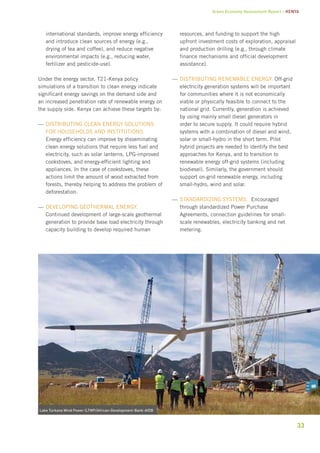
Assessment Report 
Kenya
ii 
Copyright © United Nations Environment Programme, 2014 
This publication may be reproduced in whole or in part and 
in any form for educational or non-profit purposes without 
special permission from the copyright holder, provided 
acknowledgement of the source is made. UNEP would 
appreciate receiving a copy of any publication that uses this 
publication as a source. 
No use of this publication may be made for resale or for 
any other commercial purpose whatsoever without prior 
permission in writing from the United Nations Environment 
Programme. 
Citation 
UNEP. (2014). Green Economy Assessment Report – Kenya 
Disclaimer 
The designations employed and the presentation of the 
material in this publication do not imply the expression of 
any opinion whatsoever on the part of the United Nations 
Environment Programme concerning the legal status of 
any country, territory, city or area or of its authorities, 
or concerning delimitation of its frontiers or boundaries. 
Moreover, the views expressed do not necessarily represent 
the decision or the stated policy of the United Nations 
Environment Programme, nor does citing of trade names or 
commercial processes constitute endorsement. 
UNEP promotes 
environmentally sound practices 
globally and in its own activities. This 
publication is printed on 100% recycled 
paper, using vegetable inks and other eco-friendly 
practices. Our distribution policy 
aims to reduce UNEP’s carbon footprint. 
Front cover photo: UN Photo 
Back cover photos: Above, Curt Carnemark/World Bank; middle, 
Peter Prokosch; below: Joy of Seth.
Green Economy Assessment Report – Kenya 
iii 
table of contents 
List of figures 
List of tables 
List of boxes 
Acknowledgements 
Foreword 
Key messages 
1 Introduction 
1.1 The concept of a green economy 
1.2 Context of the study – objectives, process and partners 
2 Macroeconomic profile and overarching challenges to the economy 
2.1 Macroeconomic profile 
2.2 Environmental footprint 
2.3 Social profile 
2.4 Policy and legal landscape 
3 Key sectors identified 
3.1 Agriculture sector 
3.1.1 Current policies 
3.1.2 Greening the agriculture sector 
3.2 Energy sector 
3.2.1 Current policies 
3.2.2 Greening the energy sector 
3.3 Manufacturing sector 
3.3.1 Current policies 
3.3.2 Greening the manufacturing sector 
3.4 Transport sector 
3.4.1 Current policies 
3.4.2 Greening the transport sector 
4 Greening model scenarios 
4.1 Sector modelling and formulation in T21 
4.1.1 Agriculture 
4.1.2 Energy sector 
4.1.3 Transport infrastructure (roads) 
4.2 Definition of scenario and assumption used to simulate green economy interventions 
4.2.1 Overview of results 
5 Discussion of policy-enabling conditions 
5.1 Regulations and standards 
5.2 Fiscal policy instruments 
5.3 Institutional and policy processes to support reforms 
5.4 Financing 
6 Conclusion and key recommendations 
Annexes 
Notes 
References 
iv 
iv 
iv 
v 
1 
2 
6 
8 
9 
10 
10 
11 
12 
16 
17 
17 
17 
17 
19 
19 
21 
21 
23 
23 
25 
25 
25 
26 
28 
28 
28 
29 
30 
30 
34 
34 
34 
35 
36 
38 
39 
42 
44
List of acronyms 
AAP Africa Adaptation Programme 
AFD Agence Française de Développement 
ASALs Arid and Semi-Arid Lands 
ASDS Agricultural Sector Development Strategy 
BAU Business-as-usual 
CAADP Comprehensive African Agricultural 
iv 
Development Programme 
CDM Clean Development Mechanism 
CIDA Canadian International Development Agency 
CIL Chandaria Industries Ltd. 
DANIDA Danish International Development Agency 
DfID UK Department for International Development 
EAC East African Community 
EAs Environmental Audits 
EIAs Environmental Impact Assessments 
EITI Extractive Industry Transparency Initiative 
FiT Feed-in Tariff 
GDP Gross Domestic Product 
GKI Greening Kenya Initiative 
GDI Gross Domestic Income 
GHG Greenhouse gas 
HACCP Hazard Analysis Critical Control Point 
HDI Human Development Index 
INTP Integrated National Transport Policy 
IVM Integrated Vector Management 
KBS Kenya Bureau of Standards 
KNBS Kenya National Bureau of Statistics 
KNCPC Kenya National Cleaner Production Centre 
KES Kenyan Shilling 
KTDA Kenya Tea Development Agency 
LCPDP Least Cost Power Development Plan 
LPG Liquefied Propane Gas 
MDGs Millennium Development Goals 
MEAS Multilateral Environmental Agreement Strategy 
MEAs Multilateral Environmental Agreements 
MEWNR Ministry of Environment, Water and Natural 
Resources 
MRTS Mass Rapid Transit System 
MTP Medium-Term Plan 
MVEC Motor Vehicle Emissions Control 
NAMAs Nationally Appropriate Mitigation Actions 
NCCAP National Climate Change Action Plan 
NCCRS National Climate Change Response Strategy 
NEMA National Environment Management Agency 
NEPAD New Partnership for Africa’s Development 
PPPs Public-Private Partnerships 
R&D Research and Development 
RECP Resource Efficient and Cleaner Production 
REDD Reducing Emissions from Deforestation and 
Forest Degradation 
SAM Social Accounting Matrix 
SD System Dynamics 
SMEs Small and Medium-Sized Enterprises 
SPS Sanitary and Phytosanitary Measures 
T21 Threshold 21 
TFP Total Factor Productivity 
UNDP United Nations Development Programme 
UNEP United Nations Environment Programme 
UNFCCC United Nations Framework Convention on 
Climate Change 
USAID US Agency for International Development 
VAT Value-Added Tax 
WTO World Trade Organization 
WWF World Wildlife Fund 
List of figures 
Figure 1. Kenya and sub-Saharan Africa average 2004- 
2012 
Figure 2. Sources of growth 
Figure 3. Energy consumption in Kenya 
Figure 4. Sources of electricity generation in Kenya 
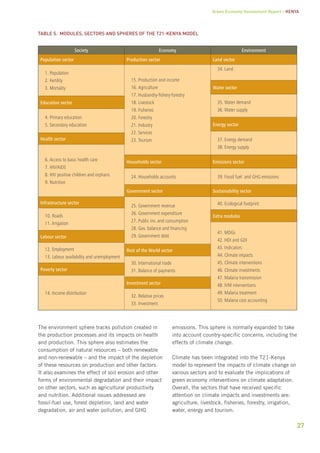
Figure 5. Cross-sectoral linkages in the T21 model 
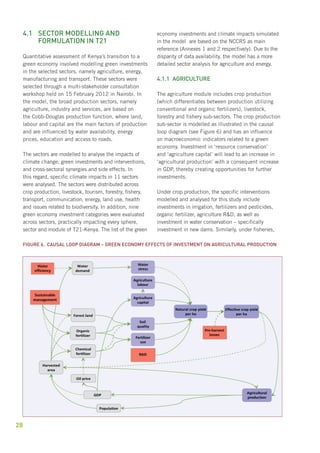
Figure 6. Causal loop diagram – green economy effects 
of investment on agricultural production 
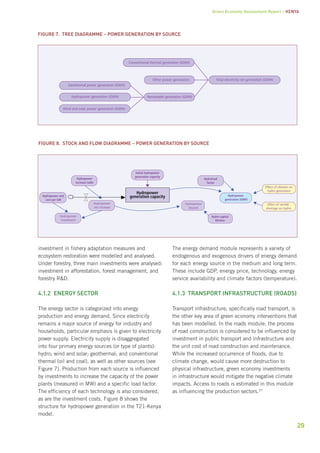
Figure 7. Tree diagramme – power generation by source 
Figure 8. Stock and flow diagramme – power generation 
by source 
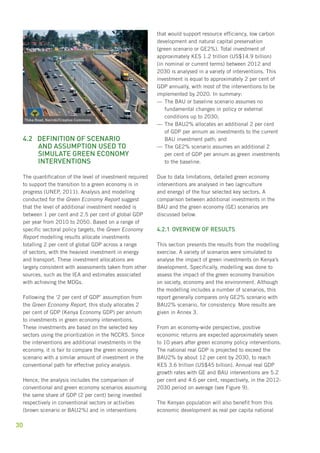
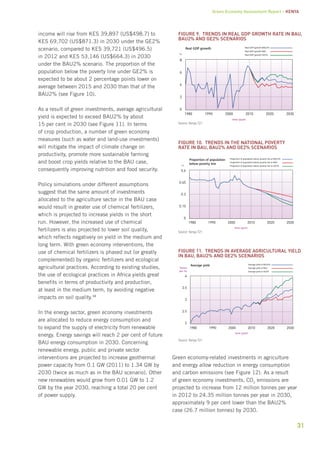
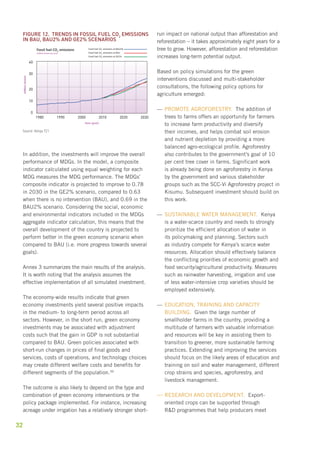
Figure 9. Trends in real GDP growth rate in BAU, 
BAU2% and GE2% scenarios 
Figure 10. Trends in national poverty rate in BAU, BAU2% 
and GE2% scenarios 
Figure 11. Trends in average agricultural yield in BAU, 
BAU2% and GE2% scenarios 
Figure 12. Trends in fossil fuel CO2 emissions in BAU, 
BAU2% and GE2% scenarios 
List of tables 
Table 1. Selected indicators of natural capital and 
environment in Kenya 
Table 2. Poverty and inequality in Kenya, 1993-2006 
Table 3. Incidence of poverty and inequality in Kenya per 
province (%), 2006, 2005 
Table 4. Policy and legal landscape provisions for a green 
economy 
Table 5. Modules, sectors and spheres of the T21-Kenya 
Model 
List of boxes 
Box 1. Just their cup of tea: sustainable farm management 
brews confidence 
Box 2. Policy sweetens rural livelihood; sugarcane energizes 
economy 
Box 3. Tissue company plying cleaner production practices 
Box 4. Public transport: speeding up green economy transition 
List of annexes 
Annex 1. Green economy investments – simulated and 
analysed 
Annex 2. Impacts of climate change – simulated and analysed 
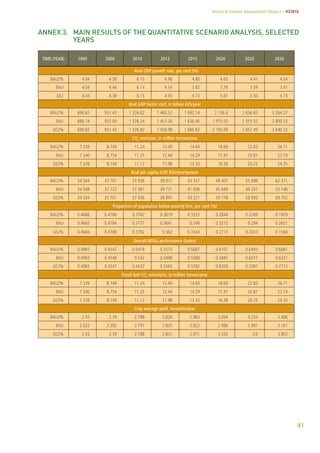
Annex 3. Main results of the quantitative scenario analysis, 
selected years 
Currency: At the time of the research in 2012, the 
exchange rate was US$ 1 = KES 80.7
Green Economy Assessment Report – Kenya 
v 
This study was commissioned by the United Nations 
Environment Programme (UNEP), at the request 
of the Ministry of Environment, Water and Natural 
Resources, on behalf of the Government of the 
Republic of Kenya. It was conducted by the Kenya 
Institute for Public Policy Research and Analysis 
(KIPPRA), with the support of the Washington-based 
Millennium Institute and the valuable research 
input from International Institute for Sustainable 
Development (IISD). The study is the result of 
national stakeholder consultations held in February 
2012 and September 2012, as well as regional 
stakeholder consultations held in April 2012 for 
communities in the coastal region, with funding from 
the World Wildlife Fund (WWF). 
UNEP is grateful for the financial support provided 
by the European Commission and the Government of 
The Netherlands. 
Representatives of the following institutions led the 
project: 
Ministry of Environment, Water and Natural 
Resources 
Alice Kaudia, Charles Mutai 
United Nations Environment Programme 
Kofi Vondolia, Moustapha Kamal Gueye, Patrick 
Mwesigye 
United Nations Development Programme 
Tim Scott 
Kenya Institute for Public Policy Research and 
Analysis 
Dickson Khainga, Rhoda Wachira, Wilfred 
Nyangena, Naomi Mathenge, Geofrey Sikei 
Millennium Institute 
Andrea M. Bassi, Zhuohua Tan 
Members of the Inter-Ministerial Committee on 
Green Economy: 
Ministry of Environment, Water and Natural 
Resources 
Moses Omedi, Stephen King’uyu, Fatuma 
Mohamed, Isabella Masinde, Simintei Kooke 
The National Treasury 
Peter Odhengo,Erastus Wahome, Obadiah Mungai 
Ministry of Devolution and Planning 
Joshua Opiyo, Florence Were 
Ministry of Energy and Petroleum 
Esther Wangombe 
Ministry of Land, Housing and Urban Development 
Mary Ndungu 
Ministry of East African Affairs, Commerce and 
Tourism 
David Gitonga 
Ministry of Agriculture, Livestock and Fisheries 
Michael Obora 
Kenya Cleaner Production Centre 
Jane Nyakang’o 
Kenya Association of Manufacturers/Kenya Private 
Sector Alliance 
Martha Cheruto, Suresh Patel 
World Wide Fund for Nature 
Jackson Kiplagat 
Green Africa Foundation 
John Kioli 
UNEP would like to thank Jason Dion (IISD), 
Veronika Gyuricza (International Energy Agency) and 
Kazuo Matsushita (Institute for Global Environmental 
Studies) for their valuable research input and 
comments. 
At UNEP, the project was managed by Joy Kim, 
under the overall guidance of Steven Stone, Chief 
of the Economics and Trade Branch, and Desta 
Mebratu, Deputy Director, Regional Office for Africa. 
Mamadou Diakhite and Asad Naqvi contributed to 
the report. Administrative support was provided by 
Désirée Leon, Fatma Pandey and Rahila Somra. 
The report was edited by Qurratul-Ain Haider, Diwata 
Hunziker, Leigh Ann Hurt and Dambudzo Muzenda. 
The layout design was done by Thomas Gianinazzi. 
Acknowledgements
vi 
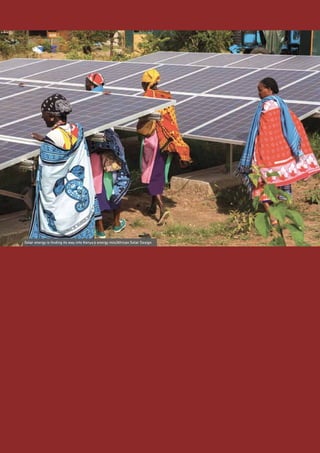
Solar energy is finding its way into Kenya’s energy mix/African Solar Design
Green Economy Assessment Report – Kenya 
i 
FOREWORD 
Kenya has one of the most dynamic economies in Africa, yet it is facing a number of pressing economic, 
environmental and social challenges. From climate change and natural resource depletion to high poverty 
rates and rising unemployment, the country is addressing these concerns through its commitment to a 
low-carbon and resource-efficient development pathway. 
In recent years, Kenya has adopted several green economy-related approaches and policies, which include 
implementing renewable energy feed-in tariffs in 2008, embedding sustainable natural resource utilization 
into its 2010 Constitution and mainstreaming green economy in its Second Medium Term Plan (2013-2017). 
Kenya is already moving towards a green economy. However, there is still untapped potential to pursue a 
development pathway that will create green jobs, accelerate poverty reduction, support sustainable growth and 
restore environmental health and quality. With targeted policy interventions and financing, the country can 
continue to generate new opportunities from this transition. 
In this context, the Ministry of Environment, Water and Natural Resources, in partnership with UNEP, 
commissioned a study to assess the economic benefits and challenges of investing in priority economic 
sectors in support of Kenya’s transition to a green economy. Conducted in collaboration with the Kenya 
Institute of Public Policy Research and Analysis (KIPPRA) and the Millennium Institute, the study examines 
investments under “business-as-usual” (BAU) compared to green economy scenarios in four key sectors that 
are critical for the country’s green growth, namely: agriculture, energy, manufacturing and transport. 
The results of this assessment will contribute not only to the realisation of Kenya’s Vision 2030, but also 
to the ongoing debate on how the transition to a green economy can serve as an enabler of sustainable 
development, poverty alleviation and green job creation. 
Judi W. Wakhungu 
Cabinet Secretary 
Ministry of Environment, Water & Natural Resources 
Republic of Kenya 
Achim Steiner 
Under-Secretary General of the United Nations 
and Executive Director of UNEP
2 
Kenya is embarking on a new era of 
development. In response to a number of 
pressing economic, environmental and social 
concerns – such as the increasing rural to urban 
migration, need for job creation for youth, and 
degradation of valuable ecosystems – Kenya has 
established key policies and programmes for a green 
economy: 
——The country has developed a national climate 
change response strategy and action plan, and 
seeks to embrace a low-carbon development 
pathway that is inclusive and equitable, and 
contributes to its global competitiveness. 
——Through the Greening Kenya Initiative (GKI), the 
government has developed a database on green 
economy activities, which highlights efforts on 
the manufacturing of eco-friendly materials, tree 
planting, organic farming, fish farming, renewable 
energy, eco-labelling, solid waste management 
and environmental management, among others. 
——The country’s long-term development blueprint, 
Kenya Vision 2030, launched in 2008, 
aims to transform the country into “a newly 
industrializing, middle-income country, providing 
a high quality of life to all its citizens in a clean 
and secure environment” by 2030. 
——The Constitution of Kenya 2010, in Article 42, 
recognizes a healthy environment as a right and 
calls for “sustainable exploitation, utilization, 
management and conservation of the environment 
and natural resources.” 
——More recently, the government’s Medium-Term 
Plan (2013-2017) endorsed the development 
of a comprehensive national green economy 
strategy. 
The next wave of investment and 
innovation in Kenya will be driven by 
the need for new energy sources, 
wealth generation and job creation. 
For instance, green investments are expected in 
renewable energy, resource-efficient and clean 
production, pollution control, waste management, 
environmental planning and governance, and the 
restoration of forests and other vital ecosystems. 
——Roughly 42 per cent of the country’s GDP is 
derived from natural resource sectors, such as 
agriculture, mining, forestry, fishing and tourism, 
while 42 per cent of the total employment comes 
from small scale agriculture and pastoralism. 
Under a green economy scenario, an investment 
in “resource conservation” and “agriculture 
capital” can lead to an increase in agriculture 
production, and thus increase GDP, investment 
and employment opportunities. 
——Under a green economy scenario, real per capita 
income in Kenya is expected to nearly double by 
2030, outpacing income growth under business-as- 
usual (BAU) scenario. 
The transition to a green economy can 
deliver important benefits, such as 
relatively high long-term economic 
growth, a cleaner environment and 
high productivity. The quantitative analyses 
undertaken to assess the economy-wide impact of 
green investments, under different scenarios, shows 
that significant positive returns can be realized after 
only seven to 10 years. 
—— In the short-term (from 2010 to 2020), in 
spite of costs associated with green economy 
investments, growth in GDP would not be 
substantially different compared to business-as-usual. 
However, the prices of goods and services, 
costs of operations and technology choices could 
create different welfare costs and benefits for 
different segments of the population in the short-term 
which require careful attention and “social 
protection floors” as needed to ensure a smooth 
and just transition. 
—— In the long-term (from 2010 to 2030), the 
analysis finds that a green economy scenario 
results in faster economic growth and increased 
wealth creation opportunities. For example, 
under a green economy scenario, national real 
Key messages
Green Economy Assessment Report – Kenya 
3 
GDP is projected to exceed the BAU investment 
scenario by 12 per cent by 2030. Furthermore, 
green economy investments can yield several 
positive impacts in the medium to long-term 
across all sectors in the economy. 
Green economy-related investments 
in the agriculture, energy, 
manufacturing and transport sectors 
could help lower energy consumption 
and carbon emissions. While CO2 
emissions 
are projected to increase from 12 million tonnes 
per year in 2012 to 24.35 million tonnes per year 
in 2030 in the agriculture and energy sector alone, 
under a green economy scenario, emissions would 
be approximately nine per cent lower than BAU 
investment scenario (26.7 million tonnes). 
The Mau Forest complex in Kenya provides goods and 
services worth US$1.5 billion a year through water for 
hydroelectricity, agriculture, tourism and urban and 
industrial use, as well as erosion control and carbon 
sequestration. Alternative accounting has helped spur 
the government of Kenya to invest in rehabilitating the 
area and its vital ecological services. 
Examining various green economy investment 
scenarios, the report proposes sector-specific policy 
interventions that have been validated through 
multiple consultations with stakeholders. 
Agriculture 
Agriculture accounts for about one quarter of Kenya’s 
GDP, and an estimated 64 per cent of households 
are engaged in farming activities, while 84 per cent 
of rural households keep livestock. Given the vital 
role of natural capital in the Kenyan economy, smart 
investment in agriculture can boost productivity and 
protect scarce natural resources. Average agricultural 
yield under the green economy investment scenario 
would exceed that of the BAU investment scenario 
by about 15 per cent by 2030. 
While the report finds that the same amount of 
investments allocated to the agriculture sector 
under BAU would result in increased yields in the 
short-term, it would also result in increased use of 
chemical fertilizers and lower soil quality, which 
would reflect negatively on yields in the medium and 
long term. 
Thus, the report outlines the benefits of scaling-up 
efforts in agro-forestry; sustainable water 
management, such as rainwater harvesting for 
irrigation; education, training and capacity building, 
mainly in soil and water management; and research 
and development. By supporting green agricultural 
practices, such as organic farming, fish farming and 
post-harvest loss reduction, Kenya can enhance job 
creation, nutrition and food security. 
Energy 
Green energy investments could lead to about a 
2 per cent reduction in energy consumption and 
an expanded supply of electricity from renewable 
sources compared to a BAU investment scenario. 
Under the green economy investment scenario, 
renewable energy is projected to double geothermal 
power capacity by 2030, compared to the BAU 
investment scenario. Other renewables would also 
grow during this period, contributing to 20 per cent 
of the total power supply. 
The report also outlines several options that the 
government could pursue in this sector, including 
adopting targeted clean energy solutions for 
households and institutions, such as energy-efficient 
lighting and appliances, and providing additional 
investment in renewable sources, such as geothermal, 
solar, wind and biofuel energy. In addition, the report 
finds that the distribution of renewable energy and 
small-scale off grid systems has the potential to 
contribute substantially to environmental conservation 
and increased access to electricity. 
Manufacturing 
Even though the contribution of the manufacturing 
sector to GDP has levelled off at about 10 per cent 
over many years, Kenya still has one of the largest 
manufacturing sectors in Sub-Saharan Africa. While 
the sector is challenged by high energy costs and
poor infrastructure, as well as weak and fragmented 
policy coordination, it has been identified as one of 
the key pillars of the Kenya Vision 2030 and various 
initiatives are underway to strengthen its productivity 
and competitiveness. 
The report finds that public policy support is needed 
to scale-up current efforts towards greening the 
sector, including eco-labelling, recycling and re-use, 
4 
and the production of eco-friendly materials. 
Also, public policy could go further to support 
resource-efficient and clean production processes; 
and, mandatory energy-efficiency audits for large 
manufacturers could be considered as part of the 
country’s overall energy-management strategy. 
Transport 
Kenya’s transport sector is growing rapidly, and as 
a result, so are its emissions, which are reportedly 
expected to triple between 2010 and 2030. In 
the last decade alone, the number of vehicles 
on the road doubled for instance. This is further 
exacerbated by limited public transport, which is 
mostly dominated by privately-owned mini buses and 
a lack of emission standards. 
The report recognizes that the government has 
taken significant steps to regulate the sector and 
reduce harmful pollutants. However, it suggests the 
government could consider taking further action by 
creating incentives that would lower the age profile 
of Kenya’s passenger and freight vehicle fleet; 
promoting mass transit, especially rail and public 
transport; and, integrating land use and transport 
planning to enhance efficiency. 
Key components of a green 
economy transition 
An overall enabling policy environment 
that underpins a green economy is 
fundamental for the success of sector-specific 
green initiatives and investments. 
The underlying institutional and policy processes, 
regulations and standards, financial resources and 
fiscal instruments that support Kenya’s transition to 
a green economy are essential components of the 
overall strategy. 
——Fisacl policy instruments. Aligning 
fiscal policy instruments, including taxation, 
subsidies, procurement and public expenditure 
allocations, is vital for the transition to a green 
economy. In this regard, Kenya can review the 
existing revenue, expenditure and taxation policy 
landscape and identify areas where pricing 
instruments can be introduced, subsidies can 
be eliminated or incentives could be provided 
to support resource efficiency and increase 
employment. Key design issues, including impact 
on the poor, administrative costs and impact on 
competitiveness, need careful consideration. 
——Financing. Continued participation in 
international climate financing mechanisms, and 
engaging with the Green Climate Fund, National 
Appropriate Mitigation Actions (NAMAs) and 
Reducing Emissions from Deforestation and Forest 
Degradation (REDD), among others, can help 
ease fiscal pressures and attract private sector 
participation in green investment. Other areas of 
actions include demonstrating transparency and 
solid fiscal management to attract international 
and domestic funding; encouraging the transition 
to a green economy through Kenya banks, asset 
managers and bankers associations, for example 
to create a National Climate Fund; introducing 
and enforcing environmental taxes; and 
facilitating the participation of the private sector 
through Public-Private Partnerships (PPPs). 
—— Institutional and policy processes 
to support reforms. Most green economy 
initiatives are multi-sectoral and involve multi-stakeholder 
participation. In this regard, a 
coordinated and strategic approach is essential 
to align policies and support. These approaches 
include sustainable public procurement that 
promotes green products and services; engaging 
local communities and county governments 
in the formulation and implementation of 
green policy interventions; encouraging 
transparency, participation and accountability 
in the exploitation of Kenya’s natural resources; 
improving collection and dissemination of 
green economy related data such as biodiversity 
inventories, GHG emission inventories and 
environmental satellite accounts; and engaging 
internationally on the appropriate international 
policy environment needed for a green economy.
Green Economy Assessment Report – Kenya 
5 
——Regulations and stanaddrs. There are 
important opportunities for Kenya to enhance 
compliance and enforcement of existing 
regulations and standards, such as those related 
to biodiversity, energy, noise, quality of water, 
waste disposal and management, and physical 
planning to support the transition to a green 
economy. Various standards are increasingly being 
applied in international trade, such as Sanitary 
and Phyto-sanitary measures (SPS) and Hazard 
Analysis and Critical Control Point (HACCP) 
regulations, which relate to food safety and 
animal and plant health; and technical standards, 
which relate to product standards and labelling. 
These are equally important for competitiveness 
and access to emerging new international 
markets. 
Recommendations for action 
A roadmap for moving Kenya to a globally 
competitive green economy by 2030, consistent with 
the goals of Kenya Vision 2030 and the provisions of 
the Constitution of Kenya 2010, could consider the 
following priority actions and guiding principles: 
—— Recognize that the green economy transition 
will support the goals of Kenya Vision 2030, by 
pursuing the country’s development as a priority; 
—— Design green economy policies to create 
youth employment, especially given Kenya’s 
demographic profile; 
—— Engage stakeholders, including industry, civil 
society and the public at national and county 
levels, to facilitate participation and buy-in; 
—— Consider sector-specific policy scenarios and 
options for a transition to a green economy to 
help inform policy on potential costs, risks and 
opportunities, trade-offs and the range of sector 
strategies; 
—— Align fiscal policy instruments to enhance 
renewable energy and encourage job creation in 
Kenya; 
—— Leverage international assistance frameworks 
aimed at enhancing aid effectiveness, to support 
a green economy. This could include climate 
finance mechanisms as well as international 
financial and technological support schemes; 
—— Adopt environmental and technical standards 
to ensure Kenya is not disadvantaged by the 
changing institutional framework governing 
international trade; and 
——Strengthen data collection, data quality and the 
reach of the national statistical system to support 
policy formulation, monitoring and evaluation of 
the transition to a green economy. 
Finally, the report demonstrates how Kenya’s 
continued leadership to advance its green economy, 
combined with targeted policy interventions 
and financing in key sectors can rapidly boost 
opportunities to accelerate this transition, while 
maintaining its broader development goals. More 
specifically, the report underscores that Kenya’s 
green economy approach has the potential to build a 
transformative development pathway that will create 
green jobs, accelerate poverty reduction, support 
sustainable growth, and restore environmental health 
and quality as a foundation for future prosperity and 
well-being. 
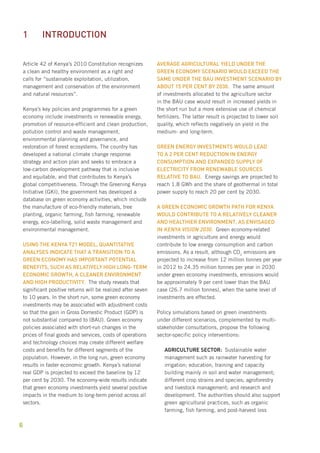
Souvenir market in Kenya/World Bank Photo Collection
Article 42 of Kenya’s 2010 Constitution recognizes 
a clean and healthy environment as a right and 
calls for “sustainable exploitation, utilization, 
management and conservation of the environment 
and natural resources”. 
Kenya’s key policies and programmes for a green 
economy include investments in renewable energy, 
promotion of resource-efficient and clean production, 
pollution control and waste management, 
environmental planning and governance, and 
restoration of forest ecosystems. The country has 
developed a national climate change response 
strategy and action plan and seeks to embrace a 
low-carbon development pathway that is inclusive 
and equitable, and that contributes to Kenya’s 
global competitiveness. Through the Greening Kenya 
Initiative (GKI), the government has developed a 
database on green economy activities, which include 
the manufacture of eco-friendly materials, tree 
planting, organic farming, fish farming, renewable 
energy, eco-labelling, solid waste management and 
environmental management. 
Using the Kenya T21 model, quantitative 
analyses indicate that a transition to a 
green economy has important potential 
benefits, such as relatively high long-term 
economic growth, a cleaner environment 
and high productivity. The study reveals that 
significant positive returns will be realized after seven 
to 10 years. In the short run, some green economy 
investments may be associated with adjustment costs 
so that the gain in Gross Domestic Product (GDP) is 
not substantial compared to (BAU). Green economy 
policies associated with short-run changes in the 
prices of final goods and services, costs of operations 
and technology choices may create different welfare 
costs and benefits for different segments of the 
population. However, in the long run, green economy 
results in faster economic growth. Kenya’s national 
real GDP is projected to exceed the baseline by 12 
per cent by 2030. The economy-wide results indicate 
that green economy investments yield several positive 
impacts in the medium to long-term period across all 
sectors. 
6 
Average agricultural yield under the 
green economy scenario would exceed the 
same under the bau investment scenario by 
about 15 per cent by 2030. The same amount 
of investments allocated to the agriculture sector 
in the BAU case would result in increased yields in 
the short run but a more extensive use of chemical 
fertilizers. The latter result is projected to lower soil 
quality, which reflects negatively on yield in the 
medium- and long-term. 
Green energy investments would lead 
to a 2 per cent reduction in energy 
consumption and expanded supply of 
electricity from renewable sources 
relative to BAU. Energy savings are projected to 
reach 1.8 GWh and the share of geothermal in total 
power supply to reach 20 per cent by 2030. 
A green economic growth path for Kenya 
would contribute to a relatively cleaner 
and healthier environment, as envisaged 
in kenya Vision 2030. Green economy-related 
investments in agriculture and energy would 
contribute to low energy consumption and carbon 
emissions. As a result, although CO2 emissions are 
projected to increase from 12 million tonnes per year 
in 2012 to 24.35 million tonnes per year in 2030 
under green economy investments, emissions would 
be approximately 9 per cent lower than the BAU 
case (26.7 million tonnes), when the same level of 
investments are effected. 
Policy simulations based on green investments 
under different scenarios, complemented by multi-stakeholder 
consultations, propose the following 
sector-specific policy interventions: 
Agriculture sector: Sustainable water 
management such as rainwater harvesting for 
irrigation; education, training and capacity 
building mainly in soil and water management; 
different crop strains and species; agroforestry 
and livestock management; and research and 
development. The authorities should also support 
green agricultural practices, such as organic 
farming, fish farming, and post-harvest loss 
1 Introduction
Green Economy Assessment Report – Kenya 
7 
reduction to support job creation, nutrition and 
food security. 
Energy sector: Targeted clean energy 
solutions for households and institutions, such 
as energy-efficient lighting and appliances; 
investment in renewable sources, such as 
geothermal, solar, wind and biofuel energy. 
Renewable energy and small-scale off grid 
systems have the potential to contribute 
substantially to environmental conservation and 
to increased access to electricity. 
Manufacturing sector: Public policy 
should support scaling up of current efforts 
towards greening the sector, including eco-labelling, 
recycling and re-use, and production 
of eco-friendly materials, as well as resource-efficient 
and clean production processes. 
Mandatory energy-efficiency audits for large 
manufacturers should be considered as part of 
the overall energy management strategy. 
Transport sector: The government should 
pursue incentives to facilitate the transition of 
Kenya’s passenger and freight vehicle fleet to one 
with a lower age profile; promote mass transit, 
especially rail and public transport; and integrate 
land use and transport planning to enhance 
efficiency. 
An overall enabling policy environment that 
underpins a green economy is fundamental for the 
success of sector-specific green interventions and 
investments. In order to support Kenya’s transition to 
a green economy, the following essential components 
have been identified: 
Institutional and policy processes to 
support reforms. Most green economy 
initiatives are multi-sectoral and involve multi-stakeholder 
participation. In this regard, 
a coordinated and strategic approach is 
essential to align policies and support. These 
approaches include public procurement that 
promotes green products and services; engaging 
local communities and county governments 
in the formulation and implementation of 
green policy interventions; encouraging 
transparency, participation and accountability 
in the exploitation of Kenya’s natural resources; 
improving collection and dissemination of 
green economy related data such as biodiversity 
inventories, GHG emission inventories and 
environmental satellite accounts; and engaging 
internationally on the appropriate international 
policy environment needed for a green economy. 
Regulations and standards. Kenya needs 
to enhance compliance and enforcement of 
existing regulations and standards, such as 
those related to biodiversity, energy, noise, water 
quality, waste disposal and management, and 
physical planning to support the transition to a 
green economy. Various standards are increasingly 
being applied in international trade, such as 
Sanitary and Phytosanitary measures (SPS) 
and Hazard Analysis and Critical Control Point 
(HACCP) regulations, which relate to food safety 
and animal and plant health, and technical 
standards, which relate to product standards 
and labelling. These are equally important for 
competitiveness and access to international 
markets. 
Fiscal policy instruments. Aligning fiscal 
policy instruments – including taxation, green 
subsidies, procurement and public expenditure 
allocations – can support the transition to a green 
economy. In this regard, Kenya should review the 
current environmental tax landscape and identify 
areas where taxes or charges can be introduced, 
eliminated or raised to support environmental 
protection, conservation and resource efficiency. 
Key design issues, including impact on the 
poor, administrative costs and impact on 
competitiveness, need to be appropriately 
addressed. 
Financing. Continued participation in 
international climate financing mechanisms, 
such as the Green Climate Fund, National 
Appropriate Mitigation Actions (NAMAs) and 
Reducing Emissions from Deforestation and 
Forest Degradation (REDD), can help ease fiscal 
pressures and attract private sector participation 
in green investment. Other actions include 
demonstrating transparency and solid fiscal 
management to attract international funding, 
encouraging the transition to a green economy 
through domestic sources of financing (e.g., 
creating a National Climate Fund), introducing
8 
and enforcing environmental taxes, and 
facilitating the participation of the private sector 
through Public-Private Partnerships (PPPs). 
Consistent with the goals of Kenya Vision 2030 and 
the provisions of the Constitution of Kenya 2010, a 
roadmap for moving Kenya to a globally competitive 
green economy by 2030 should consider the 
following priority actions and guiding principles: 
—— Recognize that the green economy transition 
should support the goals of Kenya Vision 2030, 
i.e. pursuing the country’s development as a 
priority; 
—— Take cognizance of the impact of green economy 
policies on youth employment during decision-making, 
given Kenya’s demographic profile; 
—— Engage stakeholders, including industry, civil 
society and the public at national and county 
levels, to facilitate participation and buy-in; 
—— Consider sector-specific policy scenarios and 
options for transitioning to a green economy to 
help inform policy on potential costs, risks and 
opportunities, trade-offs and the range of sector 
strategies; 
—— Align fiscal policy instruments to support a green 
economy in Kenya; 
—— Leverage international assistance frameworks 
aimed at enhancing aid effectiveness to support 
a green economy. This should include climate 
finance mechanisms as well as international 
financial and technological support schemes; 
—— Bear in mind that environmental and technical 
standards will become increasingly important in 
international trade and that Kenya should move 
to ensure it is not disadvantaged by the changing 
institutional framework governing international 
trade; and 
—— Strengthen data collection, data quality and 
the reach of the national statistical system to 
support policy formulation, monitoring and 
evaluation of the transition to a green economy. 
1.1 The concept of a green 
economy 
In recent years, interest in the ‘green economy’ has 
grown rapidly, due largely to economic, social and 
environmental challenges, including climate change, 
natural resource depletion, inequality, unemployment 
and loss of biodiversity and ecosystem services. 
The UNEP Green Economy Report defines a green 
economy as one that results in improved human well-being 
and social equity, while significantly reducing 
environmental risks and ecological scarcities.1 It 
entails essentially a low-carbon, resource-efficient 
and socially-inclusive economy. The concept 
presents a new paradigm in development thinking, 
emphasizing growth that is friendly to the earth’s 
ecosystems and that can also contribute to poverty 
alleviation. It is an approach to achieve sustainable 
development and requires a transformation of 
production and consumption ways into one that 
enhances and preserves environmental quality, while 
using energy, water and natural resources more 
efficiently. 
There is no generic model for a green economy. 
The specific case of Kenya requires an emphasis 
on achieving the goals of Kenya Vision 2030, 
Kenya’s long-term development blueprint. Kenya 
Vision 2030 aims to transform Kenya into “a newly 
industrialising, middle-income country providing 
a high quality of life to all its citizens in a clean 
and secure environment.”2 Sustainable growth 
in Kenya requires modernization, meaning huge 
investments in infrastructure and increased demand 
for electricity. In addition, Kenya is experiencing 
increased rural-to-urban migration and needs to 
create employment opportunities for a large, youthful 
population. Kenya is embarking on a new era of 
development with recent discoveries of oil, natural 
gas, coal and other minerals. Undertaking a green 
economy transition now can allow the country to 
take advantage of growing revenues and invest 
in a development pathway that puts people and 
livelihoods at the forefront.
Green Economy Assessment Report – Kenya 
9 
1.2 Context of the study – 
objectives, process and 
partners 
The aim of this study is to identify how Kenya can 
transition its key sectors – agriculture, energy, 
manufacturing and transport – towards a green 
economy pathway. It provides a profile of the country 
in terms of its economy, environment, socioeconomic 
context and policy landscape. An overview of the 
key sectors for greening the economy as well as the 
modelling done to assess the impacts of a transition 
to green economy is discussed. The report also 
provides the key findings and outlines the policy-enabling 
conditions and a roadmap for moving 
forward. 
The basis of this report is the work undertaken by 
the Kenya Institute for Public Policy Research and 
Analysis (KIPPRA) and the Ministry of Environment, 
Water and Natural Resources (MEWNR) in 
partnership with UNEP to develop a Green Economy 
Assessment Report. The report was produced in 
collaboration with relevant UNEP and international 
experts through a participatory and consultative 
process that involved various key stakeholders, to 
ensure a maximum degree of ownership. 
The International Institute for Sustainable 
Development (IISD) provided research assistance, 
drawing on UNEP publications, including the Green 
Economy Report. Through a multi-stakeholder 
consultation workshop, four sectors were identified, 
namely, agriculture, energy, manufacturing and 
transport. 
The study relied on quantitative and qualitative 
economic analysis in order to generate policy 
advice and recommendations. In addition to a desk 
literature review and stakeholder consultations, 
this study has benefited from the application of 
an integrated planning model called Threshold 21 
(T21) based on investment simulations to assess 
the impact of a transition to a green economy. 
T21 is a dynamic simulation tool designed to 
support comprehensive and integrated long-term 
development planning. The model integrates 
economic, social and environmental factors in its 
analysis, thereby providing insight into the potential 
impact of development policies across a wide range 
of sectors and revealing how different strategies 
interact to achieve desired objectives. The model was 
originally developed as part of the Africa Adaptation 
Programme (AAP) that was supported by the United 
Nations Development Programme (UNDP). 
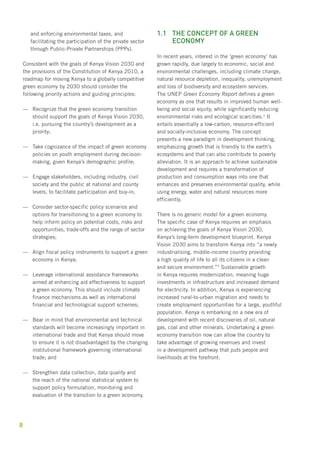
Kenyan woman holding sorghum/Bioversity International
2 Macroeconomic profile and overarching 
challenges to the economy 
2.1 Macroeconomic profile 
Kenya’s economy is the largest within the East 
African Community (EAC), which comprises Burundi, 
Kenya, Rwanda, Tanzania and Uganda. Nonetheless, 
Kenya is considered a low-income country with 
an estimated GDP per capita of US$862 in 2012 
(World Bank, 2013). Between 2003 and 2007, 
the economy registered sustained economic growth 
and by 2007, GDP growth reached 7 per cent. This 
growth was not sustained due to multiple shocks 
emanating from a political crisis in 2007/08, 
drought, high global energy and food prices and the 
global financial crisis. Economic growth fell to 1.5 
per cent in 2008, before increasing to 2.7 per cent 
in 2009. In 2010, the economy grew by 5.8 
per cent and slowed to 4.4 per cent in 2011 and 4.6 
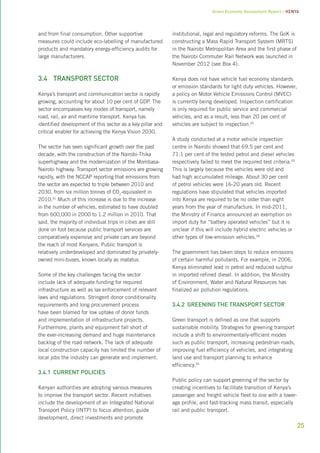
per cent in 2012.3 Nonetheless, in the recent past, 
Kenya’s growth has remained below the sub-Saharan 
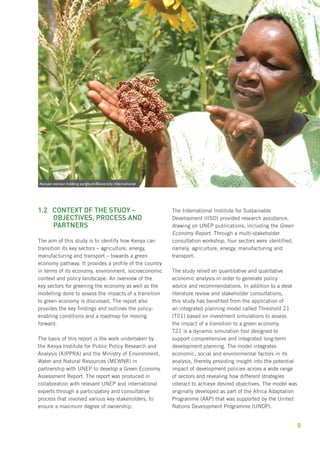
Africa average (see Figure 1). 
10 
Agriculture is one of the leading sectors, accounting 
for about one quarter of Kenya’s GDP. An estimated 
60 per cent of all households are engaged in farming 
activities and 84 per cent of rural households 
keep livestock. Roughly 64 per cent of all Kenyan 
households live in rural areas.4 Around 42 per cent 
of GDP is derived from natural resource sectors 
(namely agriculture, mining, forestry, fishing, 
tourism, water supply and energy), which account for 
more than 70 per cent of employment. The services 
sector, which includes transport and communication, 
wholesale and retail trade, financial and other 
services, accounts for about half of GDP. The share 
of the manufacturing sector in GDP has stagnated 
at about 10 per cent indicating that the rate of 
industrialization has been slow.5 
Recent trends in key macroeconomic variables 
reveal that, although external demand for Kenyan 
goods and services has increased, growth has largely 
been driven by increases in domestic demand, 
especially private consumption and investment. 
Private consumption accounts for about three 
quarters of GDP. Savings and investment rates were 
estimated at about 13.2 per cent and 21 per cent 
respectively in 2011. The economy’s performance 
in terms of external trade in goods and services also 
came under considerable pressure. Kenya’s external 
current account deficit increased from about 2.3 
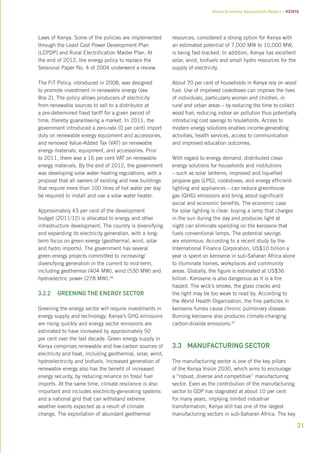
Figure 1. GDP growth: Kenya and sub-Saharan Africa, 2004-2012 
Kenya Sub-Saharan Africa average 
2004 2005 2006 2007 2008 2009 2010 2011 2012 
8 
7 
6 
5 
4 
3 
2 
1 
0 
Source: International Monetary Fund (IMF), World Economic Outlook Database, October 2013.
Green Economy Assessment Report – Kenya 
11 
per cent of GDP in 2006 to 11.9 per cent in 2012. 
The worsening external current account position 
has largely been due to a rapid growth in key 
imports, especially oil, capital goods and machinery, 
compared to growth in exports. 
While it is relatively strong by regional standards, 
Kenya’s performance in terms of mobilization of fiscal 
resources has come under increased pressure in the 
recent past. Revenue collection as a percentage of 
GDP increased from about 20.2 per cent in 2007/08 
to about 22.07 per cent in 2010/11. On the other 
hand, total expenditure as a percentage of GDP 
increased from about 27.3 per cent to about 29.5 
per cent over the same period. The fiscal deficit 
(excluding grants) increased from 5.3 per cent in 
2007/08 to 7.2 per cent in 2009/10 and is estimated 
at about 5 per cent in 2010/11. The government’s 
fiscal target is to reduce the fiscal deficit to below 4 
per cent of GDP in the medium term. 
Kenya’s total debt to GDP ratio has also increased 
in the recent past, from about 41.2 per cent of GDP 
in 2008 to 48 per cent in 2010. There has been 
increased reliance on domestic borrowing. The share 
of domestic debt in total debt increased from 40 
per cent in 2006 to 50.3 per cent in 2010. In the 
recent past, the main sources of fiscal pressure arise 
from: 
—— the need to sustain economic recovery in the 
face of external shocks including drought, high 
oil prices and the global financial and economic 
crisis; 
——weak revenue performance due to subdued 
economic performance; 
—— increased investment in infrastructure consistent 
with the medium-term plan targets; and 
—— the obligation to implement the 2010 
Constitution, which provides for a devolved 
government system of 47 county governments. 
2.2 Environmental footprint 
A country’s ecological footprint is the area of 
productive land and aquatic ecosystems required 
to produce resources and assimilate wastes at a 
specific material standard of living, wherever that 
land may be located.6 For Kenya, this was 1.11 ha/ 
person in 2007, compared to a global average of 2.7 
ha/person and a global average biocapacity of 1.8.7 
Although Kenya’s ecological footprint per person 
is considered low and is below the global average 
biocapacity, the country continues to move rapidly 
into a state of “ecological overshoot”, or simply, the 
rate at which natural resources are depleted faster 
than the rate at which they are replaced. This is 
reflected in the 37.5 per cent increase in Kenya’s 
ecological footprint from 0.8 in 2003 to 1.11 in 
2007. 
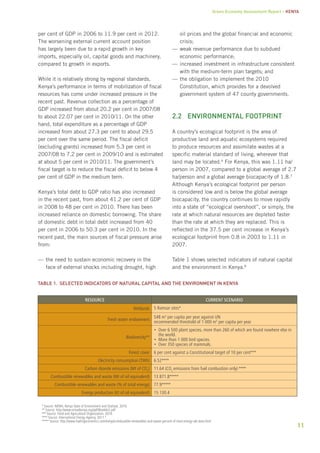
Table 1 shows selected indicators of natural capital 
and the environment in Kenya.8 
Table 1. Selected indicators of natural capital and the environment in Kenya 
Resource Current scenario 
Wetlands 5 Ramsar sites* 
Fresh water endowment 548 m3 per capita per year against UN 
recommended threshold of 1 000 m3 per capita per year 
Biodiversity** 
• Over 6 500 plant species, more than 260 of which are found nowhere else in 
the world. 
• More than 1 000 bird species. 
• Over 350 species of mammals. 
Forest cover 6 per cent against a Constitutional target of 10 per cent*** 
Electricity consumption (TWh) 6.52**** 
Carbon dioxide emissions (Mt of CO2) 11.64 (CO2 emissions from fuel combustion only) **** 
Combustible renewables and waste (Mt of oil equivalent) 13 871.8***** 
Combustible renewables and waste (% of total energy) 77.9***** 
Energy production (Kt of oil equivalent) 15 130.4 
* Source: NEMA, Kenya State of Environment and Outlook, 2010. 
** Source: http://www.virtualkenya.org/pdf/Booklet2.pdf 
*** Source: Food and Agricultural Organization, 2010. 
**** Source: International Energy Agency, 2011.9 
***** Source: http://www.tradingeconomics.com/kenya/combustible-renewables-and-waste-percent-of-total-energy-wb-data.html
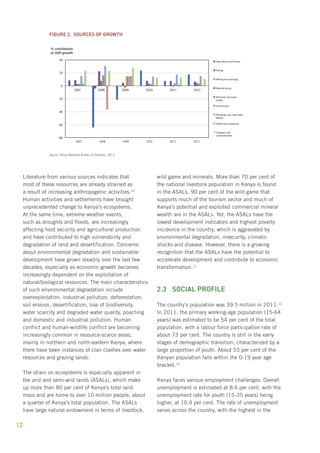
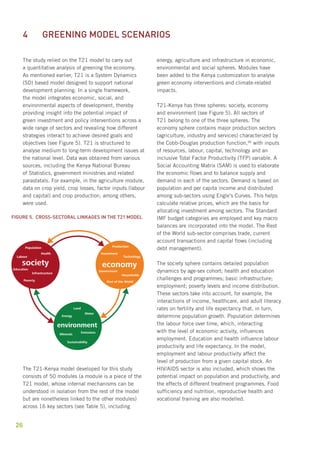
Figure 2. Sources of growth 
40 
20 
0 
-20 
-40 
-60 
Literature from various sources indicates that 
most of these resources are already strained as 
a result of increasing anthropogenic activities.10 
Human activities and settlements have brought 
unprecedented change to Kenya’s ecosystems. 
At the same time, extreme weather events, 
such as droughts and floods, are increasingly 
affecting food security and agricultural production 
and have contributed to high vulnerability and 
degradation of land and desertification. Concerns 
about environmental degradation and sustainable 
development have grown steadily over the last few 
decades, especially as economic growth becomes 
increasingly dependent on the exploitation of 
natural/biological resources. The main characteristics 
of such environmental degradation include 
overexploitation, industrial pollution, deforestation, 
soil erosion, desertification, loss of biodiversity, 
water scarcity and degraded water quality, poaching 
and domestic and industrial pollution. Human 
conflict and human-wildlife conflict are becoming 
increasingly common in resource-scarce areas, 
mainly in northern and north-eastern Kenya, where 
there have been instances of clan clashes over water 
resources and grazing lands. 
12 
The strain on ecosystems is especially apparent in 
the arid and semi-arid lands (ASALs), which make 
up more than 80 per cent of Kenya’s total land 
mass and are home to over 10 million people, about 
a quarter of Kenya’s total population. The ASALs 
have large natural endowment in terms of livestock, 
wild game and minerals. More than 70 per cent of 
the national livestock population in Kenya is found 
in the ASALs, 90 per cent of the wild game that 
supports much of the tourism sector and much of 
Kenya’s potential and exploited commercial mineral 
wealth are in the ASALs. Yet, the ASALs have the 
lowest development indicators and highest poverty 
incidence in the country, which is aggravated by 
environmental degradation, insecurity, climatic 
shocks and disease. However, there is a growing 
recognition that the ASALs have the potential to 
accelerate development and contribute to economic 
transformation.11 
2.3 Social profile 
The country’s population was 39.5 million in 2011.12 
In 2011, the primary working-age population (15-64 
years) was estimated to be 54 per cent of the total 
population, with a labour force participation rate of 
about 73 per cent. The country is still in the early 
stages of demographic transition, characterized by a 
large proportion of youth. About 53 per cent of the 
Kenyan population falls within the 0-19 year age 
bracket.13 
Kenya faces various employment challenges. Overall 
unemployment is estimated at 8.6 per cent, with the 
unemployment rate for youth (15-35 years) being 
higher, at 10.4 per cent. The rate of unemployment 
varies across the country, with the highest in the 
-80 
2007 2008 2009 2010 2011 2012 
Agriculture and forestry 
Fishing 
Mining and quarrying 
Manufacturing 
Electricity and water 
supply 
Construction 
Wholesale and retail trade, 
Repairs 
Hotels and restaurants 
Transport and 
Communication 
2007 2008 2009 2010 2011 2012 
% contribution 
to GDP growth 
Source: Kenya National Bureau of Statistics, 2013.
Green Economy Assessment Report – Kenya 
13 
north-eastern regions at about 23 per cent and the 
lowest in Nyanza and the western regions, estimated 
at 4.8 per cent and 5.2 per cent, respectively.14 
The level of under-employment (i.e. the proportion 
of employed people involuntarily working less than 
the normal hours of work) is also relatively high. 
The rate of under-employment of the labour force 
was 18 per cent in 2009. This rate was higher in 
rural areas than in urban areas. The informal sector 
remains the major employer, accounting for about 
80 per cent of total recorded employment (Economic 
Survey, 2013). The predominance of informal 
employment raises policy questions about the quality 
of employment. 
National absolute poverty in Kenya, based on the 
national poverty line – KES 1,239 (US$15.4) and 
KES 2,648 (US$32.8) per person per month for 
rural and urban areas respectively – declined slightly 
from 52.3 per cent in 1997 to 45.9 per cent in 
2005/06. However, there are disparities between 
rural and urban poverty rates (Gakuru and Mathenge, 
2012). Rural poverty declined from 52.9 per cent 
to 49.1 per cent, while urban poverty declined 
from 49.2 per cent to 33.7 per cent during the 
same period. The 2009 Oxford Poverty and Human 
Development Initiative report on multi-dimensional 
poverty in Kenya estimated that 27.4 per cent of 
the population in Kenya is vulnerable to poverty, 
while 19.8 per cent of the population lives in severe 
poverty. Overall estimates of poverty and youth 
unemployment levels (2005/06) show that there 
has been general improvement, declining from 56.0 
per cent and 27.2 per cent in 1999/2000 to 45.9 
per cent and 24.3 per cent in 2005/06, respectively. 
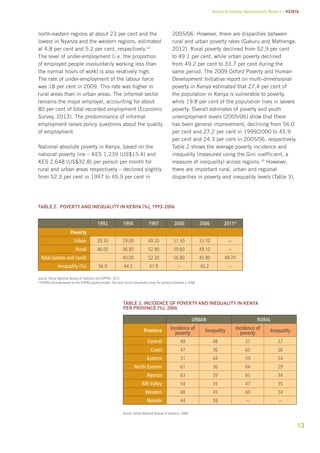
Table 2 shows the average poverty incidence and 
inequality (measured using the Gini coefficient, a 
measure of inequality) across regions.15 However, 
there are important rural, urban and regional 
disparities in poverty and inequality levels (Table 3). 
Table 2. Poverty and inequality in Kenya (%), 1993-2006 
1992 1994 1997 2000 2006 2011* 
Poverty 
Urban 29.30 29.00 49.20 51.50 33.70 − 
Rural 46.00 46.80 52.90 59.60 49.10 − 
Total (urban and rural) 40.00 52.30 56.80 45.90 49.70 
Inequality (%) 56.9 44.3 41.9 − 45.2 − 
Source: Kenya National Bureau of Statistics and KIPPRA, 2012 
* KIPPRA estimate based on the KIPPRA poverty model. The most recent household survey for poverty estimates is 2006. 
Table 3. incidence of poverty and inequality in Kenya 
per province (%), 2006 
Urban Rural 
Province Incidence of 
poverty Inequality Incidence of 
poverty Inequality 
Central 49 48 31 37 
Coast 47 36 63 36 
Eastern 51 44 59 34 
North Eastern 61 36 64 29 
Nyanza 63 39 65 34 
Rift Valley 54 35 47 35 
Western 68 45 60 34 
Nairobi 44 38 – – 
Source: Kenya National Bureau of Statistics, 2006.
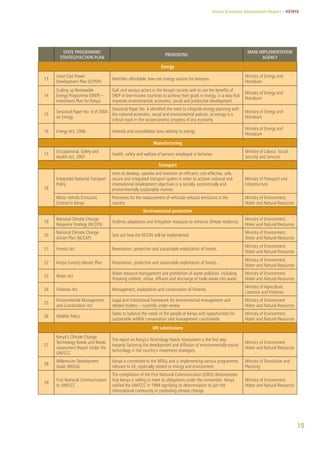
Table 4. Policy and legal provisions for a green economy 
14 
State programme/ 
Strategy/Action plan Provisions Main implementation 
agency 
Overall national development 
1 Constitution of Kenya 2010 
− Article 42 recognizes a clean and healthy environment as a right. 
− Article 60 (c) calls for sustainable and productive management of land 
resources 
− Article 69 [(a)-(h)] declares that the State shall ensure sustainable 
exploitation, utilization, and protection of genetic and biological 
diversity; establish a system for environmental impact assessment; and 
achieve and maintain a tree cover of at least 10 per cent of the land 
area of Kenya. 
Government of Kenya 
2 
Kenya Vision 2030 
Over-reaching vision and overall policy framework for sustainable 
development 
Ministry of Devolution and 
Planning 
First Medium-Term Plan, 
2008-2012: Kenya Vision 
2030 
Programmes and projects for 2008-2012: restoration of ecosystems, 
including rehabilitation and protection of the five water towers (Mau, Mt. 
Kenya, Aberdares, Cheregany and Mt. Kenya); preparation of national land 
use plan, waste management systems, exploration and mining, invasive 
species, geological mapping, renewable energy and sustainable land use. 
Ministry of Devolution and 
Planning 
Second Medium-Term Plan, 
2013-2017 
Some programmes and projects for 2013-2017 include: strengthening 
environmental governance; waste management and pollution control; 
rehabilitation of urban rivers; rehabilitation and protection of the water 
towers, forest and wildlife conservation and management; promotion and 
piloting of green energy; review of water resources management; land 
reclamation; implementation of the NCCRS and development of a national 
green economy strategy. 
Ministry of Devolution and 
Planning 
4 
Population Policy for National 
Development (PPND) 
PPND recognizes the impact of rapid population growth on Kenya’s 
development goals and proposes a multi-sectoral approach to address this 
issue, with a focus on voluntary family planning. 
Ministry of Devolution and 
Planning 
5 Physical Planning Act 
Reserve all land planned for open spaces, parks, urban forests and green 
belts. 
Ministry of Lands, Housing 
and Urban Development 
6 
Local Government Act 
(Revised) 
Utilization of sewage systems including removal and destruction of refuse 
and effluents 
Ministry of Devolution and 
Planning 
6 
Arid and Semi-Arid Lands 
(ASALs) National Vision and 
Strategy: Natural Resource 
Management, 2005-2015 
Sets out the overarching principles and broad actions required to transform 
the Kenyan ASALs into national wealth and employment creators. 
Ministry of Devolution and 
Planning 
Health 
7 Public Health Act Provisions concerning sanitation and health Ministry of Health 
Agriculture 
8 
Agricultural Sector 
Development Strategy (ASDS) 
2010-2020 
ASDS seeks to progressively reduce unemployment and poverty in Kenya 
through agriculture, and to spur agriculture back to growth trends. 
Ministry of Agriculture, 
Livestock and Fisheries 
9 Agriculture Act 
Promotes and maintains stable agriculture and provides for conservation of 
soil and its fertility; aims to stimulate the development of agricultural land 
in accordance with the accepted practices of good land management and 
good husbandry 
Ministry of Agriculture, 
Livestock and Fisheries 
10 
Agriculture (Farm Forestry) 
Rules 2009 
Promotion and maintenance of farm forest cover of at least 10 per cent of 
every agricultural land holding and preservation and sustenance of the 
environment in combating climate change and global warming 
Ministry of Agriculture, 
Livestock and Fisheries 
Energy 
11 
Draft National Energy Policy - 
Third Draft 
Aims to facilitate provision of clean, sustainable, affordable, reliable and 
secure energy services at least cost, while protecting the environment. 
Ministry of Energy and 
Petroleum 
12 
Feed-in Tariffs for Renewable 
Energy Resource Generated 
Electricity- Guide for Investors 
− Accelerates the development of green energy, including wind, solar and 
renewable biomass. 
− Instrument to promote generation of electricity from renewable energy 
sources 
Ministry of Energy and 
Petroleum
Green Economy Assessment Report – Kenya 
15 
State programme/ 
Strategy/Action plan Provisions Main implementation 
agency 
Energy 
13 
Least Cost Power 
Development Plan (LCPDP) 
Identifies affordable, low-cost energy sources for Kenyans. 
Ministry of Energy and 
Petroleum 
14 
Scaling up Renewable 
Energy Programme (SREP) – 
Investment Plan for Kenya 
GoK and various actors in the Kenyan society seek to use the benefits of 
SREP in low-income countries to achieve their goals in energy, in a way that 
improves environmental, economic, social and productive development. 
Ministry of Energy and 
Petroleum 
15 
Sessional Paper No. 4 of 2004 
on Energy 
Sessional Paper No. 4 identified the need to integrate energy planning with 
the national economic, social and environmental policies, as energy is a 
critical input in the socioeconomic progress of any economy. 
Ministry of Energy and 
Petroleum 
16 Energy Act, 2006 Amends and consolidates laws relating to energy. 
Ministry of Energy and 
Petroleum 
Manufacturing 
17 
Occupational, Safety and 
Health Act, 2007 
Health, safety and welfare of persons employed in factories. 
Ministry of Labour, Social 
Security and Services 
Transport 
18 
Integrated National Transport 
Policy 
Aims to develop, operate and maintain an efficient, cost-effective, safe, 
secure and integrated transport system in order to achieve national and 
international development objectives in a socially, economically and 
environmentally sustainable manner. 
Ministry of Transport and 
Infrastructure 
Motor Vehicle Emissions 
Control in Kenya 
Provisions for the measurement of vehicular exhaust emissions in the 
country 
Ministry of Environment, 
Water and Natural Resources 
Environmental protection 
19 
National Climate Change 
Response Strategy (NCCRS) 
Outlines adaptation and mitigation measures to enhance climate resilience. 
Ministry of Environment, 
Water and Natural Resources 
20 
National Climate Change 
Action Plan (NCCAP) 
Sets out how the NCCRS will be implemented. 
Ministry of Environment, 
Water and Natural Resources 
21 Forests Act Reservation, protection and sustainable exploitation of forests. 
Ministry of Environment, 
Water and Natural Resources 
22 Kenya Forestry Master Plan Reservation, protection and sustainable exploitation of forests. 
Ministry of Environment, 
Water and Natural Resources 
23 Water Act 
Water resource management and prohibition of water pollution, including 
throwing rubbish, refuse, effluent and discharge of trade waste into water. 
Ministry of Environment 
Water and Natural Resources 
24 Fisheries Act Management, exploitation and conservation of fisheries 
Ministry of Agriculture, 
Livestock and Fisheries 
25 
Environmental Management 
and Coordination Act 
Legal and institutional framework for environmental management and 
related matters – currently under review. 
Ministry of Environment 
Water and Natural Resources 
26 Wildlife Policy 
Seeks to balance the needs of the people of Kenya with opportunities for 
sustainable wildlife conservation and management countrywide. 
Ministry of Environment, 
Water and Natural Resources 
UN submissions 
27 
Kenya’s Climate Change 
Technology Needs and Needs 
Assessment Report Under the 
UNFCCC 
The report on Kenya’s Technology Needs Assessment is the first step 
towards factoring the development and diffusion of environmentally-sound 
technology in the country’s investment strategies. 
Ministry of Environment 
Water and Natural Resources 
28 
Millennium Development 
Goals (MDGs) 
Kenya is committed to the MDGs and is implementing various programmes 
relevant to GE, especially related to energy and environment. 
Ministry of Devolution and 
Planning 
29 
First National Communication 
to UNFCCC 
The compilation of the First National Communication (2002) demonstrates 
that Kenya is willing to meet its obligations under the convention. Kenya 
ratified the UNFCCC in 1994 signifying its determination to join the 
international community in combating climate change. 
Ministry of Environment, 
Water and Natural Resources
2.4 Policy and legal landscape 
The newly adopted Kenyan Constitution (2010) gives 
rise to a devolved two-tier structure of government 
and, hence, new and distinct governance structures 
at the national and county levels. Article 42 of the 
Constitution recognizes the right to a clean and 
healthy environment, while Article 60 (c) provides 
for sustainable and productive management of land 
resources. It calls for “sustainable exploitation, 
utilization, management and conservation of the 
environment and natural resources” and works “… 
to achieve and maintain a tree cover of at least 10 
per cent of the land area of Kenya” (Article 69 [(a)- 
(h)]). 
In 2010, the government developed a comprehensive 
National Climate Change Response Strategy (NCCRS), 
which was followed by a National Climate Change 
Action Plan (NCCAP) that sets out how the NCCRS 
will be implemented. The NCCRS and NCCAP make 
recommendations for reducing the negative impacts 
of climate change. 
By the end of 2012, other relevant policies 
were being formulated, including the National 
Environment Policy; Draft Carbon Investment Policy; 
Reducing Emissions from Deforestation and Forest 
16 
Degradation (REDD) Policy; and the National Energy 
Policy. Furthermore, policies and bills on oil and 
mineral resources are being developed, following 
the discovery of oil and mineral deposits in Kenya. 
Numerous green economy-related sector-specific 
planning documents exist (see Table 4). Kenyan 
authorities are currently in the process of formulating 
a Multilateral Environmental Agreement Strategy 
(MEAS). 
In addition to these legal and policy provisions, 
numerous green economy-related programmes are 
being undertaken by government ministries. These 
include the Kenya National Cleaner Production 
Centre and the GKI. Multilateral and bilateral 
development agencies are also involved in supporting 
numerous projects that address the challenge of 
climate change and support the green economy 
policy agenda, notably UNEP, UNDP, the Danish 
International Development Agency (DANIDA), the 
Canadian International Development Agency (CIDA), 
the UK Department for International Development 
(DfID), the Agence Française de Développement 
(AFD), the US Agency for International Development 
(USAID) and the World Bank. By January 2013, 
Kenya had registered 11 projects under the Kyoto 
Protocol’s Clean Development Mechanisms (CDM).16 
Mangroves in the Lamu Area/GRID Arendal/Peter Prokosch
Green Economy Assessment Report – Kenya 
17 
During country stakeholder consultations, the 
agriculture, energy, transport and manufacturing 
sectors were identified as having significant 
potential for greening the economy because of their 
contribution to GDP, employment creation, poverty 
reduction and global competitiveness. Each of the 
sectors is discussed below, keeping in mind the 
current development context, policy landscape and 
key green economy interventions. 
3.1 Agriculture sector 
The agriculture sector is the primary source of 
livelihood for the majority of the Kenyan population, 
in terms of food security, income, employment 
creation and foreign exchange earnings. The 
agriculture sector directly contributes to approximately 
one quarter of GDP annually. The sector accounts 
for 65 per cent of Kenya’s total exports, and 18 
per cent of formal employment in Kenya. Small-scale 
agriculture and pastoralism account for about 42 
per cent of the total employment in Kenya.17 
Farming in the country is largely small-scale, with 
75 per cent of total agricultural output produced 
on rain-fed farms that average 0.3 to 3 hectares in 
size. The agriculture sector has come under pressure 
due to population increase and extreme weather 
changes. The sub-division of land, resulting from 
population pressure and the relative scarcity of 
productive agricultural land, has resulted in small, 
uneconomic farms that cannot be run sustainably. 
The problem is expected to increase, with available 
land per person in Kenya decreasing from the present 
level of approximately 1.5 ha to 0.3 ha, by 2050.18 
Moreover, the sector is vulnerable to increasing 
droughts and floods due to climate change,20 resulting 
in increased soil erosion, deforestation, loss of soil 
fertility and reduced productivity. 
3.1.1 Current policies 
The government allocates approximately 8 per cent 
of the national budget to the sector. The Agricultural 
Sector Development Strategy (ASDS) 2010-2020 is 
the main national policy document for the 
agriculture sector. The strategy outlines the following 
interventions to fast-track growth in the sector: 
——Review and harmonize the legal, regulatory and 
institutional frameworks; 
——Restructure and privatize non-core functions of 
parastatals and sector ministries; 
——Improve delivery of research, extension and 
advisory services; 
——Improve access to quality inputs (fertilizers, hybrid 
seeds, equipment) and financial services; and 
——Improve access to both domestic and external 
markets. 
In addition, the government has developed the 
National Food and Nutrition Security Policy 20 to 
address challenges related to nutrition and food 
security, and is implementing the Comprehensive 
African Agricultural Development Programme 
(CAADP), supported by the New Partnership for 
Africa’s Development (NEPAD).21 
The country is also allocating resources towards 
increased irrigation, distribution of drought-resistant 
seeds for maize as well as indigenous crops, such as 
pigeon peas, cowpeas, green grams, chickpeas and 
beans. Some policy initiatives aim at encouraging 
the country’s youth to venture into agribusiness 
by providing concessional loans and promoting 
greenhouse farming. 
3.1.2 Greening the agriculture sector 
Green agriculture is characterized by shifting both 
commercial and subsistence farming towards 
ecologically-sound farming practices, such as efficient 
use of water, extensive use of organic and natural soil 
nutrients, optimal tillage, integrated pest control and 
agroforestry. In Kenya, where the majority of farming 
is small-scale, greening the small-farm sector through 
promotion and dissemination of sustainable practices 
could be the most effective way to make more food 
available to the poor and hungry, reduce poverty, 
increase carbon sequestration and access growing 
international markets for green products. Given food 
security concerns in the country, greening the sector 
would contribute to increasing productivity in the long 
run through the use of green practices. 
3 Key sectors identified
18 
Box 1. Just their cup of tea: 
sustainable farm management 
brews confidence 
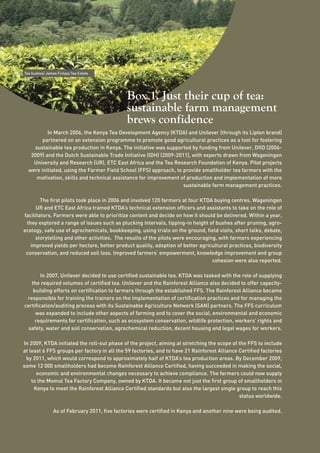
Tea bushes/ James Finlays Tea Estate 
In March 2006, the Kenya Tea Development Agency (KTDA) and Unilever (through its Lipton brand) 
partnered on an extension programme to promote good agricultural practices as a tool for fostering 
sustainable tea production in Kenya. The initiative was supported by funding from Unilever, DfID (2006- 
2009) and the Dutch Sustainable Trade Initiative (IDH) (2009-2011), with experts drawn from Wageningen 
University and Research (UR), ETC East Africa and the Tea Research Foundation of Kenya. Pilot projects 
were initiated, using the Farmer Field School (FFS) approach, to provide smallholder tea farmers with the 
motivation, skills and technical assistance for improvement of production and implementation of more 
sustainable farm management practices. 
The first pilots took place in 2006 and involved 120 farmers at four KTDA buying centres. Wageningen 
UR and ETC East Africa trained KTDA’s technical extension officers and assistants to take on the role of 
facilitators. Farmers were able to prioritize content and decide on how it should be delivered. Within a year, 
they explored a range of issues such as plucking intervals, tipping-in height of bushes after pruning, agro-ecology, 
safe use of agrochemicals, bookkeeping, using trials on the ground, field visits, short talks, debate, 
storytelling and other activities. The results of the pilots were encouraging, with farmers experiencing 
improved yields per hectare, better product quality, adoption of better agricultural practices, biodiversity 
conservation, and reduced soil loss. Improved farmers’ empowerment, knowledge improvement and group 
cohesion were also reported. 
In 2007, Unilever decided to use certified sustainable tea. KTDA was tasked with the role of supplying 
the required volumes of certified tea. Unilever and the Rainforest Alliance also decided to offer capacity-building 
efforts on certification to farmers through the established FFS. The Rainforest Alliance became 
responsible for training the trainers on the implementation of certification practices and for managing the 
certification/auditing process with its Sustainable Agriculture Network (SAN) partners. The FFS curriculum 
was expanded to include other aspects of farming and to cover the social, environmental and economic 
requirements for certification, such as ecosystem conservation, wildlife protection, workers’ rights and 
safety, water and soil conservation, agrochemical reduction, decent housing and legal wages for workers. 
In 2009, KTDA initiated the roll-out phase of the project, aiming at stretching the scope of the FFS to include 
at least 6 FFS groups per factory in all the 59 factories, and to have 21 Rainforest Alliance Certified factories 
by 2011, which would correspond to approximately half of KTDA’s tea production areas. By December 2009, 
some 12 000 smallholders had become Rainforest Alliance Certified, having succeeded in making the social, 
economic and environmental changes necessary to achieve compliance. The farmers could now supply 
to the Momul Tea Factory Company, owned by KTDA. It became not just the first group of smallholders in 
Kenya to meet the Rainforest Alliance Certified standards but also the largest single group to reach this 
status worldwide. 
As of February 2011, five factories were certified in Kenya and another nine were being audited.
Green Economy Assessment Report – Kenya 
19 
There are currently various green economy activities 
in agriculture, including organic farming, production 
of organic fertilizer, agroforestry, fish farming and 
certification (see Box 1). 
3.2 Energy sector 
Energy is obtained from a variety of renewable 
and non-removable resources, namely hydropower, 
biomass, geothermal, petroleum, wind and solar. 
At the national level, wood fuel and other biomass 
account for 68 per cent of the total primary energy 
consumption (see Figure 3). About 80 per cent 
of Kenya’s population depends on wood fuel for 
domestic energy needs (cooking and heating) and for 
informal rural industries.22 Thus, demand for energy 
is one of the main drivers of deforestation and land 
degradation in Kenya. Petroleum fuel is the major 
source of energy used by commercial and industrial 
establishments.23 
Electricity (9 per cent) is the third-most used form 
of energy in Kenya, after wood fuel (68 per cent) 
and petroleum products (22 per cent) (see Figure 
3), and remains the most sought-after form of energy 
in Kenyan society. Access to electricity is normally 
associated with a rising quality of life; total installed 
electricity generation capacity is estimated at 1,593 
MW as of June 2012.24 
In 2010, about 18 per cent of households had access 
to electricity. However, access to electricity in rural 
households is estimated at about only 4 per cent, 
while the commercial and industrial sectors together 
account for roughly 60 per cent of the electricity 
consumed in the country.25 The lack of an effective 
transmission system is a hurdle to access and 
reliability. 
The proportion of green energy out of the total 
installed capacity to generate electricity is 992 MW 
(62 per cent), including hydropower (see Figure 4). 
However, this energy source is highly vulnerable to 
weather conditions and climate change. 
The energy sector in Kenya is at an important 
transition point with increased development of 
geothermal electricity generation and exploitation of 
newly-discovered coal and oil deposits. Mining and 
minerals currently contribute less than 1 per cent 
Figure 3. Sources of energy consumed in Kenya 
Woodfuel and other biomass, 68 % 
Source: Economic Survey, 2011. 
Figure 4. Sources of electricity in Kenya 
% 
60.0 
50.0 
40.0 
30.0 
20.0 
10.0 
0.0 
47.9 
37.7 
12.4 
1.6 0.3 
Fossil 
fuel-based 
thermal 
Source: KPLC, 2011/12 
to GDP but this is expected to increase. Kenya has 
options to develop these resources by: 
—— taking green and low-carbon considerations into 
account; 
——encouraging the use of clean coal technologies 
with international support; 
——making use of natural gas that is a by-product of 
oil production instead of flaring it; and 
——allocating a percentage of royalties to a green 
development fund to support reforestation, low-carbon 
and other green actions. 
3.2.1 Current policies 
The Sessional Paper No. 4 of 2004 provides the 
overall policy framework for the energy sector. 
However, there are several supporting pieces of 
legislation, including the Energy Act, No. 12, 
Geothermal Resources Act No. 12, and Petroleum 
(Exploration and Production) Act, Chapter 308 of the
20 
Box 2. Policy sweetens 
rural livelihood; sugarcane 
energizes economy 
In March 2008, Kenya’s Ministry of Energy adopted a Feed-in Tariff (FiT) based on the realization that 
renewable energy sources, including solar, wind, small-hydro, biogas and urban solid waste energy, have 
the potential for income and employment generation, while also contributing to the energy supply and 
diversification of electricity-generation sources. 
As Kenya’s greatest renewable energy potential lies in its rural areas, the effects of the FiT policy are 
expected to trickle down and stimulate rural employment. This can happen through the construction of 
power plants; and in the context of agro-industries, in particular the sugarcane industry that is synonymous 
with Kenya. Some of the FiT projects have commenced operation. The cogeneration plant of western 
Kenya’s Mumias Sugar Company Limited, for instance, is now adding 26 MW to the grid out of the 38 MW it 
produces. The company produces power through the burning of bagasse, a waste product from sugarcane. 
Stakeholders have expressed the need to review the FiT in order to increase uptake and include other 
sources, such as wave, tidal, and ocean thermal energy conversion. It is estimated that the sugar factories 
have directly and indirectly contributed to employment generation by supporting about 200,000 small-scale 
farmers within the sugar belt of western Kenya; and that between five million and six million people either 
directly or indirectly benefit from the sugar factories. 
FiT allows power producers to sell to the national grid and obligates the distributors to buy, on a priority 
basis, all renewable energy source-generated electricity at pre-determined fixed tariffs for a given period 
of time. The FiT is expected to trigger the generation of an additional 1,300 MW of electricity from clean 
sources over the next five years. A 1,311 MW project was recently approved and two Power Purchase 
Agreements were signed. Consequently, this will nearly double the country’s current installed capacity, 
while enhancing economic competitiveness and job creation. Other advantages of the FiT’s environmental 
integrity include the reduction of GHG emissions, enhancing energy-supply security by reducing the 
country’s dependence on imported fuels and, thus, coping with the global scarcity of fossil fuels and their 
attendant price volatility. 
Sugar cane/Creative Commons
Green Economy Assessment Report – Kenya 
21 
Laws of Kenya. Some of the policies are implemented 
through the Least Cost Power Development Plan 
(LCPDP) and Rural Electrification Master Plan. At 
the end of 2012, the energy policy to replace the 
Sessional Paper No. 4 of 2004 underwent a review. 
The FiT Policy, introduced in 2008, was designed 
to promote investment in renewable energy (see 
Box 2). The policy allows producers of electricity 
from renewable sources to sell to a distributor at 
a pre-determined fixed tariff for a given period of 
time, thereby guaranteeing a market. In 2011, the 
government introduced a zero-rate (0 per cent) import 
duty on renewable energy equipment and accessories, 
and removed Value-Added Tax (VAT) on renewable 
energy materials, equipment, and accessories. Prior 
to 2011, there was a 16 per cent VAT on renewable 
energy materials. By the end of 2012, the government 
was developing solar water heating regulations, with a 
proposal that all owners of existing and new buildings 
that require more than 100 litres of hot water per day 
be required to install and use a solar water heater. 
Approximately 43 per cent of the development 
budget (2011/12) is allocated to energy and other 
infrastructure development. The country is diversifying 
and expanding its electricity generation, with a long-term 
focus on green energy (geothermal, wind, solar 
and hydro imports). The government has several 
green energy projects committed to increasing/ 
diversifying generation in the current to mid-term, 
including geothermal (404 MW), wind (530 MW) and 
hydroelectric power (278 MW).26 
3.2.2 Greening the energy sector 
Greening the energy sector will require investments in 
energy supply and technology. Kenya’s GHG emissions 
are rising quickly and energy sector emissions are 
estimated to have increased by approximately 50 
per cent over the last decade. Green energy supply in 
Kenya comprises renewable and low-carbon sources of 
electricity and heat, including geothermal, solar, wind, 
hydroelectricity and biofuels. Increased generation of 
renewable energy also has the benefit of increased 
energy security, by reducing reliance on fossil fuel 
imports. At the same time, climate resilience is also 
important and includes electricity-generating systems 
and a national grid that can withstand extreme 
weather events expected as a result of climate 
change. The exploitation of abundant geothermal 
resources, considered a strong option for Kenya with 
an estimated potential of 7,000 MW to 10,000 MW, 
is being fast-tracked. In addition, Kenya has excellent 
solar, wind, biofuels and small hydro resources for the 
supply of electricity. 
About 70 per cent of households in Kenya rely on wood 
fuel. Use of improved cookstoves can improve the lives 
of individuals, particularly women and children, in 
rural and urban areas – by reducing the time to collect 
wood fuel, reducing indoor air pollution thus potentially 
introducing cost savings to households. Access to 
modern energy solutions enables income-generating 
activities, health services, access to communication 
and improved education outcomes. 
With regard to energy demand, distributed clean 
energy solutions for households and institutions 
– such as solar lanterns, improved and liquefied 
propane gas (LPG), cookstoves, and energy efficient-lighting 
and appliances – can reduce greenhouse 
gas (GHG) emissions and bring about significant 
social and economic benefits. The economic case 
for solar lighting is clear: buying a lamp that charges 
in the sun during the day and produces light at 
night can eliminate spending on the kerosene that 
fuels conventional lamps. The potential savings 
are enormous. According to a recent study by the 
International Finance Corporation, US$10 billion a 
year is spent on kerosene in sub-Saharan Africa alone 
to illuminate homes, workplaces and community 
areas. Globally, the figure is estimated at US$36 
billion. Kerosene is also dangerous as it is a fire 
hazard. The wick’s smoke, the glass cracks and 
the light may be too weak to read by. According to 
the World Health Organization, the fine particles in 
kerosene fumes cause chronic pulmonary disease. 
Burning kerosene also produces climate-changing 
carbon-dioxide emissions.27 
3.3 Manufacturing sector 
The manufacturing sector is one of the key pillars 
of the Kenya Vision 2030, which aims to encourage 
a “robust, diverse and competitive” manufacturing 
sector. Even as the contribution of the manufacturing 
sector to GDP has stagnated at about 10 per cent 
for many years, implying limited industrial 
transformation, Kenya still has one of the largest 
manufacturing sectors in sub-Saharan Africa. The key
22 
Box 3. Tissue company plying 
cleaner production practices 
In 2005, the Nairobi-based Chandaria Industries Ltd (CIL) adopted Resource Efficient and Cleaner 
Production (RECP) practices, following an audit by the Kenya National Cleaner Production Center 
(KNCPC). CIL’s core business is the manufacture of tissue paper through waste paper recycling and 
virgin pulp blending into hygiene grades that include toilet tissues, tissue napkins, paper towels, facial 
tissues; and recycling of cotton fibres into absorbent cotton wool. RECP addresses three sustainability 
dimensions individually and synergistically: production efficiency; environmental management; and human 
development (minimization of risk for people and communities and support for their development). In 
CIL, RECP has been achieved by raising awareness, improving technology and changing attitudes through 
regular audits, training and capacity-building activities. The company began by implementing ‘no and low-cost 
investment options’ such as sub-metering of electricity and water consumption, process monitoring, 
a preventive maintenance programme, wastewater treatment and recycling. 
CIL has so far achieved great economic and environmental benefits, in addition to ensuring compliance 
with the national legislative framework governing environmental management. The table below shows the 
The absolute indicators provide a measurement 
of how much resource use/pollution output 
has changed in absolute terms. For CIL, 
energy use, materials use and water use 
have all declined by -25, -29 and -63 per cent 
respectively. The volume of pollution generated 
has also declined. Relative indicators provide 
a measurement of changes in resource use/ 
pollution in relation to production output. 
Productivity has increased, while pollution 
intensity has declined. 
As a result of the successful implementation 
results of the initiative from an analysis done by CIL: 
of RECP, CIL has improved operations through cost reduction, efficient resource use and improved 
environmental performance. Subsequently, the company’s contribution towards sustainable development 
has increased. Specifically, implementation of RECP audit by CIL has led to annual savings of KES 46, 
886, 400 (US$0.6336 million) and has facilitated the attainment of ISO 9000:2001 certification in Quality 
Management Systems. In addition, the company has won several awards. CIL has gained considerable 
recognition and, thus, access to a larger market share. The company has acquired sole supplier status of an 
array of hygiene tissue products to UN agencies and several multinationals doing business in the country. 
The company has proceeded to play a leading role by assisting other companies, such as Madhu Paper (K) 
and Kenya Paper Mill Ltd, to embrace RECP and related best practices. 
Source: KNCPC, 2011. 
Absolute indicator Change 
(%) Relative indicator Change 
(%) 
Resource use Resource productivity 
Energy use -25 Energy productivity 40 
Materials use -29 Materials productivity 48 
Water use -63 Water productivity 181 
Pollution generated Pollution intensity 
Air emissions (e.g., 
global warming, CO2) 
-24 Carbon intensity -28 
Wastewater -63 Wastewater intensity -64 
Waste -60 Waste intensity -62 
Women in export processing zone/Creative Commons
Green Economy Assessment Report – Kenya 
23 
challenges identified are high energy costs and poor 
infrastructure. Unreliable electricity generation and 
distribution in Kenya means that most manufacturing 
firms operate a standby emergency power system. 
Furthermore, many cement manufacturers intend 
to switch to coal as a reliable and cheap source 
of electricity, thus contributing to increased GHG 
emissions. The agro-processing industry, amongst 
other industries, is a major consumer (and polluter) of 
water. Water resources are generally scarce and likely 
to become more so with climate change. 
The manufacturing sector in Kenya is dominated by 
food processing industries, such as grain milling, 
sugarcane processing and beer production. Cement, 
another important sub-sector, contributes to climate 
change through GHG emissions resulting from fossil 
fuel combustion. Yet, emissions in the manufacturing 
sector are relatively low when compared to other 
sectors. At present, there is no systematic monitoring 
of industrial effluents and emissions, although 
Kenya’s environmental legislative framework requires 
Environmental Impact Assessments (EIAs) and annual 
Environmental Audits (EAs) from large industrial 
establishments. Some industries have installed 
plants to partially treat industrial wastewater before 
discharging effluents into surface water bodies and 
sewerage systems. Other industries have adopted 
and installed environment-friendly technologies 
that significantly reduce effluent discharges and 
emissions. Companies are becoming more informed 
and taking up energy-efficiency measures. 
Nonetheless, the manufacturing sector faces various 
challenges unique to the transition to a green 
economy, such as: 
——weak and fragmented policy coordination among 
relevant ministries and government agencies; 
—— low technology, innovation and Research and 
Development (R&D) uptake; 
——weak capacity to meet quality and technical 
standards; and 
——an influx of counterfeit and sub-standard goods. 
In addition, strategic management and technical 
skills are weak, especially in Small and Medium-Sized 
Enterprises (SMEs).28 
3.3.1 Current policies 
Various initiatives are in place and continue to be 
undertaken to enhance manufacturing. These include 
the implementation of the private sector development 
strategy; streamlining business registration and 
licensing; providing access to finance; and improving 
physical infrastructure. Efforts are underway to scale 
up Kenyan firms’ operations by reforming the industrial 
structure, including the establishment of special 
zones, SME parks and industrial clusters. The target 
is to increase productivity and competitiveness across 
the manufacturing sector. The government, through 
the National Environment Management Authority 
(NEMA) and the Kenya Bureau of Standards (KBS), 
is also keen to adopt eco-labelling. An eco-label 
identifies a product that meets specified environmental 
performance criteria or standards. In addition, the 
Ministry of Energy in conjunction with the Kenya 
Association of Manufacturers (KAM) established 
the Centre for Energy Efficiency and Conservation 
in 2006. The Centre runs energy efficiency and 
conservation programmes designed to help companies 
identify wastage, determine saving potential and give 
recommendations on measures to be implemented. 
The country is also encouraging and promoting the 
use of cleaner and resource-efficient production 
through the Kenya National Cleaner Production Centre 
(KNCPC) (see Box 3). Resource Efficient and Cleaner 
Production (RECP) assessments conducted by the 
KNCPC in sectors such as tea, textile, sugar, dairy, 
manufacturing and the fish industry indicate that 
some of the challenges in the transition to a clean and 
resource-efficient production include lack of knowledge 
and awareness, limited technical and professional 
management skills, and investment costs.29 
3.3.2 Greening the manufacturing sector 
According to UNEP, the supply-side approach to 
greening manufacturing involves the re-design of 
products and processes, substituting green inputs for 
conventional inputs, recycling and reuse in internal 
production processes, use of cleaner technologies 
and production processes with greater water and 
energy-efficiency, and the redesign of transport 
and infrastructure systems.30 The demand-side 
approach, on the other hand, involves production 
of manufactured goods to meet the changing 
composition of demand, both from within the industry
24 
Interior of AREX commuter train, Nairobi/Creative Commons 
Box 4. Public transport: speeding 
up green economy transition 
The provision of an efficient and reliable public transport, such as the Mass Rapid Transit System (MRTS) 
in Nairobi Metropolitan Area, will encourage more commuters to use low-carbon sustainable transport. 
Furthermore, the MRTS has the potential to improve social equality; reduce overall vehicle demand, fuel 
consumption and GHG emissions and benefit road users. The project will be implemented in various phases. 
One of the first phases of the project involves the Greater Nairobi Commuter Rail Services Project. Part of 
the rehabilitation and expansion of the Nairobi Metropolitan Commuter Rail Services, the project involves 
the construction of the Syokimau Railway Station, rehabilitation of the existing Nairobi–Embakasi rail 
track, construction of a new track to Syokimau Station and an extension of the railway line from Syokimau 
Railway Station to the airport. This line will provide high-frequency, comfortable and affordable commuter 
services between Jomo Kenyatta International Airport (JKIA) and Nairobi’s Central Business District 
(CBD). Journeys will take less than 20 minutes, compared to the current 90 minutes by road. The station 
is built for intermodal exchange for passenger traffic originating from Syokimau Estate, Mlolongo, Athi 
River, Kitengela and the surrounding area. The development is expected to offload passenger traffic from 
Mombasa Road, which will decongest Uhuru Highway and provide alternative access to JKIA through a five-minute 
shuttle service. As of September 2012, the construction of the station was 75 per cent complete. 
The economic analysis conducted involved an analysis of the development scenario with and without 
the MRTS project. The results show that the proposed MRTS project for Nairobi Metropolitan Area is 
economically viable. With the implementation of the transport plan, society will benefit immensely. In 
addition to the benefits quantified in the economic analysis, other benefits of the MRTS project include 
savings in fuel consumption and a drop in pollution and accident rates. However, in view of the huge 
investment involved, the level of implementation would depend on the availability of resources.
Green Economy Assessment Report – Kenya 
25 
and from final consumption. Other supportive 
measures could include eco-labelling of manufactured 
products and mandatory energy-efficiency audits for 
large manufacturers. 
3.4 Transport sector 
Kenya’s transport and communication sector is rapidly 
growing, accounting for about 10 per cent of GDP. The 
sector encompasses key modes of transport, namely 
road, rail, air and maritime transport. Kenya has 
identified development of this sector as a key pillar and 
critical enabler for achieving the Kenya Vision 2030. 
The sector has seen significant growth over the past 
decade, with the construction of the Nairobi-Thika 
superhighway and the modernization of the Mombasa- 
Nairobi highway. Transport sector emissions are growing 
rapidly, with the NCCAP reporting that emissions from 
the sector are expected to triple between 2010 and 
2030, from six million tonnes of CO2-equivalent in 
2010.31 Much of this increase is due to the increase 
in the number of vehicles, estimated to have doubled 
from 600,000 in 2000 to 1.2 million in 2010. That 
said, the majority of individual trips in cities are still 
done on foot because public transport services are 
comparatively expensive and private cars are beyond 
the reach of most Kenyans. Public transport is 
relatively underdeveloped and dominated by privately-owned 
mini-buses, known locally as matatus. 
Some of the key challenges facing the sector 
include lack of adequate funding for required 
infrastructure as well as lax enforcement of relevant 
laws and regulations. Stringent donor conditionality 
requirements and long procurement process 
have been blamed for low uptake of donor funds 
and implementation of infrastructure projects. 
Furthermore, plants and equipment fall short of 
the ever-increasing demand and huge maintenance 
backlog of the road network. The lack of adequate 
local construction capacity has limited the number of 
local jobs the industry can generate and implement. 
3.4.1 Current policies 
Kenyan authorities are adopting various measures 
to improve the transport sector. Recent initiatives 
include the development of an Integrated National 
Transport Policy (INTP) to focus attention, guide 
development, direct investments and promote 
institutional, legal and regulatory reforms. The GoK is 
constructing a Mass Rapid Transport System (MRTS) 
in the Nairobi Metropolitan Area and the first phase of 
the Nairobi Commuter Rail Network was launched in 
November 2012 (see Box 4). 
Kenya does not have vehicle fuel economy standards 
or emission standards for light duty vehicles. However, 
a policy on Motor Vehicle Emissions Control (MVEC) 
is currently being developed. Inspection certification 
is only required for public service and commercial 
vehicles, and as a result, less than 20 per cent of 
vehicles are subject to inspection.32 
A study conducted at a motor vehicle inspection 
centre in Nairobi showed that 69.5 per cent and 
71.1 per cent of the tested petrol and diesel vehicles 
respectively failed to meet the required test criteria.33 
This is largely because the vehicles were old and 
had high accumulated mileage. About 30 per cent 
of petrol vehicles were 16-20 years old. Recent 
regulations have stipulated that vehicles imported 
into Kenya are required to be no older than eight 
years from the year of manufacture. In mid-2011, 
the Ministry of Finance announced an exemption on 
import duty for “battery operated vehicles” but it is 
unclear if this will include hybrid electric vehicles or 
other types of low-emission vehicles.34 
The government has taken steps to reduce emissions 
of certain harmful pollutants. For example, in 2006, 
Kenya eliminated lead in petrol and reduced sulphur 
in imported refined diesel. In addition, the Ministry 
of Environment, Water and Natural Resources has 
finalized air pollution regulations. 
3.4.2 Greening the transport sector 
Green transport is defined as one that supports 
sustainable mobility. Strategies for greening transport 
include a shift to environmentally-efficient modes 
such as public transport, increasing pedestrian roads, 
improving fuel efficiency of vehicles, and integrating 
land use and transport planning to enhance 
efficiency.35 
Public policy can support greening of the sector by 
creating incentives to facilitate transition of Kenya’s 
passenger and freight vehicle fleet to one with a lower-age 
profile, and fast-tracking mass transit, especially 
rail and public transport.
4 Greening model scenarios 
The study relied on the T21 model to carry out 
a quantitative analysis of greening the economy. 
As mentioned earlier, T21 is a System Dynamics 
(SD) based model designed to support national 
development planning. In a single framework, 
the model integrates economic, social, and 
environmental aspects of development, thereby 
providing insight into the potential impact of 
green investment and policy interventions across a 
wide range of sectors and revealing how different 
strategies interact to achieve desired goals and 
objectives (see Figure 5). T21 is structured to 
analyse medium to long-term development issues at 
the national level. Data was obtained from various 
sources, including the Kenya National Bureau 
of Statistics, government ministries and related 
parastatals. For example, in the agriculture module, 
data on crop yield, crop losses, factor inputs (labour 
and capital) and crop production, among others, 
were used. 
Figure 5. Cross-sectoral linkages in the T21 model 
Population 
Education 
Infrastructure 
Production 
Investment 
Technology 
Households 
Land 
Energy 
Water 
Minerals Emissions 
The T21-Kenya model developed for this study 
consists of 50 modules (a module is a piece of the 
T21 model, whose internal mechanisms can be 
understood in isolation from the rest of the model 
but are nonetheless linked to the other modules) 
across 16 key sectors (see Table 5), including 
26 
energy, agriculture and infrastructure in economic, 
environmental and social spheres. Modules have 
been added to the Kenya customization to analyse 
green economy interventions and climate-related 
impacts. 
T21-Kenya has three spheres: society, economy 
and environment (see Figure 5). All sectors of 
T21 belong to one of the three spheres. The 
economy sphere contains major production sectors 
(agriculture, industry and services) characterized by 
the Cobb-Douglas production function,36 with inputs 
of resources, labour, capital, technology and an 
inclusive Total Factor Productivity (TFP) variable. A 
Social Accounting Matrix (SAM) is used to elaborate 
the economic flows and to balance supply and 
demand in each of the sectors. Demand is based on 
population and per capita income and distributed 
among sub-sectors using Engle’s Curves. This helps 
calculate relative prices, which are the basis for 
allocating investment among sectors. The Standard 
IMF budget categories are employed and key macro 
balances are incorporated into the model. The Rest 
of the World sub-sector comprises trade, current 
account transactions and capital flows (including 
debt management). 
The society sphere contains detailed population 
dynamics by age-sex cohort; health and education 
challenges and programmes; basic infrastructure; 
employment; poverty levels and income distribution. 
These sectors take into account, for example, the 
interactions of income, healthcare, and adult literacy 
rates on fertility and life expectancy that, in turn, 
determine population growth. Population determines 
the labour force over time, which, interacting 
with the level of economic activity, influences 
employment. Education and health influence labour 
productivity and life expectancy. In the model, 
employment and labour productivity affect the 
level of production from a given capital stock. An 
HIV/AIDS sector is also included, which shows the 
potential impact on population and productivity, and 
the effects of different treatment programmes. Food 
sufficiency and nutrition, reproductive health and 
vocational training are also modelled. 
society 
Poverty 
Health 
Labour 
economy 
Government 
Rest of the World 
environment 
Sustainability
Green Economy Assessment Report – Kenya 
27 
Table 5. Modules, sectors and spheres of the T21-Kenya Model 
Society Economy Environment 
Population sector Production sector Land sector 
The environment sphere tracks pollution created in 
the production processes and its impacts on health 
and production. This sphere also estimates the 
consumption of natural resources – both renewable 
and non-renewable – and the impact of the depletion 
of these resources on production and other factors. 
It also examines the effect of soil erosion and other 
forms of environmental degradation and their impact 
on other sectors, such as agricultural productivity 
and nutrition. Additional issues addressed are 
fossil-fuel use, forest depletion, land and water 
degradation, air and water pollution, and GHG 
emissions. This sphere is normally expanded to take 
into account country-specific concerns, including the 
effects of climate change. 
Climate has been integrated into the T21-Kenya 
model to represent the impacts of climate change on 
various sectors and to evaluate the implications of 
green economy interventions on climate adaptation. 
Overall, the sectors that have received specific 
attention on climate impacts and investments are: 
agriculture, livestock, fisheries, forestry, irrigation, 
water, energy and tourism. 
1. Population 
2. Fertility 
3. Mortality 
15. Production and income 
16. Agriculture 
17. Husbandry-fishery-forestry 
18. Livestock 
19. Fisheries 
20. Forestry 
21. Industry 
22. Services 
23. Tourism 
34. Land 
Water sector 
35. Water demand 
36. Water supply 
Education sector 
4. Primary education 
5. Secondary education Energy sector 
37. Energy demand 
38. Energy supply 
Health sector 
6. Access to basic health care 
7. HIV/AIDS 
8. HIV positive children and orphans 
9. Nutrition 
Households sector Emissions sector 
24. Households accounts 39. Fossil fuel and GHG emissions 
Government sector Sustainability sector 
Infrastructure sector 
25. Government revenue 
26. Government expenditure 
27. Public inv. and consumption 
28. Gov. balance and financing 
29. Government debt 
40. Ecological footprint 
10. Roads 
11. Irrigation 
Extra modules 
41. MDGs 
42. HDI and GDI 
43. Indicators 
44. Climate impacts 
45. Climate interventions 
46. Climate investments 
47. Malaria transmission 
48. IVM interventions 
49. Malaria treatment 
50. Malaria cost accounting 
Labour sector 
12. Employment 
13. Labour availability and unemployment 
Rest of the World sector 
30. International trade 
Poverty sector 31. Balance of payments 
14. Income distribution 
Investment sector 
32. Relative prices 
33. Investment
4.1 Sector modelling and 
28 
formulation in T21 
Quantitative assessment of Kenya’s transition to a 
green economy involved modelling green investments 
in the selected sectors, namely agriculture, energy, 
manufacturing and transport. These sectors were 
selected through a multi-stakeholder consultation 
workshop held on 15 February 2012 in Nairobi. In 
the model, the broad production sectors, namely 
agriculture, industry and services, are based on 
the Cobb-Douglas production function, where land, 
labour and capital are the main factors of production 
and are influenced by water availability, energy 
prices, education and access to roads. 
The sectors are modelled to analyse the impacts of 
climate change, green investments and interventions, 
and cross-sectoral synergies and side effects. In 
this regard, specific climate impacts in 11 sectors 
were analysed. The sectors were distributed across 
crop production, livestock, tourism, forestry, fishery, 
transport, communication, energy, land use, health 
and issues related to biodiversity. In addition, nine 
green economy investment categories were evaluated 
across sectors, practically impacting every sphere, 
sector and module of T21-Kenya. The list of the green 
economy investments and climate impacts simulated 
in the model are based on the NCCRS as main 
reference (Annexes 1 and 2 respectively). Due to the 
disparity of data availability, the model has a more 
detailed sector analysis for agriculture and energy. 
4.1.1 Agriculture 
The agriculture module includes crop production 
(which differentiates between production utilizing 
conventional and organic fertilizers), livestock, 
forestry and fishery sub-sectors. The crop production 
sub-sector is modelled as illustrated in the causal 
loop diagram (see Figure 6) and has an influence 
on macroeconomic indicators related to a green 
economy. Investment in ‘resource conservation’ 
and ‘agriculture capital’ will lead to an increase in 
‘agricultural production’ with a consequent increase 
in GDP, thereby creating opportunities for further 
investments. 
Under crop production, the specific interventions 
modelled and analysed for this study include 
investments in irrigation, fertilizers and pesticides, 
organic fertilizer, agriculture R&D, as well as 
investment in water conservation – specifically 
investment in new dams. Similarly, under fisheries, 
Figure 6. Causal loop diagram – green economy effects of investment on agricultural production 
Agricultural 
production 
Water 
stress 
Agriculture 
labour 
Fertilizer 
use 
Water 
efficiency 
Sustainable 
management 
R&D 
Pre-harvest 
losses
Green Economy Assessment Report – Kenya 
29 
Figure 7. Tree diagramme – power generation by source 
Conventional thermal generation (GWH) 
Other power generation 
Renewable generation (GWH) 
Initial hydropower 
generation capacity 
investment in fishery adaptation measures and 
ecosystem restoration were modelled and analysed. 
Under forestry, three main investments were analysed: 
investment in afforestation, forest management, and 
forestry R&D. 
4.1.2 Energy sector 
The energy sector is categorized into energy 
production and energy demand. Since electricity 
remains a major source of energy for industry and 
households, particular emphasis is given to electricity 
power supply. Electricity supply is disaggregated 
into four primary energy sources (or type of plants): 
hydro; wind and solar; geothermal; and conventional 
thermal (oil and coal), as well as other sources (see 
Figure 7). Production from each source is influenced 
by investments to increase the capacity of the power 
plants (measured in MW) and a specific load factor. 
The efficiency of each technology is also considered, 
as are the investment costs. Figure 8 shows the 
structure for hydropower generation in the T21-Kenya 
model. 
Effect of siltation on 
hydro generation 
Effect of rainfall 
shortage on hydro 
Hydropower 
generation (GWH) 
Hydroload 
factor 
Hydropower 
discard 
The energy demand module represents a variety of 
endogenous and exogenous drivers of energy demand 
for each energy source in the medium and long term. 
These include GDP, energy price, technology, energy 
service availability and climate factors (temperature). 
4.1.3 Transport infrastructure (roads) 
Transport infrastructure, specifically road transport, is 
the other key area of green economy interventions that 
has been modelled. In the roads module, the process 
of road construction is considered to be influenced by 
investment in public transport and infrastructure and 
the unit cost of road construction and maintenance. 
While the increased occurrence of floods, due to 
climate change, would cause more destruction to 
physical infrastructure, green economy investments 
in infrastructure would mitigate the negative climate 
impacts. Access to roads is estimated in this module 
as influencing the production sectors.37 
Hydropower 
generation capacity 
Hydropower 
increase table 
Hydropower 
net increase 
Hydropower unit 
cost per GW 
Hydropower 
investment 
Hydro capital 
lifetime 
Figure 8. Stock and flow diagramme – power generation by source 
Total electricity net generation (GWH) 
Geothermal power generation (GWH) 
Hydropower generation (GWH) 
Wind and solar power generation (GWH)
4.2 Definition of scenario 
30 
and assumption used to 
simulate green economy 
interventions 
The quantification of the level of investment required 
to support the transition to a green economy is in 
progress (UNEP, 2011). Analysis and modelling 
conducted for the Green Economy Report suggest 
that the level of additional investment needed is 
between 1 per cent and 2.5 per cent of global GDP 
per year from 2010 to 2050. Based on a range of 
specific sectoral policy targets, the Green Economy 
Report modelling results allocate investments 
totalling 2 per cent of global GDP across a range 
of sectors, with the heaviest investment in energy 
and transport. These investment allocations are 
largely consistent with assessments taken from other 
sources, such as the IEA and estimates associated 
with achieving the MDGs. 
Following the ‘2 per cent of GDP’ assumption from 
the Green Economy Report, this study allocates 2 
per cent of GDP (Kenya Economy GDP) per annum 
to investments in green economy interventions. 
These investments are based on the selected key 
sectors using the prioritization in the NCCRS. Since 
the interventions are additional investments in the 
economy, it is fair to compare the green economy 
scenario with a similar amount of investment in the 
conventional path for effective policy analysis. 
Hence, the analysis includes the comparison of 
conventional and green economy scenarios assuming 
the same share of GDP (2 per cent) being invested 
respectively in conventional sectors or activities 
(brown scenario or BAU2%) and in interventions 
that would support resource efficiency, low carbon 
development and natural capital preservation 
(green scenario or GE2%). Total investment of 
approximately KES 1.2 trillion (US$14.9 billion) 
(in nominal or current terms) between 2012 and 
2030 is analysed in a variety of interventions. This 
investment is equal to approximately 2 per cent of 
GDP annually, with most of the interventions to be 
implemented by 2020. In summary: 
——The BAU or baseline scenario assumes no 
fundamental changes in policy or external 
conditions up to 2030; 
——The BAU2% allocates an additional 2 per cent 
of GDP per annum as investments to the current 
BAU investment path; and 
——The GE2% scenario assumes an additional 2 
per cent of GDP per annum as green investments 
to the baseline. 
Due to data limitations, detailed green economy 
interventions are analysed in two (agriculture 
and energy) of the four selected key sectors. A 
comparison between additional investments in the 
BAU and the green economy (GE) scenarios are 
discussed below. 
4.2.1 Overview of results 
This section presents the results from the modelling 
exercise. A variety of scenarios were simulated to 
analyse the impact of green investments on Kenya’s 
development. Specifically, modelling was done to 
assess the impact of the green economy transition 
on society, economy and the environment. Although 
the modelling includes a number of scenarios, this 
report generally compares only GE2% scenario with 
BAU2% scenario, for consistency. More results are 
given in Annex 3. 
From an economy-wide perspective, positive 
economic returns are expected approximately seven 
to 10 years after green economy policy interventions. 
The national real GDP is projected to exceed the 
BAU2% by about 12 per cent by 2030, to reach 
KES 3.6 trillion (US$45 billion). Annual real GDP 
growth rates with GE and BAU interventions are 5.2 
per cent and 4.6 per cent, respectively, in the 2012- 
2030 period on average (see Figure 9). 
The Kenyan population will also benefit from this 
economic development as real per capita national 
Thika Road, Nairobi/Creative Commons
Green Economy Assessment Report – Kenya 
Figure 9. Trends in real GDP growth rate in BAU, 
BAU2% and GE2% scenarios 
Proportion of population below poverty line at BAU2% 
Proportion of population below poverty line at BAU 
Proportion of population below poverty line at GE2% 
Proportion of population 
below poverty line % 
0.6 
1980 1990 2000 2010 2020 2030 
time (year) 
0.45 
0.3 
0.15 
0 
Figure 11. Trends in average agricultural yield 
in BAU, BAU2% and GE2% scenarios 
31 
income will rise from KES 39,897 (US$498.7) to 
KES 69,702 (US$871.3) in 2030 under the GE2% 
scenario, compared to KES 39,721 (US$496.5) 
in 2012 and KES 53,146 (US$664.3) in 2030 
under the BAU2% scenario. The proportion of the 
population below the poverty line under GE2% is 
expected to be about 2 percentage points lower on 
average between 2015 and 2030 than that of the 
BAU2% (see Figure 10). 
As a result of green investments, average agricultural 
yield is expected to exceed BAU2% by about 
15 per cent in 2030 (see Figure 11). In terms 
of crop production, a number of green economy 
measures (such as water and land-use investments) 
will mitigate the impact of climate change on 
productivity, promote more sustainable farming 
and boost crop yields relative to the BAU case, 
consequently improving nutrition and food security. 
Policy simulations under different assumptions 
suggest that the same amount of investments 
allocated to the agriculture sector in the BAU case 
would result in greater use of chemical fertilizers, 
which is projected to increase yields in the short 
run. However, the increased use of chemical 
fertilizers is also projected to lower soil quality, 
which reflects negatively on yield in the medium and 
long term. With green economy interventions, the 
use of chemical fertilizers is phased out (or greatly 
complemented) by organic fertilizers and ecological 
agricultural practices. According to existing studies, 
the use of ecological practices in Africa yields great 
benefits in terms of productivity and production, 
at least in the medium term, by avoiding negative 
impacts on soil quality.38 
In the energy sector, green economy investments 
are allocated to reduce energy consumption and 
to expand the supply of electricity from renewable 
energy. Energy savings will reach 2 per cent of future 
BAU energy consumption in 2030. Concerning 
renewable energy, public and private sector 
interventions are projected to increase geothermal 
power capacity from 0.1 GW (2011) to 1.34 GW by 
2030 (twice as much as in the BAU scenario). Other 
new renewables would grow from 0.01 GW to 1.2 
GW by the year 2030, reaching a total 20 per cent 
of power supply. 
% 
8 
6 
4 
2 
0 
Real GDP growth BAU2% 
Real GDP growth BAU 
Real GDP growth GE2% 
Real GDP growth 
1980 1990 2000 2010 2020 2030 
time (year) 
Source: Kenya T21 
Figure 10. Trends in the national poverty 
rate in BAU, BAU2% and GE2% scenarios 
Source: Kenya T21 
Tonne 
per ha 
4 
3.5 
3 
2.5 
2 
Average yield at BAU2% 
Average yield at BAU 
Average yield at GE2% 
Average yield 
1980 1990 2000 2010 2020 2030 
Source: Kenya T21 
time (year) 
Green economy-related investments in agriculture 
and energy allow reduction in energy consumption 
and carbon emissions (see Figure 12). As a result 
of green economy investments, CO2 emissions are 
projected to increase from 12 million tonnes per year 
in 2012 to 24.35 million tonnes per year in 2030, 
approximately 9 per cent lower than the BAU2% 
case (26.7 million tonnes) by 2030.
million tonnes 
Fossil fuel CO2 emissions 
40 
30 
20 
10 
0 
1980 1990 2000 2010 2020 2030 
In addition, the investments will improve the overall 
performance of MDGs. In the model, a composite 
indicator calculated using equal weighting for each 
MDG measures the MDG performance. The MDGs’ 
composite indicator is projected to improve to 0.78 
in 2030 in the GE2% scenario, compared to 0.63 
when there is no intervention (BAU), and 0.69 in the 
BAU2% scenario. Considering the social, economic 
and environmental indicators included in the MDGs 
aggregate indicator calculation, this means that the 
overall development of the country is projected to 
perform better in the green economy scenario when 
compared to BAU (i.e. more progress towards several 
goals). 
Annex 3 summarizes the main results of the analysis. 
It is worth noting that the analysis assumes the 
effective implementation of all simulated investment. 
The economy-wide results indicate that green 
economy investments yield several positive impacts 
in the medium- to long-term period across all 
sectors. However, in the short run, green economy 
investments may be associated with adjustment 
costs such that the gain in GDP is not substantial 
compared to BAU. Green policies associated with 
short-run changes in prices of final goods and 
services, costs of operations, and technology choices 
may create different welfare costs and benefits for 
different segments of the population.39 
32 
The outcome is also likely to depend on the type and 
combination of green economy interventions or the 
policy package implemented. For instance, increasing 
acreage under irrigation has a relatively stronger short-run 
impact on national output than afforestation and 
reforestation – it takes approximately eight years for a 
tree to grow. However, afforestation and reforestation 
increases long-term potential output. 
Based on policy simulations for the green 
interventions discussed and multi-stakeholder 
consultations, the following policy options for 
agriculture emerged: 
——Pemoort aefgoorrrsty. The addition of 
trees to farms offers an opportunity for farmers 
to increase farm productivity and diversify 
their incomes, and helps combat soil erosion 
and nutrient depletion by providing a more 
balanced agro-ecological profile. Agroforestry 
also contributes to the government’s goal of 10 
per cent tree cover in farms. Significant work 
is already being done on agroforestry in Kenya 
by the government and various stakeholder 
groups such as the SCC-Vi Agroforestry project in 
Kisumu. Subsequent investment should build on 
this work. 
——Saabeilnstu aertw aaeegmmnnt. Kenya 
is a water-scarce country and needs to strongly 
prioritize the efficient allocation of water in 
its policymaking and planning. Sectors such 
as industry compete for Kenya’s scarce water 
resources. Allocation should effectively balance 
the conflicting priorities of economic growth and 
food security/agricultural productivity. Measures 
such as rainwater harvesting, irrigation and use 
of less water-intensive crop varieties should be 
employed extensively. 
——Eacdinotu, agiinnrt adn aaccipty 
building. Given the large number of 
smallholder farms in the country, providing a 
multitude of farmers with valuable information 
and resources will be key in assisting them to 
transition to greener, more sustainable farming 
practices. Extending and improving the services 
should focus on the likely areas of education and 
training on soil and water management, different 
crop strains and species, agroforestry, and 
livestock management. 
——Raceehrs adn deeelmnoptv. Export-oriented 
crops can be supported through 
R&D programmes that help producers meet 
Figure 12. Trends in fossil fuel CO2 emissions 
in BAU, BAU2% and GE2% scenarios 
Source: Kenya T21 
Fossil fuel CO2 emissions at BAU2% 
Fossil fuel CO2 emissions at BAU 
Fossil fuel CO2 emissions at GE2% 
(million tonnes per year) 
time (year)
Green Economy Assessment Report – Kenya 
33 
international standards, improve energy efficiency 
and introduce clean sources of energy (e.g., 
drying of tea and coffee), and reduce negative 
environmental impacts (e.g., reducing water, 
fertilizer and pesticide-use). 
Under the energy sector, T21-Kenya policy 
simulations of a transition to clean energy indicate 
significant energy savings on the demand side and 
an increased penetration rate of renewable energy on 
the supply side. Kenya can achieve these targets by: 
——Dbgiiinrsttu aceln eegnry ilnoosstu 
for households and institutions. 
Energy efficiency can improve by disseminating 
clean energy solutions that require less fuel and 
electricity, such as solar lanterns, LPG-improved 
cookstoves, and energy-efficient lighting and 
appliances. In the case of cookstoves, these 
actions limit the amount of wood extracted from 
forests, thereby helping to address the problem of 
deforestation. 
——Deegilnopv aeeghlmort eegnry. 
Continued development of large-scale geothermal 
generation to provide base load electricity through 
capacity building to develop required human 
resources, and funding to support the high 
upfront investment costs of exploration, appraisal 
and production drilling (e.g., through climate 
finance mechanisms and official development 
assistance). 
——Dbgiiinrsttu abeeelnrw eegnry. Off-grid 
electricity generation systems will be important 
for communities where it is not economically 
viable or physically feasible to connect to the 
national grid. Currently, generation is achieved 
by using mainly small diesel generators in 
order to secure supply. It could require hybrid 
systems with a combination of diesel and wind, 
solar or small-hydro in the short term. Pilot 
hybrid projects are needed to identify the best 
approaches for Kenya, and to transition to 
renewable energy off-grid systems (including 
biodiesel). Similarly, the government should 
support on-grid renewable energy, including 
small-hydro, wind and solar. 
——Saaddgiinnrtz emsssty. Encouraged 
through standardized Power Purchase 
Agreements, connection guidelines for small-scale 
renewables, electricity banking and net 
metering. 
Lake Turkana Wind Power (LTWP/African-Development-Bank-AfDB
5 Discussion of policy-enabling conditions 
Investments in green economy have the potential 
to generate significant social, economic and 
environmental benefits in the medium and long 
term. However, based on policy simulations and 
stakeholder consultations, there is a need to 
mainstream and align green economy initiatives 
across the economic, social and environmental 
spheres of society. This section provides an 
overview of the key policy issues to be considered in 
supporting the transition to a green economy, broken 
down according to four thematic areas: regulations 
and standards; fiscal policy instruments; institutional 
and policy processes; and financing. 
5.1 Regulations and standards 
34 
Regulations and standards are direct ways for 
governments to enhance the transition to a green 
economy. Conversely, if not properly designed, they 
can represent significant obstacles to expanding 
green economy initiatives. In some cases, the 
removal of barriers may be the most appropriate 
way to enable market transformation for green 
economy products and services, while in other cases 
amending regulations or creating new ones may be 
more appropriate. In the context of Kenya, there are 
two broad recommendations that are presented: 
—— Improve regulatory compliance. Kenya has 
several laws and regulations that can assist in its 
transition to a green economy such as the FiT, 
VAT exemption on renewable energy technologies 
and solar water heaters, and age limits on 
imported vehicles. Kenya also has environmental 
regulations, including EIA and audit requirements 
and regulations related to biodiversity, noise, 
water quality, waste management and physical 
planning. However, compliance with regulations 
and standards is often inadequate. Demonstrating 
a more considerable political will to bear on 
enforcement standards is required. Improved 
management and funding of enforcement 
functions are also needed. 
——Develop a robust system of environmental 
standards. In addition to enhancing compliance 
and enforcement of existing regulations, 
authorities with mandates for setting standards, 
such as the Kenya Bureau of Standards, 
should facilitate the development of a robust, 
harmonized system of environmental standards. 
These include environmental standards such as 
Sanitary and Phytosanitary Measures (SPS) and 
Hazard Analysis Critical Control Point (HACCP), 
which relate to food safety and animal and plant 
health, and technical standards, which relate to 
product standards and labelling. Such standards 
are increasingly being applied in international 
trade and are relevant to Kenya’s international 
competitiveness but many SMEs are unable 
to meet some of these standards. There are 
concerns that environmental issues may be used 
as an excuse to introduce trade protectionism 
that may adversely affect developing countries. A 
robust national standards system, benchmarked 
against various international standards, is 
required. Support to help producers meet these 
standards will also be required. 
5.2 Fiscal policy instruments 
Fiscal policy instruments, including taxation, green 
subsidies, pollution charges, public expenditure 
on infrastructure, public procurement and market 
mechanisms, can encourage the transition to a green 
economy. The following are examples of such policy 
instruments: 
——Creation of a system of targeted subsidies 
and taxes. Failure to reflect environmental 
externalities in prices can greatly hamper the 
ability of sustainable alternatives to compete, 
thereby biasing the market against investment 
in green sectors. Subsidies may be targeted 
to encourage investment in renewable energy 
and improve energy efficiency; or they may 
be removed where they exist and cause 
negative impacts on economic efficiency 
and environmental sustainability. However, a 
strategy to phase out negative subsidies (e.g., 
kerosene subsidies) should be embedded in 
the policy framework. Grants and rebates on
Green Economy Assessment Report – Kenya 
35 
green commodities and technologies are useful 
instruments. Taxes can be applied to fossil fuels 
and other pollutants as well as use of certain 
natural resources and ecosystem services to help 
curb their use. Revenues from these taxes can 
be used to fund green subsidies or to support 
relevant research and development efforts. 
—— Review and update of the Feed-in-Tariff. Kenya’s 
FiT policy is an instrument to promote the 
development of green energy. The policy needs 
to be reviewed with the aim of enhancing uptake, 
including promoting small-scale grid connected 
renewables. 
—— Environmental fiscal reform (EFR). There is a 
potential to raise revenue through taxes and/or user 
charges on extraction and use of natural resources 
in areas such as minerals, non-renewable fuels, 
water, forests, wildlife and fisheries. Such taxes 
and charges aim at internalizing externalities and 
supporting existing environmental regulations and, 
thus, support the greening of the economy. Recent 
discoveries of oil, coal, natural gas and other 
rare earth minerals clearly point to the potential 
contribution of the minerals and mining sector 
to Kenya’s economic growth, which could have 
adverse environmental impacts. To facilitate EFR, 
Kenya should review the existing environmental 
tax landscape and identify areas where taxes or 
charges can be introduced or raised to support 
environmental protection and conservation. Key 
design issues that need to be considered include 
impact on the poor, administrative costs and 
impact on competitiveness. 
5.3 Institutional and policy 
processes to support 
reforms 
An array of government processes and initiatives will 
be required to facilitate the success of the initiatives 
outlined in the four sectors. The following are some 
of the important overarching policy processes that 
the government of Kenya should engage in: 
—— Green public procurement. Various levels 
of the Kenyan government can demonstrate 
commitment to the green economy transition 
by pursuing green public procurement, which 
involves purchasing goods and services that 
meet environmental standards. This will send 
the right signals to the private sector and foreign 
investors and allow the domestic markets of such 
goods and services to develop and supply non-governmental 
sectors more cost-effectively. 
—— Development of a well-coordinated and strategic 
overall approach to the transition to a green 
economy. An effective policy and institutional 
framework is key to the transition to a green 
economy. Following Kenya’s recently adopted 
devolved governance system, the formulation, 
design, implementation and monitoring of 
green economy policies will need to take into 
account the new dispensation, given that some 
functions and activities have been devolved, 
especially those involving service delivery. The 
multi-sectoral and multi-stakeholder nature of 
green economy initiatives requires strengthening 
of macro-level coordination. The GKI could 
include the development of a national strategy or 
sector-specific strategies, the mainstreaming of 
the green economy in the national development 
agenda and a regulatory framework that is 
consistent with green economy principles and 
supports agreed standards and goals. 
—— Engagement with local communities and county 
governments. An inclusive, equitable green 
growth path requires the maximization of benefits 
from natural resources while minimizing social 
and environmental costs and risks. This may 
require local communities to participate in the 
policy process and share the benefits from natural 
resources. Kenya is well-placed to involve local 
communities through its county governments. 
——Encouragement of transparency and 
accountability in the exploitation of Kenya’s 
natural resources. Kenya is already facing 
various conflicts over natural resources. At 
the international level, the Extractive Industry 
Transparency Initiative (EITI) provides a possible 
framework that the government could benchmark 
to develop a more environmentally-sound local 
governance framework for exploiting natural 
resources (especially in mining). This would 
reinforce accountability and transparency, 
eradicate corruption and enhance the overall 
quality of natural resource management.
——Improvement of data collection and dissemination 
36 
of statistical findings. Kenya lacks a robust 
system of national accounting and data to support 
the policy planning process. The Kenya National 
Bureau of Statistics (KNBS), in collaboration with 
NEMA and other relevant institutions, will need to 
collaborate and develop a database in key areas, 
such as a biodiversity inventory, GHG emission 
inventories and environment satellite accounts, 
to enhance information and knowledge as the 
country transitions to a green economy. 
——Engagement with the international community. 
At the regional and international levels, Kenya 
will need to actively engage in Multilateral 
Environmental Agreements (MEAs), as well as 
with the World Trade Organization, to ensure that 
an appropriate international policy environment 
for promoting green economy is developed. 
Developing countries are concerned about ‘green 
protectionism’, donor conditionality, and financial 
and technical support – issues on which Kenya 
should voice its opinion. 
5.4 Financing 
There are significant opportunities to access 
international funding sources for Kenya’s transition 
to a green economy. The country has demonstrated 
the ability to mobilize international funding sources, 
and projects already exist across the energy, 
transport, agriculture and manufacturing sectors. 
The following are recommended actions to build on 
the work that the government of Kenya has been 
doing in this area: 
——Continue participating in international climate 
finance mechanisms. Transitioning towards 
a green economy requires massive financial 
resources. Various opportunities can be tapped 
to support the transition to a green economy and 
the development of relevant policy frameworks 
can facilitate access to such funds. The NCCAP 
has identified priority adaptation and mitigation 
actions that require international support, most 
of which can contribute to the transition to 
a green economy. The government should be 
pro-active to exploit partnerships with various 
donors and international frameworks, such as 
the United Nations Framework Convention on 
Climate Change (UNFCCC). Potential sources 
of international financing, technology transfer 
Planting crops /© Curt Carnemark/World Bank
Green Economy Assessment Report – Kenya 
37 
and capacity building include bilateral and 
multilateral donors, the Green Climate Fund, 
Adaptation Fund, carbon markets and the 
emerging NAMAs and REDD mechanisms. 
Concerning the latter, Kenya has gained 
experience in REDD+ through the Kasigau 
Wildlife Corridor Project, the first activity to 
issue voluntary forestry carbon credits.40 Kenya’s 
participation in mechanisms such as CDM, 
NAMAs and REDD will not only help advance 
these mechanisms but also assist Kenya in 
funding its own green economy endeavours. 
——Demonstrate transparency and solid fiscal 
management to attract international funding. 
Bilateral and international donors can help 
finance green growth. Kenya can position itself 
to attract international support by strengthening 
the management of its funding and using 
the framework of internationally-agreed aid 
effectiveness principles. 
——Encourage the transition to a green economy 
through domestic sources of financing. Many 
actions funded by the government can support 
the transition to a green economy. For example, 
the Ministry of Energy supports scientific 
research, drilling and generation of geothermal 
electricity, while the MEWNR funds reforestation 
of Kenya’s water towers. Such local actions and 
funding can be used to leverage international 
and private sector support, and should be 
systematically categorized and communicated to 
potential partners. As stated, it is also possible 
to recycle revenue from targeted green economy-related 
taxes to fund green economy programmes 
and policies. 
——Facilitate participation of the private sector. 
Despite the obvious importance of private sector 
participation in bringing about a green economy, 
such as the development of solutions to climate 
change and low-carbon growth as well as the 
massive investment opportunity offered, access 
to finance for private companies is limited. 
To facilitate access to financial markets, the 
government of Kenya should develop a stable 
financial system and improve the overall 
investment climate for green economy initiatives. 
It is important that the government makes a firm 
commitment to increase resource allocations to 
green sector activities, including using public 
investments to leverage private sector investment, 
and to build opportunities for PPPs. 
Energy at Rio+20/UN Photo/Guilherme Costa
6 Conclusion and key recommendations 
This study provides a macroeconomic assessment 
of the challenges, risks and potential benefits 
of a transition to a green economy, and presents 
recommendations to the government of Kenya on 
how to facilitate the process. The modelling work 
reveals that a green economy offers major potential 
benefits in the medium and long term with regard to 
high output and productivity, a clean environment 
and low poverty levels. 
Kenya is already implementing various green 
economy initiatives. The fundamental challenge is 
to mainstream and align green economy activities 
across the social, economic and environmental 
spheres of society. This requires an integrated 
approach through the development of a strategy 
that identifies the costs, opportunities, trade-offs 
and range of policy instruments that support the 
transition to a green economy. Some of the key 
thematic areas to be considered include standards 
and regulations, financing, fiscal policy, and 
38 
coherent and effective policy coordination. 
As part of the overall strategy and taking into 
account Kenya’s socioeconomic context, there 
is a need to deepen the understanding of the 
employment, competitiveness and equity dimensions 
of greening the economy, as well as to develop 
indicators to support policy formulation through 
monitoring and evaluating progress. 
Kenya could also develop sector-specific strategies 
with a clear recognition of the interrelated nature 
of a green economy and, thus, the need for 
prioritization. Detailed sector studies might be 
useful to identify sector-specific risks, challenges 
and opportunities. As part of the efforts towards 
mainstreaming the green economy, a review of the 
fiscal landscape should help determine relevant 
environmental fiscal reforms and financing options 
available to support the transition to a green 
economy. 
Schoolchildren in a plant nursery/Creative Commons
Green Economy Assessment Report – Kenya 
39 
ANEX 1. green economy investments –simulated and analysed41 
Sector Sub-sector Description of specific activities/interventions 
Implementation 
time frame 
(no. of years) 
Resource 
requirement 
per year 
(billion KES) 
Productive 
Agriculture 
Increasing the acreage under irrigated agriculture 20 5.2 
Investing in water harvesting programme, e.g., construction of water pans 20 2 
Provision of farm inputs, such as fertilizers and environment-friendly pesticides, e.g., 
through government subsidies 20 0.8 
Promotion of conservation agriculture – agroforestry, soil and water conservation 20 0.82 
Enhanced agricultural research, including international collaborations 20 1.28 
Marine & 
fisheries 
resources 
Assessment of socioeconomic impacts of climate change on livelihoods of riparian 
communities 
20 0.026 
Developing mitigation measures against resource decline, e.g., through • enactment of 
necessary laws • strengthening monitoring and surveying systems • upscaling sustainable 
aquaculture activities in fresh, brackish and marine water systems to ensure food security 
20 0.035 
Reducing the sector’s carbon emissions through promotion of solar lamps for “dagaa” 
fishing, solar driers for fish curing, improved energy fish smoking ovens, etc., and planting 
trees around ponds 
20 0.13 
Forestry & 
wildlife 
Afforestation and reforestation targeting additional 4.1 million ha of land under forest 
cover • Rehabilitation and restoration of all degraded forests and riverine vegetation 
• Production of 3.5 billion seedlings in 35 000 schools countrywide • Production of 4 
billion seedlings by KFS for rehabilitation of degraded forest areas, reclaimed forests and 
farmlands • Establishment of additional arboreta • Other interventions 
20 5.55 
Pursuit of innovative funding mechanisms for forestry development • Payment for 
environmental services • Preparation of tree planting proposals for funding through the 
Constituency Development Fund (CDF) and Local Authority Transfer Fund (LATF) • Setting 
up of a Forest Management and Conservation Fund (FMCF) • Revenues from sale of 
plantation timber • Other measures 
20 8 
Research to project future climate change scenarios and likely impacts on wildlife and 
rangelands 
20 0.39 
Cooperatives 
development 
Lifestyle and livelihoods interventions • Promotion of energy-efficient cookstoves • 
Development of rural sewage treatment plants 20 0.05 
Physica l infrastructure and service industry 
Water & 
irrigation 
In conjunction with the Ministry of Agriculture, undertake irrigation projects 
20 2.0 
Construction and maintenance of 24 large dams 20 2.8 
Exploitation of deep aquifers 20 0.018 
Artificial recharging of aquifers 20 0.005 
Energy Accelerated development of geothermal power by the government and its development 
partners 
10 20.3 
Accelerated development of geothermal power by the private sector (GDC will take up if 
there are no suitable investors) 
10 12.1 
Accelerated development of green energy (solar, wind, renewable biomass, etc.) by the 
govt. and its development partners 
5 15 
Accelerated development of green energy (solar, wind, renewable biomass, etc.) by the 
private sector 
5 22.5 
Provision of efficient (fluorescent) bulbs to domestic consumers 10 0.36 
Water catchment protection programmes, e.g., afforestation 10 0.375 
Promotion of low-end solar devices, including solar drip irrigation, solar water heating, etc. 10 3.0 
Transport Development of a Bus Rapid Transit (BRT) system 4 8.75 
Development of Light Rail 4 3.1 
Roads Road maintenance 20 20.0 
Manpower Youth affairs 
and sports 
Mass tree planting countrywide under the theme “Planting Our Future” using “Groasis 
Water Box” technology to enhance tree survival, especially in arid and semi-arid regions 
20 0.3
Annex 2. impacts of Climate change – simulated and analysed 
40 
Sector Climate impact Main cause(s) 
Climate change 
evidence 
Temperature and humidity changes 
Rainfall changes – floods and droughts 
Natural system 
Biodiversity Inland forest cover loss/depletion Deforestation due to demand of energy, illegal 
encroachment, logging and livestock grazing 
Rangeland depletion and encroachment by agriculture Strong winds and droughts 
Emergence of new species of pests/diseases/plants Temperature and rainfall variability 
Key economic sectors 
Agriculture Reduced productivity Changes in rainfall patterns /rainfall variability 
Low agricultural production during droughts Changes in rainfall patterns /rainfall variability 
Excess rain leaches key soil minerals (soil salinity), reducing 
Rainfall pattern 
crop production 
Land degradation Drought and overexploitation 
Crop infestation by pests and increased crop diseases e.g., 
Rise in temperatures 
millipedes due to rise in temperatures in Mau area and Mt. 
Kenya 
Crop disease outbreak during no/low rainfall Low rainfall 
Livestock Infestation/outbreak of livestock diseases, e.g., RVF Temperature and rainfall variability 
Increased livestock mortality Temperature and rainfall variability 
Reduced livestock pastures and water reducing livestock 
Temperature and rainfall variability 
production 
Increased pastures during excess rains Wind erosion, flooding and drought 
Tourism Land use change leading to diminishing natural habitat, 
thus affecting wildlife population 
Rainfall and temperature variability 
Forest Forest cover diminishing Temperature and rainfall variability 
Forest diseases Temperature and rainfall variability 
Retarded forest growth Temperature and rainfall variability 
Fisheries Reduced fish stock and species 
Reduced fish production Rainfall variability 
Transport Destruction of roads, bridges, railway lines. Temperature and rainfall variability 
Communication Destruction of communication infrastructure Floods 
Energy Reduced hydropower generation during droughts and floods Siltation and soil erosion 
Damage to power infrastructure e.g., power cable during 
floods 
Rainfall variability 
Increased demand for electricity for services such as 
refrigeration, air conditioning and irrigation 
Human settlement and land use 
Land Land degradation Droughts 
Floods/droughts/landslide-induced deaths 
Health Epidemic (diseases) during excess and low rainfall e.g., 
malaria, avian flu, cholera, malnutrition 
Floods 
Increased mortality rate Temperature increases
Green Economy Assessment Report – Kenya 
Annex 3. Main results of the quantitative scenario analysis, selected 
41 
years 
Time (Year) 1990 2000 2010 2012 2015 2020 2025 2030 
Real GDP growth rate, per cent (%) 
BAU2% 4.04 4.38 6.15 4.96 4.80 4.65 4.41 4.04 
BAU 4.04 4.44 6.14 4.54 3.83 3.78 3.59 3.41 
GE2 4.04 4.38 6.15 4.93 4.73 5.61 5.50 4.73 
Real GDP factor cost, in billion KES/year 
BAU2% 690.65 931.43 1 326.82 1 460.53 1 692.14 2 136.6 2 656.65 3 264.27 
BAU 690.74 932.00 1 328.24 1 453.36 1 636.46 1 975.02 2 355.55 2 800.53 
GE2% 690.65 931.43 1 326.82 1 459.98 1 686.82 2 195.99 2 857.49 3 640.32 
CO2 emission, in million tonnes/year 
BAU2% 7.339 8.749 11.24 12.49 14.69 18.60 22.83 26.71 
BAU 7.340 8.754 11.25 12.44 14.29 17.47 20.81 23.74 
GE2% 7.339 8.749 11.12 11.98 13.35 16.38 20.25 24.35 
Real per capita GDP, KES/year/person 
BAU2% 34 504 32 701 37 936 39 912 43 357 49 407 55 699 62 371 
BAU 34 508 32 722 37 981 39 721 41 938 45 649 49 241 53 146 
GE2% 34 504 32 701 37 936 39 897 43 221 50 778 59 930 69 702 
Proportion of population below poverty line, per cent (%) 
BAU2% 0.4666 0.4788 0.3782 0.3619 0.3333 0.2848 0.2349 0.1929 
BAU 0.4665 0.4784 0.3777 0.3641 0.348 0.3212 0.294 0.2621 
GE2% 0.4666 0.4788 0.3782 0.362 0.3343 0.2713 0.2033 0.1584 
Overall MDGs performance (index) 
BAU2% 0.4965 0.4547 0.5418 0.5513 0.5687 0.6101 0.6493 0.6881 
BAU 0.4965 0.4548 0.542 0.5498 0.5588 0.5845 0.6077 0.6331 
GE2% 0.4965 0.4547 0.5432 0.5565 0.5782 0.6309 0.7097 0.7773 
Fossil fuel CO2 emissions, in million tonnes/year 
BAU2% 7.339 8.749 11.24 12.49 14.69 18.60 22.83 26.71 
BAU 7.340 8.754 11.25 12.44 14.29 17.47 20.81 23.74 
GE2% 7.339 8.749 11.12 11.98 13.35 16.38 20.25 24.35 
Crop average yield, tonne/ha/year 
BAU2% 2.55 2.39 2.788 2.826 2.963 3.094 3.234 3.406 
BAU 2.552 2.395 2.797 2.825 2.922 2.996 2.997 3.161 
GE2% 2.55 2.39 2.788 2.821 2.971 3.335 3.6 3.903
Annex 4. participants in the stakeholders consultations 
African Centre for Technology Studies 
Charles Tonui 
African Development Bank 
Richard Walker, Wairimu Kibe 
Agence Française de Développement (AFD) 
Nyokabi Gitahi 
Anti-Counterfeit Agency 
Elijah Rutto, Agnes Karithu 
Barclays Bank 
Nuru Mugambi 
Capital FM 
Victoria Rubadiri 
CARE International 
Ruth Mitei, Geoffrey Onyango 
CARE – Kenya 
Emma Bowa 
Climate Network Africa 
Grace Akumu, Janet Muia 
Danish International Development Agency (DANIDA) 
Anne Angwenyi 
Daystar University 
Cyprine Keriga 
Department for International Development (DFID) 
Virinder Sharma 
Department of Mines and Geology 
Abel Chumba, Mesheck Ogora 
Department of Resource Survey and Remote Sensing 
Francis Masai 
Deutsche Gesellschaft für Internationale 
Zusammenarbeit (GIZ) 
Petra Jacobi 
Equity Bank Group 
Beth Waweru 
42 
Geothermal Development Company 
Thecla Mutia, Fridah Nkatha 
Green Africa Foundation 
John Kioli, Emily Awori, Gladys Gatiba 
International Labour Organization 
Harsdorff Marek, George Waigi 
Jane Goodall Institute 
Linus Wafula 
Kenya Association of Manufacturers 
Martha Cheruto 
Kenya Broadcasting Corporation 
Grace Irungu, Chris Koroba, Maureen Thuku 
Kenya Bureau of Standards 
Charles Gachoki 
Kenya Electricity Generating Company Limited 
Hussein Somow 
Kenya Forest Service 
Rose Akombo 
Kenya Meteorological Department 
Samuel Marigi, Peter Omeny 
Kenya National Chamber of Commerce and Industry 
Michael Gaitho 
Kenya National Cleaner Production Centre 
Janet Nyamusi 
Kenya Power 
Dennis Koimett 
Kenya Private Sector Alliance 
Suresh Patel 
Kenyatta University 
Jeremiah Kiplagat 
Ministry of Devolution and Planning 
Victor Orindi
Green Economy Assessment Report – Kenya 
43 
Ministry of Agriculture, Livestock and Fisheries 
Anne Chele, Michael Obora, Janet Oyuke, Anne 
Sirengo, Martin Okonji, John Maina, Robin Mbae 
Ministry of Energy and Petroleum 
Esther Wangombe, John Maina 
Ministry of Environment, Water and Natural 
Resources 
Lucy Kamande, David Adegu, Jacob Kimani, Faith 
Pesa, Elvis Kiarie, Lorraine Kojwang, Anthony 
Mugane, Simintei Kooke, Mware Kinyua 
Ministry of Lands, Housing and Urban Development 
Charles Shikuku 
Ministry of Information, Communication and 
Technology 
Nancy Mathu 
Ministry of Devolution and Planning 
Edwin Njue, John Nyangena, Peter Bundi 
Ministry of Health 
Samuel Njoroge 
Ministry of East African Affairs, Commerce and 
Tourism 
Pamela Mbogo 
Ministry of Transport and Infrastructure 
Indangasi Jascah, Paul Kingori, Gerald Muthui 
National Economic and Social Council 
Joseph Siror 
National Environment Management Authority 
Andrew Kwonyike 
National Treasury 
Peter Odhengo 
Nature Kenya 
Maina Rohi, Wayua Muli 
Norwegian Church Aid 
Paul Mbole, Isaiah Kipyegon 
Office of the Deputy President 
Alex Alusa, Patrick Chabeda, Abel Nyangweso 
Practical Action 
Erick Kisiangani, Emmanuel Cyoy 
Preferential Trade Area Bank 
Simba Chikarango, Alto Chapota 
Public Procurement Oversight Authority 
Chris Gachanja, Henock Kirungu 
Renewable Energy Venture Ltd 
Joseph Nganga, Nina Marsalek 
Safaricom Ltd 
Karen Basiye, Mary Makau, Valentine Cheruiyot 
United Nations Development Programme 
Christopher Gakahu, Timothy Ranja 
United Nations Industrial Development Organization 
Paul Njuguna 
United States Agency for International Development 
(USAID) 
Azharul Mazumder, Enock Kanyanya, Ben Wandogo 
University of Nairobi 
Wilfred Nyangena 
VBD Automotive Technologies Ltd 
Henry Kamau, Nyaga Kebuchi 
World Bank 
Christian Peter 
World Wide Fund for Nature 
Mohamed Awer, Jackson Kiplagat, George Jambiya, 
Sumaya Mohamed
1 United Nations Environment Programme. UNEP. (2011). 
Towards a Green Economy: Pathways to Sustainable Development 
and Poverty Eradication. 
Available at: http://www.unep.org/greeneconomy/Portals/88/ 
documents/ger/GER_synthesis_en.pdf 
44 
2 Government of Kenya (GoK). (2007). 
Kenya Vision 2030 
. 
Nairobi. Nairobi: Government Printers. 
Available athttp://www.google.ca/url?sa=t&rct=j&q=kenya%20 
vision%202030%20pdf&source=web&cd=1&ved=0CDEQ 
FjAA&url=http%3A%2F%2Fwww.planning.go.ke%2Findex. 
php%3Foption%3Dcom_docman%26task%3Ddoc_download%26 
gid%3D13%26Itemid%3D69&ei=gAPvUN6YFMnTswbri4DgCA&u 
sg=AFQjCNGCt1gl07uD_Mj39J6Zq4nBSSrfew&bvm=bv.135770 
0187,d.Yms 
3 Kenya National Bureau of Statistics (KNBS). (2012). Kenya 
Facts and Figures 2012. 
Available at: http://knbs.or.ke/downloads/pdf/Kenyafacts2012. 
pdf. Page 10. 
4 The Kenya Institute for Public Policy Research and Analysis 
(KIPPRA). (2009). Kenya Economic Report 2009: Building a 
Globally Competitive Economy. Nairobi: KIPPRA. 
5 Government of Kenya (GoK). (2008). First Medium-Term Plan 
(MTP) 2008-2012. Nairobi: Government Printers. 
6 Rees, W.E. (2003). Economic Development and Environmental 
Protection: An Ecological Economics Perspective. Environmental 
Monitoring and Assessment, 86, 29-4. 
7 Global Footprint Network. (2010). Ecological Footprint Atlas. 
(2010). 
Available at: http://www.footprintnetwork.org/en/index.php/GFN/ 
page/ecological_footprint_atlas_2010 
8 Data on appropriate environmental indicators are not readily 
available from national statistical sources. 
9 International Energy Agency, 2011. 
Available at: http://www.iea.org/statistics/statisticssearch/report/? 
country=KENYA&product=Indicators&year=2011 
10 Government of Kenya (GoK). (2010). National Climate Change 
Strategy. Nairobi: Government Printers. 
Available at: http://www.environment.go.ke/wp-content/ 
documents/complete%20nccrs%20executive%20brief.pdf; and 
Government of Kenya (GoK). National Environment Management 
Agency (NEMA). (2011). Kenya State of the Environment and 
Outlook 2010. Nairobi: Government Printers. 
Available at: http://na.unep.net/siouxfalls/publications/Kenya_ 
SDM.pdf 
11 Government of Kenya (GoK). (2005). Arid and Semi-Arid 
Lands (ASALs) National Vision and Strategy: Natural Resource 
Management 2005-2015. Nairobi: Government of Kenya. Page 1. 
Available at: http://csdes.uonbi.ac.ke/sites/default/files/cavs/ 
csdes/natural_resource_management_2005-2015.pdf 
12 Kenya National Bureau of Statistics (KNBS). (2007). 
Economic Survey 2012. 
13 The Kenya Institute for Public Policy Research and Analysis 
(KIPPRA). (2009). Kenya Economic Report 2009: Building a 
Globally Competitive Economy. Nairobi: KIPPRA. 
12 The Kenya Institute for Public Policy Research and Analysis 
(KIPPRA). (2009). Youth Unemployment, Under-employment and 
Decent Work in Kenya (September 2012). 
15 University of Oxford. Department of International 
Development. (2011). Country Briefing: Kenya – Multidimensional 
Poverty Index At a Glance. 
Available at: http://hdr.undp.org/external/mpi/Kenya-OPHI-CountryBrief- 
2011.pdf 
16 Government of Kenya (GoK). National Environment 
Management Authority (NEMA). (2012). Status of CDM Projects 
in Kenya. 
Available at: http://www.nema.go.ke/index.php?option=com_co 
ntent&view=article&id=241:status-of-cdm-projects-in-kenya& 
catid=100&Itemid=598 
17 Government of Kenya (GoK). (2011a). Medium-Term Expenditure 
Framework 2011/12 – 2013/14, Report for the agriculture and rural 
development sector. Nairobi: Government Printers. 
18 Government of Kenya (GoK). (2007). Kenya Vision 2030. 
Nairobi. Nairobi: Government Printers. 
Available at: https://www.google.co.ke/search?q=medium+term+ 
expenditure+framework+agriculture+sector&oq=medium+term+ex 
penditure+framework+agriculture+sector&aqs=chrome..69i57.17 
861j0j8&sourceid=chrome&espv=210&es_sm=91&ie=UTF-8 
19 Government of Kenya (GoK). Ministry of Environment, Water 
and Natural Resources (MEMR). (2012). Kenya Climate Change 
Action Plan – The Process. 
Available at http://cdkn.org/wp-content/uploads/2011/12/ 
KENYA-CLIMATE-CHANGE-AP-PROCESS.pdf 
20 The policy was developed in 2011 and aims at dealing with 
problems of eradicating hunger and addressing issues of food 
quality and nutrition. 
21 CAADP is a continental framework for agriculture development 
and growth that is supported by NEPAD. At the country level, the 
Kenya CAADP Compact commits the government in collaboration 
with development partners to implement the common vision of 
the sector to address the agricultural development agenda, as 
described in the ASDS. 
Available at: www.caadp.net/pdf/Kenya.pdf 
22 Government of Kenya (GoK). (2010). National Climate Change 
Strategy. Nairobi: Government Printers. 
notes
Green Economy Assessment Report – Kenya 
45 
Available at: http://www.environment.go.ke/wp-content/ 
documents/complete%20nccrs%20executive%20brief.pdf 
23 United Nations Framework Convention on Climate Change 
(UNFCCC). (2005). Kenya’s Climate Change Technology Needs 
and Needs Assessment Report under the United Nations 
Framework Convention on Climate Change. 
Available at: http://unfccc.int/ttclear/sunsetcms/storage/contents/ 
stored-file-20130313115535849/TNA%20%20REPORT%20 
Kenya%20final%20_nov05.pdf 24 Government of Kenya (GoK). 
Ministry of Energy. (2012). National Energy Policy, Third Draft. 
Available at: http://www.kengen.co.ke/documents/National%20 
Energy%20Policy%20-%20Third%20Draft%20-%20May%20 
11%202012.pdf 
25 Bellanger, M. (2010).Technical Assistance to the Ministry of 
Energy. Nairobi: French Development Agency (AFD). 
26 Government of Kenya (GoK). (2010). National Climate Change 
Strategy. Nairobi: Government Printers. 
Available at: http://www.environment.go.ke/wp-content/ 
documents/complete%20nccrs%20executive%20brief.pdf 
27 The Economist (September 2012). “Solar lighting - Lighting 
the way”. 
Available at: http://www.economist.com/node/21560983 
28 Government of Kenya (GoK). (2008). First Medium-Term Plan 
(MTP) 2008-2012. Nairobi: Government Printers. 
Available at: https://opendata.go.ke/api/file_data/ 
u2Q7eIQKL61jL-lW26AFIc0FDiDRSwBpQFsLQx9fxPc?filename= 
Medium_Term_Plan_2008-2012%25255B1%25255D.pdf 
29 KNCPC, UCPC & CPCT. (2011a). Resource Efficient and 
Cleaner Production (RECP) Guidance Manual For Fish Processing 
Industry, 2011; KNCPC, UCPC & CPCT. (2011b). Resource 
Efficient and Cleaner Production (RECP) Guidance Manual For the 
Dairy Processing Industry, 2011; KNCPC, UCPC & CPCT. (2011c). 
Resource Efficient and Cleaner Production (RECP) Guidance 
Manual for the Sugar Processing Industry, 2011; KNCPC, UCPC & 
CPCT. (2011d). Resource Efficient and Cleaner Production (RECP) 
Guidance Manual for the Tea Sector, 2011; KNCPC, UCPC & 
CPCT. (2011e). Resource Efficient and Cleaner Production (RECP) 
Guidance Manual For Wet Textile Processing Industry, 2011. 
30 United Nations Environment Programme (UNEP). (2011). 
Towards a Green Economy: Pathways to Sustainable Development 
and Poverty Eradication. 
Available at: http://www.unep.org/greeneconomy/Portals/88/ 
documents/ger/GER_synthesis_en.pdf 
31 IISD & ECN. (2012). Input to Kenya’s National Climate 
Change Action Plan: Chapter 7, Transportation. 
Available at: http://www.kccap.info/index.php?option=com_phoc 
adownload&view=category&id=6&Itemid=41 
32 Government of Kenya (GoK). (2011c). Motor Vehicle 
Emissions Control (MVEC) Workshop Report, April 2011. Nairobi: 
Government Printers. 
Available at: http://www.environment.go.ke/wp-content/ 
uploads/2011/04/MVEC-media-pack-110330.pdf 
33 Ibid. 
34 United Nations Environment Programme (UNEP). (2011). 
Kenya Case Study, Global Fuel Economy Initiative. Nairobi: UNEP. 
Available at : http://www.unep.org/transport/gfei/autotool/ 
nextsteps/Kenya%20Baseline%20Example.pdf 
35 United Nations Environment Programme (UNEP). (2011). 
Towards a Green Economy: Pathways to Sustainable Development 
and Poverty Eradication. 
Available at: http://www.unep.org/greeneconomy/Portals/88/ 
documents/ger/GER_synthesis_en.pdf 
36 The classic form of the Cobb Douglas (CD) production 
function is expressed as: Y = A × Kα × L(1-α). Where A represents 
the total factor productivity (TFP), K represents the stock of 
capital, and L represents labour. The constant α represents the 
elasticity of output to capital, and (1-α) is the elasticity of output 
to labour. This function assumes that there are constant returns to 
scale. In T21, the standard CD production function is transformed 
into a more transparent algebraic form, and TFP is expanded to 
include several different elements e.g., initial industry production. 
In addition total factor productivity of industry is calculated as 
the product of the effects of all input factors (health, education, 
relative length of road network, etc.). 
37 Bassi, A.M. et al. (2012). Strengthening Institutional Capacity 
for Integrated Climate Change Adaptation and Comprehensive 
National Development Planning in Kenya. 
38 Pretty, J.N. et al. (2006). Resource-Conserving Agriculture 
Increases Yields in Developing Countries. Environmental Science and 
Technology, 40(4). 
39 Porto, Guido. (2012).The Cost of Adjustment to Green Growth 
Policies Lessons from Trade Adjustment Costs, World Bank Policy 
Research Working Paper 6237. 
Available at: http://www-wds.worldbank.org/external/default/ 
WDSContentServer/IW3P/IB/2012/10/22/000158349_20121022 
083544/Rendered/PDF/wps6237.pdf 
40 Government of Kenya (GoK). National Environment 
Management Agency (NEMA). (2011). Kenya State of the 
Environment and Outlook 2010. Nairobi: Government Printers 
Available at: http://na.unep.net/siouxfalls/publications/Kenya_ 
SDM.pdf 
41 The impacts and interventions presented in Annex 1 form 
part of the action plan of the National Climate Change Response 
Strategy (NCCRS). The table outlines specific activities, time 
frames and estimated costs of various interventions. The estimates 
were generated by ministries as part of climate change project 
concepts submitted to the Ministry of Environment, Water and 
Natural Resources for the preparation of the NCCRS.
AEA Technology Plc. (2008). Kenya: Climate Change 
Screening Information and Exchange. London: 
DFID. 
Available at: http://www.dewpoint.org.uk/ 
Asset%20Library/DFID/Climate%20Risk%20 
Assessment%20Report%20-%20Kenya.pdf 
Alkire, S., Roche, J.M., Santos, M.E. & Seth, S. 
(2011). Kenya Country Briefing, Oxford Poverty 
and Human Development Initiative (OPHI) 
Multidimensional Poverty Index Country Briefing 
Series. Available at: www.ophi.org.uk/policy/ 
mulitdimensional-poverty-index/mpi-country-briefings/ 
Anthoff, D. & Hahn, R.W. (2010). Government 
Failure and Market Failure: On the Inefficiency of 
Environmental and Energy Policy. Oxford Review 
of Economic Policy, 26(2), 197–224. 
Available at: http://www.smithschool.ox.ac.uk/wp-content/ 
46 
uploads/2010/02/Hahn_09_online.pdf 
Barbier, E.B. (2009). A Global Green New Deal: 
Rethinking the Economic Recovery. Cambridge: 
Cambridge University Press and UNEP. 
Available at: http://www.sustainable-innovations. 
org/GE/UNEP%20%5B2009%5D%20A%20 
global%20green%20new%20deal.pdf 
Bassi, A.M. et al. (2012). Strengthening Institutional 
Capacity for Integrated Climate Change Adaptation 
and Comprehensive National Development 
Planning in Kenya. 
Bellanger, M. (2010).Technical Assistance to the 
Ministry of Energy. Nairobi: French Development 
Agency (AFD). 
CIA World Factbook. Unemployment Rates. 
Available at: https://www.cia.gov/library/ 
publications/the-world-factbook/fields/2129.html 
Food and Agriculture Organization of the United 
Nations (FAO). (2011). Sustainable Land 
Management in Practice: Guidelines and Best 
Practices for Sub-Saharan Africa, World Overview 
of Conservation Approaches and Technologies 
(WOCAT). Rome: TerrAfrica. 
Available at: https://www.wocat.net/fileadmin/ 
user_upload/documents/Books/SLM_in_ 
Practice_E_Final_low.pdf 
Food and Agriculture Organization of the United 
Nations (FAO). (2010). Global Forest Resource 
Assessment Country Report: Kenya. Rome: Food 
and Agricultural Organization. 
Available at: http://www.fao.org/docrep/013/ 
al543E/al543e.pdf 
Gakuru, R. & Mathenge, N. (2012). Poverty, 
Inequality and Income Distribution in Kenya: A 
SAM Perspective (AGRODEP discussion paper 
001). 
Available at: http://www.agrodep.org/sites/default/ 
files/AGRODEPWP0001_3.pdf 
Global Footprint Network. (2010). Ecological 
Footprint Atlas 2010. 
Available at: http://www.footprintnetwork.org/ 
en/index.php/GFN/page/ecological_footprint_ 
atlas_2010 
Government of Kenya (GoK). (2006). The Energy 
Act 2006 (Part V). Nairobi: Government Printers. 
Available at: http://faolex.fao.org/docs/pdf/ 
ken118420.pdf 
Government of Kenya (GoK). (2007). Kenya Vision 
2030. Nairobi. Nairobi: Government Printers. 
Available at: http://www.vision2030.go.ke/cms/vds/ 
Popular_Version.pdf 
Government of Kenya (GoK). (2008). First 
Medium-Term Plan (MTP) 2008-2012. Nairobi: 
Government Printers. 
Available at: https://opendata.go.ke/api/file_data/ 
u2Q7eIQKL61jL-lW26AFIc0FDiDRSwBpQFsL 
Qx9fxPc?filename=Medium_Term_Plan_2008- 
2012%25255B1%25255D.pdf 
Government of Kenya (GoK). (2009). Rehabilitation 
of the Mau Forest Ecosystem: A Project Concept 
Prepared by the Interim Coordinating Secretariat. 
Nairobi: Government Printers. 
Available at: http://www.kws.org/export/sites/kws/ 
info/maurestoration/maupublications/Mau_Forest_ 
Complex_Concept_paper.pdf 
Government of Kenya (GoK). (2010). National 
Climate Change Strategy. Nairobi: Government 
Printers. 
Available at: http://www.environment.go.ke/ 
wp-content/documents/complete%20nccrs%20 
executive%20brief.pdf 
Government of Kenya (GoK). (2011a). Medium Term 
Expenditure Framework 2011/12 – 2013/14, 
Report for the Agriculture and Rural Development 
Sector. Nairobi: Government Printers. 
Available at: https://www.google.co.ke/search?q 
REFERENCES
Green Economy Assessment Report – Kenya 
47 
=medium+term+expenditure+framework+agricu 
lture+sector&oq=medium+term+expenditure+fr 
amework+agriculture+sector&aqs=chrome..69i5 
7.17861j0j8&sourceid=chrome&espv=210&es_ 
sm=91&ie=UTF-8 
Government of Kenya (GoK). (2011b). Medium-Term 
Expenditure Framework 2011/12 – 2013/14, 
Report for the Energy Infrastructure and ICT 
Sector. Nairobi: Government Printers. 
Available at: https://www.google.co.ke/search?q=m 
edium+term+expenditure+framework%2C+energy 
+sector+kenya&oq=medium+term+expenditure+fr 
amework%2C+energy+sector+kenya&aqs=chrome. 
69i57.18460j0j8&sourceid=chrome&espv=210& 
es_sm=91&ie=UTF-8 
Government of Kenya (GoK). (2011c). Motor Vehicle 
Emissions Control (MVEC) Workshop Report, April 
2011. Nairobi: Government Printers. 
Available at: http://www.environment.go.ke/ 
wp-content/uploads/2011/04/MVEC-media-pack- 
110330.pdf 
Government of Kenya (GoK). (2005). Arid and Semi- 
Arid Lands (ASALs) National Vision and Strategy: 
Natural Resource Management 2005-2015. 
Nairobi: Government of Kenya. 
Available at: http://csdes.uonbi.ac.ke/sites/ 
default/files/cavs/csdes/natural_resource_ 
management_2005-2015.pdf 
Government of Kenya (GoK). Ministry of Agriculture 
and Ministry of Livestock and Fisheries 
Development. (2004). Strategy for Revitalizing 
Agriculture 2004-2014. Nairobi: Government 
Printers. 
Government of Kenya (GoK). Ministry of Energy. 
(2008). Feed-in-Tariffs Policy on Wind, Biomass, 
and Small-Hydro Resource Generated Electricity. 
Nairobi: Government Printers. 
Available at: http://www.futurepolicy.org/fileadmin/ 
user_upload/Axel/Kenya_FIT_2008.pdf 
Government of Kenya (GoK). Ministry of Energy. 
(2012). National Energy Policy, Third Draft 
Available at: http://www.kengen.co.ke/documents/ 
National%20Energy%20Policy%20-%20 
Third%20Draft%20-%20May%2011%202012. 
pdf 
Government of Kenya (GoK). Ministry of 
Environment, Water and Natural Resources 
(MEWNR). (2012). Kenya Climate Change Action 
Plan – The Process. 
Available at: http://cdkn.org/wp-content/ 
uploads/2011/12/KENYA-CLIMATE-CHANGE-AP-PROCESS. 
pdf 
Government of Kenya (GoK). National Environment 
Management Agency (NEMA). (2011). Kenya 
State of the Environment and Outlook 2010. 
Nairobi: Government Printers. 
Available at: http://na.unep.net/siouxfalls/ 
publications/Kenya_SDM.pdf 
Government of Kenya (GoK). National Environment 
Management Authority (NEMA). (2012). Status of 
CDM Projects in Kenya. 
Available at: http://www.nema.go.ke/ 
index.php?option=com_content&view=ar 
ticle&id=241:status-of-cdm-projects-in-kenya& 
catid=100&Itemid=598 
IISD & ECN. (2012). Input to Kenya’s National 
Climate Change Action Plan: Chapter 7, 
Transportation. 
Available at: http://www.kccap.info/index. 
php?option=com_phocadownload&view=category& 
id=6&Itemid=41 
International Labour Organization (ILO). (2011). 
Assessing Green Jobs Potential in Developing 
Countries. 
Available at: http://www.uncsd2012.org/content/ 
documents/230assessing%20green%20jobs%20 
potential%20ILO.pdf 
Kenya Forest Service (KFS). (2010). Revised REDD 
Readiness Preparation Proposal Kenya, Submitted 
to the Forest Carbon Partnership Facility. Nairobi: 
Government Printers. 
Available at: http://www.forestcarbonpartnership. 
org/fcp/sites/forestcarbonpartnership.org/files/ 
Documents/PDF/Oct2010/Revised%20RPP%20 
for%20Kenya.pdf 
Kenya Institute for Public Policy Research and 
Analysis (KIPPRA). (2009). Kenya Economic 
Report 2009: Building a Globally Competitive 
Economy. Nairobi: KIPPRA. 
Kenya Institute for Public Policy Research and 
Analysis (KIPPRA). (2010). A Comprehensive 
Study and Analysis of Energy Consumption 
Patterns in Kenya. Nairobi: KIPPRA. 
Kenya Institute for Public Policy Research 
and Analysis (KIPPRA). (2012). Economic 
Transformation in Kenya: A Report Presented 
to Africa Centre for Economic Transformation. 
Nairobi: KIPPRA. 
Kenya National Bureau of Statistics (KNBS). 
(2007). Basic Report on Well-Being In Kenya,
Based on Kenya Integrated Household Budget 
Survey (KIHBS) – 2005/06. Nairobi: Government 
Printers. 
Kenya National Bureau of Statistics (KNBS). (2007). 
Kenya Integrated Household Budget Survey 
(KIHBS), 2005-06. 
Available at: http://www.knbs.or.ke/pdf/Basic%20 
Report%20(Revised%20Edition).pdf 
Kenya National Bureau of Statistics (KNBS). (2011). 
Economic Survey 2011. Nairobi: Government 
Printers. 
Kenya National Bureau of Statistics (KNBS). (2012). 
Economic Survey 2012. Nairobi: Government 
Printers. 
Kenya National Bureau of Statistics (KNBS). (2013). 
Economic Survey 2013. Nairobi: Government 
Printers. 
Kenya National Bureau of Statistics (KNBS). 
(2012). Kenya Facts and Figures 2012. Nairobi: 
Government Printers. 
Available at: http://knbs.or.ke/downloads/pdf/ 
Kenyafacts2012.pdf 
KNCPC, UCPC & CPCT. (2011a). Resource Efficient 
and Cleaner Production (RECP) Guidance Manual 
for Fish Processing Industry, 2011. 
KNCPC, UCPC & CPCT. (2011b). Resource Efficient 
and Cleaner Production (RECP) Guidance Manual 
for the Dairy Processing Industry, 2011. 
KNCPC, UCPC & CPCT. (2011c). Resource Efficient 
and Cleaner Production (RECP) Guidance Manual 
for the Sugar Processing Industry, 2011. 
KNCPC, UCPC & CPCT. (2011d). Resource Efficient 
and Cleaner Production (RECP) Guidance Manual 
for the Tea Sector, 2011. 
KNCPC, UCPC & CPCT. (2011e). Resource Efficient 
and Cleaner Production (RECP) Guidance Manual 
for Wet Textile Processing Industry, 2011. 
Mutimba, S. (2012). Sustainable Development in 
Kenya: Stocktaking in the run up o Rio+20. 
Available at: http://www.uncsd2012.org/ 
content/documents/757Sustainable%20 
Developement%20Kenya.pdf 
Mwalulu, J. (2011). Kenya: Arresting Youth 
Unemployment At Once Should Be A Priority; 
Here’s How. 
Available at: http://allafrica.com/ 
stories/201104250105.html 
OECD. (2011). Towards Green Growth: A Summary 
for Policy Makers. Paris: OECD. 
Available at: http://www.oecd.org/ 
greengrowth/48012345.pdf 
48 
Pretty, J.N. et al. (2006). “Resource-Conserving 
Agriculture Increases Yields in Developing 
Countries” in Environmental Science and 
Technology, 40(4). 
Rees, W.E. (2003). “Economic Development 
and Environmental Protection: An Ecological 
Economics Perspective” in Environmental 
Monitoring and Assessment, 86, 29-4. 
UNDP & Government of Kenya (GoK). National 
Environment Management Agency (NEMA). 
(2009). Fourth National Report to the Conference 
of Parties to the Convention on Biological 
Diversity. 
United Nations Commissions on Sustainable 
Development (UNCSD). (2011). The Transition to 
a Green Economy: Benefits, Challenges and Risks 
from A Sustainable Development Perspective, 
Report By a Panel of Experts to Second 
Preparatory Committee Meeting for United Nations 
Conference on Sustainable Development. 
Available at: http://www.uncsd2012.org/rio20/ 
content/documents/Green%20Economy_full%20 
report.pdf 
United Nations Environment Programme (UNEP). 
(2011). Kenya Case Study, Global Fuel Economy 
Initiative. Nairobi: UNEP. 
United Nations Environment Programme (UNEP). 
(2011). Towards a Green Economy: Pathways to 
Sustainable Development and Poverty Eradication. 
Available at: http://www.unep.org/greeneconomy/ 
Portals/88/documents/ger/GER_synthesis_en.pdf 
United Nations Framework Convention on Climate 
Change (UNFCCC). (2005). Kenya’s Climate 
Change Technology Needs and Needs Assessment 
Report Under the United Nations Framework 
Convention on Climate Change. 
University of Oxford. Department of International 
Development. (2011). Country Briefing: Kenya – 
Multidimensional Poverty Index at a Glance. 
Available at: http://hdr.undp.org/external/mpi/ 
Kenya-OPHI-CountryBrief-2011.pdf 
World Bank. (2012). Inclusive Green Growth: The 
Pathway to Sustainable Development. 
Available at: http://siteresources.worldbank.org/ 
EXTSDNET/Resources/Inclusive_Green_Growth_ 
May_2012.pdf 
World Bank. ( 2013). World Development Indicators. 
Available at: 
http://data.worldbank.org/data-catalog/world-development- 
indicators
Green Economy Assessment Report – Kenya 
49
50 
JOB NUMBER DTI/1594/GE 
Principal Secretary 
State Department of Environment and Natural Resources 
Ministry of Environment, Water and Natural Resources 
P.O. Box 30126-00100, Nairobi, Kenya 
Tel.: +254 20 2710120 
Email: psoffice@environment.go.ke 
Website: www.environment.go.ke 
www.unep. or g 
United Nations Environment Programme 
P.O. Box 30552 Nairobi, 00100 Kenya 
Tel: (254 20) 7621234 
Fax: (254 20) 7623927 
E-mail: uneppub@unep.org 
web: www.unep.org

Kenyagreeneconomyassessment

  • 1.
  • 2.
    ii Copyright ©United Nations Environment Programme, 2014 This publication may be reproduced in whole or in part and in any form for educational or non-profit purposes without special permission from the copyright holder, provided acknowledgement of the source is made. UNEP would appreciate receiving a copy of any publication that uses this publication as a source. No use of this publication may be made for resale or for any other commercial purpose whatsoever without prior permission in writing from the United Nations Environment Programme. Citation UNEP. (2014). Green Economy Assessment Report – Kenya Disclaimer The designations employed and the presentation of the material in this publication do not imply the expression of any opinion whatsoever on the part of the United Nations Environment Programme concerning the legal status of any country, territory, city or area or of its authorities, or concerning delimitation of its frontiers or boundaries. Moreover, the views expressed do not necessarily represent the decision or the stated policy of the United Nations Environment Programme, nor does citing of trade names or commercial processes constitute endorsement. UNEP promotes environmentally sound practices globally and in its own activities. This publication is printed on 100% recycled paper, using vegetable inks and other eco-friendly practices. Our distribution policy aims to reduce UNEP’s carbon footprint. Front cover photo: UN Photo Back cover photos: Above, Curt Carnemark/World Bank; middle, Peter Prokosch; below: Joy of Seth.
  • 3.
    Green Economy AssessmentReport – Kenya iii table of contents List of figures List of tables List of boxes Acknowledgements Foreword Key messages 1 Introduction 1.1 The concept of a green economy 1.2 Context of the study – objectives, process and partners 2 Macroeconomic profile and overarching challenges to the economy 2.1 Macroeconomic profile 2.2 Environmental footprint 2.3 Social profile 2.4 Policy and legal landscape 3 Key sectors identified 3.1 Agriculture sector 3.1.1 Current policies 3.1.2 Greening the agriculture sector 3.2 Energy sector 3.2.1 Current policies 3.2.2 Greening the energy sector 3.3 Manufacturing sector 3.3.1 Current policies 3.3.2 Greening the manufacturing sector 3.4 Transport sector 3.4.1 Current policies 3.4.2 Greening the transport sector 4 Greening model scenarios 4.1 Sector modelling and formulation in T21 4.1.1 Agriculture 4.1.2 Energy sector 4.1.3 Transport infrastructure (roads) 4.2 Definition of scenario and assumption used to simulate green economy interventions 4.2.1 Overview of results 5 Discussion of policy-enabling conditions 5.1 Regulations and standards 5.2 Fiscal policy instruments 5.3 Institutional and policy processes to support reforms 5.4 Financing 6 Conclusion and key recommendations Annexes Notes References iv iv iv v 1 2 6 8 9 10 10 11 12 16 17 17 17 17 19 19 21 21 23 23 25 25 25 26 28 28 28 29 30 30 34 34 34 35 36 38 39 42 44
  • 4.
    List of acronyms AAP Africa Adaptation Programme AFD Agence Française de Développement ASALs Arid and Semi-Arid Lands ASDS Agricultural Sector Development Strategy BAU Business-as-usual CAADP Comprehensive African Agricultural iv Development Programme CDM Clean Development Mechanism CIDA Canadian International Development Agency CIL Chandaria Industries Ltd. DANIDA Danish International Development Agency DfID UK Department for International Development EAC East African Community EAs Environmental Audits EIAs Environmental Impact Assessments EITI Extractive Industry Transparency Initiative FiT Feed-in Tariff GDP Gross Domestic Product GKI Greening Kenya Initiative GDI Gross Domestic Income GHG Greenhouse gas HACCP Hazard Analysis Critical Control Point HDI Human Development Index INTP Integrated National Transport Policy IVM Integrated Vector Management KBS Kenya Bureau of Standards KNBS Kenya National Bureau of Statistics KNCPC Kenya National Cleaner Production Centre KES Kenyan Shilling KTDA Kenya Tea Development Agency LCPDP Least Cost Power Development Plan LPG Liquefied Propane Gas MDGs Millennium Development Goals MEAS Multilateral Environmental Agreement Strategy MEAs Multilateral Environmental Agreements MEWNR Ministry of Environment, Water and Natural Resources MRTS Mass Rapid Transit System MTP Medium-Term Plan MVEC Motor Vehicle Emissions Control NAMAs Nationally Appropriate Mitigation Actions NCCAP National Climate Change Action Plan NCCRS National Climate Change Response Strategy NEMA National Environment Management Agency NEPAD New Partnership for Africa’s Development PPPs Public-Private Partnerships R&D Research and Development RECP Resource Efficient and Cleaner Production REDD Reducing Emissions from Deforestation and Forest Degradation SAM Social Accounting Matrix SD System Dynamics SMEs Small and Medium-Sized Enterprises SPS Sanitary and Phytosanitary Measures T21 Threshold 21 TFP Total Factor Productivity UNDP United Nations Development Programme UNEP United Nations Environment Programme UNFCCC United Nations Framework Convention on Climate Change USAID US Agency for International Development VAT Value-Added Tax WTO World Trade Organization WWF World Wildlife Fund List of figures Figure 1. Kenya and sub-Saharan Africa average 2004- 2012 Figure 2. Sources of growth Figure 3. Energy consumption in Kenya Figure 4. Sources of electricity generation in Kenya Figure 5. Cross-sectoral linkages in the T21 model Figure 6. Causal loop diagram – green economy effects of investment on agricultural production Figure 7. Tree diagramme – power generation by source Figure 8. Stock and flow diagramme – power generation by source Figure 9. Trends in real GDP growth rate in BAU, BAU2% and GE2% scenarios Figure 10. Trends in national poverty rate in BAU, BAU2% and GE2% scenarios Figure 11. Trends in average agricultural yield in BAU, BAU2% and GE2% scenarios Figure 12. Trends in fossil fuel CO2 emissions in BAU, BAU2% and GE2% scenarios List of tables Table 1. Selected indicators of natural capital and environment in Kenya Table 2. Poverty and inequality in Kenya, 1993-2006 Table 3. Incidence of poverty and inequality in Kenya per province (%), 2006, 2005 Table 4. Policy and legal landscape provisions for a green economy Table 5. Modules, sectors and spheres of the T21-Kenya Model List of boxes Box 1. Just their cup of tea: sustainable farm management brews confidence Box 2. Policy sweetens rural livelihood; sugarcane energizes economy Box 3. Tissue company plying cleaner production practices Box 4. Public transport: speeding up green economy transition List of annexes Annex 1. Green economy investments – simulated and analysed Annex 2. Impacts of climate change – simulated and analysed Annex 3. Main results of the quantitative scenario analysis, selected years Currency: At the time of the research in 2012, the exchange rate was US$ 1 = KES 80.7
  • 5.
    Green Economy AssessmentReport – Kenya v This study was commissioned by the United Nations Environment Programme (UNEP), at the request of the Ministry of Environment, Water and Natural Resources, on behalf of the Government of the Republic of Kenya. It was conducted by the Kenya Institute for Public Policy Research and Analysis (KIPPRA), with the support of the Washington-based Millennium Institute and the valuable research input from International Institute for Sustainable Development (IISD). The study is the result of national stakeholder consultations held in February 2012 and September 2012, as well as regional stakeholder consultations held in April 2012 for communities in the coastal region, with funding from the World Wildlife Fund (WWF). UNEP is grateful for the financial support provided by the European Commission and the Government of The Netherlands. Representatives of the following institutions led the project: Ministry of Environment, Water and Natural Resources Alice Kaudia, Charles Mutai United Nations Environment Programme Kofi Vondolia, Moustapha Kamal Gueye, Patrick Mwesigye United Nations Development Programme Tim Scott Kenya Institute for Public Policy Research and Analysis Dickson Khainga, Rhoda Wachira, Wilfred Nyangena, Naomi Mathenge, Geofrey Sikei Millennium Institute Andrea M. Bassi, Zhuohua Tan Members of the Inter-Ministerial Committee on Green Economy: Ministry of Environment, Water and Natural Resources Moses Omedi, Stephen King’uyu, Fatuma Mohamed, Isabella Masinde, Simintei Kooke The National Treasury Peter Odhengo,Erastus Wahome, Obadiah Mungai Ministry of Devolution and Planning Joshua Opiyo, Florence Were Ministry of Energy and Petroleum Esther Wangombe Ministry of Land, Housing and Urban Development Mary Ndungu Ministry of East African Affairs, Commerce and Tourism David Gitonga Ministry of Agriculture, Livestock and Fisheries Michael Obora Kenya Cleaner Production Centre Jane Nyakang’o Kenya Association of Manufacturers/Kenya Private Sector Alliance Martha Cheruto, Suresh Patel World Wide Fund for Nature Jackson Kiplagat Green Africa Foundation John Kioli UNEP would like to thank Jason Dion (IISD), Veronika Gyuricza (International Energy Agency) and Kazuo Matsushita (Institute for Global Environmental Studies) for their valuable research input and comments. At UNEP, the project was managed by Joy Kim, under the overall guidance of Steven Stone, Chief of the Economics and Trade Branch, and Desta Mebratu, Deputy Director, Regional Office for Africa. Mamadou Diakhite and Asad Naqvi contributed to the report. Administrative support was provided by Désirée Leon, Fatma Pandey and Rahila Somra. The report was edited by Qurratul-Ain Haider, Diwata Hunziker, Leigh Ann Hurt and Dambudzo Muzenda. The layout design was done by Thomas Gianinazzi. Acknowledgements
  • 6.
    vi Solar energyis finding its way into Kenya’s energy mix/African Solar Design
  • 7.
    Green Economy AssessmentReport – Kenya i FOREWORD Kenya has one of the most dynamic economies in Africa, yet it is facing a number of pressing economic, environmental and social challenges. From climate change and natural resource depletion to high poverty rates and rising unemployment, the country is addressing these concerns through its commitment to a low-carbon and resource-efficient development pathway. In recent years, Kenya has adopted several green economy-related approaches and policies, which include implementing renewable energy feed-in tariffs in 2008, embedding sustainable natural resource utilization into its 2010 Constitution and mainstreaming green economy in its Second Medium Term Plan (2013-2017). Kenya is already moving towards a green economy. However, there is still untapped potential to pursue a development pathway that will create green jobs, accelerate poverty reduction, support sustainable growth and restore environmental health and quality. With targeted policy interventions and financing, the country can continue to generate new opportunities from this transition. In this context, the Ministry of Environment, Water and Natural Resources, in partnership with UNEP, commissioned a study to assess the economic benefits and challenges of investing in priority economic sectors in support of Kenya’s transition to a green economy. Conducted in collaboration with the Kenya Institute of Public Policy Research and Analysis (KIPPRA) and the Millennium Institute, the study examines investments under “business-as-usual” (BAU) compared to green economy scenarios in four key sectors that are critical for the country’s green growth, namely: agriculture, energy, manufacturing and transport. The results of this assessment will contribute not only to the realisation of Kenya’s Vision 2030, but also to the ongoing debate on how the transition to a green economy can serve as an enabler of sustainable development, poverty alleviation and green job creation. Judi W. Wakhungu Cabinet Secretary Ministry of Environment, Water & Natural Resources Republic of Kenya Achim Steiner Under-Secretary General of the United Nations and Executive Director of UNEP
  • 8.
    2 Kenya isembarking on a new era of development. In response to a number of pressing economic, environmental and social concerns – such as the increasing rural to urban migration, need for job creation for youth, and degradation of valuable ecosystems – Kenya has established key policies and programmes for a green economy: ——The country has developed a national climate change response strategy and action plan, and seeks to embrace a low-carbon development pathway that is inclusive and equitable, and contributes to its global competitiveness. ——Through the Greening Kenya Initiative (GKI), the government has developed a database on green economy activities, which highlights efforts on the manufacturing of eco-friendly materials, tree planting, organic farming, fish farming, renewable energy, eco-labelling, solid waste management and environmental management, among others. ——The country’s long-term development blueprint, Kenya Vision 2030, launched in 2008, aims to transform the country into “a newly industrializing, middle-income country, providing a high quality of life to all its citizens in a clean and secure environment” by 2030. ——The Constitution of Kenya 2010, in Article 42, recognizes a healthy environment as a right and calls for “sustainable exploitation, utilization, management and conservation of the environment and natural resources.” ——More recently, the government’s Medium-Term Plan (2013-2017) endorsed the development of a comprehensive national green economy strategy. The next wave of investment and innovation in Kenya will be driven by the need for new energy sources, wealth generation and job creation. For instance, green investments are expected in renewable energy, resource-efficient and clean production, pollution control, waste management, environmental planning and governance, and the restoration of forests and other vital ecosystems. ——Roughly 42 per cent of the country’s GDP is derived from natural resource sectors, such as agriculture, mining, forestry, fishing and tourism, while 42 per cent of the total employment comes from small scale agriculture and pastoralism. Under a green economy scenario, an investment in “resource conservation” and “agriculture capital” can lead to an increase in agriculture production, and thus increase GDP, investment and employment opportunities. ——Under a green economy scenario, real per capita income in Kenya is expected to nearly double by 2030, outpacing income growth under business-as- usual (BAU) scenario. The transition to a green economy can deliver important benefits, such as relatively high long-term economic growth, a cleaner environment and high productivity. The quantitative analyses undertaken to assess the economy-wide impact of green investments, under different scenarios, shows that significant positive returns can be realized after only seven to 10 years. —— In the short-term (from 2010 to 2020), in spite of costs associated with green economy investments, growth in GDP would not be substantially different compared to business-as-usual. However, the prices of goods and services, costs of operations and technology choices could create different welfare costs and benefits for different segments of the population in the short-term which require careful attention and “social protection floors” as needed to ensure a smooth and just transition. —— In the long-term (from 2010 to 2030), the analysis finds that a green economy scenario results in faster economic growth and increased wealth creation opportunities. For example, under a green economy scenario, national real Key messages
  • 9.
    Green Economy AssessmentReport – Kenya 3 GDP is projected to exceed the BAU investment scenario by 12 per cent by 2030. Furthermore, green economy investments can yield several positive impacts in the medium to long-term across all sectors in the economy. Green economy-related investments in the agriculture, energy, manufacturing and transport sectors could help lower energy consumption and carbon emissions. While CO2 emissions are projected to increase from 12 million tonnes per year in 2012 to 24.35 million tonnes per year in 2030 in the agriculture and energy sector alone, under a green economy scenario, emissions would be approximately nine per cent lower than BAU investment scenario (26.7 million tonnes). The Mau Forest complex in Kenya provides goods and services worth US$1.5 billion a year through water for hydroelectricity, agriculture, tourism and urban and industrial use, as well as erosion control and carbon sequestration. Alternative accounting has helped spur the government of Kenya to invest in rehabilitating the area and its vital ecological services. Examining various green economy investment scenarios, the report proposes sector-specific policy interventions that have been validated through multiple consultations with stakeholders. Agriculture Agriculture accounts for about one quarter of Kenya’s GDP, and an estimated 64 per cent of households are engaged in farming activities, while 84 per cent of rural households keep livestock. Given the vital role of natural capital in the Kenyan economy, smart investment in agriculture can boost productivity and protect scarce natural resources. Average agricultural yield under the green economy investment scenario would exceed that of the BAU investment scenario by about 15 per cent by 2030. While the report finds that the same amount of investments allocated to the agriculture sector under BAU would result in increased yields in the short-term, it would also result in increased use of chemical fertilizers and lower soil quality, which would reflect negatively on yields in the medium and long term. Thus, the report outlines the benefits of scaling-up efforts in agro-forestry; sustainable water management, such as rainwater harvesting for irrigation; education, training and capacity building, mainly in soil and water management; and research and development. By supporting green agricultural practices, such as organic farming, fish farming and post-harvest loss reduction, Kenya can enhance job creation, nutrition and food security. Energy Green energy investments could lead to about a 2 per cent reduction in energy consumption and an expanded supply of electricity from renewable sources compared to a BAU investment scenario. Under the green economy investment scenario, renewable energy is projected to double geothermal power capacity by 2030, compared to the BAU investment scenario. Other renewables would also grow during this period, contributing to 20 per cent of the total power supply. The report also outlines several options that the government could pursue in this sector, including adopting targeted clean energy solutions for households and institutions, such as energy-efficient lighting and appliances, and providing additional investment in renewable sources, such as geothermal, solar, wind and biofuel energy. In addition, the report finds that the distribution of renewable energy and small-scale off grid systems has the potential to contribute substantially to environmental conservation and increased access to electricity. Manufacturing Even though the contribution of the manufacturing sector to GDP has levelled off at about 10 per cent over many years, Kenya still has one of the largest manufacturing sectors in Sub-Saharan Africa. While the sector is challenged by high energy costs and
  • 10.
    poor infrastructure, aswell as weak and fragmented policy coordination, it has been identified as one of the key pillars of the Kenya Vision 2030 and various initiatives are underway to strengthen its productivity and competitiveness. The report finds that public policy support is needed to scale-up current efforts towards greening the sector, including eco-labelling, recycling and re-use, 4 and the production of eco-friendly materials. Also, public policy could go further to support resource-efficient and clean production processes; and, mandatory energy-efficiency audits for large manufacturers could be considered as part of the country’s overall energy-management strategy. Transport Kenya’s transport sector is growing rapidly, and as a result, so are its emissions, which are reportedly expected to triple between 2010 and 2030. In the last decade alone, the number of vehicles on the road doubled for instance. This is further exacerbated by limited public transport, which is mostly dominated by privately-owned mini buses and a lack of emission standards. The report recognizes that the government has taken significant steps to regulate the sector and reduce harmful pollutants. However, it suggests the government could consider taking further action by creating incentives that would lower the age profile of Kenya’s passenger and freight vehicle fleet; promoting mass transit, especially rail and public transport; and, integrating land use and transport planning to enhance efficiency. Key components of a green economy transition An overall enabling policy environment that underpins a green economy is fundamental for the success of sector-specific green initiatives and investments. The underlying institutional and policy processes, regulations and standards, financial resources and fiscal instruments that support Kenya’s transition to a green economy are essential components of the overall strategy. ——Fisacl policy instruments. Aligning fiscal policy instruments, including taxation, subsidies, procurement and public expenditure allocations, is vital for the transition to a green economy. In this regard, Kenya can review the existing revenue, expenditure and taxation policy landscape and identify areas where pricing instruments can be introduced, subsidies can be eliminated or incentives could be provided to support resource efficiency and increase employment. Key design issues, including impact on the poor, administrative costs and impact on competitiveness, need careful consideration. ——Financing. Continued participation in international climate financing mechanisms, and engaging with the Green Climate Fund, National Appropriate Mitigation Actions (NAMAs) and Reducing Emissions from Deforestation and Forest Degradation (REDD), among others, can help ease fiscal pressures and attract private sector participation in green investment. Other areas of actions include demonstrating transparency and solid fiscal management to attract international and domestic funding; encouraging the transition to a green economy through Kenya banks, asset managers and bankers associations, for example to create a National Climate Fund; introducing and enforcing environmental taxes; and facilitating the participation of the private sector through Public-Private Partnerships (PPPs). —— Institutional and policy processes to support reforms. Most green economy initiatives are multi-sectoral and involve multi-stakeholder participation. In this regard, a coordinated and strategic approach is essential to align policies and support. These approaches include sustainable public procurement that promotes green products and services; engaging local communities and county governments in the formulation and implementation of green policy interventions; encouraging transparency, participation and accountability in the exploitation of Kenya’s natural resources; improving collection and dissemination of green economy related data such as biodiversity inventories, GHG emission inventories and environmental satellite accounts; and engaging internationally on the appropriate international policy environment needed for a green economy.
  • 11.
    Green Economy AssessmentReport – Kenya 5 ——Regulations and stanaddrs. There are important opportunities for Kenya to enhance compliance and enforcement of existing regulations and standards, such as those related to biodiversity, energy, noise, quality of water, waste disposal and management, and physical planning to support the transition to a green economy. Various standards are increasingly being applied in international trade, such as Sanitary and Phyto-sanitary measures (SPS) and Hazard Analysis and Critical Control Point (HACCP) regulations, which relate to food safety and animal and plant health; and technical standards, which relate to product standards and labelling. These are equally important for competitiveness and access to emerging new international markets. Recommendations for action A roadmap for moving Kenya to a globally competitive green economy by 2030, consistent with the goals of Kenya Vision 2030 and the provisions of the Constitution of Kenya 2010, could consider the following priority actions and guiding principles: —— Recognize that the green economy transition will support the goals of Kenya Vision 2030, by pursuing the country’s development as a priority; —— Design green economy policies to create youth employment, especially given Kenya’s demographic profile; —— Engage stakeholders, including industry, civil society and the public at national and county levels, to facilitate participation and buy-in; —— Consider sector-specific policy scenarios and options for a transition to a green economy to help inform policy on potential costs, risks and opportunities, trade-offs and the range of sector strategies; —— Align fiscal policy instruments to enhance renewable energy and encourage job creation in Kenya; —— Leverage international assistance frameworks aimed at enhancing aid effectiveness, to support a green economy. This could include climate finance mechanisms as well as international financial and technological support schemes; —— Adopt environmental and technical standards to ensure Kenya is not disadvantaged by the changing institutional framework governing international trade; and ——Strengthen data collection, data quality and the reach of the national statistical system to support policy formulation, monitoring and evaluation of the transition to a green economy. Finally, the report demonstrates how Kenya’s continued leadership to advance its green economy, combined with targeted policy interventions and financing in key sectors can rapidly boost opportunities to accelerate this transition, while maintaining its broader development goals. More specifically, the report underscores that Kenya’s green economy approach has the potential to build a transformative development pathway that will create green jobs, accelerate poverty reduction, support sustainable growth, and restore environmental health and quality as a foundation for future prosperity and well-being. Souvenir market in Kenya/World Bank Photo Collection
  • 12.
    Article 42 ofKenya’s 2010 Constitution recognizes a clean and healthy environment as a right and calls for “sustainable exploitation, utilization, management and conservation of the environment and natural resources”. Kenya’s key policies and programmes for a green economy include investments in renewable energy, promotion of resource-efficient and clean production, pollution control and waste management, environmental planning and governance, and restoration of forest ecosystems. The country has developed a national climate change response strategy and action plan and seeks to embrace a low-carbon development pathway that is inclusive and equitable, and that contributes to Kenya’s global competitiveness. Through the Greening Kenya Initiative (GKI), the government has developed a database on green economy activities, which include the manufacture of eco-friendly materials, tree planting, organic farming, fish farming, renewable energy, eco-labelling, solid waste management and environmental management. Using the Kenya T21 model, quantitative analyses indicate that a transition to a green economy has important potential benefits, such as relatively high long-term economic growth, a cleaner environment and high productivity. The study reveals that significant positive returns will be realized after seven to 10 years. In the short run, some green economy investments may be associated with adjustment costs so that the gain in Gross Domestic Product (GDP) is not substantial compared to (BAU). Green economy policies associated with short-run changes in the prices of final goods and services, costs of operations and technology choices may create different welfare costs and benefits for different segments of the population. However, in the long run, green economy results in faster economic growth. Kenya’s national real GDP is projected to exceed the baseline by 12 per cent by 2030. The economy-wide results indicate that green economy investments yield several positive impacts in the medium to long-term period across all sectors. 6 Average agricultural yield under the green economy scenario would exceed the same under the bau investment scenario by about 15 per cent by 2030. The same amount of investments allocated to the agriculture sector in the BAU case would result in increased yields in the short run but a more extensive use of chemical fertilizers. The latter result is projected to lower soil quality, which reflects negatively on yield in the medium- and long-term. Green energy investments would lead to a 2 per cent reduction in energy consumption and expanded supply of electricity from renewable sources relative to BAU. Energy savings are projected to reach 1.8 GWh and the share of geothermal in total power supply to reach 20 per cent by 2030. A green economic growth path for Kenya would contribute to a relatively cleaner and healthier environment, as envisaged in kenya Vision 2030. Green economy-related investments in agriculture and energy would contribute to low energy consumption and carbon emissions. As a result, although CO2 emissions are projected to increase from 12 million tonnes per year in 2012 to 24.35 million tonnes per year in 2030 under green economy investments, emissions would be approximately 9 per cent lower than the BAU case (26.7 million tonnes), when the same level of investments are effected. Policy simulations based on green investments under different scenarios, complemented by multi-stakeholder consultations, propose the following sector-specific policy interventions: Agriculture sector: Sustainable water management such as rainwater harvesting for irrigation; education, training and capacity building mainly in soil and water management; different crop strains and species; agroforestry and livestock management; and research and development. The authorities should also support green agricultural practices, such as organic farming, fish farming, and post-harvest loss 1 Introduction
  • 13.
    Green Economy AssessmentReport – Kenya 7 reduction to support job creation, nutrition and food security. Energy sector: Targeted clean energy solutions for households and institutions, such as energy-efficient lighting and appliances; investment in renewable sources, such as geothermal, solar, wind and biofuel energy. Renewable energy and small-scale off grid systems have the potential to contribute substantially to environmental conservation and to increased access to electricity. Manufacturing sector: Public policy should support scaling up of current efforts towards greening the sector, including eco-labelling, recycling and re-use, and production of eco-friendly materials, as well as resource-efficient and clean production processes. Mandatory energy-efficiency audits for large manufacturers should be considered as part of the overall energy management strategy. Transport sector: The government should pursue incentives to facilitate the transition of Kenya’s passenger and freight vehicle fleet to one with a lower age profile; promote mass transit, especially rail and public transport; and integrate land use and transport planning to enhance efficiency. An overall enabling policy environment that underpins a green economy is fundamental for the success of sector-specific green interventions and investments. In order to support Kenya’s transition to a green economy, the following essential components have been identified: Institutional and policy processes to support reforms. Most green economy initiatives are multi-sectoral and involve multi-stakeholder participation. In this regard, a coordinated and strategic approach is essential to align policies and support. These approaches include public procurement that promotes green products and services; engaging local communities and county governments in the formulation and implementation of green policy interventions; encouraging transparency, participation and accountability in the exploitation of Kenya’s natural resources; improving collection and dissemination of green economy related data such as biodiversity inventories, GHG emission inventories and environmental satellite accounts; and engaging internationally on the appropriate international policy environment needed for a green economy. Regulations and standards. Kenya needs to enhance compliance and enforcement of existing regulations and standards, such as those related to biodiversity, energy, noise, water quality, waste disposal and management, and physical planning to support the transition to a green economy. Various standards are increasingly being applied in international trade, such as Sanitary and Phytosanitary measures (SPS) and Hazard Analysis and Critical Control Point (HACCP) regulations, which relate to food safety and animal and plant health, and technical standards, which relate to product standards and labelling. These are equally important for competitiveness and access to international markets. Fiscal policy instruments. Aligning fiscal policy instruments – including taxation, green subsidies, procurement and public expenditure allocations – can support the transition to a green economy. In this regard, Kenya should review the current environmental tax landscape and identify areas where taxes or charges can be introduced, eliminated or raised to support environmental protection, conservation and resource efficiency. Key design issues, including impact on the poor, administrative costs and impact on competitiveness, need to be appropriately addressed. Financing. Continued participation in international climate financing mechanisms, such as the Green Climate Fund, National Appropriate Mitigation Actions (NAMAs) and Reducing Emissions from Deforestation and Forest Degradation (REDD), can help ease fiscal pressures and attract private sector participation in green investment. Other actions include demonstrating transparency and solid fiscal management to attract international funding, encouraging the transition to a green economy through domestic sources of financing (e.g., creating a National Climate Fund), introducing
  • 14.
    8 and enforcingenvironmental taxes, and facilitating the participation of the private sector through Public-Private Partnerships (PPPs). Consistent with the goals of Kenya Vision 2030 and the provisions of the Constitution of Kenya 2010, a roadmap for moving Kenya to a globally competitive green economy by 2030 should consider the following priority actions and guiding principles: —— Recognize that the green economy transition should support the goals of Kenya Vision 2030, i.e. pursuing the country’s development as a priority; —— Take cognizance of the impact of green economy policies on youth employment during decision-making, given Kenya’s demographic profile; —— Engage stakeholders, including industry, civil society and the public at national and county levels, to facilitate participation and buy-in; —— Consider sector-specific policy scenarios and options for transitioning to a green economy to help inform policy on potential costs, risks and opportunities, trade-offs and the range of sector strategies; —— Align fiscal policy instruments to support a green economy in Kenya; —— Leverage international assistance frameworks aimed at enhancing aid effectiveness to support a green economy. This should include climate finance mechanisms as well as international financial and technological support schemes; —— Bear in mind that environmental and technical standards will become increasingly important in international trade and that Kenya should move to ensure it is not disadvantaged by the changing institutional framework governing international trade; and —— Strengthen data collection, data quality and the reach of the national statistical system to support policy formulation, monitoring and evaluation of the transition to a green economy. 1.1 The concept of a green economy In recent years, interest in the ‘green economy’ has grown rapidly, due largely to economic, social and environmental challenges, including climate change, natural resource depletion, inequality, unemployment and loss of biodiversity and ecosystem services. The UNEP Green Economy Report defines a green economy as one that results in improved human well-being and social equity, while significantly reducing environmental risks and ecological scarcities.1 It entails essentially a low-carbon, resource-efficient and socially-inclusive economy. The concept presents a new paradigm in development thinking, emphasizing growth that is friendly to the earth’s ecosystems and that can also contribute to poverty alleviation. It is an approach to achieve sustainable development and requires a transformation of production and consumption ways into one that enhances and preserves environmental quality, while using energy, water and natural resources more efficiently. There is no generic model for a green economy. The specific case of Kenya requires an emphasis on achieving the goals of Kenya Vision 2030, Kenya’s long-term development blueprint. Kenya Vision 2030 aims to transform Kenya into “a newly industrialising, middle-income country providing a high quality of life to all its citizens in a clean and secure environment.”2 Sustainable growth in Kenya requires modernization, meaning huge investments in infrastructure and increased demand for electricity. In addition, Kenya is experiencing increased rural-to-urban migration and needs to create employment opportunities for a large, youthful population. Kenya is embarking on a new era of development with recent discoveries of oil, natural gas, coal and other minerals. Undertaking a green economy transition now can allow the country to take advantage of growing revenues and invest in a development pathway that puts people and livelihoods at the forefront.
  • 15.
    Green Economy AssessmentReport – Kenya 9 1.2 Context of the study – objectives, process and partners The aim of this study is to identify how Kenya can transition its key sectors – agriculture, energy, manufacturing and transport – towards a green economy pathway. It provides a profile of the country in terms of its economy, environment, socioeconomic context and policy landscape. An overview of the key sectors for greening the economy as well as the modelling done to assess the impacts of a transition to green economy is discussed. The report also provides the key findings and outlines the policy-enabling conditions and a roadmap for moving forward. The basis of this report is the work undertaken by the Kenya Institute for Public Policy Research and Analysis (KIPPRA) and the Ministry of Environment, Water and Natural Resources (MEWNR) in partnership with UNEP to develop a Green Economy Assessment Report. The report was produced in collaboration with relevant UNEP and international experts through a participatory and consultative process that involved various key stakeholders, to ensure a maximum degree of ownership. The International Institute for Sustainable Development (IISD) provided research assistance, drawing on UNEP publications, including the Green Economy Report. Through a multi-stakeholder consultation workshop, four sectors were identified, namely, agriculture, energy, manufacturing and transport. The study relied on quantitative and qualitative economic analysis in order to generate policy advice and recommendations. In addition to a desk literature review and stakeholder consultations, this study has benefited from the application of an integrated planning model called Threshold 21 (T21) based on investment simulations to assess the impact of a transition to a green economy. T21 is a dynamic simulation tool designed to support comprehensive and integrated long-term development planning. The model integrates economic, social and environmental factors in its analysis, thereby providing insight into the potential impact of development policies across a wide range of sectors and revealing how different strategies interact to achieve desired objectives. The model was originally developed as part of the Africa Adaptation Programme (AAP) that was supported by the United Nations Development Programme (UNDP). Kenyan woman holding sorghum/Bioversity International
  • 16.
    2 Macroeconomic profileand overarching challenges to the economy 2.1 Macroeconomic profile Kenya’s economy is the largest within the East African Community (EAC), which comprises Burundi, Kenya, Rwanda, Tanzania and Uganda. Nonetheless, Kenya is considered a low-income country with an estimated GDP per capita of US$862 in 2012 (World Bank, 2013). Between 2003 and 2007, the economy registered sustained economic growth and by 2007, GDP growth reached 7 per cent. This growth was not sustained due to multiple shocks emanating from a political crisis in 2007/08, drought, high global energy and food prices and the global financial crisis. Economic growth fell to 1.5 per cent in 2008, before increasing to 2.7 per cent in 2009. In 2010, the economy grew by 5.8 per cent and slowed to 4.4 per cent in 2011 and 4.6 per cent in 2012.3 Nonetheless, in the recent past, Kenya’s growth has remained below the sub-Saharan Africa average (see Figure 1). 10 Agriculture is one of the leading sectors, accounting for about one quarter of Kenya’s GDP. An estimated 60 per cent of all households are engaged in farming activities and 84 per cent of rural households keep livestock. Roughly 64 per cent of all Kenyan households live in rural areas.4 Around 42 per cent of GDP is derived from natural resource sectors (namely agriculture, mining, forestry, fishing, tourism, water supply and energy), which account for more than 70 per cent of employment. The services sector, which includes transport and communication, wholesale and retail trade, financial and other services, accounts for about half of GDP. The share of the manufacturing sector in GDP has stagnated at about 10 per cent indicating that the rate of industrialization has been slow.5 Recent trends in key macroeconomic variables reveal that, although external demand for Kenyan goods and services has increased, growth has largely been driven by increases in domestic demand, especially private consumption and investment. Private consumption accounts for about three quarters of GDP. Savings and investment rates were estimated at about 13.2 per cent and 21 per cent respectively in 2011. The economy’s performance in terms of external trade in goods and services also came under considerable pressure. Kenya’s external current account deficit increased from about 2.3 Figure 1. GDP growth: Kenya and sub-Saharan Africa, 2004-2012 Kenya Sub-Saharan Africa average 2004 2005 2006 2007 2008 2009 2010 2011 2012 8 7 6 5 4 3 2 1 0 Source: International Monetary Fund (IMF), World Economic Outlook Database, October 2013.
  • 17.
    Green Economy AssessmentReport – Kenya 11 per cent of GDP in 2006 to 11.9 per cent in 2012. The worsening external current account position has largely been due to a rapid growth in key imports, especially oil, capital goods and machinery, compared to growth in exports. While it is relatively strong by regional standards, Kenya’s performance in terms of mobilization of fiscal resources has come under increased pressure in the recent past. Revenue collection as a percentage of GDP increased from about 20.2 per cent in 2007/08 to about 22.07 per cent in 2010/11. On the other hand, total expenditure as a percentage of GDP increased from about 27.3 per cent to about 29.5 per cent over the same period. The fiscal deficit (excluding grants) increased from 5.3 per cent in 2007/08 to 7.2 per cent in 2009/10 and is estimated at about 5 per cent in 2010/11. The government’s fiscal target is to reduce the fiscal deficit to below 4 per cent of GDP in the medium term. Kenya’s total debt to GDP ratio has also increased in the recent past, from about 41.2 per cent of GDP in 2008 to 48 per cent in 2010. There has been increased reliance on domestic borrowing. The share of domestic debt in total debt increased from 40 per cent in 2006 to 50.3 per cent in 2010. In the recent past, the main sources of fiscal pressure arise from: —— the need to sustain economic recovery in the face of external shocks including drought, high oil prices and the global financial and economic crisis; ——weak revenue performance due to subdued economic performance; —— increased investment in infrastructure consistent with the medium-term plan targets; and —— the obligation to implement the 2010 Constitution, which provides for a devolved government system of 47 county governments. 2.2 Environmental footprint A country’s ecological footprint is the area of productive land and aquatic ecosystems required to produce resources and assimilate wastes at a specific material standard of living, wherever that land may be located.6 For Kenya, this was 1.11 ha/ person in 2007, compared to a global average of 2.7 ha/person and a global average biocapacity of 1.8.7 Although Kenya’s ecological footprint per person is considered low and is below the global average biocapacity, the country continues to move rapidly into a state of “ecological overshoot”, or simply, the rate at which natural resources are depleted faster than the rate at which they are replaced. This is reflected in the 37.5 per cent increase in Kenya’s ecological footprint from 0.8 in 2003 to 1.11 in 2007. Table 1 shows selected indicators of natural capital and the environment in Kenya.8 Table 1. Selected indicators of natural capital and the environment in Kenya Resource Current scenario Wetlands 5 Ramsar sites* Fresh water endowment 548 m3 per capita per year against UN recommended threshold of 1 000 m3 per capita per year Biodiversity** • Over 6 500 plant species, more than 260 of which are found nowhere else in the world. • More than 1 000 bird species. • Over 350 species of mammals. Forest cover 6 per cent against a Constitutional target of 10 per cent*** Electricity consumption (TWh) 6.52**** Carbon dioxide emissions (Mt of CO2) 11.64 (CO2 emissions from fuel combustion only) **** Combustible renewables and waste (Mt of oil equivalent) 13 871.8***** Combustible renewables and waste (% of total energy) 77.9***** Energy production (Kt of oil equivalent) 15 130.4 * Source: NEMA, Kenya State of Environment and Outlook, 2010. ** Source: http://www.virtualkenya.org/pdf/Booklet2.pdf *** Source: Food and Agricultural Organization, 2010. **** Source: International Energy Agency, 2011.9 ***** Source: http://www.tradingeconomics.com/kenya/combustible-renewables-and-waste-percent-of-total-energy-wb-data.html
  • 18.
    Figure 2. Sourcesof growth 40 20 0 -20 -40 -60 Literature from various sources indicates that most of these resources are already strained as a result of increasing anthropogenic activities.10 Human activities and settlements have brought unprecedented change to Kenya’s ecosystems. At the same time, extreme weather events, such as droughts and floods, are increasingly affecting food security and agricultural production and have contributed to high vulnerability and degradation of land and desertification. Concerns about environmental degradation and sustainable development have grown steadily over the last few decades, especially as economic growth becomes increasingly dependent on the exploitation of natural/biological resources. The main characteristics of such environmental degradation include overexploitation, industrial pollution, deforestation, soil erosion, desertification, loss of biodiversity, water scarcity and degraded water quality, poaching and domestic and industrial pollution. Human conflict and human-wildlife conflict are becoming increasingly common in resource-scarce areas, mainly in northern and north-eastern Kenya, where there have been instances of clan clashes over water resources and grazing lands. 12 The strain on ecosystems is especially apparent in the arid and semi-arid lands (ASALs), which make up more than 80 per cent of Kenya’s total land mass and are home to over 10 million people, about a quarter of Kenya’s total population. The ASALs have large natural endowment in terms of livestock, wild game and minerals. More than 70 per cent of the national livestock population in Kenya is found in the ASALs, 90 per cent of the wild game that supports much of the tourism sector and much of Kenya’s potential and exploited commercial mineral wealth are in the ASALs. Yet, the ASALs have the lowest development indicators and highest poverty incidence in the country, which is aggravated by environmental degradation, insecurity, climatic shocks and disease. However, there is a growing recognition that the ASALs have the potential to accelerate development and contribute to economic transformation.11 2.3 Social profile The country’s population was 39.5 million in 2011.12 In 2011, the primary working-age population (15-64 years) was estimated to be 54 per cent of the total population, with a labour force participation rate of about 73 per cent. The country is still in the early stages of demographic transition, characterized by a large proportion of youth. About 53 per cent of the Kenyan population falls within the 0-19 year age bracket.13 Kenya faces various employment challenges. Overall unemployment is estimated at 8.6 per cent, with the unemployment rate for youth (15-35 years) being higher, at 10.4 per cent. The rate of unemployment varies across the country, with the highest in the -80 2007 2008 2009 2010 2011 2012 Agriculture and forestry Fishing Mining and quarrying Manufacturing Electricity and water supply Construction Wholesale and retail trade, Repairs Hotels and restaurants Transport and Communication 2007 2008 2009 2010 2011 2012 % contribution to GDP growth Source: Kenya National Bureau of Statistics, 2013.
  • 19.
    Green Economy AssessmentReport – Kenya 13 north-eastern regions at about 23 per cent and the lowest in Nyanza and the western regions, estimated at 4.8 per cent and 5.2 per cent, respectively.14 The level of under-employment (i.e. the proportion of employed people involuntarily working less than the normal hours of work) is also relatively high. The rate of under-employment of the labour force was 18 per cent in 2009. This rate was higher in rural areas than in urban areas. The informal sector remains the major employer, accounting for about 80 per cent of total recorded employment (Economic Survey, 2013). The predominance of informal employment raises policy questions about the quality of employment. National absolute poverty in Kenya, based on the national poverty line – KES 1,239 (US$15.4) and KES 2,648 (US$32.8) per person per month for rural and urban areas respectively – declined slightly from 52.3 per cent in 1997 to 45.9 per cent in 2005/06. However, there are disparities between rural and urban poverty rates (Gakuru and Mathenge, 2012). Rural poverty declined from 52.9 per cent to 49.1 per cent, while urban poverty declined from 49.2 per cent to 33.7 per cent during the same period. The 2009 Oxford Poverty and Human Development Initiative report on multi-dimensional poverty in Kenya estimated that 27.4 per cent of the population in Kenya is vulnerable to poverty, while 19.8 per cent of the population lives in severe poverty. Overall estimates of poverty and youth unemployment levels (2005/06) show that there has been general improvement, declining from 56.0 per cent and 27.2 per cent in 1999/2000 to 45.9 per cent and 24.3 per cent in 2005/06, respectively. Table 2 shows the average poverty incidence and inequality (measured using the Gini coefficient, a measure of inequality) across regions.15 However, there are important rural, urban and regional disparities in poverty and inequality levels (Table 3). Table 2. Poverty and inequality in Kenya (%), 1993-2006 1992 1994 1997 2000 2006 2011* Poverty Urban 29.30 29.00 49.20 51.50 33.70 − Rural 46.00 46.80 52.90 59.60 49.10 − Total (urban and rural) 40.00 52.30 56.80 45.90 49.70 Inequality (%) 56.9 44.3 41.9 − 45.2 − Source: Kenya National Bureau of Statistics and KIPPRA, 2012 * KIPPRA estimate based on the KIPPRA poverty model. The most recent household survey for poverty estimates is 2006. Table 3. incidence of poverty and inequality in Kenya per province (%), 2006 Urban Rural Province Incidence of poverty Inequality Incidence of poverty Inequality Central 49 48 31 37 Coast 47 36 63 36 Eastern 51 44 59 34 North Eastern 61 36 64 29 Nyanza 63 39 65 34 Rift Valley 54 35 47 35 Western 68 45 60 34 Nairobi 44 38 – – Source: Kenya National Bureau of Statistics, 2006.
  • 20.
    Table 4. Policyand legal provisions for a green economy 14 State programme/ Strategy/Action plan Provisions Main implementation agency Overall national development 1 Constitution of Kenya 2010 − Article 42 recognizes a clean and healthy environment as a right. − Article 60 (c) calls for sustainable and productive management of land resources − Article 69 [(a)-(h)] declares that the State shall ensure sustainable exploitation, utilization, and protection of genetic and biological diversity; establish a system for environmental impact assessment; and achieve and maintain a tree cover of at least 10 per cent of the land area of Kenya. Government of Kenya 2 Kenya Vision 2030 Over-reaching vision and overall policy framework for sustainable development Ministry of Devolution and Planning First Medium-Term Plan, 2008-2012: Kenya Vision 2030 Programmes and projects for 2008-2012: restoration of ecosystems, including rehabilitation and protection of the five water towers (Mau, Mt. Kenya, Aberdares, Cheregany and Mt. Kenya); preparation of national land use plan, waste management systems, exploration and mining, invasive species, geological mapping, renewable energy and sustainable land use. Ministry of Devolution and Planning Second Medium-Term Plan, 2013-2017 Some programmes and projects for 2013-2017 include: strengthening environmental governance; waste management and pollution control; rehabilitation of urban rivers; rehabilitation and protection of the water towers, forest and wildlife conservation and management; promotion and piloting of green energy; review of water resources management; land reclamation; implementation of the NCCRS and development of a national green economy strategy. Ministry of Devolution and Planning 4 Population Policy for National Development (PPND) PPND recognizes the impact of rapid population growth on Kenya’s development goals and proposes a multi-sectoral approach to address this issue, with a focus on voluntary family planning. Ministry of Devolution and Planning 5 Physical Planning Act Reserve all land planned for open spaces, parks, urban forests and green belts. Ministry of Lands, Housing and Urban Development 6 Local Government Act (Revised) Utilization of sewage systems including removal and destruction of refuse and effluents Ministry of Devolution and Planning 6 Arid and Semi-Arid Lands (ASALs) National Vision and Strategy: Natural Resource Management, 2005-2015 Sets out the overarching principles and broad actions required to transform the Kenyan ASALs into national wealth and employment creators. Ministry of Devolution and Planning Health 7 Public Health Act Provisions concerning sanitation and health Ministry of Health Agriculture 8 Agricultural Sector Development Strategy (ASDS) 2010-2020 ASDS seeks to progressively reduce unemployment and poverty in Kenya through agriculture, and to spur agriculture back to growth trends. Ministry of Agriculture, Livestock and Fisheries 9 Agriculture Act Promotes and maintains stable agriculture and provides for conservation of soil and its fertility; aims to stimulate the development of agricultural land in accordance with the accepted practices of good land management and good husbandry Ministry of Agriculture, Livestock and Fisheries 10 Agriculture (Farm Forestry) Rules 2009 Promotion and maintenance of farm forest cover of at least 10 per cent of every agricultural land holding and preservation and sustenance of the environment in combating climate change and global warming Ministry of Agriculture, Livestock and Fisheries Energy 11 Draft National Energy Policy - Third Draft Aims to facilitate provision of clean, sustainable, affordable, reliable and secure energy services at least cost, while protecting the environment. Ministry of Energy and Petroleum 12 Feed-in Tariffs for Renewable Energy Resource Generated Electricity- Guide for Investors − Accelerates the development of green energy, including wind, solar and renewable biomass. − Instrument to promote generation of electricity from renewable energy sources Ministry of Energy and Petroleum
  • 21.
    Green Economy AssessmentReport – Kenya 15 State programme/ Strategy/Action plan Provisions Main implementation agency Energy 13 Least Cost Power Development Plan (LCPDP) Identifies affordable, low-cost energy sources for Kenyans. Ministry of Energy and Petroleum 14 Scaling up Renewable Energy Programme (SREP) – Investment Plan for Kenya GoK and various actors in the Kenyan society seek to use the benefits of SREP in low-income countries to achieve their goals in energy, in a way that improves environmental, economic, social and productive development. Ministry of Energy and Petroleum 15 Sessional Paper No. 4 of 2004 on Energy Sessional Paper No. 4 identified the need to integrate energy planning with the national economic, social and environmental policies, as energy is a critical input in the socioeconomic progress of any economy. Ministry of Energy and Petroleum 16 Energy Act, 2006 Amends and consolidates laws relating to energy. Ministry of Energy and Petroleum Manufacturing 17 Occupational, Safety and Health Act, 2007 Health, safety and welfare of persons employed in factories. Ministry of Labour, Social Security and Services Transport 18 Integrated National Transport Policy Aims to develop, operate and maintain an efficient, cost-effective, safe, secure and integrated transport system in order to achieve national and international development objectives in a socially, economically and environmentally sustainable manner. Ministry of Transport and Infrastructure Motor Vehicle Emissions Control in Kenya Provisions for the measurement of vehicular exhaust emissions in the country Ministry of Environment, Water and Natural Resources Environmental protection 19 National Climate Change Response Strategy (NCCRS) Outlines adaptation and mitigation measures to enhance climate resilience. Ministry of Environment, Water and Natural Resources 20 National Climate Change Action Plan (NCCAP) Sets out how the NCCRS will be implemented. Ministry of Environment, Water and Natural Resources 21 Forests Act Reservation, protection and sustainable exploitation of forests. Ministry of Environment, Water and Natural Resources 22 Kenya Forestry Master Plan Reservation, protection and sustainable exploitation of forests. Ministry of Environment, Water and Natural Resources 23 Water Act Water resource management and prohibition of water pollution, including throwing rubbish, refuse, effluent and discharge of trade waste into water. Ministry of Environment Water and Natural Resources 24 Fisheries Act Management, exploitation and conservation of fisheries Ministry of Agriculture, Livestock and Fisheries 25 Environmental Management and Coordination Act Legal and institutional framework for environmental management and related matters – currently under review. Ministry of Environment Water and Natural Resources 26 Wildlife Policy Seeks to balance the needs of the people of Kenya with opportunities for sustainable wildlife conservation and management countrywide. Ministry of Environment, Water and Natural Resources UN submissions 27 Kenya’s Climate Change Technology Needs and Needs Assessment Report Under the UNFCCC The report on Kenya’s Technology Needs Assessment is the first step towards factoring the development and diffusion of environmentally-sound technology in the country’s investment strategies. Ministry of Environment Water and Natural Resources 28 Millennium Development Goals (MDGs) Kenya is committed to the MDGs and is implementing various programmes relevant to GE, especially related to energy and environment. Ministry of Devolution and Planning 29 First National Communication to UNFCCC The compilation of the First National Communication (2002) demonstrates that Kenya is willing to meet its obligations under the convention. Kenya ratified the UNFCCC in 1994 signifying its determination to join the international community in combating climate change. Ministry of Environment, Water and Natural Resources
  • 22.
    2.4 Policy andlegal landscape The newly adopted Kenyan Constitution (2010) gives rise to a devolved two-tier structure of government and, hence, new and distinct governance structures at the national and county levels. Article 42 of the Constitution recognizes the right to a clean and healthy environment, while Article 60 (c) provides for sustainable and productive management of land resources. It calls for “sustainable exploitation, utilization, management and conservation of the environment and natural resources” and works “… to achieve and maintain a tree cover of at least 10 per cent of the land area of Kenya” (Article 69 [(a)- (h)]). In 2010, the government developed a comprehensive National Climate Change Response Strategy (NCCRS), which was followed by a National Climate Change Action Plan (NCCAP) that sets out how the NCCRS will be implemented. The NCCRS and NCCAP make recommendations for reducing the negative impacts of climate change. By the end of 2012, other relevant policies were being formulated, including the National Environment Policy; Draft Carbon Investment Policy; Reducing Emissions from Deforestation and Forest 16 Degradation (REDD) Policy; and the National Energy Policy. Furthermore, policies and bills on oil and mineral resources are being developed, following the discovery of oil and mineral deposits in Kenya. Numerous green economy-related sector-specific planning documents exist (see Table 4). Kenyan authorities are currently in the process of formulating a Multilateral Environmental Agreement Strategy (MEAS). In addition to these legal and policy provisions, numerous green economy-related programmes are being undertaken by government ministries. These include the Kenya National Cleaner Production Centre and the GKI. Multilateral and bilateral development agencies are also involved in supporting numerous projects that address the challenge of climate change and support the green economy policy agenda, notably UNEP, UNDP, the Danish International Development Agency (DANIDA), the Canadian International Development Agency (CIDA), the UK Department for International Development (DfID), the Agence Française de Développement (AFD), the US Agency for International Development (USAID) and the World Bank. By January 2013, Kenya had registered 11 projects under the Kyoto Protocol’s Clean Development Mechanisms (CDM).16 Mangroves in the Lamu Area/GRID Arendal/Peter Prokosch
  • 23.
    Green Economy AssessmentReport – Kenya 17 During country stakeholder consultations, the agriculture, energy, transport and manufacturing sectors were identified as having significant potential for greening the economy because of their contribution to GDP, employment creation, poverty reduction and global competitiveness. Each of the sectors is discussed below, keeping in mind the current development context, policy landscape and key green economy interventions. 3.1 Agriculture sector The agriculture sector is the primary source of livelihood for the majority of the Kenyan population, in terms of food security, income, employment creation and foreign exchange earnings. The agriculture sector directly contributes to approximately one quarter of GDP annually. The sector accounts for 65 per cent of Kenya’s total exports, and 18 per cent of formal employment in Kenya. Small-scale agriculture and pastoralism account for about 42 per cent of the total employment in Kenya.17 Farming in the country is largely small-scale, with 75 per cent of total agricultural output produced on rain-fed farms that average 0.3 to 3 hectares in size. The agriculture sector has come under pressure due to population increase and extreme weather changes. The sub-division of land, resulting from population pressure and the relative scarcity of productive agricultural land, has resulted in small, uneconomic farms that cannot be run sustainably. The problem is expected to increase, with available land per person in Kenya decreasing from the present level of approximately 1.5 ha to 0.3 ha, by 2050.18 Moreover, the sector is vulnerable to increasing droughts and floods due to climate change,20 resulting in increased soil erosion, deforestation, loss of soil fertility and reduced productivity. 3.1.1 Current policies The government allocates approximately 8 per cent of the national budget to the sector. The Agricultural Sector Development Strategy (ASDS) 2010-2020 is the main national policy document for the agriculture sector. The strategy outlines the following interventions to fast-track growth in the sector: ——Review and harmonize the legal, regulatory and institutional frameworks; ——Restructure and privatize non-core functions of parastatals and sector ministries; ——Improve delivery of research, extension and advisory services; ——Improve access to quality inputs (fertilizers, hybrid seeds, equipment) and financial services; and ——Improve access to both domestic and external markets. In addition, the government has developed the National Food and Nutrition Security Policy 20 to address challenges related to nutrition and food security, and is implementing the Comprehensive African Agricultural Development Programme (CAADP), supported by the New Partnership for Africa’s Development (NEPAD).21 The country is also allocating resources towards increased irrigation, distribution of drought-resistant seeds for maize as well as indigenous crops, such as pigeon peas, cowpeas, green grams, chickpeas and beans. Some policy initiatives aim at encouraging the country’s youth to venture into agribusiness by providing concessional loans and promoting greenhouse farming. 3.1.2 Greening the agriculture sector Green agriculture is characterized by shifting both commercial and subsistence farming towards ecologically-sound farming practices, such as efficient use of water, extensive use of organic and natural soil nutrients, optimal tillage, integrated pest control and agroforestry. In Kenya, where the majority of farming is small-scale, greening the small-farm sector through promotion and dissemination of sustainable practices could be the most effective way to make more food available to the poor and hungry, reduce poverty, increase carbon sequestration and access growing international markets for green products. Given food security concerns in the country, greening the sector would contribute to increasing productivity in the long run through the use of green practices. 3 Key sectors identified
  • 24.
    18 Box 1.Just their cup of tea: sustainable farm management brews confidence Tea bushes/ James Finlays Tea Estate In March 2006, the Kenya Tea Development Agency (KTDA) and Unilever (through its Lipton brand) partnered on an extension programme to promote good agricultural practices as a tool for fostering sustainable tea production in Kenya. The initiative was supported by funding from Unilever, DfID (2006- 2009) and the Dutch Sustainable Trade Initiative (IDH) (2009-2011), with experts drawn from Wageningen University and Research (UR), ETC East Africa and the Tea Research Foundation of Kenya. Pilot projects were initiated, using the Farmer Field School (FFS) approach, to provide smallholder tea farmers with the motivation, skills and technical assistance for improvement of production and implementation of more sustainable farm management practices. The first pilots took place in 2006 and involved 120 farmers at four KTDA buying centres. Wageningen UR and ETC East Africa trained KTDA’s technical extension officers and assistants to take on the role of facilitators. Farmers were able to prioritize content and decide on how it should be delivered. Within a year, they explored a range of issues such as plucking intervals, tipping-in height of bushes after pruning, agro-ecology, safe use of agrochemicals, bookkeeping, using trials on the ground, field visits, short talks, debate, storytelling and other activities. The results of the pilots were encouraging, with farmers experiencing improved yields per hectare, better product quality, adoption of better agricultural practices, biodiversity conservation, and reduced soil loss. Improved farmers’ empowerment, knowledge improvement and group cohesion were also reported. In 2007, Unilever decided to use certified sustainable tea. KTDA was tasked with the role of supplying the required volumes of certified tea. Unilever and the Rainforest Alliance also decided to offer capacity-building efforts on certification to farmers through the established FFS. The Rainforest Alliance became responsible for training the trainers on the implementation of certification practices and for managing the certification/auditing process with its Sustainable Agriculture Network (SAN) partners. The FFS curriculum was expanded to include other aspects of farming and to cover the social, environmental and economic requirements for certification, such as ecosystem conservation, wildlife protection, workers’ rights and safety, water and soil conservation, agrochemical reduction, decent housing and legal wages for workers. In 2009, KTDA initiated the roll-out phase of the project, aiming at stretching the scope of the FFS to include at least 6 FFS groups per factory in all the 59 factories, and to have 21 Rainforest Alliance Certified factories by 2011, which would correspond to approximately half of KTDA’s tea production areas. By December 2009, some 12 000 smallholders had become Rainforest Alliance Certified, having succeeded in making the social, economic and environmental changes necessary to achieve compliance. The farmers could now supply to the Momul Tea Factory Company, owned by KTDA. It became not just the first group of smallholders in Kenya to meet the Rainforest Alliance Certified standards but also the largest single group to reach this status worldwide. As of February 2011, five factories were certified in Kenya and another nine were being audited.
  • 25.
    Green Economy AssessmentReport – Kenya 19 There are currently various green economy activities in agriculture, including organic farming, production of organic fertilizer, agroforestry, fish farming and certification (see Box 1). 3.2 Energy sector Energy is obtained from a variety of renewable and non-removable resources, namely hydropower, biomass, geothermal, petroleum, wind and solar. At the national level, wood fuel and other biomass account for 68 per cent of the total primary energy consumption (see Figure 3). About 80 per cent of Kenya’s population depends on wood fuel for domestic energy needs (cooking and heating) and for informal rural industries.22 Thus, demand for energy is one of the main drivers of deforestation and land degradation in Kenya. Petroleum fuel is the major source of energy used by commercial and industrial establishments.23 Electricity (9 per cent) is the third-most used form of energy in Kenya, after wood fuel (68 per cent) and petroleum products (22 per cent) (see Figure 3), and remains the most sought-after form of energy in Kenyan society. Access to electricity is normally associated with a rising quality of life; total installed electricity generation capacity is estimated at 1,593 MW as of June 2012.24 In 2010, about 18 per cent of households had access to electricity. However, access to electricity in rural households is estimated at about only 4 per cent, while the commercial and industrial sectors together account for roughly 60 per cent of the electricity consumed in the country.25 The lack of an effective transmission system is a hurdle to access and reliability. The proportion of green energy out of the total installed capacity to generate electricity is 992 MW (62 per cent), including hydropower (see Figure 4). However, this energy source is highly vulnerable to weather conditions and climate change. The energy sector in Kenya is at an important transition point with increased development of geothermal electricity generation and exploitation of newly-discovered coal and oil deposits. Mining and minerals currently contribute less than 1 per cent Figure 3. Sources of energy consumed in Kenya Woodfuel and other biomass, 68 % Source: Economic Survey, 2011. Figure 4. Sources of electricity in Kenya % 60.0 50.0 40.0 30.0 20.0 10.0 0.0 47.9 37.7 12.4 1.6 0.3 Fossil fuel-based thermal Source: KPLC, 2011/12 to GDP but this is expected to increase. Kenya has options to develop these resources by: —— taking green and low-carbon considerations into account; ——encouraging the use of clean coal technologies with international support; ——making use of natural gas that is a by-product of oil production instead of flaring it; and ——allocating a percentage of royalties to a green development fund to support reforestation, low-carbon and other green actions. 3.2.1 Current policies The Sessional Paper No. 4 of 2004 provides the overall policy framework for the energy sector. However, there are several supporting pieces of legislation, including the Energy Act, No. 12, Geothermal Resources Act No. 12, and Petroleum (Exploration and Production) Act, Chapter 308 of the
  • 26.
    20 Box 2.Policy sweetens rural livelihood; sugarcane energizes economy In March 2008, Kenya’s Ministry of Energy adopted a Feed-in Tariff (FiT) based on the realization that renewable energy sources, including solar, wind, small-hydro, biogas and urban solid waste energy, have the potential for income and employment generation, while also contributing to the energy supply and diversification of electricity-generation sources. As Kenya’s greatest renewable energy potential lies in its rural areas, the effects of the FiT policy are expected to trickle down and stimulate rural employment. This can happen through the construction of power plants; and in the context of agro-industries, in particular the sugarcane industry that is synonymous with Kenya. Some of the FiT projects have commenced operation. The cogeneration plant of western Kenya’s Mumias Sugar Company Limited, for instance, is now adding 26 MW to the grid out of the 38 MW it produces. The company produces power through the burning of bagasse, a waste product from sugarcane. Stakeholders have expressed the need to review the FiT in order to increase uptake and include other sources, such as wave, tidal, and ocean thermal energy conversion. It is estimated that the sugar factories have directly and indirectly contributed to employment generation by supporting about 200,000 small-scale farmers within the sugar belt of western Kenya; and that between five million and six million people either directly or indirectly benefit from the sugar factories. FiT allows power producers to sell to the national grid and obligates the distributors to buy, on a priority basis, all renewable energy source-generated electricity at pre-determined fixed tariffs for a given period of time. The FiT is expected to trigger the generation of an additional 1,300 MW of electricity from clean sources over the next five years. A 1,311 MW project was recently approved and two Power Purchase Agreements were signed. Consequently, this will nearly double the country’s current installed capacity, while enhancing economic competitiveness and job creation. Other advantages of the FiT’s environmental integrity include the reduction of GHG emissions, enhancing energy-supply security by reducing the country’s dependence on imported fuels and, thus, coping with the global scarcity of fossil fuels and their attendant price volatility. Sugar cane/Creative Commons
  • 27.
    Green Economy AssessmentReport – Kenya 21 Laws of Kenya. Some of the policies are implemented through the Least Cost Power Development Plan (LCPDP) and Rural Electrification Master Plan. At the end of 2012, the energy policy to replace the Sessional Paper No. 4 of 2004 underwent a review. The FiT Policy, introduced in 2008, was designed to promote investment in renewable energy (see Box 2). The policy allows producers of electricity from renewable sources to sell to a distributor at a pre-determined fixed tariff for a given period of time, thereby guaranteeing a market. In 2011, the government introduced a zero-rate (0 per cent) import duty on renewable energy equipment and accessories, and removed Value-Added Tax (VAT) on renewable energy materials, equipment, and accessories. Prior to 2011, there was a 16 per cent VAT on renewable energy materials. By the end of 2012, the government was developing solar water heating regulations, with a proposal that all owners of existing and new buildings that require more than 100 litres of hot water per day be required to install and use a solar water heater. Approximately 43 per cent of the development budget (2011/12) is allocated to energy and other infrastructure development. The country is diversifying and expanding its electricity generation, with a long-term focus on green energy (geothermal, wind, solar and hydro imports). The government has several green energy projects committed to increasing/ diversifying generation in the current to mid-term, including geothermal (404 MW), wind (530 MW) and hydroelectric power (278 MW).26 3.2.2 Greening the energy sector Greening the energy sector will require investments in energy supply and technology. Kenya’s GHG emissions are rising quickly and energy sector emissions are estimated to have increased by approximately 50 per cent over the last decade. Green energy supply in Kenya comprises renewable and low-carbon sources of electricity and heat, including geothermal, solar, wind, hydroelectricity and biofuels. Increased generation of renewable energy also has the benefit of increased energy security, by reducing reliance on fossil fuel imports. At the same time, climate resilience is also important and includes electricity-generating systems and a national grid that can withstand extreme weather events expected as a result of climate change. The exploitation of abundant geothermal resources, considered a strong option for Kenya with an estimated potential of 7,000 MW to 10,000 MW, is being fast-tracked. In addition, Kenya has excellent solar, wind, biofuels and small hydro resources for the supply of electricity. About 70 per cent of households in Kenya rely on wood fuel. Use of improved cookstoves can improve the lives of individuals, particularly women and children, in rural and urban areas – by reducing the time to collect wood fuel, reducing indoor air pollution thus potentially introducing cost savings to households. Access to modern energy solutions enables income-generating activities, health services, access to communication and improved education outcomes. With regard to energy demand, distributed clean energy solutions for households and institutions – such as solar lanterns, improved and liquefied propane gas (LPG), cookstoves, and energy efficient-lighting and appliances – can reduce greenhouse gas (GHG) emissions and bring about significant social and economic benefits. The economic case for solar lighting is clear: buying a lamp that charges in the sun during the day and produces light at night can eliminate spending on the kerosene that fuels conventional lamps. The potential savings are enormous. According to a recent study by the International Finance Corporation, US$10 billion a year is spent on kerosene in sub-Saharan Africa alone to illuminate homes, workplaces and community areas. Globally, the figure is estimated at US$36 billion. Kerosene is also dangerous as it is a fire hazard. The wick’s smoke, the glass cracks and the light may be too weak to read by. According to the World Health Organization, the fine particles in kerosene fumes cause chronic pulmonary disease. Burning kerosene also produces climate-changing carbon-dioxide emissions.27 3.3 Manufacturing sector The manufacturing sector is one of the key pillars of the Kenya Vision 2030, which aims to encourage a “robust, diverse and competitive” manufacturing sector. Even as the contribution of the manufacturing sector to GDP has stagnated at about 10 per cent for many years, implying limited industrial transformation, Kenya still has one of the largest manufacturing sectors in sub-Saharan Africa. The key
  • 28.
    22 Box 3.Tissue company plying cleaner production practices In 2005, the Nairobi-based Chandaria Industries Ltd (CIL) adopted Resource Efficient and Cleaner Production (RECP) practices, following an audit by the Kenya National Cleaner Production Center (KNCPC). CIL’s core business is the manufacture of tissue paper through waste paper recycling and virgin pulp blending into hygiene grades that include toilet tissues, tissue napkins, paper towels, facial tissues; and recycling of cotton fibres into absorbent cotton wool. RECP addresses three sustainability dimensions individually and synergistically: production efficiency; environmental management; and human development (minimization of risk for people and communities and support for their development). In CIL, RECP has been achieved by raising awareness, improving technology and changing attitudes through regular audits, training and capacity-building activities. The company began by implementing ‘no and low-cost investment options’ such as sub-metering of electricity and water consumption, process monitoring, a preventive maintenance programme, wastewater treatment and recycling. CIL has so far achieved great economic and environmental benefits, in addition to ensuring compliance with the national legislative framework governing environmental management. The table below shows the The absolute indicators provide a measurement of how much resource use/pollution output has changed in absolute terms. For CIL, energy use, materials use and water use have all declined by -25, -29 and -63 per cent respectively. The volume of pollution generated has also declined. Relative indicators provide a measurement of changes in resource use/ pollution in relation to production output. Productivity has increased, while pollution intensity has declined. As a result of the successful implementation results of the initiative from an analysis done by CIL: of RECP, CIL has improved operations through cost reduction, efficient resource use and improved environmental performance. Subsequently, the company’s contribution towards sustainable development has increased. Specifically, implementation of RECP audit by CIL has led to annual savings of KES 46, 886, 400 (US$0.6336 million) and has facilitated the attainment of ISO 9000:2001 certification in Quality Management Systems. In addition, the company has won several awards. CIL has gained considerable recognition and, thus, access to a larger market share. The company has acquired sole supplier status of an array of hygiene tissue products to UN agencies and several multinationals doing business in the country. The company has proceeded to play a leading role by assisting other companies, such as Madhu Paper (K) and Kenya Paper Mill Ltd, to embrace RECP and related best practices. Source: KNCPC, 2011. Absolute indicator Change (%) Relative indicator Change (%) Resource use Resource productivity Energy use -25 Energy productivity 40 Materials use -29 Materials productivity 48 Water use -63 Water productivity 181 Pollution generated Pollution intensity Air emissions (e.g., global warming, CO2) -24 Carbon intensity -28 Wastewater -63 Wastewater intensity -64 Waste -60 Waste intensity -62 Women in export processing zone/Creative Commons
  • 29.
    Green Economy AssessmentReport – Kenya 23 challenges identified are high energy costs and poor infrastructure. Unreliable electricity generation and distribution in Kenya means that most manufacturing firms operate a standby emergency power system. Furthermore, many cement manufacturers intend to switch to coal as a reliable and cheap source of electricity, thus contributing to increased GHG emissions. The agro-processing industry, amongst other industries, is a major consumer (and polluter) of water. Water resources are generally scarce and likely to become more so with climate change. The manufacturing sector in Kenya is dominated by food processing industries, such as grain milling, sugarcane processing and beer production. Cement, another important sub-sector, contributes to climate change through GHG emissions resulting from fossil fuel combustion. Yet, emissions in the manufacturing sector are relatively low when compared to other sectors. At present, there is no systematic monitoring of industrial effluents and emissions, although Kenya’s environmental legislative framework requires Environmental Impact Assessments (EIAs) and annual Environmental Audits (EAs) from large industrial establishments. Some industries have installed plants to partially treat industrial wastewater before discharging effluents into surface water bodies and sewerage systems. Other industries have adopted and installed environment-friendly technologies that significantly reduce effluent discharges and emissions. Companies are becoming more informed and taking up energy-efficiency measures. Nonetheless, the manufacturing sector faces various challenges unique to the transition to a green economy, such as: ——weak and fragmented policy coordination among relevant ministries and government agencies; —— low technology, innovation and Research and Development (R&D) uptake; ——weak capacity to meet quality and technical standards; and ——an influx of counterfeit and sub-standard goods. In addition, strategic management and technical skills are weak, especially in Small and Medium-Sized Enterprises (SMEs).28 3.3.1 Current policies Various initiatives are in place and continue to be undertaken to enhance manufacturing. These include the implementation of the private sector development strategy; streamlining business registration and licensing; providing access to finance; and improving physical infrastructure. Efforts are underway to scale up Kenyan firms’ operations by reforming the industrial structure, including the establishment of special zones, SME parks and industrial clusters. The target is to increase productivity and competitiveness across the manufacturing sector. The government, through the National Environment Management Authority (NEMA) and the Kenya Bureau of Standards (KBS), is also keen to adopt eco-labelling. An eco-label identifies a product that meets specified environmental performance criteria or standards. In addition, the Ministry of Energy in conjunction with the Kenya Association of Manufacturers (KAM) established the Centre for Energy Efficiency and Conservation in 2006. The Centre runs energy efficiency and conservation programmes designed to help companies identify wastage, determine saving potential and give recommendations on measures to be implemented. The country is also encouraging and promoting the use of cleaner and resource-efficient production through the Kenya National Cleaner Production Centre (KNCPC) (see Box 3). Resource Efficient and Cleaner Production (RECP) assessments conducted by the KNCPC in sectors such as tea, textile, sugar, dairy, manufacturing and the fish industry indicate that some of the challenges in the transition to a clean and resource-efficient production include lack of knowledge and awareness, limited technical and professional management skills, and investment costs.29 3.3.2 Greening the manufacturing sector According to UNEP, the supply-side approach to greening manufacturing involves the re-design of products and processes, substituting green inputs for conventional inputs, recycling and reuse in internal production processes, use of cleaner technologies and production processes with greater water and energy-efficiency, and the redesign of transport and infrastructure systems.30 The demand-side approach, on the other hand, involves production of manufactured goods to meet the changing composition of demand, both from within the industry
  • 30.
    24 Interior ofAREX commuter train, Nairobi/Creative Commons Box 4. Public transport: speeding up green economy transition The provision of an efficient and reliable public transport, such as the Mass Rapid Transit System (MRTS) in Nairobi Metropolitan Area, will encourage more commuters to use low-carbon sustainable transport. Furthermore, the MRTS has the potential to improve social equality; reduce overall vehicle demand, fuel consumption and GHG emissions and benefit road users. The project will be implemented in various phases. One of the first phases of the project involves the Greater Nairobi Commuter Rail Services Project. Part of the rehabilitation and expansion of the Nairobi Metropolitan Commuter Rail Services, the project involves the construction of the Syokimau Railway Station, rehabilitation of the existing Nairobi–Embakasi rail track, construction of a new track to Syokimau Station and an extension of the railway line from Syokimau Railway Station to the airport. This line will provide high-frequency, comfortable and affordable commuter services between Jomo Kenyatta International Airport (JKIA) and Nairobi’s Central Business District (CBD). Journeys will take less than 20 minutes, compared to the current 90 minutes by road. The station is built for intermodal exchange for passenger traffic originating from Syokimau Estate, Mlolongo, Athi River, Kitengela and the surrounding area. The development is expected to offload passenger traffic from Mombasa Road, which will decongest Uhuru Highway and provide alternative access to JKIA through a five-minute shuttle service. As of September 2012, the construction of the station was 75 per cent complete. The economic analysis conducted involved an analysis of the development scenario with and without the MRTS project. The results show that the proposed MRTS project for Nairobi Metropolitan Area is economically viable. With the implementation of the transport plan, society will benefit immensely. In addition to the benefits quantified in the economic analysis, other benefits of the MRTS project include savings in fuel consumption and a drop in pollution and accident rates. However, in view of the huge investment involved, the level of implementation would depend on the availability of resources.
  • 31.
    Green Economy AssessmentReport – Kenya 25 and from final consumption. Other supportive measures could include eco-labelling of manufactured products and mandatory energy-efficiency audits for large manufacturers. 3.4 Transport sector Kenya’s transport and communication sector is rapidly growing, accounting for about 10 per cent of GDP. The sector encompasses key modes of transport, namely road, rail, air and maritime transport. Kenya has identified development of this sector as a key pillar and critical enabler for achieving the Kenya Vision 2030. The sector has seen significant growth over the past decade, with the construction of the Nairobi-Thika superhighway and the modernization of the Mombasa- Nairobi highway. Transport sector emissions are growing rapidly, with the NCCAP reporting that emissions from the sector are expected to triple between 2010 and 2030, from six million tonnes of CO2-equivalent in 2010.31 Much of this increase is due to the increase in the number of vehicles, estimated to have doubled from 600,000 in 2000 to 1.2 million in 2010. That said, the majority of individual trips in cities are still done on foot because public transport services are comparatively expensive and private cars are beyond the reach of most Kenyans. Public transport is relatively underdeveloped and dominated by privately-owned mini-buses, known locally as matatus. Some of the key challenges facing the sector include lack of adequate funding for required infrastructure as well as lax enforcement of relevant laws and regulations. Stringent donor conditionality requirements and long procurement process have been blamed for low uptake of donor funds and implementation of infrastructure projects. Furthermore, plants and equipment fall short of the ever-increasing demand and huge maintenance backlog of the road network. The lack of adequate local construction capacity has limited the number of local jobs the industry can generate and implement. 3.4.1 Current policies Kenyan authorities are adopting various measures to improve the transport sector. Recent initiatives include the development of an Integrated National Transport Policy (INTP) to focus attention, guide development, direct investments and promote institutional, legal and regulatory reforms. The GoK is constructing a Mass Rapid Transport System (MRTS) in the Nairobi Metropolitan Area and the first phase of the Nairobi Commuter Rail Network was launched in November 2012 (see Box 4). Kenya does not have vehicle fuel economy standards or emission standards for light duty vehicles. However, a policy on Motor Vehicle Emissions Control (MVEC) is currently being developed. Inspection certification is only required for public service and commercial vehicles, and as a result, less than 20 per cent of vehicles are subject to inspection.32 A study conducted at a motor vehicle inspection centre in Nairobi showed that 69.5 per cent and 71.1 per cent of the tested petrol and diesel vehicles respectively failed to meet the required test criteria.33 This is largely because the vehicles were old and had high accumulated mileage. About 30 per cent of petrol vehicles were 16-20 years old. Recent regulations have stipulated that vehicles imported into Kenya are required to be no older than eight years from the year of manufacture. In mid-2011, the Ministry of Finance announced an exemption on import duty for “battery operated vehicles” but it is unclear if this will include hybrid electric vehicles or other types of low-emission vehicles.34 The government has taken steps to reduce emissions of certain harmful pollutants. For example, in 2006, Kenya eliminated lead in petrol and reduced sulphur in imported refined diesel. In addition, the Ministry of Environment, Water and Natural Resources has finalized air pollution regulations. 3.4.2 Greening the transport sector Green transport is defined as one that supports sustainable mobility. Strategies for greening transport include a shift to environmentally-efficient modes such as public transport, increasing pedestrian roads, improving fuel efficiency of vehicles, and integrating land use and transport planning to enhance efficiency.35 Public policy can support greening of the sector by creating incentives to facilitate transition of Kenya’s passenger and freight vehicle fleet to one with a lower-age profile, and fast-tracking mass transit, especially rail and public transport.
  • 32.
    4 Greening modelscenarios The study relied on the T21 model to carry out a quantitative analysis of greening the economy. As mentioned earlier, T21 is a System Dynamics (SD) based model designed to support national development planning. In a single framework, the model integrates economic, social, and environmental aspects of development, thereby providing insight into the potential impact of green investment and policy interventions across a wide range of sectors and revealing how different strategies interact to achieve desired goals and objectives (see Figure 5). T21 is structured to analyse medium to long-term development issues at the national level. Data was obtained from various sources, including the Kenya National Bureau of Statistics, government ministries and related parastatals. For example, in the agriculture module, data on crop yield, crop losses, factor inputs (labour and capital) and crop production, among others, were used. Figure 5. Cross-sectoral linkages in the T21 model Population Education Infrastructure Production Investment Technology Households Land Energy Water Minerals Emissions The T21-Kenya model developed for this study consists of 50 modules (a module is a piece of the T21 model, whose internal mechanisms can be understood in isolation from the rest of the model but are nonetheless linked to the other modules) across 16 key sectors (see Table 5), including 26 energy, agriculture and infrastructure in economic, environmental and social spheres. Modules have been added to the Kenya customization to analyse green economy interventions and climate-related impacts. T21-Kenya has three spheres: society, economy and environment (see Figure 5). All sectors of T21 belong to one of the three spheres. The economy sphere contains major production sectors (agriculture, industry and services) characterized by the Cobb-Douglas production function,36 with inputs of resources, labour, capital, technology and an inclusive Total Factor Productivity (TFP) variable. A Social Accounting Matrix (SAM) is used to elaborate the economic flows and to balance supply and demand in each of the sectors. Demand is based on population and per capita income and distributed among sub-sectors using Engle’s Curves. This helps calculate relative prices, which are the basis for allocating investment among sectors. The Standard IMF budget categories are employed and key macro balances are incorporated into the model. The Rest of the World sub-sector comprises trade, current account transactions and capital flows (including debt management). The society sphere contains detailed population dynamics by age-sex cohort; health and education challenges and programmes; basic infrastructure; employment; poverty levels and income distribution. These sectors take into account, for example, the interactions of income, healthcare, and adult literacy rates on fertility and life expectancy that, in turn, determine population growth. Population determines the labour force over time, which, interacting with the level of economic activity, influences employment. Education and health influence labour productivity and life expectancy. In the model, employment and labour productivity affect the level of production from a given capital stock. An HIV/AIDS sector is also included, which shows the potential impact on population and productivity, and the effects of different treatment programmes. Food sufficiency and nutrition, reproductive health and vocational training are also modelled. society Poverty Health Labour economy Government Rest of the World environment Sustainability
  • 33.
    Green Economy AssessmentReport – Kenya 27 Table 5. Modules, sectors and spheres of the T21-Kenya Model Society Economy Environment Population sector Production sector Land sector The environment sphere tracks pollution created in the production processes and its impacts on health and production. This sphere also estimates the consumption of natural resources – both renewable and non-renewable – and the impact of the depletion of these resources on production and other factors. It also examines the effect of soil erosion and other forms of environmental degradation and their impact on other sectors, such as agricultural productivity and nutrition. Additional issues addressed are fossil-fuel use, forest depletion, land and water degradation, air and water pollution, and GHG emissions. This sphere is normally expanded to take into account country-specific concerns, including the effects of climate change. Climate has been integrated into the T21-Kenya model to represent the impacts of climate change on various sectors and to evaluate the implications of green economy interventions on climate adaptation. Overall, the sectors that have received specific attention on climate impacts and investments are: agriculture, livestock, fisheries, forestry, irrigation, water, energy and tourism. 1. Population 2. Fertility 3. Mortality 15. Production and income 16. Agriculture 17. Husbandry-fishery-forestry 18. Livestock 19. Fisheries 20. Forestry 21. Industry 22. Services 23. Tourism 34. Land Water sector 35. Water demand 36. Water supply Education sector 4. Primary education 5. Secondary education Energy sector 37. Energy demand 38. Energy supply Health sector 6. Access to basic health care 7. HIV/AIDS 8. HIV positive children and orphans 9. Nutrition Households sector Emissions sector 24. Households accounts 39. Fossil fuel and GHG emissions Government sector Sustainability sector Infrastructure sector 25. Government revenue 26. Government expenditure 27. Public inv. and consumption 28. Gov. balance and financing 29. Government debt 40. Ecological footprint 10. Roads 11. Irrigation Extra modules 41. MDGs 42. HDI and GDI 43. Indicators 44. Climate impacts 45. Climate interventions 46. Climate investments 47. Malaria transmission 48. IVM interventions 49. Malaria treatment 50. Malaria cost accounting Labour sector 12. Employment 13. Labour availability and unemployment Rest of the World sector 30. International trade Poverty sector 31. Balance of payments 14. Income distribution Investment sector 32. Relative prices 33. Investment
  • 34.
    4.1 Sector modellingand 28 formulation in T21 Quantitative assessment of Kenya’s transition to a green economy involved modelling green investments in the selected sectors, namely agriculture, energy, manufacturing and transport. These sectors were selected through a multi-stakeholder consultation workshop held on 15 February 2012 in Nairobi. In the model, the broad production sectors, namely agriculture, industry and services, are based on the Cobb-Douglas production function, where land, labour and capital are the main factors of production and are influenced by water availability, energy prices, education and access to roads. The sectors are modelled to analyse the impacts of climate change, green investments and interventions, and cross-sectoral synergies and side effects. In this regard, specific climate impacts in 11 sectors were analysed. The sectors were distributed across crop production, livestock, tourism, forestry, fishery, transport, communication, energy, land use, health and issues related to biodiversity. In addition, nine green economy investment categories were evaluated across sectors, practically impacting every sphere, sector and module of T21-Kenya. The list of the green economy investments and climate impacts simulated in the model are based on the NCCRS as main reference (Annexes 1 and 2 respectively). Due to the disparity of data availability, the model has a more detailed sector analysis for agriculture and energy. 4.1.1 Agriculture The agriculture module includes crop production (which differentiates between production utilizing conventional and organic fertilizers), livestock, forestry and fishery sub-sectors. The crop production sub-sector is modelled as illustrated in the causal loop diagram (see Figure 6) and has an influence on macroeconomic indicators related to a green economy. Investment in ‘resource conservation’ and ‘agriculture capital’ will lead to an increase in ‘agricultural production’ with a consequent increase in GDP, thereby creating opportunities for further investments. Under crop production, the specific interventions modelled and analysed for this study include investments in irrigation, fertilizers and pesticides, organic fertilizer, agriculture R&D, as well as investment in water conservation – specifically investment in new dams. Similarly, under fisheries, Figure 6. Causal loop diagram – green economy effects of investment on agricultural production Agricultural production Water stress Agriculture labour Fertilizer use Water efficiency Sustainable management R&D Pre-harvest losses
  • 35.
    Green Economy AssessmentReport – Kenya 29 Figure 7. Tree diagramme – power generation by source Conventional thermal generation (GWH) Other power generation Renewable generation (GWH) Initial hydropower generation capacity investment in fishery adaptation measures and ecosystem restoration were modelled and analysed. Under forestry, three main investments were analysed: investment in afforestation, forest management, and forestry R&D. 4.1.2 Energy sector The energy sector is categorized into energy production and energy demand. Since electricity remains a major source of energy for industry and households, particular emphasis is given to electricity power supply. Electricity supply is disaggregated into four primary energy sources (or type of plants): hydro; wind and solar; geothermal; and conventional thermal (oil and coal), as well as other sources (see Figure 7). Production from each source is influenced by investments to increase the capacity of the power plants (measured in MW) and a specific load factor. The efficiency of each technology is also considered, as are the investment costs. Figure 8 shows the structure for hydropower generation in the T21-Kenya model. Effect of siltation on hydro generation Effect of rainfall shortage on hydro Hydropower generation (GWH) Hydroload factor Hydropower discard The energy demand module represents a variety of endogenous and exogenous drivers of energy demand for each energy source in the medium and long term. These include GDP, energy price, technology, energy service availability and climate factors (temperature). 4.1.3 Transport infrastructure (roads) Transport infrastructure, specifically road transport, is the other key area of green economy interventions that has been modelled. In the roads module, the process of road construction is considered to be influenced by investment in public transport and infrastructure and the unit cost of road construction and maintenance. While the increased occurrence of floods, due to climate change, would cause more destruction to physical infrastructure, green economy investments in infrastructure would mitigate the negative climate impacts. Access to roads is estimated in this module as influencing the production sectors.37 Hydropower generation capacity Hydropower increase table Hydropower net increase Hydropower unit cost per GW Hydropower investment Hydro capital lifetime Figure 8. Stock and flow diagramme – power generation by source Total electricity net generation (GWH) Geothermal power generation (GWH) Hydropower generation (GWH) Wind and solar power generation (GWH)
  • 36.
    4.2 Definition ofscenario 30 and assumption used to simulate green economy interventions The quantification of the level of investment required to support the transition to a green economy is in progress (UNEP, 2011). Analysis and modelling conducted for the Green Economy Report suggest that the level of additional investment needed is between 1 per cent and 2.5 per cent of global GDP per year from 2010 to 2050. Based on a range of specific sectoral policy targets, the Green Economy Report modelling results allocate investments totalling 2 per cent of global GDP across a range of sectors, with the heaviest investment in energy and transport. These investment allocations are largely consistent with assessments taken from other sources, such as the IEA and estimates associated with achieving the MDGs. Following the ‘2 per cent of GDP’ assumption from the Green Economy Report, this study allocates 2 per cent of GDP (Kenya Economy GDP) per annum to investments in green economy interventions. These investments are based on the selected key sectors using the prioritization in the NCCRS. Since the interventions are additional investments in the economy, it is fair to compare the green economy scenario with a similar amount of investment in the conventional path for effective policy analysis. Hence, the analysis includes the comparison of conventional and green economy scenarios assuming the same share of GDP (2 per cent) being invested respectively in conventional sectors or activities (brown scenario or BAU2%) and in interventions that would support resource efficiency, low carbon development and natural capital preservation (green scenario or GE2%). Total investment of approximately KES 1.2 trillion (US$14.9 billion) (in nominal or current terms) between 2012 and 2030 is analysed in a variety of interventions. This investment is equal to approximately 2 per cent of GDP annually, with most of the interventions to be implemented by 2020. In summary: ——The BAU or baseline scenario assumes no fundamental changes in policy or external conditions up to 2030; ——The BAU2% allocates an additional 2 per cent of GDP per annum as investments to the current BAU investment path; and ——The GE2% scenario assumes an additional 2 per cent of GDP per annum as green investments to the baseline. Due to data limitations, detailed green economy interventions are analysed in two (agriculture and energy) of the four selected key sectors. A comparison between additional investments in the BAU and the green economy (GE) scenarios are discussed below. 4.2.1 Overview of results This section presents the results from the modelling exercise. A variety of scenarios were simulated to analyse the impact of green investments on Kenya’s development. Specifically, modelling was done to assess the impact of the green economy transition on society, economy and the environment. Although the modelling includes a number of scenarios, this report generally compares only GE2% scenario with BAU2% scenario, for consistency. More results are given in Annex 3. From an economy-wide perspective, positive economic returns are expected approximately seven to 10 years after green economy policy interventions. The national real GDP is projected to exceed the BAU2% by about 12 per cent by 2030, to reach KES 3.6 trillion (US$45 billion). Annual real GDP growth rates with GE and BAU interventions are 5.2 per cent and 4.6 per cent, respectively, in the 2012- 2030 period on average (see Figure 9). The Kenyan population will also benefit from this economic development as real per capita national Thika Road, Nairobi/Creative Commons
  • 37.
    Green Economy AssessmentReport – Kenya Figure 9. Trends in real GDP growth rate in BAU, BAU2% and GE2% scenarios Proportion of population below poverty line at BAU2% Proportion of population below poverty line at BAU Proportion of population below poverty line at GE2% Proportion of population below poverty line % 0.6 1980 1990 2000 2010 2020 2030 time (year) 0.45 0.3 0.15 0 Figure 11. Trends in average agricultural yield in BAU, BAU2% and GE2% scenarios 31 income will rise from KES 39,897 (US$498.7) to KES 69,702 (US$871.3) in 2030 under the GE2% scenario, compared to KES 39,721 (US$496.5) in 2012 and KES 53,146 (US$664.3) in 2030 under the BAU2% scenario. The proportion of the population below the poverty line under GE2% is expected to be about 2 percentage points lower on average between 2015 and 2030 than that of the BAU2% (see Figure 10). As a result of green investments, average agricultural yield is expected to exceed BAU2% by about 15 per cent in 2030 (see Figure 11). In terms of crop production, a number of green economy measures (such as water and land-use investments) will mitigate the impact of climate change on productivity, promote more sustainable farming and boost crop yields relative to the BAU case, consequently improving nutrition and food security. Policy simulations under different assumptions suggest that the same amount of investments allocated to the agriculture sector in the BAU case would result in greater use of chemical fertilizers, which is projected to increase yields in the short run. However, the increased use of chemical fertilizers is also projected to lower soil quality, which reflects negatively on yield in the medium and long term. With green economy interventions, the use of chemical fertilizers is phased out (or greatly complemented) by organic fertilizers and ecological agricultural practices. According to existing studies, the use of ecological practices in Africa yields great benefits in terms of productivity and production, at least in the medium term, by avoiding negative impacts on soil quality.38 In the energy sector, green economy investments are allocated to reduce energy consumption and to expand the supply of electricity from renewable energy. Energy savings will reach 2 per cent of future BAU energy consumption in 2030. Concerning renewable energy, public and private sector interventions are projected to increase geothermal power capacity from 0.1 GW (2011) to 1.34 GW by 2030 (twice as much as in the BAU scenario). Other new renewables would grow from 0.01 GW to 1.2 GW by the year 2030, reaching a total 20 per cent of power supply. % 8 6 4 2 0 Real GDP growth BAU2% Real GDP growth BAU Real GDP growth GE2% Real GDP growth 1980 1990 2000 2010 2020 2030 time (year) Source: Kenya T21 Figure 10. Trends in the national poverty rate in BAU, BAU2% and GE2% scenarios Source: Kenya T21 Tonne per ha 4 3.5 3 2.5 2 Average yield at BAU2% Average yield at BAU Average yield at GE2% Average yield 1980 1990 2000 2010 2020 2030 Source: Kenya T21 time (year) Green economy-related investments in agriculture and energy allow reduction in energy consumption and carbon emissions (see Figure 12). As a result of green economy investments, CO2 emissions are projected to increase from 12 million tonnes per year in 2012 to 24.35 million tonnes per year in 2030, approximately 9 per cent lower than the BAU2% case (26.7 million tonnes) by 2030.
  • 38.
    million tonnes Fossilfuel CO2 emissions 40 30 20 10 0 1980 1990 2000 2010 2020 2030 In addition, the investments will improve the overall performance of MDGs. In the model, a composite indicator calculated using equal weighting for each MDG measures the MDG performance. The MDGs’ composite indicator is projected to improve to 0.78 in 2030 in the GE2% scenario, compared to 0.63 when there is no intervention (BAU), and 0.69 in the BAU2% scenario. Considering the social, economic and environmental indicators included in the MDGs aggregate indicator calculation, this means that the overall development of the country is projected to perform better in the green economy scenario when compared to BAU (i.e. more progress towards several goals). Annex 3 summarizes the main results of the analysis. It is worth noting that the analysis assumes the effective implementation of all simulated investment. The economy-wide results indicate that green economy investments yield several positive impacts in the medium- to long-term period across all sectors. However, in the short run, green economy investments may be associated with adjustment costs such that the gain in GDP is not substantial compared to BAU. Green policies associated with short-run changes in prices of final goods and services, costs of operations, and technology choices may create different welfare costs and benefits for different segments of the population.39 32 The outcome is also likely to depend on the type and combination of green economy interventions or the policy package implemented. For instance, increasing acreage under irrigation has a relatively stronger short-run impact on national output than afforestation and reforestation – it takes approximately eight years for a tree to grow. However, afforestation and reforestation increases long-term potential output. Based on policy simulations for the green interventions discussed and multi-stakeholder consultations, the following policy options for agriculture emerged: ——Pemoort aefgoorrrsty. The addition of trees to farms offers an opportunity for farmers to increase farm productivity and diversify their incomes, and helps combat soil erosion and nutrient depletion by providing a more balanced agro-ecological profile. Agroforestry also contributes to the government’s goal of 10 per cent tree cover in farms. Significant work is already being done on agroforestry in Kenya by the government and various stakeholder groups such as the SCC-Vi Agroforestry project in Kisumu. Subsequent investment should build on this work. ——Saabeilnstu aertw aaeegmmnnt. Kenya is a water-scarce country and needs to strongly prioritize the efficient allocation of water in its policymaking and planning. Sectors such as industry compete for Kenya’s scarce water resources. Allocation should effectively balance the conflicting priorities of economic growth and food security/agricultural productivity. Measures such as rainwater harvesting, irrigation and use of less water-intensive crop varieties should be employed extensively. ——Eacdinotu, agiinnrt adn aaccipty building. Given the large number of smallholder farms in the country, providing a multitude of farmers with valuable information and resources will be key in assisting them to transition to greener, more sustainable farming practices. Extending and improving the services should focus on the likely areas of education and training on soil and water management, different crop strains and species, agroforestry, and livestock management. ——Raceehrs adn deeelmnoptv. Export-oriented crops can be supported through R&D programmes that help producers meet Figure 12. Trends in fossil fuel CO2 emissions in BAU, BAU2% and GE2% scenarios Source: Kenya T21 Fossil fuel CO2 emissions at BAU2% Fossil fuel CO2 emissions at BAU Fossil fuel CO2 emissions at GE2% (million tonnes per year) time (year)
  • 39.
    Green Economy AssessmentReport – Kenya 33 international standards, improve energy efficiency and introduce clean sources of energy (e.g., drying of tea and coffee), and reduce negative environmental impacts (e.g., reducing water, fertilizer and pesticide-use). Under the energy sector, T21-Kenya policy simulations of a transition to clean energy indicate significant energy savings on the demand side and an increased penetration rate of renewable energy on the supply side. Kenya can achieve these targets by: ——Dbgiiinrsttu aceln eegnry ilnoosstu for households and institutions. Energy efficiency can improve by disseminating clean energy solutions that require less fuel and electricity, such as solar lanterns, LPG-improved cookstoves, and energy-efficient lighting and appliances. In the case of cookstoves, these actions limit the amount of wood extracted from forests, thereby helping to address the problem of deforestation. ——Deegilnopv aeeghlmort eegnry. Continued development of large-scale geothermal generation to provide base load electricity through capacity building to develop required human resources, and funding to support the high upfront investment costs of exploration, appraisal and production drilling (e.g., through climate finance mechanisms and official development assistance). ——Dbgiiinrsttu abeeelnrw eegnry. Off-grid electricity generation systems will be important for communities where it is not economically viable or physically feasible to connect to the national grid. Currently, generation is achieved by using mainly small diesel generators in order to secure supply. It could require hybrid systems with a combination of diesel and wind, solar or small-hydro in the short term. Pilot hybrid projects are needed to identify the best approaches for Kenya, and to transition to renewable energy off-grid systems (including biodiesel). Similarly, the government should support on-grid renewable energy, including small-hydro, wind and solar. ——Saaddgiinnrtz emsssty. Encouraged through standardized Power Purchase Agreements, connection guidelines for small-scale renewables, electricity banking and net metering. Lake Turkana Wind Power (LTWP/African-Development-Bank-AfDB
  • 40.
    5 Discussion ofpolicy-enabling conditions Investments in green economy have the potential to generate significant social, economic and environmental benefits in the medium and long term. However, based on policy simulations and stakeholder consultations, there is a need to mainstream and align green economy initiatives across the economic, social and environmental spheres of society. This section provides an overview of the key policy issues to be considered in supporting the transition to a green economy, broken down according to four thematic areas: regulations and standards; fiscal policy instruments; institutional and policy processes; and financing. 5.1 Regulations and standards 34 Regulations and standards are direct ways for governments to enhance the transition to a green economy. Conversely, if not properly designed, they can represent significant obstacles to expanding green economy initiatives. In some cases, the removal of barriers may be the most appropriate way to enable market transformation for green economy products and services, while in other cases amending regulations or creating new ones may be more appropriate. In the context of Kenya, there are two broad recommendations that are presented: —— Improve regulatory compliance. Kenya has several laws and regulations that can assist in its transition to a green economy such as the FiT, VAT exemption on renewable energy technologies and solar water heaters, and age limits on imported vehicles. Kenya also has environmental regulations, including EIA and audit requirements and regulations related to biodiversity, noise, water quality, waste management and physical planning. However, compliance with regulations and standards is often inadequate. Demonstrating a more considerable political will to bear on enforcement standards is required. Improved management and funding of enforcement functions are also needed. ——Develop a robust system of environmental standards. In addition to enhancing compliance and enforcement of existing regulations, authorities with mandates for setting standards, such as the Kenya Bureau of Standards, should facilitate the development of a robust, harmonized system of environmental standards. These include environmental standards such as Sanitary and Phytosanitary Measures (SPS) and Hazard Analysis Critical Control Point (HACCP), which relate to food safety and animal and plant health, and technical standards, which relate to product standards and labelling. Such standards are increasingly being applied in international trade and are relevant to Kenya’s international competitiveness but many SMEs are unable to meet some of these standards. There are concerns that environmental issues may be used as an excuse to introduce trade protectionism that may adversely affect developing countries. A robust national standards system, benchmarked against various international standards, is required. Support to help producers meet these standards will also be required. 5.2 Fiscal policy instruments Fiscal policy instruments, including taxation, green subsidies, pollution charges, public expenditure on infrastructure, public procurement and market mechanisms, can encourage the transition to a green economy. The following are examples of such policy instruments: ——Creation of a system of targeted subsidies and taxes. Failure to reflect environmental externalities in prices can greatly hamper the ability of sustainable alternatives to compete, thereby biasing the market against investment in green sectors. Subsidies may be targeted to encourage investment in renewable energy and improve energy efficiency; or they may be removed where they exist and cause negative impacts on economic efficiency and environmental sustainability. However, a strategy to phase out negative subsidies (e.g., kerosene subsidies) should be embedded in the policy framework. Grants and rebates on
  • 41.
    Green Economy AssessmentReport – Kenya 35 green commodities and technologies are useful instruments. Taxes can be applied to fossil fuels and other pollutants as well as use of certain natural resources and ecosystem services to help curb their use. Revenues from these taxes can be used to fund green subsidies or to support relevant research and development efforts. —— Review and update of the Feed-in-Tariff. Kenya’s FiT policy is an instrument to promote the development of green energy. The policy needs to be reviewed with the aim of enhancing uptake, including promoting small-scale grid connected renewables. —— Environmental fiscal reform (EFR). There is a potential to raise revenue through taxes and/or user charges on extraction and use of natural resources in areas such as minerals, non-renewable fuels, water, forests, wildlife and fisheries. Such taxes and charges aim at internalizing externalities and supporting existing environmental regulations and, thus, support the greening of the economy. Recent discoveries of oil, coal, natural gas and other rare earth minerals clearly point to the potential contribution of the minerals and mining sector to Kenya’s economic growth, which could have adverse environmental impacts. To facilitate EFR, Kenya should review the existing environmental tax landscape and identify areas where taxes or charges can be introduced or raised to support environmental protection and conservation. Key design issues that need to be considered include impact on the poor, administrative costs and impact on competitiveness. 5.3 Institutional and policy processes to support reforms An array of government processes and initiatives will be required to facilitate the success of the initiatives outlined in the four sectors. The following are some of the important overarching policy processes that the government of Kenya should engage in: —— Green public procurement. Various levels of the Kenyan government can demonstrate commitment to the green economy transition by pursuing green public procurement, which involves purchasing goods and services that meet environmental standards. This will send the right signals to the private sector and foreign investors and allow the domestic markets of such goods and services to develop and supply non-governmental sectors more cost-effectively. —— Development of a well-coordinated and strategic overall approach to the transition to a green economy. An effective policy and institutional framework is key to the transition to a green economy. Following Kenya’s recently adopted devolved governance system, the formulation, design, implementation and monitoring of green economy policies will need to take into account the new dispensation, given that some functions and activities have been devolved, especially those involving service delivery. The multi-sectoral and multi-stakeholder nature of green economy initiatives requires strengthening of macro-level coordination. The GKI could include the development of a national strategy or sector-specific strategies, the mainstreaming of the green economy in the national development agenda and a regulatory framework that is consistent with green economy principles and supports agreed standards and goals. —— Engagement with local communities and county governments. An inclusive, equitable green growth path requires the maximization of benefits from natural resources while minimizing social and environmental costs and risks. This may require local communities to participate in the policy process and share the benefits from natural resources. Kenya is well-placed to involve local communities through its county governments. ——Encouragement of transparency and accountability in the exploitation of Kenya’s natural resources. Kenya is already facing various conflicts over natural resources. At the international level, the Extractive Industry Transparency Initiative (EITI) provides a possible framework that the government could benchmark to develop a more environmentally-sound local governance framework for exploiting natural resources (especially in mining). This would reinforce accountability and transparency, eradicate corruption and enhance the overall quality of natural resource management.
  • 42.
    ——Improvement of datacollection and dissemination 36 of statistical findings. Kenya lacks a robust system of national accounting and data to support the policy planning process. The Kenya National Bureau of Statistics (KNBS), in collaboration with NEMA and other relevant institutions, will need to collaborate and develop a database in key areas, such as a biodiversity inventory, GHG emission inventories and environment satellite accounts, to enhance information and knowledge as the country transitions to a green economy. ——Engagement with the international community. At the regional and international levels, Kenya will need to actively engage in Multilateral Environmental Agreements (MEAs), as well as with the World Trade Organization, to ensure that an appropriate international policy environment for promoting green economy is developed. Developing countries are concerned about ‘green protectionism’, donor conditionality, and financial and technical support – issues on which Kenya should voice its opinion. 5.4 Financing There are significant opportunities to access international funding sources for Kenya’s transition to a green economy. The country has demonstrated the ability to mobilize international funding sources, and projects already exist across the energy, transport, agriculture and manufacturing sectors. The following are recommended actions to build on the work that the government of Kenya has been doing in this area: ——Continue participating in international climate finance mechanisms. Transitioning towards a green economy requires massive financial resources. Various opportunities can be tapped to support the transition to a green economy and the development of relevant policy frameworks can facilitate access to such funds. The NCCAP has identified priority adaptation and mitigation actions that require international support, most of which can contribute to the transition to a green economy. The government should be pro-active to exploit partnerships with various donors and international frameworks, such as the United Nations Framework Convention on Climate Change (UNFCCC). Potential sources of international financing, technology transfer Planting crops /© Curt Carnemark/World Bank
  • 43.
    Green Economy AssessmentReport – Kenya 37 and capacity building include bilateral and multilateral donors, the Green Climate Fund, Adaptation Fund, carbon markets and the emerging NAMAs and REDD mechanisms. Concerning the latter, Kenya has gained experience in REDD+ through the Kasigau Wildlife Corridor Project, the first activity to issue voluntary forestry carbon credits.40 Kenya’s participation in mechanisms such as CDM, NAMAs and REDD will not only help advance these mechanisms but also assist Kenya in funding its own green economy endeavours. ——Demonstrate transparency and solid fiscal management to attract international funding. Bilateral and international donors can help finance green growth. Kenya can position itself to attract international support by strengthening the management of its funding and using the framework of internationally-agreed aid effectiveness principles. ——Encourage the transition to a green economy through domestic sources of financing. Many actions funded by the government can support the transition to a green economy. For example, the Ministry of Energy supports scientific research, drilling and generation of geothermal electricity, while the MEWNR funds reforestation of Kenya’s water towers. Such local actions and funding can be used to leverage international and private sector support, and should be systematically categorized and communicated to potential partners. As stated, it is also possible to recycle revenue from targeted green economy-related taxes to fund green economy programmes and policies. ——Facilitate participation of the private sector. Despite the obvious importance of private sector participation in bringing about a green economy, such as the development of solutions to climate change and low-carbon growth as well as the massive investment opportunity offered, access to finance for private companies is limited. To facilitate access to financial markets, the government of Kenya should develop a stable financial system and improve the overall investment climate for green economy initiatives. It is important that the government makes a firm commitment to increase resource allocations to green sector activities, including using public investments to leverage private sector investment, and to build opportunities for PPPs. Energy at Rio+20/UN Photo/Guilherme Costa
  • 44.
    6 Conclusion andkey recommendations This study provides a macroeconomic assessment of the challenges, risks and potential benefits of a transition to a green economy, and presents recommendations to the government of Kenya on how to facilitate the process. The modelling work reveals that a green economy offers major potential benefits in the medium and long term with regard to high output and productivity, a clean environment and low poverty levels. Kenya is already implementing various green economy initiatives. The fundamental challenge is to mainstream and align green economy activities across the social, economic and environmental spheres of society. This requires an integrated approach through the development of a strategy that identifies the costs, opportunities, trade-offs and range of policy instruments that support the transition to a green economy. Some of the key thematic areas to be considered include standards and regulations, financing, fiscal policy, and 38 coherent and effective policy coordination. As part of the overall strategy and taking into account Kenya’s socioeconomic context, there is a need to deepen the understanding of the employment, competitiveness and equity dimensions of greening the economy, as well as to develop indicators to support policy formulation through monitoring and evaluating progress. Kenya could also develop sector-specific strategies with a clear recognition of the interrelated nature of a green economy and, thus, the need for prioritization. Detailed sector studies might be useful to identify sector-specific risks, challenges and opportunities. As part of the efforts towards mainstreaming the green economy, a review of the fiscal landscape should help determine relevant environmental fiscal reforms and financing options available to support the transition to a green economy. Schoolchildren in a plant nursery/Creative Commons
  • 45.
    Green Economy AssessmentReport – Kenya 39 ANEX 1. green economy investments –simulated and analysed41 Sector Sub-sector Description of specific activities/interventions Implementation time frame (no. of years) Resource requirement per year (billion KES) Productive Agriculture Increasing the acreage under irrigated agriculture 20 5.2 Investing in water harvesting programme, e.g., construction of water pans 20 2 Provision of farm inputs, such as fertilizers and environment-friendly pesticides, e.g., through government subsidies 20 0.8 Promotion of conservation agriculture – agroforestry, soil and water conservation 20 0.82 Enhanced agricultural research, including international collaborations 20 1.28 Marine & fisheries resources Assessment of socioeconomic impacts of climate change on livelihoods of riparian communities 20 0.026 Developing mitigation measures against resource decline, e.g., through • enactment of necessary laws • strengthening monitoring and surveying systems • upscaling sustainable aquaculture activities in fresh, brackish and marine water systems to ensure food security 20 0.035 Reducing the sector’s carbon emissions through promotion of solar lamps for “dagaa” fishing, solar driers for fish curing, improved energy fish smoking ovens, etc., and planting trees around ponds 20 0.13 Forestry & wildlife Afforestation and reforestation targeting additional 4.1 million ha of land under forest cover • Rehabilitation and restoration of all degraded forests and riverine vegetation • Production of 3.5 billion seedlings in 35 000 schools countrywide • Production of 4 billion seedlings by KFS for rehabilitation of degraded forest areas, reclaimed forests and farmlands • Establishment of additional arboreta • Other interventions 20 5.55 Pursuit of innovative funding mechanisms for forestry development • Payment for environmental services • Preparation of tree planting proposals for funding through the Constituency Development Fund (CDF) and Local Authority Transfer Fund (LATF) • Setting up of a Forest Management and Conservation Fund (FMCF) • Revenues from sale of plantation timber • Other measures 20 8 Research to project future climate change scenarios and likely impacts on wildlife and rangelands 20 0.39 Cooperatives development Lifestyle and livelihoods interventions • Promotion of energy-efficient cookstoves • Development of rural sewage treatment plants 20 0.05 Physica l infrastructure and service industry Water & irrigation In conjunction with the Ministry of Agriculture, undertake irrigation projects 20 2.0 Construction and maintenance of 24 large dams 20 2.8 Exploitation of deep aquifers 20 0.018 Artificial recharging of aquifers 20 0.005 Energy Accelerated development of geothermal power by the government and its development partners 10 20.3 Accelerated development of geothermal power by the private sector (GDC will take up if there are no suitable investors) 10 12.1 Accelerated development of green energy (solar, wind, renewable biomass, etc.) by the govt. and its development partners 5 15 Accelerated development of green energy (solar, wind, renewable biomass, etc.) by the private sector 5 22.5 Provision of efficient (fluorescent) bulbs to domestic consumers 10 0.36 Water catchment protection programmes, e.g., afforestation 10 0.375 Promotion of low-end solar devices, including solar drip irrigation, solar water heating, etc. 10 3.0 Transport Development of a Bus Rapid Transit (BRT) system 4 8.75 Development of Light Rail 4 3.1 Roads Road maintenance 20 20.0 Manpower Youth affairs and sports Mass tree planting countrywide under the theme “Planting Our Future” using “Groasis Water Box” technology to enhance tree survival, especially in arid and semi-arid regions 20 0.3
  • 46.
    Annex 2. impactsof Climate change – simulated and analysed 40 Sector Climate impact Main cause(s) Climate change evidence Temperature and humidity changes Rainfall changes – floods and droughts Natural system Biodiversity Inland forest cover loss/depletion Deforestation due to demand of energy, illegal encroachment, logging and livestock grazing Rangeland depletion and encroachment by agriculture Strong winds and droughts Emergence of new species of pests/diseases/plants Temperature and rainfall variability Key economic sectors Agriculture Reduced productivity Changes in rainfall patterns /rainfall variability Low agricultural production during droughts Changes in rainfall patterns /rainfall variability Excess rain leaches key soil minerals (soil salinity), reducing Rainfall pattern crop production Land degradation Drought and overexploitation Crop infestation by pests and increased crop diseases e.g., Rise in temperatures millipedes due to rise in temperatures in Mau area and Mt. Kenya Crop disease outbreak during no/low rainfall Low rainfall Livestock Infestation/outbreak of livestock diseases, e.g., RVF Temperature and rainfall variability Increased livestock mortality Temperature and rainfall variability Reduced livestock pastures and water reducing livestock Temperature and rainfall variability production Increased pastures during excess rains Wind erosion, flooding and drought Tourism Land use change leading to diminishing natural habitat, thus affecting wildlife population Rainfall and temperature variability Forest Forest cover diminishing Temperature and rainfall variability Forest diseases Temperature and rainfall variability Retarded forest growth Temperature and rainfall variability Fisheries Reduced fish stock and species Reduced fish production Rainfall variability Transport Destruction of roads, bridges, railway lines. Temperature and rainfall variability Communication Destruction of communication infrastructure Floods Energy Reduced hydropower generation during droughts and floods Siltation and soil erosion Damage to power infrastructure e.g., power cable during floods Rainfall variability Increased demand for electricity for services such as refrigeration, air conditioning and irrigation Human settlement and land use Land Land degradation Droughts Floods/droughts/landslide-induced deaths Health Epidemic (diseases) during excess and low rainfall e.g., malaria, avian flu, cholera, malnutrition Floods Increased mortality rate Temperature increases
  • 47.
    Green Economy AssessmentReport – Kenya Annex 3. Main results of the quantitative scenario analysis, selected 41 years Time (Year) 1990 2000 2010 2012 2015 2020 2025 2030 Real GDP growth rate, per cent (%) BAU2% 4.04 4.38 6.15 4.96 4.80 4.65 4.41 4.04 BAU 4.04 4.44 6.14 4.54 3.83 3.78 3.59 3.41 GE2 4.04 4.38 6.15 4.93 4.73 5.61 5.50 4.73 Real GDP factor cost, in billion KES/year BAU2% 690.65 931.43 1 326.82 1 460.53 1 692.14 2 136.6 2 656.65 3 264.27 BAU 690.74 932.00 1 328.24 1 453.36 1 636.46 1 975.02 2 355.55 2 800.53 GE2% 690.65 931.43 1 326.82 1 459.98 1 686.82 2 195.99 2 857.49 3 640.32 CO2 emission, in million tonnes/year BAU2% 7.339 8.749 11.24 12.49 14.69 18.60 22.83 26.71 BAU 7.340 8.754 11.25 12.44 14.29 17.47 20.81 23.74 GE2% 7.339 8.749 11.12 11.98 13.35 16.38 20.25 24.35 Real per capita GDP, KES/year/person BAU2% 34 504 32 701 37 936 39 912 43 357 49 407 55 699 62 371 BAU 34 508 32 722 37 981 39 721 41 938 45 649 49 241 53 146 GE2% 34 504 32 701 37 936 39 897 43 221 50 778 59 930 69 702 Proportion of population below poverty line, per cent (%) BAU2% 0.4666 0.4788 0.3782 0.3619 0.3333 0.2848 0.2349 0.1929 BAU 0.4665 0.4784 0.3777 0.3641 0.348 0.3212 0.294 0.2621 GE2% 0.4666 0.4788 0.3782 0.362 0.3343 0.2713 0.2033 0.1584 Overall MDGs performance (index) BAU2% 0.4965 0.4547 0.5418 0.5513 0.5687 0.6101 0.6493 0.6881 BAU 0.4965 0.4548 0.542 0.5498 0.5588 0.5845 0.6077 0.6331 GE2% 0.4965 0.4547 0.5432 0.5565 0.5782 0.6309 0.7097 0.7773 Fossil fuel CO2 emissions, in million tonnes/year BAU2% 7.339 8.749 11.24 12.49 14.69 18.60 22.83 26.71 BAU 7.340 8.754 11.25 12.44 14.29 17.47 20.81 23.74 GE2% 7.339 8.749 11.12 11.98 13.35 16.38 20.25 24.35 Crop average yield, tonne/ha/year BAU2% 2.55 2.39 2.788 2.826 2.963 3.094 3.234 3.406 BAU 2.552 2.395 2.797 2.825 2.922 2.996 2.997 3.161 GE2% 2.55 2.39 2.788 2.821 2.971 3.335 3.6 3.903
  • 48.
    Annex 4. participantsin the stakeholders consultations African Centre for Technology Studies Charles Tonui African Development Bank Richard Walker, Wairimu Kibe Agence Française de Développement (AFD) Nyokabi Gitahi Anti-Counterfeit Agency Elijah Rutto, Agnes Karithu Barclays Bank Nuru Mugambi Capital FM Victoria Rubadiri CARE International Ruth Mitei, Geoffrey Onyango CARE – Kenya Emma Bowa Climate Network Africa Grace Akumu, Janet Muia Danish International Development Agency (DANIDA) Anne Angwenyi Daystar University Cyprine Keriga Department for International Development (DFID) Virinder Sharma Department of Mines and Geology Abel Chumba, Mesheck Ogora Department of Resource Survey and Remote Sensing Francis Masai Deutsche Gesellschaft für Internationale Zusammenarbeit (GIZ) Petra Jacobi Equity Bank Group Beth Waweru 42 Geothermal Development Company Thecla Mutia, Fridah Nkatha Green Africa Foundation John Kioli, Emily Awori, Gladys Gatiba International Labour Organization Harsdorff Marek, George Waigi Jane Goodall Institute Linus Wafula Kenya Association of Manufacturers Martha Cheruto Kenya Broadcasting Corporation Grace Irungu, Chris Koroba, Maureen Thuku Kenya Bureau of Standards Charles Gachoki Kenya Electricity Generating Company Limited Hussein Somow Kenya Forest Service Rose Akombo Kenya Meteorological Department Samuel Marigi, Peter Omeny Kenya National Chamber of Commerce and Industry Michael Gaitho Kenya National Cleaner Production Centre Janet Nyamusi Kenya Power Dennis Koimett Kenya Private Sector Alliance Suresh Patel Kenyatta University Jeremiah Kiplagat Ministry of Devolution and Planning Victor Orindi
  • 49.
    Green Economy AssessmentReport – Kenya 43 Ministry of Agriculture, Livestock and Fisheries Anne Chele, Michael Obora, Janet Oyuke, Anne Sirengo, Martin Okonji, John Maina, Robin Mbae Ministry of Energy and Petroleum Esther Wangombe, John Maina Ministry of Environment, Water and Natural Resources Lucy Kamande, David Adegu, Jacob Kimani, Faith Pesa, Elvis Kiarie, Lorraine Kojwang, Anthony Mugane, Simintei Kooke, Mware Kinyua Ministry of Lands, Housing and Urban Development Charles Shikuku Ministry of Information, Communication and Technology Nancy Mathu Ministry of Devolution and Planning Edwin Njue, John Nyangena, Peter Bundi Ministry of Health Samuel Njoroge Ministry of East African Affairs, Commerce and Tourism Pamela Mbogo Ministry of Transport and Infrastructure Indangasi Jascah, Paul Kingori, Gerald Muthui National Economic and Social Council Joseph Siror National Environment Management Authority Andrew Kwonyike National Treasury Peter Odhengo Nature Kenya Maina Rohi, Wayua Muli Norwegian Church Aid Paul Mbole, Isaiah Kipyegon Office of the Deputy President Alex Alusa, Patrick Chabeda, Abel Nyangweso Practical Action Erick Kisiangani, Emmanuel Cyoy Preferential Trade Area Bank Simba Chikarango, Alto Chapota Public Procurement Oversight Authority Chris Gachanja, Henock Kirungu Renewable Energy Venture Ltd Joseph Nganga, Nina Marsalek Safaricom Ltd Karen Basiye, Mary Makau, Valentine Cheruiyot United Nations Development Programme Christopher Gakahu, Timothy Ranja United Nations Industrial Development Organization Paul Njuguna United States Agency for International Development (USAID) Azharul Mazumder, Enock Kanyanya, Ben Wandogo University of Nairobi Wilfred Nyangena VBD Automotive Technologies Ltd Henry Kamau, Nyaga Kebuchi World Bank Christian Peter World Wide Fund for Nature Mohamed Awer, Jackson Kiplagat, George Jambiya, Sumaya Mohamed
  • 50.
    1 United NationsEnvironment Programme. UNEP. (2011). Towards a Green Economy: Pathways to Sustainable Development and Poverty Eradication. Available at: http://www.unep.org/greeneconomy/Portals/88/ documents/ger/GER_synthesis_en.pdf 44 2 Government of Kenya (GoK). (2007). Kenya Vision 2030 . Nairobi. Nairobi: Government Printers. Available athttp://www.google.ca/url?sa=t&rct=j&q=kenya%20 vision%202030%20pdf&source=web&cd=1&ved=0CDEQ FjAA&url=http%3A%2F%2Fwww.planning.go.ke%2Findex. php%3Foption%3Dcom_docman%26task%3Ddoc_download%26 gid%3D13%26Itemid%3D69&ei=gAPvUN6YFMnTswbri4DgCA&u sg=AFQjCNGCt1gl07uD_Mj39J6Zq4nBSSrfew&bvm=bv.135770 0187,d.Yms 3 Kenya National Bureau of Statistics (KNBS). (2012). Kenya Facts and Figures 2012. Available at: http://knbs.or.ke/downloads/pdf/Kenyafacts2012. pdf. Page 10. 4 The Kenya Institute for Public Policy Research and Analysis (KIPPRA). (2009). Kenya Economic Report 2009: Building a Globally Competitive Economy. Nairobi: KIPPRA. 5 Government of Kenya (GoK). (2008). First Medium-Term Plan (MTP) 2008-2012. Nairobi: Government Printers. 6 Rees, W.E. (2003). Economic Development and Environmental Protection: An Ecological Economics Perspective. Environmental Monitoring and Assessment, 86, 29-4. 7 Global Footprint Network. (2010). Ecological Footprint Atlas. (2010). Available at: http://www.footprintnetwork.org/en/index.php/GFN/ page/ecological_footprint_atlas_2010 8 Data on appropriate environmental indicators are not readily available from national statistical sources. 9 International Energy Agency, 2011. Available at: http://www.iea.org/statistics/statisticssearch/report/? country=KENYA&product=Indicators&year=2011 10 Government of Kenya (GoK). (2010). National Climate Change Strategy. Nairobi: Government Printers. Available at: http://www.environment.go.ke/wp-content/ documents/complete%20nccrs%20executive%20brief.pdf; and Government of Kenya (GoK). National Environment Management Agency (NEMA). (2011). Kenya State of the Environment and Outlook 2010. Nairobi: Government Printers. Available at: http://na.unep.net/siouxfalls/publications/Kenya_ SDM.pdf 11 Government of Kenya (GoK). (2005). Arid and Semi-Arid Lands (ASALs) National Vision and Strategy: Natural Resource Management 2005-2015. Nairobi: Government of Kenya. Page 1. Available at: http://csdes.uonbi.ac.ke/sites/default/files/cavs/ csdes/natural_resource_management_2005-2015.pdf 12 Kenya National Bureau of Statistics (KNBS). (2007). Economic Survey 2012. 13 The Kenya Institute for Public Policy Research and Analysis (KIPPRA). (2009). Kenya Economic Report 2009: Building a Globally Competitive Economy. Nairobi: KIPPRA. 12 The Kenya Institute for Public Policy Research and Analysis (KIPPRA). (2009). Youth Unemployment, Under-employment and Decent Work in Kenya (September 2012). 15 University of Oxford. Department of International Development. (2011). Country Briefing: Kenya – Multidimensional Poverty Index At a Glance. Available at: http://hdr.undp.org/external/mpi/Kenya-OPHI-CountryBrief- 2011.pdf 16 Government of Kenya (GoK). National Environment Management Authority (NEMA). (2012). Status of CDM Projects in Kenya. Available at: http://www.nema.go.ke/index.php?option=com_co ntent&view=article&id=241:status-of-cdm-projects-in-kenya& catid=100&Itemid=598 17 Government of Kenya (GoK). (2011a). Medium-Term Expenditure Framework 2011/12 – 2013/14, Report for the agriculture and rural development sector. Nairobi: Government Printers. 18 Government of Kenya (GoK). (2007). Kenya Vision 2030. Nairobi. Nairobi: Government Printers. Available at: https://www.google.co.ke/search?q=medium+term+ expenditure+framework+agriculture+sector&oq=medium+term+ex penditure+framework+agriculture+sector&aqs=chrome..69i57.17 861j0j8&sourceid=chrome&espv=210&es_sm=91&ie=UTF-8 19 Government of Kenya (GoK). Ministry of Environment, Water and Natural Resources (MEMR). (2012). Kenya Climate Change Action Plan – The Process. Available at http://cdkn.org/wp-content/uploads/2011/12/ KENYA-CLIMATE-CHANGE-AP-PROCESS.pdf 20 The policy was developed in 2011 and aims at dealing with problems of eradicating hunger and addressing issues of food quality and nutrition. 21 CAADP is a continental framework for agriculture development and growth that is supported by NEPAD. At the country level, the Kenya CAADP Compact commits the government in collaboration with development partners to implement the common vision of the sector to address the agricultural development agenda, as described in the ASDS. Available at: www.caadp.net/pdf/Kenya.pdf 22 Government of Kenya (GoK). (2010). National Climate Change Strategy. Nairobi: Government Printers. notes
  • 51.
    Green Economy AssessmentReport – Kenya 45 Available at: http://www.environment.go.ke/wp-content/ documents/complete%20nccrs%20executive%20brief.pdf 23 United Nations Framework Convention on Climate Change (UNFCCC). (2005). Kenya’s Climate Change Technology Needs and Needs Assessment Report under the United Nations Framework Convention on Climate Change. Available at: http://unfccc.int/ttclear/sunsetcms/storage/contents/ stored-file-20130313115535849/TNA%20%20REPORT%20 Kenya%20final%20_nov05.pdf 24 Government of Kenya (GoK). Ministry of Energy. (2012). National Energy Policy, Third Draft. Available at: http://www.kengen.co.ke/documents/National%20 Energy%20Policy%20-%20Third%20Draft%20-%20May%20 11%202012.pdf 25 Bellanger, M. (2010).Technical Assistance to the Ministry of Energy. Nairobi: French Development Agency (AFD). 26 Government of Kenya (GoK). (2010). National Climate Change Strategy. Nairobi: Government Printers. Available at: http://www.environment.go.ke/wp-content/ documents/complete%20nccrs%20executive%20brief.pdf 27 The Economist (September 2012). “Solar lighting - Lighting the way”. Available at: http://www.economist.com/node/21560983 28 Government of Kenya (GoK). (2008). First Medium-Term Plan (MTP) 2008-2012. Nairobi: Government Printers. Available at: https://opendata.go.ke/api/file_data/ u2Q7eIQKL61jL-lW26AFIc0FDiDRSwBpQFsLQx9fxPc?filename= Medium_Term_Plan_2008-2012%25255B1%25255D.pdf 29 KNCPC, UCPC & CPCT. (2011a). Resource Efficient and Cleaner Production (RECP) Guidance Manual For Fish Processing Industry, 2011; KNCPC, UCPC & CPCT. (2011b). Resource Efficient and Cleaner Production (RECP) Guidance Manual For the Dairy Processing Industry, 2011; KNCPC, UCPC & CPCT. (2011c). Resource Efficient and Cleaner Production (RECP) Guidance Manual for the Sugar Processing Industry, 2011; KNCPC, UCPC & CPCT. (2011d). Resource Efficient and Cleaner Production (RECP) Guidance Manual for the Tea Sector, 2011; KNCPC, UCPC & CPCT. (2011e). Resource Efficient and Cleaner Production (RECP) Guidance Manual For Wet Textile Processing Industry, 2011. 30 United Nations Environment Programme (UNEP). (2011). Towards a Green Economy: Pathways to Sustainable Development and Poverty Eradication. Available at: http://www.unep.org/greeneconomy/Portals/88/ documents/ger/GER_synthesis_en.pdf 31 IISD & ECN. (2012). Input to Kenya’s National Climate Change Action Plan: Chapter 7, Transportation. Available at: http://www.kccap.info/index.php?option=com_phoc adownload&view=category&id=6&Itemid=41 32 Government of Kenya (GoK). (2011c). Motor Vehicle Emissions Control (MVEC) Workshop Report, April 2011. Nairobi: Government Printers. Available at: http://www.environment.go.ke/wp-content/ uploads/2011/04/MVEC-media-pack-110330.pdf 33 Ibid. 34 United Nations Environment Programme (UNEP). (2011). Kenya Case Study, Global Fuel Economy Initiative. Nairobi: UNEP. Available at : http://www.unep.org/transport/gfei/autotool/ nextsteps/Kenya%20Baseline%20Example.pdf 35 United Nations Environment Programme (UNEP). (2011). Towards a Green Economy: Pathways to Sustainable Development and Poverty Eradication. Available at: http://www.unep.org/greeneconomy/Portals/88/ documents/ger/GER_synthesis_en.pdf 36 The classic form of the Cobb Douglas (CD) production function is expressed as: Y = A × Kα × L(1-α). Where A represents the total factor productivity (TFP), K represents the stock of capital, and L represents labour. The constant α represents the elasticity of output to capital, and (1-α) is the elasticity of output to labour. This function assumes that there are constant returns to scale. In T21, the standard CD production function is transformed into a more transparent algebraic form, and TFP is expanded to include several different elements e.g., initial industry production. In addition total factor productivity of industry is calculated as the product of the effects of all input factors (health, education, relative length of road network, etc.). 37 Bassi, A.M. et al. (2012). Strengthening Institutional Capacity for Integrated Climate Change Adaptation and Comprehensive National Development Planning in Kenya. 38 Pretty, J.N. et al. (2006). Resource-Conserving Agriculture Increases Yields in Developing Countries. Environmental Science and Technology, 40(4). 39 Porto, Guido. (2012).The Cost of Adjustment to Green Growth Policies Lessons from Trade Adjustment Costs, World Bank Policy Research Working Paper 6237. Available at: http://www-wds.worldbank.org/external/default/ WDSContentServer/IW3P/IB/2012/10/22/000158349_20121022 083544/Rendered/PDF/wps6237.pdf 40 Government of Kenya (GoK). National Environment Management Agency (NEMA). (2011). Kenya State of the Environment and Outlook 2010. Nairobi: Government Printers Available at: http://na.unep.net/siouxfalls/publications/Kenya_ SDM.pdf 41 The impacts and interventions presented in Annex 1 form part of the action plan of the National Climate Change Response Strategy (NCCRS). The table outlines specific activities, time frames and estimated costs of various interventions. The estimates were generated by ministries as part of climate change project concepts submitted to the Ministry of Environment, Water and Natural Resources for the preparation of the NCCRS.
  • 52.
    AEA Technology Plc.(2008). Kenya: Climate Change Screening Information and Exchange. London: DFID. Available at: http://www.dewpoint.org.uk/ Asset%20Library/DFID/Climate%20Risk%20 Assessment%20Report%20-%20Kenya.pdf Alkire, S., Roche, J.M., Santos, M.E. & Seth, S. (2011). Kenya Country Briefing, Oxford Poverty and Human Development Initiative (OPHI) Multidimensional Poverty Index Country Briefing Series. Available at: www.ophi.org.uk/policy/ mulitdimensional-poverty-index/mpi-country-briefings/ Anthoff, D. & Hahn, R.W. (2010). Government Failure and Market Failure: On the Inefficiency of Environmental and Energy Policy. Oxford Review of Economic Policy, 26(2), 197–224. Available at: http://www.smithschool.ox.ac.uk/wp-content/ 46 uploads/2010/02/Hahn_09_online.pdf Barbier, E.B. (2009). A Global Green New Deal: Rethinking the Economic Recovery. Cambridge: Cambridge University Press and UNEP. Available at: http://www.sustainable-innovations. org/GE/UNEP%20%5B2009%5D%20A%20 global%20green%20new%20deal.pdf Bassi, A.M. et al. (2012). Strengthening Institutional Capacity for Integrated Climate Change Adaptation and Comprehensive National Development Planning in Kenya. Bellanger, M. (2010).Technical Assistance to the Ministry of Energy. Nairobi: French Development Agency (AFD). CIA World Factbook. Unemployment Rates. Available at: https://www.cia.gov/library/ publications/the-world-factbook/fields/2129.html Food and Agriculture Organization of the United Nations (FAO). (2011). Sustainable Land Management in Practice: Guidelines and Best Practices for Sub-Saharan Africa, World Overview of Conservation Approaches and Technologies (WOCAT). Rome: TerrAfrica. Available at: https://www.wocat.net/fileadmin/ user_upload/documents/Books/SLM_in_ Practice_E_Final_low.pdf Food and Agriculture Organization of the United Nations (FAO). (2010). Global Forest Resource Assessment Country Report: Kenya. Rome: Food and Agricultural Organization. Available at: http://www.fao.org/docrep/013/ al543E/al543e.pdf Gakuru, R. & Mathenge, N. (2012). Poverty, Inequality and Income Distribution in Kenya: A SAM Perspective (AGRODEP discussion paper 001). Available at: http://www.agrodep.org/sites/default/ files/AGRODEPWP0001_3.pdf Global Footprint Network. (2010). Ecological Footprint Atlas 2010. Available at: http://www.footprintnetwork.org/ en/index.php/GFN/page/ecological_footprint_ atlas_2010 Government of Kenya (GoK). (2006). The Energy Act 2006 (Part V). Nairobi: Government Printers. Available at: http://faolex.fao.org/docs/pdf/ ken118420.pdf Government of Kenya (GoK). (2007). Kenya Vision 2030. Nairobi. Nairobi: Government Printers. Available at: http://www.vision2030.go.ke/cms/vds/ Popular_Version.pdf Government of Kenya (GoK). (2008). First Medium-Term Plan (MTP) 2008-2012. Nairobi: Government Printers. Available at: https://opendata.go.ke/api/file_data/ u2Q7eIQKL61jL-lW26AFIc0FDiDRSwBpQFsL Qx9fxPc?filename=Medium_Term_Plan_2008- 2012%25255B1%25255D.pdf Government of Kenya (GoK). (2009). Rehabilitation of the Mau Forest Ecosystem: A Project Concept Prepared by the Interim Coordinating Secretariat. Nairobi: Government Printers. Available at: http://www.kws.org/export/sites/kws/ info/maurestoration/maupublications/Mau_Forest_ Complex_Concept_paper.pdf Government of Kenya (GoK). (2010). National Climate Change Strategy. Nairobi: Government Printers. Available at: http://www.environment.go.ke/ wp-content/documents/complete%20nccrs%20 executive%20brief.pdf Government of Kenya (GoK). (2011a). Medium Term Expenditure Framework 2011/12 – 2013/14, Report for the Agriculture and Rural Development Sector. Nairobi: Government Printers. Available at: https://www.google.co.ke/search?q REFERENCES
  • 53.
    Green Economy AssessmentReport – Kenya 47 =medium+term+expenditure+framework+agricu lture+sector&oq=medium+term+expenditure+fr amework+agriculture+sector&aqs=chrome..69i5 7.17861j0j8&sourceid=chrome&espv=210&es_ sm=91&ie=UTF-8 Government of Kenya (GoK). (2011b). Medium-Term Expenditure Framework 2011/12 – 2013/14, Report for the Energy Infrastructure and ICT Sector. Nairobi: Government Printers. Available at: https://www.google.co.ke/search?q=m edium+term+expenditure+framework%2C+energy +sector+kenya&oq=medium+term+expenditure+fr amework%2C+energy+sector+kenya&aqs=chrome. 69i57.18460j0j8&sourceid=chrome&espv=210& es_sm=91&ie=UTF-8 Government of Kenya (GoK). (2011c). Motor Vehicle Emissions Control (MVEC) Workshop Report, April 2011. Nairobi: Government Printers. Available at: http://www.environment.go.ke/ wp-content/uploads/2011/04/MVEC-media-pack- 110330.pdf Government of Kenya (GoK). (2005). Arid and Semi- Arid Lands (ASALs) National Vision and Strategy: Natural Resource Management 2005-2015. Nairobi: Government of Kenya. Available at: http://csdes.uonbi.ac.ke/sites/ default/files/cavs/csdes/natural_resource_ management_2005-2015.pdf Government of Kenya (GoK). Ministry of Agriculture and Ministry of Livestock and Fisheries Development. (2004). Strategy for Revitalizing Agriculture 2004-2014. Nairobi: Government Printers. Government of Kenya (GoK). Ministry of Energy. (2008). Feed-in-Tariffs Policy on Wind, Biomass, and Small-Hydro Resource Generated Electricity. Nairobi: Government Printers. Available at: http://www.futurepolicy.org/fileadmin/ user_upload/Axel/Kenya_FIT_2008.pdf Government of Kenya (GoK). Ministry of Energy. (2012). National Energy Policy, Third Draft Available at: http://www.kengen.co.ke/documents/ National%20Energy%20Policy%20-%20 Third%20Draft%20-%20May%2011%202012. pdf Government of Kenya (GoK). Ministry of Environment, Water and Natural Resources (MEWNR). (2012). Kenya Climate Change Action Plan – The Process. Available at: http://cdkn.org/wp-content/ uploads/2011/12/KENYA-CLIMATE-CHANGE-AP-PROCESS. pdf Government of Kenya (GoK). National Environment Management Agency (NEMA). (2011). Kenya State of the Environment and Outlook 2010. Nairobi: Government Printers. Available at: http://na.unep.net/siouxfalls/ publications/Kenya_SDM.pdf Government of Kenya (GoK). National Environment Management Authority (NEMA). (2012). Status of CDM Projects in Kenya. Available at: http://www.nema.go.ke/ index.php?option=com_content&view=ar ticle&id=241:status-of-cdm-projects-in-kenya& catid=100&Itemid=598 IISD & ECN. (2012). Input to Kenya’s National Climate Change Action Plan: Chapter 7, Transportation. Available at: http://www.kccap.info/index. php?option=com_phocadownload&view=category& id=6&Itemid=41 International Labour Organization (ILO). (2011). Assessing Green Jobs Potential in Developing Countries. Available at: http://www.uncsd2012.org/content/ documents/230assessing%20green%20jobs%20 potential%20ILO.pdf Kenya Forest Service (KFS). (2010). Revised REDD Readiness Preparation Proposal Kenya, Submitted to the Forest Carbon Partnership Facility. Nairobi: Government Printers. Available at: http://www.forestcarbonpartnership. org/fcp/sites/forestcarbonpartnership.org/files/ Documents/PDF/Oct2010/Revised%20RPP%20 for%20Kenya.pdf Kenya Institute for Public Policy Research and Analysis (KIPPRA). (2009). Kenya Economic Report 2009: Building a Globally Competitive Economy. Nairobi: KIPPRA. Kenya Institute for Public Policy Research and Analysis (KIPPRA). (2010). A Comprehensive Study and Analysis of Energy Consumption Patterns in Kenya. Nairobi: KIPPRA. Kenya Institute for Public Policy Research and Analysis (KIPPRA). (2012). Economic Transformation in Kenya: A Report Presented to Africa Centre for Economic Transformation. Nairobi: KIPPRA. Kenya National Bureau of Statistics (KNBS). (2007). Basic Report on Well-Being In Kenya,
  • 54.
    Based on KenyaIntegrated Household Budget Survey (KIHBS) – 2005/06. Nairobi: Government Printers. Kenya National Bureau of Statistics (KNBS). (2007). Kenya Integrated Household Budget Survey (KIHBS), 2005-06. Available at: http://www.knbs.or.ke/pdf/Basic%20 Report%20(Revised%20Edition).pdf Kenya National Bureau of Statistics (KNBS). (2011). Economic Survey 2011. Nairobi: Government Printers. Kenya National Bureau of Statistics (KNBS). (2012). Economic Survey 2012. Nairobi: Government Printers. Kenya National Bureau of Statistics (KNBS). (2013). Economic Survey 2013. Nairobi: Government Printers. Kenya National Bureau of Statistics (KNBS). (2012). Kenya Facts and Figures 2012. Nairobi: Government Printers. Available at: http://knbs.or.ke/downloads/pdf/ Kenyafacts2012.pdf KNCPC, UCPC & CPCT. (2011a). Resource Efficient and Cleaner Production (RECP) Guidance Manual for Fish Processing Industry, 2011. KNCPC, UCPC & CPCT. (2011b). Resource Efficient and Cleaner Production (RECP) Guidance Manual for the Dairy Processing Industry, 2011. KNCPC, UCPC & CPCT. (2011c). Resource Efficient and Cleaner Production (RECP) Guidance Manual for the Sugar Processing Industry, 2011. KNCPC, UCPC & CPCT. (2011d). Resource Efficient and Cleaner Production (RECP) Guidance Manual for the Tea Sector, 2011. KNCPC, UCPC & CPCT. (2011e). Resource Efficient and Cleaner Production (RECP) Guidance Manual for Wet Textile Processing Industry, 2011. Mutimba, S. (2012). Sustainable Development in Kenya: Stocktaking in the run up o Rio+20. Available at: http://www.uncsd2012.org/ content/documents/757Sustainable%20 Developement%20Kenya.pdf Mwalulu, J. (2011). Kenya: Arresting Youth Unemployment At Once Should Be A Priority; Here’s How. Available at: http://allafrica.com/ stories/201104250105.html OECD. (2011). Towards Green Growth: A Summary for Policy Makers. Paris: OECD. Available at: http://www.oecd.org/ greengrowth/48012345.pdf 48 Pretty, J.N. et al. (2006). “Resource-Conserving Agriculture Increases Yields in Developing Countries” in Environmental Science and Technology, 40(4). Rees, W.E. (2003). “Economic Development and Environmental Protection: An Ecological Economics Perspective” in Environmental Monitoring and Assessment, 86, 29-4. UNDP & Government of Kenya (GoK). National Environment Management Agency (NEMA). (2009). Fourth National Report to the Conference of Parties to the Convention on Biological Diversity. United Nations Commissions on Sustainable Development (UNCSD). (2011). The Transition to a Green Economy: Benefits, Challenges and Risks from A Sustainable Development Perspective, Report By a Panel of Experts to Second Preparatory Committee Meeting for United Nations Conference on Sustainable Development. Available at: http://www.uncsd2012.org/rio20/ content/documents/Green%20Economy_full%20 report.pdf United Nations Environment Programme (UNEP). (2011). Kenya Case Study, Global Fuel Economy Initiative. Nairobi: UNEP. United Nations Environment Programme (UNEP). (2011). Towards a Green Economy: Pathways to Sustainable Development and Poverty Eradication. Available at: http://www.unep.org/greeneconomy/ Portals/88/documents/ger/GER_synthesis_en.pdf United Nations Framework Convention on Climate Change (UNFCCC). (2005). Kenya’s Climate Change Technology Needs and Needs Assessment Report Under the United Nations Framework Convention on Climate Change. University of Oxford. Department of International Development. (2011). Country Briefing: Kenya – Multidimensional Poverty Index at a Glance. Available at: http://hdr.undp.org/external/mpi/ Kenya-OPHI-CountryBrief-2011.pdf World Bank. (2012). Inclusive Green Growth: The Pathway to Sustainable Development. Available at: http://siteresources.worldbank.org/ EXTSDNET/Resources/Inclusive_Green_Growth_ May_2012.pdf World Bank. ( 2013). World Development Indicators. Available at: http://data.worldbank.org/data-catalog/world-development- indicators
  • 55.
    Green Economy AssessmentReport – Kenya 49
  • 56.
    50 JOB NUMBERDTI/1594/GE Principal Secretary State Department of Environment and Natural Resources Ministry of Environment, Water and Natural Resources P.O. Box 30126-00100, Nairobi, Kenya Tel.: +254 20 2710120 Email: psoffice@environment.go.ke Website: www.environment.go.ke www.unep. or g United Nations Environment Programme P.O. Box 30552 Nairobi, 00100 Kenya Tel: (254 20) 7621234 Fax: (254 20) 7623927 E-mail: uneppub@unep.org web: www.unep.org