Downloaded 15 times




![Backtracking Algorithm :
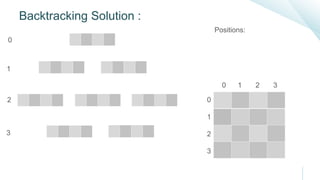
1) Start from the left most column.
2) If all Queens are placed
return true.
3) Try all rows in the current column. Do following for every tried row.
a) If the queen can be placed safely in this row then mark this [row,
column] as part of the solution and recursively check if placing
queen here leads to a solution.
b) If placing queen in [row, column] leads to a solution then return
true.
c) If placing queen doesn't lead to a solution then unmark this [row,
column] (Backtrack) and go to step (a) to try other rows.
4) If all rows have been tried and nothing worked, return false to trigger
backtracking.](https://image.slidesharecdn.com/nqueenalgorithm-170411204309/85/N-Queen-Algorithm-11-320.jpg)


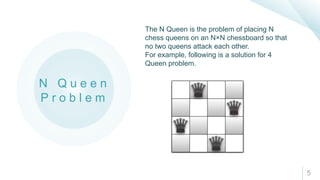
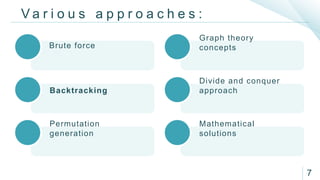
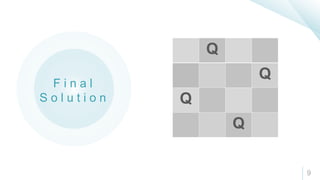
The document discusses the N-Queens problem, which involves placing N queens on an N×N chessboard such that no two queens can attack each other. It outlines various approaches to solving the problem, including brute force, backtracking, and mathematical methods. A detailed explanation of the backtracking algorithm for finding solutions is also provided.


