For any help regarding Stochastic Process Exam Help
Visit :- https://www.statisticsexamhelp.com/ ,
Email :- support@statisticsexamhelp.com or
Call us at :- +1 678 648 4277
Problem 1. In problem set 1 you showed that the nand operator by itself can be used to write equivalent
expressions for all other Boolean logical operators. We call such an operator universal. Another universal operator is
nor, defined such that P norQ ⇔ ¬(P ∨Q). Show how to express P ∧ Q in terms of: nor, P, Q, and grouping
parentheses.
Solution. (¬P) nor (¬Q) = (P nor P) nor (Q nor Q).
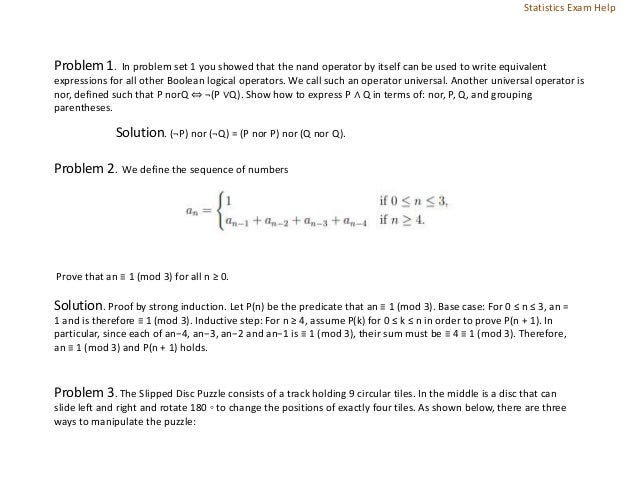
Problem 2. We define the sequence of numbers
Prove that an ≡ 1 (mod 3) for all n ≥ 0.
Solution. Proof by strong induction. Let P(n) be the predicate that an ≡ 1 (mod 3). Base case: For 0 ≤ n ≤ 3, an =
1 and is therefore ≡ 1 (mod 3). Inductive step: For n ≥ 4, assume P(k) for 0 ≤ k ≤ n in order to prove P(n + 1). In
particular, since each of an−4, an−3, an−2 and an−1 is ≡ 1 (mod 3), their sum must be ≡ 4 ≡ 1 (mod 3). Therefore,
an ≡ 1 (mod 3) and P(n + 1) holds.
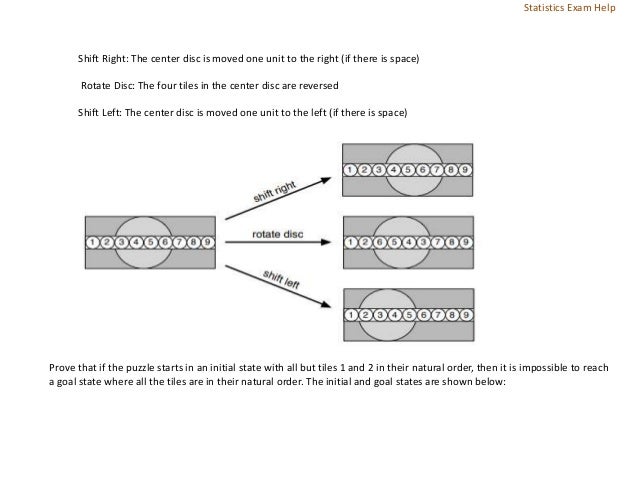
Problem 3. The Slipped Disc Puzzle consists of a track holding 9 circular tiles. In the middle is a disc that can
slide left and right and rotate 180 ◦ to change the positions of exactly four tiles. As shown below, there are three
ways to manipulate the puzzle:
Statistics Exam Help
Shift Right: The center disc is moved one unit to the right (if there is space)
Rotate Disc: The four tiles in the center disc are reversed
Shift Left: The center disc is moved one unit to the left (if there is space)
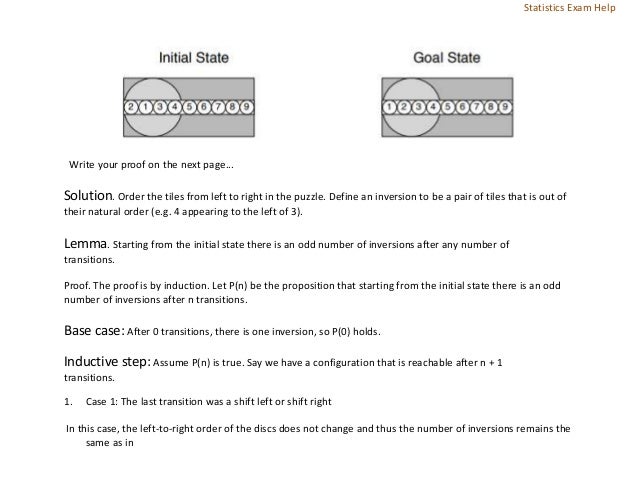
Prove that if the puzzle starts in an initial state with all but tiles 1 and 2 in their natural order, then it is impossible to reach
a goal state where all the tiles are in their natural order. The initial and goal states are shown below:
Statistics Exam Help
Write your proof on the next page...
Solution. Order the tiles from left to right in the puzzle. Define an inversion to be a pair of tiles that is out of
their natural order (e.g. 4 appearing to the left of 3).
Lemma. Starting from the initial state there is an odd number of inversions after any number of
transitions.
Proof. The proof is by induction. Let P(n) be the proposition that starting from the initial state there is an odd
number of inversions after n transitions.
Base case: After 0 transitions, there is one inversion, so P(0) holds.
Inductive step: Assume P(n) is true. Say we have a configuration that is reachable after n + 1
transitions.
1. Case 1: The last transition was a shift left or shift right
In this case, the left-to-right order of the discs does not change and thus the number of inversions remains the
same as in
Statistics Exam Help
2. The last transition was a rotate disc. In this case, six pairs of disks switch order. If there were x inversions among
these pairs after n transitions, there will be 6 − x inversions after the reversal. If x is odd, 6 − x is odd, so after n + 1
transitions the number of inversions is odd.
Conclusion: Since all reachable states have an odd number of inversions and the goal state has an even number
of inversions (specifically 0), the goal state cannot be reached.
Problem 4. Find the multiplicative inverse of 17 modulo 72 in the range {0, 1, . . . , 71}.
Solution. Since 17 and 72 = 2332 are relatively prime, an inverse exists and can be found by either Euler’s
theorem or the Pulverizer.
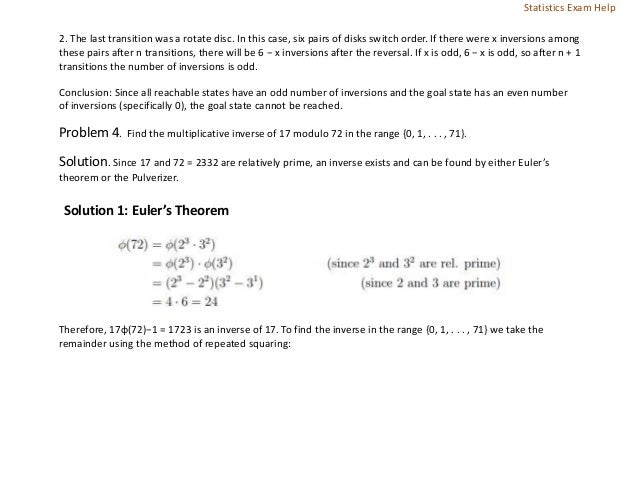
Solution 1: Euler’s Theorem
Therefore, 17φ(72)−1 = 1723 is an inverse of 17. To find the inverse in the range {0, 1, . . . , 71} we take the
remainder using the method of repeated squaring:
Statistics Exam Help
Solution 2: The Pulverizer
Statistics Exam Help
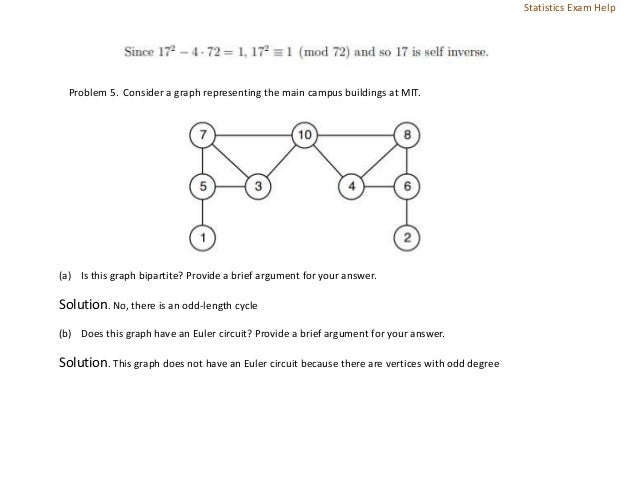
Problem 5. Consider a graph representing the main campus buildings at MIT.
(a) Is this graph bipartite? Provide a brief argument for your answer.
Solution. No, there is an odd-length cycle
(b) Does this graph have an Euler circuit? Provide a brief argument for your answer.
Solution. This graph does not have an Euler circuit because there are vertices with odd degree
Statistics Exam Help
Problem 5 continued... Now suppose each building has separate mail collection and drop-off boxes and each collection
box has a single package destined for a unique drop-off box (i.e. a permutation). We can model this as a permutation
routing problem by treating the buildings as switches, attaching an input and output terminal to each of the nine
buildings, and treating the existing edges as bidirectional as in the graph below:
(c) Give the diameter of this graph:
Solution. The diameter is 8, the length of a shortest path between the terminals for buildings 1 and 2.
(d) What is the max congestion of this graph? That is, in the worst case permutation, how many packages would
need to pass through a single building? Provide a brief argument for your answer.
Statistics Exam Help
Solution. The maximum congestion is 9. Consider a permutation where all the packages on the left side are destined for
drop-offs on the right side and vice versa with the building 10 package destined for building 10. In this case, all 9 packages
must pass through building 10, giving a congestion of 9, which is the maximum for a graph with nine input-output pairs.
Problem 6. A tournament graph G = (V, E) is a directed graph such that there is either an edge from u to v or an edge
from v to u for every distinct pair of nodes u and v. (The nodes represent players and an edge u → v indicates that
player u beats player v.)
Consider the “beats” relation implied by a tournament graph. Indicate whether or not each of the following relational
properties hold for all tournament graphs and briefly explain your reasoning. You may assume that a player never
plays herself.
1. transitive
Solution. The “beats” relation is not transitive because there could exist a cycle of length 3 where x beats y, y
beats z and z beats x. By the definition of a tournament, x cannot then beat y in such a situation.
2. symmetric
Solution. The “beats” relation is not symmetric by the definition of a tournament: if x beats y then y does not beat x.
3. antisymmetric
Solution. The “beats” relation is antisymmetric since for any distinct players x and y, if x beats y then y does
not beat x.
Statistics Exam Help
4. reflexive
Solution. The “beats” relation is not reflexive since a tournament graph has no self-loops.
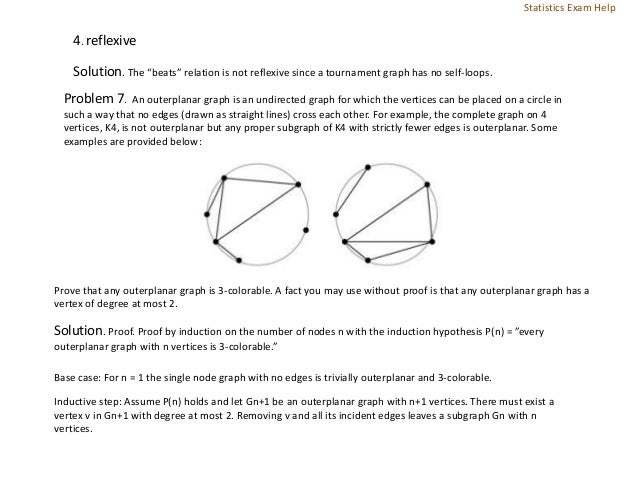
Problem 7. An outerplanar graph is an undirected graph for which the vertices can be placed on a circle in
such a way that no edges (drawn as straight lines) cross each other. For example, the complete graph on 4
vertices, K4, is not outerplanar but any proper subgraph of K4 with strictly fewer edges is outerplanar. Some
examples are provided below:
Prove that any outerplanar graph is 3-colorable. A fact you may use without proof is that any outerplanar graph has a
vertex of degree at most 2.
Solution. Proof. Proof by induction on the number of nodes n with the induction hypothesis P(n) = ”every
outerplanar graph with n vertices is 3-colorable.”
Base case: For n = 1 the single node graph with no edges is trivially outerplanar and 3-colorable.
Inductive step: Assume P(n) holds and let Gn+1 be an outerplanar graph with n+1 vertices. There must exist a
vertex v in Gn+1 with degree at most 2. Removing v and all its incident edges leaves a subgraph Gn with n
vertices.
Statistics Exam Help
Since Gn+1 could be drawn with its vertices on a circle and its edges drawn as straight lines without intersections,
any subgraph can also be drawn in such a way and so Gn is also an outerplanar graph. P(n) implies Gn is 3-
colorable. Therefore we can color all the vertices in Gn+1 other than v using only 3 colors and since deg(v) ≤ 2 we
may color it a color different than the vertices adjacent to it using only 3 colors. Therefore, Gn+1 is 3-colorable
and P(n + 1) holds.
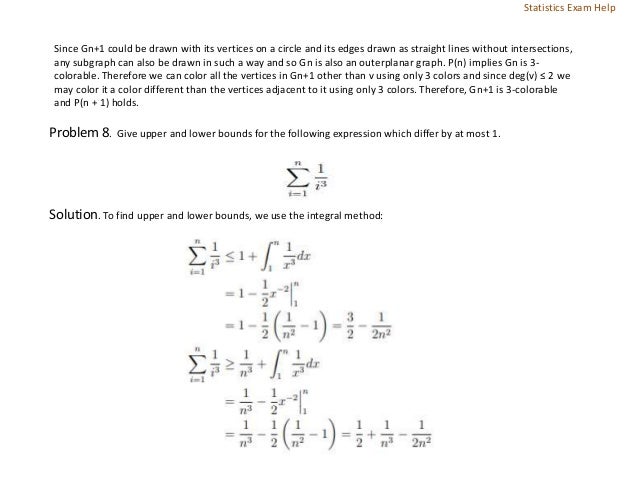
Problem 8. Give upper and lower bounds for the following expression which differ by at most 1.
Solution. To find upper and lower bounds, we use the integral method:
Statistics Exam Help
Problem 9. Circle every symbol on the left that could correctly appear in the box to its right. For each of the six parts
you may need to circle any number of symbols.
Statistics Exam Help

Stochastic Process Exam Help

  • 1.
    For any helpregarding Stochastic Process Exam Help Visit :- https://www.statisticsexamhelp.com/ , Email :- support@statisticsexamhelp.com or Call us at :- +1 678 648 4277
  • 2.
    Problem 1. Inproblem set 1 you showed that the nand operator by itself can be used to write equivalent expressions for all other Boolean logical operators. We call such an operator universal. Another universal operator is nor, defined such that P norQ ⇔ ¬(P ∨Q). Show how to express P ∧ Q in terms of: nor, P, Q, and grouping parentheses. Solution. (¬P) nor (¬Q) = (P nor P) nor (Q nor Q). Problem 2. We define the sequence of numbers Prove that an ≡ 1 (mod 3) for all n ≥ 0. Solution. Proof by strong induction. Let P(n) be the predicate that an ≡ 1 (mod 3). Base case: For 0 ≤ n ≤ 3, an = 1 and is therefore ≡ 1 (mod 3). Inductive step: For n ≥ 4, assume P(k) for 0 ≤ k ≤ n in order to prove P(n + 1). In particular, since each of an−4, an−3, an−2 and an−1 is ≡ 1 (mod 3), their sum must be ≡ 4 ≡ 1 (mod 3). Therefore, an ≡ 1 (mod 3) and P(n + 1) holds. Problem 3. The Slipped Disc Puzzle consists of a track holding 9 circular tiles. In the middle is a disc that can slide left and right and rotate 180 ◦ to change the positions of exactly four tiles. As shown below, there are three ways to manipulate the puzzle: Statistics Exam Help
  • 3.
    Shift Right: Thecenter disc is moved one unit to the right (if there is space) Rotate Disc: The four tiles in the center disc are reversed Shift Left: The center disc is moved one unit to the left (if there is space) Prove that if the puzzle starts in an initial state with all but tiles 1 and 2 in their natural order, then it is impossible to reach a goal state where all the tiles are in their natural order. The initial and goal states are shown below: Statistics Exam Help
  • 4.
    Write your proofon the next page... Solution. Order the tiles from left to right in the puzzle. Define an inversion to be a pair of tiles that is out of their natural order (e.g. 4 appearing to the left of 3). Lemma. Starting from the initial state there is an odd number of inversions after any number of transitions. Proof. The proof is by induction. Let P(n) be the proposition that starting from the initial state there is an odd number of inversions after n transitions. Base case: After 0 transitions, there is one inversion, so P(0) holds. Inductive step: Assume P(n) is true. Say we have a configuration that is reachable after n + 1 transitions. 1. Case 1: The last transition was a shift left or shift right In this case, the left-to-right order of the discs does not change and thus the number of inversions remains the same as in Statistics Exam Help
  • 5.
    2. The lasttransition was a rotate disc. In this case, six pairs of disks switch order. If there were x inversions among these pairs after n transitions, there will be 6 − x inversions after the reversal. If x is odd, 6 − x is odd, so after n + 1 transitions the number of inversions is odd. Conclusion: Since all reachable states have an odd number of inversions and the goal state has an even number of inversions (specifically 0), the goal state cannot be reached. Problem 4. Find the multiplicative inverse of 17 modulo 72 in the range {0, 1, . . . , 71}. Solution. Since 17 and 72 = 2332 are relatively prime, an inverse exists and can be found by either Euler’s theorem or the Pulverizer. Solution 1: Euler’s Theorem Therefore, 17φ(72)−1 = 1723 is an inverse of 17. To find the inverse in the range {0, 1, . . . , 71} we take the remainder using the method of repeated squaring: Statistics Exam Help
  • 6.
    Solution 2: ThePulverizer Statistics Exam Help
  • 7.
    Problem 5. Considera graph representing the main campus buildings at MIT. (a) Is this graph bipartite? Provide a brief argument for your answer. Solution. No, there is an odd-length cycle (b) Does this graph have an Euler circuit? Provide a brief argument for your answer. Solution. This graph does not have an Euler circuit because there are vertices with odd degree Statistics Exam Help
  • 8.
    Problem 5 continued...Now suppose each building has separate mail collection and drop-off boxes and each collection box has a single package destined for a unique drop-off box (i.e. a permutation). We can model this as a permutation routing problem by treating the buildings as switches, attaching an input and output terminal to each of the nine buildings, and treating the existing edges as bidirectional as in the graph below: (c) Give the diameter of this graph: Solution. The diameter is 8, the length of a shortest path between the terminals for buildings 1 and 2. (d) What is the max congestion of this graph? That is, in the worst case permutation, how many packages would need to pass through a single building? Provide a brief argument for your answer. Statistics Exam Help
  • 9.
    Solution. The maximumcongestion is 9. Consider a permutation where all the packages on the left side are destined for drop-offs on the right side and vice versa with the building 10 package destined for building 10. In this case, all 9 packages must pass through building 10, giving a congestion of 9, which is the maximum for a graph with nine input-output pairs. Problem 6. A tournament graph G = (V, E) is a directed graph such that there is either an edge from u to v or an edge from v to u for every distinct pair of nodes u and v. (The nodes represent players and an edge u → v indicates that player u beats player v.) Consider the “beats” relation implied by a tournament graph. Indicate whether or not each of the following relational properties hold for all tournament graphs and briefly explain your reasoning. You may assume that a player never plays herself. 1. transitive Solution. The “beats” relation is not transitive because there could exist a cycle of length 3 where x beats y, y beats z and z beats x. By the definition of a tournament, x cannot then beat y in such a situation. 2. symmetric Solution. The “beats” relation is not symmetric by the definition of a tournament: if x beats y then y does not beat x. 3. antisymmetric Solution. The “beats” relation is antisymmetric since for any distinct players x and y, if x beats y then y does not beat x. Statistics Exam Help
  • 10.
    4. reflexive Solution. The“beats” relation is not reflexive since a tournament graph has no self-loops. Problem 7. An outerplanar graph is an undirected graph for which the vertices can be placed on a circle in such a way that no edges (drawn as straight lines) cross each other. For example, the complete graph on 4 vertices, K4, is not outerplanar but any proper subgraph of K4 with strictly fewer edges is outerplanar. Some examples are provided below: Prove that any outerplanar graph is 3-colorable. A fact you may use without proof is that any outerplanar graph has a vertex of degree at most 2. Solution. Proof. Proof by induction on the number of nodes n with the induction hypothesis P(n) = ”every outerplanar graph with n vertices is 3-colorable.” Base case: For n = 1 the single node graph with no edges is trivially outerplanar and 3-colorable. Inductive step: Assume P(n) holds and let Gn+1 be an outerplanar graph with n+1 vertices. There must exist a vertex v in Gn+1 with degree at most 2. Removing v and all its incident edges leaves a subgraph Gn with n vertices. Statistics Exam Help
  • 11.
    Since Gn+1 couldbe drawn with its vertices on a circle and its edges drawn as straight lines without intersections, any subgraph can also be drawn in such a way and so Gn is also an outerplanar graph. P(n) implies Gn is 3- colorable. Therefore we can color all the vertices in Gn+1 other than v using only 3 colors and since deg(v) ≤ 2 we may color it a color different than the vertices adjacent to it using only 3 colors. Therefore, Gn+1 is 3-colorable and P(n + 1) holds. Problem 8. Give upper and lower bounds for the following expression which differ by at most 1. Solution. To find upper and lower bounds, we use the integral method: Statistics Exam Help
  • 12.
    Problem 9. Circleevery symbol on the left that could correctly appear in the box to its right. For each of the six parts you may need to circle any number of symbols. Statistics Exam Help