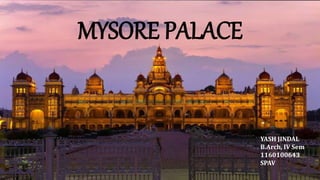
MYSORE PALACE
YASH JINDAL
B.Arch, IV Sem
1160100643
SPAV
Though Mysore is often referred to as the
"City of Palaces", the term Mysore Palace
refers to the largest and the most opulent of
all its surviving palaces located in the city
center, called the Amba Vilas Palace.
This historical palace housed within
the Old Fort facing the Chamunda Hills
stands as the official residence of the
Wadiyar dynasty. Comprising of two
durbar halls, a number of colossal
courtyards, buildings and strikingly
beautiful gardens, it speaks volumes of
the splendor of the Wadiyars.
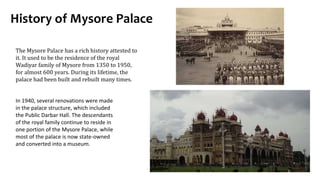
History of Mysore Palace
The Mysore Palace has a rich history attested to
it. It used to be the residence of the royal
Wadiyar family of Mysore from 1350 to 1950,
for almost 600 years. During its lifetime, the
palace had been built and rebuilt many times.
In 1940, several renovations were made
in the palace structure, which included
the Public Darbar Hall. The descendants
of the royal family continue to reside in
one portion of the Mysore Palace, while
most of the palace is now state-owned
and converted into a museum.
The present palace is a relatively new one,
constructed over the old palace that was
destroyed in a fire in 1897.
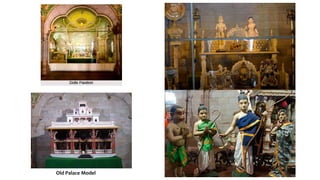
A model of this destroyed palace is the very
first exhibit from the entrance.
Photograph of the Old Palace at Mysore, taken by
William Henry Pigou around 1855. Note the
massive wooden columns of the porch. A large
part of this palace was made of wood, causing the
damage complete in that fire accident.
Old Palace Model
Architecture of Mysore Palace
The Mysore Palace is built in the Indo-Saracenic form of
architecture. In other words, one can see the elements of Hindu,
Islamic and Gothic elements in its structure and construction.
The main frontage of the
palace has nine arches,
supported by ornamental
pillars carrying a beautiful
balcony without intermediate
pillars.
It is a three-storeyed stone palace which has a series of
square towers with arches covered with domes.
Entry to the palace is through "Gombe Thotti" or Doll's
Pavillion. The entrance gate and arch hold the emblem
and coat of arms of the kingdom of Mysore, around
which is written the kingdom’s motto in Sanskrit:
translated as “never terrified”.
The three-
story stone
building of fine
gray granite
with deep pink
marble domes
has a facade
with several
expansive
arches and two
smaller ones
flanking the
central arch,
which is
supported by
tall pillars
covered with
domes.
The tallest tower of the palace is a five storied tower, measuring about 145 feet (45 meters) at the centre
of the palace. This projects up from the rest of the roof-line of the palace like a tower of a Gothic cathedral.
However on top of it is a large dome, a very typical feature of
Islamic/Persian style of structures. However it is metal gilded. Further
on top of this dome is a domed Chhatri. That is, a smaller dome
supported by slender pillars projecting up from the large dome.
Domed Chhatri is a typical Rajput ( Rajasthani ) architectural feature.
The domes are an element borrowed from the Islamic
school of architecture. There are many deep pink
marble domes projecting at the corners of the palace
structure.
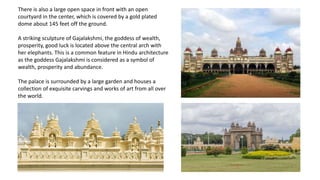
There is also a large open space in front with an open
courtyard in the center, which is covered by a gold plated
dome about 145 feet off the ground.
A striking sculpture of Gajalakshmi, the goddess of wealth,
prosperity, good luck is located above the central arch with
her elephants. This is a common feature in Hindu architecture
as the goddess Gajalakshmi is considered as a symbol of
wealth, prosperity and abundance.
The palace is surrounded by a large garden and houses a
collection of exquisite carvings and works of art from all over
the world.
This distant view from the southeast shows
the great extent of the palace. The east facade,
with its two-story arcade, is anchored on
either end by red-domed towers grouped into
blocks of four.
The new palace covers a vast area; the south-
side entrance is seen here, with the main part
of the palace rising in the background.
The southern and northern extremities of the palace possess
protruding balconies. These resemble that of the ‘jharokha'
of the Rajasthani architecture. The balconies appear three-
storied from outside. That is, three rows of tall windows one
over the other on the balconies. Top of the balcony is a semi-
dome in deep pink stone , while the bottom is supported by
a structural feature in the form a lotus.
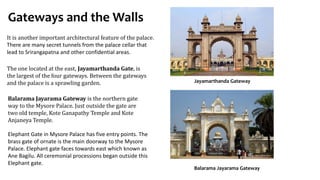
It is another important architectural feature of the palace.
There are many secret tunnels from the palace cellar that
lead to Srirangapatna and other confidential areas.
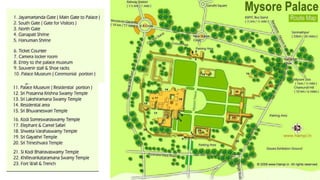
Jayamarthanda Gateway
Balarama Jayarama Gateway is the northern gate
way to the Mysore Palace. Just outside the gate are
two old temple, Kote Ganapathy Temple and Kote
Anjaneya Temple.
Balarama Jayarama Gateway
Elephant Gate in Mysore Palace has five entry points. The
brass gate of ornate is the main doorway to the Mysore
Palace. Elephant gate faces towards east which known as
Ane Bagilu. All ceremonial processions began outside this
Elephant gate.
Gateways and the Walls
The one located at the east, Jayamarthanda Gate, is
the largest of the four gateways. Between the gateways
and the palace is a sprawling garden.
Gateway to the royal palace Crest of the Balarama Jayarama Gateway Elephant Gate
AREAS
The palace has several unique rooms. These
include the Public Durbar, where the king
would host major ceremonial gatherings.
There’s also the Kalyana Mantapa, a
spectacular octagonal shaped hall where all
royal weddings, birthdays and ceremonial
functions were celebrated, the Private
Durbar, the Gombe Thotti and the Portrait
Gallery.
The palace now converted into a museum, is
home to souvenirs, paintings, jewelry, royal
costumes and other items which were once
possessed by the Wodeyars. However, the
erstwhile Royal family continues to live in a
portion of the Palace. It’s a rainbow of stained
glass and mirrors. The lavishly decorated
rooms are hidden behind elegantly decorated
and intricately carved doors.
Ambavilasa inside the Mysore palace, it is lined
up with multiple rooms
Gombe Thotti
Entry to the palace is through the Gombe Thotti or the
Doll’s Pavilion, a gallery of traditional dolls from the
nineteenth and early twentieth centuries.
The pavilion also houses a fine collection of Indian and
European marble sculpture and ceremonial objects like
a wooden elephant howdah (frame to carry
passengers) decorated with 84 kilograms of gold.
Another fascinating exhibit is an elaborate clock with
antoinettes, mechanical elements and a procession of
dolls and the seven canons which is situated in front of
the Gombe Thotti and are still fired to mark the
beginning and end of the annual Dasara procession.
Old Palace Model
Ganesha Shrine
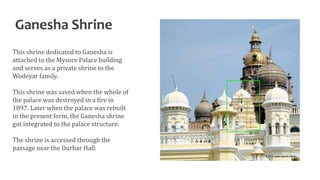
This shrine dedicated to Ganesha is
attached to the Mysore Palace building
and serves as a private shrine to the
Wodeyar family.
This shrine was saved when the whole of
the palace was destroyed in a fire in
1897. Later when the palace was rebuilt
in the present form, the Ganesha shrine
got integrated to the palace structure.
The shrine is accessed through the
passage near the Durbar Hall.
The Kalyana Mantapa
The Kalyana Mantapa,
or the wedding hall, is
a grand octagonal-
shaped room with
multi-colored stained
glass ceiling, which
soars heavenward,
and casts stunning
colored shadows
giving the whole place
a surreal feel, with a
rich tapestry of
peacock motifs
arranged in
geometrical patterns
and floral "mandalas"
held by metal beams.
Stone peacocks - The Kalyana Mantapa
Outside the Marriage Pavilion,
the walls are equally arresting
with massive oil paintings, the
multicolored columns and
pillars carvings with scenes
from the Mahabharata and the
Ramayana , shows the rich
Indian Cultural Heritage.
The dome is supported by
cast-iron pillars
from Glasgow and grand
chandeliers. The flooring
of the room continues the
peacock theme with a
peacock mosaic, with tiles
designed from England.
On the floor are the embedded
inlay work- Pietra Dura- popularly
known as Agra work
Royal Paintings
On the southern part of the
Kalyana Mantapa is the
portrait gallery.
It contains large portraits of
the kings and princes along
with innumerous examples
of traditional Mysuru
paintings.
Locally available materials
were used for these
paintings and the subjects of
the paintings include Hindu
deities, courtly life, historic
battles, and scenes from
great Indian epics.
The Portrait Gallery and the Period
Furniture Room lead off this pavilion.
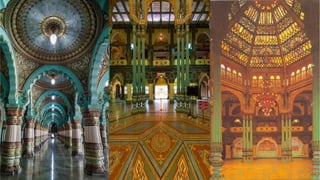
Public Durbar Hall
On the first floor, a marble
staircase leads to the
magnificent new Durbar Hall
(1938) of the Mysore Palace
which is a part of the main
palace enclosed on three sides
and completely open on the
eastern side. This hall is of a
unique kind with magnificent
proportions. Having a clear
height of 15.24m, above ground
level and hall measures 74.68m
long and 24.38 m wide without
any intermediate pillars.
The richly decorated gold-and-turquoise colonnaded hall
with majestic bottle-shaped pillars painted in pleasing
colors, and with asbestos-lined ceiling, is adorned with
the paintings of the ten incarnations of Vishnu
(Dashavatara). The central panel has the 12 signs of the
Zodiac placed around the Hindu Trinity- Brahma, Vishnu
and Maheshwara. A series of paintings on the rear wall
shows the goddess Durga in her various forms.
Also called the "Diwan-I-Am“,
it was used for public
audiences where the general
population could meet the
king at scheduled times to
submit petitions, public
announcements and hearings.
Great deal of plaster work
on the ceiling- Blend of
Native and Gothic styles
The main frontage of
the palace has nine
arches, supported by
ornamental pillars
carrying a beautiful
balcony without
intermediate pillars.
Ballroom inside
Mysore Palace
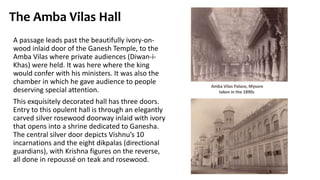
The Amba Vilas Hall
A passage leads past the beautifully ivory-on-
wood inlaid door of the Ganesh Temple, to the
Amba Vilas where private audiences (Diwan-i-
Khas) were held. It was here where the king
would confer with his ministers. It was also the
chamber in which he gave audience to people
deserving special attention.
This exquisitely decorated hall has three doors.
Entry to this opulent hall is through an elegantly
carved silver rosewood doorway inlaid with ivory
that opens into a shrine dedicated to Ganesha.
The central silver door depicts Vishnu’s 10
incarnations and the eight dikpalas (directional
guardians), with Krishna figures on the reverse,
all done in repoussé on teak and rosewood.
Amba Vilas Palace, Mysore
taken in the 1890s
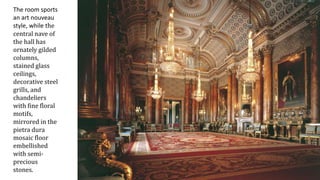
The room sports
an art nouveau
style, while the
central nave of
the hall has
ornately gilded
columns,
stained glass
ceilings,
decorative steel
grills, and
chandeliers
with fine floral
motifs,
mirrored in the
pietra dura
mosaic floor
embellished
with semi-
precious
stones.
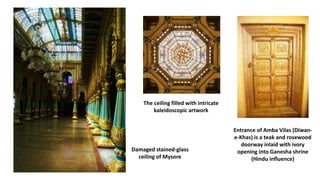
Damaged stained-glass
ceiling of Mysore
The ceiling filled with intricate
kaleidoscopic artwork
Entrance of Amba Vilas (Diwan-
e-Khas) is a teak and rosewood
doorway inlaid with ivory
opening into Ganesha shrine
(Hindu influence)
The Golden Throne
Golden Howdah or Chinnada
Ambari is a magnificent and
majestic throne mounted on a
platform with steps leading up
to the main seat where a
beautiful golden umbrella
hangs over it.
It is a wooden structure with
base carved out of fig wood, in
the form of a mantapa which is
covered with eighty kilograms
of gold sheets and encrusted
with precious stones, silver
and jewelry.
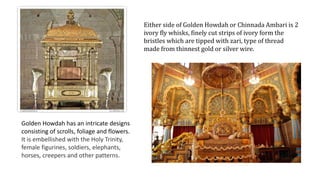
Either side of Golden Howdah or Chinnada Ambari is 2
ivory fly whisks, finely cut strips of ivory form the
bristles which are tipped with zari, type of thread
made from thinnest gold or silver wire.
Golden Howdah has an intricate designs
consisting of scrolls, foliage and flowers.
It is embellished with the Holy Trinity,
female figurines, soldiers, elephants,
horses, creepers and other patterns.
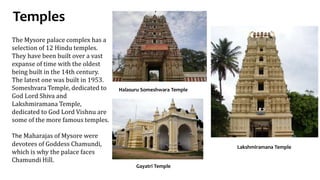
Temples
Gayatri Temple
The Mysore palace complex has a
selection of 12 Hindu temples.
They have been built over a vast
expanse of time with the oldest
being built in the 14th century.
The latest one was built in 1953.
Someshvara Temple, dedicated to
God Lord Shiva and
Lakshmiramana Temple,
dedicated to God Lord Vishnu are
some of the more famous temples.
The Maharajas of Mysore were
devotees of Goddess Chamundi,
which is why the palace faces
Chamundi Hill.
Halasuru Someshwara Temple
Lakshmiramana Temple
Shwetha Varahaswami Temple
The temple's 5-story
gopura is whitewashed;
its figural sculptures
include dvarapalas flanking
the openings, and guardian
faces on the top story.
This 18th century temple is one of 12 that lie
within the palace grounds. It is dedicated to
the Varaha incarnation of Vishnu.
With the chola style gateway tower, it is located on the northern
side of the Palace complex with identical looking tower,
providing a architectural symmetry to the campus layout
The Bhuvaneshwari Temple
The palace is
illuminated with
ninety seven
thousand bulbs at
night on Sundays
and during the
holiday season of
Dussehra.
Bronze Tigers
Bronze tiger
There are 8 larger than life size bronze
tigers installed on pedestals in the Mysore
Palace.
Six of them are located on the arena in front
of the palace building. They are installed in
pairs as if guarding the 3 pathways
radiating out of this expansive courtyard in
front of the palace.
Another pair is located inside the palace
building which can be seen on the porch
inside the palace , near the Marriage
Pavilion.
Wrestling Courtyard
Wrestling Courtyard in Mysore Palace is the eye
witness of several games like wrestling competition,
which is one of the most famous games in India. Among
the other European and Indigenous sports held,
include Horse races, Foot Ball, Polo tournament, the
chase, etc.
Gardens in Mysore Palace
Mysore Palace has a
well laid garden
within the complex.
The Fort
Faced with the grandeur of Amba Vilas Palace, it is
easy to miss the historic fort that surrounds it and is
amongst Mysore’s unique experiences.
The original walls were built under the Wadiyars in
1524 but gradually the defensive glacis was
flattened and defensive ditch was filled, but the
stone wall is still intact. Over time, the wall was
rebuilt and extended several times, the mud walls
replaced eventually with stone.
Later, Tipu had them pulled down with plans to
rebuild but died before the plans came to fruition.
Subsequently, they were reconstructed by the
British in 1799. Originally, the fort area was a
bustling centre of life, packed with houses, but these
were moved out in 1910.
THANK YOU

Mysore palace

  • 1.
    MYSORE PALACE YASH JINDAL B.Arch,IV Sem 1160100643 SPAV
  • 2.
    Though Mysore isoften referred to as the "City of Palaces", the term Mysore Palace refers to the largest and the most opulent of all its surviving palaces located in the city center, called the Amba Vilas Palace. This historical palace housed within the Old Fort facing the Chamunda Hills stands as the official residence of the Wadiyar dynasty. Comprising of two durbar halls, a number of colossal courtyards, buildings and strikingly beautiful gardens, it speaks volumes of the splendor of the Wadiyars.
  • 3.
    History of MysorePalace The Mysore Palace has a rich history attested to it. It used to be the residence of the royal Wadiyar family of Mysore from 1350 to 1950, for almost 600 years. During its lifetime, the palace had been built and rebuilt many times. In 1940, several renovations were made in the palace structure, which included the Public Darbar Hall. The descendants of the royal family continue to reside in one portion of the Mysore Palace, while most of the palace is now state-owned and converted into a museum.
  • 4.
    The present palaceis a relatively new one, constructed over the old palace that was destroyed in a fire in 1897. A model of this destroyed palace is the very first exhibit from the entrance. Photograph of the Old Palace at Mysore, taken by William Henry Pigou around 1855. Note the massive wooden columns of the porch. A large part of this palace was made of wood, causing the damage complete in that fire accident. Old Palace Model
  • 6.
    Architecture of MysorePalace The Mysore Palace is built in the Indo-Saracenic form of architecture. In other words, one can see the elements of Hindu, Islamic and Gothic elements in its structure and construction. The main frontage of the palace has nine arches, supported by ornamental pillars carrying a beautiful balcony without intermediate pillars. It is a three-storeyed stone palace which has a series of square towers with arches covered with domes. Entry to the palace is through "Gombe Thotti" or Doll's Pavillion. The entrance gate and arch hold the emblem and coat of arms of the kingdom of Mysore, around which is written the kingdom’s motto in Sanskrit: translated as “never terrified”.
  • 7.
    The three- story stone buildingof fine gray granite with deep pink marble domes has a facade with several expansive arches and two smaller ones flanking the central arch, which is supported by tall pillars covered with domes.
  • 8.
    The tallest towerof the palace is a five storied tower, measuring about 145 feet (45 meters) at the centre of the palace. This projects up from the rest of the roof-line of the palace like a tower of a Gothic cathedral. However on top of it is a large dome, a very typical feature of Islamic/Persian style of structures. However it is metal gilded. Further on top of this dome is a domed Chhatri. That is, a smaller dome supported by slender pillars projecting up from the large dome. Domed Chhatri is a typical Rajput ( Rajasthani ) architectural feature. The domes are an element borrowed from the Islamic school of architecture. There are many deep pink marble domes projecting at the corners of the palace structure.
  • 9.
    There is alsoa large open space in front with an open courtyard in the center, which is covered by a gold plated dome about 145 feet off the ground. A striking sculpture of Gajalakshmi, the goddess of wealth, prosperity, good luck is located above the central arch with her elephants. This is a common feature in Hindu architecture as the goddess Gajalakshmi is considered as a symbol of wealth, prosperity and abundance. The palace is surrounded by a large garden and houses a collection of exquisite carvings and works of art from all over the world.
  • 10.
    This distant viewfrom the southeast shows the great extent of the palace. The east facade, with its two-story arcade, is anchored on either end by red-domed towers grouped into blocks of four. The new palace covers a vast area; the south- side entrance is seen here, with the main part of the palace rising in the background.
  • 11.
    The southern andnorthern extremities of the palace possess protruding balconies. These resemble that of the ‘jharokha' of the Rajasthani architecture. The balconies appear three- storied from outside. That is, three rows of tall windows one over the other on the balconies. Top of the balcony is a semi- dome in deep pink stone , while the bottom is supported by a structural feature in the form a lotus.
  • 12.
    It is anotherimportant architectural feature of the palace. There are many secret tunnels from the palace cellar that lead to Srirangapatna and other confidential areas. Jayamarthanda Gateway Balarama Jayarama Gateway is the northern gate way to the Mysore Palace. Just outside the gate are two old temple, Kote Ganapathy Temple and Kote Anjaneya Temple. Balarama Jayarama Gateway Elephant Gate in Mysore Palace has five entry points. The brass gate of ornate is the main doorway to the Mysore Palace. Elephant gate faces towards east which known as Ane Bagilu. All ceremonial processions began outside this Elephant gate. Gateways and the Walls The one located at the east, Jayamarthanda Gate, is the largest of the four gateways. Between the gateways and the palace is a sprawling garden.
  • 13.
    Gateway to theroyal palace Crest of the Balarama Jayarama Gateway Elephant Gate
  • 14.
    AREAS The palace hasseveral unique rooms. These include the Public Durbar, where the king would host major ceremonial gatherings. There’s also the Kalyana Mantapa, a spectacular octagonal shaped hall where all royal weddings, birthdays and ceremonial functions were celebrated, the Private Durbar, the Gombe Thotti and the Portrait Gallery. The palace now converted into a museum, is home to souvenirs, paintings, jewelry, royal costumes and other items which were once possessed by the Wodeyars. However, the erstwhile Royal family continues to live in a portion of the Palace. It’s a rainbow of stained glass and mirrors. The lavishly decorated rooms are hidden behind elegantly decorated and intricately carved doors. Ambavilasa inside the Mysore palace, it is lined up with multiple rooms
  • 15.
    Gombe Thotti Entry tothe palace is through the Gombe Thotti or the Doll’s Pavilion, a gallery of traditional dolls from the nineteenth and early twentieth centuries. The pavilion also houses a fine collection of Indian and European marble sculpture and ceremonial objects like a wooden elephant howdah (frame to carry passengers) decorated with 84 kilograms of gold. Another fascinating exhibit is an elaborate clock with antoinettes, mechanical elements and a procession of dolls and the seven canons which is situated in front of the Gombe Thotti and are still fired to mark the beginning and end of the annual Dasara procession.
  • 16.
  • 17.
    Ganesha Shrine This shrinededicated to Ganesha is attached to the Mysore Palace building and serves as a private shrine to the Wodeyar family. This shrine was saved when the whole of the palace was destroyed in a fire in 1897. Later when the palace was rebuilt in the present form, the Ganesha shrine got integrated to the palace structure. The shrine is accessed through the passage near the Durbar Hall.
  • 18.
    The Kalyana Mantapa TheKalyana Mantapa, or the wedding hall, is a grand octagonal- shaped room with multi-colored stained glass ceiling, which soars heavenward, and casts stunning colored shadows giving the whole place a surreal feel, with a rich tapestry of peacock motifs arranged in geometrical patterns and floral "mandalas" held by metal beams. Stone peacocks - The Kalyana Mantapa
  • 19.
    Outside the MarriagePavilion, the walls are equally arresting with massive oil paintings, the multicolored columns and pillars carvings with scenes from the Mahabharata and the Ramayana , shows the rich Indian Cultural Heritage. The dome is supported by cast-iron pillars from Glasgow and grand chandeliers. The flooring of the room continues the peacock theme with a peacock mosaic, with tiles designed from England. On the floor are the embedded inlay work- Pietra Dura- popularly known as Agra work
  • 21.
    Royal Paintings On thesouthern part of the Kalyana Mantapa is the portrait gallery. It contains large portraits of the kings and princes along with innumerous examples of traditional Mysuru paintings. Locally available materials were used for these paintings and the subjects of the paintings include Hindu deities, courtly life, historic battles, and scenes from great Indian epics. The Portrait Gallery and the Period Furniture Room lead off this pavilion.
  • 23.
    Public Durbar Hall Onthe first floor, a marble staircase leads to the magnificent new Durbar Hall (1938) of the Mysore Palace which is a part of the main palace enclosed on three sides and completely open on the eastern side. This hall is of a unique kind with magnificent proportions. Having a clear height of 15.24m, above ground level and hall measures 74.68m long and 24.38 m wide without any intermediate pillars.
  • 24.
    The richly decoratedgold-and-turquoise colonnaded hall with majestic bottle-shaped pillars painted in pleasing colors, and with asbestos-lined ceiling, is adorned with the paintings of the ten incarnations of Vishnu (Dashavatara). The central panel has the 12 signs of the Zodiac placed around the Hindu Trinity- Brahma, Vishnu and Maheshwara. A series of paintings on the rear wall shows the goddess Durga in her various forms. Also called the "Diwan-I-Am“, it was used for public audiences where the general population could meet the king at scheduled times to submit petitions, public announcements and hearings.
  • 25.
    Great deal ofplaster work on the ceiling- Blend of Native and Gothic styles
  • 26.
    The main frontageof the palace has nine arches, supported by ornamental pillars carrying a beautiful balcony without intermediate pillars. Ballroom inside Mysore Palace
  • 27.
    The Amba VilasHall A passage leads past the beautifully ivory-on- wood inlaid door of the Ganesh Temple, to the Amba Vilas where private audiences (Diwan-i- Khas) were held. It was here where the king would confer with his ministers. It was also the chamber in which he gave audience to people deserving special attention. This exquisitely decorated hall has three doors. Entry to this opulent hall is through an elegantly carved silver rosewood doorway inlaid with ivory that opens into a shrine dedicated to Ganesha. The central silver door depicts Vishnu’s 10 incarnations and the eight dikpalas (directional guardians), with Krishna figures on the reverse, all done in repoussé on teak and rosewood. Amba Vilas Palace, Mysore taken in the 1890s
  • 28.
    The room sports anart nouveau style, while the central nave of the hall has ornately gilded columns, stained glass ceilings, decorative steel grills, and chandeliers with fine floral motifs, mirrored in the pietra dura mosaic floor embellished with semi- precious stones.
  • 29.
    Damaged stained-glass ceiling ofMysore The ceiling filled with intricate kaleidoscopic artwork Entrance of Amba Vilas (Diwan- e-Khas) is a teak and rosewood doorway inlaid with ivory opening into Ganesha shrine (Hindu influence)
  • 30.
    The Golden Throne GoldenHowdah or Chinnada Ambari is a magnificent and majestic throne mounted on a platform with steps leading up to the main seat where a beautiful golden umbrella hangs over it. It is a wooden structure with base carved out of fig wood, in the form of a mantapa which is covered with eighty kilograms of gold sheets and encrusted with precious stones, silver and jewelry.
  • 31.
    Either side ofGolden Howdah or Chinnada Ambari is 2 ivory fly whisks, finely cut strips of ivory form the bristles which are tipped with zari, type of thread made from thinnest gold or silver wire. Golden Howdah has an intricate designs consisting of scrolls, foliage and flowers. It is embellished with the Holy Trinity, female figurines, soldiers, elephants, horses, creepers and other patterns.
  • 32.
    Temples Gayatri Temple The Mysorepalace complex has a selection of 12 Hindu temples. They have been built over a vast expanse of time with the oldest being built in the 14th century. The latest one was built in 1953. Someshvara Temple, dedicated to God Lord Shiva and Lakshmiramana Temple, dedicated to God Lord Vishnu are some of the more famous temples. The Maharajas of Mysore were devotees of Goddess Chamundi, which is why the palace faces Chamundi Hill. Halasuru Someshwara Temple Lakshmiramana Temple
  • 33.
    Shwetha Varahaswami Temple Thetemple's 5-story gopura is whitewashed; its figural sculptures include dvarapalas flanking the openings, and guardian faces on the top story. This 18th century temple is one of 12 that lie within the palace grounds. It is dedicated to the Varaha incarnation of Vishnu. With the chola style gateway tower, it is located on the northern side of the Palace complex with identical looking tower, providing a architectural symmetry to the campus layout The Bhuvaneshwari Temple
  • 34.
    The palace is illuminatedwith ninety seven thousand bulbs at night on Sundays and during the holiday season of Dussehra.
  • 35.
    Bronze Tigers Bronze tiger Thereare 8 larger than life size bronze tigers installed on pedestals in the Mysore Palace. Six of them are located on the arena in front of the palace building. They are installed in pairs as if guarding the 3 pathways radiating out of this expansive courtyard in front of the palace. Another pair is located inside the palace building which can be seen on the porch inside the palace , near the Marriage Pavilion.
  • 36.
    Wrestling Courtyard Wrestling Courtyardin Mysore Palace is the eye witness of several games like wrestling competition, which is one of the most famous games in India. Among the other European and Indigenous sports held, include Horse races, Foot Ball, Polo tournament, the chase, etc.
  • 37.
    Gardens in MysorePalace Mysore Palace has a well laid garden within the complex.
  • 38.
    The Fort Faced withthe grandeur of Amba Vilas Palace, it is easy to miss the historic fort that surrounds it and is amongst Mysore’s unique experiences. The original walls were built under the Wadiyars in 1524 but gradually the defensive glacis was flattened and defensive ditch was filled, but the stone wall is still intact. Over time, the wall was rebuilt and extended several times, the mud walls replaced eventually with stone. Later, Tipu had them pulled down with plans to rebuild but died before the plans came to fruition. Subsequently, they were reconstructed by the British in 1799. Originally, the fort area was a bustling centre of life, packed with houses, but these were moved out in 1910.
  • 39.