ARCHITECTURAL CONSERVATION
OBSERVATIONS S.Sunaksha
20111AR0029
Sectioan a
5TH Sem
B.Arch
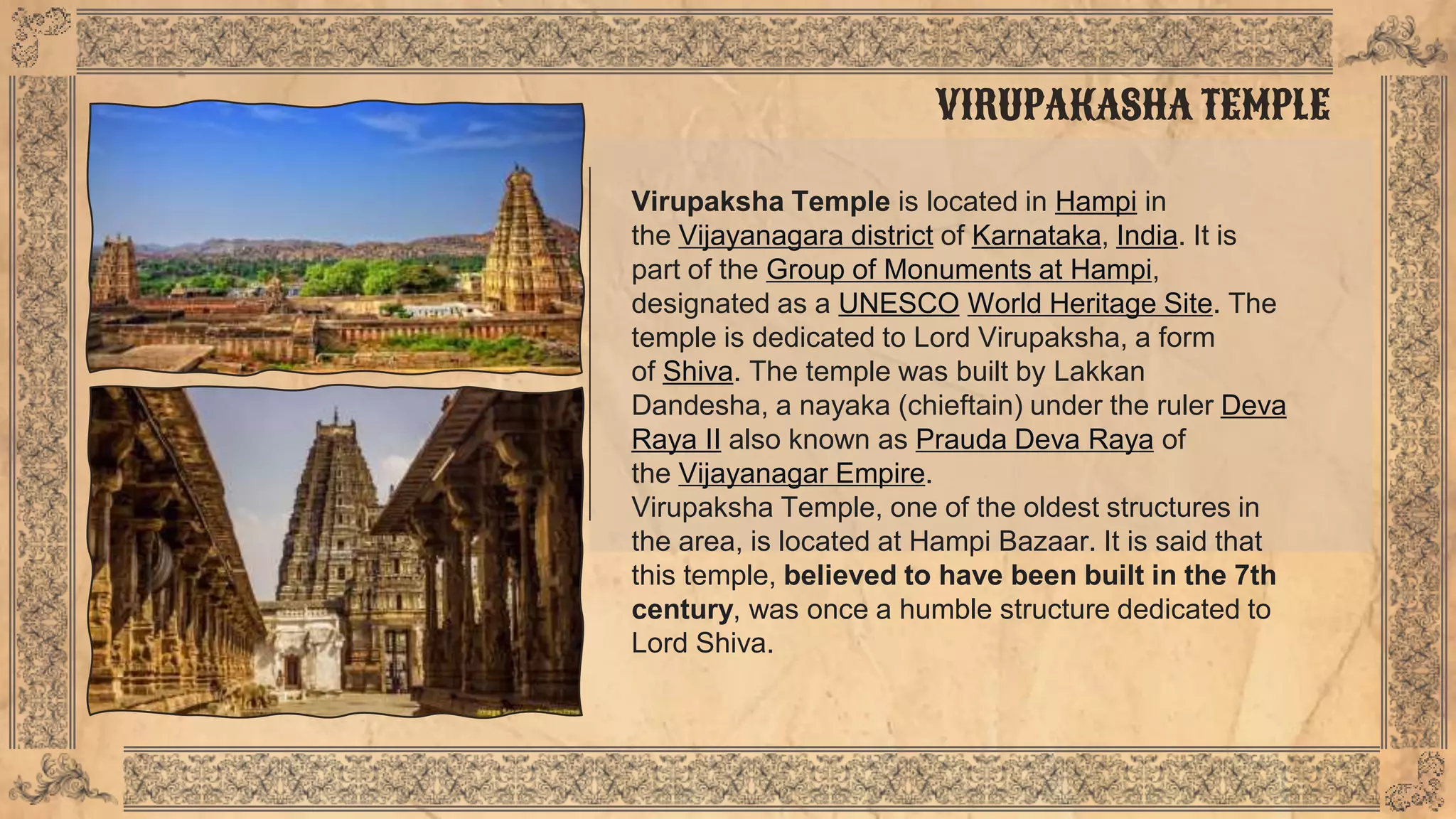
VIRUPAKASHA TEMPLE
Virupaksha Temple is located in Hampi in
the Vijayanagara district of Karnataka, India. It is
part of the Group of Monuments at Hampi,
designated as a UNESCO World Heritage Site. The
temple is dedicated to Lord Virupaksha, a form
of Shiva. The temple was built by Lakkan
Dandesha, a nayaka (chieftain) under the ruler Deva
Raya II also known as Prauda Deva Raya of
the Vijayanagar Empire.
Virupaksha Temple, one of the oldest structures in
the area, is located at Hampi Bazaar. It is said that
this temple, believed to have been built in the 7th
century, was once a humble structure dedicated to
Lord Shiva.
• At present, the main temple consists
of a sanctum, three ante chambers, a
pillared hall and an open pillared hall.
It is decorated with delicately carved
pillars. A pillared cloister, entrance
gateways, courtyards, smaller shrines
and other structures surround the
temple.[3]
• The nine-tiered eastern gateway,
which is the largest at 50 meters, is
well-proportioned and incorporates
some earlier structures. It has a brick
superstructure and a stone base. It
gives access to the outer court
containing many sub-shrines.
• The smaller eastern gateway leads to
the inner court with its numerous
smaller shrines.
• Another gopuram towards north known as
the Kanakagiri gopura, leads to a small
enclosure with subsidiary shrines and
eventually to the river Tungabhadra.[4]
• A narrow channel of the Tungabhadra
River flows along the temple's terrace and
then descends to the temple-kitchen and
out through the outer court.[citation needed]
• One of the most striking features of this
temple is the usage of mathematical
concepts to build and decorate it. The
temple has repeated patterns that
demonstrate the concept of Fractals. The
main shape of the temple is triangular. As
you look up the temple top, the patterns
divide and repeat themselves, just like
you would see in a snowflake or some
other natural wonders.
VIJAYA VITHALA TEMPLE
Vijaya Vittala is a temple dedicated to Lord
Vishnu of the Hindu Trinity (Brahma-Vishnu-
Shiva). It is built in the Dravidian architectural
style. No worship is offered at the temple now and
there is no deity inside the inner sanctum. There are
no written records on when and how the figure of
Vishnu was removed from the temple.
The Gopura of the Temple – A Typical
Component of Dravidian Architecture
Vijaya Vittala is the only temple in
Hampi that possesses a stone
chariot in the front courtyard.
The chariot appears like a monolith but
it actually isn’t. It is built out of multiple
stone slabs, carved and stacked on each
other. The links are cleverly
hidden.Vijaya Vittala is the only
temple in Hampi that possesses a
stone chariot in the front courtyard.
Vijaya Vittala Temple has 56 musical pillars and
they are often called the Saregama Pillars. These
pillars can be tapped with your thumb to generate
music similar to the notes of Saregama.
No temple in Hampi is as exquisitely carved as
the Vittala temple. In fact, this temple is one of
the finest examples of an ornately-carved-
pillared Kalyanamantapa. Kalyanamantapa
is a pillared hall used for weddings.
LOTUS MAHAL
Lotus Mahal or Chitrangini Mahal is an important secular structure in
Hampi, India. The Lotus Mahal is an example of Vijayanagara style
of architecture and is a two storied structure built in Rubble masonry
and finely plastered. The structure was used as residue place for
royal family of the Vijayanagara Empire.
• As the name given to the palace is because of the shape it
resembles. The balcony and the passages covered with a
dome that looks like an opened lotus bud. The central dome
is also carved as a lotus bud. The curves of the palace are
given an Islamic touch while the multi-layered roof design is
moreover related to Indo style of buildings. The style and
designs is an inquisitive blend of Islamic and Indian way of
architecture.
• The palace is a two-storied building, well-structured
symmetrically. It is surrounded by a rectangular wall and four
towers. These towers are also in pyramidal shape giving a
lotus-like structure visual. Around 24 pillars are present to
support the arched windows and balcony of the palace. The
walls and pillars are carved beautifully with patterns like sea
creatures and birds.
MURUDESHWARA TEMPLE
Murdeshwar Temple was built on the Kanduka Hill which is
surrounded on three sides by the waters of the Arabian Sea. It is
dedicated to lord shiva, and a 20-storied Raja Gopura is
constructed at the temple. The temple authorities have installed a
lift that provides a view of the 123-feet Sri Shiva idol from the top
of the Raja Gopura. There is also a Rameshwara linga at the
bottom of the hill, where devotees can do seva themselves. A
Shaneswar temple has been built next to the idol of Sri
Akshayaguna. Two life-size elephants in concrete stand guard at
the steps leading to it. The entire temple and temple complex,
including the 209-feet-tall Raja Gopura, is one among the tallest.
MANJUNATHA TEMPLE
Dharmasthala Temple is an 800-year-old Hindu religious
institution in the temple town of Dharmasthala in Dakshina
Kannada, Karnataka, India. The deities of the temple are Hindu
god Shiva, who is referred to as Mañjunatha, Hindu goddess
Ammanavaru, the Tirthankara Chandraprabha and the
protective gods of Jainism, Kalarahu, Kalarkayi, Kumarasvami and
Kanyakumari. The temple was reconsecrated in 16th century by
Hindu Dvaita saint Vadiraja Tirtha by the request of the then
administrator of the temple, Devaraja Heggade. The temple is
considered unique, Since the priests in the temple are Madhwa
Brahmins, who are Vaishnava, and the administration is run by
a Jain Bunt family called the Pergades.
MYSORE PALACE
The Mysore Palace, also known as Amba
Vilas Palace, is a historical palace and a royal
residence (house). It is located
in Mysore, Karnataka. It used to be the official
residence of the Wadiyar dynasty and the seat
of the Kingdom of Mysore. The palace is in the
centre of Mysore, and faces the Chamundi
Hills eastward. Mysore is commonly described
as the 'City of Palaces', and there are seven
palaces including this one.
The land on which the palace now stands was
originally known as mysuru (literally,
"citadel"). Yaduraya built the first palace inside
the Old Fort in the 14th century, which was set
ablaze and reconstructed multiple times. The
Old Fort was built of wood and thus easily
caught fire, while the current fort was built of
stone, bricks and wood. The current structure
was constructed between 1897 and 1912, after
the Old Palace burnt down, the current structure
is also known as the New Fort. Mysore Palace
is one of the most famous tourist attractions in
India, after the Taj Mahal, with more than six
million annual visitors.
THANK YOU

monuments of karnatka.pptx

  • 1.
  • 2.
    VIRUPAKASHA TEMPLE Virupaksha Templeis located in Hampi in the Vijayanagara district of Karnataka, India. It is part of the Group of Monuments at Hampi, designated as a UNESCO World Heritage Site. The temple is dedicated to Lord Virupaksha, a form of Shiva. The temple was built by Lakkan Dandesha, a nayaka (chieftain) under the ruler Deva Raya II also known as Prauda Deva Raya of the Vijayanagar Empire. Virupaksha Temple, one of the oldest structures in the area, is located at Hampi Bazaar. It is said that this temple, believed to have been built in the 7th century, was once a humble structure dedicated to Lord Shiva.
  • 3.
    • At present,the main temple consists of a sanctum, three ante chambers, a pillared hall and an open pillared hall. It is decorated with delicately carved pillars. A pillared cloister, entrance gateways, courtyards, smaller shrines and other structures surround the temple.[3] • The nine-tiered eastern gateway, which is the largest at 50 meters, is well-proportioned and incorporates some earlier structures. It has a brick superstructure and a stone base. It gives access to the outer court containing many sub-shrines. • The smaller eastern gateway leads to the inner court with its numerous smaller shrines. • Another gopuram towards north known as the Kanakagiri gopura, leads to a small enclosure with subsidiary shrines and eventually to the river Tungabhadra.[4] • A narrow channel of the Tungabhadra River flows along the temple's terrace and then descends to the temple-kitchen and out through the outer court.[citation needed] • One of the most striking features of this temple is the usage of mathematical concepts to build and decorate it. The temple has repeated patterns that demonstrate the concept of Fractals. The main shape of the temple is triangular. As you look up the temple top, the patterns divide and repeat themselves, just like you would see in a snowflake or some other natural wonders.
  • 4.
    VIJAYA VITHALA TEMPLE VijayaVittala is a temple dedicated to Lord Vishnu of the Hindu Trinity (Brahma-Vishnu- Shiva). It is built in the Dravidian architectural style. No worship is offered at the temple now and there is no deity inside the inner sanctum. There are no written records on when and how the figure of Vishnu was removed from the temple.
  • 5.
    The Gopura ofthe Temple – A Typical Component of Dravidian Architecture Vijaya Vittala is the only temple in Hampi that possesses a stone chariot in the front courtyard. The chariot appears like a monolith but it actually isn’t. It is built out of multiple stone slabs, carved and stacked on each other. The links are cleverly hidden.Vijaya Vittala is the only temple in Hampi that possesses a stone chariot in the front courtyard. Vijaya Vittala Temple has 56 musical pillars and they are often called the Saregama Pillars. These pillars can be tapped with your thumb to generate music similar to the notes of Saregama. No temple in Hampi is as exquisitely carved as the Vittala temple. In fact, this temple is one of the finest examples of an ornately-carved- pillared Kalyanamantapa. Kalyanamantapa is a pillared hall used for weddings.
  • 6.
    LOTUS MAHAL Lotus Mahalor Chitrangini Mahal is an important secular structure in Hampi, India. The Lotus Mahal is an example of Vijayanagara style of architecture and is a two storied structure built in Rubble masonry and finely plastered. The structure was used as residue place for royal family of the Vijayanagara Empire. • As the name given to the palace is because of the shape it resembles. The balcony and the passages covered with a dome that looks like an opened lotus bud. The central dome is also carved as a lotus bud. The curves of the palace are given an Islamic touch while the multi-layered roof design is moreover related to Indo style of buildings. The style and designs is an inquisitive blend of Islamic and Indian way of architecture. • The palace is a two-storied building, well-structured symmetrically. It is surrounded by a rectangular wall and four towers. These towers are also in pyramidal shape giving a lotus-like structure visual. Around 24 pillars are present to support the arched windows and balcony of the palace. The walls and pillars are carved beautifully with patterns like sea creatures and birds.
  • 7.
    MURUDESHWARA TEMPLE Murdeshwar Templewas built on the Kanduka Hill which is surrounded on three sides by the waters of the Arabian Sea. It is dedicated to lord shiva, and a 20-storied Raja Gopura is constructed at the temple. The temple authorities have installed a lift that provides a view of the 123-feet Sri Shiva idol from the top of the Raja Gopura. There is also a Rameshwara linga at the bottom of the hill, where devotees can do seva themselves. A Shaneswar temple has been built next to the idol of Sri Akshayaguna. Two life-size elephants in concrete stand guard at the steps leading to it. The entire temple and temple complex, including the 209-feet-tall Raja Gopura, is one among the tallest.
  • 8.
    MANJUNATHA TEMPLE Dharmasthala Templeis an 800-year-old Hindu religious institution in the temple town of Dharmasthala in Dakshina Kannada, Karnataka, India. The deities of the temple are Hindu god Shiva, who is referred to as Mañjunatha, Hindu goddess Ammanavaru, the Tirthankara Chandraprabha and the protective gods of Jainism, Kalarahu, Kalarkayi, Kumarasvami and Kanyakumari. The temple was reconsecrated in 16th century by Hindu Dvaita saint Vadiraja Tirtha by the request of the then administrator of the temple, Devaraja Heggade. The temple is considered unique, Since the priests in the temple are Madhwa Brahmins, who are Vaishnava, and the administration is run by a Jain Bunt family called the Pergades.
  • 9.
    MYSORE PALACE The MysorePalace, also known as Amba Vilas Palace, is a historical palace and a royal residence (house). It is located in Mysore, Karnataka. It used to be the official residence of the Wadiyar dynasty and the seat of the Kingdom of Mysore. The palace is in the centre of Mysore, and faces the Chamundi Hills eastward. Mysore is commonly described as the 'City of Palaces', and there are seven palaces including this one. The land on which the palace now stands was originally known as mysuru (literally, "citadel"). Yaduraya built the first palace inside the Old Fort in the 14th century, which was set ablaze and reconstructed multiple times. The Old Fort was built of wood and thus easily caught fire, while the current fort was built of stone, bricks and wood. The current structure was constructed between 1897 and 1912, after the Old Palace burnt down, the current structure is also known as the New Fort. Mysore Palace is one of the most famous tourist attractions in India, after the Taj Mahal, with more than six million annual visitors.
  • 10.