Brief History of Mysore 
Mysore city was the capital of the former royal Mysore province. The 
word Mysore expands to 'Mahishasurana Ooru', which means the 
town of Mahishasura. According to Hindu mythology Mahishasura 
was a demon king who was killed by the warrior goddess 
Chamundeshwari on Chamundi hill near Mysore. Ever since, the 
people of Mysore have worshipped Chamundeshwari as their tutelary 
deity. 
The Wadiyar royal family ruled Mysore since the 14th century except 
for a short period of 40 years in the 18th century when Hyder Ali and 
Tipu Sultan were the rulers. Hyder Ali was a general in the army of 
the Wadiyar king who rose to become the ruler of Mysore. His son 
Tipu Sultan followed in his footsteps expanding Mysore’s territories 
in a series of daring battles, until he was killed when fighting the 
British.
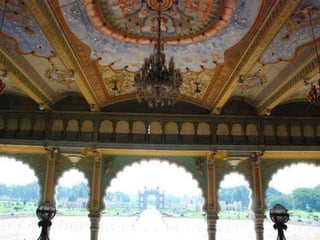
From this Hall one can have a 
panoramic view of the open yard 
consisting of lawns and 
fountains, towers of temples, the 
majestic Jayamarthanda Gate and 
in the horizon, a view of the 
famous Lalit Mahal Palace as well 
as the rugged, uneven contours of 
the Chamundi Hill.
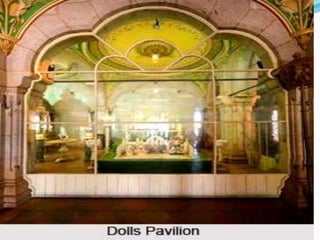
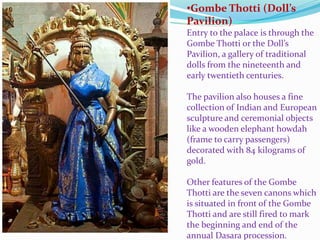
•Gombe Thotti (Doll’s 
Pavilion) 
Entry to the palace is through the 
Gombe Thotti or the Doll’s 
Pavilion, a gallery of traditional 
dolls from the nineteenth and 
early twentieth centuries. 
The pavilion also houses a fine 
collection of Indian and European 
sculpture and ceremonial objects 
like a wooden elephant howdah 
(frame to carry passengers) 
decorated with 84 kilograms of 
gold. 
Other features of the Gombe 
Thotti are the seven canons which 
is situated in front of the Gombe 
Thotti and are still fired to mark 
the beginning and end of the 
annual Dasara procession.
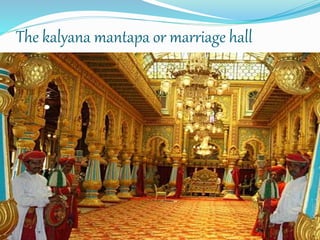
The kalyana mantapa or marriage hall
KalyanaMantapa 
The Kalyana Mantapa or marriage hall is a 
grand octagonal-shaped pavilion with a 
multihued stained glass ceiling with peacock 
motifs arranged in geometrical patterns. The 
entire structure was wrought in Glasgow, 
Scotland. 
The floor of the Mantapa continues the 
peacock theme with a peacock mosaic, 
designed with tiles from England. 
The hall is lined with elaborately detailed oil 
paintings, illustrating the royal procession 
and Dasara celebrations of bygone years.
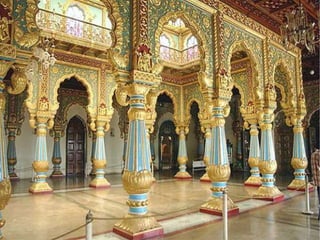
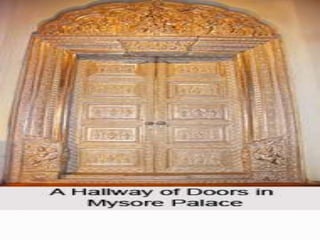
A Hallway of Doors in Palace
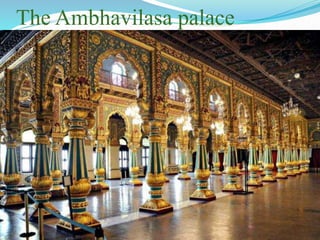
The Ambhavilasa palace
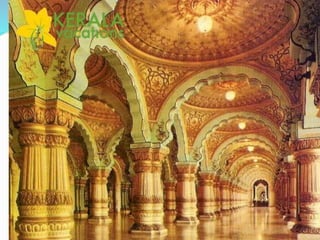
Ambavilasa or Diwan e khas 
The Ambavilasa, a hall used by the king for private 
audience, is one of the most spectacular rooms of the 
palace. 
Entry to this opulent hall is through an elegantly carved 
rosewood doorway inlaid with ivory that opens into a shrine 
to Ganesha. 
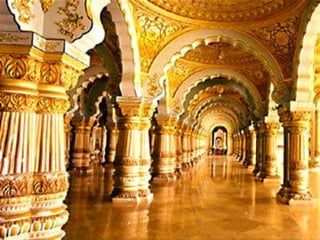
The central knave of the hall has ornately gilded columns, 
stained glass ceilings, decorative steel grills, and 
chandeliers with fine floral motifs, mirrored in the pietra 
dura mosaic floor embellished with semi-precious stones.
Architecture 
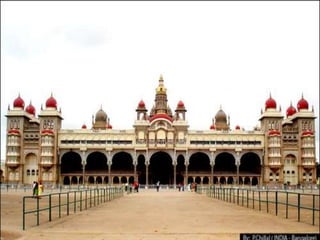
A dramatic three storied stone building of fine 
gray granite with deep pink marble domes 
dominated by a five-storied 145 ft tower with a 
gilded dome mounted by a single golden flag. 
Designed by Henry Irwin, the Mysore Palace is 
one of the finest achievements of Indo-Saracenic 
architecture, summing up many diverse themes 
that have played through Indian architecture over 
the centuries. Muslim designs and Rajput style 
combine with Gothic elements and indigenous 
materials in an exuberant display of grandeur.
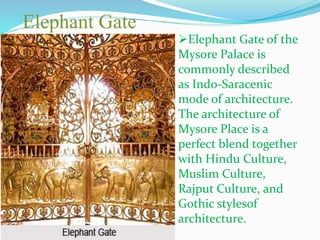
Elephant Gate 
Elephant Gate of the 
Mysore Palace is 
commonly described 
as Indo-Saracenic 
mode of architecture. 
The architecture of 
Mysore Place is a 
perfect blend together 
with Hindu Culture, 
Muslim Culture, 
Rajput Culture, and 
Gothic stylesof 
architecture.
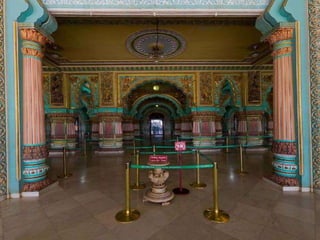
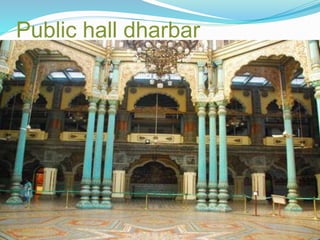
Public hall dharbar
The new Durbar Hall (1938) of the Mysore Palace 
is a part of the main palace enclosed on three sides 
and completely open on the eastern side. This hall is 
of a unique kind with magnificent 
proportions. Having a clear height of about 15.24 m. 
above ground level and hall measures 74.68 m long 
and 24.38 m wide without any intermediate 
pillars. The ceiling of the hall is adorned with the 
paintings of the ten incarnations of Vishnu 
(Dashavatara). The cnetral panel has the 12 signs of 
the Zodiac placed around the Hindu Trinity-Brahma, 
Vishnu and Maheswara. The main frontage of the 
palace has nine arches, supported by ornamental 
pillars carrying a beautiful balcony without 
intermediate pillars.
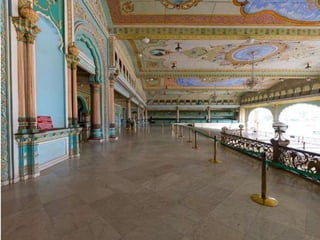
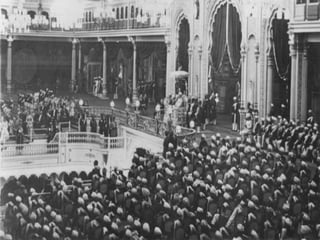
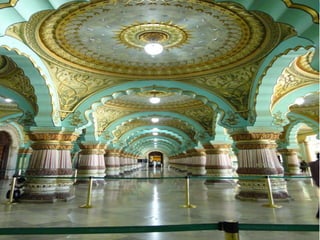
Public Darbar Hall 
The Public Darbar Hall for public audience is 155 
feet in length and 42 feet in breadth, with 
majestic bottle-shaped columns tastefully 
painted in pleasing colors. The hall contains a 
priceless collection of paintings by great Indian 
artists including Raja Ravivarma. 
The hall opens into an expansive balcony 
supported by massive columns that has a fine 
view of the Chamundi Hills and parade 
grounds.
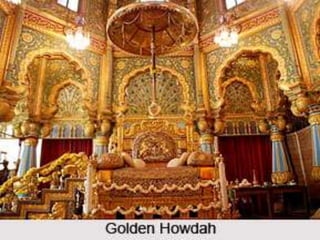
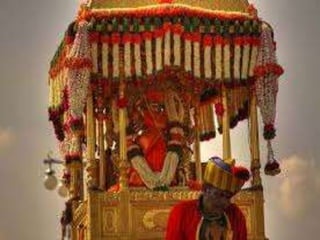
Golden Howdah 
that is the elephant seat or 
Chinnada Ambari is a Howdah, 
which is the carrier mounted on 
the lead elephant during the 
"Jamboo Savari" (Elephant 
Procession) of the famous 
Dasara festival. 
https://www.youtube.com/watch?v=6r7eR2F2MNY
mysore palace

mysore palace

  • 4.
    Brief History ofMysore Mysore city was the capital of the former royal Mysore province. The word Mysore expands to 'Mahishasurana Ooru', which means the town of Mahishasura. According to Hindu mythology Mahishasura was a demon king who was killed by the warrior goddess Chamundeshwari on Chamundi hill near Mysore. Ever since, the people of Mysore have worshipped Chamundeshwari as their tutelary deity. The Wadiyar royal family ruled Mysore since the 14th century except for a short period of 40 years in the 18th century when Hyder Ali and Tipu Sultan were the rulers. Hyder Ali was a general in the army of the Wadiyar king who rose to become the ruler of Mysore. His son Tipu Sultan followed in his footsteps expanding Mysore’s territories in a series of daring battles, until he was killed when fighting the British.
  • 8.
    From this Hallone can have a panoramic view of the open yard consisting of lawns and fountains, towers of temples, the majestic Jayamarthanda Gate and in the horizon, a view of the famous Lalit Mahal Palace as well as the rugged, uneven contours of the Chamundi Hill.
  • 11.
    •Gombe Thotti (Doll’s Pavilion) Entry to the palace is through the Gombe Thotti or the Doll’s Pavilion, a gallery of traditional dolls from the nineteenth and early twentieth centuries. The pavilion also houses a fine collection of Indian and European sculpture and ceremonial objects like a wooden elephant howdah (frame to carry passengers) decorated with 84 kilograms of gold. Other features of the Gombe Thotti are the seven canons which is situated in front of the Gombe Thotti and are still fired to mark the beginning and end of the annual Dasara procession.
  • 14.
    The kalyana mantapaor marriage hall
  • 15.
    KalyanaMantapa The KalyanaMantapa or marriage hall is a grand octagonal-shaped pavilion with a multihued stained glass ceiling with peacock motifs arranged in geometrical patterns. The entire structure was wrought in Glasgow, Scotland. The floor of the Mantapa continues the peacock theme with a peacock mosaic, designed with tiles from England. The hall is lined with elaborately detailed oil paintings, illustrating the royal procession and Dasara celebrations of bygone years.
  • 17.
    A Hallway ofDoors in Palace
  • 18.
  • 19.
    Ambavilasa or Diwane khas The Ambavilasa, a hall used by the king for private audience, is one of the most spectacular rooms of the palace. Entry to this opulent hall is through an elegantly carved rosewood doorway inlaid with ivory that opens into a shrine to Ganesha. The central knave of the hall has ornately gilded columns, stained glass ceilings, decorative steel grills, and chandeliers with fine floral motifs, mirrored in the pietra dura mosaic floor embellished with semi-precious stones.
  • 21.
    Architecture A dramaticthree storied stone building of fine gray granite with deep pink marble domes dominated by a five-storied 145 ft tower with a gilded dome mounted by a single golden flag. Designed by Henry Irwin, the Mysore Palace is one of the finest achievements of Indo-Saracenic architecture, summing up many diverse themes that have played through Indian architecture over the centuries. Muslim designs and Rajput style combine with Gothic elements and indigenous materials in an exuberant display of grandeur.
  • 22.
    Elephant Gate ElephantGate of the Mysore Palace is commonly described as Indo-Saracenic mode of architecture. The architecture of Mysore Place is a perfect blend together with Hindu Culture, Muslim Culture, Rajput Culture, and Gothic stylesof architecture.
  • 23.
  • 24.
    The new DurbarHall (1938) of the Mysore Palace is a part of the main palace enclosed on three sides and completely open on the eastern side. This hall is of a unique kind with magnificent proportions. Having a clear height of about 15.24 m. above ground level and hall measures 74.68 m long and 24.38 m wide without any intermediate pillars. The ceiling of the hall is adorned with the paintings of the ten incarnations of Vishnu (Dashavatara). The cnetral panel has the 12 signs of the Zodiac placed around the Hindu Trinity-Brahma, Vishnu and Maheswara. The main frontage of the palace has nine arches, supported by ornamental pillars carrying a beautiful balcony without intermediate pillars.
  • 26.
    Public Darbar Hall The Public Darbar Hall for public audience is 155 feet in length and 42 feet in breadth, with majestic bottle-shaped columns tastefully painted in pleasing colors. The hall contains a priceless collection of paintings by great Indian artists including Raja Ravivarma. The hall opens into an expansive balcony supported by massive columns that has a fine view of the Chamundi Hills and parade grounds.
  • 29.
    Golden Howdah thatis the elephant seat or Chinnada Ambari is a Howdah, which is the carrier mounted on the lead elephant during the "Jamboo Savari" (Elephant Procession) of the famous Dasara festival. https://www.youtube.com/watch?v=6r7eR2F2MNY