Carolina Schmitt Nunes
Cecilia E. Giuffra Palomino
Ricardo Azambuja Silveira
Marina Keiko Nakayama
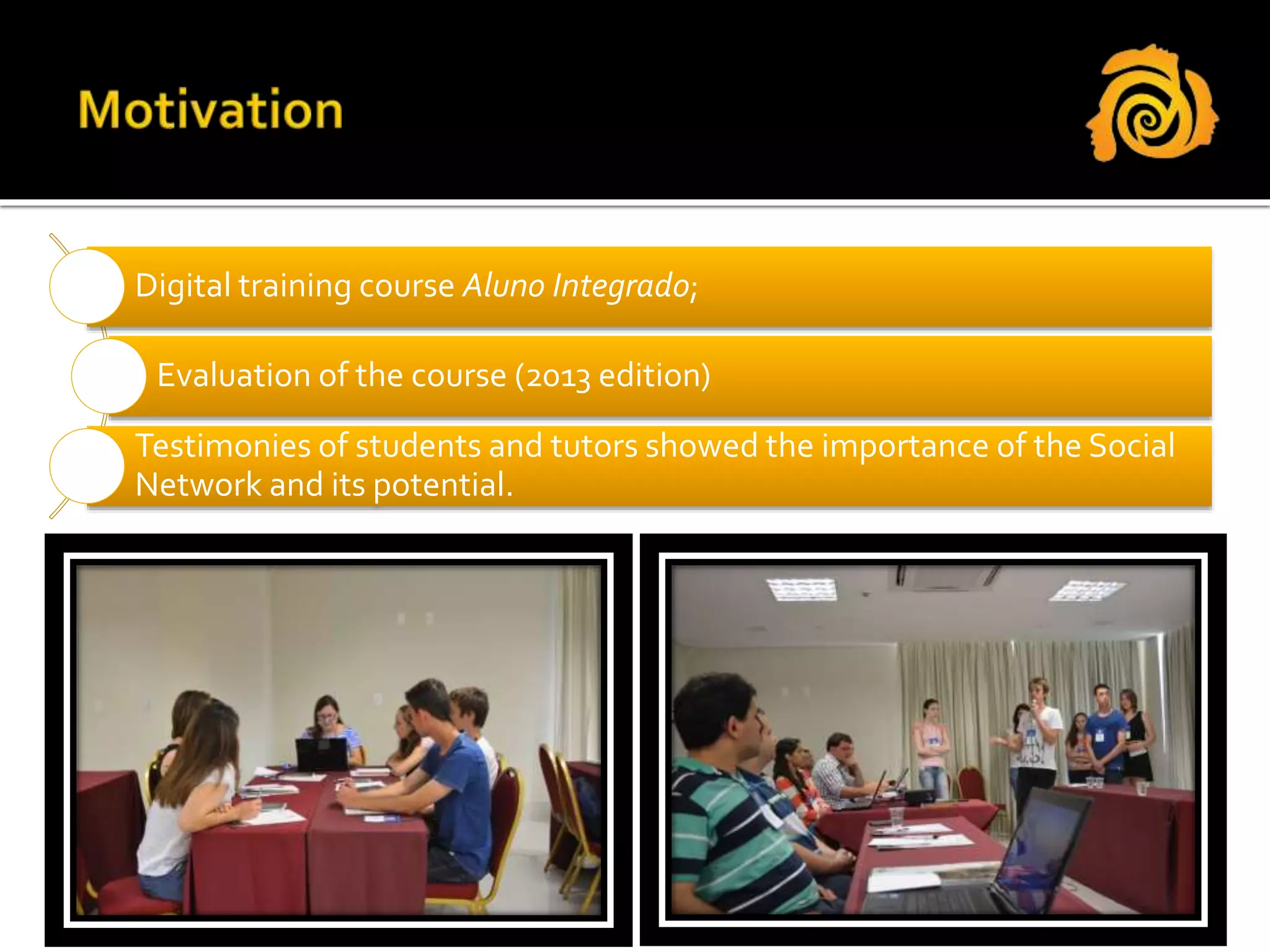
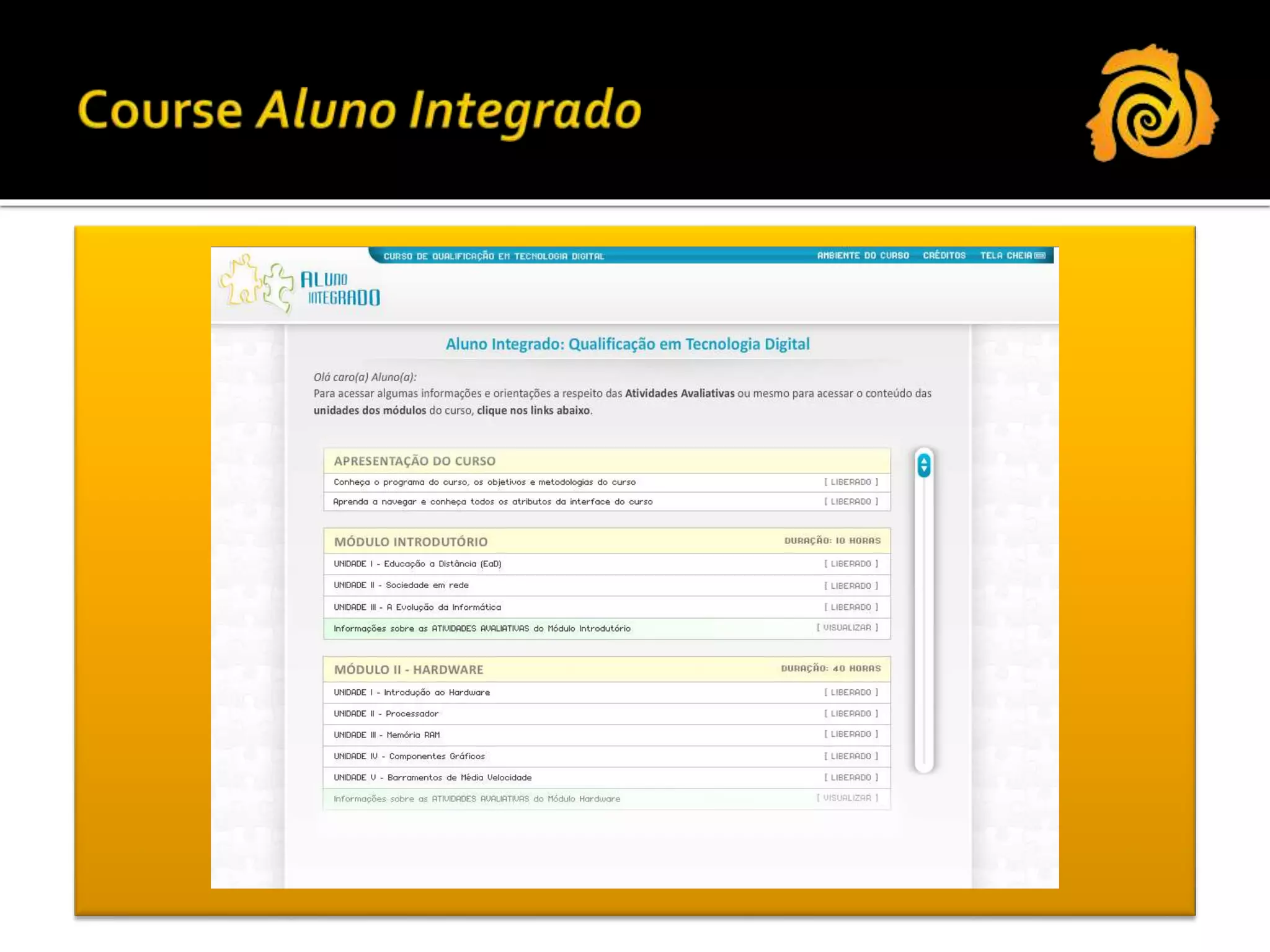
Digital training course Aluno Integrado;
Evaluation of the course (2013 edition)
Testimonies of students and tutors showed the importance of the Social
Network and its potential.
• Facebook is a free social network with expressive growth in the
last four years in Brazil – 89 millions of Brazilians have an active
profile.
• According to Centre for Learning and Performance
Technologies (2013) is the ninth best tool for learning.
• In 2011 the authors of the document Facebook for Educators
show the possibility of exploring the resources of this network
for educational purposes (Phillips, Baird, Fogg, & Ph, 2011)
To identify and present the perception,
in the view of students and tutors, of
the use of the Facebook in a distance
education course for high school
students of the public school system in
Santa Catarina.
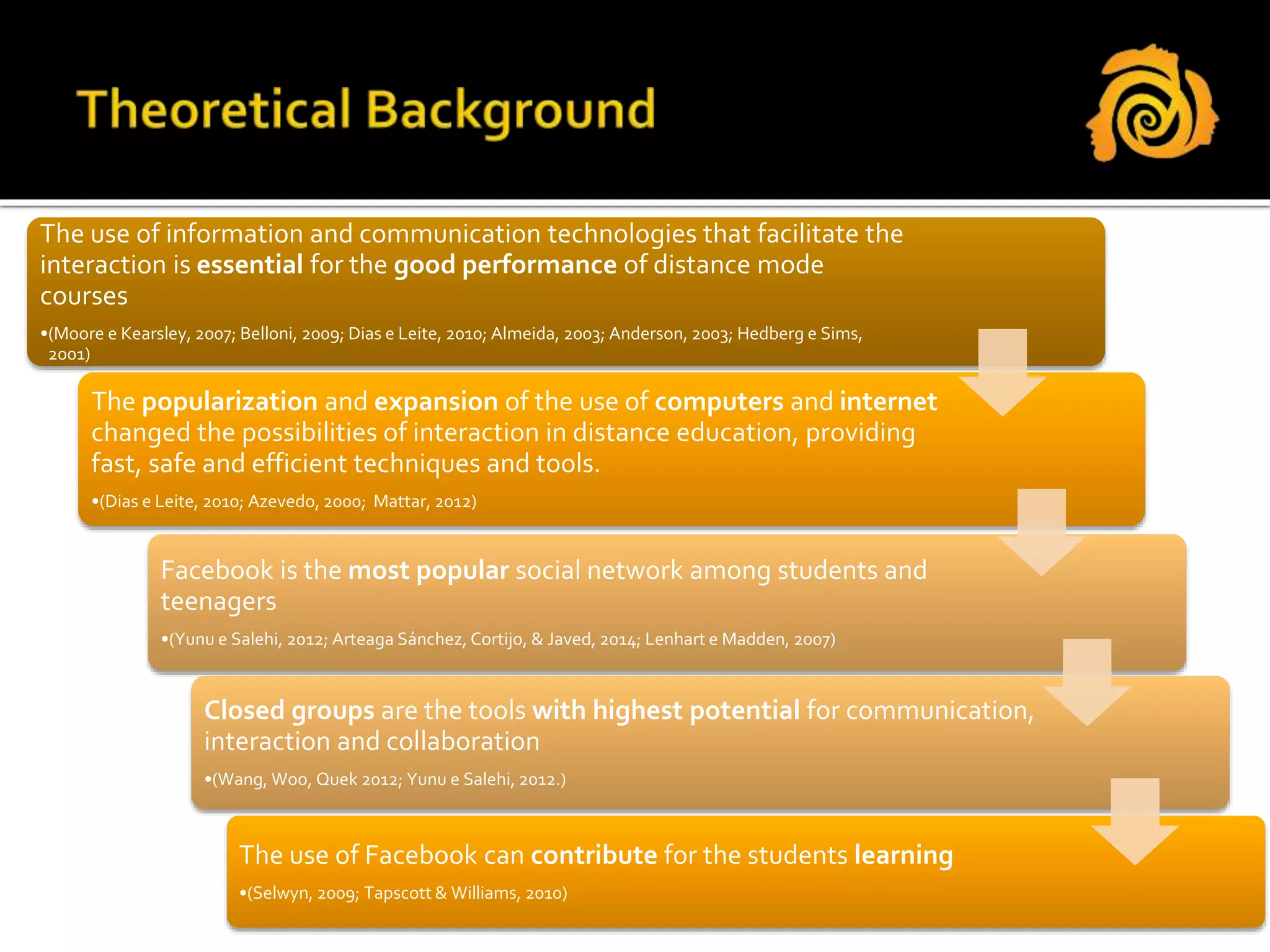
The use of information and communication technologies that facilitate the
interaction is essential for the good performance of distance mode
courses
•(Moore e Kearsley, 2007; Belloni, 2009; Dias e Leite, 2010; Almeida, 2003; Anderson, 2003; Hedberg e Sims,
2001)
The popularization and expansion of the use of computers and internet
changed the possibilities of interaction in distance education, providing
fast, safe and efficient techniques and tools.
•(Dias e Leite, 2010; Azevedo, 2000; Mattar, 2012)
Facebook is the most popular social network among students and
teenagers
•(Yunu e Salehi, 2012; Arteaga Sánchez, Cortijo, & Javed, 2014; Lenhart e Madden, 2007)
Closed groups are the tools with highest potential for communication,
interaction and collaboration
•(Wang, Woo, Quek 2012; Yunu e Salehi, 2012.)
The use of Facebook can contribute for the students learning
•(Selwyn, 2009; Tapscott & Williams, 2010)
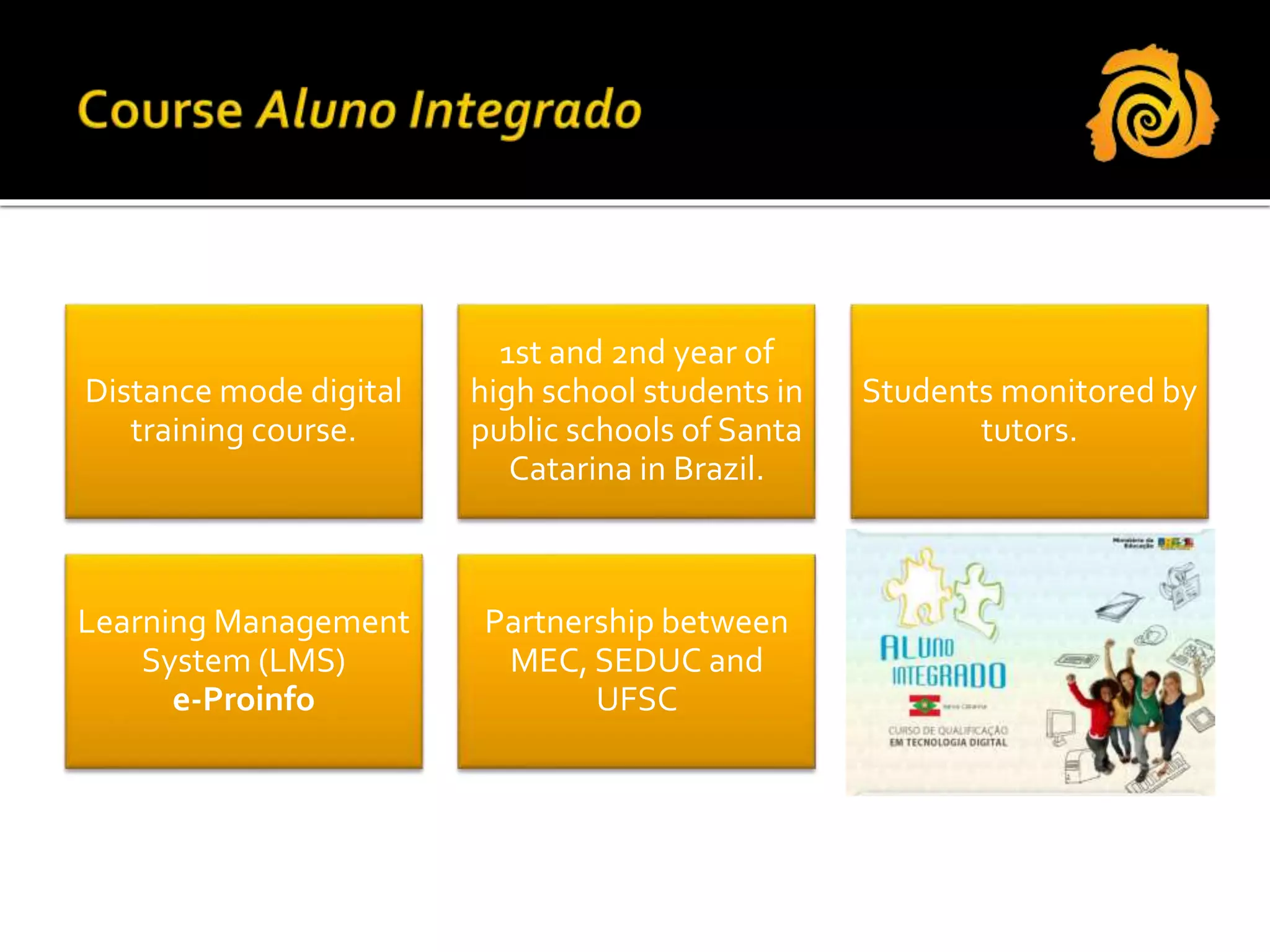
Distance mode digital
training course.
1st and 2nd year of
high school students in
public schools of Santa
Catarina in Brazil.
Students monitored by
tutors.
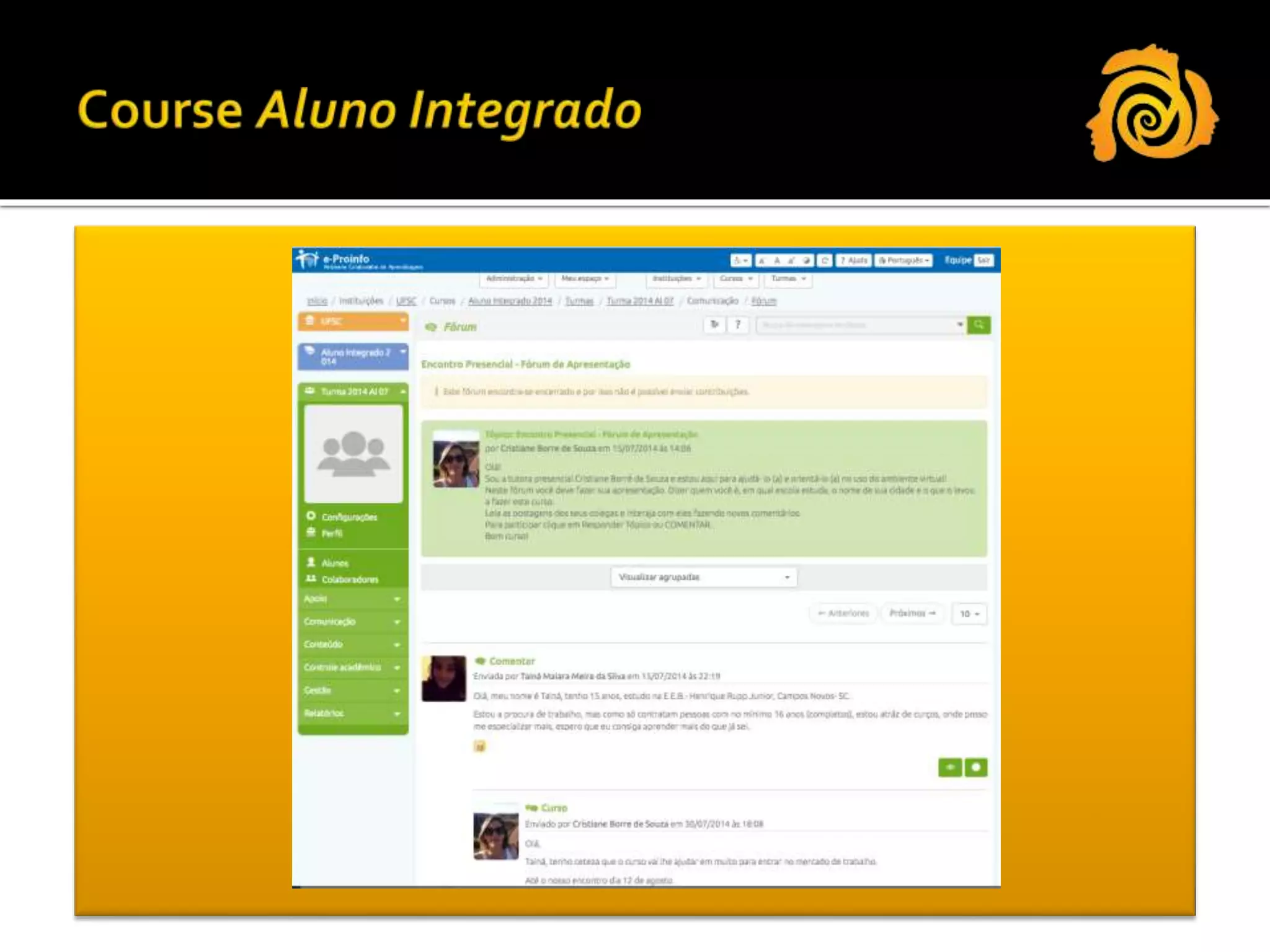
Learning Management
System (LMS)
e-Proinfo
Partnership between
MEC, SEDUC and
UFSC
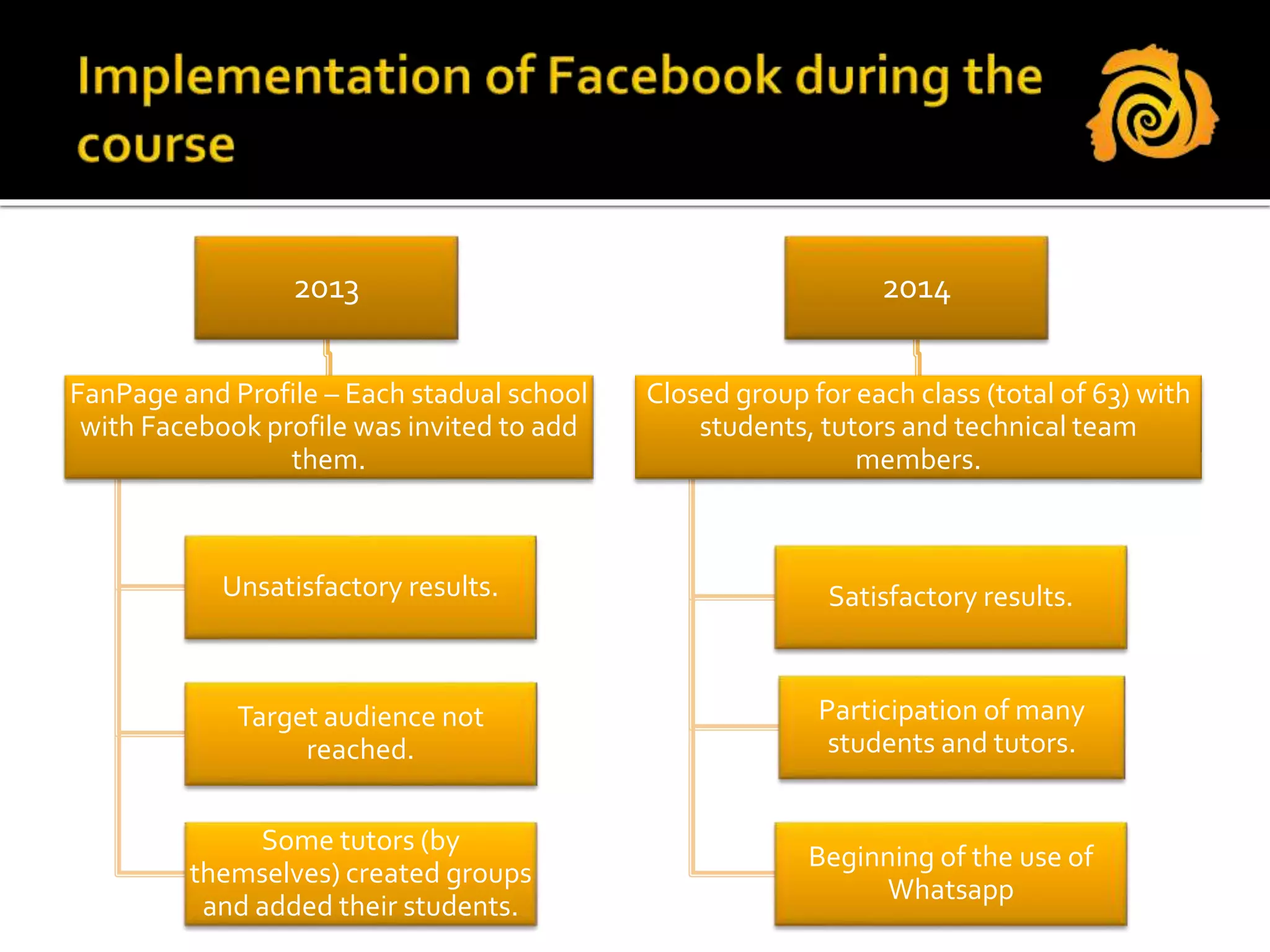
2013
FanPage and Profile – Each stadual school
with Facebook profile was invited to add
them.
Unsatisfactory results.
Target audience not
reached.
Some tutors (by
themselves) created groups
and added their students.
2014
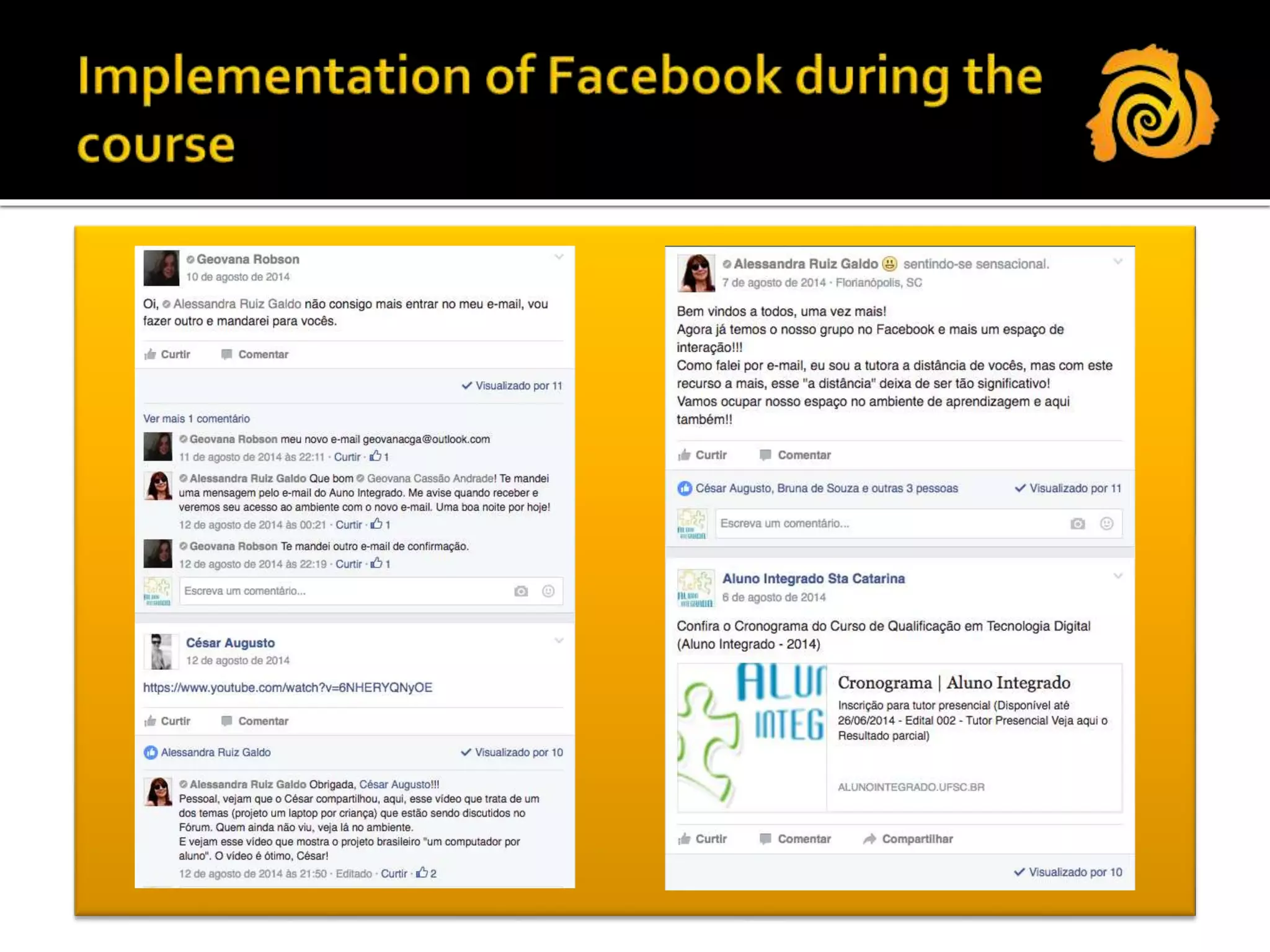
Closed group for each class (total of 63) with
students, tutors and technical team
members.
Satisfactory results.
Participation of many
students and tutors.
Beginning of the use of
Whatsapp
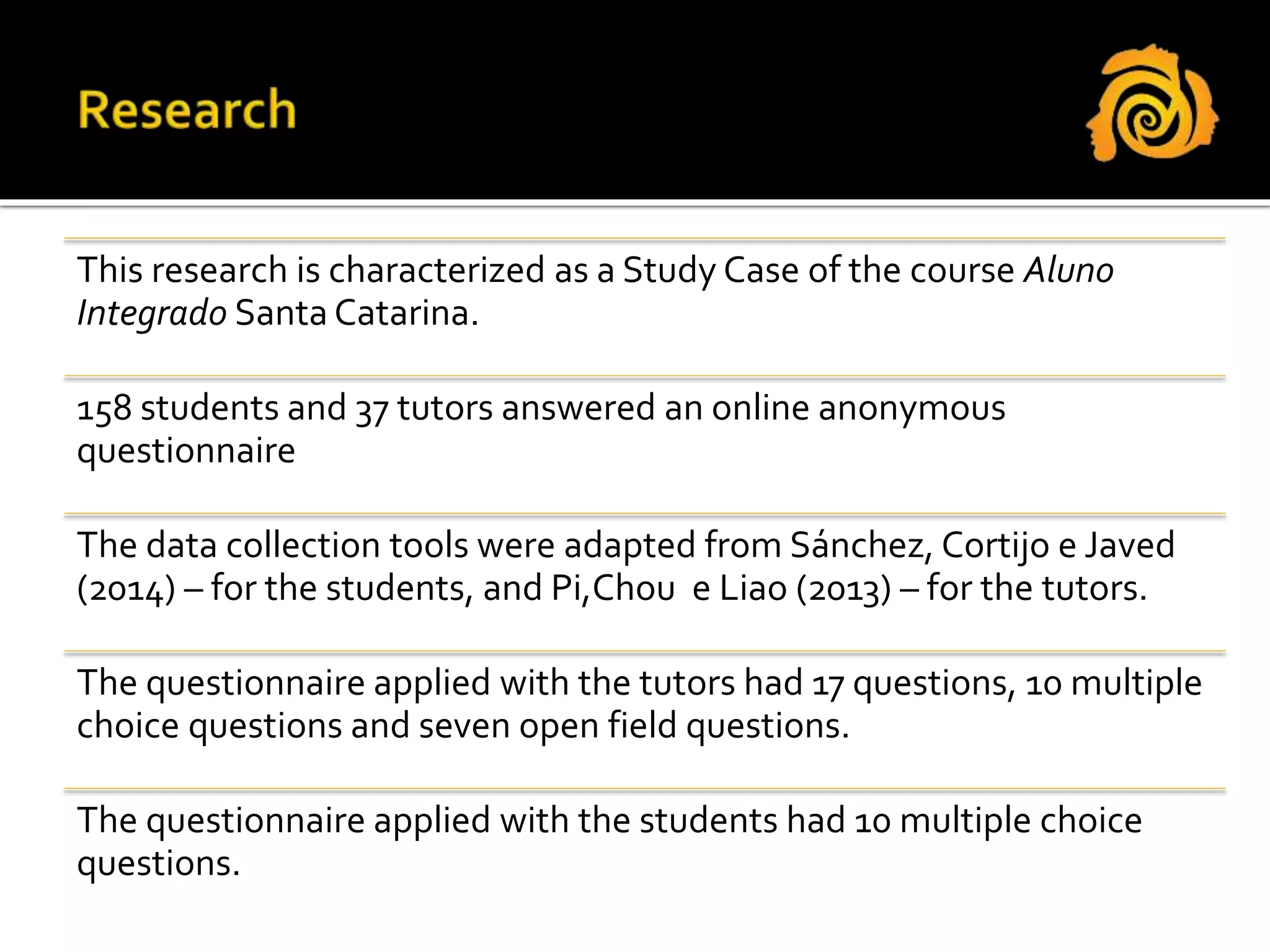
This research is characterized as a Study Case of the course Aluno
Integrado Santa Catarina.
158 students and 37 tutors answered an online anonymous
questionnaire
The data collection tools were adapted from Sánchez, Cortijo e Javed
(2014) – for the students, and Pi,Chou e Liao (2013) – for the tutors.
The questionnaire applied with the tutors had 17 questions, 10 multiple
choice questions and seven open field questions.
The questionnaire applied with the students had 10 multiple choice
questions.
Participants:
 Predominantly female (59%);
 Ages between 14 and 17 years old.
Access to Facebook
from:
Frequency of
use
Computer at home
Computer at school
Celphone
Tablet
Everyday [115]
2-5 times p/week [22]
1 time p/week [5]
1 time p/ 15 days [1]
All day long [15]
All day long
Everyday
2-5 times p/week
1 time p/week
1 time p/15 days
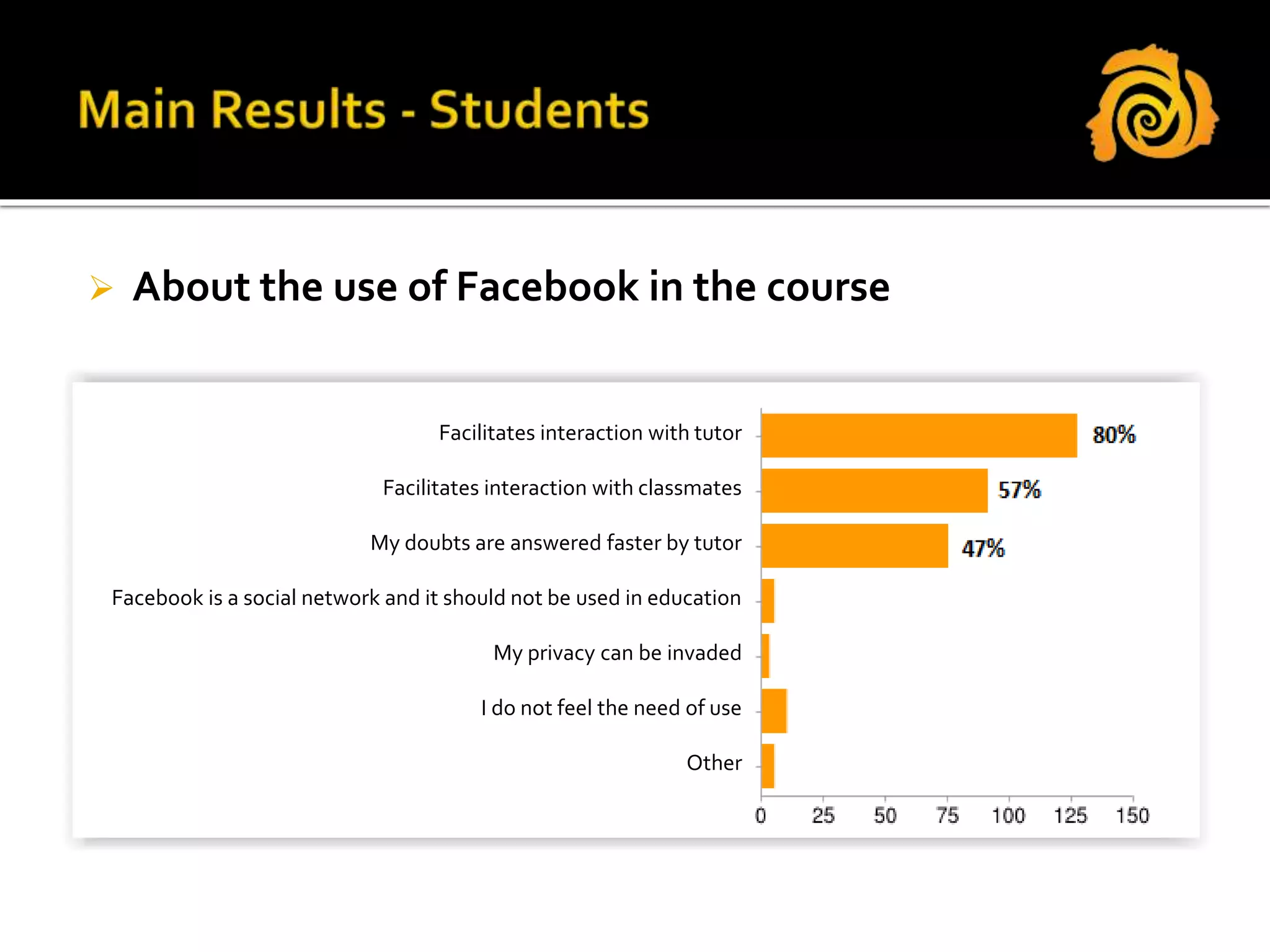
 About the use of Facebook in the course
Facilitates interaction with tutor
Facilitates interaction with classmates
My doubts are answered faster by tutor
Facebook is a social network and it should not be used in education
My privacy can be invaded
I do not feel the need of use
Other
Participants:
 Ages between 24 and 58 years old;
 The most (76%) have specialisation or master degree (19%);
 Heterogeneity in the field of education of the tutors: computer
science, information systems, letters, administration,
accounting, arts and pedagogy.
 However, the most (68%) had never used the Facebook for
educational purposes.
Distance
education
experience
More than 5 years [11]
3 to 5 years [8]
Up to 3 years [18]
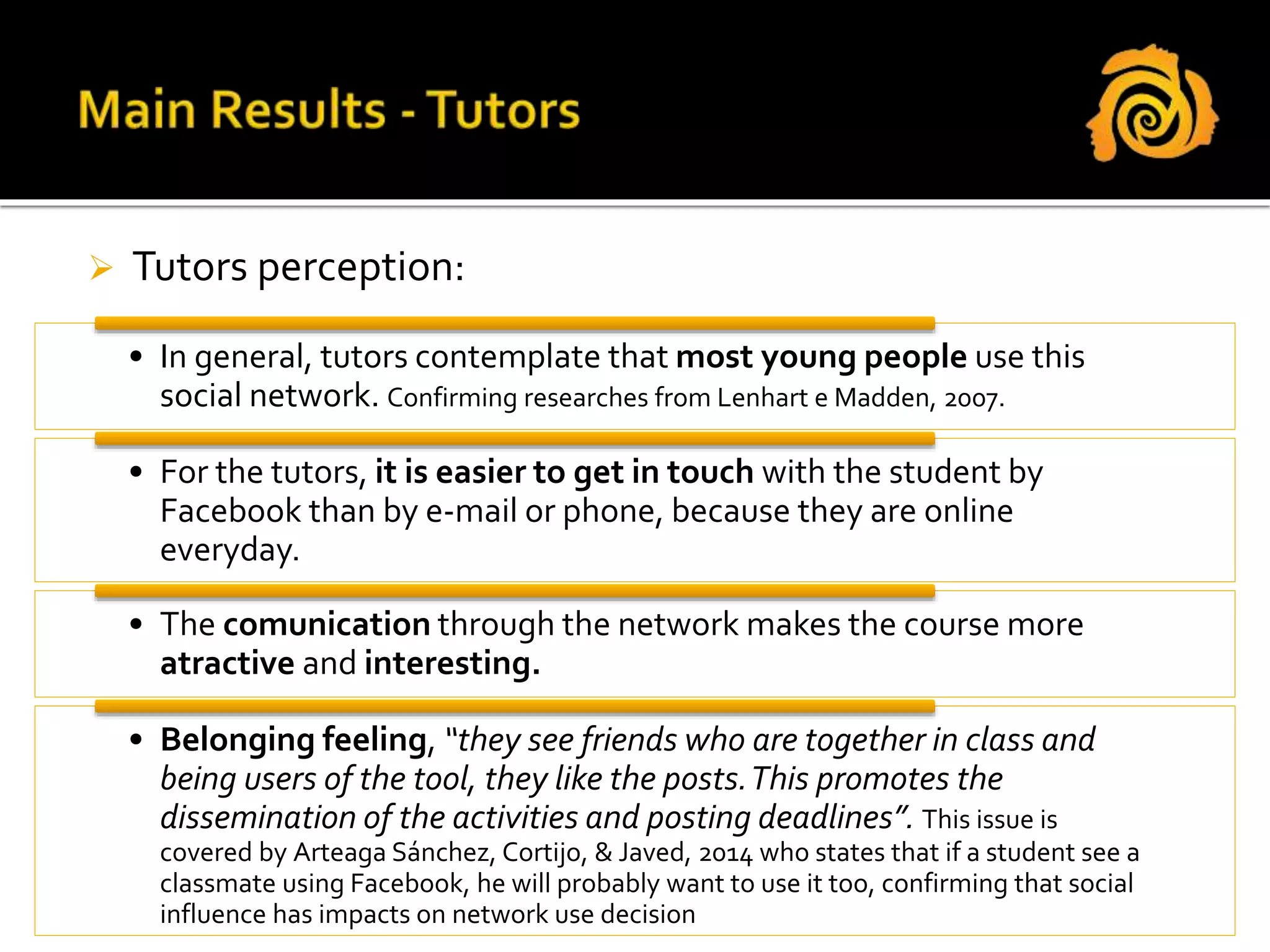
 Tutors perception:
• In general, tutors contemplate that most young people use this
social network. Confirming researches from Lenhart e Madden, 2007.
• For the tutors, it is easier to get in touch with the student by
Facebook than by e-mail or phone, because they are online
everyday.
• The comunication through the network makes the course more
atractive and interesting.
• Belonging feeling, “they see friends who are together in class and
being users of the tool, they like the posts.This promotes the
dissemination of the activities and posting deadlines”. This issue is
covered by Arteaga Sánchez, Cortijo, & Javed, 2014 who states that if a student see a
classmate using Facebook, he will probably want to use it too, confirming that social
influence has impacts on network use decision
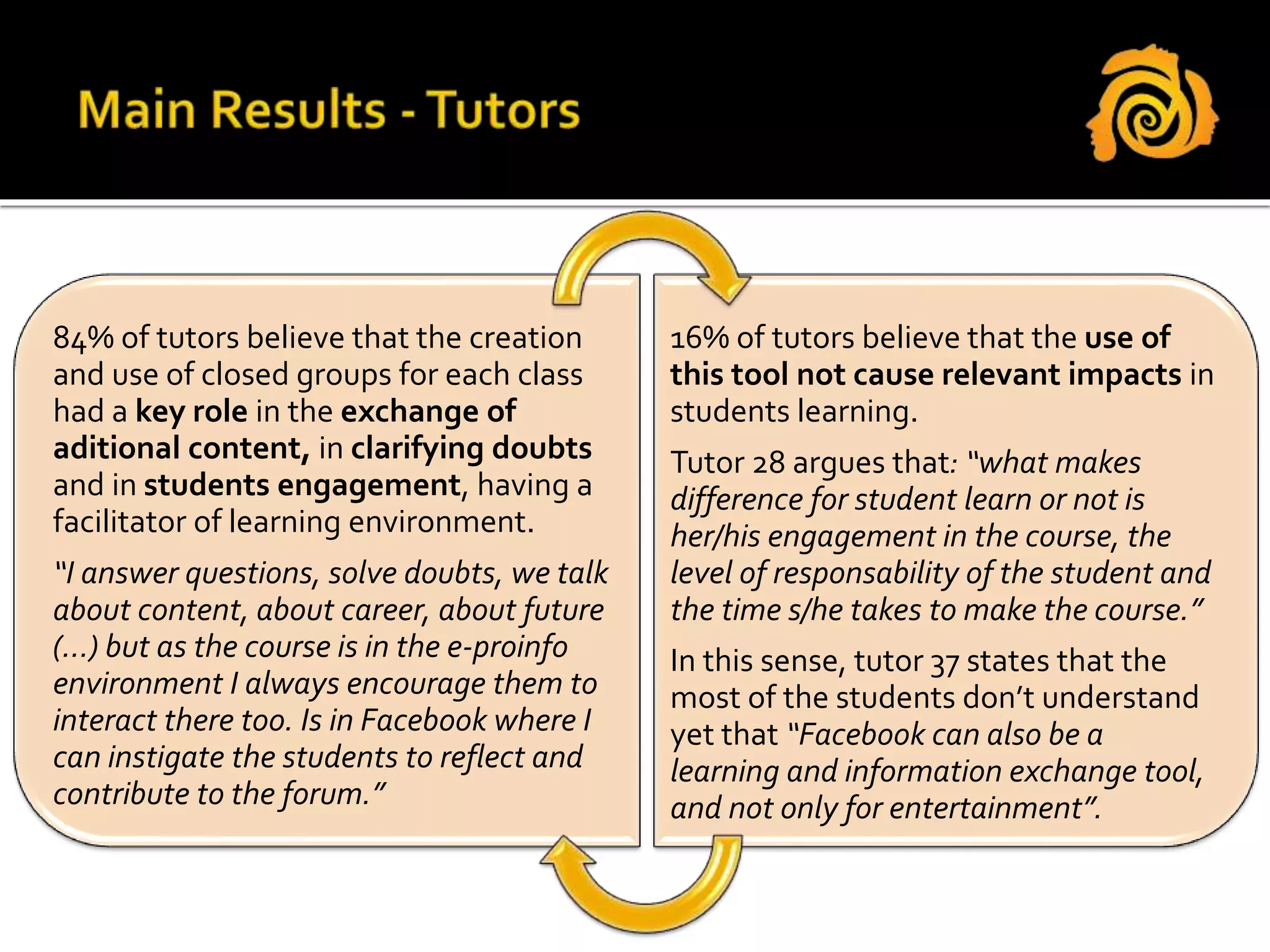
84% of tutors believe that the creation
and use of closed groups for each class
had a key role in the exchange of
aditional content, in clarifying doubts
and in students engagement, having a
facilitator of learning environment.
“I answer questions, solve doubts, we talk
about content, about career, about future
(...) but as the course is in the e-proinfo
environment I always encourage them to
interact there too. Is in Facebook where I
can instigate the students to reflect and
contribute to the forum.”
16% of tutors believe that the use of
this tool not cause relevant impacts in
students learning.
Tutor 28 argues that: “what makes
difference for student learn or not is
her/his engagement in the course, the
level of responsability of the student and
the time s/he takes to make the course.”
In this sense, tutor 37 states that the
most of the students don’t understand
yet that “Facebook can also be a
learning and information exchange tool,
and not only for entertainment”.
The main contributions of this research are:
 Check and record the perception of tutors about the use of
the tool for educational purposes
 Check how happens this practice with students of public
schools in SC in an extra curricular course.
This paper contributes to the advancement of the scientific
knowledge evidencing how the Facebook can help in the
decreasing of the dropout in distance learning courses, with
teen students of low-income.
ricardo.silveira@ufsc.br

Interaction on distance education in virtual social networks a case study with facebook

  • 1.
    Carolina Schmitt Nunes CeciliaE. Giuffra Palomino Ricardo Azambuja Silveira Marina Keiko Nakayama
  • 3.
    Digital training courseAluno Integrado; Evaluation of the course (2013 edition) Testimonies of students and tutors showed the importance of the Social Network and its potential.
  • 4.
    • Facebook isa free social network with expressive growth in the last four years in Brazil – 89 millions of Brazilians have an active profile. • According to Centre for Learning and Performance Technologies (2013) is the ninth best tool for learning. • In 2011 the authors of the document Facebook for Educators show the possibility of exploring the resources of this network for educational purposes (Phillips, Baird, Fogg, & Ph, 2011)
  • 5.
    To identify andpresent the perception, in the view of students and tutors, of the use of the Facebook in a distance education course for high school students of the public school system in Santa Catarina.
  • 6.
    The use ofinformation and communication technologies that facilitate the interaction is essential for the good performance of distance mode courses •(Moore e Kearsley, 2007; Belloni, 2009; Dias e Leite, 2010; Almeida, 2003; Anderson, 2003; Hedberg e Sims, 2001) The popularization and expansion of the use of computers and internet changed the possibilities of interaction in distance education, providing fast, safe and efficient techniques and tools. •(Dias e Leite, 2010; Azevedo, 2000; Mattar, 2012) Facebook is the most popular social network among students and teenagers •(Yunu e Salehi, 2012; Arteaga Sánchez, Cortijo, & Javed, 2014; Lenhart e Madden, 2007) Closed groups are the tools with highest potential for communication, interaction and collaboration •(Wang, Woo, Quek 2012; Yunu e Salehi, 2012.) The use of Facebook can contribute for the students learning •(Selwyn, 2009; Tapscott & Williams, 2010)
  • 7.
    Distance mode digital trainingcourse. 1st and 2nd year of high school students in public schools of Santa Catarina in Brazil. Students monitored by tutors. Learning Management System (LMS) e-Proinfo Partnership between MEC, SEDUC and UFSC
  • 10.
    2013 FanPage and Profile– Each stadual school with Facebook profile was invited to add them. Unsatisfactory results. Target audience not reached. Some tutors (by themselves) created groups and added their students. 2014 Closed group for each class (total of 63) with students, tutors and technical team members. Satisfactory results. Participation of many students and tutors. Beginning of the use of Whatsapp
  • 12.
    This research ischaracterized as a Study Case of the course Aluno Integrado Santa Catarina. 158 students and 37 tutors answered an online anonymous questionnaire The data collection tools were adapted from Sánchez, Cortijo e Javed (2014) – for the students, and Pi,Chou e Liao (2013) – for the tutors. The questionnaire applied with the tutors had 17 questions, 10 multiple choice questions and seven open field questions. The questionnaire applied with the students had 10 multiple choice questions.
  • 13.
    Participants:  Predominantly female(59%);  Ages between 14 and 17 years old. Access to Facebook from: Frequency of use Computer at home Computer at school Celphone Tablet Everyday [115] 2-5 times p/week [22] 1 time p/week [5] 1 time p/ 15 days [1] All day long [15] All day long Everyday 2-5 times p/week 1 time p/week 1 time p/15 days
  • 14.
     About theuse of Facebook in the course Facilitates interaction with tutor Facilitates interaction with classmates My doubts are answered faster by tutor Facebook is a social network and it should not be used in education My privacy can be invaded I do not feel the need of use Other
  • 15.
    Participants:  Ages between24 and 58 years old;  The most (76%) have specialisation or master degree (19%);  Heterogeneity in the field of education of the tutors: computer science, information systems, letters, administration, accounting, arts and pedagogy.  However, the most (68%) had never used the Facebook for educational purposes. Distance education experience More than 5 years [11] 3 to 5 years [8] Up to 3 years [18]
  • 16.
     Tutors perception: •In general, tutors contemplate that most young people use this social network. Confirming researches from Lenhart e Madden, 2007. • For the tutors, it is easier to get in touch with the student by Facebook than by e-mail or phone, because they are online everyday. • The comunication through the network makes the course more atractive and interesting. • Belonging feeling, “they see friends who are together in class and being users of the tool, they like the posts.This promotes the dissemination of the activities and posting deadlines”. This issue is covered by Arteaga Sánchez, Cortijo, & Javed, 2014 who states that if a student see a classmate using Facebook, he will probably want to use it too, confirming that social influence has impacts on network use decision
  • 17.
    84% of tutorsbelieve that the creation and use of closed groups for each class had a key role in the exchange of aditional content, in clarifying doubts and in students engagement, having a facilitator of learning environment. “I answer questions, solve doubts, we talk about content, about career, about future (...) but as the course is in the e-proinfo environment I always encourage them to interact there too. Is in Facebook where I can instigate the students to reflect and contribute to the forum.” 16% of tutors believe that the use of this tool not cause relevant impacts in students learning. Tutor 28 argues that: “what makes difference for student learn or not is her/his engagement in the course, the level of responsability of the student and the time s/he takes to make the course.” In this sense, tutor 37 states that the most of the students don’t understand yet that “Facebook can also be a learning and information exchange tool, and not only for entertainment”.
  • 18.
    The main contributionsof this research are:  Check and record the perception of tutors about the use of the tool for educational purposes  Check how happens this practice with students of public schools in SC in an extra curricular course. This paper contributes to the advancement of the scientific knowledge evidencing how the Facebook can help in the decreasing of the dropout in distance learning courses, with teen students of low-income.
  • 19.

Editor's Notes

  • #5 Considerando 107,7 milhões de internatutas no país, significa que 8 em cada 10 possuem um perfil na rede. Há 200 milhões de habitantes no Brasil
  • #16 40% são formados em ciencias da computação e sistemas de informação.