MYOFASCIAL RELEASE THERAPY

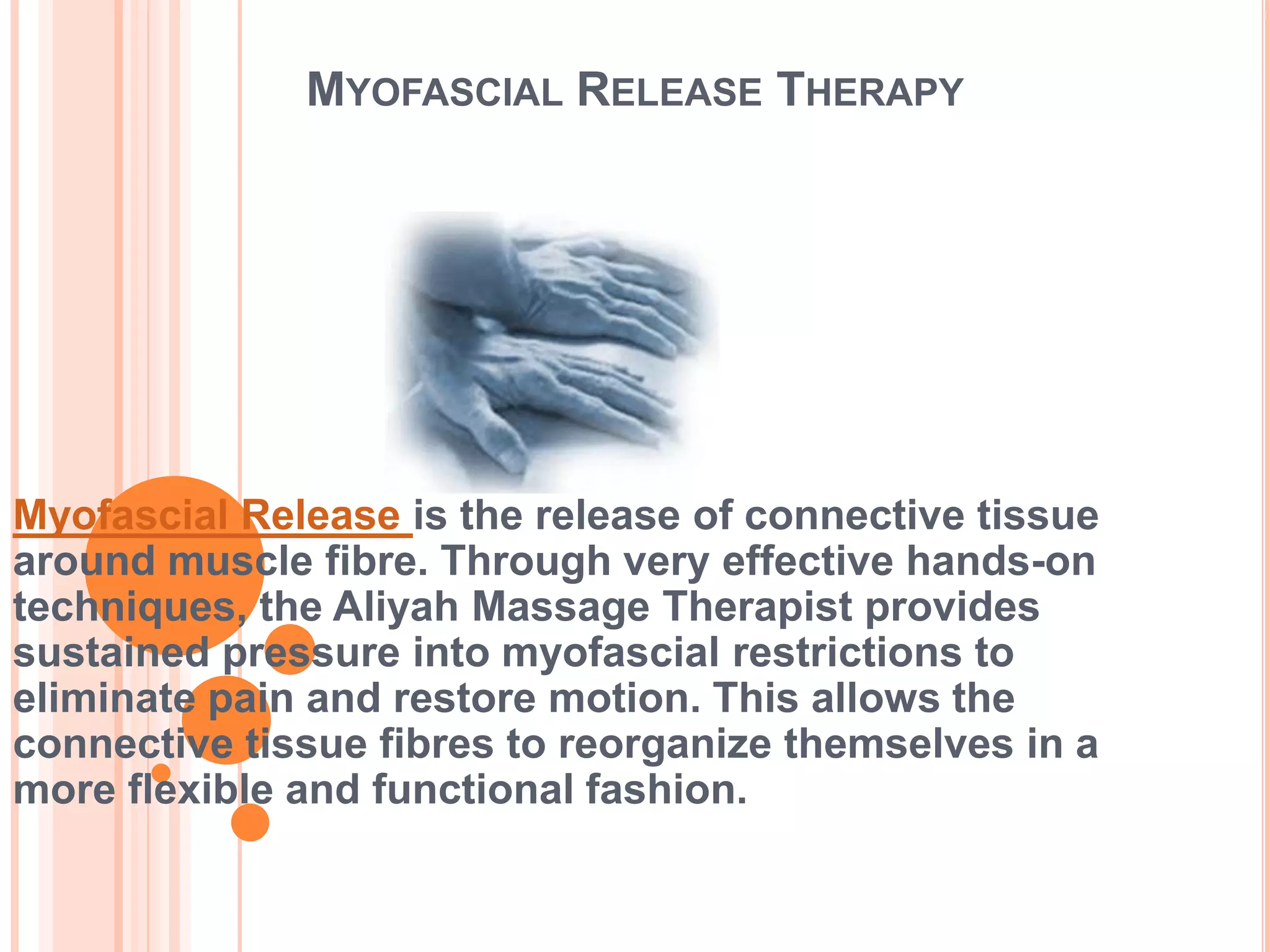
Myofascial Release is the release of connective tissue
around muscle fibre. Through very effective hands-on
techniques, the Aliyah Massage Therapist provides
sustained pressure into myofascial restrictions to
eliminate pain and restore motion. This allows the
connective tissue fibres to reorganize themselves in a
more flexible and functional fashion.
Fascia is a very densely woven covering that connects
every muscle, bone, nerve, artery and vein as well as all of
our internal organs including the heart, lungs, brain and
spinal cord. The most interesting aspect of the Fascial
System is that it is, in fact, one structure that exists from
head to foot without interruption. It has the appearance of a
spider web. In this way you can begin to see that each part
of the entire body is connected to every other part by the
fascia (connective tissue of the body), like the yarn in a
sweater.
Fascial restrictions, caused by improper posture, overuse,
injury, and scar tissue, exert excessive pressure producing
pain and restricting motion and proper function of the body.
It affects our flexibility and stability, and is a large
determining factor in our ability to withstand stress and
strain.
The human body is a phenomenal machine. It is built for
lasting movement as well as an amazing capacity for
compensation and adaptation. Take a look at yourself and
others and notice the different ways in which people hold and
use our bodies. Compensation can be achieved largely
through the fascial, or connective tissue, network.
To reiterate, fascia is found everywhere in our bodies. In fact,
our body is composed primarily of water and fascia. All of our
bones, muscles and organs are wrapped in fascia. The
myriad of functions our fascia performs includes the
definitions of all structures in their shape. cushions
structures from shock, and helps to transmit forces
throughout the body when we move.
Let us now try an experiment with our fascia.
This will help gain a better understanding of its importance in
daily movements.
Please stand up.
As you stand tall, raise your hands over your head directly in
front of you.
Appreciate how high and far behind your head your arms
can reach.
Now, let’s shorten the fascia in the front of your body by
caving in your chest and rounding out the mid back.
Holding this posture, raise your hands over head like before.
Notice a difference?
With the shortened fascia in front, your arms were probably
unable to reach as high.
This movement was undoubtedly more challenging at the
top.
Now, imagine holding that posture for a long time.
You can most probably notice see how it would start to affect
your function.
Myofascial Release is the release of connective tissue
around muscle fibre. Through very effective hands-on
techniques, the Aliyah Massage Therapist provides
sustained gradual pressure into myofascial restrictions to
eliminate pain and restore motion . These restrictions may
be due to a gradual change in posture which will cause the
fascia to adapt by slowly shortening and lengthening in
certain areas leading to sustained bad posture.
They may also be due to lack of hydration, scars/adhesions
from injury, surgery, etc.These fascial restrictions can
significantly reduce range of motion which will lead to
compensations. Over time, these changes will lead
compression of tissues and circulation
(vascular/neurological) resulting in pain and dysfunction. The
end result is that our flexibility and stability become impaired,
as does our ability to withstand stress and strain.

By engaging these fascial restrictions, your Aliyah Massage
Therapist will guide your fascia through an unwinding
process to reorganize the connective tissue fibres, thus
allowing a more flexible and functional global tissue network.
Call 514-448-1484 to schedule an appointment.

Myofascial release therapy

  • 1.
    MYOFASCIAL RELEASE THERAPY MyofascialRelease is the release of connective tissue around muscle fibre. Through very effective hands-on techniques, the Aliyah Massage Therapist provides sustained pressure into myofascial restrictions to eliminate pain and restore motion. This allows the connective tissue fibres to reorganize themselves in a more flexible and functional fashion.
  • 2.
    Fascia is avery densely woven covering that connects every muscle, bone, nerve, artery and vein as well as all of our internal organs including the heart, lungs, brain and spinal cord. The most interesting aspect of the Fascial System is that it is, in fact, one structure that exists from head to foot without interruption. It has the appearance of a spider web. In this way you can begin to see that each part of the entire body is connected to every other part by the fascia (connective tissue of the body), like the yarn in a sweater. Fascial restrictions, caused by improper posture, overuse, injury, and scar tissue, exert excessive pressure producing pain and restricting motion and proper function of the body. It affects our flexibility and stability, and is a large determining factor in our ability to withstand stress and strain.
  • 3.
    The human bodyis a phenomenal machine. It is built for lasting movement as well as an amazing capacity for compensation and adaptation. Take a look at yourself and others and notice the different ways in which people hold and use our bodies. Compensation can be achieved largely through the fascial, or connective tissue, network. To reiterate, fascia is found everywhere in our bodies. In fact, our body is composed primarily of water and fascia. All of our bones, muscles and organs are wrapped in fascia. The myriad of functions our fascia performs includes the definitions of all structures in their shape. cushions structures from shock, and helps to transmit forces throughout the body when we move. Let us now try an experiment with our fascia.
  • 4.
    This will helpgain a better understanding of its importance in daily movements. Please stand up. As you stand tall, raise your hands over your head directly in front of you. Appreciate how high and far behind your head your arms can reach. Now, let’s shorten the fascia in the front of your body by caving in your chest and rounding out the mid back. Holding this posture, raise your hands over head like before. Notice a difference? With the shortened fascia in front, your arms were probably unable to reach as high.
  • 5.
    This movement wasundoubtedly more challenging at the top. Now, imagine holding that posture for a long time. You can most probably notice see how it would start to affect your function. Myofascial Release is the release of connective tissue around muscle fibre. Through very effective hands-on techniques, the Aliyah Massage Therapist provides sustained gradual pressure into myofascial restrictions to eliminate pain and restore motion . These restrictions may be due to a gradual change in posture which will cause the fascia to adapt by slowly shortening and lengthening in certain areas leading to sustained bad posture.
  • 6.
    They may alsobe due to lack of hydration, scars/adhesions from injury, surgery, etc.These fascial restrictions can significantly reduce range of motion which will lead to compensations. Over time, these changes will lead compression of tissues and circulation (vascular/neurological) resulting in pain and dysfunction. The end result is that our flexibility and stability become impaired, as does our ability to withstand stress and strain. By engaging these fascial restrictions, your Aliyah Massage Therapist will guide your fascia through an unwinding process to reorganize the connective tissue fibres, thus allowing a more flexible and functional global tissue network. Call 514-448-1484 to schedule an appointment.