What are mycoplasmas?
•Mycoplasmas are the simplest, self-replicating, unicellular prokaryotes.
• They are considered to be the smallest known cell with a size range of 300nm - 0.2nm.
• They are gram-positive bacteria but they lack a cell wall. Hence they can change their
shape (pleomorphic).
• They were first discovered by Pasteur (1843) and Nocard and Roux successfully
obtained pure culture of these microorganisms in media (1898)
• They have a low G+C% of about 23-41%.
• They can be facultative anaerobes or obligate anaerobes.
• Most of the mycoplasmas require cholesterol for their growth.
3.
structure of mycoplasmas
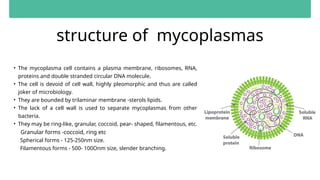
•The mycoplasma cell contains a plasma membrane, ribosomes, RNA,
proteins and double stranded circular DNA molecule.
• The cell is devoid of cell wall, highly pleomorphic and thus are called
joker of microbiology.
• They are bounded by trilaminar membrane -sterols lipids.
• The lack of a cell wall is used to separate mycoplasmas from other
bacteria.
• They may be ring-like, granular, coccoid, pear- shaped, filamentous, etc.
Granular forms -coccoid, ring etc
Spherical forms - 125-250nm size.
Filamentous forms - 500- 100Onm size, slender branching.
• They arethe smallest free living bacteria and can pass through
bacterial filters
• They lack cell wall but differ from virus as it has both RNA and DNA.
• Requires cholesterol for growth.
• Occurs as saprophytic in soil and sewage.
• Commensal in animals and plants.
• Do not possess flagella and pilli. Exhibit gliding motility
• They stain poorly with Gram’s stain but can be stained properly with
Giemsa and Dienes method.
• Mycoplasma are killed by heating at 56oC for 30 mins .
• Resistant to penicillin and cephalosporins
• Sensitive to tetracycline and erythromycin.
• The colonies of mycoplasma have a characteristic round form with a
thickened centre and a delicate periphery like a fried egg.
• They reproduce by vegetative means like, binary fission and budding.
characteristics of mycoplasmas







![MUSHROOM_PRODUCTION_UNITS and mechanism 1][1].pptx](https://cdn.slidesharecdn.com/ss_thumbnails/mushroomproductionunits11-251106185651-32f95ca8-thumbnail.jpg?width=640&height=640&fit=bounds)


