MYASTHENIA GRAVIS
BY;
ANUSHRI SRIVASTAVA
INTRODUCTION
Myasthenia Gravis is a rare autoimmune disease of the
neuromuscular junction characterized by the fluctuating
weakness of certain skeletal muscles groups.
The peak age at onset in women is during childbearing years; in
men the peak onset of myasthenia gravis is between the ages of
50 and 70 years.
June month is celebrated as myasthenia awareness month.
history
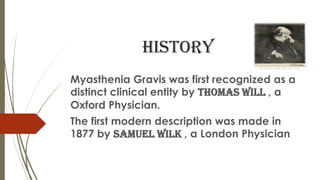
Myasthenia Gravis was first recognized as a
distinct clinical entity by THOMAS WILL , a
Oxford Physician.
The first modern description was made in
1877 by Samuel wilk , a London Physician
definition
• Myasthenia Gravis is an autoimmune disorder
characterized by weakness and rapid fatigue of
any of the muscles under your voluntary control.
According to WORLD HEALTH ORGANIZATION,
• Myasthenia Gravis is an acquired disease of the
neuromuscular junction characterized by
muscular weakness and fatigability.
etiology
Myasthenia Gravis can be caused due to:
• Idiopathic
• Autoimmune attack
Autoantibodies to Acetylcholine receptors
Autoantibodies to Tyrosine kinase receptors
• Thymic tumor
• Congenital
RISK FACTORS
• Family History
• Young Women(Age 20 and 30 )
• Men aged 50 and older
• People with vitamin deficiency especially
Vitamin D
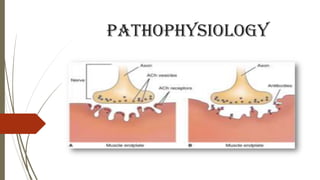
pathophysiology
classification
• Ocular Muscle weakness
• Mild weakness of muscles other than ocular
muscles
• Moderate weakness of muscles other than
ocular muscles
• Severe weakness of muscles other than
ocular muscles
• Intubation
CLINICAL MANIFESTATIONS
• Fluctuating weakness of skeletal muscles involves
ocular muscles and muscles that are used to chew,
swallow, speak and breathe.
• Muscles are generally strongest in the morning and
become exhausted with continued activity, but a
period of rest usually stores strength.
• By the end of day , muscles weakness is prominent.
• No sensory loss , reflexes are normal and muscle
atrophy is rare.
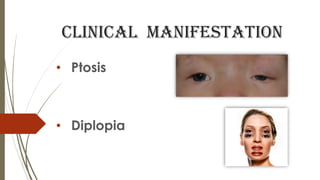
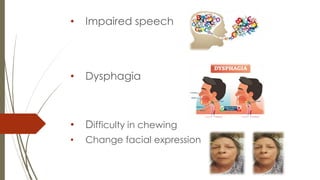
Clinical manifestation
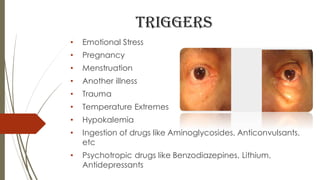
• Ptosis
• Diplopia
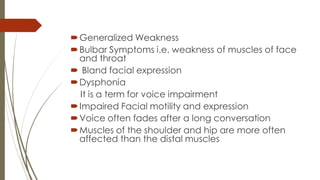
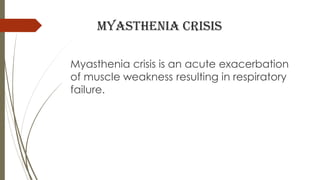
• Impaired speech
• Dysphagia
• Difficulty in chewing
• Change facial expression
Generalized Weakness
Bulbar Symptoms i.e. weakness of muscles of face
and throat
 Bland facial expression
Dysphonia
It is a term for voice impairment
Impaired Facial motility and expression
Voice often fades after a long conversation
Muscles of the shoulder and hip are more often
affected than the distal muscles
Myasthenia crisis
Myasthenia crisis is an acute exacerbation
of muscle weakness resulting in respiratory
failure.
triggers
• Emotional Stress
• Pregnancy
• Menstruation
• Another illness
• Trauma
• Temperature Extremes
• Hypokalemia
• Ingestion of drugs like Aminoglycosides, Anticonvulsants,
etc
• Psychotropic drugs like Benzodiazepines, Lithium,
Antidepressants
complications
• Aspiration
• Respiratory Insufficiency
• Respiratory Tract Infection
• Cardiomyopathies
• Any other autoimmune diseases
Diagnostic evaluation
• History Collection
• Physical Examination
• Electromyography and Single fiber EMG
• Tensilon test
IV injection of Anticholinesterase agent edrophonium
chloride
• Chest CT scan
• Acetylcholine receptors antibodies
• Magnetic Resonance Imaging
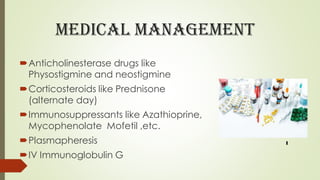
Medical management
Anticholinesterase drugs like
Physostigmine and neostigmine
Corticosteroids like Prednisone
(alternate day)
Immunosuppressants like Azathioprine,
Mycophenolate Mofetil ,etc.
Plasmapheresis
IV Immunoglobulin G
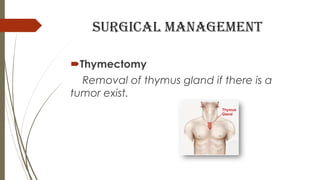
Surgical management
Thymectomy
Removal of thymus gland if there is a
tumor exist.
Nursing management
• Assess the patient condition
• Provide comfortable position
• Monitor Vitals
• Assess for dyspnea, dysphagia, dysphonia ,etc
• Administer medication as prescribed by Physician
• IV fluid administration
• Nasogastric feeding if the patient is unable to chew and
swallow the food.
Nursing diagnosis
 Ineffective airway clearance related to intercoastal
muscle weakness as evidence by patient
decreased breathing pattern
 Impaired verbal communication related to
weakness of larynx, lips ,moth and jaw as evidence
by patient verbal response
 Activity intolerance related to muscle weakness and
fatigability as evidence by physical examination
.
thank you!

myasthenia gravis.pdf

  • 1.
  • 2.
    INTRODUCTION Myasthenia Gravis isa rare autoimmune disease of the neuromuscular junction characterized by the fluctuating weakness of certain skeletal muscles groups. The peak age at onset in women is during childbearing years; in men the peak onset of myasthenia gravis is between the ages of 50 and 70 years. June month is celebrated as myasthenia awareness month.
  • 3.
    history Myasthenia Gravis wasfirst recognized as a distinct clinical entity by THOMAS WILL , a Oxford Physician. The first modern description was made in 1877 by Samuel wilk , a London Physician
  • 4.
    definition • Myasthenia Gravisis an autoimmune disorder characterized by weakness and rapid fatigue of any of the muscles under your voluntary control. According to WORLD HEALTH ORGANIZATION, • Myasthenia Gravis is an acquired disease of the neuromuscular junction characterized by muscular weakness and fatigability.
  • 5.
    etiology Myasthenia Gravis canbe caused due to: • Idiopathic • Autoimmune attack Autoantibodies to Acetylcholine receptors Autoantibodies to Tyrosine kinase receptors • Thymic tumor • Congenital
  • 6.
    RISK FACTORS • FamilyHistory • Young Women(Age 20 and 30 ) • Men aged 50 and older • People with vitamin deficiency especially Vitamin D
  • 7.
  • 8.
    classification • Ocular Muscleweakness • Mild weakness of muscles other than ocular muscles • Moderate weakness of muscles other than ocular muscles • Severe weakness of muscles other than ocular muscles • Intubation
  • 9.
    CLINICAL MANIFESTATIONS • Fluctuatingweakness of skeletal muscles involves ocular muscles and muscles that are used to chew, swallow, speak and breathe. • Muscles are generally strongest in the morning and become exhausted with continued activity, but a period of rest usually stores strength. • By the end of day , muscles weakness is prominent. • No sensory loss , reflexes are normal and muscle atrophy is rare.
  • 10.
  • 11.
    • Impaired speech •Dysphagia • Difficulty in chewing • Change facial expression
  • 12.
    Generalized Weakness Bulbar Symptomsi.e. weakness of muscles of face and throat  Bland facial expression Dysphonia It is a term for voice impairment Impaired Facial motility and expression Voice often fades after a long conversation Muscles of the shoulder and hip are more often affected than the distal muscles
  • 13.
    Myasthenia crisis Myasthenia crisisis an acute exacerbation of muscle weakness resulting in respiratory failure.
  • 14.
    triggers • Emotional Stress •Pregnancy • Menstruation • Another illness • Trauma • Temperature Extremes • Hypokalemia • Ingestion of drugs like Aminoglycosides, Anticonvulsants, etc • Psychotropic drugs like Benzodiazepines, Lithium, Antidepressants
  • 15.
    complications • Aspiration • RespiratoryInsufficiency • Respiratory Tract Infection • Cardiomyopathies • Any other autoimmune diseases
  • 16.
    Diagnostic evaluation • HistoryCollection • Physical Examination • Electromyography and Single fiber EMG • Tensilon test IV injection of Anticholinesterase agent edrophonium chloride • Chest CT scan • Acetylcholine receptors antibodies • Magnetic Resonance Imaging
  • 17.
    Medical management Anticholinesterase drugslike Physostigmine and neostigmine Corticosteroids like Prednisone (alternate day) Immunosuppressants like Azathioprine, Mycophenolate Mofetil ,etc. Plasmapheresis IV Immunoglobulin G
  • 18.
    Surgical management Thymectomy Removal ofthymus gland if there is a tumor exist.
  • 19.
    Nursing management • Assessthe patient condition • Provide comfortable position • Monitor Vitals • Assess for dyspnea, dysphagia, dysphonia ,etc • Administer medication as prescribed by Physician • IV fluid administration • Nasogastric feeding if the patient is unable to chew and swallow the food.
  • 20.
    Nursing diagnosis  Ineffectiveairway clearance related to intercoastal muscle weakness as evidence by patient decreased breathing pattern  Impaired verbal communication related to weakness of larynx, lips ,moth and jaw as evidence by patient verbal response  Activity intolerance related to muscle weakness and fatigability as evidence by physical examination
  • 21.