A SEMINAR PRESENTATION BY

                                    G. HARISH,
                                    091D1R0014,


UNDER THE SUPERVISION OF

Dr. BIGALA RAJKAMAL.
             M.Pharm, PhD, FAGE.
PRINCIPAL
GANGA PHARMACY COLLEGE,
DASNAGAR,
NIZAMABAD.
                                                               1
1. INTRODUCTION

2. ETIOLOGY

3. PATHOPHYSIOLOGY

4. SIGNS& SYMPTOMS

5. DIAGNOSIS

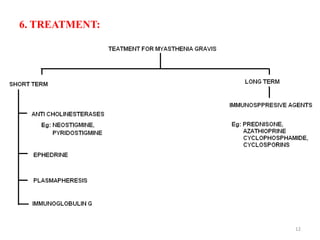
6. TREATMENT

7. CONCLUSION

8. REFERENCES


                     2
1. INTRODUCTION:

          Myasthenia gravis (MG) is an autoimmune syndrome caused by the failure
of neuromuscular transmission, which results from the binding of auto antibodies to
proteins involved in signaling at the neuromuscular junction (NMJ)

         MG is caused by a decrease in the numbers of postsynaptic acetylcholine
receptors at the neuromuscular junction, which decreases the capacity of the
neuromuscular end-plate to transmit the nerve signal.

          Normally, in response to a stimulus resulting in depolarization, acetylcholine
is released presynaptically and acts on the motor end plate to initiate a muscle action
potential. In MG, the number of activated postsynaptic receptors may be insufficient
to trigger an action potential.


                                                                                   3
2. ETIOLOGY:


(1) Acquired autoimmune.

(2) Transient neonatal caused by the passive transfer of maternal anti-AChR
antibodies

(3) Drug induced: D-penicillamine is the prototype of drug induced myasthenia
gravis. Clinical presentation may be identical to typical acquired autoimmune
myasthenia gravis and the antibody to AChR may be found.

(4) Congenital myasthenic syndromes (AChR deficiency, slow channel syndrome, and
fast channel syndrome) are distinct heritable disorders of postsynaptic neuromuscular
transmission with characteristic age of onset, pathology, electrophysiology, and
treatment.


                                                                                 4
3. PATHOPHYSIOLOGY:
      A. Normal Neuromuscular Transmission


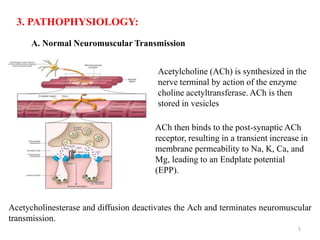
                                        Acetylcholine (ACh) is synthesized in the
                                        nerve terminal by action of the enzyme
                                        choline acetyltransferase. ACh is then
                                        stored in vesicles

                                       ACh then binds to the post-synaptic ACh
                                       receptor, resulting in a transient increase in
                                       membrane permeability to Na, K, Ca, and
                                       Mg, leading to an Endplate potential
                                       (EPP).


Acetycholinesterase and diffusion deactivates the Ach and terminates neuromuscular
transmission.
                                                                                  5
B. Acetylcholine Receptor Antibody:


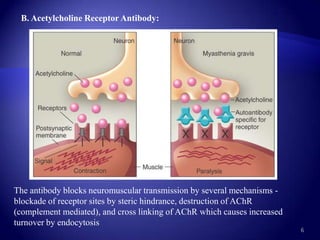
The antibody blocks neuromuscular transmission by several mechanisms -
blockade of receptor sites by steric hindrance, destruction of AChR
(complement mediated), and cross linking of AChR which causes increased
turnover by endocytosis
                                                                          6
C. Structural Changes


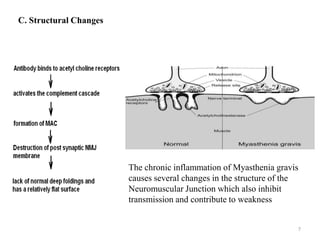
                        The chronic inflammation of Myasthenia gravis
                        causes several changes in the structure of the
                        Neuromuscular Junction which also inhibit
                        transmission and contribute to weakness


                                                                     7
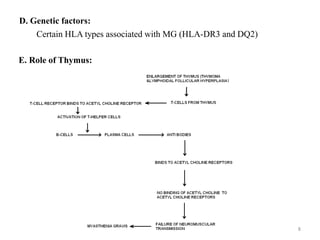
D. Genetic factors:
    Certain HLA types associated with MG (HLA-DR3 and DQ2)

E. Role of Thymus:


                                                             8
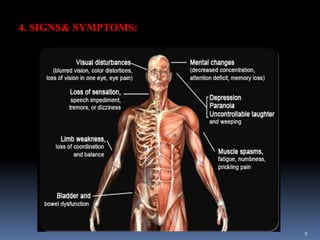
4. SIGNS& SYMPTOMS:


                      9
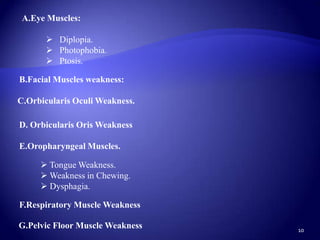
A.Eye Muscles:

        Diplopia.
        Photophobia.
        Ptosis.

B.Facial Muscles weakness:

C.Orbicularis Oculi Weakness.

D. Orbicularis Oris Weakness

E.Oropharyngeal Muscles.

      Tongue Weakness.
      Weakness in Chewing.
      Dysphagia.

F.Respiratory Muscle Weakness

G.Pelvic Floor Muscle Weakness   10
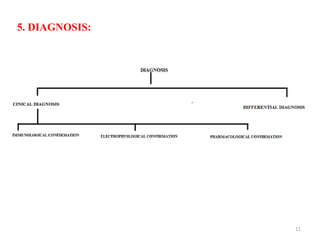
5. DIAGNOSIS:


                11
6. TREATMENT:


                12
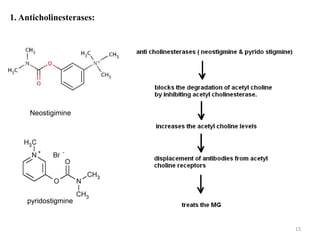
1. Anticholinesterases:


     Neostigimine


    pyridostigmine


                          13
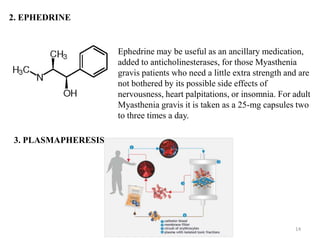
2. EPHEDRINE


                     Ephedrine may be useful as an ancillary medication,
                     added to anticholinesterases, for those Myasthenia
                     gravis patients who need a little extra strength and are
                     not bothered by its possible side effects of
                     nervousness, heart palpitations, or insomnia. For adult
                     Myasthenia gravis it is taken as a 25-mg capsules two
                     to three times a day.

3. PLASMAPHERESIS.


                                                                        14
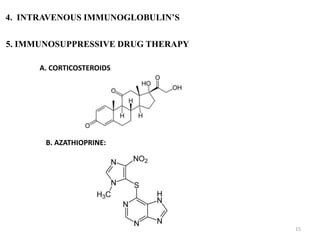
4. INTRAVENOUS IMMUNOGLOBULIN’S

5. IMMUNOSUPPRESSIVE DRUG THERAPY

      A. CORTICOSTEROIDS


       B. AZATHIOPRINE:


                                    15
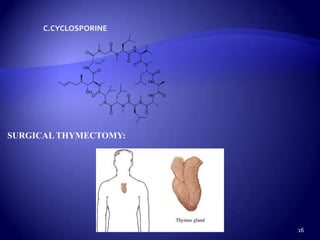
C.CYCLOSPORINE


SURGICAL THYMECTOMY:


                       16
7. CONCLUSION

In the management of myasthenia gravis, no standard measure of disease severity
and no medical treatment approach has been proven efficacious by rigorous,
prospective, controlled studies. The preponderance of evidence certainly links a
“connection” between the immune system and the central nervous system beyond a
reasonable doubt.


  However the latest techniques like intra venous immunoglobulins, plasma
pheresis and surgical thymectomy were found to be effective. But research is going
on to findout the effective medical treatment for myasthenia gravis. May be in
future we can treat the myasthenia gravis without any adverse effects.


                                                                             17
8. BIBLIOGRAPHY:

1. A text book of pharmacology by rang and dales, sixth edition, published by
churchill livingstone, page numbers 52,166,745.

2. A text book of pharmacology by tripati, sixth edition, jaypee publications, page
number 102-104

3. A text book of pharmacology by goodman&gillman, chapter 52

4. Journal of neurosurg psychiatry 2012 july, masuda.j, motmura.m et.al..

5. International journal of padiatric ortorhniolarynglogy19(1990)273-276, elsevier.

6. The journal of clinical investigation volume 116, number 11, nov 2006

7. The journal of clinical evaluation and management of myasthenia gravis by john c.,
keesey.md et. al..
                                                                                 18
19

myasthenia gravis in present era

  • 1.
    A SEMINAR PRESENTATIONBY G. HARISH, 091D1R0014, UNDER THE SUPERVISION OF Dr. BIGALA RAJKAMAL. M.Pharm, PhD, FAGE. PRINCIPAL GANGA PHARMACY COLLEGE, DASNAGAR, NIZAMABAD. 1
  • 2.
    1. INTRODUCTION 2. ETIOLOGY 3.PATHOPHYSIOLOGY 4. SIGNS& SYMPTOMS 5. DIAGNOSIS 6. TREATMENT 7. CONCLUSION 8. REFERENCES 2
  • 3.
    1. INTRODUCTION: Myasthenia gravis (MG) is an autoimmune syndrome caused by the failure of neuromuscular transmission, which results from the binding of auto antibodies to proteins involved in signaling at the neuromuscular junction (NMJ) MG is caused by a decrease in the numbers of postsynaptic acetylcholine receptors at the neuromuscular junction, which decreases the capacity of the neuromuscular end-plate to transmit the nerve signal. Normally, in response to a stimulus resulting in depolarization, acetylcholine is released presynaptically and acts on the motor end plate to initiate a muscle action potential. In MG, the number of activated postsynaptic receptors may be insufficient to trigger an action potential. 3
  • 4.
    2. ETIOLOGY: (1) Acquiredautoimmune. (2) Transient neonatal caused by the passive transfer of maternal anti-AChR antibodies (3) Drug induced: D-penicillamine is the prototype of drug induced myasthenia gravis. Clinical presentation may be identical to typical acquired autoimmune myasthenia gravis and the antibody to AChR may be found. (4) Congenital myasthenic syndromes (AChR deficiency, slow channel syndrome, and fast channel syndrome) are distinct heritable disorders of postsynaptic neuromuscular transmission with characteristic age of onset, pathology, electrophysiology, and treatment. 4
  • 5.
    3. PATHOPHYSIOLOGY: A. Normal Neuromuscular Transmission Acetylcholine (ACh) is synthesized in the nerve terminal by action of the enzyme choline acetyltransferase. ACh is then stored in vesicles ACh then binds to the post-synaptic ACh receptor, resulting in a transient increase in membrane permeability to Na, K, Ca, and Mg, leading to an Endplate potential (EPP). Acetycholinesterase and diffusion deactivates the Ach and terminates neuromuscular transmission. 5
  • 6.
    B. Acetylcholine ReceptorAntibody: The antibody blocks neuromuscular transmission by several mechanisms - blockade of receptor sites by steric hindrance, destruction of AChR (complement mediated), and cross linking of AChR which causes increased turnover by endocytosis 6
  • 7.
    C. Structural Changes The chronic inflammation of Myasthenia gravis causes several changes in the structure of the Neuromuscular Junction which also inhibit transmission and contribute to weakness 7
  • 8.
    D. Genetic factors: Certain HLA types associated with MG (HLA-DR3 and DQ2) E. Role of Thymus: 8
  • 9.
  • 10.
    A.Eye Muscles:  Diplopia.  Photophobia.  Ptosis. B.Facial Muscles weakness: C.Orbicularis Oculi Weakness. D. Orbicularis Oris Weakness E.Oropharyngeal Muscles.  Tongue Weakness.  Weakness in Chewing.  Dysphagia. F.Respiratory Muscle Weakness G.Pelvic Floor Muscle Weakness 10
  • 11.
  • 12.
  • 13.
    1. Anticholinesterases: Neostigimine pyridostigmine 13
  • 14.
    2. EPHEDRINE Ephedrine may be useful as an ancillary medication, added to anticholinesterases, for those Myasthenia gravis patients who need a little extra strength and are not bothered by its possible side effects of nervousness, heart palpitations, or insomnia. For adult Myasthenia gravis it is taken as a 25-mg capsules two to three times a day. 3. PLASMAPHERESIS. 14
  • 15.
    4. INTRAVENOUS IMMUNOGLOBULIN’S 5.IMMUNOSUPPRESSIVE DRUG THERAPY A. CORTICOSTEROIDS B. AZATHIOPRINE: 15
  • 16.
  • 17.
    7. CONCLUSION In themanagement of myasthenia gravis, no standard measure of disease severity and no medical treatment approach has been proven efficacious by rigorous, prospective, controlled studies. The preponderance of evidence certainly links a “connection” between the immune system and the central nervous system beyond a reasonable doubt. However the latest techniques like intra venous immunoglobulins, plasma pheresis and surgical thymectomy were found to be effective. But research is going on to findout the effective medical treatment for myasthenia gravis. May be in future we can treat the myasthenia gravis without any adverse effects. 17
  • 18.
    8. BIBLIOGRAPHY: 1. Atext book of pharmacology by rang and dales, sixth edition, published by churchill livingstone, page numbers 52,166,745. 2. A text book of pharmacology by tripati, sixth edition, jaypee publications, page number 102-104 3. A text book of pharmacology by goodman&gillman, chapter 52 4. Journal of neurosurg psychiatry 2012 july, masuda.j, motmura.m et.al.. 5. International journal of padiatric ortorhniolarynglogy19(1990)273-276, elsevier. 6. The journal of clinical investigation volume 116, number 11, nov 2006 7. The journal of clinical evaluation and management of myasthenia gravis by john c., keesey.md et. al.. 18
  • 19.