1
ONLINE ASSIGNMENT
BY
SANGEETHA LS DERSINI
B.Ed Natural Science
Reg .No. 18114300019
2
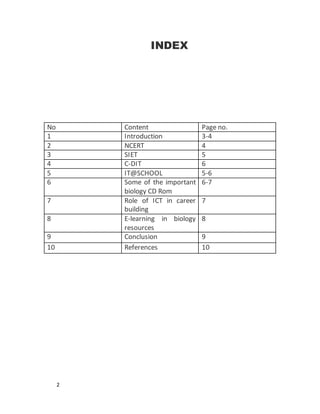
INDEX
No Content Page no.
1 Introduction 3-4
2 NCERT 4
3 SIET 5
4 C-DIT 6
5 IT@SCHOOL 5-6
6 Some of the important
biology CD Rom
6-7
7 Role of ICT in career
building
7
8 E-learning in biology
resources
8
9 Conclusion 9
10 References 10
3
Introduction
Information and Communication Technologies have recently gained groundswell
of interest. It is a significant research area for many scholars around the globe.
Their nature has highly changed the face of education over the last few decades.
For most European countries, the use of ICT in education and training has become
a priority during the last decade. However, very few have achieved progress.
Indeed, a small percentage of schools in some countries achieved high levels of
effective use of ICT to supportand change the teaching and learning process in
many subject areas. Others are still in the early phase of Information and
Communication Technologies adoption.
ICT has positive impact on students’ performances in primary schools particularly
in English language and less in science. Schools with higher level of e-
maturity show a rapid increase in performances in scores compared to those with
lower level.
In addition, schools with sufficient ICT resources achieved better results than those
that are not well-equipped. There is a significant improvement on learners’
performances. Finally, teachers becomemore convinced that educational
achievements of pupils are due to good ICT use. In fact, high percentage of
teachers in Europe (86%) states that pupils are more motivated when computers
and Internet are being used in class.
Many pupils consider ICT tools very helpful in that it helps them to do
assignments teachers see that ICT enables students with special needs or
difficulties. It also helps to reduce the social disparities between pupils, since they
work in teams in order to achieve a given task. Students also assume
responsibilities when they use ICT to organize their work through digital portfolios
or projects. In addition, the study showed that ICT has significant impact on
teachers and teaching processes.
By virtue of government Interventions and training seminars organized in this
regard, ICT tools stimulate teachers. Indeed, an absolute majority of teachers in
Europe (90 %) claim to use ICT to do tasks, suchas preparing lessons, sequencing
classroomactivities, etc. Therefore, teachers plan their lessons more efficiently.
ICT also help teachers to work in teams and share ideas related to schools
curriculum. There is also evidence that broadband and interactive whiteboards play
4
a central role in fostering teachers’ communication and increasing collaboration
between educators.
Information and communication technology may be used by the biology teachers
for the following purposes to enhance their teaching and make teaching effective:
 Graphics- can be used for draw diagrams which act as a teaching aid.
 MS word- can be used to write/type/prepare materials for teaching.
 Animation – may be used to demonstrate by visually .
 Sound effect- can be used as audio visual aid.
 For exam purposes-preparing question paper, online test , evaluation and
declaration of results
1. Undertake, aid, promote and coordinate research in areas related to
school education;
2. Prepare and publish model textbooks, supplementary material,
newsletters, journals and other related literature;
3. Organize pre-service and in-service training of teachers;
4. Develop and disseminate innovative educational techniques and
practices;
5. Collaborate and network with state educational departments,
universities, NGOs and other educational institutions;
6. Act as a clearing house for ideas and information in matters related
to school education; and
7. Act as a nodal agency for achieving goals of universalisation of
elementary education.
NCERT
National Council of Educational Research and Training (NCERT) is an
autonomous organization set up in 1961 by the Government of India to
assist and advise the Central and State Governments on policies and
programmes for qualitative improvement in school education. Major
objectives of the NCERT and its constituent units are to:
5
SIET
State Institute of Educational Technology ,Kerala, formed in 1998, is
responsible for planning, research, production and evaluation of
educational softwares like video, audio, programmes and computer
multimedia . It aims to implement schemes to generate teaching
technologies and learning process in modern contest.
Centre for Development of Imaging Technology (C-DIT) is a
unique organization working in the area of convergence and beyond of
Information and Communication Technologies (ICT) and Content
development and dissemination in multi-media formats. C-DIT is
proud of having a talented pool of creative personnel working in close
collaboration with qualified and experienced technological work force.
C-DIT has reorganized its activities through four functional Groups,
each specializing in a core area, viz. Communication Group,
Technology Group, Education & Training Group and Operations
Group. C-DIT has been functioning as a Total Solutions Provider to
the departments and agencies under the Government of Kerala in the
areas of ICT applications and in supply of Holography based security
products.
IT@School
The IT @ School Project, is an Information Technology project under the
Department of General Education, Government of Kerala in India.Launched in
2001, the Project has remodeled conventional teaching methodologies in
6
classrooms through the use of IT. The project is being implemented in over
12,000 schools in the State of Kerala, and also in schools
in Mahé, Lakshadweep and the Middle East which follow the State syllabus. An
estimated 5 million students and 200,000 teachers are now part of this project,
which has a network of 160 Master Trainers and 5600 School IT Co-ordinators
statewide, who are school teachers themselves. The project also conducts
specialized training for visually challenged teachers in the State. The Project
functions on Free Software platform
SOME OF THE IMPORTANT BIOLOGY C-DROMs
Name Type Descriptions
SIET CD-ROM Interactive CD-ROM for
children .It enables children
to extent their knowledge in
science .
NCERT CD ROM Interactive CD-ROM for
children .It enables children
to extent their knowledge in
science .
C-DIT CD- ROM Interactive CD-ROM for
children .It enables children
to extent their knowledge in
science .
IT@School CD-ROM Interactive CD-ROM for
children .It enables children
to extent their knowledge in
science .
Encyclopedia of
science2.0
CD-ROM Interactive CD-ROM for
children .It enables children
to extent their knowledge in
science .
Science explorer CD-ROM Covers topic related to electricity,
light and sound , human beings ,
forces, motion . Contains interactive
experiments , a slide show , further
information and short test on on
each topic
My amazing human body CD-ROM A multimedia CD-ROM which enables
children to extend their knowledge
through interactive games.
7
Ecosystem software Allows students to explore
interdepency
Mammals software Interactive CD-ROM for research. It
enables children to extend their
knowledge.
A field trip to rain forest software Information package through which
children can explore the Amazon rain
forest.
Role of ICT in career building
Information and communication technology has affected almost all areas of our
life. It has been aptly described as the fastest growing and the most dynamic
industry in the world. ICT affects the way we live, work, interact and socialize.
The emergence of World Wide Web(WWW) and the explosion of Internet usage
are having far-reaching effects on all aspects of the society.It is true to say that
“success and progress in all walks of life, is now driven by information and
communication technology”.
In the present environment, computers are essential tools for any type of
business, educational, social or commercial. The following points can clearly
illustrate the significance of ICT in career building:
 The Portfolio – A tool for documenting graduate attributes.
 Online submission of resumes.
 Online application
 Online intimation of screening for interview.
 Online interviews.
 Online selection.
 Online tests and assignments.
8
E-Learning in biological sciences.
E-Learning is web based training with inputs of techniques such as
animations, visualizations, stimulation , games, text, audio, video and lots
of creativity in building training programmers. Teachers and students of
biological sciences may use e-learning in the following ways.
1. Online libraries or virtual libraries.
a. Library resources (http:/www.20library.nwk.edu/resources/library)
b. The NIST virtual library(http:/www.nvl.nist.gov/)
2. By using reference sources
a. Science fact finder(http:/www.accurate-eye.com.au/earth.html)
3. By using search engines and directories
a. http:/www.google.com
b. http:/www.dogpile.com
c. http:/www.yahoomailsearch.com
4. By seeking assistance
a. The mad scientist network (http:/www.madsci.org/)
b. Ask jeeves for kids (http:/www.ajkids.com)
5. Online tuitions
a. The biology project (http://www.biology.arizona.edu/)
b. www.schoolnetindia.com
6. Online magazines.
a. Discover (http:/www.discover.com)
7. Online newspapers
a. The times of India (http://www.indiatimes.com)
b. The Hindu (http://www.thehindu.com)
9
CONCLUSION
A carefully thought-out, integrated approach to introducing computers and the
Internet into learning environments in developing countries can have a
significant impact on teaching and learning. In countries where learning
resources are limited and teachers never dream of having a fully stocked
library, let alone the Internet, teachers and students have been introduced to a
new world of learning. As a result, those with access to ICTs have been greatly
empowered, and now believe they can compete in a global knowledge-based
economy because they know that their knowledge, ideas, culture, and passions
are as valuable as any in the world.
In the developing world, ICTs are used largely to increase
access to and improve the relevance and quality of education. ICTs have
demonstrated potential to increase the options, access, participation, and
achievement for all students. The unprecedented speed and general availability
of diverse and relevant information due to ICT, extends educational
opportunities to the marginalized and vulnerable groups, among the other
disadvantaged. ICTs are, ultimately, only physical tools, which by themselves
cannot bring benefits to students, teachers and communities at large. Therefore
the unique contextual realities of this region, including, primarily, the initiative
and impetus of the various countries and its constituents and the level of
infrastructure, play determining roles in creating enabling environments
promoting the use of ICTs for primary and secondary education.
10
REFERENCES
1. Teaching of biological sciences, Jasim Ahmed
2. ‘Using Technology for Education’, Guilherme Vaz, IL & FS Educational
Technology Services, Discussion Paper on National Policy on ICT in School
Education
3. Haddad and Jurich, “ICT for Education: Potential and Potency.

Ict based resources

  • 1.
    1 ONLINE ASSIGNMENT BY SANGEETHA LSDERSINI B.Ed Natural Science Reg .No. 18114300019
  • 2.
    2 INDEX No Content Pageno. 1 Introduction 3-4 2 NCERT 4 3 SIET 5 4 C-DIT 6 5 IT@SCHOOL 5-6 6 Some of the important biology CD Rom 6-7 7 Role of ICT in career building 7 8 E-learning in biology resources 8 9 Conclusion 9 10 References 10
  • 3.
    3 Introduction Information and CommunicationTechnologies have recently gained groundswell of interest. It is a significant research area for many scholars around the globe. Their nature has highly changed the face of education over the last few decades. For most European countries, the use of ICT in education and training has become a priority during the last decade. However, very few have achieved progress. Indeed, a small percentage of schools in some countries achieved high levels of effective use of ICT to supportand change the teaching and learning process in many subject areas. Others are still in the early phase of Information and Communication Technologies adoption. ICT has positive impact on students’ performances in primary schools particularly in English language and less in science. Schools with higher level of e- maturity show a rapid increase in performances in scores compared to those with lower level. In addition, schools with sufficient ICT resources achieved better results than those that are not well-equipped. There is a significant improvement on learners’ performances. Finally, teachers becomemore convinced that educational achievements of pupils are due to good ICT use. In fact, high percentage of teachers in Europe (86%) states that pupils are more motivated when computers and Internet are being used in class. Many pupils consider ICT tools very helpful in that it helps them to do assignments teachers see that ICT enables students with special needs or difficulties. It also helps to reduce the social disparities between pupils, since they work in teams in order to achieve a given task. Students also assume responsibilities when they use ICT to organize their work through digital portfolios or projects. In addition, the study showed that ICT has significant impact on teachers and teaching processes. By virtue of government Interventions and training seminars organized in this regard, ICT tools stimulate teachers. Indeed, an absolute majority of teachers in Europe (90 %) claim to use ICT to do tasks, suchas preparing lessons, sequencing classroomactivities, etc. Therefore, teachers plan their lessons more efficiently. ICT also help teachers to work in teams and share ideas related to schools curriculum. There is also evidence that broadband and interactive whiteboards play
  • 4.
    4 a central rolein fostering teachers’ communication and increasing collaboration between educators. Information and communication technology may be used by the biology teachers for the following purposes to enhance their teaching and make teaching effective:  Graphics- can be used for draw diagrams which act as a teaching aid.  MS word- can be used to write/type/prepare materials for teaching.  Animation – may be used to demonstrate by visually .  Sound effect- can be used as audio visual aid.  For exam purposes-preparing question paper, online test , evaluation and declaration of results 1. Undertake, aid, promote and coordinate research in areas related to school education; 2. Prepare and publish model textbooks, supplementary material, newsletters, journals and other related literature; 3. Organize pre-service and in-service training of teachers; 4. Develop and disseminate innovative educational techniques and practices; 5. Collaborate and network with state educational departments, universities, NGOs and other educational institutions; 6. Act as a clearing house for ideas and information in matters related to school education; and 7. Act as a nodal agency for achieving goals of universalisation of elementary education. NCERT National Council of Educational Research and Training (NCERT) is an autonomous organization set up in 1961 by the Government of India to assist and advise the Central and State Governments on policies and programmes for qualitative improvement in school education. Major objectives of the NCERT and its constituent units are to:
  • 5.
    5 SIET State Institute ofEducational Technology ,Kerala, formed in 1998, is responsible for planning, research, production and evaluation of educational softwares like video, audio, programmes and computer multimedia . It aims to implement schemes to generate teaching technologies and learning process in modern contest. Centre for Development of Imaging Technology (C-DIT) is a unique organization working in the area of convergence and beyond of Information and Communication Technologies (ICT) and Content development and dissemination in multi-media formats. C-DIT is proud of having a talented pool of creative personnel working in close collaboration with qualified and experienced technological work force. C-DIT has reorganized its activities through four functional Groups, each specializing in a core area, viz. Communication Group, Technology Group, Education & Training Group and Operations Group. C-DIT has been functioning as a Total Solutions Provider to the departments and agencies under the Government of Kerala in the areas of ICT applications and in supply of Holography based security products. IT@School The IT @ School Project, is an Information Technology project under the Department of General Education, Government of Kerala in India.Launched in 2001, the Project has remodeled conventional teaching methodologies in
  • 6.
    6 classrooms through theuse of IT. The project is being implemented in over 12,000 schools in the State of Kerala, and also in schools in Mahé, Lakshadweep and the Middle East which follow the State syllabus. An estimated 5 million students and 200,000 teachers are now part of this project, which has a network of 160 Master Trainers and 5600 School IT Co-ordinators statewide, who are school teachers themselves. The project also conducts specialized training for visually challenged teachers in the State. The Project functions on Free Software platform SOME OF THE IMPORTANT BIOLOGY C-DROMs Name Type Descriptions SIET CD-ROM Interactive CD-ROM for children .It enables children to extent their knowledge in science . NCERT CD ROM Interactive CD-ROM for children .It enables children to extent their knowledge in science . C-DIT CD- ROM Interactive CD-ROM for children .It enables children to extent their knowledge in science . IT@School CD-ROM Interactive CD-ROM for children .It enables children to extent their knowledge in science . Encyclopedia of science2.0 CD-ROM Interactive CD-ROM for children .It enables children to extent their knowledge in science . Science explorer CD-ROM Covers topic related to electricity, light and sound , human beings , forces, motion . Contains interactive experiments , a slide show , further information and short test on on each topic My amazing human body CD-ROM A multimedia CD-ROM which enables children to extend their knowledge through interactive games.
  • 7.
    7 Ecosystem software Allowsstudents to explore interdepency Mammals software Interactive CD-ROM for research. It enables children to extend their knowledge. A field trip to rain forest software Information package through which children can explore the Amazon rain forest. Role of ICT in career building Information and communication technology has affected almost all areas of our life. It has been aptly described as the fastest growing and the most dynamic industry in the world. ICT affects the way we live, work, interact and socialize. The emergence of World Wide Web(WWW) and the explosion of Internet usage are having far-reaching effects on all aspects of the society.It is true to say that “success and progress in all walks of life, is now driven by information and communication technology”. In the present environment, computers are essential tools for any type of business, educational, social or commercial. The following points can clearly illustrate the significance of ICT in career building:  The Portfolio – A tool for documenting graduate attributes.  Online submission of resumes.  Online application  Online intimation of screening for interview.  Online interviews.  Online selection.  Online tests and assignments.
  • 8.
    8 E-Learning in biologicalsciences. E-Learning is web based training with inputs of techniques such as animations, visualizations, stimulation , games, text, audio, video and lots of creativity in building training programmers. Teachers and students of biological sciences may use e-learning in the following ways. 1. Online libraries or virtual libraries. a. Library resources (http:/www.20library.nwk.edu/resources/library) b. The NIST virtual library(http:/www.nvl.nist.gov/) 2. By using reference sources a. Science fact finder(http:/www.accurate-eye.com.au/earth.html) 3. By using search engines and directories a. http:/www.google.com b. http:/www.dogpile.com c. http:/www.yahoomailsearch.com 4. By seeking assistance a. The mad scientist network (http:/www.madsci.org/) b. Ask jeeves for kids (http:/www.ajkids.com) 5. Online tuitions a. The biology project (http://www.biology.arizona.edu/) b. www.schoolnetindia.com 6. Online magazines. a. Discover (http:/www.discover.com) 7. Online newspapers a. The times of India (http://www.indiatimes.com) b. The Hindu (http://www.thehindu.com)
  • 9.
    9 CONCLUSION A carefully thought-out,integrated approach to introducing computers and the Internet into learning environments in developing countries can have a significant impact on teaching and learning. In countries where learning resources are limited and teachers never dream of having a fully stocked library, let alone the Internet, teachers and students have been introduced to a new world of learning. As a result, those with access to ICTs have been greatly empowered, and now believe they can compete in a global knowledge-based economy because they know that their knowledge, ideas, culture, and passions are as valuable as any in the world. In the developing world, ICTs are used largely to increase access to and improve the relevance and quality of education. ICTs have demonstrated potential to increase the options, access, participation, and achievement for all students. The unprecedented speed and general availability of diverse and relevant information due to ICT, extends educational opportunities to the marginalized and vulnerable groups, among the other disadvantaged. ICTs are, ultimately, only physical tools, which by themselves cannot bring benefits to students, teachers and communities at large. Therefore the unique contextual realities of this region, including, primarily, the initiative and impetus of the various countries and its constituents and the level of infrastructure, play determining roles in creating enabling environments promoting the use of ICTs for primary and secondary education.
  • 10.
    10 REFERENCES 1. Teaching ofbiological sciences, Jasim Ahmed 2. ‘Using Technology for Education’, Guilherme Vaz, IL & FS Educational Technology Services, Discussion Paper on National Policy on ICT in School Education 3. Haddad and Jurich, “ICT for Education: Potential and Potency.