


Universidade do Minho


Compositing, composing worlds
Nelson Zagalo, University of Minho, Portugal


13th May 2011, University of Maribor, Slovenia
Nelson Zagalo

Contact me
nzagalo@ics.uminho.pt
www.facebook.com/nelsonzagalo


My Work
nelsonzagalo.googlepages.com
www.engagelab.org
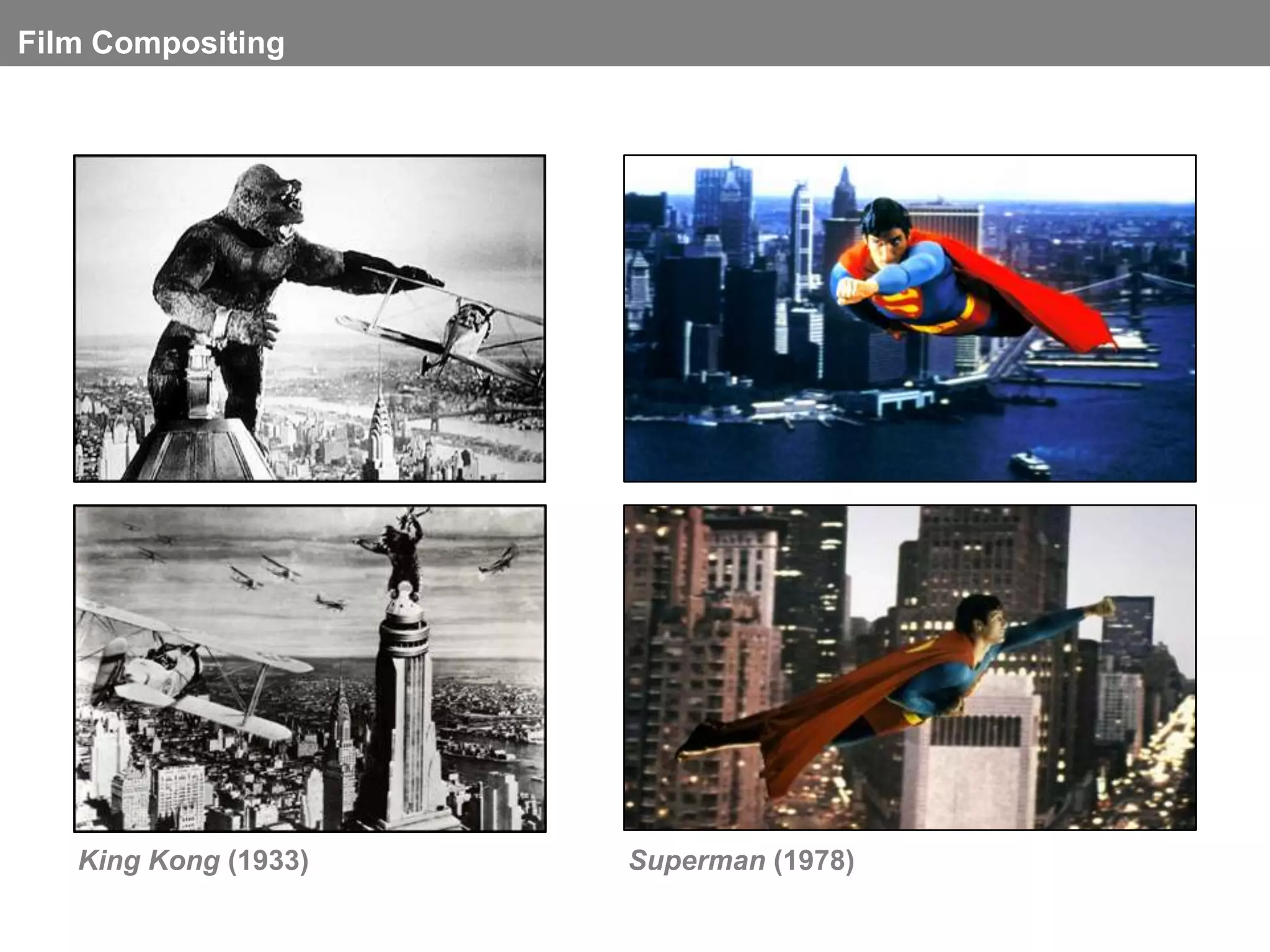
Film Compositing


   King Kong (1933)   Superman (1978)
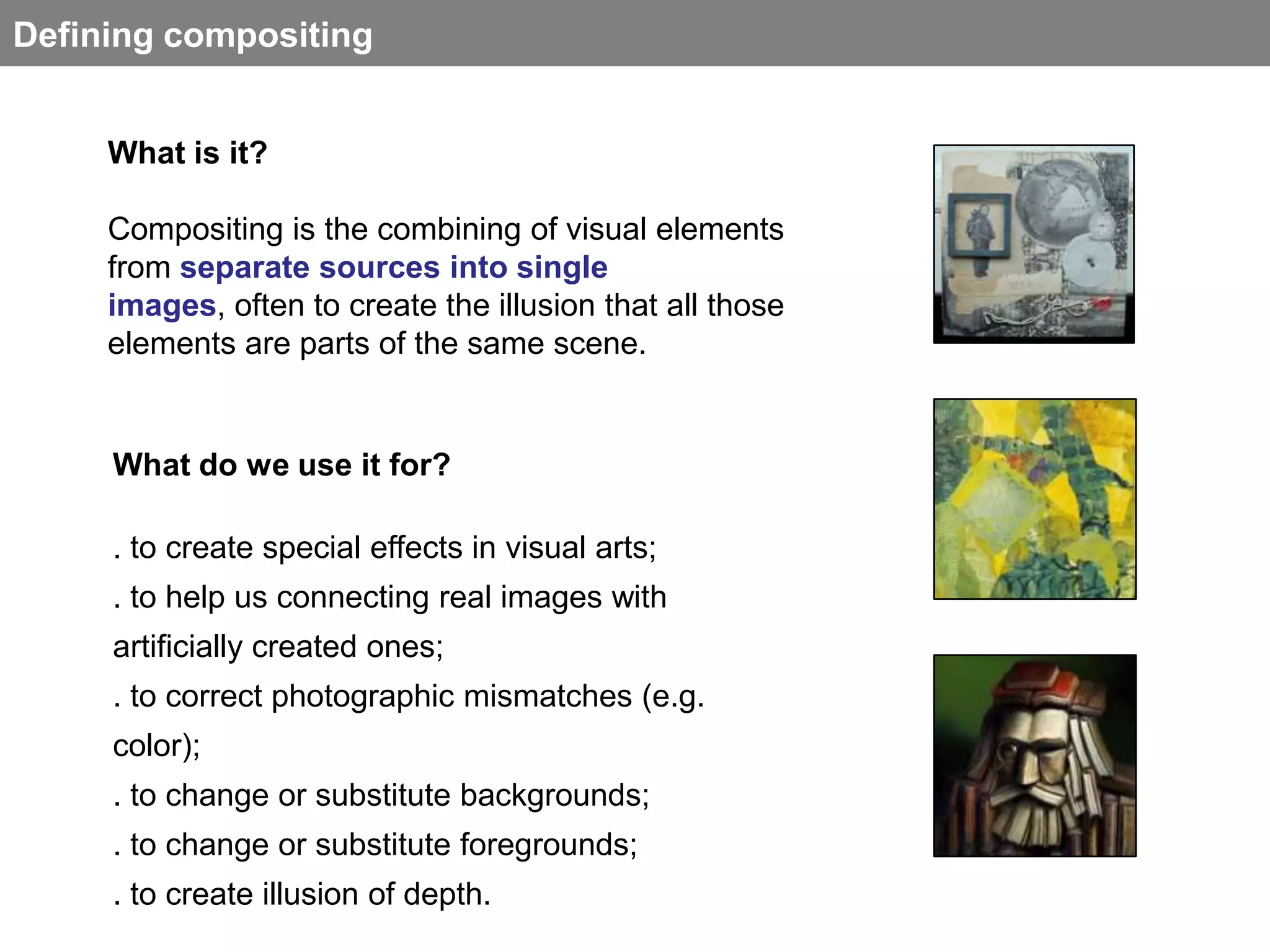
Defining compositing


     What is it?

     Compositing is the combining of visual elements
     from separate sources into single
     images, often to create the illusion that all those
     elements are parts of the same scene.


     What do we use it for?

     . to create special effects in visual arts;
     . to help us connecting real images with
     artificially created ones;
     . to correct photographic mismatches (e.g.
     color);
     . to change or substitute backgrounds;
     . to change or substitute foregrounds;
     . to create illusion of depth.
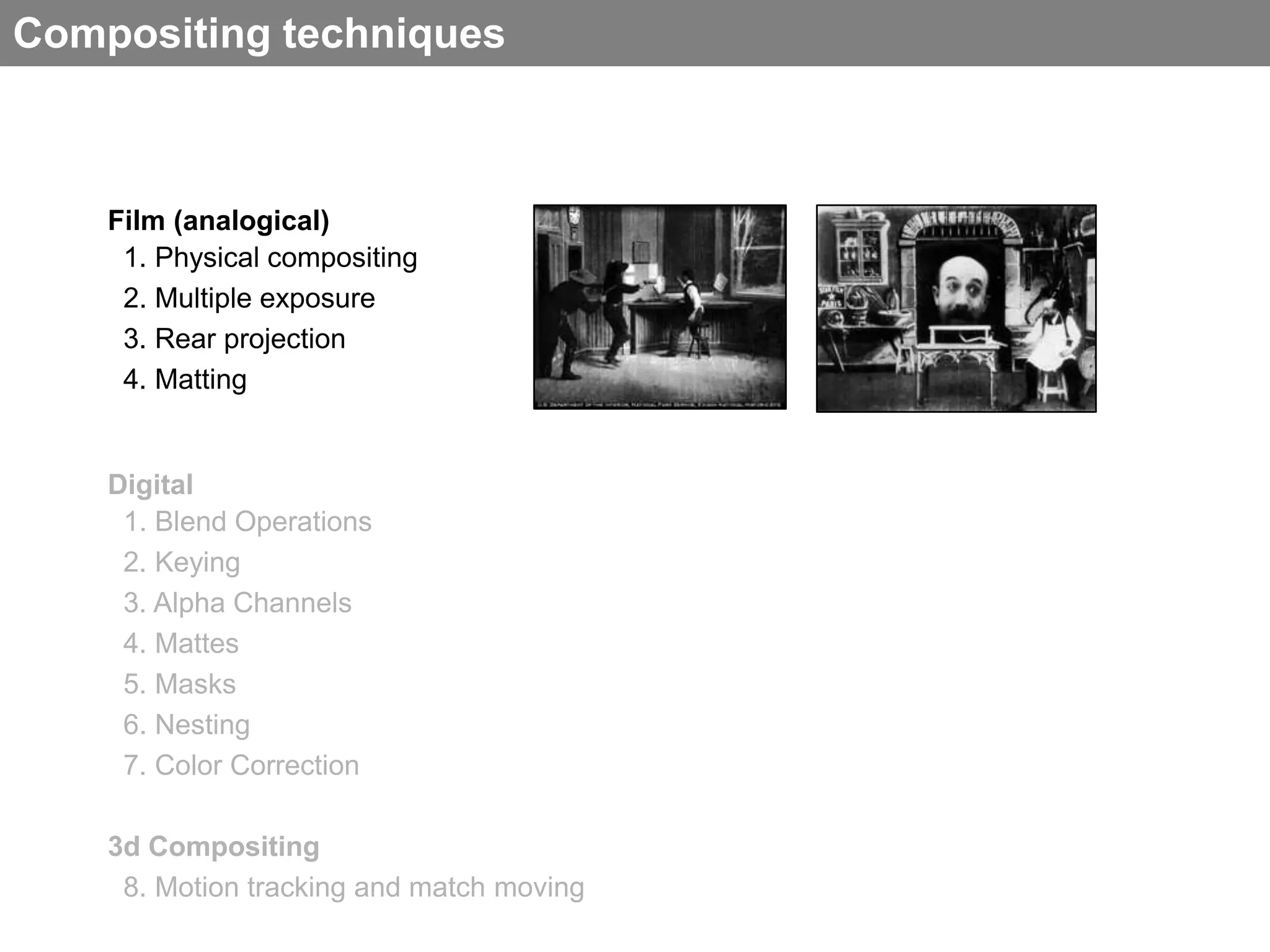
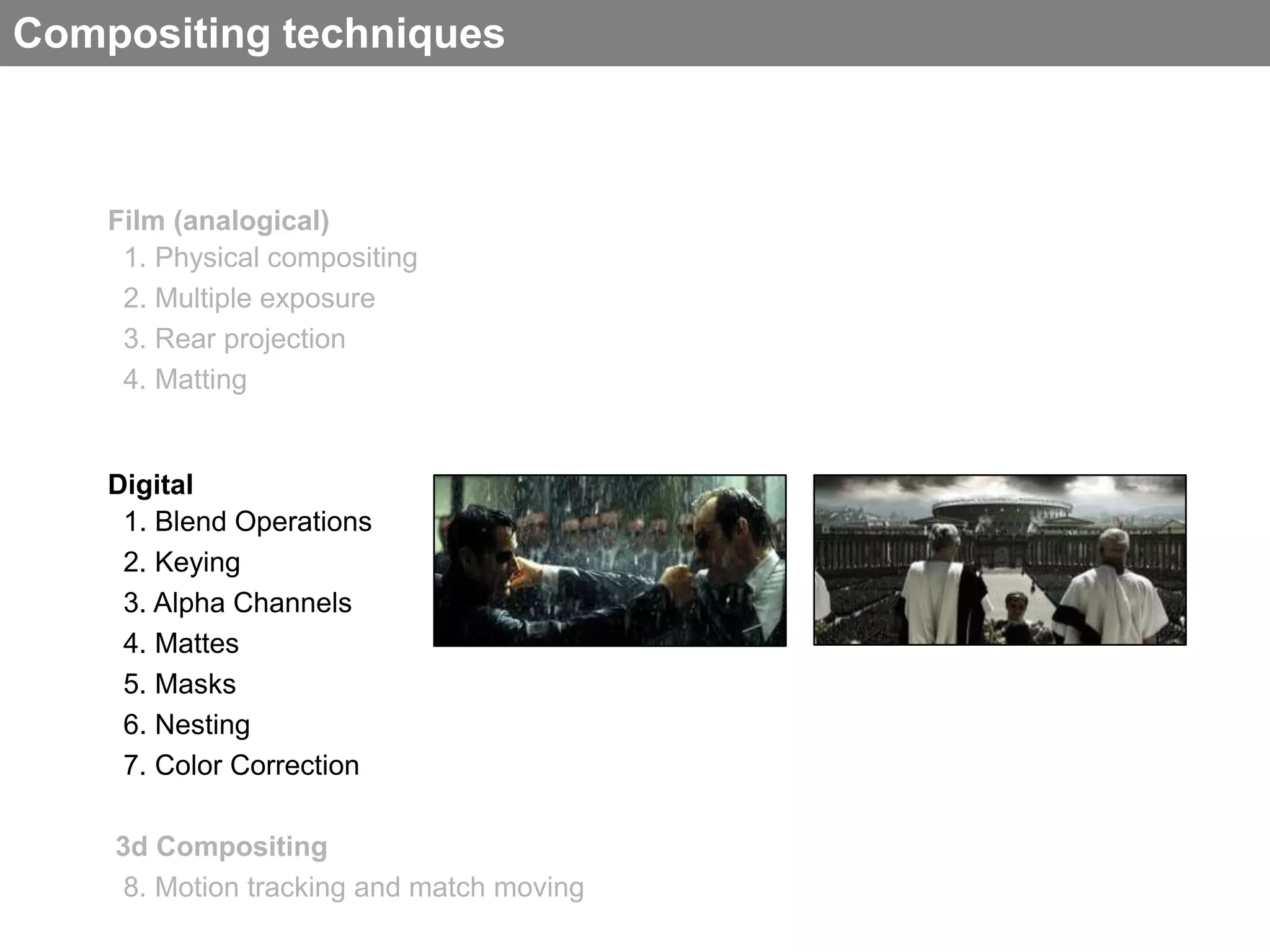
Compositing techniques


    Film (analogical)
     1. Physical compositing
     2. Multiple exposure
     3. Rear projection
     4. Matting


    Digital
     1. Blend Operations
     2. Keying
     3. Alpha Channels
     4. Mattes
     5. Masks
     6. Nesting
     7. Color Correction

    3d Compositing
     8. Motion tracking and match moving
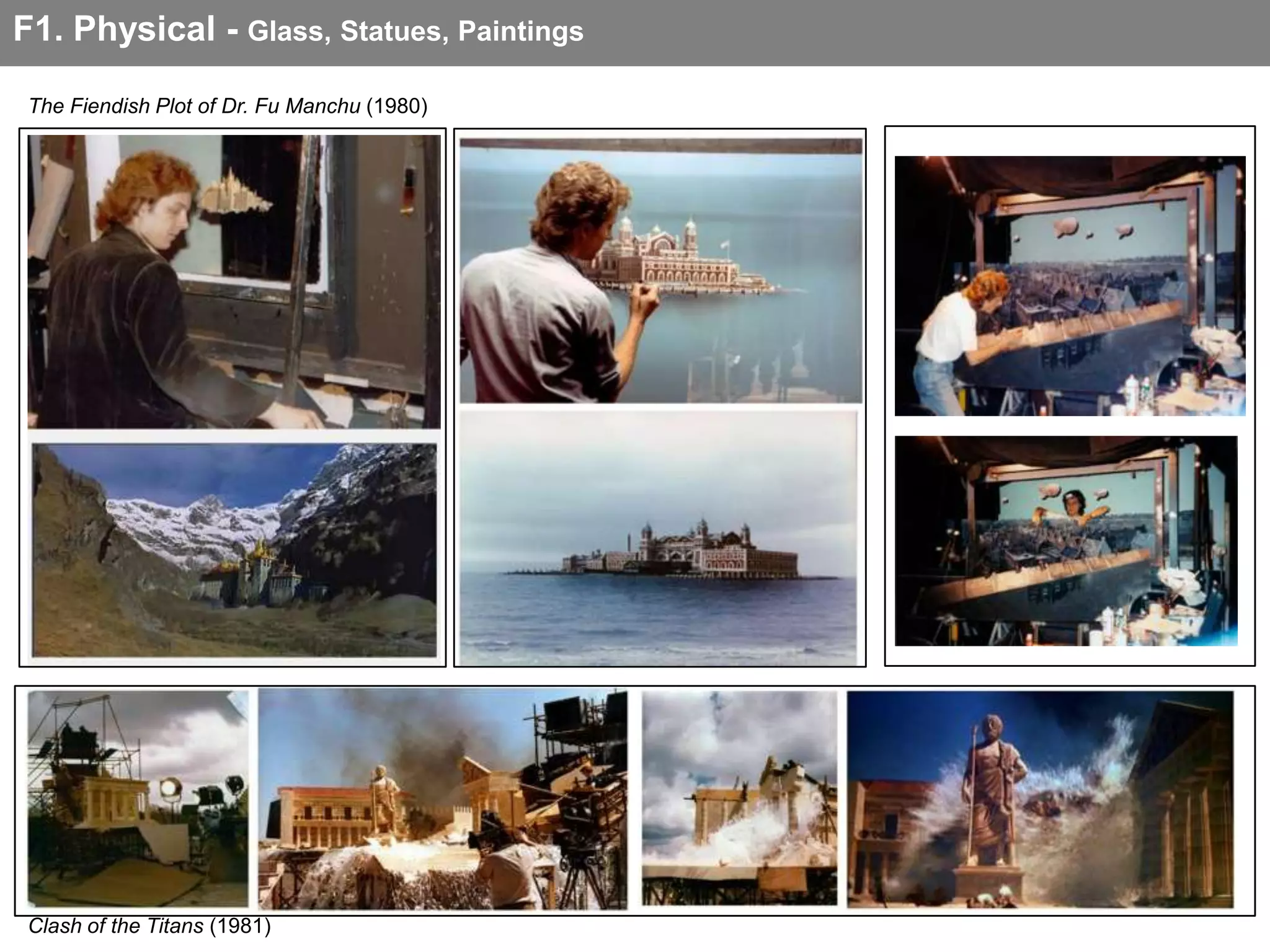
F1. Physical - Glass, Statues, Paintings

 The Fiendish Plot of Dr. Fu Manchu (1980)


 Clash of the Titans (1981)
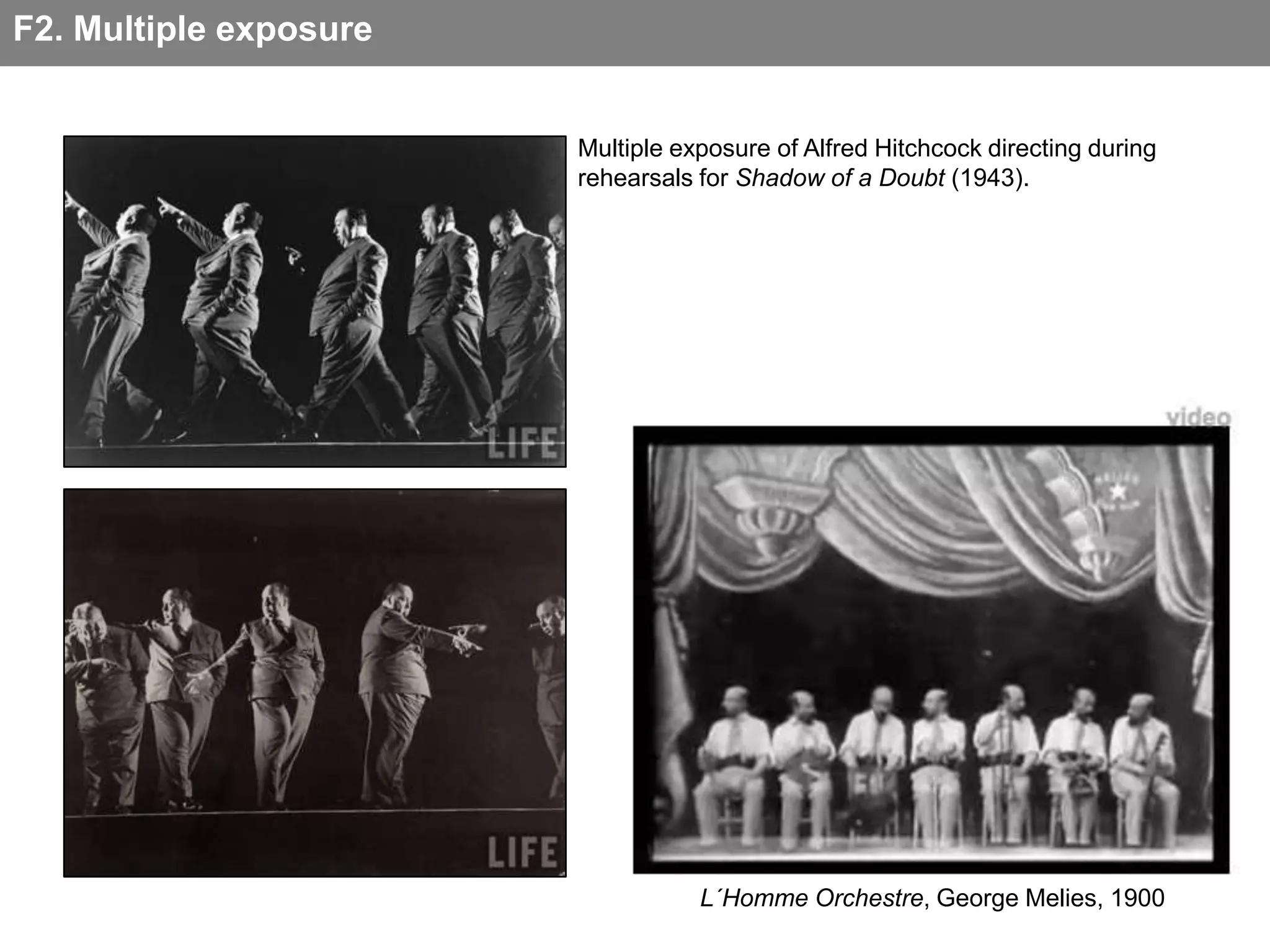
F2. Multiple exposure


                        Multiple exposure of Alfred Hitchcock directing during
                        rehearsals for Shadow of a Doubt (1943).


                                                                                 video


                                   L´Homme Orchestre, George Melies, 1900
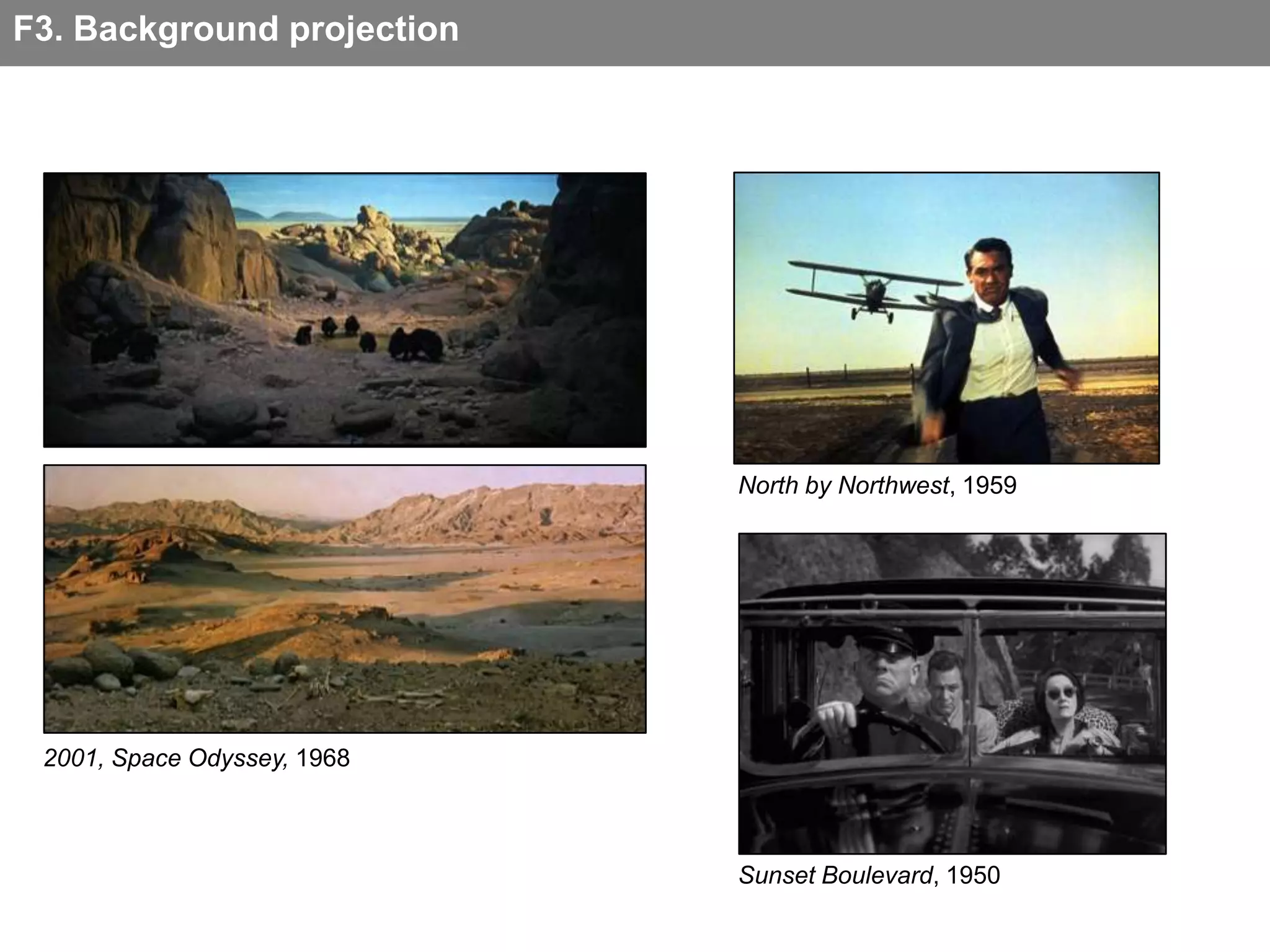
F3. Background projection


                             North by Northwest, 1959


 2001, Space Odyssey, 1968


                             Sunset Boulevard, 1950
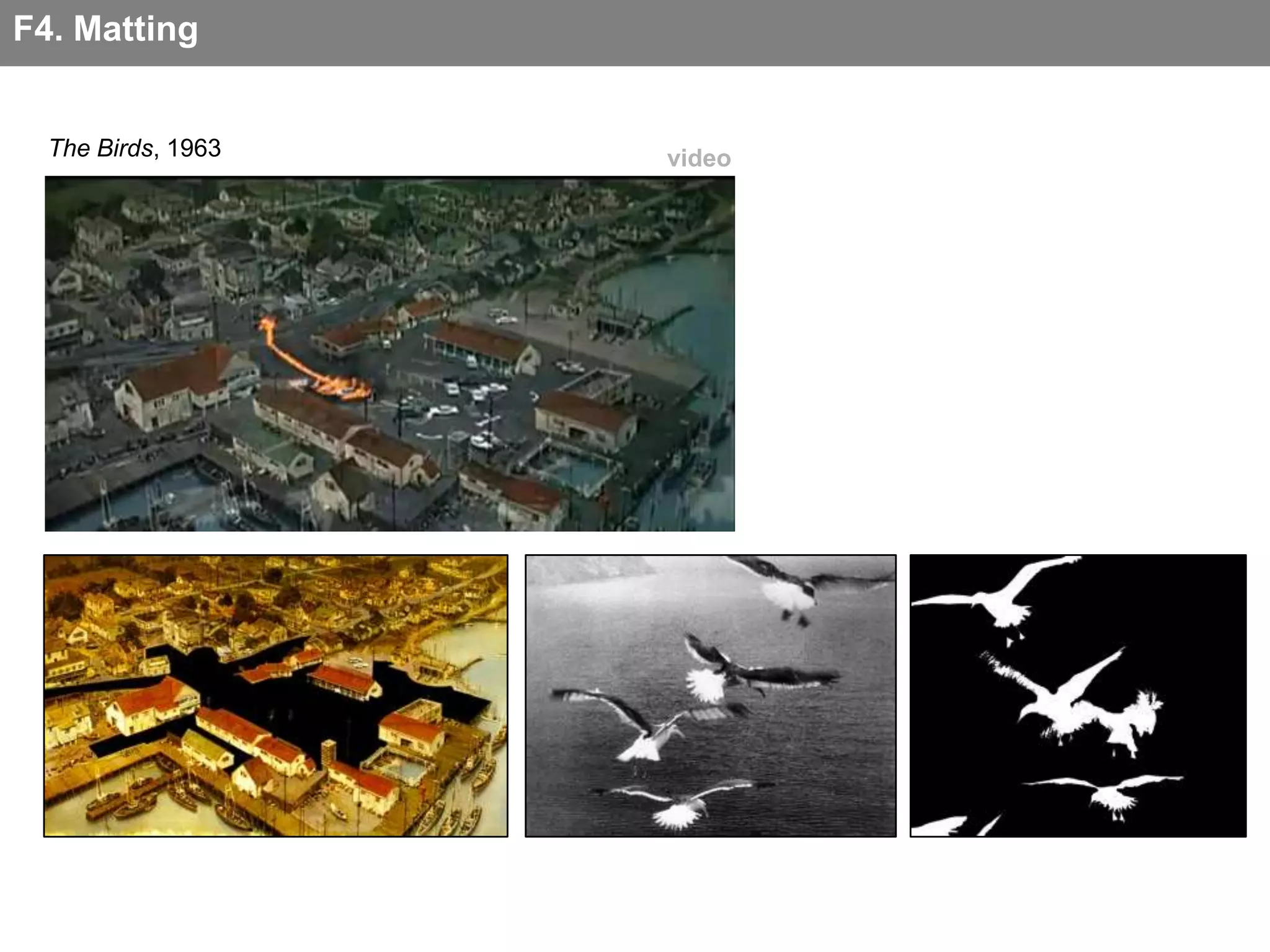
F4. Matting


  The Birds, 1963   video
Compositing techniques


    Film (analogical)
     1. Physical compositing
     2. Multiple exposure
     3. Rear projection
     4. Matting


    Digital
     1. Blend Operations
     2. Keying
     3. Alpha Channels
     4. Mattes
     5. Masks
     6. Nesting
     7. Color Correction

    3d Compositing
     8. Motion tracking and match moving
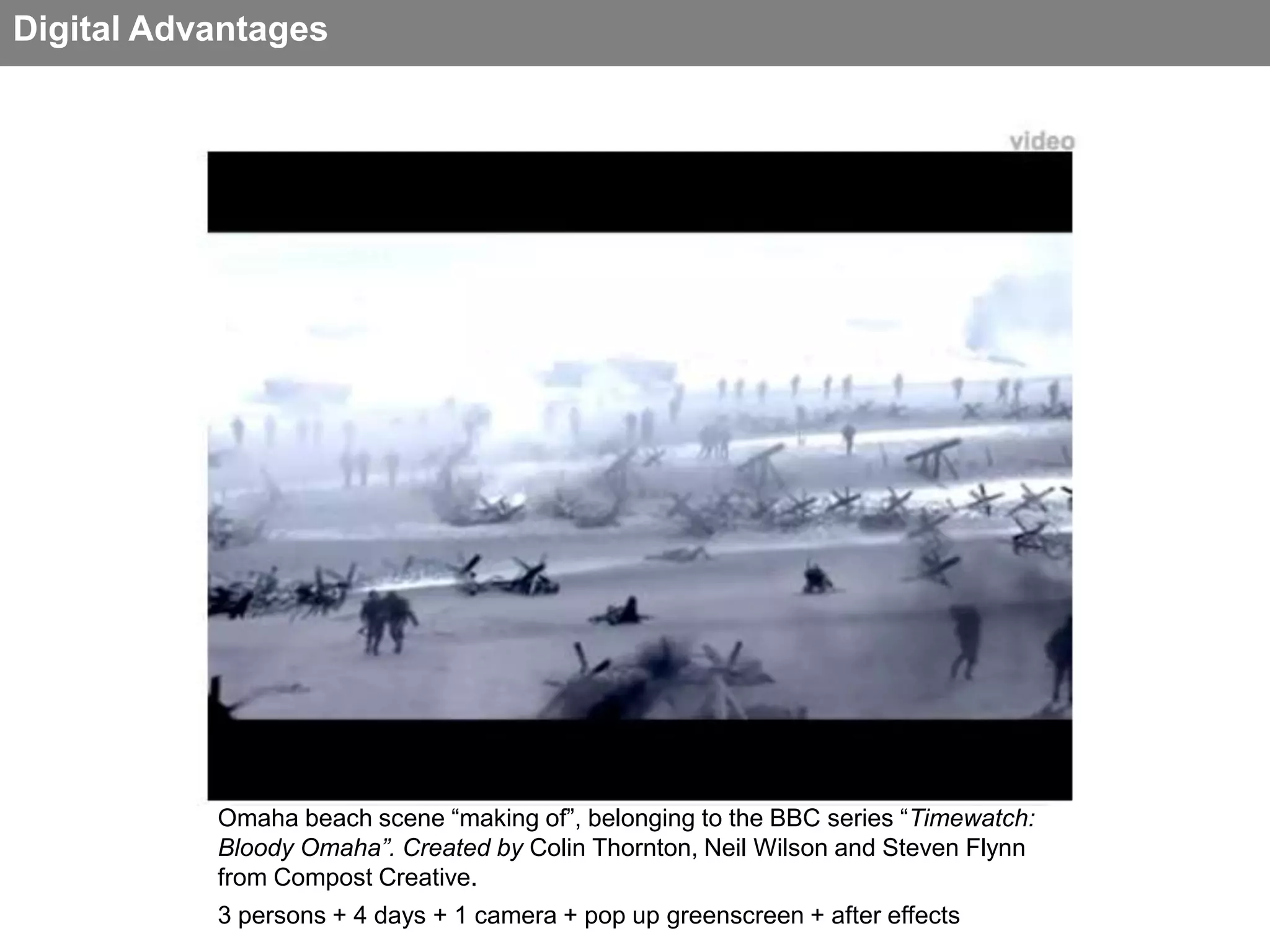
Digital Advantages


                                                                                video


           Omaha beach scene “making of”, belonging to the BBC series “Timewatch:
           Bloody Omaha”. Created by Colin Thornton, Neil Wilson and Steven Flynn
           from Compost Creative.
           3 persons + 4 days + 1 camera + pop up greenscreen + after effects
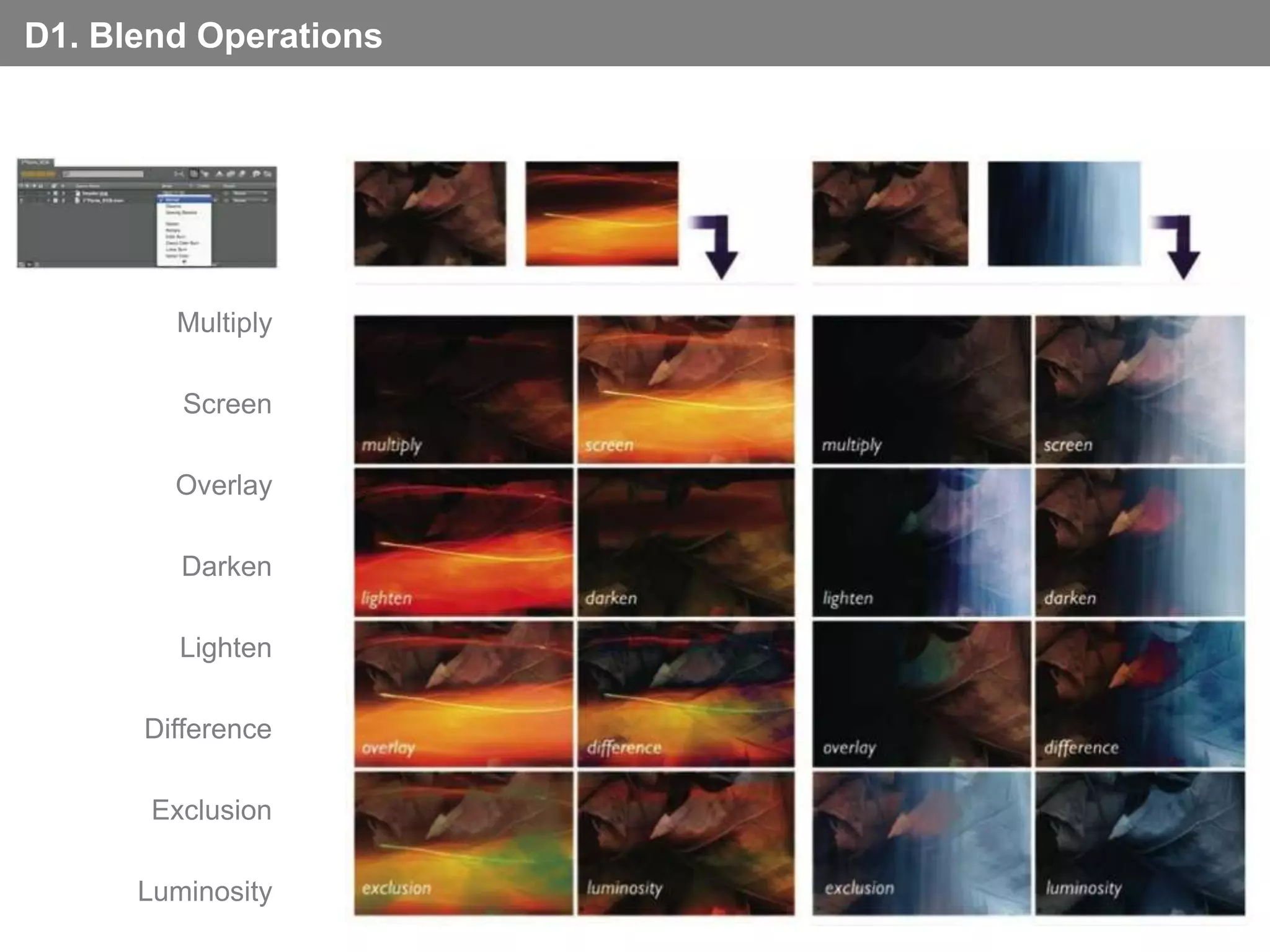
D1. Blend Operations


        Multiply

         Screen

        Overlay

         Darken

         Lighten

      Difference

       Exclusion

      Luminosity
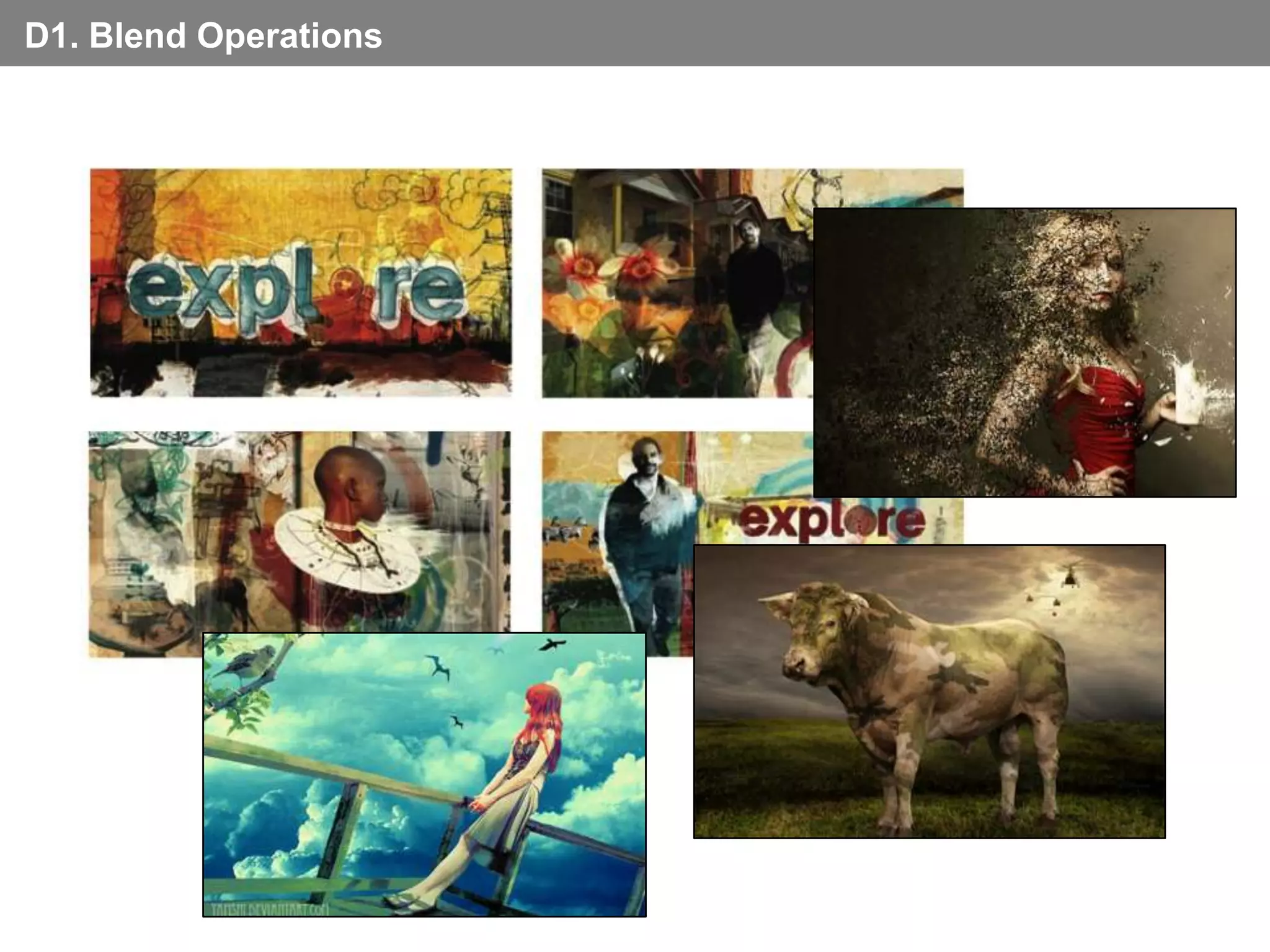
D1. Blend Operations
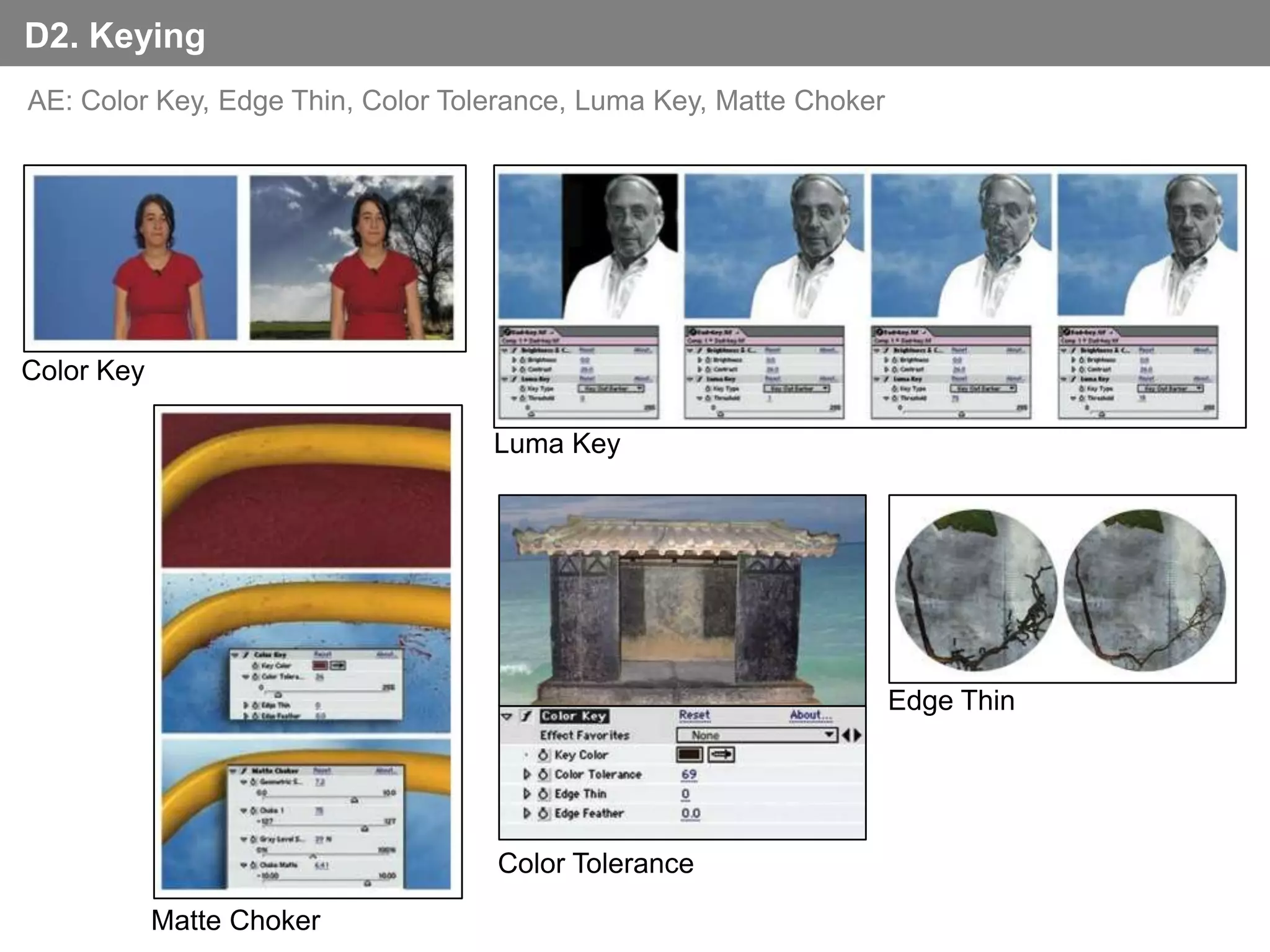
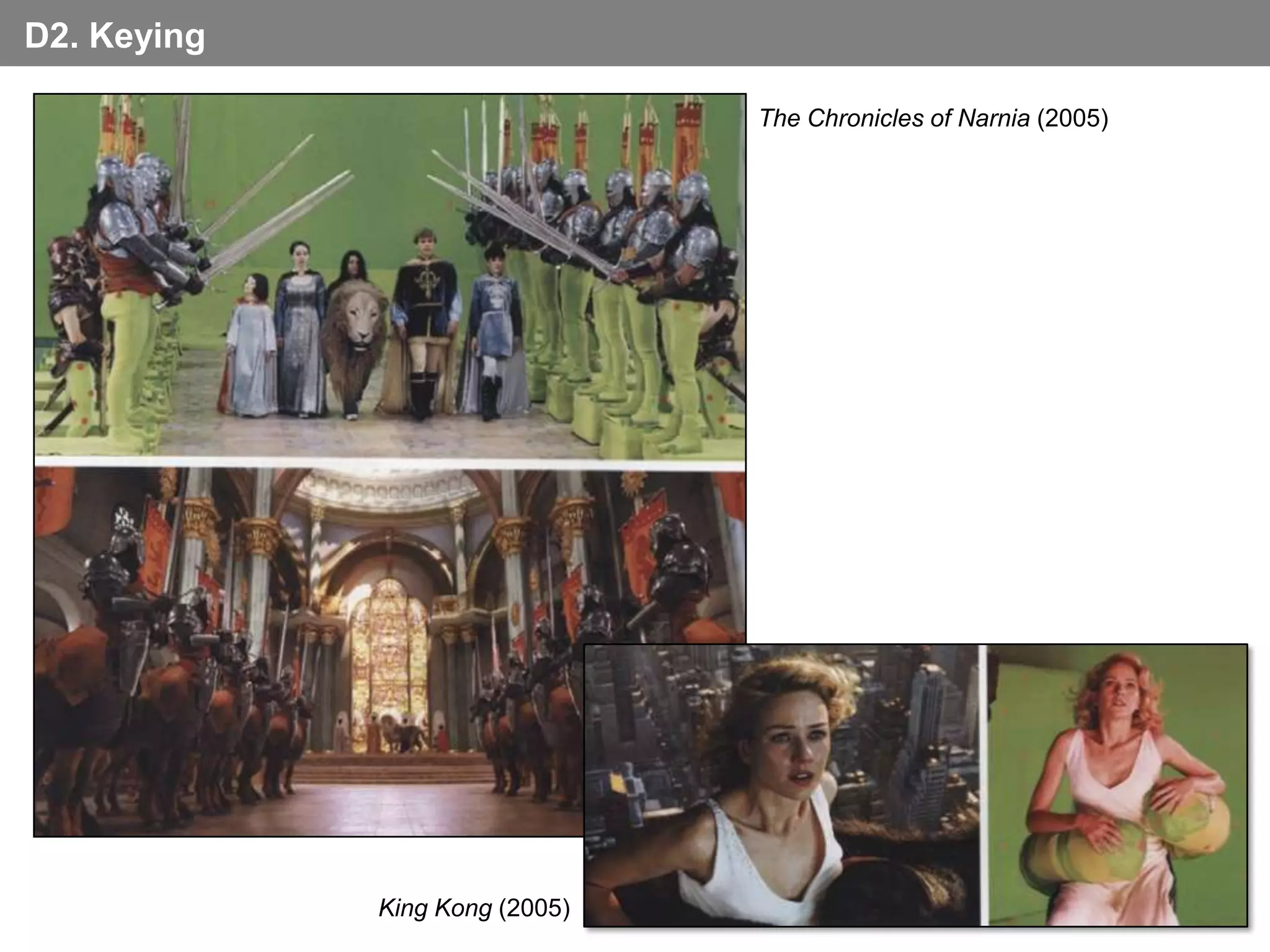
D2. Keying
AE: Color Key, Edge Thin, Color Tolerance, Luma Key, Matte Choker


Color Key

                                   Luma Key


                                                                    Edge Thin


                                   Color Tolerance

            Matte Choker
D2. Keying

                                The Chronicles of Narnia (2005)


             King Kong (2005)
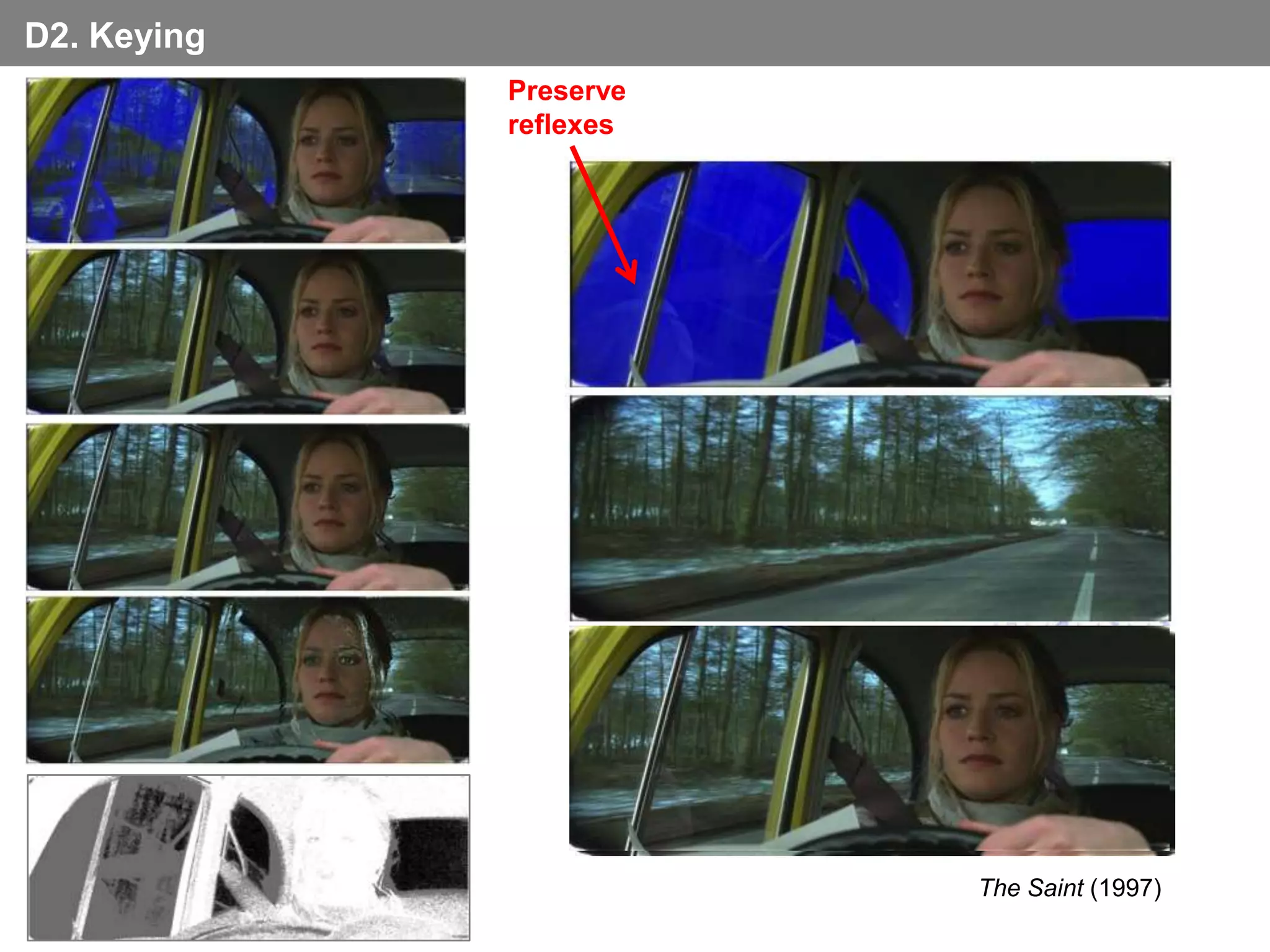
D2. Keying
             Preserve
             reflexes


                        The Saint (1997)
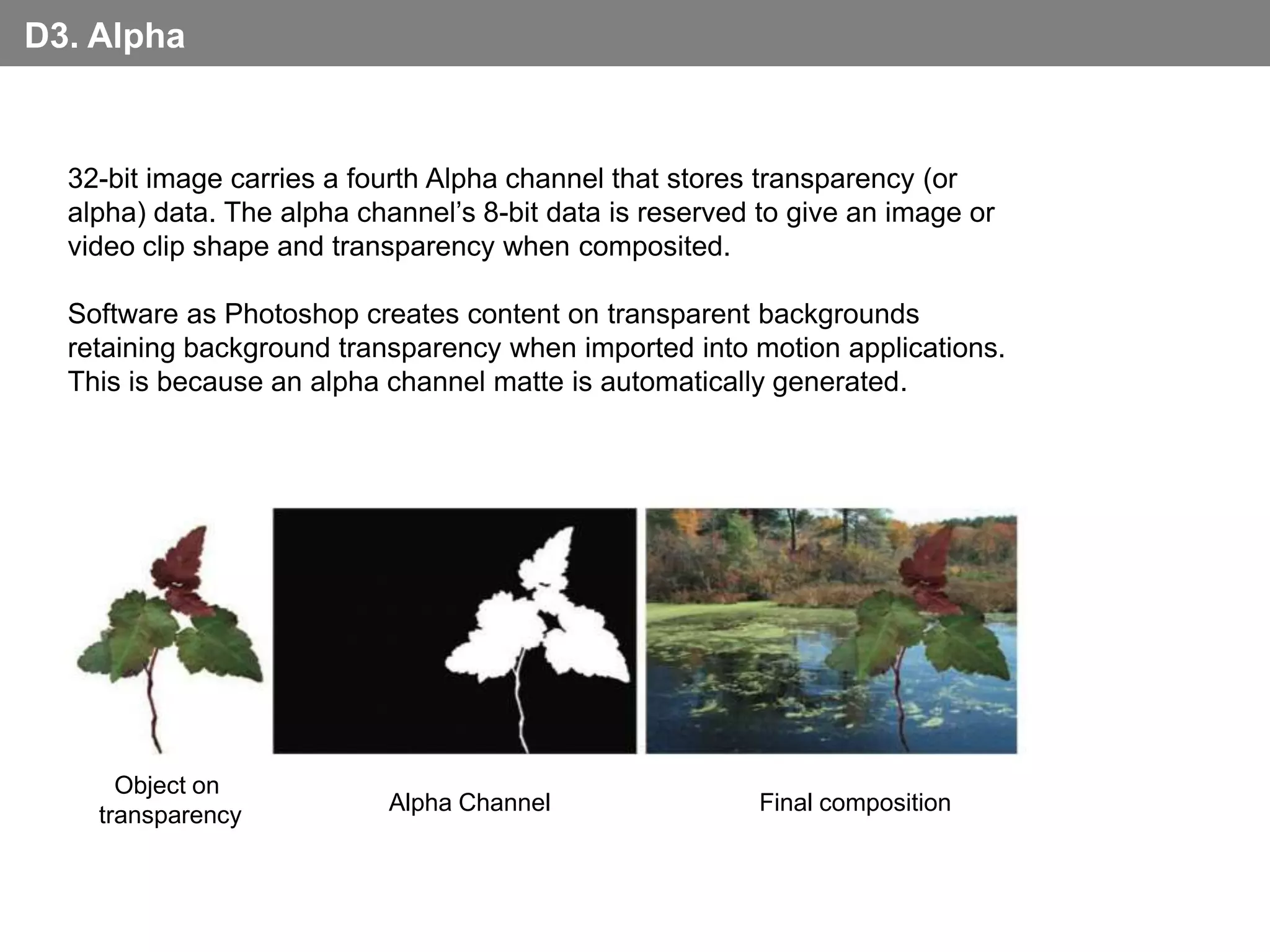
D3. Alpha


  32-bit image carries a fourth Alpha channel that stores transparency (or
  alpha) data. The alpha channel’s 8-bit data is reserved to give an image or
  video clip shape and transparency when composited.

  Software as Photoshop creates content on transparent backgrounds
  retaining background transparency when imported into motion applications.
  This is because an alpha channel matte is automatically generated.


      Object on
                           Alpha Channel                 Final composition
    transparency
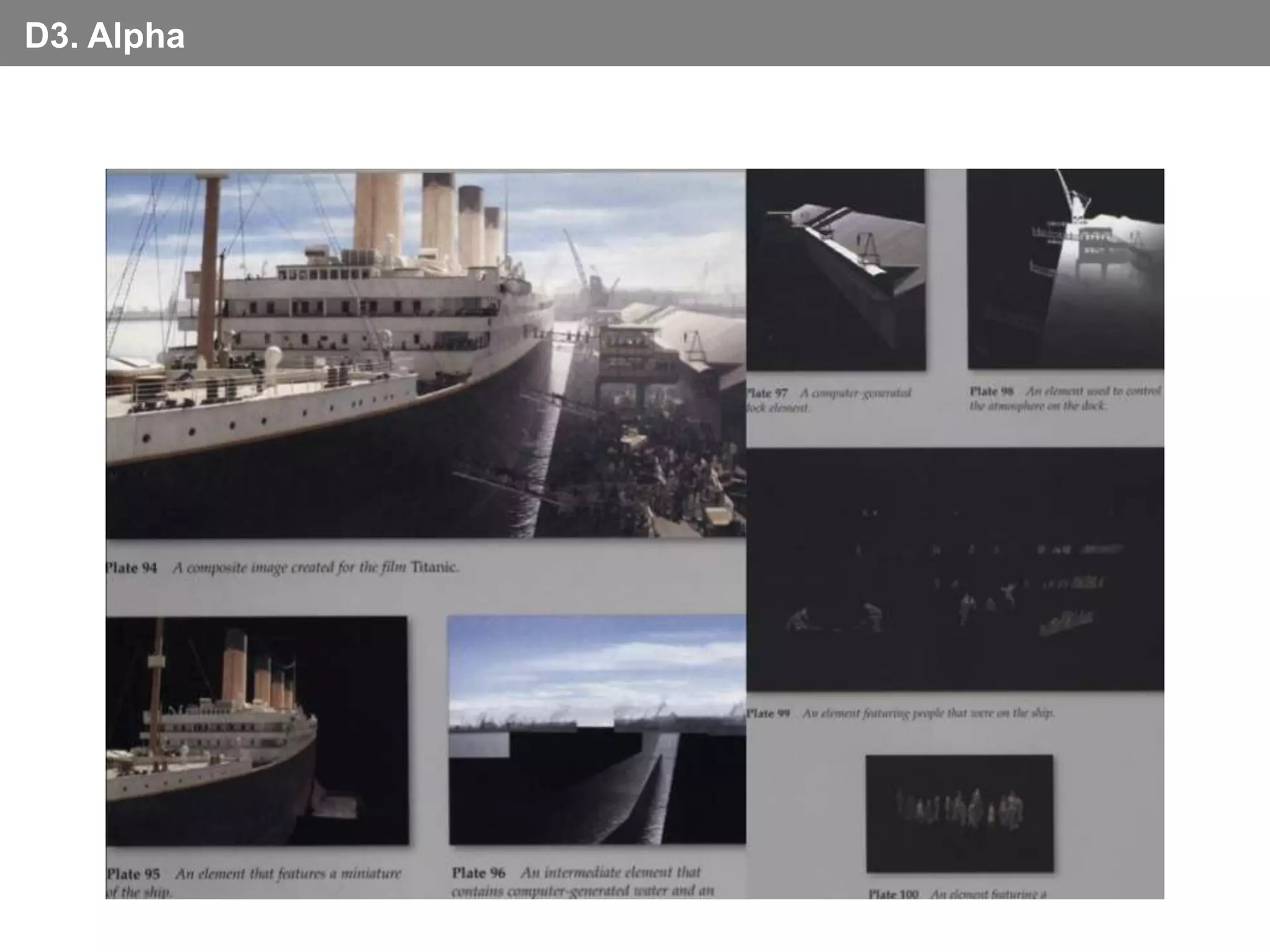
D3. Alpha
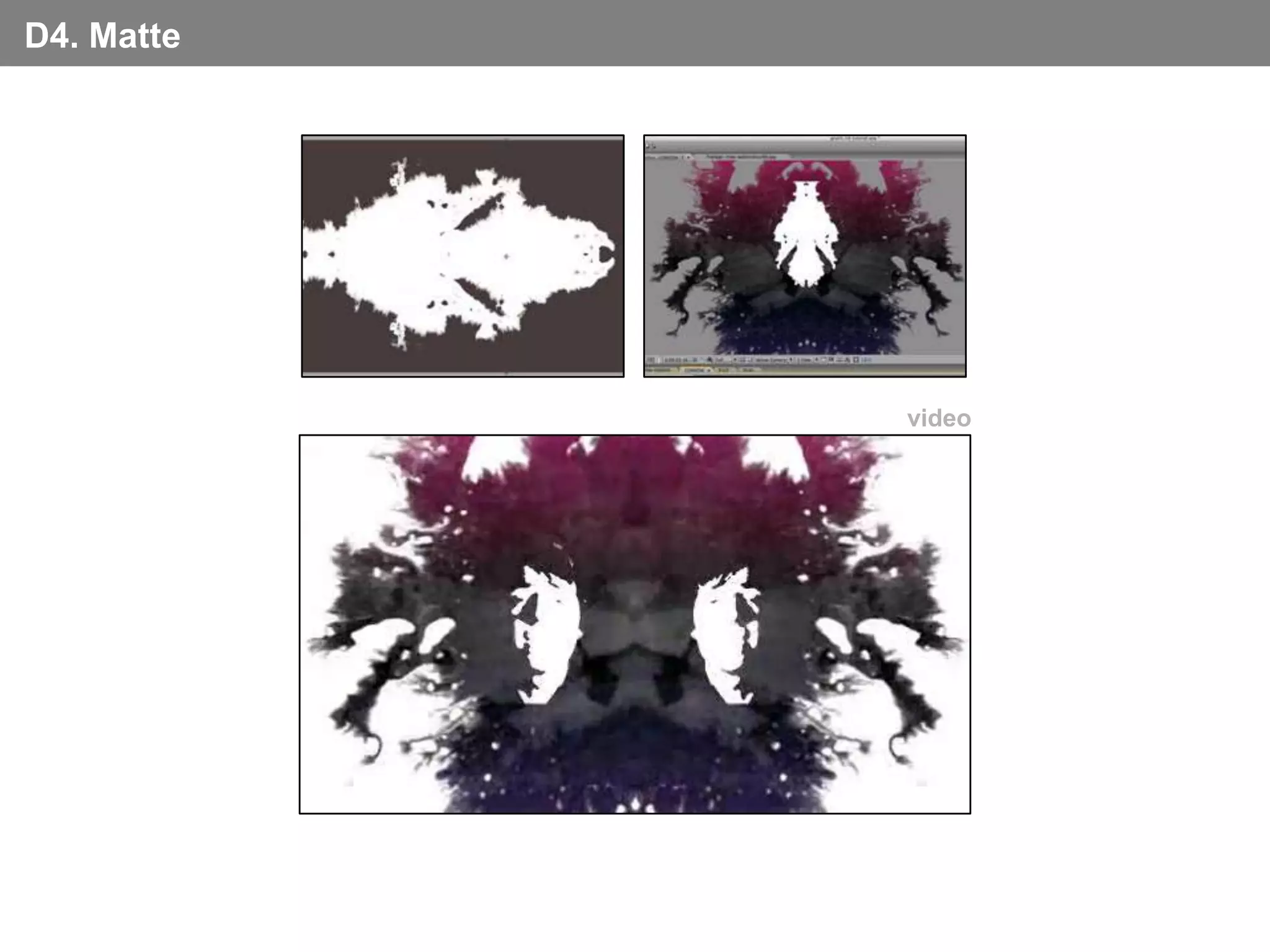
D4. Matte

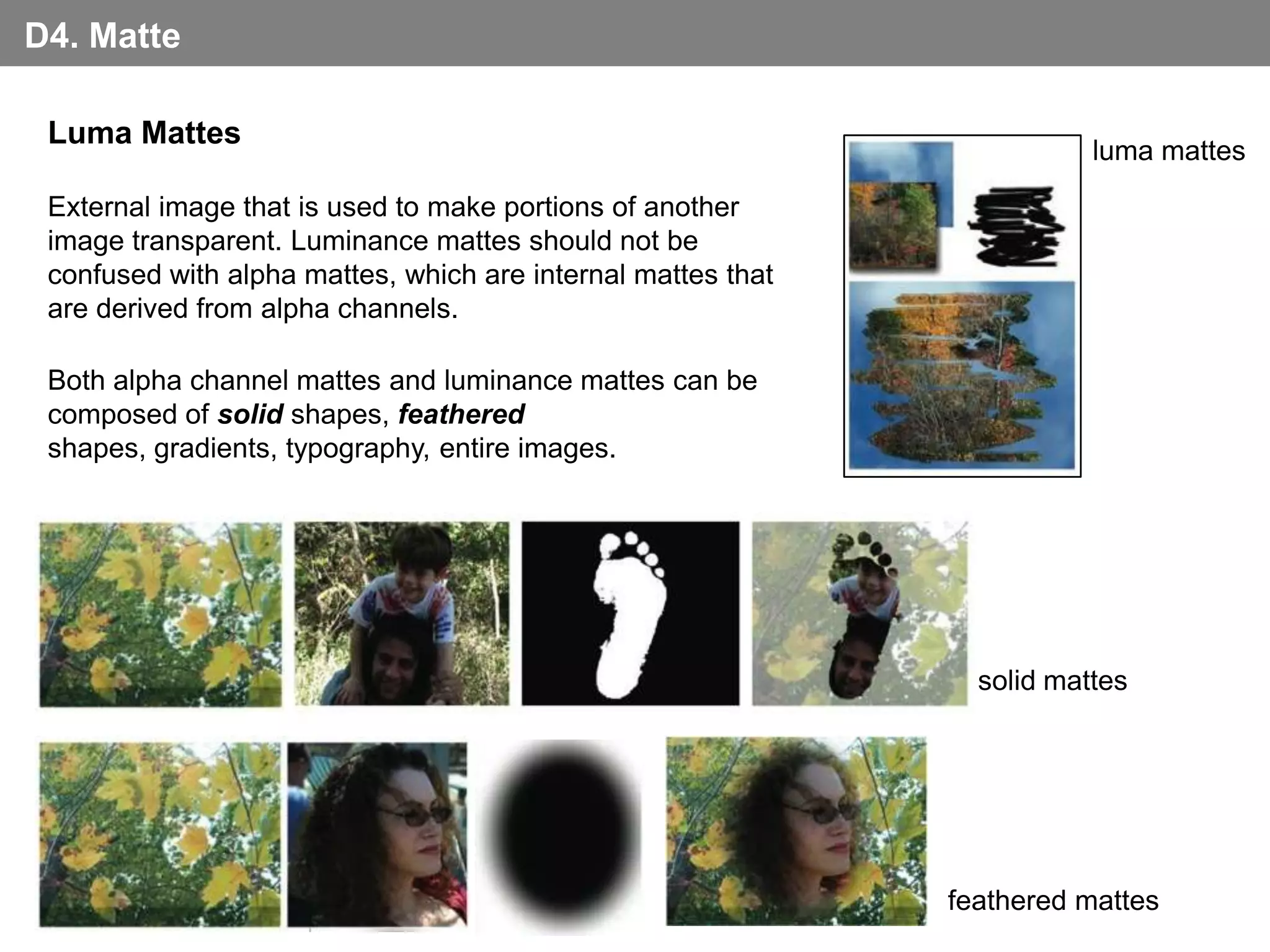
 Luma Mattes
                                                                         luma mattes
 External image that is used to make portions of another
 image transparent. Luminance mattes should not be
 confused with alpha mattes, which are internal mattes that
 are derived from alpha channels.

 Both alpha channel mattes and luminance mattes can be
 composed of solid shapes, feathered
 shapes, gradients, typography, entire images.


                                                                solid mattes


                                                              feathered mattes
D4. Matte


            video
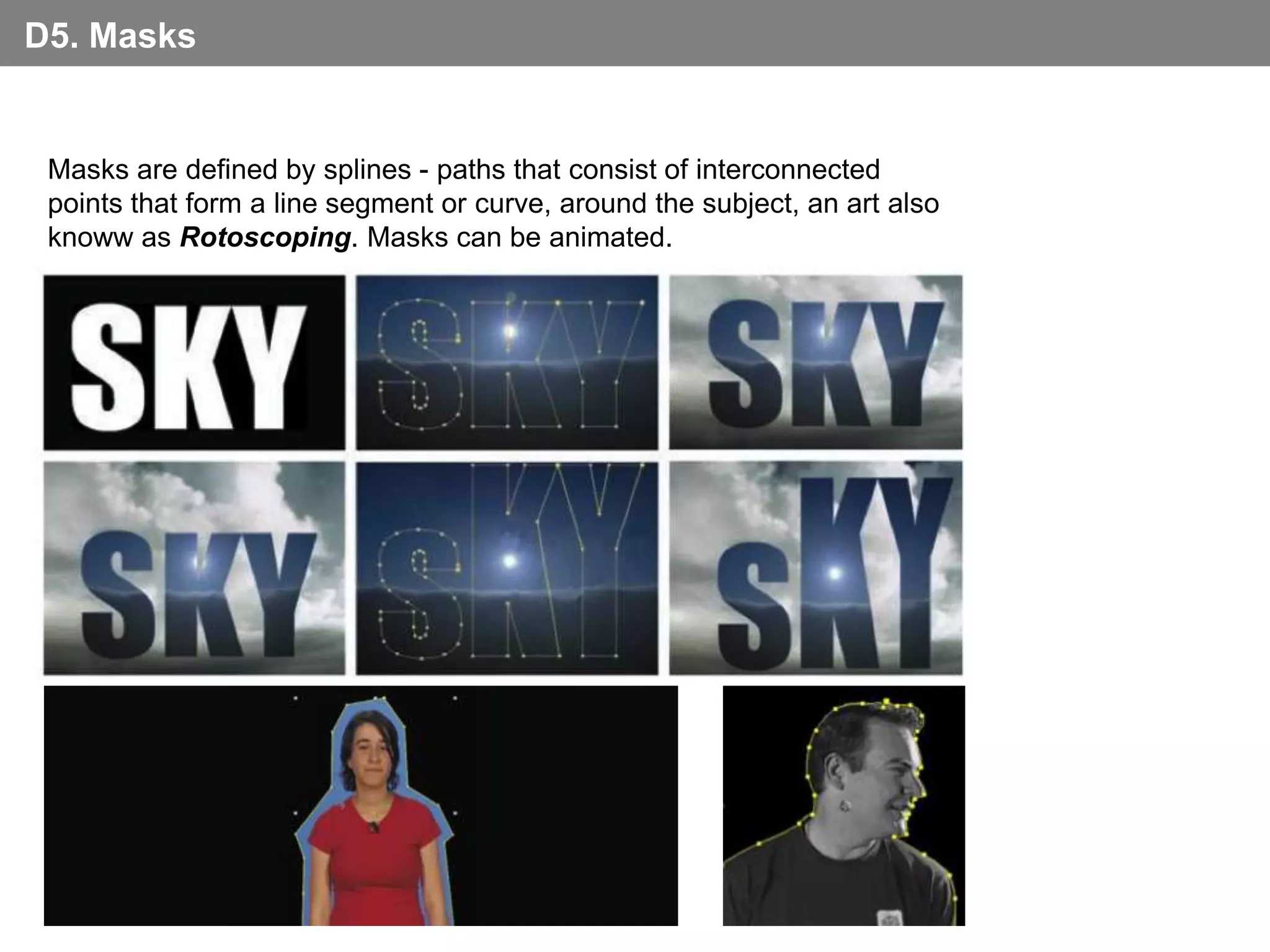
D5. Masks


 Masks are defined by splines - paths that consist of interconnected
 points that form a line segment or curve, around the subject, an art also
 knoww as Rotoscoping. Masks can be animated.
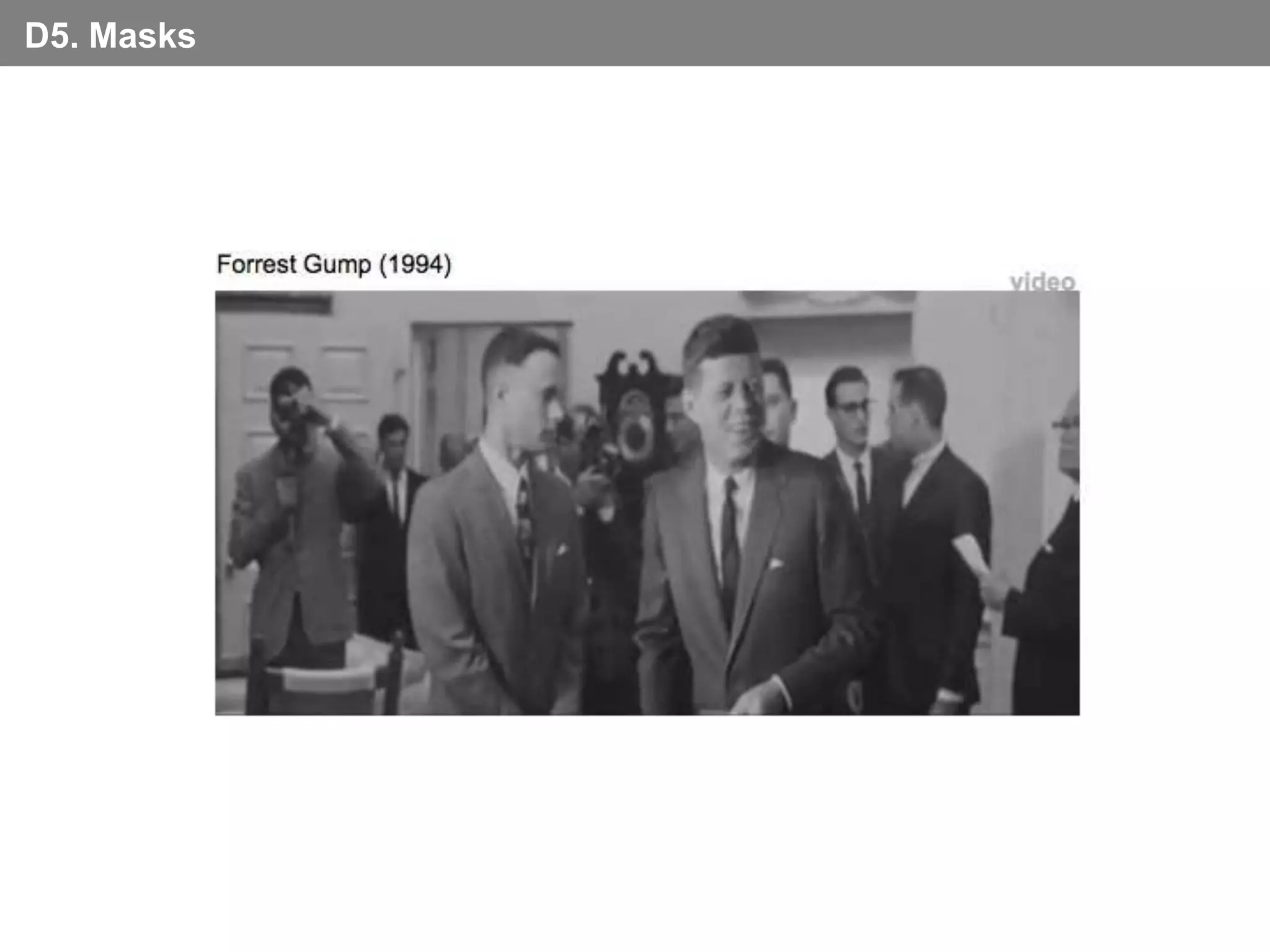
D5. Masks


            Forrest Gump (1994)
                                  video
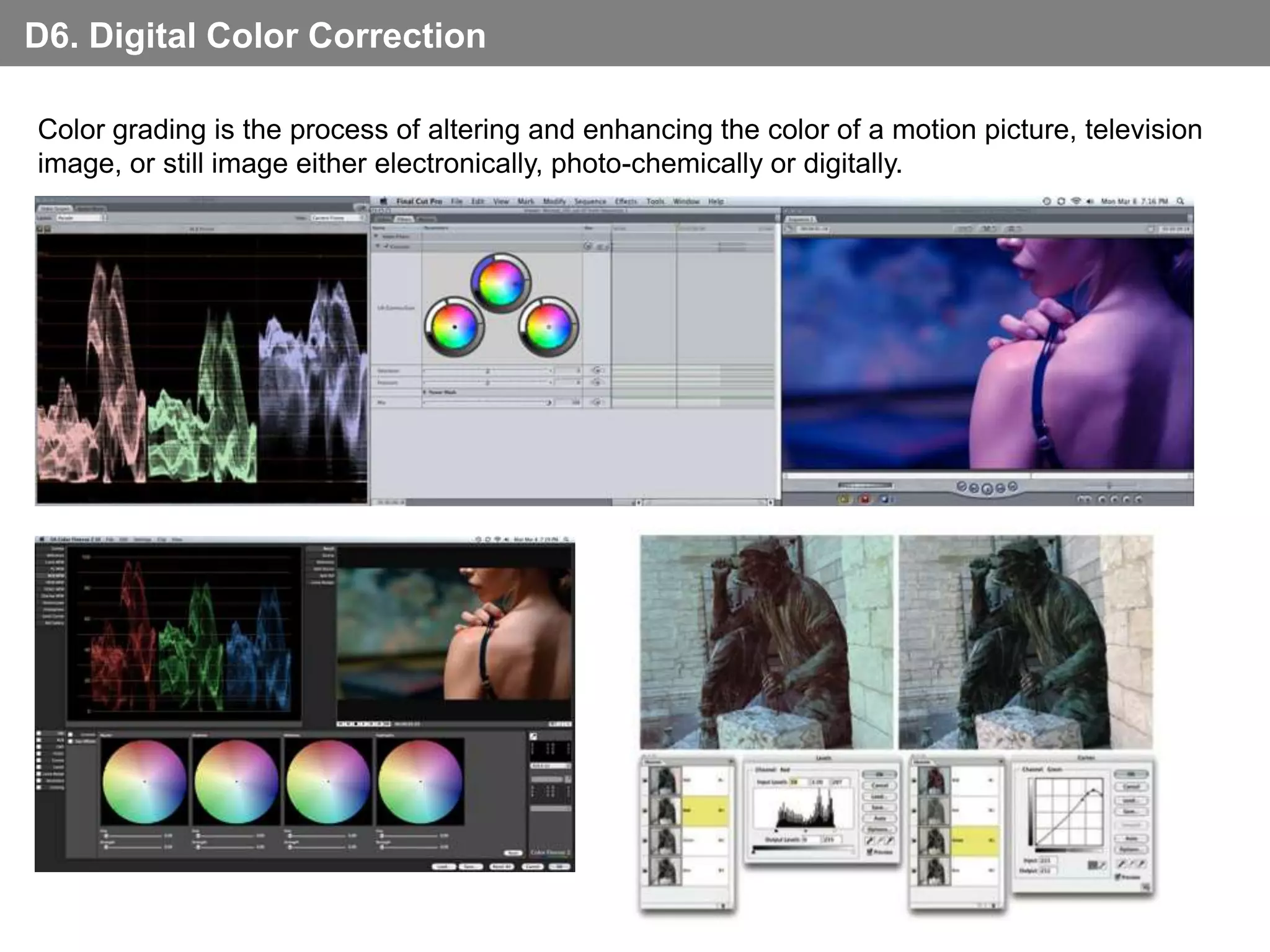
D6. Digital Color Correction

Color grading is the process of altering and enhancing the color of a motion picture, television
image, or still image either electronically, photo-chemically or digitally.
D6. Color Correction
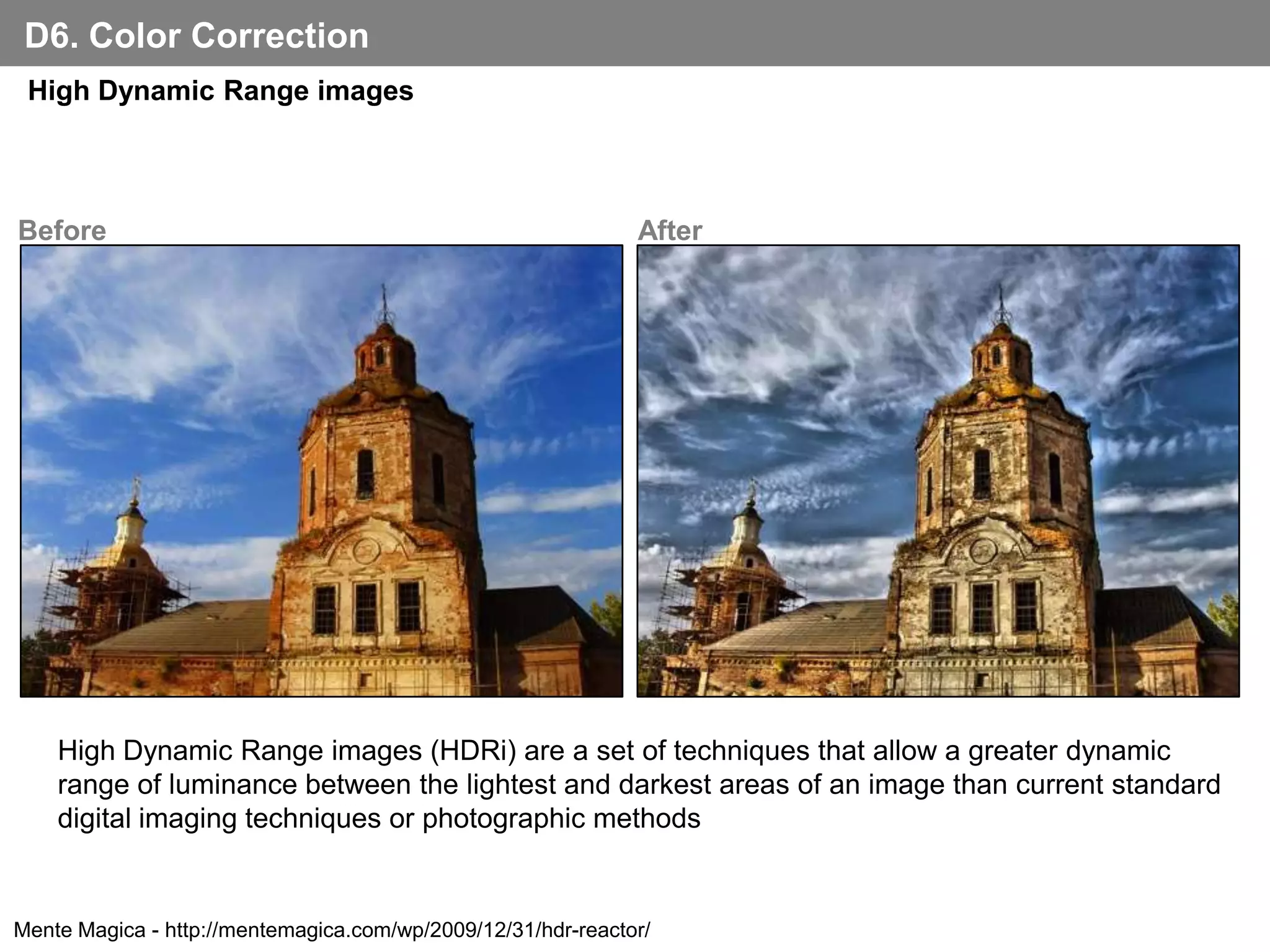
 High Dynamic Range images


Before                                                        After


    High Dynamic Range images (HDRi) are a set of techniques that allow a greater dynamic
    range of luminance between the lightest and darkest areas of an image than current standard
    digital imaging techniques or photographic methods


Mente Magica - http://mentemagica.com/wp/2009/12/31/hdr-reactor/
D7. Nesting and Parenting
Nesting – means building compositions and put them inside other compositions.


 nesting
D7. Nesting and Parenting
Parenting - permits the association or control of animation settings through different layers.
                                                                                                                 video


                             Parenting
          From “Animated type tutorial 3: anchor points and parenting”, by Gareth Smith, http://vimeo.com/22582326
Compositing techniques


    Film (analogical)
     1. Physical compositing
     2. Multiple exposure
     3. Rear projection
     4. Matting


    Digital
     1. Blend Operations
     2. Keying
     3. Alpha Channels
     4. Mattes
     5. Masks
     6. Nesting
     7. Color Correction

    3d Compositing
     8. Motion tracking and match moving
D8. Motion track and match moving

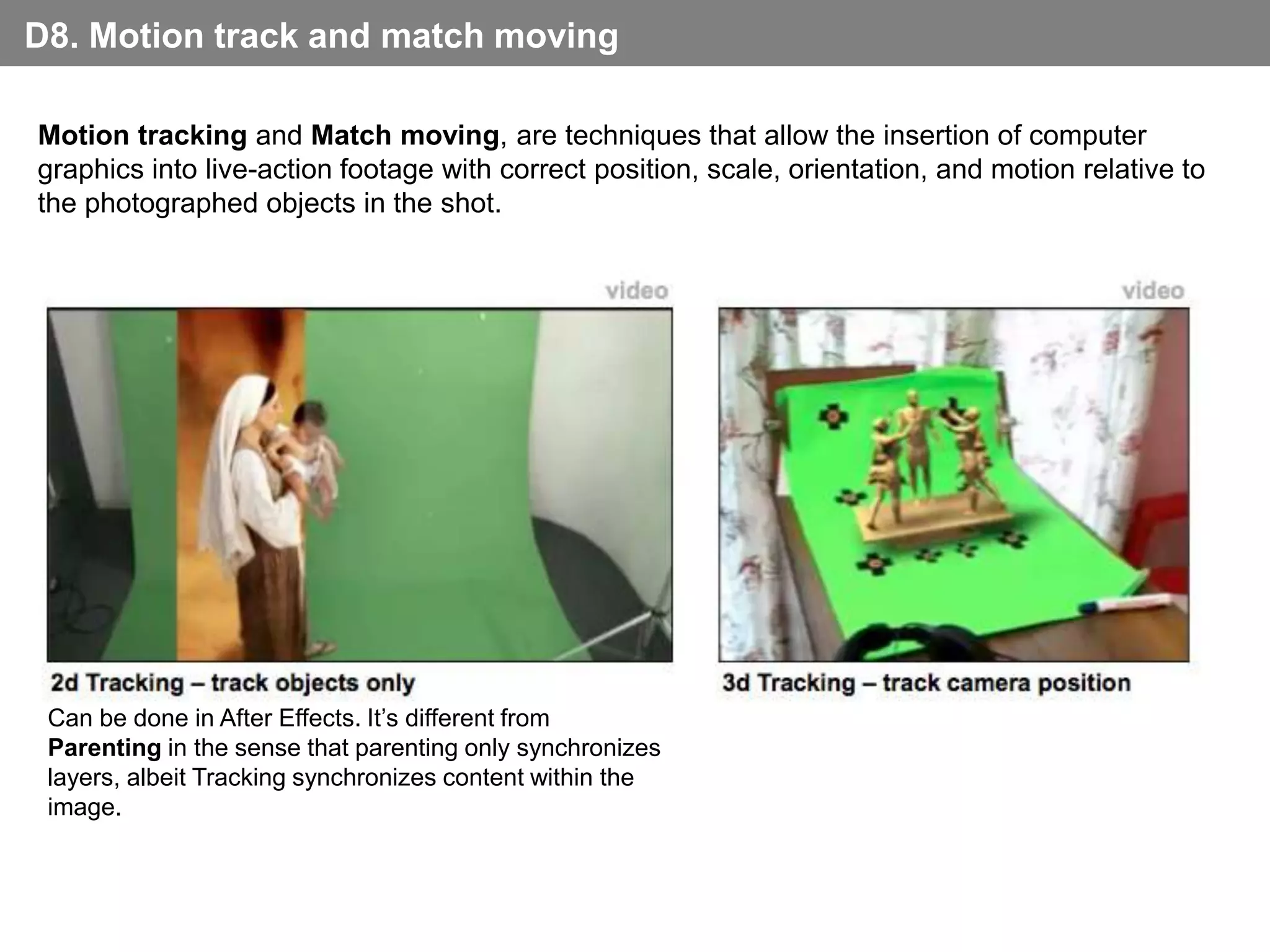
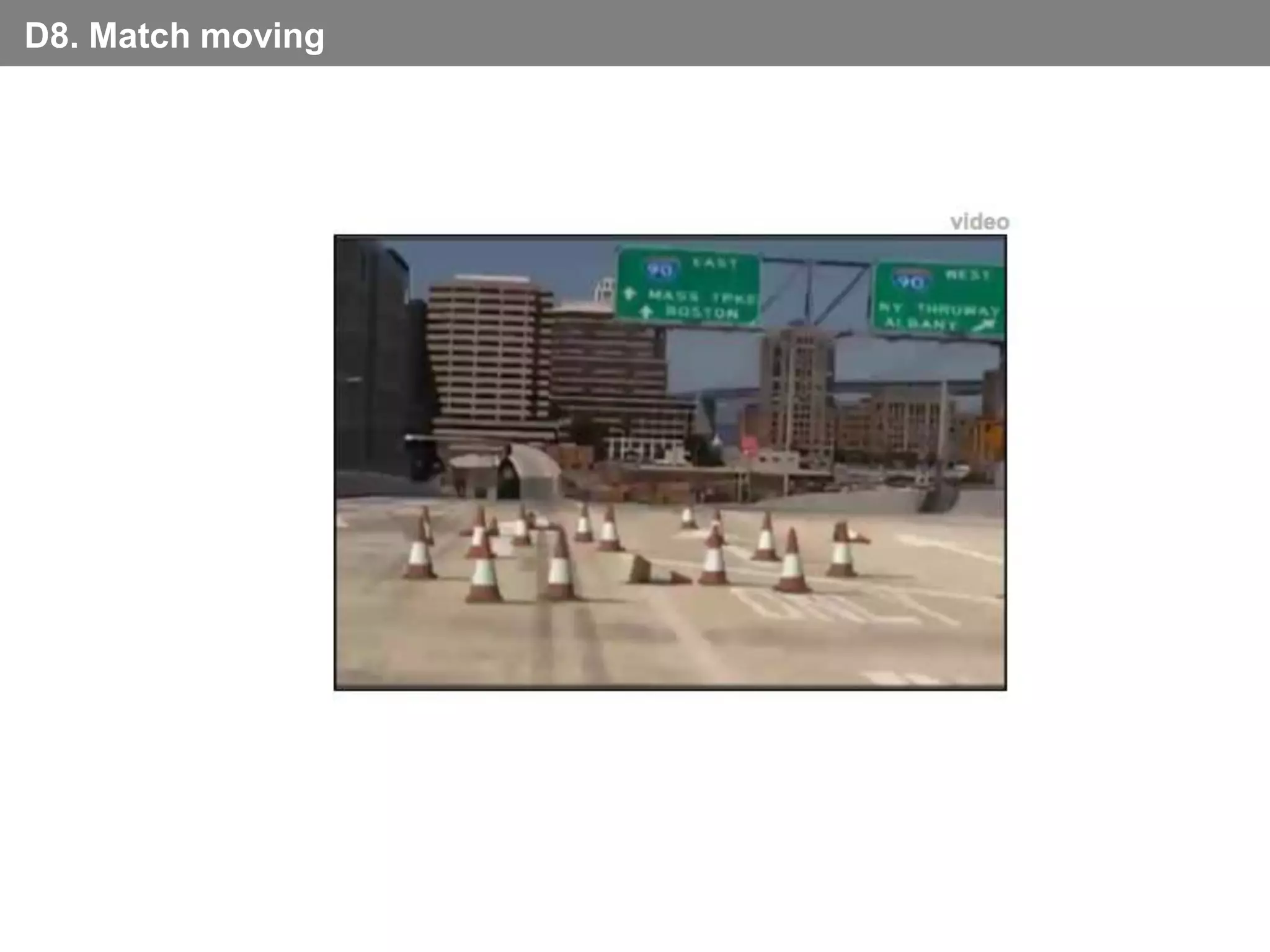
Motion tracking and Match moving, are techniques that allow the insertion of computer
graphics into live-action footage with correct position, scale, orientation, and motion relative to
the photographed objects in the shot.

                                                    video                                     video


 2d Tracking – track objects only                           3d Tracking – track camera position
 Can be done in After Effects. It’s different from
 Parenting in the sense that parenting only synchronizes
 layers, albeit Tracking synchronizes content within the
 image.
D8. Motion track and match moving


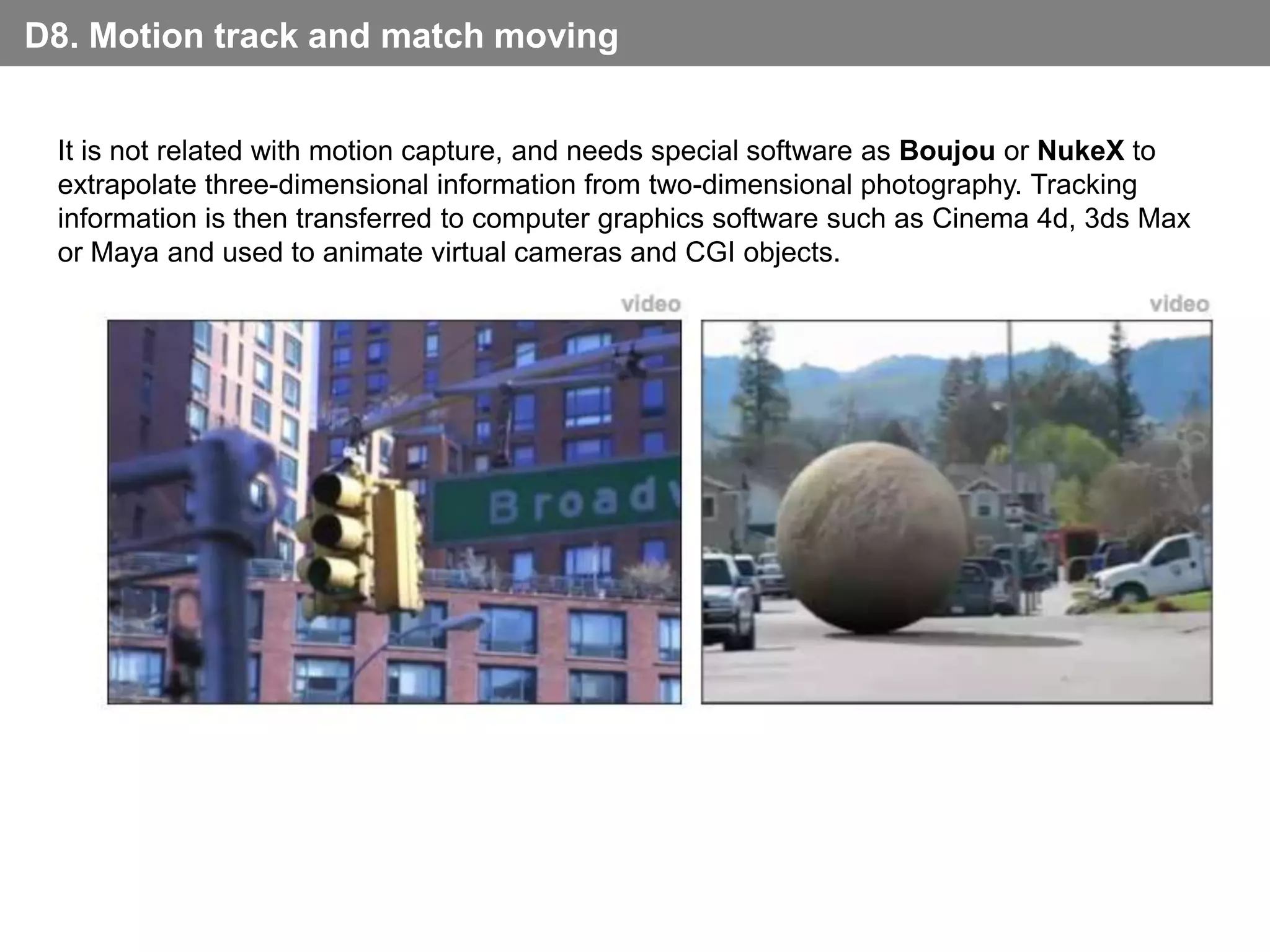
 It is not related with motion capture, and needs special software as Boujou or NukeX to
 extrapolate three-dimensional information from two-dimensional photography. Tracking
 information is then transferred to computer graphics software such as Cinema 4d, 3ds Max
 or Maya and used to animate virtual cameras and CGI objects.
                                          video                                        video
D8. Match moving


                   video
Compositing break down for "The Third & The Seventh", a short-film entirely modeled in 3d, which has gone
through intense compositing.
Bibliography

Ron Brinkman, Art & Science of Digital Compositing, Morgan Kaufmann, 2008
Richard Rickitt, Special Effects: The History and Technique, Billboard Books, 2007
Krasner, J., Motion Graphic Design: applied history and aesthetics, Elsevier, 2008


References

Leow Wee Kheng, Digital Compositing, CS5245 Vision and Graphics for Special Effects, National University of
Singapore, www.comp.nus.edu.sg/~cs5245/lecture/compositing.pdf

Matte Shot - a tribute to Golden Era special fx - http://nzpetesmatteshot.blogspot.com/2010/11/leigh-took-matte-
painter-portrait-of.html
Universidade do Minho


Compositing, composing worlds


Nelson Zagalo
nelsonzagalo.googlepages.com
engagelab.org

Compositing, Composing Worlds

  • 1.
    Universidade do Minho Compositing,composing worlds Nelson Zagalo, University of Minho, Portugal 13th May 2011, University of Maribor, Slovenia
  • 2.
  • 3.
    Film Compositing King Kong (1933) Superman (1978)
  • 4.
    Defining compositing What is it? Compositing is the combining of visual elements from separate sources into single images, often to create the illusion that all those elements are parts of the same scene. What do we use it for? . to create special effects in visual arts; . to help us connecting real images with artificially created ones; . to correct photographic mismatches (e.g. color); . to change or substitute backgrounds; . to change or substitute foregrounds; . to create illusion of depth.
  • 5.
    Compositing techniques Film (analogical) 1. Physical compositing 2. Multiple exposure 3. Rear projection 4. Matting Digital 1. Blend Operations 2. Keying 3. Alpha Channels 4. Mattes 5. Masks 6. Nesting 7. Color Correction 3d Compositing 8. Motion tracking and match moving
  • 6.
    F1. Physical -Glass, Statues, Paintings The Fiendish Plot of Dr. Fu Manchu (1980) Clash of the Titans (1981)
  • 7.
    F2. Multiple exposure Multiple exposure of Alfred Hitchcock directing during rehearsals for Shadow of a Doubt (1943). video L´Homme Orchestre, George Melies, 1900
  • 8.
    F3. Background projection North by Northwest, 1959 2001, Space Odyssey, 1968 Sunset Boulevard, 1950
  • 9.
    F4. Matting The Birds, 1963 video
  • 10.
    Compositing techniques Film (analogical) 1. Physical compositing 2. Multiple exposure 3. Rear projection 4. Matting Digital 1. Blend Operations 2. Keying 3. Alpha Channels 4. Mattes 5. Masks 6. Nesting 7. Color Correction 3d Compositing 8. Motion tracking and match moving
  • 11.
    Digital Advantages video Omaha beach scene “making of”, belonging to the BBC series “Timewatch: Bloody Omaha”. Created by Colin Thornton, Neil Wilson and Steven Flynn from Compost Creative. 3 persons + 4 days + 1 camera + pop up greenscreen + after effects
  • 12.
    D1. Blend Operations Multiply Screen Overlay Darken Lighten Difference Exclusion Luminosity
  • 13.
  • 14.
    D2. Keying AE: ColorKey, Edge Thin, Color Tolerance, Luma Key, Matte Choker Color Key Luma Key Edge Thin Color Tolerance Matte Choker
  • 15.
    D2. Keying The Chronicles of Narnia (2005) King Kong (2005)
  • 16.
    D2. Keying Preserve reflexes The Saint (1997)
  • 17.
    D3. Alpha 32-bit image carries a fourth Alpha channel that stores transparency (or alpha) data. The alpha channel’s 8-bit data is reserved to give an image or video clip shape and transparency when composited. Software as Photoshop creates content on transparent backgrounds retaining background transparency when imported into motion applications. This is because an alpha channel matte is automatically generated. Object on Alpha Channel Final composition transparency
  • 18.
  • 19.
    D4. Matte LumaMattes luma mattes External image that is used to make portions of another image transparent. Luminance mattes should not be confused with alpha mattes, which are internal mattes that are derived from alpha channels. Both alpha channel mattes and luminance mattes can be composed of solid shapes, feathered shapes, gradients, typography, entire images. solid mattes feathered mattes
  • 20.
  • 21.
    D5. Masks Masksare defined by splines - paths that consist of interconnected points that form a line segment or curve, around the subject, an art also knoww as Rotoscoping. Masks can be animated.
  • 22.
    D5. Masks Forrest Gump (1994) video
  • 23.
    D6. Digital ColorCorrection Color grading is the process of altering and enhancing the color of a motion picture, television image, or still image either electronically, photo-chemically or digitally.
  • 24.
    D6. Color Correction High Dynamic Range images Before After High Dynamic Range images (HDRi) are a set of techniques that allow a greater dynamic range of luminance between the lightest and darkest areas of an image than current standard digital imaging techniques or photographic methods Mente Magica - http://mentemagica.com/wp/2009/12/31/hdr-reactor/
  • 25.
    D7. Nesting andParenting Nesting – means building compositions and put them inside other compositions. nesting
  • 26.
    D7. Nesting andParenting Parenting - permits the association or control of animation settings through different layers. video Parenting From “Animated type tutorial 3: anchor points and parenting”, by Gareth Smith, http://vimeo.com/22582326
  • 27.
    Compositing techniques Film (analogical) 1. Physical compositing 2. Multiple exposure 3. Rear projection 4. Matting Digital 1. Blend Operations 2. Keying 3. Alpha Channels 4. Mattes 5. Masks 6. Nesting 7. Color Correction 3d Compositing 8. Motion tracking and match moving
  • 28.
    D8. Motion trackand match moving Motion tracking and Match moving, are techniques that allow the insertion of computer graphics into live-action footage with correct position, scale, orientation, and motion relative to the photographed objects in the shot. video video 2d Tracking – track objects only 3d Tracking – track camera position Can be done in After Effects. It’s different from Parenting in the sense that parenting only synchronizes layers, albeit Tracking synchronizes content within the image.
  • 29.
    D8. Motion trackand match moving It is not related with motion capture, and needs special software as Boujou or NukeX to extrapolate three-dimensional information from two-dimensional photography. Tracking information is then transferred to computer graphics software such as Cinema 4d, 3ds Max or Maya and used to animate virtual cameras and CGI objects. video video
  • 30.
  • 31.
    Compositing break downfor "The Third & The Seventh", a short-film entirely modeled in 3d, which has gone through intense compositing.
  • 32.
    Bibliography Ron Brinkman, Art& Science of Digital Compositing, Morgan Kaufmann, 2008 Richard Rickitt, Special Effects: The History and Technique, Billboard Books, 2007 Krasner, J., Motion Graphic Design: applied history and aesthetics, Elsevier, 2008 References Leow Wee Kheng, Digital Compositing, CS5245 Vision and Graphics for Special Effects, National University of Singapore, www.comp.nus.edu.sg/~cs5245/lecture/compositing.pdf Matte Shot - a tribute to Golden Era special fx - http://nzpetesmatteshot.blogspot.com/2010/11/leigh-took-matte- painter-portrait-of.html
  • 33.
    Universidade do Minho Compositing,composing worlds Nelson Zagalo nelsonzagalo.googlepages.com engagelab.org