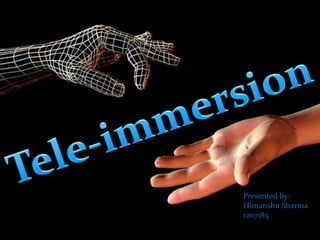
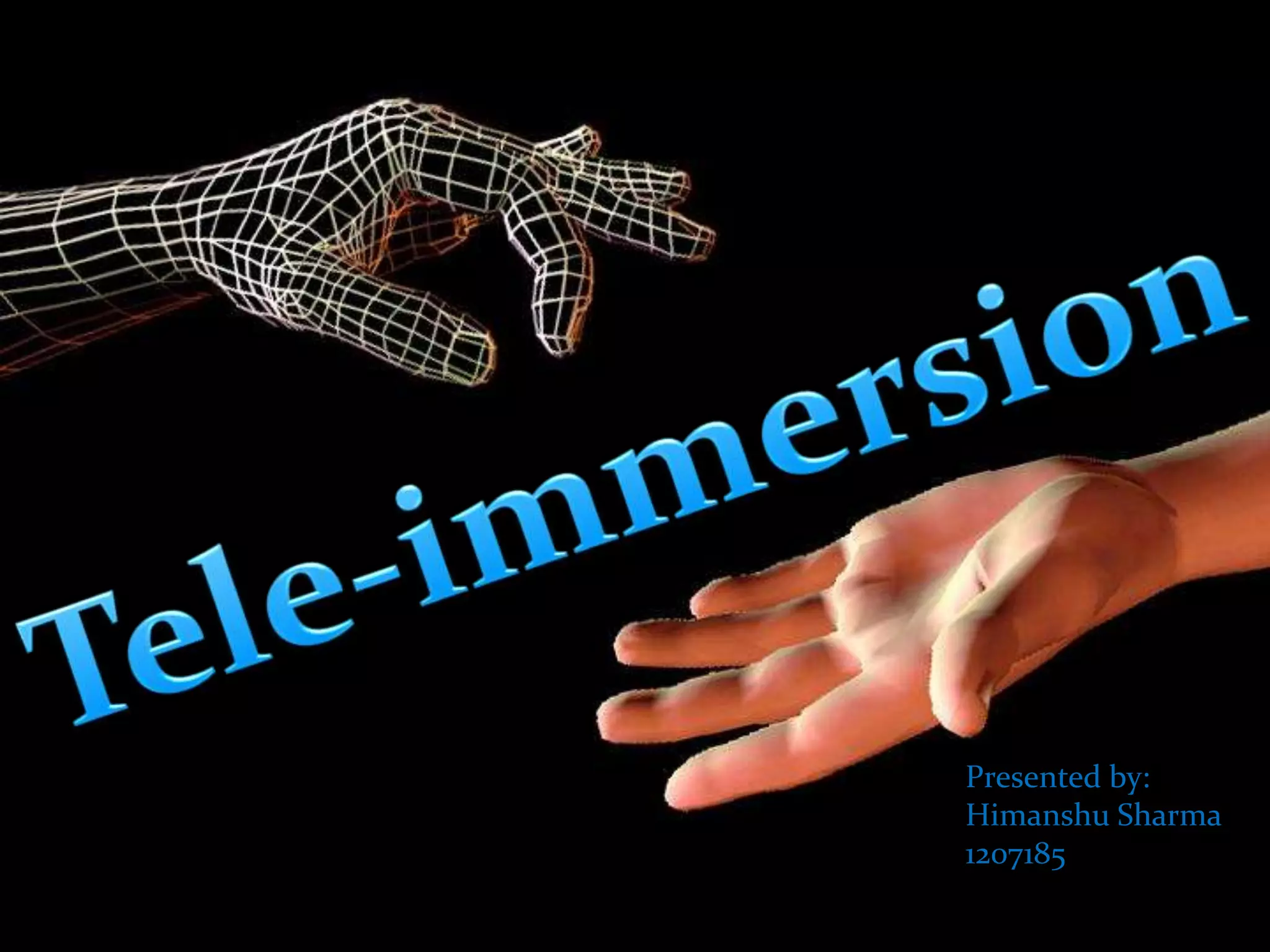
Tele-immersionPresented by:Himanshu Sharma1207185
ContentsIntroductionHistoryTele-conferencing vs. Tele-immersion WorkingApplicationsChallenges
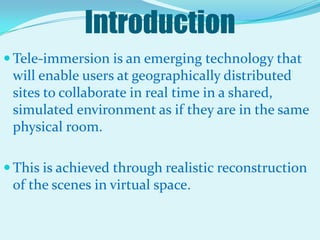
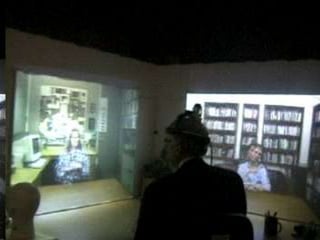
IntroductionTele-immersion is an emerging technology that will enable users at geographically distributed sites to collaborate in real time in a shared, simulated environment as if they are in the same physical room. This is achieved through realistic reconstruction of the scenes in virtual space.
HistoryThe idea of Tele-immersion was proposed by Jaron Lanier , the head of Advanced Networks  and Services in 1997. National Tele-Immersion Initiative (NTII) was formed to implement this.In May 2000, researchers at University of North Carolina (UNC), the University of Pennsylvania  and Advanced Networks and Services developed this technology.A user sitting in office at UNC was able to see lifelike 3D images of his colleagues hundreds of mile away.
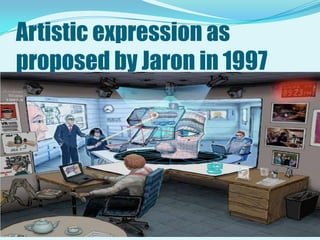
Artistic expression as proposed by Jaron in 1997
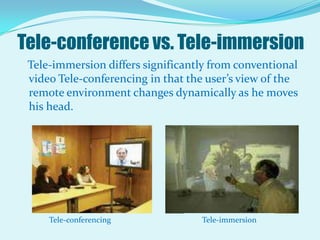
Tele-conference vs. Tele-immersion   Tele-immersion differs significantly from conventional video Tele-conferencing in that the user’s view of the remote environment changes dynamically as he moves his head.Tele-conferencingTele-immersion
WORKING
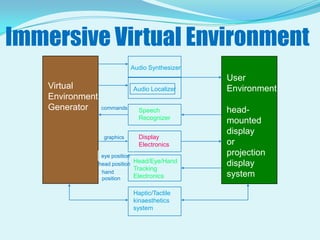
Immersive Virtual EnvironmentAudio SynthesizerUserEnvironmenthead-mounteddisplay orprojectiondisplaysystemVirtualEnvironmentGeneratorAudio LocalizercommandsSpeechRecognizerDisplayElectronicsgraphicseye positionHead/Eye/HandTrackingElectronicshead positionhand positionHaptic/Tactilekinaestheticssystem
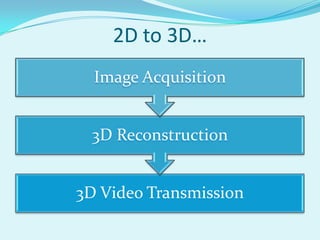
2D to 3D…
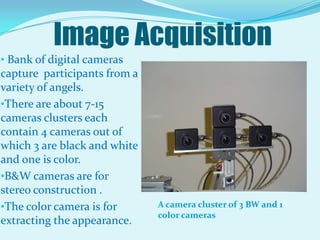
Image Acquisition Bank of digital cameras       capture  participants from a variety of angels.
There are about 7-15 cameras clusters each contain 4 cameras out of which 3 are black and white and one is color.
B&W cameras are for stereo construction .
The color camera is for extracting the appearance. A camera cluster of 3 BW and 1 color cameras
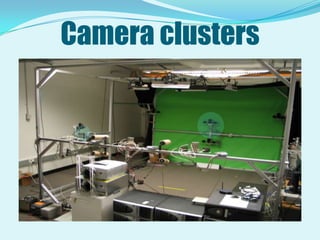
Camera clusters
Each camera is synchronized to other camera.Each camera is connected to workstation.
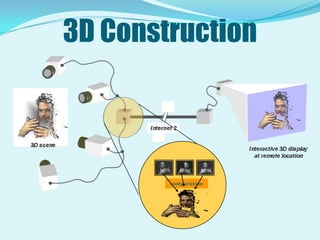
3D Constructioncomputation
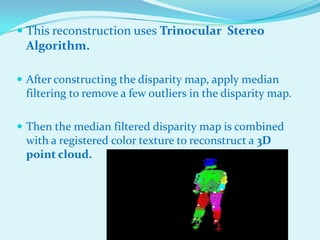
This reconstruction uses Trinocular  Stereo Algorithm. After constructing the disparity map, apply median filtering to remove a few outliers in the disparity map.Then the median filtered disparity map is combined with a registered color texture to reconstruct a 3D point cloud.
3D Video Transmission 3D data is transmitted in compressed form using Modern Driven compression algorithm.System which generates 640x480 pixel depth color maps from 10 camera clusters in a rate of 15 frames per second (fps), requires 220 mbps bandwidth.Around 1.2 gbps is necessary for high quality effect.
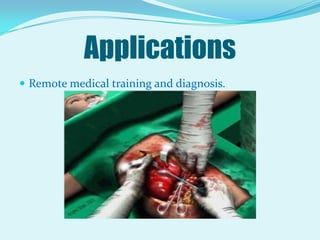
ApplicationsRemote medical training and diagnosis.
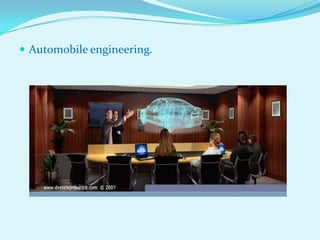
Automobile engineering.

Tele immersion

  • 1.
  • 2.
  • 3.
    IntroductionTele-immersion is anemerging technology that will enable users at geographically distributed sites to collaborate in real time in a shared, simulated environment as if they are in the same physical room. This is achieved through realistic reconstruction of the scenes in virtual space.
  • 5.
    HistoryThe idea ofTele-immersion was proposed by Jaron Lanier , the head of Advanced Networks and Services in 1997. National Tele-Immersion Initiative (NTII) was formed to implement this.In May 2000, researchers at University of North Carolina (UNC), the University of Pennsylvania and Advanced Networks and Services developed this technology.A user sitting in office at UNC was able to see lifelike 3D images of his colleagues hundreds of mile away.
  • 6.
    Artistic expression asproposed by Jaron in 1997
  • 7.
    Tele-conference vs. Tele-immersion Tele-immersion differs significantly from conventional video Tele-conferencing in that the user’s view of the remote environment changes dynamically as he moves his head.Tele-conferencingTele-immersion
  • 8.
  • 9.
    Immersive Virtual EnvironmentAudioSynthesizerUserEnvironmenthead-mounteddisplay orprojectiondisplaysystemVirtualEnvironmentGeneratorAudio LocalizercommandsSpeechRecognizerDisplayElectronicsgraphicseye positionHead/Eye/HandTrackingElectronicshead positionhand positionHaptic/Tactilekinaestheticssystem
  • 10.
  • 11.
    Image Acquisition Bankof digital cameras capture participants from a variety of angels.
  • 12.
    There are about7-15 cameras clusters each contain 4 cameras out of which 3 are black and white and one is color.
  • 13.
    B&W cameras arefor stereo construction .
  • 14.
    The color camerais for extracting the appearance. A camera cluster of 3 BW and 1 color cameras
  • 15.
  • 16.
    Each camera issynchronized to other camera.Each camera is connected to workstation.
  • 17.
  • 18.
    This reconstruction usesTrinocular Stereo Algorithm. After constructing the disparity map, apply median filtering to remove a few outliers in the disparity map.Then the median filtered disparity map is combined with a registered color texture to reconstruct a 3D point cloud.
  • 19.
    3D Video Transmission3D data is transmitted in compressed form using Modern Driven compression algorithm.System which generates 640x480 pixel depth color maps from 10 camera clusters in a rate of 15 frames per second (fps), requires 220 mbps bandwidth.Around 1.2 gbps is necessary for high quality effect.
  • 20.
  • 21.
  • 22.
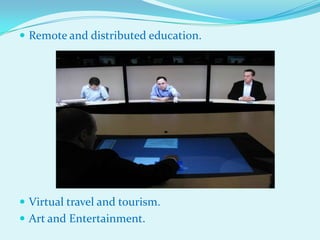
    Remote and distributededucation.Virtual travel and tourism.Art and Entertainment.
  • 23.
    ChallengesQuality of transmittingmultimedia and Tele-immersion data streams over the internet is affected by high packets loss rates.ExpensiveHigh bandwidth requirement.
  • 24.