MIT-WPU
School Of
Education
Course-E-
content
Development
Topic- Animation
Tools
Presented By- Bharati Saikrupa
Ph.D Student
OBJECTIVES :
After the completion of this topic, you will be able to
● Understand the origin of Animation
● Meaning of Animation
● Types of Animation
● Animation Tools
● Significance of using Animation in e content prepartion
Origin of Animation : EARLY WAYS OF SHOWING MOTION
30,000 B.C -SHAHR-E SUKHTEH
A bronze-age pottery bowl depicts goats leaping.
1500 A.D.-VITRUVIAN MAN
Leonardo da Vinci’s Vitruvian Man
drawing shows multiple angles,
implying movement.
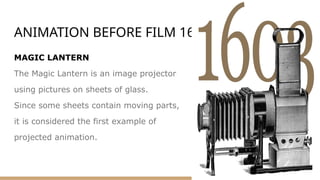
ANIMATION BEFORE FILM 1600-1877
MAGIC LANTERN
The Magic Lantern is an image projector
using pictures on sheets of glass.
Since some sheets contain moving parts,
it is considered the first example of
projected animation.
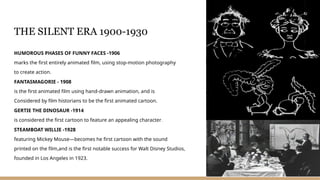
THE SILENT ERA 1900-1930
HUMOROUS PHASES OF FUNNY FACES -1906
marks the first entirely animated film, using stop-motion photography
to create action.
FANTASMAGORIE - 1908
is the first animated film using hand-drawn animation, and is
Considered by film historians to be the first animated cartoon.
GERTIE THE DINOSAUR -1914
is considered the first cartoon to feature an appealing character.
STEAMBOAT WILLIE -1928
featuring Mickey Mouse—becomes he first cartoon with the sound
printed on the film,and is the first notable success for Walt Disney Studios,
founded in Los Angeles in 1923.
Meaning of Animation
The technique of creating the illusion of motion by displaying a series of images or frames in rapid
succession.
It involves bringing static elements to life, capturing movement and conveying a story or message.
The simulation of movement created by a series of pictures is animation.
Animation is a method of photographing successive drawings, models, or even puppets, to create
an illusion of movement in a sequence. Our eyes can only retain an image for approximately 1/10
of a second, when multiple images appear in fast succession, the brain blends them into a single
moving image.
In traditional animation, pictures are drawn or painted on transparent celluloid sheets
to be photographed. Early cartoons are examples of this, but today, most animated
movies are made with computer-generated imagery or CGI. To create the appearance of
smooth motion from these drawn, painted, or computer-generated images, frame rate,
or the number of consecutive images that are displayed each second, is considered.
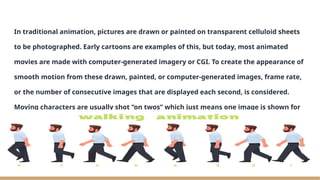
Moving characters are usually shot “on twos” which just means one image is shown for
two frames, totaling in at 12 drawings per second. 12 frames per second allows for
motion but may look choppy. In the film, a frame rate of 24 frames per second is often
used for smooth motion.
Different Types of Animations
● Traditional Animation : Hand-drawn frame-by-frame animation, where each
frame is created by hand, exemplified by classic Disney animations like "The Lion
King."
● Rotoscoping : A technique where animators trace over live-action footage frame
by frame, producing realistic movement, as seen in the film "A Scanner Darkly."
● Anime : A style of animation originating from Japan, characterized by colorful
artwork, vibrant characters, and fantastical themes, as seen in the series
"Naruto."
● Cutout : An animation style using 2D characters or objects cut from paper
or other materials and manipulated to create movement, often seen in
educational videos.
● 3D Animation : Computer-generated animation that creates a three-
dimensional effect, widely used in films like "Toy Story" and "Avatar."
● Stop Motion : An animation technique where physical objects are
manipulated frame by frame to create movement, showcased in films like
"Wallace and Gromit."
● Motion graphics : Animated graphic design elements used in multimedia
productions, such as title sequences in films .
Animation Tools
1.Adobe Animate:
● A versatile tool for creating 2D animations, interactive content, and vector graphics.
● Features: Supports frame-by-frame animation, tweening, and integration with other Adobe
Creative Cloud apps.
● Use Case: Ideal for creating traditional 2D animations and interactive web content.
2.Toon Boom Harmony:
● A professional animation software widely used in the industry for 2D animation and vector-
based graphics.
● Features: Offers advanced rigging, frame-by-frame animation, and seamless integration with
other animation pipelines.
● Use Case: Popular in the production of television series, films, and web animations.
3.Blender:
● A free and open-source 3D creation suite that includes tools for modeling, sculpting, and
animation.
● Features: Powerful 3D animation capabilities, including rigging, keyframing, and a built-in
game engine.
● Use Case: Suitable for 3D animation projects, from character animations to architectural
visualization.
4.Autodesk Maya:
● A widely used 3D animation and modeling software in the entertainment industry.
● Features: Robust tools for character animation, dynamics, and rendering.
● Use Case: Commonly used in film, television, and game development for creating realistic 3D
animations.
5.Dragonframe:
● Stop-motion animation software designed specifically for capturing and editing stop-motion
sequences.
● Features: Onion skinning, time-lapse photography, and integrated camera controls for precise
stop-motion animation.
● Use Case: Essential for stop-motion projects, such as commercials, films, and short
animations.
6.Powtoon:
● Description: A user-friendly online platform for creating animated presentations and explainer
videos.
● Features: Pre-designed templates, drag-and-drop interface, and simple character animations.
● Use Case: Suitable for educational presentations, business pitches, and marketing content.
7.After Effects:
● A motion graphics and visual effects software used for creating dynamic animations and
video compositions.
● Features: Keyframing, effects, and integration with Adobe Creative Cloud apps.
● Use Case: Widely used for adding motion graphics and effects to video projects,
including intros and title sequences.
8.Pencil2D:
● An open-source, cross-platform animation software for creating 2D hand-drawn
animations.
● Features: Simple interface, bitmap and vector drawing tools, and basic animation
features.
● Use Case: Suitable for beginners and hobbyists interested in creating traditional 2D
animations.
Significance :
1.Animation reduces cognitive load by presenting information in a visually
engaging manner.
Example: Animated diagrams illustrating complex concepts in physics.
2.Animated characters and stories evoke emotions, enhancing learning and
retention.
Example: Animated characters explaining historical events to create an emotional connection.
3.Animation attracts attention to key information, improving focus.
Example: Animated highlights in e-content to emphasize crucial points.
4.Animation fosters interactive learning, allowing students to explore
concepts actively.
Example: Simulations and interactive scenarios in educational animations.
References :
1. https://history-of-animation-3dd00d.webflow.io/
2. https://www.studiobinder.com/blog/what-is-animation-definition/
3. https://www.wyzowl.com/types-of-animation/#:~:text=Frame%20by%20r
otoscope%20animation%20is%20like%20traditional,realistic%20look%20
while%20still%20maintaining%20the%20qualities

Animation Tools M.Ed (E -Content Development).pptx

  • 1.
  • 2.
    OBJECTIVES : After thecompletion of this topic, you will be able to ● Understand the origin of Animation ● Meaning of Animation ● Types of Animation ● Animation Tools ● Significance of using Animation in e content prepartion
  • 3.
    Origin of Animation: EARLY WAYS OF SHOWING MOTION 30,000 B.C -SHAHR-E SUKHTEH A bronze-age pottery bowl depicts goats leaping. 1500 A.D.-VITRUVIAN MAN Leonardo da Vinci’s Vitruvian Man drawing shows multiple angles, implying movement.
  • 4.
    ANIMATION BEFORE FILM1600-1877 MAGIC LANTERN The Magic Lantern is an image projector using pictures on sheets of glass. Since some sheets contain moving parts, it is considered the first example of projected animation.
  • 5.
    THE SILENT ERA1900-1930 HUMOROUS PHASES OF FUNNY FACES -1906 marks the first entirely animated film, using stop-motion photography to create action. FANTASMAGORIE - 1908 is the first animated film using hand-drawn animation, and is Considered by film historians to be the first animated cartoon. GERTIE THE DINOSAUR -1914 is considered the first cartoon to feature an appealing character. STEAMBOAT WILLIE -1928 featuring Mickey Mouse—becomes he first cartoon with the sound printed on the film,and is the first notable success for Walt Disney Studios, founded in Los Angeles in 1923.
  • 7.
    Meaning of Animation Thetechnique of creating the illusion of motion by displaying a series of images or frames in rapid succession. It involves bringing static elements to life, capturing movement and conveying a story or message. The simulation of movement created by a series of pictures is animation. Animation is a method of photographing successive drawings, models, or even puppets, to create an illusion of movement in a sequence. Our eyes can only retain an image for approximately 1/10 of a second, when multiple images appear in fast succession, the brain blends them into a single moving image.
  • 8.
    In traditional animation,pictures are drawn or painted on transparent celluloid sheets to be photographed. Early cartoons are examples of this, but today, most animated movies are made with computer-generated imagery or CGI. To create the appearance of smooth motion from these drawn, painted, or computer-generated images, frame rate, or the number of consecutive images that are displayed each second, is considered. Moving characters are usually shot “on twos” which just means one image is shown for two frames, totaling in at 12 drawings per second. 12 frames per second allows for motion but may look choppy. In the film, a frame rate of 24 frames per second is often used for smooth motion.
  • 9.
    Different Types ofAnimations ● Traditional Animation : Hand-drawn frame-by-frame animation, where each frame is created by hand, exemplified by classic Disney animations like "The Lion King." ● Rotoscoping : A technique where animators trace over live-action footage frame by frame, producing realistic movement, as seen in the film "A Scanner Darkly." ● Anime : A style of animation originating from Japan, characterized by colorful artwork, vibrant characters, and fantastical themes, as seen in the series "Naruto."
  • 10.
    ● Cutout :An animation style using 2D characters or objects cut from paper or other materials and manipulated to create movement, often seen in educational videos. ● 3D Animation : Computer-generated animation that creates a three- dimensional effect, widely used in films like "Toy Story" and "Avatar." ● Stop Motion : An animation technique where physical objects are manipulated frame by frame to create movement, showcased in films like "Wallace and Gromit." ● Motion graphics : Animated graphic design elements used in multimedia productions, such as title sequences in films .
  • 11.
    Animation Tools 1.Adobe Animate: ●A versatile tool for creating 2D animations, interactive content, and vector graphics. ● Features: Supports frame-by-frame animation, tweening, and integration with other Adobe Creative Cloud apps. ● Use Case: Ideal for creating traditional 2D animations and interactive web content. 2.Toon Boom Harmony: ● A professional animation software widely used in the industry for 2D animation and vector- based graphics. ● Features: Offers advanced rigging, frame-by-frame animation, and seamless integration with other animation pipelines. ● Use Case: Popular in the production of television series, films, and web animations.
  • 12.
    3.Blender: ● A freeand open-source 3D creation suite that includes tools for modeling, sculpting, and animation. ● Features: Powerful 3D animation capabilities, including rigging, keyframing, and a built-in game engine. ● Use Case: Suitable for 3D animation projects, from character animations to architectural visualization. 4.Autodesk Maya: ● A widely used 3D animation and modeling software in the entertainment industry. ● Features: Robust tools for character animation, dynamics, and rendering. ● Use Case: Commonly used in film, television, and game development for creating realistic 3D animations.
  • 13.
    5.Dragonframe: ● Stop-motion animationsoftware designed specifically for capturing and editing stop-motion sequences. ● Features: Onion skinning, time-lapse photography, and integrated camera controls for precise stop-motion animation. ● Use Case: Essential for stop-motion projects, such as commercials, films, and short animations. 6.Powtoon: ● Description: A user-friendly online platform for creating animated presentations and explainer videos. ● Features: Pre-designed templates, drag-and-drop interface, and simple character animations. ● Use Case: Suitable for educational presentations, business pitches, and marketing content.
  • 14.
    7.After Effects: ● Amotion graphics and visual effects software used for creating dynamic animations and video compositions. ● Features: Keyframing, effects, and integration with Adobe Creative Cloud apps. ● Use Case: Widely used for adding motion graphics and effects to video projects, including intros and title sequences. 8.Pencil2D: ● An open-source, cross-platform animation software for creating 2D hand-drawn animations. ● Features: Simple interface, bitmap and vector drawing tools, and basic animation features. ● Use Case: Suitable for beginners and hobbyists interested in creating traditional 2D animations.
  • 15.
    Significance : 1.Animation reducescognitive load by presenting information in a visually engaging manner. Example: Animated diagrams illustrating complex concepts in physics. 2.Animated characters and stories evoke emotions, enhancing learning and retention. Example: Animated characters explaining historical events to create an emotional connection. 3.Animation attracts attention to key information, improving focus. Example: Animated highlights in e-content to emphasize crucial points.
  • 16.
    4.Animation fosters interactivelearning, allowing students to explore concepts actively. Example: Simulations and interactive scenarios in educational animations.
  • 17.
    References : 1. https://history-of-animation-3dd00d.webflow.io/ 2.https://www.studiobinder.com/blog/what-is-animation-definition/ 3. https://www.wyzowl.com/types-of-animation/#:~:text=Frame%20by%20r otoscope%20animation%20is%20like%20traditional,realistic%20look%20 while%20still%20maintaining%20the%20qualities