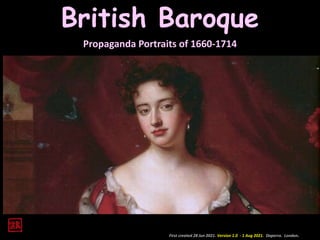
British Baroque
Propaganda Portraits of 1660-1714
First created 28 Jun 2021. Version 1.0 - 1 Aug 2021. Daperro. London.
In 1649 England executed the country’s
own king Charles I, for starting the English
Civil War (1642-1651), in opposition to
Parliament.
Historical Background
Oliver Cromwell who led armies of the
Parliament became ruler of Britain, Lord
Protector. Soon after his death, in 1660
the British monarchy was restored.
Charles II became king.
Execution of Charles I
Oliver Cromwell. Parliament, London,
The slideshow covers the period
between 1660 and 1714. British
Baroque was an age when art was
used to support and advertise the
authority of rising aristocracy.
With the weakening of the monarchy
and a strong period of economic
expansion, due to the Atlantic trade
with the West Indies and America. The
aristocracy found new confidence and
wealth. It was this background for the
development of the British Baroque
paintings.
Historical Background
Verro 1678
Historians call this the Glorious
Revolution. The House Parliament
was firmly in control of the English
politics.
Charles II died. James II, a Catholic
became king. Later in 1688 he was
deposed. William III or Orange of
United Provinces of Netherland
became the British Monarch, even
through the Dutch was a competitor
of England in trade.
Verro 1674
Verro
Verro 1690
Antonio Verro, the ‘Chief First Painter’, who became the most influential painter of Baroque
mural paintings in England.
Hoogstraten c1655
To create a 3-D view, Hoogstraten painted 5 paintings (right) and mounted it inside a
peepshow box (left) on a stand. Viewing through the peep holes on the left or the right side
of the box does create an illusion of a 3-D room.
Hoogstraten c1655
Hoogstraten c1655
Wright c1660
Wright 1662-65
John Michael Wright was
born in London and trained
in Edinburgh. He is one of
the few home-grown
Baroque painter of England.
He also worked in Rome and
Austria. He return to
England in 1655 and served
as a court painter.
Lely 1666
Lely 1666
Look like hair loops were popular
fashion of the time.
Lely 1671
Lely 1678
In the sixteenth and seventeenth
centuries, many portraitists who
worked in England were not English by
birth. Most of the painters came from
continental Europe. Many settled down
and lived in England, like Jacob
Huysmans.
Huysmans 1662
Queen Catherine of Braganza was born
in Portugal. Jacob Huysmans became
her court painter, with his exuberant
style.
Huysmans 1680s
Verelst c1669
Verelst c1670
Gascar 1672
The aristocracy was so confident that
they posed as if they are kings.
Gascar c1678
Elizabeth Percy (later Duchess of
Somerset. C1678. Oil on canvas.
125x99 cm. Henri Gascar (1635-
1701). French. Private Collection.
Henri Gascar (1635-1701)
found success in England. He
painted many court ladies,
including the King’s
mistresses. He the returned to
Paris and relocated to Rome.
Wissing c1683-4
Wissing c1685
It was under her reign that England,
Scotland and Ireland came together to
become Great Britain.
Gennari c1684
Gennari 1686
Benedetto Gennari came from a dynasty of
painters. He was the grandson of
Benedetto Gennari and brother of Cesare
Gennari.
Benedetto Gennari was successful with the
Royal family. King James II was deposed
and exiled to France. Gennari joined the
exiled to St Germaine-en-Laye France. In
1692 he returned to Bologna Italy.
Kneller 1689
Kneller painted a series of 10 reigning
European monarchs, including King
Louis XIV of France.
Sir Godfrey Kneller was the leading
portrait painter in England during the
late 17c and early 18C. He was also the
leading court painter of the day too.
Kneller painted a series of
four portraits of Isaac
Newton. In science, in 1967
Newton published his great
work Principia Mathematica.
He lays the foundation of
modern physics.
Kneller 1689
Kneller 1691
Kneller 1691
Sarah. Duchess of Marlborough Playing Cards with Lady Fitzharding. 1691. 143.5x106.6 cm.
Kneller c1706
Kneller c1706 (Detail)
Wyck 1690s
Jan Wyck was a Dutch baroque painter
best known for his works on military
subjects. Like others painters of the
Low Countries, he moved to England
and worked there throughout his life.
Many of his work was under royal
patronage.
Wyck c1700
Siberechts 1699-1702
Dahl c1702
Michael Dahl was a Swedish portrait
painter who lived and worked in
England. He was one of the most
internationally known Swedish
painters of his time.
He also painted the portrait of Queen
Christina of Sweden.
Dahl 1704-5
Danckerts 1670s
von Roestraeten c1670
Ferguson c1690
Riley & Closterman 1688
1691 John Closterman (1660-1711)
went to England to work for John Riley.
John Riley (1646-1691) died in 1691.
Closterman finished several of his
portraits.
Dorothy Mason. Lady Bronlow. 1688.
Oil on canvas. 223.5x124.5 cm. John
Riley and John Closterman. Private.
Closterman 1696
Closterman 1695-1705
John Closterman (1660-
1711) was a native of
Germany, from Westphalia.
He specialized in portraits of
mostly European noblemen
and their families.
He left England for the
Spanish court in 1696 and
returned to England in 1702.
Griffier c1697
The aristocracy became rich. Some of them built manor houses like palaces.
Laguerre 1702
Monnoyer c1690
Jean-Baptiste Monnoyer (1636-
1699) was a Franco Flemish
painter who specialized in
flower pieces.
Boghani c1700
Baker 1710
The
End
Music – Beethoven’s Minuet in G
Baroque Painters
British Baroque 1.0
British Baroque 1.0

British Baroque 1.0

  • 1.
    British Baroque Propaganda Portraitsof 1660-1714 First created 28 Jun 2021. Version 1.0 - 1 Aug 2021. Daperro. London.
  • 2.
    In 1649 Englandexecuted the country’s own king Charles I, for starting the English Civil War (1642-1651), in opposition to Parliament. Historical Background Oliver Cromwell who led armies of the Parliament became ruler of Britain, Lord Protector. Soon after his death, in 1660 the British monarchy was restored. Charles II became king. Execution of Charles I Oliver Cromwell. Parliament, London,
  • 3.
    The slideshow coversthe period between 1660 and 1714. British Baroque was an age when art was used to support and advertise the authority of rising aristocracy. With the weakening of the monarchy and a strong period of economic expansion, due to the Atlantic trade with the West Indies and America. The aristocracy found new confidence and wealth. It was this background for the development of the British Baroque paintings. Historical Background
  • 4.
    Verro 1678 Historians callthis the Glorious Revolution. The House Parliament was firmly in control of the English politics. Charles II died. James II, a Catholic became king. Later in 1688 he was deposed. William III or Orange of United Provinces of Netherland became the British Monarch, even through the Dutch was a competitor of England in trade.
  • 5.
  • 6.
  • 7.
    Verro 1690 Antonio Verro,the ‘Chief First Painter’, who became the most influential painter of Baroque mural paintings in England.
  • 8.
    Hoogstraten c1655 To createa 3-D view, Hoogstraten painted 5 paintings (right) and mounted it inside a peepshow box (left) on a stand. Viewing through the peep holes on the left or the right side of the box does create an illusion of a 3-D room.
  • 9.
  • 10.
  • 11.
  • 12.
    Wright 1662-65 John MichaelWright was born in London and trained in Edinburgh. He is one of the few home-grown Baroque painter of England. He also worked in Rome and Austria. He return to England in 1655 and served as a court painter.
  • 13.
  • 14.
    Lely 1666 Look likehair loops were popular fashion of the time.
  • 15.
  • 16.
  • 17.
    In the sixteenthand seventeenth centuries, many portraitists who worked in England were not English by birth. Most of the painters came from continental Europe. Many settled down and lived in England, like Jacob Huysmans. Huysmans 1662 Queen Catherine of Braganza was born in Portugal. Jacob Huysmans became her court painter, with his exuberant style.
  • 18.
  • 19.
  • 20.
  • 21.
    Gascar 1672 The aristocracywas so confident that they posed as if they are kings.
  • 22.
    Gascar c1678 Elizabeth Percy(later Duchess of Somerset. C1678. Oil on canvas. 125x99 cm. Henri Gascar (1635- 1701). French. Private Collection. Henri Gascar (1635-1701) found success in England. He painted many court ladies, including the King’s mistresses. He the returned to Paris and relocated to Rome.
  • 23.
  • 24.
    Wissing c1685 It wasunder her reign that England, Scotland and Ireland came together to become Great Britain.
  • 25.
  • 26.
    Gennari 1686 Benedetto Gennaricame from a dynasty of painters. He was the grandson of Benedetto Gennari and brother of Cesare Gennari. Benedetto Gennari was successful with the Royal family. King James II was deposed and exiled to France. Gennari joined the exiled to St Germaine-en-Laye France. In 1692 he returned to Bologna Italy.
  • 27.
    Kneller 1689 Kneller painteda series of 10 reigning European monarchs, including King Louis XIV of France. Sir Godfrey Kneller was the leading portrait painter in England during the late 17c and early 18C. He was also the leading court painter of the day too.
  • 28.
    Kneller painted aseries of four portraits of Isaac Newton. In science, in 1967 Newton published his great work Principia Mathematica. He lays the foundation of modern physics. Kneller 1689
  • 29.
  • 30.
    Kneller 1691 Sarah. Duchessof Marlborough Playing Cards with Lady Fitzharding. 1691. 143.5x106.6 cm.
  • 31.
  • 32.
  • 33.
    Wyck 1690s Jan Wyckwas a Dutch baroque painter best known for his works on military subjects. Like others painters of the Low Countries, he moved to England and worked there throughout his life. Many of his work was under royal patronage.
  • 34.
  • 35.
  • 36.
  • 37.
    Dahl c1702 Michael Dahlwas a Swedish portrait painter who lived and worked in England. He was one of the most internationally known Swedish painters of his time. He also painted the portrait of Queen Christina of Sweden.
  • 38.
  • 39.
  • 40.
  • 41.
  • 42.
    Riley & Closterman1688 1691 John Closterman (1660-1711) went to England to work for John Riley. John Riley (1646-1691) died in 1691. Closterman finished several of his portraits. Dorothy Mason. Lady Bronlow. 1688. Oil on canvas. 223.5x124.5 cm. John Riley and John Closterman. Private.
  • 43.
  • 44.
    Closterman 1695-1705 John Closterman(1660- 1711) was a native of Germany, from Westphalia. He specialized in portraits of mostly European noblemen and their families. He left England for the Spanish court in 1696 and returned to England in 1702.
  • 45.
    Griffier c1697 The aristocracybecame rich. Some of them built manor houses like palaces.
  • 46.
  • 47.
    Monnoyer c1690 Jean-Baptiste Monnoyer(1636- 1699) was a Franco Flemish painter who specialized in flower pieces.
  • 48.
  • 49.
  • 50.
  • 51.