Muscular Systemmovement
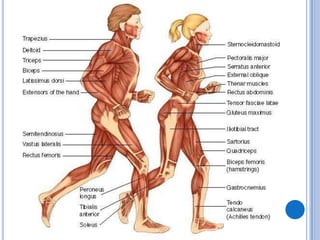
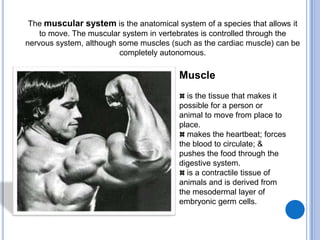
The muscular system is the anatomical system of a species that allows it to move. The muscular system in vertebrates is controlled through the nervous system, although some muscles (such as the cardiac muscle) can be completely autonomous.Muscle is the tissue that makes it possible for a person or animal to move from place to place.makes the heartbeat; forces the blood to circulate; & pushes the food through the digestive system. is a contractile tissue of animals and is derived from the mesodermal layer of embryonic germ cells.
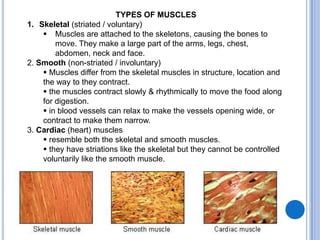
TYPES OF MUSCLESSkeletal (striated / voluntary)Muscles are attached to the skeletons, causing the bones to move. They make a large part of the arms, legs, chest, abdomen, neck and face.2. Smooth (non-striated / involuntary) Muscles differ from the skeletal muscles in structure, location and the way to they contract.
the muscles contract slowly & rhythmically to move the food along for digestion.
in blood vessels can relax to make the vessels opening wide, or contract to make them narrow. 3. Cardiac (heart) muscles resemble both the skeletal and smooth muscles.
they have striations like the skeletal but they cannot be controlled voluntarily like the smooth muscle.Diseases & Disorder of the Muscular SystemAtrophyMuscular Atrophy
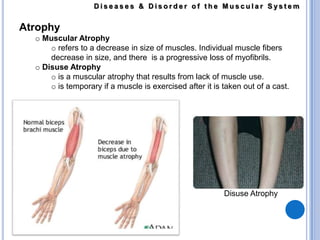
refers to a decrease in size of muscles. Individual muscle fibers decrease in size, and there  is a progressive loss of myofibrils.
Disuse Atrophy
is a muscular atrophy that results from lack of muscle use.
is temporary if a muscle is exercised after it is taken out of a cast.Disuse Atrophy

Muscular system

  • 1.
  • 3.
    The muscular systemis the anatomical system of a species that allows it to move. The muscular system in vertebrates is controlled through the nervous system, although some muscles (such as the cardiac muscle) can be completely autonomous.Muscle is the tissue that makes it possible for a person or animal to move from place to place.makes the heartbeat; forces the blood to circulate; & pushes the food through the digestive system. is a contractile tissue of animals and is derived from the mesodermal layer of embryonic germ cells.
  • 4.
    TYPES OF MUSCLESSkeletal(striated / voluntary)Muscles are attached to the skeletons, causing the bones to move. They make a large part of the arms, legs, chest, abdomen, neck and face.2. Smooth (non-striated / involuntary) Muscles differ from the skeletal muscles in structure, location and the way to they contract.
  • 5.
    the muscles contractslowly & rhythmically to move the food along for digestion.
  • 6.
    in blood vesselscan relax to make the vessels opening wide, or contract to make them narrow. 3. Cardiac (heart) muscles resemble both the skeletal and smooth muscles.
  • 7.
    they have striationslike the skeletal but they cannot be controlled voluntarily like the smooth muscle.Diseases & Disorder of the Muscular SystemAtrophyMuscular Atrophy
  • 8.
    refers to adecrease in size of muscles. Individual muscle fibers decrease in size, and there is a progressive loss of myofibrils.
  • 9.
  • 10.
    is a muscularatrophy that results from lack of muscle use.
  • 11.
    is temporary ifa muscle is exercised after it is taken out of a cast.Disuse Atrophy