Anatomy and Physiology I
Muscles that Move the Thigh,
Lower Leg, Foot, and Toes
Instructor: Mary Holman
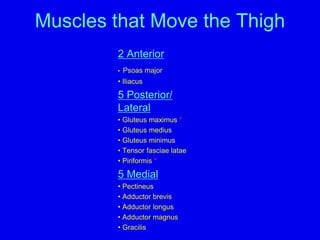
Muscles that Move the Thigh
2 Anterior
• Psoas major
• Iliacus
5 Posterior/
Lateral
• Gluteus maximus *
• Gluteus medius
• Gluteus minimus
• Tensor fasciae latae
• Piriformis *
5 Medial
• Pectineus
• Adductor brevis
• Adductor longus
• Adductor magnus
• Gracilis
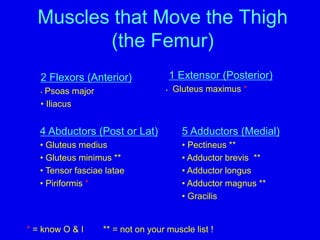
Muscles that Move the Thigh
(the Femur)
1 Extensor (Posterior)
• Gluteus maximus *
2 Flexors (Anterior)
• Psoas major
• Iliacus
5 Adductors (Medial)
• Pectineus **
• Adductor brevis **
• Adductor longus
• Adductor magnus **
• Gracilis
4 Abductors (Post or Lat)
• Gluteus medius
• Gluteus minimus **
• Tensor fasciae latae
• Piriformis *
* = know O & I ** = not on your muscle list !
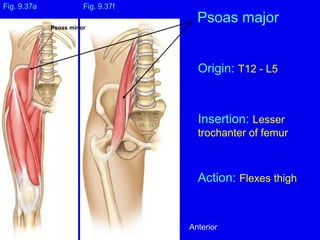
Origin: T12 - L5
Insertion: Lesser
trochanter of femur
Action: Flexes thigh
Fig. 9.37a
Psoas major
Fig. 9.37f
Psoas minor
Anterior
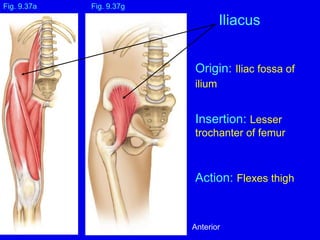
Origin: Iliac fossa of
ilium
Insertion: Lesser
trochanter of femur
Action: Flexes thigh
Fig. 9.37a
Iliacus
Fig. 9.37g
Anterior
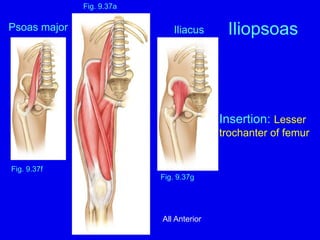
Iliopsoas
Psoas major Iliacus
Insertion: Lesser
trochanter of femur
Fig. 9.37f
Fig. 9.37g
Fig. 9.37a
All Anterior
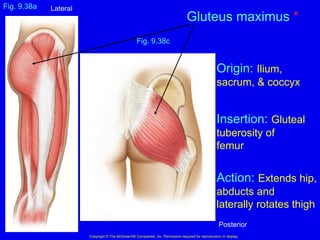
Fig. 9.38c
Copyright © The McGraw-Hill Companies, Inc. Permission required for reproduction or display.
Gluteus maximus *
Fig. 9.38a
Origin: Ilium,
sacrum, & coccyx
Insertion: Gluteal
tuberosity of
femur
Action: Extends hip,
abducts and
laterally rotates thigh
Lateral
Posterior
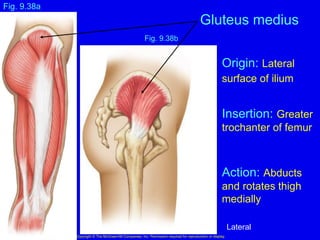
Fig. 9.38b
Gluteus medius
Copyright © The McGraw-Hill Companies, Inc. Permission required for reproduction or display.
Fig. 9.38a
Origin: Lateral
surface of ilium
Insertion: Greater
trochanter of femur
Action: Abducts
and rotates thigh
medially
Lateral
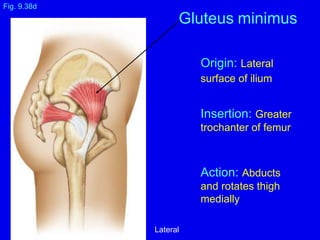
Fig. 9.38d
Gluteus minimus
Origin: Lateral
surface of ilium
Insertion: Greater
trochanter of femur
Action: Abducts
and rotates thigh
medially
Lateral
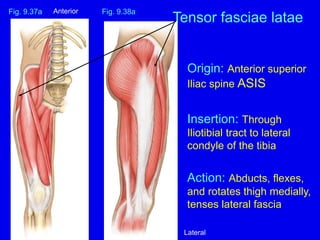
Origin: Anterior superior
Iliac spine ASIS
Insertion: Through
Iliotibial tract to lateral
condyle of the tibia
Action: Abducts, flexes,
and rotates thigh medially,
tenses lateral fascia
Fig. 9.37a
Tensor fasciae latae
Fig. 9.38a
Anterior
Lateral
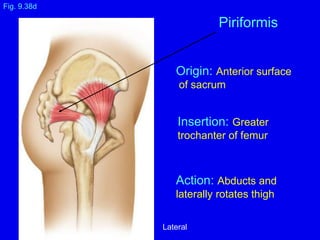
Origin: Anterior surface
of sacrum
Insertion: Greater
trochanter of femur
Action: Abducts and
laterally rotates thigh
Fig. 9.38d
Piriformis
Lateral
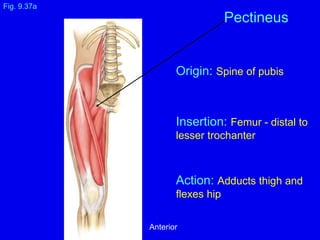
Origin: Spine of pubis
Insertion: Femur - distal to
lesser trochanter
Action: Adducts thigh and
flexes hip
Fig. 9.37a
Pectineus
Anterior
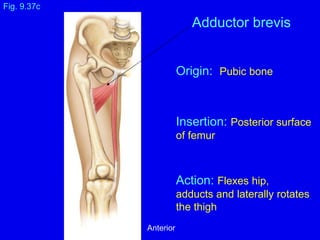
Origin: Pubic bone
Insertion: Posterior surface
of femur
Action: Flexes hip,
adducts and laterally rotates
the thigh
Fig. 9.37c
Adductor brevis
Anterior
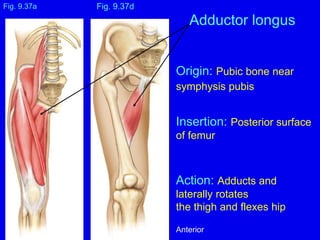
Origin: Pubic bone near
symphysis pubis
Insertion: Posterior surface
of femur
Action: Adducts and
laterally rotates
the thigh and flexes hip
Fig. 9.37a
Adductor longus
Fig. 9.37d
Anterior
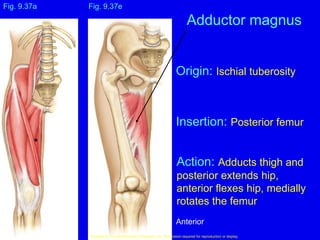
Fig. 9.37e
Copyright © The McGraw-Hill Companies, Inc. Permission required for reproduction or display.
Adductor magnus
Fig. 9.37a
Origin: Ischial tuberosity
Insertion: Posterior femur
Action: Adducts thigh and
posterior extends hip,
anterior flexes hip, medially
rotates the femur
Anterior
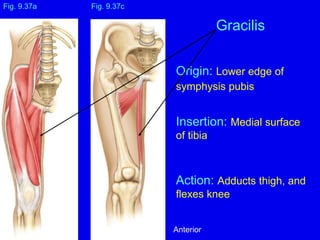
Origin: Lower edge of
symphysis pubis
Insertion: Medial surface
of tibia
Action: Adducts thigh, and
flexes knee
Fig. 9.37a
Gracilis
Fig. 9.37c
Anterior
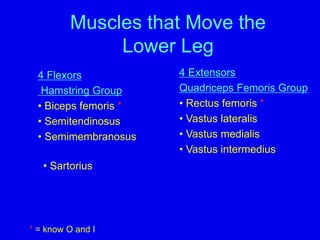
Muscles that Move the
Lower Leg
4 Flexors
Hamstring Group
• Biceps femoris *
• Semitendinosus
• Semimembranosus
4 Extensors
Quadriceps Femoris Group
• Rectus femoris *
• Vastus lateralis
• Vastus medialis
• Vastus intermedius
• Sartorius
* = know O and I
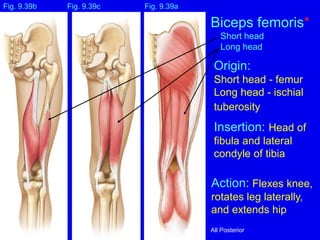
Origin:
Short head - femur
Long head - ischial
tuberosity
Insertion: Head of
fibula and lateral
condyle of tibia
Action: Flexes knee,
rotates leg laterally,
and extends hip
Fig. 9.39c
Biceps femoris*
Short head
Long head
Fig. 9.39a
Fig. 9.39b
All Posterior
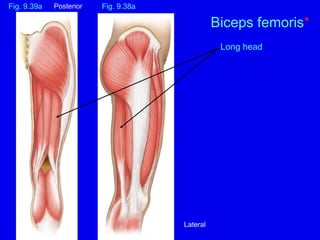
Biceps femoris*
Long head
Fig. 9.39a Fig. 9.38a
Posterior
Lateral
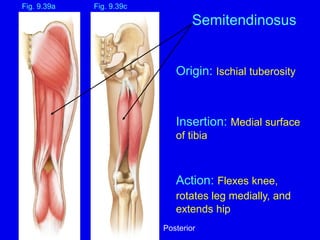
Origin: Ischial tuberosity
Insertion: Medial surface
of tibia
Action: Flexes knee,
rotates leg medially, and
extends hip
Fig. 9.39c
Fig. 9.39a
Semitendinosus
Posterior
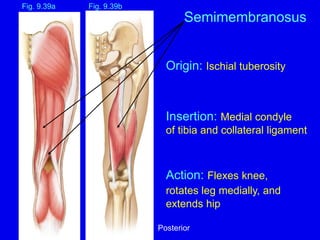
Origin: Ischial tuberosity
Insertion: Medial condyle
of tibia and collateral ligament
Action: Flexes knee,
rotates leg medially, and
extends hip
Fig. 9.39b
Semimembranosus
Fig. 9.39a
Posterior
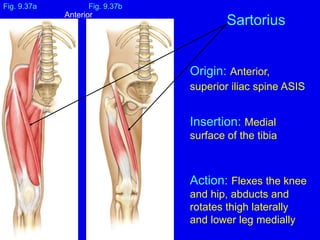
Origin: Anterior,
superior iliac spine ASIS
Insertion: Medial
surface of the tibia
Action: Flexes the knee
and hip, abducts and
rotates thigh laterally
and lower leg medially
Fig. 9.37a
Sartorius
Fig. 9.37b
Anterior
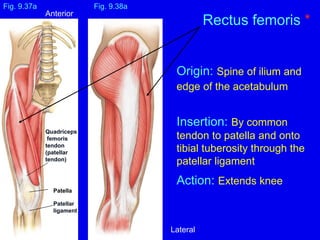
Origin: Spine of ilium and
edge of the acetabulum
Insertion: By common
tendon to patella and onto
tibial tuberosity through the
patellar ligament
Action: Extends knee
Fig. 9.37a
Rectus femoris *
Fig. 9.38a
Patella
Patellar
ligament
Quadriceps
femoris
tendon
(patellar
tendon)
Anterior
Lateral
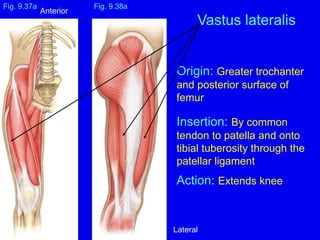
Origin: Greater trochanter
and posterior surface of
femur
Insertion: By common
tendon to patella and onto
tibial tuberosity through the
patellar ligament
Action: Extends knee
Fig. 9.37a Fig. 9.38a
Vastus lateralis
Anterior
Lateral
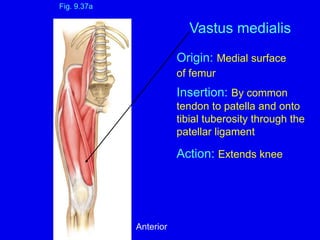
Origin: Medial surface
of femur
Insertion: By common
tendon to patella and onto
tibial tuberosity through the
patellar ligament
Action: Extends knee
Fig. 9.37a
Vastus medialis
Anterior
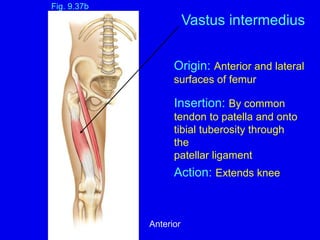
Fig. 9.37b
Vastus intermedius
Origin: Anterior and lateral
surfaces of femur
Insertion: By common
tendon to patella and onto
tibial tuberosity through
the
patellar ligament
Action: Extends knee
Anterior
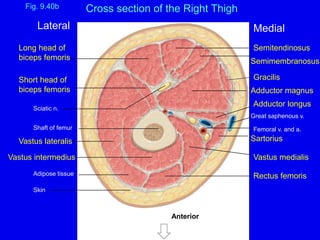
Fig. 9.40b
Gracilis
Semimembranosus
Semitendinosus
Sartorius
Vastus medialis
Rectus femoris
Adipose tissue
Skin
Adductor magnus
Adductor longus
Great saphenous v.
Femoral v. and a.
Vastus intermedius
Shaft of femur
Sciatic n.
Vastus lateralis
Lateral Medial
Anterior
Long head of
biceps femoris
Short head of
biceps femoris
Cross section of the Right Thigh
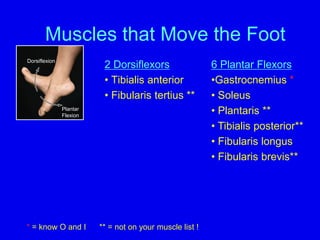
Muscles that Move the Foot
2 Dorsiflexors
• Tibialis anterior
• Fibularis tertius **
Dorsiflexion
Plantar
Flexion
6 Plantar Flexors
•Gastrocnemius *
• Soleus
• Plantaris **
• Tibialis posterior**
• Fibularis longus
• Fibularis brevis**
* = know O and I ** = not on your muscle list !
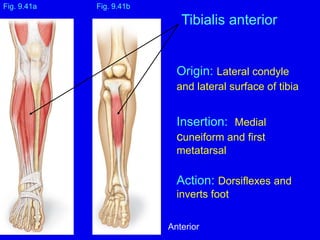
Origin: Lateral condyle
and lateral surface of tibia
Insertion: Medial
cuneiform and first
metatarsal
Action: Dorsiflexes and
inverts foot
Fig. 9.41a
Tibialis anterior
Fig. 9.41b
Anterior
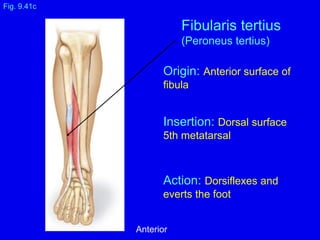
Origin: Anterior surface of
fibula
Insertion: Dorsal surface
5th metatarsal
Action: Dorsiflexes and
everts the foot
Fig. 9.41c
Fibularis tertius
(Peroneus tertius)
Anterior
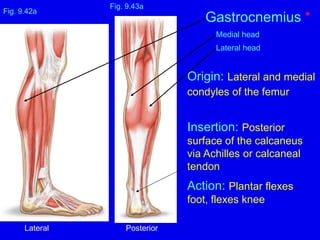
Origin: Lateral and medial
condyles of the femur
Insertion: Posterior
surface of the calcaneus
via Achilles or calcaneal
tendon
Action: Plantar flexes
foot, flexes knee
Fig. 9.43a
Gastrocnemius *
Medial head
Lateral head
Fig. 9.42a
Lateral Posterior
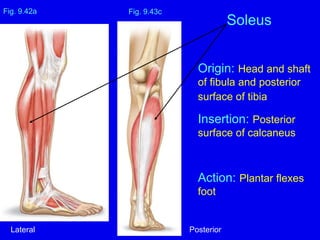
Origin: Head and shaft
of fibula and posterior
surface of tibia
Insertion: Posterior
surface of calcaneus
Action: Plantar flexes
foot
Fig. 9.43c
Soleus
Fig. 9.42a
Lateral Posterior
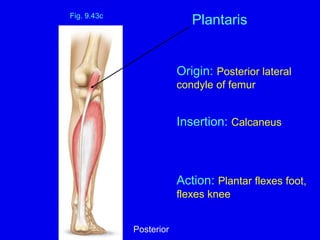
Origin: Posterior lateral
condyle of femur
Insertion: Calcaneus
Action: Plantar flexes foot,
flexes knee
Fig. 9.43c
Plantaris
Posterior
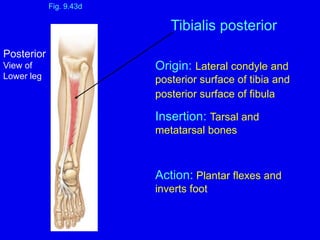
Origin: Lateral condyle and
posterior surface of tibia and
posterior surface of fibula
Insertion: Tarsal and
metatarsal bones
Action: Plantar flexes and
inverts foot
Fig. 9.43d
Tibialis posterior
Posterior
View of
Lower leg
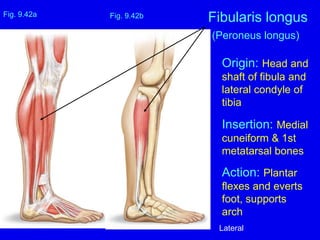
Origin: Head and
shaft of fibula and
lateral condyle of
tibia
Insertion: Medial
cuneiform & 1st
metatarsal bones
Action: Plantar
flexes and everts
foot, supports
arch
Fig. 9.42a
Fibularis longus
(Peroneus longus)
Fig. 9.42b
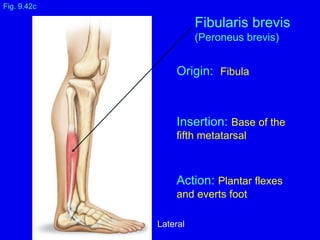
Lateral
Origin: Fibula
Insertion: Base of the
fifth metatarsal
Action: Plantar flexes
and everts foot
Fig. 9.42c
Fibularis brevis
(Peroneus brevis)
Lateral
Muscles that Move the Toes
• Flexor digitorum longus
• Extensor digitorum longus
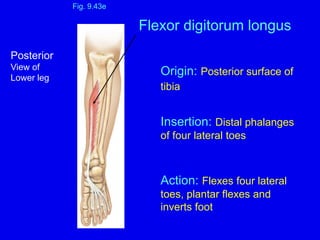
Origin: Posterior surface of
tibia
Insertion: Distal phalanges
of four lateral toes
Action: Flexes four lateral
toes, plantar flexes and
inverts foot
Fig. 9.43e
Flexor digitorum longus
Posterior
View of
Lower leg
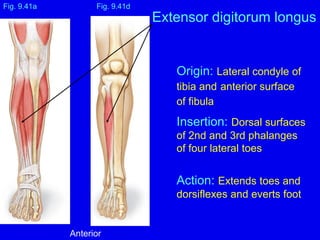
Origin: Lateral condyle of
tibia and anterior surface
of fibula
Insertion: Dorsal surfaces
of 2nd and 3rd phalanges
of four lateral toes
Action: Extends toes and
dorsiflexes and everts foot
Fig. 9.41a
Extensor digitorum longus
Fig. 9.41d
Anterior
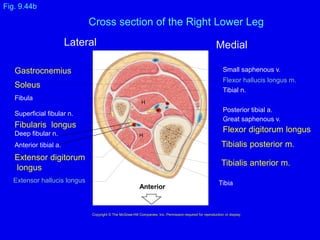
Fig. 9.44b
Copyright © The McGraw-Hill Companies, Inc. Permission required for reproduction or display.
Gastrocnemius
Fibularis longus
Deep fibular n.
Superficial fibular n.
Anterior tibial a.
Extensor digitorum
longus
Extensor hallucis longus
Fibula
Soleus
Tibia
Great saphenous v.
Tibialis posterior m.
Flexor digitorum longus
Small saphenous v.
Posterior tibial a.
Flexor hallucis longus m.
Tibial n.
Tibialis anterior m.
Anterior
Cross section of the Right Lower Leg
H
H
Lateral Medial
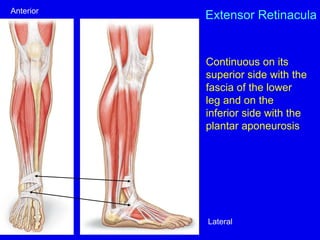
Extensor Retinacula
Continuous on its
superior side with the
fascia of the lower
leg and on the
inferior side with the
plantar aponeurosis
Anterior
Lateral

Muscles-Leg ppt

  • 1.
    Anatomy and PhysiologyI Muscles that Move the Thigh, Lower Leg, Foot, and Toes Instructor: Mary Holman
  • 2.
    Muscles that Movethe Thigh 2 Anterior • Psoas major • Iliacus 5 Posterior/ Lateral • Gluteus maximus * • Gluteus medius • Gluteus minimus • Tensor fasciae latae • Piriformis * 5 Medial • Pectineus • Adductor brevis • Adductor longus • Adductor magnus • Gracilis
  • 3.
    Muscles that Movethe Thigh (the Femur) 1 Extensor (Posterior) • Gluteus maximus * 2 Flexors (Anterior) • Psoas major • Iliacus 5 Adductors (Medial) • Pectineus ** • Adductor brevis ** • Adductor longus • Adductor magnus ** • Gracilis 4 Abductors (Post or Lat) • Gluteus medius • Gluteus minimus ** • Tensor fasciae latae • Piriformis * * = know O & I ** = not on your muscle list !
  • 4.
    Origin: T12 -L5 Insertion: Lesser trochanter of femur Action: Flexes thigh Fig. 9.37a Psoas major Fig. 9.37f Psoas minor Anterior
  • 5.
    Origin: Iliac fossaof ilium Insertion: Lesser trochanter of femur Action: Flexes thigh Fig. 9.37a Iliacus Fig. 9.37g Anterior
  • 6.
    Iliopsoas Psoas major Iliacus Insertion:Lesser trochanter of femur Fig. 9.37f Fig. 9.37g Fig. 9.37a All Anterior
  • 7.
    Fig. 9.38c Copyright ©The McGraw-Hill Companies, Inc. Permission required for reproduction or display. Gluteus maximus * Fig. 9.38a Origin: Ilium, sacrum, & coccyx Insertion: Gluteal tuberosity of femur Action: Extends hip, abducts and laterally rotates thigh Lateral Posterior
  • 8.
    Fig. 9.38b Gluteus medius Copyright© The McGraw-Hill Companies, Inc. Permission required for reproduction or display. Fig. 9.38a Origin: Lateral surface of ilium Insertion: Greater trochanter of femur Action: Abducts and rotates thigh medially Lateral
  • 9.
    Fig. 9.38d Gluteus minimus Origin:Lateral surface of ilium Insertion: Greater trochanter of femur Action: Abducts and rotates thigh medially Lateral
  • 10.
    Origin: Anterior superior Iliacspine ASIS Insertion: Through Iliotibial tract to lateral condyle of the tibia Action: Abducts, flexes, and rotates thigh medially, tenses lateral fascia Fig. 9.37a Tensor fasciae latae Fig. 9.38a Anterior Lateral
  • 11.
    Origin: Anterior surface ofsacrum Insertion: Greater trochanter of femur Action: Abducts and laterally rotates thigh Fig. 9.38d Piriformis Lateral
  • 12.
    Origin: Spine ofpubis Insertion: Femur - distal to lesser trochanter Action: Adducts thigh and flexes hip Fig. 9.37a Pectineus Anterior
  • 13.
    Origin: Pubic bone Insertion:Posterior surface of femur Action: Flexes hip, adducts and laterally rotates the thigh Fig. 9.37c Adductor brevis Anterior
  • 14.
    Origin: Pubic bonenear symphysis pubis Insertion: Posterior surface of femur Action: Adducts and laterally rotates the thigh and flexes hip Fig. 9.37a Adductor longus Fig. 9.37d Anterior
  • 15.
    Fig. 9.37e Copyright ©The McGraw-Hill Companies, Inc. Permission required for reproduction or display. Adductor magnus Fig. 9.37a Origin: Ischial tuberosity Insertion: Posterior femur Action: Adducts thigh and posterior extends hip, anterior flexes hip, medially rotates the femur Anterior
  • 16.
    Origin: Lower edgeof symphysis pubis Insertion: Medial surface of tibia Action: Adducts thigh, and flexes knee Fig. 9.37a Gracilis Fig. 9.37c Anterior
  • 17.
    Muscles that Movethe Lower Leg 4 Flexors Hamstring Group • Biceps femoris * • Semitendinosus • Semimembranosus 4 Extensors Quadriceps Femoris Group • Rectus femoris * • Vastus lateralis • Vastus medialis • Vastus intermedius • Sartorius * = know O and I
  • 18.
    Origin: Short head -femur Long head - ischial tuberosity Insertion: Head of fibula and lateral condyle of tibia Action: Flexes knee, rotates leg laterally, and extends hip Fig. 9.39c Biceps femoris* Short head Long head Fig. 9.39a Fig. 9.39b All Posterior
  • 19.
    Biceps femoris* Long head Fig.9.39a Fig. 9.38a Posterior Lateral
  • 20.
    Origin: Ischial tuberosity Insertion:Medial surface of tibia Action: Flexes knee, rotates leg medially, and extends hip Fig. 9.39c Fig. 9.39a Semitendinosus Posterior
  • 21.
    Origin: Ischial tuberosity Insertion:Medial condyle of tibia and collateral ligament Action: Flexes knee, rotates leg medially, and extends hip Fig. 9.39b Semimembranosus Fig. 9.39a Posterior
  • 22.
    Origin: Anterior, superior iliacspine ASIS Insertion: Medial surface of the tibia Action: Flexes the knee and hip, abducts and rotates thigh laterally and lower leg medially Fig. 9.37a Sartorius Fig. 9.37b Anterior
  • 23.
    Origin: Spine ofilium and edge of the acetabulum Insertion: By common tendon to patella and onto tibial tuberosity through the patellar ligament Action: Extends knee Fig. 9.37a Rectus femoris * Fig. 9.38a Patella Patellar ligament Quadriceps femoris tendon (patellar tendon) Anterior Lateral
  • 24.
    Origin: Greater trochanter andposterior surface of femur Insertion: By common tendon to patella and onto tibial tuberosity through the patellar ligament Action: Extends knee Fig. 9.37a Fig. 9.38a Vastus lateralis Anterior Lateral
  • 25.
    Origin: Medial surface offemur Insertion: By common tendon to patella and onto tibial tuberosity through the patellar ligament Action: Extends knee Fig. 9.37a Vastus medialis Anterior
  • 26.
    Fig. 9.37b Vastus intermedius Origin:Anterior and lateral surfaces of femur Insertion: By common tendon to patella and onto tibial tuberosity through the patellar ligament Action: Extends knee Anterior
  • 27.
    Fig. 9.40b Gracilis Semimembranosus Semitendinosus Sartorius Vastus medialis Rectusfemoris Adipose tissue Skin Adductor magnus Adductor longus Great saphenous v. Femoral v. and a. Vastus intermedius Shaft of femur Sciatic n. Vastus lateralis Lateral Medial Anterior Long head of biceps femoris Short head of biceps femoris Cross section of the Right Thigh
  • 28.
    Muscles that Movethe Foot 2 Dorsiflexors • Tibialis anterior • Fibularis tertius ** Dorsiflexion Plantar Flexion 6 Plantar Flexors •Gastrocnemius * • Soleus • Plantaris ** • Tibialis posterior** • Fibularis longus • Fibularis brevis** * = know O and I ** = not on your muscle list !
  • 29.
    Origin: Lateral condyle andlateral surface of tibia Insertion: Medial cuneiform and first metatarsal Action: Dorsiflexes and inverts foot Fig. 9.41a Tibialis anterior Fig. 9.41b Anterior
  • 30.
    Origin: Anterior surfaceof fibula Insertion: Dorsal surface 5th metatarsal Action: Dorsiflexes and everts the foot Fig. 9.41c Fibularis tertius (Peroneus tertius) Anterior
  • 31.
    Origin: Lateral andmedial condyles of the femur Insertion: Posterior surface of the calcaneus via Achilles or calcaneal tendon Action: Plantar flexes foot, flexes knee Fig. 9.43a Gastrocnemius * Medial head Lateral head Fig. 9.42a Lateral Posterior
  • 32.
    Origin: Head andshaft of fibula and posterior surface of tibia Insertion: Posterior surface of calcaneus Action: Plantar flexes foot Fig. 9.43c Soleus Fig. 9.42a Lateral Posterior
  • 33.
    Origin: Posterior lateral condyleof femur Insertion: Calcaneus Action: Plantar flexes foot, flexes knee Fig. 9.43c Plantaris Posterior
  • 34.
    Origin: Lateral condyleand posterior surface of tibia and posterior surface of fibula Insertion: Tarsal and metatarsal bones Action: Plantar flexes and inverts foot Fig. 9.43d Tibialis posterior Posterior View of Lower leg
  • 35.
    Origin: Head and shaftof fibula and lateral condyle of tibia Insertion: Medial cuneiform & 1st metatarsal bones Action: Plantar flexes and everts foot, supports arch Fig. 9.42a Fibularis longus (Peroneus longus) Fig. 9.42b Lateral
  • 36.
    Origin: Fibula Insertion: Baseof the fifth metatarsal Action: Plantar flexes and everts foot Fig. 9.42c Fibularis brevis (Peroneus brevis) Lateral
  • 37.
    Muscles that Movethe Toes • Flexor digitorum longus • Extensor digitorum longus
  • 38.
    Origin: Posterior surfaceof tibia Insertion: Distal phalanges of four lateral toes Action: Flexes four lateral toes, plantar flexes and inverts foot Fig. 9.43e Flexor digitorum longus Posterior View of Lower leg
  • 39.
    Origin: Lateral condyleof tibia and anterior surface of fibula Insertion: Dorsal surfaces of 2nd and 3rd phalanges of four lateral toes Action: Extends toes and dorsiflexes and everts foot Fig. 9.41a Extensor digitorum longus Fig. 9.41d Anterior
  • 40.
    Fig. 9.44b Copyright ©The McGraw-Hill Companies, Inc. Permission required for reproduction or display. Gastrocnemius Fibularis longus Deep fibular n. Superficial fibular n. Anterior tibial a. Extensor digitorum longus Extensor hallucis longus Fibula Soleus Tibia Great saphenous v. Tibialis posterior m. Flexor digitorum longus Small saphenous v. Posterior tibial a. Flexor hallucis longus m. Tibial n. Tibialis anterior m. Anterior Cross section of the Right Lower Leg H H Lateral Medial
  • 41.
    Extensor Retinacula Continuous onits superior side with the fascia of the lower leg and on the inferior side with the plantar aponeurosis Anterior Lateral