MUSCLES AND
  BONES
 The musculoskeletal system
THE MUSCULOSKELETAL SYSTEM
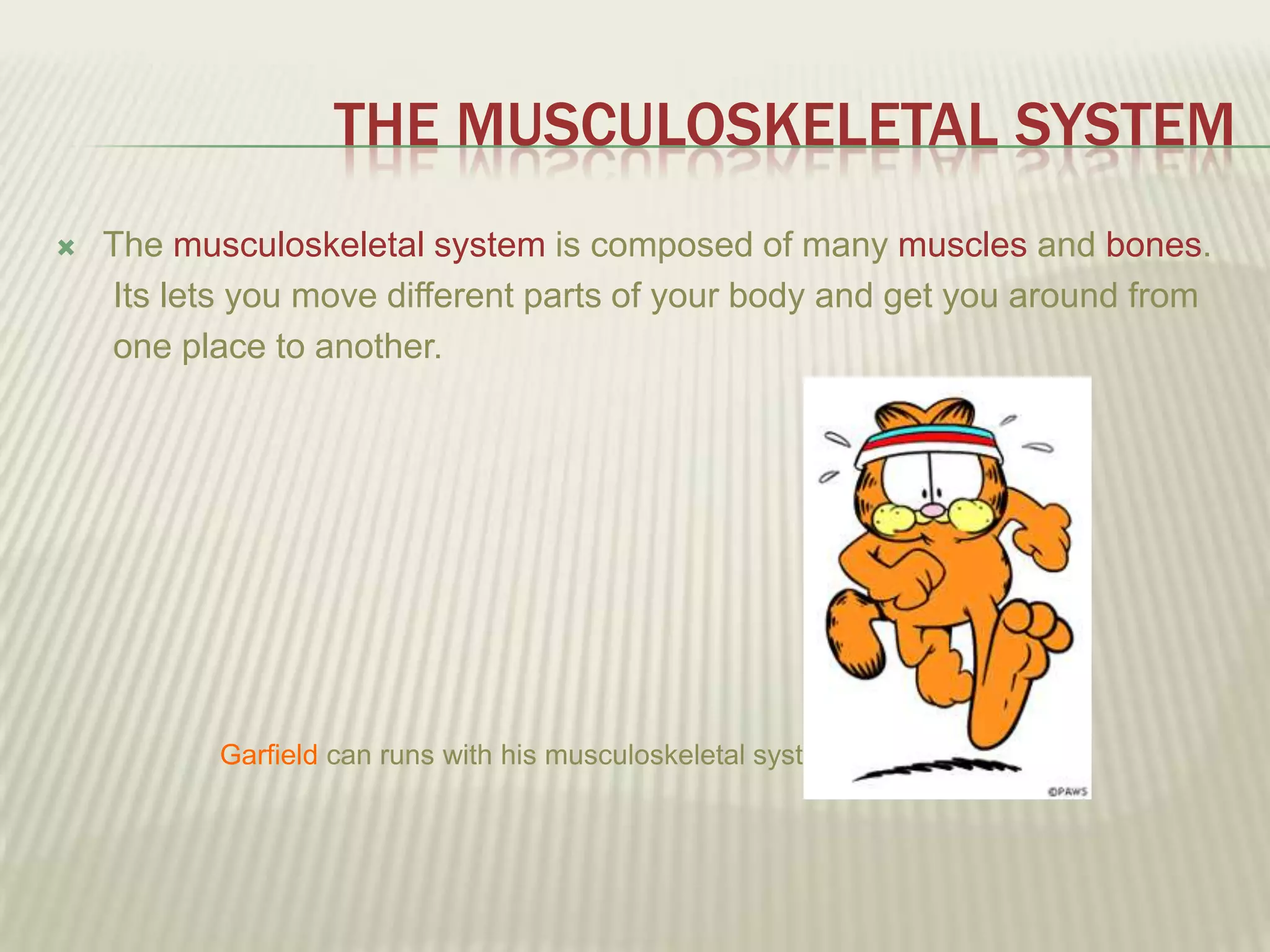
   The musculoskeletal system is composed of many muscles and bones.
    Its lets you move different parts of your body and get you around from
    one place to another.


           Garfield can runs with his musculoskeletal system
THE FUNCTIONS OF THE SKELETON

   Humans have got an internal skeleton. It is made of 206 different bones.
    The skeleton perfoms three main functions:

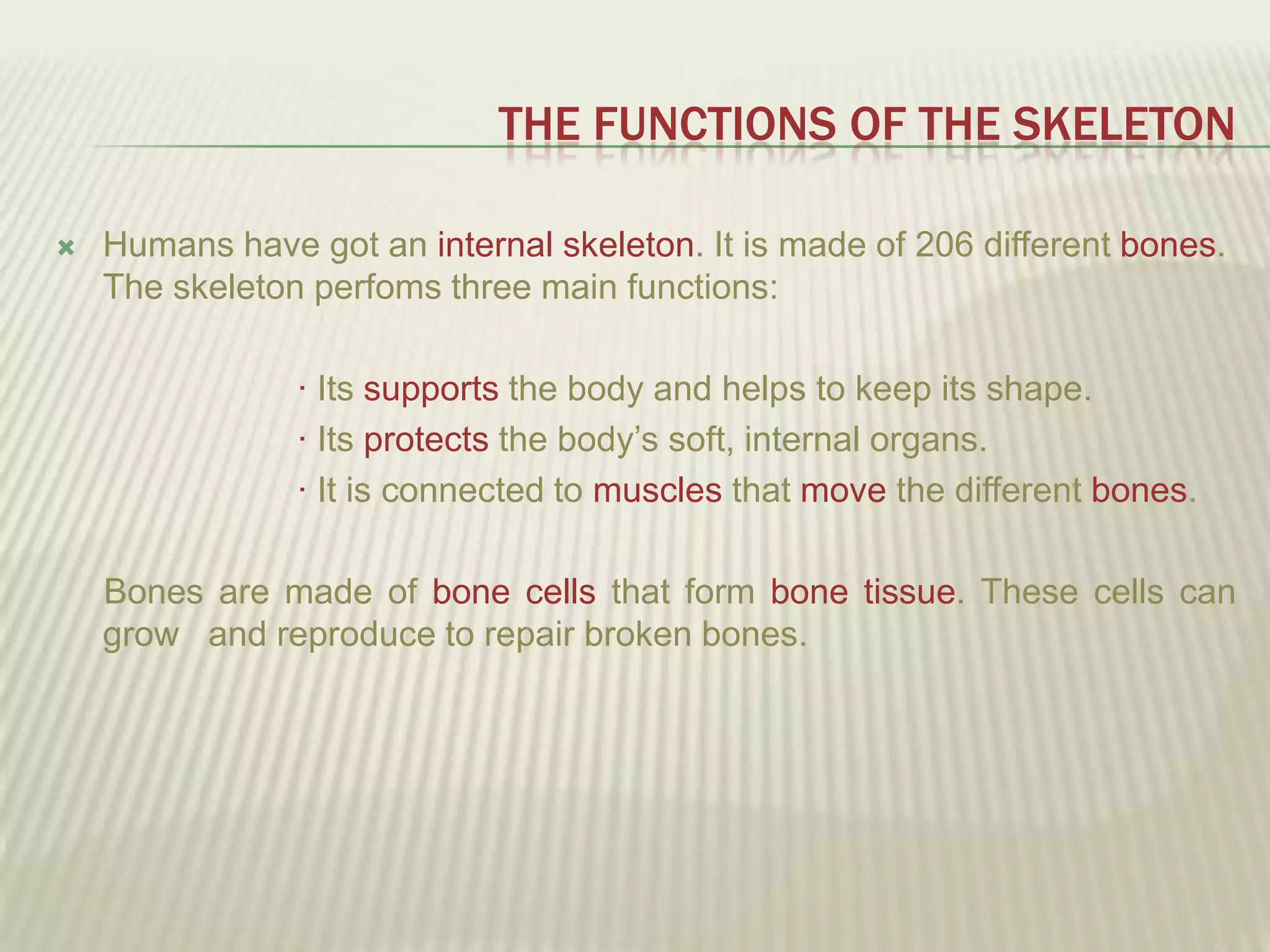
                · Its supports the body and helps to keep its shape.
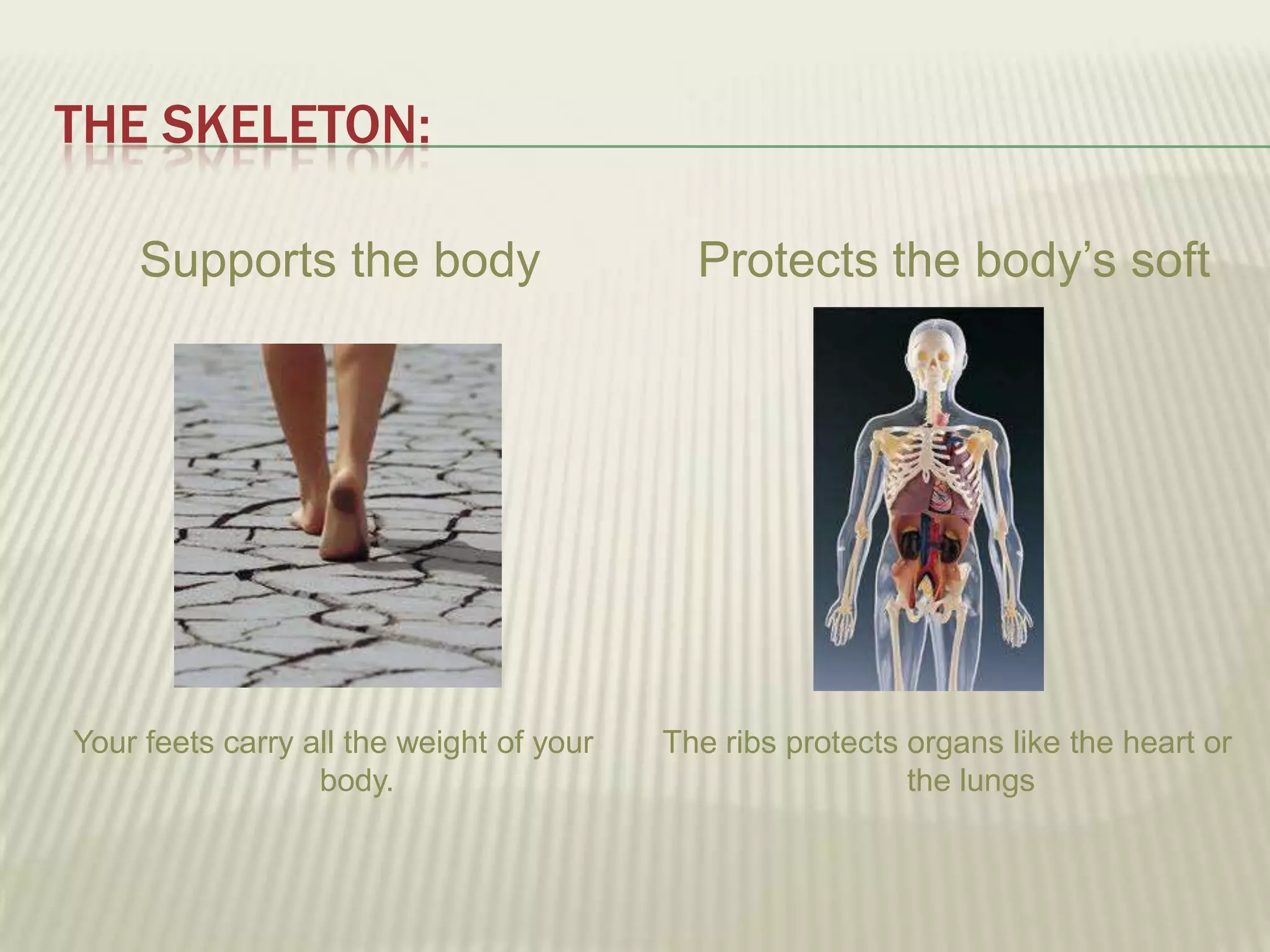
                · Its protects the body’s soft, internal organs.
                · It is connected to muscles that move the different bones.

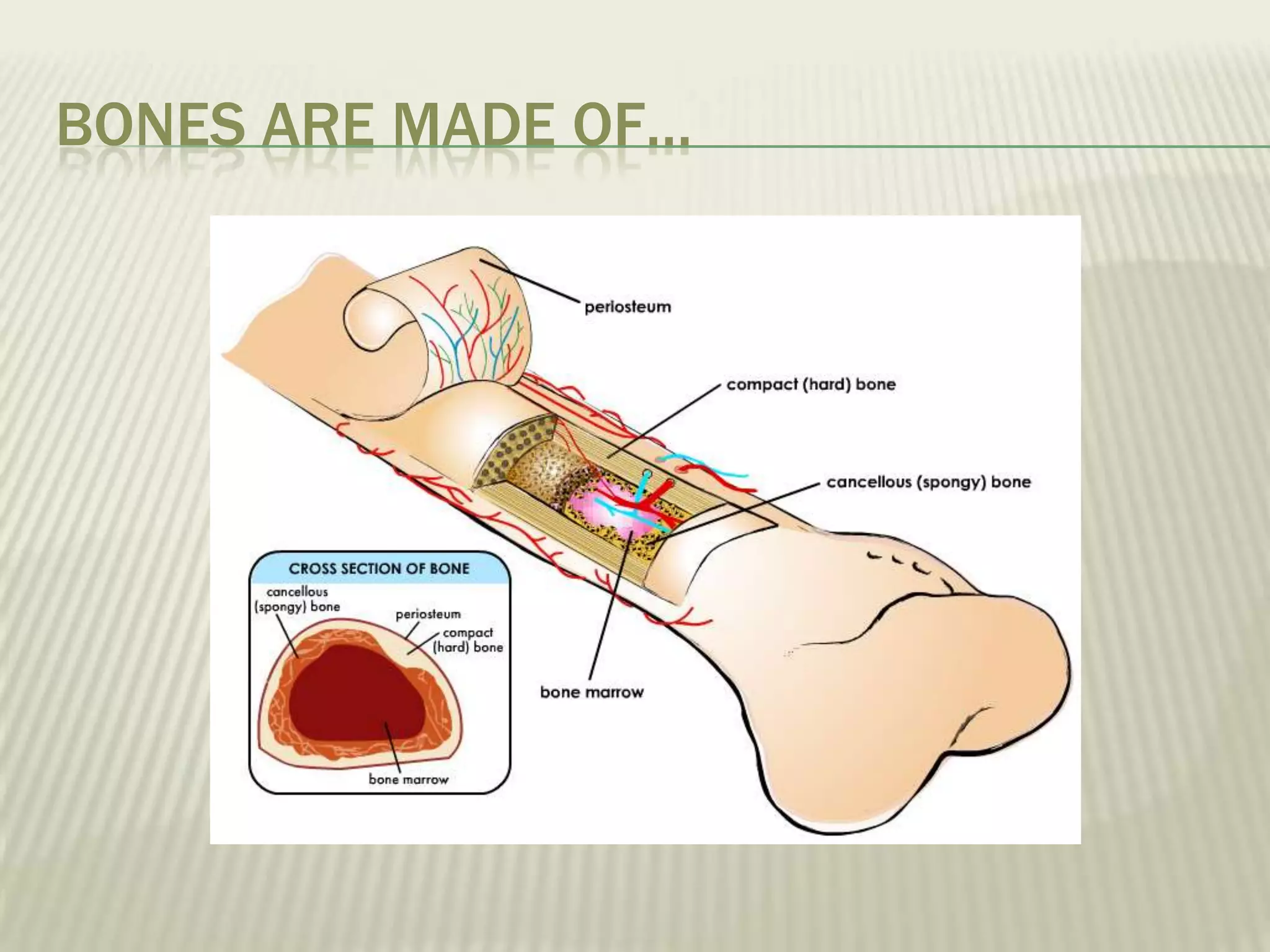
    Bones are made of bone cells that form bone tissue. These cells can
    grow and reproduce to repair broken bones.
THE SKELETON:

    Supports the body                       Protects the body’s soft


Your feets carry all the weight of your   The ribs protects organs like the heart or
                  body.                                     the lungs
BONES ARE MADE OF…
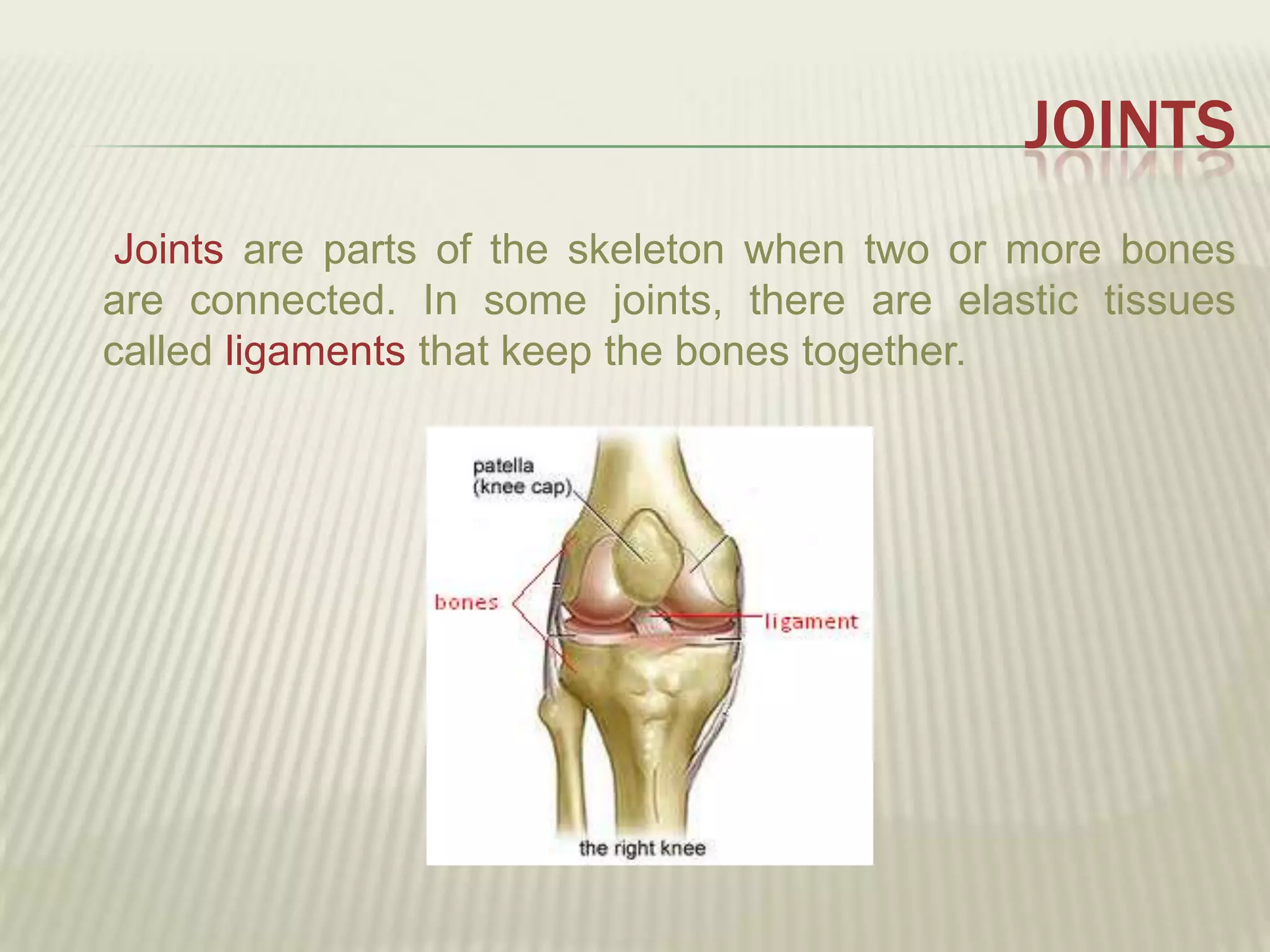
JOINTS
 Joints are parts of the skeleton when two or more bones
are connected. In some joints, there are elastic tissues
called ligaments that keep the bones together.
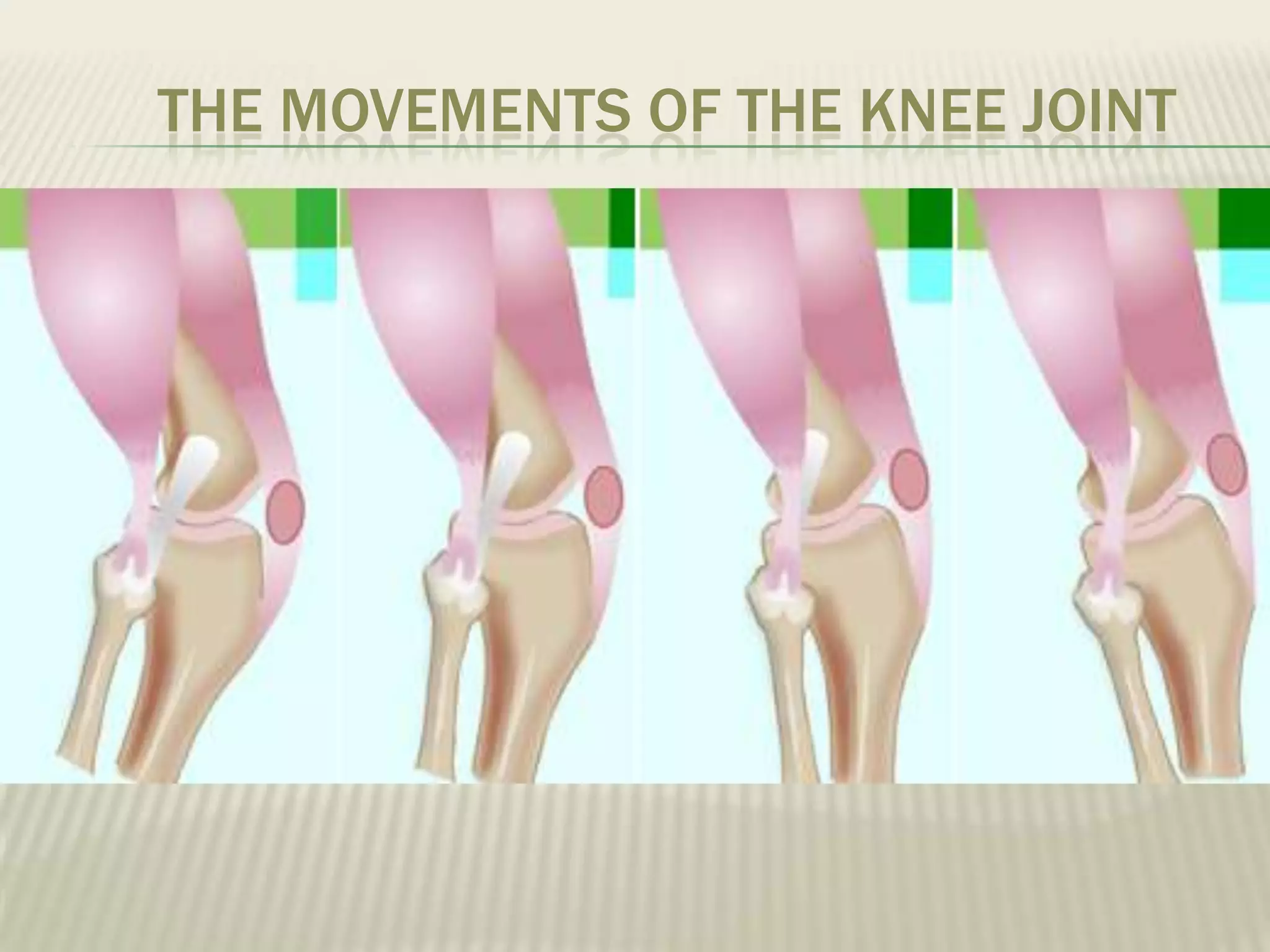
THE MOVEMENTS OF THE KNEE JOINT
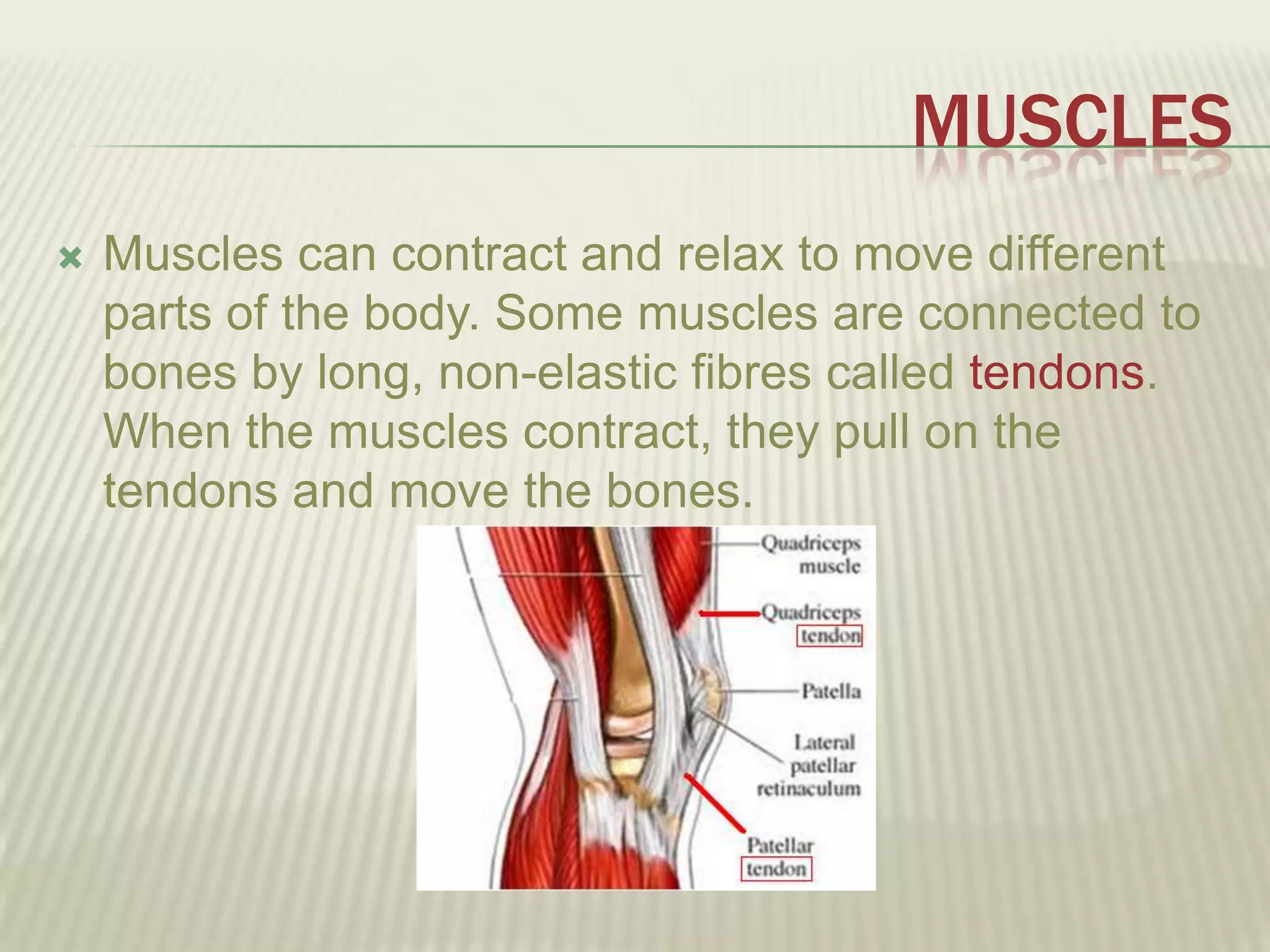
MUSCLES
   Muscles can contract and relax to move different
    parts of the body. Some muscles are connected to
    bones by long, non-elastic fibres called tendons.
    When the muscles contract, they pull on the
    tendons and move the bones.
THE HUMAN SKELETON
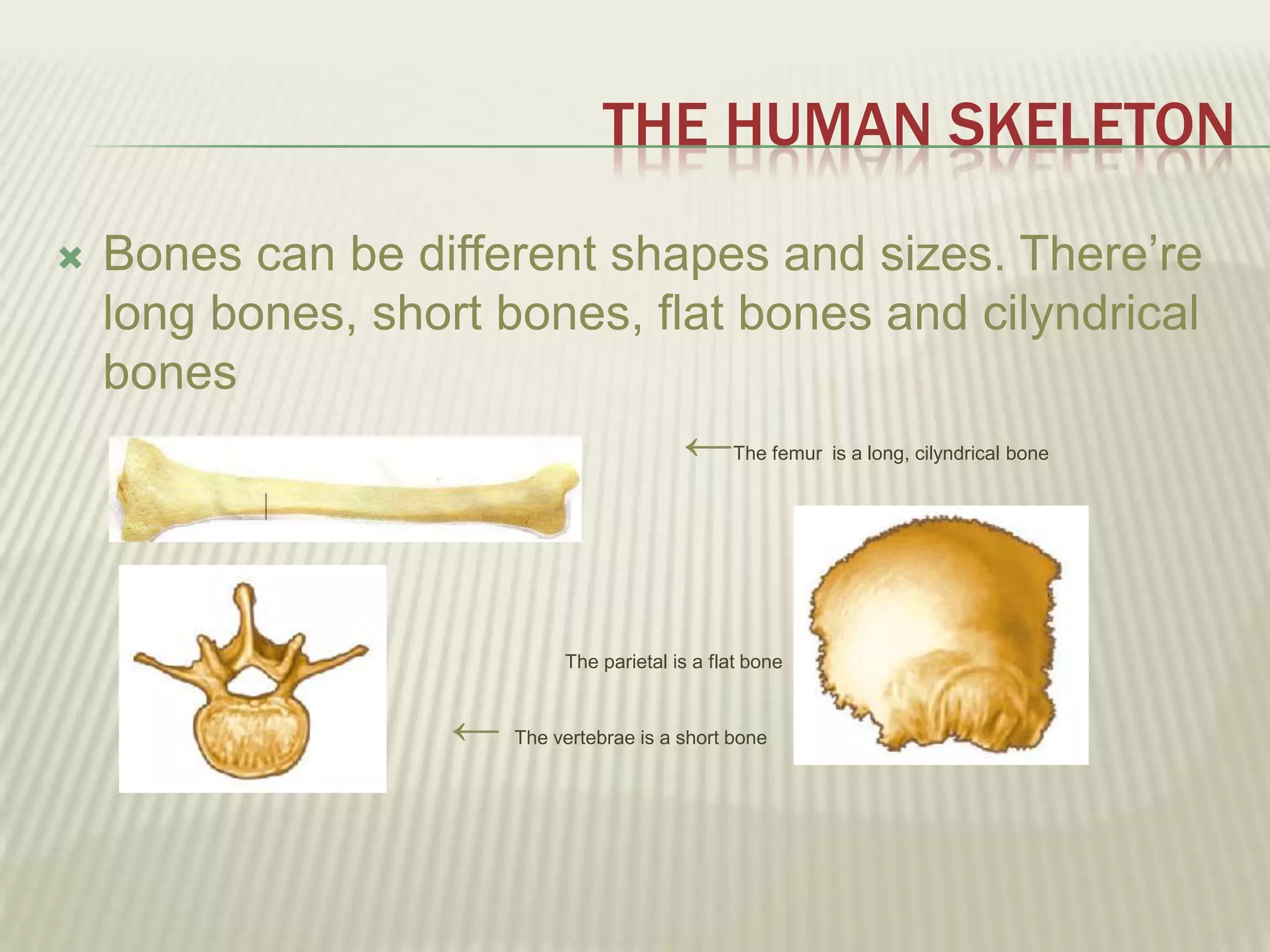
   Bones can be different shapes and sizes. There’re
    long bones, short bones, flat bones and cilyndrical
    bones
                               ←                 The femur is a long, cilyndrical bone


                             The parietal is a flat bone   →
                    ←   The vertebrae is a short bone
THE HUMAN SKELETON
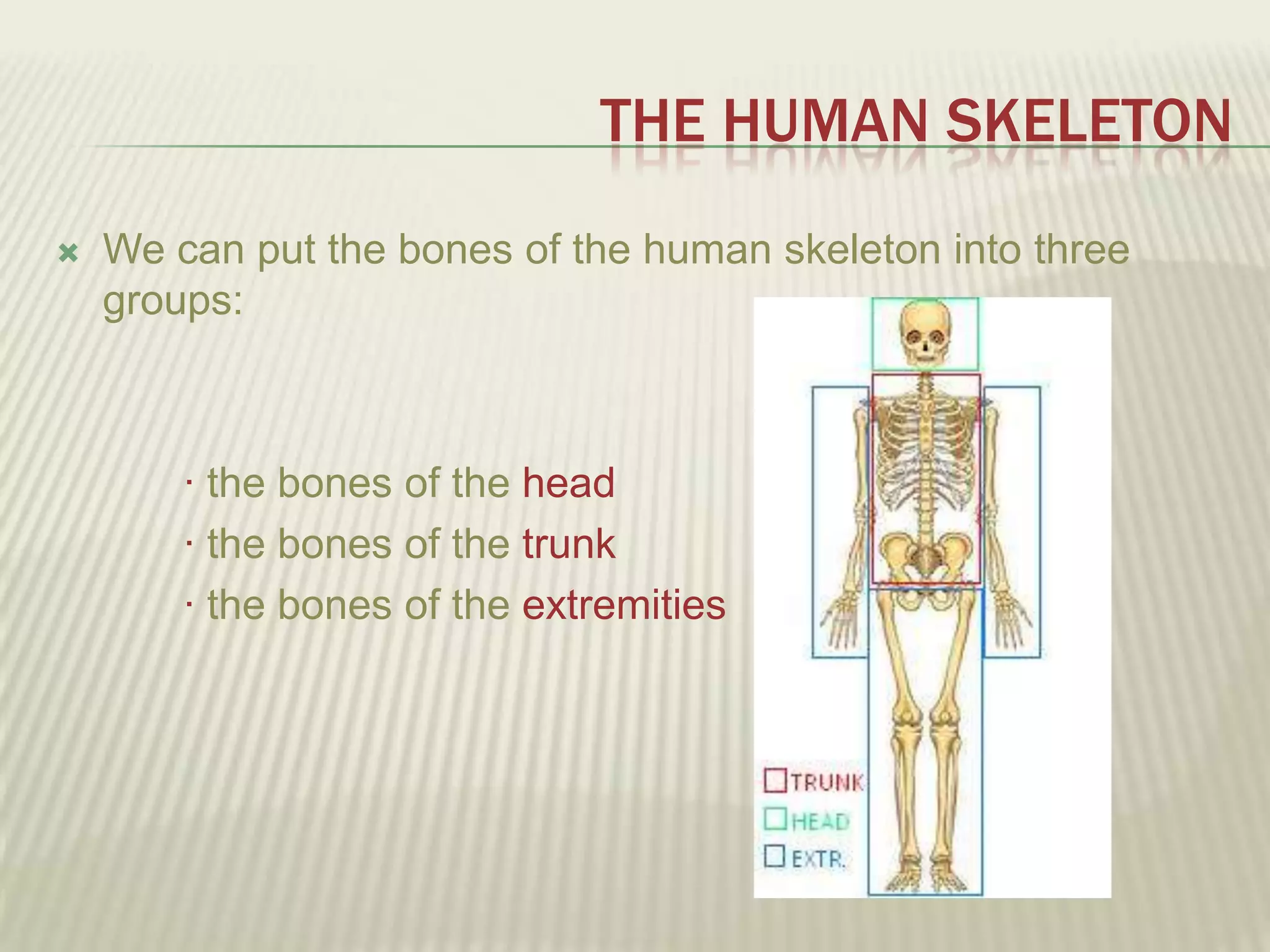
   We can put the bones of the human skeleton into three
    groups:


        · the bones of the head
        · the bones of the trunk
        · the bones of the extremities
THE HUMAN SKELETON
THE BONES OF THE HEAD
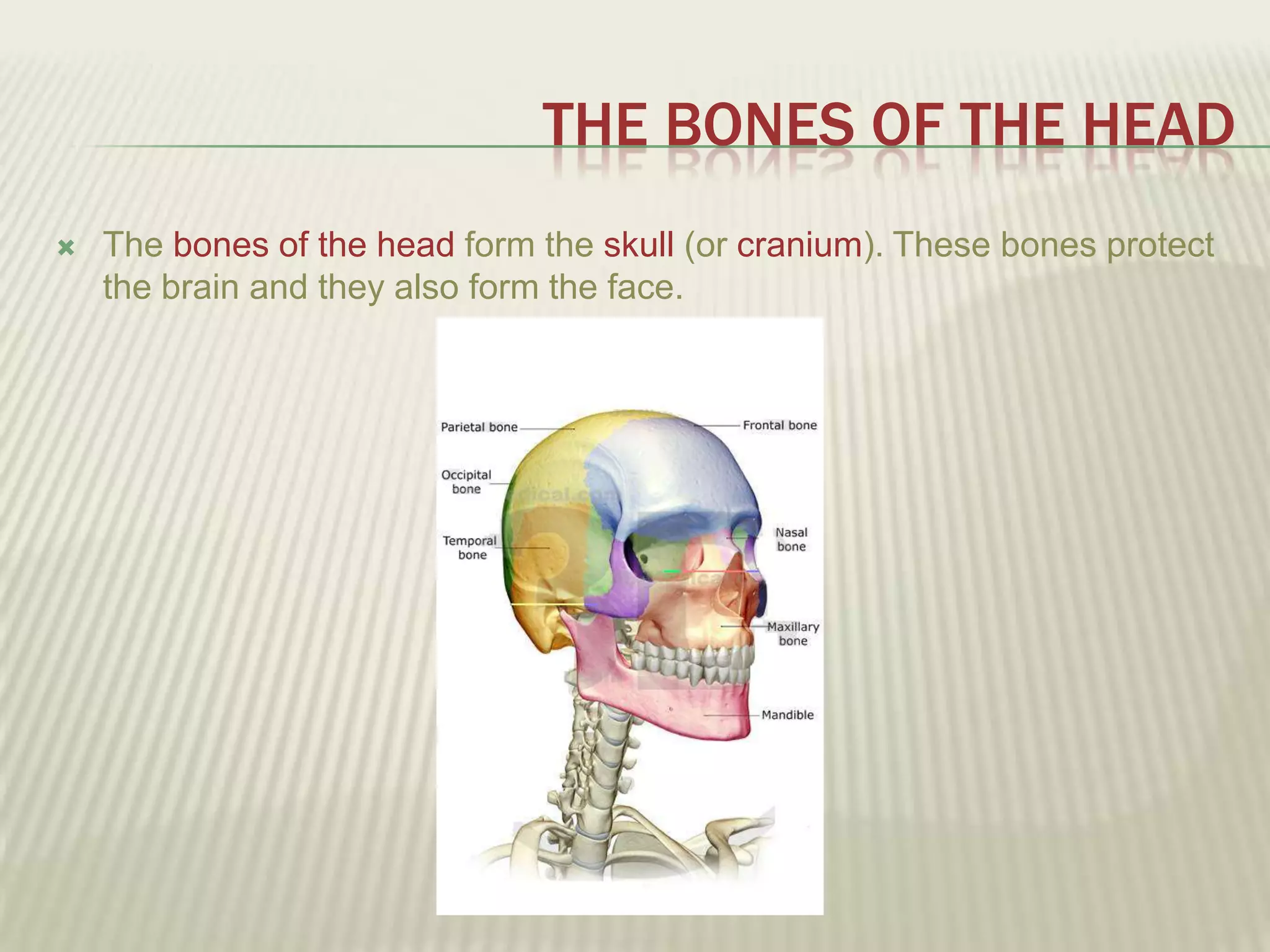
   The bones of the head form the skull (or cranium). These bones protect
    the brain and they also form the face.
THE BONES OF THE TRUNK
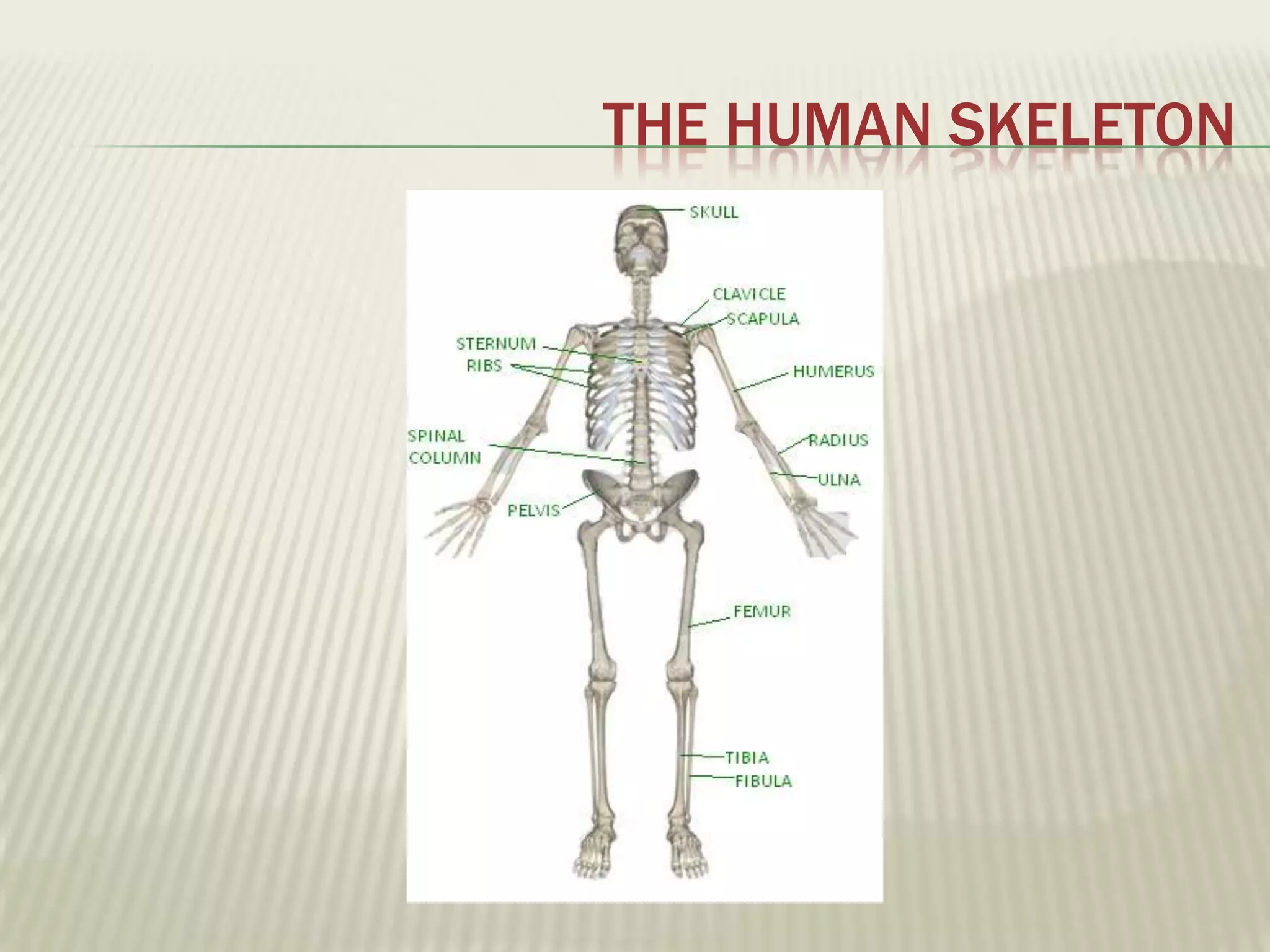
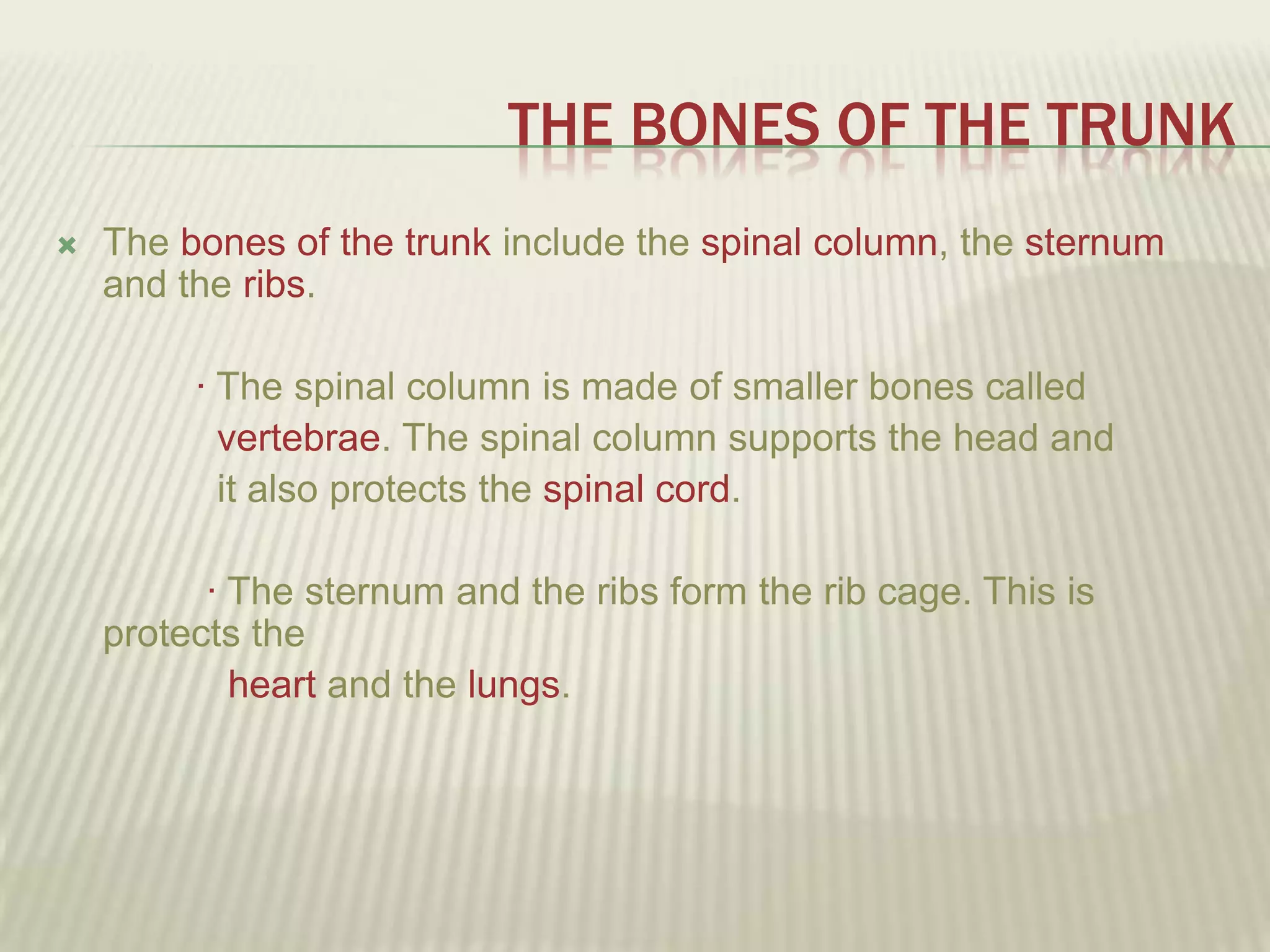
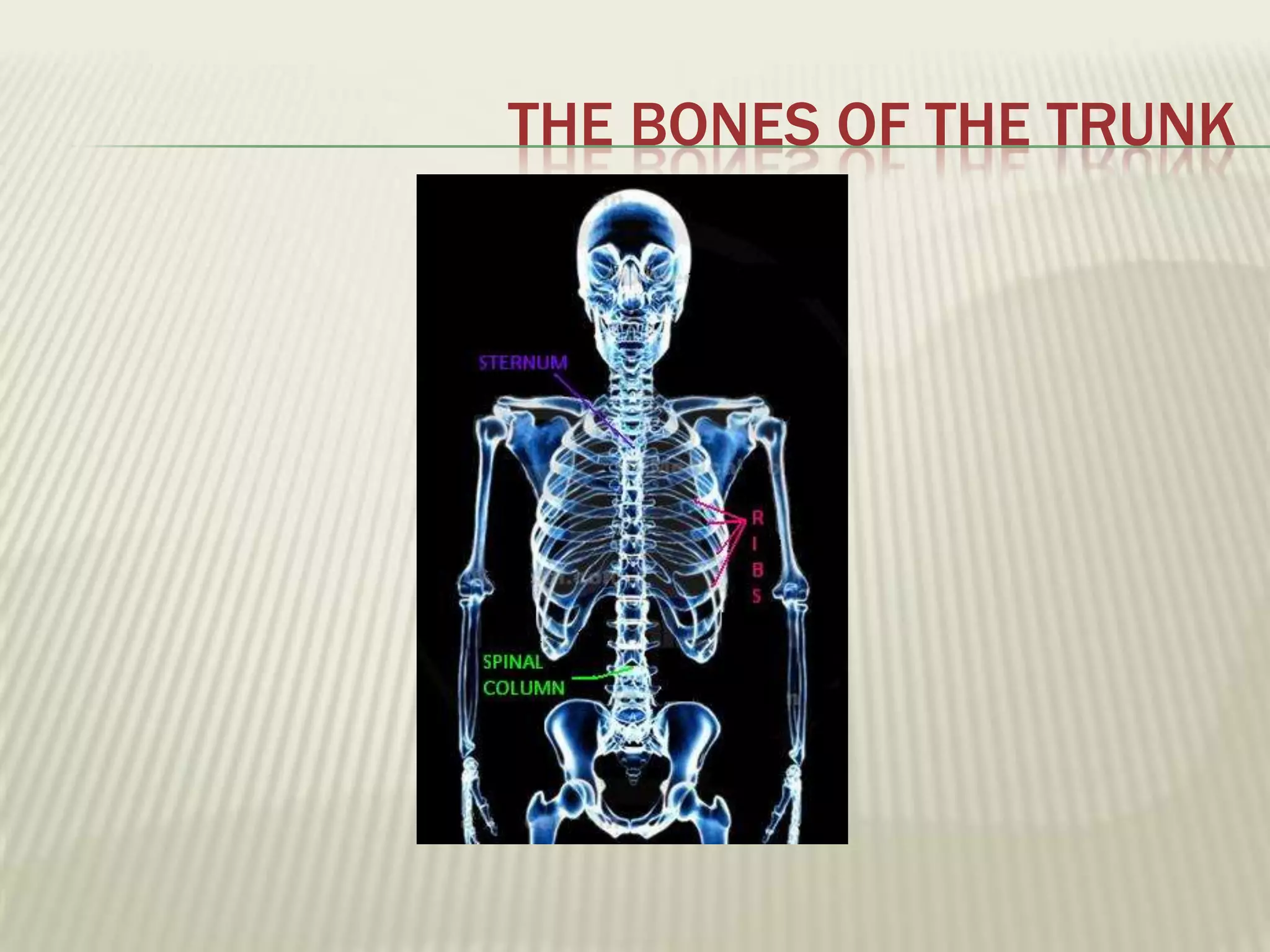
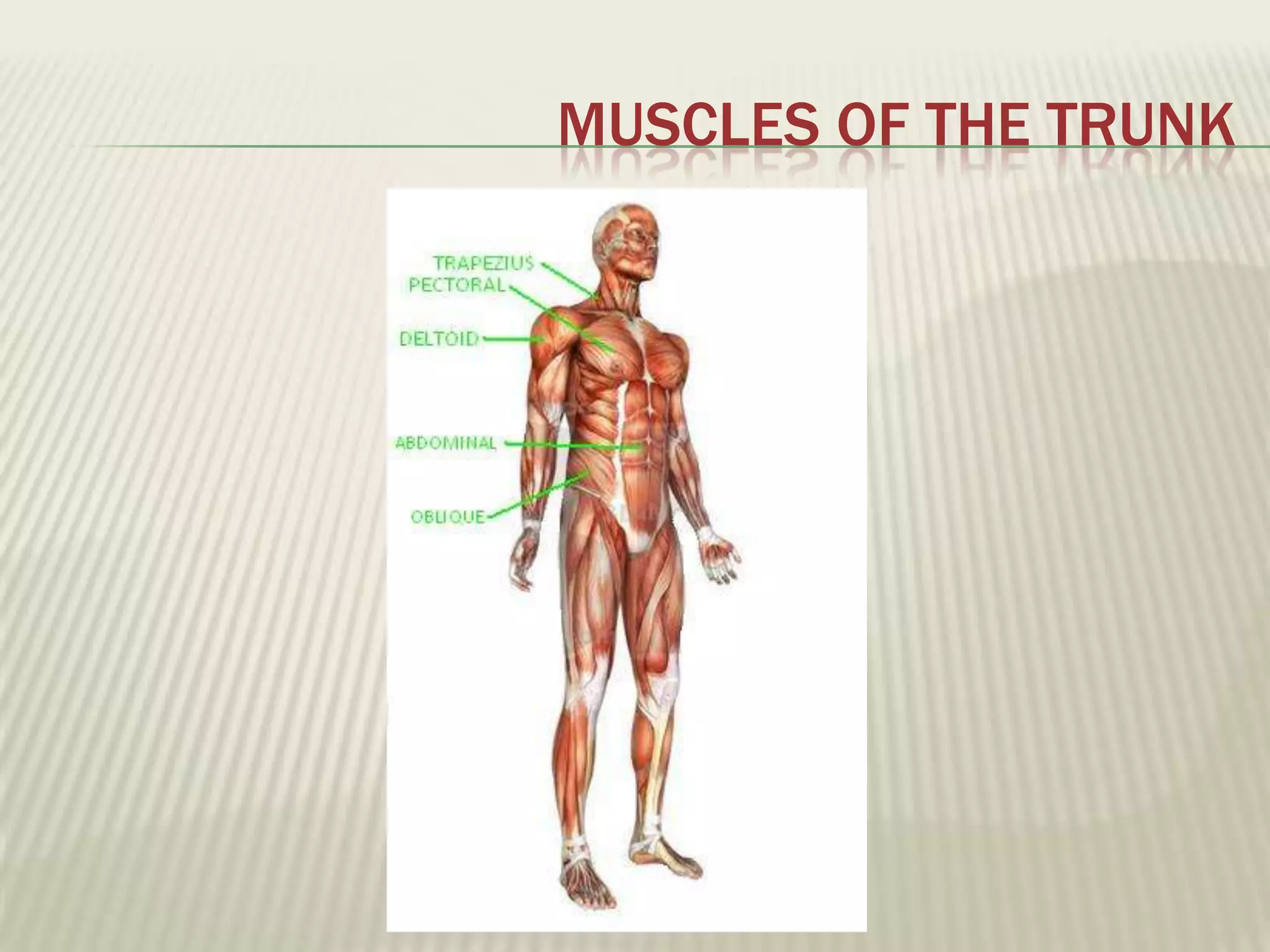
   The bones of the trunk include the spinal column, the sternum
    and the ribs.

         · The spinal column is made of smaller bones called
           vertebrae. The spinal column supports the head and
           it also protects the spinal cord.

          · The sternum and the ribs form the rib cage. This is
    protects the
            heart and the lungs.
THE BONES OF THE TRUNK
THE BONES OF THE EXTREMITIES
   Each upper extremity is connected to the trunk by: the
    clavicle at the front, and the scapula at the back.
   The bones of the upper extremities form the arms, hands
    and fingers.
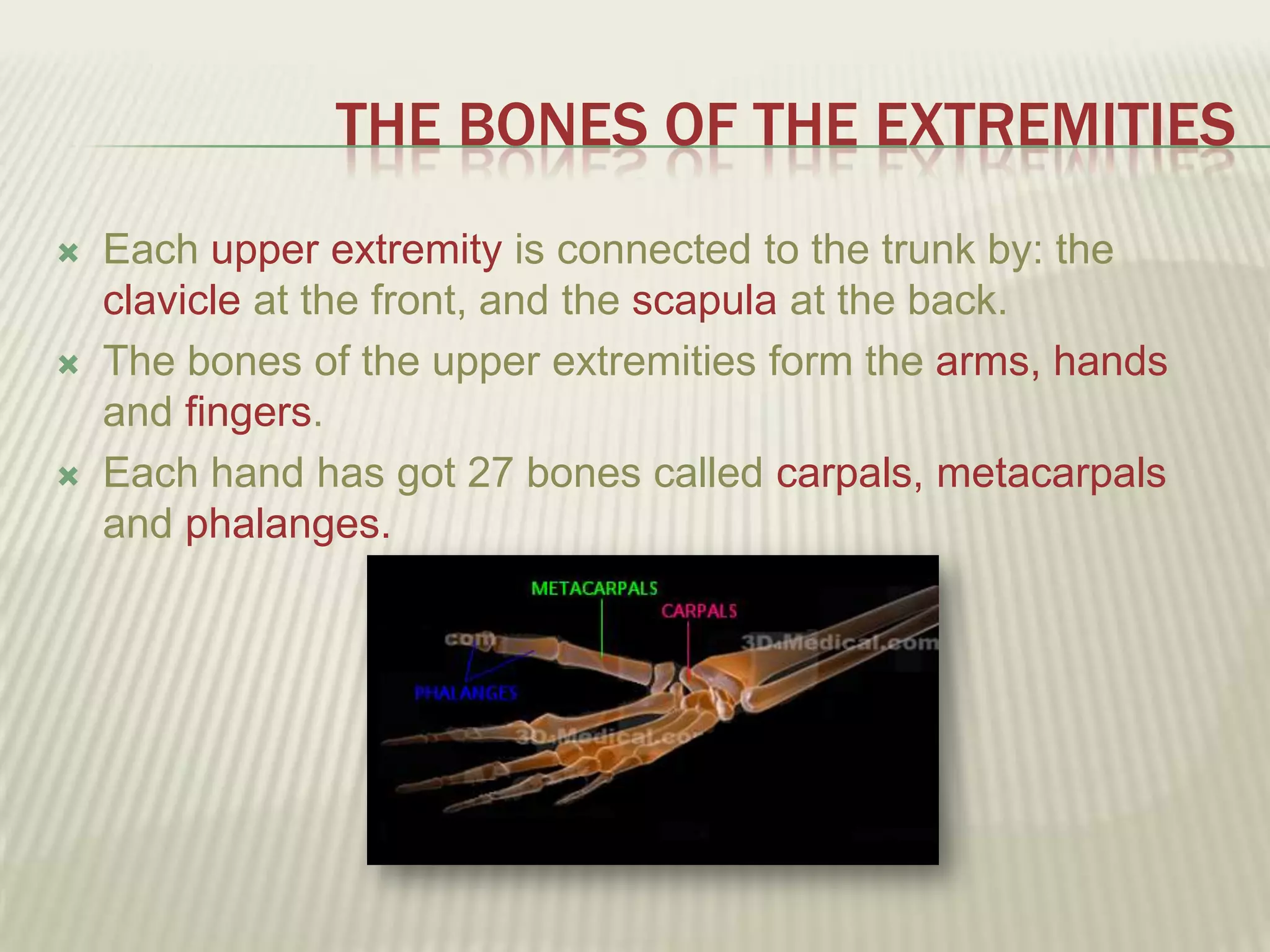
   Each hand has got 27 bones called carpals, metacarpals
    and phalanges.
THE BONES OF THE EXTREMITIES
   The lower extremities are connected to the trunk by the
    pelvis.
   The bones of the lower extremities form the legs, feets and
    toes.
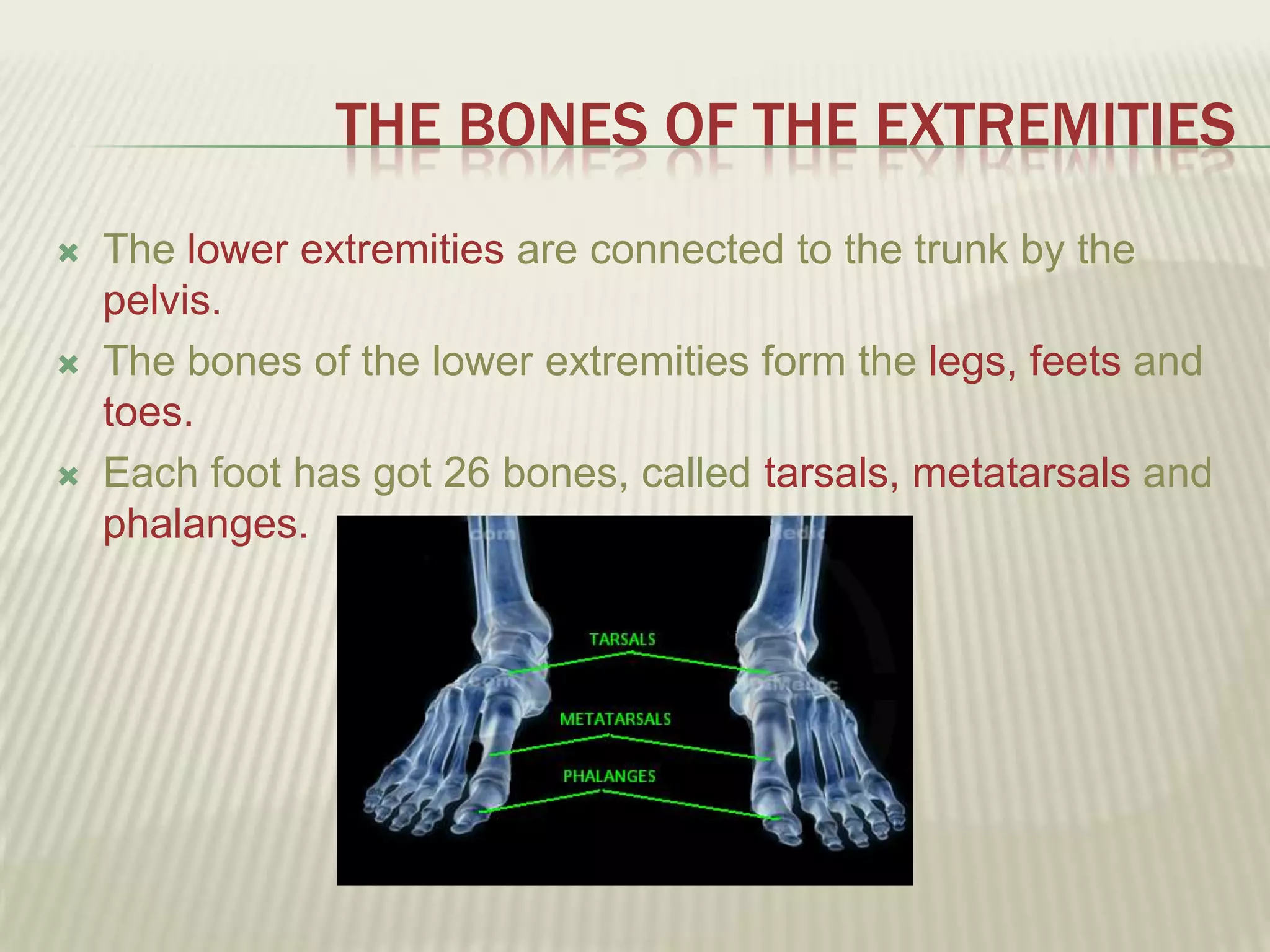
   Each foot has got 26 bones, called tarsals, metatarsals and
    phalanges.
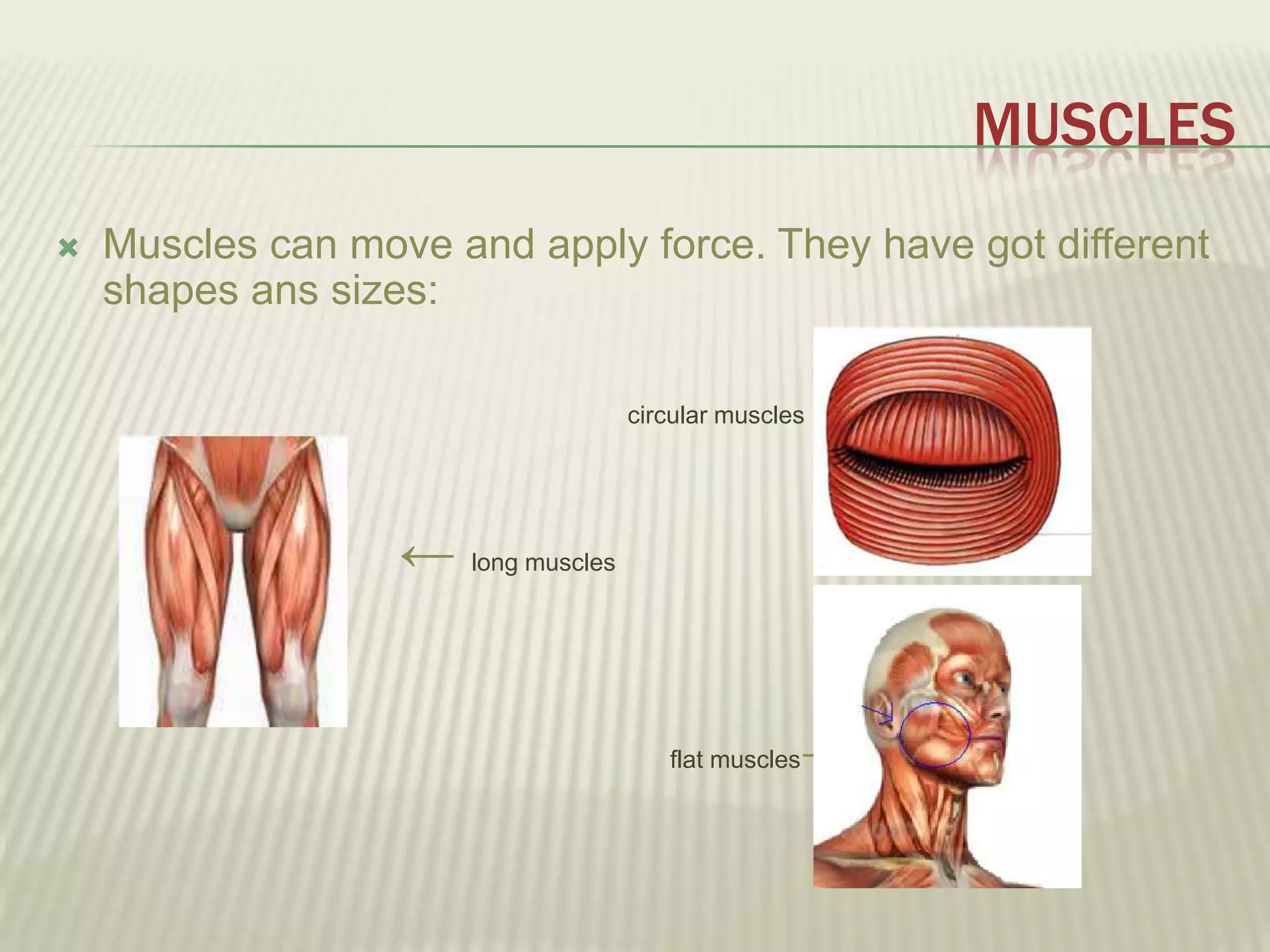
MUSCLES
   Muscles can move and apply force. They have got different
    shapes ans sizes:

                                    circular muscles   →

                   ← long muscles


                                       flat muscles   →
MUSCLES
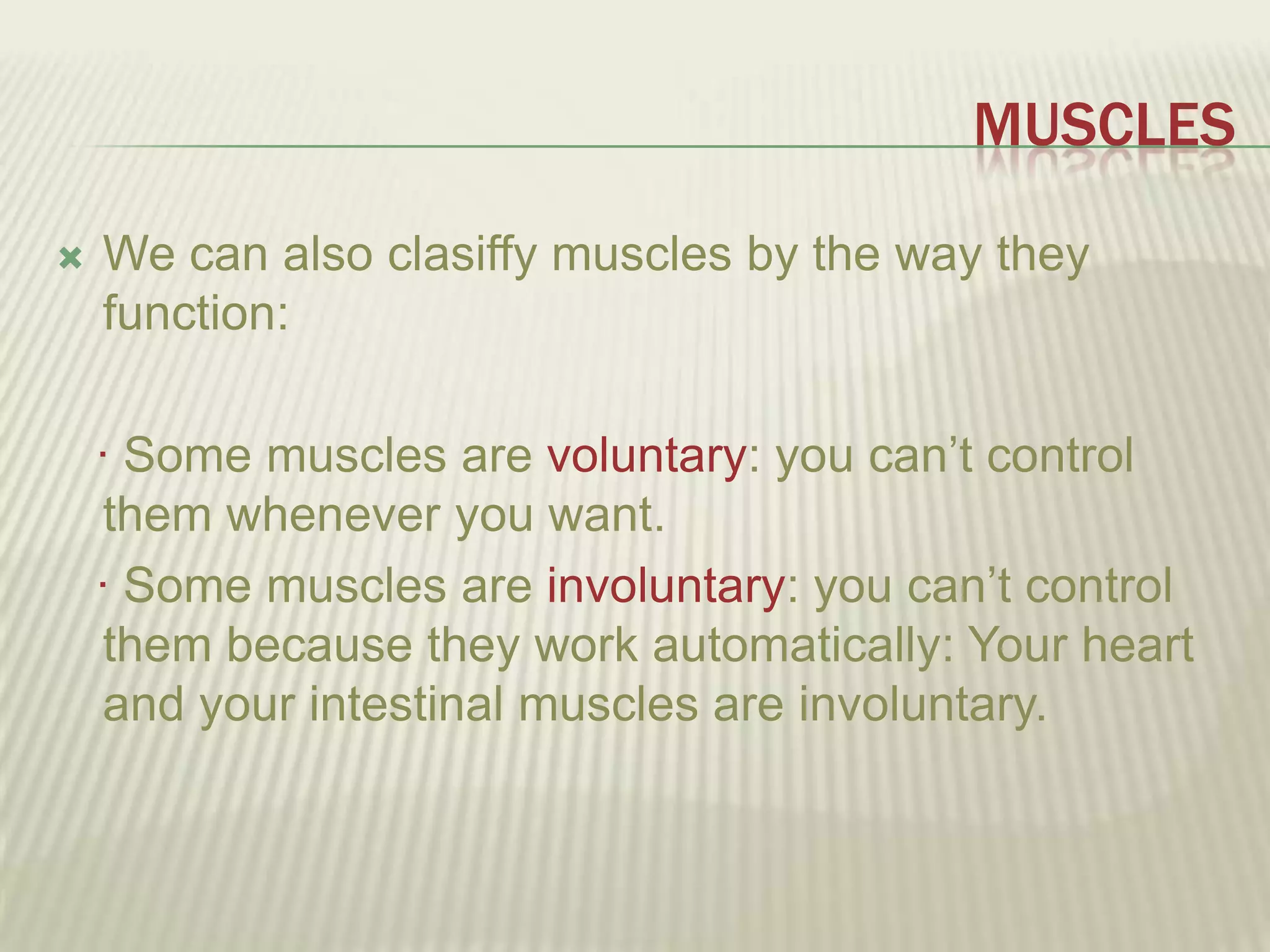
   We can also clasiffy muscles by the way they
    function:

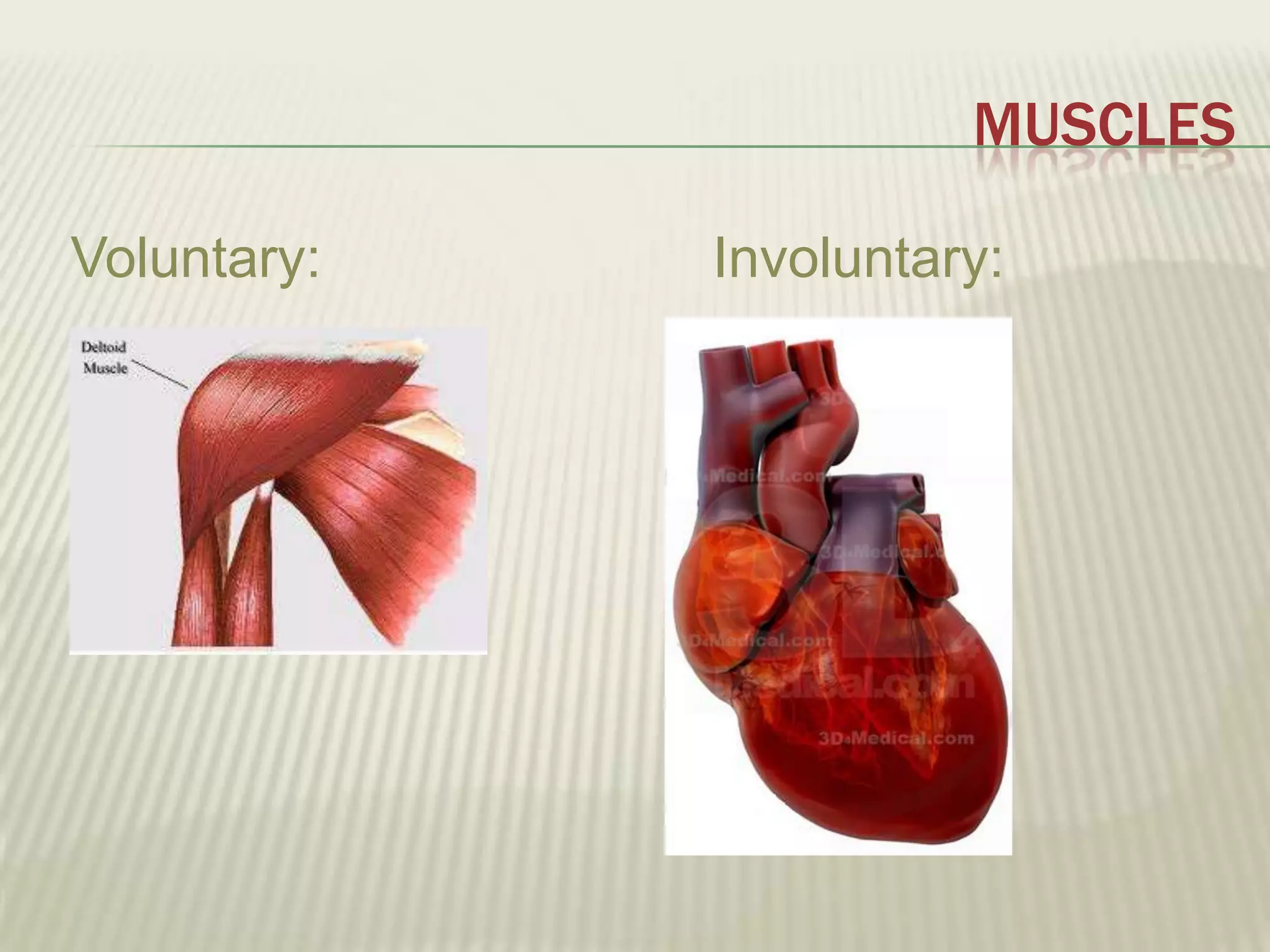
    · Some muscles are voluntary: you can’t control
    them whenever you want.
    · Some muscles are involuntary: you can’t control
    them because they work automatically: Your heart
    and your intestinal muscles are involuntary.
MUSCLES

Voluntary:   Involuntary:
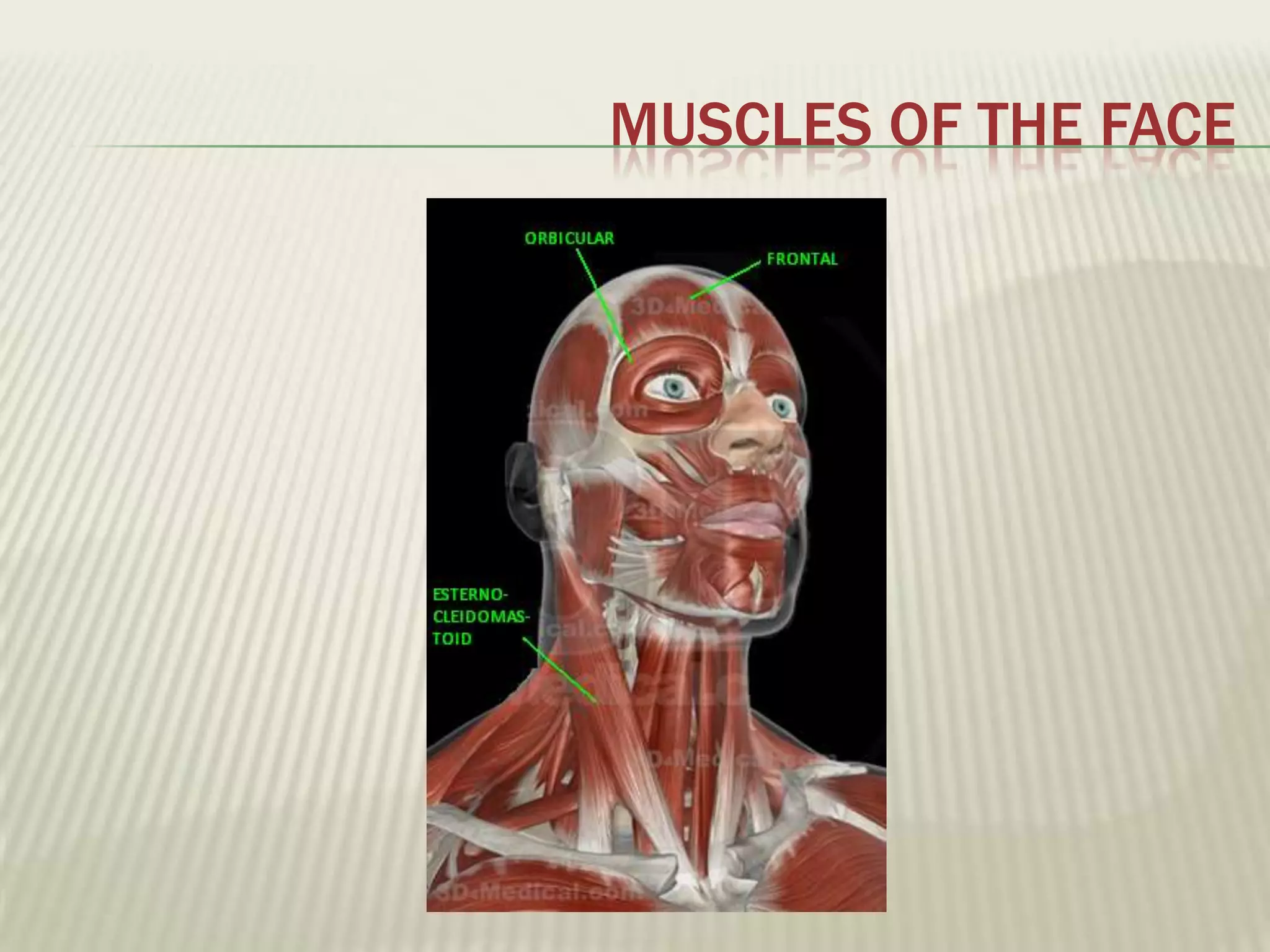
MUSCLES OF THE FACE
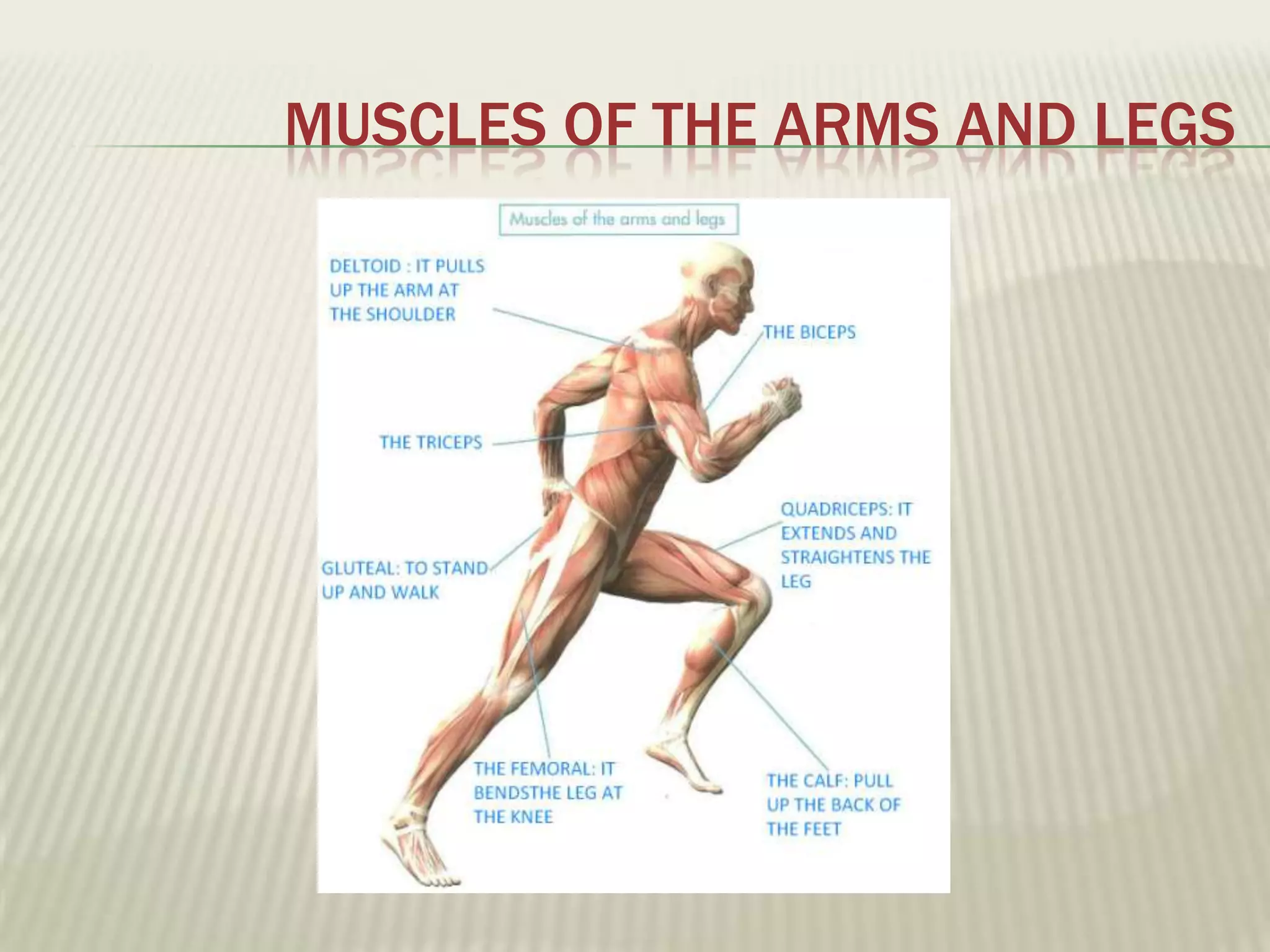
MUSCLES OF THE ARMS AND LEGS
MUSCLES OF THE TRUNK
JOINTS
   Joints are places when to or more bones are
    connected.
   We can clasiffy joints by how much they move:
     · Fixed joints can’y move.
     · Semi-moveable joints can’t move very much.
     · Moveable joints can move a lot. Inside this
       joints, there is a tough, flexible tissue called
       cartilage.
JOINTS

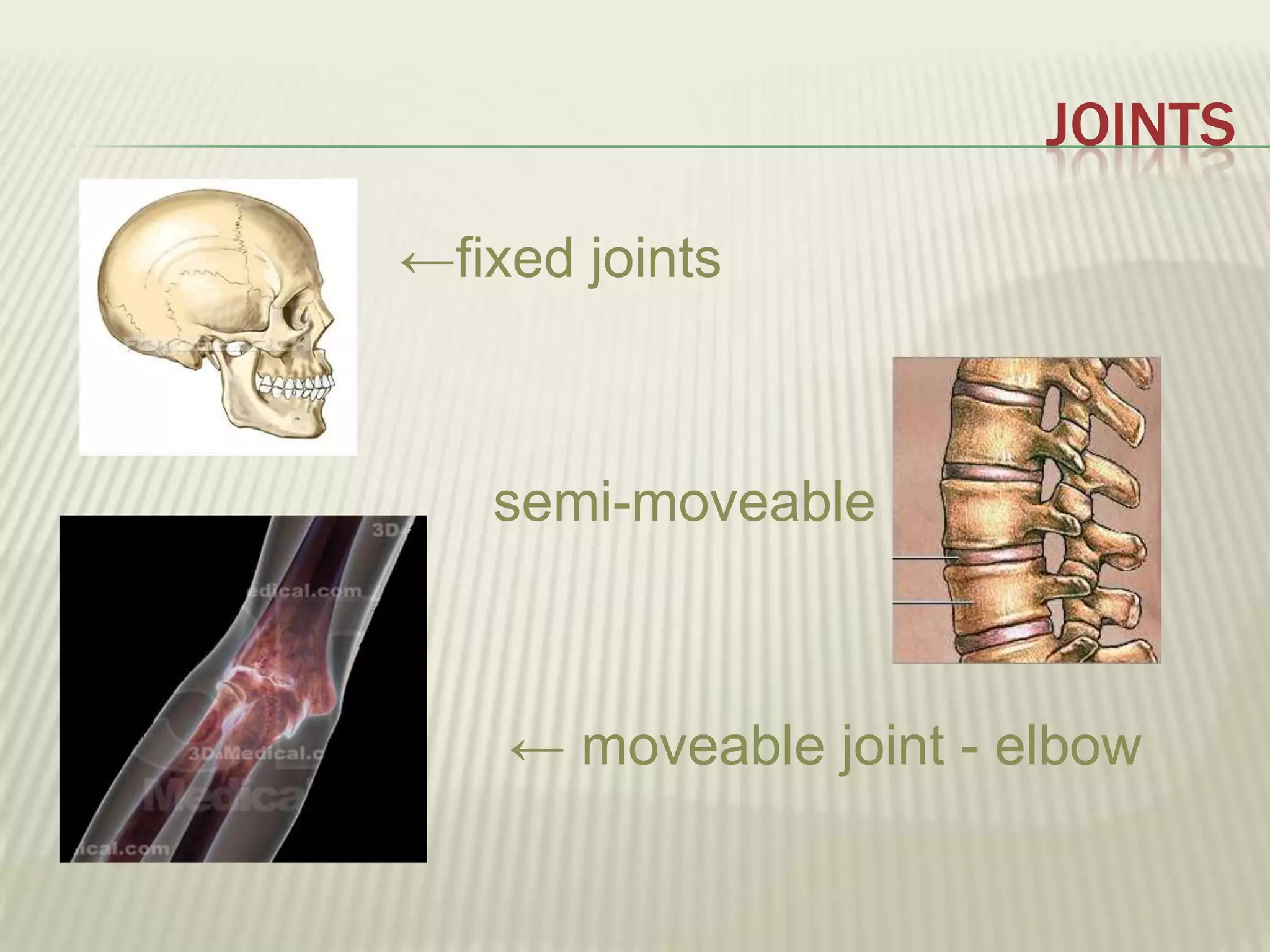
←fixed joints


   semi-moveable →


    ← moveable joint - elbow
JOINTS AND PAIRS OF MUSCLES


   Muscles often works togheter in
    pairs.They take turns contracting and
    relaxing. When one of the muscles
    contracts, it becomes shorter and pulls
    on the other muscles. At the same time,
    the other muscle relaxes and becomes
    longer.
A PROJECT BY…

Muscles and bones

  • 1.
    MUSCLES AND BONES The musculoskeletal system
  • 2.
    THE MUSCULOSKELETAL SYSTEM  The musculoskeletal system is composed of many muscles and bones. Its lets you move different parts of your body and get you around from one place to another. Garfield can runs with his musculoskeletal system
  • 3.
    THE FUNCTIONS OFTHE SKELETON  Humans have got an internal skeleton. It is made of 206 different bones. The skeleton perfoms three main functions: · Its supports the body and helps to keep its shape. · Its protects the body’s soft, internal organs. · It is connected to muscles that move the different bones. Bones are made of bone cells that form bone tissue. These cells can grow and reproduce to repair broken bones.
  • 4.
    THE SKELETON: Supports the body Protects the body’s soft Your feets carry all the weight of your The ribs protects organs like the heart or body. the lungs
  • 5.
  • 6.
    JOINTS Joints areparts of the skeleton when two or more bones are connected. In some joints, there are elastic tissues called ligaments that keep the bones together.
  • 7.
    THE MOVEMENTS OFTHE KNEE JOINT
  • 8.
    MUSCLES  Muscles can contract and relax to move different parts of the body. Some muscles are connected to bones by long, non-elastic fibres called tendons. When the muscles contract, they pull on the tendons and move the bones.
  • 9.
    THE HUMAN SKELETON  Bones can be different shapes and sizes. There’re long bones, short bones, flat bones and cilyndrical bones ← The femur is a long, cilyndrical bone The parietal is a flat bone → ← The vertebrae is a short bone
  • 10.
    THE HUMAN SKELETON  We can put the bones of the human skeleton into three groups: · the bones of the head · the bones of the trunk · the bones of the extremities
  • 11.
  • 12.
    THE BONES OFTHE HEAD  The bones of the head form the skull (or cranium). These bones protect the brain and they also form the face.
  • 13.
    THE BONES OFTHE TRUNK  The bones of the trunk include the spinal column, the sternum and the ribs. · The spinal column is made of smaller bones called vertebrae. The spinal column supports the head and it also protects the spinal cord. · The sternum and the ribs form the rib cage. This is protects the heart and the lungs.
  • 14.
    THE BONES OFTHE TRUNK
  • 15.
    THE BONES OFTHE EXTREMITIES  Each upper extremity is connected to the trunk by: the clavicle at the front, and the scapula at the back.  The bones of the upper extremities form the arms, hands and fingers.  Each hand has got 27 bones called carpals, metacarpals and phalanges.
  • 16.
    THE BONES OFTHE EXTREMITIES  The lower extremities are connected to the trunk by the pelvis.  The bones of the lower extremities form the legs, feets and toes.  Each foot has got 26 bones, called tarsals, metatarsals and phalanges.
  • 17.
    MUSCLES  Muscles can move and apply force. They have got different shapes ans sizes: circular muscles → ← long muscles flat muscles →
  • 18.
    MUSCLES  We can also clasiffy muscles by the way they function: · Some muscles are voluntary: you can’t control them whenever you want. · Some muscles are involuntary: you can’t control them because they work automatically: Your heart and your intestinal muscles are involuntary.
  • 19.
    MUSCLES Voluntary: Involuntary:
  • 20.
  • 21.
    MUSCLES OF THEARMS AND LEGS
  • 22.
  • 23.
    JOINTS  Joints are places when to or more bones are connected.  We can clasiffy joints by how much they move: · Fixed joints can’y move. · Semi-moveable joints can’t move very much. · Moveable joints can move a lot. Inside this joints, there is a tough, flexible tissue called cartilage.
  • 24.
    JOINTS ←fixed joints semi-moveable → ← moveable joint - elbow
  • 25.
    JOINTS AND PAIRSOF MUSCLES  Muscles often works togheter in pairs.They take turns contracting and relaxing. When one of the muscles contracts, it becomes shorter and pulls on the other muscles. At the same time, the other muscle relaxes and becomes longer.
  • 26.