Skeletal & Muscular
Considerations for Movement
Kinesiology
RHS 341
Lecture 3
Dr. Einas Al-Eisa
The kinetic chain concept
• Extremities consist of several bony
segments linked by a series of joints
Chain
1) Open-kinetic chain
• When the distal end of the extremity is not
fixed to any surface.
• Allows any joint in the extremity to move
without causing movement in the other
joints.
• Example: shoulder shrug
2) Closed-kinetic chain
• When the distal end of the extremity is
fixed to a surface.
• Movement of one joint can not occur
without causing predictable movements of
the other joint in the extremity.
• Example: push-up
Why learn kinetic chain?
• For determining appropriate conditioning
exercises to improve function.
• Open-chain usually isolate one segment,
while closed-chain exercises work all
segments in the chain, resulting in
conditioning of the muscles crossing each
joint.
Kinetic chain
• Most sports involve closed-kinetic chain
activities in the lower limb, and open-
kinetic chain in the upper limb.
Kinematic chain
• Derived from combining degrees of
freedom at various joints to produce
movement.
• = the summation of the degrees of
freedom in adjacent joints that identifies
the total degrees of freedom available or
necessary for the performance of a
movement.
Muscle attachment
• A muscle typically attaches to a bone at
both ends.
• Origin= proximal attachment
• Insertion = distal attachment
• Muscles pull equally on both ends (both
attachment sites receive equal force).
Muscle attachment
• Both muscle ends can move depending on
the activity….
• Example: Psoas major
¾leg raise (hip flexion)
¾sit-up (trunk flexion)
Muscular contraction
• = active shortening of a muscle with the
distance between the two muscle
attachments decreasing
• But, muscles also produce force while
lengthening….
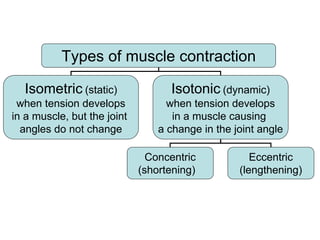
Types of muscle contraction
Isometric (static)
when tension develops
in a muscle, but the joint
angles do not change
Isotonic (dynamic)
when tension develops
in a muscle causing
a change in the joint angle
Concentric
(shortening)
Eccentric
(lengthening)
Isometric contraction
• Static
• Muscle force = resistance force
• Muscle tension with NO change in:
– Joint angle
– Muscle length
Isotonic contraction
• Dynamic
• Muscle force greater OR less than
resistance force
• Muscle tension with a change in:
– Joint angle
– Muscle length (shortening or lengthening)
Isotonic contraction
1) Concentric contraction
• Causes the body part to move against
gravity or resistance.
• Muscle force greater than resistance force
• Muscle tension with a change in:
– Joint angle
– Muscle length (shortening)
Isotonic contraction
2) Eccentric contraction
• Control the movement with gravity or
resistance.
• Muscle force less than resistance force
• Muscle tension with a change in:
– Joint angle
– Muscle length (lengthening)
Internal vs. external force
• Concentric contraction: internal forces
produced by the muscles are greater than
the external forces applied
• Eccentric contraction : external forces are
greater than the internal force
Contraction & movement
• Concentric contraction:
¾movement occurs against gravity
¾joint moves towards the inner range
• Eccentric contraction:
¾movement occurs slowly in the direction of
gravity
¾joint moves towards its outer range
Muscle force
• Concentric contraction: produce the lowest
magnitude of muscle force………why???
• Eccentric contraction: produce the highest
magnitude of the muscular force
Note
• If a movement occurs in certain direction,
slowly towards gravity, the group of
muscles that is opposite to this direction is
acting in an eccentric contraction.
Example
• Elbow extension in the direction of gravity:
• What is the acting muscle group?
Isometric contraction
• The overall muscle length does not change
• The internal force produced by the muscle
equals the effects of the external forces
• No joint movement is produced
• No mechanical work is done, but fatigue
develops…why??
• Produce intermediate magnitude of muscle
force
Isokinetic exercises
• Specific technique of exercise that may
use any of the muscle contractions.
• = dynamic exercise using concentric
and/or eccentric muscle contraction in
which (throughout the movement):
¾the speed (or velocity) is constant
¾muscle contraction ideally maximum
Isokinetic exercises
• Procedure: The subject is positioned so
that the body movement to be measured is
isolated. The equipment is then set at
different speeds and the force applied can
be measured throughout the range of
movement.
Isokinetic exercises
• Results: The results are often reported at
different speeds so that a
speed/strength/power relationship can
be seen. Comparison of the relative
strengths of the different sides of the body,
or agonists/antagonists
(quads/hamstrings) can show specific
limitations.
Isokinetic exercises
• Equipment required: Isokinetic testing
equipment (e.g. Biodex, Cybex)
• Advantages: nearly any joint action can
be tested by the adjustment of the
equipment.
• Disadvantages: the equipment required is
bulky and expensive.
Passive movement
• Occurs without any muscle contraction.
• = movement produced by external forces
such as those applied by a therapist,
resistance, or the force of gravity.

musculoskeletal considerations.pdf

  • 1.
    Skeletal & Muscular Considerationsfor Movement Kinesiology RHS 341 Lecture 3 Dr. Einas Al-Eisa
  • 2.
    The kinetic chainconcept • Extremities consist of several bony segments linked by a series of joints Chain
  • 3.
    1) Open-kinetic chain •When the distal end of the extremity is not fixed to any surface. • Allows any joint in the extremity to move without causing movement in the other joints. • Example: shoulder shrug
  • 4.
    2) Closed-kinetic chain •When the distal end of the extremity is fixed to a surface. • Movement of one joint can not occur without causing predictable movements of the other joint in the extremity. • Example: push-up
  • 5.
    Why learn kineticchain? • For determining appropriate conditioning exercises to improve function. • Open-chain usually isolate one segment, while closed-chain exercises work all segments in the chain, resulting in conditioning of the muscles crossing each joint.
  • 6.
    Kinetic chain • Mostsports involve closed-kinetic chain activities in the lower limb, and open- kinetic chain in the upper limb.
  • 7.
    Kinematic chain • Derivedfrom combining degrees of freedom at various joints to produce movement. • = the summation of the degrees of freedom in adjacent joints that identifies the total degrees of freedom available or necessary for the performance of a movement.
  • 14.
    Muscle attachment • Amuscle typically attaches to a bone at both ends. • Origin= proximal attachment • Insertion = distal attachment • Muscles pull equally on both ends (both attachment sites receive equal force).
  • 16.
    Muscle attachment • Bothmuscle ends can move depending on the activity…. • Example: Psoas major ¾leg raise (hip flexion) ¾sit-up (trunk flexion)
  • 18.
    Muscular contraction • =active shortening of a muscle with the distance between the two muscle attachments decreasing • But, muscles also produce force while lengthening….
  • 19.
    Types of musclecontraction Isometric (static) when tension develops in a muscle, but the joint angles do not change Isotonic (dynamic) when tension develops in a muscle causing a change in the joint angle Concentric (shortening) Eccentric (lengthening)
  • 20.
    Isometric contraction • Static •Muscle force = resistance force • Muscle tension with NO change in: – Joint angle – Muscle length
  • 21.
    Isotonic contraction • Dynamic •Muscle force greater OR less than resistance force • Muscle tension with a change in: – Joint angle – Muscle length (shortening or lengthening)
  • 22.
    Isotonic contraction 1) Concentriccontraction • Causes the body part to move against gravity or resistance. • Muscle force greater than resistance force • Muscle tension with a change in: – Joint angle – Muscle length (shortening)
  • 23.
    Isotonic contraction 2) Eccentriccontraction • Control the movement with gravity or resistance. • Muscle force less than resistance force • Muscle tension with a change in: – Joint angle – Muscle length (lengthening)
  • 24.
    Internal vs. externalforce • Concentric contraction: internal forces produced by the muscles are greater than the external forces applied • Eccentric contraction : external forces are greater than the internal force
  • 25.
    Contraction & movement •Concentric contraction: ¾movement occurs against gravity ¾joint moves towards the inner range • Eccentric contraction: ¾movement occurs slowly in the direction of gravity ¾joint moves towards its outer range
  • 26.
    Muscle force • Concentriccontraction: produce the lowest magnitude of muscle force………why??? • Eccentric contraction: produce the highest magnitude of the muscular force
  • 27.
    Note • If amovement occurs in certain direction, slowly towards gravity, the group of muscles that is opposite to this direction is acting in an eccentric contraction.
  • 28.
    Example • Elbow extensionin the direction of gravity: • What is the acting muscle group?
  • 29.
    Isometric contraction • Theoverall muscle length does not change • The internal force produced by the muscle equals the effects of the external forces • No joint movement is produced • No mechanical work is done, but fatigue develops…why?? • Produce intermediate magnitude of muscle force
  • 30.
    Isokinetic exercises • Specifictechnique of exercise that may use any of the muscle contractions. • = dynamic exercise using concentric and/or eccentric muscle contraction in which (throughout the movement): ¾the speed (or velocity) is constant ¾muscle contraction ideally maximum
  • 31.
    Isokinetic exercises • Procedure:The subject is positioned so that the body movement to be measured is isolated. The equipment is then set at different speeds and the force applied can be measured throughout the range of movement.
  • 32.
    Isokinetic exercises • Results:The results are often reported at different speeds so that a speed/strength/power relationship can be seen. Comparison of the relative strengths of the different sides of the body, or agonists/antagonists (quads/hamstrings) can show specific limitations.
  • 33.
    Isokinetic exercises • Equipmentrequired: Isokinetic testing equipment (e.g. Biodex, Cybex) • Advantages: nearly any joint action can be tested by the adjustment of the equipment. • Disadvantages: the equipment required is bulky and expensive.
  • 34.
    Passive movement • Occurswithout any muscle contraction. • = movement produced by external forces such as those applied by a therapist, resistance, or the force of gravity.