STRUCTURE AND FUNCTION
OF MUSCLE
Dr Tabassum Saher
Assistant Professor
SOP
, DPSRU
New Delhi
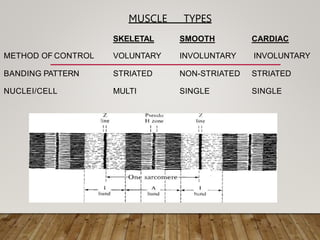
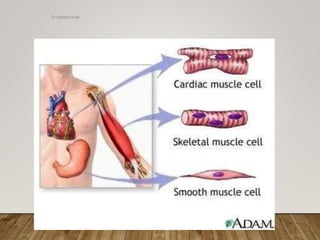
SKELETAL SMOOTH CARDIAC
METHOD OF CONTROL VOLUNTARY INVOLUNTARY INVOLUNTARY
BANDING PATTERN STRIATED NON-STRIATED STRIATED
NUCLEI/CELL MULTI SINGLE SINGLE
MUSCLE TYPES
Dr ManishKumar
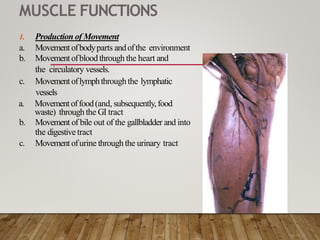
MUSCLE FUNCTIONS
1. Production of Movement
a. Movementofbodyparts andofthe environment
b. Movementofbloodthroughthe heart and
the circulatory vessels.
c. Movementoflymphthroughthe lymphatic
vessels
a. Movementoffood(and, subsequently,food
waste) throughthe GI tract
b. Movement of bile out of the gallbladder and into
the digestivetract
c. Movementofurine throughthe urinary tract
2. Maintenance ofposture
– Musclecontraction isconstantly allowingusto remain
upright.
– Themusclesofour neckare keepingour headup.
–Aswestand, our legmuscles keepuson two feet.
3.Thermogenesis
– Generation ofheat. Occurs viashivering– aninvoluntary
contraction ofskeletal muscle.
CHARACTERISTICS OF MUSCLE TISSUE
1. Excitability
– Theability to receive andrespond to astimulus
• Inskeletalmuscle, the stimulusisaneurotransmitter (chemical signal)
release byaneuron (nerve cell).
• Insmooth muscle, the stimuluscould be aneurotransmitter,
ahormone, stretch, DpH, DPco2, or DPo2. (thesymbolDmeans
“achangein”)
• Incardiacmuscle, the stimulus could be aneurotransmitter,
ahormone, or stretch.
– Theresponseisthe generation ofanelectrical impulse that travels
alongthe plasmamembrane ofthe muscle cell.
2. Contractility
– Theability to shorten forcibly whenadequately
stimulated.
– Thisisthe definingproperty ofmuscletissue.
3. Extensibility
– Theability to bestretched
4. Elasticity
– Theability to recoil andresume original length after being
stretched.
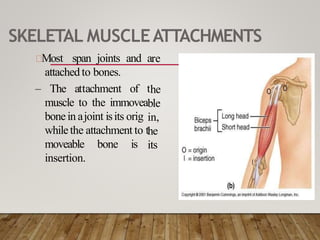
SKELETAL MUSCLEATTACHMENTS
re
he
ble
in,
he
its
Most span joints and a
attached to bones.
– The attachment of t
muscle to the immovea
bonein ajoint isits orig
whilethe attachment to t
moveable bone is
insertion.
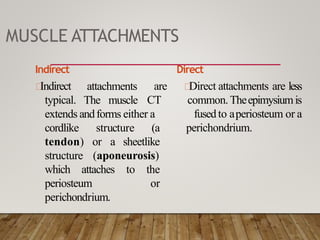
MUSCLE ATTACHMENTS
attachments
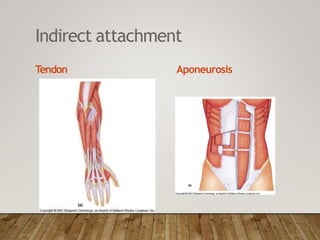
Indirect
Indirect
typical. The muscle
extends andforms either a
structure (a
or a sheetlike
cordlike
tendon)
structure (aponeurosis)
which attaches to the
or
periosteum
perichondrium.
Direct
are Direct attachments are less
CT common.Theepimysiumis
fusedto aperiosteum or a
perichondrium.
Indirect attachment
Tendon Aponeurosis
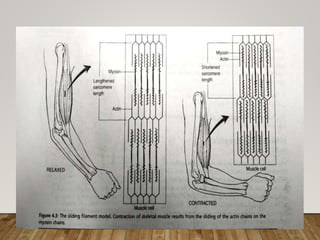
SLIDING FILAMENTTHEORY OFMUSCLE CONTRACTION
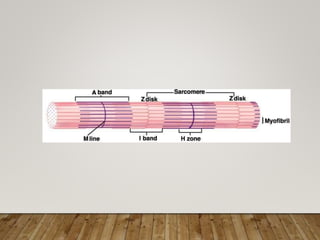
TheSarcomere, containingthe contractile proteins actin &
myosin, isthe the basicfunctionalunit of muscle.
Contraction of a whole muscle is actually the sum of singular
contraction events occurring within the individual
sarcomeres.
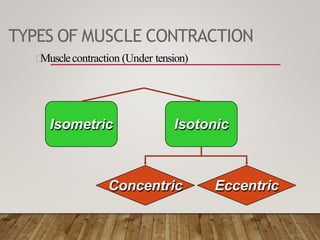
TYPES OF MUSCLE CONTRACTION
Musclecontraction (Under tension)
Isometric Isotonic
Eccentric
Concentric
Isotonic contractions are either concentric or eccentric on
basisofwhether shortening or lengthening occurs
MOVEMENT MAYOCCUR AT ANY
GIVEN JOINT WITHOUT ANY MUSCLE
CONTRACTION WHATSOEVER:
referred to aspassive
solelydue to external forcessuchasthose appliedbyanother
person, object, or resistanceor the force ofgravityin the
presenceofmuscle relaxation
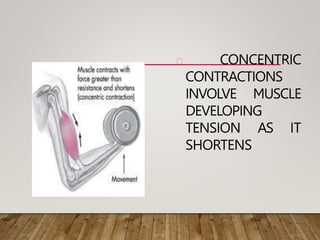
CONCENTRIC
CONTRACTIONS
INVOLVE MUSCLE
DEVELOPING
TENSION AS IT
SHORTENS
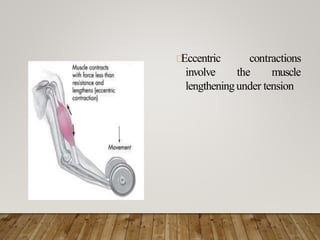
contractions
Eccentric
involve the muscle
lengtheningunder tension
CONCENTRICCONTRACTION
muscle developstension asit shortens
occurs when muscle develops enough force to
overcome
• applied resistance
causesmovementagainstgravityor resistance
described asbeingapositive contraction
ECCENTRICCONTRACTION(MUSCLE ACTION)
muscle lengthens under tension
occurs when muscle graduallylessens in tension to control the
• descent of resistance
weightor resistance overcomes muscle contraction but not to
the point that musclecannot control descending movement
controls movement with gravityor resistance
described asanegative contraction
force developed bythe muscle islessthan that of the resistance
results in the joint angle changing in the direction of the
resistanceor external force
causes body part to move with gravity or external forces
(resistance)
usedto decelerate bodysegment movement
ECCENTRICCONTRACTION(MUSCLEACTION)
Somerefer to this asamuscleactioninsteadofacontraction
sincethe muscleislengtheningasopposed to shortening
Variousexercisesmayuseanyone or all ofthese contraction
types for muscle development
ISOKINETICS - A TYPE OF
DYNAMICEXERCISE
USING CONCENTRIC
AND/OR ECCENTRIC MUSCLE
CONTRACTIONS
Dr ManishKumar
speed(or velocity)ofmovementis constant
muscular contraction (ideally maximum contraction) occurs
throughout movement
not another type ofcontraction, assomehave described
Ex. Biodex,Cybex,Lido
FASCICULAR
ARRANGEMENT
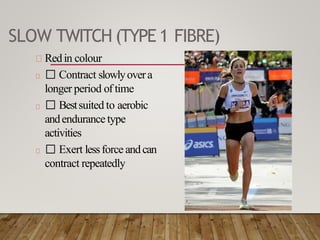
SLOW TWITCH (TYPE 1 FIBRE)
Redin colour
Contract slowlyovera
longer period of time
Bestsuited to aerobic
andendurancetype
activities
Exert lessforce andcan
contract repeatedly
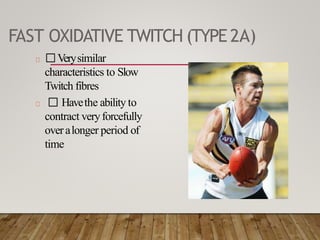
FAST OXIDATIVE TWITCH (TYPE2A)
Verysimilar
characteristics to Slow
Twitch fibres
Havethe ability to
contract veryforcefully
overalonger period of
time
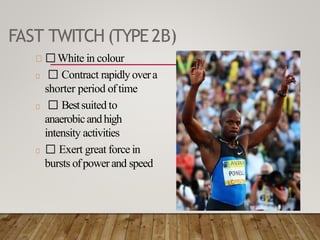
FAST TWITCH (TYPE2B)
White in colour
Contract rapidlyovera
shorter period oftime
Bestsuited to
anaerobicandhigh
intensity activities
Exert great force in
bursts ofpowerand speed

MUSCLE PPT 3RD SEM.pptx

  • 1.
    STRUCTURE AND FUNCTION OFMUSCLE Dr Tabassum Saher Assistant Professor SOP , DPSRU New Delhi
  • 2.
    SKELETAL SMOOTH CARDIAC METHODOF CONTROL VOLUNTARY INVOLUNTARY INVOLUNTARY BANDING PATTERN STRIATED NON-STRIATED STRIATED NUCLEI/CELL MULTI SINGLE SINGLE MUSCLE TYPES
  • 3.
  • 4.
    MUSCLE FUNCTIONS 1. Productionof Movement a. Movementofbodyparts andofthe environment b. Movementofbloodthroughthe heart and the circulatory vessels. c. Movementoflymphthroughthe lymphatic vessels a. Movementoffood(and, subsequently,food waste) throughthe GI tract b. Movement of bile out of the gallbladder and into the digestivetract c. Movementofurine throughthe urinary tract
  • 5.
    2. Maintenance ofposture –Musclecontraction isconstantly allowingusto remain upright. – Themusclesofour neckare keepingour headup. –Aswestand, our legmuscles keepuson two feet. 3.Thermogenesis – Generation ofheat. Occurs viashivering– aninvoluntary contraction ofskeletal muscle.
  • 6.
    CHARACTERISTICS OF MUSCLETISSUE 1. Excitability – Theability to receive andrespond to astimulus • Inskeletalmuscle, the stimulusisaneurotransmitter (chemical signal) release byaneuron (nerve cell). • Insmooth muscle, the stimuluscould be aneurotransmitter, ahormone, stretch, DpH, DPco2, or DPo2. (thesymbolDmeans “achangein”) • Incardiacmuscle, the stimulus could be aneurotransmitter, ahormone, or stretch. – Theresponseisthe generation ofanelectrical impulse that travels alongthe plasmamembrane ofthe muscle cell.
  • 7.
    2. Contractility – Theabilityto shorten forcibly whenadequately stimulated. – Thisisthe definingproperty ofmuscletissue. 3. Extensibility – Theability to bestretched 4. Elasticity – Theability to recoil andresume original length after being stretched.
  • 8.
    SKELETAL MUSCLEATTACHMENTS re he ble in, he its Most spanjoints and a attached to bones. – The attachment of t muscle to the immovea bonein ajoint isits orig whilethe attachment to t moveable bone is insertion.
  • 9.
    MUSCLE ATTACHMENTS attachments Indirect Indirect typical. Themuscle extends andforms either a structure (a or a sheetlike cordlike tendon) structure (aponeurosis) which attaches to the or periosteum perichondrium. Direct are Direct attachments are less CT common.Theepimysiumis fusedto aperiosteum or a perichondrium.
  • 10.
  • 11.
    SLIDING FILAMENTTHEORY OFMUSCLECONTRACTION TheSarcomere, containingthe contractile proteins actin & myosin, isthe the basicfunctionalunit of muscle. Contraction of a whole muscle is actually the sum of singular contraction events occurring within the individual sarcomeres.
  • 14.
    TYPES OF MUSCLECONTRACTION Musclecontraction (Under tension) Isometric Isotonic Eccentric Concentric
  • 15.
    Isotonic contractions areeither concentric or eccentric on basisofwhether shortening or lengthening occurs
  • 16.
    MOVEMENT MAYOCCUR ATANY GIVEN JOINT WITHOUT ANY MUSCLE CONTRACTION WHATSOEVER: referred to aspassive solelydue to external forcessuchasthose appliedbyanother person, object, or resistanceor the force ofgravityin the presenceofmuscle relaxation
  • 17.
  • 18.
  • 19.
    CONCENTRICCONTRACTION muscle developstension asitshortens occurs when muscle develops enough force to overcome • applied resistance causesmovementagainstgravityor resistance described asbeingapositive contraction
  • 20.
    ECCENTRICCONTRACTION(MUSCLE ACTION) muscle lengthensunder tension occurs when muscle graduallylessens in tension to control the • descent of resistance weightor resistance overcomes muscle contraction but not to the point that musclecannot control descending movement controls movement with gravityor resistance described asanegative contraction force developed bythe muscle islessthan that of the resistance
  • 21.
    results in thejoint angle changing in the direction of the resistanceor external force causes body part to move with gravity or external forces (resistance) usedto decelerate bodysegment movement
  • 22.
    ECCENTRICCONTRACTION(MUSCLEACTION) Somerefer to thisasamuscleactioninsteadofacontraction sincethe muscleislengtheningasopposed to shortening Variousexercisesmayuseanyone or all ofthese contraction types for muscle development
  • 23.
    ISOKINETICS - ATYPE OF DYNAMICEXERCISE USING CONCENTRIC AND/OR ECCENTRIC MUSCLE CONTRACTIONS Dr ManishKumar speed(or velocity)ofmovementis constant muscular contraction (ideally maximum contraction) occurs throughout movement not another type ofcontraction, assomehave described Ex. Biodex,Cybex,Lido
  • 24.
  • 25.
    SLOW TWITCH (TYPE1 FIBRE) Redin colour Contract slowlyovera longer period of time Bestsuited to aerobic andendurancetype activities Exert lessforce andcan contract repeatedly
  • 26.
    FAST OXIDATIVE TWITCH(TYPE2A) Verysimilar characteristics to Slow Twitch fibres Havethe ability to contract veryforcefully overalonger period of time
  • 27.
    FAST TWITCH (TYPE2B) Whitein colour Contract rapidlyovera shorter period oftime Bestsuited to anaerobicandhigh intensity activities Exert great force in bursts ofpowerand speed