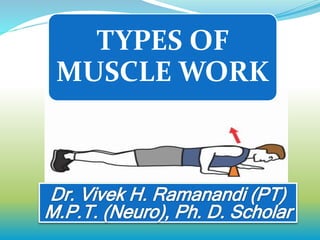
TYPES OF
MUSCLE WORK
Content
Definition of Muscle work
Types of muscle work
Static work
Dynamic work
Types of Muscle Work_DR. VIVEK RAMANANDI
2
Definition
“A muscle fiber generates
tension when properly
stimulated, by the nervous
system or by electrical
impulses. This physiological
process is called muscle
contraction.”
Types of Muscle Work_DR. VIVEK RAMANANDI 3
Types of Muscle Work
Types of Muscle Work_DR. VIVEK RAMANANDI 4
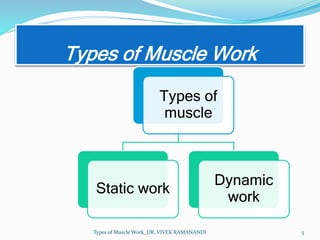
Types of Muscle Work
Types of
muscle
Static work
Dynamic
work
Types of Muscle Work_DR. VIVEK RAMANANDI 5
Types of Muscle Work (cont…)
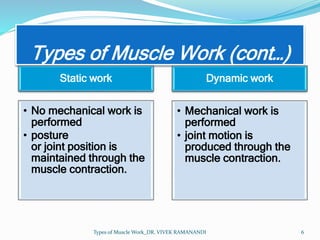
Static work
• No mechanical work is
performed
• posture
or joint position is
maintained through the
muscle contraction.
Dynamic work
• Mechanical work is
performed
• joint motion is
produced through the
muscle contraction.
Types of Muscle Work_DR. VIVEK RAMANANDI 6
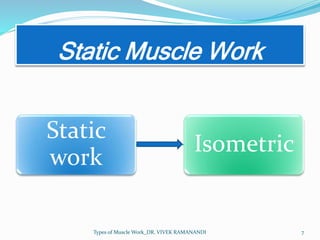
Static Muscle Work
Static
work
Isometric
Types of Muscle Work_DR. VIVEK RAMANANDI 7
Isometric Muscle Contraction
When a muscle contracts,
producing force without changing
the length of muscle.
Muscles are not always directly
involved in the production of joint
movements.
They may exercise either a
Types of Muscle Work_DR. VIVEK RAMANANDI 8
Isometric Muscle Contraction
(cont…)
Types of Muscle Work_DR. VIVEK RAMANANDI 9
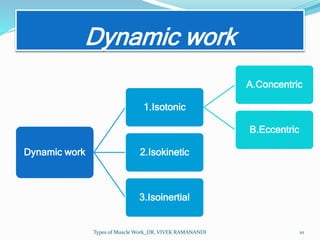
Dynamic work
Dynamic work
1.Isotonic
A.Concentric
B.Eccentric
2.Isokinetic
3.Isoinertial
Types of Muscle Work_DR. VIVEK RAMANANDI 10
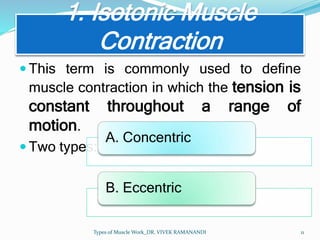
1. Isotonic Muscle
Contraction
 This term is commonly used to define
muscle contraction in which the tension is
constant throughout a range of
motion.
 Two types:
Types of Muscle Work_DR. VIVEK RAMANANDI 11
A. Concentric
B. Eccentric
Concentric Muscle
Contraction
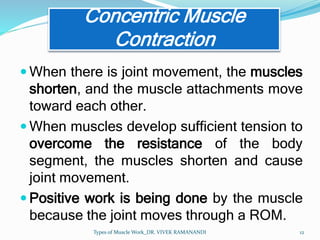
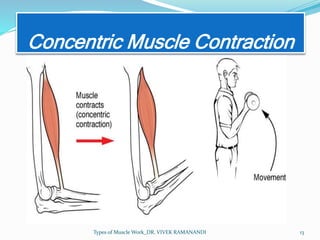
 When there is joint movement, the muscles
shorten, and the muscle attachments move
toward each other.
 When muscles develop sufficient tension to
overcome the resistance of the body
segment, the muscles shorten and cause
joint movement.
 Positive work is being done by the muscle
because the joint moves through a ROM.
Types of Muscle Work_DR. VIVEK RAMANANDI 12
Concentric Muscle Contraction
Types of Muscle Work_DR. VIVEK RAMANANDI 13
Concentric Muscle Contraction
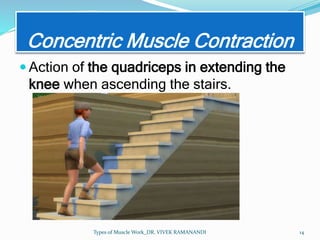
 Action of the quadriceps in extending the
knee when ascending the stairs.
Types of Muscle Work_DR. VIVEK RAMANANDI 14
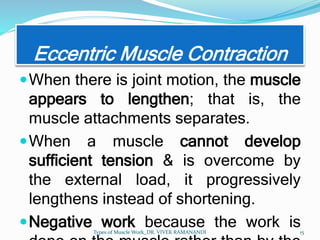
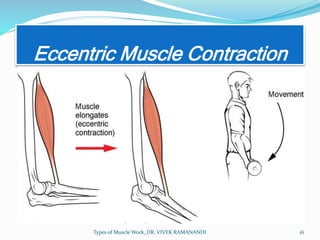
Eccentric Muscle Contraction
When there is joint motion, the muscle
appears to lengthen; that is, the
muscle attachments separates.
When a muscle cannot develop
sufficient tension & is overcome by
the external load, it progressively
lengthens instead of shortening.
Negative work because the work is
Types of Muscle Work_DR. VIVEK RAMANANDI 15
Eccentric Muscle Contraction
Types of Muscle Work_DR. VIVEK RAMANANDI 16
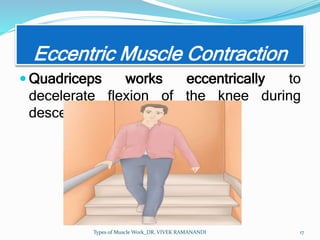
Eccentric Muscle Contraction
 Quadriceps works eccentrically to
decelerate flexion of the knee during
descending the stairs.
Types of Muscle Work_DR. VIVEK RAMANANDI 17
2. Isokinetic Muscle Work
With an isokinetic contraction,
resistance to the part varies, but
the velocity, or speed stays
constant, hence the velocity of
shortening or lengthening of the
muscle is constant.
It can be done only with special
Types of Muscle Work_DR. VIVEK RAMANANDI 18
3. Isoinertial Muscle Work
The resistance against which the
muscle must contract remains
constant.
Isoinertial contraction occurs
when a constant external load is
lifted.
Types of Muscle Work_DR. VIVEK RAMANANDI 19
3. Isoinertial Muscle Work
(cont…)
If the moment (torque) produced by
the muscle is equal to or less than the
resistance to be overcome, the
muscle length remains unchanged
and the muscle contracts
isometrically.
If the moment is greater than the
resistance, the muscle shortens
Types of Muscle Work_DR. VIVEK RAMANANDI 20
References
1.Pamela K. Levangie, Cynthia C. Norkin. Joint structure
and function. Fourth edition.
2.Margareta Nordin, Victor H. Frankel. Basic Biomechanics
of the Musculoskeletal system. Thied edition.
Types of Muscle Work_DR. VIVEK RAMANANDI 21
Types of Muscle Work_DR. VIVEK RAMANANDI 22

musclework-191003092206.pdf

  • 1.
  • 2.
    Content Definition of Musclework Types of muscle work Static work Dynamic work Types of Muscle Work_DR. VIVEK RAMANANDI 2
  • 3.
    Definition “A muscle fibergenerates tension when properly stimulated, by the nervous system or by electrical impulses. This physiological process is called muscle contraction.” Types of Muscle Work_DR. VIVEK RAMANANDI 3
  • 4.
    Types of MuscleWork Types of Muscle Work_DR. VIVEK RAMANANDI 4
  • 5.
    Types of MuscleWork Types of muscle Static work Dynamic work Types of Muscle Work_DR. VIVEK RAMANANDI 5
  • 6.
    Types of MuscleWork (cont…) Static work • No mechanical work is performed • posture or joint position is maintained through the muscle contraction. Dynamic work • Mechanical work is performed • joint motion is produced through the muscle contraction. Types of Muscle Work_DR. VIVEK RAMANANDI 6
  • 7.
    Static Muscle Work Static work Isometric Typesof Muscle Work_DR. VIVEK RAMANANDI 7
  • 8.
    Isometric Muscle Contraction Whena muscle contracts, producing force without changing the length of muscle. Muscles are not always directly involved in the production of joint movements. They may exercise either a Types of Muscle Work_DR. VIVEK RAMANANDI 8
  • 9.
    Isometric Muscle Contraction (cont…) Typesof Muscle Work_DR. VIVEK RAMANANDI 9
  • 10.
  • 11.
    1. Isotonic Muscle Contraction This term is commonly used to define muscle contraction in which the tension is constant throughout a range of motion.  Two types: Types of Muscle Work_DR. VIVEK RAMANANDI 11 A. Concentric B. Eccentric
  • 12.
    Concentric Muscle Contraction  Whenthere is joint movement, the muscles shorten, and the muscle attachments move toward each other.  When muscles develop sufficient tension to overcome the resistance of the body segment, the muscles shorten and cause joint movement.  Positive work is being done by the muscle because the joint moves through a ROM. Types of Muscle Work_DR. VIVEK RAMANANDI 12
  • 13.
    Concentric Muscle Contraction Typesof Muscle Work_DR. VIVEK RAMANANDI 13
  • 14.
    Concentric Muscle Contraction Action of the quadriceps in extending the knee when ascending the stairs. Types of Muscle Work_DR. VIVEK RAMANANDI 14
  • 15.
    Eccentric Muscle Contraction Whenthere is joint motion, the muscle appears to lengthen; that is, the muscle attachments separates. When a muscle cannot develop sufficient tension & is overcome by the external load, it progressively lengthens instead of shortening. Negative work because the work is Types of Muscle Work_DR. VIVEK RAMANANDI 15
  • 16.
    Eccentric Muscle Contraction Typesof Muscle Work_DR. VIVEK RAMANANDI 16
  • 17.
    Eccentric Muscle Contraction Quadriceps works eccentrically to decelerate flexion of the knee during descending the stairs. Types of Muscle Work_DR. VIVEK RAMANANDI 17
  • 18.
    2. Isokinetic MuscleWork With an isokinetic contraction, resistance to the part varies, but the velocity, or speed stays constant, hence the velocity of shortening or lengthening of the muscle is constant. It can be done only with special Types of Muscle Work_DR. VIVEK RAMANANDI 18
  • 19.
    3. Isoinertial MuscleWork The resistance against which the muscle must contract remains constant. Isoinertial contraction occurs when a constant external load is lifted. Types of Muscle Work_DR. VIVEK RAMANANDI 19
  • 20.
    3. Isoinertial MuscleWork (cont…) If the moment (torque) produced by the muscle is equal to or less than the resistance to be overcome, the muscle length remains unchanged and the muscle contracts isometrically. If the moment is greater than the resistance, the muscle shortens Types of Muscle Work_DR. VIVEK RAMANANDI 20
  • 21.
    References 1.Pamela K. Levangie,Cynthia C. Norkin. Joint structure and function. Fourth edition. 2.Margareta Nordin, Victor H. Frankel. Basic Biomechanics of the Musculoskeletal system. Thied edition. Types of Muscle Work_DR. VIVEK RAMANANDI 21
  • 22.
    Types of MuscleWork_DR. VIVEK RAMANANDI 22