From Syllabus Design to Curriculum Design
SIRAJ KHAN
From Syllabus Design to Curriculum Design
The Quest for New Methods
Changing Needs for Foreign Languages in Europe
English for Specific Purposes
Needs Analysis in ESP
Communicative Language Teaching
Emergence of a Curriculum Approach in Language
Teaching
The Quest for New Methods
World War II  immigrants, refugees and
foreign students  UK, Canada, US,
Australia
There was much greater mobility of
peoples in air travel, international
trade and commerce.
The Quest for New Methods
Whites(1988,9) comments:
 The emergence of the USA as an English-
speaking superpower
The industrial and technological developments
of the nineteenth and twentieth centuries.
The Quest for New Methods
Explore new teaching method
 linguistics  organization & structure
of language
A new approach  Oral Approach
 Situational Language Teaching  British
The Quest for New Methods
Situational Language Teaching in British
A structural syllabus with graded vocabulary levels
Meaningful presentation of structures in contexts
PPP method- Presentation/ Practice/ Production
The Quest for New Methods
1950s- Situational Approach
British, Australia, Malaysia, India, Hong Kong
1960s- Audiolingual Method
United States
1978s- Audiovisual Method
Europe
The Quest for New Methods
Audiolingual Method in US
Habits are strengthened by reinforcement
Foreign language habits are formed most
effectively by giving the right response
Language is behavior
Changing Needs for Foreign
Languages in Europe
 The upsurge in English language teaching
(since the mid-1950s~1960s)
 A Language Teaching Revolution
a) Introduce new methods and materials
b) WHY/ HOW people learn a second language
c) Evaluation results
Jupp&Hodin(1975)
Changing Needs for Foreign Languages
in Europe
 In 1969s-The Council of Europe
a) removed language barriers
b) modern language enrichment
c) the modern Europe language
 In 1970s- The Decision of school system
In 1971s- The Unit-credit System for Adults
Communicative Language Teaching
in Europe
Whole context of teaching and learning
 The need for society
The need for learners
English for Specific Purpose
 To make the courses relevant to learners’ needs
 The Language for Specific Purpose Movement
The ESP approach concerns
a) the need for Non-English background students
b) the need for employment
c) the need for business purpose
d) the need for migrants
English for Specific Purpose
 University of Michigan
 language patterns and vocabulary
 A number of selected texts appeared in 1960s
a) The selection and gradation books
b) General English books
c) Specialized English books
d) Word Frequency Counts
e) Discourse Analysis
English for Specific Purpose
 The widely used books
Course in Basic Scientific English
(Ewer & Latorre,1969)
 The merits of this book:
a) three million words of scientific English
b) covering ten areas of science & technology
c) sentence patterns
d) structural words
e) non-structural vocabulary
English for Specific Purpose
 The determine of “register ”:
* what is actually taking place
* what part the language is playing
* who is taking part
(Halliday 1978,31)
English for Specific Purpose
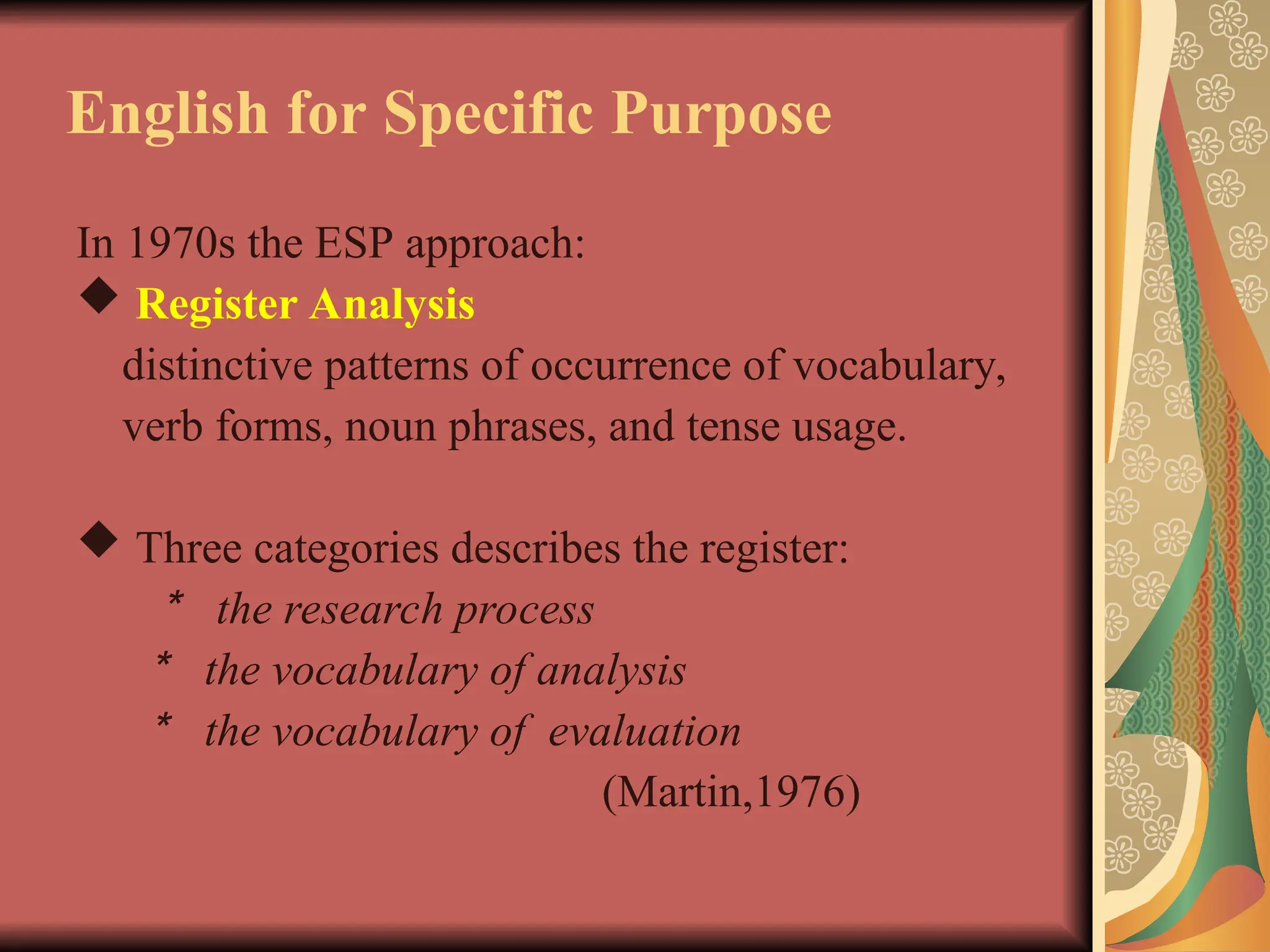
In 1970s the ESP approach:
 Register Analysis
distinctive patterns of occurrence of vocabulary,
verb forms, noun phrases, and tense usage.
 Three categories describes the register:
* the research process
* the vocabulary of analysis
* the vocabulary of evaluation
(Martin,1976)
English for Specific Purpose
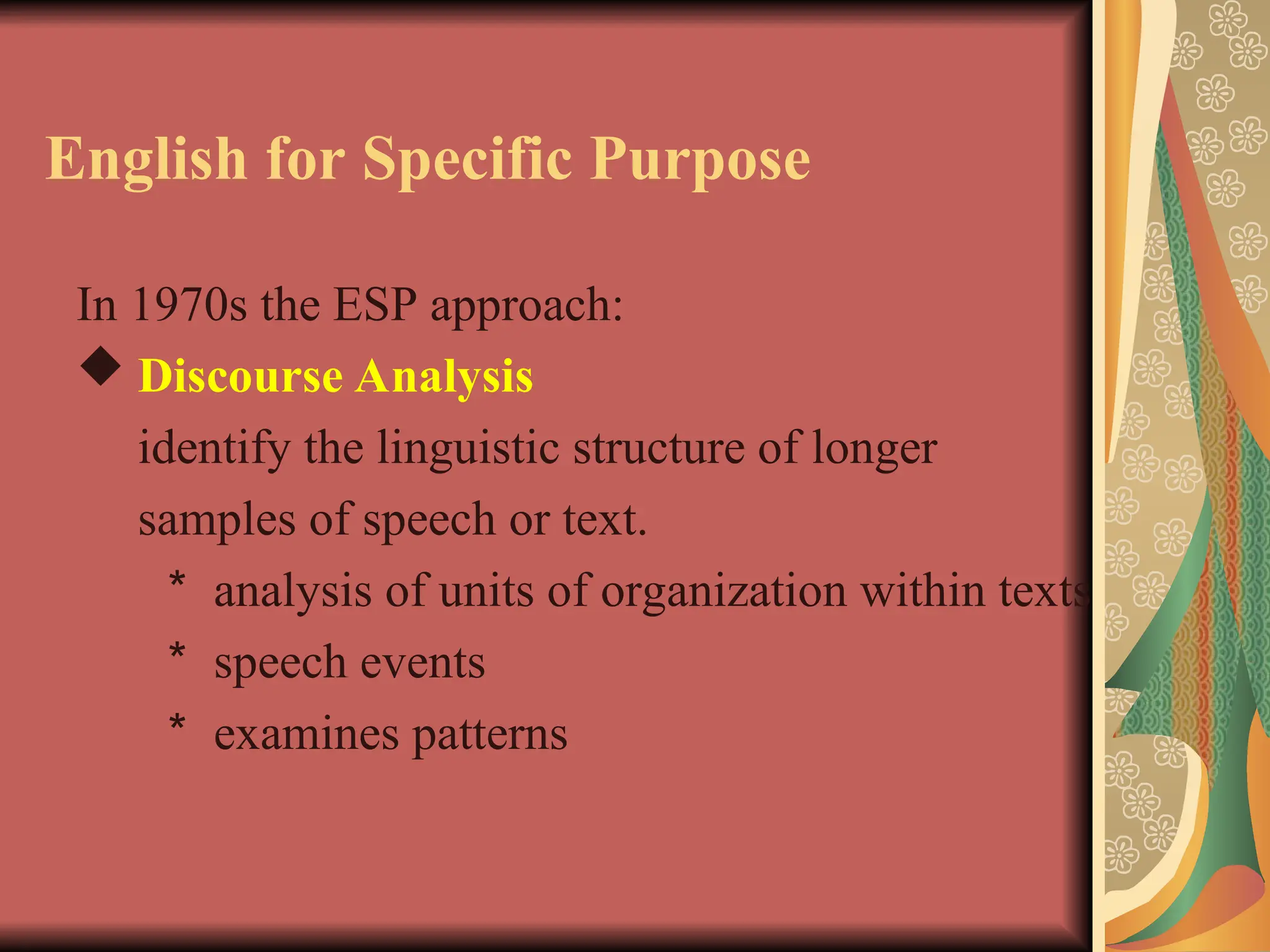
In 1970s the ESP approach:
 Discourse Analysis
identify the linguistic structure of longer
samples of speech or text.
* analysis of units of organization within texts
* speech events
* examines patterns
English for Specific Purpose
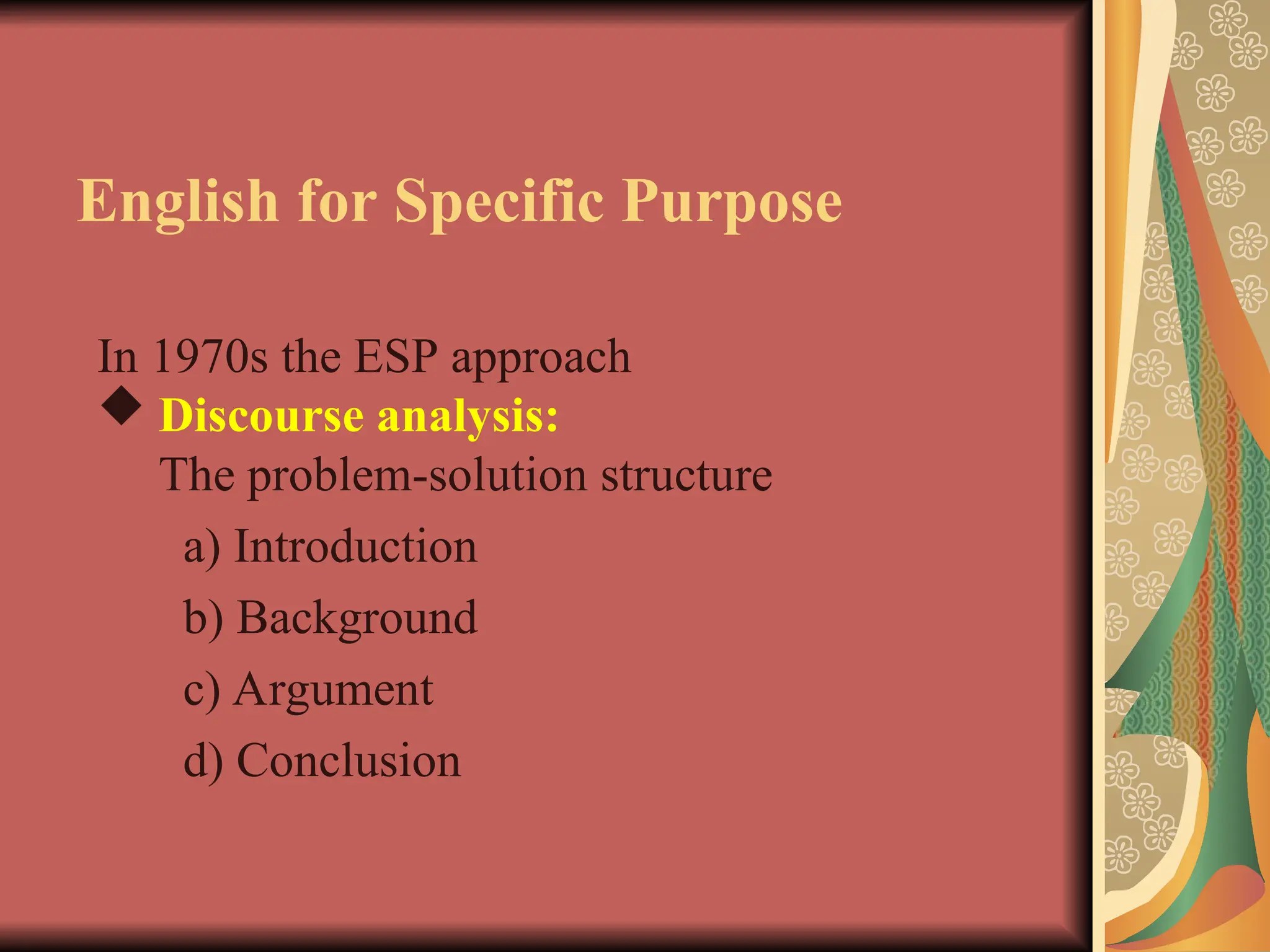
In 1970s the ESP approach
 Discourse analysis:
The problem-solution structure
a) Introduction
b) Background
c) Argument
d) Conclusion
Needs analysis in ESP
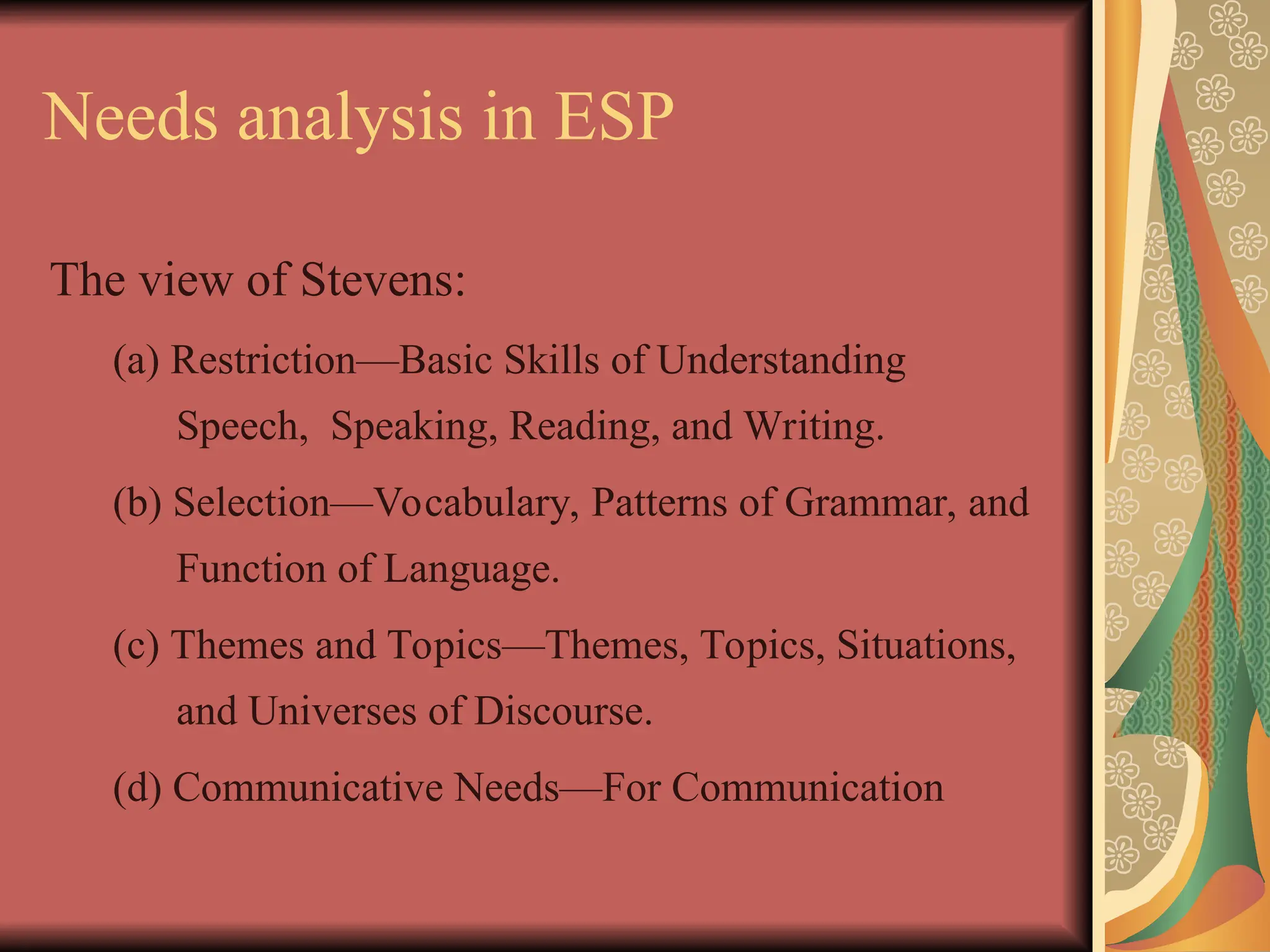
The view of Stevens:
(a) Restriction—Basic Skills of Understanding
Speech, Speaking, Reading, and Writing.
(b) Selection—Vocabulary, Patterns of Grammar, and
Function of Language.
(c) Themes and Topics—Themes, Topics, Situations,
and Universes of Discourse.
(d) Communicative Needs—For Communication
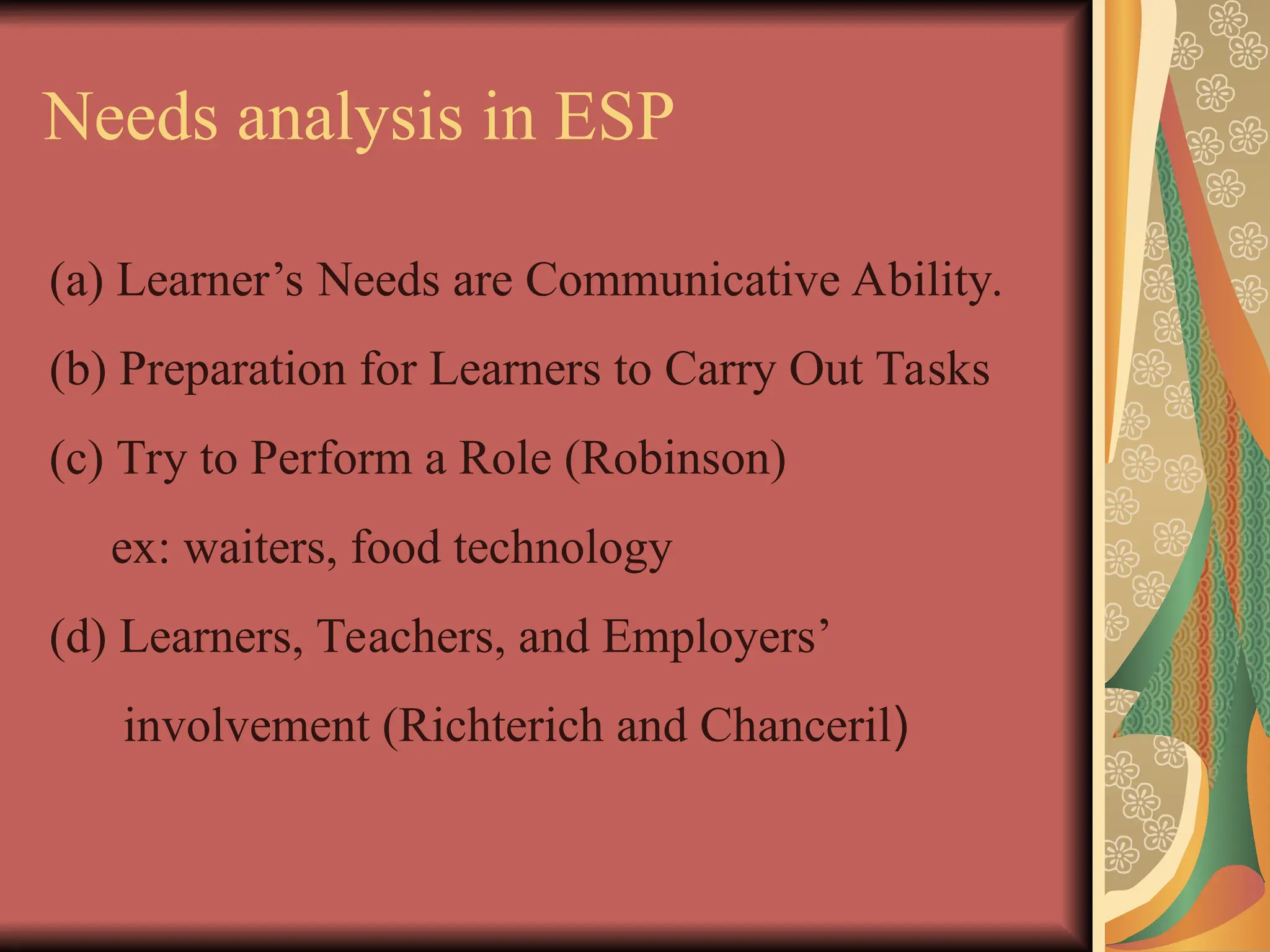
Needs analysis in ESP
(a) Learner’s Needs are Communicative Ability.
(b) Preparation for Learners to Carry Out Tasks
(c) Try to Perform a Role (Robinson)
ex: waiters, food technology
(d) Learners, Teachers, and Employers’
involvement (Richterich and Chanceril)
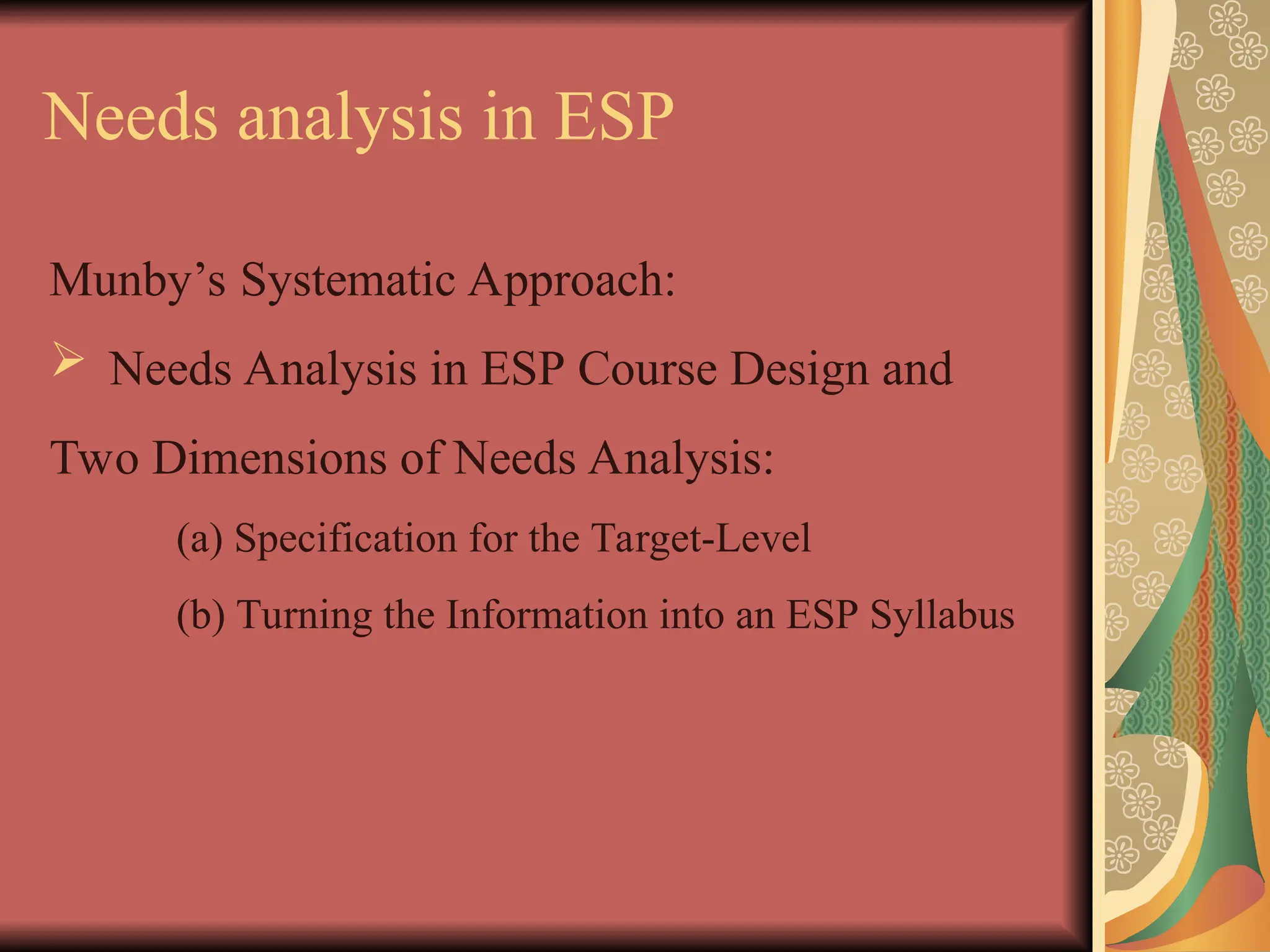
Needs analysis in ESP
Munby’s Systematic Approach:
 Needs Analysis in ESP Course Design and
Two Dimensions of Needs Analysis:
(a) Specification for the Target-Level
(b) Turning the Information into an ESP Syllabus
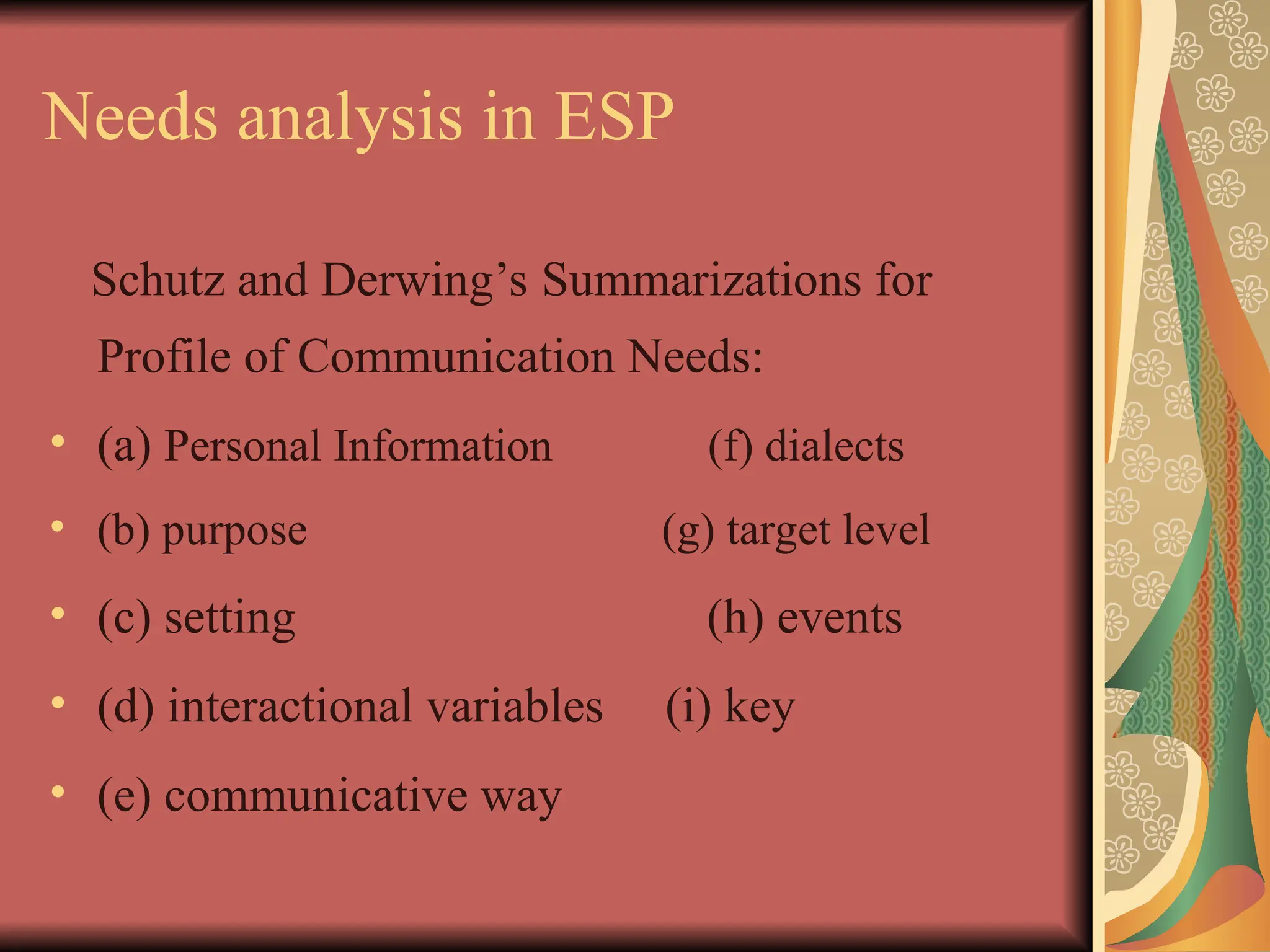
Needs analysis in ESP
Schutz and Derwing’s Summarizations for
Profile of Communication Needs:
• (a) Personal Information (f) dialects
• (b) purpose (g) target level
• (c) setting (h) events
• (d) interactional variables (i) key
• (e) communicative way
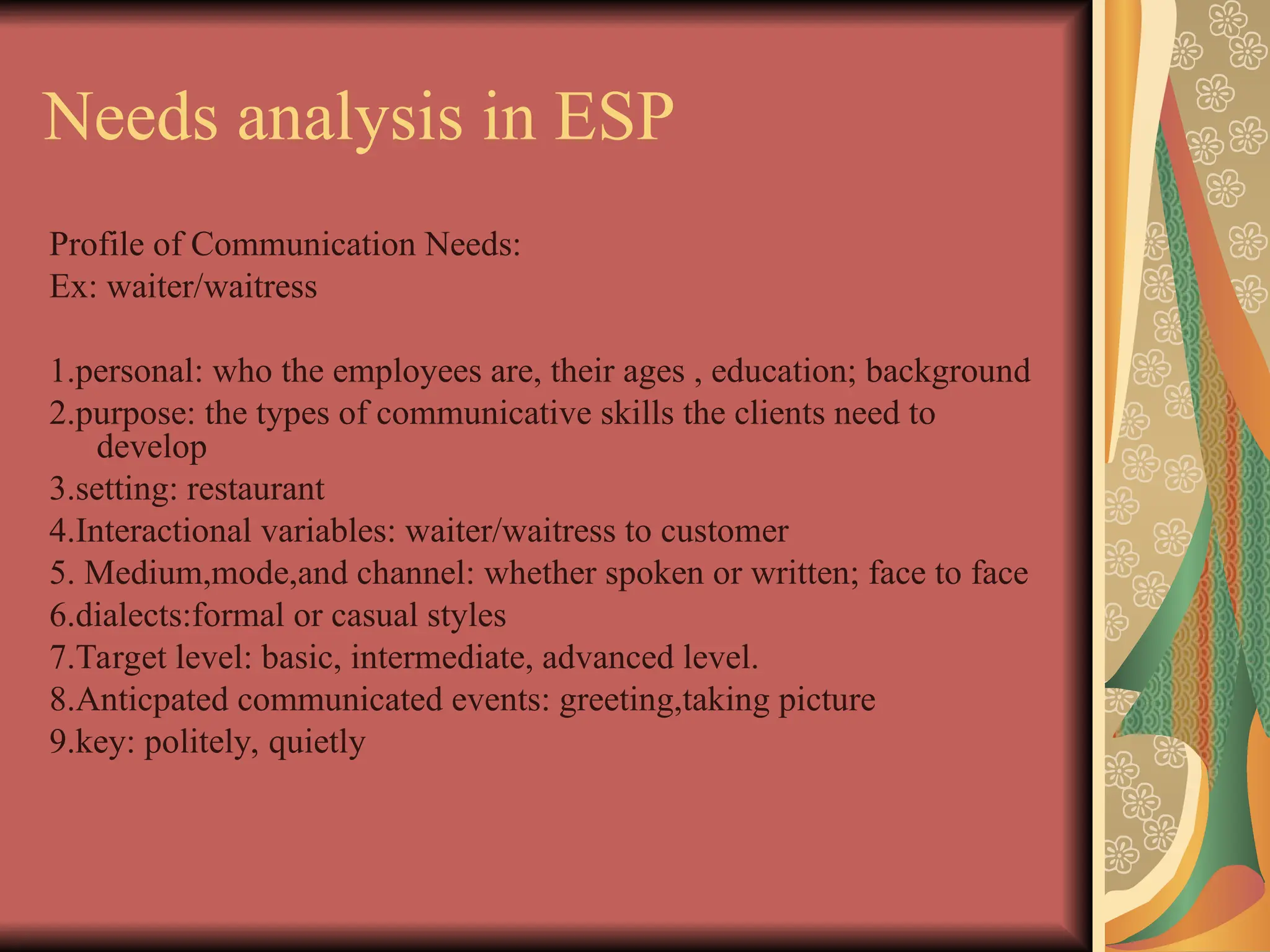
Needs analysis in ESP
Profile of Communication Needs:
Ex: waiter/waitress
1.personal: who the employees are, their ages , education; background
2.purpose: the types of communicative skills the clients need to
develop
3.setting: restaurant
4.Interactional variables: waiter/waitress to customer
5. Medium,mode,and channel: whether spoken or written; face to face
6.dialects:formal or casual styles
7.Target level: basic, intermediate, advanced level.
8.Anticpated communicated events: greeting,taking picture
9.key: politely, quietly
Communicative language teaching
1. The Emergence of ESP
2. The Interval Between 1960s and 1970s
=>a replacement for structural situation and
audio-lingual methods.
3. The Europe
=>Grammatical  Communicative
Emergence of a curriculum approach in
language teaching
Wilkins’s notional syllabus
(a) semantico-grammatical meaning:
e.g. point of time, duration, time relations,
frequency, and sequence
(b) model meaning: modality, scale of certainty,
scale of commitment
(c) communicative function: request, complaints,
apologies, suggestion
Emergence of a curriculum approach in
language teaching
Yalden’s Descriptions for Communicative Syllabuses
(1)Learner’s Purpose
(2)The Setting
(3) Learner’s Capacity
(4)Participation
(5)Language function
(6)Notion
(7)Skills
(8)Variety
(9)Grammar
(10)Lexicon
Emergence of a curriculum approach in
language teaching
A curriculum in a school context refers to the
whole body of knowledge that children acquire
in schools.
Rodgers(1989)
Syllabi: the content to be covered by a given
course, from only a small part of the total
school program.
Curriculum: those activities in which children
engage under the auspices of the school.
Emergence of a curriculum approach in
language teaching
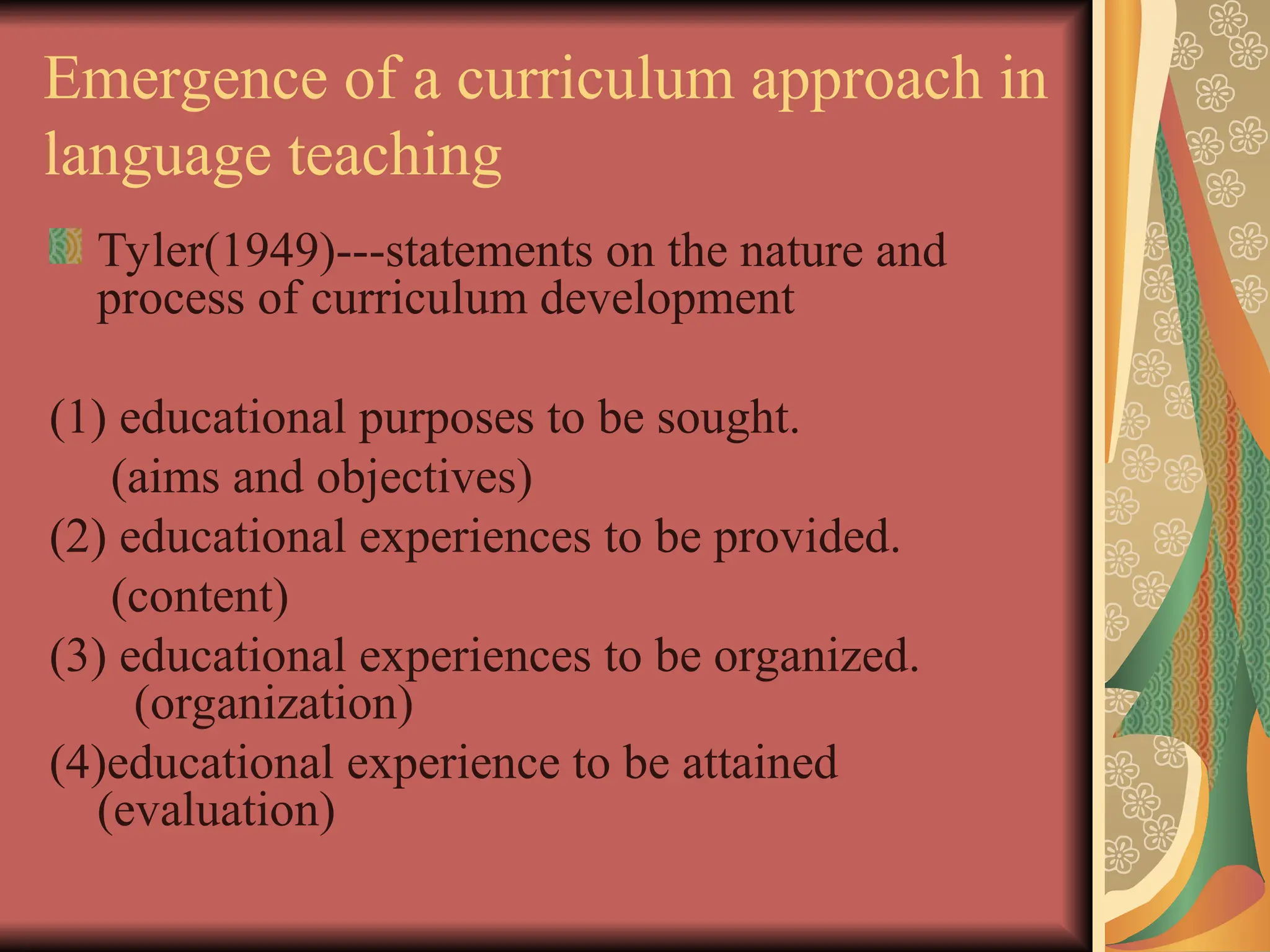
Tyler(1949)---statements on the nature and
process of curriculum development
(1) educational purposes to be sought.
(aims and objectives)
(2) educational experiences to be provided.
(content)
(3) educational experiences to be organized.
(organization)
(4)educational experience to be attained
(evaluation)
Emergence of a curriculum approach in
language teaching
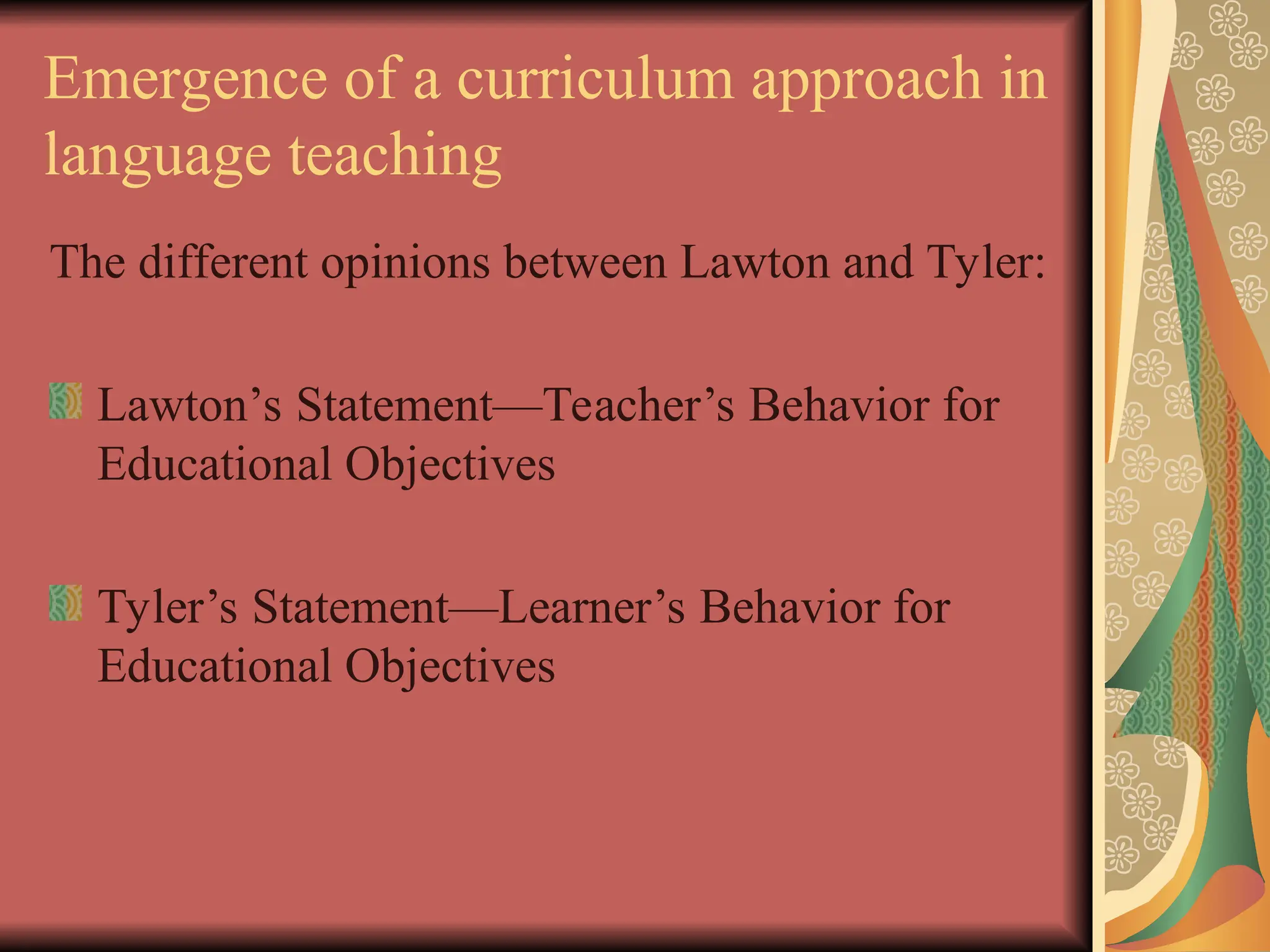
The different opinions between Lawton and Tyler:
Lawton’s Statement—Teacher’s Behavior for
Educational Objectives
Tyler’s Statement—Learner’s Behavior for
Educational Objectives
Emergence of a curriculum approach in
language teaching
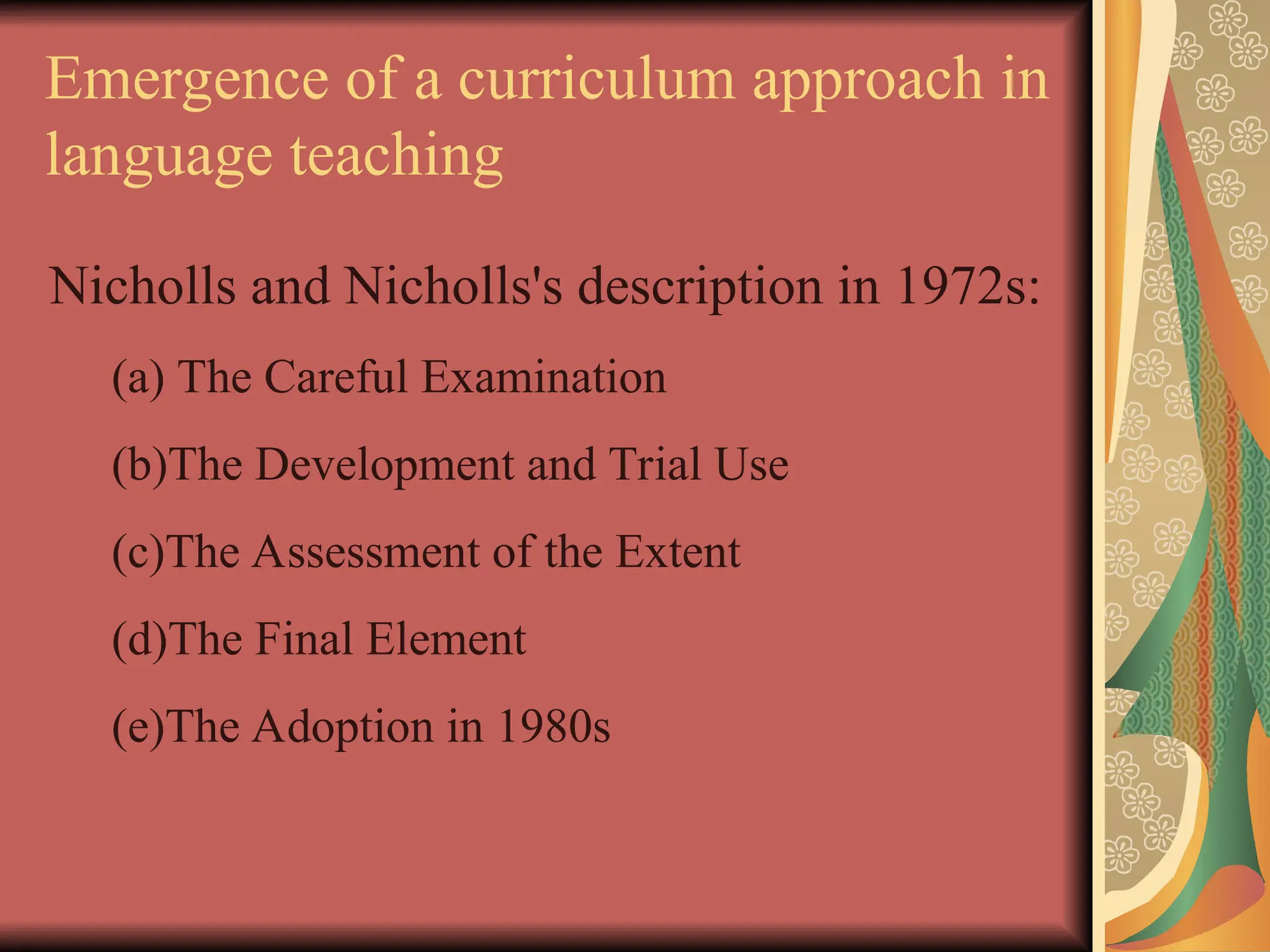
Nicholls and Nicholls's description in 1972s:
(a) The Careful Examination
(b)The Development and Trial Use
(c)The Assessment of the Extent
(d)The Final Element
(e)The Adoption in 1980s
Emergence of a curriculum approach in
language teaching
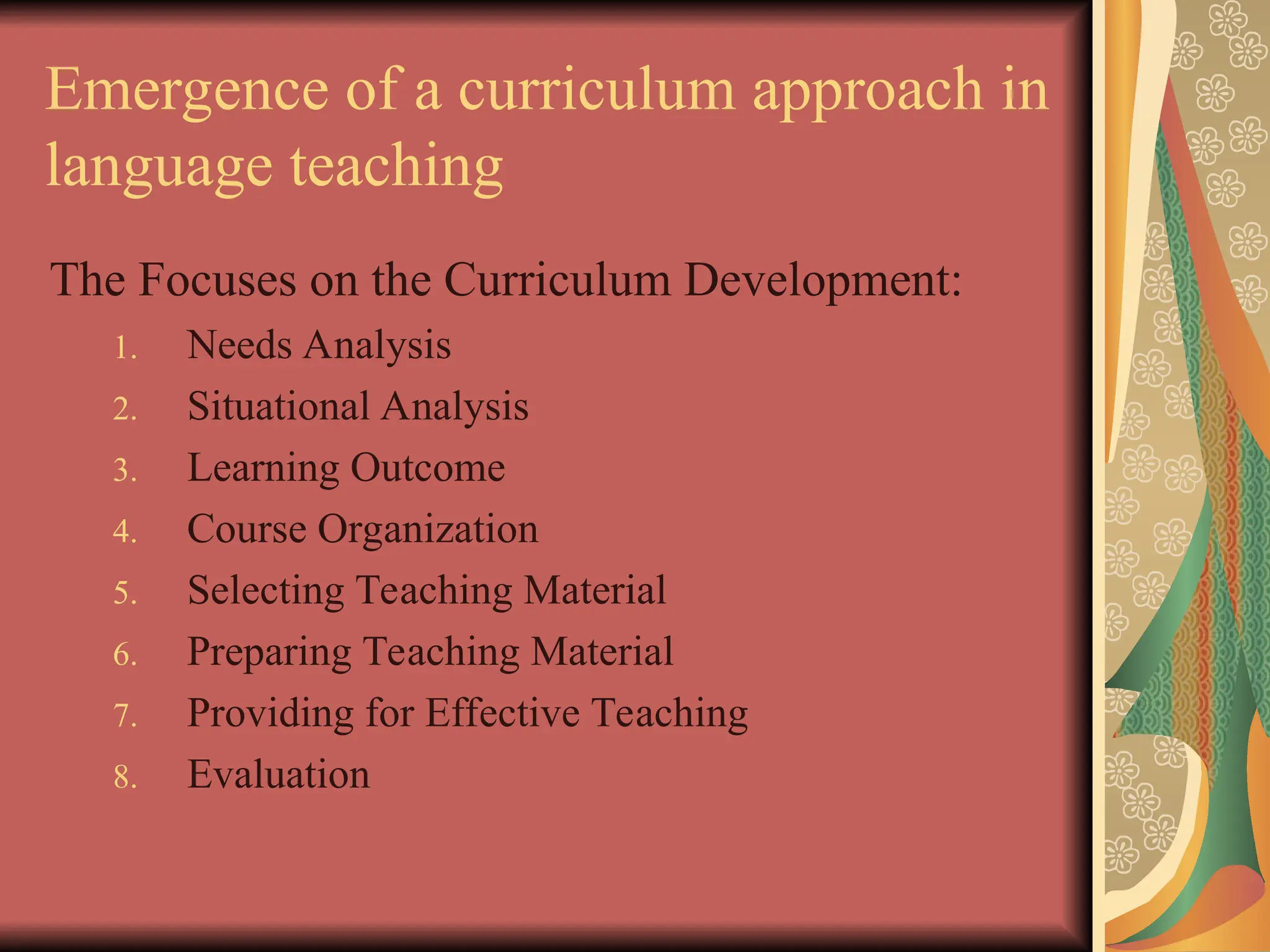
The Focuses on the Curriculum Development:
1. Needs Analysis
2. Situational Analysis
3. Learning Outcome
4. Course Organization
5. Selecting Teaching Material
6. Preparing Teaching Material
7. Providing for Effective Teaching
8. Evaluation
Emergence of a curriculum approach in
language teaching
Clark’s Statement on the Curriculum Development:
1. The Review of Principles
2. The Reworking of Syllabuses
3. The Review of Strategies
4. Embodying Appropriate Learning Experiences
5. The Review of Assessment Designed
6. The Review of Classroom Schemes
7. The Review and Creation of Strategies Designed
8. The Further Research
9. The Review or Devising on In-service Education Designed

Thanks for your listening

Chapter2.ppt, from syllabus design to curricullun design

  • 1.
    From Syllabus Designto Curriculum Design SIRAJ KHAN
  • 2.
    From Syllabus Designto Curriculum Design The Quest for New Methods Changing Needs for Foreign Languages in Europe English for Specific Purposes Needs Analysis in ESP Communicative Language Teaching Emergence of a Curriculum Approach in Language Teaching
  • 3.
    The Quest forNew Methods World War II  immigrants, refugees and foreign students  UK, Canada, US, Australia There was much greater mobility of peoples in air travel, international trade and commerce.
  • 4.
    The Quest forNew Methods Whites(1988,9) comments:  The emergence of the USA as an English- speaking superpower The industrial and technological developments of the nineteenth and twentieth centuries.
  • 5.
    The Quest forNew Methods Explore new teaching method  linguistics  organization & structure of language A new approach  Oral Approach  Situational Language Teaching  British
  • 6.
    The Quest forNew Methods Situational Language Teaching in British A structural syllabus with graded vocabulary levels Meaningful presentation of structures in contexts PPP method- Presentation/ Practice/ Production
  • 7.
    The Quest forNew Methods 1950s- Situational Approach British, Australia, Malaysia, India, Hong Kong 1960s- Audiolingual Method United States 1978s- Audiovisual Method Europe
  • 8.
    The Quest forNew Methods Audiolingual Method in US Habits are strengthened by reinforcement Foreign language habits are formed most effectively by giving the right response Language is behavior
  • 9.
    Changing Needs forForeign Languages in Europe  The upsurge in English language teaching (since the mid-1950s~1960s)  A Language Teaching Revolution a) Introduce new methods and materials b) WHY/ HOW people learn a second language c) Evaluation results Jupp&Hodin(1975)
  • 10.
    Changing Needs forForeign Languages in Europe  In 1969s-The Council of Europe a) removed language barriers b) modern language enrichment c) the modern Europe language  In 1970s- The Decision of school system In 1971s- The Unit-credit System for Adults
  • 11.
    Communicative Language Teaching inEurope Whole context of teaching and learning  The need for society The need for learners
  • 12.
    English for SpecificPurpose  To make the courses relevant to learners’ needs  The Language for Specific Purpose Movement The ESP approach concerns a) the need for Non-English background students b) the need for employment c) the need for business purpose d) the need for migrants
  • 13.
    English for SpecificPurpose  University of Michigan  language patterns and vocabulary  A number of selected texts appeared in 1960s a) The selection and gradation books b) General English books c) Specialized English books d) Word Frequency Counts e) Discourse Analysis
  • 14.
    English for SpecificPurpose  The widely used books Course in Basic Scientific English (Ewer & Latorre,1969)  The merits of this book: a) three million words of scientific English b) covering ten areas of science & technology c) sentence patterns d) structural words e) non-structural vocabulary
  • 15.
    English for SpecificPurpose  The determine of “register ”: * what is actually taking place * what part the language is playing * who is taking part (Halliday 1978,31)
  • 16.
    English for SpecificPurpose In 1970s the ESP approach:  Register Analysis distinctive patterns of occurrence of vocabulary, verb forms, noun phrases, and tense usage.  Three categories describes the register: * the research process * the vocabulary of analysis * the vocabulary of evaluation (Martin,1976)
  • 17.
    English for SpecificPurpose In 1970s the ESP approach:  Discourse Analysis identify the linguistic structure of longer samples of speech or text. * analysis of units of organization within texts * speech events * examines patterns
  • 18.
    English for SpecificPurpose In 1970s the ESP approach  Discourse analysis: The problem-solution structure a) Introduction b) Background c) Argument d) Conclusion
  • 19.
    Needs analysis inESP The view of Stevens: (a) Restriction—Basic Skills of Understanding Speech, Speaking, Reading, and Writing. (b) Selection—Vocabulary, Patterns of Grammar, and Function of Language. (c) Themes and Topics—Themes, Topics, Situations, and Universes of Discourse. (d) Communicative Needs—For Communication
  • 20.
    Needs analysis inESP (a) Learner’s Needs are Communicative Ability. (b) Preparation for Learners to Carry Out Tasks (c) Try to Perform a Role (Robinson) ex: waiters, food technology (d) Learners, Teachers, and Employers’ involvement (Richterich and Chanceril)
  • 21.
    Needs analysis inESP Munby’s Systematic Approach:  Needs Analysis in ESP Course Design and Two Dimensions of Needs Analysis: (a) Specification for the Target-Level (b) Turning the Information into an ESP Syllabus
  • 22.
    Needs analysis inESP Schutz and Derwing’s Summarizations for Profile of Communication Needs: • (a) Personal Information (f) dialects • (b) purpose (g) target level • (c) setting (h) events • (d) interactional variables (i) key • (e) communicative way
  • 23.
    Needs analysis inESP Profile of Communication Needs: Ex: waiter/waitress 1.personal: who the employees are, their ages , education; background 2.purpose: the types of communicative skills the clients need to develop 3.setting: restaurant 4.Interactional variables: waiter/waitress to customer 5. Medium,mode,and channel: whether spoken or written; face to face 6.dialects:formal or casual styles 7.Target level: basic, intermediate, advanced level. 8.Anticpated communicated events: greeting,taking picture 9.key: politely, quietly
  • 24.
    Communicative language teaching 1.The Emergence of ESP 2. The Interval Between 1960s and 1970s =>a replacement for structural situation and audio-lingual methods. 3. The Europe =>Grammatical  Communicative
  • 25.
    Emergence of acurriculum approach in language teaching Wilkins’s notional syllabus (a) semantico-grammatical meaning: e.g. point of time, duration, time relations, frequency, and sequence (b) model meaning: modality, scale of certainty, scale of commitment (c) communicative function: request, complaints, apologies, suggestion
  • 26.
    Emergence of acurriculum approach in language teaching Yalden’s Descriptions for Communicative Syllabuses (1)Learner’s Purpose (2)The Setting (3) Learner’s Capacity (4)Participation (5)Language function (6)Notion (7)Skills (8)Variety (9)Grammar (10)Lexicon
  • 27.
    Emergence of acurriculum approach in language teaching A curriculum in a school context refers to the whole body of knowledge that children acquire in schools. Rodgers(1989) Syllabi: the content to be covered by a given course, from only a small part of the total school program. Curriculum: those activities in which children engage under the auspices of the school.
  • 28.
    Emergence of acurriculum approach in language teaching Tyler(1949)---statements on the nature and process of curriculum development (1) educational purposes to be sought. (aims and objectives) (2) educational experiences to be provided. (content) (3) educational experiences to be organized. (organization) (4)educational experience to be attained (evaluation)
  • 29.
    Emergence of acurriculum approach in language teaching The different opinions between Lawton and Tyler: Lawton’s Statement—Teacher’s Behavior for Educational Objectives Tyler’s Statement—Learner’s Behavior for Educational Objectives
  • 30.
    Emergence of acurriculum approach in language teaching Nicholls and Nicholls's description in 1972s: (a) The Careful Examination (b)The Development and Trial Use (c)The Assessment of the Extent (d)The Final Element (e)The Adoption in 1980s
  • 31.
    Emergence of acurriculum approach in language teaching The Focuses on the Curriculum Development: 1. Needs Analysis 2. Situational Analysis 3. Learning Outcome 4. Course Organization 5. Selecting Teaching Material 6. Preparing Teaching Material 7. Providing for Effective Teaching 8. Evaluation
  • 32.
    Emergence of acurriculum approach in language teaching Clark’s Statement on the Curriculum Development: 1. The Review of Principles 2. The Reworking of Syllabuses 3. The Review of Strategies 4. Embodying Appropriate Learning Experiences 5. The Review of Assessment Designed 6. The Review of Classroom Schemes 7. The Review and Creation of Strategies Designed 8. The Further Research 9. The Review or Devising on In-service Education Designed

  • 33.
    Thanks for yourlistening