DYNAMIC ANALYSIS 
OF 
MULTISTOREY FRAMED STRUCTURE 
WITH ROOF TOWER 
Guide :- Mr. PRAMOD TIWARI 
PRESENTED BY: 
Amit Ranjan (2002309) 
Gupta Abhishek (2002964) 
Mohit Jain (2002355) 
Navdeep Kumar (2002357) 
Siddhant Raturi (2002403) 
Vipin Thapliyal (2002854)
INTRODUCTION 
• Telecommunication structure designed for supporting 
parabolic antennas. 
e.g. microwave transmission for communication , radio and 
T.V signals. 
• Self-supporting structures. 
• Three-legged and Four-legged space trussed structures. 
• Consideration of load. 
 Seismic load. 
 Wind load.
OBJECTIVES 
 Modeling of the tower. 
 Modeling of the building. 
 Study of the Response Spectra Method on the building with roof tower. 
 Study of the wind load on the building.
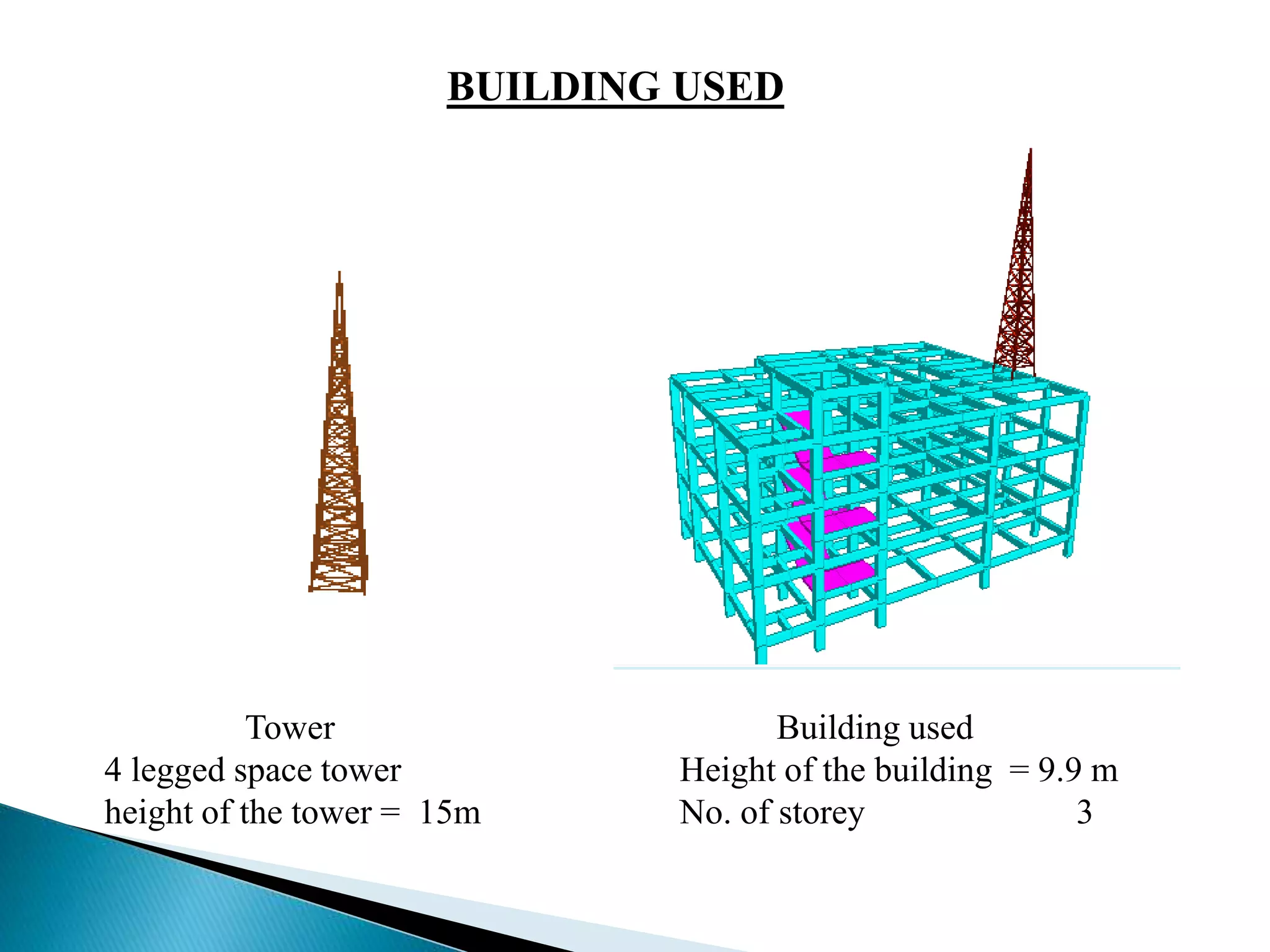
BUILDING USED 
Building used 
Height of the building = 9.9 m 
No. of storey 3 
Tower 
4 legged space tower 
height of the tower = 15m
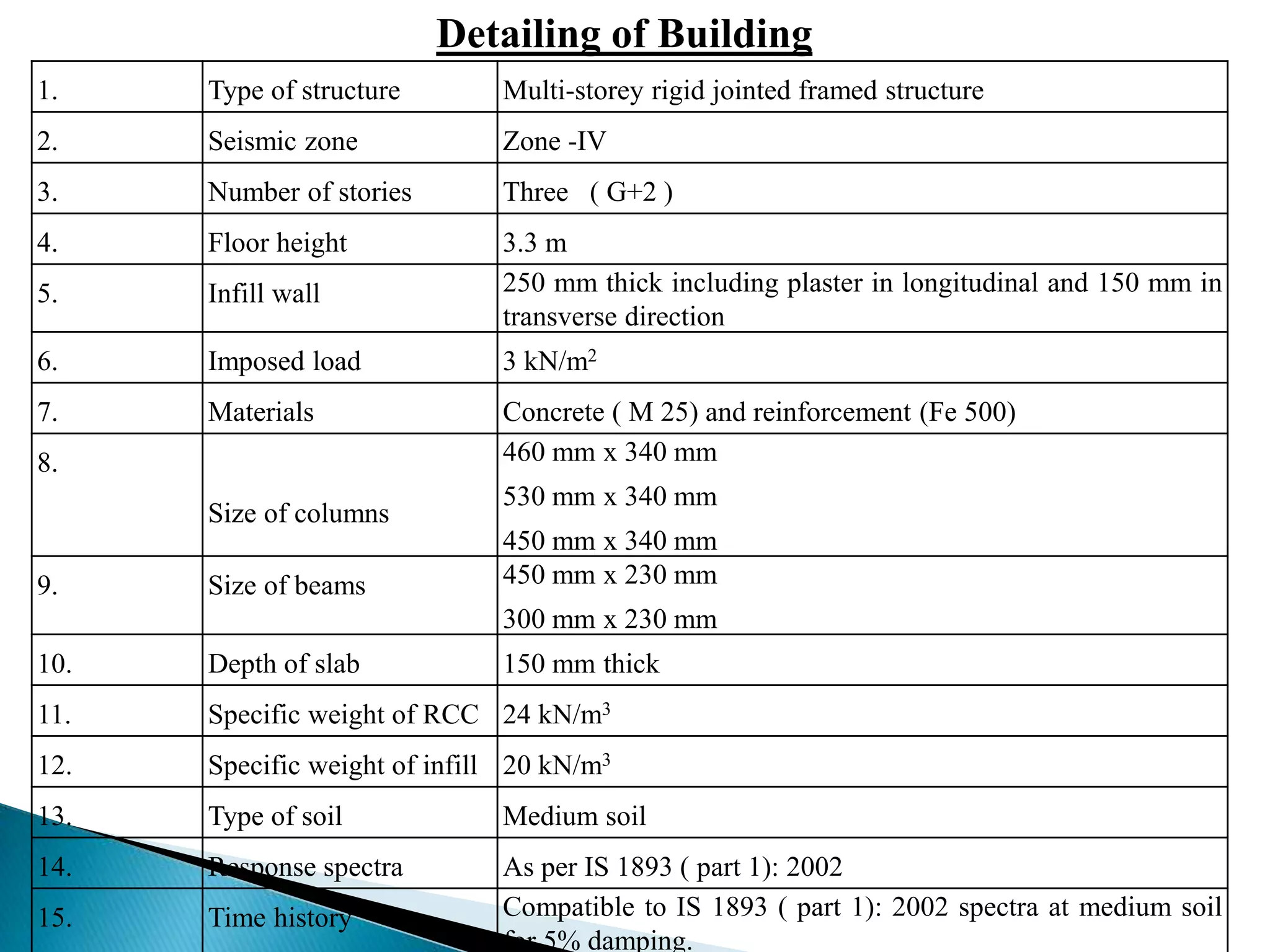
Detailing of Building 
1. Type of structure Multi-storey rigid jointed framed structure 
2. Seismic zone Zone -IV 
3. Number of stories Three ( G+2 ) 
4. Floor height 3.3 m 
5. Infill wall 250 mm thick including plaster in longitudinal and 150 mm in 
transverse direction 
6. Imposed load 3 kN/m2 
7. Materials Concrete ( M 25) and reinforcement (Fe 500) 
8. 
Size of columns 
460 mm x 340 mm 
530 mm x 340 mm 
450 mm x 340 mm 
9. Size of beams 450 mm x 230 mm 
300 mm x 230 mm 
10. Depth of slab 150 mm thick 
11. Specific weight of RCC 24 kN/m3 
12. Specific weight of infill 20 kN/m3 
13. Type of soil Medium soil 
14. Response spectra As per IS 1893 ( part 1): 2002 
15. Time history Compatible to IS 1893 ( part 1): 2002 spectra at medium soil 
for 5% damping.
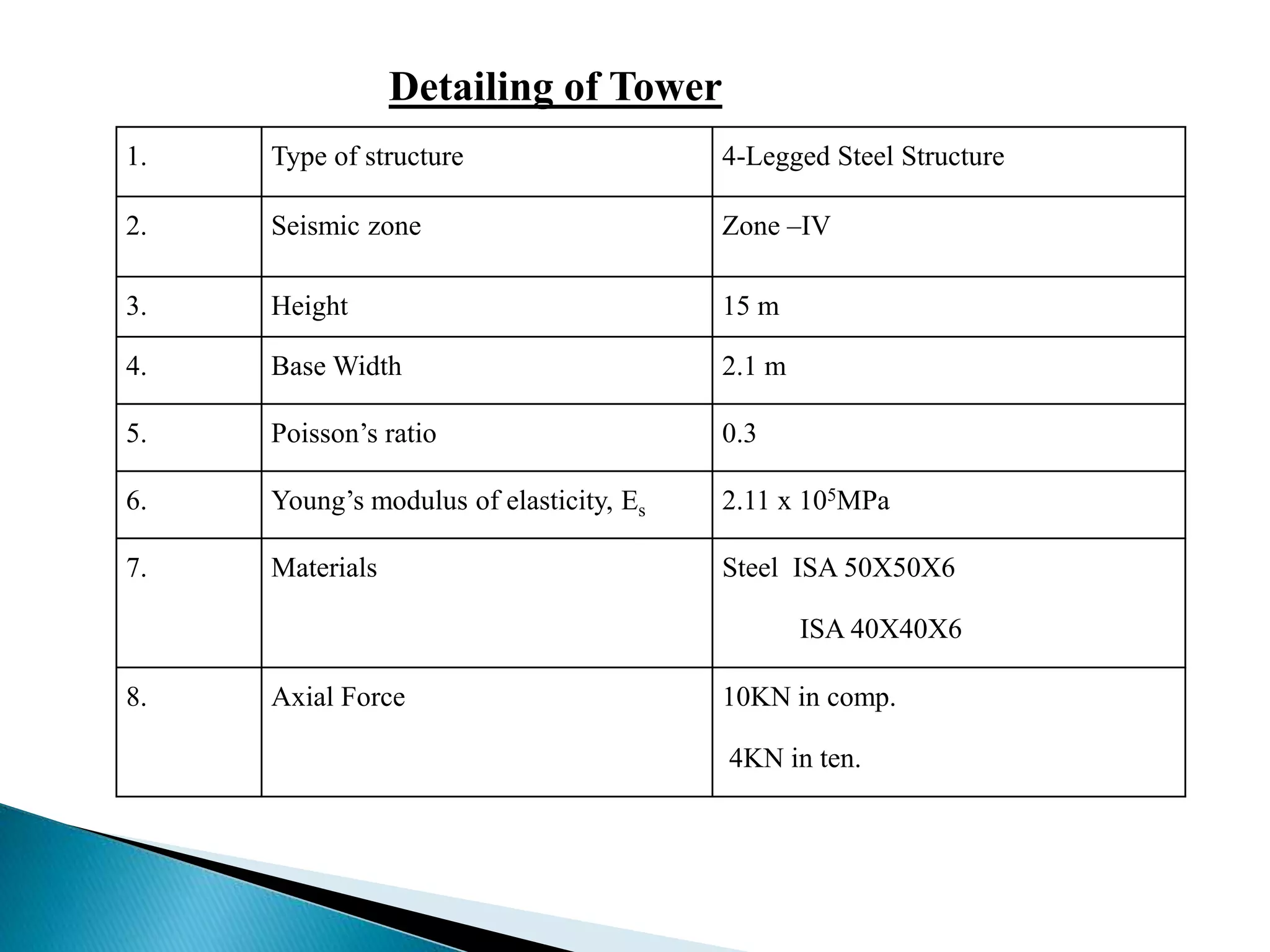
1. Type of structure 4-Legged Steel Structure 
2. Seismic zone Zone –IV 
3. Height 15 m 
4. BaseWidth 2.1 m 
5. Poisson’s ratio 0.3 
6. Young’s modulus of elasticity, Es 2.11 x 10⁵MPa 
7. Materials Steel ISA 50X50X6 
ISA 40X40X6 
8. Axial Force 10KN in comp. 
4KN in ten. 
Detailing of Tower
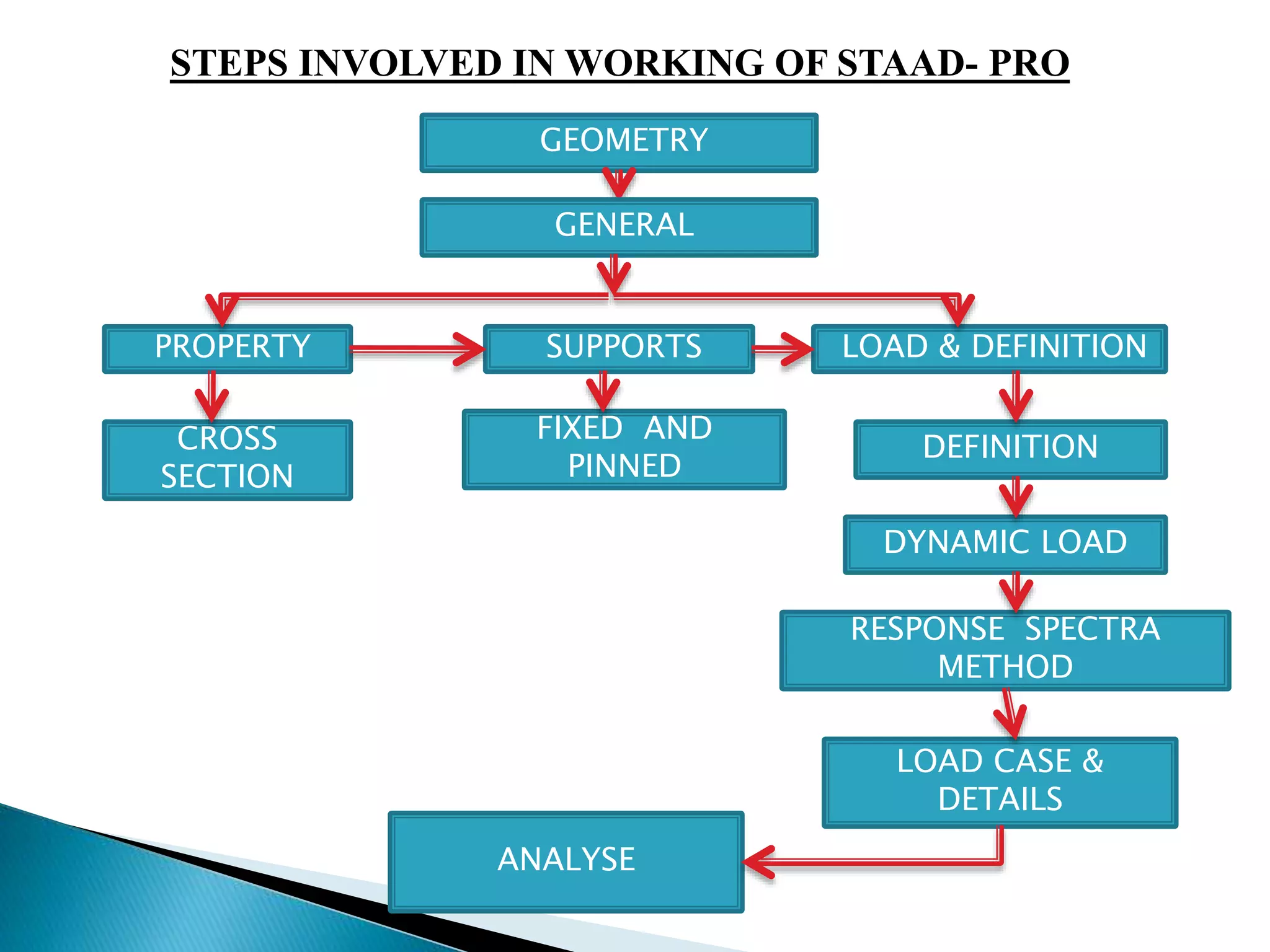
STEPS INVOLVED IN WORKING OF STAAD- PRO 
GEOMETRY 
GENERAL 
PROPERTY SUPPORTS LOAD & DEFINITION 
CROSS 
SECTION 
FIXED AND 
PINNED 
DEFINITION 
DYNAMIC LOAD 
RESPONSE SPECTRA 
METHOD 
LOAD CASE & 
DETAILS 
ANALYSE
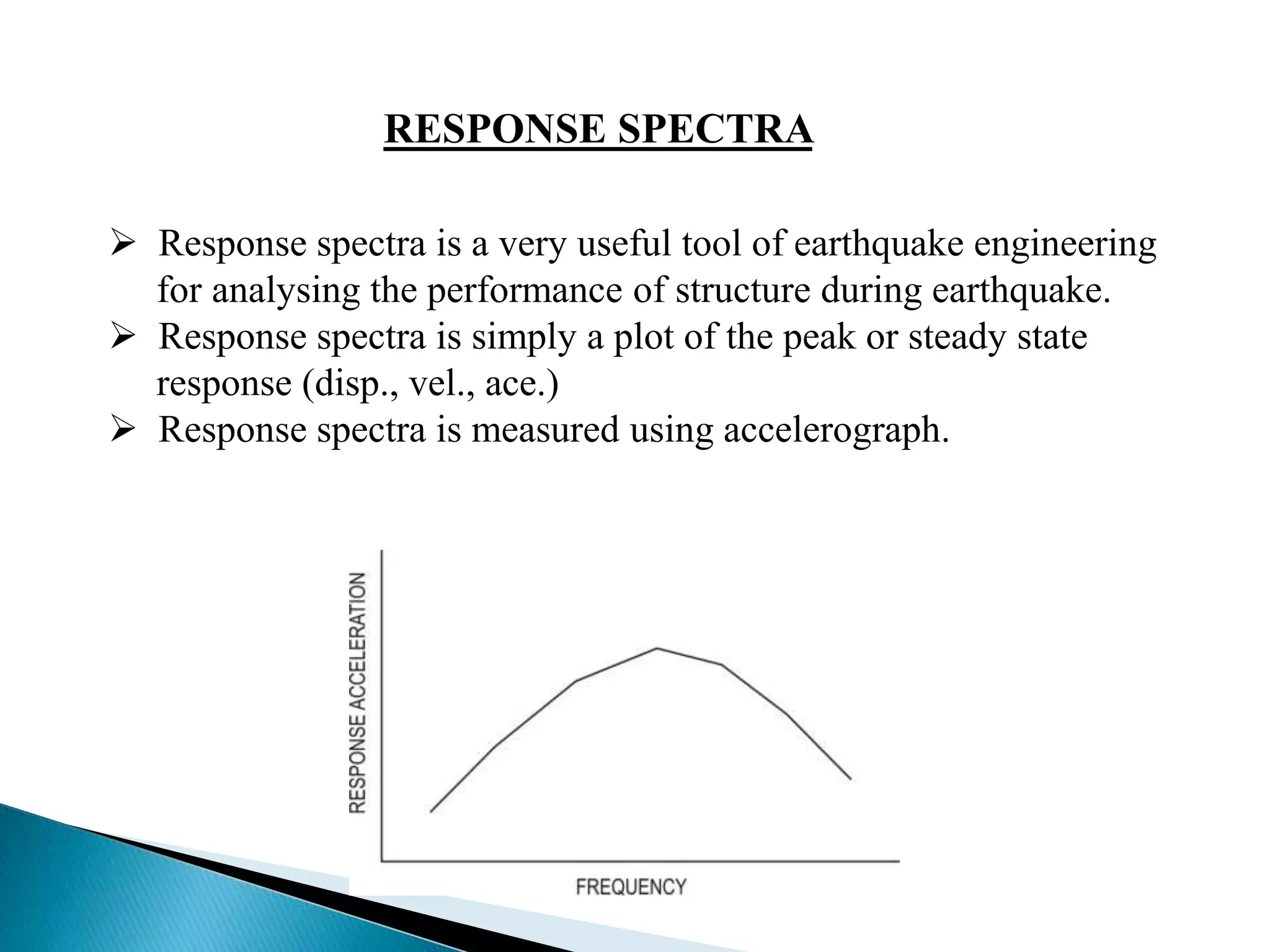
RESPONSE SPECTRA 
 Response spectra is a very useful tool of earthquake engineering 
for analysing the performance of structure during earthquake. 
 Response spectra is simply a plot of the peak or steady state 
response (disp., vel., ace.) 
 Response spectra is measured using accelerograph.
RESPONSE SPECTRUM METHOD BY USING 
STAADPRO 
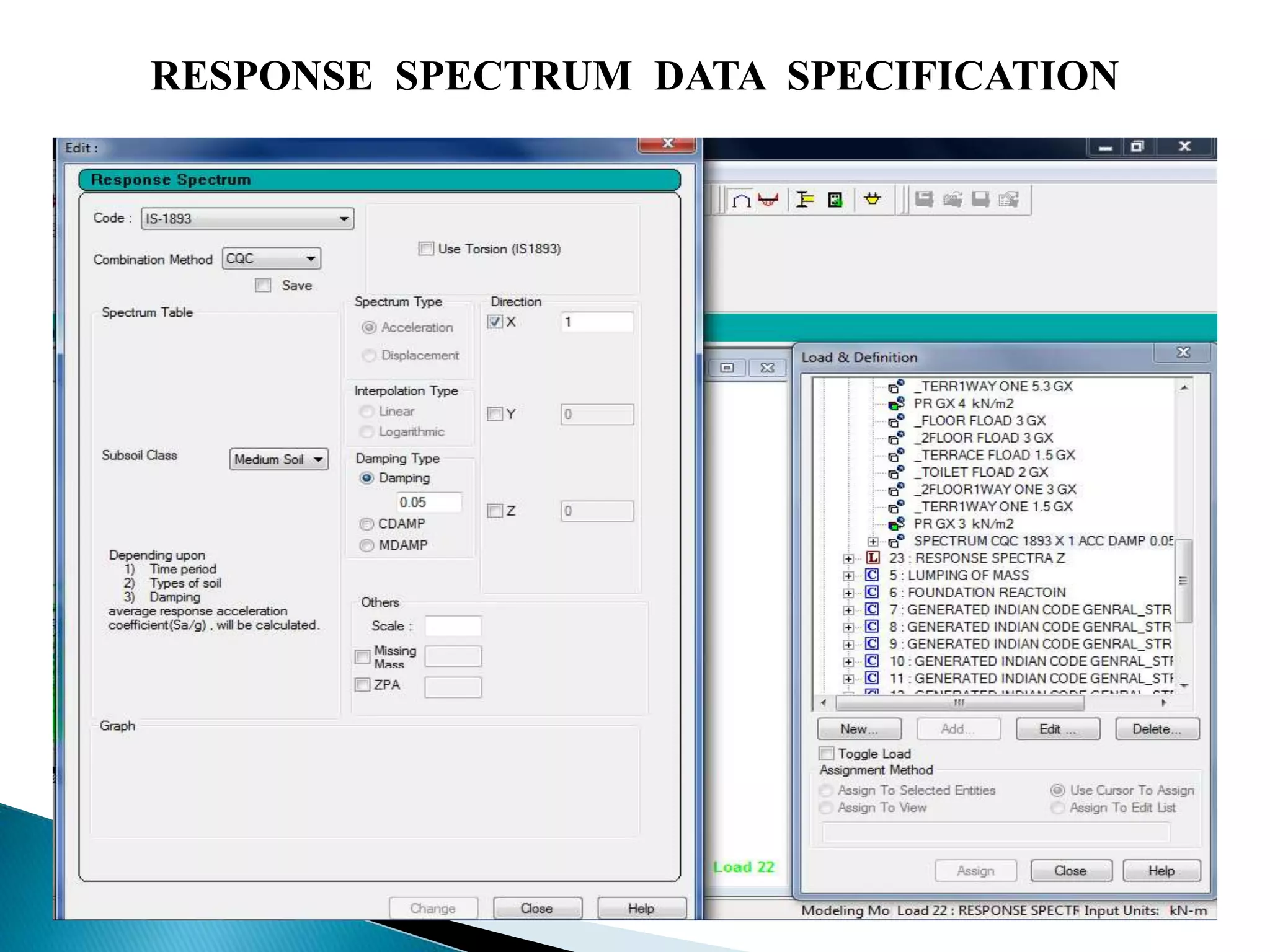
The design lateral shear force at each floor in each mode is 
computed by STAAD in accordance with the IS: 1893 (Part 1) - 
2002 
STAAD utilizes the following procedure to generate the lateral seismic 
loads. 
[1] User provides the value for as factors for input spectrum. I* Z / 2 R 
[2] Program calculates time periods for first six modes or as specified 
by the user. 
[3] Program calculates Sa/g for each mode utilizing time period and 
damping for each mode.
[4] The program calculates design horizontal acceleration spectrum 
for different modes 
[5] The program then calculates mode participation factor for different 
modes. 
[6] The peak lateral seismic force at each floor in each mode is 
calculated. 
[7] All response quantities for each mode are calculated. 
[8] The peak response quantities are then combined as per method 
(CQC or SRSS or ABS ) as defined by the user to get the final results
RESPONSE SPECTRUM DATA SPECIFICATION
Mode shape 
Mode shape is the deformed shape of the building when 
shaken at natural period 
Factors influencing Mode Shapes 
(1) Effect of Flexural Stiffness of Structural Elements 
(2) Effect of Axial Stiffness of Vertical Members 
(3) Effect of Degree of Fixity at Member Ends 
(4) Effect of Building Height
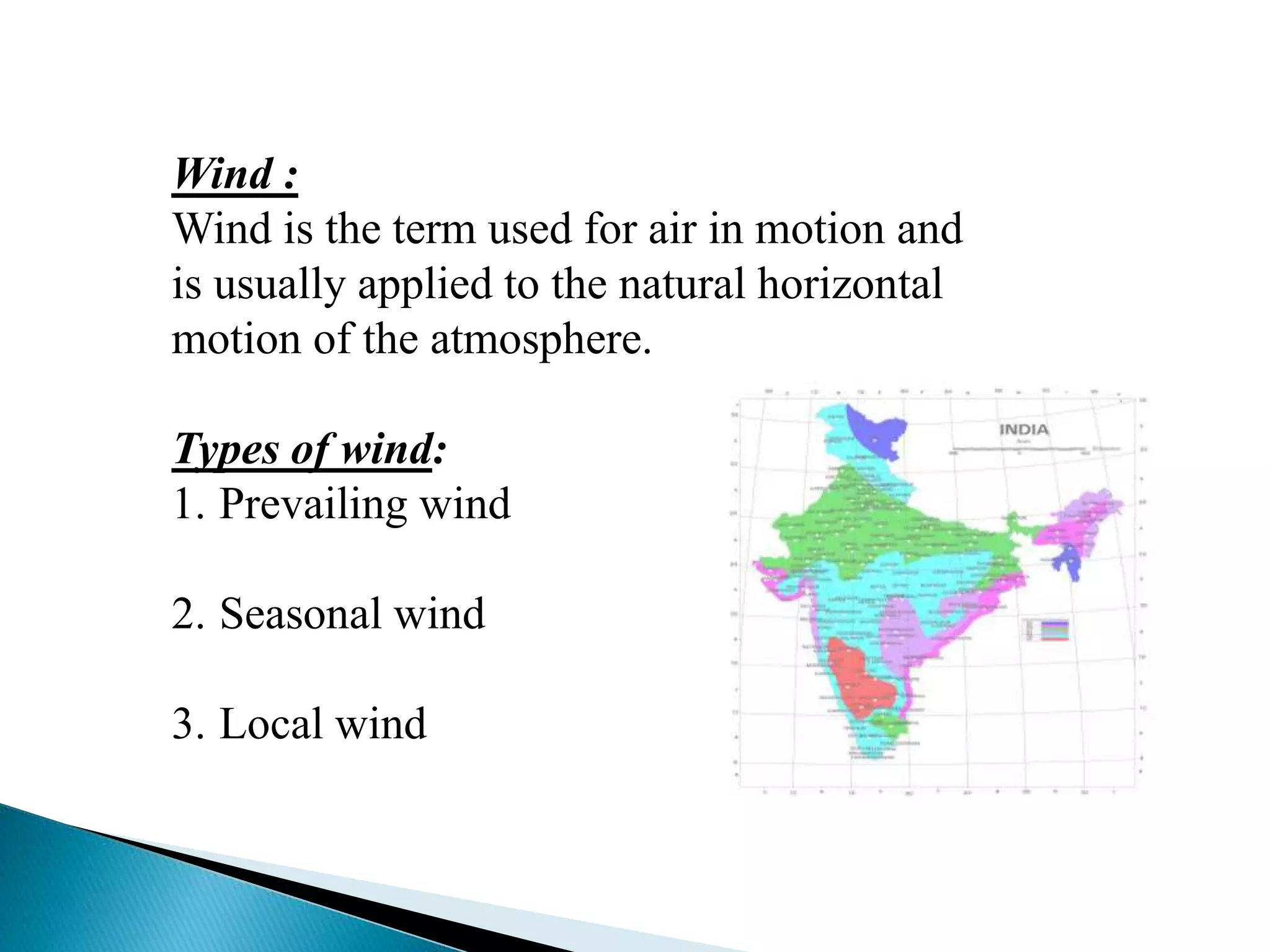
Wind : 
Wind is the term used for air in motion and 
is usually applied to the natural horizontal 
motion of the atmosphere. 
Types of wind: 
1. Prevailing wind 
2. Seasonal wind 
3. Local wind
Design analysis of wind : 
Design Wind Speed (Vz) : 
Vz = Vb k1 k2 k3 
Vz = design wind speed at any height z in m/s, 
k1 = probability factor (risk coefficient) 
k2 = terrain roughness and height factor 
k3 = topography factor 
Design Wind Pressure (pz): 
pz = 0.6 vz 
2 
pz = wind pressure in N/m2 at height z, and 
Vz = design wind speed in m/s at height z.
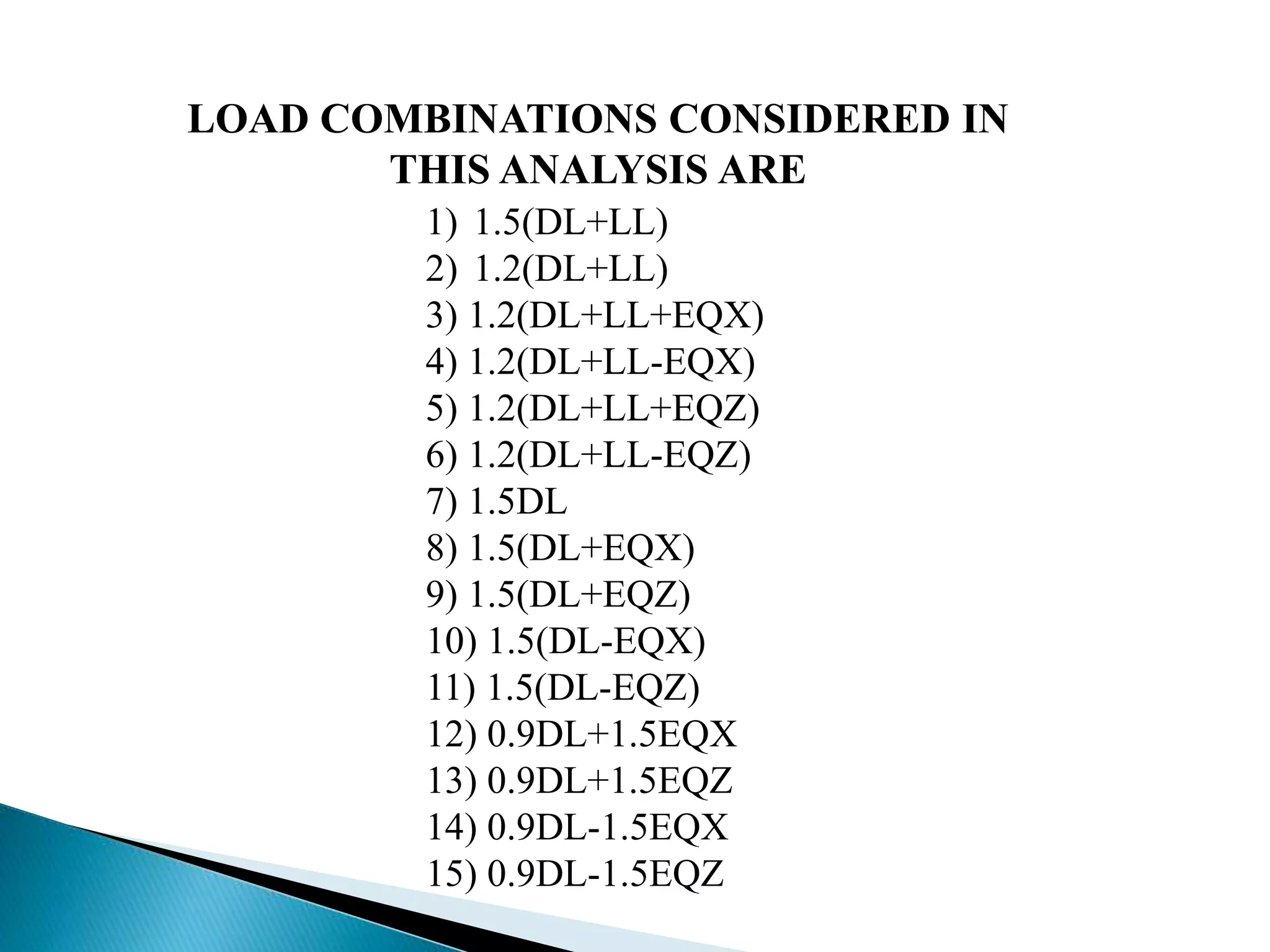
LOAD COMBINATIONS CONSIDERED IN 
THIS ANALYSIS ARE 
1) 1.5(DL+LL) 
2) 1.2(DL+LL) 
3) 1.2(DL+LL+EQX) 
4) 1.2(DL+LL-EQX) 
5) 1.2(DL+LL+EQZ) 
6) 1.2(DL+LL-EQZ) 
7) 1.5DL 
8) 1.5(DL+EQX) 
9) 1.5(DL+EQZ) 
10) 1.5(DL-EQX) 
11) 1.5(DL-EQZ) 
12) 0.9DL+1.5EQX 
13) 0.9DL+1.5EQZ 
14) 0.9DL-1.5EQX 
15) 0.9DL-1.5EQZ
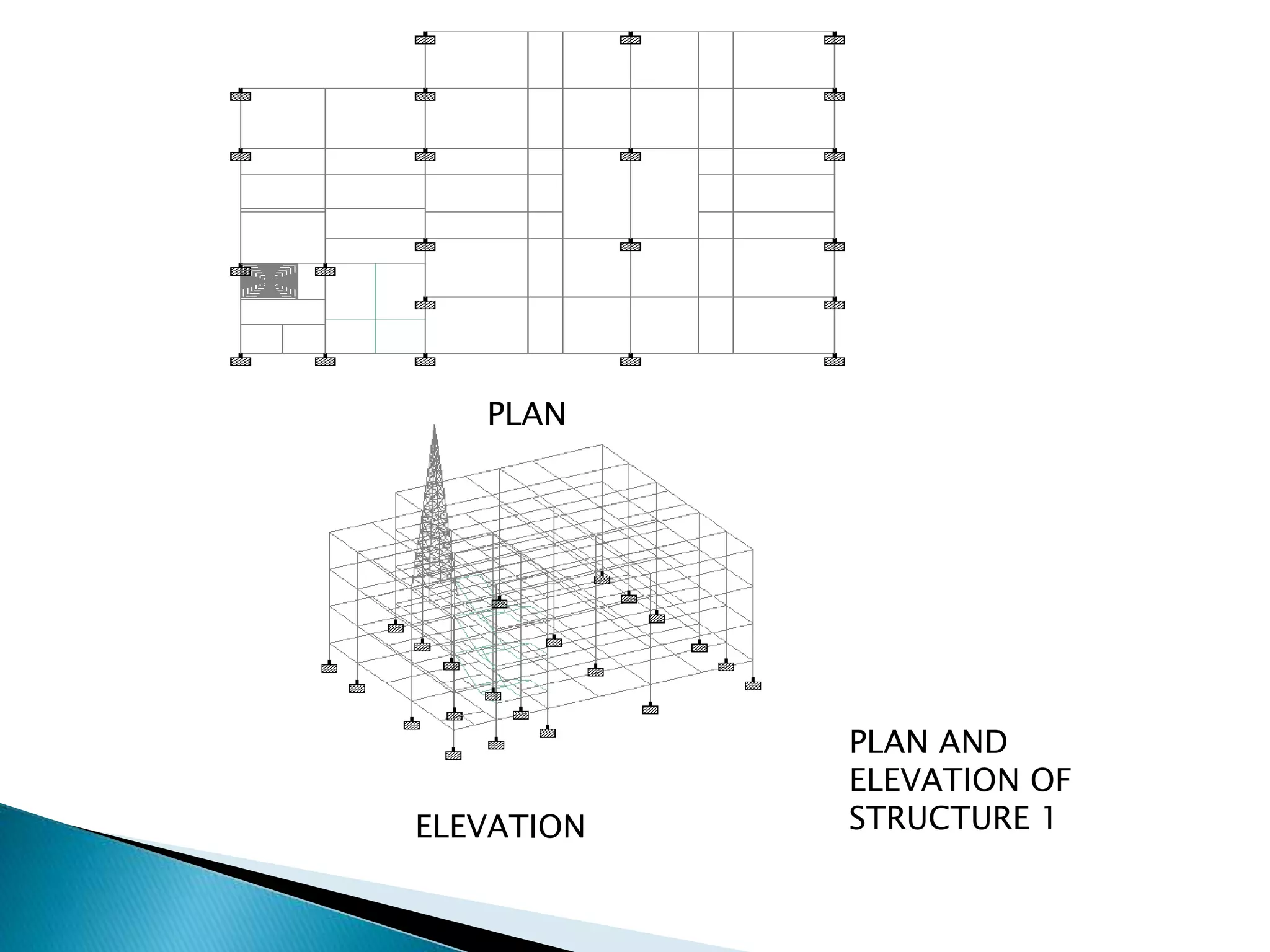
PLAN 
ELEVATION 
PLAN AND 
ELEVATION OF 
STRUCTURE 1
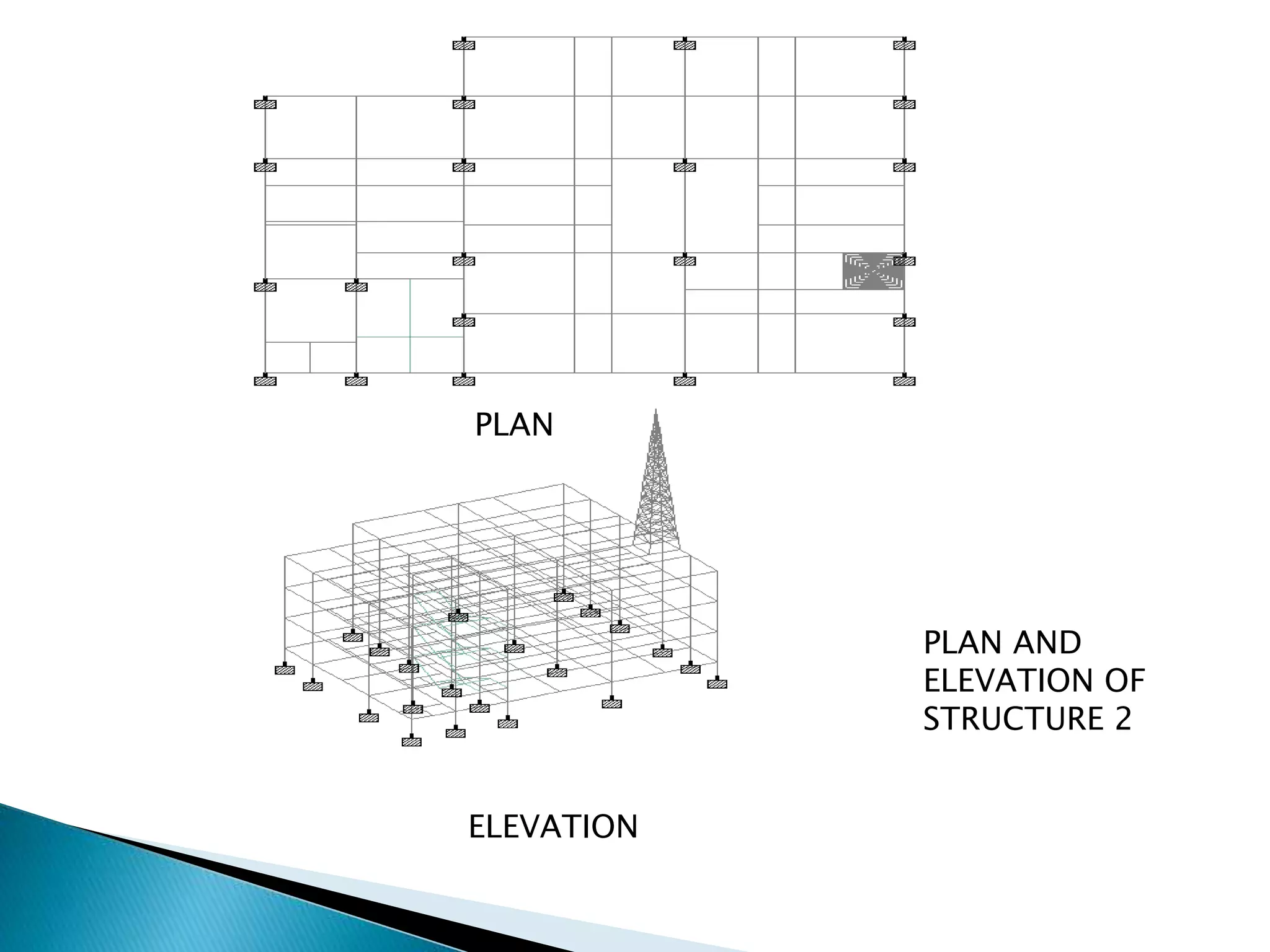
PLAN 
ELEVATION 
PLAN AND 
ELEVATION OF 
STRUCTURE 2
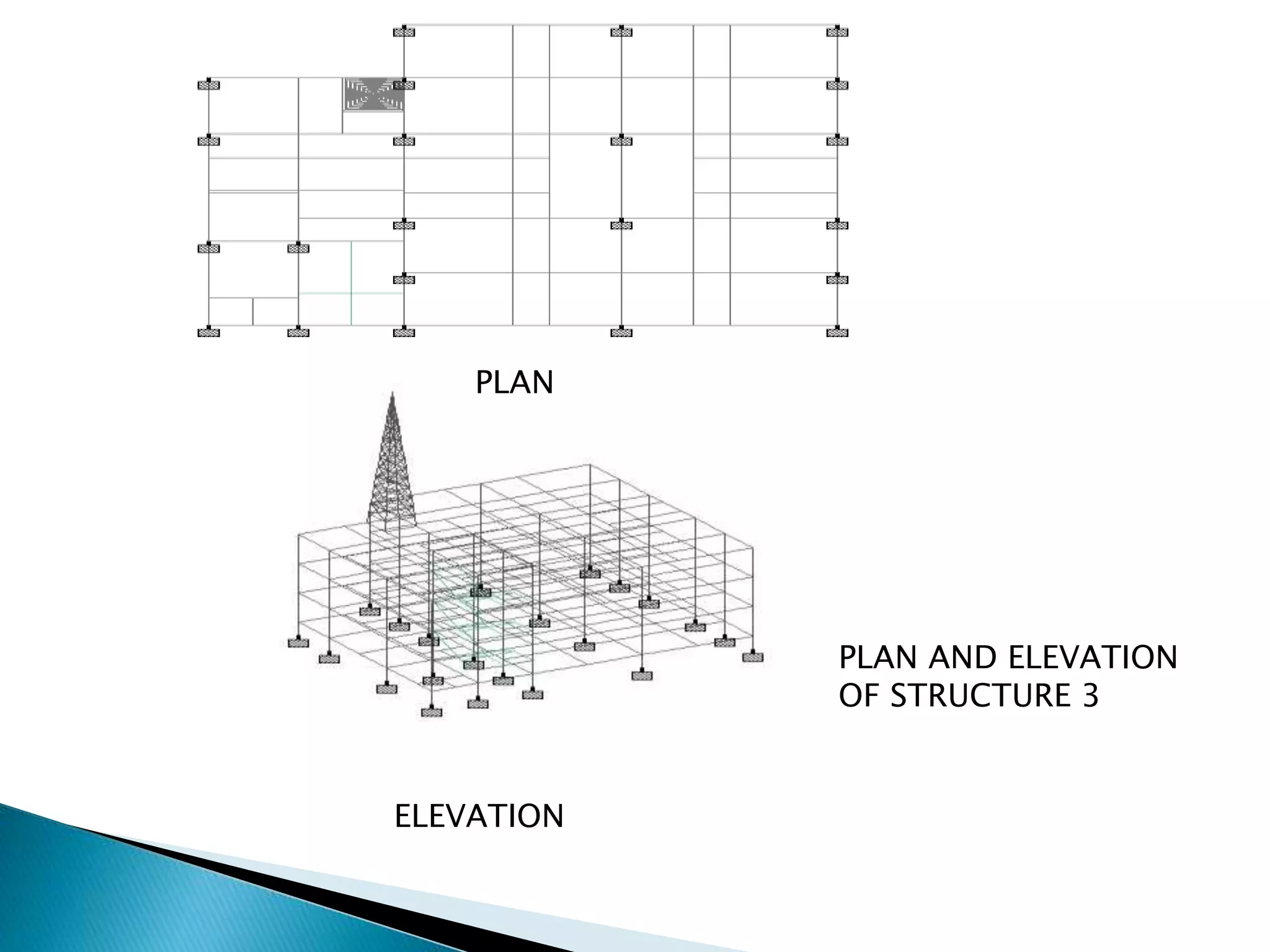
PLAN 
ELEVATION 
PLAN AND ELEVATION 
OF STRUCTURE 3
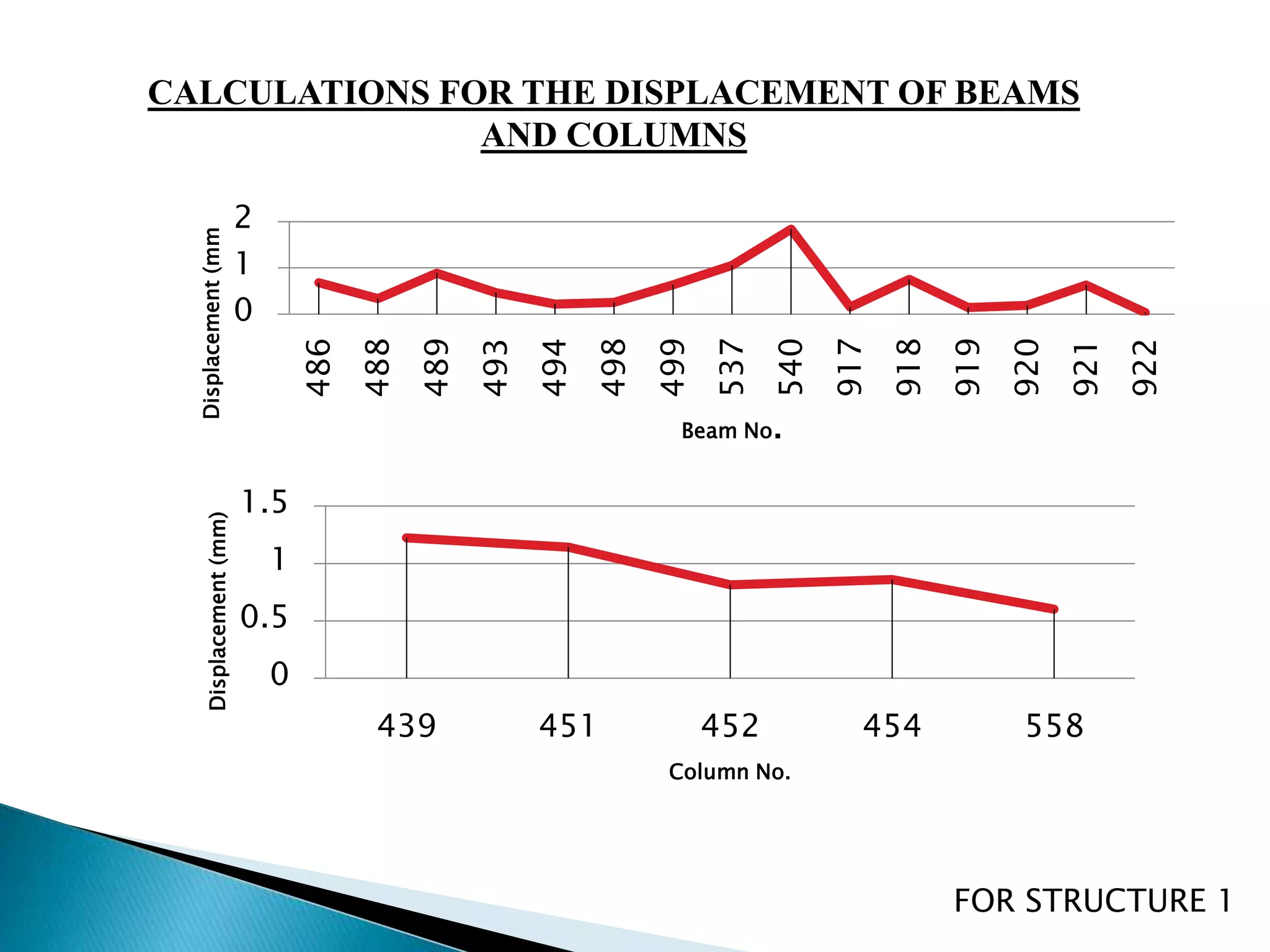
CALCULATIONS FOR THE DISPLACEMENT OF BEAMS 
2 
1 
0 
AND COLUMNS 
486 
488 
489 
493 
494 
498 
499 
537 
540 
917 
918 
919 
920 
921 
922 
Displacement (mm 
Beam No. 
1.5 
1 
0.5 
0 
439 451 452 454 558 
Displacement (mm) 
Column No. 
FOR STRUCTURE 1
4 
3 
2 
1 
0 
476 
481 
509 
511 
512 
534 
535 
915 
917 
918 
919 
921 
Displacement (mm) 
Beam No. 
2 
1.5 
1 
0.5 
0 
441 444 445 447 450 
Displacement 
(mm) 
Column No. 
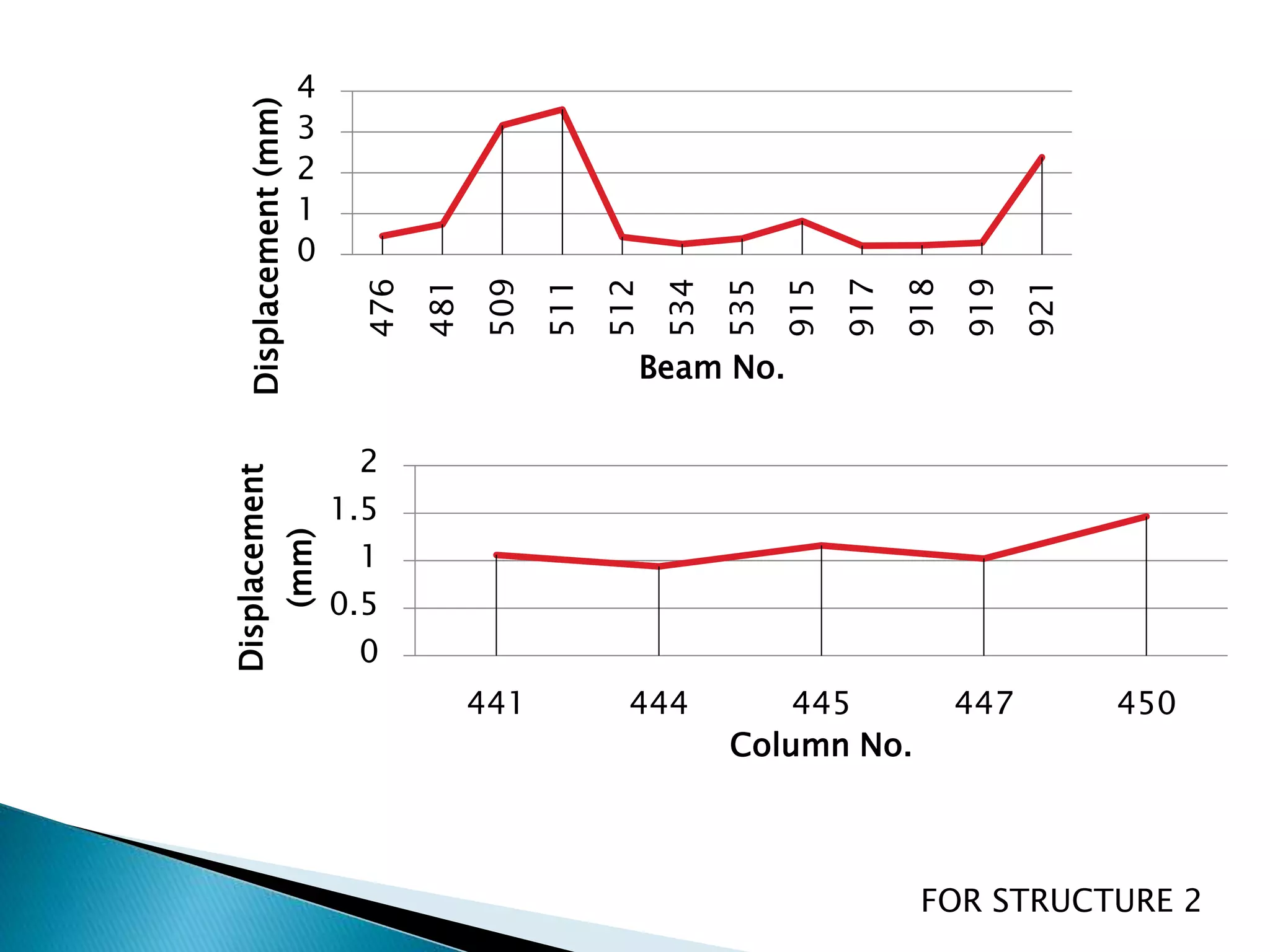
FOR STRUCTURE 2
6 
5 
4 
3 
2 
1 
0 
457 
458 
459 
461 
464 
465 
470 
487 
496 
901 
903 
906 
907 
908 
909 
Displacement (mm) 
Beam No 
1.5 
1 
0.5 
0 
433 436 437 438 439 
Displacement 
(mm) 
Column No. 
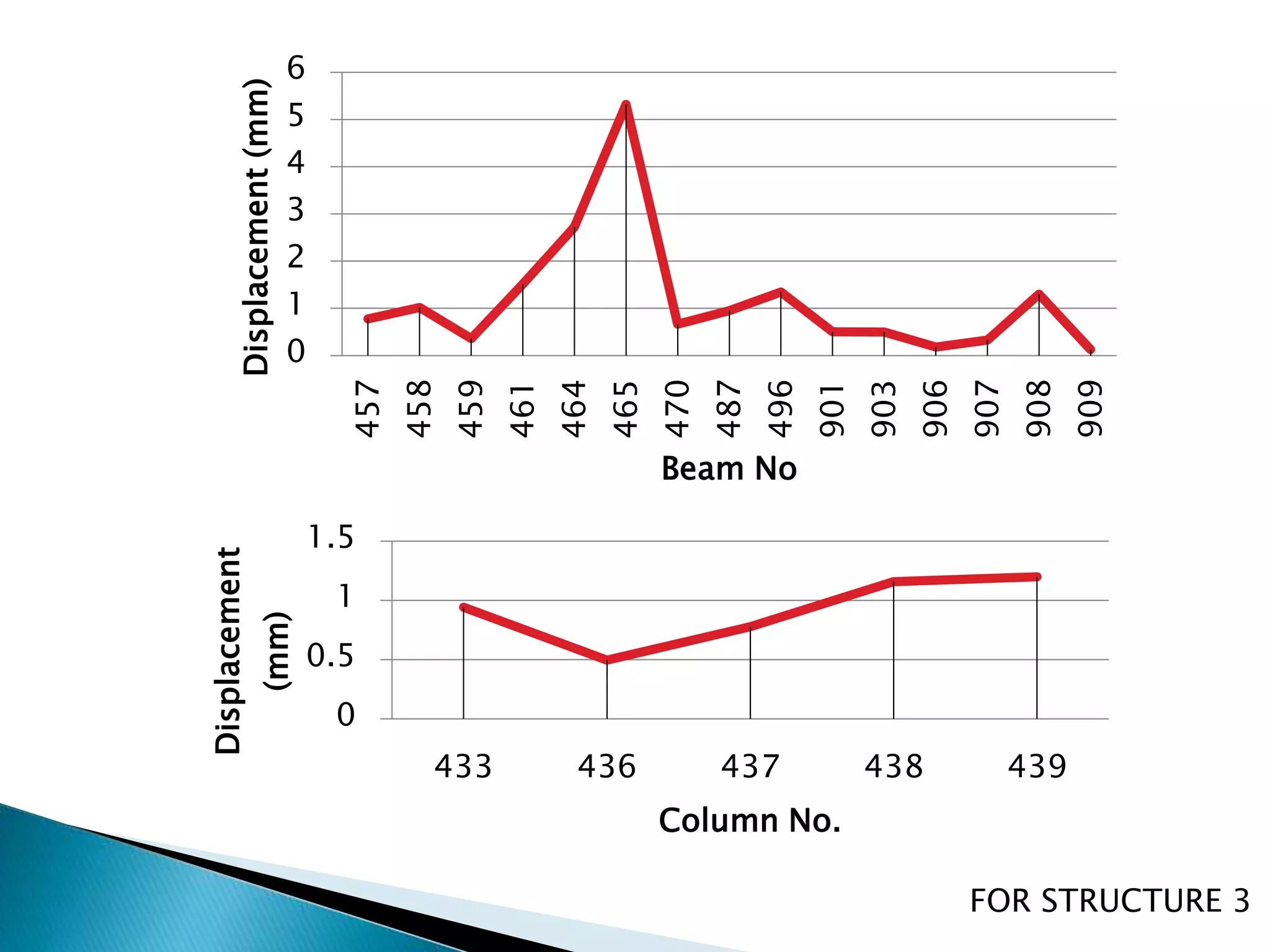
FOR STRUCTURE 3
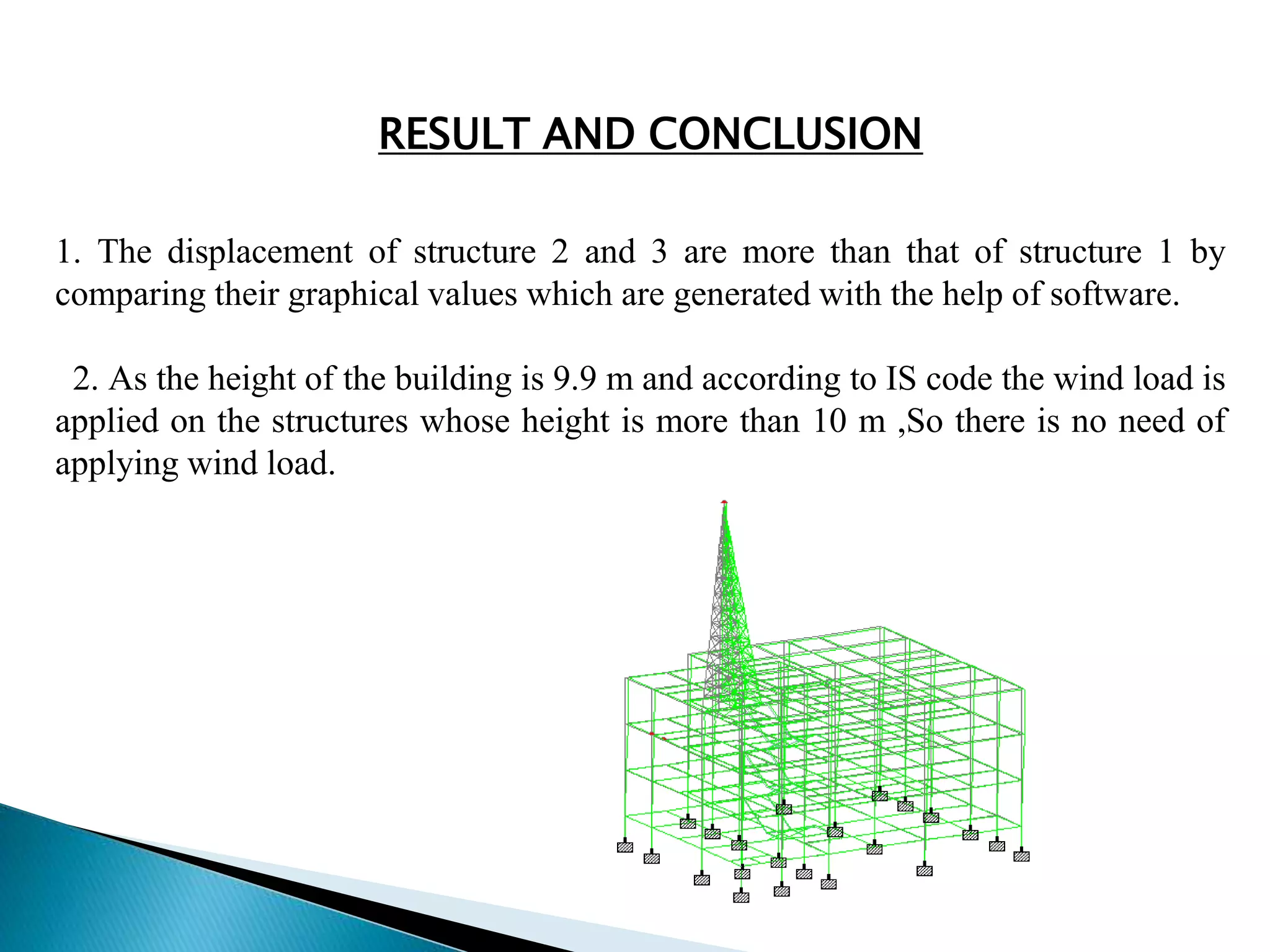
RESULT AND CONCLUSION 
1. The displacement of structure 2 and 3 are more than that of structure 1 by 
comparing their graphical values which are generated with the help of software. 
2. As the height of the building is 9.9 m and according to IS code the wind load is 
applied on the structures whose height is more than 10 m ,So there is no need of 
applying wind load.
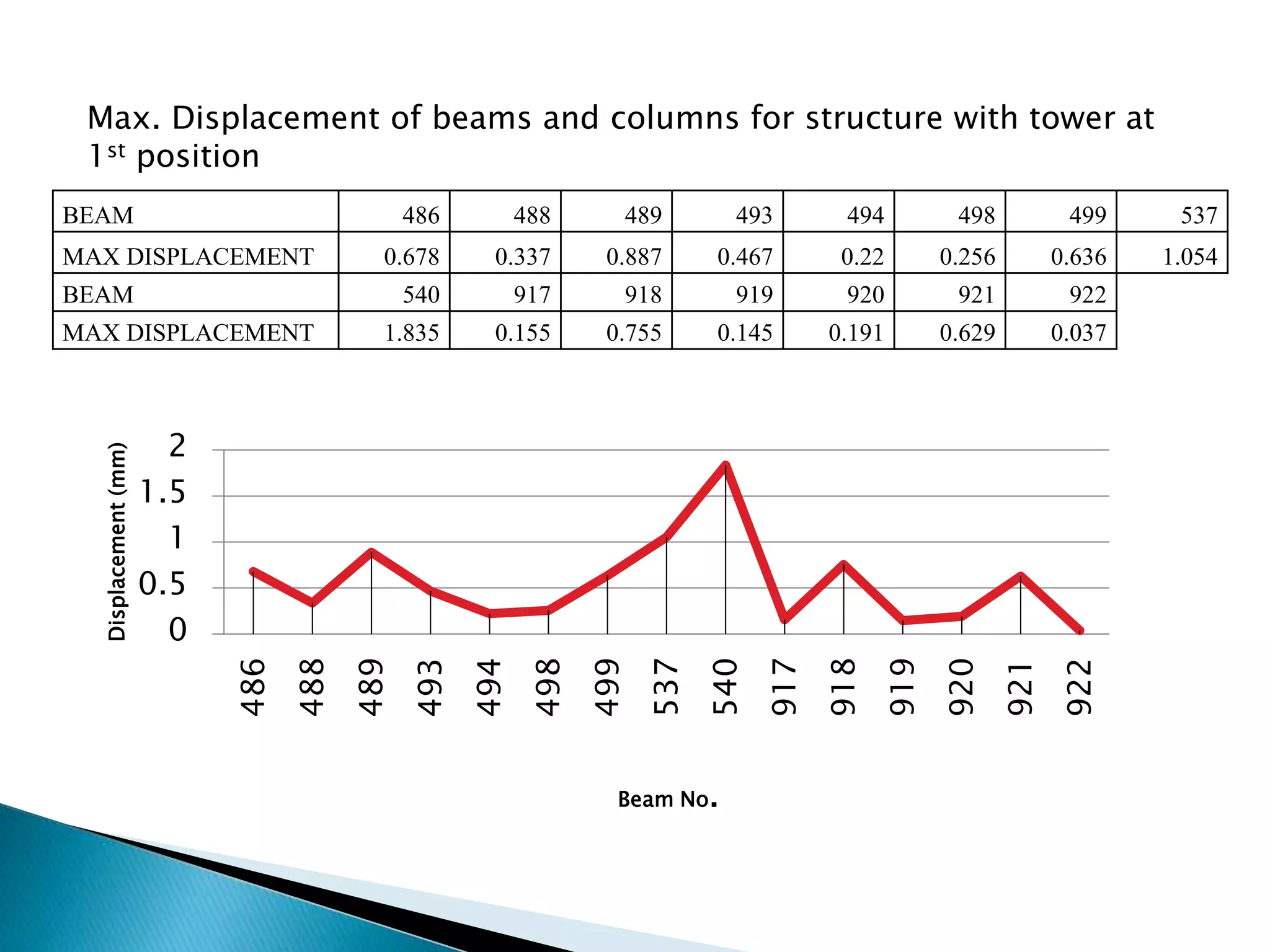
Max. Displacement of beams and columns for structure with tower at 
1st position 
BEAM 486 488 489 493 494 498 499 537 
MAX DISPLACEMENT 0.678 0.337 0.887 0.467 0.22 0.256 0.636 1.054 
BEAM 540 917 918 919 920 921 922 
MAX DISPLACEMENT 1.835 0.155 0.755 0.145 0.191 0.629 0.037 
2 
1.5 
1 
0.5 
0 
486 
488 
489 
493 
494 
498 
499 
537 
540 
917 
918 
919 
920 
921 
922 
Displacement (mm) 
Beam No.
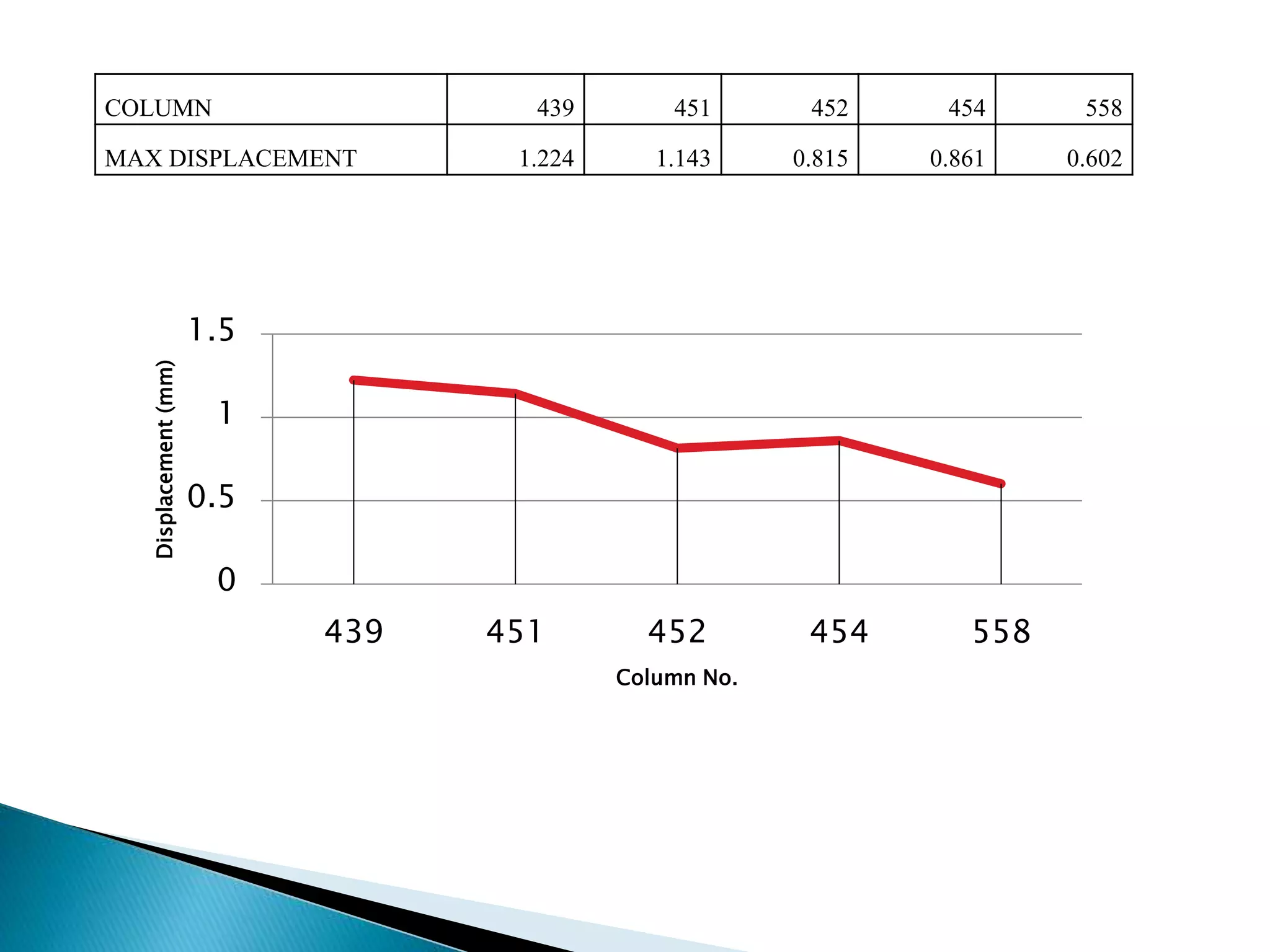
COLUMN 439 451 452 454 558 
MAX DISPLACEMENT 1.224 1.143 0.815 0.861 0.602 
1.5 
1 
0.5 
0 
439 451 452 454 558 
Displacement (mm) 
Column No.
REFERENCES 
 IS - 1893 – 2002 (part - 1) 
 IS - 875 (part - 3) 
Bhosale N.Kumar P., Pandey A.D., (2012), Influence of Host Structure 
Characteristics on Response of Rooftop Telecommunication Towers, 
International Journal of Civil and Structural Engineering, 2(3), 2012. 
 Siddhesha H., (2010), Wind analysis of Microwave Towers, International 
Journal of Applied Engineering Research, Dindigul, 1(3), 574-584. 
 Amiri G., Barkhordari M.A., Massah S. R., Vafaei M.R.,(2007), Earthquake 
Amplification Factors for Self-supporting 4-legged Telecommunication 
Towers, World Applied Sciences Journal, 6(2), 635-643. 
 McClure G., Georgi L., Assi R, (2004), Seismic considerations for 
telecommunication towers mounted on building rooftop, 13th World 
Conference on Earthquake Engineering, Vancouver, Canada, Paper No. 1988.
Dynamic Analysis of Multistorey framed structure with roof tower

Dynamic Analysis of Multistorey framed structure with roof tower

  • 1.
    DYNAMIC ANALYSIS OF MULTISTOREY FRAMED STRUCTURE WITH ROOF TOWER Guide :- Mr. PRAMOD TIWARI PRESENTED BY: Amit Ranjan (2002309) Gupta Abhishek (2002964) Mohit Jain (2002355) Navdeep Kumar (2002357) Siddhant Raturi (2002403) Vipin Thapliyal (2002854)
  • 2.
    INTRODUCTION • Telecommunicationstructure designed for supporting parabolic antennas. e.g. microwave transmission for communication , radio and T.V signals. • Self-supporting structures. • Three-legged and Four-legged space trussed structures. • Consideration of load.  Seismic load.  Wind load.
  • 3.
    OBJECTIVES  Modelingof the tower.  Modeling of the building.  Study of the Response Spectra Method on the building with roof tower.  Study of the wind load on the building.
  • 4.
    BUILDING USED Buildingused Height of the building = 9.9 m No. of storey 3 Tower 4 legged space tower height of the tower = 15m
  • 5.
    Detailing of Building 1. Type of structure Multi-storey rigid jointed framed structure 2. Seismic zone Zone -IV 3. Number of stories Three ( G+2 ) 4. Floor height 3.3 m 5. Infill wall 250 mm thick including plaster in longitudinal and 150 mm in transverse direction 6. Imposed load 3 kN/m2 7. Materials Concrete ( M 25) and reinforcement (Fe 500) 8. Size of columns 460 mm x 340 mm 530 mm x 340 mm 450 mm x 340 mm 9. Size of beams 450 mm x 230 mm 300 mm x 230 mm 10. Depth of slab 150 mm thick 11. Specific weight of RCC 24 kN/m3 12. Specific weight of infill 20 kN/m3 13. Type of soil Medium soil 14. Response spectra As per IS 1893 ( part 1): 2002 15. Time history Compatible to IS 1893 ( part 1): 2002 spectra at medium soil for 5% damping.
  • 6.
    1. Type ofstructure 4-Legged Steel Structure 2. Seismic zone Zone –IV 3. Height 15 m 4. BaseWidth 2.1 m 5. Poisson’s ratio 0.3 6. Young’s modulus of elasticity, Es 2.11 x 10⁵MPa 7. Materials Steel ISA 50X50X6 ISA 40X40X6 8. Axial Force 10KN in comp. 4KN in ten. Detailing of Tower
  • 7.
    STEPS INVOLVED INWORKING OF STAAD- PRO GEOMETRY GENERAL PROPERTY SUPPORTS LOAD & DEFINITION CROSS SECTION FIXED AND PINNED DEFINITION DYNAMIC LOAD RESPONSE SPECTRA METHOD LOAD CASE & DETAILS ANALYSE
  • 8.
    RESPONSE SPECTRA Response spectra is a very useful tool of earthquake engineering for analysing the performance of structure during earthquake.  Response spectra is simply a plot of the peak or steady state response (disp., vel., ace.)  Response spectra is measured using accelerograph.
  • 9.
    RESPONSE SPECTRUM METHODBY USING STAADPRO The design lateral shear force at each floor in each mode is computed by STAAD in accordance with the IS: 1893 (Part 1) - 2002 STAAD utilizes the following procedure to generate the lateral seismic loads. [1] User provides the value for as factors for input spectrum. I* Z / 2 R [2] Program calculates time periods for first six modes or as specified by the user. [3] Program calculates Sa/g for each mode utilizing time period and damping for each mode.
  • 10.
    [4] The programcalculates design horizontal acceleration spectrum for different modes [5] The program then calculates mode participation factor for different modes. [6] The peak lateral seismic force at each floor in each mode is calculated. [7] All response quantities for each mode are calculated. [8] The peak response quantities are then combined as per method (CQC or SRSS or ABS ) as defined by the user to get the final results
  • 11.
  • 12.
    Mode shape Modeshape is the deformed shape of the building when shaken at natural period Factors influencing Mode Shapes (1) Effect of Flexural Stiffness of Structural Elements (2) Effect of Axial Stiffness of Vertical Members (3) Effect of Degree of Fixity at Member Ends (4) Effect of Building Height
  • 13.
    Wind : Windis the term used for air in motion and is usually applied to the natural horizontal motion of the atmosphere. Types of wind: 1. Prevailing wind 2. Seasonal wind 3. Local wind
  • 14.
    Design analysis ofwind : Design Wind Speed (Vz) : Vz = Vb k1 k2 k3 Vz = design wind speed at any height z in m/s, k1 = probability factor (risk coefficient) k2 = terrain roughness and height factor k3 = topography factor Design Wind Pressure (pz): pz = 0.6 vz 2 pz = wind pressure in N/m2 at height z, and Vz = design wind speed in m/s at height z.
  • 15.
    LOAD COMBINATIONS CONSIDEREDIN THIS ANALYSIS ARE 1) 1.5(DL+LL) 2) 1.2(DL+LL) 3) 1.2(DL+LL+EQX) 4) 1.2(DL+LL-EQX) 5) 1.2(DL+LL+EQZ) 6) 1.2(DL+LL-EQZ) 7) 1.5DL 8) 1.5(DL+EQX) 9) 1.5(DL+EQZ) 10) 1.5(DL-EQX) 11) 1.5(DL-EQZ) 12) 0.9DL+1.5EQX 13) 0.9DL+1.5EQZ 14) 0.9DL-1.5EQX 15) 0.9DL-1.5EQZ
  • 16.
    PLAN ELEVATION PLANAND ELEVATION OF STRUCTURE 1
  • 17.
    PLAN ELEVATION PLANAND ELEVATION OF STRUCTURE 2
  • 18.
    PLAN ELEVATION PLANAND ELEVATION OF STRUCTURE 3
  • 19.
    CALCULATIONS FOR THEDISPLACEMENT OF BEAMS 2 1 0 AND COLUMNS 486 488 489 493 494 498 499 537 540 917 918 919 920 921 922 Displacement (mm Beam No. 1.5 1 0.5 0 439 451 452 454 558 Displacement (mm) Column No. FOR STRUCTURE 1
  • 20.
    4 3 2 1 0 476 481 509 511 512 534 535 915 917 918 919 921 Displacement (mm) Beam No. 2 1.5 1 0.5 0 441 444 445 447 450 Displacement (mm) Column No. FOR STRUCTURE 2
  • 21.
    6 5 4 3 2 1 0 457 458 459 461 464 465 470 487 496 901 903 906 907 908 909 Displacement (mm) Beam No 1.5 1 0.5 0 433 436 437 438 439 Displacement (mm) Column No. FOR STRUCTURE 3
  • 22.
    RESULT AND CONCLUSION 1. The displacement of structure 2 and 3 are more than that of structure 1 by comparing their graphical values which are generated with the help of software. 2. As the height of the building is 9.9 m and according to IS code the wind load is applied on the structures whose height is more than 10 m ,So there is no need of applying wind load.
  • 23.
    Max. Displacement ofbeams and columns for structure with tower at 1st position BEAM 486 488 489 493 494 498 499 537 MAX DISPLACEMENT 0.678 0.337 0.887 0.467 0.22 0.256 0.636 1.054 BEAM 540 917 918 919 920 921 922 MAX DISPLACEMENT 1.835 0.155 0.755 0.145 0.191 0.629 0.037 2 1.5 1 0.5 0 486 488 489 493 494 498 499 537 540 917 918 919 920 921 922 Displacement (mm) Beam No.
  • 24.
    COLUMN 439 451452 454 558 MAX DISPLACEMENT 1.224 1.143 0.815 0.861 0.602 1.5 1 0.5 0 439 451 452 454 558 Displacement (mm) Column No.
  • 25.
    REFERENCES  IS- 1893 – 2002 (part - 1)  IS - 875 (part - 3) Bhosale N.Kumar P., Pandey A.D., (2012), Influence of Host Structure Characteristics on Response of Rooftop Telecommunication Towers, International Journal of Civil and Structural Engineering, 2(3), 2012.  Siddhesha H., (2010), Wind analysis of Microwave Towers, International Journal of Applied Engineering Research, Dindigul, 1(3), 574-584.  Amiri G., Barkhordari M.A., Massah S. R., Vafaei M.R.,(2007), Earthquake Amplification Factors for Self-supporting 4-legged Telecommunication Towers, World Applied Sciences Journal, 6(2), 635-643.  McClure G., Georgi L., Assi R, (2004), Seismic considerations for telecommunication towers mounted on building rooftop, 13th World Conference on Earthquake Engineering, Vancouver, Canada, Paper No. 1988.