International Research Journal of Engineering and Technology (IRJET) e-ISSN: 2395 -0056
Volume: 04 Issue: 06 | June -2017 www.irjet.net p-ISSN: 2395-0072
© 2017, IRJET | Impact Factor value: 5.181 | ISO 9001:2008 Certified Journal | Page 1848
ANALYSIS OF RC FRAMED HIGH RISE STRUCTURAL SYSTEM WITH
GROUND AND INTERMEDIATE SOFT STOREY CONSIDERING WIND
EFFECT
1Sujeet Patil , 2Prof. Vishwanath B Patil
1P G Student , 2Associate Professor Dept. of civil Engineering, PDACE Kalaburagi-585102
---------------------------------------------------------------------***---------------------------------------------------------------------
Abstract: Generally RC framed high rise building
structures are designed neglecting the effect of masonary
infill walls . Wheras the masonary infill walls are used for
partition . The masonary infill walls are treated as non-
strucutural elements . RC frame structures having open first
storey is known as soft storey
Meanwhile the soft storey located in the upper part of high
rise building does not significantly effect the overall
performance compared to the performance of the fully infill
frame.
The primary purpose of all kinds of structural systems used
in building type of structure is to support gravity loads. The
most common loads resulting from the effect of gravity are
dead load, live load and snow load. Beside this vertical loads
building are also subjected to lateral loads caused by wind,
earthquake.
Lateral loads can develop high stresses produces
sway moment or cause vibration. Therefore, it is very
important for the structure to have sufficient strength
against vertical loads together with adequate stiffness to
resist lateral forces.
Reinforced concrete building structure can be classifiedare:
1. Structural frame system: The structural system
consists of frames, floor slabs, beams and column
are the basis elements of structural system.
2. Structural wall system: In this type of structures,all
material members are made of structural walls,
generally called shear walls.
Key Words: RC framed building, wind analysis of building,
Soft storey, shear walls.
1. INTRODUCTION
In every aspect of human civilization, we needed structures
to live in or to get what we need. But it is not only building
structure. But to build efficient structure so that it can fulfill
the main purpose for what it was made for, here comes the
role of civil engineering and more precisely the role of
analysis of structure. There are many classical methods to
solve design problem and with time new software also
coming into play. Here in this project work recent from
based software named ETABS has been used.
2. DESCRIPTION OF STRUCTURAL MODEL
The present plan is of residential building which consist of
(G+24) storey.30.5X28.6m
Plan area = 866.8m^2
Built-up area = 611.8m^2
Total height = 85m.
 There are 8 flat in each storey.
 The ground floor is made for parking with storey
height 3m.
 There are no flat at 13thstorey with storey height of
3m.
 Remaining stories of 3.35m height.
 The head room of 2m is provided at the top.
There are 4 different models are analyzed:
Model 1: G+24 with exterior walls at 13thstorey.
Model 2: G+24 with 13thstorey as soft storey.
Model 3: G+24 with shear walls at 13thstorey.
Model 4: G+24 bare model.
Imposed load: The load assumed to be produced by the
intended use or occupancy of a building. Including the
weight ofmovablepartitionsdistributed,concentratedloads,
load due to impact and vibration, and dust load but
excluding wind, seismic, snow and other loads due to
temperatu.re changes, creep, shrinkage, differential
settlement, etc.
The imposed loads that are envisaged to act permanently
shall be calculated based on type of material and thickness
using unit weight specified by IS: 875(part 1)-1987.
International Research Journal of Engineering and Technology (IRJET) e-ISSN: 2395 -0056
Volume: 04 Issue: 06 | June -2017 www.irjet.net p-ISSN: 2395-0072
© 2017, IRJET | Impact Factor value: 5.181 | ISO 9001:2008 Certified Journal | Page 1849
Internal partition load shall be calculated based on type of
material and thickness using weight specified by IS:
875(part 1)-1987. The super imposed load or otherwise
live load is assessed based on occupancy classification as
per IS: 875(part 2)-1987 (TABLE 3).
1. Live load = 2KN/m
2. Floor finish = 1KN/m
3. Wall load
For 3.35m height wall
Density of brick wall = 18kn/m
3.35x0.23x18 = 13.86KN/m (230mm wall)
3.35x.0.1x18 = 6.03KN/m (100mm wall)
For 3m height wall
3x18x0.23 = 12.42KN/m (230mm wall)
3x18x0.1 = 5.4KN/m (100mm wall)
Wind exposures parameters:
1. Wind direction angle for x-direction=0
2. Wind direction angle for y-direction=90
3. Wind ward coefficient=0.8
4. Leeward coefficient=0.5
Exposures height:
1. Top story=RF
2. Bottom story=base
Wind coefficients:
1. Wind speed (vb)=44m/s
2. Terrain category=3
3. Structure class=C
4. Risk coefficient (k1 factor) =1
5. Topography (k3 factor) =1
3. MODELS FOR ANALYSIS
Model 1:
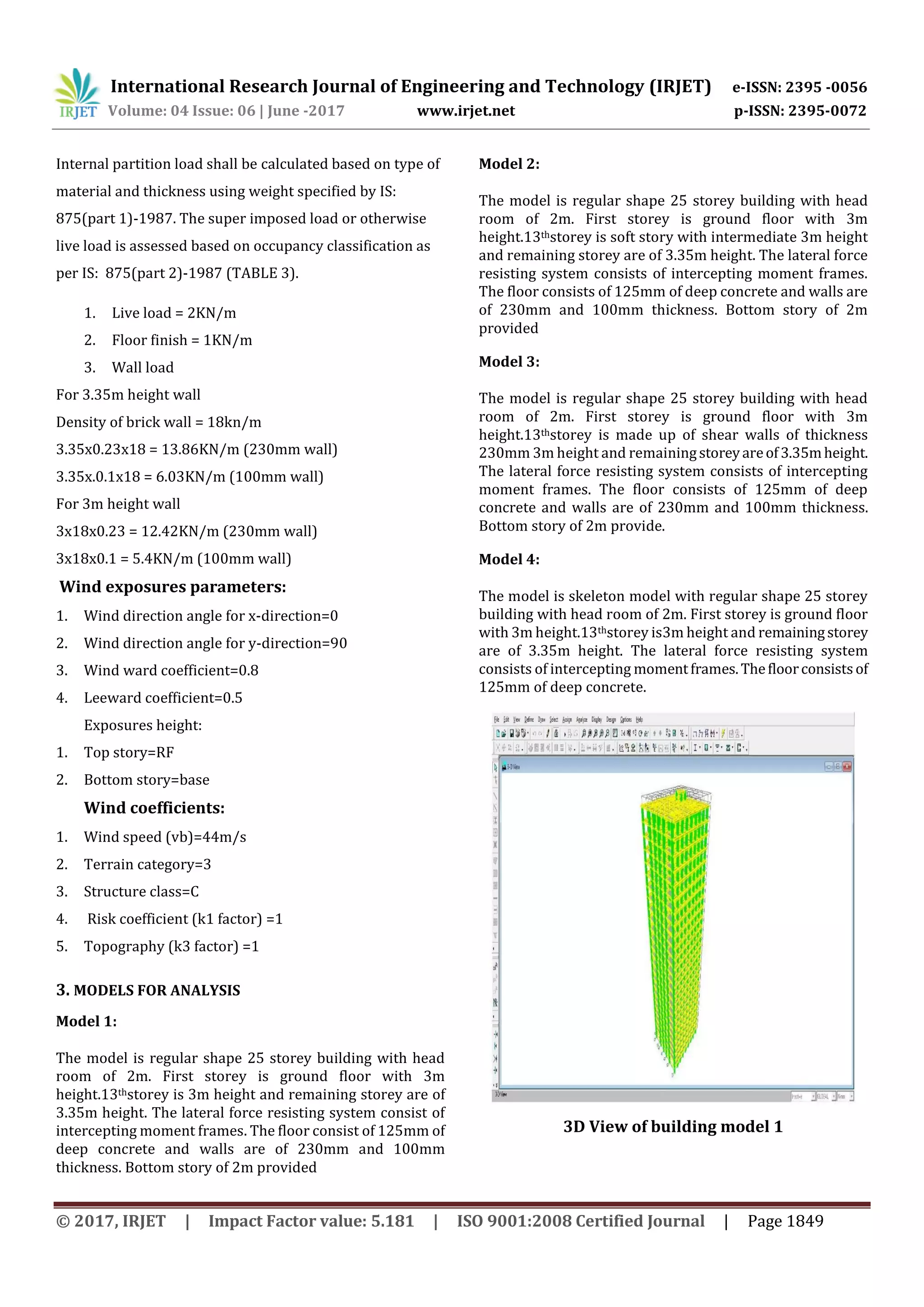
The model is regular shape 25 storey building with head
room of 2m. First storey is ground floor with 3m
height.13thstorey is 3m height and remaining storey are of
3.35m height. The lateral force resisting system consist of
intercepting moment frames. The floor consist of 125mm of
deep concrete and walls are of 230mm and 100mm
thickness. Bottom story of 2m provided
Model 2:
The model is regular shape 25 storey building with head
room of 2m. First storey is ground floor with 3m
height.13thstorey is soft story with intermediate 3m height
and remaining storey are of 3.35m height. The lateral force
resisting system consists of intercepting moment frames.
The floor consists of 125mm of deep concrete and walls are
of 230mm and 100mm thickness. Bottom story of 2m
provided
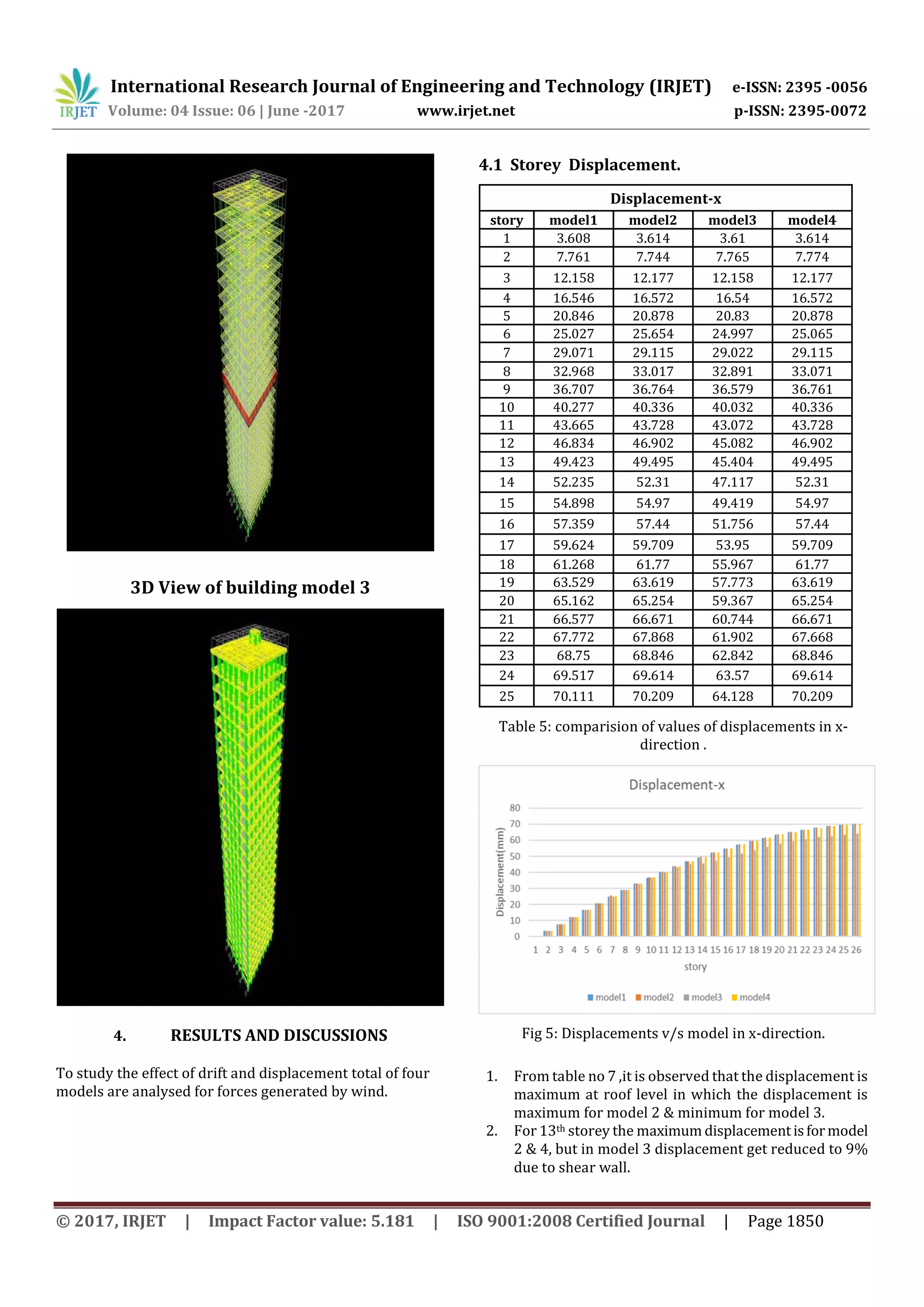
Model 3:
The model is regular shape 25 storey building with head
room of 2m. First storey is ground floor with 3m
height.13thstorey is made up of shear walls of thickness
230mm 3m height and remainingstoreyareof3.35mheight.
The lateral force resisting system consists of intercepting
moment frames. The floor consists of 125mm of deep
concrete and walls are of 230mm and 100mm thickness.
Bottom story of 2m provide.
Model 4:
The model is skeleton model with regular shape 25 storey
building with head room of 2m. First storey is ground floor
with 3m height.13thstorey is3m height and remainingstorey
are of 3.35m height. The lateral force resisting system
consists of intercepting momentframes.Thefloorconsistsof
125mm of deep concrete.
3D View of building model 1
International Research Journal of Engineering and Technology (IRJET) e-ISSN: 2395 -0056
Volume: 04 Issue: 06 | June -2017 www.irjet.net p-ISSN: 2395-0072
© 2017, IRJET | Impact Factor value: 5.181 | ISO 9001:2008 Certified Journal | Page 1850
3D View of building model 3
4. RESULTS AND DISCUSSIONS
To study the effect of drift and displacement total of four
models are analysed for forces generated by wind.
4.1 Storey Displacement.
Displacement-x
story model1 model2 model3 model4
1 3.608 3.614 3.61 3.614
2 7.761 7.744 7.765 7.774
3 12.158 12.177 12.158 12.177
4 16.546 16.572 16.54 16.572
5 20.846 20.878 20.83 20.878
6 25.027 25.654 24.997 25.065
7 29.071 29.115 29.022 29.115
8 32.968 33.017 32.891 33.071
9 36.707 36.764 36.579 36.761
10 40.277 40.336 40.032 40.336
11 43.665 43.728 43.072 43.728
12 46.834 46.902 45.082 46.902
13 49.423 49.495 45.404 49.495
14 52.235 52.31 47.117 52.31
15 54.898 54.97 49.419 54.97
16 57.359 57.44 51.756 57.44
17 59.624 59.709 53.95 59.709
18 61.268 61.77 55.967 61.77
19 63.529 63.619 57.773 63.619
20 65.162 65.254 59.367 65.254
21 66.577 66.671 60.744 66.671
22 67.772 67.868 61.902 67.668
23 68.75 68.846 62.842 68.846
24 69.517 69.614 63.57 69.614
25 70.111 70.209 64.128 70.209
Table 5: comparision of values of displacements in x-
direction .
Fig 5: Displacements v/s model in x-direction.
1. From table no 7 ,it is observed that the displacement is
maximum at roof level in which the displacement is
maximum for model 2 & minimum for model 3.
2. For 13th storey the maximum displacementisformodel
2 & 4, but in model 3 displacement get reduced to 9%
due to shear wall.
International Research Journal of Engineering and Technology (IRJET) e-ISSN: 2395 -0056
Volume: 04 Issue: 06 | June -2017 www.irjet.net p-ISSN: 2395-0072
© 2017, IRJET | Impact Factor value: 5.181 | ISO 9001:2008 Certified Journal | Page 1851
Displacement-Y
Story model 1 model 2 model 3 model 4
1 3.411 3.411 3.396 3.411
2 8.059 8.059 8.016 8.059
3 13.582 13.582 13.495 13.582
4 19.518 19.518 19.365 19.518
5 25.597 25.597 25.348 25.597
6 31.663 31.663 31.271 31.663
7 37.621 37.621 37.061 37.621
8 43.411 43.411 42.47 43.411
9 48.992 48.992 47.508 48.992
10 54.334 54.334 51.943 54.334
11 59.412 59.412 55.47 59.412
12 64.196 64.196 57.558 64.196
13 68.208 68.208 58.199 68.208
14 72.462 72.462 59.807 72.462
15 76.453 76.456 62.266 76.453
16 80.162 80.162 65.062 80.162
17 83.574 83.574 67.909 83.574
18 86.68 86.68 70.646 86.68
19 89.476 89.476 73.183 89.476
20 91.957 91.957 75.469 91.957
21 94.127 94.127 77.479 94.127
22 95.991 95.911 79.205 95.991
23 97.569 97.56 80.655 97.569
24 98.873 98.893 81.86 98.893
25 100.03 100.03 82.88 100.03
Table 5: comparision of values of displacements in x-
direction.
Fig 5: Displacements v/s model in y-direction.
1.From table no 8 ,it is observed that the displacement is
maximum at roof level in which the displacement is
maximum for model 2 & minimum for model 3.
2.For 13th storey the maximum displacementisformodel 2
& 4, but in model 3 displacement get reduced to 9% due to
shear wall.
4.2 Storey Drift.
DRIFT X
Store
y
MODEL 1 MODEL 2 MODEL 3 MODEL 4
1 0.000951 0.00095 0.00095 0.000951
2 0.00124 0.00124 0.00124 0.00124
3 0.00131 0.00134 0.00124 0.00131
4 0.00131 0.00131 0.00131 0.00131
5 0.00128 0.00129 0.00131 0.00129
6 0.00125 0.00125 0.00124 0.00125
7 0.00121 0.00121 0.0012 0.00121
8 0.00116 0.00117 0.00116 0.00117
9 0.00116 0.00112 0.0011 0.00112
10 0.00107 0.00107 0.00103 0.00107
11 0.00101 0.00101 0.00091 0.00101
12 0.00095 0.00095 0.0006 0.00095
13 0.00086 0.00086 0.00013 0.00086
14 0.00084 0.00084 0.00049 0.00084
15 0.00079 0.00079 0.00069 0.00079
16 0.00074 0.00074 0.0007 0.00074
17 0.00068 0.00068 0.00066 0.00068
18 0.00061 0.00062 0.0006 0.00062
19 0.00055 0.00055 0.00054 0.00055
20 0.00049 0.00049 0.00048 0.00049
21 0.00042 0.00042 0.00041 0.00042
22 0.00035 0.00036 0.00035 0.00036
23 0.00029 0.00029 0.00028 0.00029
24 0.00023 0.00023 0.00028 0.00023
25 0.00018 0.00018 0.00017 0.00018
Table 7: Comparision of values of Drift along X-direction .
Fig 7: Drift values v/s models along X-direction
International Research Journal of Engineering and Technology (IRJET) e-ISSN: 2395 -0056
Volume: 04 Issue: 06 | June -2017 www.irjet.net p-ISSN: 2395-0072
© 2017, IRJET | Impact Factor value: 5.181 | ISO 9001:2008 Certified Journal | Page 1852
1. From table no 9 ,it is observed that the drift is maximum
at 3rd storey in which the driftt is maximum for model 2 &
minimum for model 3.
2. For 13th storey the maximum drift is for model 2 & 4, but
in model 3 drift get reduced to 84% due to shear wall.
3. Due to shear wall there is sudden reduction in the drift.
DRIFT Y
STOREY
MODEL
1
MODEL
2
MODEL
3
MODEL
4
1 0.00139 0.00139 0.00138 0.00139
2 0.00165 0.00165 0.00164 0.00165
3 0.00177 0.00177 0.00175 0.00177
4 0.00182 0.00182 0.00179 0.00182
5 0.00181 0.00181 0.00177 0.00181
6 0.00178 0.00178 0.00172 0.00178
7 0.00173 0.00173 0.00163 0.00173
8 0.00167 0.00167 0.0015 0.00167
9 0.0016 0.0016 0.00132 0.0016
10 0.00151 0.00152 0.00105 0.00152
11 0.00143 0.00143 0.00062 0.00143
12 0.00134 0.00134 0.00021 0.00134
13 0.00127 0.00127 0.00048 0.00127
14 0.00119 0.00119 0.00073 0.00119
15 0.00111 0.00111 0.00084 0.00111
16 0.00102 0.00102 0.00085 0.00102
17 0.00093 0.00093 0.00082 0.00093
18 0.00083 0.00083 0.00076 0.00083
19 0.00074 0.00075 0.00068 0.00074
20 0.00065 0.00065 0.0006 0.00065
21 0.00056 0.00056 0.00052 0.00056
22 0.00047 0.00047 0.00043 0.00047
23 0.0004 0.0004 0.00036 0.0004
24 0.00034 0.00034 0.0003 0.00034
Table 7: Comparision of values of Drift along y-direction .
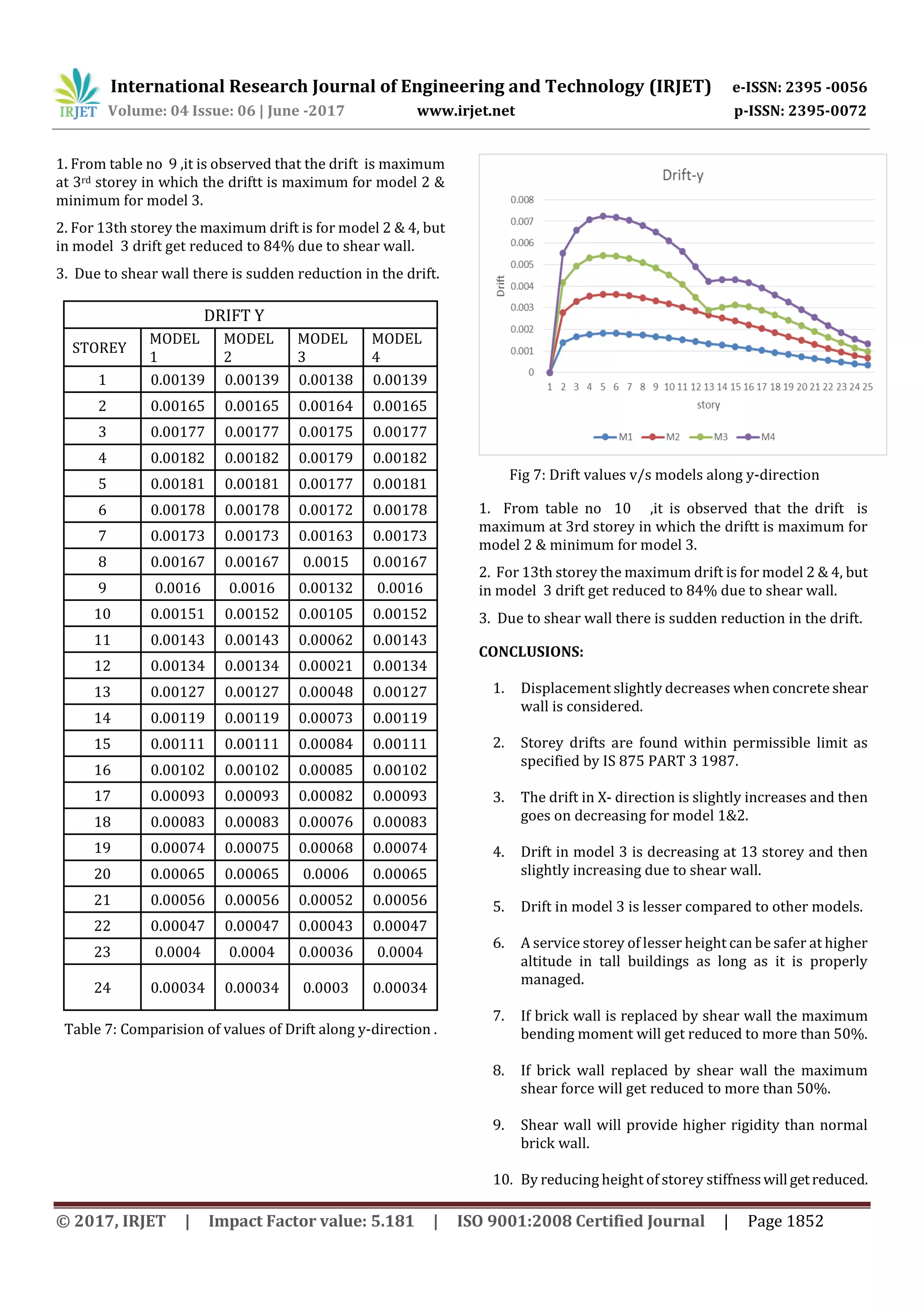
Fig 7: Drift values v/s models along y-direction
1. From table no 10 ,it is observed that the drift is
maximum at 3rd storey in which the driftt is maximum for
model 2 & minimum for model 3.
2. For 13th storey the maximum drift is for model 2 & 4, but
in model 3 drift get reduced to 84% due to shear wall.
3. Due to shear wall there is sudden reduction in the drift.
CONCLUSIONS:
1. Displacement slightly decreases when concrete shear
wall is considered.
2. Storey drifts are found within permissible limit as
specified by IS 875 PART 3 1987.
3. The drift in X- direction is slightly increases and then
goes on decreasing for model 1&2.
4. Drift in model 3 is decreasing at 13 storey and then
slightly increasing due to shear wall.
5. Drift in model 3 is lesser compared to other models.
6. A service storey of lesser height can be safer at higher
altitude in tall buildings as long as it is properly
managed.
7. If brick wall is replaced by shear wall the maximum
bending moment will get reduced to more than 50%.
8. If brick wall replaced by shear wall the maximum
shear force will get reduced to more than 50%.
9. Shear wall will provide higher rigidity than normal
brick wall.
10. By reducing height of storey stiffnesswill getreduced.
International Research Journal of Engineering and Technology (IRJET) e-ISSN: 2395 -0056
Volume: 04 Issue: 06 | June -2017 www.irjet.net p-ISSN: 2395-0072
© 2017, IRJET | Impact Factor value: 5.181 | ISO 9001:2008 Certified Journal | Page 1853
REFERENCES
1. Jawad ahmed and H S vidyadhar (2013) “wind
analysis and design of multi bay multi
storey 3D RC Frame “international journal of Engg
research and technology, volume.2 issue 9,
September 2013.
2. Chandradhara G.P, Vikram M.B(2012) “Effect of
wind load on the aspect ratio of the
building” IOSR journal of mechanical and civil
engineering. PP 45-49.
3. IS 875-part3(1987) Indian standard code of
practice for design wind loads.
4. IS 456:2000. “Indian standard code of practice for
plain and reinforced concrete”, Bureau of Indian
standards, New Delhi.
5. S.Ramamurutham & Narayan theory of structures.
6. Basic structural analysis by Reddy C.S.
7. www.csiberkeley.com
8. ETABS Non-linear 9.7,” Extended3-Danalysisofthe
building systems”, California, computers and
structures Inc., Berkeley.

Analysis of Rc Framed High Rise Structural System with Ground and Intermediate Soft Storey Considering Wind Effect

  • 1.
    International Research Journalof Engineering and Technology (IRJET) e-ISSN: 2395 -0056 Volume: 04 Issue: 06 | June -2017 www.irjet.net p-ISSN: 2395-0072 © 2017, IRJET | Impact Factor value: 5.181 | ISO 9001:2008 Certified Journal | Page 1848 ANALYSIS OF RC FRAMED HIGH RISE STRUCTURAL SYSTEM WITH GROUND AND INTERMEDIATE SOFT STOREY CONSIDERING WIND EFFECT 1Sujeet Patil , 2Prof. Vishwanath B Patil 1P G Student , 2Associate Professor Dept. of civil Engineering, PDACE Kalaburagi-585102 ---------------------------------------------------------------------***--------------------------------------------------------------------- Abstract: Generally RC framed high rise building structures are designed neglecting the effect of masonary infill walls . Wheras the masonary infill walls are used for partition . The masonary infill walls are treated as non- strucutural elements . RC frame structures having open first storey is known as soft storey Meanwhile the soft storey located in the upper part of high rise building does not significantly effect the overall performance compared to the performance of the fully infill frame. The primary purpose of all kinds of structural systems used in building type of structure is to support gravity loads. The most common loads resulting from the effect of gravity are dead load, live load and snow load. Beside this vertical loads building are also subjected to lateral loads caused by wind, earthquake. Lateral loads can develop high stresses produces sway moment or cause vibration. Therefore, it is very important for the structure to have sufficient strength against vertical loads together with adequate stiffness to resist lateral forces. Reinforced concrete building structure can be classifiedare: 1. Structural frame system: The structural system consists of frames, floor slabs, beams and column are the basis elements of structural system. 2. Structural wall system: In this type of structures,all material members are made of structural walls, generally called shear walls. Key Words: RC framed building, wind analysis of building, Soft storey, shear walls. 1. INTRODUCTION In every aspect of human civilization, we needed structures to live in or to get what we need. But it is not only building structure. But to build efficient structure so that it can fulfill the main purpose for what it was made for, here comes the role of civil engineering and more precisely the role of analysis of structure. There are many classical methods to solve design problem and with time new software also coming into play. Here in this project work recent from based software named ETABS has been used. 2. DESCRIPTION OF STRUCTURAL MODEL The present plan is of residential building which consist of (G+24) storey.30.5X28.6m Plan area = 866.8m^2 Built-up area = 611.8m^2 Total height = 85m.  There are 8 flat in each storey.  The ground floor is made for parking with storey height 3m.  There are no flat at 13thstorey with storey height of 3m.  Remaining stories of 3.35m height.  The head room of 2m is provided at the top. There are 4 different models are analyzed: Model 1: G+24 with exterior walls at 13thstorey. Model 2: G+24 with 13thstorey as soft storey. Model 3: G+24 with shear walls at 13thstorey. Model 4: G+24 bare model. Imposed load: The load assumed to be produced by the intended use or occupancy of a building. Including the weight ofmovablepartitionsdistributed,concentratedloads, load due to impact and vibration, and dust load but excluding wind, seismic, snow and other loads due to temperatu.re changes, creep, shrinkage, differential settlement, etc. The imposed loads that are envisaged to act permanently shall be calculated based on type of material and thickness using unit weight specified by IS: 875(part 1)-1987.
  • 2.
    International Research Journalof Engineering and Technology (IRJET) e-ISSN: 2395 -0056 Volume: 04 Issue: 06 | June -2017 www.irjet.net p-ISSN: 2395-0072 © 2017, IRJET | Impact Factor value: 5.181 | ISO 9001:2008 Certified Journal | Page 1849 Internal partition load shall be calculated based on type of material and thickness using weight specified by IS: 875(part 1)-1987. The super imposed load or otherwise live load is assessed based on occupancy classification as per IS: 875(part 2)-1987 (TABLE 3). 1. Live load = 2KN/m 2. Floor finish = 1KN/m 3. Wall load For 3.35m height wall Density of brick wall = 18kn/m 3.35x0.23x18 = 13.86KN/m (230mm wall) 3.35x.0.1x18 = 6.03KN/m (100mm wall) For 3m height wall 3x18x0.23 = 12.42KN/m (230mm wall) 3x18x0.1 = 5.4KN/m (100mm wall) Wind exposures parameters: 1. Wind direction angle for x-direction=0 2. Wind direction angle for y-direction=90 3. Wind ward coefficient=0.8 4. Leeward coefficient=0.5 Exposures height: 1. Top story=RF 2. Bottom story=base Wind coefficients: 1. Wind speed (vb)=44m/s 2. Terrain category=3 3. Structure class=C 4. Risk coefficient (k1 factor) =1 5. Topography (k3 factor) =1 3. MODELS FOR ANALYSIS Model 1: The model is regular shape 25 storey building with head room of 2m. First storey is ground floor with 3m height.13thstorey is 3m height and remaining storey are of 3.35m height. The lateral force resisting system consist of intercepting moment frames. The floor consist of 125mm of deep concrete and walls are of 230mm and 100mm thickness. Bottom story of 2m provided Model 2: The model is regular shape 25 storey building with head room of 2m. First storey is ground floor with 3m height.13thstorey is soft story with intermediate 3m height and remaining storey are of 3.35m height. The lateral force resisting system consists of intercepting moment frames. The floor consists of 125mm of deep concrete and walls are of 230mm and 100mm thickness. Bottom story of 2m provided Model 3: The model is regular shape 25 storey building with head room of 2m. First storey is ground floor with 3m height.13thstorey is made up of shear walls of thickness 230mm 3m height and remainingstoreyareof3.35mheight. The lateral force resisting system consists of intercepting moment frames. The floor consists of 125mm of deep concrete and walls are of 230mm and 100mm thickness. Bottom story of 2m provide. Model 4: The model is skeleton model with regular shape 25 storey building with head room of 2m. First storey is ground floor with 3m height.13thstorey is3m height and remainingstorey are of 3.35m height. The lateral force resisting system consists of intercepting momentframes.Thefloorconsistsof 125mm of deep concrete. 3D View of building model 1
  • 3.
    International Research Journalof Engineering and Technology (IRJET) e-ISSN: 2395 -0056 Volume: 04 Issue: 06 | June -2017 www.irjet.net p-ISSN: 2395-0072 © 2017, IRJET | Impact Factor value: 5.181 | ISO 9001:2008 Certified Journal | Page 1850 3D View of building model 3 4. RESULTS AND DISCUSSIONS To study the effect of drift and displacement total of four models are analysed for forces generated by wind. 4.1 Storey Displacement. Displacement-x story model1 model2 model3 model4 1 3.608 3.614 3.61 3.614 2 7.761 7.744 7.765 7.774 3 12.158 12.177 12.158 12.177 4 16.546 16.572 16.54 16.572 5 20.846 20.878 20.83 20.878 6 25.027 25.654 24.997 25.065 7 29.071 29.115 29.022 29.115 8 32.968 33.017 32.891 33.071 9 36.707 36.764 36.579 36.761 10 40.277 40.336 40.032 40.336 11 43.665 43.728 43.072 43.728 12 46.834 46.902 45.082 46.902 13 49.423 49.495 45.404 49.495 14 52.235 52.31 47.117 52.31 15 54.898 54.97 49.419 54.97 16 57.359 57.44 51.756 57.44 17 59.624 59.709 53.95 59.709 18 61.268 61.77 55.967 61.77 19 63.529 63.619 57.773 63.619 20 65.162 65.254 59.367 65.254 21 66.577 66.671 60.744 66.671 22 67.772 67.868 61.902 67.668 23 68.75 68.846 62.842 68.846 24 69.517 69.614 63.57 69.614 25 70.111 70.209 64.128 70.209 Table 5: comparision of values of displacements in x- direction . Fig 5: Displacements v/s model in x-direction. 1. From table no 7 ,it is observed that the displacement is maximum at roof level in which the displacement is maximum for model 2 & minimum for model 3. 2. For 13th storey the maximum displacementisformodel 2 & 4, but in model 3 displacement get reduced to 9% due to shear wall.
  • 4.
    International Research Journalof Engineering and Technology (IRJET) e-ISSN: 2395 -0056 Volume: 04 Issue: 06 | June -2017 www.irjet.net p-ISSN: 2395-0072 © 2017, IRJET | Impact Factor value: 5.181 | ISO 9001:2008 Certified Journal | Page 1851 Displacement-Y Story model 1 model 2 model 3 model 4 1 3.411 3.411 3.396 3.411 2 8.059 8.059 8.016 8.059 3 13.582 13.582 13.495 13.582 4 19.518 19.518 19.365 19.518 5 25.597 25.597 25.348 25.597 6 31.663 31.663 31.271 31.663 7 37.621 37.621 37.061 37.621 8 43.411 43.411 42.47 43.411 9 48.992 48.992 47.508 48.992 10 54.334 54.334 51.943 54.334 11 59.412 59.412 55.47 59.412 12 64.196 64.196 57.558 64.196 13 68.208 68.208 58.199 68.208 14 72.462 72.462 59.807 72.462 15 76.453 76.456 62.266 76.453 16 80.162 80.162 65.062 80.162 17 83.574 83.574 67.909 83.574 18 86.68 86.68 70.646 86.68 19 89.476 89.476 73.183 89.476 20 91.957 91.957 75.469 91.957 21 94.127 94.127 77.479 94.127 22 95.991 95.911 79.205 95.991 23 97.569 97.56 80.655 97.569 24 98.873 98.893 81.86 98.893 25 100.03 100.03 82.88 100.03 Table 5: comparision of values of displacements in x- direction. Fig 5: Displacements v/s model in y-direction. 1.From table no 8 ,it is observed that the displacement is maximum at roof level in which the displacement is maximum for model 2 & minimum for model 3. 2.For 13th storey the maximum displacementisformodel 2 & 4, but in model 3 displacement get reduced to 9% due to shear wall. 4.2 Storey Drift. DRIFT X Store y MODEL 1 MODEL 2 MODEL 3 MODEL 4 1 0.000951 0.00095 0.00095 0.000951 2 0.00124 0.00124 0.00124 0.00124 3 0.00131 0.00134 0.00124 0.00131 4 0.00131 0.00131 0.00131 0.00131 5 0.00128 0.00129 0.00131 0.00129 6 0.00125 0.00125 0.00124 0.00125 7 0.00121 0.00121 0.0012 0.00121 8 0.00116 0.00117 0.00116 0.00117 9 0.00116 0.00112 0.0011 0.00112 10 0.00107 0.00107 0.00103 0.00107 11 0.00101 0.00101 0.00091 0.00101 12 0.00095 0.00095 0.0006 0.00095 13 0.00086 0.00086 0.00013 0.00086 14 0.00084 0.00084 0.00049 0.00084 15 0.00079 0.00079 0.00069 0.00079 16 0.00074 0.00074 0.0007 0.00074 17 0.00068 0.00068 0.00066 0.00068 18 0.00061 0.00062 0.0006 0.00062 19 0.00055 0.00055 0.00054 0.00055 20 0.00049 0.00049 0.00048 0.00049 21 0.00042 0.00042 0.00041 0.00042 22 0.00035 0.00036 0.00035 0.00036 23 0.00029 0.00029 0.00028 0.00029 24 0.00023 0.00023 0.00028 0.00023 25 0.00018 0.00018 0.00017 0.00018 Table 7: Comparision of values of Drift along X-direction . Fig 7: Drift values v/s models along X-direction
  • 5.
    International Research Journalof Engineering and Technology (IRJET) e-ISSN: 2395 -0056 Volume: 04 Issue: 06 | June -2017 www.irjet.net p-ISSN: 2395-0072 © 2017, IRJET | Impact Factor value: 5.181 | ISO 9001:2008 Certified Journal | Page 1852 1. From table no 9 ,it is observed that the drift is maximum at 3rd storey in which the driftt is maximum for model 2 & minimum for model 3. 2. For 13th storey the maximum drift is for model 2 & 4, but in model 3 drift get reduced to 84% due to shear wall. 3. Due to shear wall there is sudden reduction in the drift. DRIFT Y STOREY MODEL 1 MODEL 2 MODEL 3 MODEL 4 1 0.00139 0.00139 0.00138 0.00139 2 0.00165 0.00165 0.00164 0.00165 3 0.00177 0.00177 0.00175 0.00177 4 0.00182 0.00182 0.00179 0.00182 5 0.00181 0.00181 0.00177 0.00181 6 0.00178 0.00178 0.00172 0.00178 7 0.00173 0.00173 0.00163 0.00173 8 0.00167 0.00167 0.0015 0.00167 9 0.0016 0.0016 0.00132 0.0016 10 0.00151 0.00152 0.00105 0.00152 11 0.00143 0.00143 0.00062 0.00143 12 0.00134 0.00134 0.00021 0.00134 13 0.00127 0.00127 0.00048 0.00127 14 0.00119 0.00119 0.00073 0.00119 15 0.00111 0.00111 0.00084 0.00111 16 0.00102 0.00102 0.00085 0.00102 17 0.00093 0.00093 0.00082 0.00093 18 0.00083 0.00083 0.00076 0.00083 19 0.00074 0.00075 0.00068 0.00074 20 0.00065 0.00065 0.0006 0.00065 21 0.00056 0.00056 0.00052 0.00056 22 0.00047 0.00047 0.00043 0.00047 23 0.0004 0.0004 0.00036 0.0004 24 0.00034 0.00034 0.0003 0.00034 Table 7: Comparision of values of Drift along y-direction . Fig 7: Drift values v/s models along y-direction 1. From table no 10 ,it is observed that the drift is maximum at 3rd storey in which the driftt is maximum for model 2 & minimum for model 3. 2. For 13th storey the maximum drift is for model 2 & 4, but in model 3 drift get reduced to 84% due to shear wall. 3. Due to shear wall there is sudden reduction in the drift. CONCLUSIONS: 1. Displacement slightly decreases when concrete shear wall is considered. 2. Storey drifts are found within permissible limit as specified by IS 875 PART 3 1987. 3. The drift in X- direction is slightly increases and then goes on decreasing for model 1&2. 4. Drift in model 3 is decreasing at 13 storey and then slightly increasing due to shear wall. 5. Drift in model 3 is lesser compared to other models. 6. A service storey of lesser height can be safer at higher altitude in tall buildings as long as it is properly managed. 7. If brick wall is replaced by shear wall the maximum bending moment will get reduced to more than 50%. 8. If brick wall replaced by shear wall the maximum shear force will get reduced to more than 50%. 9. Shear wall will provide higher rigidity than normal brick wall. 10. By reducing height of storey stiffnesswill getreduced.
  • 6.
    International Research Journalof Engineering and Technology (IRJET) e-ISSN: 2395 -0056 Volume: 04 Issue: 06 | June -2017 www.irjet.net p-ISSN: 2395-0072 © 2017, IRJET | Impact Factor value: 5.181 | ISO 9001:2008 Certified Journal | Page 1853 REFERENCES 1. Jawad ahmed and H S vidyadhar (2013) “wind analysis and design of multi bay multi storey 3D RC Frame “international journal of Engg research and technology, volume.2 issue 9, September 2013. 2. Chandradhara G.P, Vikram M.B(2012) “Effect of wind load on the aspect ratio of the building” IOSR journal of mechanical and civil engineering. PP 45-49. 3. IS 875-part3(1987) Indian standard code of practice for design wind loads. 4. IS 456:2000. “Indian standard code of practice for plain and reinforced concrete”, Bureau of Indian standards, New Delhi. 5. S.Ramamurutham & Narayan theory of structures. 6. Basic structural analysis by Reddy C.S. 7. www.csiberkeley.com 8. ETABS Non-linear 9.7,” Extended3-Danalysisofthe building systems”, California, computers and structures Inc., Berkeley.