1
CHAPTER 1
INTRODUCTION
1.1 GENERAL BACKGROUND
Now-a-days we are facing some of the major problems because of natural calamities
which lead to loss in economy and our valuable life’s, one of those disaster is
earthquakes to solve the problem we should caught up with earthquake resistance
structures one of the technique is Shear walls, shear walls are vertical elements of the
horizontal force resisting system. These walls are constructed to counter the effects of
lateral load acting on a structure. Shear wall building which differs from the other
building is due to the transference of lateral loads, and treated as cantilevers fixed at
the basement level and constructed to carry the lateral loads safely by shear and
bending. In last two decades, the shear walls become the important part of high rise
building and generally lift wells and stair wells are designed as shear walls. This paper
addresses the determination of interaction diagram between axial force and bending
moment on the section. The interaction diagrams which giving more accurate
description about the capacity of shear wall structures. Earthquakes are the most critical
loading condition for all land based structures located in the seismically active regions.
The reasons were (a) most of the buildings had soft and weak ground storey that
provided open space for parking, (b) poor quality of concrete in columns, and (c) poor
detailing of the structural design. Therefore, this incident has shown that designers and
structural engineers should ensure to offer adequate earthquake resistant provisions
with regard to planning, design and detailing in high rise buildings to withstand the
effect of an earthquake. As an earthquake resistant system, the use of shear walls is one
of the potential options. The use of shear wall buildings is quite common in some
earthquake prone regions. Shear walls majorly resist the seismic force, wind forces and
even can be built on soils of weak bases by adopting various ground improvement
techniques. The project includes load intention is physically and examining the entire
construction through ETABS
2
CHAPTER 2
LITERATURE REVIEW
2.1 GENERAL
Effect of change in shear wall location on storey drift of multistorey building
subjected to lateral load was performed by Ashish S. Agrawal (Nov -2011)
The study of 25 storey building in zone V is presented with some preliminary
investigation which is analysed by changing various position of shear wall to determine
parameter like storey drift, axial load, and displacement. This analysis is done by using
ETABS. It was observed that placing shear wall away from the centre of gravity
resulted in increase in most of member forces. The drift is increased as the height of the
building is increased and reduced for the top floor. Location of shear wall had effect on
dynamic and axial load of the column.
Vikas Govalkar studied the behaviour of bare frame and infilled frame with
different positioning of shear wall (July-2014)
The effectiveness of shear wall has been studied by eight models. Four bare frame
model and four infilled models with different position of shear wall were considered.
The analysis was performed using STAAD pro V8i. Infilled model was found to be
more economical, and superior compared to bare Frame model. Axial force was
significantly reduced using the shear wall. However, more intense research is required
for fixing the ideal location of shear wall in multistorey building.Reinforced concrete
building can adequately resist both horizontal and vertical load. Whenever there is
requirement for a multistorey building to resist higher value of seismic forces, lateral
load resisting system such as shear wall should be introduced in a building. Vertical
plate like RC wall introduced in building in addition to beam, column, and slab are
called shear wall. Shear wall can be provided both along the length and width of the
building. Properly designed building with shear wall has shown good performance in
past earthquakes.
3
CHAPTER 3
BUILDING MODELLING
3.1 ANALYSIS OF BUILDING MODELLING
For analysis, G+ 9 storey building with plan area of 17*17 m in Zone V is considered.
The storey height is 3m in all the floor including the ground Floor. There are 5 bays in
building in both X and Y direction. M25 grade concrete and Fe415 structural steel is
used. Building is fixed at the base. All the properties of building are mentioned below:
Size of Beam in all Direction: 300*600 mm
Size of column: 400*600 mm
Thickness of Shear Wall: 300 mm
Thickness of Slab: 150 mm
Thickness of external Wall: 230 mm
Partition Wall: 2KN/M2
uniformly applied in slab
Floor Finish: 1KN/m2
Importance Factor: 1.5
Response Reduction Factor: 3
Type of soil: medium
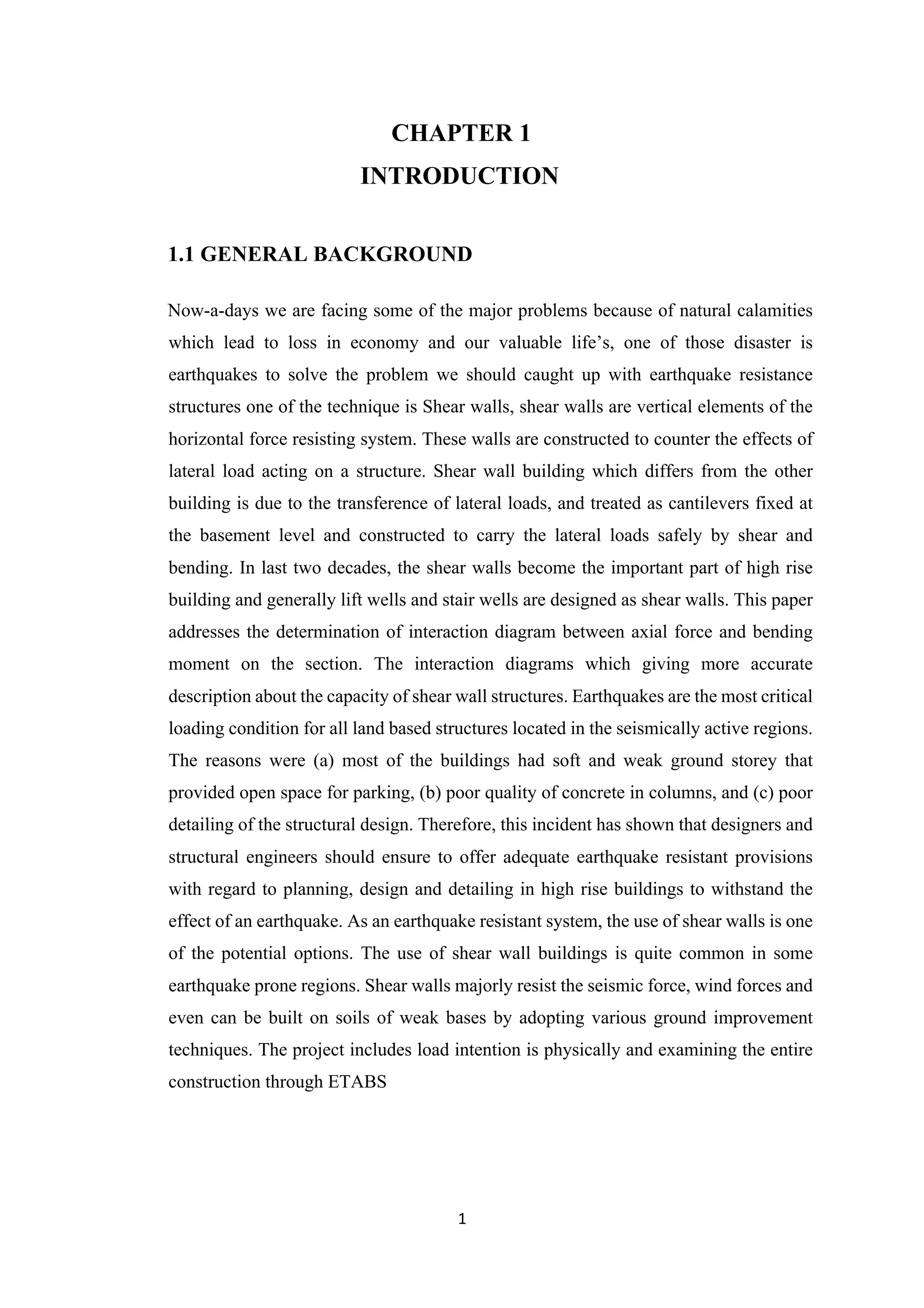
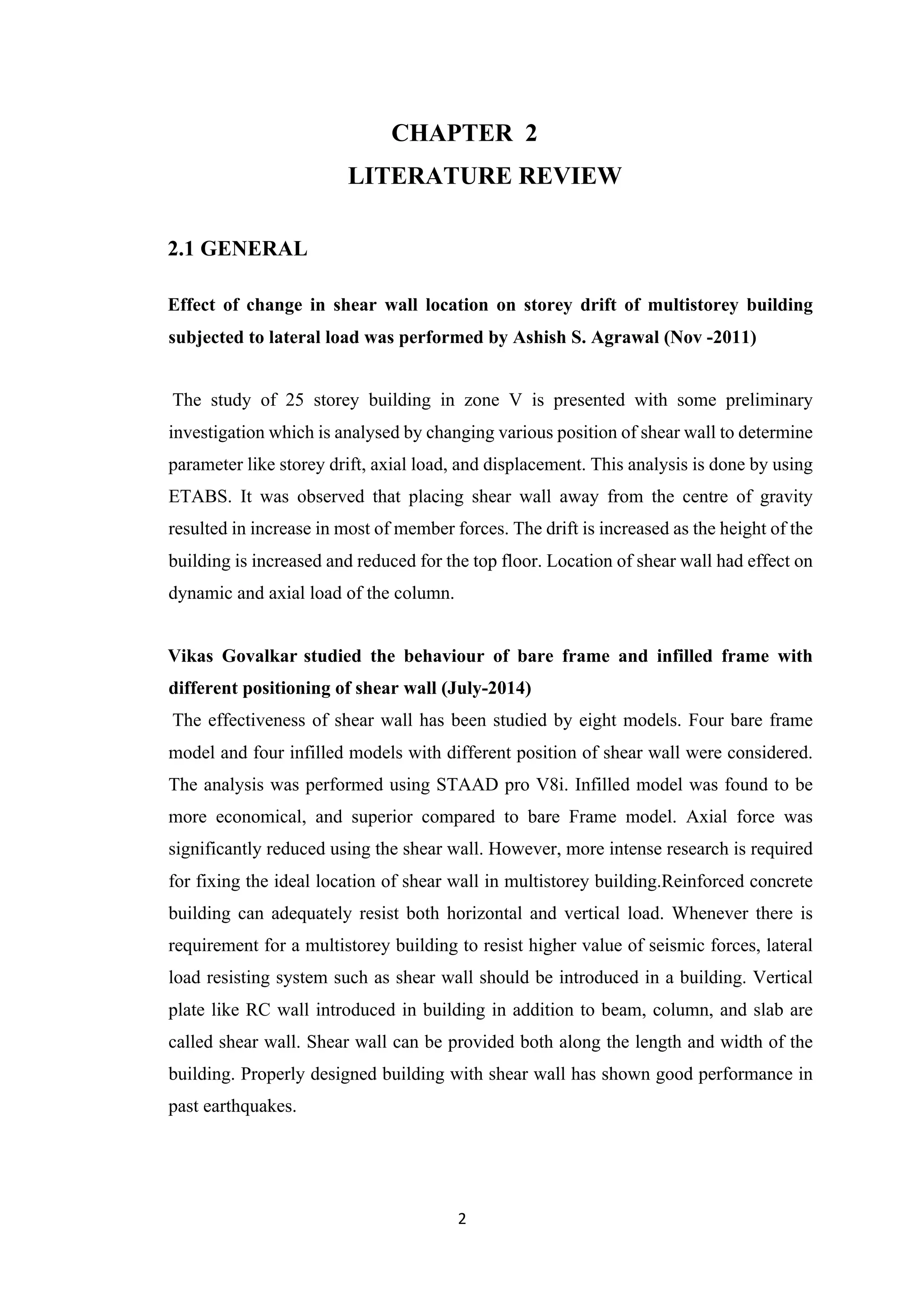
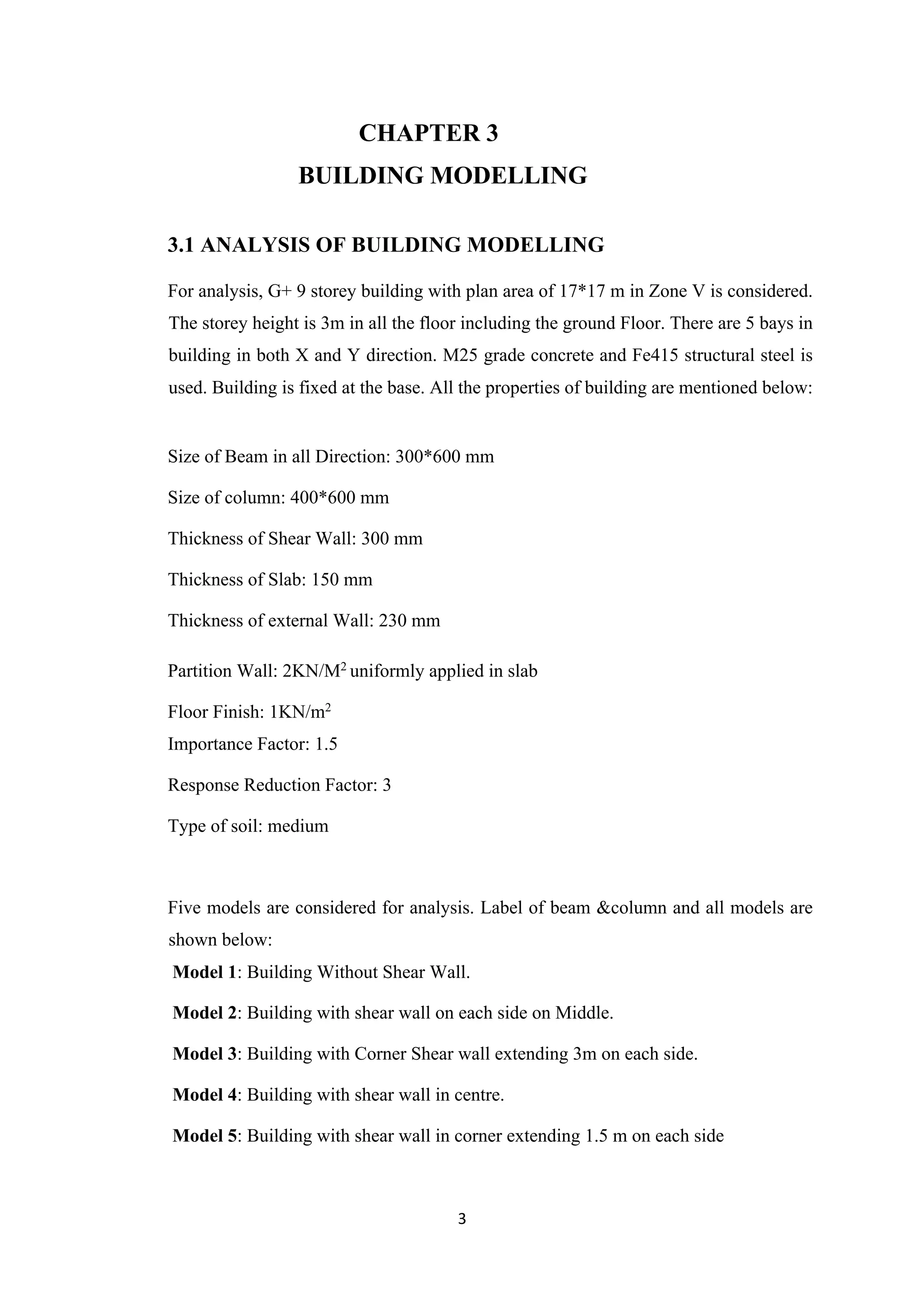
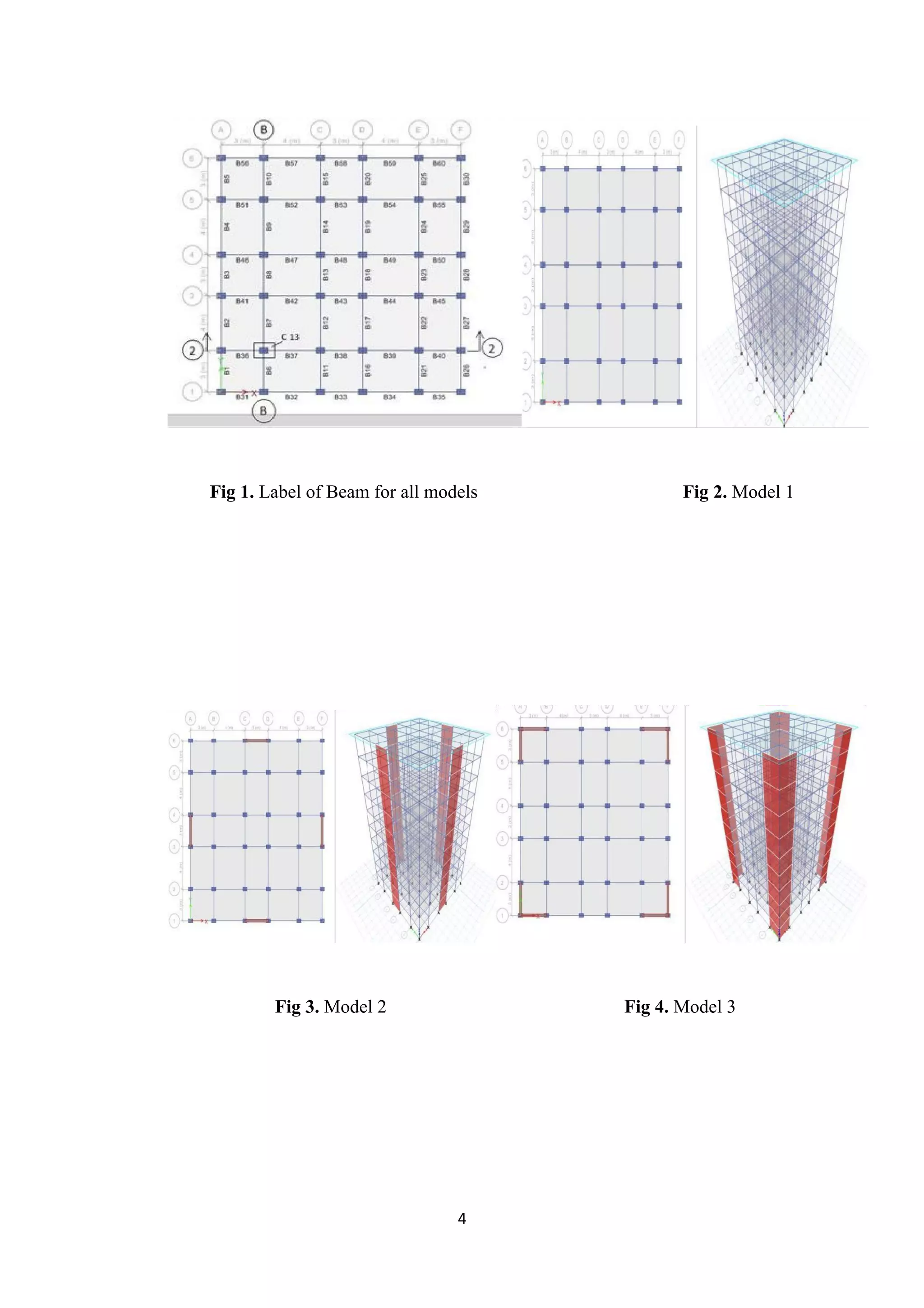
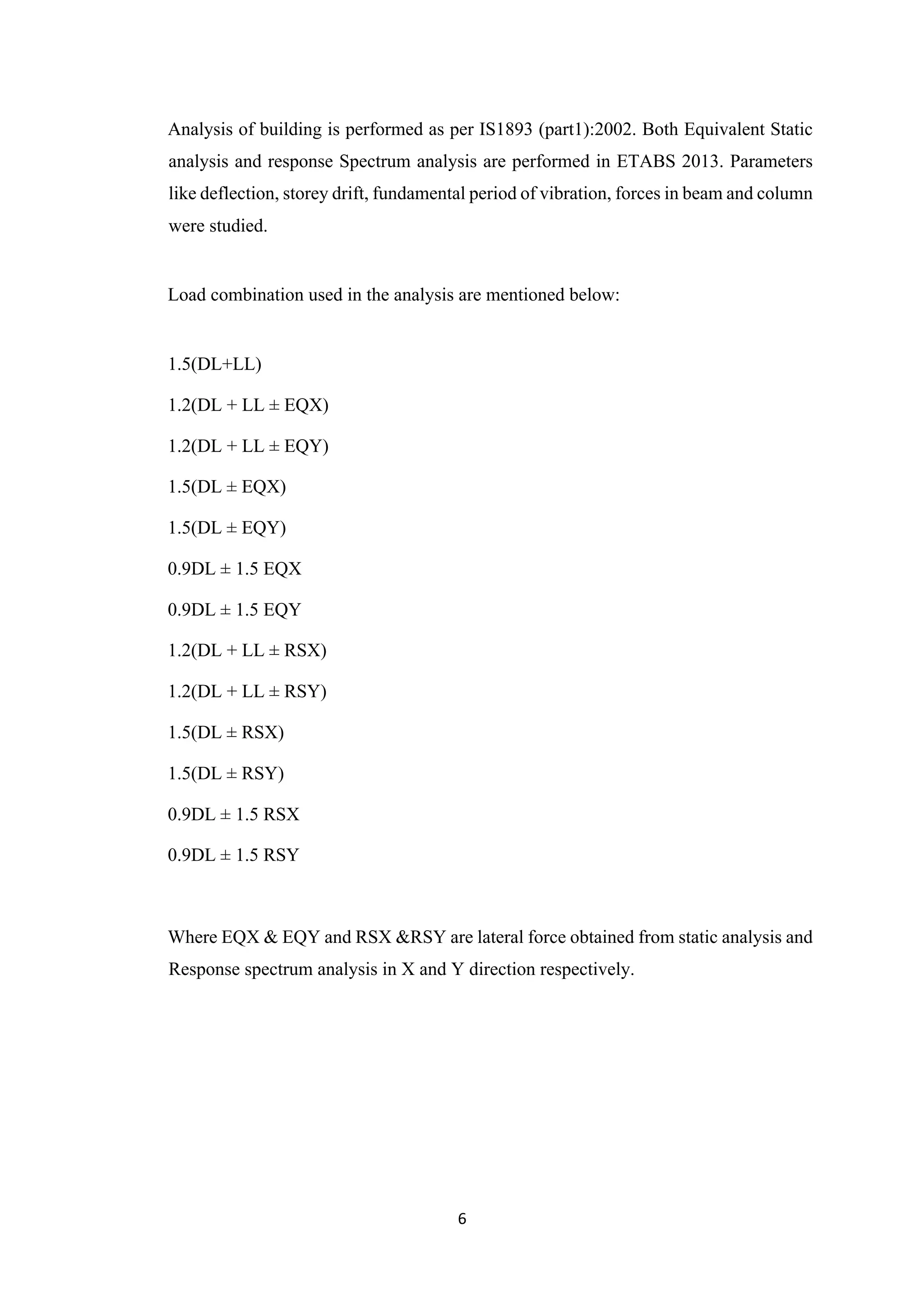
Five models are considered for analysis. Label of beam &column and all models are
shown below:
Model 1: Building Without Shear Wall.
Model 2: Building with shear wall on each side on Middle.
Model 3: Building with Corner Shear wall extending 3m on each side.
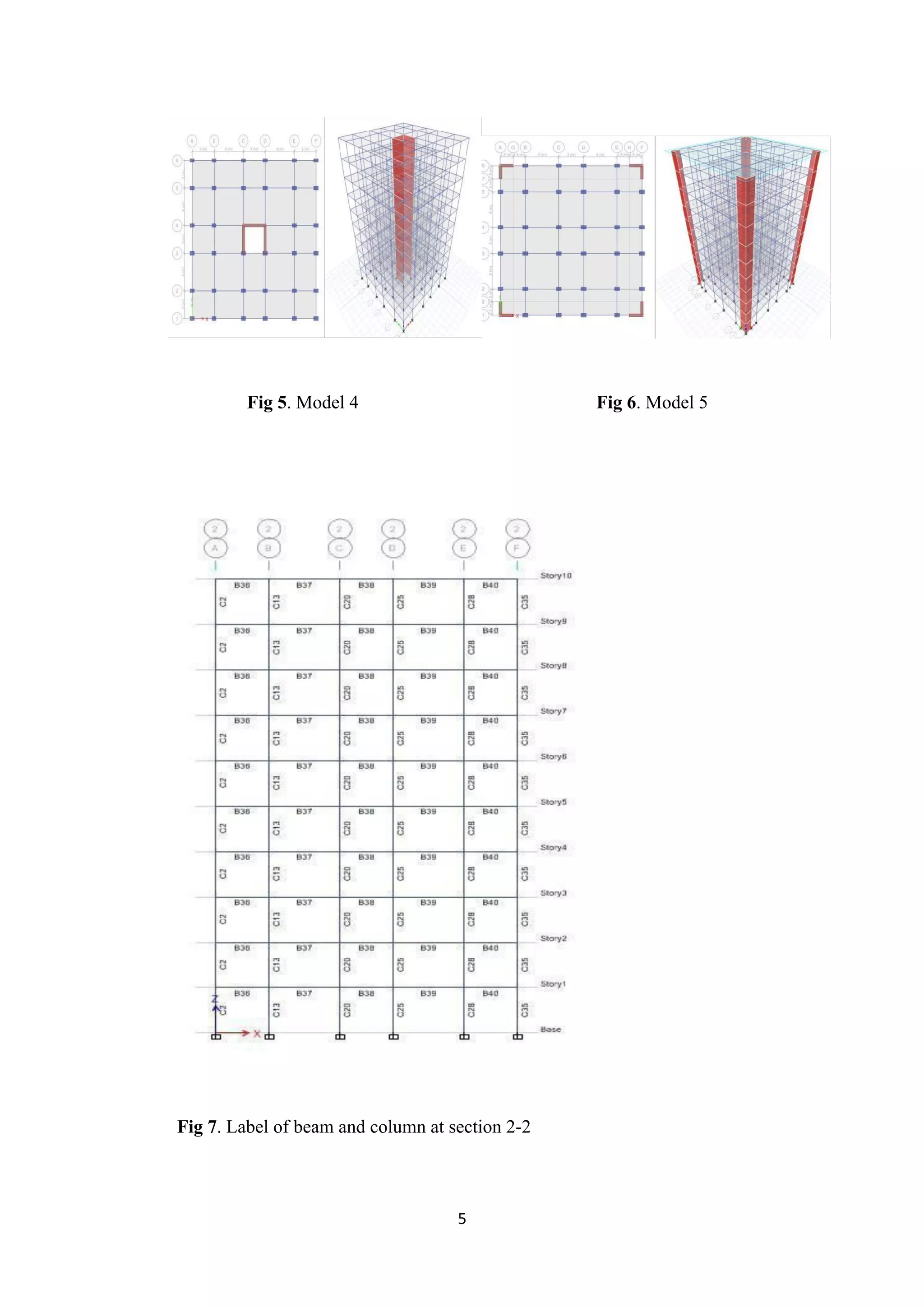
Model 4: Building with shear wall in centre.
Model 5: Building with shear wall in corner extending 1.5 m on each side
4
Fig 1. Label of Beam for all models Fig 2. Model 1
Fig 3. Model 2 Fig 4. Model 3
5
Fig 5. Model 4 Fig 6. Model 5
Fig 7. Label of beam and column at section 2-2
6
Analysis of building is performed as per IS1893 (part1):2002. Both Equivalent Static
analysis and response Spectrum analysis are performed in ETABS 2013. Parameters
like deflection, storey drift, fundamental period of vibration, forces in beam and column
were studied.
Load combination used in the analysis are mentioned below:
1.5(DL+LL)
1.2(DL + LL ± EQX)
1.2(DL + LL ± EQY)
1.5(DL ± EQX)
1.5(DL ± EQY)
0.9DL ± 1.5 EQX
0.9DL ± 1.5 EQY
1.2(DL + LL ± RSX)
1.2(DL + LL ± RSY)
1.5(DL ± RSX)
1.5(DL ± RSY)
0.9DL ± 1.5 RSX
0.9DL ± 1.5 RSY
Where EQX & EQY and RSX &RSY are lateral force obtained from static analysis and
Response spectrum analysis in X and Y direction respectively.
7
3.2 METHODOLOGY
Equivalent static load method of analysis This method characterizes a progression of
the forces, following up on a structure to speak with the impact of the earthquake ground
motion, generally identified by response spectrum. This method expect that structure
react at its basic mode. To achieve the structure should not twist altogether during
structure subjected to ground motion. The natural frequency of the building is obtained
by design a response spectrum to get response of the structure to the earthquake. The
application of this method was stretched out in so many construction regulations by
applying variables to represent the tall structure with same highest modes. The
equivalent static load method for a quake is an extraordinary idea utilized in seismic
designing.
Response spectrum method of analysis To accomplish the earthquake analysis and
design of building constructing at a specific place the genuine time history record is
compulsory. At every location we can’t find time history records. And also, Earthquake
analysis of structure not done for every locationResponse spectrum method is only
prominent means in the earthquake analysis of structures. Displacement and member
forces in structure can be find easily as computational advantage. Damping and Time
period during earthquake ground motions, of single degree freedom system can
described in most extreme reaction condition. The RSA should confirm to IS1893-2016
(part1). Zone factor, type of soil, Response reduction factor, Importance factor should
take from IS1893-2016 (part1). The response spectra for all type of soil can be analysed
in ETABS software.
Wind Load Analysis Wind is the air, moving with the outside of the earth surface. The
radiations of winds are may move upwards or downwards. The wind hit the ground
surface at high speed. The wind speed is measured by using anemometers or
anemographs which are available in meteorological department. The impact of wind on
the structure is on internal and external pressures. The structure failure due to wind
loads is not only depends on geological area, and vicinity of different obstacles to wind
stream but also depends upon the qualities of structure itself. In present days all tall
structures are constructed to wind delicate since the structure shapes, slenderness ratio,
stiffness, size & lightness of structure. The structural design for wind load confirm to
IS 875-2015 (part 3) is considered.
8
CHAPTER 4
RESULTS AND DISCUSSION
4.1 FUNDAMENTAL TIME PERIOD:
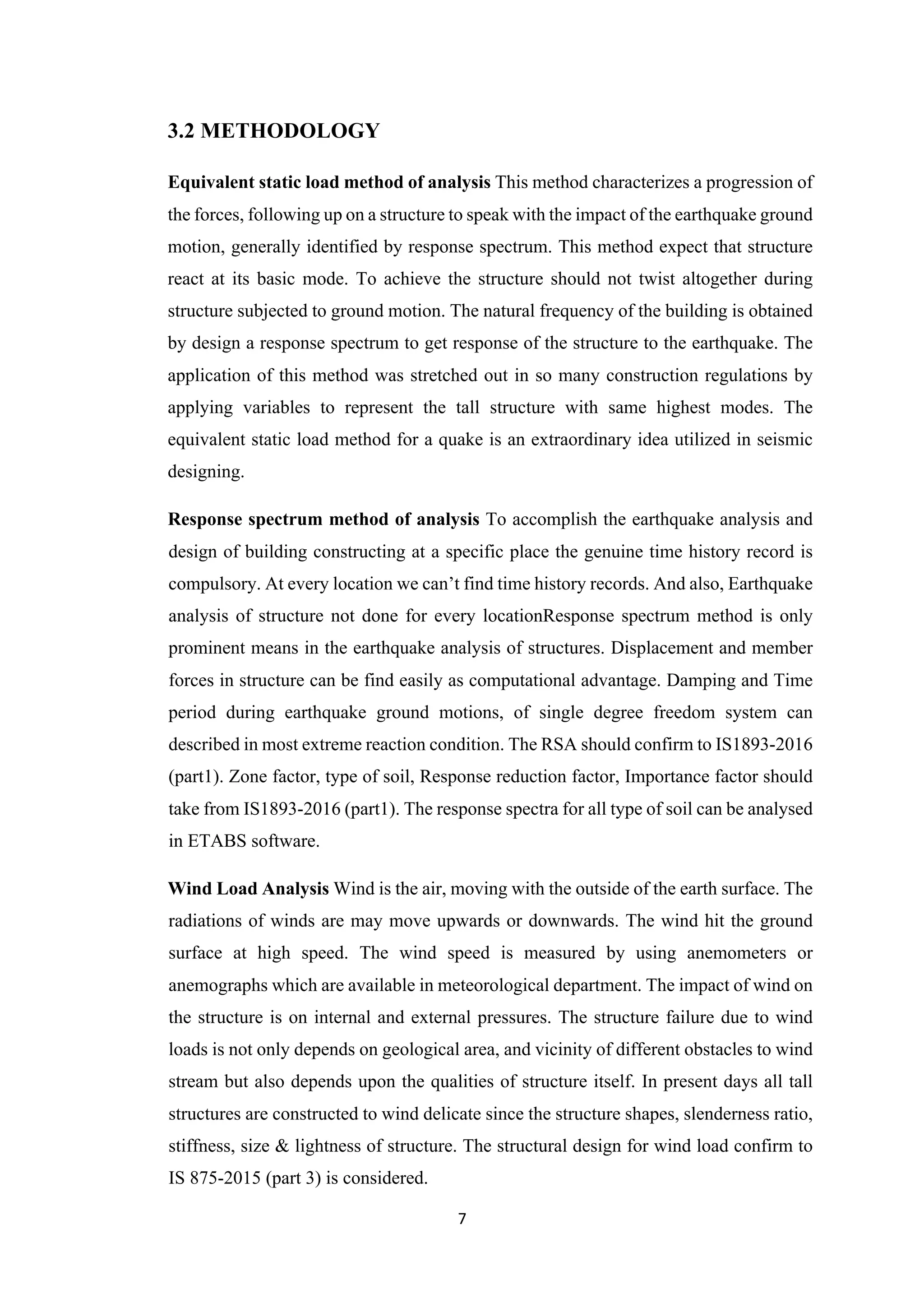
Time period for all the model are shown in figure below:
Fig 8. Time period of models
Model 3 has the least fundamental period of vibration among all the models.
4.2 MODAL MASS PARTICIPATION FACTOR:
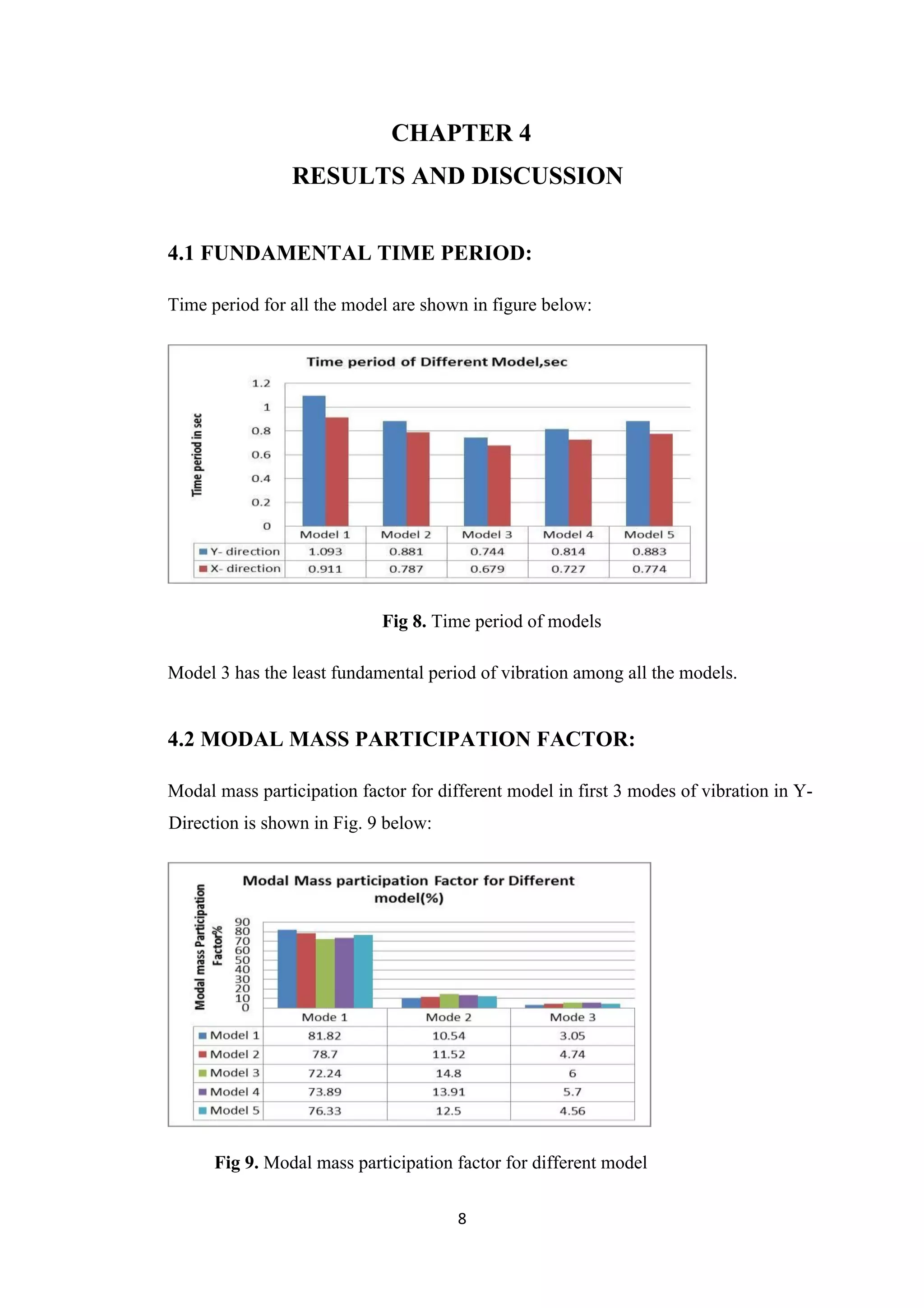
Modal mass participation factor for different model in first 3 modes of vibration in Y-
Direction is shown in Fig. 9 below:
Fig 9. Modal mass participation factor for different model
9
Modal Mass participation Factor is found to be higher for model 1 in 1st
mode. For 2nd
and 3rd
mode modal mass participation factor was higher in case of Model 1.
4.3 LATERAL DISPLACEMENT:
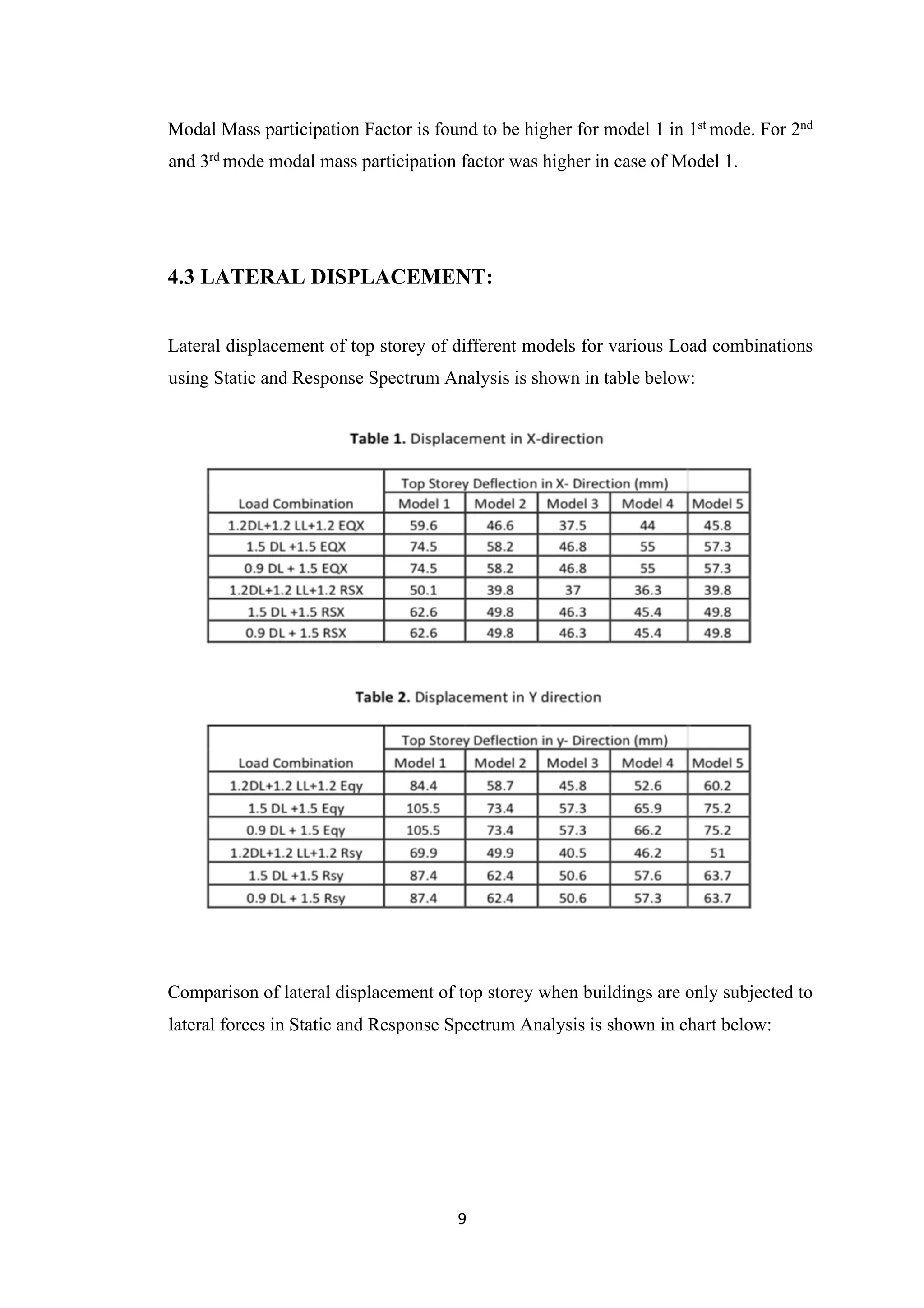
Lateral displacement of top storey of different models for various Load combinations
using Static and Response Spectrum Analysis is shown in table below:
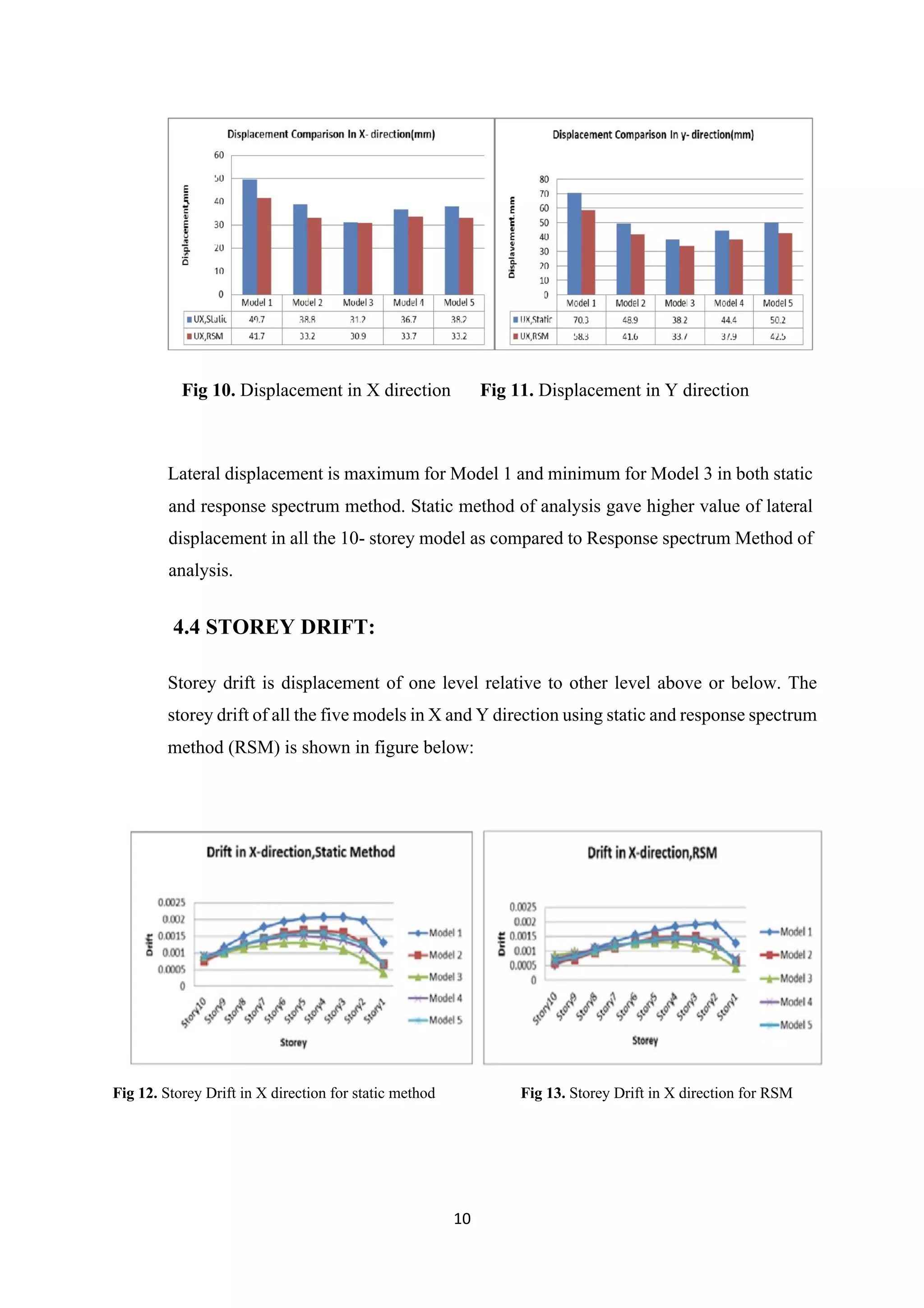
Comparison of lateral displacement of top storey when buildings are only subjected to
lateral forces in Static and Response Spectrum Analysis is shown in chart below:
10
Fig 10. Displacement in X direction Fig 11. Displacement in Y direction
Lateral displacement is maximum for Model 1 and minimum for Model 3 in both static
and response spectrum method. Static method of analysis gave higher value of lateral
displacement in all the 10- storey model as compared to Response spectrum Method of
analysis.
4.4 STOREY DRIFT:
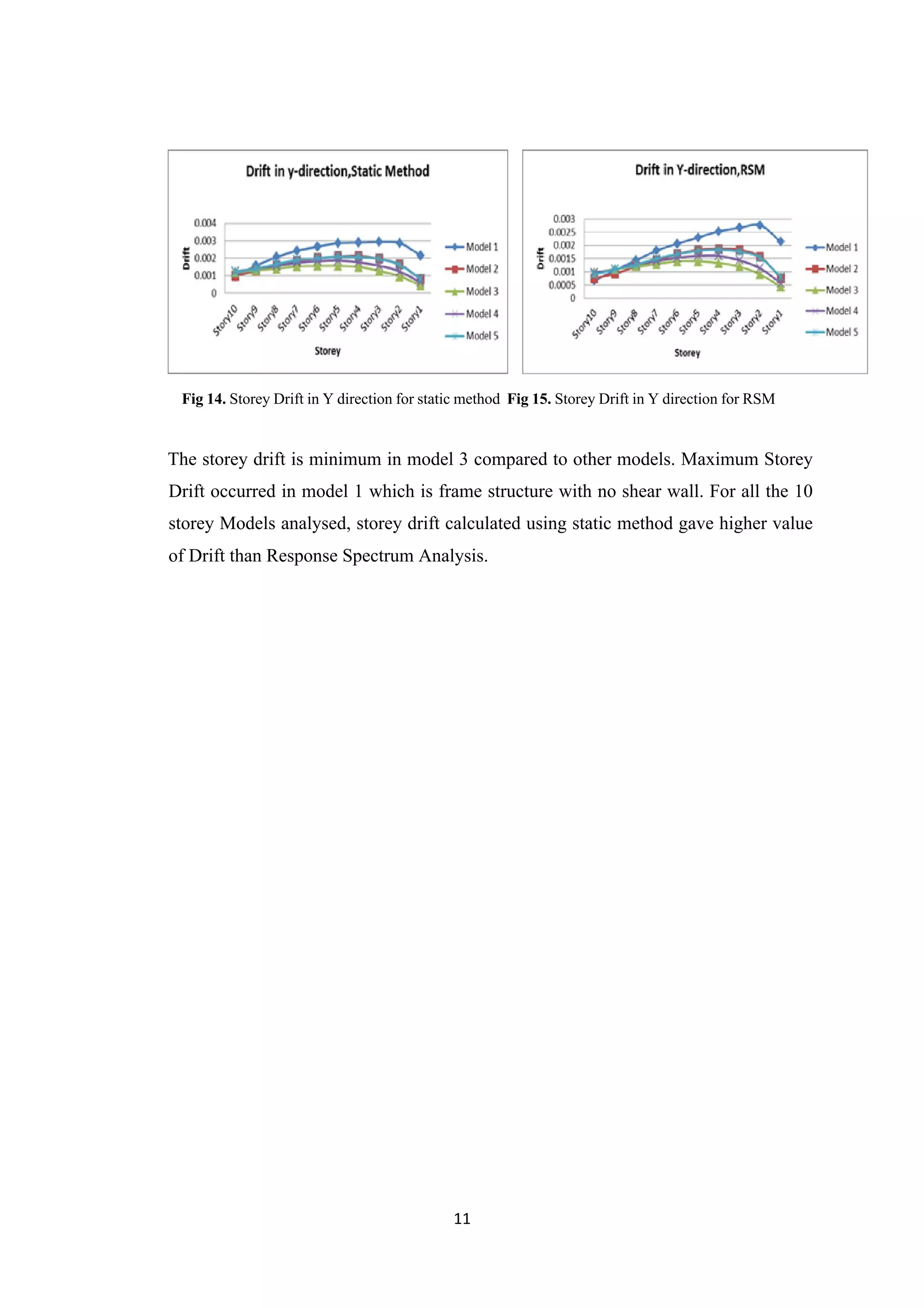
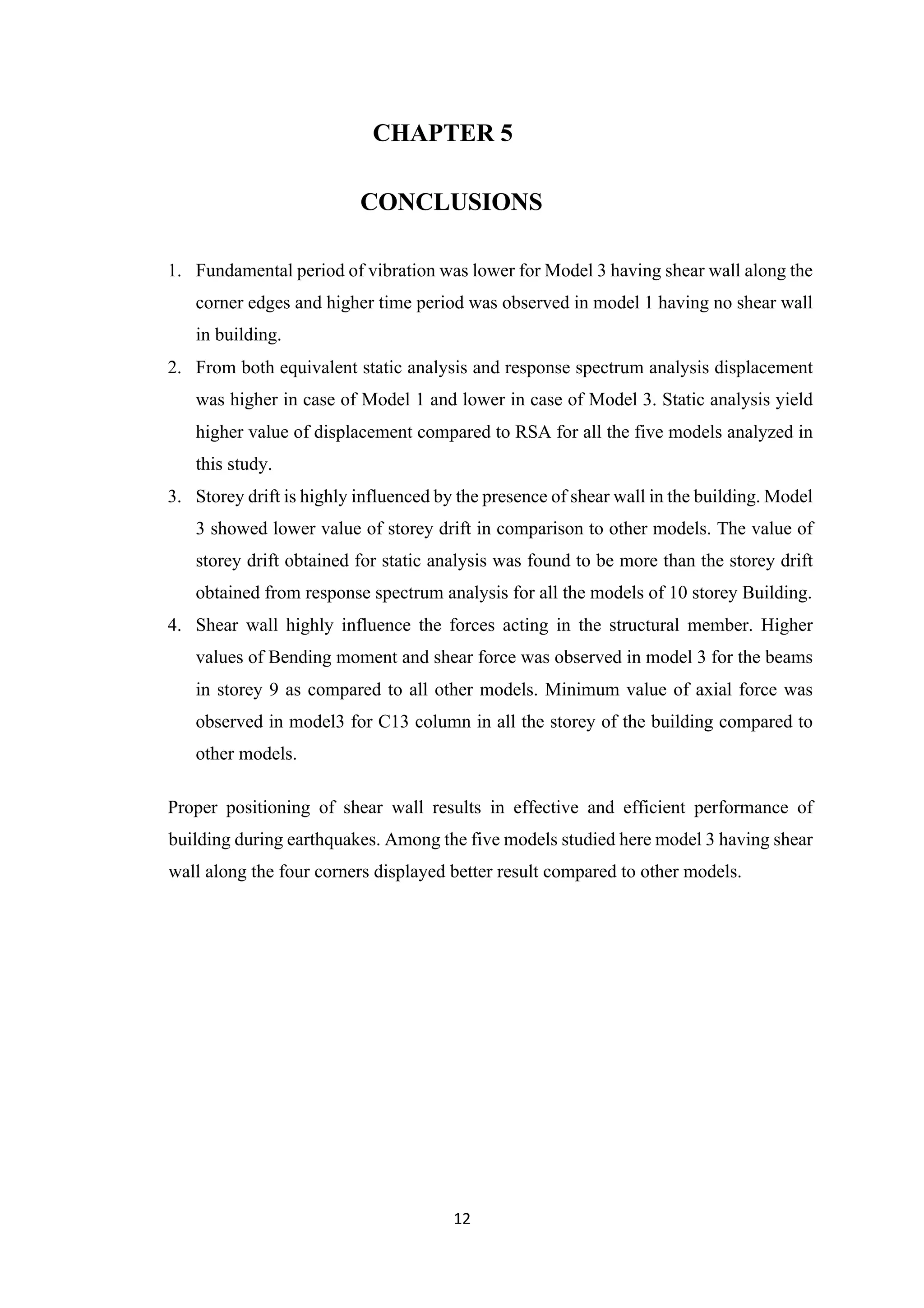
Storey drift is displacement of one level relative to other level above or below. The
storey drift of all the five models in X and Y direction using static and response spectrum
method (RSM) is shown in figure below:
Fig 12. Storey Drift in X direction for static method Fig 13. Storey Drift in X direction for RSM
11
Fig 14. Storey Drift in Y direction for static method Fig 15. Storey Drift in Y direction for RSM
The storey drift is minimum in model 3 compared to other models. Maximum Storey
Drift occurred in model 1 which is frame structure with no shear wall. For all the 10
storey Models analysed, storey drift calculated using static method gave higher value
of Drift than Response Spectrum Analysis.
12
CHAPTER 5
CONCLUSIONS
1. Fundamental period of vibration was lower for Model 3 having shear wall along the
corner edges and higher time period was observed in model 1 having no shear wall
in building.
2. From both equivalent static analysis and response spectrum analysis displacement
was higher in case of Model 1 and lower in case of Model 3. Static analysis yield
higher value of displacement compared to RSA for all the five models analyzed in
this study.
3. Storey drift is highly influenced by the presence of shear wall in the building. Model
3 showed lower value of storey drift in comparison to other models. The value of
storey drift obtained for static analysis was found to be more than the storey drift
obtained from response spectrum analysis for all the models of 10 storey Building.
4. Shear wall highly influence the forces acting in the structural member. Higher
values of Bending moment and shear force was observed in model 3 for the beams
in storey 9 as compared to all other models. Minimum value of axial force was
observed in model3 for C13 column in all the storey of the building compared to
other models.
Proper positioning of shear wall results in effective and efficient performance of
building during earthquakes. Among the five models studied here model 3 having shear
wall along the four corners displayed better result compared to other models.
13
REFERENCE
1. Anshuman. S, DipenduBhunia, BhavinRamjiyani (2011), “Solution of Shear
Wall Location in Multi-Storey Building.”
2. AshishS. Agrawal, S.D. charkha(2012) .”Effect of Change in shear wall location
on storey drift of multistorey building subjected to Lateral Load.”
3. VikasGovalkar,P.J.Salunke, N.G.Gore,(2014)”Analysis of Bare Frame and
Infilled Frame with Different position of Shear wall.”
4. P. P. Chandurkar and Dr. P. S. Pajgade (2013), “Seismic Analysis of RCC
Building with and Without Shear Wall.”
5. VarshaR.Harne(2014)”Comparative Study of Strength of Rc Shear wall at
Different Location on Multi-storied Residential Building”
6. Shahzadjamilsardar and Umesh. N. Karadi(2013),”Effect of Change in shear
wall location on storey drift of multistorey building subjected to Lateral Load”
7. P.C. Varghese(2012),”Advance Reinforce Concrete Design.”

sd project report Final.pdf

  • 1.
    1 CHAPTER 1 INTRODUCTION 1.1 GENERALBACKGROUND Now-a-days we are facing some of the major problems because of natural calamities which lead to loss in economy and our valuable life’s, one of those disaster is earthquakes to solve the problem we should caught up with earthquake resistance structures one of the technique is Shear walls, shear walls are vertical elements of the horizontal force resisting system. These walls are constructed to counter the effects of lateral load acting on a structure. Shear wall building which differs from the other building is due to the transference of lateral loads, and treated as cantilevers fixed at the basement level and constructed to carry the lateral loads safely by shear and bending. In last two decades, the shear walls become the important part of high rise building and generally lift wells and stair wells are designed as shear walls. This paper addresses the determination of interaction diagram between axial force and bending moment on the section. The interaction diagrams which giving more accurate description about the capacity of shear wall structures. Earthquakes are the most critical loading condition for all land based structures located in the seismically active regions. The reasons were (a) most of the buildings had soft and weak ground storey that provided open space for parking, (b) poor quality of concrete in columns, and (c) poor detailing of the structural design. Therefore, this incident has shown that designers and structural engineers should ensure to offer adequate earthquake resistant provisions with regard to planning, design and detailing in high rise buildings to withstand the effect of an earthquake. As an earthquake resistant system, the use of shear walls is one of the potential options. The use of shear wall buildings is quite common in some earthquake prone regions. Shear walls majorly resist the seismic force, wind forces and even can be built on soils of weak bases by adopting various ground improvement techniques. The project includes load intention is physically and examining the entire construction through ETABS
  • 2.
    2 CHAPTER 2 LITERATURE REVIEW 2.1GENERAL Effect of change in shear wall location on storey drift of multistorey building subjected to lateral load was performed by Ashish S. Agrawal (Nov -2011) The study of 25 storey building in zone V is presented with some preliminary investigation which is analysed by changing various position of shear wall to determine parameter like storey drift, axial load, and displacement. This analysis is done by using ETABS. It was observed that placing shear wall away from the centre of gravity resulted in increase in most of member forces. The drift is increased as the height of the building is increased and reduced for the top floor. Location of shear wall had effect on dynamic and axial load of the column. Vikas Govalkar studied the behaviour of bare frame and infilled frame with different positioning of shear wall (July-2014) The effectiveness of shear wall has been studied by eight models. Four bare frame model and four infilled models with different position of shear wall were considered. The analysis was performed using STAAD pro V8i. Infilled model was found to be more economical, and superior compared to bare Frame model. Axial force was significantly reduced using the shear wall. However, more intense research is required for fixing the ideal location of shear wall in multistorey building.Reinforced concrete building can adequately resist both horizontal and vertical load. Whenever there is requirement for a multistorey building to resist higher value of seismic forces, lateral load resisting system such as shear wall should be introduced in a building. Vertical plate like RC wall introduced in building in addition to beam, column, and slab are called shear wall. Shear wall can be provided both along the length and width of the building. Properly designed building with shear wall has shown good performance in past earthquakes.
  • 3.
    3 CHAPTER 3 BUILDING MODELLING 3.1ANALYSIS OF BUILDING MODELLING For analysis, G+ 9 storey building with plan area of 17*17 m in Zone V is considered. The storey height is 3m in all the floor including the ground Floor. There are 5 bays in building in both X and Y direction. M25 grade concrete and Fe415 structural steel is used. Building is fixed at the base. All the properties of building are mentioned below: Size of Beam in all Direction: 300*600 mm Size of column: 400*600 mm Thickness of Shear Wall: 300 mm Thickness of Slab: 150 mm Thickness of external Wall: 230 mm Partition Wall: 2KN/M2 uniformly applied in slab Floor Finish: 1KN/m2 Importance Factor: 1.5 Response Reduction Factor: 3 Type of soil: medium Five models are considered for analysis. Label of beam &column and all models are shown below: Model 1: Building Without Shear Wall. Model 2: Building with shear wall on each side on Middle. Model 3: Building with Corner Shear wall extending 3m on each side. Model 4: Building with shear wall in centre. Model 5: Building with shear wall in corner extending 1.5 m on each side
  • 4.
    4 Fig 1. Labelof Beam for all models Fig 2. Model 1 Fig 3. Model 2 Fig 4. Model 3
  • 5.
    5 Fig 5. Model4 Fig 6. Model 5 Fig 7. Label of beam and column at section 2-2
  • 6.
    6 Analysis of buildingis performed as per IS1893 (part1):2002. Both Equivalent Static analysis and response Spectrum analysis are performed in ETABS 2013. Parameters like deflection, storey drift, fundamental period of vibration, forces in beam and column were studied. Load combination used in the analysis are mentioned below: 1.5(DL+LL) 1.2(DL + LL ± EQX) 1.2(DL + LL ± EQY) 1.5(DL ± EQX) 1.5(DL ± EQY) 0.9DL ± 1.5 EQX 0.9DL ± 1.5 EQY 1.2(DL + LL ± RSX) 1.2(DL + LL ± RSY) 1.5(DL ± RSX) 1.5(DL ± RSY) 0.9DL ± 1.5 RSX 0.9DL ± 1.5 RSY Where EQX & EQY and RSX &RSY are lateral force obtained from static analysis and Response spectrum analysis in X and Y direction respectively.
  • 7.
    7 3.2 METHODOLOGY Equivalent staticload method of analysis This method characterizes a progression of the forces, following up on a structure to speak with the impact of the earthquake ground motion, generally identified by response spectrum. This method expect that structure react at its basic mode. To achieve the structure should not twist altogether during structure subjected to ground motion. The natural frequency of the building is obtained by design a response spectrum to get response of the structure to the earthquake. The application of this method was stretched out in so many construction regulations by applying variables to represent the tall structure with same highest modes. The equivalent static load method for a quake is an extraordinary idea utilized in seismic designing. Response spectrum method of analysis To accomplish the earthquake analysis and design of building constructing at a specific place the genuine time history record is compulsory. At every location we can’t find time history records. And also, Earthquake analysis of structure not done for every locationResponse spectrum method is only prominent means in the earthquake analysis of structures. Displacement and member forces in structure can be find easily as computational advantage. Damping and Time period during earthquake ground motions, of single degree freedom system can described in most extreme reaction condition. The RSA should confirm to IS1893-2016 (part1). Zone factor, type of soil, Response reduction factor, Importance factor should take from IS1893-2016 (part1). The response spectra for all type of soil can be analysed in ETABS software. Wind Load Analysis Wind is the air, moving with the outside of the earth surface. The radiations of winds are may move upwards or downwards. The wind hit the ground surface at high speed. The wind speed is measured by using anemometers or anemographs which are available in meteorological department. The impact of wind on the structure is on internal and external pressures. The structure failure due to wind loads is not only depends on geological area, and vicinity of different obstacles to wind stream but also depends upon the qualities of structure itself. In present days all tall structures are constructed to wind delicate since the structure shapes, slenderness ratio, stiffness, size & lightness of structure. The structural design for wind load confirm to IS 875-2015 (part 3) is considered.
  • 8.
    8 CHAPTER 4 RESULTS ANDDISCUSSION 4.1 FUNDAMENTAL TIME PERIOD: Time period for all the model are shown in figure below: Fig 8. Time period of models Model 3 has the least fundamental period of vibration among all the models. 4.2 MODAL MASS PARTICIPATION FACTOR: Modal mass participation factor for different model in first 3 modes of vibration in Y- Direction is shown in Fig. 9 below: Fig 9. Modal mass participation factor for different model
  • 9.
    9 Modal Mass participationFactor is found to be higher for model 1 in 1st mode. For 2nd and 3rd mode modal mass participation factor was higher in case of Model 1. 4.3 LATERAL DISPLACEMENT: Lateral displacement of top storey of different models for various Load combinations using Static and Response Spectrum Analysis is shown in table below: Comparison of lateral displacement of top storey when buildings are only subjected to lateral forces in Static and Response Spectrum Analysis is shown in chart below:
  • 10.
    10 Fig 10. Displacementin X direction Fig 11. Displacement in Y direction Lateral displacement is maximum for Model 1 and minimum for Model 3 in both static and response spectrum method. Static method of analysis gave higher value of lateral displacement in all the 10- storey model as compared to Response spectrum Method of analysis. 4.4 STOREY DRIFT: Storey drift is displacement of one level relative to other level above or below. The storey drift of all the five models in X and Y direction using static and response spectrum method (RSM) is shown in figure below: Fig 12. Storey Drift in X direction for static method Fig 13. Storey Drift in X direction for RSM
  • 11.
    11 Fig 14. StoreyDrift in Y direction for static method Fig 15. Storey Drift in Y direction for RSM The storey drift is minimum in model 3 compared to other models. Maximum Storey Drift occurred in model 1 which is frame structure with no shear wall. For all the 10 storey Models analysed, storey drift calculated using static method gave higher value of Drift than Response Spectrum Analysis.
  • 12.
    12 CHAPTER 5 CONCLUSIONS 1. Fundamentalperiod of vibration was lower for Model 3 having shear wall along the corner edges and higher time period was observed in model 1 having no shear wall in building. 2. From both equivalent static analysis and response spectrum analysis displacement was higher in case of Model 1 and lower in case of Model 3. Static analysis yield higher value of displacement compared to RSA for all the five models analyzed in this study. 3. Storey drift is highly influenced by the presence of shear wall in the building. Model 3 showed lower value of storey drift in comparison to other models. The value of storey drift obtained for static analysis was found to be more than the storey drift obtained from response spectrum analysis for all the models of 10 storey Building. 4. Shear wall highly influence the forces acting in the structural member. Higher values of Bending moment and shear force was observed in model 3 for the beams in storey 9 as compared to all other models. Minimum value of axial force was observed in model3 for C13 column in all the storey of the building compared to other models. Proper positioning of shear wall results in effective and efficient performance of building during earthquakes. Among the five models studied here model 3 having shear wall along the four corners displayed better result compared to other models.
  • 13.
    13 REFERENCE 1. Anshuman. S,DipenduBhunia, BhavinRamjiyani (2011), “Solution of Shear Wall Location in Multi-Storey Building.” 2. AshishS. Agrawal, S.D. charkha(2012) .”Effect of Change in shear wall location on storey drift of multistorey building subjected to Lateral Load.” 3. VikasGovalkar,P.J.Salunke, N.G.Gore,(2014)”Analysis of Bare Frame and Infilled Frame with Different position of Shear wall.” 4. P. P. Chandurkar and Dr. P. S. Pajgade (2013), “Seismic Analysis of RCC Building with and Without Shear Wall.” 5. VarshaR.Harne(2014)”Comparative Study of Strength of Rc Shear wall at Different Location on Multi-storied Residential Building” 6. Shahzadjamilsardar and Umesh. N. Karadi(2013),”Effect of Change in shear wall location on storey drift of multistorey building subjected to Lateral Load” 7. P.C. Varghese(2012),”Advance Reinforce Concrete Design.”