International Research Journal of Engineering and Technology (IRJET) e-ISSN: 2395-0056
Volume: 06 Issue: 07 | July 2019 www.irjet.net p-ISSN: 2395-0072
© 2019, IRJET | Impact Factor value: 7.211 | ISO 9001:2008 Certified Journal | Page 1024
Analysis of Tall Building Structure Subjected to Wind and Earthquake
Loads in Different Seismic Zones
Mr. Jaiprakash C1, Ms. Ramya B V2
1Post Graduate in Structural Engineering, BIET College, Davangere, Karnataka, India
2Assistant Professor, M-Tech Structural Engineering, BIET College, Davangere, Karnataka, India
---------------------------------------------------------------------***---------------------------------------------------------------------
Abstract - Consideration of site specific lateral loading due
to wind or earthquake loads together with vertical gravity
loads is important for finding thebehaviorofthetallbuildings.
As the height of a building becomes taller, the quantity of
structural material required to resist lateral loads increases
considerably. The design of tall buildings essentially involvesa
conceptual design, approximate evaluation, preliminary
design and optimization, to safely convey gravity and lateral
loads. The design criteria are strength, serviceability and
human consolation. The goal of the structural engineer is to
arrive at appropriate structural schemes, to meet these
criteria. In the present research, the Response Spectrum
Method of analysis of a G+30-storey reinforced concrete high
rise building under wind and seismic loads as per IS codes of
exercise is described. The comparison was made for base
shear, storey drift, storey displacement, storey acceleration,
storey forces and storey stiffness.
Key Words: Tall Building1, ETABS2, Response
Spectrum3, Seismic Loads4, Wind Loads5
1. INTRODUCTION
Tall buildings, which are usually designed for office or
commercial use, are among the most distinguished space
definitions in the Structural Engineers history of Indian
urbanism in the twentieth century. They are primarily a
reaction to the rapid growth of the urban populationandthe
demand by business activities to be as close to each other as
possible. Structural Engineers reinterpretations of the
building type, the high cost of land in urban areas, the desire
to prevent the disorganized expansion, the need to preserve
agricultural production, the concept of skyscraper,influence
of cultural significance and prestige, have all contributed to
force buildings upward. Today, it is virtually impossible to
imagine a major city without tall buildings. The importance
of tall buildings in the contemporary urban development is
without doubt ever increasing despite their several
undeniable negative effects on the quality of urban life.
1.1 Wind Effects on Tall Buildings
The wind is the most powerful and unpredictable force
affecting tall buildings. Tall building can be definedasa mast
anchored in the ground, bending and swaying in the wind.
This movement, known as wind drift, should be kept within
acceptable limits. Moreover,for a well-designedtall building,
the wind drift should not surpass the height of the building
divided by 500. Wind loads on buildings increase
considerably with the increase in building heights.
Furthermore, the speed of wind increases with height, and
the wind pressures increase as the square ofthewindspeed.
Thus, wind effects on a tall building are compounded as its
height increases.
Besides this, with innovations in architectural treatment,
increase in the strengths of materials, and advances in
methods of analysis, tall buildinghave becomemoreefficient
and lighter, and so, more vulnerable to deflection, and even
to swaying under wind loading. Despite all the engineering
sophistication performed with computers, wind is still a
complex phenomenon, mainlyowingtotwomajorproblems.
Unlike dead loads and live loads, wind loads change rapidly
and even abruptly, creating effects much larger than when
the same loads were applied gradually, and that they limit
building accelerations below human perception. Although
the true complexity of the wind and the acceptable human
tolerance to it have just begun to be understood, thereisstill
a need to understand more the nature of wind and its
interaction with a tall building, with particular reference to
allowable defections and comfort of occupants.
1.2 Earthquake Effects on Tall Buildings
As earthquakes can happen almost anywhere, some
measure of earthquake resistance in the form of reserve
ductility and redundancy should be built into the design of
all structures to prevent catastrophic failures. Moreover,
during the life of a building in a seismically active zone, it is
usually expected that the building will be subjected to many
small earthquakes, including some moderate ones, one or
more large ones, and possibly a very severe one. Building
massing, shape and proportion, groundacceleration,andthe
dynamic response of the structure,influencesthe magnitude
and distribution of earthquake forces. On the other hand, if
irregular forms are inevitable, special design considerations
are necessary to account for load transfer at abrupt changes
in structural resistance. Therefore, two general approaches
are utilized to determine the seismicloading,whichtakeinto
consideration the properties of the structure, and the past
record of earthquakes in the region. When compared to the
wind loads, earthquake loads have stronger intensity and
shorter duration.
International Research Journal of Engineering and Technology (IRJET) e-ISSN: 2395-0056
Volume: 06 Issue: 07 | July 2019 www.irjet.net p-ISSN: 2395-0072
© 2019, IRJET | Impact Factor value: 7.211 | ISO 9001:2008 Certified Journal | Page 1025
2. OBJECTIVES
 How the seismic evaluation of a building should be
carried out.
 To study the behavior of a building under theaction
of seismic loads and wind loads.
 The building model in the study has thirty storey’s
with constant storey height of 3m. Model is
analyzed with constant bay lengths and the bay
width along two horizontal directions are kept
constant in model for convenience.
 Different analysis like Response Spectrum method
is carried for the analysis and correspondingeffects
are interpreted in the results.
 Wind speeds are taken for wind analysis and their
corresponding effects of building structure are
interpreted in the results.
3. METHODOLOGY
 An extensive literature review is carried out to
establish the above objectives for the project work.
 G+30 storey structure is chosen for the present
investigation.
 ETABS software is chosen for modelling and
analysis of the selected structure.
 To understand the behaviour of structure, the
analysis is carried in Response spectrum method
are considered.
3.1 Modelling
Table-1: Structure Details
Number of stories G+30
C/C distance between
columns in X-direction
5 m
C/C distance between
columns in Y-direction
5 m
Foundation level to ground
level
3 m
Floor to floor height 3 m
Live load on all floors 3 kN/m2
Live Load on Roof 1.5 kN/m2
Floor Finish 1.5 kN/m2
Concrete M25 and M30
Steel Fe 415 and Fe
500
Size of column 800 x 800
mm
Size of beam 400 x 650
mm
Depth of slab 150 mm
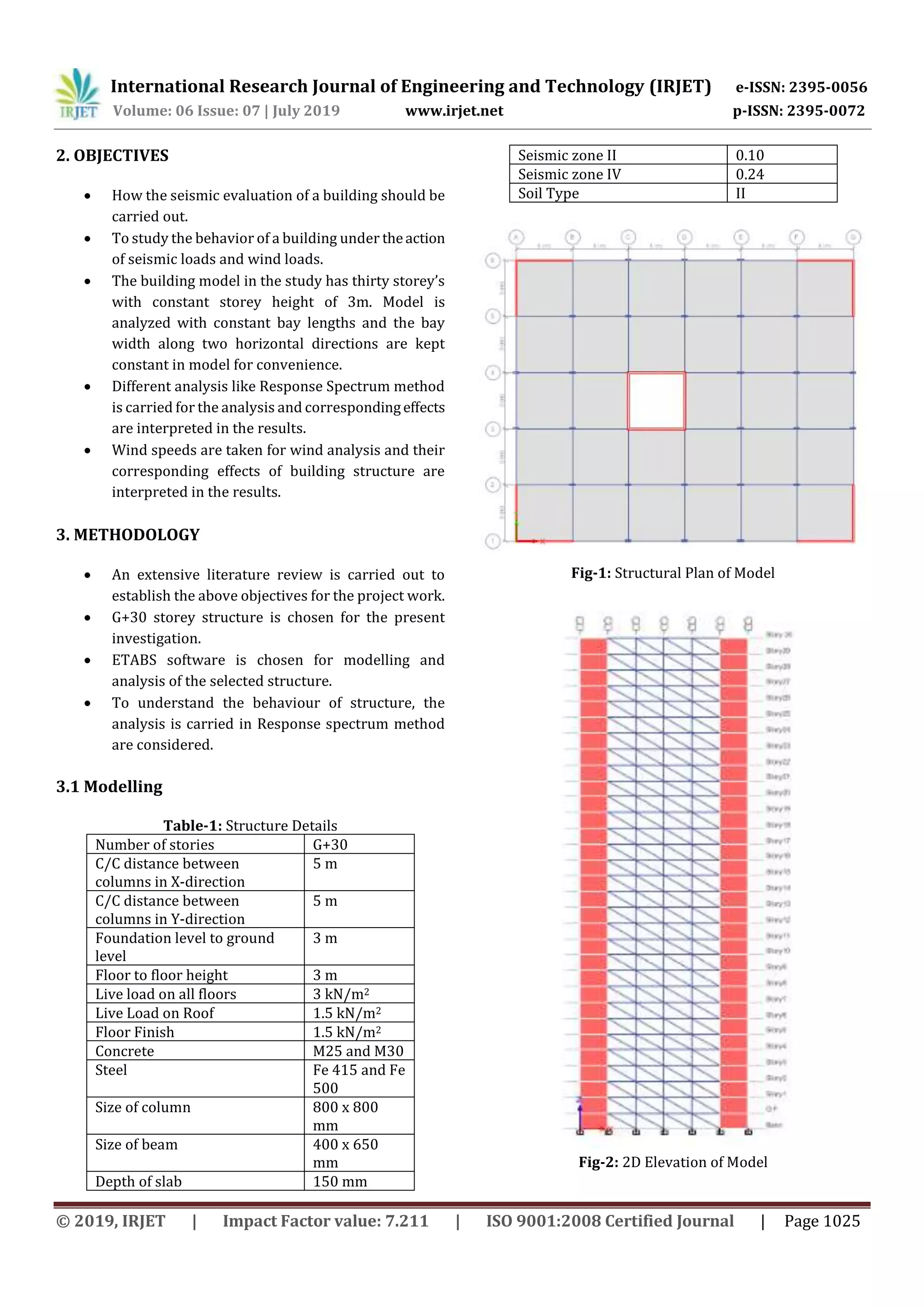
Seismic zone II 0.10
Seismic zone IV 0.24
Soil Type II
Fig-1: Structural Plan of Model
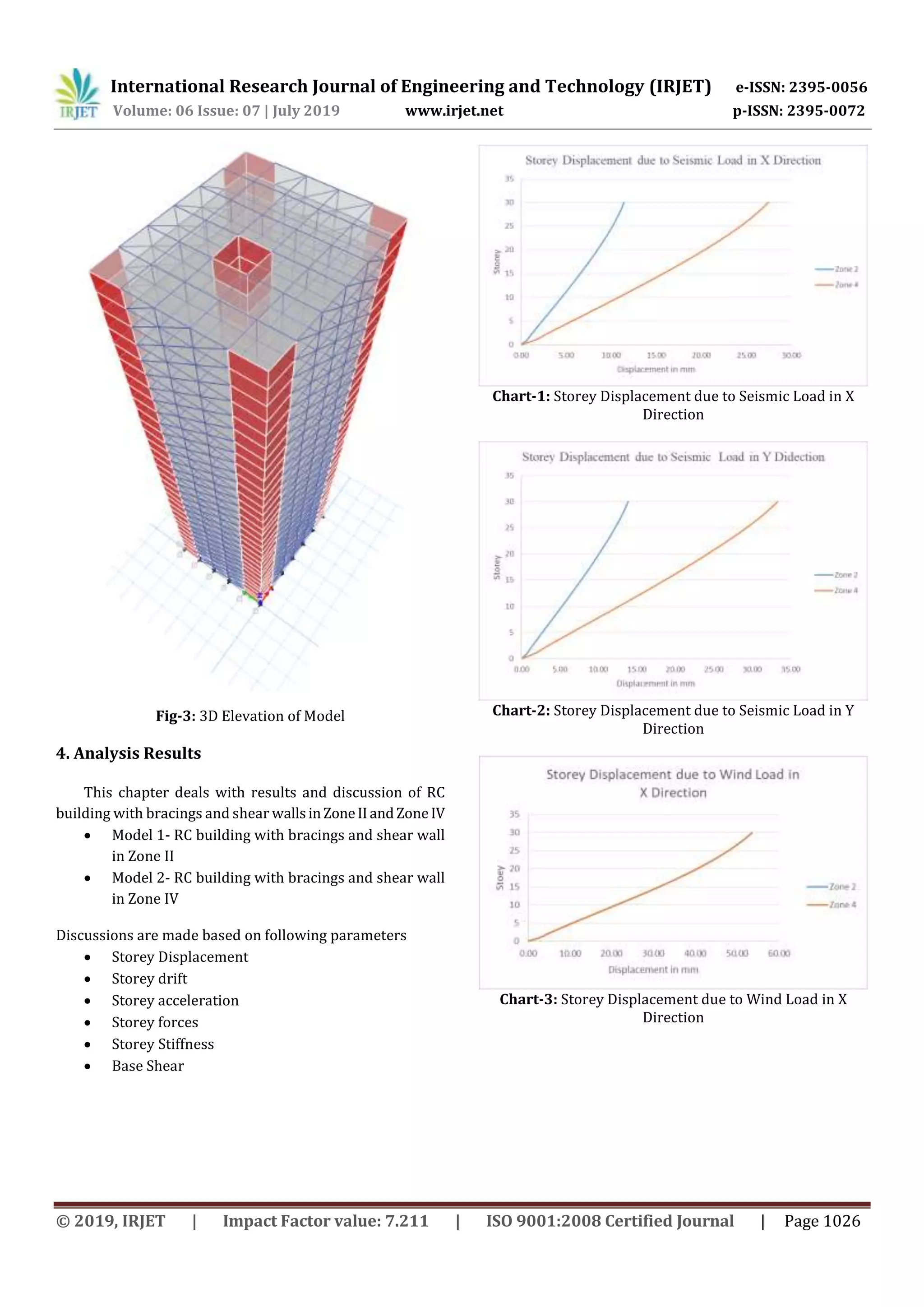
Fig-2: 2D Elevation of Model
International Research Journal of Engineering and Technology (IRJET) e-ISSN: 2395-0056
Volume: 06 Issue: 07 | July 2019 www.irjet.net p-ISSN: 2395-0072
© 2019, IRJET | Impact Factor value: 7.211 | ISO 9001:2008 Certified Journal | Page 1026
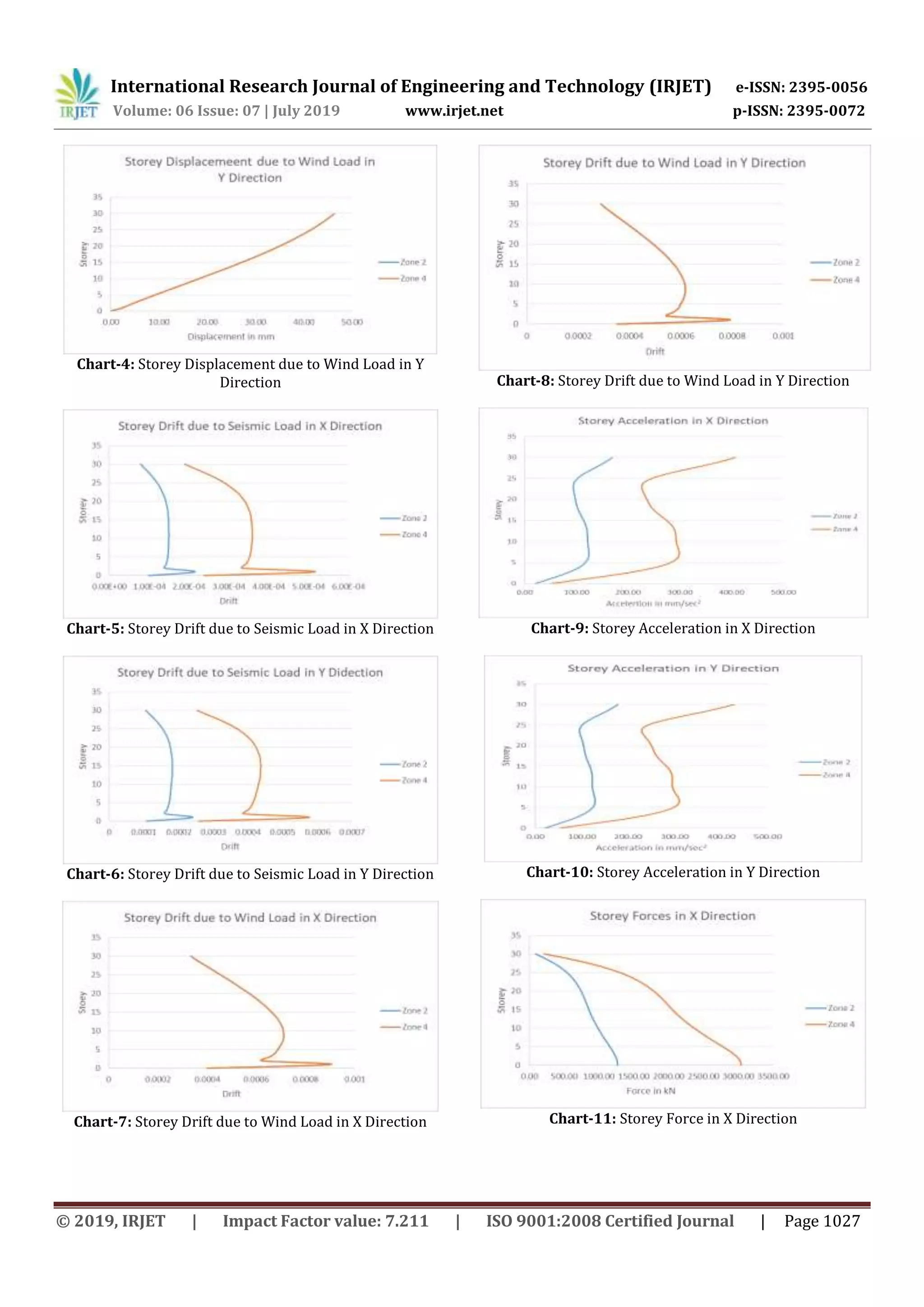
Fig-3: 3D Elevation of Model
4. Analysis Results
This chapter deals with results and discussion of RC
building with bracings and shear wallsinZoneIIandZoneIV
 Model 1- RC building with bracings and shear wall
in Zone II
 Model 2- RC building with bracings and shear wall
in Zone IV
Discussions are made based on following parameters
 Storey Displacement
 Storey drift
 Storey acceleration
 Storey forces
 Storey Stiffness
 Base Shear
Chart-1: Storey Displacement due to Seismic Load in X
Direction
Chart-2: Storey Displacement due to Seismic Load in Y
Direction
Chart-3: Storey Displacement due to Wind Load in X
Direction
International Research Journal of Engineering and Technology (IRJET) e-ISSN: 2395-0056
Volume: 06 Issue: 07 | July 2019 www.irjet.net p-ISSN: 2395-0072
© 2019, IRJET | Impact Factor value: 7.211 | ISO 9001:2008 Certified Journal | Page 1027
Chart-4: Storey Displacement due to Wind Load in Y
Direction
Chart-5: Storey Drift due to Seismic Load in X Direction
Chart-6: Storey Drift due to Seismic Load in Y Direction
Chart-7: Storey Drift due to Wind Load in X Direction
Chart-8: Storey Drift due to Wind Load in Y Direction
Chart-9: Storey Acceleration in X Direction
Chart-10: Storey Acceleration in Y Direction
Chart-11: Storey Force in X Direction
International Research Journal of Engineering and Technology (IRJET) e-ISSN: 2395-0056
Volume: 06 Issue: 07 | July 2019 www.irjet.net p-ISSN: 2395-0072
© 2019, IRJET | Impact Factor value: 7.211 | ISO 9001:2008 Certified Journal | Page 1028
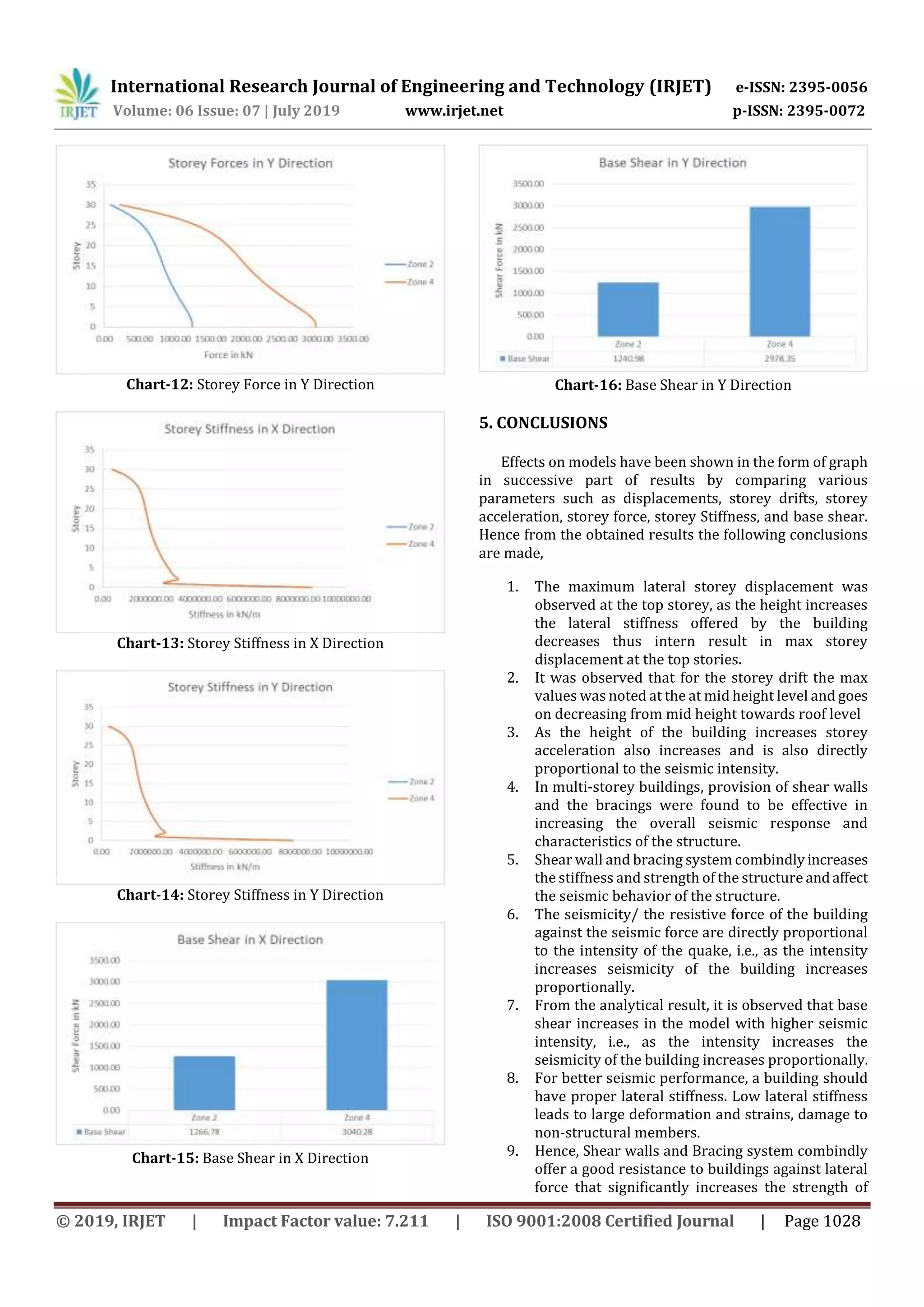
Chart-12: Storey Force in Y Direction
Chart-13: Storey Stiffness in X Direction
Chart-14: Storey Stiffness in Y Direction
Chart-15: Base Shear in X Direction
Chart-16: Base Shear in Y Direction
5. CONCLUSIONS
Effects on models have been shown in the form of graph
in successive part of results by comparing various
parameters such as displacements, storey drifts, storey
acceleration, storey force, storey Stiffness, and base shear.
Hence from the obtained results the following conclusions
are made,
1. The maximum lateral storey displacement was
observed at the top storey, as the height increases
the lateral stiffness offered by the building
decreases thus intern result in max storey
displacement at the top stories.
2. It was observed that for the storey drift the max
values was noted at the at mid height level and goes
on decreasing from mid height towards roof level
3. As the height of the building increases storey
acceleration also increases and is also directly
proportional to the seismic intensity.
4. In multi-storey buildings, provision of shear walls
and the bracings were found to be effective in
increasing the overall seismic response and
characteristics of the structure.
5. Shear wall and bracing system combindly increases
the stiffness and strength of the structure andaffect
the seismic behavior of the structure.
6. The seismicity/ the resistive force of the building
against the seismic force are directly proportional
to the intensity of the quake, i.e., as the intensity
increases seismicity of the building increases
proportionally.
7. From the analytical result, it is observed that base
shear increases in the model with higher seismic
intensity, i.e., as the intensity increases the
seismicity of the building increases proportionally.
8. For better seismic performance, a building should
have proper lateral stiffness. Low lateral stiffness
leads to large deformation and strains, damage to
non-structural members.
9. Hence, Shear walls and Bracing system combindly
offer a good resistance to buildings against lateral
force that significantly increases the strength of
International Research Journal of Engineering and Technology (IRJET) e-ISSN: 2395-0056
Volume: 06 Issue: 07 | July 2019 www.irjet.net p-ISSN: 2395-0072
© 2019, IRJET | Impact Factor value: 7.211 | ISO 9001:2008 Certified Journal | Page 1029
overall frame and thus decrease the possibility of
failure of the structure.
REFERENCES
[1] Anupam Rajmani, ProfPriyabrata Guha,“Analysisof
Wind & Earthquake Load for Different Shapes of
High Rise Building” IAEME Volume 6, Issue 2,
February (2015), pp. 38-45.
[2] Baldev D. Prajapati & D. R. Panchal, “Study of
Seismic and Wind Effect on Multi StoreyR.C.C.,Steel
and Composite Building” IJAET Vol. 6, Issue 4, pp.
1836-1847.
[3] K. Rama Raju, M.I. Shereef, Nagesh R Iyer, S.
Gopalakrishnan, “Analysis and Design of Rc Tall
Building Subjected to Wind and Earthquake Loads”
APCWE December 10–14, 2013.
[4] Narla Mohan,A.Mounika Vardhan,“AnalysisofG+20
Rc Building in Different Zones Using Etabs” IJPRES
Volume VIII /Issue 3 / Mar 2017.
[5] Naga Sai,G. Radha Devi, “Seismic and Wind Effects
on High Rise Structure Using ETABS” IJRASET
Volume 6 Issue II, February 2018.
[6] Shruti Badami, M. R. Suresh,“AStudyonBehaviorof
Structural Systems for Tall Buildings Subjected To
Lateral Loads” IJERT Vol. 3 Issue 7, July – 2014.
[7] Susheel S M, Sanjith J, Vidyashree B S3, Ranjith A,
“Analysis of Tall Building in Chikkamagaluru
Region” IRJET Volume: 03 Issue: 06 | June-2016.
[8] Vikrant Trivedi, Sumit Pahwa, “Wind Analysis and
Design of G+11 Storied Building Using STAAD-Pro”
IRJET Volume: 05 Issue: 03 | Mar-2018.
BIOGRAPHIES
Mr. Jaiprakash C
Post Graduate Student,
Department of Civil Engineering,
BIET College, Davangere.
Ms. Ramya B V
Assistant Professor,
Department of Civil Engineering,
BIET College, Davangere.

IRJET- Analysis of Tall Building Structure Subjected to Wind and Earthquake Loads in Different Seismic Zones

  • 1.
    International Research Journalof Engineering and Technology (IRJET) e-ISSN: 2395-0056 Volume: 06 Issue: 07 | July 2019 www.irjet.net p-ISSN: 2395-0072 © 2019, IRJET | Impact Factor value: 7.211 | ISO 9001:2008 Certified Journal | Page 1024 Analysis of Tall Building Structure Subjected to Wind and Earthquake Loads in Different Seismic Zones Mr. Jaiprakash C1, Ms. Ramya B V2 1Post Graduate in Structural Engineering, BIET College, Davangere, Karnataka, India 2Assistant Professor, M-Tech Structural Engineering, BIET College, Davangere, Karnataka, India ---------------------------------------------------------------------***--------------------------------------------------------------------- Abstract - Consideration of site specific lateral loading due to wind or earthquake loads together with vertical gravity loads is important for finding thebehaviorofthetallbuildings. As the height of a building becomes taller, the quantity of structural material required to resist lateral loads increases considerably. The design of tall buildings essentially involvesa conceptual design, approximate evaluation, preliminary design and optimization, to safely convey gravity and lateral loads. The design criteria are strength, serviceability and human consolation. The goal of the structural engineer is to arrive at appropriate structural schemes, to meet these criteria. In the present research, the Response Spectrum Method of analysis of a G+30-storey reinforced concrete high rise building under wind and seismic loads as per IS codes of exercise is described. The comparison was made for base shear, storey drift, storey displacement, storey acceleration, storey forces and storey stiffness. Key Words: Tall Building1, ETABS2, Response Spectrum3, Seismic Loads4, Wind Loads5 1. INTRODUCTION Tall buildings, which are usually designed for office or commercial use, are among the most distinguished space definitions in the Structural Engineers history of Indian urbanism in the twentieth century. They are primarily a reaction to the rapid growth of the urban populationandthe demand by business activities to be as close to each other as possible. Structural Engineers reinterpretations of the building type, the high cost of land in urban areas, the desire to prevent the disorganized expansion, the need to preserve agricultural production, the concept of skyscraper,influence of cultural significance and prestige, have all contributed to force buildings upward. Today, it is virtually impossible to imagine a major city without tall buildings. The importance of tall buildings in the contemporary urban development is without doubt ever increasing despite their several undeniable negative effects on the quality of urban life. 1.1 Wind Effects on Tall Buildings The wind is the most powerful and unpredictable force affecting tall buildings. Tall building can be definedasa mast anchored in the ground, bending and swaying in the wind. This movement, known as wind drift, should be kept within acceptable limits. Moreover,for a well-designedtall building, the wind drift should not surpass the height of the building divided by 500. Wind loads on buildings increase considerably with the increase in building heights. Furthermore, the speed of wind increases with height, and the wind pressures increase as the square ofthewindspeed. Thus, wind effects on a tall building are compounded as its height increases. Besides this, with innovations in architectural treatment, increase in the strengths of materials, and advances in methods of analysis, tall buildinghave becomemoreefficient and lighter, and so, more vulnerable to deflection, and even to swaying under wind loading. Despite all the engineering sophistication performed with computers, wind is still a complex phenomenon, mainlyowingtotwomajorproblems. Unlike dead loads and live loads, wind loads change rapidly and even abruptly, creating effects much larger than when the same loads were applied gradually, and that they limit building accelerations below human perception. Although the true complexity of the wind and the acceptable human tolerance to it have just begun to be understood, thereisstill a need to understand more the nature of wind and its interaction with a tall building, with particular reference to allowable defections and comfort of occupants. 1.2 Earthquake Effects on Tall Buildings As earthquakes can happen almost anywhere, some measure of earthquake resistance in the form of reserve ductility and redundancy should be built into the design of all structures to prevent catastrophic failures. Moreover, during the life of a building in a seismically active zone, it is usually expected that the building will be subjected to many small earthquakes, including some moderate ones, one or more large ones, and possibly a very severe one. Building massing, shape and proportion, groundacceleration,andthe dynamic response of the structure,influencesthe magnitude and distribution of earthquake forces. On the other hand, if irregular forms are inevitable, special design considerations are necessary to account for load transfer at abrupt changes in structural resistance. Therefore, two general approaches are utilized to determine the seismicloading,whichtakeinto consideration the properties of the structure, and the past record of earthquakes in the region. When compared to the wind loads, earthquake loads have stronger intensity and shorter duration.
  • 2.
    International Research Journalof Engineering and Technology (IRJET) e-ISSN: 2395-0056 Volume: 06 Issue: 07 | July 2019 www.irjet.net p-ISSN: 2395-0072 © 2019, IRJET | Impact Factor value: 7.211 | ISO 9001:2008 Certified Journal | Page 1025 2. OBJECTIVES  How the seismic evaluation of a building should be carried out.  To study the behavior of a building under theaction of seismic loads and wind loads.  The building model in the study has thirty storey’s with constant storey height of 3m. Model is analyzed with constant bay lengths and the bay width along two horizontal directions are kept constant in model for convenience.  Different analysis like Response Spectrum method is carried for the analysis and correspondingeffects are interpreted in the results.  Wind speeds are taken for wind analysis and their corresponding effects of building structure are interpreted in the results. 3. METHODOLOGY  An extensive literature review is carried out to establish the above objectives for the project work.  G+30 storey structure is chosen for the present investigation.  ETABS software is chosen for modelling and analysis of the selected structure.  To understand the behaviour of structure, the analysis is carried in Response spectrum method are considered. 3.1 Modelling Table-1: Structure Details Number of stories G+30 C/C distance between columns in X-direction 5 m C/C distance between columns in Y-direction 5 m Foundation level to ground level 3 m Floor to floor height 3 m Live load on all floors 3 kN/m2 Live Load on Roof 1.5 kN/m2 Floor Finish 1.5 kN/m2 Concrete M25 and M30 Steel Fe 415 and Fe 500 Size of column 800 x 800 mm Size of beam 400 x 650 mm Depth of slab 150 mm Seismic zone II 0.10 Seismic zone IV 0.24 Soil Type II Fig-1: Structural Plan of Model Fig-2: 2D Elevation of Model
  • 3.
    International Research Journalof Engineering and Technology (IRJET) e-ISSN: 2395-0056 Volume: 06 Issue: 07 | July 2019 www.irjet.net p-ISSN: 2395-0072 © 2019, IRJET | Impact Factor value: 7.211 | ISO 9001:2008 Certified Journal | Page 1026 Fig-3: 3D Elevation of Model 4. Analysis Results This chapter deals with results and discussion of RC building with bracings and shear wallsinZoneIIandZoneIV  Model 1- RC building with bracings and shear wall in Zone II  Model 2- RC building with bracings and shear wall in Zone IV Discussions are made based on following parameters  Storey Displacement  Storey drift  Storey acceleration  Storey forces  Storey Stiffness  Base Shear Chart-1: Storey Displacement due to Seismic Load in X Direction Chart-2: Storey Displacement due to Seismic Load in Y Direction Chart-3: Storey Displacement due to Wind Load in X Direction
  • 4.
    International Research Journalof Engineering and Technology (IRJET) e-ISSN: 2395-0056 Volume: 06 Issue: 07 | July 2019 www.irjet.net p-ISSN: 2395-0072 © 2019, IRJET | Impact Factor value: 7.211 | ISO 9001:2008 Certified Journal | Page 1027 Chart-4: Storey Displacement due to Wind Load in Y Direction Chart-5: Storey Drift due to Seismic Load in X Direction Chart-6: Storey Drift due to Seismic Load in Y Direction Chart-7: Storey Drift due to Wind Load in X Direction Chart-8: Storey Drift due to Wind Load in Y Direction Chart-9: Storey Acceleration in X Direction Chart-10: Storey Acceleration in Y Direction Chart-11: Storey Force in X Direction
  • 5.
    International Research Journalof Engineering and Technology (IRJET) e-ISSN: 2395-0056 Volume: 06 Issue: 07 | July 2019 www.irjet.net p-ISSN: 2395-0072 © 2019, IRJET | Impact Factor value: 7.211 | ISO 9001:2008 Certified Journal | Page 1028 Chart-12: Storey Force in Y Direction Chart-13: Storey Stiffness in X Direction Chart-14: Storey Stiffness in Y Direction Chart-15: Base Shear in X Direction Chart-16: Base Shear in Y Direction 5. CONCLUSIONS Effects on models have been shown in the form of graph in successive part of results by comparing various parameters such as displacements, storey drifts, storey acceleration, storey force, storey Stiffness, and base shear. Hence from the obtained results the following conclusions are made, 1. The maximum lateral storey displacement was observed at the top storey, as the height increases the lateral stiffness offered by the building decreases thus intern result in max storey displacement at the top stories. 2. It was observed that for the storey drift the max values was noted at the at mid height level and goes on decreasing from mid height towards roof level 3. As the height of the building increases storey acceleration also increases and is also directly proportional to the seismic intensity. 4. In multi-storey buildings, provision of shear walls and the bracings were found to be effective in increasing the overall seismic response and characteristics of the structure. 5. Shear wall and bracing system combindly increases the stiffness and strength of the structure andaffect the seismic behavior of the structure. 6. The seismicity/ the resistive force of the building against the seismic force are directly proportional to the intensity of the quake, i.e., as the intensity increases seismicity of the building increases proportionally. 7. From the analytical result, it is observed that base shear increases in the model with higher seismic intensity, i.e., as the intensity increases the seismicity of the building increases proportionally. 8. For better seismic performance, a building should have proper lateral stiffness. Low lateral stiffness leads to large deformation and strains, damage to non-structural members. 9. Hence, Shear walls and Bracing system combindly offer a good resistance to buildings against lateral force that significantly increases the strength of
  • 6.
    International Research Journalof Engineering and Technology (IRJET) e-ISSN: 2395-0056 Volume: 06 Issue: 07 | July 2019 www.irjet.net p-ISSN: 2395-0072 © 2019, IRJET | Impact Factor value: 7.211 | ISO 9001:2008 Certified Journal | Page 1029 overall frame and thus decrease the possibility of failure of the structure. REFERENCES [1] Anupam Rajmani, ProfPriyabrata Guha,“Analysisof Wind & Earthquake Load for Different Shapes of High Rise Building” IAEME Volume 6, Issue 2, February (2015), pp. 38-45. [2] Baldev D. Prajapati & D. R. Panchal, “Study of Seismic and Wind Effect on Multi StoreyR.C.C.,Steel and Composite Building” IJAET Vol. 6, Issue 4, pp. 1836-1847. [3] K. Rama Raju, M.I. Shereef, Nagesh R Iyer, S. Gopalakrishnan, “Analysis and Design of Rc Tall Building Subjected to Wind and Earthquake Loads” APCWE December 10–14, 2013. [4] Narla Mohan,A.Mounika Vardhan,“AnalysisofG+20 Rc Building in Different Zones Using Etabs” IJPRES Volume VIII /Issue 3 / Mar 2017. [5] Naga Sai,G. Radha Devi, “Seismic and Wind Effects on High Rise Structure Using ETABS” IJRASET Volume 6 Issue II, February 2018. [6] Shruti Badami, M. R. Suresh,“AStudyonBehaviorof Structural Systems for Tall Buildings Subjected To Lateral Loads” IJERT Vol. 3 Issue 7, July – 2014. [7] Susheel S M, Sanjith J, Vidyashree B S3, Ranjith A, “Analysis of Tall Building in Chikkamagaluru Region” IRJET Volume: 03 Issue: 06 | June-2016. [8] Vikrant Trivedi, Sumit Pahwa, “Wind Analysis and Design of G+11 Storied Building Using STAAD-Pro” IRJET Volume: 05 Issue: 03 | Mar-2018. BIOGRAPHIES Mr. Jaiprakash C Post Graduate Student, Department of Civil Engineering, BIET College, Davangere. Ms. Ramya B V Assistant Professor, Department of Civil Engineering, BIET College, Davangere.