Abdul Quyyum Butt
M.Sc Information Technology
   aqbutt.786@gmail.com
 University of Gujrat (UOG)
          Pakistan
 Multiprotocol Label Switching
 Originating in IPv4
 Proposed to improve forwarding speed.
 Integrates both Layer 2 fast switching and Layer 3
 routing and forwarding, satisfying the networking
 requirements of various new applications.
 Its core technology can be extended to multiple
  network protocols, such as IPv6, Internet Packet
  Exchange (IPX), and Connectionless Network Protocol
  (CLNP).
 That is what the term multiprotocol means.
 Basic Concepts of MPLS
1.   FEC ( Forwarding Equivalence Cass )
2.   Label
3.   LSR (Label Switch Router)
4.   LSP (Label switched Path)
5.   LDP (Label Distribution Protocol)
6.   LSP Tunneling
7.   Multi-level Label Stack
 MPLS groups packets to be forwarded in the same
  manner into a class called the forwarding equivalence
  class (FEC).
 Packets of the same FEC are handled in the same way.
 The classification of FECs is very flexible.
 It can be based on any combination of source address,
  destination address, source port, destination port,
  protocol type and VPN. For example, in the traditional
  IP forwarding using longest match, all packets to the
  same destination belongs to the same FEC.
 A label is a short fixed length identifier for identifying
  a FEC.
 A FEC may correspond to multiple labels in scenarios
  where, for example, load sharing is required, while a
  label can only represent a single FEC.
 A label is carried in the header of a packet. It does not
  contain any topology information and is local
  significant.
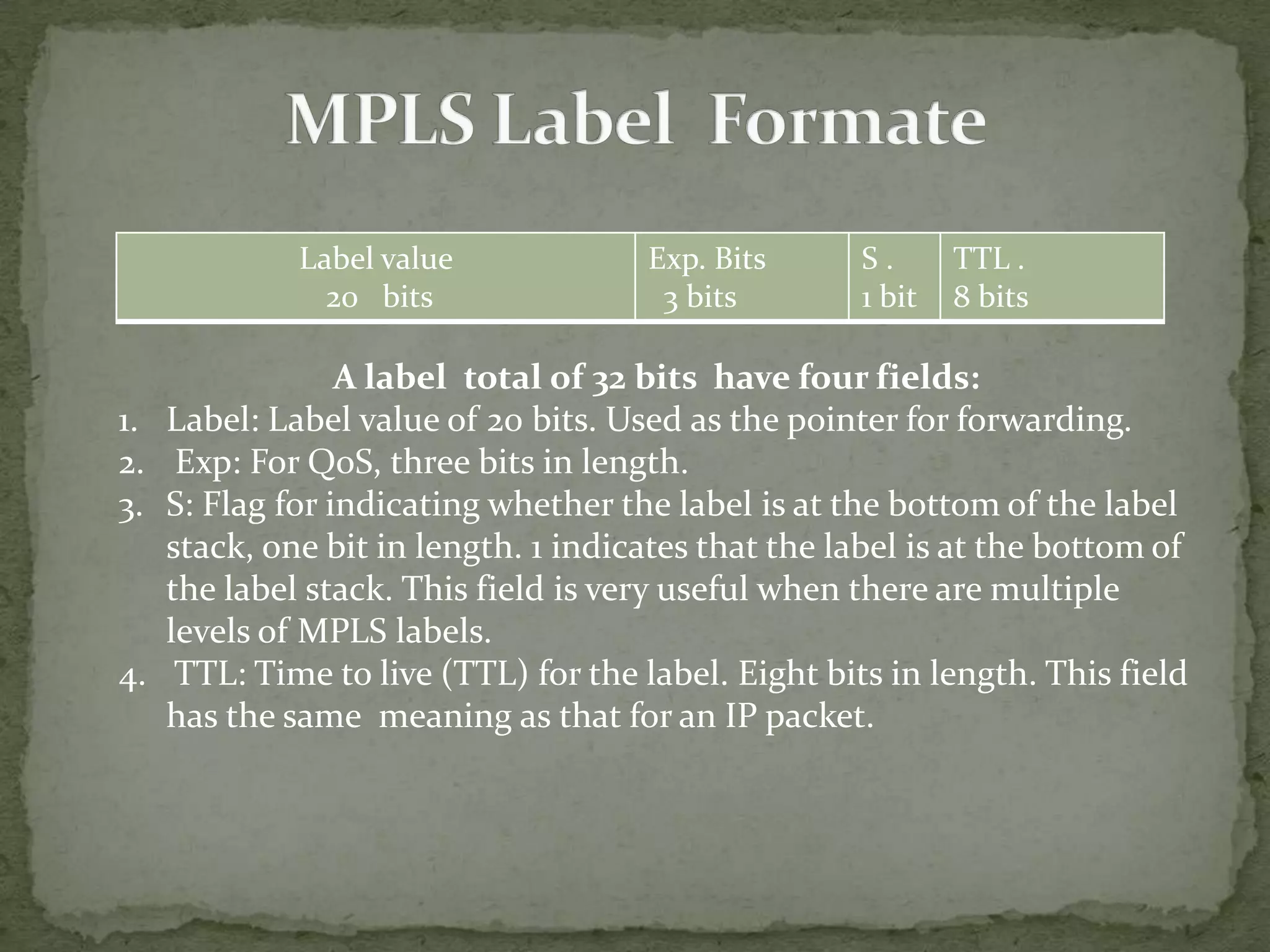
 A label is four octets, or 32 bits, in length
Label value             Exp. Bits      S.      TTL .
                20 bits                3 bits        1 bit   8 bits

                  A label total of 32 bits have four fields:
1.   Label: Label value of 20 bits. Used as the pointer for forwarding.
2.    Exp: For QoS, three bits in length.
3.   S: Flag for indicating whether the label is at the bottom of the label
     stack, one bit in length. 1 indicates that the label is at the bottom of
     the label stack. This field is very useful when there are multiple
     levels of MPLS labels.
4.    TTL: Time to live (TTL) for the label. Eight bits in length. This field
     has the same meaning as that for an IP packet.
LSR (Label switching router)
 Fundamental component of an MPLS network.
 LSR is a router capable of MPLS .
            LSP (Label switched path)
 LSP means the path along which a FEC travels through
  an MPLS network.
 Along an LSP, two neighboring LSRs are called
  upstream LSR and downstream LSR respectively.
 The protocol used by MPLS for control.
 An LDP has the same functions as a signaling protocol on a
  traditional network.
 It classifies FECs, distributes labels, and establishes and
  maintains LSPs.
 MPLS supports multiple label distribution protocols of
  either of the following two types:
1. Those dedicated for label distribution, such as LDP and
     Constraint-based Routing using LDP (CR-LDP).
2. The existing protocols that are extended to support label
     distribution, such as Border Gateway Protocol (BGP) and
     Resource Reservation Protocol (RSVP).
 MPLS support LSP tunneling.
 An LSR of an LSP and its downstream LSR are not
  necessarily on a path provided by the routing protocol.
 MPLS allows an LSP to be established between two
  LSRs that are not on a path established by the routing
  protocol. In this case, the two LSRs are respectively the
  start point and end point of the LSP, and the LSP is an
  LSP tunnel,
 LSP tunnel does not use the traditional network layer
  encapsulation tunneling technology.
 For example,
    the LSP      <R2→R21→R22→R3 >
    is a tunnel between R2 and R3.
 MPLS allows a packet to carry a number of labels organized
  as a last-in first-out (LIFO) stack, which is called a label
  stack.
 A packet with a label stack can travel along more than one
  level of LSP tunnel. At the ingress and egress of each
  tunnel, these operations can be performed on the top of a
  stack: PUSH and POP.
 MPLS has no limit to the depth of a label stack. For a label
  stack with a depth of m,
 The label at the bottom is of level 1, while the label at the
  top has a level of m. An unlabeled packet can be considered
  as a packet with an empty label stack, that is, a label
  stackwhose depth is 0.
THANK
 YOU

Mpls

  • 1.
    Abdul Quyyum Butt M.ScInformation Technology aqbutt.786@gmail.com University of Gujrat (UOG) Pakistan
  • 2.
     Multiprotocol LabelSwitching  Originating in IPv4  Proposed to improve forwarding speed.  Integrates both Layer 2 fast switching and Layer 3 routing and forwarding, satisfying the networking requirements of various new applications.
  • 3.
     Its coretechnology can be extended to multiple network protocols, such as IPv6, Internet Packet Exchange (IPX), and Connectionless Network Protocol (CLNP).  That is what the term multiprotocol means.
  • 4.
     Basic Conceptsof MPLS 1. FEC ( Forwarding Equivalence Cass ) 2. Label 3. LSR (Label Switch Router) 4. LSP (Label switched Path) 5. LDP (Label Distribution Protocol) 6. LSP Tunneling 7. Multi-level Label Stack
  • 5.
     MPLS groupspackets to be forwarded in the same manner into a class called the forwarding equivalence class (FEC).  Packets of the same FEC are handled in the same way.  The classification of FECs is very flexible.  It can be based on any combination of source address, destination address, source port, destination port, protocol type and VPN. For example, in the traditional IP forwarding using longest match, all packets to the same destination belongs to the same FEC.
  • 6.
     A labelis a short fixed length identifier for identifying a FEC.  A FEC may correspond to multiple labels in scenarios where, for example, load sharing is required, while a label can only represent a single FEC.  A label is carried in the header of a packet. It does not contain any topology information and is local significant.  A label is four octets, or 32 bits, in length
  • 7.
    Label value Exp. Bits S. TTL . 20 bits 3 bits 1 bit 8 bits A label total of 32 bits have four fields: 1. Label: Label value of 20 bits. Used as the pointer for forwarding. 2. Exp: For QoS, three bits in length. 3. S: Flag for indicating whether the label is at the bottom of the label stack, one bit in length. 1 indicates that the label is at the bottom of the label stack. This field is very useful when there are multiple levels of MPLS labels. 4. TTL: Time to live (TTL) for the label. Eight bits in length. This field has the same meaning as that for an IP packet.
  • 8.
    LSR (Label switchingrouter)  Fundamental component of an MPLS network.  LSR is a router capable of MPLS . LSP (Label switched path)  LSP means the path along which a FEC travels through an MPLS network.  Along an LSP, two neighboring LSRs are called upstream LSR and downstream LSR respectively.
  • 9.
     The protocolused by MPLS for control.  An LDP has the same functions as a signaling protocol on a traditional network.  It classifies FECs, distributes labels, and establishes and maintains LSPs.  MPLS supports multiple label distribution protocols of either of the following two types: 1. Those dedicated for label distribution, such as LDP and Constraint-based Routing using LDP (CR-LDP). 2. The existing protocols that are extended to support label distribution, such as Border Gateway Protocol (BGP) and Resource Reservation Protocol (RSVP).
  • 10.
     MPLS supportLSP tunneling.  An LSR of an LSP and its downstream LSR are not necessarily on a path provided by the routing protocol.  MPLS allows an LSP to be established between two LSRs that are not on a path established by the routing protocol. In this case, the two LSRs are respectively the start point and end point of the LSP, and the LSP is an LSP tunnel,
  • 11.
     LSP tunneldoes not use the traditional network layer encapsulation tunneling technology.  For example, the LSP <R2→R21→R22→R3 > is a tunnel between R2 and R3.
  • 12.
     MPLS allowsa packet to carry a number of labels organized as a last-in first-out (LIFO) stack, which is called a label stack.  A packet with a label stack can travel along more than one level of LSP tunnel. At the ingress and egress of each tunnel, these operations can be performed on the top of a stack: PUSH and POP.  MPLS has no limit to the depth of a label stack. For a label stack with a depth of m,  The label at the bottom is of level 1, while the label at the top has a level of m. An unlabeled packet can be considered as a packet with an empty label stack, that is, a label stackwhose depth is 0.
  • 14.