MULTIVARIATE TECHNIQUES
•ALL STATISTICAL TECHNIQUES
WHICH SIMULTANEOUSLY
ANALYSE MORE THAN TWO
VARIABLES CAN BE CATEGORISED
AS MULTIVARIATE TECHNIQUES
•THESE TECHNIQUES TAKE INTO
ACCOUNT THE DIFFERENT TYPES
OF RELATIONSHIPS AMONGST
VARIABLES
TYPES OF MUTIVARIATE TECHNIQUES
• ALL MULTIVARIATE TECHNIQUES ARE
BROADLY CLASSIFIED INTO TWO
CATEGORIES:
(I) DEPENDENCE METHODS
(II) INTEDEPENDENCE METHODS
• Several Variants of these methods are there
on the basis of the following
• (a) Number of dependent variables
• (b) The nature of data used in a model( with
reference to the scale of measurement)
Multivariate Techniques to be
discussed/used in this course
• Multiple Regression
(Both Additive and Multiplicative Models)
• Exploratory Factor Analysis
• Cluster Analysis
Multiple Regression
(Dependence methods)
• Multiple Regression is one of the important
Multivariate Techniques under the dependence
methods.
• In MR we have one dependent and more than
one independent variables.
• The dependent variables is in metric
measurement scale and the independent
variables are normally in metric scale but in
cases qualitative variables measured in nominal
scale could also be used with a specific
purpose.
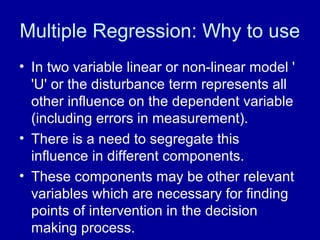
Multiple Regression: Why to use
• In two variable linear or non-linear model '
'U' or the disturbance term represents all
other influence on the dependent variable
(including errors in measurement).
• There is a need to segregate this
influence in different components.
• These components may be other relevant
variables which are necessary for finding
points of intervention in the decision
making process.
Multiple Regression
The general form
• If we have specified a functional
relationship between 'Y' and several 'Xs'
Such as Y = ( X1,X2,X3,…..Xk) and have 'n'
observations, we may write the general form
of the Multiple Regression in different
ways such as linear or loglinear.
(Additive and Multiplicative regression
models have wide application in empirical
Research.)
Additive and Multiplicative
Regression Models
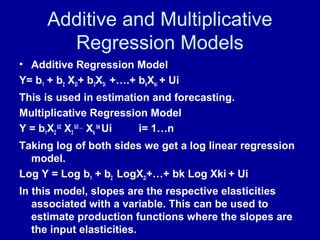
• Additive Regression Model
Y= b1 + b2 X2i+ b3X3i +….+ bkXki + Ui
This is used in estimation and forecasting.
Multiplicative Regression Model
Y = b1X2
b2
X3
b3 …
Xk
bk
Ui i= 1…n
Taking log of both sides we get a log linear regression
model.
Log Y = Log b1 + b2 LogX2i+…+ bk Log Xki + Ui
In this model, slopes are the respective elasticities
associated with a variable. This can be used to
estimate production functions where the slopes are
the input elasticities.
The matrix form of the Multiple Regression
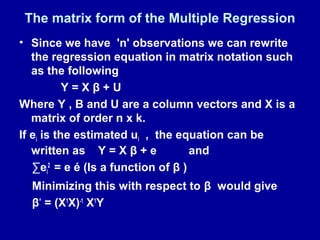
• Since we have 'n' observations we can rewrite
the regression equation in matrix notation such
as the following
Y = X β + U
Where Y , B and U are a column vectors and X is a
matrix of order n x k.
If ei is the estimated ui , the equation can be
written as Y = X β + e and
∑ei
2
= e é (Is a function of β )
Minimizing this with respect to β would give
β^
= (X1
X)-1
X1
Y
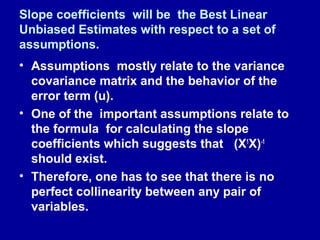
Slope coefficients will be the Best Linear
Unbiased Estimates with respect to a set of
assumptions.
• Assumptions mostly relate to the variance
covariance matrix and the behavior of the
error term (u).
• One of the important assumptions relate to
the formula for calculating the slope
coefficients which suggests that (X1
X)-1
should exist.
• Therefore, one has to see that there is no
perfect collinearity between any pair of
variables.
The Correlation Table
• To examine the pair wise correlation between
variables one may examine the correlation
matrix.
• Trial and error methods is applied to arrive at
a set of independent variables that best
explain the dependent variables by the use
of several combinations of explanatory
variables and comparing the explanatory
power and the significance levels of the βi
s .Adjusted R2
may be considered in MR.
Interpretation of the Output
• DECISION POINTS AND INTERPRETATION:
1. 't' Values of β^¡ = β^¡ / SE of β¡
With the help of the sign and
significance levels conclusions on
relationship is arrived at.
2. R2
& Adjusted R2
(R bar Square).
R2
is a non-decreasing function of the
number of explanatory variable or
regressors present in the model.
• Consider the Venn Diagram discussed earlier.
• If one increases the number of explanatory
variables one after the other R2
is expected to
increase (Not decrease)
• R2
is adjusted to the number of parameters in
the model. Hence, it is a better estimate of the
co-efficient of determination (Adjusted)
•The following formula is used to calculate the
Adjusted R2
•R2
= 1 – RSS/TSS or 1 - ∑ ui
2
/ ∑ yi
2
• Adjusted R2
= 1 – [∑ ui
2
/ (n-k)]/ ∑ yi
2
/ (n-1)
• Where k is the number of parameter including
the intercept term. ( See Page 217: 4th
Ed DNG)
Interpretation of the Output
• Comparing two R2
• The dependent variable and number of
• observation have to be the same.
• 3. Standardized Coefficients: They
indicate the relative importance of the
independent variables in explaining the
dependent variable.
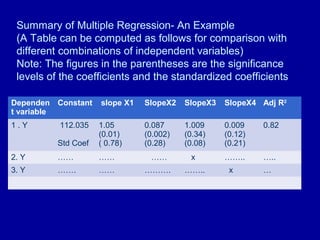
Summary of Multiple Regression- An Example
(A Table can be computed as follows for comparison with
different combinations of independent variables)
Note: The figures in the parentheses are the significance
levels of the coefficients and the standardized coefficients
Dependen
t variable
Constant slope X1 SlopeX2 SlopeX3 SlopeX4 Adj R2
1 . Y 112.035
Std Coef
1.05
(0.01)
( 0.78)
0.087
(0.002)
(0.28)
1.009
(0.34)
(0.08)
0.009
(0.12)
(0.21)
0.82
2. Y …… …… …… x …….. …..
3. Y ……. …… ………. …….. x …
Assignment 3
• Groups will use time series and cross
section data in estimating the Multiple
Regression.
• Both additive and Multiplicative Models will
be estimated.
• Two /three combinations could be used after
examining the correlation table.
• The output may be summarized in a table.
• Ref: Basic Econometrics by DN Gujarati
• & Business Research Methods by P.Mishra

10685 6.1 multivar_mr_srm bm i

  • 1.
    MULTIVARIATE TECHNIQUES •ALL STATISTICALTECHNIQUES WHICH SIMULTANEOUSLY ANALYSE MORE THAN TWO VARIABLES CAN BE CATEGORISED AS MULTIVARIATE TECHNIQUES •THESE TECHNIQUES TAKE INTO ACCOUNT THE DIFFERENT TYPES OF RELATIONSHIPS AMONGST VARIABLES
  • 2.
    TYPES OF MUTIVARIATETECHNIQUES • ALL MULTIVARIATE TECHNIQUES ARE BROADLY CLASSIFIED INTO TWO CATEGORIES: (I) DEPENDENCE METHODS (II) INTEDEPENDENCE METHODS • Several Variants of these methods are there on the basis of the following • (a) Number of dependent variables • (b) The nature of data used in a model( with reference to the scale of measurement)
  • 3.
    Multivariate Techniques tobe discussed/used in this course • Multiple Regression (Both Additive and Multiplicative Models) • Exploratory Factor Analysis • Cluster Analysis
  • 4.
    Multiple Regression (Dependence methods) •Multiple Regression is one of the important Multivariate Techniques under the dependence methods. • In MR we have one dependent and more than one independent variables. • The dependent variables is in metric measurement scale and the independent variables are normally in metric scale but in cases qualitative variables measured in nominal scale could also be used with a specific purpose.
  • 5.
    Multiple Regression: Whyto use • In two variable linear or non-linear model ' 'U' or the disturbance term represents all other influence on the dependent variable (including errors in measurement). • There is a need to segregate this influence in different components. • These components may be other relevant variables which are necessary for finding points of intervention in the decision making process.
  • 6.
    Multiple Regression The generalform • If we have specified a functional relationship between 'Y' and several 'Xs' Such as Y = ( X1,X2,X3,…..Xk) and have 'n' observations, we may write the general form of the Multiple Regression in different ways such as linear or loglinear. (Additive and Multiplicative regression models have wide application in empirical Research.)
  • 7.
    Additive and Multiplicative RegressionModels • Additive Regression Model Y= b1 + b2 X2i+ b3X3i +….+ bkXki + Ui This is used in estimation and forecasting. Multiplicative Regression Model Y = b1X2 b2 X3 b3 … Xk bk Ui i= 1…n Taking log of both sides we get a log linear regression model. Log Y = Log b1 + b2 LogX2i+…+ bk Log Xki + Ui In this model, slopes are the respective elasticities associated with a variable. This can be used to estimate production functions where the slopes are the input elasticities.
  • 8.
    The matrix formof the Multiple Regression • Since we have 'n' observations we can rewrite the regression equation in matrix notation such as the following Y = X β + U Where Y , B and U are a column vectors and X is a matrix of order n x k. If ei is the estimated ui , the equation can be written as Y = X β + e and ∑ei 2 = e é (Is a function of β ) Minimizing this with respect to β would give β^ = (X1 X)-1 X1 Y
  • 9.
    Slope coefficients willbe the Best Linear Unbiased Estimates with respect to a set of assumptions. • Assumptions mostly relate to the variance covariance matrix and the behavior of the error term (u). • One of the important assumptions relate to the formula for calculating the slope coefficients which suggests that (X1 X)-1 should exist. • Therefore, one has to see that there is no perfect collinearity between any pair of variables.
  • 10.
    The Correlation Table •To examine the pair wise correlation between variables one may examine the correlation matrix. • Trial and error methods is applied to arrive at a set of independent variables that best explain the dependent variables by the use of several combinations of explanatory variables and comparing the explanatory power and the significance levels of the βi s .Adjusted R2 may be considered in MR.
  • 11.
    Interpretation of theOutput • DECISION POINTS AND INTERPRETATION: 1. 't' Values of β^¡ = β^¡ / SE of β¡ With the help of the sign and significance levels conclusions on relationship is arrived at. 2. R2 & Adjusted R2 (R bar Square). R2 is a non-decreasing function of the number of explanatory variable or regressors present in the model.
  • 12.
    • Consider theVenn Diagram discussed earlier. • If one increases the number of explanatory variables one after the other R2 is expected to increase (Not decrease) • R2 is adjusted to the number of parameters in the model. Hence, it is a better estimate of the co-efficient of determination (Adjusted) •The following formula is used to calculate the Adjusted R2 •R2 = 1 – RSS/TSS or 1 - ∑ ui 2 / ∑ yi 2 • Adjusted R2 = 1 – [∑ ui 2 / (n-k)]/ ∑ yi 2 / (n-1) • Where k is the number of parameter including the intercept term. ( See Page 217: 4th Ed DNG)
  • 13.
    Interpretation of theOutput • Comparing two R2 • The dependent variable and number of • observation have to be the same. • 3. Standardized Coefficients: They indicate the relative importance of the independent variables in explaining the dependent variable.
  • 14.
    Summary of MultipleRegression- An Example (A Table can be computed as follows for comparison with different combinations of independent variables) Note: The figures in the parentheses are the significance levels of the coefficients and the standardized coefficients Dependen t variable Constant slope X1 SlopeX2 SlopeX3 SlopeX4 Adj R2 1 . Y 112.035 Std Coef 1.05 (0.01) ( 0.78) 0.087 (0.002) (0.28) 1.009 (0.34) (0.08) 0.009 (0.12) (0.21) 0.82 2. Y …… …… …… x …….. ….. 3. Y ……. …… ………. …….. x …
  • 15.
    Assignment 3 • Groupswill use time series and cross section data in estimating the Multiple Regression. • Both additive and Multiplicative Models will be estimated. • Two /three combinations could be used after examining the correlation table. • The output may be summarized in a table. • Ref: Basic Econometrics by DN Gujarati • & Business Research Methods by P.Mishra