REFLECTION ON HOW
PEOPLE LEARN?
DEFINING LEARNING AND LOOKING AT HOW PEOPLE LEARN IN DIFFERENT WAYS
WHAT IS LEARNING?
In my opinion learning can be described as:
• Acquiring a new skill
• Taking in information and Knowledge
• Storing information in our memory
LEARNING STYLES
• The concept of learning styles became apparent as
psychologists examined how children used their strengths
and skills to comprehend and study new materials
(Walkup, 2011)
Image Source: http://kindredgrace.com/learning-styles/
BUT HOW DO WE LEARN?
• A theory I have found particularly interesting is Gardner’s Multiple Intelligence
Theory
Image Source:
http://www.huffingtonpost.com/howard-
gardner/
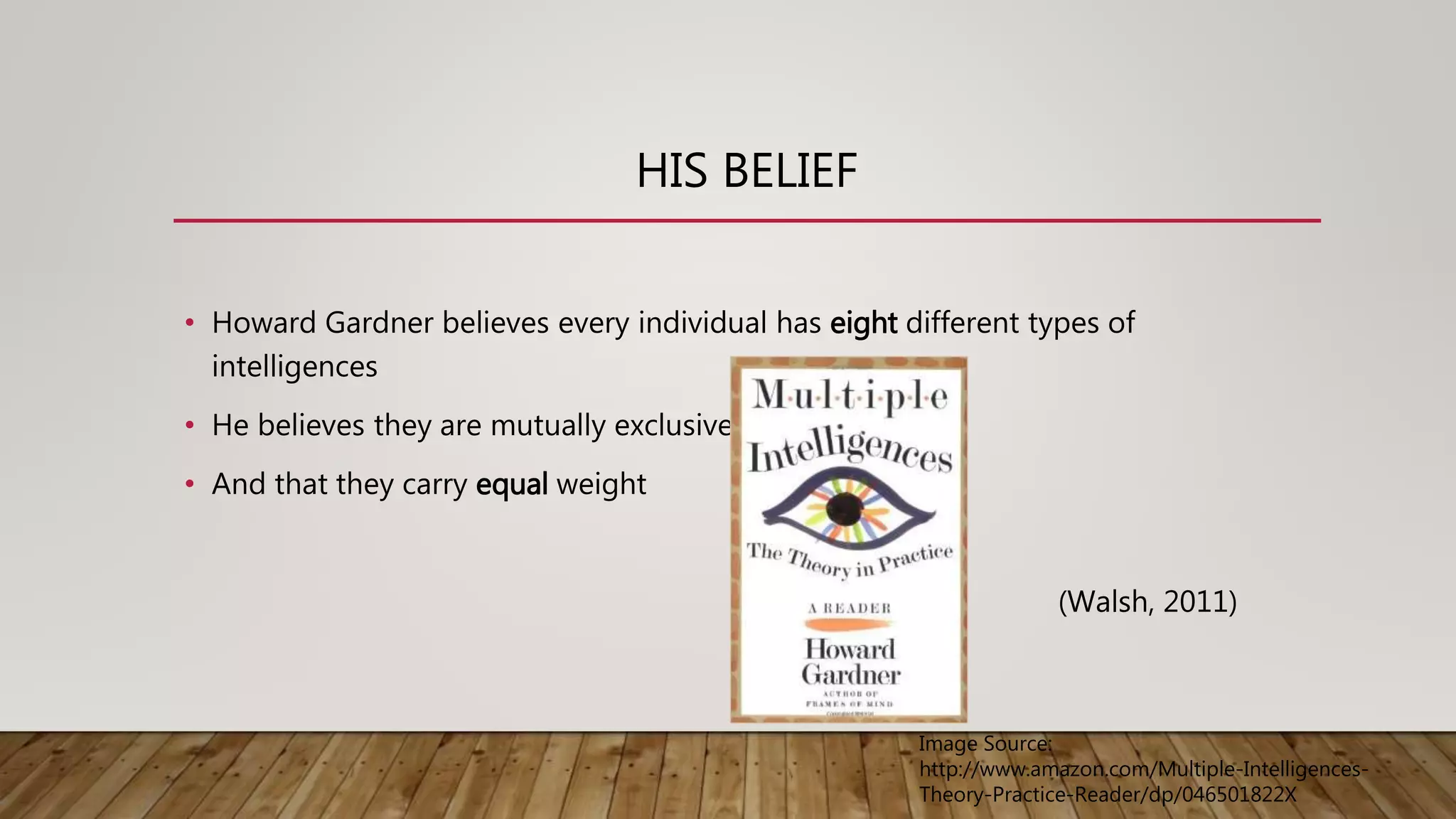
HIS BELIEF
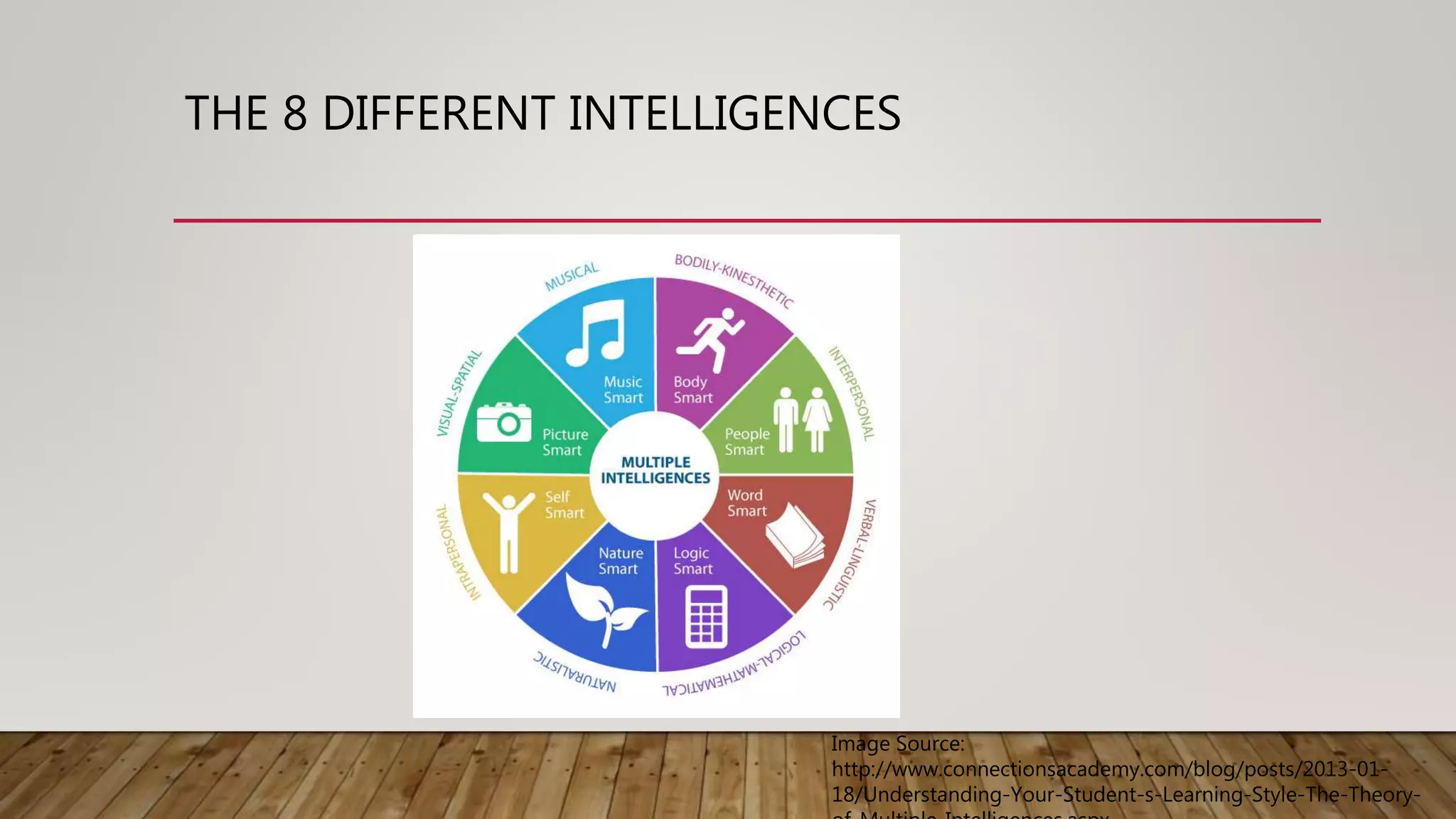
• Howard Gardner believes every individual has eight different types of
intelligences
• He believes they are mutually exclusive
• And that they carry equal weight
(Walsh, 2011)
Image Source:
http://www.amazon.com/Multiple-Intelligences-
Theory-Practice-Reader/dp/046501822X
THE 8 DIFFERENT INTELLIGENCES
Image Source:
http://www.connectionsacademy.com/blog/posts/2013-01-
18/Understanding-Your-Student-s-Learning-Style-The-Theory-
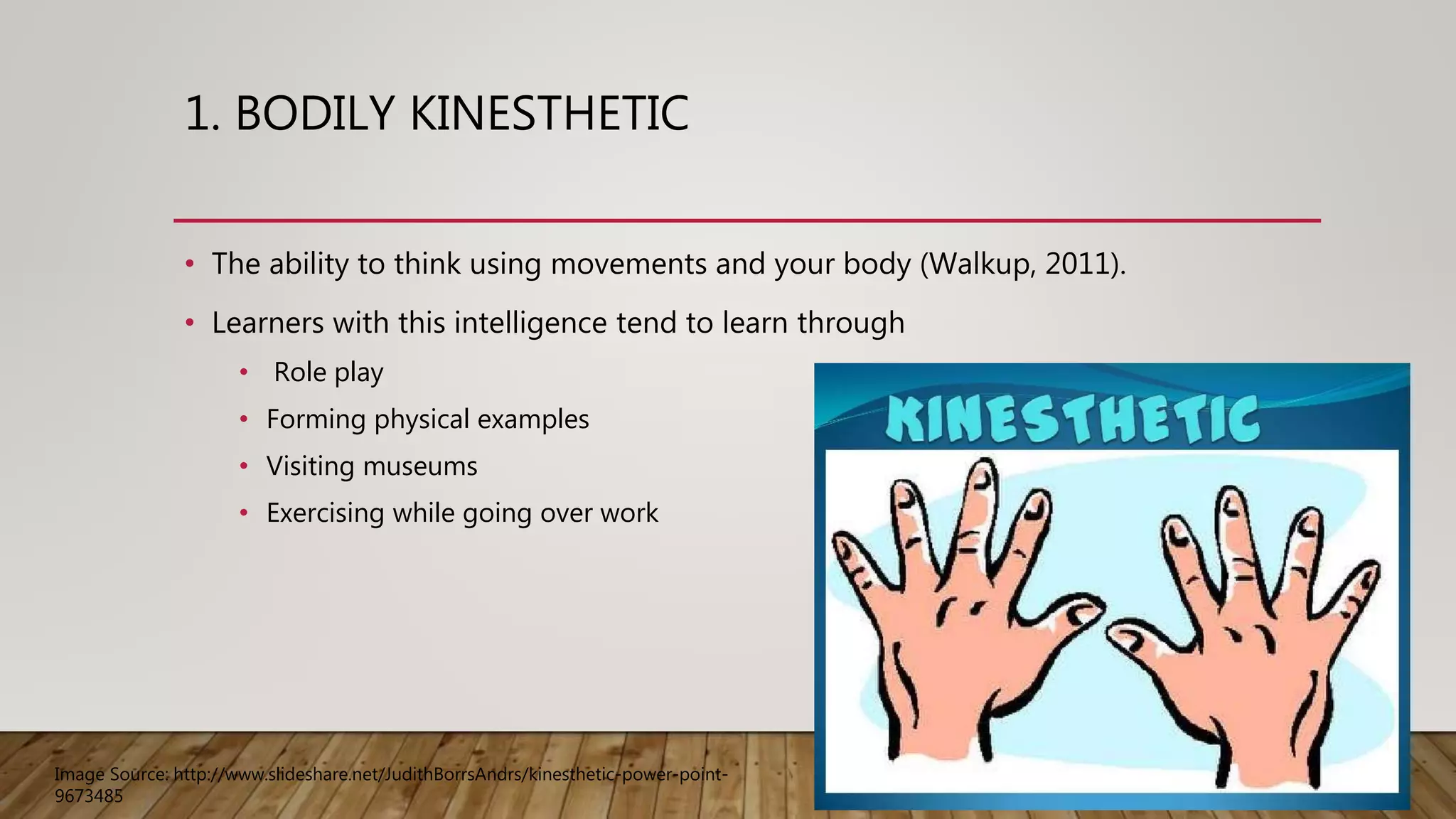
1. BODILY KINESTHETIC
• The ability to think using movements and your body (Walkup, 2011).
• Learners with this intelligence tend to learn through
• Role play
• Forming physical examples
• Visiting museums
• Exercising while going over work
Image Source: http://www.slideshare.net/JudithBorrsAndrs/kinesthetic-power-point-
9673485
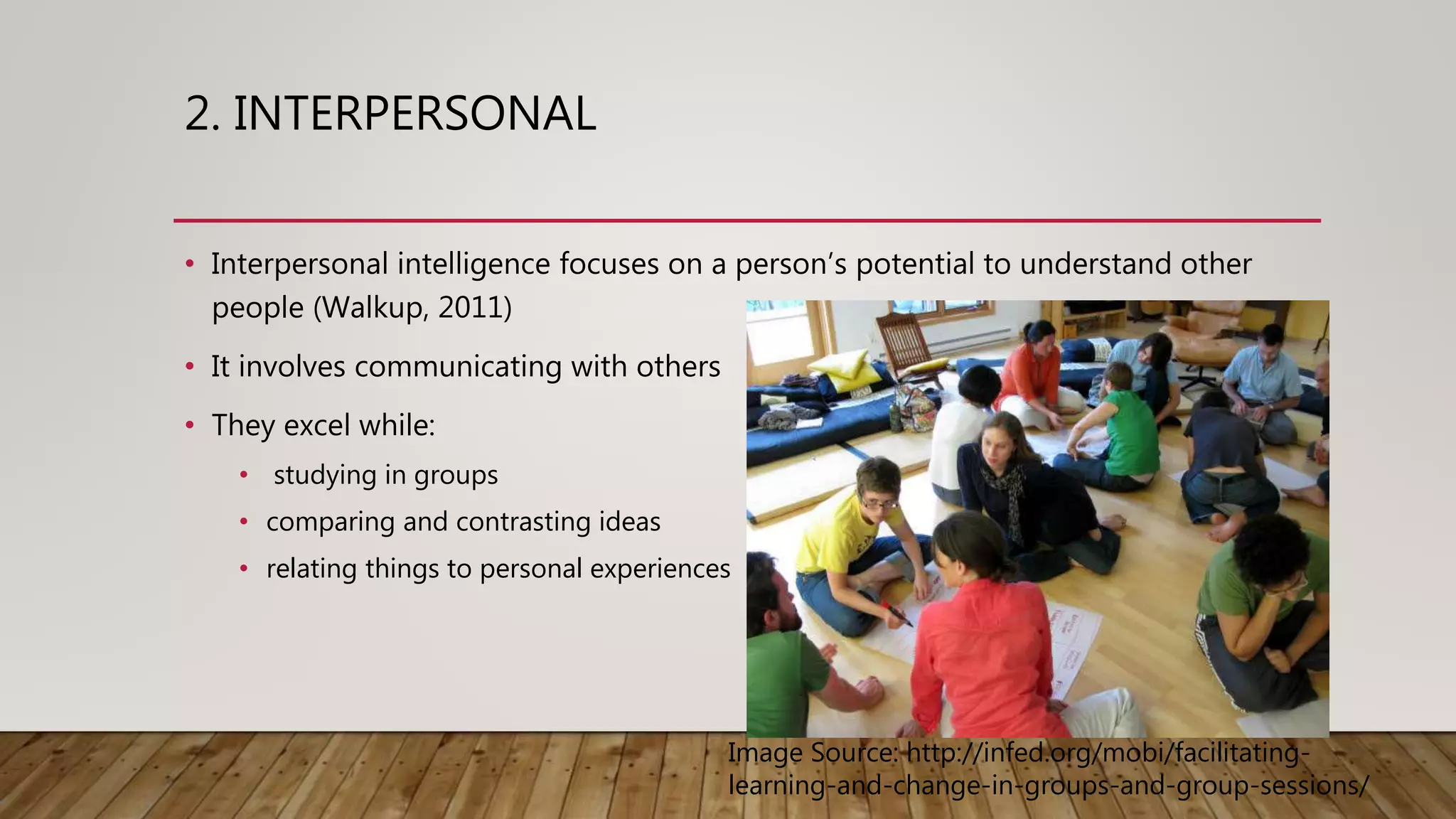
2. INTERPERSONAL
• Interpersonal intelligence focuses on a person’s potential to understand other
people (Walkup, 2011)
• It involves communicating with others
• They excel while:
• studying in groups
• comparing and contrasting ideas
• relating things to personal experiences
Image Source: http://infed.org/mobi/facilitating-
learning-and-change-in-groups-and-group-sessions/
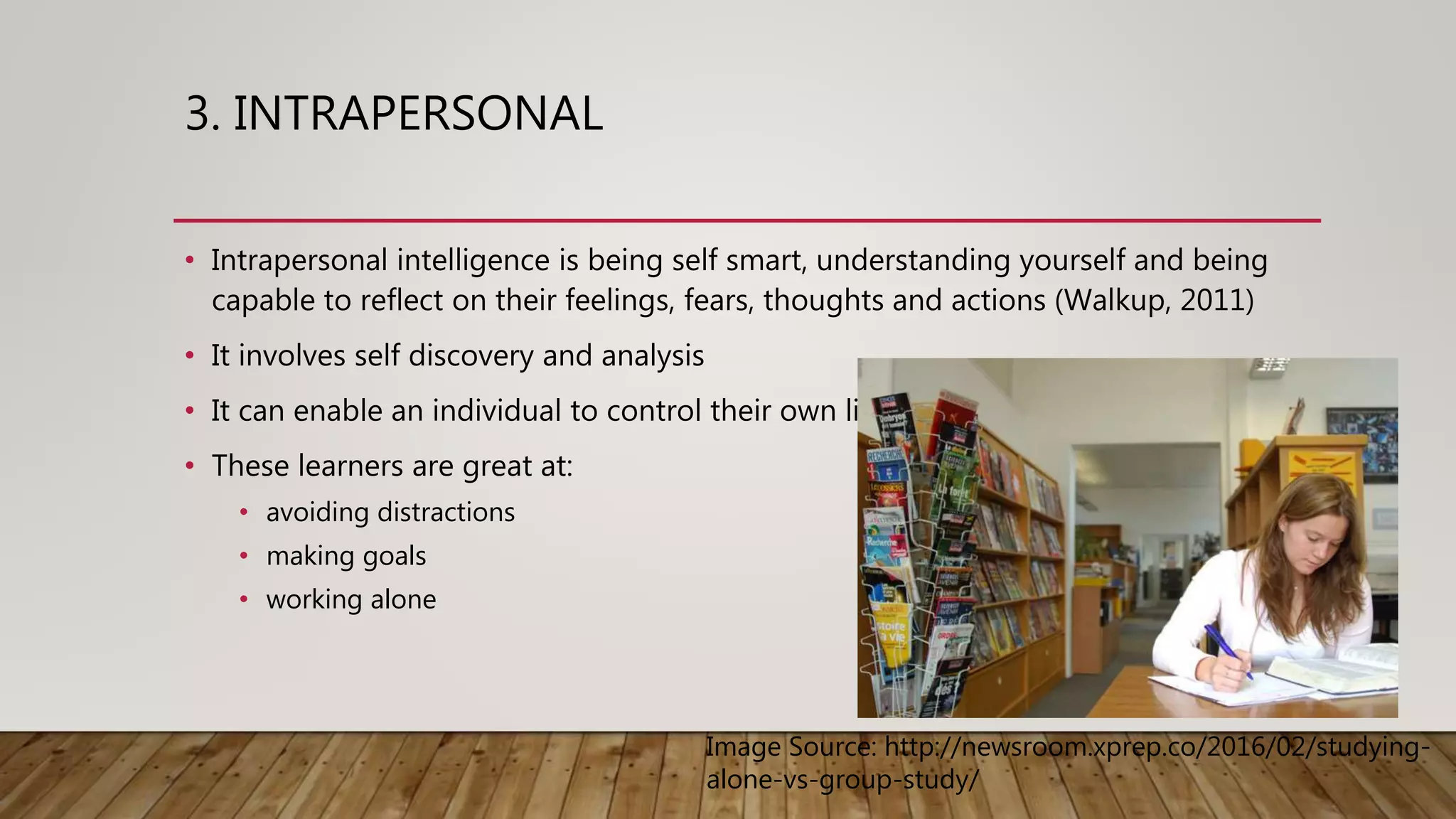
3. INTRAPERSONAL
• Intrapersonal intelligence is being self smart, understanding yourself and being
capable to reflect on their feelings, fears, thoughts and actions (Walkup, 2011)
• It involves self discovery and analysis
• It can enable an individual to control their own life
• These learners are great at:
• avoiding distractions
• making goals
• working alone
Image Source: http://newsroom.xprep.co/2016/02/studying-
alone-vs-group-study/
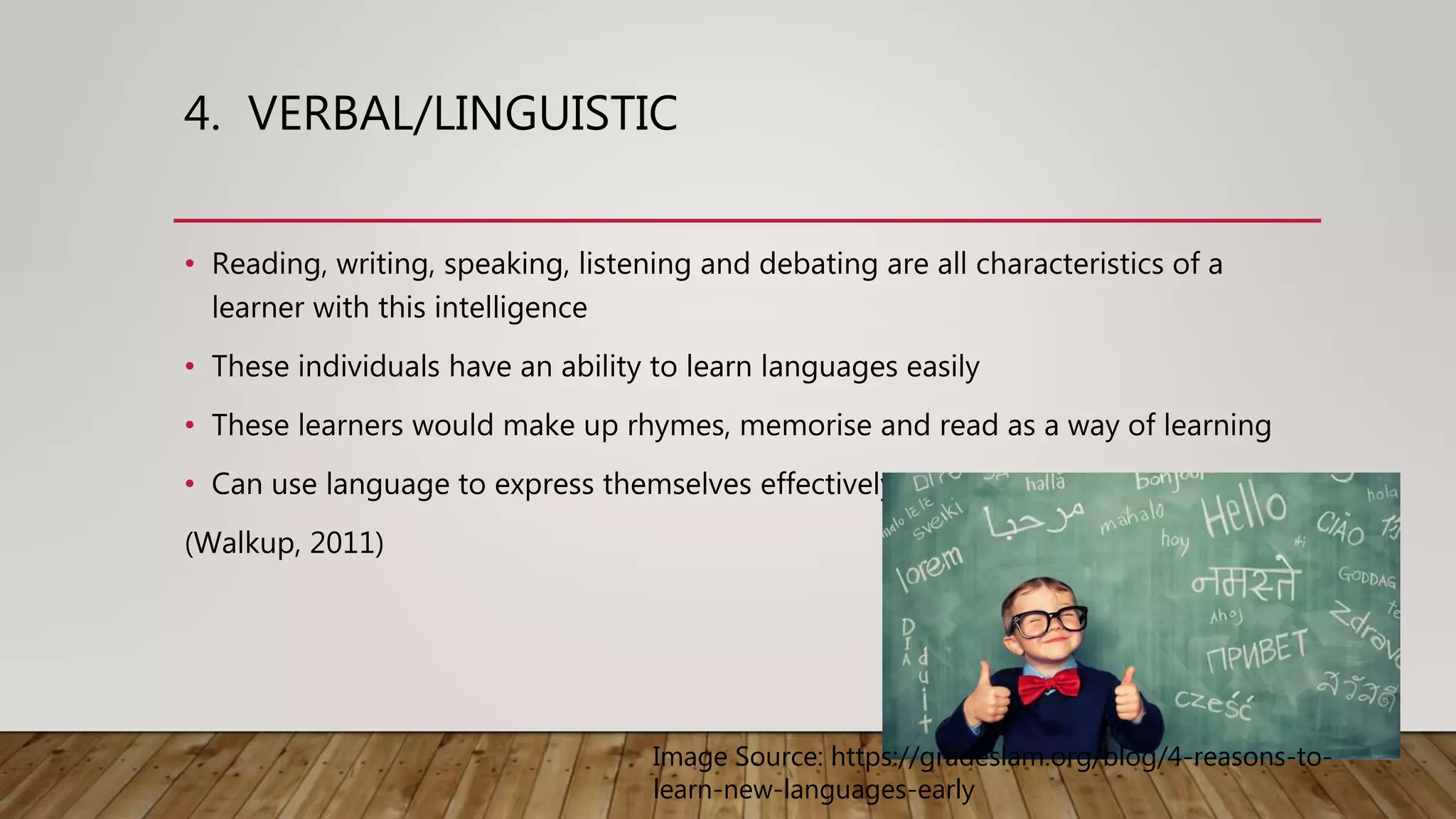
4. VERBAL/LINGUISTIC
• Reading, writing, speaking, listening and debating are all characteristics of a
learner with this intelligence
• These individuals have an ability to learn languages easily
• These learners would make up rhymes, memorise and read as a way of learning
• Can use language to express themselves effectively
(Walkup, 2011)
Image Source: https://gradeslam.org/blog/4-reasons-to-
learn-new-languages-early
5. LOGICAL/MATHEMATICAL
• The capability to solve problems (Walkup, 2011)
• Learn best by:
• Recording information
• Analysing data
• Conducting experiments
Image Source:
http://mathgeekmama.com/about-math-
geek-mama/
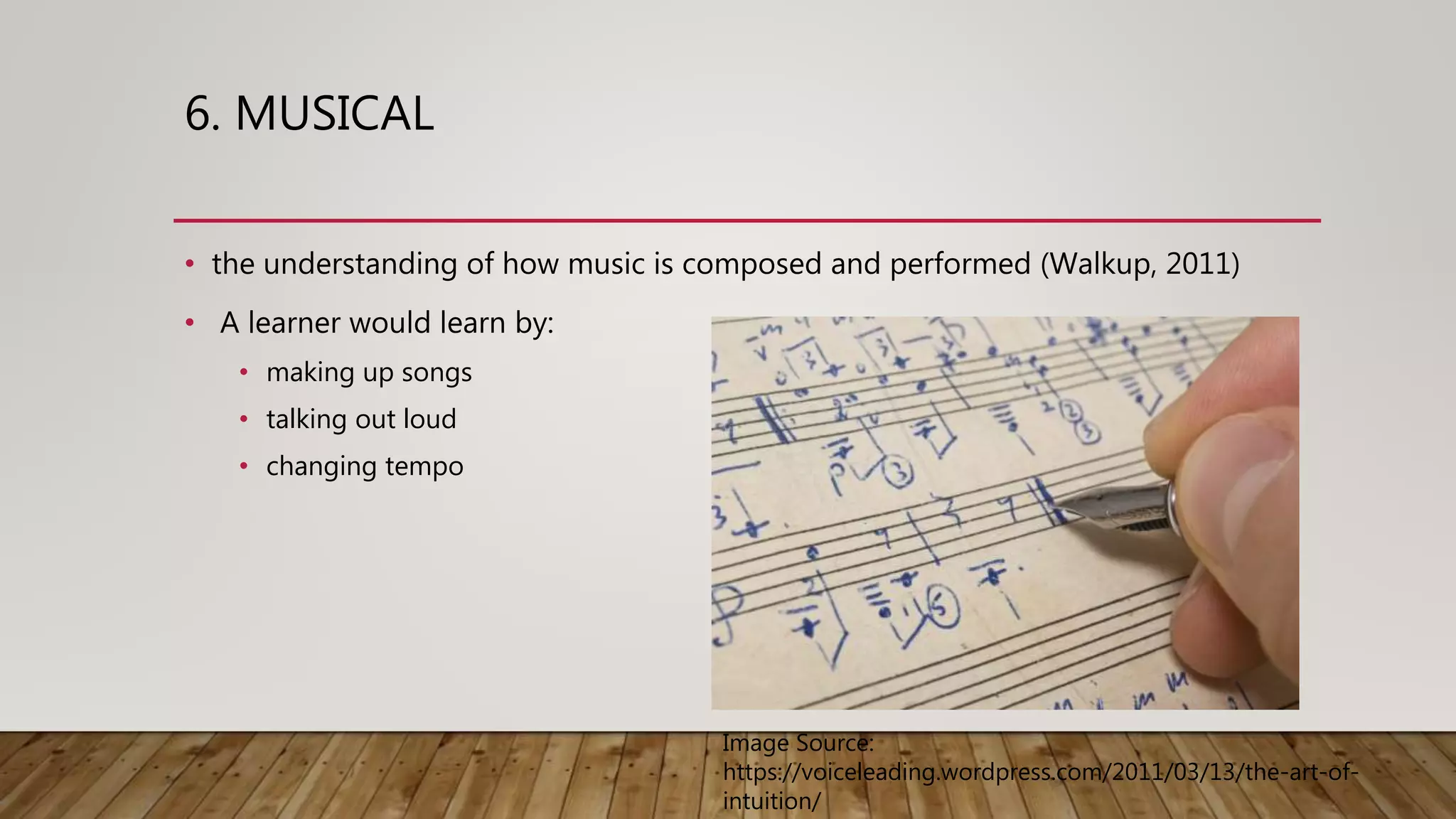
6. MUSICAL
• the understanding of how music is composed and performed (Walkup, 2011)
• A learner would learn by:
• making up songs
• talking out loud
• changing tempo
Image Source:
https://voiceleading.wordpress.com/2011/03/13/the-art-of-
intuition/
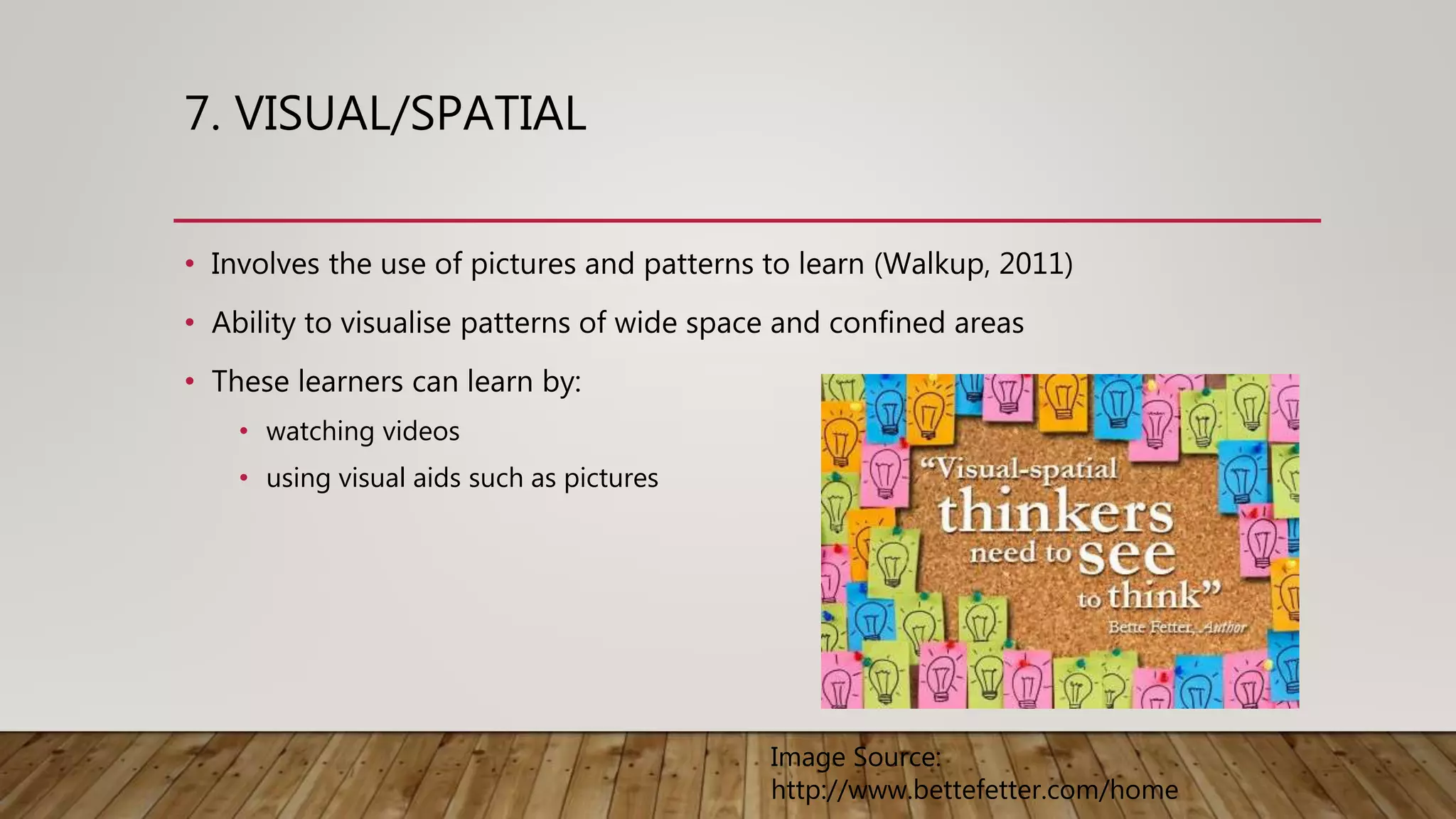
7. VISUAL/SPATIAL
• Involves the use of pictures and patterns to learn (Walkup, 2011)
• Ability to visualise patterns of wide space and confined areas
• These learners can learn by:
• watching videos
• using visual aids such as pictures
Image Source:
http://www.bettefetter.com/home
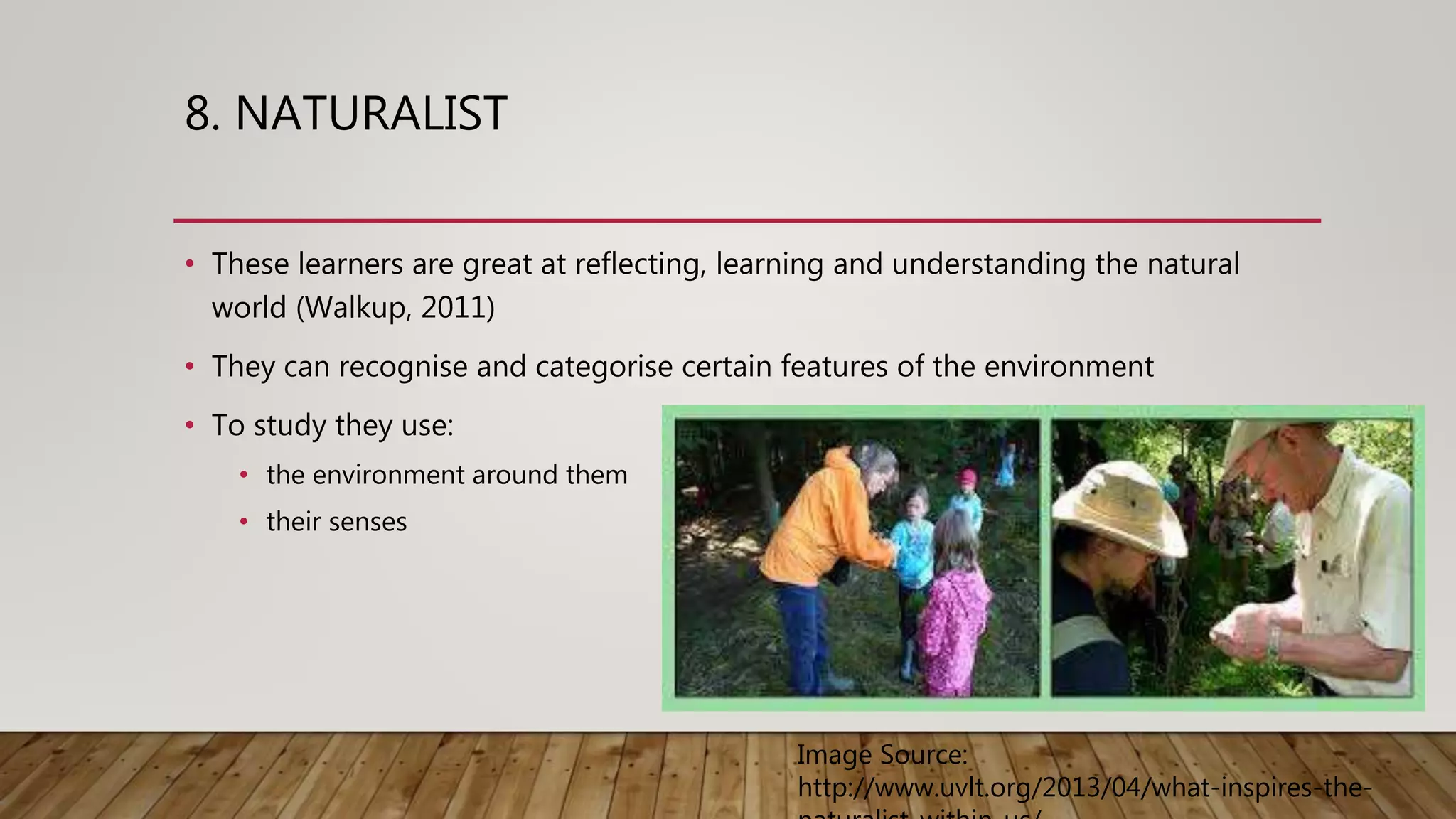
8. NATURALIST
• These learners are great at reflecting, learning and understanding the natural
world (Walkup, 2011)
• They can recognise and categorise certain features of the environment
• To study they use:
• the environment around them
• their senses
Image Source:
http://www.uvlt.org/2013/04/what-inspires-the-
CRITICS
• Critics have challenged Gardner’s theory and questioned the ability to use all
eight intelligences in each lesson
• Gardner has acknowledged this and believes that only two or three should be
included into each lesson
(McCown and Snowman, 2012)
PERSONAL REFLECTION
• I am quite interested in Gardner’s Theory of Multiple Intelligences
• From my experience in school and from observing people I believe individuals do
have different types and levels of intelligences. While one student may excel in verbal
and linguistic abilities, another may excel in musical abilities.
• Schools in Ireland mainly focus on linguistic and mathematical intelligences and tend
not to do well with musical and spatial intelligences as they treat them as
extracurricular activities
• Interpersonal and intrapersonal intelligences are not even part of the curriculum in
schools.
• I believe that if we nurture all the different kinds of intelligences than a lot more
students will succeed in school and in learning
Image Source: http://robertscooke.com/taking-time-
personal-reflection/
• Personally I like Gardner’s MI theory as it caters for many different learning styles
allowing for all students to excel in school.
• On reflection my learning styles would be musical and visual
• In turn I think this theory will motivate all the students to work to their best ability
as it caters to their abilities and interests
• I hope to be able to employ this theory of Multiple Intelligences into my
classroom in the future
REFERENCES
• McCown, Rick and Snowman, Jack. (2012) Psychology Applied to Teaching, 13th
edition, USA: Wadsworth, Cengage Learning.
• Walkup, Vivienne. (2011) Exploring Education Studies, 1st Edition. Essex: Pearson
Education Limited.
• Walsh, Brendan. (2011) Education Studies in Ireland, 1st edition. Dublin: Gill &
Macmillan LTD.

Gardners theory of multiple intelligences

  • 1.
    REFLECTION ON HOW PEOPLELEARN? DEFINING LEARNING AND LOOKING AT HOW PEOPLE LEARN IN DIFFERENT WAYS
  • 2.
    WHAT IS LEARNING? Inmy opinion learning can be described as: • Acquiring a new skill • Taking in information and Knowledge • Storing information in our memory
  • 3.
    LEARNING STYLES • Theconcept of learning styles became apparent as psychologists examined how children used their strengths and skills to comprehend and study new materials (Walkup, 2011) Image Source: http://kindredgrace.com/learning-styles/
  • 4.
    BUT HOW DOWE LEARN? • A theory I have found particularly interesting is Gardner’s Multiple Intelligence Theory Image Source: http://www.huffingtonpost.com/howard- gardner/
  • 5.
    HIS BELIEF • HowardGardner believes every individual has eight different types of intelligences • He believes they are mutually exclusive • And that they carry equal weight (Walsh, 2011) Image Source: http://www.amazon.com/Multiple-Intelligences- Theory-Practice-Reader/dp/046501822X
  • 6.
    THE 8 DIFFERENTINTELLIGENCES Image Source: http://www.connectionsacademy.com/blog/posts/2013-01- 18/Understanding-Your-Student-s-Learning-Style-The-Theory-
  • 7.
    1. BODILY KINESTHETIC •The ability to think using movements and your body (Walkup, 2011). • Learners with this intelligence tend to learn through • Role play • Forming physical examples • Visiting museums • Exercising while going over work Image Source: http://www.slideshare.net/JudithBorrsAndrs/kinesthetic-power-point- 9673485
  • 8.
    2. INTERPERSONAL • Interpersonalintelligence focuses on a person’s potential to understand other people (Walkup, 2011) • It involves communicating with others • They excel while: • studying in groups • comparing and contrasting ideas • relating things to personal experiences Image Source: http://infed.org/mobi/facilitating- learning-and-change-in-groups-and-group-sessions/
  • 9.
    3. INTRAPERSONAL • Intrapersonalintelligence is being self smart, understanding yourself and being capable to reflect on their feelings, fears, thoughts and actions (Walkup, 2011) • It involves self discovery and analysis • It can enable an individual to control their own life • These learners are great at: • avoiding distractions • making goals • working alone Image Source: http://newsroom.xprep.co/2016/02/studying- alone-vs-group-study/
  • 10.
    4. VERBAL/LINGUISTIC • Reading,writing, speaking, listening and debating are all characteristics of a learner with this intelligence • These individuals have an ability to learn languages easily • These learners would make up rhymes, memorise and read as a way of learning • Can use language to express themselves effectively (Walkup, 2011) Image Source: https://gradeslam.org/blog/4-reasons-to- learn-new-languages-early
  • 11.
    5. LOGICAL/MATHEMATICAL • Thecapability to solve problems (Walkup, 2011) • Learn best by: • Recording information • Analysing data • Conducting experiments Image Source: http://mathgeekmama.com/about-math- geek-mama/
  • 12.
    6. MUSICAL • theunderstanding of how music is composed and performed (Walkup, 2011) • A learner would learn by: • making up songs • talking out loud • changing tempo Image Source: https://voiceleading.wordpress.com/2011/03/13/the-art-of- intuition/
  • 13.
    7. VISUAL/SPATIAL • Involvesthe use of pictures and patterns to learn (Walkup, 2011) • Ability to visualise patterns of wide space and confined areas • These learners can learn by: • watching videos • using visual aids such as pictures Image Source: http://www.bettefetter.com/home
  • 14.
    8. NATURALIST • Theselearners are great at reflecting, learning and understanding the natural world (Walkup, 2011) • They can recognise and categorise certain features of the environment • To study they use: • the environment around them • their senses Image Source: http://www.uvlt.org/2013/04/what-inspires-the-
  • 15.
    CRITICS • Critics havechallenged Gardner’s theory and questioned the ability to use all eight intelligences in each lesson • Gardner has acknowledged this and believes that only two or three should be included into each lesson (McCown and Snowman, 2012)
  • 16.
    PERSONAL REFLECTION • Iam quite interested in Gardner’s Theory of Multiple Intelligences • From my experience in school and from observing people I believe individuals do have different types and levels of intelligences. While one student may excel in verbal and linguistic abilities, another may excel in musical abilities. • Schools in Ireland mainly focus on linguistic and mathematical intelligences and tend not to do well with musical and spatial intelligences as they treat them as extracurricular activities • Interpersonal and intrapersonal intelligences are not even part of the curriculum in schools. • I believe that if we nurture all the different kinds of intelligences than a lot more students will succeed in school and in learning Image Source: http://robertscooke.com/taking-time- personal-reflection/
  • 17.
    • Personally Ilike Gardner’s MI theory as it caters for many different learning styles allowing for all students to excel in school. • On reflection my learning styles would be musical and visual • In turn I think this theory will motivate all the students to work to their best ability as it caters to their abilities and interests • I hope to be able to employ this theory of Multiple Intelligences into my classroom in the future
  • 18.
    REFERENCES • McCown, Rickand Snowman, Jack. (2012) Psychology Applied to Teaching, 13th edition, USA: Wadsworth, Cengage Learning. • Walkup, Vivienne. (2011) Exploring Education Studies, 1st Edition. Essex: Pearson Education Limited. • Walsh, Brendan. (2011) Education Studies in Ireland, 1st edition. Dublin: Gill & Macmillan LTD.