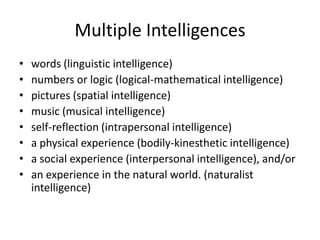
Multiple Intelligenceswords (linguistic intelligence)numbers or logic (logical-mathematical intelligence)pictures (spatial intelligence)music (musical intelligence)self-reflection (intrapersonal intelligence)a physical experience (bodily-kinesthetic intelligence)a social experience (interpersonal intelligence), and/oran experience in the natural world. (naturalist intelligence)
The theory of multiple intelligences was developed in 1983 by Dr. Howard Gardner, professor of education at Harvard University. He believed that the traditional notion of intelligence, based on I.Q. testing, is far too LIMITED.
Children who haveMultiple Intelligencegifts don’t receive much reinforcement for them in school. They don’t conform to our expectations or the gifted stereotype.
Sometimes these children are heading in a different direction.
Unconventional Math Student“The child who takes more time to master simple multiplication 1) may best learn to multiply through a different approach, 2) may excel in a field outside of mathematics, or 3) may even be looking at and understand the multiplication process at a fundamentally deeper level. “
Many of these children end up not being identified as gifted but instead may be seen as being "learning disabled," "ADD (attention deficit disorder," or simply underachievers, when their unique ways of thinking and learning aren’t addressed by a heavily linguistic or logical-mathematical classroom.
A traditional classroom setting can be stifling.
These are the gifted students who ‘just don’t get it” –we need to diversify the way content material is presented, we need to expect MI products, we need to modify our classroom environment , and we need to offer opportunities for students to develop their learning styles.
Embed Technology into your lessons and put these into the hands of your students: digital cameras, flip cameras, iPods, iPads, e-readers, computers, and interactive websites.
	MI ImmersionOnline Experiences in each of the Intelligences- updated for 2010! Many of the links on this page are for adult learners.http://surfaquarium.com/MI/intelligences.htm
http://www.edheads.com is free, interactive and is great for visual and auditory learners.
Twist on PuzzlesCrickler Interactive Crossword Puzzleshttp://crickler.com/This intuitive site walks you through the steps in solving and creating crossword puzzles. Very different from Puzzle Maker.
Updating PostersGlogster – Interactive Posters http://edu.glogster.com/
BBC Literacy Zonehttp://www.woodlands-junior.kent.sch.uk/interactive/onlinestory.htm
Billy Bug x,y coordinateshttp://www.oswego.org/ocsd-web/games/BillyBug/bugcoord.html
Umatilla-Morrow Education Service Districthttp://www.umesd.k12.or.us/techlinks
My students have problem solving discussions as they work on group projects. Very affordable.
Castle UnitIn this unit I tried to tap into my students various learning styles and their ‘other intelligences” .
We started with a read-aloud.Students could follow along and took turns being the reader.
Non-fiction on castles and knights.Students used A-Z lists, sticky notes, and index cards to record information  and questions.
Videos from Discovery Education United Streaming
Visual Learner likes to capture notes on index cards and organize them on separate pages.
A-Z list is a good organizational tool for recording ideas or facts.
http://www.ZooBurst.com allows students to create a free on-line book with pop-ups. For a small fee you can add sound/ voice.
Students decided to make their own castles to take home.
Family Research and Family Crest
Mi powerpoint

Mi powerpoint

  • 1.
    Multiple Intelligenceswords (linguisticintelligence)numbers or logic (logical-mathematical intelligence)pictures (spatial intelligence)music (musical intelligence)self-reflection (intrapersonal intelligence)a physical experience (bodily-kinesthetic intelligence)a social experience (interpersonal intelligence), and/oran experience in the natural world. (naturalist intelligence)
  • 2.
    The theory ofmultiple intelligences was developed in 1983 by Dr. Howard Gardner, professor of education at Harvard University. He believed that the traditional notion of intelligence, based on I.Q. testing, is far too LIMITED.
  • 3.
    Children who haveMultipleIntelligencegifts don’t receive much reinforcement for them in school. They don’t conform to our expectations or the gifted stereotype.
  • 4.
    Sometimes these childrenare heading in a different direction.
  • 5.
    Unconventional Math Student“Thechild who takes more time to master simple multiplication 1) may best learn to multiply through a different approach, 2) may excel in a field outside of mathematics, or 3) may even be looking at and understand the multiplication process at a fundamentally deeper level. “
  • 6.
    Many of thesechildren end up not being identified as gifted but instead may be seen as being "learning disabled," "ADD (attention deficit disorder," or simply underachievers, when their unique ways of thinking and learning aren’t addressed by a heavily linguistic or logical-mathematical classroom.
  • 7.
    A traditional classroomsetting can be stifling.
  • 8.
    These are thegifted students who ‘just don’t get it” –we need to diversify the way content material is presented, we need to expect MI products, we need to modify our classroom environment , and we need to offer opportunities for students to develop their learning styles.
  • 9.
    Embed Technology intoyour lessons and put these into the hands of your students: digital cameras, flip cameras, iPods, iPads, e-readers, computers, and interactive websites.
  • 10.
    MI ImmersionOnline Experiencesin each of the Intelligences- updated for 2010! Many of the links on this page are for adult learners.http://surfaquarium.com/MI/intelligences.htm
  • 11.
    http://www.edheads.com is free,interactive and is great for visual and auditory learners.
  • 12.
    Twist on PuzzlesCricklerInteractive Crossword Puzzleshttp://crickler.com/This intuitive site walks you through the steps in solving and creating crossword puzzles. Very different from Puzzle Maker.
  • 13.
    Updating PostersGlogster –Interactive Posters http://edu.glogster.com/
  • 14.
  • 15.
    Billy Bug x,ycoordinateshttp://www.oswego.org/ocsd-web/games/BillyBug/bugcoord.html
  • 16.
    Umatilla-Morrow Education ServiceDistricthttp://www.umesd.k12.or.us/techlinks
  • 17.
    My students haveproblem solving discussions as they work on group projects. Very affordable.
  • 18.
    Castle UnitIn thisunit I tried to tap into my students various learning styles and their ‘other intelligences” .
  • 19.
    We started witha read-aloud.Students could follow along and took turns being the reader.
  • 20.
    Non-fiction on castlesand knights.Students used A-Z lists, sticky notes, and index cards to record information and questions.
  • 21.
    Videos from DiscoveryEducation United Streaming
  • 22.
    Visual Learner likesto capture notes on index cards and organize them on separate pages.
  • 23.
    A-Z list isa good organizational tool for recording ideas or facts.
  • 24.
    http://www.ZooBurst.com allows studentsto create a free on-line book with pop-ups. For a small fee you can add sound/ voice.
  • 26.
    Students decided tomake their own castles to take home.
  • 27.