


Framework For Analysing
International Business Environment
Amit Gwaskoti
Pranav Kishor Choudhary
MBA 1st Year
Introduction
• Framework demonstrates
the complexity and
independency of different
levels in international
business management.
• There are 8 Levels and each
level has different goals and
directions
Levels of Framework
• Level 1: International framework
• Level 2: Globalisation
• Level 3: National objectives
• Level 4: Location
• Level 5: Company
• Level 6: Foreign trade activities
• Level 7: Foreign trade financing
• Level 8: International business
Level 1: International framework
• At this level, there are two kinds of organisations with the objective to
develop the world trade activities and to improve the world market
sales.
a) International financial institutions
• The World Bank, International Monetary Fund, National Reserve Banks,
European Central Bank, and other National Financial Institutions
b) Organisational institutions
• WTO, EU, NAFTA, MERCOSUR, ASEAN, etc. (TTIP)
Level 2: Globalisation
a) CHANGE OF ECONOMIC POLICY
b) LIBERALISATION OF INTERNATIONAL TRADE AND CAPITAL
c) INTERNATIONAL STANDARDS AND NORMS
2.1 - CHANGE OF ECONOMIC POLICY
• Deregulation of employment markets
• Privatisation of nationalised companies
• Reduction of taxes for earnings and property incomes
• Simplification of the international capital flows
• Improvement of the chance to success for companies to create an
attractive climate for investments
2.2 - LIBERALISATION OF
INTERNATIONAL TRADE AND CAPITAL
• Simplification of trade in
goods and services as well as
the transfer of capital
• General Agreement on Trade
and Tariffs (GATT) of 1948
was basis for the worldwide
free movement of goods
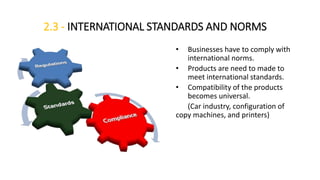
2.3 - INTERNATIONAL STANDARDS AND NORMS
• Businesses have to comply with
international norms.
• Products are need to made to
meet international standards.
• Compatibility of the products
becomes universal.
(Car industry, configuration of
copy machines, and printers)
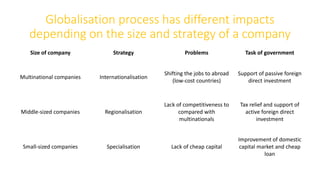
Globalisation process has different impacts
depending on the size and strategy of a company
Size of company Strategy Problems Task of government
Multinational companies Internationalisation
Shifting the jobs to abroad
(low-cost countries)
Support of passive foreign
direct investment
Middle-sized companies Regionalisation
Lack of competitiveness to
compared with
multinationals
Tax relief and support of
active foreign direct
investment
Small-sized companies Specialisation Lack of cheap capital
Improvement of domestic
capital market and cheap
loan
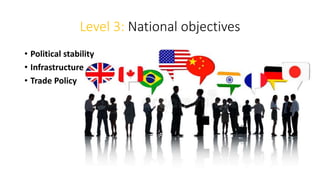
Level 3: National objectives
• Political stability
• Infrastructure
• Trade Policy
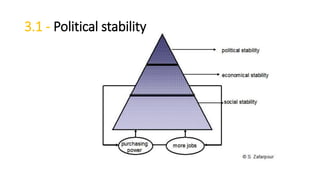
3.1 - Political stability
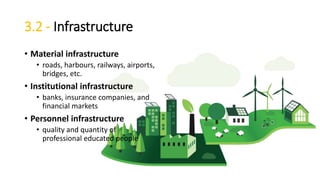
3.2 - Infrastructure
• Material infrastructure
• roads, harbours, railways, airports,
bridges, etc.
• Institutional infrastructure
• banks, insurance companies, and
financial markets
• Personnel infrastructure
• quality and quantity of
professional educated people
3.3 - Trade policy
• Trade policy depends on elected
government.
• It could be progressive or
digressive.
• The government may (or may
not) support the companies.
• The national frameworks for
companies in international
business may differ from country
to country
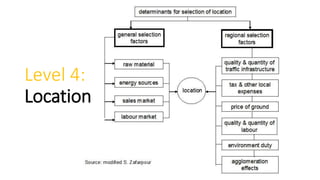
Level 4:
Location
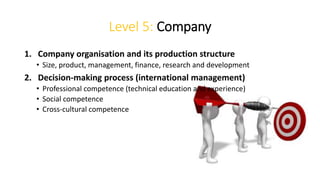
Level 5: Company
1. Company organisation and its production structure
• Size, product, management, finance, research and development
2. Decision-making process (international management)
• Professional competence (technical education and experience)
• Social competence
• Cross-cultural competence
Level 6: Foreign trade activities
1. Basic types of international trade
1. Exports (direct/indirect)
2. Imports (direct/indirect)
3. Transit trade (through third country)
2. Special types of international trade
1. Across the border processing
2. Licensing, franchising
3. Foreign direct investment (FDI) and joint ventures
Level 6: Foreign trade activities
• These choices will Increase competitiveness by
• Reducing production costs abroad (cost and location advantage),
• Accessing core resources (safeguard supplies of raw materials),
• Making easier market entry in case of trade barriers,
• Lowering taxation on earnings in the host country,
• Reducing exchange risk (risk avoidance).
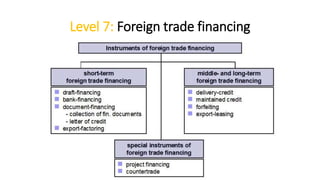
Level 7: Foreign trade financing
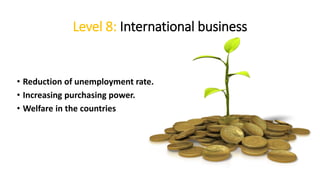
Level 8: International business
• Reduction of unemployment rate.
• Increasing purchasing power.
• Welfare in the countries
Conclusion
• This theoretical framework of international
business environment helps in
understanding different factors of
International trade.
• International trade brings the economy of
a country to higher levels of equilibrium.
• It reduces and unemployment and
increases purchasing power.
Sources
Schapour Zafarpour (October 14th 2015). A Theoretical Framework
(Modelling) for International Business Management, Perspectives on
Business and Management, Vito Bobek, IntechOpen, DOI:
10.5772/60903.
Vienna University for Economic and Business, Austria
Available from: https://www.intechopen.com/books/perspectives-
on-business-and-management/a-theoretical-framework-modelling-
for-international-business-management
Framework For Analysing International Business Environment

Framework For Analysing International Business Environment

  • 1.
    Framework For Analysing InternationalBusiness Environment Amit Gwaskoti Pranav Kishor Choudhary MBA 1st Year
  • 2.
    Introduction • Framework demonstrates thecomplexity and independency of different levels in international business management. • There are 8 Levels and each level has different goals and directions
  • 3.
    Levels of Framework •Level 1: International framework • Level 2: Globalisation • Level 3: National objectives • Level 4: Location • Level 5: Company • Level 6: Foreign trade activities • Level 7: Foreign trade financing • Level 8: International business
  • 4.
    Level 1: Internationalframework • At this level, there are two kinds of organisations with the objective to develop the world trade activities and to improve the world market sales. a) International financial institutions • The World Bank, International Monetary Fund, National Reserve Banks, European Central Bank, and other National Financial Institutions b) Organisational institutions • WTO, EU, NAFTA, MERCOSUR, ASEAN, etc. (TTIP)
  • 5.
    Level 2: Globalisation a)CHANGE OF ECONOMIC POLICY b) LIBERALISATION OF INTERNATIONAL TRADE AND CAPITAL c) INTERNATIONAL STANDARDS AND NORMS
  • 6.
    2.1 - CHANGEOF ECONOMIC POLICY • Deregulation of employment markets • Privatisation of nationalised companies • Reduction of taxes for earnings and property incomes • Simplification of the international capital flows • Improvement of the chance to success for companies to create an attractive climate for investments
  • 7.
    2.2 - LIBERALISATIONOF INTERNATIONAL TRADE AND CAPITAL • Simplification of trade in goods and services as well as the transfer of capital • General Agreement on Trade and Tariffs (GATT) of 1948 was basis for the worldwide free movement of goods
  • 8.
    2.3 - INTERNATIONALSTANDARDS AND NORMS • Businesses have to comply with international norms. • Products are need to made to meet international standards. • Compatibility of the products becomes universal. (Car industry, configuration of copy machines, and printers)
  • 9.
    Globalisation process hasdifferent impacts depending on the size and strategy of a company Size of company Strategy Problems Task of government Multinational companies Internationalisation Shifting the jobs to abroad (low-cost countries) Support of passive foreign direct investment Middle-sized companies Regionalisation Lack of competitiveness to compared with multinationals Tax relief and support of active foreign direct investment Small-sized companies Specialisation Lack of cheap capital Improvement of domestic capital market and cheap loan
  • 10.
    Level 3: Nationalobjectives • Political stability • Infrastructure • Trade Policy
  • 11.
    3.1 - Politicalstability
  • 12.
    3.2 - Infrastructure •Material infrastructure • roads, harbours, railways, airports, bridges, etc. • Institutional infrastructure • banks, insurance companies, and financial markets • Personnel infrastructure • quality and quantity of professional educated people
  • 13.
    3.3 - Tradepolicy • Trade policy depends on elected government. • It could be progressive or digressive. • The government may (or may not) support the companies. • The national frameworks for companies in international business may differ from country to country
  • 14.
  • 15.
    Level 5: Company 1.Company organisation and its production structure • Size, product, management, finance, research and development 2. Decision-making process (international management) • Professional competence (technical education and experience) • Social competence • Cross-cultural competence
  • 16.
    Level 6: Foreigntrade activities 1. Basic types of international trade 1. Exports (direct/indirect) 2. Imports (direct/indirect) 3. Transit trade (through third country) 2. Special types of international trade 1. Across the border processing 2. Licensing, franchising 3. Foreign direct investment (FDI) and joint ventures
  • 17.
    Level 6: Foreigntrade activities • These choices will Increase competitiveness by • Reducing production costs abroad (cost and location advantage), • Accessing core resources (safeguard supplies of raw materials), • Making easier market entry in case of trade barriers, • Lowering taxation on earnings in the host country, • Reducing exchange risk (risk avoidance).
  • 18.
    Level 7: Foreigntrade financing
  • 19.
    Level 8: Internationalbusiness • Reduction of unemployment rate. • Increasing purchasing power. • Welfare in the countries
  • 20.
    Conclusion • This theoreticalframework of international business environment helps in understanding different factors of International trade. • International trade brings the economy of a country to higher levels of equilibrium. • It reduces and unemployment and increases purchasing power.
  • 21.
    Sources Schapour Zafarpour (October14th 2015). A Theoretical Framework (Modelling) for International Business Management, Perspectives on Business and Management, Vito Bobek, IntechOpen, DOI: 10.5772/60903. Vienna University for Economic and Business, Austria Available from: https://www.intechopen.com/books/perspectives- on-business-and-management/a-theoretical-framework-modelling- for-international-business-management

Editor's Notes

  • #5 1. These organisations can and do support only the countries (infrastructure, etc.) and not the individual companies. The country has to apply for their financial support. The support always depends on accepting the laid down conditions (e.g., restructuring the country) of these Organisations 2. The task of these mentioned trade organisations is to create standards and free competition on the world market. However, countries with more political or economic power do and can influence the rules and get more favourable treatment.
  • #7 Disadvantage: Privatisation could support corruption and nepotism
  • #10 Disadvantage: Privatisation could support corruption and nepotism
  • #11 This level is perhaps the most complex level because of complications that result due to the multiplicity of factors, players, goals, and strategies.
  • #12 Political stability is necessarily based on economic stability. Economic stability is based on social stability. Social stability in turn depends on low unemployment rate and purchasing power of the per capita income of the people (currently many countries in crisis days are faced with frequent strikes and labour unrest due to the lack of two).
  • #13 2. The building of a capital market in a country depends on the policy decisions (centripetal or centrifugal) of the government.
  • #14 (e.g., state guarantee for international trade of the companies)
  • #17 The measurement of success of all steps we have mentioned before are the following trade activities creation of better framework conditions and reduction of production costs
  • #19 The multinational companies have no big problems with it because of their own reserve capital from one hand, and they are successful enough to get money from the banks. The middle-sized companies do not have problems until the balance is positive over many years The small-sized companies have more problems in this field if the percentage of own capital is less than 30% of the investment volume and if the company cannot offer any guarantees or property.
  • #20 Every society basically aspires to have low unemployment, to have high rates of increase in per capita national income, and to maximise economic and social welfare.