ToTCOOP+i PROJECT
Unit 7 : Management of
Agricultural Policy
1
STRATEGIC PARTNERSHIP FOR INNOVATING THE TRAINING OF TRAINERS
OF THE EUROPEAN AGRI-FOOD COOPERATIVES
Index
1. Agricultural policy
2. National Rural Development policy
3. EU & National legislation for Agri-
food cooperatives
4. National rural non-governmental
organisations
5. Role of agri-food cooperatives
2
3
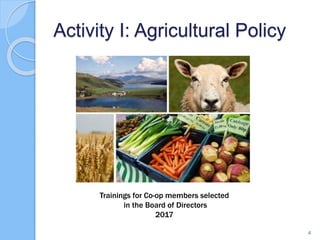
Activity I: Agricultural Policy
4
Trainings for Co-op members selected
in the Board of Directors
2017
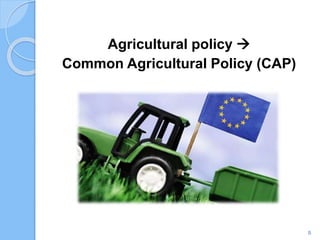
Agricultural policy 
Common Agricultural Policy (CAP)
5
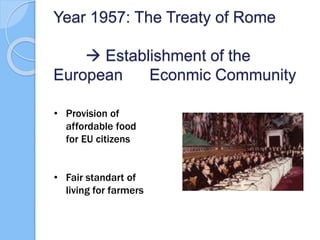
Year 1957: The Treaty of Rome
 Establishment of the
European Econmic Community
• Provision of
affordable food
for EU citizens
• Fair standart of
living for farmers
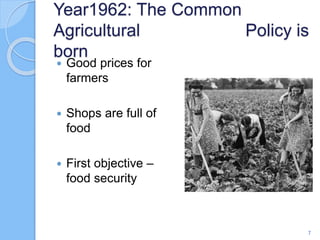
Year1962: The Common
Agricultural Policy is
born
 Good prices for
farmers
 Shops are full of
food
 First objective –
food security
7
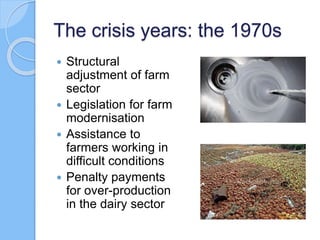
The crisis years: the 1970s
 Structural
adjustment of farm
sector
 Legislation for farm
modernisation
 Assistance to
farmers working in
difficult conditions
 Penalty payments
for over-production
in the dairy sector
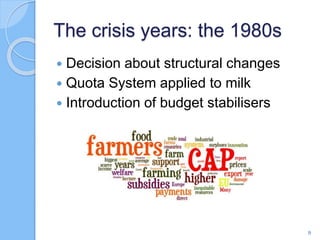
The crisis years: the 1980s
9
 Decision about structural changes
 Quota System applied to milk
 Introduction of budget stabilisers
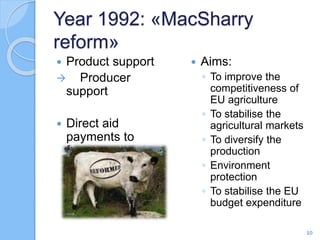
Year 1992: «MacSharry
reform»
 Product support
 Producer
support
 Direct aid
payments to
farmers
 Aims:
◦ To improve the
competitiveness of
EU agriculture
◦ To stabilise the
agricultural markets
◦ To diversify the
production
◦ Environment
protection
◦ To stabilise the EU
budget expenditure
10
Agenda 2000
 More focus on
economic, social
and cultural
development
• Raising competitiveness
of agricultural product
markets
• Stabilization of
agricultural incomes
• Environmental measures
• Raising the food quality
and safety level
• Developing the vitality of
rural areas
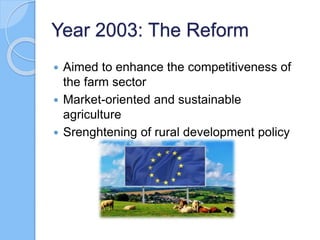
Year 2003: The Reform
 Aimed to enhance the competitiveness of
the farm sector
 Market-oriented and sustainable
agriculture
 Srenghtening of rural development policy
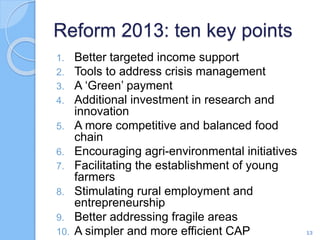
Reform 2013: ten key points
1. Better targeted income support
2. Tools to address crisis management
3. A ‘Green’ payment
4. Additional investment in research and
innovation
5. A more competitive and balanced food
chain
6. Encouraging agri-environmental initiatives
7. Facilitating the establishment of young
farmers
8. Stimulating rural employment and
entrepreneurship
9. Better addressing fragile areas
10. A simpler and more efficient CAP 13
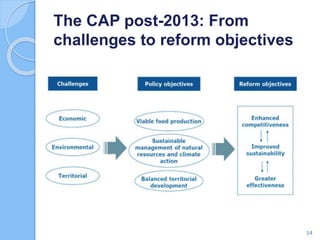
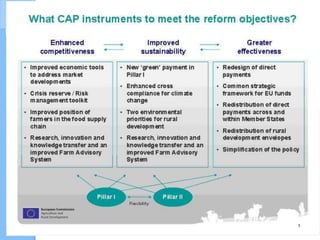
The CAP post-2013: From
challenges to reform objectives
14
16
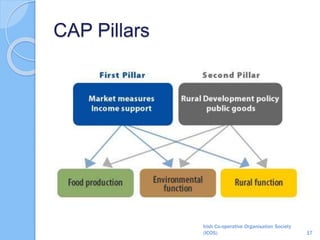
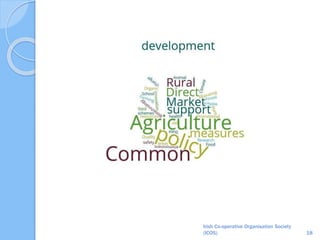
CAP Pillars
Irish Co-operative Organisation Society
(ICOS) 17
Irish Co-operative Organisation Society
(ICOS) 18
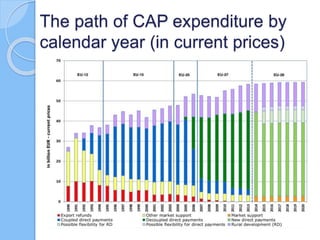
The path of CAP expenditure by
calendar year (in current prices)
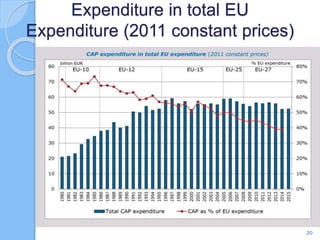
Expenditure in total EU
Expenditure (2011 constant prices)
20
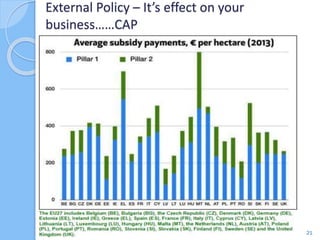
External Policy – It’s effect on your
business……CAP
21
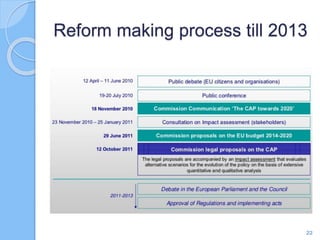
Reform making process till 2013
22
23
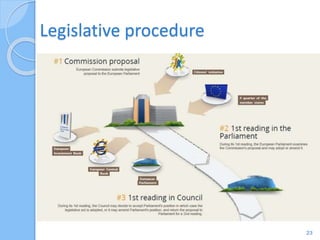
Legislative procedure
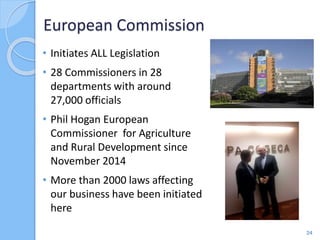
European Commission
24
• Initiates ALL Legislation
• 28 Commissioners in 28
departments with around
27,000 officials
• Phil Hogan European
Commissioner for Agriculture
and Rural Development since
November 2014
• More than 2000 laws affecting
our business have been initiated
here
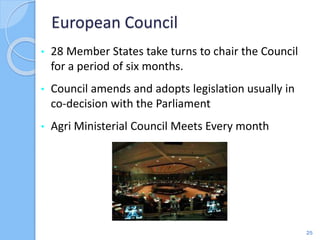
• 28 Member States take turns to chair the Council
for a period of six months.
• Council amends and adopts legislation usually in
co-decision with the Parliament
• Agri Ministerial Council Meets Every month
European Council
25
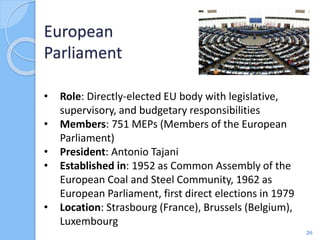
European
Parliament
26
• Role: Directly-elected EU body with legislative,
supervisory, and budgetary responsibilities
• Members: 751 MEPs (Members of the European
Parliament)
• President: Antonio Tajani
• Established in: 1952 as Common Assembly of the
European Coal and Steel Community, 1962 as
European Parliament, first direct elections in 1979
• Location: Strasbourg (France), Brussels (Belgium),
Luxembourg
27
Index
1. Agricultural policy
2. National Rural Development policy
3. EU & National legislation for Agri-
food cooperatives
4. National rural non-governmental
organisations
5. Role of agri-food cooperatives
28
29
Activity 2: National Rural
Development Programme
(RDP)
Trainings for Co-op members selected
in the Board of Directors
2017
30
Implementation of
Rural Development
Policy 2014-2020
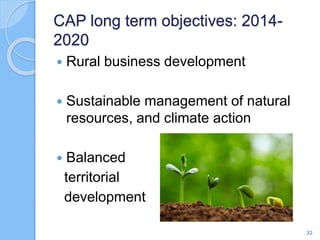
CAP long term objectives: 2014-
2020
 Rural business development
 Sustainable management of natural
resources, and climate action
 Balanced
territorial
development
32
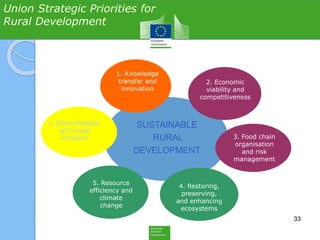
SUSTAINABLE
RURAL
DEVELOPMENT
33
3. Food chain
organisation
and risk
management
4. Restoring,
preserving,
and enhancing
ecosystems
5. Resource
efficiency and
climate
change
6. Diversification
and social
inclusion
2. Economic
viability and
competitiveness
1. Knowledge
transfer and
innovation
Union Strategic Priorities for
Rural Development
33
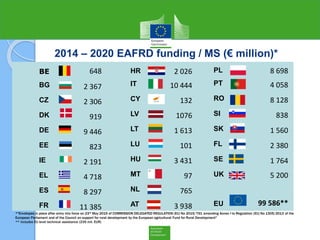
2014 – 2020 EAFRD funding / MS (€ million)*
BE 648
BG 2 367
CZ 2 306
DK 919
DE 9 446
EE 823
IE 2 191
EL 4 718
ES 8 297
FR 11 385
HR 2 026
IT 10 444
CY 132
LV 1076
LT 1 613
LU 101
HU 3 431
MT 97
NL 765
AT 3 938
PL 8 698
PT 4 058
RO 8 128
SI 838
SK 1 560
FL 2 380
SE 1 764
UK 5 200
EU 99 586**
*"Envelopes in place after entry into force on 23rd May 2015 of COMMISSION DELEGATED REGULATION (EU) No 2015/791 amending Annex I to Regulation (EU) No 1305/2013 of the
European Parliament and of the Council on support for rural development by the European agricultural Fund for Rural Development"
** includes EU level technical assistance (239 mil. EUR)
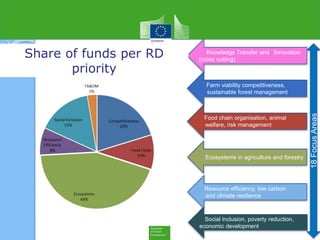
Food chain organisation, animal
welfare, risk management
Farm viability competitiveness,
sustainable forest management
Ecosystems in agriculture and forestry
Resource efficiency, low carbon
and climate resilience
Social inclusion, poverty reduction,
economic development
18FocusAreas
Knowledge Transfer and Innovation
(cross cutting)
Share of funds per RD
priority
New measures for better covering
the needs, e.g.:
36
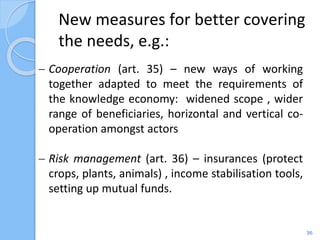
 Cooperation (art. 35) – new ways of working
together adapted to meet the requirements of
the knowledge economy: widened scope , wider
range of beneficiaries, horizontal and vertical co-
operation amongst actors
 Risk management (art. 36) – insurances (protect
crops, plants, animals) , income stabilisation tools,
setting up mutual funds.
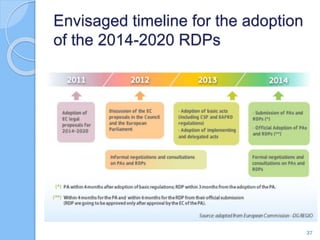
Envisaged timeline for the adoption
of the 2014-2020 RDPs
37
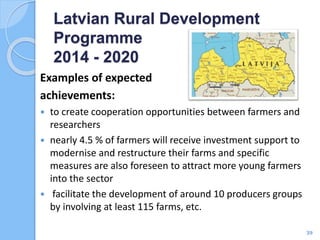
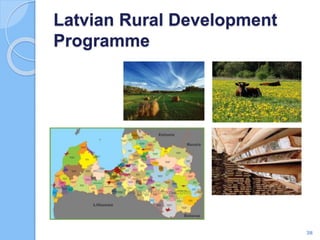
Latvian Rural Development
Programme
38
Examples of expected
achievements:
 to create cooperation opportunities between farmers and
researchers
 nearly 4.5 % of farmers will receive investment support to
modernise and restructure their farms and specific
measures are also foreseen to attract more young farmers
into the sector
 facilitate the development of around 10 producers groups
by involving at least 115 farms, etc.
Latvian Rural Development
Programme
2014 - 2020
39
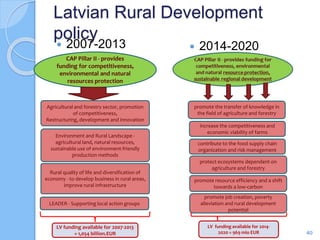
Latvian Rural Development
policy
 2007-2013  2014-2020
40
CAP Pillar II - provides
funding for competitiveness,
environmental and natural
resources protection
Agricultural and forestry sector, promotion
of competitiveness,
Restructuring, development and innovation
Environment and Rural Landscape -
agricultural land, natural resources,
sustainable use of environment-friendly
production methods
Rural quality of life and diversification of
economy - to develop business in rural areas,
improve rural infrastructure
LEADER - Supporting local action groups
LV funding available for 2007-2013
= 1,054 billion.EUR
promote the transfer of knowledge in
the field of agriculture and forestry
increase the competitiveness and
economic viability of farms
contribute to the food supply chain
organization and risk management
protect ecosystems dependent on
agriculture and forestry
promote resource efficiency and a shift
towards a low-carbon
promote job creation, poverty
alleviation and rural development
potential
LV funding available for 2014-
2020 = 969 mio EUR
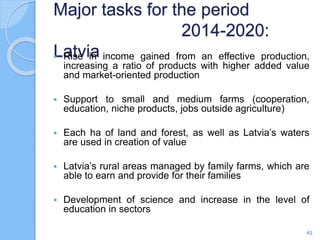
Major tasks for the period
2014-2020:
Latvia Rise in income gained from an effective production,
increasing a ratio of products with higher added value
and market-oriented production
 Support to small and medium farms (cooperation,
education, niche products, jobs outside agriculture)
 Each ha of land and forest, as well as Latvia’s waters
are used in creation of value
 Latvia’s rural areas managed by family farms, which are
able to earn and provide for their families
 Development of science and increase in the level of
education in sectors
41
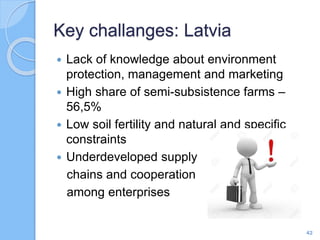
 Lack of knowledge about environment
protection, management and marketing
 High share of semi-subsistence farms –
56,5%
 Low soil fertility and natural and specific
constraints
 Underdeveloped supply
chains and cooperation
among enterprises
Key challanges: Latvia
42
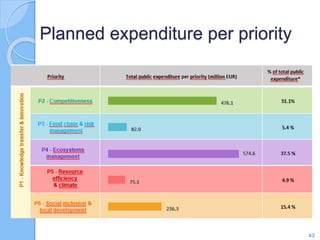
Planned expenditure per priority
43
 M01 – Knowledge
 M02 - Advisory services
 M04 – Investments
 M06 - Farm and business development
 M08 - Forest
 M09 - Producer groups / organisations
 M16 - Cooperation
 M19 - LEADER and CLLD
RDP Meassuers for agri - food
cooperatives
44
45
Index
1. Agricultural policy
2. National Rural Development policy
3. EU & National legislation for Agri-
food cooperatives
4. National rural non-governmental
organisations
5. Role of agri-food cooperatives
46
Activity 3: EU and National
legislation for agri-food
cooperatives
Trainings for Co-op members selected
in the Board of Directors
2017
47
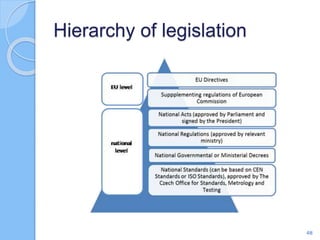
Hierarchy of legislation
48
EU legislation for agri – food
cooperatives
 Treaty on the functioning of the European Union
 Council Regulation (EC) No 1435/2003 of 22 July 2003
on the Statute for a European Cooperative Society (SCE)
49
50
National legislation for agri – food
cooperatives
 National law of
cooperative societies
 Cabinet of Ministers
regulations No 77:
"Regulations on the
agricultural services
cooperatives and the
forestry services
cooperatives in
compliance assessment"
51
Regulations on the agricultural services
cooperatives and forestry services cooperatives in
compliance assessment
 Latvian Agricultural Cooperatives Association
(LACA) - responsible for compliance assessment
 Accordance with the legislation
and Statute for compliance
assessment
52
Compliance assesment of cooperatives
 An annual task
 Decision adoptet by the Commission
 Commission consist of 5 members
representing 4 institutions
53
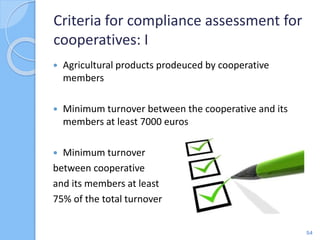
 Agricultural products prodeuced by cooperative
members
 Minimum turnover between the cooperative and its
members at least 7000 euros
 Minimum turnover
between cooperative
and its members at least
75% of the total turnover
Criteria for compliance assessment for
cooperatives: I
54
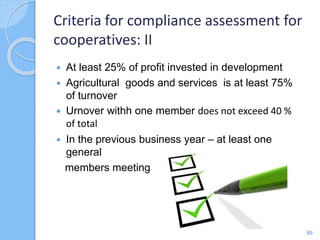
 At least 25% of profit invested in development
 Agricultural goods and services is at least 75%
of turnover
 Urnover withh one member does not exceed 40 %
of total
 In the previous business year – at least one
general
members meeting
Criteria for compliance assessment for
cooperatives: II
55
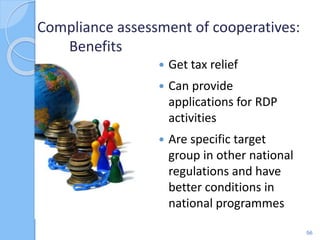
 Get tax relief
 Can provide
applications for RDP
activities
 Are specific target
group in other national
regulations and have
better conditions in
national programmes
Compliance assessment of cooperatives:
Benefits
56
57
58
Index
1. Agricultural policy
2. National Rural Development policy
3. EU & National legislation for Agri-
food cooperatives
4. National rural non-governmental
organisations
5. Role of agri-food cooperatives
59
60
Activity 4: National rural non –
governmental organizations (NGO’s)
Trainings for Co-op members selected
in the Board of Directors
2017
61
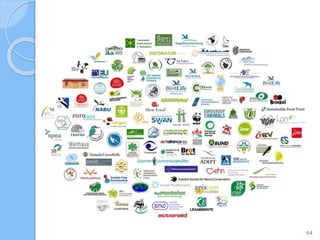
What is Non-Governmental
Organization?
 NGO – any non-profit, voluntary citizens’ group
which is legally constituted, organized and
operated on a local, national or international
level
 NGO - citizen-based association thet operates
independently of government, usually to deliver
resources or serve some social or political
purpose
 Task – oriented and driven by people with a
common interest
62
History of NGO’s
 The term first
coined in 1945
 Created by United
Nations (UN)
 Any kind of private
organization –
independent from
government control
63
64
EU  Agriculture  NGO
65
 The dynamic force of European
farmers and their cooperatives
 COPA - Committee of Professional Agricultural
Organisations created on 6 September 1958
 COGECA - General Committee for Agricultural
Cooperation in the European Union created on 24
September 1959
 Merged on 1 December 1962
66
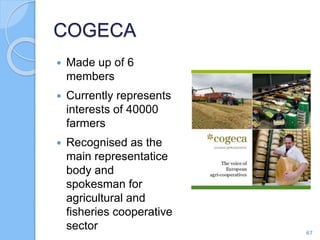
COGECA
 Made up of 6
members
 Currently represents
interests of 40000
farmers
 Recognised as the
main representatice
body and
spokesman for
agricultural and
fisheries cooperative
sector 67
- lobby and a platform for inter-
cooperative relationships
 involved in shaping and further
developing all Community policies that
create important framework conditions
for cooperative enterprises
 fosters cooperation between cooperative
enterprises at European level
COGECA
68
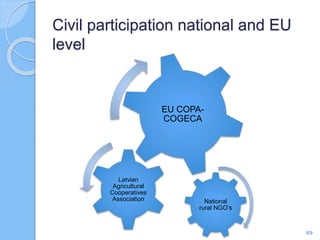
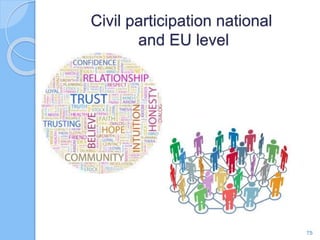
Civil participation national and EU
level
69
National
rural NGO’s
Latvian
Agricultural
Cooperatives
Association
EU COPA-
COGECA
Latvian NGO sector
70
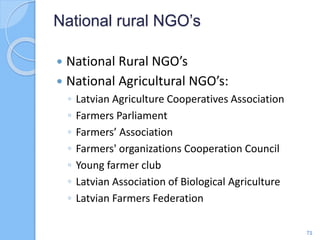
 National Rural NGO’s
 National Agricultural NGO’s:
◦ Latvian Agriculture Cooperatives Association
◦ Farmers Parliament
◦ Farmers’ Association
◦ Farmers' organizations Cooperation Council
◦ Young farmer club
◦ Latvian Association of Biological Agriculture
◦ Latvian Farmers Federation
National rural NGO’s
71
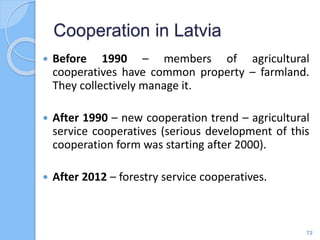
 Before 1990 – members of agricultural
cooperatives have common property – farmland.
They collectively manage it.
 After 1990 – new cooperation trend – agricultural
service cooperatives (serious development of this
cooperation form was starting after 2000).
 After 2012 – forestry service cooperatives.
Cooperation in Latvia
72
 Established in 2002
 Unites 50 members LACA – association
 Performs compliance assessments of
agricultural and
forestry cooperatives
 Member of COGECA
Latvian Agricultural Cooperatives
Association (LACA)
73
 Provision of actual information
 Consultations about cooperation and agriculture
 Representation of member’s interests in EU,
national and other institutions
 Organization of training courses, study trips,
conferences
 Public awareness about
cooperation and advantages
of cooperation in rural
economy
Main activities of Latvian Agricultural
Cooperatives Association (LACA)
74
Civil participation national
and EU level
75
76
Index
1. Agricultural policy
2. National Rural Development policy
3. EU & National legislation for Agri-
food cooperatives
4. National rural non-governmental
organisations
5. Role of agri-food cooperatives
77
“Role of agri - food cooperatives in civil
sociality political challenges – sustainable
development or short term planning”
Trainings for Co-op members selected
in the Board of Directors
2017
78
79
80

ToTCOOP+i O3 o4 unit-7_final_version_en

  • 1.
    ToTCOOP+i PROJECT Unit 7: Management of Agricultural Policy 1 STRATEGIC PARTNERSHIP FOR INNOVATING THE TRAINING OF TRAINERS OF THE EUROPEAN AGRI-FOOD COOPERATIVES
  • 2.
    Index 1. Agricultural policy 2.National Rural Development policy 3. EU & National legislation for Agri- food cooperatives 4. National rural non-governmental organisations 5. Role of agri-food cooperatives 2
  • 3.
  • 4.
    Activity I: AgriculturalPolicy 4 Trainings for Co-op members selected in the Board of Directors 2017
  • 5.
    Agricultural policy  CommonAgricultural Policy (CAP) 5
  • 6.
    Year 1957: TheTreaty of Rome  Establishment of the European Econmic Community • Provision of affordable food for EU citizens • Fair standart of living for farmers
  • 7.
    Year1962: The Common AgriculturalPolicy is born  Good prices for farmers  Shops are full of food  First objective – food security 7
  • 8.
    The crisis years:the 1970s  Structural adjustment of farm sector  Legislation for farm modernisation  Assistance to farmers working in difficult conditions  Penalty payments for over-production in the dairy sector
  • 9.
    The crisis years:the 1980s 9  Decision about structural changes  Quota System applied to milk  Introduction of budget stabilisers
  • 10.
    Year 1992: «MacSharry reform» Product support  Producer support  Direct aid payments to farmers  Aims: ◦ To improve the competitiveness of EU agriculture ◦ To stabilise the agricultural markets ◦ To diversify the production ◦ Environment protection ◦ To stabilise the EU budget expenditure 10
  • 11.
    Agenda 2000  Morefocus on economic, social and cultural development • Raising competitiveness of agricultural product markets • Stabilization of agricultural incomes • Environmental measures • Raising the food quality and safety level • Developing the vitality of rural areas
  • 12.
    Year 2003: TheReform  Aimed to enhance the competitiveness of the farm sector  Market-oriented and sustainable agriculture  Srenghtening of rural development policy
  • 13.
    Reform 2013: tenkey points 1. Better targeted income support 2. Tools to address crisis management 3. A ‘Green’ payment 4. Additional investment in research and innovation 5. A more competitive and balanced food chain 6. Encouraging agri-environmental initiatives 7. Facilitating the establishment of young farmers 8. Stimulating rural employment and entrepreneurship 9. Better addressing fragile areas 10. A simpler and more efficient CAP 13
  • 14.
    The CAP post-2013:From challenges to reform objectives 14
  • 16.
  • 17.
    CAP Pillars Irish Co-operativeOrganisation Society (ICOS) 17
  • 18.
  • 19.
    The path ofCAP expenditure by calendar year (in current prices)
  • 20.
    Expenditure in totalEU Expenditure (2011 constant prices) 20
  • 21.
    External Policy –It’s effect on your business……CAP 21
  • 22.
  • 23.
  • 24.
    European Commission 24 • InitiatesALL Legislation • 28 Commissioners in 28 departments with around 27,000 officials • Phil Hogan European Commissioner for Agriculture and Rural Development since November 2014 • More than 2000 laws affecting our business have been initiated here
  • 25.
    • 28 MemberStates take turns to chair the Council for a period of six months. • Council amends and adopts legislation usually in co-decision with the Parliament • Agri Ministerial Council Meets Every month European Council 25
  • 26.
    European Parliament 26 • Role: Directly-electedEU body with legislative, supervisory, and budgetary responsibilities • Members: 751 MEPs (Members of the European Parliament) • President: Antonio Tajani • Established in: 1952 as Common Assembly of the European Coal and Steel Community, 1962 as European Parliament, first direct elections in 1979 • Location: Strasbourg (France), Brussels (Belgium), Luxembourg
  • 27.
  • 28.
    Index 1. Agricultural policy 2.National Rural Development policy 3. EU & National legislation for Agri- food cooperatives 4. National rural non-governmental organisations 5. Role of agri-food cooperatives 28
  • 29.
  • 30.
    Activity 2: NationalRural Development Programme (RDP) Trainings for Co-op members selected in the Board of Directors 2017 30
  • 31.
  • 32.
    CAP long termobjectives: 2014- 2020  Rural business development  Sustainable management of natural resources, and climate action  Balanced territorial development 32
  • 33.
    SUSTAINABLE RURAL DEVELOPMENT 33 3. Food chain organisation andrisk management 4. Restoring, preserving, and enhancing ecosystems 5. Resource efficiency and climate change 6. Diversification and social inclusion 2. Economic viability and competitiveness 1. Knowledge transfer and innovation Union Strategic Priorities for Rural Development 33
  • 34.
    2014 – 2020EAFRD funding / MS (€ million)* BE 648 BG 2 367 CZ 2 306 DK 919 DE 9 446 EE 823 IE 2 191 EL 4 718 ES 8 297 FR 11 385 HR 2 026 IT 10 444 CY 132 LV 1076 LT 1 613 LU 101 HU 3 431 MT 97 NL 765 AT 3 938 PL 8 698 PT 4 058 RO 8 128 SI 838 SK 1 560 FL 2 380 SE 1 764 UK 5 200 EU 99 586** *"Envelopes in place after entry into force on 23rd May 2015 of COMMISSION DELEGATED REGULATION (EU) No 2015/791 amending Annex I to Regulation (EU) No 1305/2013 of the European Parliament and of the Council on support for rural development by the European agricultural Fund for Rural Development" ** includes EU level technical assistance (239 mil. EUR)
  • 35.
    Food chain organisation,animal welfare, risk management Farm viability competitiveness, sustainable forest management Ecosystems in agriculture and forestry Resource efficiency, low carbon and climate resilience Social inclusion, poverty reduction, economic development 18FocusAreas Knowledge Transfer and Innovation (cross cutting) Share of funds per RD priority
  • 36.
    New measures forbetter covering the needs, e.g.: 36  Cooperation (art. 35) – new ways of working together adapted to meet the requirements of the knowledge economy: widened scope , wider range of beneficiaries, horizontal and vertical co- operation amongst actors  Risk management (art. 36) – insurances (protect crops, plants, animals) , income stabilisation tools, setting up mutual funds.
  • 37.
    Envisaged timeline forthe adoption of the 2014-2020 RDPs 37
  • 38.
  • 39.
    Examples of expected achievements: to create cooperation opportunities between farmers and researchers  nearly 4.5 % of farmers will receive investment support to modernise and restructure their farms and specific measures are also foreseen to attract more young farmers into the sector  facilitate the development of around 10 producers groups by involving at least 115 farms, etc. Latvian Rural Development Programme 2014 - 2020 39
  • 40.
    Latvian Rural Development policy 2007-2013  2014-2020 40 CAP Pillar II - provides funding for competitiveness, environmental and natural resources protection Agricultural and forestry sector, promotion of competitiveness, Restructuring, development and innovation Environment and Rural Landscape - agricultural land, natural resources, sustainable use of environment-friendly production methods Rural quality of life and diversification of economy - to develop business in rural areas, improve rural infrastructure LEADER - Supporting local action groups LV funding available for 2007-2013 = 1,054 billion.EUR promote the transfer of knowledge in the field of agriculture and forestry increase the competitiveness and economic viability of farms contribute to the food supply chain organization and risk management protect ecosystems dependent on agriculture and forestry promote resource efficiency and a shift towards a low-carbon promote job creation, poverty alleviation and rural development potential LV funding available for 2014- 2020 = 969 mio EUR
  • 41.
    Major tasks forthe period 2014-2020: Latvia Rise in income gained from an effective production, increasing a ratio of products with higher added value and market-oriented production  Support to small and medium farms (cooperation, education, niche products, jobs outside agriculture)  Each ha of land and forest, as well as Latvia’s waters are used in creation of value  Latvia’s rural areas managed by family farms, which are able to earn and provide for their families  Development of science and increase in the level of education in sectors 41
  • 42.
     Lack ofknowledge about environment protection, management and marketing  High share of semi-subsistence farms – 56,5%  Low soil fertility and natural and specific constraints  Underdeveloped supply chains and cooperation among enterprises Key challanges: Latvia 42
  • 43.
  • 44.
     M01 –Knowledge  M02 - Advisory services  M04 – Investments  M06 - Farm and business development  M08 - Forest  M09 - Producer groups / organisations  M16 - Cooperation  M19 - LEADER and CLLD RDP Meassuers for agri - food cooperatives 44
  • 45.
  • 46.
    Index 1. Agricultural policy 2.National Rural Development policy 3. EU & National legislation for Agri- food cooperatives 4. National rural non-governmental organisations 5. Role of agri-food cooperatives 46
  • 47.
    Activity 3: EUand National legislation for agri-food cooperatives Trainings for Co-op members selected in the Board of Directors 2017 47
  • 48.
  • 49.
    EU legislation foragri – food cooperatives  Treaty on the functioning of the European Union  Council Regulation (EC) No 1435/2003 of 22 July 2003 on the Statute for a European Cooperative Society (SCE) 49
  • 50.
  • 51.
    National legislation foragri – food cooperatives  National law of cooperative societies  Cabinet of Ministers regulations No 77: "Regulations on the agricultural services cooperatives and the forestry services cooperatives in compliance assessment" 51
  • 52.
    Regulations on theagricultural services cooperatives and forestry services cooperatives in compliance assessment  Latvian Agricultural Cooperatives Association (LACA) - responsible for compliance assessment  Accordance with the legislation and Statute for compliance assessment 52
  • 53.
    Compliance assesment ofcooperatives  An annual task  Decision adoptet by the Commission  Commission consist of 5 members representing 4 institutions 53
  • 54.
     Agricultural productsprodeuced by cooperative members  Minimum turnover between the cooperative and its members at least 7000 euros  Minimum turnover between cooperative and its members at least 75% of the total turnover Criteria for compliance assessment for cooperatives: I 54
  • 55.
     At least25% of profit invested in development  Agricultural goods and services is at least 75% of turnover  Urnover withh one member does not exceed 40 % of total  In the previous business year – at least one general members meeting Criteria for compliance assessment for cooperatives: II 55
  • 56.
     Get taxrelief  Can provide applications for RDP activities  Are specific target group in other national regulations and have better conditions in national programmes Compliance assessment of cooperatives: Benefits 56
  • 57.
  • 58.
  • 59.
    Index 1. Agricultural policy 2.National Rural Development policy 3. EU & National legislation for Agri- food cooperatives 4. National rural non-governmental organisations 5. Role of agri-food cooperatives 59
  • 60.
  • 61.
    Activity 4: Nationalrural non – governmental organizations (NGO’s) Trainings for Co-op members selected in the Board of Directors 2017 61
  • 62.
    What is Non-Governmental Organization? NGO – any non-profit, voluntary citizens’ group which is legally constituted, organized and operated on a local, national or international level  NGO - citizen-based association thet operates independently of government, usually to deliver resources or serve some social or political purpose  Task – oriented and driven by people with a common interest 62
  • 63.
    History of NGO’s The term first coined in 1945  Created by United Nations (UN)  Any kind of private organization – independent from government control 63
  • 64.
  • 65.
  • 66.
     The dynamicforce of European farmers and their cooperatives  COPA - Committee of Professional Agricultural Organisations created on 6 September 1958  COGECA - General Committee for Agricultural Cooperation in the European Union created on 24 September 1959  Merged on 1 December 1962 66
  • 67.
    COGECA  Made upof 6 members  Currently represents interests of 40000 farmers  Recognised as the main representatice body and spokesman for agricultural and fisheries cooperative sector 67
  • 68.
    - lobby anda platform for inter- cooperative relationships  involved in shaping and further developing all Community policies that create important framework conditions for cooperative enterprises  fosters cooperation between cooperative enterprises at European level COGECA 68
  • 69.
    Civil participation nationaland EU level 69 National rural NGO’s Latvian Agricultural Cooperatives Association EU COPA- COGECA
  • 70.
  • 71.
     National RuralNGO’s  National Agricultural NGO’s: ◦ Latvian Agriculture Cooperatives Association ◦ Farmers Parliament ◦ Farmers’ Association ◦ Farmers' organizations Cooperation Council ◦ Young farmer club ◦ Latvian Association of Biological Agriculture ◦ Latvian Farmers Federation National rural NGO’s 71
  • 72.
     Before 1990– members of agricultural cooperatives have common property – farmland. They collectively manage it.  After 1990 – new cooperation trend – agricultural service cooperatives (serious development of this cooperation form was starting after 2000).  After 2012 – forestry service cooperatives. Cooperation in Latvia 72
  • 73.
     Established in2002  Unites 50 members LACA – association  Performs compliance assessments of agricultural and forestry cooperatives  Member of COGECA Latvian Agricultural Cooperatives Association (LACA) 73
  • 74.
     Provision ofactual information  Consultations about cooperation and agriculture  Representation of member’s interests in EU, national and other institutions  Organization of training courses, study trips, conferences  Public awareness about cooperation and advantages of cooperation in rural economy Main activities of Latvian Agricultural Cooperatives Association (LACA) 74
  • 75.
  • 76.
  • 77.
    Index 1. Agricultural policy 2.National Rural Development policy 3. EU & National legislation for Agri- food cooperatives 4. National rural non-governmental organisations 5. Role of agri-food cooperatives 77
  • 78.
    “Role of agri- food cooperatives in civil sociality political challenges – sustainable development or short term planning” Trainings for Co-op members selected in the Board of Directors 2017 78
  • 79.
  • 80.