Mrs. AMRITA ROY
M.SC PSYCHIATRIC NURSING
NIMHANS,BANGALORE
 Teamwork means the combined, co-coordinated &
dedicated effort of each & every member of the
team toward achievement of the vested interest,
target or goal of the team as an entity.
 Teamwork becomes more significant in a mental
health setting where the contribution of all the
members is extremely vital for the assessment,
diagnosis, treatment, in-patient rehabilitation as
well as community based rehabilitation of the
mentally ill patient.
 A group composed of members with varied
but complimentary experience, qualifications
and skills that contribute to the achievement of
the organization's specific objectives.
 A multidisciplinary team (MDT) is composed of
members from different healthcare professions
with specialised skills and expertise.
 The members collaborate together to make
treatment recommendations that facilitate quality
patient care.
 Multidisciplinary teams form one aspect of the
provision of a streamlined patient journey by
developing individual treatment plans that are
based on 'best practice'.
 This multi-disciplinary team functions as an Inter-
disciplinary team in that the total care of the patient
requires not only the total input of each members of
this team but also the inter-disciplinary coordinated
effort .
 Multi-disciplinary input & inter-disciplinary
coordination's as directed by the patient & his illness
will lead to the splendid outcome of recovery of the
patient to his maximum capability & capacity in the
community.
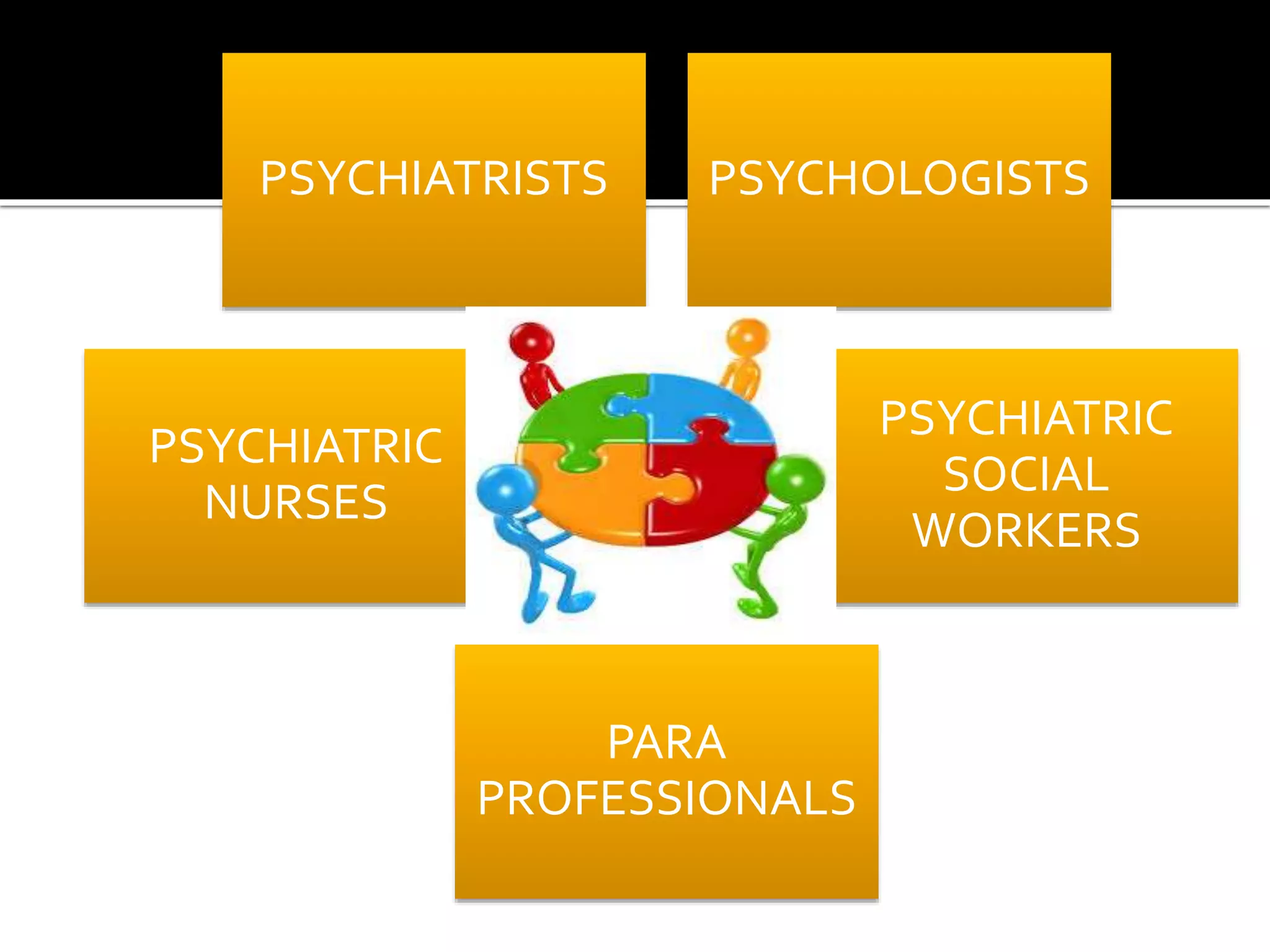
PSYCHIATRISTS PSYCHOLOGISTS
PSYCHIATRIC
NURSES
PSYCHIATRIC
SOCIAL
WORKERS
PARA
PROFESSIONALS
 The psychiatrist is a doctor with post-
graduation in psychiatry with 2-3 years of
residence training.
 The psychiatrist is responsible for diagnosis,
treatment & prevention of mental disorders,
prescribe medicines & somatic therapy &
function as a leader of the mental
health team.
 The psychiatric nurse clinical specialist should have a
master degree in nursing, preferably with post –graduate
research work.
 She participates actively in primary, secondary &
tertiary prevention of mental disorder & provides
individual, group & family psychotherapy in a hospital
& community setting.
 She also takes up the responsibility of teaching,
administration & research, bedsides publishing work in
a mental health setting.
 She takes up the role of a leader & can practice
independently.
 The clinical psychologist holds a doctoral degree in
clinical psychology & is registered with the
clinical psychologist’s association.
 She/he conducts psychological, diagnosis tests,
interprets & evaluates the finding of these tests &
implements a program of behavior modification.
 The psychiatric social worker is a graduate in social work
& post-graduate in psychiatric social work. She/he assesses
the individual, the family & community support system,
helps in discharge planning, counseling for job placement
& is aware of the state laws & legal rights of the patient &
protects these rights.
 She/he is skilled in interview techniques & group
dynamics.
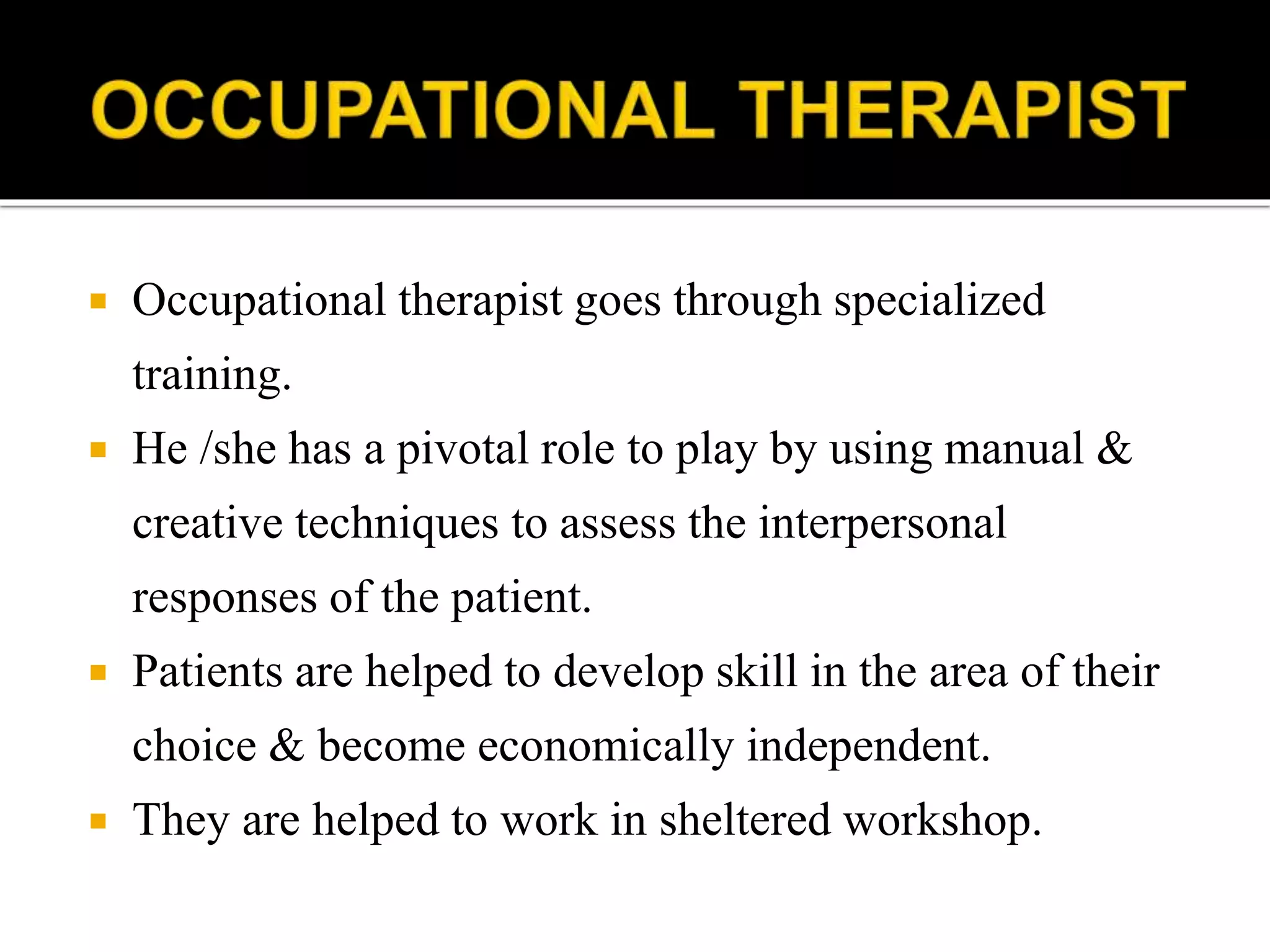
A. Occupational Therapist
B. Recreational Therapist
C. Diversional Play Therapist
D. Creative Art Therapist
E. Psychiatric Nursing Aids/Attendants
F. ECT technicians
G. Auxiliary Personnel
 Occupational therapist goes through specialized
training.
 He /she has a pivotal role to play by using manual &
creative techniques to assess the interpersonal
responses of the patient.
 Patients are helped to develop skill in the area of their
choice & become economically independent.
 They are helped to work in sheltered workshop.
 The recreational therapist plans activities to
stimulate the patient’s muscle co-ordination,
interpersonal relationship & socialization.
 These approaches are need-based
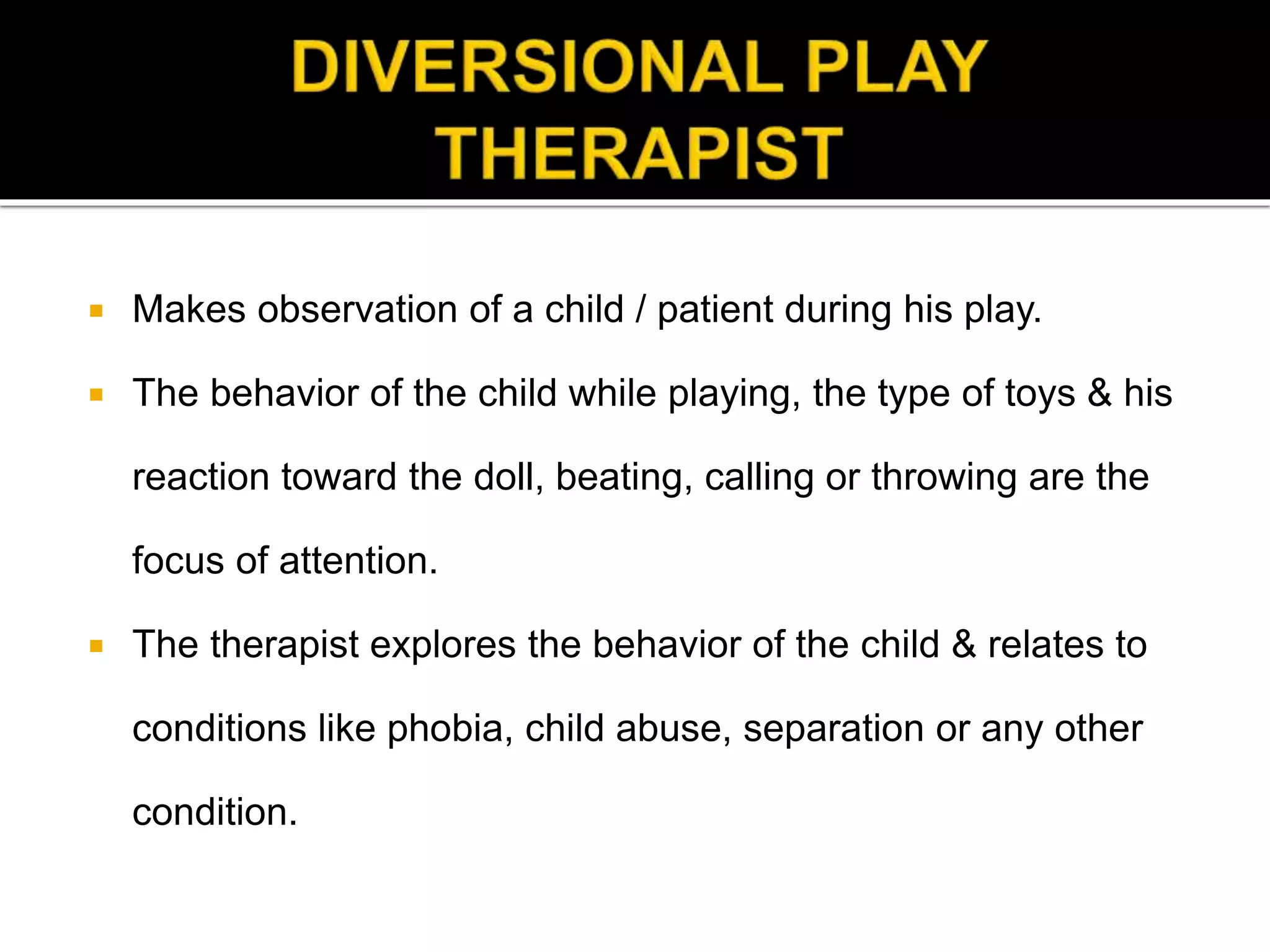
 Makes observation of a child / patient during his play.
 The behavior of the child while playing, the type of toys & his
reaction toward the doll, beating, calling or throwing are the
focus of attention.
 The therapist explores the behavior of the child & relates to
conditions like phobia, child abuse, separation or any other
condition.
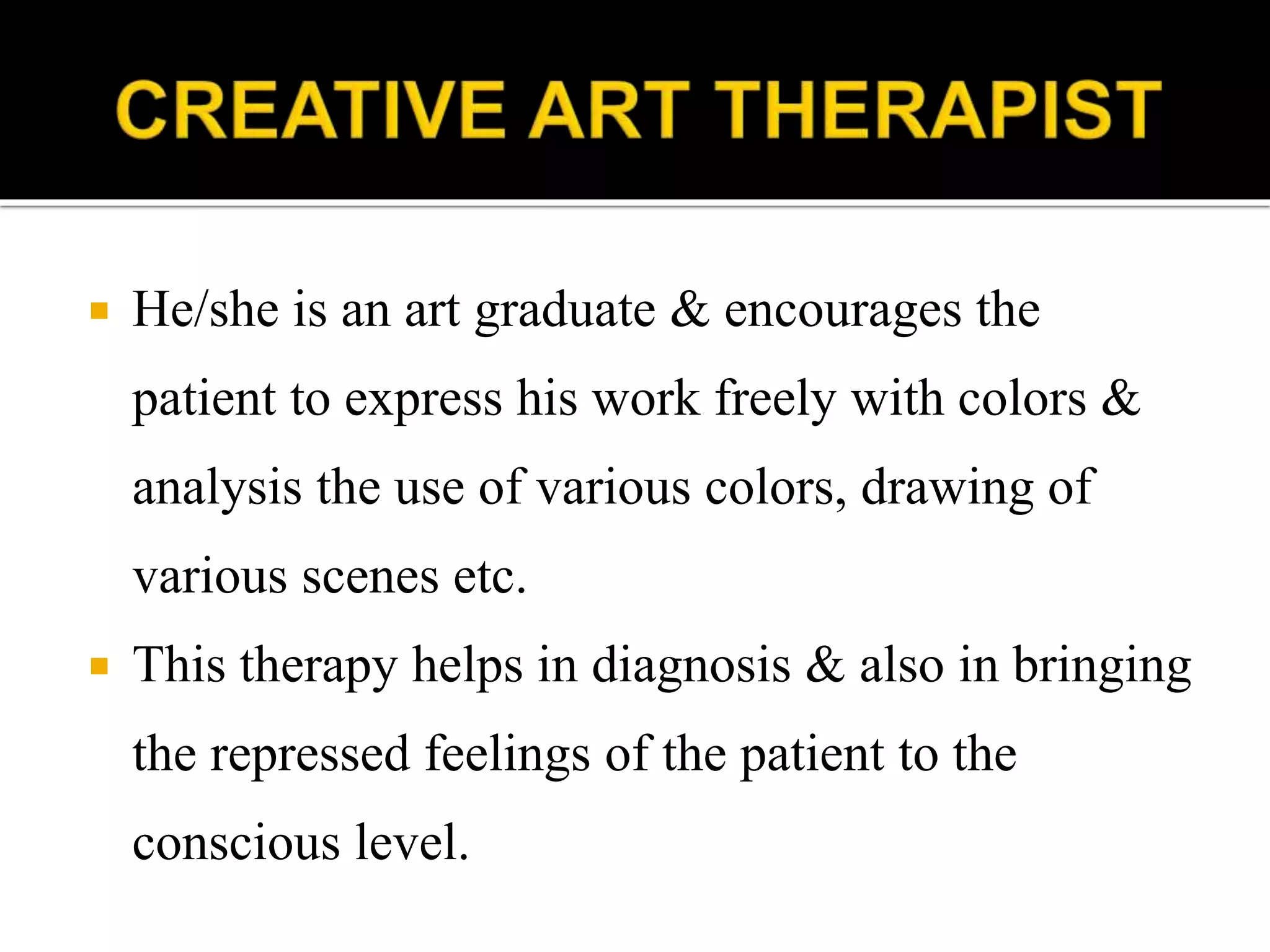
 He/she is an art graduate & encourages the
patient to express his work freely with colors &
analysis the use of various colors, drawing of
various scenes etc.
 This therapy helps in diagnosis & also in bringing
the repressed feelings of the patient to the
conscious level.
 They have high school training & are trained on
the job.
 They aid maintaining the therapeutic
environment & provide care under supervision.
 They undergo training for 6-9 months.
 Their function is to assist in ECT.
 They are volunteer housekeeper or clerical
staff & require in-service education to interact
with the patient therapeutically
MRS. AMRITA RANI PAL
M.SC NURSING IYR
NIMHANS
 A role is “the sum total of expected behaviours
from a person who occupies a particular
position and status in a social pattern.”
 According to Hardy & Hardy (1988) – A role
is set of expected and actual behaviours
associated with a position in a social structure.
 The concept of an extended role means to reach
out. It is the extension of the basic caring role.
Nurses are assuming their roles in variety of
settings.
 Nurse educator
 Nurse administrator
 Clinical nurse specialist
 Critical care nurse
 Nurse anaesthetist
 Nurse practitioner
It is the role which the nurse
assumes by virtue of
education and experiences. It
goes beyond the traditional
role and adds maximum
responsibility with wide range
of functions in community
and clinical care settings.
 Nurse Entrepreneurs
 Nurse Researcher
 Nurse Informatics
 Nurse Consultant
 It provides variety of services for patient of all
age groups which may be part of hospital or
community.
 It enhances clinical decision skills.
 It provides great challenges & opportunities
for nurses.
 It provides expert knowledge and high level of
job satisfaction.
 Published evidences shows that nurse can be
as effective as doctors within her expanded
role.
 Health as a fundamental right of individual
 Emerging trend of health oriented model from
a disease oriented model
 Expansion of scientific knowledge
 To meet changing health care needs
1. Medical Duties
2. Nursing Care Plan
3. Patient Educator
4. Patient Advocate
5. Care Manager
6. Assessment, Evaluation, Triage and Referral
Nurse
7. Utilization Review Nurse
8. Risk Manager
9. Chief Quality Officer
10. Corporate Managers and Executives
 MULTIDISCIPLINARY TEAM
 MEANING
 MEMBERS & THEIR ROLES
 ROLES OF A NURSE IN MDT
 ADVANTAGES AND NEED OF
EXTENDED & EXPANDED ROLES
 EXTENDED & EXPANDED ROLE OF A
PSYCHIATRIC NURSE
Multi discplinary health team

Multi discplinary health team

  • 1.
    Mrs. AMRITA ROY M.SCPSYCHIATRIC NURSING NIMHANS,BANGALORE
  • 2.
     Teamwork meansthe combined, co-coordinated & dedicated effort of each & every member of the team toward achievement of the vested interest, target or goal of the team as an entity.  Teamwork becomes more significant in a mental health setting where the contribution of all the members is extremely vital for the assessment, diagnosis, treatment, in-patient rehabilitation as well as community based rehabilitation of the mentally ill patient.
  • 3.
     A groupcomposed of members with varied but complimentary experience, qualifications and skills that contribute to the achievement of the organization's specific objectives.
  • 4.
     A multidisciplinaryteam (MDT) is composed of members from different healthcare professions with specialised skills and expertise.  The members collaborate together to make treatment recommendations that facilitate quality patient care.  Multidisciplinary teams form one aspect of the provision of a streamlined patient journey by developing individual treatment plans that are based on 'best practice'.
  • 5.
     This multi-disciplinaryteam functions as an Inter- disciplinary team in that the total care of the patient requires not only the total input of each members of this team but also the inter-disciplinary coordinated effort .  Multi-disciplinary input & inter-disciplinary coordination's as directed by the patient & his illness will lead to the splendid outcome of recovery of the patient to his maximum capability & capacity in the community.
  • 7.
  • 8.
     The psychiatristis a doctor with post- graduation in psychiatry with 2-3 years of residence training.  The psychiatrist is responsible for diagnosis, treatment & prevention of mental disorders, prescribe medicines & somatic therapy & function as a leader of the mental health team.
  • 9.
     The psychiatricnurse clinical specialist should have a master degree in nursing, preferably with post –graduate research work.  She participates actively in primary, secondary & tertiary prevention of mental disorder & provides individual, group & family psychotherapy in a hospital & community setting.  She also takes up the responsibility of teaching, administration & research, bedsides publishing work in a mental health setting.  She takes up the role of a leader & can practice independently.
  • 10.
     The clinicalpsychologist holds a doctoral degree in clinical psychology & is registered with the clinical psychologist’s association.  She/he conducts psychological, diagnosis tests, interprets & evaluates the finding of these tests & implements a program of behavior modification.
  • 11.
     The psychiatricsocial worker is a graduate in social work & post-graduate in psychiatric social work. She/he assesses the individual, the family & community support system, helps in discharge planning, counseling for job placement & is aware of the state laws & legal rights of the patient & protects these rights.  She/he is skilled in interview techniques & group dynamics.
  • 12.
    A. Occupational Therapist B.Recreational Therapist C. Diversional Play Therapist D. Creative Art Therapist E. Psychiatric Nursing Aids/Attendants F. ECT technicians G. Auxiliary Personnel
  • 13.
     Occupational therapistgoes through specialized training.  He /she has a pivotal role to play by using manual & creative techniques to assess the interpersonal responses of the patient.  Patients are helped to develop skill in the area of their choice & become economically independent.  They are helped to work in sheltered workshop.
  • 14.
     The recreationaltherapist plans activities to stimulate the patient’s muscle co-ordination, interpersonal relationship & socialization.  These approaches are need-based
  • 15.
     Makes observationof a child / patient during his play.  The behavior of the child while playing, the type of toys & his reaction toward the doll, beating, calling or throwing are the focus of attention.  The therapist explores the behavior of the child & relates to conditions like phobia, child abuse, separation or any other condition.
  • 16.
     He/she isan art graduate & encourages the patient to express his work freely with colors & analysis the use of various colors, drawing of various scenes etc.  This therapy helps in diagnosis & also in bringing the repressed feelings of the patient to the conscious level.
  • 17.
     They havehigh school training & are trained on the job.  They aid maintaining the therapeutic environment & provide care under supervision.
  • 18.
     They undergotraining for 6-9 months.  Their function is to assist in ECT.
  • 19.
     They arevolunteer housekeeper or clerical staff & require in-service education to interact with the patient therapeutically
  • 20.
    MRS. AMRITA RANIPAL M.SC NURSING IYR NIMHANS
  • 21.
     A roleis “the sum total of expected behaviours from a person who occupies a particular position and status in a social pattern.”  According to Hardy & Hardy (1988) – A role is set of expected and actual behaviours associated with a position in a social structure.
  • 22.
     The conceptof an extended role means to reach out. It is the extension of the basic caring role. Nurses are assuming their roles in variety of settings.  Nurse educator  Nurse administrator  Clinical nurse specialist  Critical care nurse  Nurse anaesthetist  Nurse practitioner
  • 23.
    It is therole which the nurse assumes by virtue of education and experiences. It goes beyond the traditional role and adds maximum responsibility with wide range of functions in community and clinical care settings.
  • 24.
     Nurse Entrepreneurs Nurse Researcher  Nurse Informatics  Nurse Consultant
  • 25.
     It providesvariety of services for patient of all age groups which may be part of hospital or community.  It enhances clinical decision skills.  It provides great challenges & opportunities for nurses.  It provides expert knowledge and high level of job satisfaction.  Published evidences shows that nurse can be as effective as doctors within her expanded role.
  • 26.
     Health asa fundamental right of individual  Emerging trend of health oriented model from a disease oriented model  Expansion of scientific knowledge  To meet changing health care needs
  • 27.
    1. Medical Duties 2.Nursing Care Plan 3. Patient Educator 4. Patient Advocate 5. Care Manager
  • 28.
    6. Assessment, Evaluation,Triage and Referral Nurse 7. Utilization Review Nurse 8. Risk Manager 9. Chief Quality Officer 10. Corporate Managers and Executives
  • 29.
     MULTIDISCIPLINARY TEAM MEANING  MEMBERS & THEIR ROLES  ROLES OF A NURSE IN MDT  ADVANTAGES AND NEED OF EXTENDED & EXPANDED ROLES  EXTENDED & EXPANDED ROLE OF A PSYCHIATRIC NURSE