Multichannel Self-Organized Learning and Research in Web 2.0 Environment TENCompetence Special Technology Track "Technology Support for Self-Organized Learners" Malinka Ivanova, Technical University – Sofia
Aim Support self-organized learners by building a multichannel environment based on performed research and analysis of start pages
Outlines eLearning 2.0 Features Start Pages analysis Multichannel learning and research environment design Self-Organized Learning in Start Pages Prototype of Multichannel Learning and Research Environment  Conclusion
eLearning a strategy for learning employs technologies, tools and systems  support knowledge increase and skills improvement at times and terms defined by each learner the first area to benefit from the Web 2.0 principles
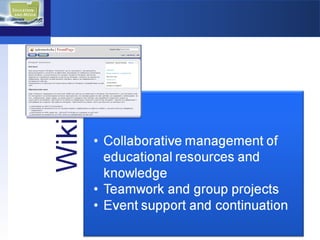
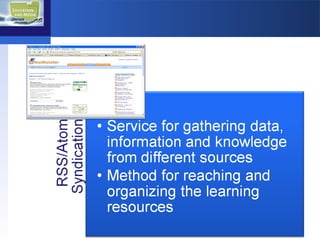
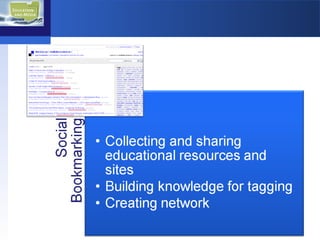
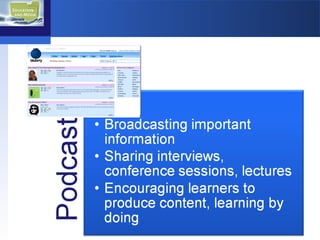
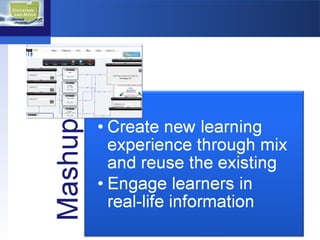
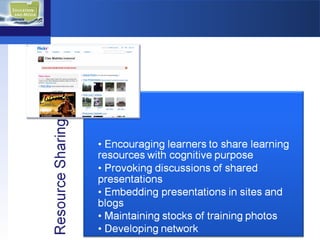
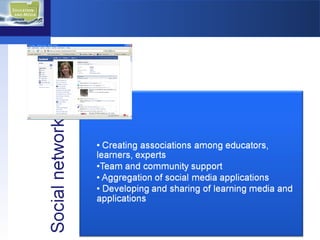
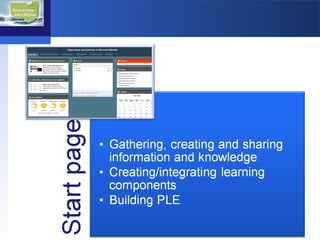
Web 2.0 New tools and services  Blogs Microblogs Wikis RSS/Atom syndication Podcasts Social bookmarking Start pages Mashups Resource sharing Social networks Impact on the learners Encourage informal conversation  Collaborative content generation  Sharing of information Learners access to a vast array of ideas and representations of knowledge Ability to form meaningful communities and collaborate Ability to interconnect applications


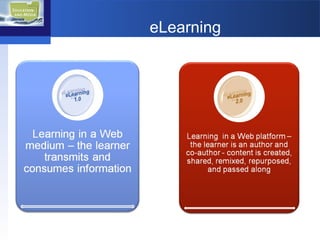
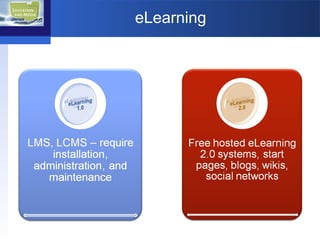
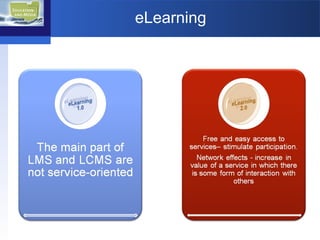
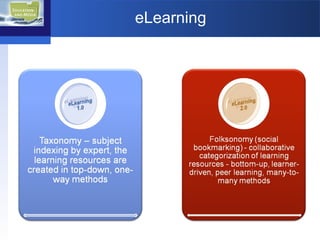
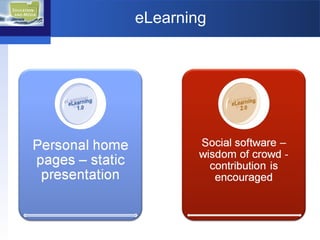
eLearning 2.0 What is eLearning 2.0? eLearning 2.0  is based on  Web 2.0  and emerging trends in eLearning. It can include such features as e-Learning where students  create content ,  collaborate  with peers to form a learning network with distribution of content creation and responsibilities, e-Learning that takes advantage of  many sources of content aggregated  together into learning experiences and e-Learning that  utilizes various tools  including online references, courseware, knowledge management, collaboration and search. http://en.wikipedia.org/wiki/ELearning_2.0
What is eLearning 2.0? “ In the future it will be more widely recognized that the learning comes  not from the design of learning content  but in  how it is used . Most e-learning theorists are already there, and are exploring how learning content-whether professionally authored or created by students— can be used as the  basis for learning activities  rather than the conduit for learning content.“ Stephen Downes, National Research Council of Canada http://www.elearnmag.org/subpage.cfm?section=articles&article=29-1
eLearning
eLearning
eLearning
eLearning
eLearning
eLearning
eLearning
eLearning
eLearning
eLearning
eLearning
eLearning
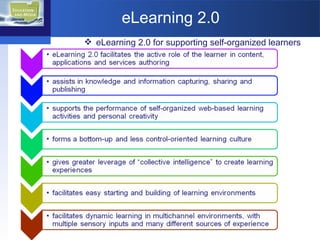
eLearning 2.0 eLearning 2.0 for supporting self-organized learners
The main questions: How to build a technology-rich environment for self-organized learners? What components should it consist of? How can Web 2.0 technologies support the implementation of such environment?
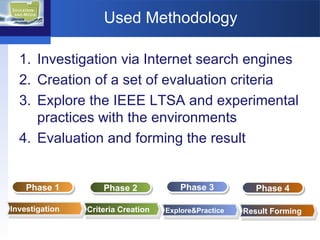
Used Methodology Investigation via Internet search engines Creation of a set of evaluation criteria Explore the IEEE LTSA and experimental practices with the environments Evaluation and forming the result Explore&Practice Criteria Creation Investigation Phase 1 Phase 2 Phase 3 Result Forming Phase 4
investigation via Internet search engines using keywords “start pages software” and “learning, education” gathering blog shared experience Investigation Phase 1
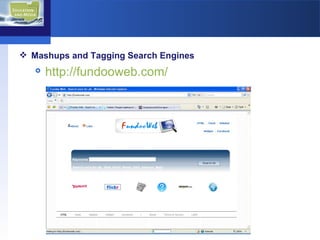
Mashups and Tagging Search Engines http://fundooweb.com/
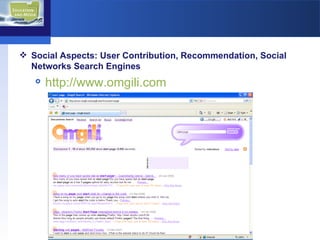
Social Aspects: User Contribution, Recommendation, Social Networks Search Engines http://www.omgili.com
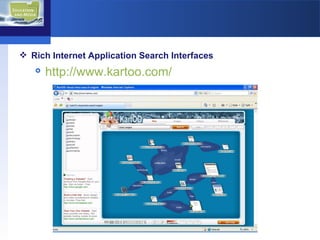
Rich Internet Application Search Interfaces http://www.kartoo.com/
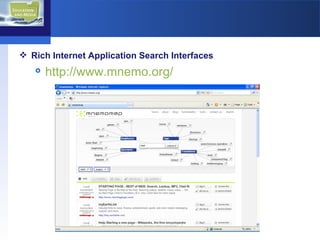
Rich Internet Application Search Interfaces http://www.mnemo.org/
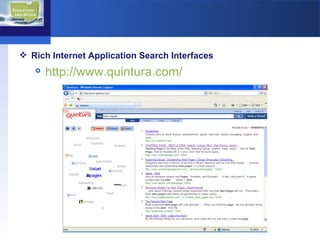
Rich Internet Application Search Interfaces http://www.quintura.com/
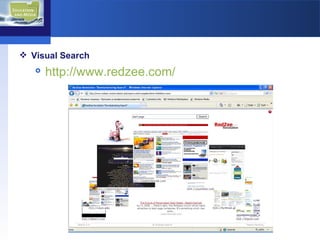
Visual Search http://www.redzee.com/
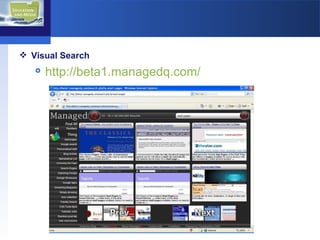
Visual Search http://beta1.managedq.com/
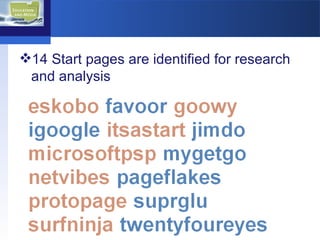
14 Start pages are identified for research and analysis
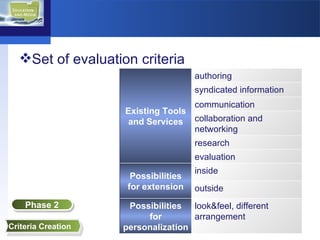
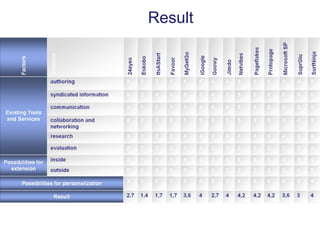
Set of evaluation criteria Criteria Creation Phase 2 Existing Tools and Services authoring syndicated information communication collaboration and networking research evaluation Possibilities for extension inside outside Possibilities for personalization look&feel, different arrangement
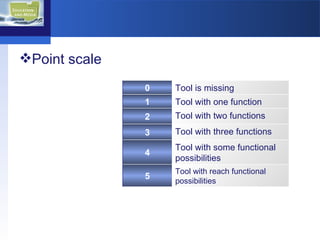
Point scale 0 Tool is missing 1 Tool with one function  2 Tool with two functions 3 Tool with three functions 4 Tool with some functional possibilities  5 Tool with reach functional possibilities
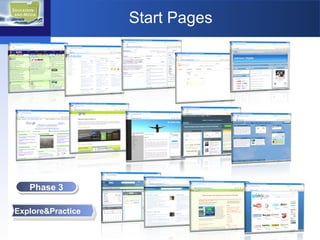
Start Pages Explore&Practice Phase 3
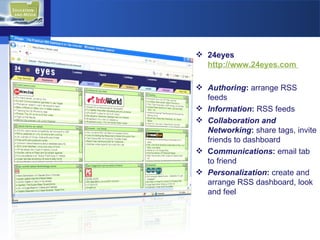
24eyes  http://www.24eyes.com  Authoring :  arrange RSS feeds Information :  RSS feeds Collaboration and Networking :  share tags, invite friends to dashboard C ommunications :  email tab to friend Personalization :  create and arrange RSS dashboard, look and feel
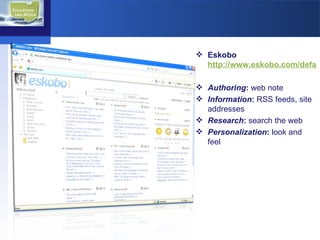
Eskobo  http://www.eskobo.com/default.aspx  Authoring :  web note  Information :  RSS feeds, site addresses Research :  search the web Personalization :  look and feel
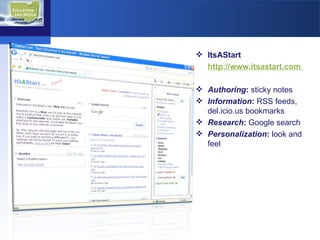
ItsAStart  http://www.itsastart.com  Authoring :  sticky notes Information :  RSS feeds,  del.icio.us bookmarks Research :  Google search Personalization :  look and feel
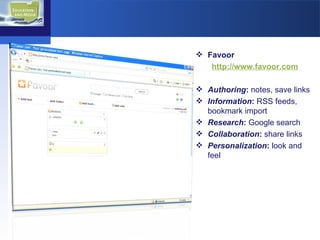
Favoor  http://www.favoor.com   Authoring :  notes, save links Information :  RSS feeds, bookmark import  Research :  Google search Collaboration :  share links Personalization :  look and feel
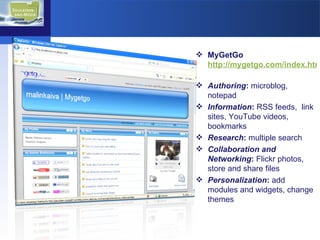
MyGetGo  http://mygetgo.com/index.html   Authoring :  microblog, notepad Information :  RSS feeds,  link sites, YouTube videos, bookmarks Research :  multiple search Collaboration and Networking :  Flickr   photos, store and share files Personalization :  add modules and widgets, change themes
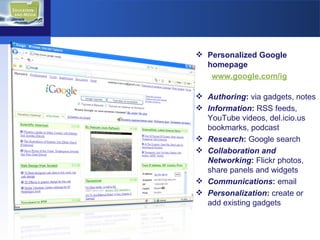
Personalized Google homepage  www.google.com/ig   Authoring :  via gadgets, notes Information :  RSS feeds,  YouTube videos, del.icio.us bookmarks, podcast Research :  Google search Collaboration and Networking :  Flickr photos, share panels and widgets Communications :  email Personalization :  create or add existing gadgets
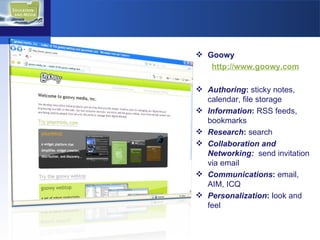
Goowy  http://www.goowy.com   Authoring :  sticky notes, calendar, file storage Information :  RSS feeds,  bookmarks Research :  search Collaboration and Networking:  send invitation via email Communications :  email, AIM, ICQ Personalization :  look and feel
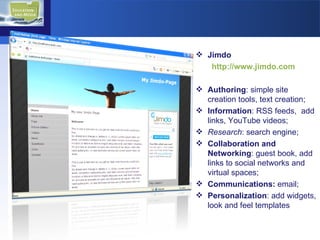
Jimdo http://www.jimdo.com Authoring : simple site creation tools, text creation; Information : RSS feeds,  add links, YouTube videos; Research : search engine; Collaboration and Networking : guest book, add links to social networks and virtual spaces; Communications:  email; Personalization : add widgets, look and feel templates
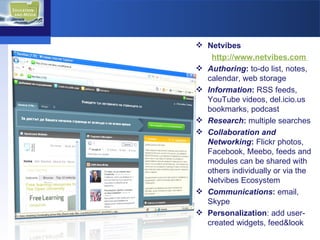
Netvibes http://www.netvibes.com  Authoring :  to-do list, notes, calendar, web storage Information :  RSS feeds,  YouTube videos, del.icio.us bookmarks, podcast Research :  multiple searches Collaboration and Networking :  Flickr photos, Facebook, Meebo, feeds and modules can be shared with others individually or via the Netvibes Ecosystem Communications :  email, Skype Personalization : add user-created widgets, feed&look
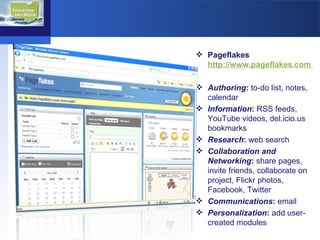
Pageflakes  http://www.pageflakes.com  Authoring :  to-do list, notes, calendar Information :  RSS feeds,  YouTube videos, del.icio.us bookmarks Research :  web search Collaboration and Networking :  share pages, invite friends, collaborate on project, Flickr photos, Facebook, Twitter Communications :  email Personalization :  add user-created modules
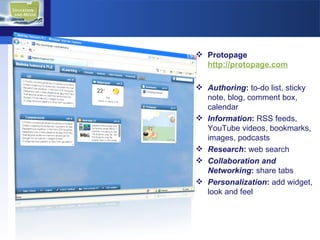
Protopage  http://protopage.com   Authoring :  to-do list, sticky note, blog, comment box, calendar Information :  RSS feeds,  YouTube videos, bookmarks, images, podcasts Research :  web search Collaboration and Networking :  share tabs Personalization :  add widget, look and feel
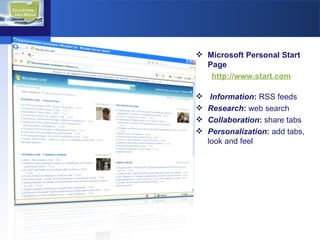
Microsoft Personal Start Page  http://www.start.com   Information :  RSS feeds Research :  web search Collaboration :  share tabs Personalization :  add tabs, look and feel
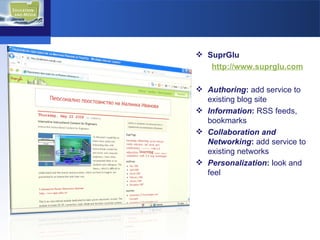
SuprGlu  http://www.suprglu.com   Authoring :  add service to existing blog site Information :  RSS feeds, bookmarks Collaboration and Networking :  add service to existing networks Personalization :  look and feel
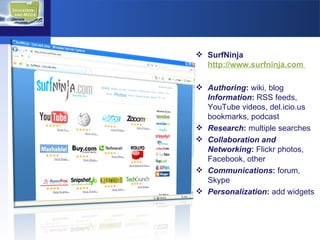
SurfNinja  http://www.surfninja.com  Authoring :  wiki, blog   Information :  RSS feeds,  YouTube videos, del.icio.us bookmarks, podcast Research :  multiple searches Collaboration and Networking :  Flickr photos, Facebook, other Communications :  forum, Skype Personalization :  add widgets
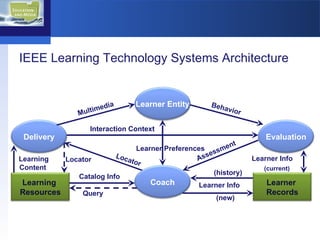
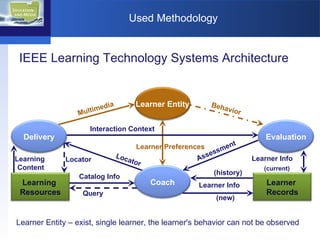
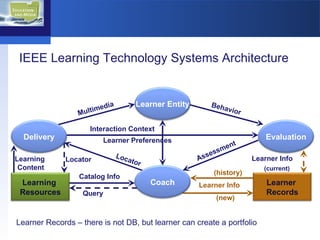
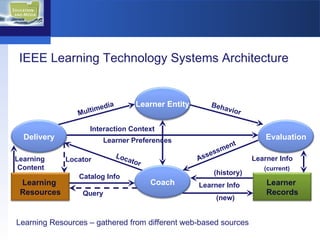
IEEE Learning Technology Systems Architecture Interaction Context Assessment Locator Learner Info Learner Info ( history ) Query Catalog Info Locator Learning  Content ( new ) ( current ) Multimedia Behavior Interaction Context Learner Preferences Delivery Evaluation Coach Learning  Resources Learner  Records Learner Entity
Used Methodology IEEE Learning Technology Systems Architecture Multimedia Behavior Interaction Context Learner   Preferences Assessment Locator Learner Info Learner Info ( history ) Query Catalog Info Locator Learning  Content ( new ) ( current ) Learner Entity – exist, single learner, the learner's behavior can not be observed Learner Entity Delivery Evaluation Coach Learning  Resources Learner  Records
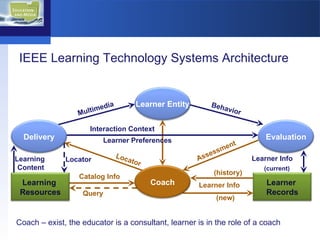
IEEE Learning Technology Systems Architecture Multimedia Behavior Interaction Context Learner Preferences Assessment Locator Learner Info Learner Info ( history ) Query Catalog   Info Locator Learning  Content ( new ) ( current ) Coach – exist, the educator is a consultant, learner is in the role of a coach Learner Entity Delivery Evaluation Coach Learning  Resources Learner  Records
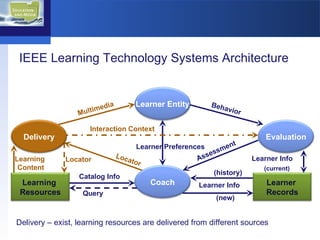
IEEE Learning Technology Systems Architecture Multimedia Behavior Interaction   Context Learner Preferences Assessment Locator Learner Info Learner Info ( history ) Query Catalog Info Locator Learning   Content ( new ) ( current ) Delivery – exist, learning resources are delivered from different sources  Learner Entity Delivery Evaluation Coach Learning  Resources Learner  Records
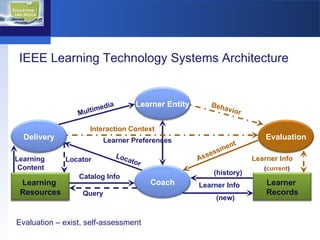
IEEE Learning Technology Systems Architecture Multimedia Behavior Interaction   Context Learner Preferences Assessment Locator Learner   Info Learner Info ( history ) Query Catalog Info Locator Learning  Content ( new ) ( current ) Evaluation – exist, self-assessment  Learner Entity Delivery Evaluation Coach Learning  Resources Learner  Records
IEEE Learning Technology Systems Architecture Multimedia Behavior Interaction Context Learner Preferences Assessment Locator Learner Info Learner Info ( history ) Query Catalog Info Locator Learning  Content ( new ) ( current ) Learner Records – there is not DB, but learner can create a portfolio  Learner Entity Delivery Evaluation Coach Learning  Resources Learner  Records
IEEE Learning Technology Systems Architecture Multimedia Behavior Interaction Context Learner Preferences Assessment Locator Learner Info Learner Info ( history ) Query Catalog Info Locator Learning  Content ( new ) ( current ) Learning Resources – gathered from different web-based sources Learner Entity Delivery Evaluation Coach Learning  Resources Learner  Records
The start page’s limitations:  The evaluation process is limited – data gathering, tracking and evaluation  The coach could be another learner or a group of learners  There are no Learner Records Several flows are missing: interaction context, learner info, catalog info
Start pages  Possess flexible functions for configuring the existing components in a learning environment Can be extended with new created components  Can support the self-organized learners in two aspects:  learning – learn to exploit the Learning 2.0 advantages , learn to work with Web 2.0 technologies  research - exploring the riches and functionality of an environment in order to build effective prototypes
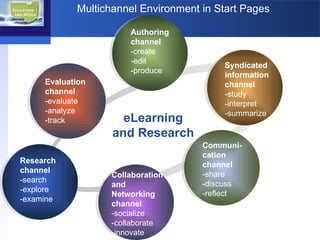
Start pages are suitable for building multichannel learning environments, where learning and knowledge capturing can be provided The start pages Netvibes, Pageflakes and Protopage show the rich possibilities for self-organized learning environments with tools for: Authoring Syndicating information   Communication Collaboration and networking Researching   Evaluation
Multichannel Environment in Start Pages Text eLearning and Research  Authoring channel -create -edit -produce Syndicated information channel -study -interpret -summarize Communi-cation channel -share -discuss -reflect Collaboration and Networking channel -socialize -collaborate -innovate Research channel -search -explore -examine Evaluation channel -evaluate -analyze -track
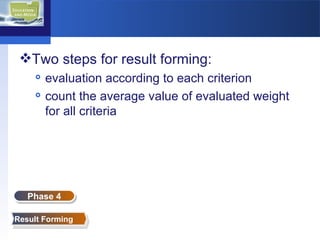
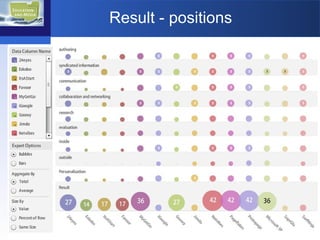
Two steps for result forming: evaluation according to each criterion count the average value of evaluated weight for all criteria Result Forming Phase 4
Result
Result - positions
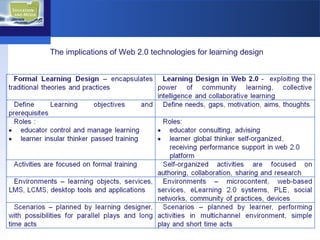
The implications of Web 2.0 technologies for learning design
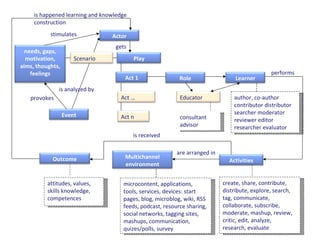
is happened learning and knowledge construction  performs are arranged in  is received  is analyzed by stimulates gets provokes needs, gaps, motivation, aims, thoughts, feelings Actor Role Learner Educator Event author, co-author contributor distributor searcher moderator reviewer editor researcher evaluator consultant advisor  Activities create, share, contribute, distribute, explore, search, tag, communicate, collaborate, subscribe, moderate, mashup, review, critic, edit, analyze,  research, evaluate  Multichannel environment microcontent, applications, tools, services, devices: start pages, blog, microblog, wiki, RSS feeds, podcast, resource sharing, social networks, tagging sites, mashups, communication, quizes/polls, survey Outcome attitudes, values, skills knowledge, competences  Play Act 1 Act … Act n Scenario
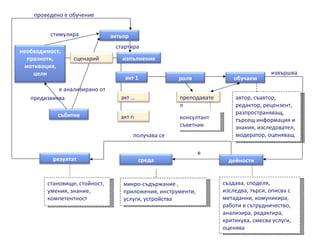
проведено е обучение  извършва в получава се е анализирано от стимулира стартира предизвиква необходимост ,  празноти ,  мотивация ,  цели актьор роля обучаем преподавател събитие автор,   съавтор,   редактор, рецензент, разпространяващ,   търсещ информация и знания, изследовател, модератор, оценяващ  консултант съветник   дейности създава, споделя ,  изследва, търси, описва с метаданни, комуникира, работи в сътрудничество, анализира, редактира, критикува, смесва услуги, оценява среда микро-съдържание , приложения, инструменти, услуги, устройства резултат становище ,  стойност ,  умения,   знание ,  компетентност изпълнение акт  1 акт  … акт  n сценарий
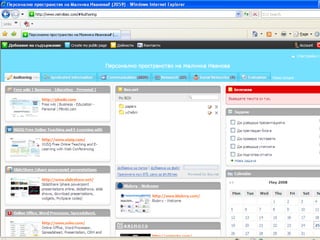
Prototype of Multichannel Learning and Research Environment  Prototype a working model in Netvibes and Pageflakes is created to: test the functions evaluate research hypotheses  It is used from advanced students (2-3 from a group)
 
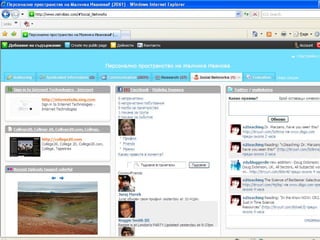
Tools and services in Authoring Channel to-do list, note, calendar html component (or widgets) for :  http://www.wiziq.com  – online teaching and learning with web conferencing http://www.blubrry.com  - podcasting www.box.net  – store and share documents http://www.zoho.com/  - create documents http://www.slideshare.net/  - share presentation http://animoto.com/  - create and share videos http://pbwiki.com/  - share information http://bubbl.us  – concept mapping http://secondlife.com/  - virtual space http://www.inetword.com/  - social html editor  http://www.mofuse.com  – create mobile site http://pipes.yahoo.com/pipes/  - mashups
 
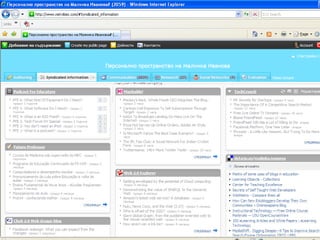
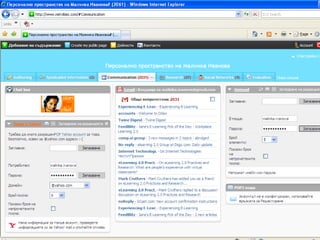
Tools and services in Syndication and Information Channel embedded component for: Social bookmarking Del.icio.us Sites as: TechCruch, Mashable, Web 2.0 Explorer, Podcast for Educators, O’Reilly Radar, SKYPE blog, Read/Write Web, and so on html component for: http://www.bloglines.com / - RSS reader http://www.newsgator.com /  - RSS reader http://technorati.com/  - RSS blog reader  Widget RSS reader
 
Tools and Services in Communication Channel Embedded components for: Email – gmail, hotmail, yahoo, POP3 html component for: Chat box http://c4lpt.co.uk/Directory/  - more tools
 
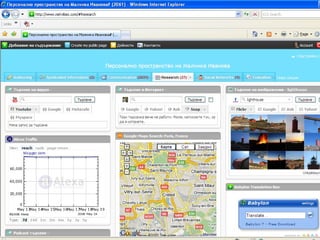
Tools and Services in Research Channel Search engines (embedded component/widget) for: Information, podcast, webcast, video, pictures, locations, blogs  Calculator Translation tool – Babylon Poll/survey Analysis – Alexa traffic, Feedburner, Google Analysis, tracker.icerocket.com  Visualization  http://services.alphaworks.ibm.com/manyeyes/app
 
Social Networks Enbedded components for: Facebook Twitter Flickr  html components for: Ning social networks Xing Google groups
 
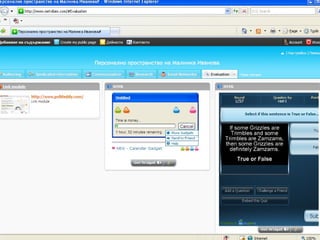
Tools and Services for Evaluation html components for:  Polls/Survey http://www.polldaddy.com/   Test/Quizzes http://www.quizilla.com/ Peer Review  Widget Time reminder
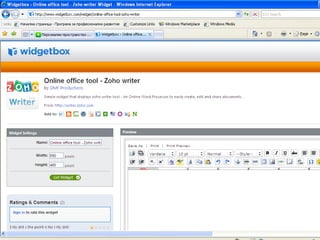
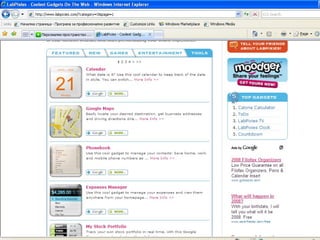
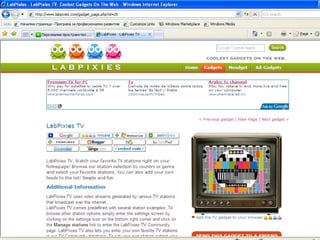
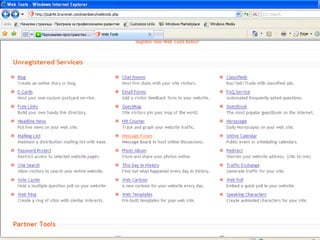
Widgets http://www.labpixies.com/ http://www.widgetbox.com http://widgets.yahoo.com/ http://www.bravenet.com/webtools/widgets.php http://www.springwidgets.com   http://www.yourminis.com


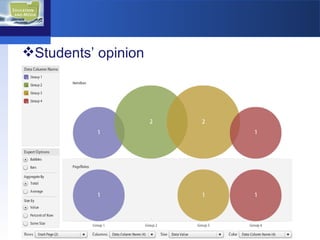
Students’ opinion
Conclusion Analysis shows: Start pages are suitable for easy and fast unfolding of learning and research environment The information and knowledge can be gathered via many channels for: authoring, syndicated information, communication, collaboration and networking, research, and evaluation
Self-organized learner has to cope with two main tasks: study technology and functionality of a start page design technology-rich environment and learning with social orientation
Web 2.0 technologies impact on learning design: Different learner’s roles Multichannel environments A broad set of activities Different scenarios
 

Multichannel Self-Organized Learning and Research in Web 2.0 Environment

  • 1.
    Multichannel Self-Organized Learningand Research in Web 2.0 Environment TENCompetence Special Technology Track "Technology Support for Self-Organized Learners" Malinka Ivanova, Technical University – Sofia
  • 2.
    Aim Support self-organizedlearners by building a multichannel environment based on performed research and analysis of start pages
  • 3.
    Outlines eLearning 2.0Features Start Pages analysis Multichannel learning and research environment design Self-Organized Learning in Start Pages Prototype of Multichannel Learning and Research Environment Conclusion
  • 4.
    eLearning a strategyfor learning employs technologies, tools and systems support knowledge increase and skills improvement at times and terms defined by each learner the first area to benefit from the Web 2.0 principles
  • 5.
    Web 2.0 Newtools and services Blogs Microblogs Wikis RSS/Atom syndication Podcasts Social bookmarking Start pages Mashups Resource sharing Social networks Impact on the learners Encourage informal conversation Collaborative content generation Sharing of information Learners access to a vast array of ideas and representations of knowledge Ability to form meaningful communities and collaborate Ability to interconnect applications
  • 6.
  • 7.
  • 8.
  • 9.
  • 10.
  • 11.
  • 12.
  • 13.
  • 14.
  • 15.
  • 16.
  • 17.
    eLearning 2.0 Whatis eLearning 2.0? eLearning 2.0 is based on Web 2.0 and emerging trends in eLearning. It can include such features as e-Learning where students create content , collaborate with peers to form a learning network with distribution of content creation and responsibilities, e-Learning that takes advantage of many sources of content aggregated together into learning experiences and e-Learning that utilizes various tools including online references, courseware, knowledge management, collaboration and search. http://en.wikipedia.org/wiki/ELearning_2.0
  • 18.
    What is eLearning2.0? “ In the future it will be more widely recognized that the learning comes not from the design of learning content but in how it is used . Most e-learning theorists are already there, and are exploring how learning content-whether professionally authored or created by students— can be used as the basis for learning activities rather than the conduit for learning content.“ Stephen Downes, National Research Council of Canada http://www.elearnmag.org/subpage.cfm?section=articles&article=29-1
  • 19.
  • 20.
  • 21.
  • 22.
  • 23.
  • 24.
  • 25.
  • 26.
  • 27.
  • 28.
  • 29.
  • 30.
  • 31.
    eLearning 2.0 eLearning2.0 for supporting self-organized learners
  • 32.
    The main questions:How to build a technology-rich environment for self-organized learners? What components should it consist of? How can Web 2.0 technologies support the implementation of such environment?
  • 33.
    Used Methodology Investigationvia Internet search engines Creation of a set of evaluation criteria Explore the IEEE LTSA and experimental practices with the environments Evaluation and forming the result Explore&Practice Criteria Creation Investigation Phase 1 Phase 2 Phase 3 Result Forming Phase 4
  • 34.
    investigation via Internetsearch engines using keywords “start pages software” and “learning, education” gathering blog shared experience Investigation Phase 1
  • 35.
    Mashups and TaggingSearch Engines http://fundooweb.com/
  • 36.
    Social Aspects: UserContribution, Recommendation, Social Networks Search Engines http://www.omgili.com
  • 37.
    Rich Internet ApplicationSearch Interfaces http://www.kartoo.com/
  • 38.
    Rich Internet ApplicationSearch Interfaces http://www.mnemo.org/
  • 39.
    Rich Internet ApplicationSearch Interfaces http://www.quintura.com/
  • 40.
  • 41.
  • 42.
    14 Start pagesare identified for research and analysis
  • 43.
    Set of evaluationcriteria Criteria Creation Phase 2 Existing Tools and Services authoring syndicated information communication collaboration and networking research evaluation Possibilities for extension inside outside Possibilities for personalization look&feel, different arrangement
  • 44.
    Point scale 0Tool is missing 1 Tool with one function 2 Tool with two functions 3 Tool with three functions 4 Tool with some functional possibilities 5 Tool with reach functional possibilities
  • 45.
  • 46.
    24eyes http://www.24eyes.com Authoring : arrange RSS feeds Information : RSS feeds Collaboration and Networking : share tags, invite friends to dashboard C ommunications : email tab to friend Personalization : create and arrange RSS dashboard, look and feel
  • 47.
    Eskobo http://www.eskobo.com/default.aspx Authoring : web note Information : RSS feeds, site addresses Research : search the web Personalization : look and feel
  • 48.
    ItsAStart http://www.itsastart.com Authoring : sticky notes Information : RSS feeds, del.icio.us bookmarks Research : Google search Personalization : look and feel
  • 49.
    Favoor http://www.favoor.com Authoring : notes, save links Information : RSS feeds, bookmark import Research : Google search Collaboration : share links Personalization : look and feel
  • 50.
    MyGetGo http://mygetgo.com/index.html Authoring : microblog, notepad Information : RSS feeds, link sites, YouTube videos, bookmarks Research : multiple search Collaboration and Networking : Flickr photos, store and share files Personalization : add modules and widgets, change themes
  • 51.
    Personalized Google homepage www.google.com/ig Authoring : via gadgets, notes Information : RSS feeds, YouTube videos, del.icio.us bookmarks, podcast Research : Google search Collaboration and Networking : Flickr photos, share panels and widgets Communications : email Personalization : create or add existing gadgets
  • 52.
    Goowy http://www.goowy.com Authoring : sticky notes, calendar, file storage Information : RSS feeds, bookmarks Research : search Collaboration and Networking: send invitation via email Communications : email, AIM, ICQ Personalization : look and feel
  • 53.
    Jimdo http://www.jimdo.com Authoring: simple site creation tools, text creation; Information : RSS feeds, add links, YouTube videos; Research : search engine; Collaboration and Networking : guest book, add links to social networks and virtual spaces; Communications: email; Personalization : add widgets, look and feel templates
  • 54.
    Netvibes http://www.netvibes.com Authoring : to-do list, notes, calendar, web storage Information : RSS feeds, YouTube videos, del.icio.us bookmarks, podcast Research : multiple searches Collaboration and Networking : Flickr photos, Facebook, Meebo, feeds and modules can be shared with others individually or via the Netvibes Ecosystem Communications : email, Skype Personalization : add user-created widgets, feed&look
  • 55.
    Pageflakes http://www.pageflakes.com Authoring : to-do list, notes, calendar Information : RSS feeds, YouTube videos, del.icio.us bookmarks Research : web search Collaboration and Networking : share pages, invite friends, collaborate on project, Flickr photos, Facebook, Twitter Communications : email Personalization : add user-created modules
  • 56.
    Protopage http://protopage.com Authoring : to-do list, sticky note, blog, comment box, calendar Information : RSS feeds, YouTube videos, bookmarks, images, podcasts Research : web search Collaboration and Networking : share tabs Personalization : add widget, look and feel
  • 57.
    Microsoft Personal StartPage http://www.start.com Information : RSS feeds Research : web search Collaboration : share tabs Personalization : add tabs, look and feel
  • 58.
    SuprGlu http://www.suprglu.com Authoring : add service to existing blog site Information : RSS feeds, bookmarks Collaboration and Networking : add service to existing networks Personalization : look and feel
  • 59.
    SurfNinja http://www.surfninja.com Authoring : wiki, blog Information : RSS feeds, YouTube videos, del.icio.us bookmarks, podcast Research : multiple searches Collaboration and Networking : Flickr photos, Facebook, other Communications : forum, Skype Personalization : add widgets
  • 60.
    IEEE Learning TechnologySystems Architecture Interaction Context Assessment Locator Learner Info Learner Info ( history ) Query Catalog Info Locator Learning Content ( new ) ( current ) Multimedia Behavior Interaction Context Learner Preferences Delivery Evaluation Coach Learning Resources Learner Records Learner Entity
  • 61.
    Used Methodology IEEELearning Technology Systems Architecture Multimedia Behavior Interaction Context Learner Preferences Assessment Locator Learner Info Learner Info ( history ) Query Catalog Info Locator Learning Content ( new ) ( current ) Learner Entity – exist, single learner, the learner's behavior can not be observed Learner Entity Delivery Evaluation Coach Learning Resources Learner Records
  • 62.
    IEEE Learning TechnologySystems Architecture Multimedia Behavior Interaction Context Learner Preferences Assessment Locator Learner Info Learner Info ( history ) Query Catalog Info Locator Learning Content ( new ) ( current ) Coach – exist, the educator is a consultant, learner is in the role of a coach Learner Entity Delivery Evaluation Coach Learning Resources Learner Records
  • 63.
    IEEE Learning TechnologySystems Architecture Multimedia Behavior Interaction Context Learner Preferences Assessment Locator Learner Info Learner Info ( history ) Query Catalog Info Locator Learning Content ( new ) ( current ) Delivery – exist, learning resources are delivered from different sources Learner Entity Delivery Evaluation Coach Learning Resources Learner Records
  • 64.
    IEEE Learning TechnologySystems Architecture Multimedia Behavior Interaction Context Learner Preferences Assessment Locator Learner Info Learner Info ( history ) Query Catalog Info Locator Learning Content ( new ) ( current ) Evaluation – exist, self-assessment Learner Entity Delivery Evaluation Coach Learning Resources Learner Records
  • 65.
    IEEE Learning TechnologySystems Architecture Multimedia Behavior Interaction Context Learner Preferences Assessment Locator Learner Info Learner Info ( history ) Query Catalog Info Locator Learning Content ( new ) ( current ) Learner Records – there is not DB, but learner can create a portfolio Learner Entity Delivery Evaluation Coach Learning Resources Learner Records
  • 66.
    IEEE Learning TechnologySystems Architecture Multimedia Behavior Interaction Context Learner Preferences Assessment Locator Learner Info Learner Info ( history ) Query Catalog Info Locator Learning Content ( new ) ( current ) Learning Resources – gathered from different web-based sources Learner Entity Delivery Evaluation Coach Learning Resources Learner Records
  • 67.
    The start page’slimitations: The evaluation process is limited – data gathering, tracking and evaluation The coach could be another learner or a group of learners There are no Learner Records Several flows are missing: interaction context, learner info, catalog info
  • 68.
    Start pages Possess flexible functions for configuring the existing components in a learning environment Can be extended with new created components Can support the self-organized learners in two aspects: learning – learn to exploit the Learning 2.0 advantages , learn to work with Web 2.0 technologies research - exploring the riches and functionality of an environment in order to build effective prototypes
  • 69.
    Start pages aresuitable for building multichannel learning environments, where learning and knowledge capturing can be provided The start pages Netvibes, Pageflakes and Protopage show the rich possibilities for self-organized learning environments with tools for: Authoring Syndicating information Communication Collaboration and networking Researching Evaluation
  • 70.
    Multichannel Environment inStart Pages Text eLearning and Research Authoring channel -create -edit -produce Syndicated information channel -study -interpret -summarize Communi-cation channel -share -discuss -reflect Collaboration and Networking channel -socialize -collaborate -innovate Research channel -search -explore -examine Evaluation channel -evaluate -analyze -track
  • 71.
    Two steps forresult forming: evaluation according to each criterion count the average value of evaluated weight for all criteria Result Forming Phase 4
  • 72.
  • 73.
  • 74.
    The implications ofWeb 2.0 technologies for learning design
  • 75.
    is happened learningand knowledge construction performs are arranged in is received is analyzed by stimulates gets provokes needs, gaps, motivation, aims, thoughts, feelings Actor Role Learner Educator Event author, co-author contributor distributor searcher moderator reviewer editor researcher evaluator consultant advisor Activities create, share, contribute, distribute, explore, search, tag, communicate, collaborate, subscribe, moderate, mashup, review, critic, edit, analyze, research, evaluate Multichannel environment microcontent, applications, tools, services, devices: start pages, blog, microblog, wiki, RSS feeds, podcast, resource sharing, social networks, tagging sites, mashups, communication, quizes/polls, survey Outcome attitudes, values, skills knowledge, competences Play Act 1 Act … Act n Scenario
  • 76.
    проведено е обучение извършва в получава се е анализирано от стимулира стартира предизвиква необходимост , празноти , мотивация , цели актьор роля обучаем преподавател събитие автор, съавтор, редактор, рецензент, разпространяващ, търсещ информация и знания, изследовател, модератор, оценяващ консултант съветник дейности създава, споделя , изследва, търси, описва с метаданни, комуникира, работи в сътрудничество, анализира, редактира, критикува, смесва услуги, оценява среда микро-съдържание , приложения, инструменти, услуги, устройства резултат становище , стойност , умения, знание , компетентност изпълнение акт 1 акт … акт n сценарий
  • 77.
    Prototype of MultichannelLearning and Research Environment Prototype a working model in Netvibes and Pageflakes is created to: test the functions evaluate research hypotheses It is used from advanced students (2-3 from a group)
  • 78.
  • 79.
    Tools and servicesin Authoring Channel to-do list, note, calendar html component (or widgets) for : http://www.wiziq.com – online teaching and learning with web conferencing http://www.blubrry.com - podcasting www.box.net – store and share documents http://www.zoho.com/ - create documents http://www.slideshare.net/ - share presentation http://animoto.com/ - create and share videos http://pbwiki.com/ - share information http://bubbl.us – concept mapping http://secondlife.com/ - virtual space http://www.inetword.com/ - social html editor http://www.mofuse.com – create mobile site http://pipes.yahoo.com/pipes/ - mashups
  • 80.
  • 81.
    Tools and servicesin Syndication and Information Channel embedded component for: Social bookmarking Del.icio.us Sites as: TechCruch, Mashable, Web 2.0 Explorer, Podcast for Educators, O’Reilly Radar, SKYPE blog, Read/Write Web, and so on html component for: http://www.bloglines.com / - RSS reader http://www.newsgator.com / - RSS reader http://technorati.com/ - RSS blog reader Widget RSS reader
  • 82.
  • 83.
    Tools and Servicesin Communication Channel Embedded components for: Email – gmail, hotmail, yahoo, POP3 html component for: Chat box http://c4lpt.co.uk/Directory/ - more tools
  • 84.
  • 85.
    Tools and Servicesin Research Channel Search engines (embedded component/widget) for: Information, podcast, webcast, video, pictures, locations, blogs Calculator Translation tool – Babylon Poll/survey Analysis – Alexa traffic, Feedburner, Google Analysis, tracker.icerocket.com Visualization http://services.alphaworks.ibm.com/manyeyes/app
  • 86.
  • 87.
    Social Networks Enbeddedcomponents for: Facebook Twitter Flickr html components for: Ning social networks Xing Google groups
  • 88.
  • 89.
    Tools and Servicesfor Evaluation html components for: Polls/Survey http://www.polldaddy.com/ Test/Quizzes http://www.quizilla.com/ Peer Review Widget Time reminder
  • 90.
    Widgets http://www.labpixies.com/ http://www.widgetbox.comhttp://widgets.yahoo.com/ http://www.bravenet.com/webtools/widgets.php http://www.springwidgets.com http://www.yourminis.com
  • 91.
  • 92.
  • 93.
  • 94.
  • 95.
  • 96.
    Conclusion Analysis shows:Start pages are suitable for easy and fast unfolding of learning and research environment The information and knowledge can be gathered via many channels for: authoring, syndicated information, communication, collaboration and networking, research, and evaluation
  • 97.
    Self-organized learner hasto cope with two main tasks: study technology and functionality of a start page design technology-rich environment and learning with social orientation
  • 98.
    Web 2.0 technologiesimpact on learning design: Different learner’s roles Multichannel environments A broad set of activities Different scenarios
  • 99.