Towards Security, Data Privacy
and Learning Performance
Malinka Ivanova and Roumiana Ilieva
Technical University of Sofia
ITHET, IEETeL, 4 November 2021, Sydney, Australia
The authors would like to thank the Research and Development Sector at the Technical University of Sofia for the financial support.
This research is also partially supported by the Bulgarian FNI fund through the project “Modeling and Research of Intelligent Educational Systems and Sensor Networks
(ISOSeM)”, contract КП-06-Н47/4 from 26.11.2020
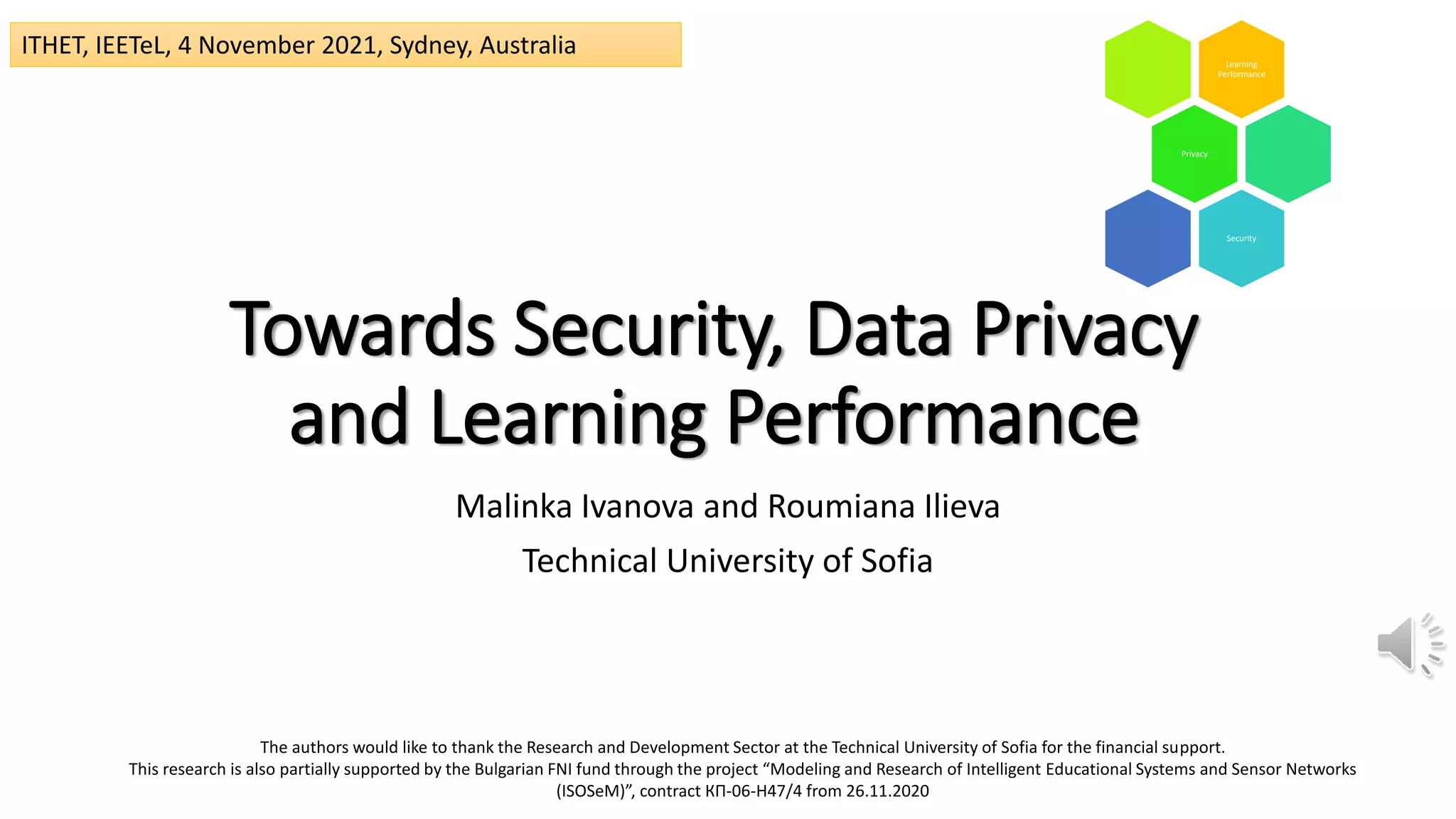
Learning
Performance
Privacy
Security
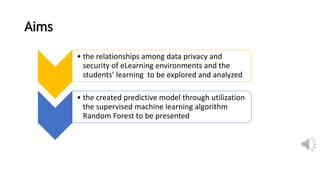
Aims
• the relationships among data privacy and
security of eLearning environments and the
students’ learning to be explored and analyzed
• the created predictive model through utilization
the supervised machine learning algorithm
Random Forest to be presented
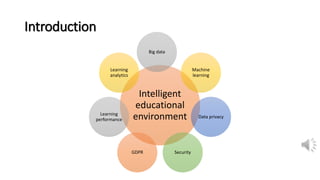
Introduction
Intelligent
educational
environment
Big data
Machine
learning
Data privacy
Security
GDPR
Learning
performance
Learning
analytics
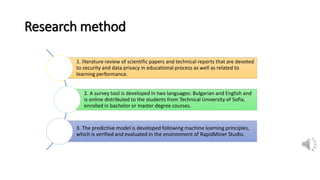
Research method
1. literature review of scientific papers and technical reports that are devoted
to security and data privacy in educational process as well as related to
learning performance.
2. A survey tool is developed in two languages: Bulgarian and English and
is online distributed to the students from Technical University of Sofia,
enrolled in bachelor or master degree courses.
3. The predictive model is developed following machine learning principles,
which is verified and evaluated in the environment of RapidMiner Studio.
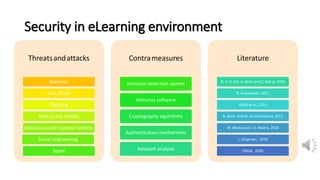
Security in eLearning environment
Threatsandattacks
Malware
DoS, DDoS
Phishing
Man in the middle
Malicious code injection attacks
Social engineering
Spam
Contrameasures
Intrusion detection system
Antivirus software
Cryptography algorithms
Authentication mechanisms
Network analysis
Literature
N. H. P. Dai, A. Kerti, and Z. Rajnai, 2016
R. Grzybowski, 2011
Rjaibi et al., 2012
N. Barik and Dr. Sunil Karforma, 2012
M. Bhatia and J. K. Maitra, 2018
J. Chapman, 2020
ENISA, 2020
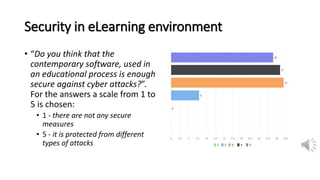
Security in eLearning environment
• “Do you think that the
contemporary software, used in
an educational process is enough
secure against cyber attacks?”.
For the answers a scale from 1 to
5 is chosen:
• 1 - there are not any secure
measures
• 5 - it is protected from different
types of attacks
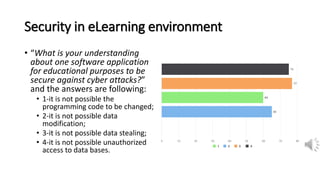
Security in eLearning environment
• “What is your understanding
about one software application
for educational purposes to be
secure against cyber attacks?”
and the answers are following:
• 1-it is not possible the
programming code to be changed;
• 2-it is not possible data
modification;
• 3-it is not possible data stealing;
• 4-it is not possible unauthorized
access to data bases.
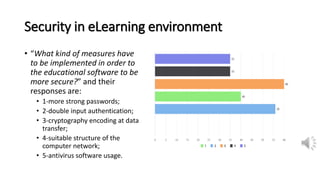
Security in eLearning environment
• “What kind of measures have
to be implemented in order to
the educational software to be
more secure?” and their
responses are:
• 1-more strong passwords;
• 2-double input authentication;
• 3-cryptography encoding at data
transfer;
• 4-suitable structure of the
computer network;
• 5-antivirus software usage.
Security in eLearning environment
• The purpose of the next question “What do you think is the most commonly used
attack/s on educational software?” is to see the students’ knowledge and
experience with contemporary attacks and their consequences.
• Among the most applied attacks against educational software are the following:
• malware software for attacking,
• phishing,
• DoS and DDoS (Distributed DoS) attacks,
• SQL injection attack,
• XSS attacks,
• spoofing,
• man in the middle,
• passwords and personal data stealing,
• social engineering,
• spam emails.
Data privacy protection
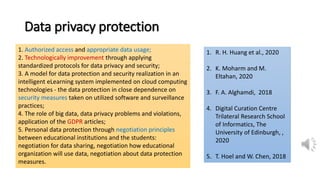
1. Authorized access and appropriate data usage;
2. Technologically improvement through applying
standardized protocols for data privacy and security;
3. A model for data protection and security realization in an
intelligent eLearning system implemented on cloud computing
technologies - the data protection in close dependence on
security measures taken on utilized software and surveillance
practices;
4. The role of big data, data privacy problems and violations,
application of the GDPR articles;
5. Personal data protection through negotiation principles
between educational institutions and the students:
negotiation for data sharing, negotiation how educational
organization will use data, negotiation about data protection
measures.
1. R. H. Huang et al., 2020
2. K. Moharm and M.
Eltahan, 2020
3. F. A. Alghamdi, 2018
4. Digital Curation Centre
Trilateral Research School
of Informatics, The
University of Edinburgh, ,
2020
5. T. Hoel and W. Chen, 2018
Data privacy protection
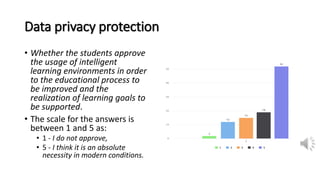
• Whether the students approve
the usage of intelligent
learning environments in order
to the educational process to
be improved and the
realization of learning goals to
be supported.
• The scale for the answers is
between 1 and 5 as:
• 1 - I do not approve,
• 5 - I think it is an absolute
necessity in modern conditions.
Data privacy protection
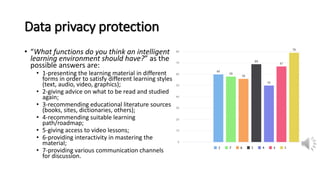
• “What functions do you think an intelligent
learning environment should have?” as the
possible answers are:
• 1-presenting the learning material in different
forms in order to satisfy different learning styles
(text, audio, video, graphics);
• 2-giving advice on what to be read and studied
again;
• 3-recommending educational literature sources
(books, sites, dictionaries, others);
• 4-recommending suitable learning
path/roadmap;
• 5-giving access to video lessons;
• 6-providing interactivity in mastering the
material;
• 7-providing various communication channels
for discussion.
Data privacy protection
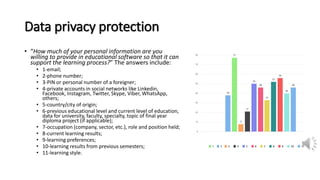
• “How much of your personal information are you
willing to provide in educational software so that it can
support the learning process?” The answers include:
• 1-email;
• 2-phone number;
• 3-PIN or personal number of a foreigner;
• 4-private accounts in social networks like Linkedin,
Facebook, Instagram, Twitter, Skype, Viber, WhatsApp,
others;
• 5-country/city of origin;
• 6-previous educational level and current level of education,
data for university, faculty, specialty, topic of final year
diploma project (if applicable);
• 7-occupation (company, sector, etc.), role and position held;
• 8-current learning results;
• 9-learning preferences;
• 10-learning results from previous semesters;
• 11-learning style.
Data privacy protection
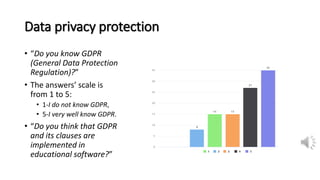
• “Do you know GDPR
(General Data Protection
Regulation)?”
• The answers’ scale is
from 1 to 5:
• 1-I do not know GDPR,
• 5-I very well know GDPR.
• “Do you think that GDPR
and its clauses are
implemented in
educational software?”
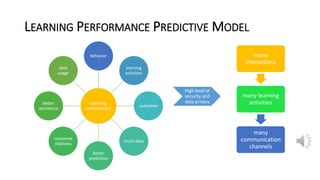
LEARNING PERFORMANCE PREDICTIVE MODEL
Learning
performance
behavior
learning
activities
outcomes
much data
better
prediction
recomme
ndations
better
assistance
data
usage
High level of
security and
data privacy
many
interactions
many learning
activities
many
communication
channels
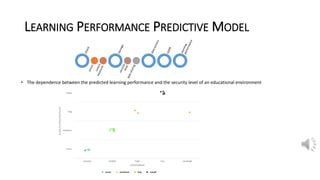
LEARNING PERFORMANCE PREDICTIVE MODEL
• The dependence between the predicted learning performance and the security level of an educational environment
Discussion
• Technological advancements, including artificial intelligence have their reflection on functionality of
contemporary LMSs and eLearning arrangement.
• More and more data are collected, analyzed and prepared in the form of reports in order to explain the
students’ behavior, learning activities and progress.
• The number and complexity of cyber attacks increases in global scale.
• The developers of educational software and training organizations are looking for appropriate solutions to
propose secure environment to the students and their private data to be stored in safe repositories.
• GDPR regulations pose the main principles and requirements in defense of data privacy.
Discussion
•The students' sense of security when conducting learning activities is related to their learning behavior and data sharing, to
their requirements for high qualitative educational process and to the expectation for learning performance improvement.
•A big part of the students gives their high vote regarding the educational software security as in the same time they agree
about the most utilized contemporary cyber attacks.
•The students share their high expectations regarding the level of intelligence of the organized educational environment.
•Тhey tend to provide the necessary amount of data to receive high quality training, including to disclosure the sensitive data.
•The students have some knowledge about the articles in GDPR as well as they think its clauses have not yet been
implemented at the required level.
Conclusion
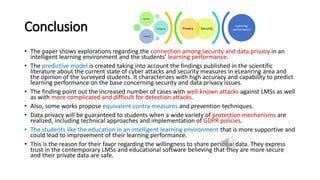
• The paper shows explorations regarding the connection among security and data privacy in an
intelligent learning environment and the students’ learning performance.
• The predictive model is created taking into account the findings published in the scientific
literature about the current state of cyber attacks and security measures in eLeanring area and
the opinion of the surveyed students. It characterizes with high accuracy and capability to predict
learning performance on the base concerning security and data privacy issues.
• The finding point out the increased number of cases with well-known attacks against LMSs as well
as with more complicated and difficult for detection attacks.
• Also, some works propose equivalent contra measures and prevention techniques.
• Data privacy will be guaranteed to students when a wide variety of protection mechanisms are
realized, including technical approaches and implementation of GDPR policies.
• The students like the education in an intelligent learning environment that is more supportive and
could lead to improvement of their learning performance.
• This is the reason for their favor regarding the willingness to share personal data. They express
trust in the contemporary LMSs and educational software believing that they are more secure
and their private data are safe.
Privacy Security
Big data
intelligence
Analytics
Learning
performance
Thank
you
for your attention!

144 presentation iee_tel2021

  • 1.
    Towards Security, DataPrivacy and Learning Performance Malinka Ivanova and Roumiana Ilieva Technical University of Sofia ITHET, IEETeL, 4 November 2021, Sydney, Australia The authors would like to thank the Research and Development Sector at the Technical University of Sofia for the financial support. This research is also partially supported by the Bulgarian FNI fund through the project “Modeling and Research of Intelligent Educational Systems and Sensor Networks (ISOSeM)”, contract КП-06-Н47/4 from 26.11.2020 Learning Performance Privacy Security
  • 2.
    Aims • the relationshipsamong data privacy and security of eLearning environments and the students’ learning to be explored and analyzed • the created predictive model through utilization the supervised machine learning algorithm Random Forest to be presented
  • 3.
  • 4.
    Research method 1. literaturereview of scientific papers and technical reports that are devoted to security and data privacy in educational process as well as related to learning performance. 2. A survey tool is developed in two languages: Bulgarian and English and is online distributed to the students from Technical University of Sofia, enrolled in bachelor or master degree courses. 3. The predictive model is developed following machine learning principles, which is verified and evaluated in the environment of RapidMiner Studio.
  • 5.
    Security in eLearningenvironment Threatsandattacks Malware DoS, DDoS Phishing Man in the middle Malicious code injection attacks Social engineering Spam Contrameasures Intrusion detection system Antivirus software Cryptography algorithms Authentication mechanisms Network analysis Literature N. H. P. Dai, A. Kerti, and Z. Rajnai, 2016 R. Grzybowski, 2011 Rjaibi et al., 2012 N. Barik and Dr. Sunil Karforma, 2012 M. Bhatia and J. K. Maitra, 2018 J. Chapman, 2020 ENISA, 2020
  • 6.
    Security in eLearningenvironment • “Do you think that the contemporary software, used in an educational process is enough secure against cyber attacks?”. For the answers a scale from 1 to 5 is chosen: • 1 - there are not any secure measures • 5 - it is protected from different types of attacks
  • 7.
    Security in eLearningenvironment • “What is your understanding about one software application for educational purposes to be secure against cyber attacks?” and the answers are following: • 1-it is not possible the programming code to be changed; • 2-it is not possible data modification; • 3-it is not possible data stealing; • 4-it is not possible unauthorized access to data bases.
  • 8.
    Security in eLearningenvironment • “What kind of measures have to be implemented in order to the educational software to be more secure?” and their responses are: • 1-more strong passwords; • 2-double input authentication; • 3-cryptography encoding at data transfer; • 4-suitable structure of the computer network; • 5-antivirus software usage.
  • 9.
    Security in eLearningenvironment • The purpose of the next question “What do you think is the most commonly used attack/s on educational software?” is to see the students’ knowledge and experience with contemporary attacks and their consequences. • Among the most applied attacks against educational software are the following: • malware software for attacking, • phishing, • DoS and DDoS (Distributed DoS) attacks, • SQL injection attack, • XSS attacks, • spoofing, • man in the middle, • passwords and personal data stealing, • social engineering, • spam emails.
  • 10.
    Data privacy protection 1.Authorized access and appropriate data usage; 2. Technologically improvement through applying standardized protocols for data privacy and security; 3. A model for data protection and security realization in an intelligent eLearning system implemented on cloud computing technologies - the data protection in close dependence on security measures taken on utilized software and surveillance practices; 4. The role of big data, data privacy problems and violations, application of the GDPR articles; 5. Personal data protection through negotiation principles between educational institutions and the students: negotiation for data sharing, negotiation how educational organization will use data, negotiation about data protection measures. 1. R. H. Huang et al., 2020 2. K. Moharm and M. Eltahan, 2020 3. F. A. Alghamdi, 2018 4. Digital Curation Centre Trilateral Research School of Informatics, The University of Edinburgh, , 2020 5. T. Hoel and W. Chen, 2018
  • 11.
    Data privacy protection •Whether the students approve the usage of intelligent learning environments in order to the educational process to be improved and the realization of learning goals to be supported. • The scale for the answers is between 1 and 5 as: • 1 - I do not approve, • 5 - I think it is an absolute necessity in modern conditions.
  • 12.
    Data privacy protection •“What functions do you think an intelligent learning environment should have?” as the possible answers are: • 1-presenting the learning material in different forms in order to satisfy different learning styles (text, audio, video, graphics); • 2-giving advice on what to be read and studied again; • 3-recommending educational literature sources (books, sites, dictionaries, others); • 4-recommending suitable learning path/roadmap; • 5-giving access to video lessons; • 6-providing interactivity in mastering the material; • 7-providing various communication channels for discussion.
  • 13.
    Data privacy protection •“How much of your personal information are you willing to provide in educational software so that it can support the learning process?” The answers include: • 1-email; • 2-phone number; • 3-PIN or personal number of a foreigner; • 4-private accounts in social networks like Linkedin, Facebook, Instagram, Twitter, Skype, Viber, WhatsApp, others; • 5-country/city of origin; • 6-previous educational level and current level of education, data for university, faculty, specialty, topic of final year diploma project (if applicable); • 7-occupation (company, sector, etc.), role and position held; • 8-current learning results; • 9-learning preferences; • 10-learning results from previous semesters; • 11-learning style.
  • 14.
    Data privacy protection •“Do you know GDPR (General Data Protection Regulation)?” • The answers’ scale is from 1 to 5: • 1-I do not know GDPR, • 5-I very well know GDPR. • “Do you think that GDPR and its clauses are implemented in educational software?”
  • 15.
    LEARNING PERFORMANCE PREDICTIVEMODEL Learning performance behavior learning activities outcomes much data better prediction recomme ndations better assistance data usage High level of security and data privacy many interactions many learning activities many communication channels
  • 16.
    LEARNING PERFORMANCE PREDICTIVEMODEL • The dependence between the predicted learning performance and the security level of an educational environment
  • 17.
    Discussion • Technological advancements,including artificial intelligence have their reflection on functionality of contemporary LMSs and eLearning arrangement. • More and more data are collected, analyzed and prepared in the form of reports in order to explain the students’ behavior, learning activities and progress. • The number and complexity of cyber attacks increases in global scale. • The developers of educational software and training organizations are looking for appropriate solutions to propose secure environment to the students and their private data to be stored in safe repositories. • GDPR regulations pose the main principles and requirements in defense of data privacy.
  • 18.
    Discussion •The students' senseof security when conducting learning activities is related to their learning behavior and data sharing, to their requirements for high qualitative educational process and to the expectation for learning performance improvement. •A big part of the students gives their high vote regarding the educational software security as in the same time they agree about the most utilized contemporary cyber attacks. •The students share their high expectations regarding the level of intelligence of the organized educational environment. •Тhey tend to provide the necessary amount of data to receive high quality training, including to disclosure the sensitive data. •The students have some knowledge about the articles in GDPR as well as they think its clauses have not yet been implemented at the required level.
  • 19.
    Conclusion • The papershows explorations regarding the connection among security and data privacy in an intelligent learning environment and the students’ learning performance. • The predictive model is created taking into account the findings published in the scientific literature about the current state of cyber attacks and security measures in eLeanring area and the opinion of the surveyed students. It characterizes with high accuracy and capability to predict learning performance on the base concerning security and data privacy issues. • The finding point out the increased number of cases with well-known attacks against LMSs as well as with more complicated and difficult for detection attacks. • Also, some works propose equivalent contra measures and prevention techniques. • Data privacy will be guaranteed to students when a wide variety of protection mechanisms are realized, including technical approaches and implementation of GDPR policies. • The students like the education in an intelligent learning environment that is more supportive and could lead to improvement of their learning performance. • This is the reason for their favor regarding the willingness to share personal data. They express trust in the contemporary LMSs and educational software believing that they are more secure and their private data are safe. Privacy Security Big data intelligence Analytics Learning performance
  • 20.