Diversity in Recommender System
How to extend SINGLE-CRITERIA RecommenderSystems ?
Author :
DAVIDEGIANNICO
Specialists formanaging information systems basedon the semantic manipulation of information -
University of Bari
Multi-Criteria Recommender Systems
Outline
• Introduction to RECOMMENDERSYSTEMS
•Introduction to MULTI-CRITERIARECOMMENDER SYSTEMS(MCRS)
•MCRS :TYPOLOGIES & Some recentworks
•OPENISSUES AND CHALLENGES
Specialists formanaging information systems basedon the semantic manipulation of information -
University of Bari
Multi-Criteria Recommender Systems - Specialists formanaging information systems
based on the semantic manipulation of information -University of Bari
InformationOverload
How much Information?
Multi-Criteria Recommender Systems - Specialists formanaging information systemsbased on the
semantic manipulation of information - University of Bari
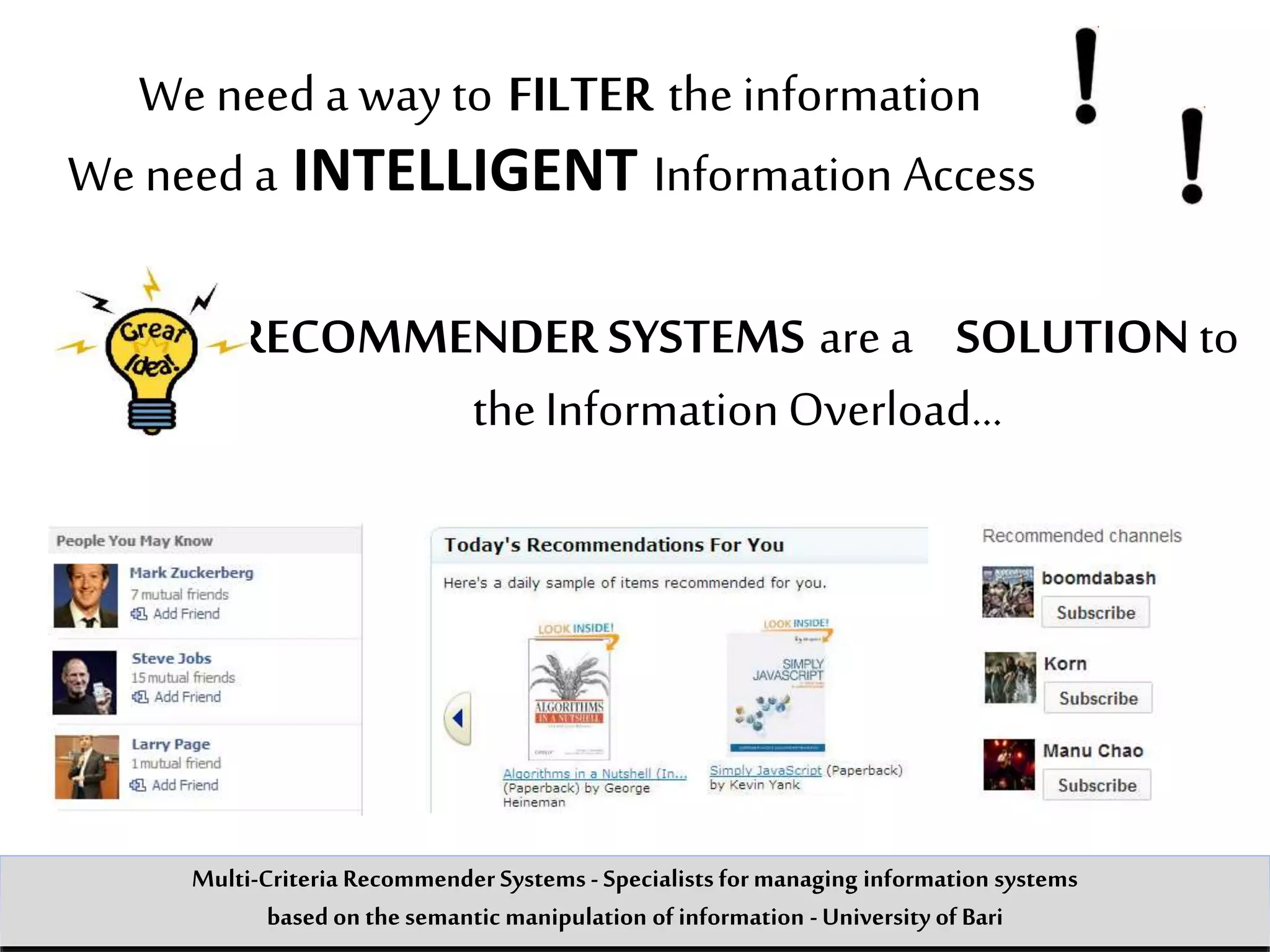
RECOMMENDER SYSTEMS are a SOLUTION to
the InformationOverload…
We need a INTELLIGENT Information Access
We need a way to FILTER the information
Multi-Criteria Recommender Systems - Specialists formanaging information systems
based on the semantic manipulation of information -University of Bari
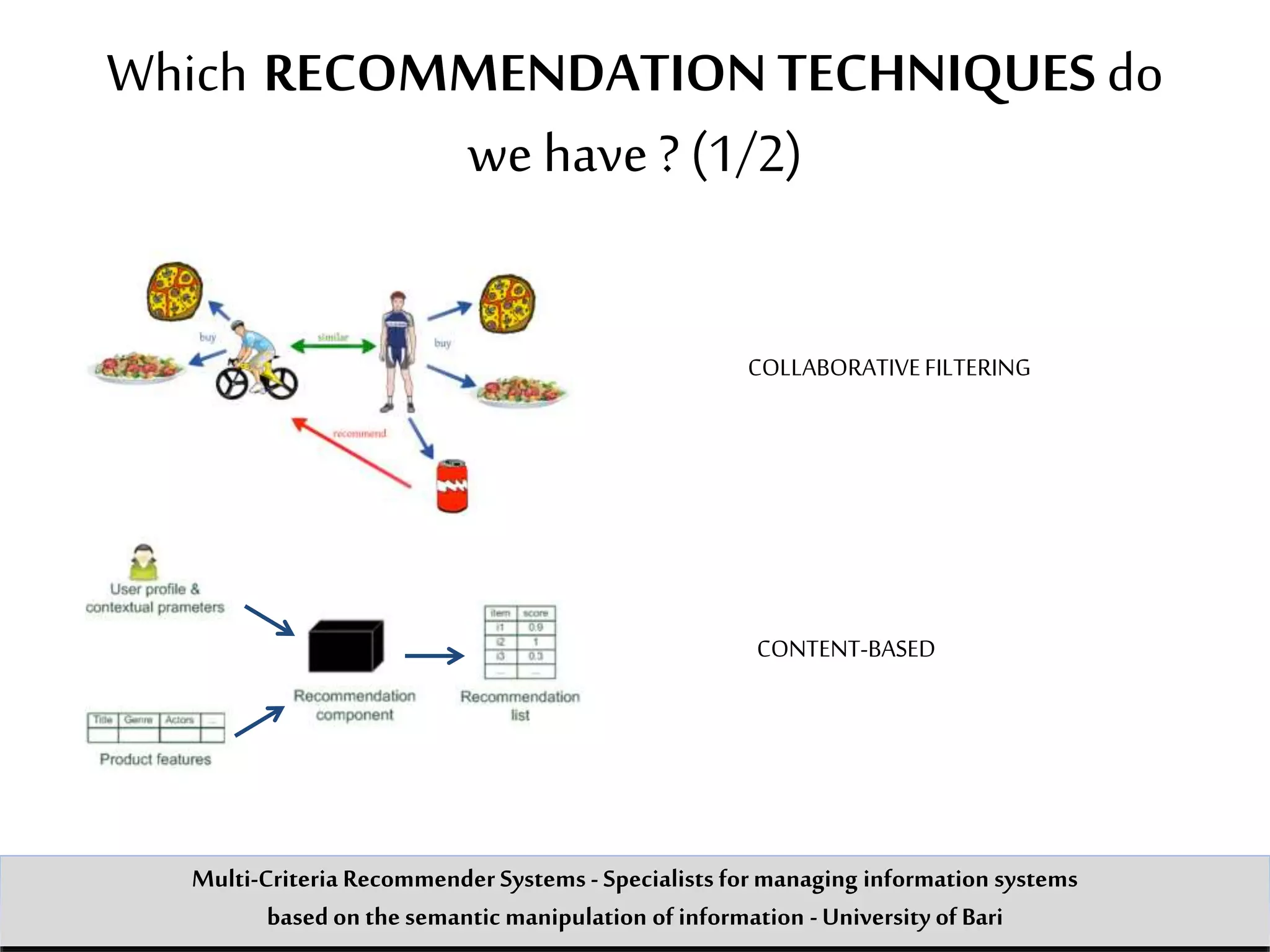
Which RECOMMENDATIONTECHNIQUES do
we have ? (1/2)
COLLABORATIVEFILTERING
CONTENT-BASED
Multi-Criteria Recommender Systems - Specialists formanaging information systems
based on the semantic manipulation of information -University of Bari
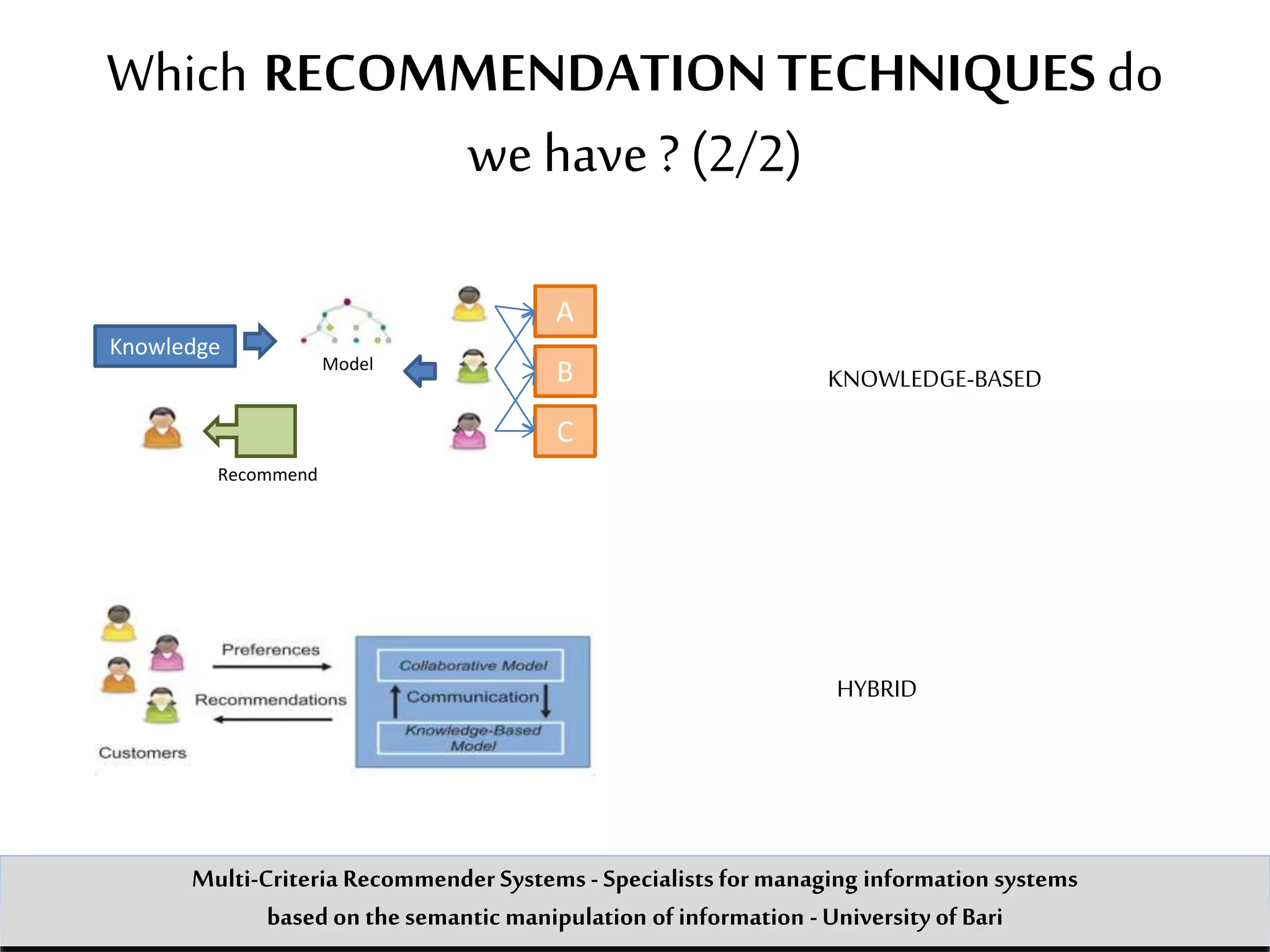
HYBRID
KNOWLEDGE-BASED
Which RECOMMENDATIONTECHNIQUES do
we have ? (2/2)
Knowledge
A
B
C
Recommend
Model
Multi-Criteria Recommender Systems - Specialists formanaging information systems
based on the semantic manipulation of information -University of Bari
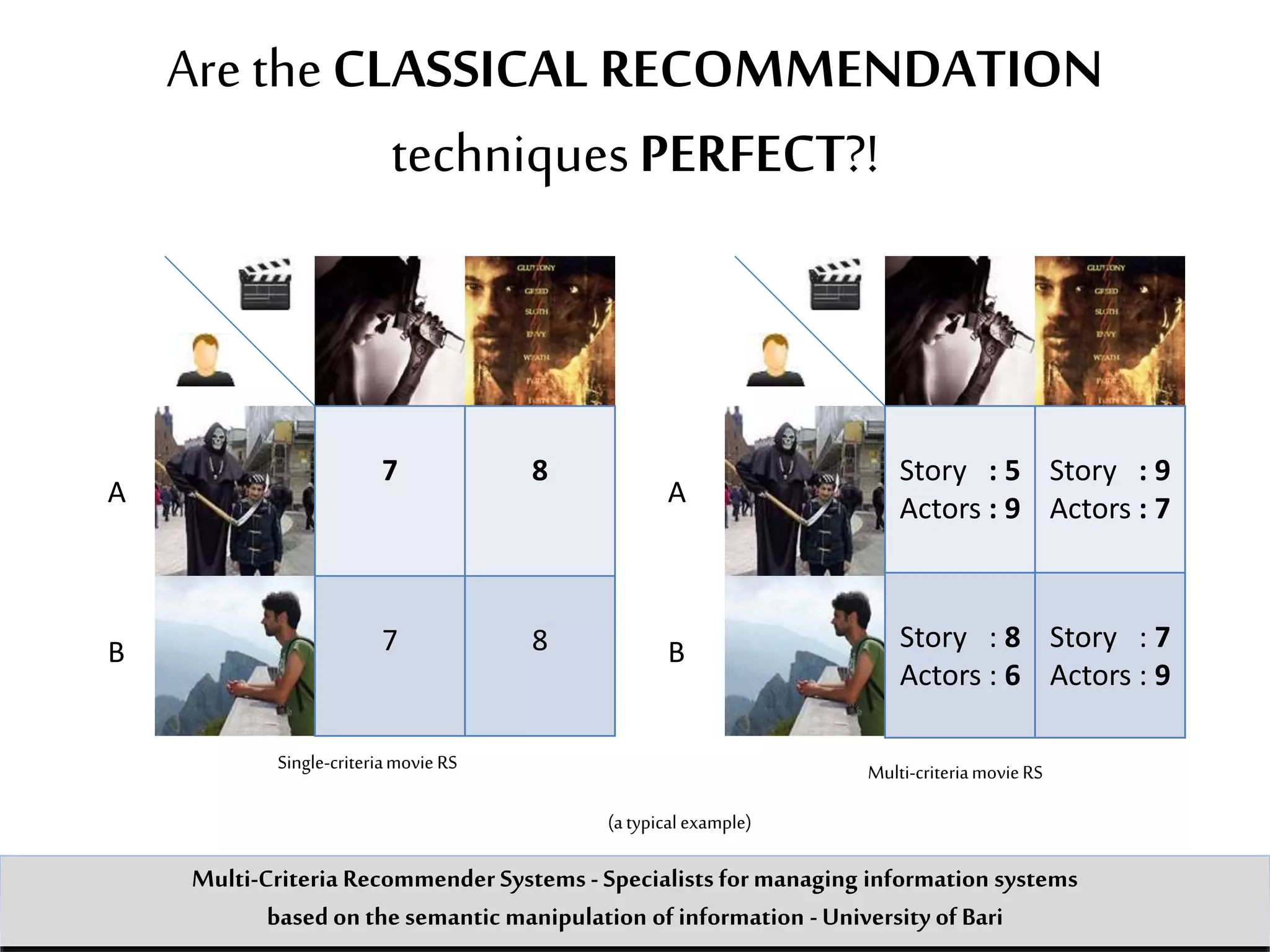
Are theCLASSICAL RECOMMENDATION
techniquesPERFECT?!
Single-criteriamovieRS Multi-criteriamovieRS
7 8
7 8
Story : 5
Actors : 9
Story : 9
Actors : 7
Story : 8
Actors : 6
Story : 7
Actors : 9
(atypicalexample)
Multi-Criteria Recommender Systems - Specialists formanaging information systems
based on the semantic manipulation of information -University of Bari
A
B
A
B
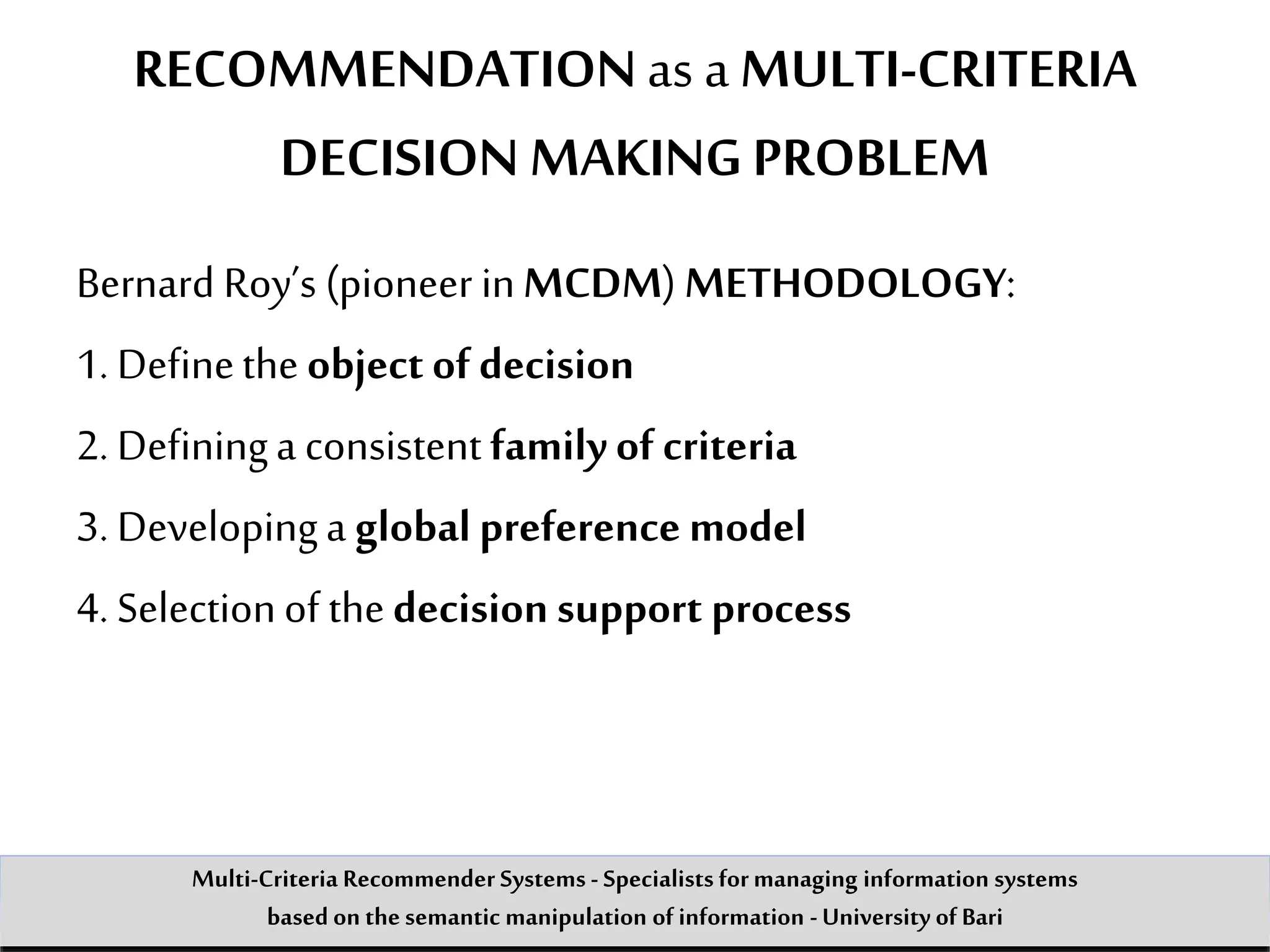
RECOMMENDATIONas a MULTI-CRITERIA
DECISION MAKING PROBLEM
Bernard Roy’s (pioneer inMCDM) METHODOLOGY:
1. Definethe object of decision
2. Defininga consistent familyof criteria
3. Developinga global preference model
4. Selectionof thedecision support process
Multi-Criteria Recommender Systems - Specialists formanaging information systems
based on the semantic manipulation of information -University of Bari
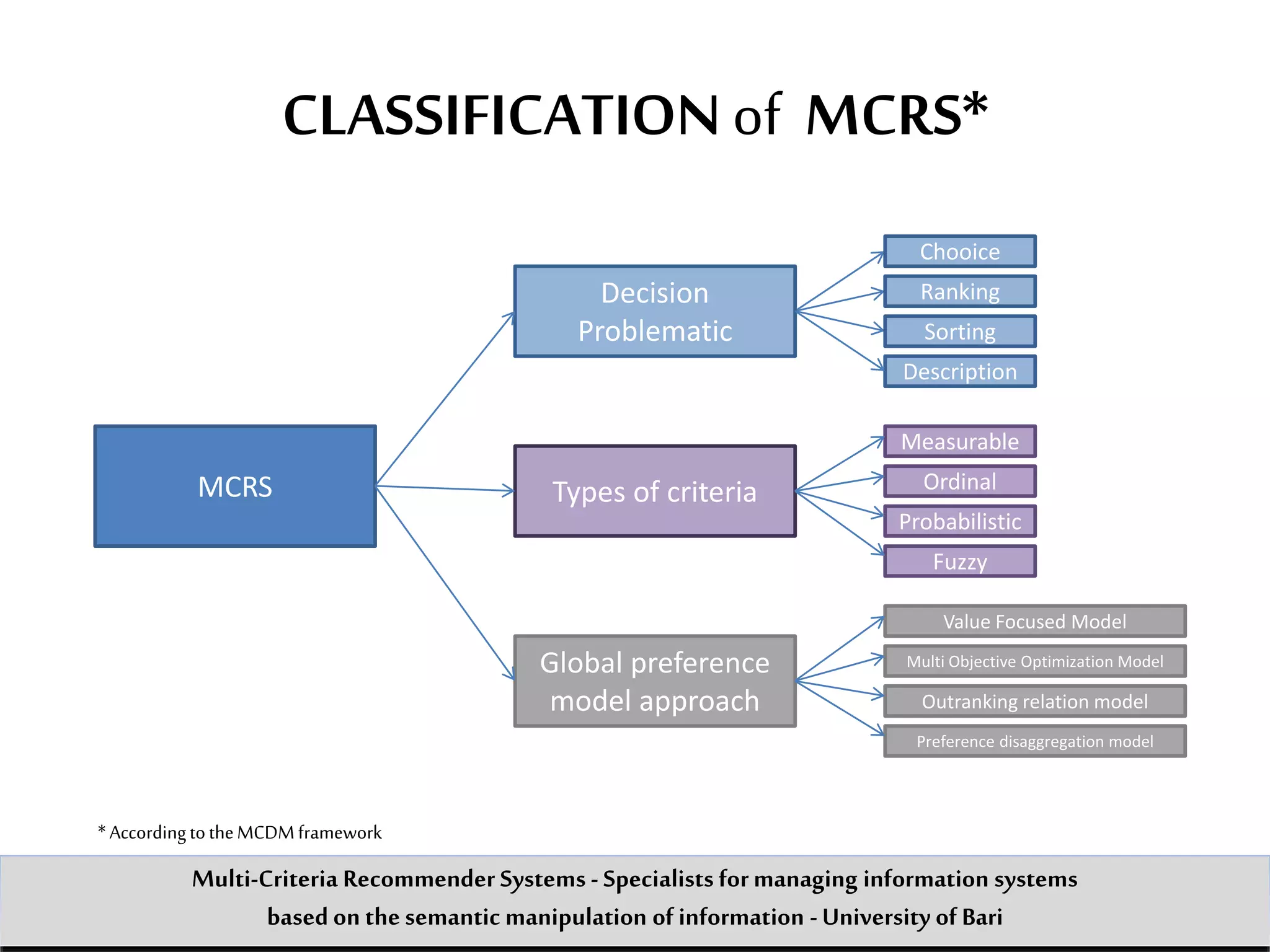
CLASSIFICATIONof MCRS*
MCRS
Decision
Problematic
Types of criteria
Global preference
model approach
*AccordingtotheMCDM framework
Multi-Criteria Recommender Systems - Specialists formanaging information systems
based on the semantic manipulation of information -University of Bari
Chooice
Ranking
Sorting
Description
Measurable
Ordinal
Probabilistic
Fuzzy
Value Focused Model
Multi Objective Optimization Model
Outranking relation model
Preference disaggregation model
*AccordingtoraccomandationApproach
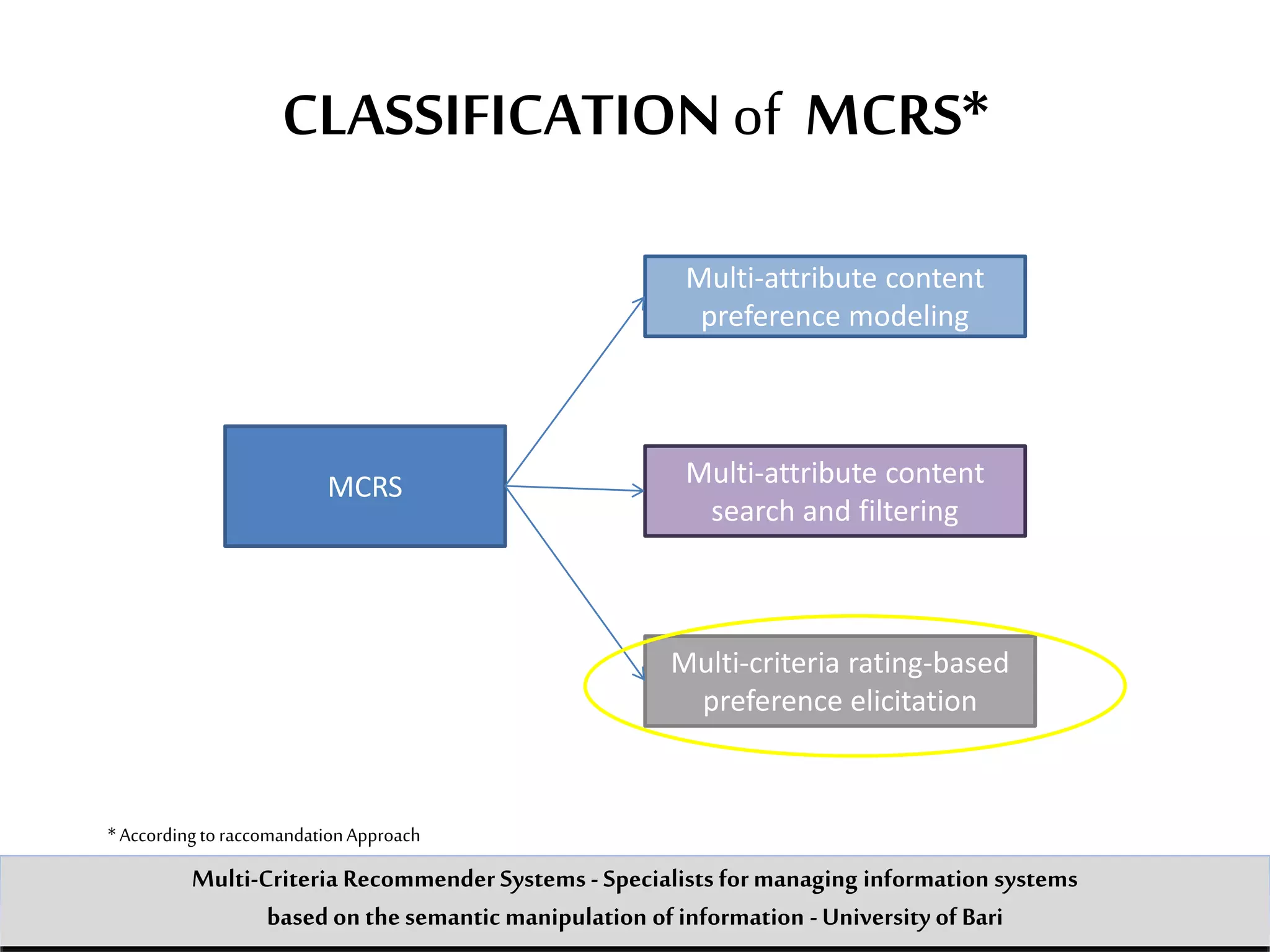
CLASSIFICATIONof MCRS*
MCRS
Multi-attribute content
preference modeling
Multi-attribute content
search and filtering
Multi-criteria rating-based
preference elicitation
Multi-Criteria Recommender Systems - Specialists formanaging information systems
based on the semantic manipulation of information -University of Bari
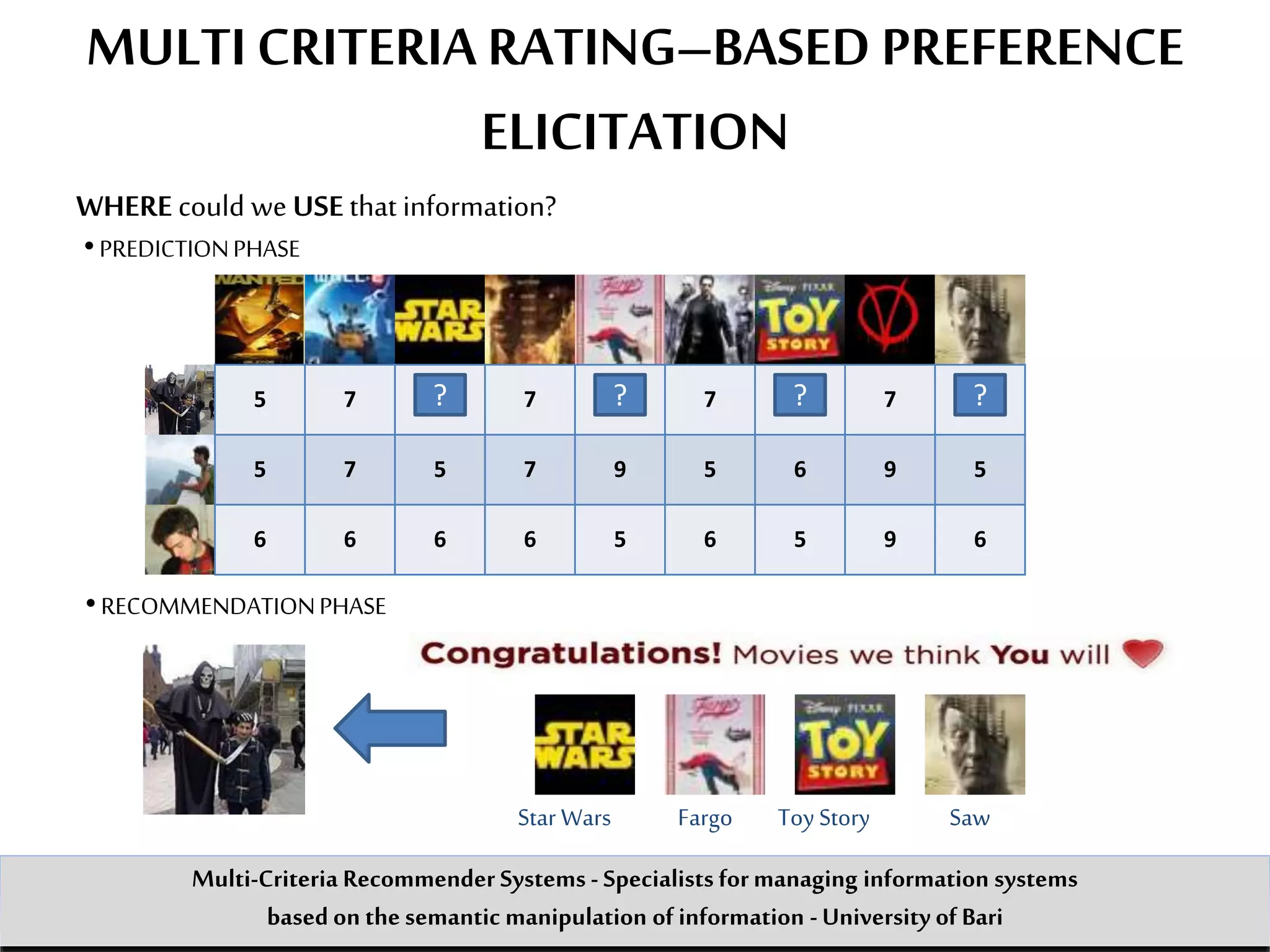
MULTI CRITERIA RATING–BASED PREFERENCE
ELICITATION
WHERE could we USE that information?
5
5
6
7
7
6
5
6
7
7
6
9
5
??? ?7 7
Star Wars Fargo Toy Story Saw
•PREDICTIONPHASE
•RECOMMENDATIONPHASE
6
65 9
95
5 7 ? 7 ? 7 ? 7 ?
5 7 5 7 9 5 6 9 5
6 6 6 6 5 6 5 9 6
? ? ? ?
Multi-Criteria Recommender Systems - Specialists formanaging information systems
based on the semantic manipulation of information -University of Bari
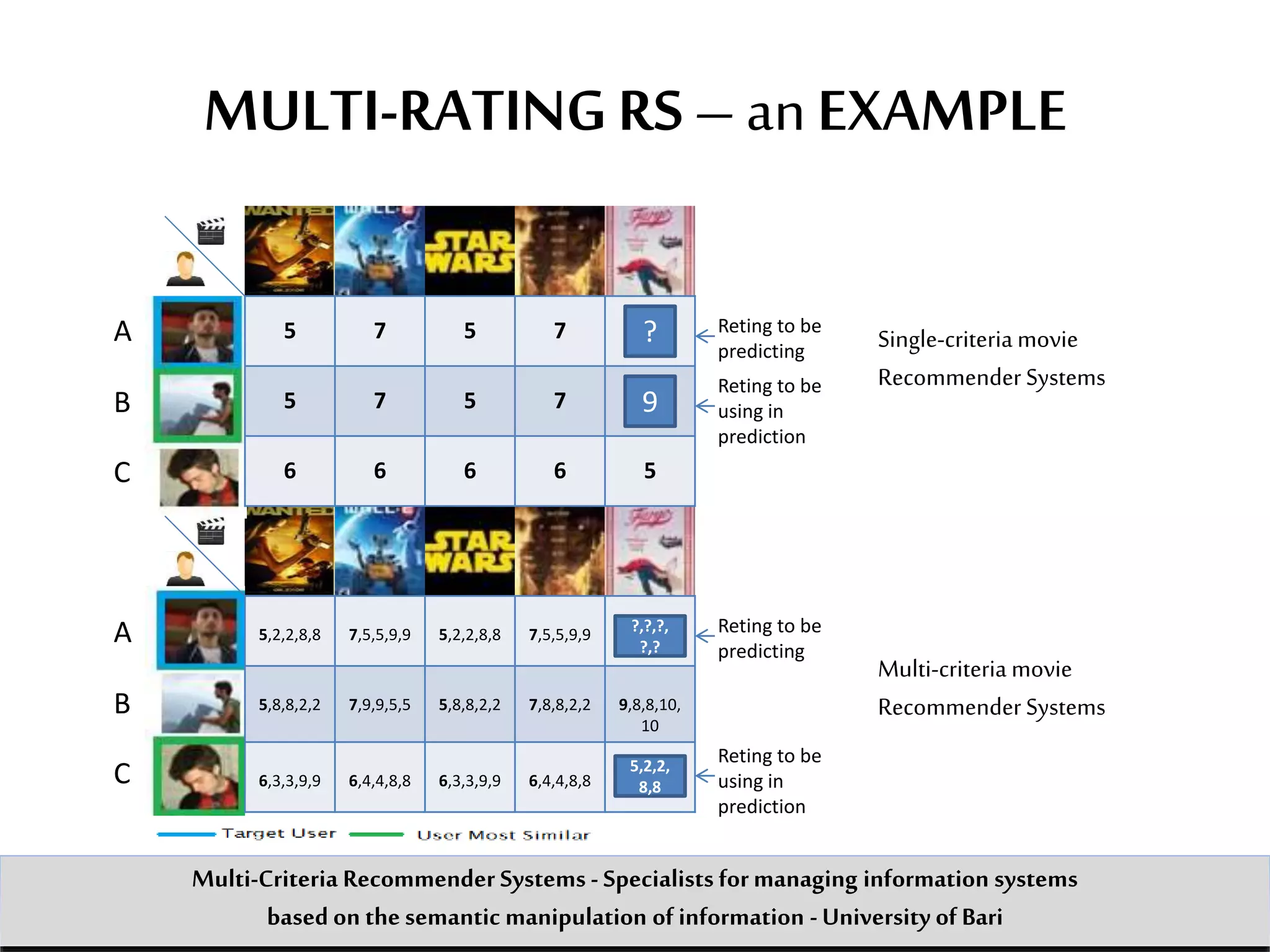
MULTI-RATINGRS –anEXAMPLE
Single-criteriamovie
Recommender Systems
Multi-criteria movie
Recommender Systems
5,2,2,8,8 7,5,5,9,9 5,2,2,8,8 7,5,5,9,9
5,8,8,2,2 7,9,9,5,5 5,8,8,2,2 7,8,8,2,2
6,3,3,9,9 6,4,4,8,8 6,3,3,9,9 6,4,4,8,8
? Reting to be
predicting
Reting to be
using in
prediction
Reting to be
predicting
Reting to be
using in
prediction
5 7 5 7 ?
5 7 5 7 9
6 6 6 6 5
?
9
5,2,2,8,8 7,5,5,9,9 5,2,2,8,8 7,5,5,9,9 ?,?,?,?,?
5,8,8,2,2 7,9,9,5,5 5,8,8,2,2 7,8,8,2,2 9,8,8,10,
10
6,3,3,9,9 6,4,4,8,8 6,3,3,9,9 6,4,4,8,8 5,2,2,8,8
?,?,?,
?,?
5,2,2,
8,8
Multi-Criteria Recommender Systems - Specialists formanaging information systems
based on the semantic manipulation of information -University of Bari
A
B
C
A
B
C
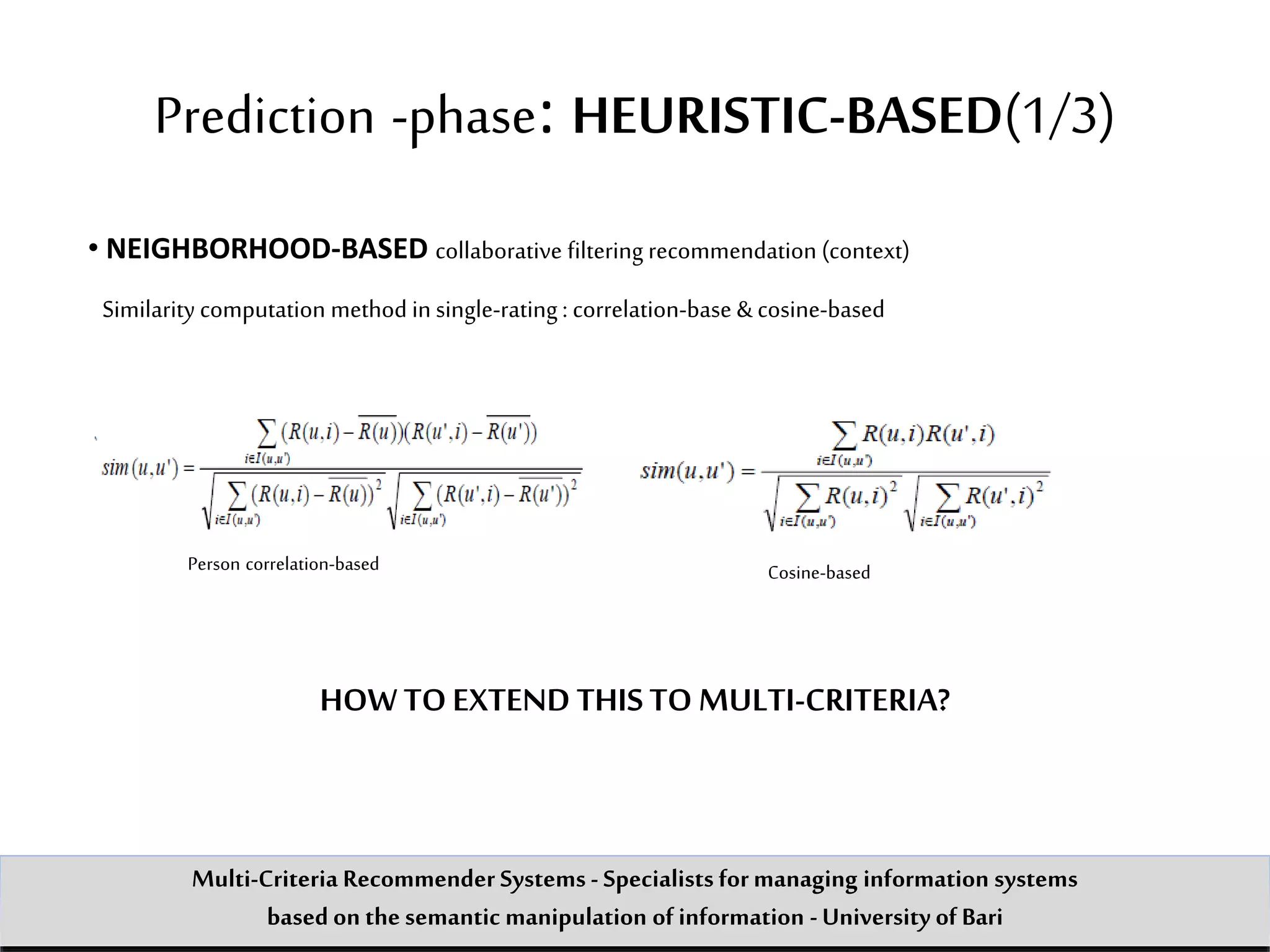
Prediction -phase: HEURISTIC-BASED(1/3)
• NEIGHBORHOOD-BASED collaborative filtering recommendation (context)
Similarity computation method in single-rating : correlation-base &cosine-based
Person correlation-based Cosine-based
HOW TOEXTEND THISTO MULTI-CRITERIA?
Multi-Criteria Recommender Systems - Specialists formanaging information systems
based on the semantic manipulation of information -University of Bari
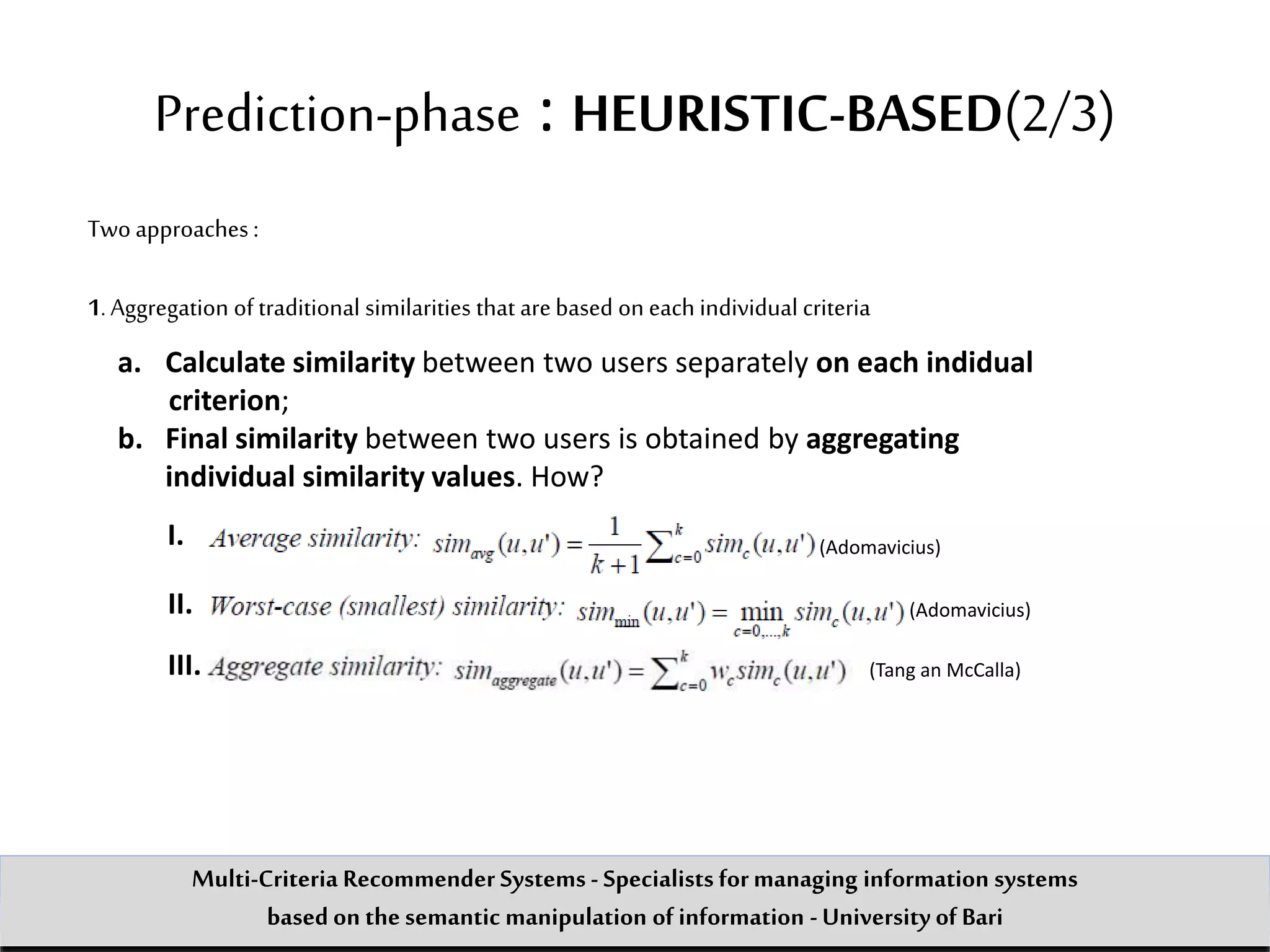
Prediction-phase : HEURISTIC-BASED(2/3)
Two approaches :
1.Aggregation of traditional similarities that arebased on each individual criteria
a. Calculate similarity between two users separately on each indidual
criterion;
b. Final similarity between two users is obtained by aggregating
individual similarity values. How?
I.
II.
(Adomavicius)
(Adomavicius)
III. (Tang an McCalla)
Multi-Criteria Recommender Systems - Specialists formanaging information systems
based on the semantic manipulation of information -University of Bari
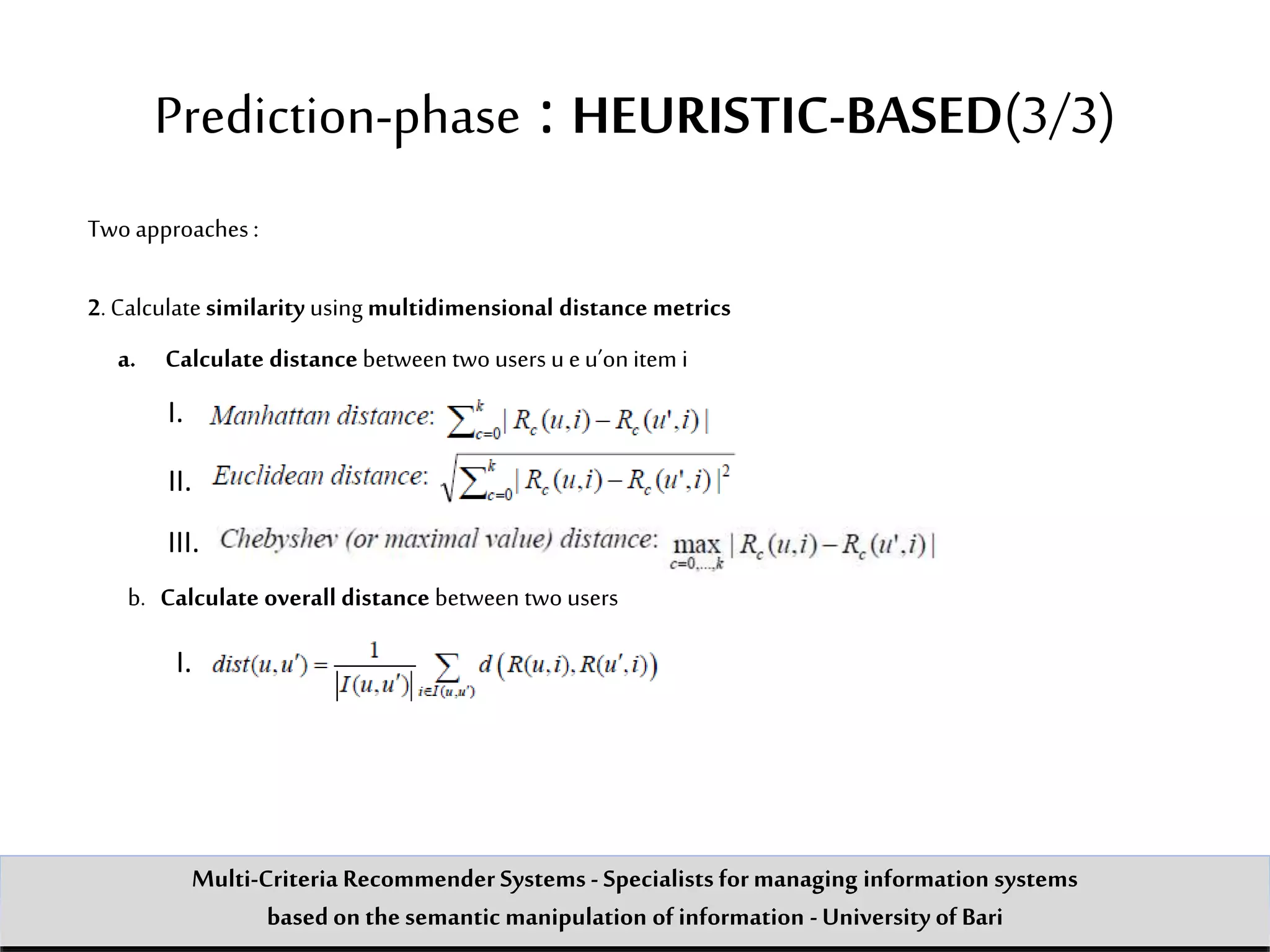
Two approaches :
2.Calculate similarity using multidimensional distance metrics
a. Calculate distance between two users u eu’on item i
I.
II.
III.
b. Calculate overall distance between two users
I.
Prediction-phase : HEURISTIC-BASED(3/3)
Multi-Criteria Recommender Systems - Specialists formanaging information systems
based on the semantic manipulation of information -University of Bari
Do they workBETTER?
Empirical results using the small-scale Yahoo! Movies dataset show that BOTH HEURISTIC APPROACHES
OUTPERFORM thecorresponding traditional single-rating collaborative filtering technique byup 3.8% in
terms of precision-in-top-Nmertric.
Multi-Criteria Recommender Systems - Specialists formanaging information systems
based on the semantic manipulation of information -University of Bari
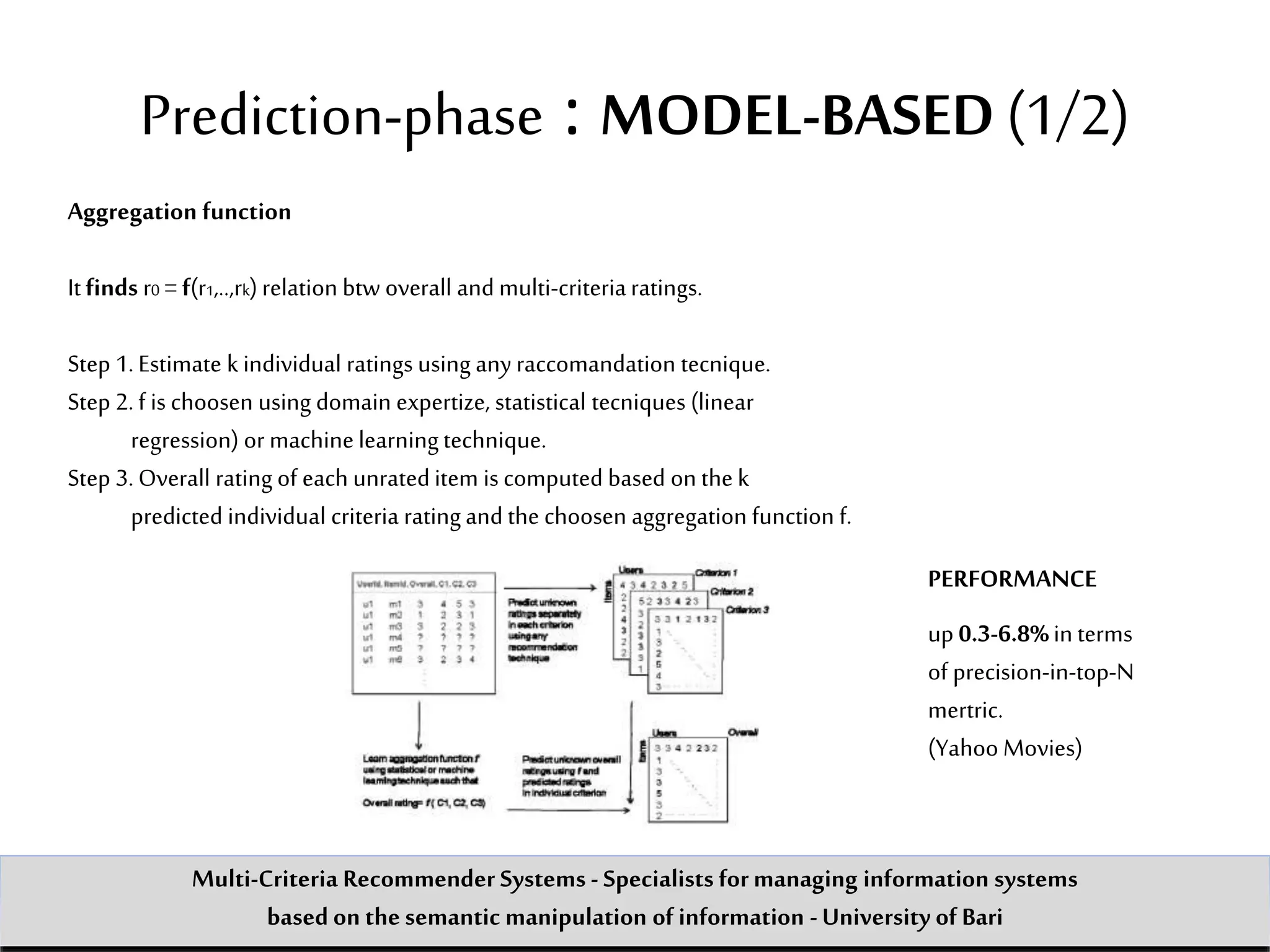
Aggregation function
Itfinds r0 = f(r1,..,rk)relation btw overall and multi-criteriaratings.
Step 1.Estimate k individual ratings using any raccomandation tecnique.
Step 2.f is choosen using domain expertize, statistical tecniques (linear
regression) or machinelearningtechnique.
Step 3. Overall rating of each unrateditem is computed based on the k
predicted individual criteria ratingand the choosen aggregation function f.
up 0.3-6.8%in terms
of precision-in-top-N
mertric.
(Yahoo Movies)
Prediction-phase : MODEL-BASED (1/2)
Multi-Criteria Recommender Systems - Specialists formanaging information systems
based on the semantic manipulation of information -University of Bari
PERFORMANCE
Other Approaches:
•Probabilstic Modeling Approach (Sahoo et all.)
(Yahoo Movies!; Precision/Recall-in-top-Nmertric -maximum of 10%increase)
•Multi singular value decomposition(MSVD) approach (Li et all.)
(Collaborative filtering; context of restaurant recommendersystems, Precision-in-top-Nmertric - maxiumumof
5% increase).
Prediction-phase : MODEL-BASED(2/2)
Multi-Criteria Recommender Systems - Specialists formanaging information systems
based on the semantic manipulation of information -University of Bari
Recommendation-phase
When overall ratings are included as partof the model , theraccomandation process is very
straightforward, essentially the same as in single-criteria RS.
Without an overall rating the recommandation process becomes more complex.
Approaches for Multi-criteria optimization :
- Finding Pareto optimal solutions;
- …..
Multi-Criteria Recommender Systems - Specialists formanaging information systems
based on the semantic manipulation of information -University of Bari
Using Multi-Criteria ratings as RECOMMENDATION
FILTERS
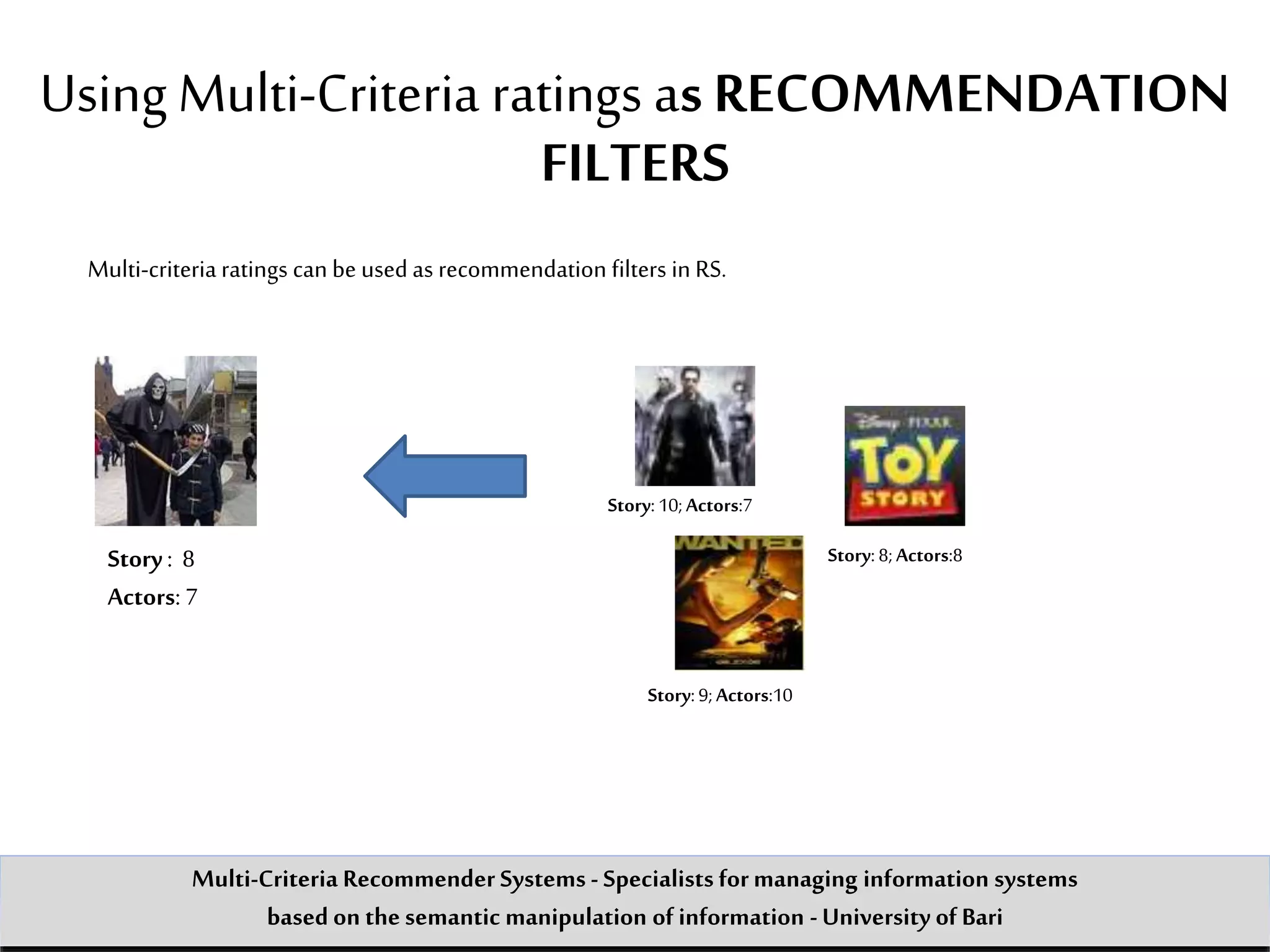
Multi-criteria ratings can be used as recommendation filters in RS.
Story: 8
Actors: 7
Multi-Criteria Recommender Systems - Specialists formanaging information systems
based on the semantic manipulation of information -University of Bari
Story:9;Actors:10
Story:8;Actors:8
Story:10;Actors:7
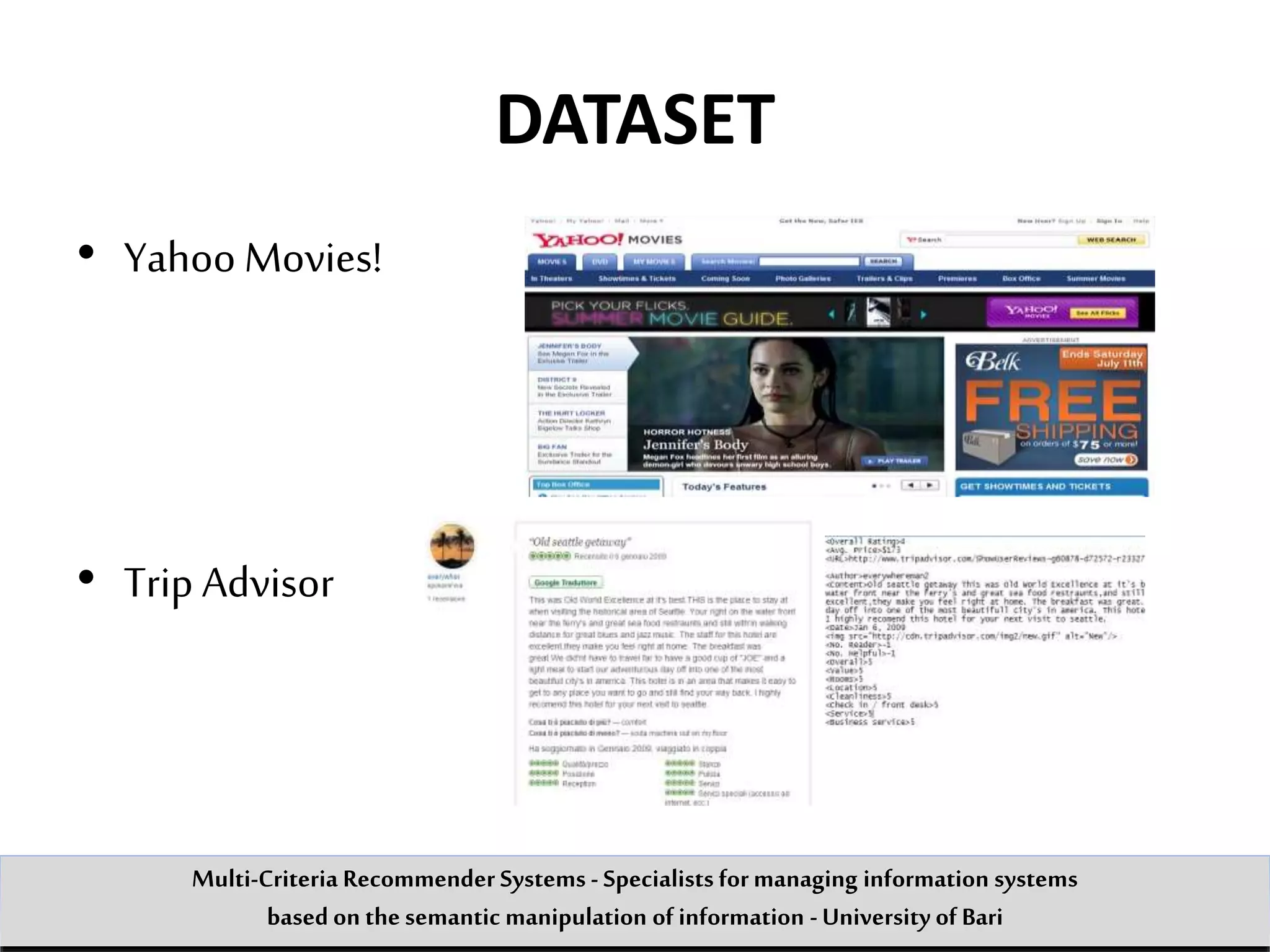
DATASET
• Yahoo Movies!
• Trip Advisor
Multi-Criteria Recommender Systems - Specialists formanaging information systems
based on the semantic manipulation of information -University of Bari
FRAMEWORK
• Single-rating
• Multi-rating: NO ONE!
Multi-Criteria Recommender Systems - Specialists formanaging information systems
based on the semantic manipulation of information -University of Bari
OPEN ISSUES & CHALLENGES
• Managing Intrusivness
• Reusingexisting single-rating
recommendationstechnique
• Costructing theitemevaluation criteria
• Dealing with missing multi-criteriaratings
• Developing newMCDMmodeling approach
• Collecting large-scalemulti criteriaratingdata
Multi-Criteria Recommender Systems - Specialists formanaging information systems
based on the semantic manipulation of information -University of Bari
REFERENCES
• AccuracyImprovementsforMulti-CriteriaRecommenderSystems(DietmarJ., ZeynepK.,FatihG.)
• Multi-CriteriaUserModeling in RecommenderSystems(KleanthiL.,NikolaosF., Alexis T.)
• Multi CriteriaRecommenderSystems(Adomavicius,Manouselis,Kwon)
• NewRecommendationTechniques forMulti-CriteriaRatingSystems(Adomavicius,Kwon)
Multi-Criteria Recommender Systems - Specialists formanaging information systems
based on the semantic manipulation of information -University of Bari

Multi Criteria Recommender Systems - Overview

  • 1.
    Diversity in RecommenderSystem How to extend SINGLE-CRITERIA RecommenderSystems ? Author : DAVIDEGIANNICO Specialists formanaging information systems basedon the semantic manipulation of information - University of Bari Multi-Criteria Recommender Systems
  • 2.
    Outline • Introduction toRECOMMENDERSYSTEMS •Introduction to MULTI-CRITERIARECOMMENDER SYSTEMS(MCRS) •MCRS :TYPOLOGIES & Some recentworks •OPENISSUES AND CHALLENGES Specialists formanaging information systems basedon the semantic manipulation of information - University of Bari Multi-Criteria Recommender Systems - Specialists formanaging information systems based on the semantic manipulation of information -University of Bari
  • 3.
    InformationOverload How much Information? Multi-CriteriaRecommender Systems - Specialists formanaging information systemsbased on the semantic manipulation of information - University of Bari
  • 4.
    RECOMMENDER SYSTEMS area SOLUTION to the InformationOverload… We need a INTELLIGENT Information Access We need a way to FILTER the information Multi-Criteria Recommender Systems - Specialists formanaging information systems based on the semantic manipulation of information -University of Bari
  • 5.
    Which RECOMMENDATIONTECHNIQUES do wehave ? (1/2) COLLABORATIVEFILTERING CONTENT-BASED Multi-Criteria Recommender Systems - Specialists formanaging information systems based on the semantic manipulation of information -University of Bari
  • 6.
    HYBRID KNOWLEDGE-BASED Which RECOMMENDATIONTECHNIQUES do wehave ? (2/2) Knowledge A B C Recommend Model Multi-Criteria Recommender Systems - Specialists formanaging information systems based on the semantic manipulation of information -University of Bari
  • 7.
    Are theCLASSICAL RECOMMENDATION techniquesPERFECT?! Single-criteriamovieRSMulti-criteriamovieRS 7 8 7 8 Story : 5 Actors : 9 Story : 9 Actors : 7 Story : 8 Actors : 6 Story : 7 Actors : 9 (atypicalexample) Multi-Criteria Recommender Systems - Specialists formanaging information systems based on the semantic manipulation of information -University of Bari A B A B
  • 8.
    RECOMMENDATIONas a MULTI-CRITERIA DECISIONMAKING PROBLEM Bernard Roy’s (pioneer inMCDM) METHODOLOGY: 1. Definethe object of decision 2. Defininga consistent familyof criteria 3. Developinga global preference model 4. Selectionof thedecision support process Multi-Criteria Recommender Systems - Specialists formanaging information systems based on the semantic manipulation of information -University of Bari
  • 9.
    CLASSIFICATIONof MCRS* MCRS Decision Problematic Types ofcriteria Global preference model approach *AccordingtotheMCDM framework Multi-Criteria Recommender Systems - Specialists formanaging information systems based on the semantic manipulation of information -University of Bari Chooice Ranking Sorting Description Measurable Ordinal Probabilistic Fuzzy Value Focused Model Multi Objective Optimization Model Outranking relation model Preference disaggregation model
  • 10.
    *AccordingtoraccomandationApproach CLASSIFICATIONof MCRS* MCRS Multi-attribute content preferencemodeling Multi-attribute content search and filtering Multi-criteria rating-based preference elicitation Multi-Criteria Recommender Systems - Specialists formanaging information systems based on the semantic manipulation of information -University of Bari
  • 11.
    MULTI CRITERIA RATING–BASEDPREFERENCE ELICITATION WHERE could we USE that information? 5 5 6 7 7 6 5 6 7 7 6 9 5 ??? ?7 7 Star Wars Fargo Toy Story Saw •PREDICTIONPHASE •RECOMMENDATIONPHASE 6 65 9 95 5 7 ? 7 ? 7 ? 7 ? 5 7 5 7 9 5 6 9 5 6 6 6 6 5 6 5 9 6 ? ? ? ? Multi-Criteria Recommender Systems - Specialists formanaging information systems based on the semantic manipulation of information -University of Bari
  • 12.
    MULTI-RATINGRS –anEXAMPLE Single-criteriamovie Recommender Systems Multi-criteriamovie Recommender Systems 5,2,2,8,8 7,5,5,9,9 5,2,2,8,8 7,5,5,9,9 5,8,8,2,2 7,9,9,5,5 5,8,8,2,2 7,8,8,2,2 6,3,3,9,9 6,4,4,8,8 6,3,3,9,9 6,4,4,8,8 ? Reting to be predicting Reting to be using in prediction Reting to be predicting Reting to be using in prediction 5 7 5 7 ? 5 7 5 7 9 6 6 6 6 5 ? 9 5,2,2,8,8 7,5,5,9,9 5,2,2,8,8 7,5,5,9,9 ?,?,?,?,? 5,8,8,2,2 7,9,9,5,5 5,8,8,2,2 7,8,8,2,2 9,8,8,10, 10 6,3,3,9,9 6,4,4,8,8 6,3,3,9,9 6,4,4,8,8 5,2,2,8,8 ?,?,?, ?,? 5,2,2, 8,8 Multi-Criteria Recommender Systems - Specialists formanaging information systems based on the semantic manipulation of information -University of Bari A B C A B C
  • 13.
    Prediction -phase: HEURISTIC-BASED(1/3) •NEIGHBORHOOD-BASED collaborative filtering recommendation (context) Similarity computation method in single-rating : correlation-base &cosine-based Person correlation-based Cosine-based HOW TOEXTEND THISTO MULTI-CRITERIA? Multi-Criteria Recommender Systems - Specialists formanaging information systems based on the semantic manipulation of information -University of Bari
  • 14.
    Prediction-phase : HEURISTIC-BASED(2/3) Twoapproaches : 1.Aggregation of traditional similarities that arebased on each individual criteria a. Calculate similarity between two users separately on each indidual criterion; b. Final similarity between two users is obtained by aggregating individual similarity values. How? I. II. (Adomavicius) (Adomavicius) III. (Tang an McCalla) Multi-Criteria Recommender Systems - Specialists formanaging information systems based on the semantic manipulation of information -University of Bari
  • 15.
    Two approaches : 2.Calculatesimilarity using multidimensional distance metrics a. Calculate distance between two users u eu’on item i I. II. III. b. Calculate overall distance between two users I. Prediction-phase : HEURISTIC-BASED(3/3) Multi-Criteria Recommender Systems - Specialists formanaging information systems based on the semantic manipulation of information -University of Bari
  • 16.
    Do they workBETTER? Empiricalresults using the small-scale Yahoo! Movies dataset show that BOTH HEURISTIC APPROACHES OUTPERFORM thecorresponding traditional single-rating collaborative filtering technique byup 3.8% in terms of precision-in-top-Nmertric. Multi-Criteria Recommender Systems - Specialists formanaging information systems based on the semantic manipulation of information -University of Bari
  • 17.
    Aggregation function Itfinds r0= f(r1,..,rk)relation btw overall and multi-criteriaratings. Step 1.Estimate k individual ratings using any raccomandation tecnique. Step 2.f is choosen using domain expertize, statistical tecniques (linear regression) or machinelearningtechnique. Step 3. Overall rating of each unrateditem is computed based on the k predicted individual criteria ratingand the choosen aggregation function f. up 0.3-6.8%in terms of precision-in-top-N mertric. (Yahoo Movies) Prediction-phase : MODEL-BASED (1/2) Multi-Criteria Recommender Systems - Specialists formanaging information systems based on the semantic manipulation of information -University of Bari PERFORMANCE
  • 18.
    Other Approaches: •Probabilstic ModelingApproach (Sahoo et all.) (Yahoo Movies!; Precision/Recall-in-top-Nmertric -maximum of 10%increase) •Multi singular value decomposition(MSVD) approach (Li et all.) (Collaborative filtering; context of restaurant recommendersystems, Precision-in-top-Nmertric - maxiumumof 5% increase). Prediction-phase : MODEL-BASED(2/2) Multi-Criteria Recommender Systems - Specialists formanaging information systems based on the semantic manipulation of information -University of Bari
  • 19.
    Recommendation-phase When overall ratingsare included as partof the model , theraccomandation process is very straightforward, essentially the same as in single-criteria RS. Without an overall rating the recommandation process becomes more complex. Approaches for Multi-criteria optimization : - Finding Pareto optimal solutions; - ….. Multi-Criteria Recommender Systems - Specialists formanaging information systems based on the semantic manipulation of information -University of Bari
  • 20.
    Using Multi-Criteria ratingsas RECOMMENDATION FILTERS Multi-criteria ratings can be used as recommendation filters in RS. Story: 8 Actors: 7 Multi-Criteria Recommender Systems - Specialists formanaging information systems based on the semantic manipulation of information -University of Bari Story:9;Actors:10 Story:8;Actors:8 Story:10;Actors:7
  • 21.
    DATASET • Yahoo Movies! •Trip Advisor Multi-Criteria Recommender Systems - Specialists formanaging information systems based on the semantic manipulation of information -University of Bari
  • 22.
    FRAMEWORK • Single-rating • Multi-rating:NO ONE! Multi-Criteria Recommender Systems - Specialists formanaging information systems based on the semantic manipulation of information -University of Bari
  • 23.
    OPEN ISSUES &CHALLENGES • Managing Intrusivness • Reusingexisting single-rating recommendationstechnique • Costructing theitemevaluation criteria • Dealing with missing multi-criteriaratings • Developing newMCDMmodeling approach • Collecting large-scalemulti criteriaratingdata Multi-Criteria Recommender Systems - Specialists formanaging information systems based on the semantic manipulation of information -University of Bari
  • 24.
    REFERENCES • AccuracyImprovementsforMulti-CriteriaRecommenderSystems(DietmarJ., ZeynepK.,FatihG.) •Multi-CriteriaUserModeling in RecommenderSystems(KleanthiL.,NikolaosF., Alexis T.) • Multi CriteriaRecommenderSystems(Adomavicius,Manouselis,Kwon) • NewRecommendationTechniques forMulti-CriteriaRatingSystems(Adomavicius,Kwon) Multi-Criteria Recommender Systems - Specialists formanaging information systems based on the semantic manipulation of information -University of Bari