Multi-Agent Path Finding
(MAPF)
Md.Ahasanul Alam(10)
Mustafizur Rahman(22)
Supervised by:
Dr. Ismat Rahman
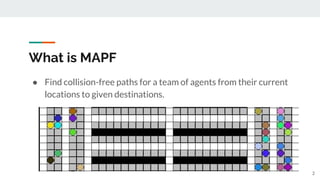
What is MAPF
● Find collision-free paths for a team of agents from their current
locations to given destinations.
2
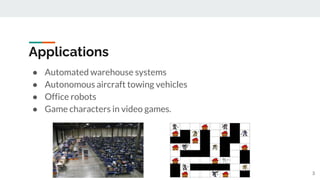
Applications
● Automated warehouse systems
● Autonomous aircraft towing vehicles
● Office robots
● Game characters in video games.
3
Formulation and Objective:
● Whole area is considered as block of cells
● Cells with obstacles are blocked
● N Agents are currently in N cells(x,y)
● Find N collision free paths
● Objective Function:
○ Sum of Cost
○ Makespan
4
Assumptions
● No kinematic constraints
● Time is assumed discretized(t)
● Five different actions(Left,Right,Up,Down,No move)
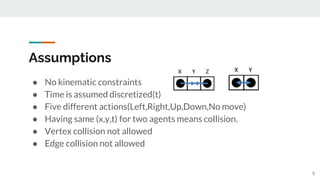
● Having same (x,y,t) for two agents means collision.
● Vertex collision not allowed
● Edge collision not allowed
5
Different Algorithms
● Searched based
○ CA*,Cost Tree Search,Conflict based search etc
● Rule based
○ Push and swap,push and rotate etc
6
Cooperative Pathfinding (David et al. 2005)
● Cooperative A*(CA*) : considering other agent’s actions
● Hierarchical CA*(HCA*) : without considering other agent’s
actions
● Windowed HCA* (WHCA*) : cooperative search for fixed depth
limit
7
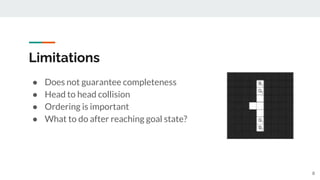
Limitations
● Does not guarantee completeness
● Head to head collision
● Ordering is important
● What to do after reaching goal state?
8
Increasing Cost Tree Search (Sharon et
al. 2013)
● Two level search
● High level:
○ Searching for minimal cost solution
● Low level:
○ Searching for a valid solution under the costs constraints
● Performance is number of agents and environment dependent
9
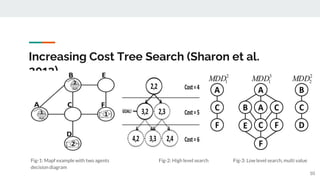
Increasing Cost Tree Search (Sharon et al.
2013)
zd
Fig-1: Mapf example with two agents Fig-2: High level search Fig-3: Low level search, multi value
decision diagram
10
Conflict Based Search (Sharon et al.2015)
● Two level search
● High level:
○ Search the Constraint Tree (CT)
○ Constraint denoted as (a,v,t)
○ Resolve conflict adding more constraints
● Low level:
○ Search for optimal path to goal state
○ Path is consistent with the constraints.
○ Doesn’t consider other agent during the search 11
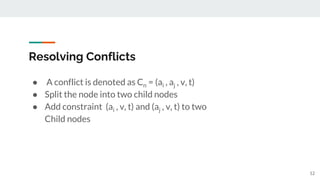
Resolving Conflicts
● A conflict is denoted as Cn = (ai , aj , v, t)
● Split the node into two child nodes
● Add constraint (ai , v, t) and (aj , v, t) to two
Child nodes
12
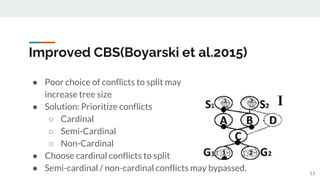
Improved CBS(Boyarski et al.2015)
● Poor choice of conflicts to split may
increase tree size
● Solution: Prioritize conflicts
○ Cardinal
○ Semi-Cardinal
○ Non-Cardinal
● Choose cardinal conflicts to split
● Semi-cardinal / non-cardinal conflicts may bypassed. 13
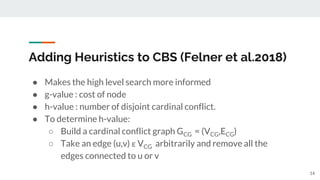
Adding Heuristics to CBS (Felner et al.2018)
● Makes the high level search more informed
● g-value : cost of node
● h-value : number of disjoint cardinal conflict.
● To determine h-value:
○ Build a cardinal conflict graph GCG = (VCG,ECG)
○ Take an edge (u,v) ε VCG arbitrarily and remove all the
edges connected to u or v
14
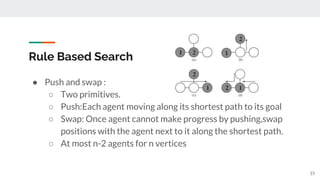
Rule Based Search
● Push and swap :
○ Two primitives.
○ Push:Each agent moving along its shortest path to its goal
○ Swap: Once agent cannot make progress by pushing,swap
positions with the agent next to it along the shortest path.
○ At most n-2 agents for n vertices
15
Rule Based Search
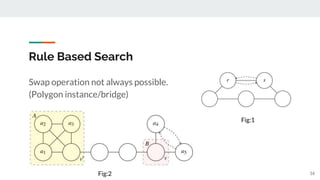
Swap operation not always possible.
(Polygon instance/bridge)
Fig:1
Fig:2 16
Potential Improvements
● What are the effects of different parameters that influence the
difficulty of the problem?
● Optimization on existing algorithms
● Algorithms that perform well for both objective functions
17
References
● A. Felner et al,” Search-Based Optimal Solvers for the Multi-Agent Pathfinding Problem:
Summary and Challenges”. In Proceedings of the Symposium on Combinatorial Search
(SoCS), 28-37, 2017.
● Silver, David. "Cooperative Pathfinding." AIIDE 1 (2005): 117-122.
● Sharon, Guni, et al. "The increasing cost tree search for optimal multi-agent pathfinding."
Artificial Intelligence 195 (2013): 470-495
● Sharon, Guni, et al. "Conflict-based search for optimal multi-agent pathfinding." Artificial
Intelligence 219 (2015): 40-66.
18
References
● Boyarski, Eli, et al. "ICBS: improved conflict-based search algorithm for multi-agent
pathfinding." Twenty-Fourth International Joint Conference on Artificial Intelligence
(IJACAI) . 2015.
● Felner, Ariel, et al. "Adding heuristics to conflict-based search for multi-agent path finding.
" Twenty-Eighth International Conference on Automated Planning and Scheduling.
(SoCS).2018.
● Luna, Ryan J., and Kostas E. Bekris. "Push and swap: Fast cooperative path-finding with
completeness guarantees." Twenty-Second International Joint Conference on Artificial
Intelligence. 2011.
19
Thank You
&
Any questions?
20

Multi Agent Path Finding (MAPF)

  • 1.
    Multi-Agent Path Finding (MAPF) Md.AhasanulAlam(10) Mustafizur Rahman(22) Supervised by: Dr. Ismat Rahman
  • 2.
    What is MAPF ●Find collision-free paths for a team of agents from their current locations to given destinations. 2
  • 3.
    Applications ● Automated warehousesystems ● Autonomous aircraft towing vehicles ● Office robots ● Game characters in video games. 3
  • 4.
    Formulation and Objective: ●Whole area is considered as block of cells ● Cells with obstacles are blocked ● N Agents are currently in N cells(x,y) ● Find N collision free paths ● Objective Function: ○ Sum of Cost ○ Makespan 4
  • 5.
    Assumptions ● No kinematicconstraints ● Time is assumed discretized(t) ● Five different actions(Left,Right,Up,Down,No move) ● Having same (x,y,t) for two agents means collision. ● Vertex collision not allowed ● Edge collision not allowed 5
  • 6.
    Different Algorithms ● Searchedbased ○ CA*,Cost Tree Search,Conflict based search etc ● Rule based ○ Push and swap,push and rotate etc 6
  • 7.
    Cooperative Pathfinding (Davidet al. 2005) ● Cooperative A*(CA*) : considering other agent’s actions ● Hierarchical CA*(HCA*) : without considering other agent’s actions ● Windowed HCA* (WHCA*) : cooperative search for fixed depth limit 7
  • 8.
    Limitations ● Does notguarantee completeness ● Head to head collision ● Ordering is important ● What to do after reaching goal state? 8
  • 9.
    Increasing Cost TreeSearch (Sharon et al. 2013) ● Two level search ● High level: ○ Searching for minimal cost solution ● Low level: ○ Searching for a valid solution under the costs constraints ● Performance is number of agents and environment dependent 9
  • 10.
    Increasing Cost TreeSearch (Sharon et al. 2013) zd Fig-1: Mapf example with two agents Fig-2: High level search Fig-3: Low level search, multi value decision diagram 10
  • 11.
    Conflict Based Search(Sharon et al.2015) ● Two level search ● High level: ○ Search the Constraint Tree (CT) ○ Constraint denoted as (a,v,t) ○ Resolve conflict adding more constraints ● Low level: ○ Search for optimal path to goal state ○ Path is consistent with the constraints. ○ Doesn’t consider other agent during the search 11
  • 12.
    Resolving Conflicts ● Aconflict is denoted as Cn = (ai , aj , v, t) ● Split the node into two child nodes ● Add constraint (ai , v, t) and (aj , v, t) to two Child nodes 12
  • 13.
    Improved CBS(Boyarski etal.2015) ● Poor choice of conflicts to split may increase tree size ● Solution: Prioritize conflicts ○ Cardinal ○ Semi-Cardinal ○ Non-Cardinal ● Choose cardinal conflicts to split ● Semi-cardinal / non-cardinal conflicts may bypassed. 13
  • 14.
    Adding Heuristics toCBS (Felner et al.2018) ● Makes the high level search more informed ● g-value : cost of node ● h-value : number of disjoint cardinal conflict. ● To determine h-value: ○ Build a cardinal conflict graph GCG = (VCG,ECG) ○ Take an edge (u,v) ε VCG arbitrarily and remove all the edges connected to u or v 14
  • 15.
    Rule Based Search ●Push and swap : ○ Two primitives. ○ Push:Each agent moving along its shortest path to its goal ○ Swap: Once agent cannot make progress by pushing,swap positions with the agent next to it along the shortest path. ○ At most n-2 agents for n vertices 15
  • 16.
    Rule Based Search Swapoperation not always possible. (Polygon instance/bridge) Fig:1 Fig:2 16
  • 17.
    Potential Improvements ● Whatare the effects of different parameters that influence the difficulty of the problem? ● Optimization on existing algorithms ● Algorithms that perform well for both objective functions 17
  • 18.
    References ● A. Felneret al,” Search-Based Optimal Solvers for the Multi-Agent Pathfinding Problem: Summary and Challenges”. In Proceedings of the Symposium on Combinatorial Search (SoCS), 28-37, 2017. ● Silver, David. "Cooperative Pathfinding." AIIDE 1 (2005): 117-122. ● Sharon, Guni, et al. "The increasing cost tree search for optimal multi-agent pathfinding." Artificial Intelligence 195 (2013): 470-495 ● Sharon, Guni, et al. "Conflict-based search for optimal multi-agent pathfinding." Artificial Intelligence 219 (2015): 40-66. 18
  • 19.
    References ● Boyarski, Eli,et al. "ICBS: improved conflict-based search algorithm for multi-agent pathfinding." Twenty-Fourth International Joint Conference on Artificial Intelligence (IJACAI) . 2015. ● Felner, Ariel, et al. "Adding heuristics to conflict-based search for multi-agent path finding. " Twenty-Eighth International Conference on Automated Planning and Scheduling. (SoCS).2018. ● Luna, Ryan J., and Kostas E. Bekris. "Push and swap: Fast cooperative path-finding with completeness guarantees." Twenty-Second International Joint Conference on Artificial Intelligence. 2011. 19
  • 20.