AI I: problem-
solving and search
Lecturer: Tom Lenaerts
Institut de Recherches Interdisciplinaires
et de Développements en Intelligence
Artificielle (IRIDIA)
Université Libre de Bruxelles
TLo (IRIDIA) 2October 13, 2015
Outline
 Problem-solving agents
 A kind of goal-based agent
 Problem types
 Single state (fully observable)
 Search with partial information
 Problem formulation
 Example problems
 Basic search algorithms
 Uninformed
TLo (IRIDIA) 3October 13, 2015
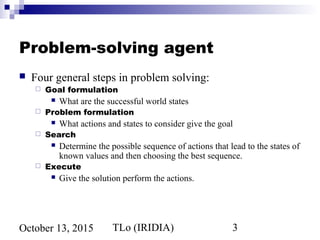
Problem-solving agent
 Four general steps in problem solving:
 Goal formulation
 What are the successful world states
 Problem formulation
 What actions and states to consider give the goal
 Search
 Determine the possible sequence of actions that lead to the states of
known values and then choosing the best sequence.
 Execute
 Give the solution perform the actions.
TLo (IRIDIA) 4October 13, 2015
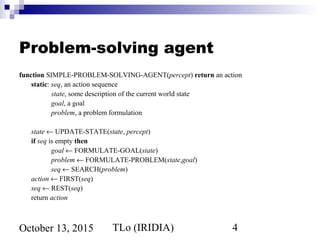
Problem-solving agent
function SIMPLE-PROBLEM-SOLVING-AGENT(percept) return an action
static: seq, an action sequence
state, some description of the current world state
goal, a goal
problem, a problem formulation
state ← UPDATE-STATE(state, percept)
if seq is empty then
goal ← FORMULATE-GOAL(state)
problem ← FORMULATE-PROBLEM(state,goal)
seq ← SEARCH(problem)
action ← FIRST(seq)
seq ← REST(seq)
return action
TLo (IRIDIA) 5October 13, 2015
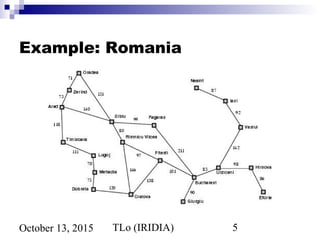
Example: Romania
TLo (IRIDIA) 6October 13, 2015
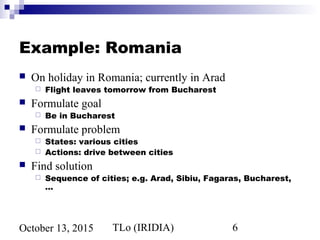
Example: Romania
 On holiday in Romania; currently in Arad
 Flight leaves tomorrow from Bucharest
 Formulate goal
 Be in Bucharest
 Formulate problem
 States: various cities
 Actions: drive between cities
 Find solution
 Sequence of cities; e.g. Arad, Sibiu, Fagaras, Bucharest,
…
TLo (IRIDIA) 7October 13, 2015
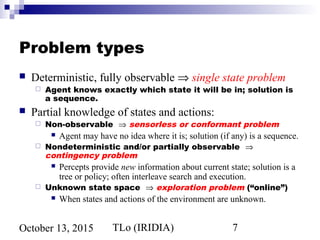
Problem types
 Deterministic, fully observable ⇒ single state problem
 Agent knows exactly which state it will be in; solution is
a sequence.
 Partial knowledge of states and actions:
 Non-observable ⇒ sensorless or conformant problem
 Agent may have no idea where it is; solution (if any) is a sequence.
 Nondeterministic and/or partially observable ⇒
contingency problem
 Percepts provide new information about current state; solution is a
tree or policy; often interleave search and execution.
 Unknown state space ⇒ exploration problem (“online”)
 When states and actions of the environment are unknown.
TLo (IRIDIA) 8October 13, 2015
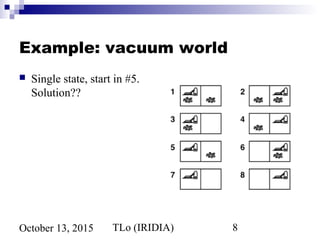
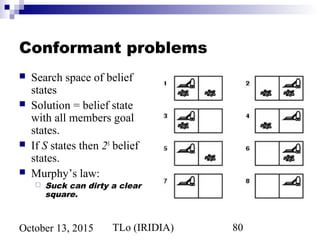
Example: vacuum world
 Single state, start in #5.
Solution??
TLo (IRIDIA) 9October 13, 2015
Example: vacuum world
 Single state, start in #5.
Solution??
 [Right, Suck]
TLo (IRIDIA) 10October 13, 2015
Example: vacuum world
 Single state, start in #5.
Solution??
 [Right, Suck]
 Sensorless: start in
{1,2,3,4,5,6,7,8} e.g Right
goes to {2,4,6,8}. Solution??
 Contingency: start in {1,3}.
(assume Murphy’s law, Suck
can dirty a clean carpet and
local sensing: [location,dirt]
only. Solution??
TLo (IRIDIA) 11October 13, 2015
Problem formulation
 A problem is defined by:
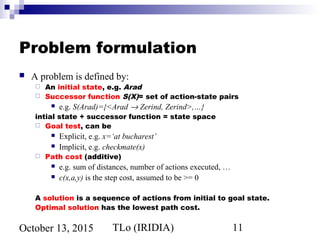
 An initial state, e.g. Arad
 Successor function S(X)= set of action-state pairs
 e.g. S(Arad)={<Arad → Zerind, Zerind>,…}
intial state + successor function = state space
 Goal test, can be
 Explicit, e.g. x=‘at bucharest’
 Implicit, e.g. checkmate(x)
 Path cost (additive)
 e.g. sum of distances, number of actions executed, …
 c(x,a,y) is the step cost, assumed to be >= 0
A solution is a sequence of actions from initial to goal state.
Optimal solution has the lowest path cost.
TLo (IRIDIA) 12October 13, 2015
Selecting a state space
 Real world is absurdly complex.
State space must be abstracted for problem solving.
 (Abstract) state = set of real states.
 (Abstract) action = complex combination of real actions.
 e.g. Arad →Zerind represents a complex set of possible routes,
detours, rest stops, etc.
 The abstraction is valid if the path between two states is
reflected in the real world.
 (Abstract) solution = set of real paths that are solutions in the real
world.
 Each abstract action should be “easier” than the real problem.
TLo (IRIDIA) 13October 13, 2015
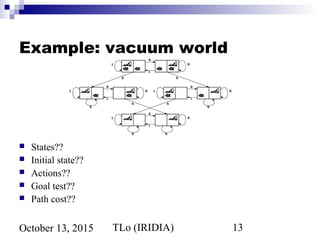
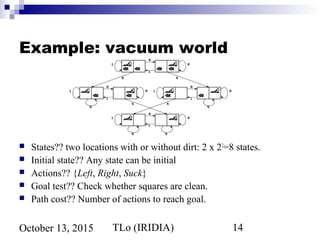
Example: vacuum world
 States??
 Initial state??
 Actions??
 Goal test??
 Path cost??
TLo (IRIDIA) 14October 13, 2015
Example: vacuum world
 States?? two locations with or without dirt: 2 x 22
=8 states.
 Initial state?? Any state can be initial
 Actions?? {Left, Right, Suck}
 Goal test?? Check whether squares are clean.
 Path cost?? Number of actions to reach goal.
TLo (IRIDIA) 15October 13, 2015
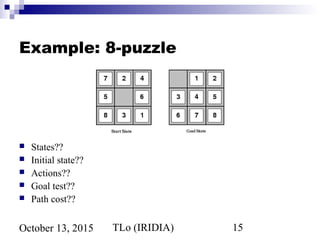
Example: 8-puzzle
 States??
 Initial state??
 Actions??
 Goal test??
 Path cost??
TLo (IRIDIA) 16October 13, 2015
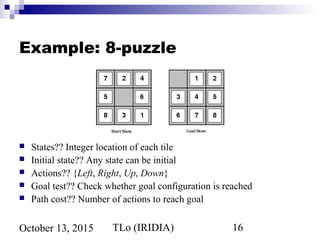
Example: 8-puzzle
 States?? Integer location of each tile
 Initial state?? Any state can be initial
 Actions?? {Left, Right, Up, Down}
 Goal test?? Check whether goal configuration is reached
 Path cost?? Number of actions to reach goal
TLo (IRIDIA) 17October 13, 2015
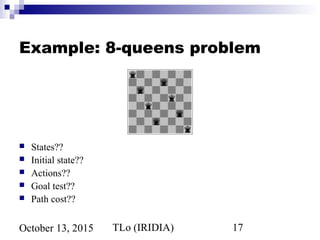
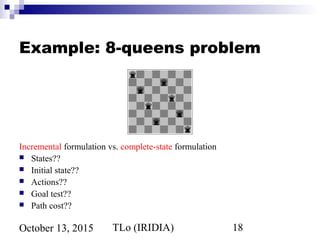
Example: 8-queens problem
 States??
 Initial state??
 Actions??
 Goal test??
 Path cost??
TLo (IRIDIA) 18October 13, 2015
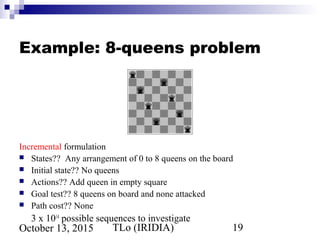
Example: 8-queens problem
Incremental formulation vs. complete-state formulation
 States??
 Initial state??
 Actions??
 Goal test??
 Path cost??
TLo (IRIDIA) 19October 13, 2015
Example: 8-queens problem
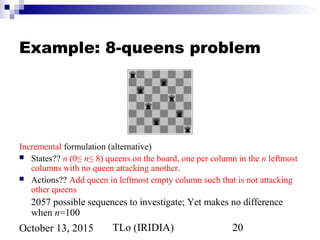
Incremental formulation
 States?? Any arrangement of 0 to 8 queens on the board
 Initial state?? No queens
 Actions?? Add queen in empty square
 Goal test?? 8 queens on board and none attacked
 Path cost?? None
3 x 10¹⁴
possible sequences to investigate
TLo (IRIDIA) 20October 13, 2015
Example: 8-queens problem
Incremental formulation (alternative)
 States?? n (0≤ n≤ 8) queens on the board, one per column in the n leftmost
columns with no queen attacking another.
 Actions?? Add queen in leftmost empty column such that is not attacking
other queens
2057 possible sequences to investigate; Yet makes no difference
when n=100
TLo (IRIDIA) 21October 13, 2015
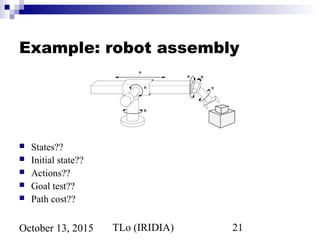
Example: robot assembly
 States??
 Initial state??
 Actions??
 Goal test??
 Path cost??
TLo (IRIDIA) 22October 13, 2015
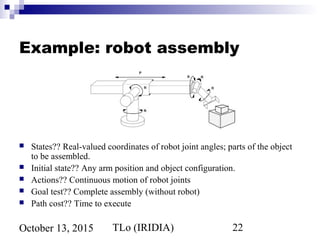
Example: robot assembly
 States?? Real-valued coordinates of robot joint angles; parts of the object
to be assembled.
 Initial state?? Any arm position and object configuration.
 Actions?? Continuous motion of robot joints
 Goal test?? Complete assembly (without robot)
 Path cost?? Time to execute
TLo (IRIDIA) 23October 13, 2015
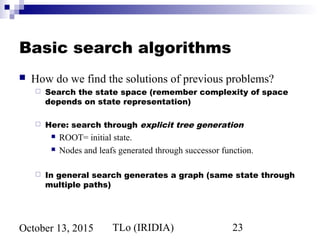
Basic search algorithms
 How do we find the solutions of previous problems?
 Search the state space (remember complexity of space
depends on state representation)
 Here: search through explicit tree generation
 ROOT= initial state.
 Nodes and leafs generated through successor function.
 In general search generates a graph (same state through
multiple paths)
TLo (IRIDIA) 24October 13, 2015
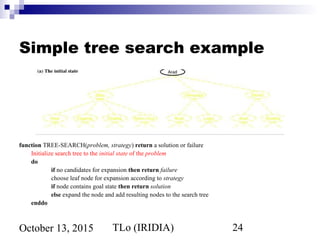
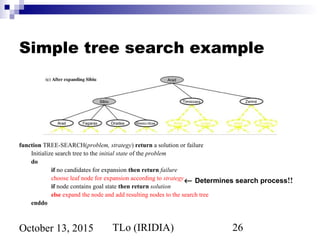
Simple tree search example
function TREE-SEARCH(problem, strategy) return a solution or failure
Initialize search tree to the initial state of the problem
do
if no candidates for expansion then return failure
choose leaf node for expansion according to strategy
if node contains goal state then return solution
else expand the node and add resulting nodes to the search tree
enddo
TLo (IRIDIA) 25October 13, 2015
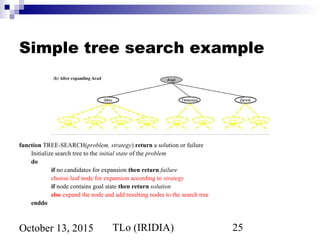
Simple tree search example
function TREE-SEARCH(problem, strategy) return a solution or failure
Initialize search tree to the initial state of the problem
do
if no candidates for expansion then return failure
choose leaf node for expansion according to strategy
if node contains goal state then return solution
else expand the node and add resulting nodes to the search tree
enddo
TLo (IRIDIA) 26October 13, 2015
Simple tree search example
function TREE-SEARCH(problem, strategy) return a solution or failure
Initialize search tree to the initial state of the problem
do
if no candidates for expansion then return failure
choose leaf node for expansion according to strategy
if node contains goal state then return solution
else expand the node and add resulting nodes to the search tree
enddo
← Determines search process!!
TLo (IRIDIA) 27October 13, 2015
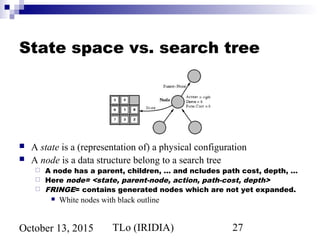
State space vs. search tree
 A state is a (representation of) a physical configuration
 A node is a data structure belong to a search tree
 A node has a parent, children, … and ncludes path cost, depth, …
 Here node= <state, parent-node, action, path-cost, depth>
 FRINGE= contains generated nodes which are not yet expanded.
 White nodes with black outline
TLo (IRIDIA) 28October 13, 2015
Tree search algorithm
function TREE-SEARCH(problem,fringe) return a solution or failure
fringe ← INSERT(MAKE-NODE(INITIAL-STATE[problem]), fringe)
loop do
if EMPTY?(fringe) then return failure
node ← REMOVE-FIRST(fringe)
if GOAL-TEST[problem] applied to STATE[node] succeeds
then return SOLUTION(node)
fringe ← INSERT-ALL(EXPAND(node, problem), fringe)
TLo (IRIDIA) 29October 13, 2015
Tree search algorithm (2)
function EXPAND(node,problem) return a set of nodes
successors ← the empty set
for each <action, result> in SUCCESSOR-FN[problem](STATE[node]) do
s ← a new NODE
STATE[s] ← result
PARENT-NODE[s] ← node
ACTION[s] ← action
PATH-COST[s] ← PATH-COST[node] + STEP-COST(node, action,s)
DEPTH[s] ← DEPTH[node]+1
add s to successors
return successors
TLo (IRIDIA) 30October 13, 2015
Search strategies
 A strategy is defined by picking the order of node expansion.
 Problem-solving performance is measured in four ways:
 Completeness; Does it always find a solution if one exists?
 Optimality; Does it always find the least-cost solution?
 Time Complexity; Number of nodes generated/expanded?
 Space Complexity; Number of nodes stored in memory during
search?
 Time and space complexity are measured in terms of problem
difficulty defined by:
 b - maximum branching factor of the search tree
 d - depth of the least-cost solution
 m - maximum depth of the state space (may be ∞)
TLo (IRIDIA) 31October 13, 2015
Uninformed search strategies
 (a.k.a. blind search) = use only information available in
problem definition.
 When strategies can determine whether one non-goal
state is better than another → informed search.
 Categories defined by expansion algorithm:
 Breadth-first search
 Uniform-cost search
 Depth-first search
 Depth-limited search
 Iterative deepening search.
 Bidirectional search
TLo (IRIDIA) 32October 13, 2015
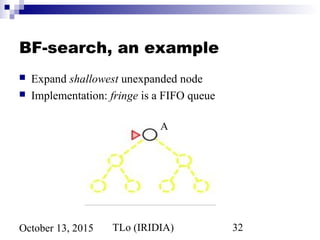
BF-search, an example
 Expand shallowest unexpanded node
 Implementation: fringe is a FIFO queue
A
TLo (IRIDIA) 33October 13, 2015
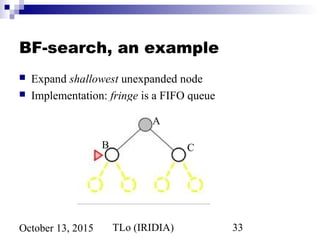
BF-search, an example
 Expand shallowest unexpanded node
 Implementation: fringe is a FIFO queue
A
B C
TLo (IRIDIA) 34October 13, 2015
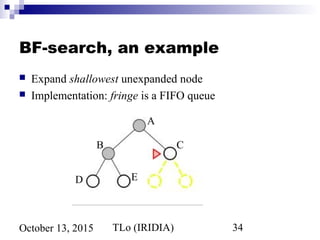
BF-search, an example
 Expand shallowest unexpanded node
 Implementation: fringe is a FIFO queue
A
B C
D E
TLo (IRIDIA) 35October 13, 2015
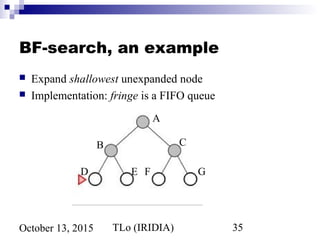
BF-search, an example
 Expand shallowest unexpanded node
 Implementation: fringe is a FIFO queue
A
B C
D E F G
TLo (IRIDIA) 36October 13, 2015
BF-search; evaluation
 Completeness:
 Does it always find a solution if one exists?
 YES
 If shallowest goal node is at some finite depth d
 Condition: If b is finite
 (maximum num. Of succ. nodes is finite)
TLo (IRIDIA) 37October 13, 2015
BF-search; evaluation
 Completeness:
 YES (if b is finite)
 Time complexity:
 Assume a state space where every state has b successors.
 root has b successors, each node at the next level has again b successors
(total b2
), …
 Assume solution is at depth d
 Worst case; expand all but the last node at depth d
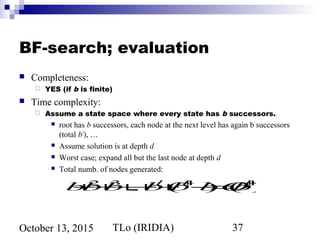
 Total numb. of nodes generated:
b+b2
+b3
+...+bd
+(bd+1
−b)=O(bd+1
)
TLo (IRIDIA) 38October 13, 2015
BF-search; evaluation
 Completeness:
 YES (if b is finite)
 Time complexity:
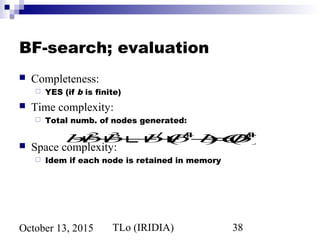
 Total numb. of nodes generated:
 Space complexity:
 Idem if each node is retained in memory
b+b2
+b3
+...+bd
+(bd+1
−b)=O(bd+1
)
TLo (IRIDIA) 39October 13, 2015
BF-search; evaluation
 Completeness:
 YES (if b is finite)
 Time complexity:
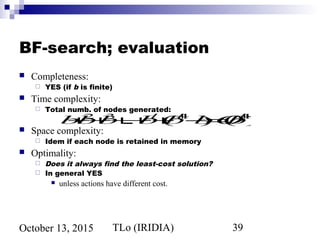
 Total numb. of nodes generated:
 Space complexity:
 Idem if each node is retained in memory
 Optimality:
 Does it always find the least-cost solution?
 In general YES
 unless actions have different cost.
b+b2
+b3
+...+bd
+(bd+1
−b)=O(bd+1
)
TLo (IRIDIA) 40October 13, 2015
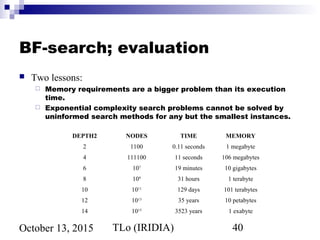
BF-search; evaluation
 Two lessons:
 Memory requirements are a bigger problem than its execution
time.
 Exponential complexity search problems cannot be solved by
uninformed search methods for any but the smallest instances.
DEPTH2 NODES TIME MEMORY
2 1100 0.11 seconds 1 megabyte
4 111100 11 seconds 106 megabytes
6 107
19 minutes 10 gigabytes
8 109
31 hours 1 terabyte
10 1011
129 days 101 terabytes
12 1013
35 years 10 petabytes
14 1015
3523 years 1 exabyte
TLo (IRIDIA) 41October 13, 2015
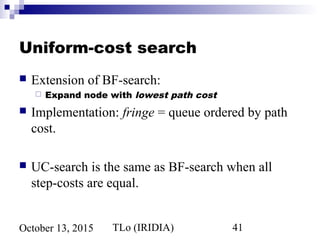
Uniform-cost search
 Extension of BF-search:
 Expand node with lowest path cost
 Implementation: fringe = queue ordered by path
cost.
 UC-search is the same as BF-search when all
step-costs are equal.
TLo (IRIDIA) 42October 13, 2015
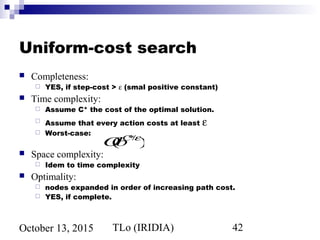
Uniform-cost search
 Completeness:
 YES, if step-cost > ε (smal positive constant)
 Time complexity:
 Assume C* the cost of the optimal solution.
 Assume that every action costs at least ε
 Worst-case:
 Space complexity:
 Idem to time complexity
 Optimality:
 nodes expanded in order of increasing path cost.
 YES, if complete.
O(bC*/ε
)
TLo (IRIDIA) 43October 13, 2015
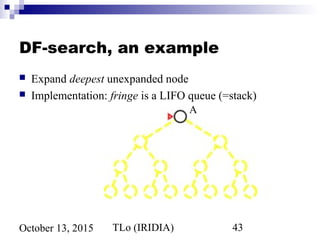
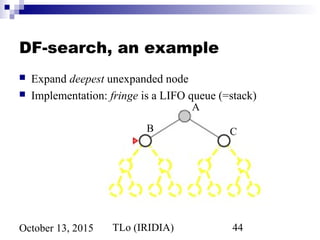
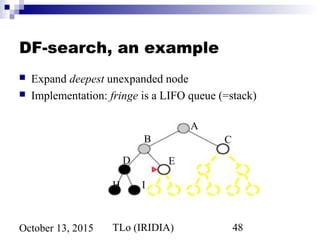
DF-search, an example
 Expand deepest unexpanded node
 Implementation: fringe is a LIFO queue (=stack)
A
TLo (IRIDIA) 44October 13, 2015
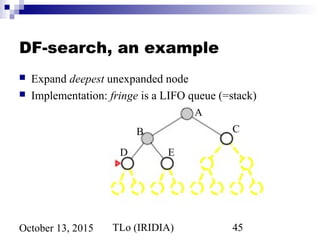
DF-search, an example
 Expand deepest unexpanded node
 Implementation: fringe is a LIFO queue (=stack)
A
B C
TLo (IRIDIA) 45October 13, 2015
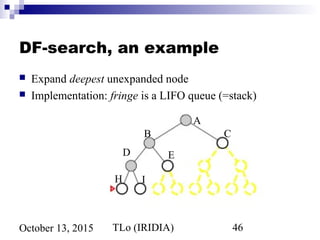
DF-search, an example
 Expand deepest unexpanded node
 Implementation: fringe is a LIFO queue (=stack)
A
B C
D E
TLo (IRIDIA) 46October 13, 2015
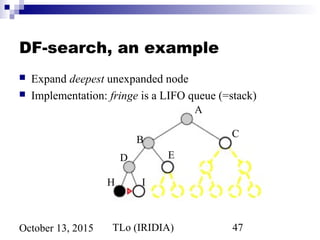
DF-search, an example
 Expand deepest unexpanded node
 Implementation: fringe is a LIFO queue (=stack)
A
B C
D E
H I
TLo (IRIDIA) 47October 13, 2015
DF-search, an example
 Expand deepest unexpanded node
 Implementation: fringe is a LIFO queue (=stack)
A
B
C
D E
H I
TLo (IRIDIA) 48October 13, 2015
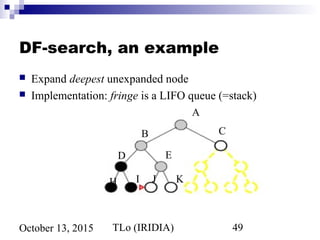
DF-search, an example
 Expand deepest unexpanded node
 Implementation: fringe is a LIFO queue (=stack)
A
B C
D E
H I
TLo (IRIDIA) 49October 13, 2015
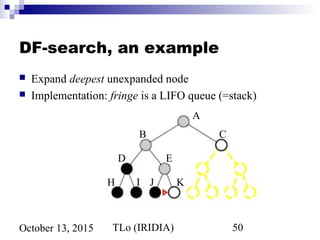
DF-search, an example
 Expand deepest unexpanded node
 Implementation: fringe is a LIFO queue (=stack)
A
B C
D E
H I J K
TLo (IRIDIA) 50October 13, 2015
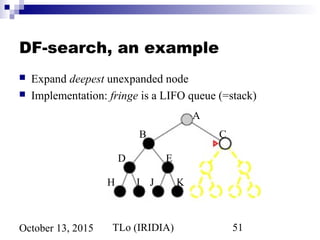
DF-search, an example
 Expand deepest unexpanded node
 Implementation: fringe is a LIFO queue (=stack)
A
B C
D E
H I J K
TLo (IRIDIA) 51October 13, 2015
DF-search, an example
 Expand deepest unexpanded node
 Implementation: fringe is a LIFO queue (=stack)
A
B C
D E
H I J K
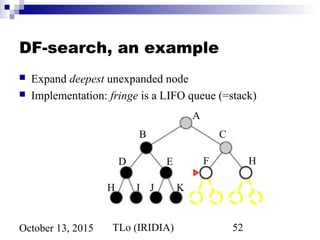
TLo (IRIDIA) 52October 13, 2015
DF-search, an example
 Expand deepest unexpanded node
 Implementation: fringe is a LIFO queue (=stack)
A
B C
D E
H I J K
F H
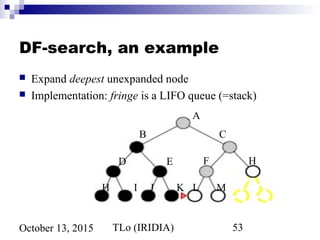
TLo (IRIDIA) 53October 13, 2015
DF-search, an example
 Expand deepest unexpanded node
 Implementation: fringe is a LIFO queue (=stack)
A
B C
D E
H I J K
F H
L M
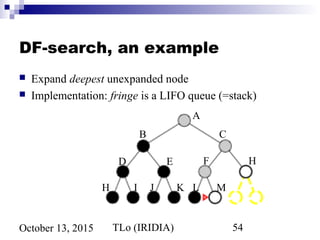
TLo (IRIDIA) 54October 13, 2015
DF-search, an example
 Expand deepest unexpanded node
 Implementation: fringe is a LIFO queue (=stack)
A
B C
D E
H I J K
F H
L M
TLo (IRIDIA) 55October 13, 2015
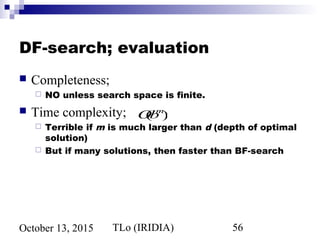
DF-search; evaluation
 Completeness;
 Does it always find a solution if one exists?
 NO
 unless search space is finite and no loops are possible.
TLo (IRIDIA) 56October 13, 2015
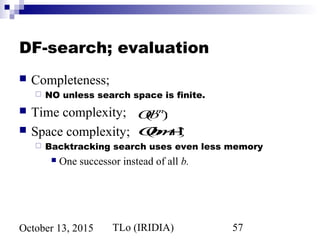
DF-search; evaluation
 Completeness;
 NO unless search space is finite.
 Time complexity;
 Terrible if m is much larger than d (depth of optimal
solution)
 But if many solutions, then faster than BF-search
O(bm
)
TLo (IRIDIA) 57October 13, 2015
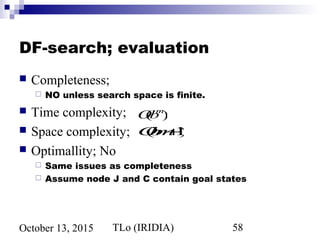
DF-search; evaluation
 Completeness;
 NO unless search space is finite.
 Time complexity;
 Space complexity;
 Backtracking search uses even less memory
 One successor instead of all b.
O(bm+1)
O(bm
)
TLo (IRIDIA) 58October 13, 2015
DF-search; evaluation
 Completeness;
 NO unless search space is finite.
 Time complexity;
 Space complexity;
 Optimallity; No
 Same issues as completeness
 Assume node J and C contain goal states
O(bm+1)
O(bm
)
TLo (IRIDIA) 59October 13, 2015
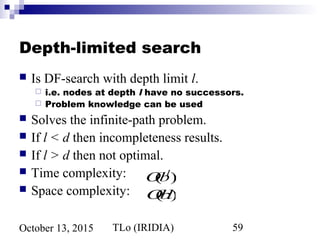
Depth-limited search
 Is DF-search with depth limit l.
 i.e. nodes at depth l have no successors.
 Problem knowledge can be used
 Solves the infinite-path problem.
 If l < d then incompleteness results.
 If l > d then not optimal.
 Time complexity:
 Space complexity:
O(bl
)
O(bl)
TLo (IRIDIA) 60October 13, 2015
Depth-limited algorithm
function DEPTH-LIMITED-SEARCH(problem,limit) return a solution or failure/cutoff
return RECURSIVE-DLS(MAKE-NODE(INITIAL-STATE[problem]),problem,limit)
function RECURSIVE-DLS(node, problem, limit) return a solution or failure/cutoff
cutoff_occurred? ← false
if GOAL-TEST[problem](STATE[node]) then return SOLUTION(node)
else if DEPTH[node] == limit then return cutoff
else for each successor in EXPAND(node, problem) do
result ← RECURSIVE-DLS(successor, problem, limit)
if result == cutoff then cutoff_occurred? ← true
else if result ≠ failure then return result
if cutoff_occurred? then return cutoff else return failure
TLo (IRIDIA) 61October 13, 2015
Iterative deepening search
 What?
 A general strategy to find best depth limit l.
 Goals is found at depth d, the depth of the shallowest
goal-node.
 Often used in combination with DF-search
 Combines benefits of DF- en BF-search
TLo (IRIDIA) 62October 13, 2015
Iterative deepening search
function ITERATIVE_DEEPENING_SEARCH(problem) return a solution or failure
inputs: problem
for depth ← 0 to ∞ do
result ← DEPTH-LIMITED_SEARCH(problem, depth)
if result ≠ cuttoff then return result
TLo (IRIDIA) 63October 13, 2015
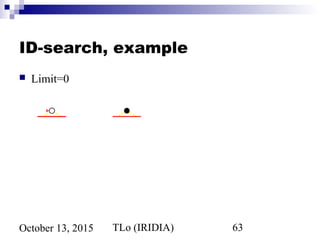
ID-search, example
 Limit=0
TLo (IRIDIA) 64October 13, 2015
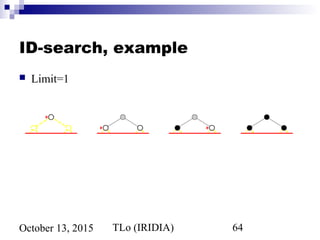
ID-search, example
 Limit=1
TLo (IRIDIA) 65October 13, 2015
ID-search, example
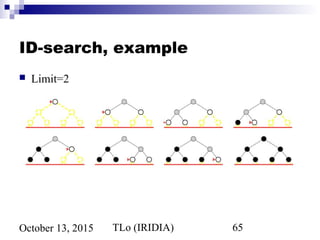
 Limit=2
TLo (IRIDIA) 66October 13, 2015
ID-search, example
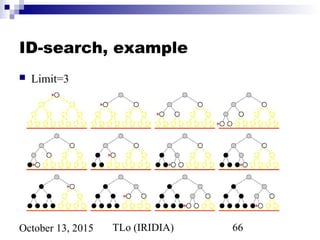
 Limit=3
TLo (IRIDIA) 67October 13, 2015
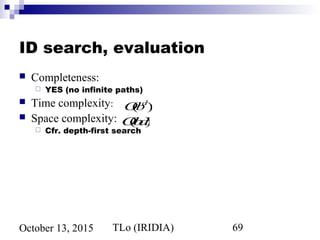
ID search, evaluation
 Completeness:
 YES (no infinite paths)
TLo (IRIDIA) 68October 13, 2015
ID search, evaluation
 Completeness:
 YES (no infinite paths)
 Time complexity:
 Algorithm seems costly due to repeated generation of certain
states.
 Node generation:
 level d: once
 level d-1: 2
 level d-2: 3
 …
 level 2: d-1
 level 1: d
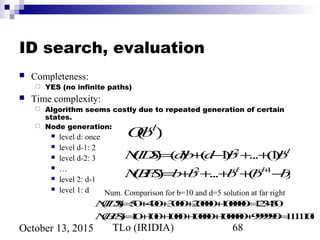
N(IDS)=(d)b+(d−1)b2
+...+(1)bd
N(BFS)=b+b2
+...+bd
+(bd+1
−b)
O(bd
)
N(IDS)=50+400+3000+20000+100000=123450
N(BFS)=10+100+1000+10000+100000+999990=1111100
Num. Comparison for b=10 and d=5 solution at far right
TLo (IRIDIA) 69October 13, 2015
ID search, evaluation
 Completeness:
 YES (no infinite paths)
 Time complexity:
 Space complexity:
 Cfr. depth-first search
O(bd
)
O(bd)
TLo (IRIDIA) 70October 13, 2015
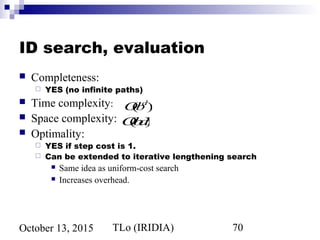
ID search, evaluation
 Completeness:
 YES (no infinite paths)
 Time complexity:
 Space complexity:
 Optimality:
 YES if step cost is 1.
 Can be extended to iterative lengthening search
 Same idea as uniform-cost search
 Increases overhead.
O(bd
)
O(bd)
TLo (IRIDIA) 71October 13, 2015
Bidirectional search
 Two simultaneous searches from start an goal.
 Motivation:
 Check whether the node belongs to the other fringe before
expansion.
 Space complexity is the most significant weakness.
 Complete and optimal if both searches are BF.
bd/2
+bd/2
≠bd
TLo (IRIDIA) 72October 13, 2015
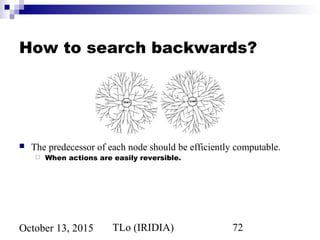
How to search backwards?
 The predecessor of each node should be efficiently computable.
 When actions are easily reversible.
TLo (IRIDIA) 73October 13, 2015
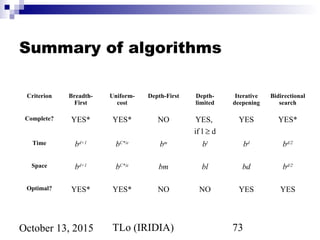
Summary of algorithms
Criterion Breadth-
First
Uniform-
cost
Depth-First Depth-
limited
Iterative
deepening
Bidirectional
search
Complete? YES* YES* NO YES,
if l ≥ d
YES YES*
Time bd+1
bC*/e
bm
bl
bd
bd/2
Space bd+1
bC*/e
bm bl bd bd/2
Optimal? YES* YES* NO NO YES YES
TLo (IRIDIA) 74October 13, 2015
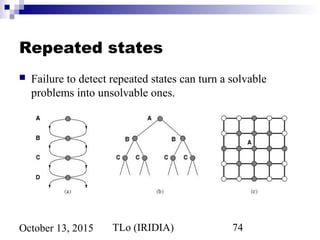
Repeated states
 Failure to detect repeated states can turn a solvable
problems into unsolvable ones.
TLo (IRIDIA) 75October 13, 2015
Graph search algorithm
 Closed list stores all expanded nodes
function GRAPH-SEARCH(problem,fringe) return a solution or failure
closed ← an empty set
fringe ← INSERT(MAKE-NODE(INITIAL-STATE[problem]), fringe)
loop do
if EMPTY?(fringe) then return failure
node ← REMOVE-FIRST(fringe)
if GOAL-TEST[problem] applied to STATE[node] succeeds
then return SOLUTION(node)
if STATE[node] is not in closed then
add STATE[node] to closed
fringe ← INSERT-ALL(EXPAND(node, problem), fringe)
TLo (IRIDIA) 76October 13, 2015
Graph search, evaluation
 Optimality:
 GRAPH-SEARCH discard newly discovered paths.
 This may result in a sub-optimal solution
 YET: when uniform-cost search or BF-search with constant step
cost
 Time and space complexity,
 proportional to the size of the state space
(may be much smaller than O(bd
)).
 DF- and ID-search with closed list no longer has linear
space requirements since all nodes are stored in closed
list!!
TLo (IRIDIA) 77October 13, 2015
Search with partial information
 Previous assumption:
 Environment is fully observable
 Environment is deterministic
 Agent knows the effects of its actions
What if knowledge of states or actions is incomplete?
TLo (IRIDIA) 78October 13, 2015
Search with partial information
 (SLIDE 7) Partial knowledge of states and actions:
 sensorless or conformant problem
 Agent may have no idea where it is; solution (if any) is a sequence.
 contingency problem
 Percepts provide new information about current state; solution is a
tree or policy; often interleave search and execution.
 If uncertainty is caused by actions of another agent: adversarial
problem
 exploration problem
 When states and actions of the environment are unknown.
TLo (IRIDIA) 79October 13, 2015
Conformant problems
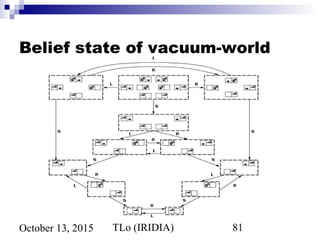
 start in {1,2,3,4,5,6,7,8}
e.g Right goes to
{2,4,6,8}. Solution??
 [Right, Suck, Left,Suck]
 When the world is not
fully observable: reason
about a set of states that
migth be reached
=belief state
TLo (IRIDIA) 80October 13, 2015
Conformant problems
 Search space of belief
states
 Solution = belief state
with all members goal
states.
 If S states then 2S
belief
states.
 Murphy’s law:
 Suck can dirty a clear
square.
TLo (IRIDIA) 81October 13, 2015
Belief state of vacuum-world
TLo (IRIDIA) 82October 13, 2015
Contingency problems
 Contingency, start in {1,3}.
 Murphy’s law, Suck can dirty a clean
carpet.
 Local sensing: dirt, location only.
 Percept = [L,Dirty] ={1,3}
 [Suck] = {5,7}
 [Right] ={6,8}
 [Suck] in {6}={8} (Success)
 BUT [Suck] in {8} = failure
 Solution??
 Belief-state: no fixed action
sequence guarantees solution
 Relax requirement:
 [Suck, Right, if [R,dirty] then Suck]
 Select actions based on
contingencies arising during
execution.

3 problem-solving-

  • 1.
    AI I: problem- solvingand search Lecturer: Tom Lenaerts Institut de Recherches Interdisciplinaires et de Développements en Intelligence Artificielle (IRIDIA) Université Libre de Bruxelles
  • 2.
    TLo (IRIDIA) 2October13, 2015 Outline  Problem-solving agents  A kind of goal-based agent  Problem types  Single state (fully observable)  Search with partial information  Problem formulation  Example problems  Basic search algorithms  Uninformed
  • 3.
    TLo (IRIDIA) 3October13, 2015 Problem-solving agent  Four general steps in problem solving:  Goal formulation  What are the successful world states  Problem formulation  What actions and states to consider give the goal  Search  Determine the possible sequence of actions that lead to the states of known values and then choosing the best sequence.  Execute  Give the solution perform the actions.
  • 4.
    TLo (IRIDIA) 4October13, 2015 Problem-solving agent function SIMPLE-PROBLEM-SOLVING-AGENT(percept) return an action static: seq, an action sequence state, some description of the current world state goal, a goal problem, a problem formulation state ← UPDATE-STATE(state, percept) if seq is empty then goal ← FORMULATE-GOAL(state) problem ← FORMULATE-PROBLEM(state,goal) seq ← SEARCH(problem) action ← FIRST(seq) seq ← REST(seq) return action
  • 5.
    TLo (IRIDIA) 5October13, 2015 Example: Romania
  • 6.
    TLo (IRIDIA) 6October13, 2015 Example: Romania  On holiday in Romania; currently in Arad  Flight leaves tomorrow from Bucharest  Formulate goal  Be in Bucharest  Formulate problem  States: various cities  Actions: drive between cities  Find solution  Sequence of cities; e.g. Arad, Sibiu, Fagaras, Bucharest, …
  • 7.
    TLo (IRIDIA) 7October13, 2015 Problem types  Deterministic, fully observable ⇒ single state problem  Agent knows exactly which state it will be in; solution is a sequence.  Partial knowledge of states and actions:  Non-observable ⇒ sensorless or conformant problem  Agent may have no idea where it is; solution (if any) is a sequence.  Nondeterministic and/or partially observable ⇒ contingency problem  Percepts provide new information about current state; solution is a tree or policy; often interleave search and execution.  Unknown state space ⇒ exploration problem (“online”)  When states and actions of the environment are unknown.
  • 8.
    TLo (IRIDIA) 8October13, 2015 Example: vacuum world  Single state, start in #5. Solution??
  • 9.
    TLo (IRIDIA) 9October13, 2015 Example: vacuum world  Single state, start in #5. Solution??  [Right, Suck]
  • 10.
    TLo (IRIDIA) 10October13, 2015 Example: vacuum world  Single state, start in #5. Solution??  [Right, Suck]  Sensorless: start in {1,2,3,4,5,6,7,8} e.g Right goes to {2,4,6,8}. Solution??  Contingency: start in {1,3}. (assume Murphy’s law, Suck can dirty a clean carpet and local sensing: [location,dirt] only. Solution??
  • 11.
    TLo (IRIDIA) 11October13, 2015 Problem formulation  A problem is defined by:  An initial state, e.g. Arad  Successor function S(X)= set of action-state pairs  e.g. S(Arad)={<Arad → Zerind, Zerind>,…} intial state + successor function = state space  Goal test, can be  Explicit, e.g. x=‘at bucharest’  Implicit, e.g. checkmate(x)  Path cost (additive)  e.g. sum of distances, number of actions executed, …  c(x,a,y) is the step cost, assumed to be >= 0 A solution is a sequence of actions from initial to goal state. Optimal solution has the lowest path cost.
  • 12.
    TLo (IRIDIA) 12October13, 2015 Selecting a state space  Real world is absurdly complex. State space must be abstracted for problem solving.  (Abstract) state = set of real states.  (Abstract) action = complex combination of real actions.  e.g. Arad →Zerind represents a complex set of possible routes, detours, rest stops, etc.  The abstraction is valid if the path between two states is reflected in the real world.  (Abstract) solution = set of real paths that are solutions in the real world.  Each abstract action should be “easier” than the real problem.
  • 13.
    TLo (IRIDIA) 13October13, 2015 Example: vacuum world  States??  Initial state??  Actions??  Goal test??  Path cost??
  • 14.
    TLo (IRIDIA) 14October13, 2015 Example: vacuum world  States?? two locations with or without dirt: 2 x 22 =8 states.  Initial state?? Any state can be initial  Actions?? {Left, Right, Suck}  Goal test?? Check whether squares are clean.  Path cost?? Number of actions to reach goal.
  • 15.
    TLo (IRIDIA) 15October13, 2015 Example: 8-puzzle  States??  Initial state??  Actions??  Goal test??  Path cost??
  • 16.
    TLo (IRIDIA) 16October13, 2015 Example: 8-puzzle  States?? Integer location of each tile  Initial state?? Any state can be initial  Actions?? {Left, Right, Up, Down}  Goal test?? Check whether goal configuration is reached  Path cost?? Number of actions to reach goal
  • 17.
    TLo (IRIDIA) 17October13, 2015 Example: 8-queens problem  States??  Initial state??  Actions??  Goal test??  Path cost??
  • 18.
    TLo (IRIDIA) 18October13, 2015 Example: 8-queens problem Incremental formulation vs. complete-state formulation  States??  Initial state??  Actions??  Goal test??  Path cost??
  • 19.
    TLo (IRIDIA) 19October13, 2015 Example: 8-queens problem Incremental formulation  States?? Any arrangement of 0 to 8 queens on the board  Initial state?? No queens  Actions?? Add queen in empty square  Goal test?? 8 queens on board and none attacked  Path cost?? None 3 x 10¹⁴ possible sequences to investigate
  • 20.
    TLo (IRIDIA) 20October13, 2015 Example: 8-queens problem Incremental formulation (alternative)  States?? n (0≤ n≤ 8) queens on the board, one per column in the n leftmost columns with no queen attacking another.  Actions?? Add queen in leftmost empty column such that is not attacking other queens 2057 possible sequences to investigate; Yet makes no difference when n=100
  • 21.
    TLo (IRIDIA) 21October13, 2015 Example: robot assembly  States??  Initial state??  Actions??  Goal test??  Path cost??
  • 22.
    TLo (IRIDIA) 22October13, 2015 Example: robot assembly  States?? Real-valued coordinates of robot joint angles; parts of the object to be assembled.  Initial state?? Any arm position and object configuration.  Actions?? Continuous motion of robot joints  Goal test?? Complete assembly (without robot)  Path cost?? Time to execute
  • 23.
    TLo (IRIDIA) 23October13, 2015 Basic search algorithms  How do we find the solutions of previous problems?  Search the state space (remember complexity of space depends on state representation)  Here: search through explicit tree generation  ROOT= initial state.  Nodes and leafs generated through successor function.  In general search generates a graph (same state through multiple paths)
  • 24.
    TLo (IRIDIA) 24October13, 2015 Simple tree search example function TREE-SEARCH(problem, strategy) return a solution or failure Initialize search tree to the initial state of the problem do if no candidates for expansion then return failure choose leaf node for expansion according to strategy if node contains goal state then return solution else expand the node and add resulting nodes to the search tree enddo
  • 25.
    TLo (IRIDIA) 25October13, 2015 Simple tree search example function TREE-SEARCH(problem, strategy) return a solution or failure Initialize search tree to the initial state of the problem do if no candidates for expansion then return failure choose leaf node for expansion according to strategy if node contains goal state then return solution else expand the node and add resulting nodes to the search tree enddo
  • 26.
    TLo (IRIDIA) 26October13, 2015 Simple tree search example function TREE-SEARCH(problem, strategy) return a solution or failure Initialize search tree to the initial state of the problem do if no candidates for expansion then return failure choose leaf node for expansion according to strategy if node contains goal state then return solution else expand the node and add resulting nodes to the search tree enddo ← Determines search process!!
  • 27.
    TLo (IRIDIA) 27October13, 2015 State space vs. search tree  A state is a (representation of) a physical configuration  A node is a data structure belong to a search tree  A node has a parent, children, … and ncludes path cost, depth, …  Here node= <state, parent-node, action, path-cost, depth>  FRINGE= contains generated nodes which are not yet expanded.  White nodes with black outline
  • 28.
    TLo (IRIDIA) 28October13, 2015 Tree search algorithm function TREE-SEARCH(problem,fringe) return a solution or failure fringe ← INSERT(MAKE-NODE(INITIAL-STATE[problem]), fringe) loop do if EMPTY?(fringe) then return failure node ← REMOVE-FIRST(fringe) if GOAL-TEST[problem] applied to STATE[node] succeeds then return SOLUTION(node) fringe ← INSERT-ALL(EXPAND(node, problem), fringe)
  • 29.
    TLo (IRIDIA) 29October13, 2015 Tree search algorithm (2) function EXPAND(node,problem) return a set of nodes successors ← the empty set for each <action, result> in SUCCESSOR-FN[problem](STATE[node]) do s ← a new NODE STATE[s] ← result PARENT-NODE[s] ← node ACTION[s] ← action PATH-COST[s] ← PATH-COST[node] + STEP-COST(node, action,s) DEPTH[s] ← DEPTH[node]+1 add s to successors return successors
  • 30.
    TLo (IRIDIA) 30October13, 2015 Search strategies  A strategy is defined by picking the order of node expansion.  Problem-solving performance is measured in four ways:  Completeness; Does it always find a solution if one exists?  Optimality; Does it always find the least-cost solution?  Time Complexity; Number of nodes generated/expanded?  Space Complexity; Number of nodes stored in memory during search?  Time and space complexity are measured in terms of problem difficulty defined by:  b - maximum branching factor of the search tree  d - depth of the least-cost solution  m - maximum depth of the state space (may be ∞)
  • 31.
    TLo (IRIDIA) 31October13, 2015 Uninformed search strategies  (a.k.a. blind search) = use only information available in problem definition.  When strategies can determine whether one non-goal state is better than another → informed search.  Categories defined by expansion algorithm:  Breadth-first search  Uniform-cost search  Depth-first search  Depth-limited search  Iterative deepening search.  Bidirectional search
  • 32.
    TLo (IRIDIA) 32October13, 2015 BF-search, an example  Expand shallowest unexpanded node  Implementation: fringe is a FIFO queue A
  • 33.
    TLo (IRIDIA) 33October13, 2015 BF-search, an example  Expand shallowest unexpanded node  Implementation: fringe is a FIFO queue A B C
  • 34.
    TLo (IRIDIA) 34October13, 2015 BF-search, an example  Expand shallowest unexpanded node  Implementation: fringe is a FIFO queue A B C D E
  • 35.
    TLo (IRIDIA) 35October13, 2015 BF-search, an example  Expand shallowest unexpanded node  Implementation: fringe is a FIFO queue A B C D E F G
  • 36.
    TLo (IRIDIA) 36October13, 2015 BF-search; evaluation  Completeness:  Does it always find a solution if one exists?  YES  If shallowest goal node is at some finite depth d  Condition: If b is finite  (maximum num. Of succ. nodes is finite)
  • 37.
    TLo (IRIDIA) 37October13, 2015 BF-search; evaluation  Completeness:  YES (if b is finite)  Time complexity:  Assume a state space where every state has b successors.  root has b successors, each node at the next level has again b successors (total b2 ), …  Assume solution is at depth d  Worst case; expand all but the last node at depth d  Total numb. of nodes generated: b+b2 +b3 +...+bd +(bd+1 −b)=O(bd+1 )
  • 38.
    TLo (IRIDIA) 38October13, 2015 BF-search; evaluation  Completeness:  YES (if b is finite)  Time complexity:  Total numb. of nodes generated:  Space complexity:  Idem if each node is retained in memory b+b2 +b3 +...+bd +(bd+1 −b)=O(bd+1 )
  • 39.
    TLo (IRIDIA) 39October13, 2015 BF-search; evaluation  Completeness:  YES (if b is finite)  Time complexity:  Total numb. of nodes generated:  Space complexity:  Idem if each node is retained in memory  Optimality:  Does it always find the least-cost solution?  In general YES  unless actions have different cost. b+b2 +b3 +...+bd +(bd+1 −b)=O(bd+1 )
  • 40.
    TLo (IRIDIA) 40October13, 2015 BF-search; evaluation  Two lessons:  Memory requirements are a bigger problem than its execution time.  Exponential complexity search problems cannot be solved by uninformed search methods for any but the smallest instances. DEPTH2 NODES TIME MEMORY 2 1100 0.11 seconds 1 megabyte 4 111100 11 seconds 106 megabytes 6 107 19 minutes 10 gigabytes 8 109 31 hours 1 terabyte 10 1011 129 days 101 terabytes 12 1013 35 years 10 petabytes 14 1015 3523 years 1 exabyte
  • 41.
    TLo (IRIDIA) 41October13, 2015 Uniform-cost search  Extension of BF-search:  Expand node with lowest path cost  Implementation: fringe = queue ordered by path cost.  UC-search is the same as BF-search when all step-costs are equal.
  • 42.
    TLo (IRIDIA) 42October13, 2015 Uniform-cost search  Completeness:  YES, if step-cost > ε (smal positive constant)  Time complexity:  Assume C* the cost of the optimal solution.  Assume that every action costs at least ε  Worst-case:  Space complexity:  Idem to time complexity  Optimality:  nodes expanded in order of increasing path cost.  YES, if complete. O(bC*/ε )
  • 43.
    TLo (IRIDIA) 43October13, 2015 DF-search, an example  Expand deepest unexpanded node  Implementation: fringe is a LIFO queue (=stack) A
  • 44.
    TLo (IRIDIA) 44October13, 2015 DF-search, an example  Expand deepest unexpanded node  Implementation: fringe is a LIFO queue (=stack) A B C
  • 45.
    TLo (IRIDIA) 45October13, 2015 DF-search, an example  Expand deepest unexpanded node  Implementation: fringe is a LIFO queue (=stack) A B C D E
  • 46.
    TLo (IRIDIA) 46October13, 2015 DF-search, an example  Expand deepest unexpanded node  Implementation: fringe is a LIFO queue (=stack) A B C D E H I
  • 47.
    TLo (IRIDIA) 47October13, 2015 DF-search, an example  Expand deepest unexpanded node  Implementation: fringe is a LIFO queue (=stack) A B C D E H I
  • 48.
    TLo (IRIDIA) 48October13, 2015 DF-search, an example  Expand deepest unexpanded node  Implementation: fringe is a LIFO queue (=stack) A B C D E H I
  • 49.
    TLo (IRIDIA) 49October13, 2015 DF-search, an example  Expand deepest unexpanded node  Implementation: fringe is a LIFO queue (=stack) A B C D E H I J K
  • 50.
    TLo (IRIDIA) 50October13, 2015 DF-search, an example  Expand deepest unexpanded node  Implementation: fringe is a LIFO queue (=stack) A B C D E H I J K
  • 51.
    TLo (IRIDIA) 51October13, 2015 DF-search, an example  Expand deepest unexpanded node  Implementation: fringe is a LIFO queue (=stack) A B C D E H I J K
  • 52.
    TLo (IRIDIA) 52October13, 2015 DF-search, an example  Expand deepest unexpanded node  Implementation: fringe is a LIFO queue (=stack) A B C D E H I J K F H
  • 53.
    TLo (IRIDIA) 53October13, 2015 DF-search, an example  Expand deepest unexpanded node  Implementation: fringe is a LIFO queue (=stack) A B C D E H I J K F H L M
  • 54.
    TLo (IRIDIA) 54October13, 2015 DF-search, an example  Expand deepest unexpanded node  Implementation: fringe is a LIFO queue (=stack) A B C D E H I J K F H L M
  • 55.
    TLo (IRIDIA) 55October13, 2015 DF-search; evaluation  Completeness;  Does it always find a solution if one exists?  NO  unless search space is finite and no loops are possible.
  • 56.
    TLo (IRIDIA) 56October13, 2015 DF-search; evaluation  Completeness;  NO unless search space is finite.  Time complexity;  Terrible if m is much larger than d (depth of optimal solution)  But if many solutions, then faster than BF-search O(bm )
  • 57.
    TLo (IRIDIA) 57October13, 2015 DF-search; evaluation  Completeness;  NO unless search space is finite.  Time complexity;  Space complexity;  Backtracking search uses even less memory  One successor instead of all b. O(bm+1) O(bm )
  • 58.
    TLo (IRIDIA) 58October13, 2015 DF-search; evaluation  Completeness;  NO unless search space is finite.  Time complexity;  Space complexity;  Optimallity; No  Same issues as completeness  Assume node J and C contain goal states O(bm+1) O(bm )
  • 59.
    TLo (IRIDIA) 59October13, 2015 Depth-limited search  Is DF-search with depth limit l.  i.e. nodes at depth l have no successors.  Problem knowledge can be used  Solves the infinite-path problem.  If l < d then incompleteness results.  If l > d then not optimal.  Time complexity:  Space complexity: O(bl ) O(bl)
  • 60.
    TLo (IRIDIA) 60October13, 2015 Depth-limited algorithm function DEPTH-LIMITED-SEARCH(problem,limit) return a solution or failure/cutoff return RECURSIVE-DLS(MAKE-NODE(INITIAL-STATE[problem]),problem,limit) function RECURSIVE-DLS(node, problem, limit) return a solution or failure/cutoff cutoff_occurred? ← false if GOAL-TEST[problem](STATE[node]) then return SOLUTION(node) else if DEPTH[node] == limit then return cutoff else for each successor in EXPAND(node, problem) do result ← RECURSIVE-DLS(successor, problem, limit) if result == cutoff then cutoff_occurred? ← true else if result ≠ failure then return result if cutoff_occurred? then return cutoff else return failure
  • 61.
    TLo (IRIDIA) 61October13, 2015 Iterative deepening search  What?  A general strategy to find best depth limit l.  Goals is found at depth d, the depth of the shallowest goal-node.  Often used in combination with DF-search  Combines benefits of DF- en BF-search
  • 62.
    TLo (IRIDIA) 62October13, 2015 Iterative deepening search function ITERATIVE_DEEPENING_SEARCH(problem) return a solution or failure inputs: problem for depth ← 0 to ∞ do result ← DEPTH-LIMITED_SEARCH(problem, depth) if result ≠ cuttoff then return result
  • 63.
    TLo (IRIDIA) 63October13, 2015 ID-search, example  Limit=0
  • 64.
    TLo (IRIDIA) 64October13, 2015 ID-search, example  Limit=1
  • 65.
    TLo (IRIDIA) 65October13, 2015 ID-search, example  Limit=2
  • 66.
    TLo (IRIDIA) 66October13, 2015 ID-search, example  Limit=3
  • 67.
    TLo (IRIDIA) 67October13, 2015 ID search, evaluation  Completeness:  YES (no infinite paths)
  • 68.
    TLo (IRIDIA) 68October13, 2015 ID search, evaluation  Completeness:  YES (no infinite paths)  Time complexity:  Algorithm seems costly due to repeated generation of certain states.  Node generation:  level d: once  level d-1: 2  level d-2: 3  …  level 2: d-1  level 1: d N(IDS)=(d)b+(d−1)b2 +...+(1)bd N(BFS)=b+b2 +...+bd +(bd+1 −b) O(bd ) N(IDS)=50+400+3000+20000+100000=123450 N(BFS)=10+100+1000+10000+100000+999990=1111100 Num. Comparison for b=10 and d=5 solution at far right
  • 69.
    TLo (IRIDIA) 69October13, 2015 ID search, evaluation  Completeness:  YES (no infinite paths)  Time complexity:  Space complexity:  Cfr. depth-first search O(bd ) O(bd)
  • 70.
    TLo (IRIDIA) 70October13, 2015 ID search, evaluation  Completeness:  YES (no infinite paths)  Time complexity:  Space complexity:  Optimality:  YES if step cost is 1.  Can be extended to iterative lengthening search  Same idea as uniform-cost search  Increases overhead. O(bd ) O(bd)
  • 71.
    TLo (IRIDIA) 71October13, 2015 Bidirectional search  Two simultaneous searches from start an goal.  Motivation:  Check whether the node belongs to the other fringe before expansion.  Space complexity is the most significant weakness.  Complete and optimal if both searches are BF. bd/2 +bd/2 ≠bd
  • 72.
    TLo (IRIDIA) 72October13, 2015 How to search backwards?  The predecessor of each node should be efficiently computable.  When actions are easily reversible.
  • 73.
    TLo (IRIDIA) 73October13, 2015 Summary of algorithms Criterion Breadth- First Uniform- cost Depth-First Depth- limited Iterative deepening Bidirectional search Complete? YES* YES* NO YES, if l ≥ d YES YES* Time bd+1 bC*/e bm bl bd bd/2 Space bd+1 bC*/e bm bl bd bd/2 Optimal? YES* YES* NO NO YES YES
  • 74.
    TLo (IRIDIA) 74October13, 2015 Repeated states  Failure to detect repeated states can turn a solvable problems into unsolvable ones.
  • 75.
    TLo (IRIDIA) 75October13, 2015 Graph search algorithm  Closed list stores all expanded nodes function GRAPH-SEARCH(problem,fringe) return a solution or failure closed ← an empty set fringe ← INSERT(MAKE-NODE(INITIAL-STATE[problem]), fringe) loop do if EMPTY?(fringe) then return failure node ← REMOVE-FIRST(fringe) if GOAL-TEST[problem] applied to STATE[node] succeeds then return SOLUTION(node) if STATE[node] is not in closed then add STATE[node] to closed fringe ← INSERT-ALL(EXPAND(node, problem), fringe)
  • 76.
    TLo (IRIDIA) 76October13, 2015 Graph search, evaluation  Optimality:  GRAPH-SEARCH discard newly discovered paths.  This may result in a sub-optimal solution  YET: when uniform-cost search or BF-search with constant step cost  Time and space complexity,  proportional to the size of the state space (may be much smaller than O(bd )).  DF- and ID-search with closed list no longer has linear space requirements since all nodes are stored in closed list!!
  • 77.
    TLo (IRIDIA) 77October13, 2015 Search with partial information  Previous assumption:  Environment is fully observable  Environment is deterministic  Agent knows the effects of its actions What if knowledge of states or actions is incomplete?
  • 78.
    TLo (IRIDIA) 78October13, 2015 Search with partial information  (SLIDE 7) Partial knowledge of states and actions:  sensorless or conformant problem  Agent may have no idea where it is; solution (if any) is a sequence.  contingency problem  Percepts provide new information about current state; solution is a tree or policy; often interleave search and execution.  If uncertainty is caused by actions of another agent: adversarial problem  exploration problem  When states and actions of the environment are unknown.
  • 79.
    TLo (IRIDIA) 79October13, 2015 Conformant problems  start in {1,2,3,4,5,6,7,8} e.g Right goes to {2,4,6,8}. Solution??  [Right, Suck, Left,Suck]  When the world is not fully observable: reason about a set of states that migth be reached =belief state
  • 80.
    TLo (IRIDIA) 80October13, 2015 Conformant problems  Search space of belief states  Solution = belief state with all members goal states.  If S states then 2S belief states.  Murphy’s law:  Suck can dirty a clear square.
  • 81.
    TLo (IRIDIA) 81October13, 2015 Belief state of vacuum-world
  • 82.
    TLo (IRIDIA) 82October13, 2015 Contingency problems  Contingency, start in {1,3}.  Murphy’s law, Suck can dirty a clean carpet.  Local sensing: dirt, location only.  Percept = [L,Dirty] ={1,3}  [Suck] = {5,7}  [Right] ={6,8}  [Suck] in {6}={8} (Success)  BUT [Suck] in {8} = failure  Solution??  Belief-state: no fixed action sequence guarantees solution  Relax requirement:  [Suck, Right, if [R,dirty] then Suck]  Select actions based on contingencies arising during execution.