SAP
SAP stands for ‘Systems Applications
and Products’ and was originally aimed
providing customers with the ability to
interact upon a common database along
a comprehensive application range. It
was originally that the more applications
began to be assembled and today, SAP
is being used by thriving companies like
Microsoft and IBM.
SAP HISTORY
 SAP was in fact founded by five IBM employees in 1972 from
Mannheim, Germany. SAP applications have gone through
different changes and modifications and the latest R/3 (business
applications from SAP) provides immense capabilities to manage
financial assets, production operations, plants, personnel,
materials, archived documents and cost accounting. The latest
R/3 framework runs on several platforms that include Windows
2000 and use client/server models. It also includes internet
enabled packages for better information exchange.
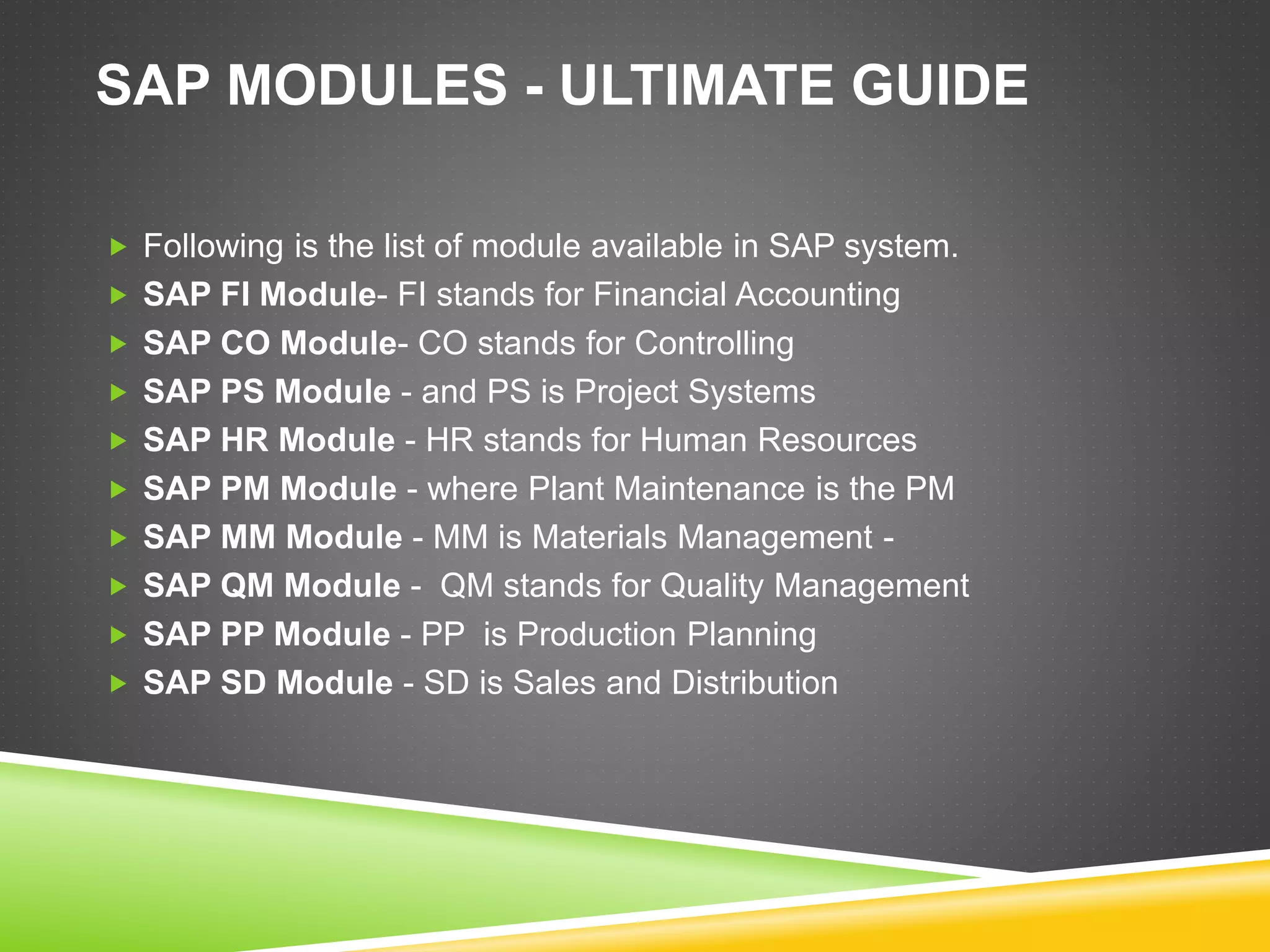
SAP MODULES - ULTIMATE GUIDE
 Following is the list of module available in SAP system.
 SAP FI Module- FI stands for Financial Accounting
 SAP CO Module- CO stands for Controlling
 SAP PS Module - and PS is Project Systems
 SAP HR Module - HR stands for Human Resources
 SAP PM Module - where Plant Maintenance is the PM
 SAP MM Module - MM is Materials Management -
 SAP QM Module - QM stands for Quality Management
 SAP PP Module - PP is Production Planning
 SAP SD Module - SD is Sales and Distribution
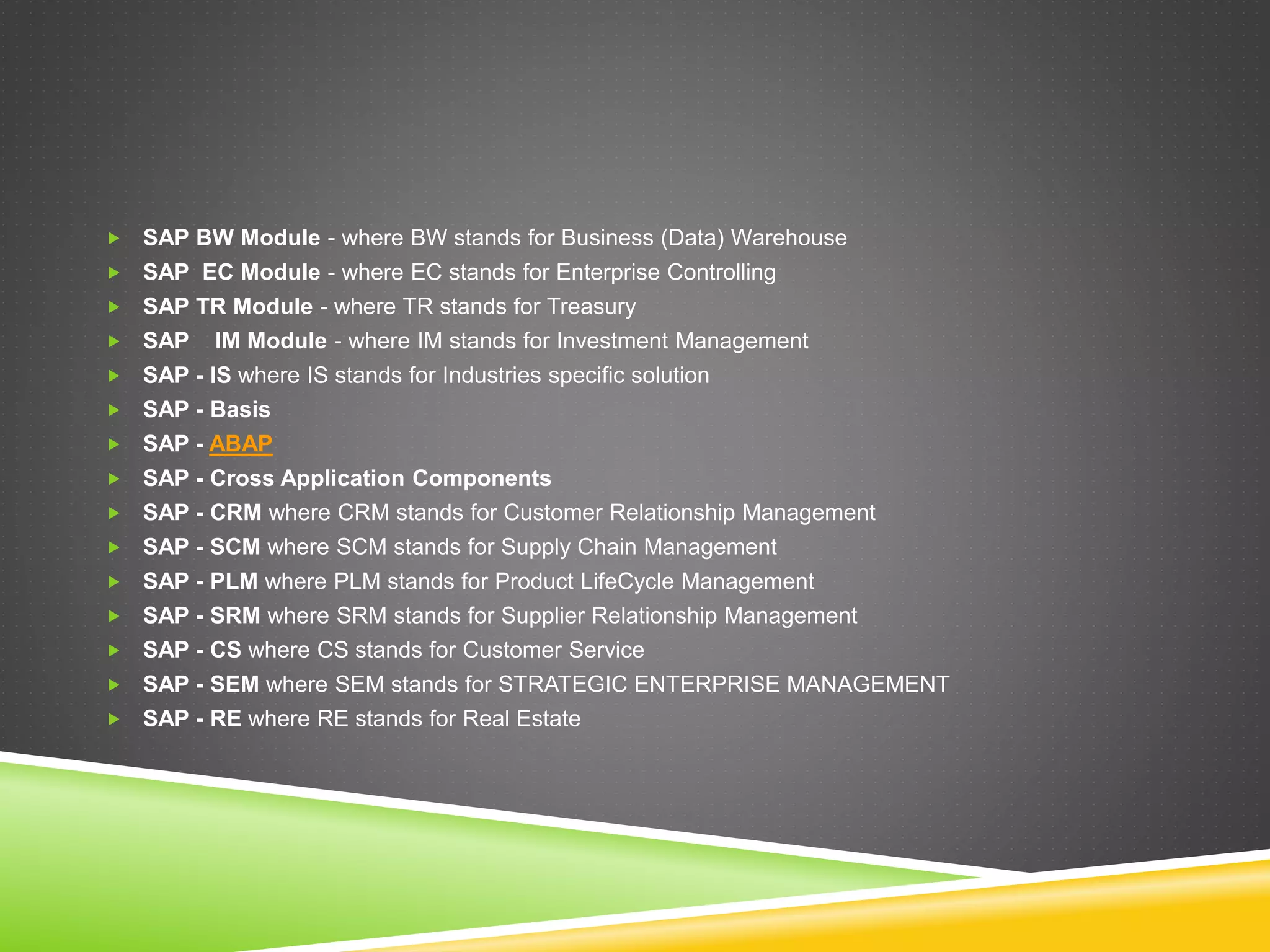
 SAP BW Module - where BW stands for Business (Data) Warehouse
 SAP EC Module - where EC stands for Enterprise Controlling
 SAP TR Module - where TR stands for Treasury
 SAP IM Module - where IM stands for Investment Management
 SAP - IS where IS stands for Industries specific solution
 SAP - Basis
 SAP - ABAP
 SAP - Cross Application Components
 SAP - CRM where CRM stands for Customer Relationship Management
 SAP - SCM where SCM stands for Supply Chain Management
 SAP - PLM where PLM stands for Product LifeCycle Management
 SAP - SRM where SRM stands for Supplier Relationship Management
 SAP - CS where CS stands for Customer Service
 SAP - SEM where SEM stands for STRATEGIC ENTERPRISE MANAGEMENT
 SAP - RE where RE stands for Real Estate
WHAT IS SAP INSTANCE & SID
 What is an Instance?
 An SAP R/3 instance defines a group of resources such as
 memory
 work processes
 dispatcher
 gateway
 usually for a single application or database server within an SAP R/3 client-
server environment.
 Basically there are three types of instances:-
 Dialog instance
 Central Instance
 Database Instance
FOR ONE SAP SYSTEM ALL THREE
INSTANCES SHARE THE SAME
DIRECTORY.
 Dialog Instance:- Dialog instance exists in the application layer.Its purpose is to maintain load
on the server.Dialog instance exists on different host.If number of dialog instance increases
hardware resources,dispatcher,workprocesses also increases so that more number of users
can login at a time.
 Central Instance:- Central instance can also work as dialog instance.But the main thing is that
it contains Enqueue and message servers. All dialog instances communicate with central
instance before requesting database with message server. When an instance is started, the
dispatcher process attempts to establish a connection to the message server so that it can
announce the services it provides (DIA, BTC, SPO, UPD, etc.).Lock table is managed in
central instance by enqueue service.
 Database Instance:- As normal database instance accepts requests from central instance to
fulfill the user's requests. As lock management system provided by enqueue server it will
provide service to users.
 What is SID ?
 Each R/3 installation (SAP system) of a database server and several app servers running the
application logic is uniquely identified by a single SID (SAP System Identification), SAPSID —
a three-character code such as C11, PRD, E56, etc.),
LOGICAL SYSTEM NAMES:-
 When data is distributed between different systems, each system within a
network has to be clearly identifiable. The "logical system" deals with this
issue.
 A logical system is an application system in which the applications work
together on a common database. In SAP terms, the logical system is a client.
 Since the logical system name is used to identify a system uniquely within the
network, two systems cannot have the same name if they are connected to
each other as BW systems or as source systems, or if there are plans to
connect them in any way.
 Example for production system logical system name might be:-
 SID – PBG
 SID Description - P=Production(type) , B=BW(component) ,
G=Germany.(plant name)
 Logical System name-
 PBGCLNT100.This form is easy to understand.
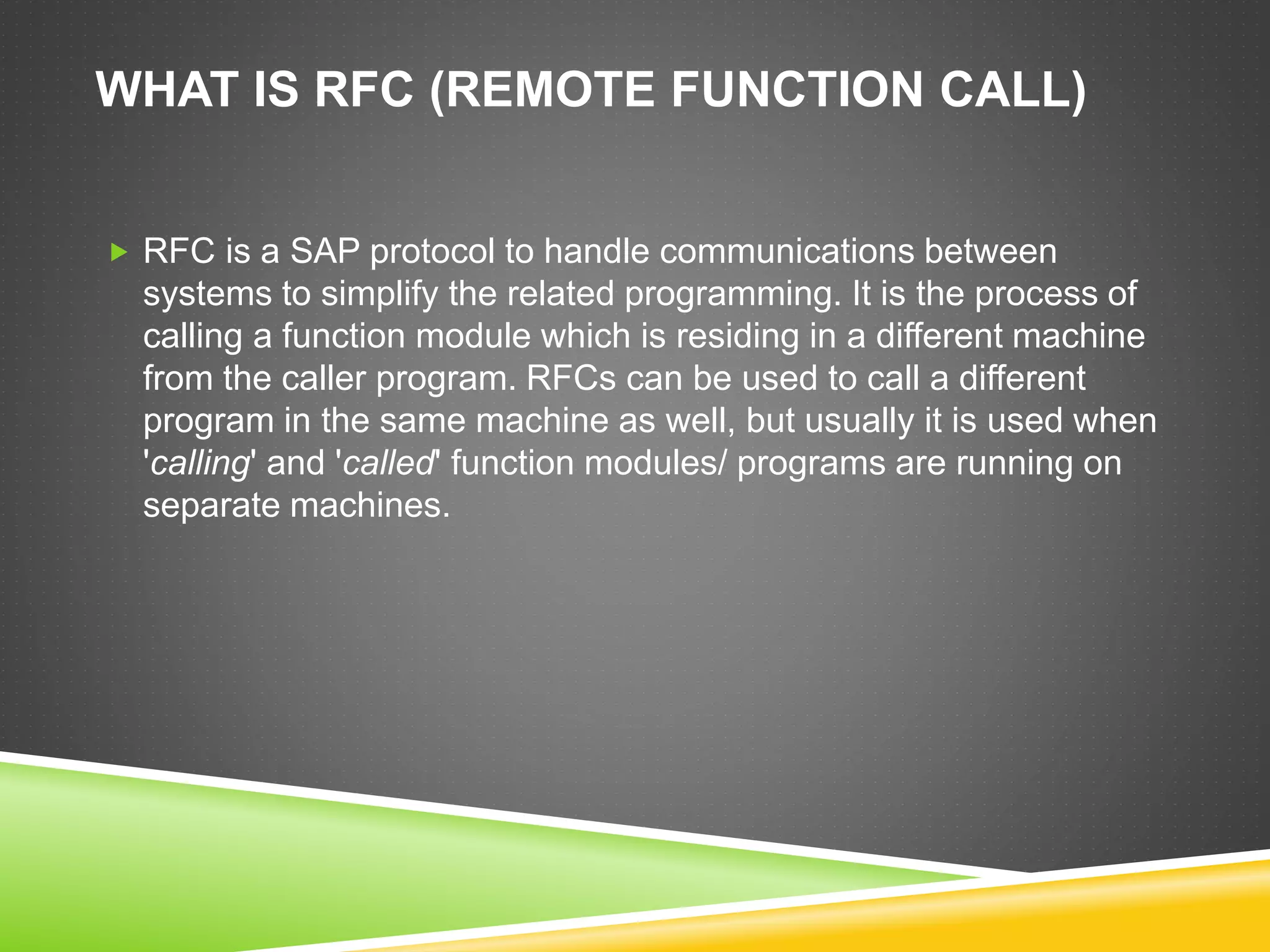
WHAT IS RFC (REMOTE FUNCTION CALL)
 RFC is a SAP protocol to handle communications between
systems to simplify the related programming. It is the process of
calling a function module which is residing in a different machine
from the caller program. RFCs can be used to call a different
program in the same machine as well, but usually it is used when
'calling' and 'called' function modules/ programs are running on
separate machines.
IDOC AND BAPI
 IDoc
IDoc (for intermediate document) is a standard data structure for
electronic data interchange (EDI) between application programs
written for the popular SAP business system or between an SAP
application and an external program. IDocs serve as the vehicle
for data transfer in SAP's Application Link Enabling (ALE) system.
IDocs are used for asynchronous transactions: each IDoc
generated exists as a self-contained text file that can then be
transmitted to the requesting workstation without connecting to
the central database. Another SAP mechanism, the Business
Application Programming Interface (BAPI) is used
for synchronous transactions.
 IDoc types define different categories of data, such as purchase
orders or invoices, which may then be broken down into more
specific categories called message types. Greater specificity means
that an IDoc type is capable of storing only the data required for a
particular transaction, which increases efficiency and decreases
resource demands.
An IDoc can be generated at any point in a transaction process. For
example, during a shipping transaction process, an IDoc may be
generated that includes the data fields required to print a shipping
manifest. After a user performs an SAP transaction, one or more
IDocs are generated in the sending database and passed to the ALE
communication layer. The communication layer performs a Remote
Function Call (RFC), using the port definition and RFC destination
specified by the customer model. The IDoc is transmitted to the
receiver, which may be an R/3, R/2, or some external system.
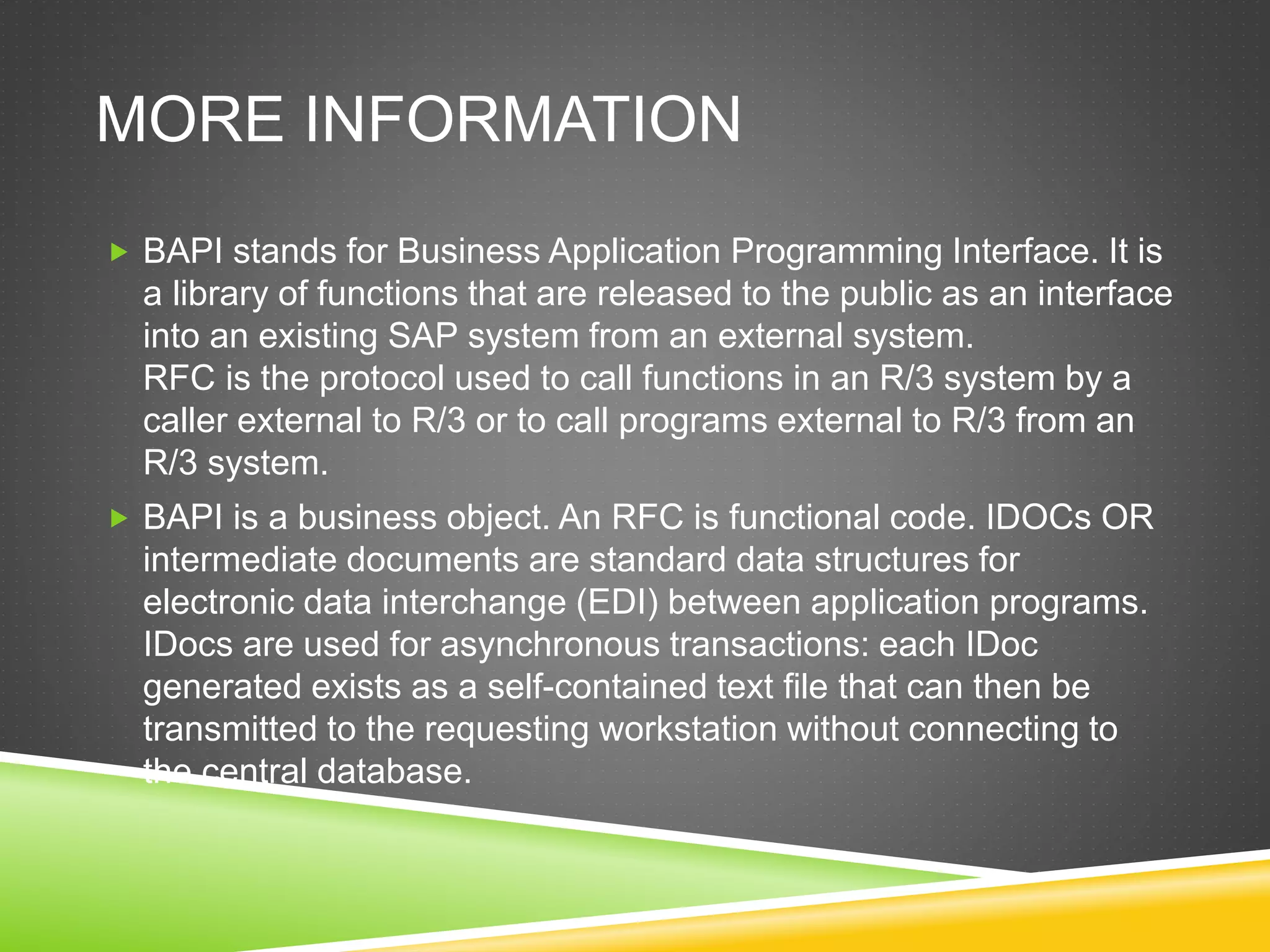
MORE INFORMATION
 BAPI stands for Business Application Programming Interface. It is
a library of functions that are released to the public as an interface
into an existing SAP system from an external system.
RFC is the protocol used to call functions in an R/3 system by a
caller external to R/3 or to call programs external to R/3 from an
R/3 system.
 BAPI is a business object. An RFC is functional code. IDOCs OR
intermediate documents are standard data structures for
electronic data interchange (EDI) between application programs.
IDocs are used for asynchronous transactions: each IDoc
generated exists as a self-contained text file that can then be
transmitted to the requesting workstation without connecting to
the central database.

Sap

  • 1.
    SAP SAP stands for‘Systems Applications and Products’ and was originally aimed providing customers with the ability to interact upon a common database along a comprehensive application range. It was originally that the more applications began to be assembled and today, SAP is being used by thriving companies like Microsoft and IBM.
  • 2.
    SAP HISTORY  SAPwas in fact founded by five IBM employees in 1972 from Mannheim, Germany. SAP applications have gone through different changes and modifications and the latest R/3 (business applications from SAP) provides immense capabilities to manage financial assets, production operations, plants, personnel, materials, archived documents and cost accounting. The latest R/3 framework runs on several platforms that include Windows 2000 and use client/server models. It also includes internet enabled packages for better information exchange.
  • 3.
    SAP MODULES -ULTIMATE GUIDE  Following is the list of module available in SAP system.  SAP FI Module- FI stands for Financial Accounting  SAP CO Module- CO stands for Controlling  SAP PS Module - and PS is Project Systems  SAP HR Module - HR stands for Human Resources  SAP PM Module - where Plant Maintenance is the PM  SAP MM Module - MM is Materials Management -  SAP QM Module - QM stands for Quality Management  SAP PP Module - PP is Production Planning  SAP SD Module - SD is Sales and Distribution
  • 4.
     SAP BWModule - where BW stands for Business (Data) Warehouse  SAP EC Module - where EC stands for Enterprise Controlling  SAP TR Module - where TR stands for Treasury  SAP IM Module - where IM stands for Investment Management  SAP - IS where IS stands for Industries specific solution  SAP - Basis  SAP - ABAP  SAP - Cross Application Components  SAP - CRM where CRM stands for Customer Relationship Management  SAP - SCM where SCM stands for Supply Chain Management  SAP - PLM where PLM stands for Product LifeCycle Management  SAP - SRM where SRM stands for Supplier Relationship Management  SAP - CS where CS stands for Customer Service  SAP - SEM where SEM stands for STRATEGIC ENTERPRISE MANAGEMENT  SAP - RE where RE stands for Real Estate
  • 5.
    WHAT IS SAPINSTANCE & SID  What is an Instance?  An SAP R/3 instance defines a group of resources such as  memory  work processes  dispatcher  gateway  usually for a single application or database server within an SAP R/3 client- server environment.  Basically there are three types of instances:-  Dialog instance  Central Instance  Database Instance
  • 6.
    FOR ONE SAPSYSTEM ALL THREE INSTANCES SHARE THE SAME DIRECTORY.  Dialog Instance:- Dialog instance exists in the application layer.Its purpose is to maintain load on the server.Dialog instance exists on different host.If number of dialog instance increases hardware resources,dispatcher,workprocesses also increases so that more number of users can login at a time.  Central Instance:- Central instance can also work as dialog instance.But the main thing is that it contains Enqueue and message servers. All dialog instances communicate with central instance before requesting database with message server. When an instance is started, the dispatcher process attempts to establish a connection to the message server so that it can announce the services it provides (DIA, BTC, SPO, UPD, etc.).Lock table is managed in central instance by enqueue service.  Database Instance:- As normal database instance accepts requests from central instance to fulfill the user's requests. As lock management system provided by enqueue server it will provide service to users.  What is SID ?  Each R/3 installation (SAP system) of a database server and several app servers running the application logic is uniquely identified by a single SID (SAP System Identification), SAPSID — a three-character code such as C11, PRD, E56, etc.),
  • 7.
    LOGICAL SYSTEM NAMES:- When data is distributed between different systems, each system within a network has to be clearly identifiable. The "logical system" deals with this issue.  A logical system is an application system in which the applications work together on a common database. In SAP terms, the logical system is a client.  Since the logical system name is used to identify a system uniquely within the network, two systems cannot have the same name if they are connected to each other as BW systems or as source systems, or if there are plans to connect them in any way.  Example for production system logical system name might be:-  SID – PBG  SID Description - P=Production(type) , B=BW(component) , G=Germany.(plant name)  Logical System name-  PBGCLNT100.This form is easy to understand.
  • 8.
    WHAT IS RFC(REMOTE FUNCTION CALL)  RFC is a SAP protocol to handle communications between systems to simplify the related programming. It is the process of calling a function module which is residing in a different machine from the caller program. RFCs can be used to call a different program in the same machine as well, but usually it is used when 'calling' and 'called' function modules/ programs are running on separate machines.
  • 9.
    IDOC AND BAPI IDoc IDoc (for intermediate document) is a standard data structure for electronic data interchange (EDI) between application programs written for the popular SAP business system or between an SAP application and an external program. IDocs serve as the vehicle for data transfer in SAP's Application Link Enabling (ALE) system. IDocs are used for asynchronous transactions: each IDoc generated exists as a self-contained text file that can then be transmitted to the requesting workstation without connecting to the central database. Another SAP mechanism, the Business Application Programming Interface (BAPI) is used for synchronous transactions.
  • 10.
     IDoc typesdefine different categories of data, such as purchase orders or invoices, which may then be broken down into more specific categories called message types. Greater specificity means that an IDoc type is capable of storing only the data required for a particular transaction, which increases efficiency and decreases resource demands. An IDoc can be generated at any point in a transaction process. For example, during a shipping transaction process, an IDoc may be generated that includes the data fields required to print a shipping manifest. After a user performs an SAP transaction, one or more IDocs are generated in the sending database and passed to the ALE communication layer. The communication layer performs a Remote Function Call (RFC), using the port definition and RFC destination specified by the customer model. The IDoc is transmitted to the receiver, which may be an R/3, R/2, or some external system.
  • 11.
    MORE INFORMATION  BAPIstands for Business Application Programming Interface. It is a library of functions that are released to the public as an interface into an existing SAP system from an external system. RFC is the protocol used to call functions in an R/3 system by a caller external to R/3 or to call programs external to R/3 from an R/3 system.  BAPI is a business object. An RFC is functional code. IDOCs OR intermediate documents are standard data structures for electronic data interchange (EDI) between application programs. IDocs are used for asynchronous transactions: each IDoc generated exists as a self-contained text file that can then be transmitted to the requesting workstation without connecting to the central database.