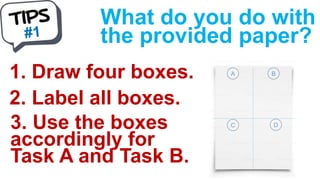
What do you do with
the provided paper?
1. Draw four boxes.
2. Label all boxes.
A B
C D3. Use the boxes
accordingly for
Task A and Task B.
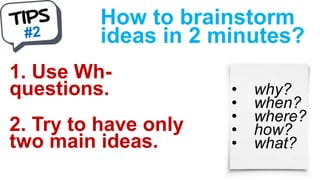
How to brainstorm
ideas in 2 minutes?
1. Use Wh-
questions.
2. Try to have only
two main ideas.
• why?
• when?
• where?
• how?
• what?
How to give enough
explanation?
1. Use examples. Don’t forget to
use the signpost ‘For example,
….’ or ‘As examples,..’
2. Use situations as examples.
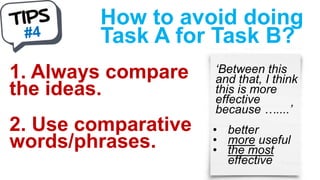
How to avoid doing
Task A for Task B?
1. Always compare
the ideas.
2. Use comparative
words/phrases.
‘Between this
and that, I think
this is more
effective
because …....’
• better
• more useful
• the most
effective
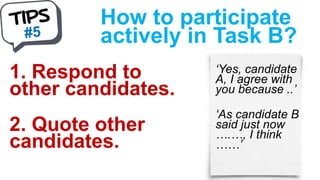
How to participate
actively in Task B?
1. Respond to
other candidates.
2. Quote other
candidates.
‘Yes, candidate
A, I agree with
you because ..’
‘As candidate B
said just now
….…, I think
……’
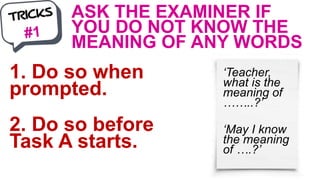
ASK THE EXAMINER IF
YOU DO NOT KNOW THE
MEANING OF ANY WORDS
1. Do so when
prompted.
2. Do so before
Task A starts.
‘Teacher,
what is the
meaning of
……..?’
‘May I know
the meaning
of ….?’
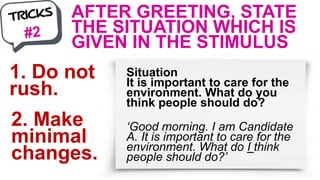
AFTER GREETING, STATE
THE SITUATION WHICH IS
GIVEN IN THE STIMULUS
1. Do not
rush.
2. Make
minimal
changes.
Situation
It is important to care for the
environment. What do you
think people should do?
‘Good morning. I am Candidate
A. It is important to care for the
environment. What do I think
people should do?’
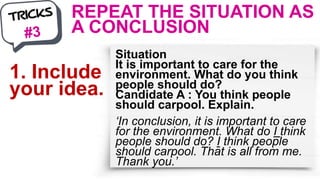
REPEAT THE SITUATION AS
A CONCLUSION
Situation
It is important to care for the
environment. What do you think
people should do?
Candidate A : You think people
should carpool. Explain.
‘In conclusion, it is important to care
for the environment. What do I think
people should do? I think people
should carpool. That is all from me.
Thank you.’
1. Include
your idea.
MUET Speaking Tips and Tricks

MUET Speaking Tips and Tricks

  • 2.
    What do youdo with the provided paper? 1. Draw four boxes. 2. Label all boxes. A B C D3. Use the boxes accordingly for Task A and Task B.
  • 3.
    How to brainstorm ideasin 2 minutes? 1. Use Wh- questions. 2. Try to have only two main ideas. • why? • when? • where? • how? • what?
  • 4.
    How to giveenough explanation? 1. Use examples. Don’t forget to use the signpost ‘For example, ….’ or ‘As examples,..’ 2. Use situations as examples.
  • 5.
    How to avoiddoing Task A for Task B? 1. Always compare the ideas. 2. Use comparative words/phrases. ‘Between this and that, I think this is more effective because …....’ • better • more useful • the most effective
  • 6.
    How to participate activelyin Task B? 1. Respond to other candidates. 2. Quote other candidates. ‘Yes, candidate A, I agree with you because ..’ ‘As candidate B said just now ….…, I think ……’
  • 7.
    ASK THE EXAMINERIF YOU DO NOT KNOW THE MEANING OF ANY WORDS 1. Do so when prompted. 2. Do so before Task A starts. ‘Teacher, what is the meaning of ……..?’ ‘May I know the meaning of ….?’
  • 8.
    AFTER GREETING, STATE THESITUATION WHICH IS GIVEN IN THE STIMULUS 1. Do not rush. 2. Make minimal changes. Situation It is important to care for the environment. What do you think people should do? ‘Good morning. I am Candidate A. It is important to care for the environment. What do I think people should do?’
  • 9.
    REPEAT THE SITUATIONAS A CONCLUSION Situation It is important to care for the environment. What do you think people should do? Candidate A : You think people should carpool. Explain. ‘In conclusion, it is important to care for the environment. What do I think people should do? I think people should carpool. That is all from me. Thank you.’ 1. Include your idea.