Developing an Effective Case
Study
TEACHING IN MEDICAL EDUCATION
FACULTY FELLOWS PROGRAM

ADLT 672, INSTRUCTIONAL STRATEGIES FOR
TEACHING IN MEDICINE
NOVEMBER 14, 2013
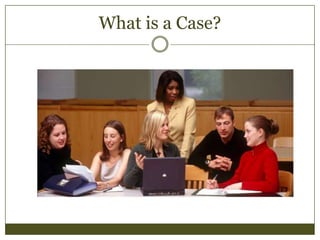
What is a Case?
The What
Cases are stories: real events or problems so
learners experience the complexities, ambiguities, and
uncertainties of participants

 Cases come in all sizes: written
cases, movie clips, radio/TV stories, pictures

 Retrospective cases tell the whole story
 Provide an overview
 A brief summary of the facts of the case
 The story of the case
 Issues raised by the case

Your
Initial
Moves

 Create an analytic framework
 The time line
 Decisions to be made/ decision-makers
 Rational analysis
What is the problem?
 What are the alternatives?
 How should you evaluate the alternatives?
 What’s the rationale for the solution you
propose?

 Use a Quick Question
 Pose a question to students to open the
case to elicit
facts, opinions, interpretations, or issues

Your
Initial
Moves

 Ask students to summarize

the story of the case in one
sentence


The subsequent discussion can pool their
ideas to create a larger, more complex
picture of the case

 Establish a baseline


Poll students with their preliminary
judgments about the case
Deploying Your Power as Facilitator
 Inquiring or badgering?
 Be sure your questions are designed in the spirit of inquiry
 Avoid overly specific or skeptical questions
 Your points or theirs?
 Demonstrate that you are wide open to their ideas and
suggestions. “I like your point; let’s use it.”
 Avoid asking students to guess what you want. Instead, use
questions like, “Have we covered all the main points?”
Deploying Your Power as Facilitator
 Hearing or Listening?
 Focus on sensing what they really mean when you listen to
what they say. Are you sensing their concerns or their issues?
More than “hearing” is required when you facilitate a case
discussion.
 Seeing or reacting?
 It is easy to see or react to learners who sit up front. You’ll
need to develop your peripheral vision to stay attuned to those
who have something to add from the back of the room.
Deploying Your Power as Facilitator
 Warm or cold?


Avoid being the dispassionate observer. If learners think you are
remote or unresponsive, they will “check out” of the discussion.
Warmth and enthusiasm go a long way!

 Up here or out there?


Students under pressure to answer questions will often deflect the
attention and pressure back to you by insisting that you provide
answers or clarifications, putting you back in the expert role.



Avoid the “hub and spoke” discussion in which conversation moves
back and forth from one student to you.
Moving the Discussion Forward
 Consider using flip charts or a chalkboard to

establish a sense of progress
 Use transitions to mark the sequence of

stages or steps in the discussion:






In a seque, your transition seems natural to the conversation,
“that point raises another good issue.”
In a shift, your transition is deliberately more abrupt. “I want
to ask you a different question.”
In an interim summary, you (or the learners) sum up what
has been said so far
Skillful time management is essential

Remember, that with the best case
discussions, students will all wish
there was more time!
But what if it isn’t working?
SPECIAL
SITUATIONS
Dealing with Problem Situations
 Silence / Apathy
 Premature closure
 Sitting at the teacher’s feet
 The abyss
 The problem student








Unmotivated student
Uninformed student
Defector
Compulsive talker
Show-off
Conflict avoider
The rude or abrasive student
How do you close a case
discussion?

What’s the most important
thing to remember?
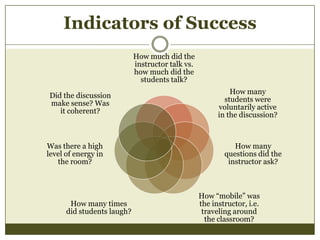
Indicators of Success
How much did the
instructor talk vs.
how much did the
students talk?
Did the discussion
make sense? Was
it coherent?

Was there a high
level of energy in
the room?

How many times
did students laugh?

How many
students were
voluntarily active
in the discussion?

How many
questions did the
instructor ask?

How “mobile” was
the instructor, i.e.
traveling around
the classroom?
The LCME definition of Active Learning


In active learning,




The learner is given the opportunity to independently
identify, analyze, and synthesize relevant information





The learner is given the opportunity to self-assess
learning needs

The learner is given the opportunity to appraise the
credibility of information resources

All of this implies a new paradigm for
teaching!
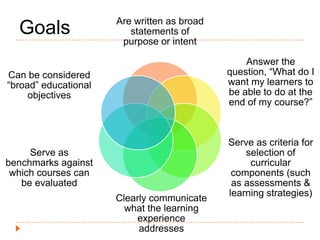
Goals

Are written as broad
statements of
purpose or intent

Can be considered
“broad” educational
objectives

Answer the
question, “What do I
want my learners to
be able to do at the
end of my course?”

Serve as
benchmarks against
which courses can
be evaluated

Serve as criteria for
selection of
curricular
components (such
as assessments &
learning strategies)

Clearly communicate
what the learning
experience
addresses
Goals Differ from Learning
Objectives
Learning
Goals


Can use verbs such as
“understand,” “know”
or “appreciate”

Objectives


Use strong, actionoriented verbs in one of
three domains of
learning:






Are often written,


The purpose of this
course is ….





Cognitive
Psychomotor
Affective

Can also be related to
process or desired
outcomes of the learning
experience
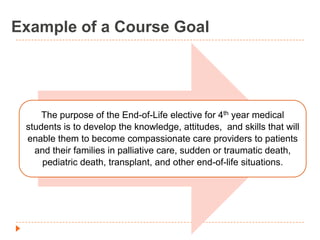
Example of a Course Goal

The purpose of the End-of-Life elective for 4th year medical
students is to develop the knowledge, attitudes, and skills that will
enable them to become compassionate care providers to patients
and their families in palliative care, sudden or traumatic death,
pediatric death, transplant, and other end-of-life situations.
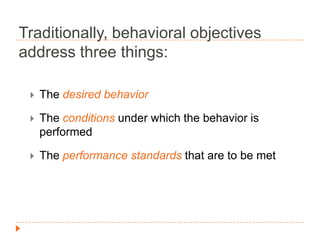
Traditionally, behavioral objectives
address three things:


The desired behavior



The conditions under which the behavior is
performed



The performance standards that are to be met
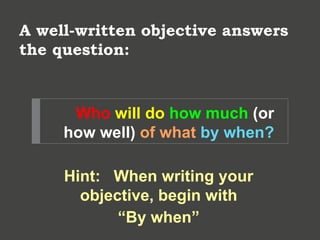
A well-written objective answers
the question:

Who will do how much (or
how well) of what by when?
Hint: When writing your
objective, begin with
“By when”
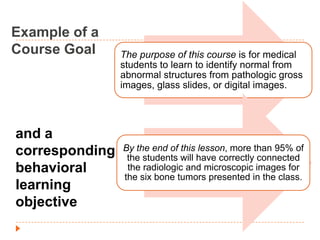
Example of a
Course Goal

and a
corresponding
behavioral
learning
objective

The purpose of this course is for medical
students to learn to identify normal from
abnormal structures from pathologic gross
images, glass slides, or digital images.

By the end of this lesson, more than 95% of
the students will have correctly connected
the radiologic and microscopic images for
the six bone tumors presented in the class.

Developing an effective case study

  • 1.
    Developing an EffectiveCase Study TEACHING IN MEDICAL EDUCATION FACULTY FELLOWS PROGRAM ADLT 672, INSTRUCTIONAL STRATEGIES FOR TEACHING IN MEDICINE NOVEMBER 14, 2013
  • 2.
    What is aCase?
  • 3.
    The What Cases arestories: real events or problems so learners experience the complexities, ambiguities, and uncertainties of participants  Cases come in all sizes: written cases, movie clips, radio/TV stories, pictures  Retrospective cases tell the whole story
  • 4.
     Provide anoverview  A brief summary of the facts of the case  The story of the case  Issues raised by the case Your Initial Moves  Create an analytic framework  The time line  Decisions to be made/ decision-makers  Rational analysis What is the problem?  What are the alternatives?  How should you evaluate the alternatives?  What’s the rationale for the solution you propose? 
  • 5.
     Use aQuick Question  Pose a question to students to open the case to elicit facts, opinions, interpretations, or issues Your Initial Moves  Ask students to summarize the story of the case in one sentence  The subsequent discussion can pool their ideas to create a larger, more complex picture of the case  Establish a baseline  Poll students with their preliminary judgments about the case
  • 6.
    Deploying Your Poweras Facilitator  Inquiring or badgering?  Be sure your questions are designed in the spirit of inquiry  Avoid overly specific or skeptical questions  Your points or theirs?  Demonstrate that you are wide open to their ideas and suggestions. “I like your point; let’s use it.”  Avoid asking students to guess what you want. Instead, use questions like, “Have we covered all the main points?”
  • 7.
    Deploying Your Poweras Facilitator  Hearing or Listening?  Focus on sensing what they really mean when you listen to what they say. Are you sensing their concerns or their issues? More than “hearing” is required when you facilitate a case discussion.  Seeing or reacting?  It is easy to see or react to learners who sit up front. You’ll need to develop your peripheral vision to stay attuned to those who have something to add from the back of the room.
  • 8.
    Deploying Your Poweras Facilitator  Warm or cold?  Avoid being the dispassionate observer. If learners think you are remote or unresponsive, they will “check out” of the discussion. Warmth and enthusiasm go a long way!  Up here or out there?  Students under pressure to answer questions will often deflect the attention and pressure back to you by insisting that you provide answers or clarifications, putting you back in the expert role.  Avoid the “hub and spoke” discussion in which conversation moves back and forth from one student to you.
  • 9.
    Moving the DiscussionForward  Consider using flip charts or a chalkboard to establish a sense of progress  Use transitions to mark the sequence of stages or steps in the discussion:    In a seque, your transition seems natural to the conversation, “that point raises another good issue.” In a shift, your transition is deliberately more abrupt. “I want to ask you a different question.” In an interim summary, you (or the learners) sum up what has been said so far
  • 10.
    Skillful time managementis essential Remember, that with the best case discussions, students will all wish there was more time!
  • 11.
    But what ifit isn’t working? SPECIAL SITUATIONS
  • 12.
    Dealing with ProblemSituations  Silence / Apathy  Premature closure  Sitting at the teacher’s feet  The abyss  The problem student        Unmotivated student Uninformed student Defector Compulsive talker Show-off Conflict avoider The rude or abrasive student
  • 13.
    How do youclose a case discussion? What’s the most important thing to remember?
  • 14.
    Indicators of Success Howmuch did the instructor talk vs. how much did the students talk? Did the discussion make sense? Was it coherent? Was there a high level of energy in the room? How many times did students laugh? How many students were voluntarily active in the discussion? How many questions did the instructor ask? How “mobile” was the instructor, i.e. traveling around the classroom?
  • 15.
    The LCME definitionof Active Learning  In active learning,   The learner is given the opportunity to independently identify, analyze, and synthesize relevant information   The learner is given the opportunity to self-assess learning needs The learner is given the opportunity to appraise the credibility of information resources All of this implies a new paradigm for teaching!
  • 16.
    Goals Are written asbroad statements of purpose or intent Can be considered “broad” educational objectives Answer the question, “What do I want my learners to be able to do at the end of my course?” Serve as benchmarks against which courses can be evaluated Serve as criteria for selection of curricular components (such as assessments & learning strategies) Clearly communicate what the learning experience addresses
  • 17.
    Goals Differ fromLearning Objectives Learning Goals  Can use verbs such as “understand,” “know” or “appreciate” Objectives  Use strong, actionoriented verbs in one of three domains of learning:    Are often written,  The purpose of this course is ….   Cognitive Psychomotor Affective Can also be related to process or desired outcomes of the learning experience
  • 18.
    Example of aCourse Goal The purpose of the End-of-Life elective for 4th year medical students is to develop the knowledge, attitudes, and skills that will enable them to become compassionate care providers to patients and their families in palliative care, sudden or traumatic death, pediatric death, transplant, and other end-of-life situations.
  • 19.
    Traditionally, behavioral objectives addressthree things:  The desired behavior  The conditions under which the behavior is performed  The performance standards that are to be met
  • 20.
    A well-written objectiveanswers the question: Who will do how much (or how well) of what by when? Hint: When writing your objective, begin with “By when”
  • 21.
    Example of a CourseGoal and a corresponding behavioral learning objective The purpose of this course is for medical students to learn to identify normal from abnormal structures from pathologic gross images, glass slides, or digital images. By the end of this lesson, more than 95% of the students will have correctly connected the radiologic and microscopic images for the six bone tumors presented in the class.