MALAYSIAN UNIVERSITY
ENGLISH TEST (MUET)
(800/2)
SPEAKING TIPS
By
Ms Maria Liza Bt P. Mohd. Latiff
(B.Ed TESL, M.A. Linguistics & English Language Studies)
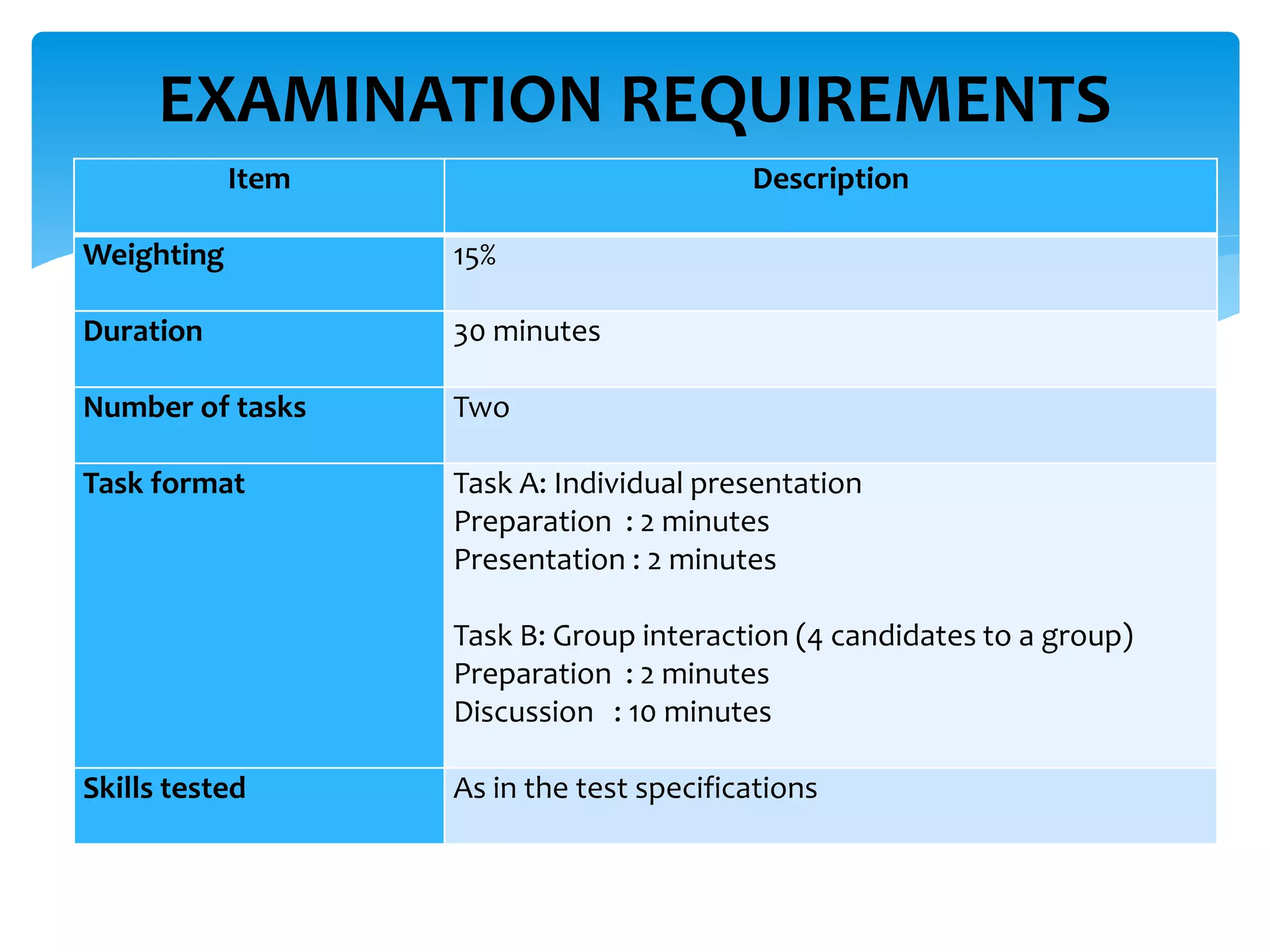
Item Description
Weighting 15%
Duration 30 minutes
Number of tasks Two
Task format Task A: Individual presentation
Preparation : 2 minutes
Presentation : 2 minutes
Task B: Group interaction (4 candidates to a group)
Preparation : 2 minutes
Discussion : 10 minutes
Skills tested As in the test specifications
EXAMINATION REQUIREMENTS
 Evaluation Criteria
1. Task Fulfilment
 - understand the topic
- - shows maturity in discussing the topic
- develops ideas successfully
- presents viewpoints clearly
2. Language
- conveys meaning clearly
- uses appropriate and varied vocabulary
- links ideas effectively
- speaks using accurate grammar
3. Communicative Ability
- speaks fluently
- pronounces words accurately
- uses correct stress and intonation
- projects confidence during delivery
- interacts well and is able to maintain a discussion
- shows initiative and interest
CHIEF
EXAMINER
Candidate A Candidate B
EXAMINER
Candidate D Candidate C
SEATING ARRANGEMENT
SOME USEFUL TIPS FOR MUET
SPEAKING CANDIDATES
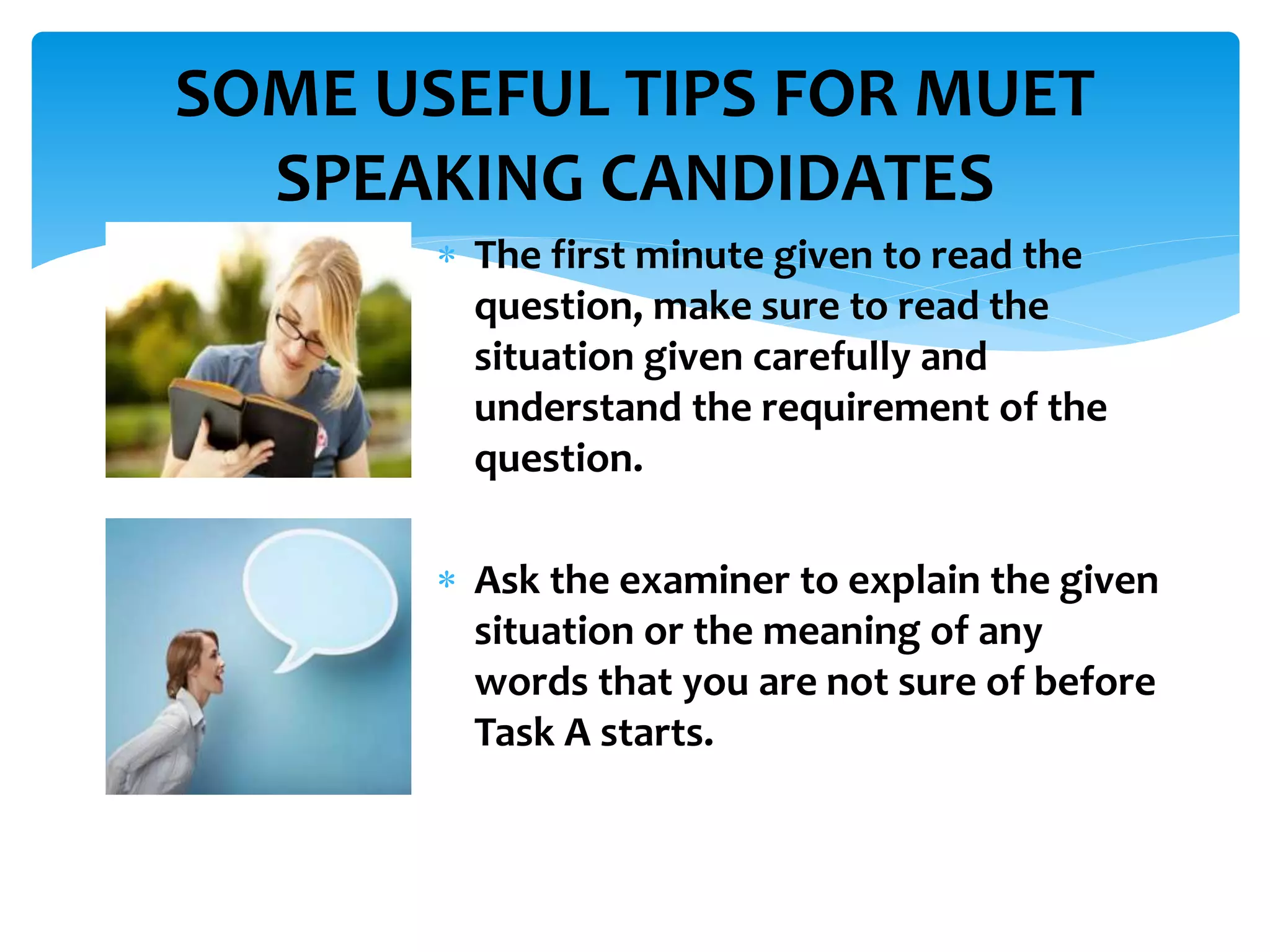
 The first minute given to read the
question, make sure to read the
situation given carefully and
understand the requirement of the
question.
 Ask the examiner to explain the given
situation or the meaning of any
words that you are not sure of before
Task A starts.
 Use the provided paper to draw four
boxes like this
 Use each column to write notes for
Task A and Task B
 To brainstorm for ideas in 2 minutes,
use Wh- questions
Who, What, Why, Which, Where,
When, How
# Write at least 2 main ideas with
 Explanation, Elaboration, Example/s
& Reiteration
A B
C D
 The points mentioned by
a candidate in Task A can
be repeated in Task B.
The points will be taken
as new points by the
examiners.
 Task B is treated as a new
task, so do not attempt
to continue the
discussion by quoting
what other candidates
have mentioned in Task
A.
 Show interest in the
discussion
 Pay attention to what others
are saying
 Respond to other candidates
and quote what other
candidates say
STEP 1
Begin your presentation by
greeting the examiners and
candidates.
* Good morning everyone.
* Good morning examiners and all my friends.
* A very good morning to the examiners and
friends.
STEP 2
State the situation/ task
given
* The situation states that…
* Based on the situation given,…
* According to the situation given,…
* The situation I have been given is…
STEP 3
Start your presentation by
stating your viewpoint or by
introducing your first point.
Then move on to your main
point.
* In my opinion,…
* I believe that…
* It is my view that…
* Based on my experience, my opinion is
that…
USEFUL EXPRESSIONS
To introduce the first point * First of all, I propose…
* For a start, I would like to suggest…
* I would like to begin by…
To signal a main point * My main point is…
* It is important to…
* One important reason is…
* The most important factor is…
To illustrate a point * Therefore…
* This means that…
* This is because…
* On top of that…
* According to…
To provide an example * For example,…
* For instance,…
* One example is…
* Take for example…
* …such as…
To start a new point * Secondly,…
* My next point is…
* Another suggestion is…
* Next, I would like to highlight…
* Another point that I would like to
emphasize is…
* Next, we come to…
* Moving on to my next point, which is…
To refer to what you have said * As I have said earlier,…
* I mentioned earlier that…
* As I said at the beginning…
* I have pointed out earlier that…
To signal cause and effect * This…in turn can lead to…
* For this reason…
* As a result…
* Due to…
* As a consequence…
* …so that…
* …because of…
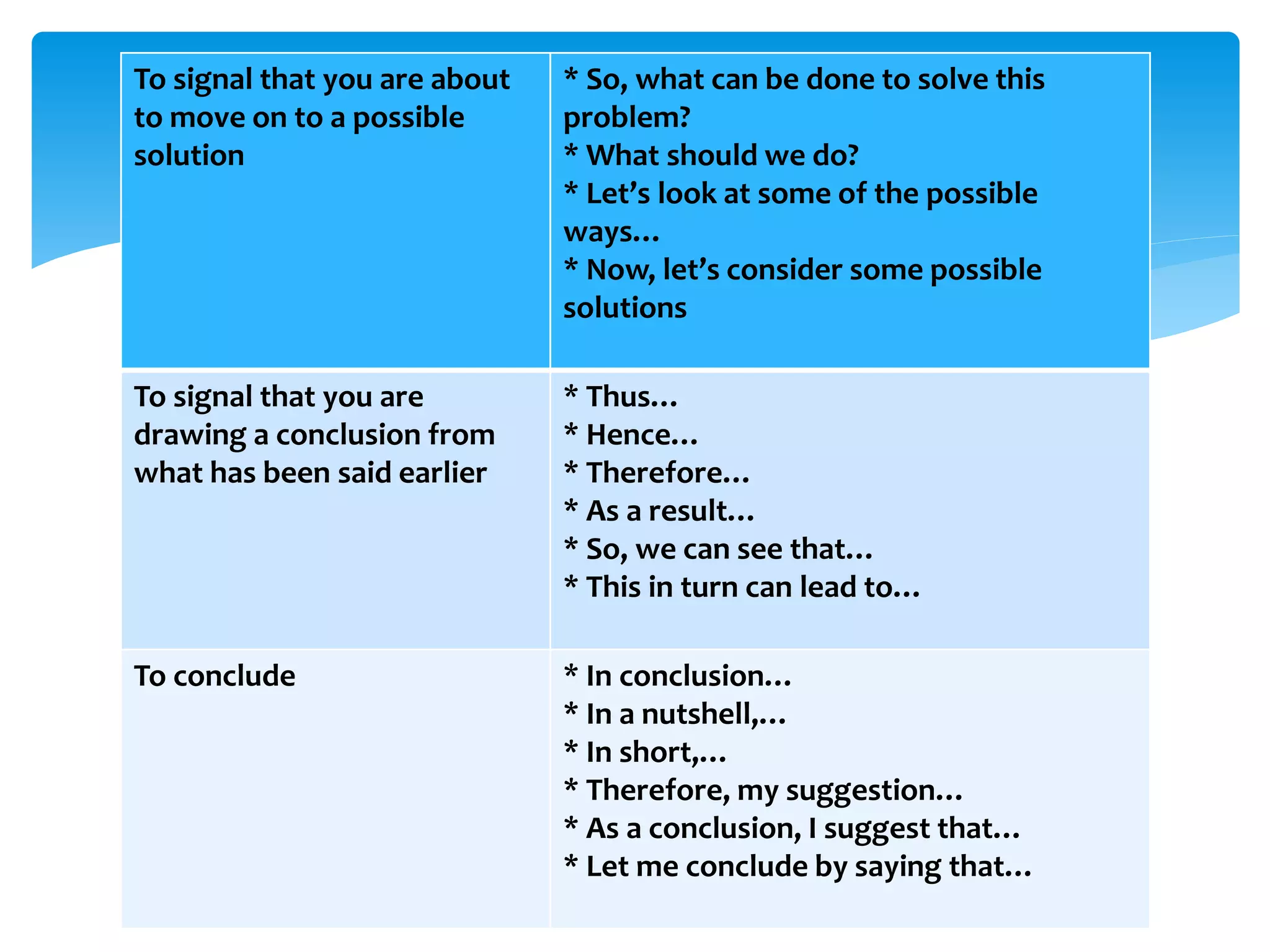
To signal that you are about
to move on to a possible
solution
* So, what can be done to solve this
problem?
* What should we do?
* Let’s look at some of the possible
ways…
* Now, let’s consider some possible
solutions
To signal that you are
drawing a conclusion from
what has been said earlier
* Thus…
* Hence…
* Therefore…
* As a result…
* So, we can see that…
* This in turn can lead to…
To conclude * In conclusion…
* In a nutshell,…
* In short,…
* Therefore, my suggestion…
* As a conclusion, I suggest that…
* Let me conclude by saying that…
To start a discussion * I would like to start the discussion
by saying that…
* We are here to discuss…
* I would like to express my view
regarding this matter…
* Let’s look at some possible
solutions…
* Let’s begin this/ our discussion
by…
* Allow me to begin…
* May I begin by saying…
Useful expressions to initiate a
discussion in Group Interaction
To ask for an opinion * What is your opinion?
* What do you think about…?
* What is your view on…?
* May I know your opinion
regarding…?
* What do you feel about…?
* Do you agree that…?
* What do you think we can do to…?
* Would you like to share your opinion
on…?
* Would you like to offer your
comments…?
To give an opinion/ state point of view * I think…
* I believe…
* I must say…
* In my opinion…
* From my point of view…
* I would say that…
* Personally, I feel…
* I am sure that…
* As far as I am concerned…
To express strong agreement * I strongly agree.
* I agree completely.
* That is certainly true.
* Yes. I am sure you are right.
* Absolutely!
* Exactly! I couldn’t agree with you
more…
* You have hit the nail on the head…
* You’ve made your point very clear.
* You have made an absolutely
convincing argument. I completely
agree…
To express agreement * I agree with you.
* You are right.
* That is true.
* I share the same view.
* I am of the same opinion.
* I am glad you mentioned that.
* I see your point.
To express partial agreement * You could be right but…
* That is true but…
* I see your point but…
* You have a point but…
* That may be so but…
* Your suggestion is good but…
* I do not entirely agree with you.
* I agree to a certain extent, but…
* That’s true to a certain extent, but…
• I think you are right to say that.
However,…
To express strong disagreement * I disagree completely.
* That can’t be true at all.
* That is absolutely untrue.
* That’s totally out of the question.
* No. I don’t like this suggestion.
To express disagreement
* I disagree.
* I don’t see it that way.
* I beg to differ.
* I don’t think so.
* I am not convinced that your
suggestion will work.
* This will give rise to other problems.
On the contrary,…
* I understand what you’re saying but
I don’t think that’s practical / the
correct solution.
* I would consider …as more
important…
* I think it would be better if…
* I think you are mistaken.
To accept ideas/ opinions/
suggestions
* That’s a good idea.
* That sounds great!
* That’s fine with me.
* I can’t agree more.
* I support your suggestion.
* I have no objection to that.
* Your suggestion is acceptable to
me.
* I am in favour of Candidate C’s
suggestion.
* That’s a great suggestion. You’ve
got my support.
* You’ve made your point very
clear.
Useful Expressions to Maintain a
Discussion in Group Interaction
To reject ideas/ opinions/
suggestions
* I appreciate your opinion but…
* I do see your point but…
* I understand your concern but…
* That is interesting but…
* You have a good point there but …
* I am sorry, I can’t agree with you.
* I am afraid we do not share the same opinion.
* I am sorry, I can’t accept what you have just
said.
To ask for clarification * What do you mean by…?
* I am sorry I missed your point. Could you
please explain…
* I am afraid I am not quite sure of what you
meant. Could you please clarify…
* Sorry, I don’t follow you. Would you mind
giving an example?
* Can you please explain further on…?
Do you mean to say that…
* May I know why…?
* Do you mind telling me more about…?
* Could you please explain that to me again?
To interrupt * Excuse me, can you please repeat
what you have just said?
* Excuse me, can you please clarify
that?
* Allow me to interrupt…
* Excuse me, but isn’t it true that…
* Sorry to interrupt but I have to say
this…
* Excuse me, could I just ask you a
quick question?
* I am sorry to interrupt but I think
we need to get back to our topic.
* I am sorry I have to stop you. Can
we get back to our topic on…?
To conclude * In conclusion,…
* As a conclusion,…
* To conclude,…
* In a nutshell,…
To state a group decision
(total agreement)
* We all agree that…
* Our decision is that…
* We have decided that …
* We have come to the conclusion that…
* We have come to an agreement that…
Useful Expressions to Close a
Discussion in Group Interaction
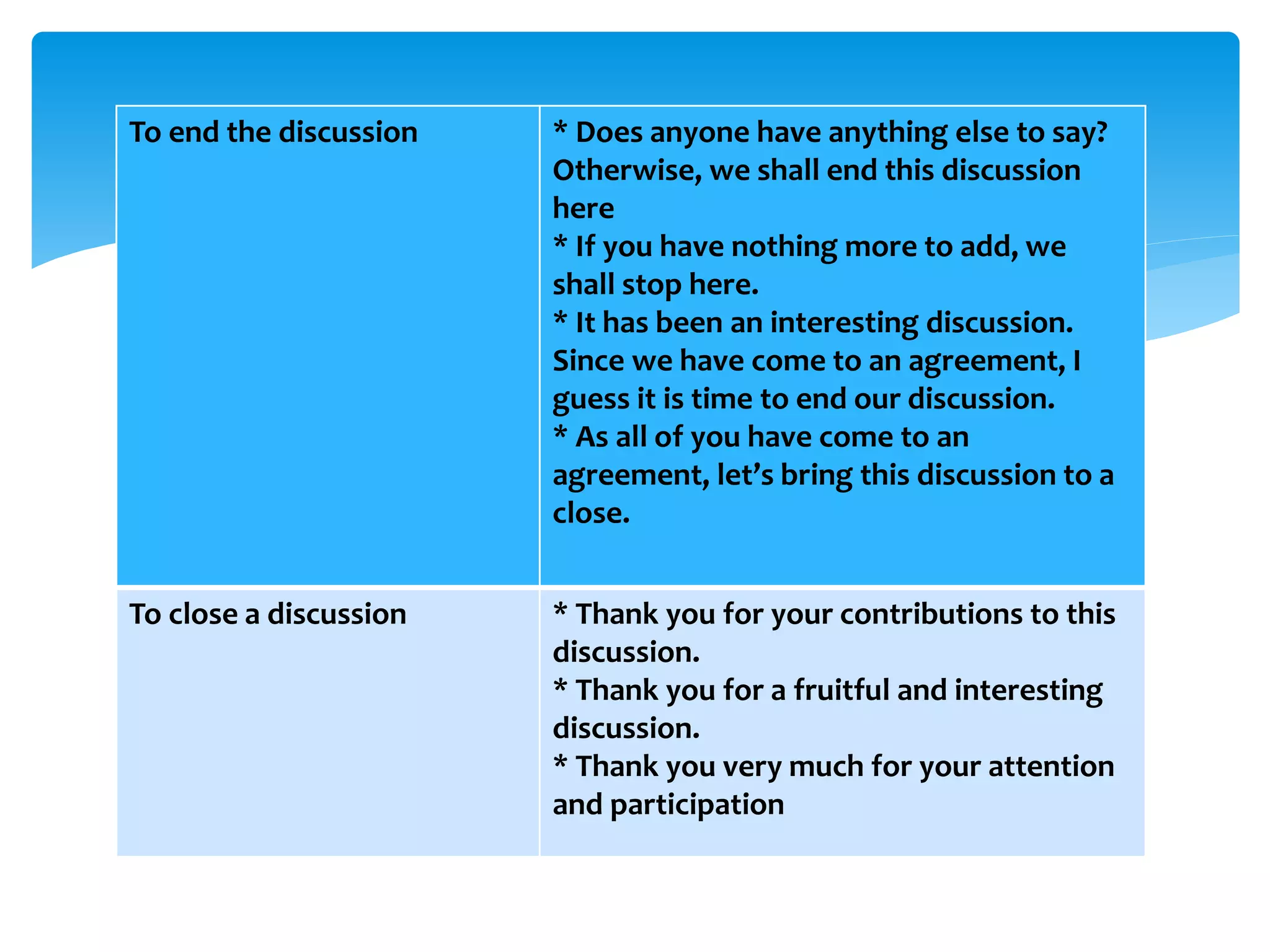
To end the discussion * Does anyone have anything else to say?
Otherwise, we shall end this discussion
here
* If you have nothing more to add, we
shall stop here.
* It has been an interesting discussion.
Since we have come to an agreement, I
guess it is time to end our discussion.
* As all of you have come to an
agreement, let’s bring this discussion to a
close.
To close a discussion * Thank you for your contributions to this
discussion.
* Thank you for a fruitful and interesting
discussion.
* Thank you very much for your attention
and participation
3 agree 1 disagrees If three candidates agree on one of the
arguments, while one candidate strongly agrees
with a different argument, the ‘leader’ of the
group may conclude the discussion like this:
Example:
‘In conclusion, most of us agree that exercising
moderately is the most effective way to
overcome stress. Thank you for your attention.’
IF NOT EVERYONE CAN AGREE
2 agree, 2 disagree If two candidates agree on one argument
while the other two candidates agree with
another argument, the ‘leader’ of the group
may say something like this:
Example:
‘To conclude, we are unable to come to a
group decision because some of us believe
that exercising moderately is the most
effective way to overcome stress, because
exercising moderately produces the feel-
good hormone and promotes restful sleep.
The rest of us, on the other hand, are of the
opinion that good time management is the
best way to overcome stress because we
can get things done in a systematic manner
so that work does not accumulate over
time. Thank you.’
No one agrees with anyone It is also possible that all four candidates
hold strongly to their individual arguments
where all four candidates cannot agree on
one argument. A group decision may not be
achieved at the end of the 10-minute
discussion. The ‘leader’ of the group may
then say something like this:
Example:
‘We are unable to come to an agreement on
the most effective way to overcome stress.
All of us strongly believe in our own views
though we agree with some of the
arguments presented. Thank you for your
contribution to this discussion.’
THE DOs
Read the given situation carefully
•Understand the requirement of the question
•Write short notes (the main points, explanation,
examples)
Speak confidently
•Organise your ideas before you speak
•Speak clearly
•Finish your sentence
Show interest in the discussion
•Pay attention to what others are saying
•Respond to other candidates and quote what other
candidates say
Conquering discussion
•Not giving the chance for other candidates to speak
•Keep on interrupting before the other candidate can finish
his/ her points
Only focusing on your own points
•Busy writing all the time
•Not paying attention to other candidates’ points
•No eye contact with other candidates throughout the
discussion
Being a passive participant in a discussion
• Wait to be prompted
• Monosyllabic reply/ respond
• Show no interest (facial expression)
The Don’ts
 For MUET speaking notes, sample questions and tips
 Go to teslpowerhsbm.blogspot.com
THANK YOU

Muet speaking tips

  • 1.
    MALAYSIAN UNIVERSITY ENGLISH TEST(MUET) (800/2) SPEAKING TIPS By Ms Maria Liza Bt P. Mohd. Latiff (B.Ed TESL, M.A. Linguistics & English Language Studies)
  • 2.
    Item Description Weighting 15% Duration30 minutes Number of tasks Two Task format Task A: Individual presentation Preparation : 2 minutes Presentation : 2 minutes Task B: Group interaction (4 candidates to a group) Preparation : 2 minutes Discussion : 10 minutes Skills tested As in the test specifications EXAMINATION REQUIREMENTS
  • 3.
     Evaluation Criteria 1.Task Fulfilment  - understand the topic - - shows maturity in discussing the topic - develops ideas successfully - presents viewpoints clearly 2. Language - conveys meaning clearly - uses appropriate and varied vocabulary - links ideas effectively - speaks using accurate grammar 3. Communicative Ability - speaks fluently - pronounces words accurately - uses correct stress and intonation - projects confidence during delivery - interacts well and is able to maintain a discussion - shows initiative and interest
  • 4.
    CHIEF EXAMINER Candidate A CandidateB EXAMINER Candidate D Candidate C SEATING ARRANGEMENT
  • 5.
    SOME USEFUL TIPSFOR MUET SPEAKING CANDIDATES  The first minute given to read the question, make sure to read the situation given carefully and understand the requirement of the question.  Ask the examiner to explain the given situation or the meaning of any words that you are not sure of before Task A starts.
  • 6.
     Use theprovided paper to draw four boxes like this  Use each column to write notes for Task A and Task B  To brainstorm for ideas in 2 minutes, use Wh- questions Who, What, Why, Which, Where, When, How # Write at least 2 main ideas with  Explanation, Elaboration, Example/s & Reiteration A B C D
  • 7.
     The pointsmentioned by a candidate in Task A can be repeated in Task B. The points will be taken as new points by the examiners.  Task B is treated as a new task, so do not attempt to continue the discussion by quoting what other candidates have mentioned in Task A.
  • 8.
     Show interestin the discussion  Pay attention to what others are saying  Respond to other candidates and quote what other candidates say
  • 9.
    STEP 1 Begin yourpresentation by greeting the examiners and candidates. * Good morning everyone. * Good morning examiners and all my friends. * A very good morning to the examiners and friends. STEP 2 State the situation/ task given * The situation states that… * Based on the situation given,… * According to the situation given,… * The situation I have been given is… STEP 3 Start your presentation by stating your viewpoint or by introducing your first point. Then move on to your main point. * In my opinion,… * I believe that… * It is my view that… * Based on my experience, my opinion is that… USEFUL EXPRESSIONS
  • 10.
    To introduce thefirst point * First of all, I propose… * For a start, I would like to suggest… * I would like to begin by… To signal a main point * My main point is… * It is important to… * One important reason is… * The most important factor is… To illustrate a point * Therefore… * This means that… * This is because… * On top of that… * According to… To provide an example * For example,… * For instance,… * One example is… * Take for example… * …such as…
  • 11.
    To start anew point * Secondly,… * My next point is… * Another suggestion is… * Next, I would like to highlight… * Another point that I would like to emphasize is… * Next, we come to… * Moving on to my next point, which is… To refer to what you have said * As I have said earlier,… * I mentioned earlier that… * As I said at the beginning… * I have pointed out earlier that… To signal cause and effect * This…in turn can lead to… * For this reason… * As a result… * Due to… * As a consequence… * …so that… * …because of…
  • 12.
    To signal thatyou are about to move on to a possible solution * So, what can be done to solve this problem? * What should we do? * Let’s look at some of the possible ways… * Now, let’s consider some possible solutions To signal that you are drawing a conclusion from what has been said earlier * Thus… * Hence… * Therefore… * As a result… * So, we can see that… * This in turn can lead to… To conclude * In conclusion… * In a nutshell,… * In short,… * Therefore, my suggestion… * As a conclusion, I suggest that… * Let me conclude by saying that…
  • 13.
    To start adiscussion * I would like to start the discussion by saying that… * We are here to discuss… * I would like to express my view regarding this matter… * Let’s look at some possible solutions… * Let’s begin this/ our discussion by… * Allow me to begin… * May I begin by saying… Useful expressions to initiate a discussion in Group Interaction
  • 14.
    To ask foran opinion * What is your opinion? * What do you think about…? * What is your view on…? * May I know your opinion regarding…? * What do you feel about…? * Do you agree that…? * What do you think we can do to…? * Would you like to share your opinion on…? * Would you like to offer your comments…? To give an opinion/ state point of view * I think… * I believe… * I must say… * In my opinion… * From my point of view… * I would say that… * Personally, I feel… * I am sure that… * As far as I am concerned…
  • 15.
    To express strongagreement * I strongly agree. * I agree completely. * That is certainly true. * Yes. I am sure you are right. * Absolutely! * Exactly! I couldn’t agree with you more… * You have hit the nail on the head… * You’ve made your point very clear. * You have made an absolutely convincing argument. I completely agree… To express agreement * I agree with you. * You are right. * That is true. * I share the same view. * I am of the same opinion. * I am glad you mentioned that. * I see your point.
  • 16.
    To express partialagreement * You could be right but… * That is true but… * I see your point but… * You have a point but… * That may be so but… * Your suggestion is good but… * I do not entirely agree with you. * I agree to a certain extent, but… * That’s true to a certain extent, but… • I think you are right to say that. However,… To express strong disagreement * I disagree completely. * That can’t be true at all. * That is absolutely untrue. * That’s totally out of the question. * No. I don’t like this suggestion.
  • 17.
    To express disagreement *I disagree. * I don’t see it that way. * I beg to differ. * I don’t think so. * I am not convinced that your suggestion will work. * This will give rise to other problems. On the contrary,… * I understand what you’re saying but I don’t think that’s practical / the correct solution. * I would consider …as more important… * I think it would be better if… * I think you are mistaken.
  • 18.
    To accept ideas/opinions/ suggestions * That’s a good idea. * That sounds great! * That’s fine with me. * I can’t agree more. * I support your suggestion. * I have no objection to that. * Your suggestion is acceptable to me. * I am in favour of Candidate C’s suggestion. * That’s a great suggestion. You’ve got my support. * You’ve made your point very clear. Useful Expressions to Maintain a Discussion in Group Interaction
  • 19.
    To reject ideas/opinions/ suggestions * I appreciate your opinion but… * I do see your point but… * I understand your concern but… * That is interesting but… * You have a good point there but … * I am sorry, I can’t agree with you. * I am afraid we do not share the same opinion. * I am sorry, I can’t accept what you have just said. To ask for clarification * What do you mean by…? * I am sorry I missed your point. Could you please explain… * I am afraid I am not quite sure of what you meant. Could you please clarify… * Sorry, I don’t follow you. Would you mind giving an example? * Can you please explain further on…? Do you mean to say that… * May I know why…? * Do you mind telling me more about…? * Could you please explain that to me again?
  • 20.
    To interrupt *Excuse me, can you please repeat what you have just said? * Excuse me, can you please clarify that? * Allow me to interrupt… * Excuse me, but isn’t it true that… * Sorry to interrupt but I have to say this… * Excuse me, could I just ask you a quick question? * I am sorry to interrupt but I think we need to get back to our topic. * I am sorry I have to stop you. Can we get back to our topic on…?
  • 21.
    To conclude *In conclusion,… * As a conclusion,… * To conclude,… * In a nutshell,… To state a group decision (total agreement) * We all agree that… * Our decision is that… * We have decided that … * We have come to the conclusion that… * We have come to an agreement that… Useful Expressions to Close a Discussion in Group Interaction
  • 22.
    To end thediscussion * Does anyone have anything else to say? Otherwise, we shall end this discussion here * If you have nothing more to add, we shall stop here. * It has been an interesting discussion. Since we have come to an agreement, I guess it is time to end our discussion. * As all of you have come to an agreement, let’s bring this discussion to a close. To close a discussion * Thank you for your contributions to this discussion. * Thank you for a fruitful and interesting discussion. * Thank you very much for your attention and participation
  • 23.
    3 agree 1disagrees If three candidates agree on one of the arguments, while one candidate strongly agrees with a different argument, the ‘leader’ of the group may conclude the discussion like this: Example: ‘In conclusion, most of us agree that exercising moderately is the most effective way to overcome stress. Thank you for your attention.’ IF NOT EVERYONE CAN AGREE
  • 24.
    2 agree, 2disagree If two candidates agree on one argument while the other two candidates agree with another argument, the ‘leader’ of the group may say something like this: Example: ‘To conclude, we are unable to come to a group decision because some of us believe that exercising moderately is the most effective way to overcome stress, because exercising moderately produces the feel- good hormone and promotes restful sleep. The rest of us, on the other hand, are of the opinion that good time management is the best way to overcome stress because we can get things done in a systematic manner so that work does not accumulate over time. Thank you.’
  • 25.
    No one agreeswith anyone It is also possible that all four candidates hold strongly to their individual arguments where all four candidates cannot agree on one argument. A group decision may not be achieved at the end of the 10-minute discussion. The ‘leader’ of the group may then say something like this: Example: ‘We are unable to come to an agreement on the most effective way to overcome stress. All of us strongly believe in our own views though we agree with some of the arguments presented. Thank you for your contribution to this discussion.’
  • 26.
    THE DOs Read thegiven situation carefully •Understand the requirement of the question •Write short notes (the main points, explanation, examples) Speak confidently •Organise your ideas before you speak •Speak clearly •Finish your sentence Show interest in the discussion •Pay attention to what others are saying •Respond to other candidates and quote what other candidates say
  • 27.
    Conquering discussion •Not givingthe chance for other candidates to speak •Keep on interrupting before the other candidate can finish his/ her points Only focusing on your own points •Busy writing all the time •Not paying attention to other candidates’ points •No eye contact with other candidates throughout the discussion Being a passive participant in a discussion • Wait to be prompted • Monosyllabic reply/ respond • Show no interest (facial expression) The Don’ts
  • 28.
     For MUETspeaking notes, sample questions and tips  Go to teslpowerhsbm.blogspot.com
  • 30.