Open Semantic Service Networks
       models, platforms, applications, and visualization

                               Jorge Cardoso
                     Dept. Engenharia Informatica/CISUC
                            University of Coimbra
                              Coimbra, Portugal
                             jcardoso@dei.uc.pt

                                      17 July 2012


2012               Genessiz: Center for Large-Scale Service System Research   1
Who are we?
• Supervisors                                    • Students
       – Jorge Cardoso                                  –    Bruno Rito
       – Alexandre Pinto                                –    Filipe Barata
       – Catarina Ferreira                              –    João Duro
                                                        –    João Nabais
                                                        –    Jorge Araújo
                                                        –    Pedro Macedo
                                                        –    Ricardo Lopes
                                                        –    Diana Miguel


2012               Genessiz: Center for Large-Scale Service System Research   2
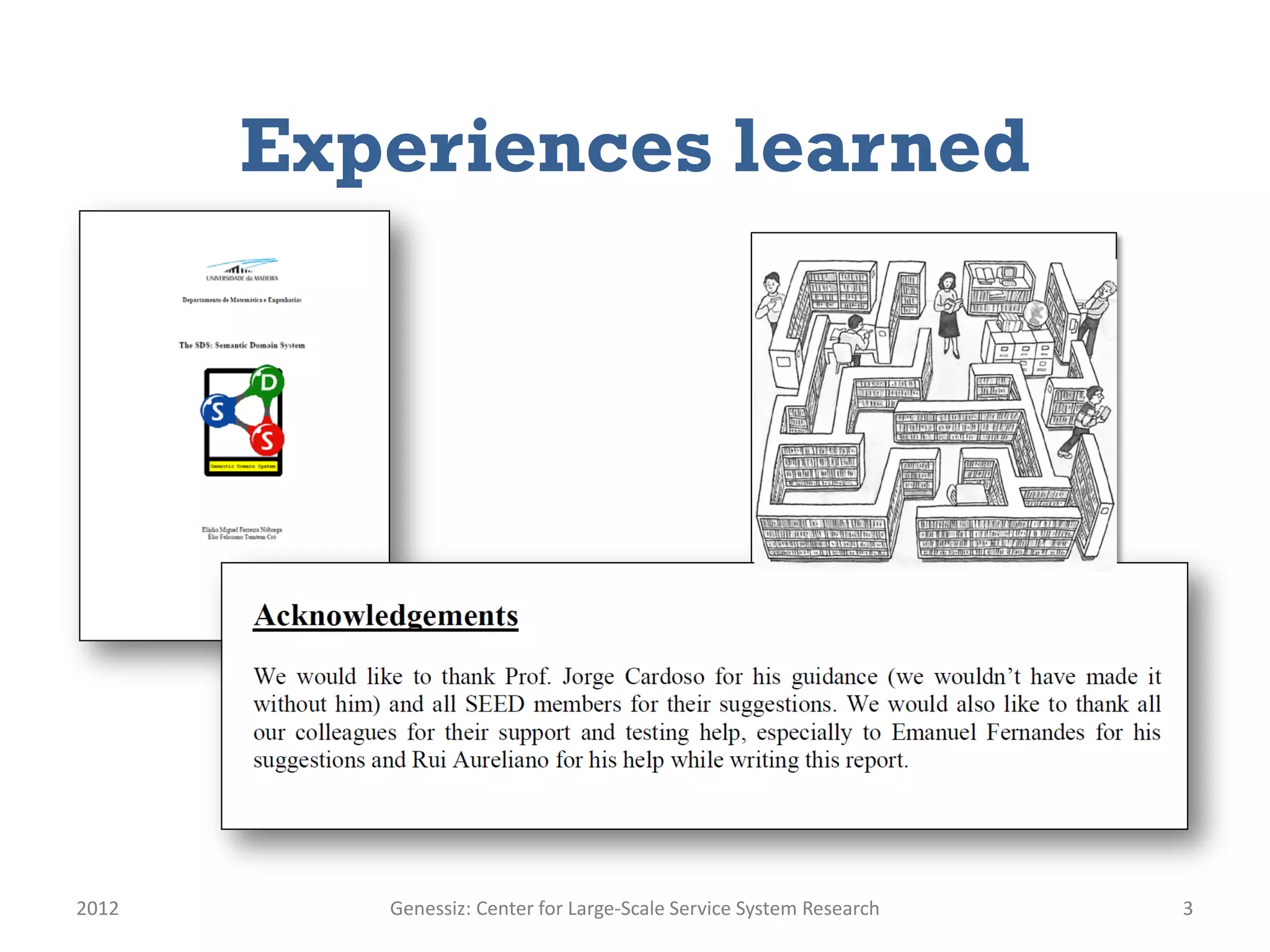
Experiences learned


2012      Genessiz: Center for Large-Scale Service System Research   3
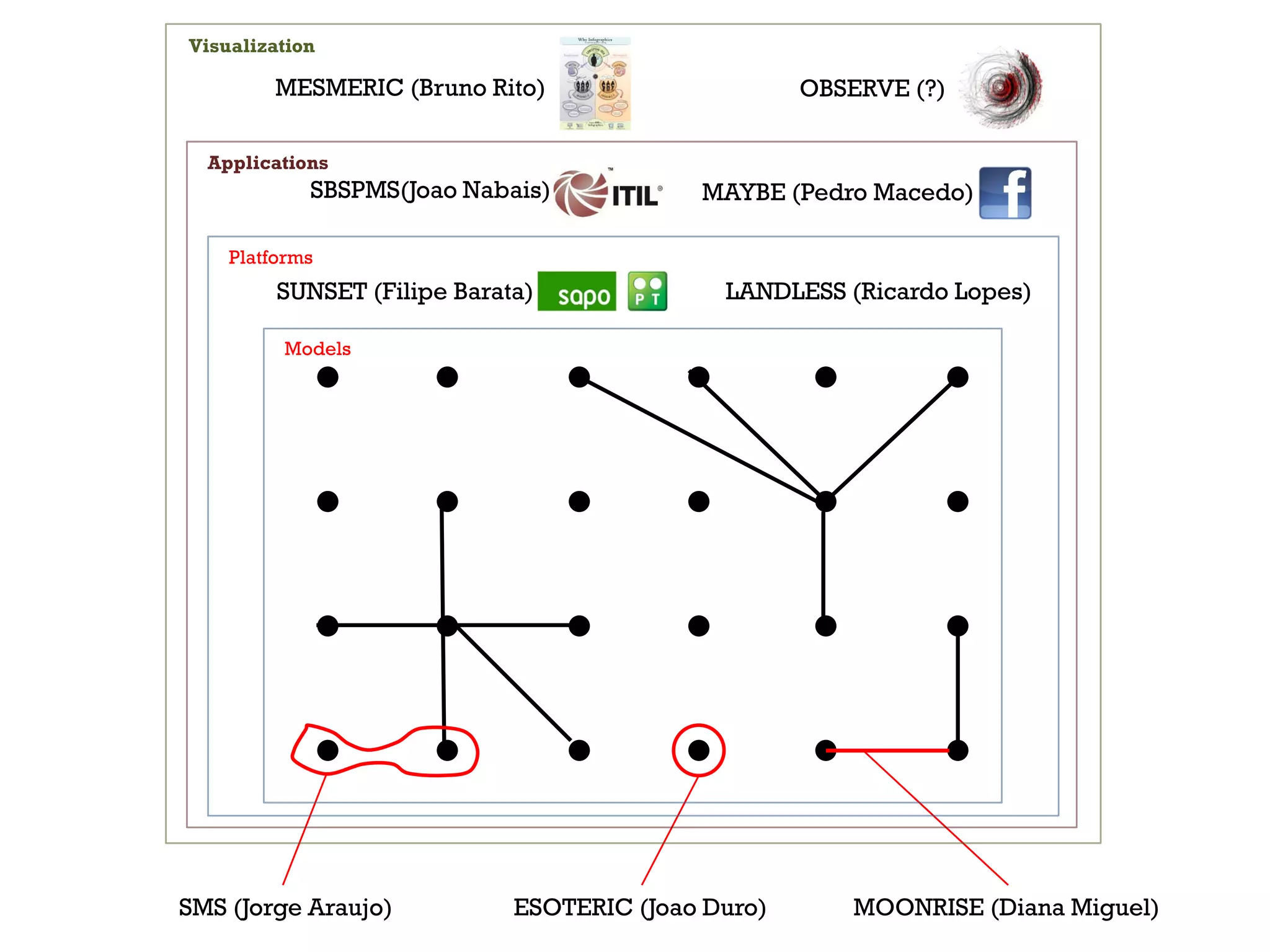
Visualization

        MESMERIC (Bruno Rito)                       OBSERVE (?)

  Applications
            SBSPMS(Joao Nabais)            MAYBE (Pedro Macedo)

    Platforms
         SUNSET (Filipe Barata)              LANDLESS (Ricardo Lopes)

         Models


SMS (Jorge Araujo)           ESOTERIC (Joao Duro)       MOONRISE (Diana Miguel)
ESOTERIC:Joao_Duro
• Background
     – Industries have particular requirements
           • Specific domain vocabularies, business models, etc.


• Problem
     – “one size fits all” does not fit everyone…


• Solution
     – Explore domain extensions to USDL

Esoteric: Intended for or likely to be understood by only a small number of people with a specialized
2012                         Genessiz: Center for Large-Scale Service System Research             5
                                           knowledge or interest.
LaNDLESS:Ricardo_Lopes
• Background
       – Linked Services
       – Linked Open Data initiatives
       – Open Semantic Service Networks


• Problem
       – Fragmented and time consuming access to linked services
         and linked data


• Solution
       – Efficient broker with a mediating ontology

2012                  Genessiz: Center for Large-Scale Service System Research   6
SBSPMS:João_Nabais
• Background
       – High level definition of ITIL processes
       – No standard specification languages


• Problem
       – Deployment of various incompatible process incarnations
       – Expensive customization


• Solution
       – Definition of common and known process interfaces
       – “Plug-and-Process”

2012                  Genessiz: Center for Large-Scale Service System Research   7
MOONRISE:Diana_Miguel
• Background
       – Service marketplaces of isolated services descriptions
       – No view of the global and digital service-based economy


• Problem
       – Service networks cannot be modeled
       – Service network analysis and reasoning are not feasible


• Solution
       – Connect services with service relationship model
       – Demonstrate the existence of service networks

2012                   Genessiz: Center for Large-Scale Service System Research   8
                MOONRISE : Modeling open semantic service relationships
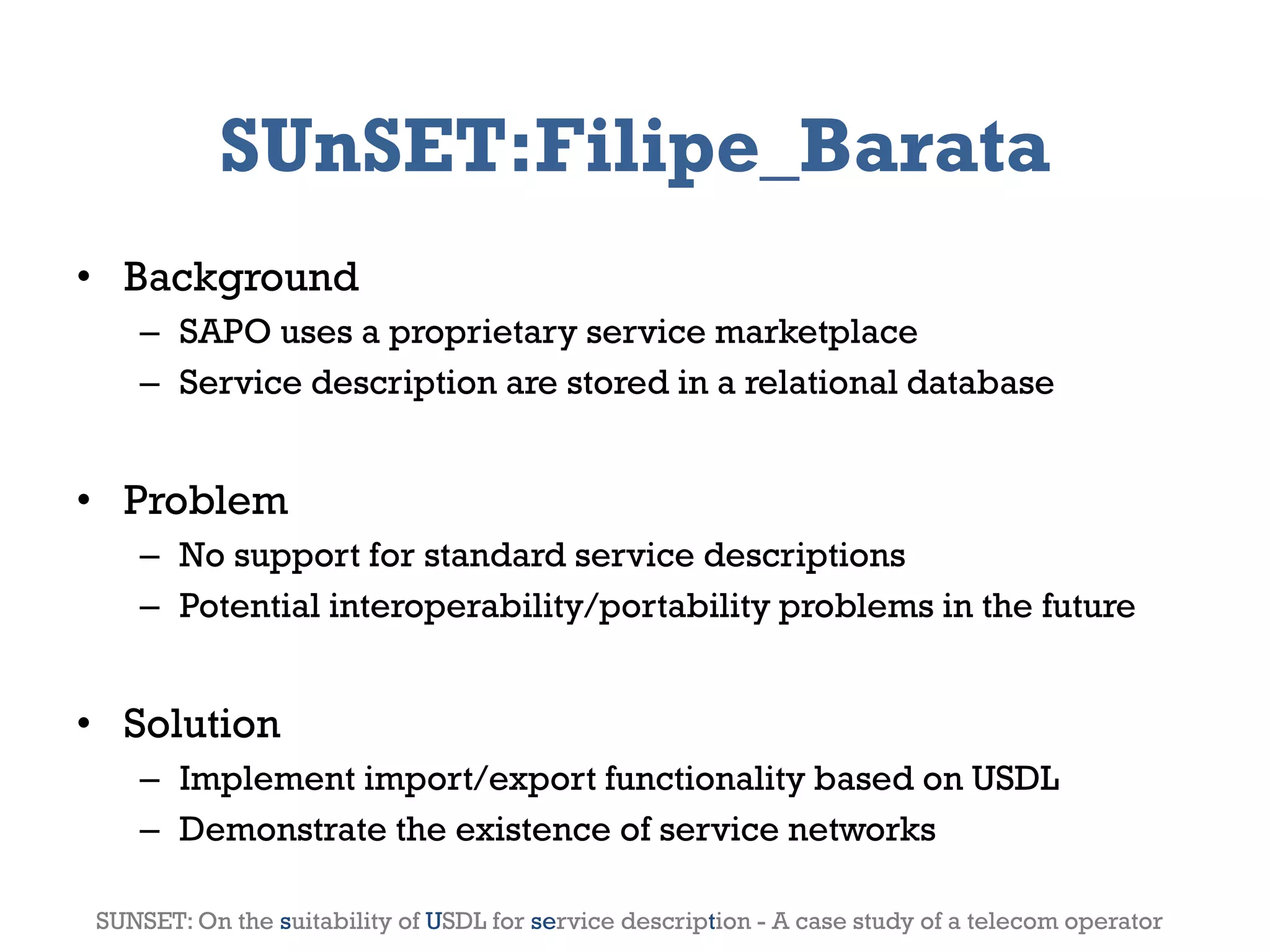
SUnSET:Filipe_Barata
• Background
       – SAPO uses a proprietary service marketplace
       – Service description are stored in a relational database


• Problem
       – No support for standard service descriptions
       – Potential interoperability/portability problems in the future


• Solution
       – Implement import/export functionality based on USDL
       – Demonstrate the existence of service networks

2012                       Genessiz: Center for Large-Scale Service System Research                9
 SUNSET: On the suitability of USDL for service description - A case study of a telecom operator
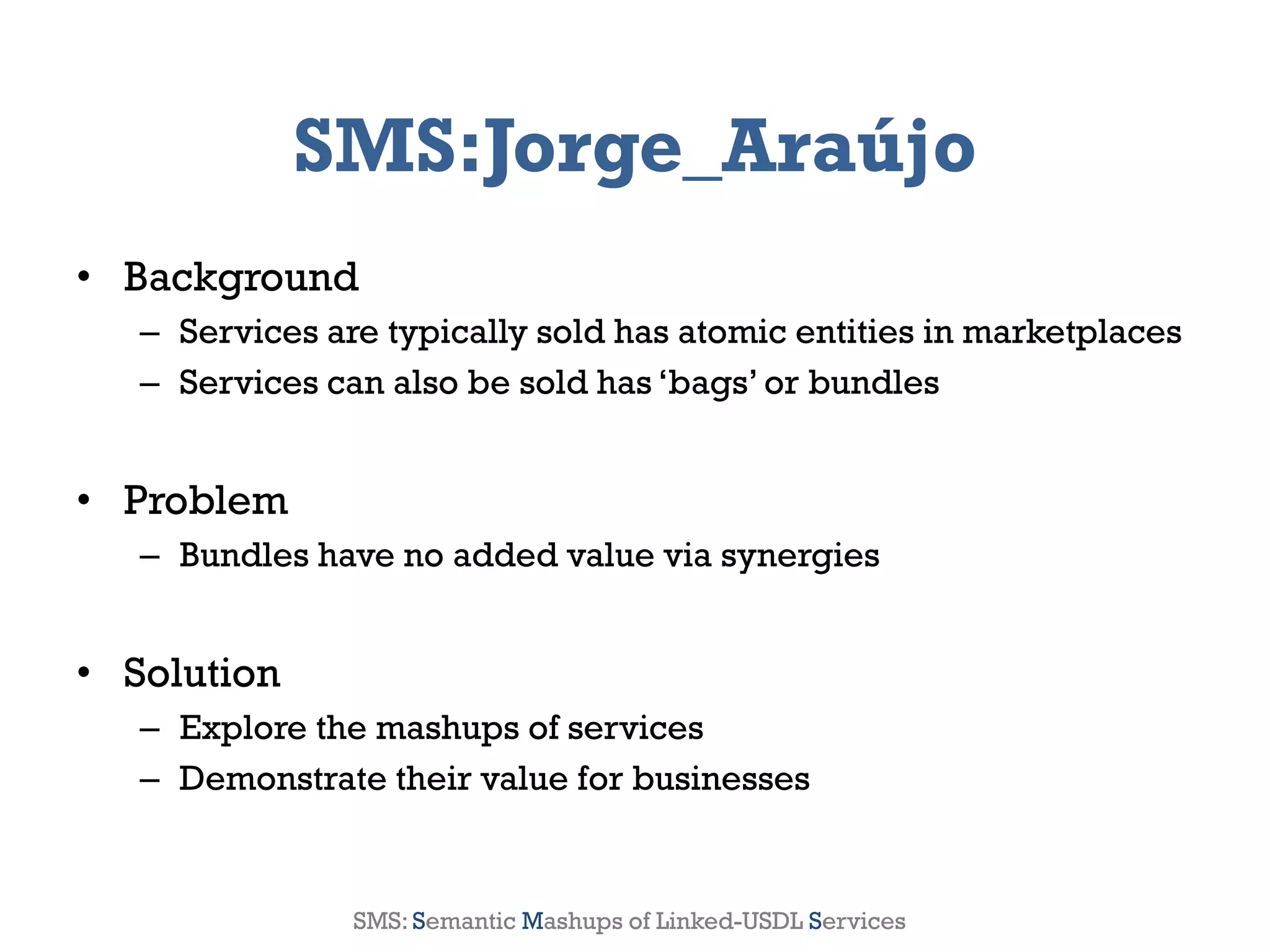
SMS:Jorge_Araújo
• Background
       – Services are typically sold has atomic entities in marketplaces
       – Services can also be sold has ‘bags’ or bundles


• Problem
       – Bundles have no added value via synergies


• Solution
       – Explore the mashups of services
       – Demonstrate their value for businesses


2012                  Genessiz: Center for Large-Scale Service System Research   10
                    SMS: Semantic Mashups of Linked-USDL Services
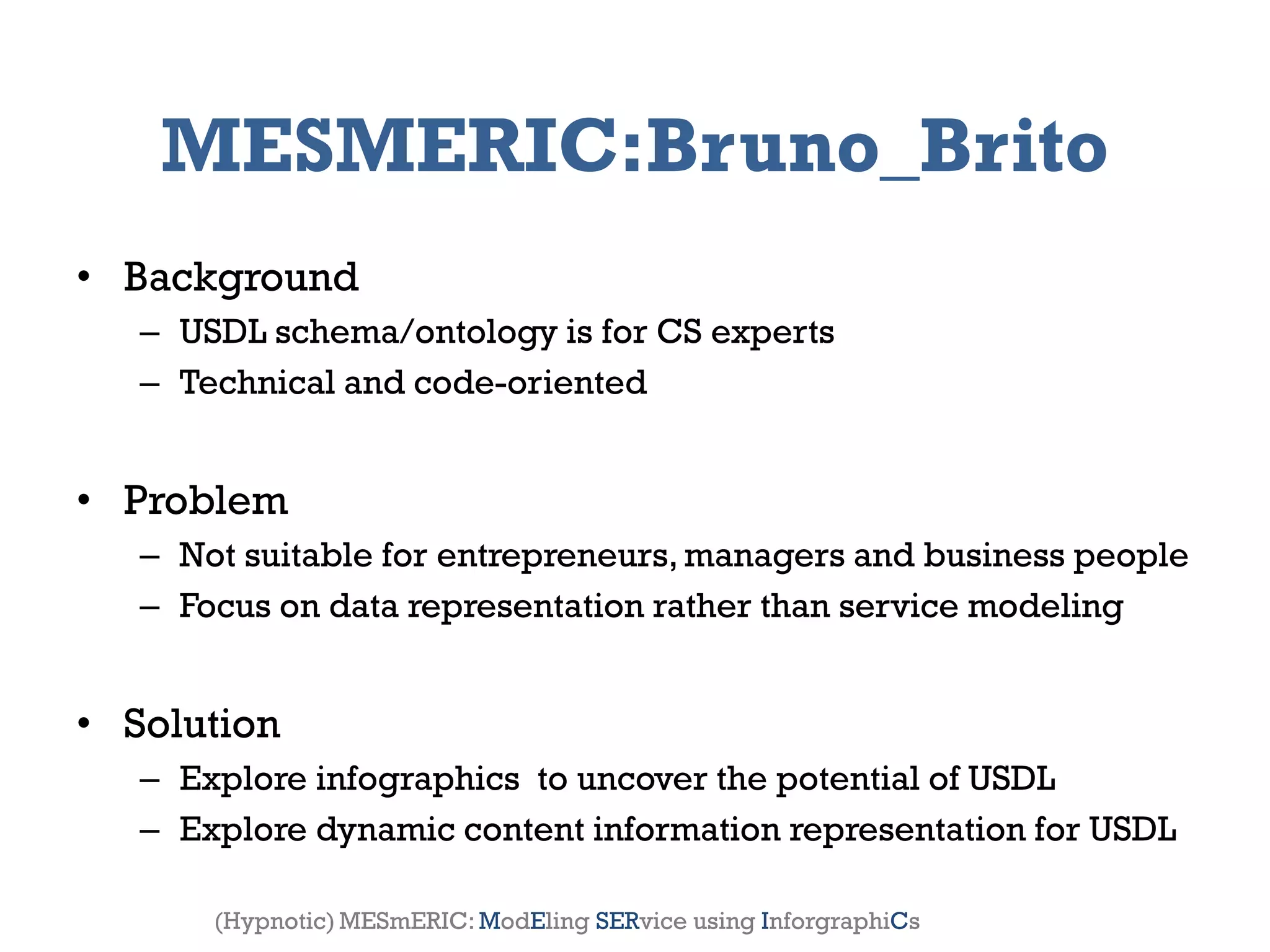
MESMERIC:Bruno_Brito
• Background
       – USDL schema/ontology is for CS experts
       – Technical and code-oriented


• Problem
       – Not suitable for entrepreneurs, managers and business people
       – Focus on data representation rather than service modeling


• Solution
       – Explore infographics to uncover the potential of USDL
       – Explore dynamic content information representation for USDL

2012                     Genessiz: Center for Large-Scale Service System Research   11
           (Hypnotic) MESmERIC: ModEling SERvice using InforgraphiCs
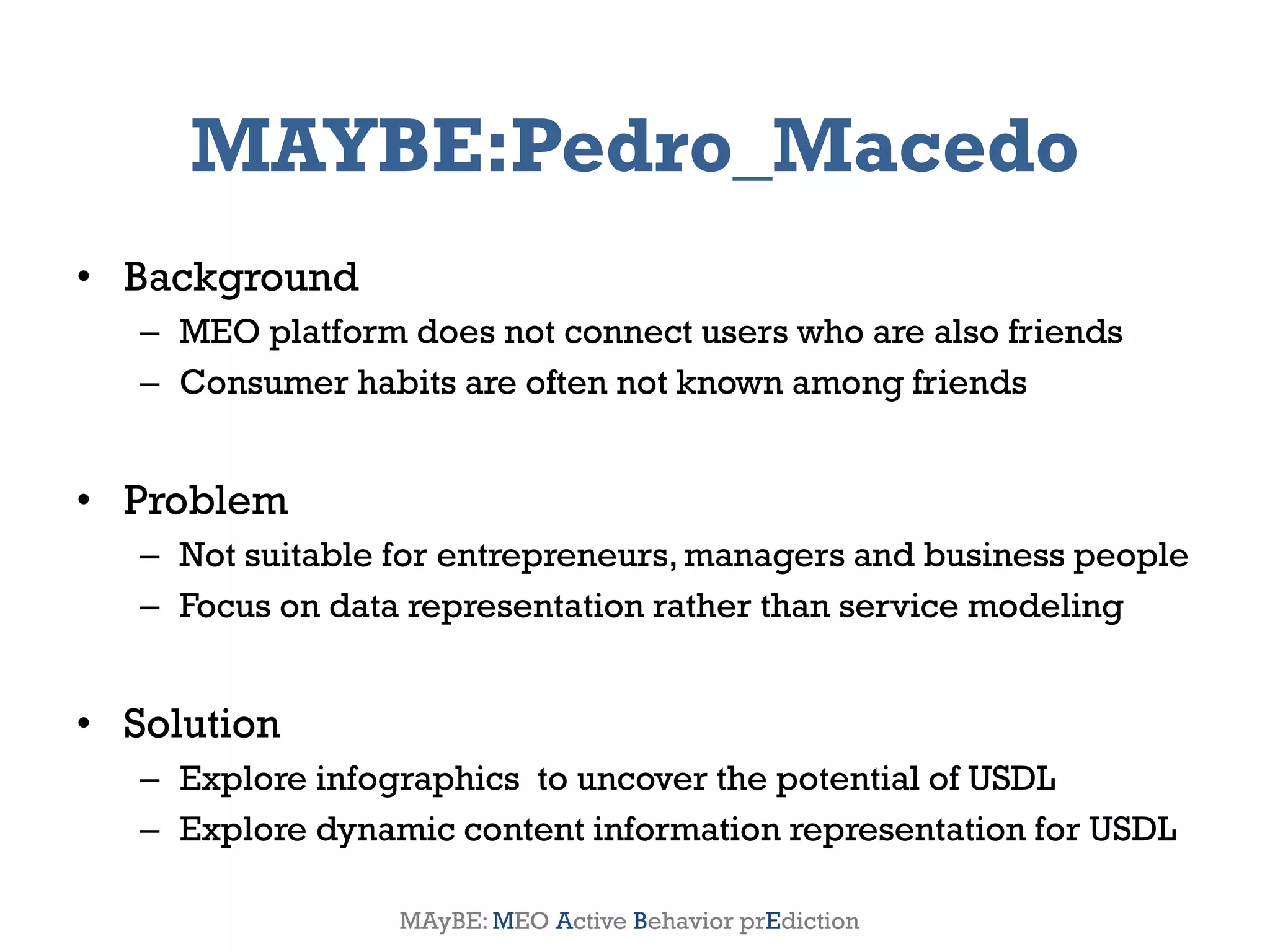
MAYBE:Pedro_Macedo
• Background
       – MEO platform does not connect users who are also friends
       – Consumer habits are often not known among friends


• Problem
       – Not suitable for entrepreneurs, managers and business people
       – Focus on data representation rather than service modeling


• Solution
       – Explore infographics to uncover the potential of USDL
       – Explore dynamic content information representation for USDL

2012                 Genessiz: Center for Large-Scale Service System Research   12
                      MAyBE: MEO Active Behavior prEdiction
Research method
101.Basic guidelines
• Do not do it if it is already done
       – “Reinventing the wheel” syndrome


• What will you be proving?
       – You must be proving something, right!?


• How will the world become a better place for
  all?
       – Practice and spread altruism

2012               Genessiz: Center for Large-Scale Service System Research   14
2012   Genessiz: Center for Large-Scale Service System Research   15
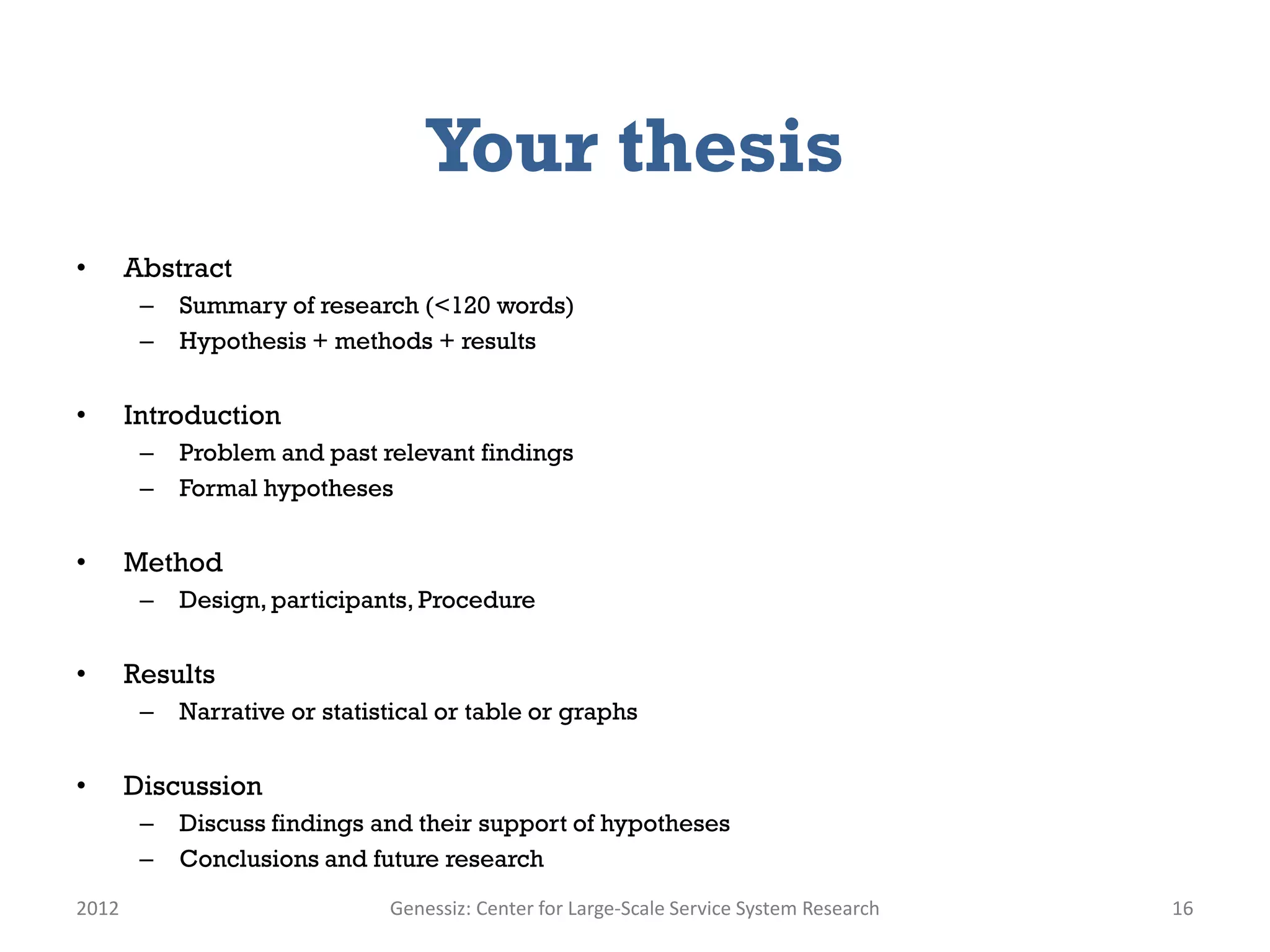
Your thesis
•      Abstract
        –   Summary of research (<120 words)
        –   Hypothesis + methods + results


•      Introduction
        –   Problem and past relevant findings
        –   Formal hypotheses


•      Method
        –   Design, participants, Procedure


•      Results
        –   Narrative or statistical or table or graphs


•      Discussion
        –   Discuss findings and their support of hypotheses
        –   Conclusions and future research
2012                           Genessiz: Center for Large-Scale Service System Research   16

Genssiz Projects: Year 2012 2013

  • 1.
    Open Semantic ServiceNetworks models, platforms, applications, and visualization Jorge Cardoso Dept. Engenharia Informatica/CISUC University of Coimbra Coimbra, Portugal jcardoso@dei.uc.pt 17 July 2012 2012 Genessiz: Center for Large-Scale Service System Research 1
  • 2.
    Who are we? •Supervisors • Students – Jorge Cardoso – Bruno Rito – Alexandre Pinto – Filipe Barata – Catarina Ferreira – João Duro – João Nabais – Jorge Araújo – Pedro Macedo – Ricardo Lopes – Diana Miguel 2012 Genessiz: Center for Large-Scale Service System Research 2
  • 3.
    Experiences learned 2012 Genessiz: Center for Large-Scale Service System Research 3
  • 4.
    Visualization MESMERIC (Bruno Rito) OBSERVE (?) Applications SBSPMS(Joao Nabais) MAYBE (Pedro Macedo) Platforms SUNSET (Filipe Barata) LANDLESS (Ricardo Lopes) Models SMS (Jorge Araujo) ESOTERIC (Joao Duro) MOONRISE (Diana Miguel)
  • 5.
    ESOTERIC:Joao_Duro • Background – Industries have particular requirements • Specific domain vocabularies, business models, etc. • Problem – “one size fits all” does not fit everyone… • Solution – Explore domain extensions to USDL Esoteric: Intended for or likely to be understood by only a small number of people with a specialized 2012 Genessiz: Center for Large-Scale Service System Research 5 knowledge or interest.
  • 6.
    LaNDLESS:Ricardo_Lopes • Background – Linked Services – Linked Open Data initiatives – Open Semantic Service Networks • Problem – Fragmented and time consuming access to linked services and linked data • Solution – Efficient broker with a mediating ontology 2012 Genessiz: Center for Large-Scale Service System Research 6
  • 7.
    SBSPMS:João_Nabais • Background – High level definition of ITIL processes – No standard specification languages • Problem – Deployment of various incompatible process incarnations – Expensive customization • Solution – Definition of common and known process interfaces – “Plug-and-Process” 2012 Genessiz: Center for Large-Scale Service System Research 7
  • 8.
    MOONRISE:Diana_Miguel • Background – Service marketplaces of isolated services descriptions – No view of the global and digital service-based economy • Problem – Service networks cannot be modeled – Service network analysis and reasoning are not feasible • Solution – Connect services with service relationship model – Demonstrate the existence of service networks 2012 Genessiz: Center for Large-Scale Service System Research 8 MOONRISE : Modeling open semantic service relationships
  • 9.
    SUnSET:Filipe_Barata • Background – SAPO uses a proprietary service marketplace – Service description are stored in a relational database • Problem – No support for standard service descriptions – Potential interoperability/portability problems in the future • Solution – Implement import/export functionality based on USDL – Demonstrate the existence of service networks 2012 Genessiz: Center for Large-Scale Service System Research 9 SUNSET: On the suitability of USDL for service description - A case study of a telecom operator
  • 10.
    SMS:Jorge_Araújo • Background – Services are typically sold has atomic entities in marketplaces – Services can also be sold has ‘bags’ or bundles • Problem – Bundles have no added value via synergies • Solution – Explore the mashups of services – Demonstrate their value for businesses 2012 Genessiz: Center for Large-Scale Service System Research 10 SMS: Semantic Mashups of Linked-USDL Services
  • 11.
    MESMERIC:Bruno_Brito • Background – USDL schema/ontology is for CS experts – Technical and code-oriented • Problem – Not suitable for entrepreneurs, managers and business people – Focus on data representation rather than service modeling • Solution – Explore infographics to uncover the potential of USDL – Explore dynamic content information representation for USDL 2012 Genessiz: Center for Large-Scale Service System Research 11 (Hypnotic) MESmERIC: ModEling SERvice using InforgraphiCs
  • 12.
    MAYBE:Pedro_Macedo • Background – MEO platform does not connect users who are also friends – Consumer habits are often not known among friends • Problem – Not suitable for entrepreneurs, managers and business people – Focus on data representation rather than service modeling • Solution – Explore infographics to uncover the potential of USDL – Explore dynamic content information representation for USDL 2012 Genessiz: Center for Large-Scale Service System Research 12 MAyBE: MEO Active Behavior prEdiction
  • 13.
  • 14.
    101.Basic guidelines • Donot do it if it is already done – “Reinventing the wheel” syndrome • What will you be proving? – You must be proving something, right!? • How will the world become a better place for all? – Practice and spread altruism 2012 Genessiz: Center for Large-Scale Service System Research 14
  • 15.
    2012 Genessiz: Center for Large-Scale Service System Research 15
  • 16.
    Your thesis • Abstract – Summary of research (<120 words) – Hypothesis + methods + results • Introduction – Problem and past relevant findings – Formal hypotheses • Method – Design, participants, Procedure • Results – Narrative or statistical or table or graphs • Discussion – Discuss findings and their support of hypotheses – Conclusions and future research 2012 Genessiz: Center for Large-Scale Service System Research 16