MATERIAL HANDLING
MATERIAL HANDLING.
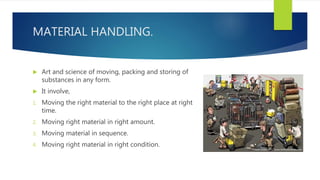
 Art and science of moving, packing and storing of
substances in any form.
 It involve,
1. Moving the right material to the right place at right
time.
2. Moving right material in right amount.
3. Moving material in sequence.
4. Moving right material in right condition.
Function of material handling.
 To lowers unit materials handling cost.
 To reduce manufacturing cycle time.
 To provide better control of the flow of materials.
 To provide better working conditions.
 To increase storage capacity.
 To provide higher productivity at lower manufacturing cost.
 To avoiding damage to products.
Principle of material handling.
 Orientation Principle: It encourages study of all available system relationships before moving
towards preliminary planning. The study includes looking at existing methods, problems, etc.
 Planning Principle: It establishes a plan which includes basic requirements, desirable alternates and
planning for contingency.
 Unit Load Principle: Handle product in a unit load as large as possible.
 Space Utilization Principle: Encourage effective utilization of all the space available.
 Standardization Principle: It encourages standardization of handling methods and equipment.
 Ergonomic Principle: It recognizes human capabilities and limitation by design effective handling
equipment.
 Ecology Principle: It encourages minimum impact upon the environment during material
handling.
 Energy Principle: It considers consumption of energy during material handling.
 Mechanization Principle: It encourages mechanization of handling process wherever possible
as to encourage
 Principle: Encourages of methods and equipment which are possible to utilize in all types of
condition.
 Simplification Principle: Encourage simplification of methods and process by removing
unnecessary movements,
 Gravity Principle: Encourages usage of gravity principle in movement of goods.
 Safety Principle: Encourages provision for safe handling equipment according to safety rules
and.
Types of material handling.
Semi-
automated
handling
Automated
handling
Manual
handling
Manual handling.
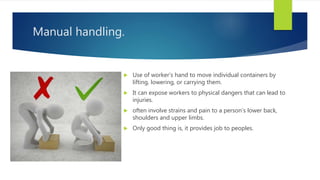
 Use of worker’s hand to move individual containers by
lifting, lowering, or carrying them.
 It can expose workers to physical dangers that can lead to
injuries.
 often involve strains and pain to a person’s lower back,
shoulders and upper limbs.
 Only good thing is, it provides job to peoples.
Automated handling.
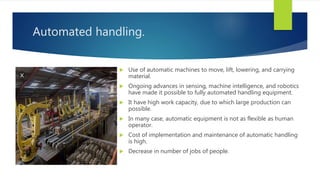
 Use of automatic machines to move, lift, lowering, and carrying
material.
 Ongoing advances in sensing, machine intelligence, and robotics
have made it possible to fully automated handling equipment.
 It have high work capacity, due to which large production can
possible.
 In many case, automatic equipment is not as flexible as human
operator.
 Cost of implementation and maintenance of automatic handling
is high.
 Decrease in number of jobs of people.
Semi-automatic handling.
 Use of machines and human to move individual containers by
lifting, lowering, or carrying them.
 Most economic handling type.
 Most existing material handling equipment is only semi-
automated because a human operator is needed difficult task or
the task which is costly to fully automate.
 Humans do work where precise work is needed.
 Save cost of maintenance.
FACTORS IN MATERIAL HANDLING
PRODUCTION
PROBLEM
HUMAN ELEMENT
INVOVLED
CAPABILITIES OF
HANDLING
EQUIPMENT
AVAIABLE
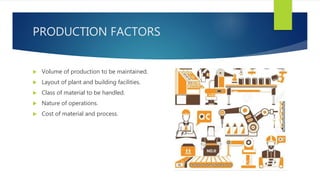
PRODUCTION FACTORS
 Volume of production to be maintained.
 Layout of plant and building facilities.
 Class of material to be handled.
 Nature of operations.
 Cost of material and process.
HUMAN FACTORS
 Capabilities of man power.
 Safety of personnel.
 Process improvement.
 Maintenance and inspection.
EQUIPMENTS FACTORS
 Speed.
 Space requirements.
 Supervision required.
 Environment.
 Cost.
 Ease of maintenance.
 Power.
 Load capacity.
 Adaptability.
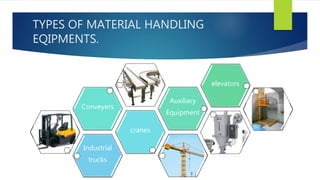
TYPES OF MATERIAL HANDLING
EQIPMENTS.
Industrial
trucks
cranes
Conveyers
Auxiliary
Equipment
elevators
TYPES OF MATERIAL HANDLING
EQIPMENTS
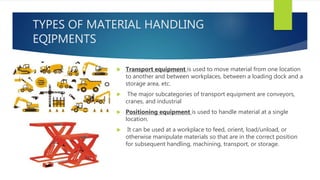
 Transport equipment is used to move material from one location
to another and between workplaces, between a loading dock and a
storage area, etc.
 The major subcategories of transport equipment are conveyors,
cranes, and industrial
 Positioning equipment is used to handle material at a single
location.
 It can be used at a workplace to feed, orient, load/unload, or
otherwise manipulate materials so that are in the correct position
for subsequent handling, machining, transport, or storage.
TYPES OF MATERIAL HANDLING
EQIPMENTS
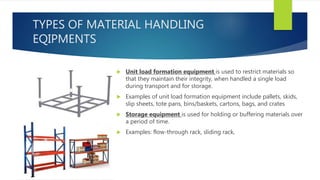
 Unit load formation equipment is used to restrict materials so
that they maintain their integrity, when handled a single load
during transport and for storage.
 Examples of unit load formation equipment include pallets, skids,
slip sheets, tote pans, bins/baskets, cartons, bags, and crates
 Storage equipment is used for holding or buffering materials over
a period of time.
 Examples: flow-through rack, sliding rack,
Sources.
 www.google.com
 En.m.Wikipedia.org
 www.thomasnet.com
 www.kokeinc.com
 www.vallybox.com
Material handling

Material handling

  • 1.
  • 2.
    MATERIAL HANDLING.  Artand science of moving, packing and storing of substances in any form.  It involve, 1. Moving the right material to the right place at right time. 2. Moving right material in right amount. 3. Moving material in sequence. 4. Moving right material in right condition.
  • 3.
    Function of materialhandling.  To lowers unit materials handling cost.  To reduce manufacturing cycle time.  To provide better control of the flow of materials.  To provide better working conditions.  To increase storage capacity.  To provide higher productivity at lower manufacturing cost.  To avoiding damage to products.
  • 4.
    Principle of materialhandling.  Orientation Principle: It encourages study of all available system relationships before moving towards preliminary planning. The study includes looking at existing methods, problems, etc.  Planning Principle: It establishes a plan which includes basic requirements, desirable alternates and planning for contingency.  Unit Load Principle: Handle product in a unit load as large as possible.  Space Utilization Principle: Encourage effective utilization of all the space available.  Standardization Principle: It encourages standardization of handling methods and equipment.  Ergonomic Principle: It recognizes human capabilities and limitation by design effective handling equipment.
  • 5.
     Ecology Principle:It encourages minimum impact upon the environment during material handling.  Energy Principle: It considers consumption of energy during material handling.  Mechanization Principle: It encourages mechanization of handling process wherever possible as to encourage  Principle: Encourages of methods and equipment which are possible to utilize in all types of condition.  Simplification Principle: Encourage simplification of methods and process by removing unnecessary movements,  Gravity Principle: Encourages usage of gravity principle in movement of goods.  Safety Principle: Encourages provision for safe handling equipment according to safety rules and.
  • 6.
    Types of materialhandling. Semi- automated handling Automated handling Manual handling
  • 7.
    Manual handling.  Useof worker’s hand to move individual containers by lifting, lowering, or carrying them.  It can expose workers to physical dangers that can lead to injuries.  often involve strains and pain to a person’s lower back, shoulders and upper limbs.  Only good thing is, it provides job to peoples.
  • 8.
    Automated handling.  Useof automatic machines to move, lift, lowering, and carrying material.  Ongoing advances in sensing, machine intelligence, and robotics have made it possible to fully automated handling equipment.  It have high work capacity, due to which large production can possible.  In many case, automatic equipment is not as flexible as human operator.  Cost of implementation and maintenance of automatic handling is high.  Decrease in number of jobs of people.
  • 9.
    Semi-automatic handling.  Useof machines and human to move individual containers by lifting, lowering, or carrying them.  Most economic handling type.  Most existing material handling equipment is only semi- automated because a human operator is needed difficult task or the task which is costly to fully automate.  Humans do work where precise work is needed.  Save cost of maintenance.
  • 10.
    FACTORS IN MATERIALHANDLING PRODUCTION PROBLEM HUMAN ELEMENT INVOVLED CAPABILITIES OF HANDLING EQUIPMENT AVAIABLE
  • 11.
    PRODUCTION FACTORS  Volumeof production to be maintained.  Layout of plant and building facilities.  Class of material to be handled.  Nature of operations.  Cost of material and process.
  • 12.
    HUMAN FACTORS  Capabilitiesof man power.  Safety of personnel.  Process improvement.  Maintenance and inspection.
  • 13.
    EQUIPMENTS FACTORS  Speed. Space requirements.  Supervision required.  Environment.  Cost.  Ease of maintenance.  Power.  Load capacity.  Adaptability.
  • 14.
    TYPES OF MATERIALHANDLING EQIPMENTS. Industrial trucks cranes Conveyers Auxiliary Equipment elevators
  • 15.
    TYPES OF MATERIALHANDLING EQIPMENTS  Transport equipment is used to move material from one location to another and between workplaces, between a loading dock and a storage area, etc.  The major subcategories of transport equipment are conveyors, cranes, and industrial  Positioning equipment is used to handle material at a single location.  It can be used at a workplace to feed, orient, load/unload, or otherwise manipulate materials so that are in the correct position for subsequent handling, machining, transport, or storage.
  • 16.
    TYPES OF MATERIALHANDLING EQIPMENTS  Unit load formation equipment is used to restrict materials so that they maintain their integrity, when handled a single load during transport and for storage.  Examples of unit load formation equipment include pallets, skids, slip sheets, tote pans, bins/baskets, cartons, bags, and crates  Storage equipment is used for holding or buffering materials over a period of time.  Examples: flow-through rack, sliding rack,
  • 17.
    Sources.  www.google.com  En.m.Wikipedia.org www.thomasnet.com  www.kokeinc.com  www.vallybox.com