MaintenanceAndMaterial HandlingMethods
By-
SanamV S Srikar
Harpreet SinghGrover
MAS flight Boeing 737 left KLIA at 2:00 pm.
All two engines, hydraulic systems working.
2:22 pm explosion shook plane.
Number 2 engine torn apart, 2 separate hydraulic lines ceased
to work.
In spite of maintenance work, engine still failed.
Imagine having no maintenance system.
• What is maintenance?
• Why do we need maintenance?
• What are the costs of doing maintenance?
• What are the costs of not doing maintenance?
• What are the benefits of maintenance?
• How can maintenance increase profitability of
company?
• All actions necessary for retaining an item, or restoring to
it, a serviceable condition, include servicing, repair,
modification, overhaul, inspection and condition
verification
• Increase availability of a system
• Keep system’s equipment in working order
What Is Maintenance ?
Purpose ofMaintenance
• Attempt to maximize performance of production
equipment efficiently and regularly.
• Prevent breakdown or failures.
• Minimize production loss from failures.
• Increase reliability of the operating systems.
• To achieve product quality and customer satisfaction
through adjusted and serviced equipment
• Maximize useful life of equipment
• Keep equipment safe and prevent safety hazards
• Minimize frequency and severity of interruptions
• Maximize production capacity – through high
utilization of facility
Problems in Maintenance
• Lack of management attention to maintenance
• Little participation by accounting in analyzing and
reporting costs
• Difficulties in applying quantitative analysis
• Difficulties in obtaining time and cost estimates for
maintenance works
• Difficulties in measuring performance
Problems Exist DueTo
• Failure to develop written objectives and policy
• Inadequate budgetary control
• Inadequate control procedures for work order, service
requests etc.
• Infrequent use of standards
• To control maintenance work
• Absence of cost reports to aid maintenance planning
and control system
MaintenanceObjectives
• Must be consistent with the goals of production
(cost, quality, delivery, safety)
• Must be comprehensive and include specific
responsibilities
MaintenanceCosts
• Cost to replace or repair
• Losses of output
• Delayed shipment
• Scrap and rework
Typesof Maintenance
• Maintenance may be classified into four categories:
• (some authors prefer three categories- scheduled and
preventive maintenances are merged)
• Corrective or Breakdown maintenance
• Scheduled maintenance
• Preventive maintenance
• Predictive (Condition-based) maintenance
Corrective or BreakdownMaintenance
• Corrective or Breakdown maintenance implies that
repairs are made after the equipment is failed and can
not perform its normal function anymore.
• Quite justified in small factories where:
– Down times are non-critical and repair costs are less than
other type of maintenance
– Financial justification for scheduling are not felt
Scheduled Maintenance
 Scheduled maintenance is a stitch-in-time procedure
and incorporates .
– inspection
– lubrication
– repair and overhaul of equipments
 If neglected can result in breakdown
 Generally followed for:
– overhauling of machines
– changing of heavy equipment oils
– cleaning of water and other tanks etc.
Preventive Maintenance(PM)
• Principle – “Prevention is better than cure”
• Procedure - Stitch-in-time
• It
– locates weak spots of machinery and equipments
– provides them periodic/scheduled inspections and
minor repairs to reduce the danger of unanticipated
breakdowns
Predictive (Condition-based)Maintenance
• In predictive maintenance, machinery conditions are
periodically monitored and this enables the maintenance
crews to take timely actions, such as machine
adjustment, repair or overhaul.
• It makes use of human sense and other sensitive
instruments, such as
–audio gauge, vibration analyzer, amplitude meter,
pressure, temperature and resistance strain gauges
etc.
Predictive Maintenance(Contd.)
• Unusual sounds coming out of a rotating equipment
predicts a trouble
• An excessively hot electric cable predicts a trouble
• Simple hand touch can point out many unusual
equipment conditions and thus predicts a trouble
Maintenance(Dependon The TimeHorizon)
1. Long-range (master) schedule
2. Weekly schedule
3. Daily schedule
Long-Range (master) Schedule
• Covering a period of 3 months to 1 year.
• Based on existing maintenance work orders (blanket
work order, backlog, anticipated EM).
• Balancing long-term demand for maintenance work
with available resources.
• Spare parts and material could be identified and
ordered in advance.
• Revision and updating to reflect changes in the
plans and maintenance work.
Weekly Schedule
• Covering 1 week.
• Generated from the master schedule.
• Takes into account current operations schedules and
economic considerations.
• Allow 10% to 15% of the workforce to be available for
emergency work.
• The schedule prepared for the current week and the
following one in order to consider the available backlog.
• The work orders scheduled in this week are sequenced
based on priority.
• CPM and integer programming techniques can be used
to generate a schedule.
Daily Schedule
• Covering 1 day.
• Generated from weekly schedule.
• Prepared the day before.
• Interrupted to perform EM.
• Priorities are used to schedule the jobs.
MaintenanceManagement
Employee Involvement
Partnering with maintenance
Personnel.
Skill training.
Employee empowerment.
Maintenance and Reliability
Procedures
Clean and lubricate.
Monitor and adjust.
Make minor repair.
Keep computerized records.
Results
Reduced inventory.
Improved quality.
Improved capacity.
Reputation for quality.
Continuous improvement.
Reduced variability.
ComputerizedMaintenance System
Output Reports
Inventory and
purchasing reports
Equipment
parts list
Equipment
history reports
Cost analysis
(Actual vs. standard)
Work orders
– Preventive
maintenance
– Scheduled
downtime
– Emergency
maintenance
Data Files
Personnel data
with skills, wages,
etc.
Equipment file
with parts list
Maintenance
and work order
schedule
Inventory of
spare parts
Repair
history file
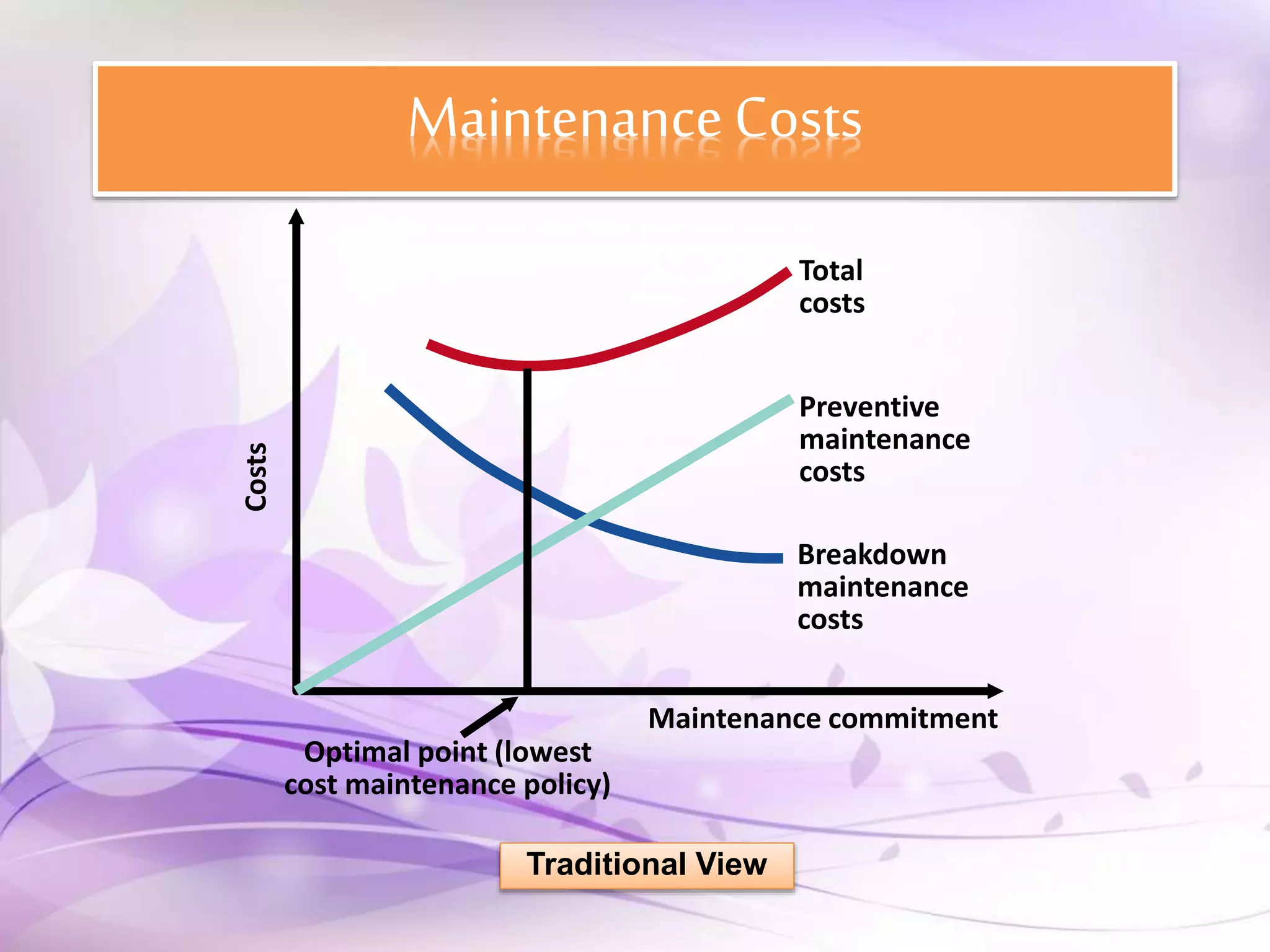
MaintenanceCosts
Total
costs
Breakdown
maintenance
costs
Costs
Maintenance commitment
Traditional View
Preventive
maintenance
costs
Optimal point (lowest
cost maintenance policy)
MaintenanceCosts
Costs
Maintenance commitment
Full Cost View
Optimal point (lowest
cost maintenance policy)
Total
costs
Full cost of
breakdowns
Preventive
maintenance
costs
How Maintenance is Performed
Operator
(autonomous
maintenance)
Maintenance
department
Manufacturer’s
field service
Depot service
(return equipment)
Increasing Operator Ownership Increasing Complexity
Preventive
maintenance costs less and
is faster the more we move to the left
Competence is higher as we
move to the right
Material Handling
Towardsa definiton
• Material Handling accounts for:
– 25% of all employees,
– 55% of all factory space,
– 87% of production time
– 15-70% of the total cost of a manufactured product
• 3-5% of all material handled becomes damaged
– “Totally eliminate mistakes”
– However, handling less is not the answer.
Motivations
• Material handling is a means by which:
– Total manufacturing costs are reduced through
• Reduced inventory
• Improved safety
• Improved material control
• By reducing damage
– Manufacturing quality is improved by:
• By giving more time to manufacturing process
• Proper supervision of machinery will lower defects in
products.
Definitions:
•Material handling is the art and science of moving, storing,
protecting, controlling and status of material
–Moving: is required to create time and place utility.The
value of having the material at the right time and the right
place.
–Storing: Provides a buffer between operations, facilitates
the efficient use of people and machines.
–Protecting: Includes the packaging,damage and theft.
–Controlling: Physical storage, sequence and space
between material.
–Status: Real-time awareness of the location, amount,
destination and schedule of material.
Material Handling is the function of moving the right material
to the right place at the right time, in the right amount, in right
sequence, and in the right condition to minimize production
cost.
The cost of MH estimates 20-25% of total manufacturing
labor cost in the United States [The Material Handling
Industry of America (MHIA)]
Classesof materials
• Raw materials:- This is material which is used in product
manufacturing and is in an unprocessed condition.(eg
cotton)
• Purchased Parts:- These are the items used in the
assembly of the product.(eg processor)
• In-progress materials:- They are called ‘work in progress’
inventories. These goods require further processing.
Finished materials:- These are fully manufactured
goods, inspected and ready for delivery to the
customers.
Supplies:- These are consumable goods used in the
process of manufacturing.(eg electricity)
Principles of material handling
• Least handling is the best handling.
• Lengths and number of moves to be minimized.
• Unit load
• Minimize the distance.
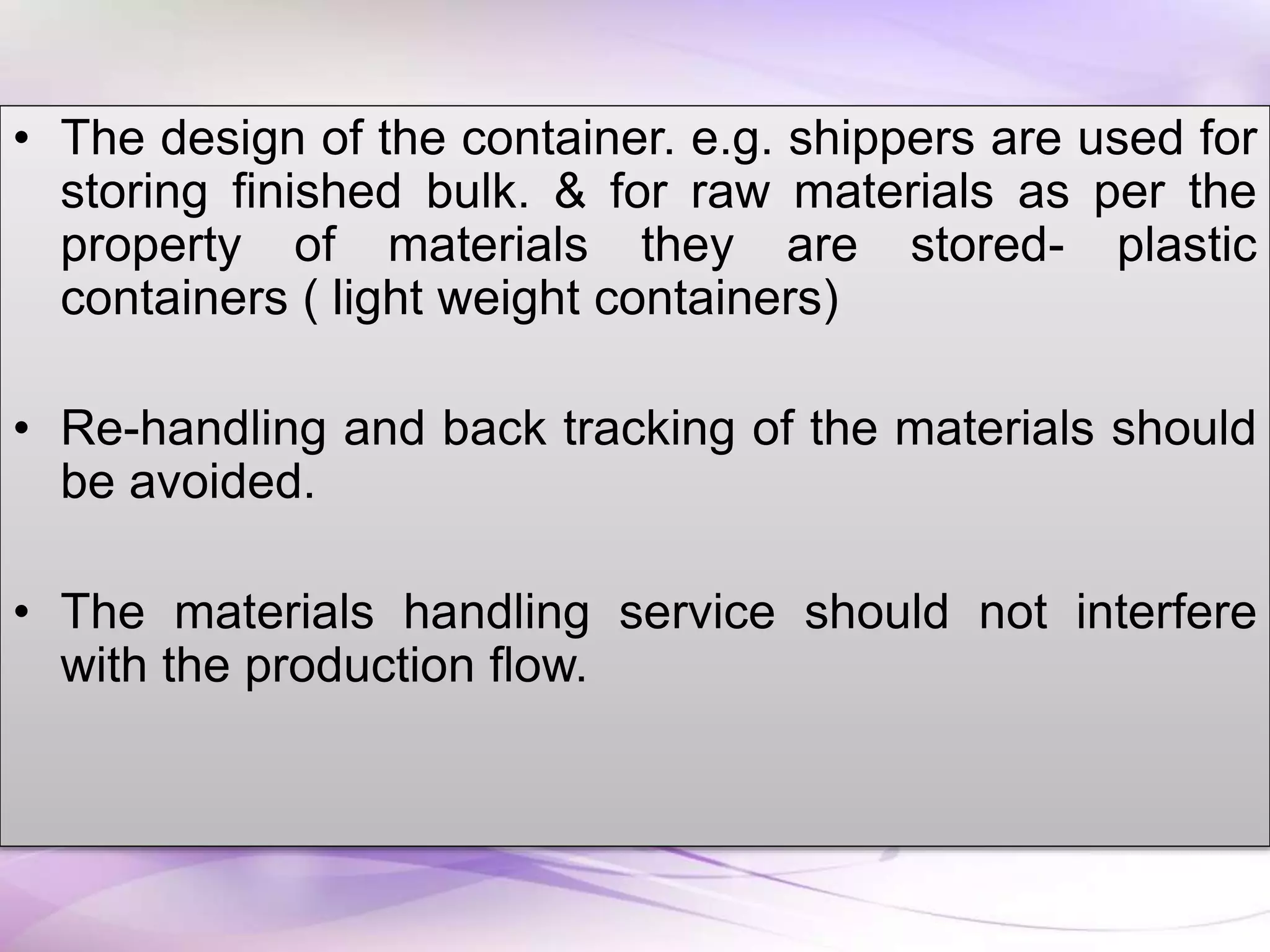
• The design of the container. e.g. shippers are used for
storing finished bulk. & for raw materials as per the
property of materials they are stored- plastic
containers ( light weight containers)
• Re-handling and back tracking of the materials should
be avoided.
• The materials handling service should not interfere
with the production flow.
Example of Materials and PeopleFlow
Six-step engineeringdesing process
1. Define the objectives and scope for the material handling
system.
2. Analyze the requirements for moving, storing, protecting, and
controlling material.
3. Generate alternative designs for meeting material handling
system requirements.
4. Evaluate alternative material handling system designs.
5. Select the preferred design for moving, storing, protecting, and
controlling material.
6. Implement the preferred design, including the selection of
suppliers, training of personnel, installation, debug and startup
of equipment, and periodic audits of system performance.
Categories of Material Handling Equipment
1. Containers and Unitizing Equipment
• Containers
• Unitizers
2. Material Transport Equipment
• Conveyors
• Industrial Vehicles
• Monorails, Hoists, and Cranes
3. Storage and Retrieval Equipment
• Unit Load Storage and Retrieval
• Unit Load Storage Equipment
• Unit Load Retrieval Equipment
• Small Load Storage and Retrieval
4. Automatic Data Collection and Communication Equipment
• Automatic Identification and Recognition
• Automatic Paperless Communication
Containers
Unitizers
Conveyors
Industrial Vehicles
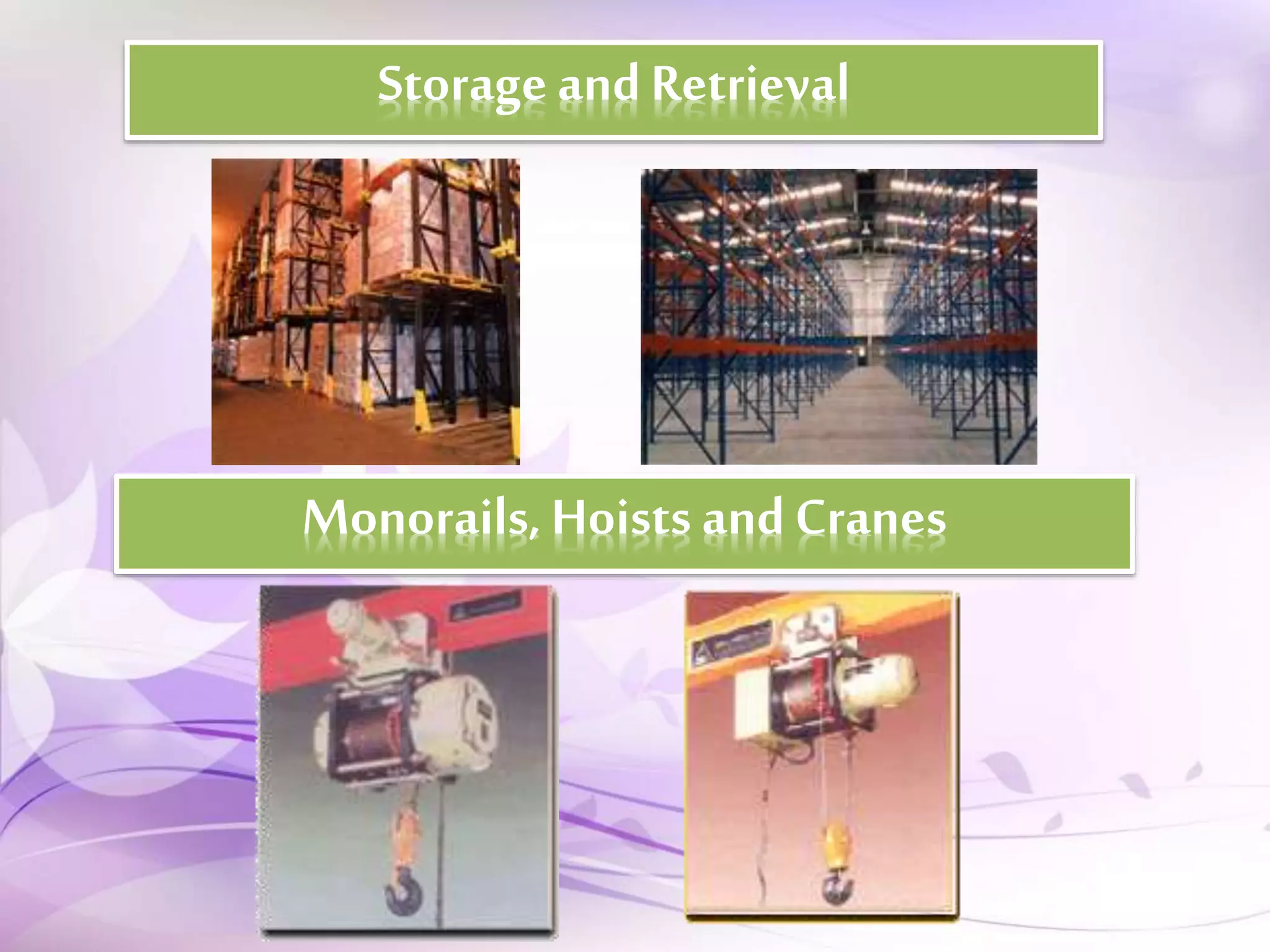
Storage andRetrieval
Monorails, Hoists andCranes
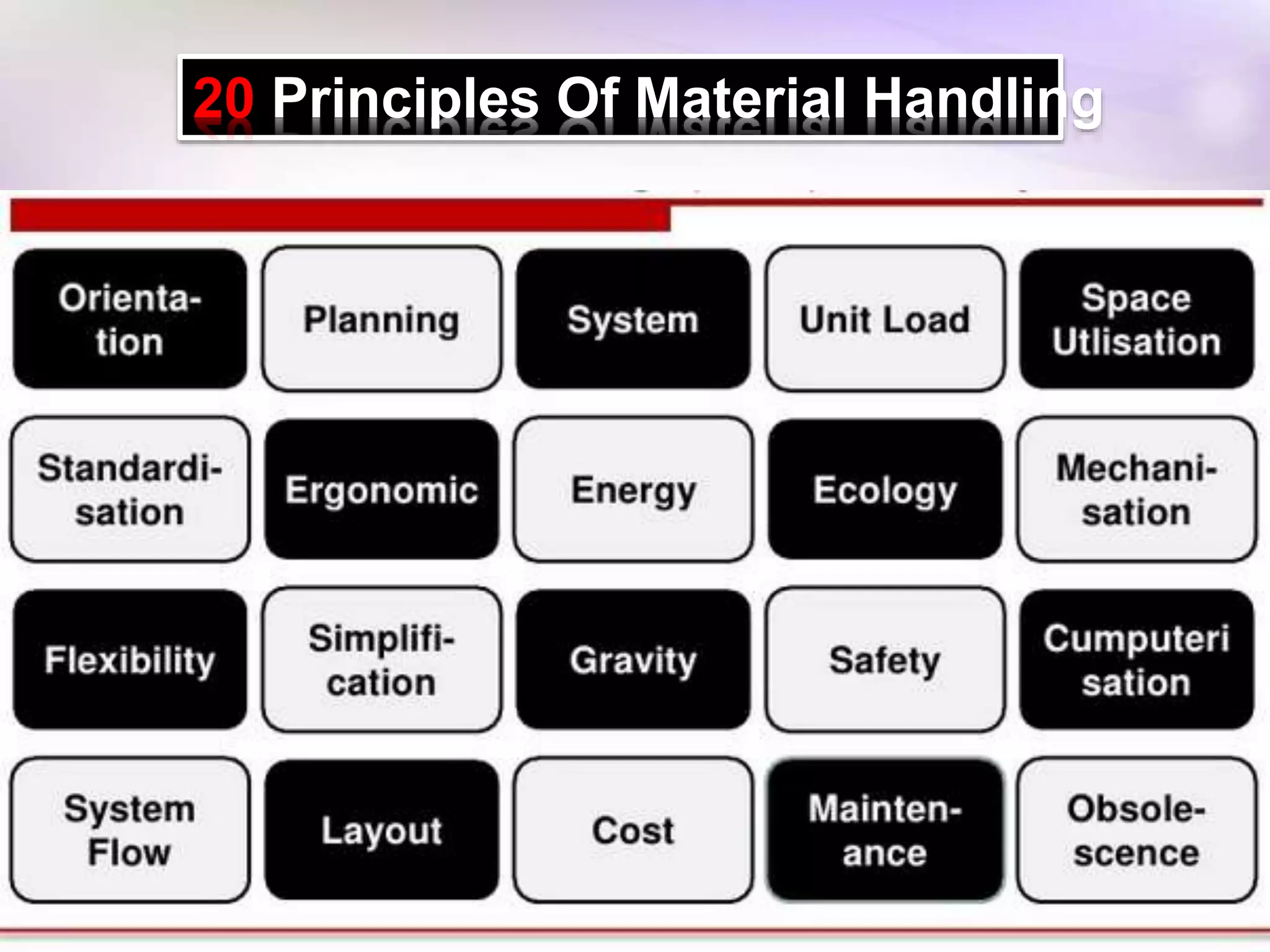
20 Principles Of Material Handling
Study the system relationships thoroughly prior to preliminary planning in order to identify
existing methods and problems, and physical and economic constraints, and to establish
future requirements and goals.
Establish a plan to include basic requirements, desirable options, and the consideration of
contingencies for all material handling and storage activities.
Integrate those handling and storage which are economically viable into a coordinated
system of operation including receiving, storage, production, assembly, packaging,
warehousing, shipping, and transportation.
Handling product in as large a unit load as practical.
Readily have access to the knowledge, expertise, professionalism, and industry leadership.
Standardize handling methods and equipment wherever possible.
Make effective utilization of all cubic space.
Recognize human capabilities and limitations by designing material handling equipment and
procedures for effective interaction with the people using the system.
Include energy consumption of the material handling systems and material handling
procedures when making comparisons or preparing economic justifications
Minimize adverse effects on the environment when selecting material handling equipment
and procedures.
Use methods and equipment which can perform a variety of tasks under a variety of
operating conditions.
Mechanize the handling process where feasible to increase efficiency and economy in the
handling of materials.
Simplify handling by eliminating, reducing, or combining unnecessary movements and/or
equipment
Utilize gravity to move material wherever possible, while respecting limitations concerning
safety, product damage, and loss.
Provide safe material handling equipment and methods which follow existing safety codes
and regulations in addition to accrued experience.
Prepare an operational sequence and equipment layout for all viable systems solutions, then
select the alternative system which best integrates efficiency and effectiveness.
Consider computerization in material handling and storage systems when circumstances
warrant for improved material and information control.
Compare the economic justification of alternative solutions in equipment and methods on
the basis of economic effectiveness as measured by expense per unit handled.
Prepare a plan for preventive maintenance and scheduled repairs on all material handling
equipment
Provide reliable and dependable material handling equipment from manufacturers who have
demonstrated quality and longevity in the industry
Conclusion
Maintenance and Material handling helps in Improving
efficiency of a production system by ensuring the right
quantity of materials delivered at the right place at the right
time via best economic way and it helps in cut down indirect
labor cost, reduces damage of machine and material during
production , storage and movement and maximizes space
utilization.
Material handling and maintenance is a scientific approach of
reducing the cost of production and is necessary for all
industries , however it should be implemented only after
thorough analysis of cost , available resources and budgetary
constraints.
QUERIES
Maintenance and material handling methods (1)

Maintenance and material handling methods (1)

  • 1.
  • 3.
    MAS flight Boeing737 left KLIA at 2:00 pm. All two engines, hydraulic systems working. 2:22 pm explosion shook plane. Number 2 engine torn apart, 2 separate hydraulic lines ceased to work. In spite of maintenance work, engine still failed. Imagine having no maintenance system.
  • 4.
    • What ismaintenance? • Why do we need maintenance? • What are the costs of doing maintenance? • What are the costs of not doing maintenance? • What are the benefits of maintenance? • How can maintenance increase profitability of company?
  • 5.
    • All actionsnecessary for retaining an item, or restoring to it, a serviceable condition, include servicing, repair, modification, overhaul, inspection and condition verification • Increase availability of a system • Keep system’s equipment in working order What Is Maintenance ?
  • 6.
    Purpose ofMaintenance • Attemptto maximize performance of production equipment efficiently and regularly. • Prevent breakdown or failures. • Minimize production loss from failures. • Increase reliability of the operating systems.
  • 7.
    • To achieveproduct quality and customer satisfaction through adjusted and serviced equipment • Maximize useful life of equipment • Keep equipment safe and prevent safety hazards • Minimize frequency and severity of interruptions • Maximize production capacity – through high utilization of facility
  • 8.
    Problems in Maintenance •Lack of management attention to maintenance • Little participation by accounting in analyzing and reporting costs • Difficulties in applying quantitative analysis • Difficulties in obtaining time and cost estimates for maintenance works • Difficulties in measuring performance
  • 9.
    Problems Exist DueTo •Failure to develop written objectives and policy • Inadequate budgetary control • Inadequate control procedures for work order, service requests etc. • Infrequent use of standards • To control maintenance work • Absence of cost reports to aid maintenance planning and control system
  • 10.
    MaintenanceObjectives • Must beconsistent with the goals of production (cost, quality, delivery, safety) • Must be comprehensive and include specific responsibilities
  • 11.
    MaintenanceCosts • Cost toreplace or repair • Losses of output • Delayed shipment • Scrap and rework
  • 12.
    Typesof Maintenance • Maintenancemay be classified into four categories: • (some authors prefer three categories- scheduled and preventive maintenances are merged) • Corrective or Breakdown maintenance • Scheduled maintenance • Preventive maintenance • Predictive (Condition-based) maintenance
  • 13.
    Corrective or BreakdownMaintenance •Corrective or Breakdown maintenance implies that repairs are made after the equipment is failed and can not perform its normal function anymore. • Quite justified in small factories where: – Down times are non-critical and repair costs are less than other type of maintenance – Financial justification for scheduling are not felt
  • 14.
    Scheduled Maintenance  Scheduledmaintenance is a stitch-in-time procedure and incorporates . – inspection – lubrication – repair and overhaul of equipments  If neglected can result in breakdown  Generally followed for: – overhauling of machines – changing of heavy equipment oils – cleaning of water and other tanks etc.
  • 15.
    Preventive Maintenance(PM) • Principle– “Prevention is better than cure” • Procedure - Stitch-in-time • It – locates weak spots of machinery and equipments – provides them periodic/scheduled inspections and minor repairs to reduce the danger of unanticipated breakdowns
  • 16.
    Predictive (Condition-based)Maintenance • Inpredictive maintenance, machinery conditions are periodically monitored and this enables the maintenance crews to take timely actions, such as machine adjustment, repair or overhaul. • It makes use of human sense and other sensitive instruments, such as –audio gauge, vibration analyzer, amplitude meter, pressure, temperature and resistance strain gauges etc.
  • 17.
    Predictive Maintenance(Contd.) • Unusualsounds coming out of a rotating equipment predicts a trouble • An excessively hot electric cable predicts a trouble • Simple hand touch can point out many unusual equipment conditions and thus predicts a trouble
  • 18.
    Maintenance(Dependon The TimeHorizon) 1.Long-range (master) schedule 2. Weekly schedule 3. Daily schedule
  • 19.
    Long-Range (master) Schedule •Covering a period of 3 months to 1 year. • Based on existing maintenance work orders (blanket work order, backlog, anticipated EM). • Balancing long-term demand for maintenance work with available resources. • Spare parts and material could be identified and ordered in advance. • Revision and updating to reflect changes in the plans and maintenance work.
  • 20.
    Weekly Schedule • Covering1 week. • Generated from the master schedule. • Takes into account current operations schedules and economic considerations. • Allow 10% to 15% of the workforce to be available for emergency work. • The schedule prepared for the current week and the following one in order to consider the available backlog. • The work orders scheduled in this week are sequenced based on priority. • CPM and integer programming techniques can be used to generate a schedule.
  • 21.
    Daily Schedule • Covering1 day. • Generated from weekly schedule. • Prepared the day before. • Interrupted to perform EM. • Priorities are used to schedule the jobs.
  • 22.
    MaintenanceManagement Employee Involvement Partnering withmaintenance Personnel. Skill training. Employee empowerment. Maintenance and Reliability Procedures Clean and lubricate. Monitor and adjust. Make minor repair. Keep computerized records. Results Reduced inventory. Improved quality. Improved capacity. Reputation for quality. Continuous improvement. Reduced variability.
  • 23.
    ComputerizedMaintenance System Output Reports Inventoryand purchasing reports Equipment parts list Equipment history reports Cost analysis (Actual vs. standard) Work orders – Preventive maintenance – Scheduled downtime – Emergency maintenance Data Files Personnel data with skills, wages, etc. Equipment file with parts list Maintenance and work order schedule Inventory of spare parts Repair history file
  • 24.
  • 25.
    MaintenanceCosts Costs Maintenance commitment Full CostView Optimal point (lowest cost maintenance policy) Total costs Full cost of breakdowns Preventive maintenance costs
  • 26.
    How Maintenance isPerformed Operator (autonomous maintenance) Maintenance department Manufacturer’s field service Depot service (return equipment) Increasing Operator Ownership Increasing Complexity Preventive maintenance costs less and is faster the more we move to the left Competence is higher as we move to the right
  • 27.
  • 28.
    Towardsa definiton • MaterialHandling accounts for: – 25% of all employees, – 55% of all factory space, – 87% of production time – 15-70% of the total cost of a manufactured product • 3-5% of all material handled becomes damaged – “Totally eliminate mistakes” – However, handling less is not the answer.
  • 29.
    Motivations • Material handlingis a means by which: – Total manufacturing costs are reduced through • Reduced inventory • Improved safety • Improved material control • By reducing damage – Manufacturing quality is improved by: • By giving more time to manufacturing process • Proper supervision of machinery will lower defects in products.
  • 30.
    Definitions: •Material handling isthe art and science of moving, storing, protecting, controlling and status of material –Moving: is required to create time and place utility.The value of having the material at the right time and the right place. –Storing: Provides a buffer between operations, facilitates the efficient use of people and machines. –Protecting: Includes the packaging,damage and theft. –Controlling: Physical storage, sequence and space between material. –Status: Real-time awareness of the location, amount, destination and schedule of material.
  • 31.
    Material Handling isthe function of moving the right material to the right place at the right time, in the right amount, in right sequence, and in the right condition to minimize production cost. The cost of MH estimates 20-25% of total manufacturing labor cost in the United States [The Material Handling Industry of America (MHIA)]
  • 32.
    Classesof materials • Rawmaterials:- This is material which is used in product manufacturing and is in an unprocessed condition.(eg cotton) • Purchased Parts:- These are the items used in the assembly of the product.(eg processor) • In-progress materials:- They are called ‘work in progress’ inventories. These goods require further processing.
  • 33.
    Finished materials:- Theseare fully manufactured goods, inspected and ready for delivery to the customers. Supplies:- These are consumable goods used in the process of manufacturing.(eg electricity)
  • 34.
    Principles of materialhandling • Least handling is the best handling. • Lengths and number of moves to be minimized. • Unit load • Minimize the distance.
  • 35.
    • The designof the container. e.g. shippers are used for storing finished bulk. & for raw materials as per the property of materials they are stored- plastic containers ( light weight containers) • Re-handling and back tracking of the materials should be avoided. • The materials handling service should not interfere with the production flow.
  • 36.
    Example of Materialsand PeopleFlow
  • 37.
    Six-step engineeringdesing process 1.Define the objectives and scope for the material handling system. 2. Analyze the requirements for moving, storing, protecting, and controlling material. 3. Generate alternative designs for meeting material handling system requirements. 4. Evaluate alternative material handling system designs. 5. Select the preferred design for moving, storing, protecting, and controlling material. 6. Implement the preferred design, including the selection of suppliers, training of personnel, installation, debug and startup of equipment, and periodic audits of system performance.
  • 38.
    Categories of MaterialHandling Equipment 1. Containers and Unitizing Equipment • Containers • Unitizers 2. Material Transport Equipment • Conveyors • Industrial Vehicles • Monorails, Hoists, and Cranes 3. Storage and Retrieval Equipment • Unit Load Storage and Retrieval • Unit Load Storage Equipment • Unit Load Retrieval Equipment • Small Load Storage and Retrieval 4. Automatic Data Collection and Communication Equipment • Automatic Identification and Recognition • Automatic Paperless Communication
  • 39.
  • 40.
  • 41.
  • 42.
    20 Principles OfMaterial Handling
  • 43.
    Study the systemrelationships thoroughly prior to preliminary planning in order to identify existing methods and problems, and physical and economic constraints, and to establish future requirements and goals. Establish a plan to include basic requirements, desirable options, and the consideration of contingencies for all material handling and storage activities. Integrate those handling and storage which are economically viable into a coordinated system of operation including receiving, storage, production, assembly, packaging, warehousing, shipping, and transportation. Handling product in as large a unit load as practical. Readily have access to the knowledge, expertise, professionalism, and industry leadership.
  • 44.
    Standardize handling methodsand equipment wherever possible. Make effective utilization of all cubic space. Recognize human capabilities and limitations by designing material handling equipment and procedures for effective interaction with the people using the system. Include energy consumption of the material handling systems and material handling procedures when making comparisons or preparing economic justifications Minimize adverse effects on the environment when selecting material handling equipment and procedures.
  • 45.
    Use methods andequipment which can perform a variety of tasks under a variety of operating conditions. Mechanize the handling process where feasible to increase efficiency and economy in the handling of materials. Simplify handling by eliminating, reducing, or combining unnecessary movements and/or equipment Utilize gravity to move material wherever possible, while respecting limitations concerning safety, product damage, and loss. Provide safe material handling equipment and methods which follow existing safety codes and regulations in addition to accrued experience.
  • 46.
    Prepare an operationalsequence and equipment layout for all viable systems solutions, then select the alternative system which best integrates efficiency and effectiveness. Consider computerization in material handling and storage systems when circumstances warrant for improved material and information control. Compare the economic justification of alternative solutions in equipment and methods on the basis of economic effectiveness as measured by expense per unit handled. Prepare a plan for preventive maintenance and scheduled repairs on all material handling equipment Provide reliable and dependable material handling equipment from manufacturers who have demonstrated quality and longevity in the industry
  • 47.
    Conclusion Maintenance and Materialhandling helps in Improving efficiency of a production system by ensuring the right quantity of materials delivered at the right place at the right time via best economic way and it helps in cut down indirect labor cost, reduces damage of machine and material during production , storage and movement and maximizes space utilization. Material handling and maintenance is a scientific approach of reducing the cost of production and is necessary for all industries , however it should be implemented only after thorough analysis of cost , available resources and budgetary constraints.
  • 48.