Analysis of Algorithms
Greedy Methods
Andres Mendez-Vazquez
November 19, 2014
1 / 64
Outline
1 Greedy Method
Steps of the greedy method
Dynamic programming vs Greedy Method
2 Greedy Method Examples
Knapsack Problem
Fractional Knapsack
Activity selection
Huffman codes
Some lemmas
3 Exercises
2 / 64
Outline
1 Greedy Method
Steps of the greedy method
Dynamic programming vs Greedy Method
2 Greedy Method Examples
Knapsack Problem
Fractional Knapsack
Activity selection
Huffman codes
Some lemmas
3 Exercises
3 / 64
Steps of the greedy method
Proceed as follows
Determine the optimal substructure.
Develop a recursive solution.
Prove that at any stage of recursion, one of the optimal choices is the
greedy choice.
Show that all but one of the sub-problems resulting from the greedy
choice are empty.
Develop a recursive greedy algorithm.
Convert it to an iterative algorithm.
4 / 64
Outline
1 Greedy Method
Steps of the greedy method
Dynamic programming vs Greedy Method
2 Greedy Method Examples
Knapsack Problem
Fractional Knapsack
Activity selection
Huffman codes
Some lemmas
3 Exercises
5 / 64
Dynamic Programming vs Greedy Method
Dynamic Programming
Make a choice at each step
Choice depends on knowing optimal solutions to sub-problems. Solve
sub-problems first.
Solve bottom-up.
Greedy Method
Make a choice at each step.
Make the choice before solving the sub-problems.
Solve top-down.
6 / 64
Dynamic Programming vs Greedy Method
Dynamic Programming
Make a choice at each step
Choice depends on knowing optimal solutions to sub-problems. Solve
sub-problems first.
Solve bottom-up.
Greedy Method
Make a choice at each step.
Make the choice before solving the sub-problems.
Solve top-down.
6 / 64
Outline
1 Greedy Method
Steps of the greedy method
Dynamic programming vs Greedy Method
2 Greedy Method Examples
Knapsack Problem
Fractional Knapsack
Activity selection
Huffman codes
Some lemmas
3 Exercises
7 / 64
You are a thief
You get into a store
With a knapsack/bag
The bag has capacity W
You want to select items to fill the bag...
Question
How do you do it?
8 / 64
You are a thief
You get into a store
With a knapsack/bag
The bag has capacity W
You want to select items to fill the bag...
Question
How do you do it?
8 / 64
You are a thief
You get into a store
With a knapsack/bag
The bag has capacity W
You want to select items to fill the bag...
Question
How do you do it?
8 / 64
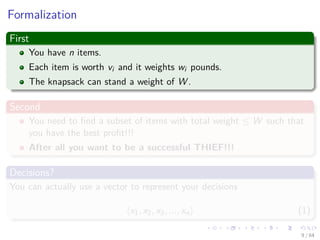
Formalization
First
You have n items.
Each item is worth vi and it weights wi pounds.
The knapsack can stand a weight of W .
Second
You need to find a subset of items with total weight ≤ W such that
you have the best profit!!!
After all you want to be a successful THIEF!!!
Decisions?
You can actually use a vector to represent your decisions
x1, x2, x3, ..., xn (1)
9 / 64
Formalization
First
You have n items.
Each item is worth vi and it weights wi pounds.
The knapsack can stand a weight of W .
Second
You need to find a subset of items with total weight ≤ W such that
you have the best profit!!!
After all you want to be a successful THIEF!!!
Decisions?
You can actually use a vector to represent your decisions
x1, x2, x3, ..., xn (1)
9 / 64
Formalization
First
You have n items.
Each item is worth vi and it weights wi pounds.
The knapsack can stand a weight of W .
Second
You need to find a subset of items with total weight ≤ W such that
you have the best profit!!!
After all you want to be a successful THIEF!!!
Decisions?
You can actually use a vector to represent your decisions
x1, x2, x3, ..., xn (1)
9 / 64
You have two versions
0-1 knapsack problem
You have to either take an item or not take it, you cannot take a
fraction of it.
Thus, elements in the vector are xi ∈ {0, 1} with i = 1, ..., n.
Fractional knapsack problem
Like the 0-1 knapsack problem, but you can take a fraction of an item.
Thus, elements in the vector are xi ∈ [0, 1] with i = 1, ..., n.
10 / 64
You have two versions
0-1 knapsack problem
You have to either take an item or not take it, you cannot take a
fraction of it.
Thus, elements in the vector are xi ∈ {0, 1} with i = 1, ..., n.
Fractional knapsack problem
Like the 0-1 knapsack problem, but you can take a fraction of an item.
Thus, elements in the vector are xi ∈ [0, 1] with i = 1, ..., n.
10 / 64
Greedy Process for 0-1 Knapsack
First, You choose an ordering
What about per price of each item?
If we have the following situation
11 / 64
Greedy Process for 0-1 Knapsack
First, You choose an ordering
What about per price of each item?
If we have the following situation
item 1
item 2
item 3
KNAPSACK
$120
30 kg
50 kg
20 kg
10 kg
$100$80
ORDER OF SELECTION
11 / 64
Thus
It works fine
item 1
KNAPSACK50 kg
10 kg
$100+$120=$220$80
30 kg
20 kg
What about this?
12 / 64
Thus
It works fine
item 1
KNAPSACK50 kg
10 kg
$100+$120=$220$80
30 kg
20 kg
What about this?
item 1 item 2
item 3
KNAPSACK
$120
30 kg
50 kg
25 kg
$100$80
ORDER OF SELECTION
25 kg
12 / 64
Thus, we need a better way to select elements!!!
Actually
Why not to use the price of kg?
Thus, we have this!!!
13 / 64
Thus, we need a better way to select elements!!!
Actually
Why not to use the price of kg?
Thus, we have this!!!
item 1 item 2
item 3
KNAPSACK
$120
30 kg
50 kg
20 kg
$100$80
ORDER OF SELECTION?
20 kg
13 / 64
Did you notice this?
First
item 1
KNAPSACK
$100+$120=220
50 kg
$80
20 kg
30 kg
20 kg
Second
14 / 64
Did you notice this?
First
item 1
KNAPSACK
$100+$120=220
50 kg
$80
20 kg
30 kg
20 kg
Second
KNAPSACK
$40+$80+$100=220
50 kg
$80
20 kg
20 kg 20 kg
10 kg
14 / 64
However!!!
Even with an order based in v
w
0-1 Knapsack fails!!!
item 1 item 2 item 3
KNAPSACK
$120
30 kg
50 kg
25 kg
$75$75
ORDER OF SELECTION?
25 kg
15 / 64
Outline
1 Greedy Method
Steps of the greedy method
Dynamic programming vs Greedy Method
2 Greedy Method Examples
Knapsack Problem
Fractional Knapsack
Activity selection
Huffman codes
Some lemmas
3 Exercises
16 / 64
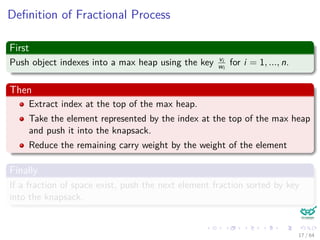
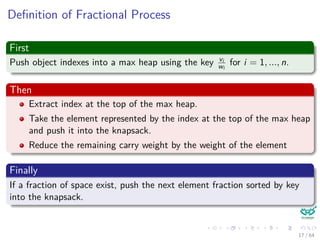
Definition of Fractional Process
First
Push object indexes into a max heap using the key vi
wi
for i = 1, ..., n.
Then
Extract index at the top of the max heap.
Take the element represented by the index at the top of the max heap
and push it into the knapsack.
Reduce the remaining carry weight by the weight of the element
Finally
If a fraction of space exist, push the next element fraction sorted by key
into the knapsack.
17 / 64
Definition of Fractional Process
First
Push object indexes into a max heap using the key vi
wi
for i = 1, ..., n.
Then
Extract index at the top of the max heap.
Take the element represented by the index at the top of the max heap
and push it into the knapsack.
Reduce the remaining carry weight by the weight of the element
Finally
If a fraction of space exist, push the next element fraction sorted by key
into the knapsack.
17 / 64
Definition of Fractional Process
First
Push object indexes into a max heap using the key vi
wi
for i = 1, ..., n.
Then
Extract index at the top of the max heap.
Take the element represented by the index at the top of the max heap
and push it into the knapsack.
Reduce the remaining carry weight by the weight of the element
Finally
If a fraction of space exist, push the next element fraction sorted by key
into the knapsack.
17 / 64
Theorem about Greedy Choice
Theorem
The greedy choice, which always selects the object with better ratio
value/weight, always finds an optimal solution to the Fractional Knapsack
problem.
Proof
Constraints:
xi ∈ [0, 1]
18 / 64
Theorem about Greedy Choice
Theorem
The greedy choice, which always selects the object with better ratio
value/weight, always finds an optimal solution to the Fractional Knapsack
problem.
Proof
Constraints:
xi ∈ [0, 1]
18 / 64
Fractional Greedy
FRACTIONAL-KNAPSACK(W , w, v)
1 for i = 1 to n do x [i] = 0
2 weight = 0
3 // Use a Max-Heap
4 T = Build-Max-Heap(v/w)
5 while weight < W do
6 i = T.Heap-Extract-Max()
7 if (weight + w[i] ≤ W ) do
8 x [i] = 1
9 weight = weight + w[i]
10 else
11 x [i] = W −weight
w[i]
12 weight = W
13 return x
19 / 64
Fractional Greedy
Complexity
Under the fact that this algorithm is using a heap we can get the
complexity O(n log n).
If we assume already an initial sorting or use a linear sorting we get
complexity O(n).
20 / 64
Outline
1 Greedy Method
Steps of the greedy method
Dynamic programming vs Greedy Method
2 Greedy Method Examples
Knapsack Problem
Fractional Knapsack
Activity selection
Huffman codes
Some lemmas
3 Exercises
21 / 64
Activity selection
Problem
Set of activities S = a1, ..., an. The ai activity needs a resource (Class
Room, Machine, Assembly Line, etc) during period [si , fi ), which is a
half-open interval, where si is the start time of activity ai and fi is the
finish time of activity ai .
For example
i 1 2 3 4 5 6 7 8 9
si 1 2 4 1 5 8 9 11 13
fi 3 5 7 8 9 10 11 14 16
Goal:
Select the largest possible set of non-overlapping activities.
22 / 64
Activity selection
Problem
Set of activities S = a1, ..., an. The ai activity needs a resource (Class
Room, Machine, Assembly Line, etc) during period [si , fi ), which is a
half-open interval, where si is the start time of activity ai and fi is the
finish time of activity ai .
For example
i 1 2 3 4 5 6 7 8 9
si 1 2 4 1 5 8 9 11 13
fi 3 5 7 8 9 10 11 14 16
Goal:
Select the largest possible set of non-overlapping activities.
22 / 64
Activity selection
Problem
Set of activities S = a1, ..., an. The ai activity needs a resource (Class
Room, Machine, Assembly Line, etc) during period [si , fi ), which is a
half-open interval, where si is the start time of activity ai and fi is the
finish time of activity ai .
For example
i 1 2 3 4 5 6 7 8 9
si 1 2 4 1 5 8 9 11 13
fi 3 5 7 8 9 10 11 14 16
Goal:
Select the largest possible set of non-overlapping activities.
22 / 64
We have something like this
Example
0 1 2 3 4 5 6 7 8 9 10 11 12 13 14 15 16 17 18 19
TIME
A
C
T
I
V
I
T
Y
Goal:
Select the largest possible set of non-overlapping activities.
23 / 64
We have something like this
Example
0 1 2 3 4 5 6 7 8 9 10 11 12 13 14 15 16 17 18 19
TIME
A
C
T
I
V
I
T
Y
Goal:
Select the largest possible set of non-overlapping activities.
23 / 64
For Example
Example
0 1 2 3 4 5 6 7 8 9 10 11 12 13 14 15 16 17 18 19
A
C
T
I
V
I
T
Y
TIME
24 / 64
Thus!!!
First
The Optimal Substructure!!!
Second
We need the recursive solution!!!
Third
The Greedy Choice
Fourth
Prove it is the only one!!!
Fifth
We need the iterative solution!!!
25 / 64
Thus!!!
First
The Optimal Substructure!!!
Second
We need the recursive solution!!!
Third
The Greedy Choice
Fourth
Prove it is the only one!!!
Fifth
We need the iterative solution!!!
25 / 64
Thus!!!
First
The Optimal Substructure!!!
Second
We need the recursive solution!!!
Third
The Greedy Choice
Fourth
Prove it is the only one!!!
Fifth
We need the iterative solution!!!
25 / 64
Thus!!!
First
The Optimal Substructure!!!
Second
We need the recursive solution!!!
Third
The Greedy Choice
Fourth
Prove it is the only one!!!
Fifth
We need the iterative solution!!!
25 / 64
Thus!!!
First
The Optimal Substructure!!!
Second
We need the recursive solution!!!
Third
The Greedy Choice
Fourth
Prove it is the only one!!!
Fifth
We need the iterative solution!!!
25 / 64
How do we discover the Optimal Structure
We know we have the following
S = a1, ..., an, a set of activities.
We can then refine the set of activities in the following way
We define:
Sij = the set of activities that start after activity ai finishes and that
finishes before activity aj start.
26 / 64
How do we discover the Optimal Structure
We know we have the following
S = a1, ..., an, a set of activities.
We can then refine the set of activities in the following way
We define:
Sij = the set of activities that start after activity ai finishes and that
finishes before activity aj start.
26 / 64
The Optimal Substructure
Thus, we have
Activity time from less to more
27 / 64
The Optimal Substructure
Second
Suppose that the set Aij denotes the maximum set of compatible
activities for Sij
28 / 64
For Example
Thus, we have
Activity time from less to more
29 / 64
Then
Third
In addition assume that Aij includes some activity ak.
Then, imagine that ak belongs to some optimal solution.
30 / 64
What do we need?
We need to find the optimal solutions for Sik and Skj.
Activity time from less to more
31 / 64
The Optimal Substructure
Then
We need to prove the optimal substructure:
For this we will use
The Cut-and-Paste Argument
Contradiction
First
We have that Aik = Sik ∩ Aij and similarly Akj = Skj ∩ Aij.
Then
Aij = Aik ∪ {ak} ∪ Akj or |Aij| = |Aik| + |Akj| + 1
32 / 64
The Optimal Substructure
Then
We need to prove the optimal substructure:
For this we will use
The Cut-and-Paste Argument
Contradiction
First
We have that Aik = Sik ∩ Aij and similarly Akj = Skj ∩ Aij.
Then
Aij = Aik ∪ {ak} ∪ Akj or |Aij| = |Aik| + |Akj| + 1
32 / 64
The Optimal Substructure
Then
We need to prove the optimal substructure:
For this we will use
The Cut-and-Paste Argument
Contradiction
First
We have that Aik = Sik ∩ Aij and similarly Akj = Skj ∩ Aij.
Then
Aij = Aik ∪ {ak} ∪ Akj or |Aij| = |Aik| + |Akj| + 1
32 / 64
For Example
We need to find the optimal solutions for Sik and Skj.
Activity time from less to more
33 / 64
The Optimal Substructure: Using Contradictions
Use Cut-and-Paste Argument
How? Assume that exist Aik such that Aik > |Aik|.
Meaning
We assume that we cannot construct the large answer using the small
answers!!!
The Basis of Contradiction (S ∪ {¬P} F) =⇒ (S P)
34 / 64
The Optimal Substructure: Using Contradictions
Use Cut-and-Paste Argument
How? Assume that exist Aik such that Aik > |Aik|.
Meaning
We assume that we cannot construct the large answer using the small
answers!!!
The Basis of Contradiction (S ∪ {¬P} F) =⇒ (S P)
34 / 64
Important
Here
¬P =exist Aik such that Aik > |Aik|.
35 / 64
Then
This means that Aij has more activities than Aij
Then Aij = Aik + |Akj| + 1 > |Aik| + |Akj| + 1 = |Aij| , which is a
contradiction.
Finally
We have the optimal-substructure.
36 / 64
Then
This means that Aij has more activities than Aij
Then Aij = Aik + |Akj| + 1 > |Aik| + |Akj| + 1 = |Aij| , which is a
contradiction.
Finally
We have the optimal-substructure.
36 / 64
Then
Given
Aij = Aik ∪ {ak} ∪ Akj or |Aij| = |Aik| + |Akj| + 1.
Question
Can anybody give me the recursion?
37 / 64
Then
Given
Aij = Aik ∪ {ak} ∪ Akj or |Aij| = |Aik| + |Akj| + 1.
Question
Can anybody give me the recursion?
37 / 64
Recursive Formulation
c[i, j] =



0 if Sij = ∅
max
i<k<j
ak ∈Sij
c[i, k] + c[k, j] + 1 if Sij = ∅
Did you notice that you can use Dynamic Programming?
38 / 64
Recursive Formulation
c[i, j] =



0 if Sij = ∅
max
i<k<j
ak ∈Sij
c[i, k] + c[k, j] + 1 if Sij = ∅
Did you notice that you can use Dynamic Programming?
38 / 64
We have our Goal?
Thus
Any Ideas to obtain the largest possible set using Greedy Choice?
What about?
Early Starting Time?
Early Starting + Less Activity Length?
Me!!!
Do we have something that combines both things?
39 / 64
We have our Goal?
Thus
Any Ideas to obtain the largest possible set using Greedy Choice?
What about?
Early Starting Time?
Early Starting + Less Activity Length?
Me!!!
Do we have something that combines both things?
39 / 64
We have our Goal?
Thus
Any Ideas to obtain the largest possible set using Greedy Choice?
What about?
Early Starting Time?
Early Starting + Less Activity Length?
Me!!!
Do we have something that combines both things?
39 / 64
Which Greedy Choice?
Did you notice the following
Active
Finishing
Time
40 / 64
The Early Finishing Time
Yes!!!
The Greedy Choice = Select by earliest finishing time.
41 / 64
Greedy solution
Theorem 16.1
Consider any nonempty subproblem Sk = {ai ∈ S|si > fk}, and let am be
an activity in Sk with the earliest finish time. Then am is included in some
maximum-size subset of mutually compatible activities of Sk .
42 / 64
Thus
We can do the following
We can repeatedly choose the activity that finishes first.
Remove all activities incompatible with this activity
Then repeat
Not only that
Because we always choose the activity with the earliest finish time.
Then, finish times of the activities we choose must strictly increase.
43 / 64
Thus
We can do the following
We can repeatedly choose the activity that finishes first.
Remove all activities incompatible with this activity
Then repeat
Not only that
Because we always choose the activity with the earliest finish time.
Then, finish times of the activities we choose must strictly increase.
43 / 64
Top-Down Approach
Something Notable
An algorithm to solve the activity-selection problem does not need to work
bottom-up!!!
Instead
It can work top-down, choosing an activity to put into the optimal solution
and then solving the subproblem of choosing activities from those that are
compatible with those already chosen.
Important
Greedy algorithms typically have this top-down design:
They make a choice and then solve one subproblem.
44 / 64
Top-Down Approach
Something Notable
An algorithm to solve the activity-selection problem does not need to work
bottom-up!!!
Instead
It can work top-down, choosing an activity to put into the optimal solution
and then solving the subproblem of choosing activities from those that are
compatible with those already chosen.
Important
Greedy algorithms typically have this top-down design:
They make a choice and then solve one subproblem.
44 / 64
Top-Down Approach
Something Notable
An algorithm to solve the activity-selection problem does not need to work
bottom-up!!!
Instead
It can work top-down, choosing an activity to put into the optimal solution
and then solving the subproblem of choosing activities from those that are
compatible with those already chosen.
Important
Greedy algorithms typically have this top-down design:
They make a choice and then solve one subproblem.
44 / 64
Then
First
The activities are already sorted by finishing time
In addition
There are dummy activities:
a0= fictitious activity, f0 = 0.
45 / 64
Then
First
The activities are already sorted by finishing time
In addition
There are dummy activities:
a0= fictitious activity, f0 = 0.
45 / 64
Recursive Activity Selector
REC-ACTIVITY-SELECTOR(s, f , k, n) - Entry Point (s, f , 0, n)
1 m = k + 1
2 // find the first activity in Sk to finish
3 while m ≤ n and s [m] < f [k]
4 m = m + 1
5 if m ≤ n
6 return {am} ∪REC-ACTIVITY-SELECTOR(s, f , m, n)
7 else return ∅
46 / 64
Do we need into the recursion?
Did you notice?
We remove all the activities before fk!!!
47 / 64
We can do more...
GREEDY-ACTIVITY-SELECTOR(s, f , n)
1 n = s.length
2 A={a1}
3 k = 1
4 for m = 2 to n
5 if s [m] ≥ f [k]
6 A=A∪ {am}
7 k = m
8 return A
Complexity of the algorithm
Θ(n)
Note: Clearly, we are not taking into account the sorting of the
activities.
48 / 64
We can do more...
GREEDY-ACTIVITY-SELECTOR(s, f , n)
1 n = s.length
2 A={a1}
3 k = 1
4 for m = 2 to n
5 if s [m] ≥ f [k]
6 A=A∪ {am}
7 k = m
8 return A
Complexity of the algorithm
Θ(n)
Note: Clearly, we are not taking into account the sorting of the
activities.
48 / 64
Outline
1 Greedy Method
Steps of the greedy method
Dynamic programming vs Greedy Method
2 Greedy Method Examples
Knapsack Problem
Fractional Knapsack
Activity selection
Huffman codes
Some lemmas
3 Exercises
49 / 64
Huffman codes
Use
Huffman codes are widely used and very effective technique for
compressing.
Advantages
Savings of 20% to 90% are typical, depending on the characteristics of the
data being compressed.
Idea
Huffman codes are based on the idea of prefix codes:
Codes in which no codeword is also a prefix of some other codeword.
It is possible to show that the optimal data compression achievable by
a character code can always be achieved with a prefix code.
50 / 64
Huffman codes
Use
Huffman codes are widely used and very effective technique for
compressing.
Advantages
Savings of 20% to 90% are typical, depending on the characteristics of the
data being compressed.
Idea
Huffman codes are based on the idea of prefix codes:
Codes in which no codeword is also a prefix of some other codeword.
It is possible to show that the optimal data compression achievable by
a character code can always be achieved with a prefix code.
50 / 64
Huffman codes
Use
Huffman codes are widely used and very effective technique for
compressing.
Advantages
Savings of 20% to 90% are typical, depending on the characteristics of the
data being compressed.
Idea
Huffman codes are based on the idea of prefix codes:
Codes in which no codeword is also a prefix of some other codeword.
It is possible to show that the optimal data compression achievable by
a character code can always be achieved with a prefix code.
50 / 64
Imagine the following
We have the following
Imagine having 100,000-character data file, and we want to store it
compactly.
In addition, we have the following distribution of character in the
hundred of thousands.
Table
a b c d e f
Frequency 45,000 13,000 12,000 16,000 9,000 5,000
Fixed-Leng cw 000 001 010 011 100 101
Vari Leng cw 0 101 100 111 1101 1100
Table : Distribution of characters in the text and their codewords.
51 / 64
Imagine the following
We have the following
Imagine having 100,000-character data file, and we want to store it
compactly.
In addition, we have the following distribution of character in the
hundred of thousands.
Table
a b c d e f
Frequency 45,000 13,000 12,000 16,000 9,000 5,000
Fixed-Leng cw 000 001 010 011 100 101
Vari Leng cw 0 101 100 111 1101 1100
Table : Distribution of characters in the text and their codewords.
51 / 64
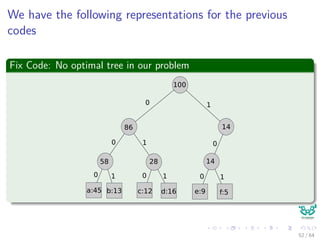
We have the following representations for the previous
codes
Fix Code: No optimal tree in our problem
100
86
28
0 1
14
14
0 1 0
0 0 01 1 1
58
a:45 b:13 c:12 d:16 e:9 f:5
52 / 64
We have the following representations for the previous
codes
Prefix Code: Binary tree for the variable prefix code in table
100
0 1
55
25
0
0
0
0
1 1
1
a:45
b:13c:12 d:16
e:9 f:5
30
14
53 / 64
Cost in the number of bits to represent the text
Fix Code
3 × 100, 000 = 300, 000 bits (2)
Variable Code
[45 × 1 + 13 × 3 + 12 × 3 + 16 × 3 + ...
9 × 4 + 5 × 4] × 1000 = 224, 000 bits
54 / 64
Cost in the number of bits to represent the text
Fix Code
3 × 100, 000 = 300, 000 bits (2)
Variable Code
[45 × 1 + 13 × 3 + 12 × 3 + 16 × 3 + ...
9 × 4 + 5 × 4] × 1000 = 224, 000 bits
54 / 64
Prefix Codes
Something Notable
It has been show that prefix codes:
Codes in which no codeword is also a prefix of some other codeword.
They have the following nice properties
Easy to decode.
They are unambiguous.
For example in our example the string 001011101 transform as
0 ◦ 0 ◦ 101 ◦ 1101 = aabe.
Properties
As we can prove an optimal code for a text is always represented by a full
binary tree!!!
55 / 64
Prefix Codes
Something Notable
It has been show that prefix codes:
Codes in which no codeword is also a prefix of some other codeword.
They have the following nice properties
Easy to decode.
They are unambiguous.
For example in our example the string 001011101 transform as
0 ◦ 0 ◦ 101 ◦ 1101 = aabe.
Properties
As we can prove an optimal code for a text is always represented by a full
binary tree!!!
55 / 64
Prefix Codes
Something Notable
It has been show that prefix codes:
Codes in which no codeword is also a prefix of some other codeword.
They have the following nice properties
Easy to decode.
They are unambiguous.
For example in our example the string 001011101 transform as
0 ◦ 0 ◦ 101 ◦ 1101 = aabe.
Properties
As we can prove an optimal code for a text is always represented by a full
binary tree!!!
55 / 64
It is more...
Given that we will concentrate our attention for the prefix codes to
full binary tree.
Given that C is the alphabet for the text file
We have that
1 The tree for the optimal prefix code has |C| leaves.
2 The number of internal leaves is |C| − 1.
3 Each character x at the leaves has a depth dT (x) which is the length
of the codeword.
Thus
Knowing the frequency of each character and the tree T representing
the optimal prefix encoding.
We can define the number of bits necessary to encode the text file.
56 / 64
It is more...
Given that we will concentrate our attention for the prefix codes to
full binary tree.
Given that C is the alphabet for the text file
We have that
1 The tree for the optimal prefix code has |C| leaves.
2 The number of internal leaves is |C| − 1.
3 Each character x at the leaves has a depth dT (x) which is the length
of the codeword.
Thus
Knowing the frequency of each character and the tree T representing
the optimal prefix encoding.
We can define the number of bits necessary to encode the text file.
56 / 64
It is more...
Given that we will concentrate our attention for the prefix codes to
full binary tree.
Given that C is the alphabet for the text file
We have that
1 The tree for the optimal prefix code has |C| leaves.
2 The number of internal leaves is |C| − 1.
3 Each character x at the leaves has a depth dT (x) which is the length
of the codeword.
Thus
Knowing the frequency of each character and the tree T representing
the optimal prefix encoding.
We can define the number of bits necessary to encode the text file.
56 / 64
Cost of Trees for Coding
Cost in the number of bits for a text
B(T) =
c∈C
c.freq × dT (c).
57 / 64
Now, Which Greedy Choice?
I leave this to you
The optimal substructure
Greedy Choice
Ideas?
58 / 64
Now, Which Greedy Choice?
I leave this to you
The optimal substructure
Greedy Choice
Ideas?
58 / 64
Now, Which Greedy Choice?
I leave this to you
The optimal substructure
Greedy Choice
Ideas?
58 / 64
What about this?
Prefix Code: Binary tree for the variable prefix code in table
100
0 1
55
25
0
0
0
0
1 1
1
a:45
b:13c:12 d:16
e:9 f:5
30
14
59 / 64
Greedy Process for Huffman Codes
Process
You start with an alphabet C with an associated frequency for each
element in it.
Use the frequencies to build a min priority queue.
Subtract the two least frequent elements (Greedy Choice)
Build a three using as children the two nodes of the subtrees
extracted from the min priority queue. The new root holds the sum of
frequencies of the two subtrees.
Put it back into the Priority Queue.
60 / 64
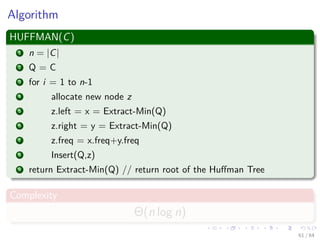
Algorithm
HUFFMAN(C)
1 n = |C|
2 Q = C
3 for i = 1 to n-1
4 allocate new node z
5 z.left = x = Extract-Min(Q)
6 z.right = y = Extract-Min(Q)
7 z.freq = x.freq+y.freq
8 Insert(Q,z)
9 return Extract-Min(Q) // return root of the Huffman Tree
Complexity
Θ(n log n)
61 / 64
Algorithm
HUFFMAN(C)
1 n = |C|
2 Q = C
3 for i = 1 to n-1
4 allocate new node z
5 z.left = x = Extract-Min(Q)
6 z.right = y = Extract-Min(Q)
7 z.freq = x.freq+y.freq
8 Insert(Q,z)
9 return Extract-Min(Q) // return root of the Huffman Tree
Complexity
Θ(n log n)
61 / 64
Example
The Process!!!
62 / 64
Lemmas to sustain the claims
Lemma 16.2
Let C be an alphabet in which each character c ∈ C has frequency c.freq.
Let x and y be two characters in C having the lowest frequencies. Then
there exists an optimal prefix code for C in which the codewords for x and
y have the same length and differ only in the last bit.
Lemma 16.3
Let C be a given alphabet with frequency c:freq defined for each character
c ∈ C . Let x and y be two characters in C with minimum frequency. Let
C be the alphabet C with the characters x and y removed and a new
character z added, so that C = C − {x, y} ∪ {z}. Define f for C as for
C, except that z.freq = x.freq + y.freq. Let T be any tree representing
an optimal prefix code for the alphabet C . Then the tree T, obtained
from T by replacing the leaf node for z with an internal node having x
and y as children, represents an optimal prefix code for the alphabet C.
63 / 64
Lemmas to sustain the claims
Lemma 16.2
Let C be an alphabet in which each character c ∈ C has frequency c.freq.
Let x and y be two characters in C having the lowest frequencies. Then
there exists an optimal prefix code for C in which the codewords for x and
y have the same length and differ only in the last bit.
Lemma 16.3
Let C be a given alphabet with frequency c:freq defined for each character
c ∈ C . Let x and y be two characters in C with minimum frequency. Let
C be the alphabet C with the characters x and y removed and a new
character z added, so that C = C − {x, y} ∪ {z}. Define f for C as for
C, except that z.freq = x.freq + y.freq. Let T be any tree representing
an optimal prefix code for the alphabet C . Then the tree T, obtained
from T by replacing the leaf node for z with an internal node having x
and y as children, represents an optimal prefix code for the alphabet C.
63 / 64
Exercises
From Cormen’s book solve the following
16.2-1
16.2-4
16.2-5
16.2-7
16.1-3
16.3-3
16.3-5
16.3-7
64 / 64

12 Greeddy Method

  • 1.
    Analysis of Algorithms GreedyMethods Andres Mendez-Vazquez November 19, 2014 1 / 64
  • 2.
    Outline 1 Greedy Method Stepsof the greedy method Dynamic programming vs Greedy Method 2 Greedy Method Examples Knapsack Problem Fractional Knapsack Activity selection Huffman codes Some lemmas 3 Exercises 2 / 64
  • 3.
    Outline 1 Greedy Method Stepsof the greedy method Dynamic programming vs Greedy Method 2 Greedy Method Examples Knapsack Problem Fractional Knapsack Activity selection Huffman codes Some lemmas 3 Exercises 3 / 64
  • 4.
    Steps of thegreedy method Proceed as follows Determine the optimal substructure. Develop a recursive solution. Prove that at any stage of recursion, one of the optimal choices is the greedy choice. Show that all but one of the sub-problems resulting from the greedy choice are empty. Develop a recursive greedy algorithm. Convert it to an iterative algorithm. 4 / 64
  • 5.
    Outline 1 Greedy Method Stepsof the greedy method Dynamic programming vs Greedy Method 2 Greedy Method Examples Knapsack Problem Fractional Knapsack Activity selection Huffman codes Some lemmas 3 Exercises 5 / 64
  • 6.
    Dynamic Programming vsGreedy Method Dynamic Programming Make a choice at each step Choice depends on knowing optimal solutions to sub-problems. Solve sub-problems first. Solve bottom-up. Greedy Method Make a choice at each step. Make the choice before solving the sub-problems. Solve top-down. 6 / 64
  • 7.
    Dynamic Programming vsGreedy Method Dynamic Programming Make a choice at each step Choice depends on knowing optimal solutions to sub-problems. Solve sub-problems first. Solve bottom-up. Greedy Method Make a choice at each step. Make the choice before solving the sub-problems. Solve top-down. 6 / 64
  • 8.
    Outline 1 Greedy Method Stepsof the greedy method Dynamic programming vs Greedy Method 2 Greedy Method Examples Knapsack Problem Fractional Knapsack Activity selection Huffman codes Some lemmas 3 Exercises 7 / 64
  • 9.
    You are athief You get into a store With a knapsack/bag The bag has capacity W You want to select items to fill the bag... Question How do you do it? 8 / 64
  • 10.
    You are athief You get into a store With a knapsack/bag The bag has capacity W You want to select items to fill the bag... Question How do you do it? 8 / 64
  • 11.
    You are athief You get into a store With a knapsack/bag The bag has capacity W You want to select items to fill the bag... Question How do you do it? 8 / 64
  • 12.
    Formalization First You have nitems. Each item is worth vi and it weights wi pounds. The knapsack can stand a weight of W . Second You need to find a subset of items with total weight ≤ W such that you have the best profit!!! After all you want to be a successful THIEF!!! Decisions? You can actually use a vector to represent your decisions x1, x2, x3, ..., xn (1) 9 / 64
  • 13.
    Formalization First You have nitems. Each item is worth vi and it weights wi pounds. The knapsack can stand a weight of W . Second You need to find a subset of items with total weight ≤ W such that you have the best profit!!! After all you want to be a successful THIEF!!! Decisions? You can actually use a vector to represent your decisions x1, x2, x3, ..., xn (1) 9 / 64
  • 14.
    Formalization First You have nitems. Each item is worth vi and it weights wi pounds. The knapsack can stand a weight of W . Second You need to find a subset of items with total weight ≤ W such that you have the best profit!!! After all you want to be a successful THIEF!!! Decisions? You can actually use a vector to represent your decisions x1, x2, x3, ..., xn (1) 9 / 64
  • 15.
    You have twoversions 0-1 knapsack problem You have to either take an item or not take it, you cannot take a fraction of it. Thus, elements in the vector are xi ∈ {0, 1} with i = 1, ..., n. Fractional knapsack problem Like the 0-1 knapsack problem, but you can take a fraction of an item. Thus, elements in the vector are xi ∈ [0, 1] with i = 1, ..., n. 10 / 64
  • 16.
    You have twoversions 0-1 knapsack problem You have to either take an item or not take it, you cannot take a fraction of it. Thus, elements in the vector are xi ∈ {0, 1} with i = 1, ..., n. Fractional knapsack problem Like the 0-1 knapsack problem, but you can take a fraction of an item. Thus, elements in the vector are xi ∈ [0, 1] with i = 1, ..., n. 10 / 64
  • 17.
    Greedy Process for0-1 Knapsack First, You choose an ordering What about per price of each item? If we have the following situation 11 / 64
  • 18.
    Greedy Process for0-1 Knapsack First, You choose an ordering What about per price of each item? If we have the following situation item 1 item 2 item 3 KNAPSACK $120 30 kg 50 kg 20 kg 10 kg $100$80 ORDER OF SELECTION 11 / 64
  • 19.
    Thus It works fine item1 KNAPSACK50 kg 10 kg $100+$120=$220$80 30 kg 20 kg What about this? 12 / 64
  • 20.
    Thus It works fine item1 KNAPSACK50 kg 10 kg $100+$120=$220$80 30 kg 20 kg What about this? item 1 item 2 item 3 KNAPSACK $120 30 kg 50 kg 25 kg $100$80 ORDER OF SELECTION 25 kg 12 / 64
  • 21.
    Thus, we needa better way to select elements!!! Actually Why not to use the price of kg? Thus, we have this!!! 13 / 64
  • 22.
    Thus, we needa better way to select elements!!! Actually Why not to use the price of kg? Thus, we have this!!! item 1 item 2 item 3 KNAPSACK $120 30 kg 50 kg 20 kg $100$80 ORDER OF SELECTION? 20 kg 13 / 64
  • 23.
    Did you noticethis? First item 1 KNAPSACK $100+$120=220 50 kg $80 20 kg 30 kg 20 kg Second 14 / 64
  • 24.
    Did you noticethis? First item 1 KNAPSACK $100+$120=220 50 kg $80 20 kg 30 kg 20 kg Second KNAPSACK $40+$80+$100=220 50 kg $80 20 kg 20 kg 20 kg 10 kg 14 / 64
  • 25.
    However!!! Even with anorder based in v w 0-1 Knapsack fails!!! item 1 item 2 item 3 KNAPSACK $120 30 kg 50 kg 25 kg $75$75 ORDER OF SELECTION? 25 kg 15 / 64
  • 26.
    Outline 1 Greedy Method Stepsof the greedy method Dynamic programming vs Greedy Method 2 Greedy Method Examples Knapsack Problem Fractional Knapsack Activity selection Huffman codes Some lemmas 3 Exercises 16 / 64
  • 27.
    Definition of FractionalProcess First Push object indexes into a max heap using the key vi wi for i = 1, ..., n. Then Extract index at the top of the max heap. Take the element represented by the index at the top of the max heap and push it into the knapsack. Reduce the remaining carry weight by the weight of the element Finally If a fraction of space exist, push the next element fraction sorted by key into the knapsack. 17 / 64
  • 28.
    Definition of FractionalProcess First Push object indexes into a max heap using the key vi wi for i = 1, ..., n. Then Extract index at the top of the max heap. Take the element represented by the index at the top of the max heap and push it into the knapsack. Reduce the remaining carry weight by the weight of the element Finally If a fraction of space exist, push the next element fraction sorted by key into the knapsack. 17 / 64
  • 29.
    Definition of FractionalProcess First Push object indexes into a max heap using the key vi wi for i = 1, ..., n. Then Extract index at the top of the max heap. Take the element represented by the index at the top of the max heap and push it into the knapsack. Reduce the remaining carry weight by the weight of the element Finally If a fraction of space exist, push the next element fraction sorted by key into the knapsack. 17 / 64
  • 30.
    Theorem about GreedyChoice Theorem The greedy choice, which always selects the object with better ratio value/weight, always finds an optimal solution to the Fractional Knapsack problem. Proof Constraints: xi ∈ [0, 1] 18 / 64
  • 31.
    Theorem about GreedyChoice Theorem The greedy choice, which always selects the object with better ratio value/weight, always finds an optimal solution to the Fractional Knapsack problem. Proof Constraints: xi ∈ [0, 1] 18 / 64
  • 32.
    Fractional Greedy FRACTIONAL-KNAPSACK(W ,w, v) 1 for i = 1 to n do x [i] = 0 2 weight = 0 3 // Use a Max-Heap 4 T = Build-Max-Heap(v/w) 5 while weight < W do 6 i = T.Heap-Extract-Max() 7 if (weight + w[i] ≤ W ) do 8 x [i] = 1 9 weight = weight + w[i] 10 else 11 x [i] = W −weight w[i] 12 weight = W 13 return x 19 / 64
  • 33.
    Fractional Greedy Complexity Under thefact that this algorithm is using a heap we can get the complexity O(n log n). If we assume already an initial sorting or use a linear sorting we get complexity O(n). 20 / 64
  • 34.
    Outline 1 Greedy Method Stepsof the greedy method Dynamic programming vs Greedy Method 2 Greedy Method Examples Knapsack Problem Fractional Knapsack Activity selection Huffman codes Some lemmas 3 Exercises 21 / 64
  • 35.
    Activity selection Problem Set ofactivities S = a1, ..., an. The ai activity needs a resource (Class Room, Machine, Assembly Line, etc) during period [si , fi ), which is a half-open interval, where si is the start time of activity ai and fi is the finish time of activity ai . For example i 1 2 3 4 5 6 7 8 9 si 1 2 4 1 5 8 9 11 13 fi 3 5 7 8 9 10 11 14 16 Goal: Select the largest possible set of non-overlapping activities. 22 / 64
  • 36.
    Activity selection Problem Set ofactivities S = a1, ..., an. The ai activity needs a resource (Class Room, Machine, Assembly Line, etc) during period [si , fi ), which is a half-open interval, where si is the start time of activity ai and fi is the finish time of activity ai . For example i 1 2 3 4 5 6 7 8 9 si 1 2 4 1 5 8 9 11 13 fi 3 5 7 8 9 10 11 14 16 Goal: Select the largest possible set of non-overlapping activities. 22 / 64
  • 37.
    Activity selection Problem Set ofactivities S = a1, ..., an. The ai activity needs a resource (Class Room, Machine, Assembly Line, etc) during period [si , fi ), which is a half-open interval, where si is the start time of activity ai and fi is the finish time of activity ai . For example i 1 2 3 4 5 6 7 8 9 si 1 2 4 1 5 8 9 11 13 fi 3 5 7 8 9 10 11 14 16 Goal: Select the largest possible set of non-overlapping activities. 22 / 64
  • 38.
    We have somethinglike this Example 0 1 2 3 4 5 6 7 8 9 10 11 12 13 14 15 16 17 18 19 TIME A C T I V I T Y Goal: Select the largest possible set of non-overlapping activities. 23 / 64
  • 39.
    We have somethinglike this Example 0 1 2 3 4 5 6 7 8 9 10 11 12 13 14 15 16 17 18 19 TIME A C T I V I T Y Goal: Select the largest possible set of non-overlapping activities. 23 / 64
  • 40.
    For Example Example 0 12 3 4 5 6 7 8 9 10 11 12 13 14 15 16 17 18 19 A C T I V I T Y TIME 24 / 64
  • 41.
    Thus!!! First The Optimal Substructure!!! Second Weneed the recursive solution!!! Third The Greedy Choice Fourth Prove it is the only one!!! Fifth We need the iterative solution!!! 25 / 64
  • 42.
    Thus!!! First The Optimal Substructure!!! Second Weneed the recursive solution!!! Third The Greedy Choice Fourth Prove it is the only one!!! Fifth We need the iterative solution!!! 25 / 64
  • 43.
    Thus!!! First The Optimal Substructure!!! Second Weneed the recursive solution!!! Third The Greedy Choice Fourth Prove it is the only one!!! Fifth We need the iterative solution!!! 25 / 64
  • 44.
    Thus!!! First The Optimal Substructure!!! Second Weneed the recursive solution!!! Third The Greedy Choice Fourth Prove it is the only one!!! Fifth We need the iterative solution!!! 25 / 64
  • 45.
    Thus!!! First The Optimal Substructure!!! Second Weneed the recursive solution!!! Third The Greedy Choice Fourth Prove it is the only one!!! Fifth We need the iterative solution!!! 25 / 64
  • 46.
    How do wediscover the Optimal Structure We know we have the following S = a1, ..., an, a set of activities. We can then refine the set of activities in the following way We define: Sij = the set of activities that start after activity ai finishes and that finishes before activity aj start. 26 / 64
  • 47.
    How do wediscover the Optimal Structure We know we have the following S = a1, ..., an, a set of activities. We can then refine the set of activities in the following way We define: Sij = the set of activities that start after activity ai finishes and that finishes before activity aj start. 26 / 64
  • 48.
    The Optimal Substructure Thus,we have Activity time from less to more 27 / 64
  • 49.
    The Optimal Substructure Second Supposethat the set Aij denotes the maximum set of compatible activities for Sij 28 / 64
  • 50.
    For Example Thus, wehave Activity time from less to more 29 / 64
  • 51.
    Then Third In addition assumethat Aij includes some activity ak. Then, imagine that ak belongs to some optimal solution. 30 / 64
  • 52.
    What do weneed? We need to find the optimal solutions for Sik and Skj. Activity time from less to more 31 / 64
  • 53.
    The Optimal Substructure Then Weneed to prove the optimal substructure: For this we will use The Cut-and-Paste Argument Contradiction First We have that Aik = Sik ∩ Aij and similarly Akj = Skj ∩ Aij. Then Aij = Aik ∪ {ak} ∪ Akj or |Aij| = |Aik| + |Akj| + 1 32 / 64
  • 54.
    The Optimal Substructure Then Weneed to prove the optimal substructure: For this we will use The Cut-and-Paste Argument Contradiction First We have that Aik = Sik ∩ Aij and similarly Akj = Skj ∩ Aij. Then Aij = Aik ∪ {ak} ∪ Akj or |Aij| = |Aik| + |Akj| + 1 32 / 64
  • 55.
    The Optimal Substructure Then Weneed to prove the optimal substructure: For this we will use The Cut-and-Paste Argument Contradiction First We have that Aik = Sik ∩ Aij and similarly Akj = Skj ∩ Aij. Then Aij = Aik ∪ {ak} ∪ Akj or |Aij| = |Aik| + |Akj| + 1 32 / 64
  • 56.
    For Example We needto find the optimal solutions for Sik and Skj. Activity time from less to more 33 / 64
  • 57.
    The Optimal Substructure:Using Contradictions Use Cut-and-Paste Argument How? Assume that exist Aik such that Aik > |Aik|. Meaning We assume that we cannot construct the large answer using the small answers!!! The Basis of Contradiction (S ∪ {¬P} F) =⇒ (S P) 34 / 64
  • 58.
    The Optimal Substructure:Using Contradictions Use Cut-and-Paste Argument How? Assume that exist Aik such that Aik > |Aik|. Meaning We assume that we cannot construct the large answer using the small answers!!! The Basis of Contradiction (S ∪ {¬P} F) =⇒ (S P) 34 / 64
  • 59.
    Important Here ¬P =exist Aiksuch that Aik > |Aik|. 35 / 64
  • 60.
    Then This means thatAij has more activities than Aij Then Aij = Aik + |Akj| + 1 > |Aik| + |Akj| + 1 = |Aij| , which is a contradiction. Finally We have the optimal-substructure. 36 / 64
  • 61.
    Then This means thatAij has more activities than Aij Then Aij = Aik + |Akj| + 1 > |Aik| + |Akj| + 1 = |Aij| , which is a contradiction. Finally We have the optimal-substructure. 36 / 64
  • 62.
    Then Given Aij = Aik∪ {ak} ∪ Akj or |Aij| = |Aik| + |Akj| + 1. Question Can anybody give me the recursion? 37 / 64
  • 63.
    Then Given Aij = Aik∪ {ak} ∪ Akj or |Aij| = |Aik| + |Akj| + 1. Question Can anybody give me the recursion? 37 / 64
  • 64.
    Recursive Formulation Recursive Formulation c[i,j] =    0 if Sij = ∅ max i<k<j ak ∈Sij c[i, k] + c[k, j] + 1 if Sij = ∅ Did you notice that you can use Dynamic Programming? 38 / 64
  • 65.
    Recursive Formulation Recursive Formulation c[i,j] =    0 if Sij = ∅ max i<k<j ak ∈Sij c[i, k] + c[k, j] + 1 if Sij = ∅ Did you notice that you can use Dynamic Programming? 38 / 64
  • 66.
    We have ourGoal? Thus Any Ideas to obtain the largest possible set using Greedy Choice? What about? Early Starting Time? Early Starting + Less Activity Length? Me!!! Do we have something that combines both things? 39 / 64
  • 67.
    We have ourGoal? Thus Any Ideas to obtain the largest possible set using Greedy Choice? What about? Early Starting Time? Early Starting + Less Activity Length? Me!!! Do we have something that combines both things? 39 / 64
  • 68.
    We have ourGoal? Thus Any Ideas to obtain the largest possible set using Greedy Choice? What about? Early Starting Time? Early Starting + Less Activity Length? Me!!! Do we have something that combines both things? 39 / 64
  • 69.
    Which Greedy Choice? Didyou notice the following Active Finishing Time 40 / 64
  • 70.
    The Early FinishingTime Yes!!! The Greedy Choice = Select by earliest finishing time. 41 / 64
  • 71.
    Greedy solution Theorem 16.1 Considerany nonempty subproblem Sk = {ai ∈ S|si > fk}, and let am be an activity in Sk with the earliest finish time. Then am is included in some maximum-size subset of mutually compatible activities of Sk . 42 / 64
  • 72.
    Thus We can dothe following We can repeatedly choose the activity that finishes first. Remove all activities incompatible with this activity Then repeat Not only that Because we always choose the activity with the earliest finish time. Then, finish times of the activities we choose must strictly increase. 43 / 64
  • 73.
    Thus We can dothe following We can repeatedly choose the activity that finishes first. Remove all activities incompatible with this activity Then repeat Not only that Because we always choose the activity with the earliest finish time. Then, finish times of the activities we choose must strictly increase. 43 / 64
  • 74.
    Top-Down Approach Something Notable Analgorithm to solve the activity-selection problem does not need to work bottom-up!!! Instead It can work top-down, choosing an activity to put into the optimal solution and then solving the subproblem of choosing activities from those that are compatible with those already chosen. Important Greedy algorithms typically have this top-down design: They make a choice and then solve one subproblem. 44 / 64
  • 75.
    Top-Down Approach Something Notable Analgorithm to solve the activity-selection problem does not need to work bottom-up!!! Instead It can work top-down, choosing an activity to put into the optimal solution and then solving the subproblem of choosing activities from those that are compatible with those already chosen. Important Greedy algorithms typically have this top-down design: They make a choice and then solve one subproblem. 44 / 64
  • 76.
    Top-Down Approach Something Notable Analgorithm to solve the activity-selection problem does not need to work bottom-up!!! Instead It can work top-down, choosing an activity to put into the optimal solution and then solving the subproblem of choosing activities from those that are compatible with those already chosen. Important Greedy algorithms typically have this top-down design: They make a choice and then solve one subproblem. 44 / 64
  • 77.
    Then First The activities arealready sorted by finishing time In addition There are dummy activities: a0= fictitious activity, f0 = 0. 45 / 64
  • 78.
    Then First The activities arealready sorted by finishing time In addition There are dummy activities: a0= fictitious activity, f0 = 0. 45 / 64
  • 79.
    Recursive Activity Selector REC-ACTIVITY-SELECTOR(s,f , k, n) - Entry Point (s, f , 0, n) 1 m = k + 1 2 // find the first activity in Sk to finish 3 while m ≤ n and s [m] < f [k] 4 m = m + 1 5 if m ≤ n 6 return {am} ∪REC-ACTIVITY-SELECTOR(s, f , m, n) 7 else return ∅ 46 / 64
  • 80.
    Do we needinto the recursion? Did you notice? We remove all the activities before fk!!! 47 / 64
  • 81.
    We can domore... GREEDY-ACTIVITY-SELECTOR(s, f , n) 1 n = s.length 2 A={a1} 3 k = 1 4 for m = 2 to n 5 if s [m] ≥ f [k] 6 A=A∪ {am} 7 k = m 8 return A Complexity of the algorithm Θ(n) Note: Clearly, we are not taking into account the sorting of the activities. 48 / 64
  • 82.
    We can domore... GREEDY-ACTIVITY-SELECTOR(s, f , n) 1 n = s.length 2 A={a1} 3 k = 1 4 for m = 2 to n 5 if s [m] ≥ f [k] 6 A=A∪ {am} 7 k = m 8 return A Complexity of the algorithm Θ(n) Note: Clearly, we are not taking into account the sorting of the activities. 48 / 64
  • 83.
    Outline 1 Greedy Method Stepsof the greedy method Dynamic programming vs Greedy Method 2 Greedy Method Examples Knapsack Problem Fractional Knapsack Activity selection Huffman codes Some lemmas 3 Exercises 49 / 64
  • 84.
    Huffman codes Use Huffman codesare widely used and very effective technique for compressing. Advantages Savings of 20% to 90% are typical, depending on the characteristics of the data being compressed. Idea Huffman codes are based on the idea of prefix codes: Codes in which no codeword is also a prefix of some other codeword. It is possible to show that the optimal data compression achievable by a character code can always be achieved with a prefix code. 50 / 64
  • 85.
    Huffman codes Use Huffman codesare widely used and very effective technique for compressing. Advantages Savings of 20% to 90% are typical, depending on the characteristics of the data being compressed. Idea Huffman codes are based on the idea of prefix codes: Codes in which no codeword is also a prefix of some other codeword. It is possible to show that the optimal data compression achievable by a character code can always be achieved with a prefix code. 50 / 64
  • 86.
    Huffman codes Use Huffman codesare widely used and very effective technique for compressing. Advantages Savings of 20% to 90% are typical, depending on the characteristics of the data being compressed. Idea Huffman codes are based on the idea of prefix codes: Codes in which no codeword is also a prefix of some other codeword. It is possible to show that the optimal data compression achievable by a character code can always be achieved with a prefix code. 50 / 64
  • 87.
    Imagine the following Wehave the following Imagine having 100,000-character data file, and we want to store it compactly. In addition, we have the following distribution of character in the hundred of thousands. Table a b c d e f Frequency 45,000 13,000 12,000 16,000 9,000 5,000 Fixed-Leng cw 000 001 010 011 100 101 Vari Leng cw 0 101 100 111 1101 1100 Table : Distribution of characters in the text and their codewords. 51 / 64
  • 88.
    Imagine the following Wehave the following Imagine having 100,000-character data file, and we want to store it compactly. In addition, we have the following distribution of character in the hundred of thousands. Table a b c d e f Frequency 45,000 13,000 12,000 16,000 9,000 5,000 Fixed-Leng cw 000 001 010 011 100 101 Vari Leng cw 0 101 100 111 1101 1100 Table : Distribution of characters in the text and their codewords. 51 / 64
  • 89.
    We have thefollowing representations for the previous codes Fix Code: No optimal tree in our problem 100 86 28 0 1 14 14 0 1 0 0 0 01 1 1 58 a:45 b:13 c:12 d:16 e:9 f:5 52 / 64
  • 90.
    We have thefollowing representations for the previous codes Prefix Code: Binary tree for the variable prefix code in table 100 0 1 55 25 0 0 0 0 1 1 1 a:45 b:13c:12 d:16 e:9 f:5 30 14 53 / 64
  • 91.
    Cost in thenumber of bits to represent the text Fix Code 3 × 100, 000 = 300, 000 bits (2) Variable Code [45 × 1 + 13 × 3 + 12 × 3 + 16 × 3 + ... 9 × 4 + 5 × 4] × 1000 = 224, 000 bits 54 / 64
  • 92.
    Cost in thenumber of bits to represent the text Fix Code 3 × 100, 000 = 300, 000 bits (2) Variable Code [45 × 1 + 13 × 3 + 12 × 3 + 16 × 3 + ... 9 × 4 + 5 × 4] × 1000 = 224, 000 bits 54 / 64
  • 93.
    Prefix Codes Something Notable Ithas been show that prefix codes: Codes in which no codeword is also a prefix of some other codeword. They have the following nice properties Easy to decode. They are unambiguous. For example in our example the string 001011101 transform as 0 ◦ 0 ◦ 101 ◦ 1101 = aabe. Properties As we can prove an optimal code for a text is always represented by a full binary tree!!! 55 / 64
  • 94.
    Prefix Codes Something Notable Ithas been show that prefix codes: Codes in which no codeword is also a prefix of some other codeword. They have the following nice properties Easy to decode. They are unambiguous. For example in our example the string 001011101 transform as 0 ◦ 0 ◦ 101 ◦ 1101 = aabe. Properties As we can prove an optimal code for a text is always represented by a full binary tree!!! 55 / 64
  • 95.
    Prefix Codes Something Notable Ithas been show that prefix codes: Codes in which no codeword is also a prefix of some other codeword. They have the following nice properties Easy to decode. They are unambiguous. For example in our example the string 001011101 transform as 0 ◦ 0 ◦ 101 ◦ 1101 = aabe. Properties As we can prove an optimal code for a text is always represented by a full binary tree!!! 55 / 64
  • 96.
    It is more... Giventhat we will concentrate our attention for the prefix codes to full binary tree. Given that C is the alphabet for the text file We have that 1 The tree for the optimal prefix code has |C| leaves. 2 The number of internal leaves is |C| − 1. 3 Each character x at the leaves has a depth dT (x) which is the length of the codeword. Thus Knowing the frequency of each character and the tree T representing the optimal prefix encoding. We can define the number of bits necessary to encode the text file. 56 / 64
  • 97.
    It is more... Giventhat we will concentrate our attention for the prefix codes to full binary tree. Given that C is the alphabet for the text file We have that 1 The tree for the optimal prefix code has |C| leaves. 2 The number of internal leaves is |C| − 1. 3 Each character x at the leaves has a depth dT (x) which is the length of the codeword. Thus Knowing the frequency of each character and the tree T representing the optimal prefix encoding. We can define the number of bits necessary to encode the text file. 56 / 64
  • 98.
    It is more... Giventhat we will concentrate our attention for the prefix codes to full binary tree. Given that C is the alphabet for the text file We have that 1 The tree for the optimal prefix code has |C| leaves. 2 The number of internal leaves is |C| − 1. 3 Each character x at the leaves has a depth dT (x) which is the length of the codeword. Thus Knowing the frequency of each character and the tree T representing the optimal prefix encoding. We can define the number of bits necessary to encode the text file. 56 / 64
  • 99.
    Cost of Treesfor Coding Cost in the number of bits for a text B(T) = c∈C c.freq × dT (c). 57 / 64
  • 100.
    Now, Which GreedyChoice? I leave this to you The optimal substructure Greedy Choice Ideas? 58 / 64
  • 101.
    Now, Which GreedyChoice? I leave this to you The optimal substructure Greedy Choice Ideas? 58 / 64
  • 102.
    Now, Which GreedyChoice? I leave this to you The optimal substructure Greedy Choice Ideas? 58 / 64
  • 103.
    What about this? PrefixCode: Binary tree for the variable prefix code in table 100 0 1 55 25 0 0 0 0 1 1 1 a:45 b:13c:12 d:16 e:9 f:5 30 14 59 / 64
  • 104.
    Greedy Process forHuffman Codes Process You start with an alphabet C with an associated frequency for each element in it. Use the frequencies to build a min priority queue. Subtract the two least frequent elements (Greedy Choice) Build a three using as children the two nodes of the subtrees extracted from the min priority queue. The new root holds the sum of frequencies of the two subtrees. Put it back into the Priority Queue. 60 / 64
  • 105.
    Algorithm HUFFMAN(C) 1 n =|C| 2 Q = C 3 for i = 1 to n-1 4 allocate new node z 5 z.left = x = Extract-Min(Q) 6 z.right = y = Extract-Min(Q) 7 z.freq = x.freq+y.freq 8 Insert(Q,z) 9 return Extract-Min(Q) // return root of the Huffman Tree Complexity Θ(n log n) 61 / 64
  • 106.
    Algorithm HUFFMAN(C) 1 n =|C| 2 Q = C 3 for i = 1 to n-1 4 allocate new node z 5 z.left = x = Extract-Min(Q) 6 z.right = y = Extract-Min(Q) 7 z.freq = x.freq+y.freq 8 Insert(Q,z) 9 return Extract-Min(Q) // return root of the Huffman Tree Complexity Θ(n log n) 61 / 64
  • 107.
  • 108.
    Lemmas to sustainthe claims Lemma 16.2 Let C be an alphabet in which each character c ∈ C has frequency c.freq. Let x and y be two characters in C having the lowest frequencies. Then there exists an optimal prefix code for C in which the codewords for x and y have the same length and differ only in the last bit. Lemma 16.3 Let C be a given alphabet with frequency c:freq defined for each character c ∈ C . Let x and y be two characters in C with minimum frequency. Let C be the alphabet C with the characters x and y removed and a new character z added, so that C = C − {x, y} ∪ {z}. Define f for C as for C, except that z.freq = x.freq + y.freq. Let T be any tree representing an optimal prefix code for the alphabet C . Then the tree T, obtained from T by replacing the leaf node for z with an internal node having x and y as children, represents an optimal prefix code for the alphabet C. 63 / 64
  • 109.
    Lemmas to sustainthe claims Lemma 16.2 Let C be an alphabet in which each character c ∈ C has frequency c.freq. Let x and y be two characters in C having the lowest frequencies. Then there exists an optimal prefix code for C in which the codewords for x and y have the same length and differ only in the last bit. Lemma 16.3 Let C be a given alphabet with frequency c:freq defined for each character c ∈ C . Let x and y be two characters in C with minimum frequency. Let C be the alphabet C with the characters x and y removed and a new character z added, so that C = C − {x, y} ∪ {z}. Define f for C as for C, except that z.freq = x.freq + y.freq. Let T be any tree representing an optimal prefix code for the alphabet C . Then the tree T, obtained from T by replacing the leaf node for z with an internal node having x and y as children, represents an optimal prefix code for the alphabet C. 63 / 64
  • 110.
    Exercises From Cormen’s booksolve the following 16.2-1 16.2-4 16.2-5 16.2-7 16.1-3 16.3-3 16.3-5 16.3-7 64 / 64