Emotionally Intelligent Mentoring

   Using EI Concepts to Enhance
   Your Mentoring Program


                    Presented by:
                    Don Peterson
               Strategic Partners, Inc.
What We’ll Cover Today
 Review of Emotional Intelligence
    What it is
    Why it matters
 EQ Skills
 EQ Skills for Mentoring
   For Mentors
   For Mentees
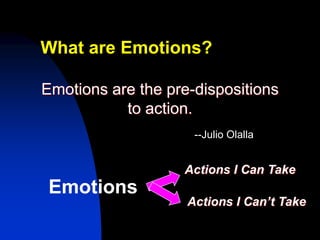
What are Emotions?

Emotions are the pre-dispositions
           to action.
                     --Julio Olalla


                   Actions I Can Take
 Emotions
                    Actions I Can’t Take
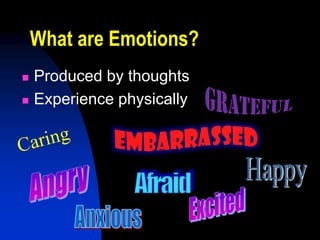
What are Emotions?
   Produced by thoughts
   Experience physically
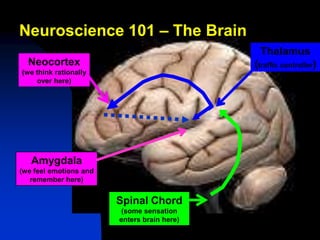
Neuroscience 101 – The Brain
                                              Thalamus
  Neocortex                                  (traffic controller)
(we think rationally
     over here)


   Amygdala
(we feel emotions and
   remember here)


                        Spinal Chord
                         (some sensation
                        enters brain here)
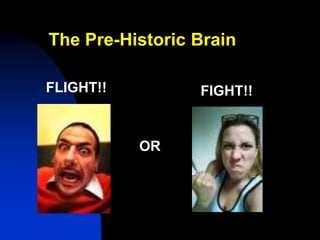
The Pre-Historic Brain

FLIGHT!!         FIGHT!!


           OR
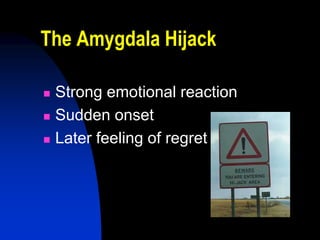
The Amygdala Hijack

   Strong emotional reaction
   Sudden onset
   Later feeling of regret
“Take a Breath”
          Notice your instant reaction (What
           are you feeling? How is your body
           reacting? What are you telling
           yourself?)
          Breathe!
          Intentionally go to your “thinking”
           brain
          Express your emotions in a
           constructive manner
“Take a Breath” Activities
           Count to three
           “Whoa! What’s happening to
            me?”
           Name the emotion and where
            it came from
           Name three things you like
            about the person with whom
            you are talking/fighting
What is EQ?

     The ability to
     sense, understand and use
     emotions to more
     effectively manage
     ourselves and influence
     positive outcomes in our
     relationships with others
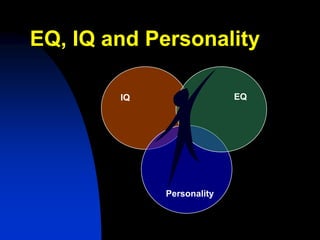
EQ, IQ and Personality

        IQ                 EQ


             Personality
Why EQ Matters
 High EQ Skills:
    80% of high performers
    More important to job performance
     than any other skill
    More influence on job performance
     than IQ and experience combined
    20% more productive
    60% of workplace success
We are being judged
by a new yardstick;
not just how smart we are, or by our
training and expertise, but also how
well we handle ourselves and each
other.
                      -- Dan Goleman
                   Working with Emotional Intelligence
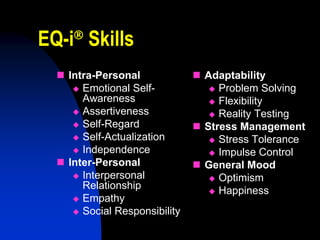
EQ-i Skills
     


   Intra-Personal              Adaptability
      Emotional Self-             Problem Solving
       Awareness                   Flexibility
      Assertiveness               Reality Testing
      Self-Regard              Stress Management
      Self-Actualization          Stress Tolerance
      Independence                Impulse Control
   Inter-Personal              General Mood
      Interpersonal               Optimism
       Relationship                Happiness
      Empathy
      Social Responsibility
We are what we repeatedly do.
Excellence is not an act, but a habit.
                   --Aristotle
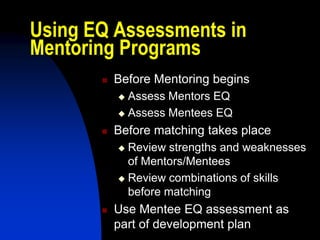
Using EQ Assessments in
Mentoring Programs
          Before Mentoring begins
            Assess Mentors EQ
            Assess Mentees EQ

          Before matching takes place
            Review strengths and weaknesses
             of Mentors/Mentees
            Review combinations of skills
             before matching
          Use Mentee EQ assessment as
           part of development plan
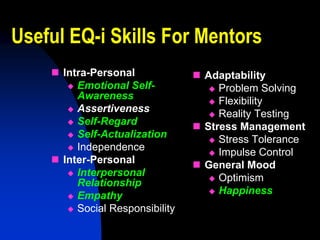
Useful EQ-i Skills For Mentors
     Intra-Personal              Adaptability
        Emotional Self-             Problem Solving
         Awareness                   Flexibility
        Assertiveness
                                     Reality Testing
        Self-Regard
                                  Stress Management
        Self-Actualization
                                     Stress Tolerance
        Independence
                                     Impulse Control
     Inter-Personal              General Mood
        Interpersonal
                                     Optimism
         Relationship
                                     Happiness
        Empathy
        Social Responsibility
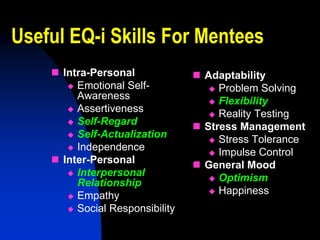
Useful EQ-i Skills For Mentees
     Intra-Personal              Adaptability
        Emotional Self-             Problem Solving
         Awareness                   Flexibility
        Assertiveness
                                     Reality Testing
        Self-Regard
                                  Stress Management
        Self-Actualization
                                     Stress Tolerance
        Independence
                                     Impulse Control
     Inter-Personal              General Mood
        Interpersonal
                                     Optimism
         Relationship
                                     Happiness
        Empathy
        Social Responsibility
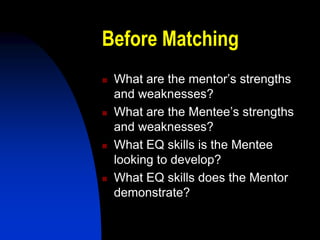
Before Matching
   What are the mentor’s strengths
    and weaknesses?
   What are the Mentee’s strengths
    and weaknesses?
   What EQ skills is the Mentee
    looking to develop?
   What EQ skills does the Mentor
    demonstrate?
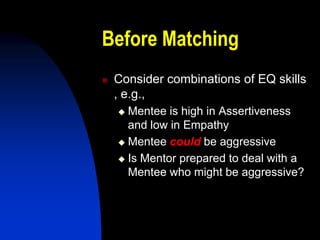
Before Matching
   Consider combinations of EQ skills
    , e.g.,
     Mentee is high in Assertiveness
      and low in Empathy
     Mentee could be aggressive

     Is Mentor prepared to deal with a
      Mentee who might be aggressive?
Mentoring Development Plan
      Pick ONE or TWO EQ skills to
       work on
      Agree to new practices and actions
       to develop skills
Self Regard
          Definition: The ability to
           respect and accept ourselves
           warts and all
          Importance: One of the most
           powerful predictors of
           competent behavior
Self Regard
           To build: An on-going process
            of self-exploration that focuses
            on grounding negative self-
            assessments
           Benefits: An expanding
            knowledge of identity that is
            richer, more flexible, more
            confident and more secure
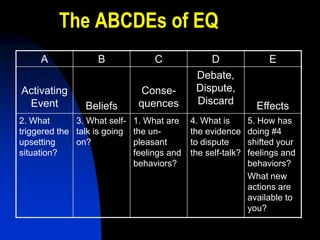
The ABCDEs of EQ
     A             B               C             D                 E
                                              Debate,
Activating                      Conse-        Dispute,
 Event          Beliefs        quences        Discard           Effects
2. What       3. What self-   1. What are    4. What is       5. How has
triggered the talk is going   the un-        the evidence     doing #4
upsetting     on?             pleasant       to dispute       shifted your
situation?                    feelings and   the self-talk?   feelings and
                              behaviors?                      behaviors?
                                                              What new
                                                              actions are
                                                              available to
                                                              you?
Emotional Self
Awareness
   Definition: The ability to
    understand what we are
    feeling and why
   Importance: It provides the
    springboard for the positive
    development of the other EQ
    skills
Emotional Self
Awareness
   To build: Ask ourselves questions
    about our current emotional state
    and our triggers
   Benefits: Eliminates or mitigates
    the emotions that are getting in our
    way, causing our own suffering
    and the suffering of others
It Just Bubbles Up
1. Describe a recent situation in which you
   were triggered by another person and
   acted “badly”
2. Name the emotions you experienced

3. Describe the thoughts you had about
   yourself, the other person and the
   situation
It Just Bubbles Up
4.   Describe how you responded to those
     thoughts and emotions
     (withdrew, became verbally
     abusive, pretended agreement, etc.)
5.   Describe the physical sensations as
     you experienced the thoughts and
     emotions
6.   What do you want to do differently
     when faced with a similar situation in
     the future.
Interpersonal
Relationships
   Definition: The ability to develop
    mutually satisfying relationships by
    surrendering some self-interest for
    the good of the relationship
   Importance: As naturally social
     beings, critical to success and
    survival
Interpersonal
Relationships
   To build: Improve your
    listening, find areas of
    common interest, read non-
    verbal clues
   Benefits: Stress
    reduction,      increased
    productivity and
    creativity, greater enjoyment
    of life
Happiness
         Definition: The ability to feel
          satisfied with one’s life, to
          enjoy oneself and others, and
          to have fun
         Importance: Affects the
          development and exercise of
          all your skills
Happiness
         To build: Pay attention to
          when you need to be right and
          to your “wanting;” choose
          happiness instead
         Benefits: The relaxation of our
          self-importance; more
          pleasure and less pain
No creature can fly with just one wing.
 Gifted leadership occurs where heart
and head – feeling and thought – meet.
 These are the two wings that allow a
            leader to soar.
               -- From “Primal Leadership”

Emotionally Inelligent Mentoring

  • 1.
    Emotionally Intelligent Mentoring Using EI Concepts to Enhance Your Mentoring Program Presented by: Don Peterson Strategic Partners, Inc.
  • 2.
    What We’ll CoverToday  Review of Emotional Intelligence  What it is  Why it matters  EQ Skills  EQ Skills for Mentoring For Mentors For Mentees
  • 3.
    What are Emotions? Emotionsare the pre-dispositions to action. --Julio Olalla Actions I Can Take Emotions Actions I Can’t Take
  • 4.
    What are Emotions?  Produced by thoughts  Experience physically
  • 5.
    Neuroscience 101 –The Brain Thalamus Neocortex (traffic controller) (we think rationally over here) Amygdala (we feel emotions and remember here) Spinal Chord (some sensation enters brain here)
  • 6.
  • 7.
    The Amygdala Hijack  Strong emotional reaction  Sudden onset  Later feeling of regret
  • 8.
    “Take a Breath”  Notice your instant reaction (What are you feeling? How is your body reacting? What are you telling yourself?)  Breathe!  Intentionally go to your “thinking” brain  Express your emotions in a constructive manner
  • 9.
    “Take a Breath”Activities  Count to three  “Whoa! What’s happening to me?”  Name the emotion and where it came from  Name three things you like about the person with whom you are talking/fighting
  • 10.
    What is EQ? The ability to sense, understand and use emotions to more effectively manage ourselves and influence positive outcomes in our relationships with others
  • 11.
    EQ, IQ andPersonality IQ EQ Personality
  • 12.
    Why EQ Matters High EQ Skills:  80% of high performers  More important to job performance than any other skill  More influence on job performance than IQ and experience combined  20% more productive  60% of workplace success
  • 13.
    We are beingjudged by a new yardstick; not just how smart we are, or by our training and expertise, but also how well we handle ourselves and each other. -- Dan Goleman Working with Emotional Intelligence
  • 14.
    EQ-i Skills   Intra-Personal  Adaptability  Emotional Self-  Problem Solving Awareness  Flexibility  Assertiveness  Reality Testing  Self-Regard  Stress Management  Self-Actualization  Stress Tolerance  Independence  Impulse Control  Inter-Personal  General Mood  Interpersonal  Optimism Relationship  Happiness  Empathy  Social Responsibility
  • 15.
    We are whatwe repeatedly do. Excellence is not an act, but a habit. --Aristotle
  • 16.
    Using EQ Assessmentsin Mentoring Programs  Before Mentoring begins  Assess Mentors EQ  Assess Mentees EQ  Before matching takes place  Review strengths and weaknesses of Mentors/Mentees  Review combinations of skills before matching  Use Mentee EQ assessment as part of development plan
  • 17.
    Useful EQ-i SkillsFor Mentors  Intra-Personal  Adaptability  Emotional Self-  Problem Solving Awareness  Flexibility  Assertiveness  Reality Testing  Self-Regard  Stress Management  Self-Actualization  Stress Tolerance  Independence  Impulse Control  Inter-Personal  General Mood  Interpersonal  Optimism Relationship  Happiness  Empathy  Social Responsibility
  • 18.
    Useful EQ-i SkillsFor Mentees  Intra-Personal  Adaptability  Emotional Self-  Problem Solving Awareness  Flexibility  Assertiveness  Reality Testing  Self-Regard  Stress Management  Self-Actualization  Stress Tolerance  Independence  Impulse Control  Inter-Personal  General Mood  Interpersonal  Optimism Relationship  Happiness  Empathy  Social Responsibility
  • 19.
    Before Matching  What are the mentor’s strengths and weaknesses?  What are the Mentee’s strengths and weaknesses?  What EQ skills is the Mentee looking to develop?  What EQ skills does the Mentor demonstrate?
  • 20.
    Before Matching  Consider combinations of EQ skills , e.g.,  Mentee is high in Assertiveness and low in Empathy  Mentee could be aggressive  Is Mentor prepared to deal with a Mentee who might be aggressive?
  • 21.
    Mentoring Development Plan  Pick ONE or TWO EQ skills to work on  Agree to new practices and actions to develop skills
  • 22.
    Self Regard  Definition: The ability to respect and accept ourselves warts and all  Importance: One of the most powerful predictors of competent behavior
  • 23.
    Self Regard  To build: An on-going process of self-exploration that focuses on grounding negative self- assessments  Benefits: An expanding knowledge of identity that is richer, more flexible, more confident and more secure
  • 24.
    The ABCDEs ofEQ A B C D E Debate, Activating Conse- Dispute, Event Beliefs quences Discard Effects 2. What 3. What self- 1. What are 4. What is 5. How has triggered the talk is going the un- the evidence doing #4 upsetting on? pleasant to dispute shifted your situation? feelings and the self-talk? feelings and behaviors? behaviors? What new actions are available to you?
  • 25.
    Emotional Self Awareness  Definition: The ability to understand what we are feeling and why  Importance: It provides the springboard for the positive development of the other EQ skills
  • 26.
    Emotional Self Awareness  To build: Ask ourselves questions about our current emotional state and our triggers  Benefits: Eliminates or mitigates the emotions that are getting in our way, causing our own suffering and the suffering of others
  • 27.
    It Just BubblesUp 1. Describe a recent situation in which you were triggered by another person and acted “badly” 2. Name the emotions you experienced 3. Describe the thoughts you had about yourself, the other person and the situation
  • 28.
    It Just BubblesUp 4. Describe how you responded to those thoughts and emotions (withdrew, became verbally abusive, pretended agreement, etc.) 5. Describe the physical sensations as you experienced the thoughts and emotions 6. What do you want to do differently when faced with a similar situation in the future.
  • 29.
    Interpersonal Relationships  Definition: The ability to develop mutually satisfying relationships by surrendering some self-interest for the good of the relationship  Importance: As naturally social beings, critical to success and survival
  • 30.
    Interpersonal Relationships  To build: Improve your listening, find areas of common interest, read non- verbal clues  Benefits: Stress reduction, increased productivity and creativity, greater enjoyment of life
  • 31.
    Happiness  Definition: The ability to feel satisfied with one’s life, to enjoy oneself and others, and to have fun  Importance: Affects the development and exercise of all your skills
  • 32.
    Happiness  To build: Pay attention to when you need to be right and to your “wanting;” choose happiness instead  Benefits: The relaxation of our self-importance; more pleasure and less pain
  • 33.
    No creature canfly with just one wing. Gifted leadership occurs where heart and head – feeling and thought – meet. These are the two wings that allow a leader to soar. -- From “Primal Leadership”